
See Also

Adolf Hitler

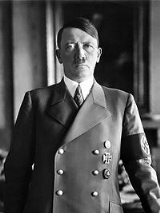
Adolf Hitler was Chancellor of Germany Chancellor of Germany

The head of government [i] of Germany [i] is called Chancellor . ... 

 from 1933, and F?hrer of Germany Germany

Germany , officially the Federal Republic of Germany , is a country [i] in central Europe [i]. ... 

 from 1934 until his death. He was leader of the National Socialist German Workers Party National Socialist German Workers Party

The National Socialist German Workers Party , generally known in English [i] as the ... 

 , better known as the Nazi Party. Hitler gained power in a Germany facing crisis Weimar Republic

The Weimar Republic is the common name for the republic that governed Germany from 1919 [i] to 1933 [i] ... 

 after World War I World War I

World War I, also known as the First World War, the Great War and "The War to End All War... 

, using charismatic Charismatic authority

*Charisma [i] *Guru [i] *King [i] ... 

 oratory and propaganda Propaganda

Propaganda is a specific type of message [i] presentation directly aimed at influencing the opinion [i]s ... 

, appealing to economic need of the lower and middle classes, nationalism Nationalism

Nationalism is an ideology that holds that a nation [i] is the fundamental unit for human [i] social life [i] ... 

 and anti-Semitism Anti-Semitism

Anti-Semitism is hostility toward or prejudice [i] against Jew [i]s as a religious, ethnic, or racial g ... 

 to establish a totalitarian or fascist Fascism

Fascism is a radical [i] political ideology [i] that combines elements of corporatism [i], authoritarianism [i] ... 

 dictatorship. With a restructured economy and rearmed military, Hitler pursued an aggressive foreign policy with the intention of expanding German Lebensraum which triggered World War II in Europe European Theatre of World War II

The European Theatre was an area of heavy fighting across Europe [i], during World War II [i], from 1 September [i] ... 

 when he ordered the invasion of Poland.

Discussions

  Discussion Features

   Ask a question about 'Adolf Hitler'

   Start a new discussion about 'Adolf Hitler'

   Answer questions about 'Adolf Hitler'

   'Adolf Hitler' discussion forum

Timeline

1889   On this date Adolf Hitler was born.

1889   Born

1920   Adolf Hitler presents his National Socialist National Socialist German Workers Party

The National Socialist German Workers Party , generally known in English [i] as the ... 

 program in Munich Munich

colspan="2" bgcolor="BBDDFF" | Munich ... 

.

1920   Adolf Hitler makes first public political speech, in Austria Austria

Austria is a landlocked [i] country in central Europe [i]. ... 

.

1921   Adolf Hitler becomes Chairman of the Nazi Party National Socialist German Workers Party

The National Socialist German Workers Party , generally known in English [i] as the ... 

1923   Beer Hall Putsch: In Munich Munich

colspan="2" bgcolor="BBDDFF" | Munich ... 

, Adolf Hitler leads the Nazis Nazism

National Socialism, commonly shortened to Nazism or Naziism, originated as a fascist [i] mo ... 

 in an unsuccessful attempt to overthrow the German government. Police and troops crush the attempt the next day

1924   Adolf Hitler beings dictating his book, ''Mein Kampf'' (or in English, ''My Struggle''), while imprisoned in Bavaria.

1924   Adolf Hitler is sentenced to five years in jail Prison

prison, penitentiary, or correctional facility is a place in which individuals are physicall... 

 for his participation in the Beer Hall Putsch. However he was only in jail for nine months.

1925   Adolf Hitler publishes his personal manifesto ''Mein Kampf Mein Kampf

Mein Kampf is the signature work of Adolf Hitler [i], combining elements of autobiography [i] with ... 

''.

1932   Adolf Hitler gains German citizenship Citizenship

Citizenship is membership in a political community and carries with it rights [i] to political partici ... 

 prior to elections

   More Events >>


Quotations

As soon as the idea was introduced that all men were equal before God, that world was bound to collapse. (26th February, 1942)

Catholics and Protestants are fighting with one another … while the enemy of Aryan humanity and all Christendom is laughing up his sleeve. p. 309

God helps only those who are prepared and determined to help themselves. Speech in Weimar, 6 November 1938

I am now as before a Catholic and will always remain so. Adolph Hitler to Gen. Gerhard Engel, 1941

I am now as before a Catholic and will always remain so.

from John Toland, Adolf Hitler, New York: Anchor Publishing, 1992, p. 507.

I believe today that my conduct is in accordance with the will of the Almighty Creator. p. 46

       More Quotes >>


Encyclopedia

Adolf Hitler was Chancellor of Germany Chancellor of Germany

The head of government [i] of Germany [i] is called Chancellor .... 

 from 1933, and Führer of Germany Germany

Germany , officially the Federal Republic of Germany , is a country [i] in central Europe [i]. ... 

 from 1934 until his death. He was leader of the National Socialist German Workers Party National Socialist German Workers Party

The National Socialist German Workers Party , generally known in English [i] as the ... 

 , better known as the Nazi Party.

Hitler gained power in a Germany facing crisis Weimar Republic

The Weimar Republic is the common name for the republic that governed Germany from 1919 [i] to 1933 [i] ... 

 after World War I World War I

World War I, also known as the First World War, the Great War and "The War to End All War... 

, using charismatic Charismatic authority

*Charisma [i]
  • Guru [i]
  • King [i]

... 

 oratory and propaganda Propaganda

Propaganda is a specific type of message [i] presentation directly aimed at influencing the opinion [i]s ... 

, appealing to economic need of the lower and middle classes, nationalism Nationalism

Nationalism is an ideology that holds that a nation [i] is the fundamental unit for human [i] social life [i] ... 

 and anti-Semitism Anti-Semitism

Anti-Semitism is hostility toward or prejudice [i] against Jew [i]s as a religious, ethnic, or racial g ... 

 to establish a totalitarian or fascist Fascism

Fascism is a radical [i] political ideology [i] that combines elements of corporatism [i], authoritarianism [i] ... 

 dictatorship. With a restructured economy and rearmed military, Hitler pursued an aggressive foreign policy with the intention of expanding German Lebensraum which triggered World War II in Europe European Theatre of World War II

The European Theatre was an area of heavy fighting across Europe [i], during World War II [i], from 1 September [i] ... 

 when he ordered the invasion of Poland. At the height of its power, Nazi Germany Nazi Germany

Nazi Germany, or the Third Reich, refers to Germany in the years 1933 to 1945, when it was governe... 

 occupied most of Europe, but it and the Axis Powers Axis Powers

The Axis Powers were those nations opposed to the Allies [i] during the Second World War [i] ... 

 were eventually defeated by the Allies Allies of World War II

The Allies [i] of World War II [i] were the countries officially opposed to the Axis Powers [i] during t ... 

. By then, Hitler's racial policies Racial policy of Nazi Germany

The Racial Policy of Nazi Germany refers to the policies and laws implemented by Nazi [i] German ... 

 had culminated in the genocide of 11 million people, including about six million Jew Jew

Jews are followers of Judaism [i] or, more generally, members of the Jewish people , an ethno [i]... 

s, in what is now known as the Holocaust The Holocaust

The Holocaust, also known as Ha-Shoah and the Porajmos [i] or Samudaripen in Romani [i] ... 

.

In the final days of the war, Hitler committed suicide Death of Adolf Hitler

The generally accepted cause of the death of Adolf Hitler on April 30, 1945 is suicide [i] by gunshot an ... 

 in his underground bunker Führerbunker

The Fhrerbunker is a common name for a complex of subterranean rooms in Berlin [i], Germany [i] where Adolf Hitler [i] ... 

 in Berlin Berlin

Berlin is the capital [i] city and a state [i] of Germany [i]. ... 

 with his newlywed wife, Eva Braun Eva Braun

Eva Anna Paula Braun was the longtime companion and, briefly, wife of Adolf Hitler [i].... 

.

Early years


Childhood and heritage


Adolf Hitler was born on April 20, 1889 at Braunau am Inn Braunau am Inn

Braunau am Inn is a city [i] in the Innviertel [i] region of Upper Austria [i], the north-western state [i] ... 

, Austria Austria

Austria is a landlocked [i] country in central Europe [i]. ... 

, a small town in Upper Austria Upper Austria

Upper Austria is one of the nine states [i] or Bundeslnder of Austria [i].... 

, on the border with Germany Germany

Germany , officially the Federal Republic of Germany , is a country [i] in central Europe [i]. ... 

. He was the third son and the fourth of six children of Alois Hitler Alois Hitler

Alois Hitler, born Aloys Schicklgruber was the father of Adolf Hitler [i].... 

  , a minor customs official, and Klara Pölzl , his second cousin, and third wife. Because of the close kinship of the two, a papal dispensation had to be obtained for the marriage. Of Alois and Klara's six children, only Adolf and his younger sister Paula Paula Hitler

Paula Hitler was the younger sister of Adolf Hitler [i] and the last child of Alois Hitler [i] and his t ... 

 reached adulthood. Alois Hitler also had a son and a daughter by his second wife.

Alois was born illegitimate and for the first thirty-nine years of his life bore his mother's name, Schicklgruber. In 1876, Alois began using the name of his stepfather, Johann Georg Hiedler, after visiting a priest responsible for birth registries and declaring that Georg was his father . The name was variously spelled Hiedler, Huetler, Huettler and Hitler and probably changed to "Hitler" by a clerk. About the origin of the name there are two theories:
  1. From German German language

    German is a West Germanic language [i]. ... 

     Hittler and similar, "one who lives in a hut", "shepherd".
  2. From Slavic Slavic languages

    The Slavic languages , a group of closely related language [i]s of the Slavic peoples [i] and a subgroup ... 

     Hidlar and Hidlarcek.


Later, Adolf Hitler was accused by his political enemies of not rightfully being a Hitler, but a Schicklgruber. This was also exploited in Allied propaganda Propaganda

Propaganda is a specific type of message [i] presentation directly aimed at influencing the opinion [i]s ... 

 during the Second World War World War II

World War II, or the Second World War, was a worldwide [i] conflict [i] fought betwe ... 

 when pamphlet Pamphlet

A pamphlet is an unbound booklet [i]. ... 

s bearing the phrase "Heil Schicklgruber" were airdrop Airdrop

An airdrop is a type of airlift [i], developed during World War II [i] to resupply otherwise inaccessibl ... 

ped over German cities. Adolf was legally born a Hitler, however, and was also closely related to Hiedler through his maternal grandmother, Johanna Hiedler.

Hitler's given name, "Adolf", comes from the Old High German for "noble wolf" . Hence, not surprisingly, one of Hitler's self-given nicknames was Wolf or Herr Wolf — he began using this nickname in the early 1920s and was addressed by it only by intimates up until the fall of the Third Reich. The names of his various headquarters scattered throughout continental Europe  seem to reflect this.

Hitler was not sure who his paternal grandfather was, but it was probably either Johann Georg Hiedler or his brother Johann Nepomuk Hiedler. There have been rumours that Hitler was one-quarter Jew Jew

Jews are followers of Judaism [i] or, more generally, members of the Jewish people , an ethno [i]... 

ish and that his paternal grandmother, Maria Schicklgruber, had become pregnant after working as a servant in a Jewish household in Graz Graz

Graz [gra?ts] , with a population of 285,470 as of 2006 [i] , is the second-largest city [i] ... 

. During the 1920s, the implications of these rumours along with his known family history were politically explosive, especially for the proponent of a racist Racism

Racism is a belief in the moral or biological superiority of one race or ethnic group over another or ot... 

 ideology. Opponents tried to prove that Hitler, the leader of the anti-Semitic Anti-Semitism

Anti-Semitism is hostility toward or prejudice [i] against Jew [i]s as a religious, ethnic, or racial g ... 

 Nazi Party National Socialist German Workers Party

The National Socialist German Workers Party , generally known in English [i] as the ... 

, had Jewish or Czech Czech people

Czechs are a western Slavic [i] people of Central Europe [i], living predominantly in the Czech Republic [i]... 

 ancestors. Although these rumours were never confirmed, for Hitler they were reason enough to conceal his origins. Soviet Soviet Union

The Union of Soviet Socialist Republics , more commonly known as the Soviet Union, was a Communist state [i] ... 

 propaganda insisted Hitler was a Jew, though more modern research tends to diminish the probability that he had Jewish ancestors. According to Robert G. L. Waite in The Psychopathic God: Adolf Hitler, Hitler made it illegal for German women to work in Jewish households, and after the Anschluss with Austria, Hitler had his father's hometown obliterated as an artillery practice area. Hitler seemed to fear that he was Jewish, and as Waite points out, this fact is more important than whether he actually was.

Because of Alois Hitler's profession, his family moved frequently, from Braunau Braunau am Inn

Braunau am Inn is a city [i] in the Innviertel [i] region of Upper Austria [i], the north-western state [i] ... 

 to Passau Passau

Passau is a town [i] in Niederbayern [i], Eastern Bavaria [i], Germany [i], known also as ... 

, Lambach, Leonding Leonding

Leonding is a town situated to the southwest of Linz [i], Austria [i] in the state [i] ... 

, and Linz Linz

Linz is a statutory city [i] in northeastern Austria [i], by the Danube [i] river. ... 

. As a young child, Hitler was reportedly a good student at the various elementary school Primary education

Primary or elementary education consists of the first years of formal, structured education [i] th ... 

s he attended; however, in sixth grade , his first year of high school High school

High school or secondary school is the name used for the last segment of compulsory secondary education [i] ... 

  in Linz, he failed completely and had to repeat the grade. His teachers reported that he had "no desire to work."

Hitler later explained this educational slump as a kind of rebellion against his father Alois, who wanted the boy to follow him in a career as a customs official, although Adolf wanted to become a painter Painter

A painter is a person who applies paint [i] to a surface.
... 

. This explanation is further supported by Hitler's later description of himself as a misunderstood artist. However, after Alois died on January 3, 1903, when Adolf was 13, Hitler's schoolwork did not improve. At the age of 16, Hitler left school with no qualifications.

Early adulthood in Vienna and Munich


From 1905 onward, Hitler was able to live the life of a Bohemian Bohemianism

Though a Bohemian [i] is a native of the Czech [i] province of Bohemia [i], a secondary meaning ... 

 on a fatherless child's pension and support from his mother. He was rejected twice by the Academy of Fine Arts Vienna Academy of Fine Arts Vienna

The Academy of Fine Arts Vienna is an institution of higher education in Vienna [i], Austria [i]. ... 

  due to "unfitness for painting", and was told his abilities lay rather in the field of architecture Architecture

* Architectural history [i]
  • Architectural mythology [i]

... 

. His own memoirs reflect a fascination with the subject:

"The purpose of my trip was to study the picture gallery in the Court Museum, but I had eyes for scarcely anything but the Museum itself. From morning until late at night, I ran from one object of interest to another, but it was always the buildings which held my primary interest." .


Following the school rector's recommendation, he too became convinced this was the path to pursue, yet he lacked the proper academic preparation for architecture Architecture

* Architectural history [i]
  • Architectural mythology [i]

... 

 school:

"In a few days I myself knew that I should some day become an architect.
To be sure, it was an incredibly hard road; for the studies I had neglected out of spite at the Realschule were sorely needed. One could not attend the Academy's architectural school without having attended the building school at the Technic, and the latter required a high-school degree. I had none of all this. The fulfillment of my artistic dream seemed physically impossible.'".


On December 21, 1907, his mother Klara died a painful death from breast cancer Breast cancer

Breast cancer is a cancer [i] of breast [i] tissue.... 

 at the age of 47. Hitler gave his share of the orphan Orphan

An orphan is a person, who has lost one or both parents, often through death.... 

s' benefits to his younger sister Paula Paula Hitler

Paula Hitler was the younger sister of Adolf Hitler [i] and the last child of Alois Hitler [i] and his t ... 

, but when he was 21 he inherited some money from an aunt. He worked as a struggling painter in Vienna, copying scenes from postcard Postcard

A postcard or post card is typically a rectangular piece of thick paper [i] or thin cardboard [i] ... 

s and selling his paintings to merchants and tourists . Several biographers have noted that a Jewish resident of the house named Hanisch helped him sell his postcards.


After the second refusal from the Academy of Arts, Hitler gradually ran out of money. By 1909, he sought refuge in a homeless shelter, and by the beginning of 1910 had settled permanently into a house for poor working men.

Hitler first became an active anti-Semite in Vienna, which had a large Jewish community, including many Orthodox Jews from Eastern Europe Eastern Europe

Eastern Europe is the east [i]ern region [i] of Europe [i] variably defined. ... 

 and where traditional religious prejudice mixed with recent racist theories. Hitler was influenced over time by the writings of the race ideologist and anti-Semite Lanz von Liebenfels Lanz von Liebenfels

Adolf Josef Lanz, who called himself Lanz von Liebenfels was a former monk and the founder of the ... 

 and polemics from politicians such as Karl Lueger Karl Lueger

Karl Lueger was an Austria [i]n politician and mayor [i] of Vienna [i], known for his overtly anti-semitic [i] ... 

, founder of the Christian Social Party Christian Social Party

The Christian Social Party was an Austria [i]n political party from 1893 to 1933 and is a predecessor of ... 

 and mayor of Vienna, one of the most outrageous demagogues in history, and Georg Ritter von Schönerer Georg Ritter von Schönerer

Georg Ritter [i] von Schnerer was an Austria [i]n politician active in the late 1800s and early 1900s. ... 

, leader of the pan-Germanic Away from Rome! movement. He later wrote in his book Mein Kampf Mein Kampf

Mein Kampf is the signature work of Adolf Hitler [i], combining elements of autobiography [i] with ... 

that his transition from opposing anti-Semitism on religious grounds to supporting it on racial grounds came from having seen an Orthodox Jew:

"There were very few Jews in Linz. In the course of centuries the Jews who lived there had become Europeanized in external appearance and were so much like other human beings that I even looked upon them as Germans. The reason why I did not then perceive the absurdity of such an illusion was that the only external mark which I recognized as distinguishing them from us was the practice of their strange religion. As I thought that they were persecuted on account of their faith my aversion to hearing remarks against them grew almost into a feeling of abhorrence. I did not in the least suspect that there could be such a thing as a systematic anti-Semitism.


Once, when passing through the inner City, I suddenly encountered a phenomenon in a long caftan and wearing black side-locks. My first thought was: Is this a Jew? They certainly did not have this appearance in Linz. I carefully watched the man stealthily and cautiously but the longer I gazed at the strange countenance and examined it feature by feature, the more the question shaped itself in my brain: Is this a German?"


Hitler began to claim the Jews were natural enemies of what he called the Aryan race Aryan race

The "Aryan race" is a concept in Europe [i]an culture that was influential in the period of the late nin ... 

. He held them responsible for Austria's crisis. He also identified certain forms of Socialism Socialism

Socialism refers to a broad array of doctrines or political movements that envisage a socio-economic [i]... 

 and especially Bolshevism Communism

Communism is an ideology that seeks to establish a future classless [i], stateless [i] ... 

, which had many Jews among its leaders, as Jewish movements, merging his anti-Semitism with anti-Marxism. Blaming Germany's military defeat on the 1917 Revolutions, he considered Jews the culprit of Imperial Germany's military defeat and subsequent economic problems as well.

Generalising from tumultuous scenes in the parliament of the multi-national Austria Monarchy Austria-Hungary

Austria-Hungary, also known as the Austro-Hungarian Empire, Dual Monarchy or k.u.k. [i] ... 

, he developed a firm belief in the inferiority of the democratic parliamentary system Parliamentary system

|
|-
|
|}
A parliamentary system, also known as parliamentarianism, is distinguished by the executive branch of government [i] ... 

, which formed the basis of his political views. However, according to August Kubizek, his close friend and roommate at the time, he was more interested in the opera Opera

Opera is a dramatic [i] art [i] form, originating in Italy [i], in which the emotional content or... 

s of Richard Wagner Richard Wagner

Wilhelm Richard Wagner was an influential German [i] composer [i], conductor [i], music theorist [i] ... 

 than in politics.


Hitler received the final part of his father's estate in May 1913 and moved to Munich Munich

colspan="2" bgcolor="BBDDFF" | Munich
... 

. He later wrote in Mein Kampf Mein Kampf

Mein Kampf is the signature work of Adolf Hitler [i], combining elements of autobiography [i] with ... 

that he had always longed to live in a "real" German city. In Munich, he became more interested in architecture and the writings of Houston Stewart Chamberlain Houston Stewart Chamberlain

Houston Stewart Chamberlain was a British [i]-born, naturalized German author of works wh ... 

. Moving to Munich also helped him escape military service Conscription

Conscription is a general term for involuntary labor demanded by some established authority, but it is m... 

 in Austria for a time, but the Austrian army later arrested him. After a physical exam and a contrite plea, he was deemed unfit for service and allowed to return to Munich. However, when Germany entered World War I World War I

World War I, also known as the First World War, the Great War and "The War to End All War... 

 in August 1914, he immediately petitioned King Ludwig III of Bavaria for permission to serve in a Bavarian regiment, this request was granted, and Adolf Hitler enlisted in the Bavaria Bavaria

The Free State [i] of Bavaria  , with an area of 70,553 km and 12.4 million inhab... 

n army.

World War I


Hitler saw active service in France France

France, officially the French Republic, is a country [i] whose metropolitan territory [i] ... 

 and Belgium Belgium

The Kingdom of Belgium is a country in northwest Europe [i] bordered by the Netherlands [i] ... 

 as a messenger for the regimental headquarters of the 16th Bavarian Reserve Regiment , which exposed him to enemy fire. Unlike his fellow soldiers, Hitler reportedly never complained about the food or hard conditions, preferring to talk about art Art

By its original and broadest definition, art is the product or process of the effective application... 

 or history. He also drew some cartoon Cartoon

A cartoon is any of several forms of art, with varied meanings that evolved from one to another.... 

s and instructional drawings for the army newspaper. His behaviour as a soldier was considered somewhat sloppy, but his regular duties required taking dispatches to and from fighting areas and he was twice decorated for his performance of these duties. He received the Iron Cross Iron Cross

Sometimes erroneously called the Maltese cross [i], the Iron Cross is a military decoration [i] of the Kingdom of Prussia [i] ... 

, Second Class in December 1914 and the Iron Cross, First Class in August 1918, an honour rarely given to a Gefreiter Gefreiter

Gefreiter is the German equivalent for Private [i] in the armed services. ... 

. However, because of the perception of "a lack of leadership skills" on the part of some of the regimental staff, as well as Hitler's unwillingness to leave regimental headquarters , he was never promoted to Unteroffizier Unteroffizier

Unteroffizier is both a specific military rank [i] as well as a collective term for non-commissioned officer [i] ... 

. Other historians, however, say that the reason he was not promoted is that he did not have German citizenship. His duty station at regimental headquarters, while often dangerous, gave Hitler time to pursue his artwork. During October 1916 in northern France, Hitler was wound Wound

A wound is type of physical trauma wherein the skin [i] is torn, cut or punctured, or where blunt force ... 

ed in the leg, but returned to the front in March 1917. He received the Wound Badge Wound Badge

Wound Badge is a German military award for wounded or frost-bitten soldiers of Wehrmacht [i], SS [i] and ... 

 later that year, as his injury was the direct result of hostile fire. Sebastian Haffner Sebastian Haffner

Sebastian Haffner was a German [i] journalist [i] and author [i]. ... 

, referring to Hitler's experience at the front, suggests he did have at least some understanding of the military.

On October 15, 1918, shortly before the end of the war, Hitler was admitted to a field hospital Field hospital

A field hospital is a large mobile medical unit that takes care of the casualties outside the hospital b... 

, temporarily blinded Blindness

[i] or [[psychological]... 

 by a poison gas Chemical warfare

The Battle of Barnet, which took place on April 14 [i], 1471 [i], was a decisive battle of the Wars of the Roses [i] ... 

 attack. The English psychologist David Lewis and Bernhard Horstmann indicate the blindness may have been the result of a hysteria. Hitler later said it was during this experience that he became convinced the purpose of his life was to "save Germany".

Some scholars, including Lucy Dawidowicz, argue that an intention to mass murder Europe's Jews was fully formed in Hitler's mind, though he probably hadn't thought through how it could be done.

Two passages in Mein Kampf Mein Kampf

Mein Kampf is the signature work of Adolf Hitler [i], combining elements of autobiography [i] with ... 

mention the use of poison gas Chemical warfare

The Battle of Barnet, which took place on April 14 [i], 1471 [i], was a decisive battle of the Wars of the Roses [i] ... 

:

At the beginning of the Great War, or even during the War, if twelve or fifteen thousand of these Jews who were corrupting the nation had been forced to submit to poison-gas . . . then the millions of sacrifices made at the front would not have been in vain. .


These tactics are based on an accurate estimation of human weakness and must lead to success, with almost mathematical certainty, unless the other side also learns how to fight poison gas with poison gas. The weaker natures must be told that here it is a case of to be or not to be.


Hitler had long admired Germany, and during the war he had become a passionate German patriot Patriotism

Patriotism denotes positive and supportive attitudes to a 'fatherland' , by individuals and groups.... 

, although he did not become a German citizen until 1932. He was shocked by Germany's capitulation in November 1918 even while the German army still held enemy territory. Like many other German nationalists Nationalism

Nationalism is an ideology that holds that a nation [i] is the fundamental unit for human [i] social life [i] ... 

, Hitler believed in the Dolchstoßlegende which claimed that the army, "undefeated in the field", had been "stabbed in the back" by civilian leaders and Marxists back on the home front Home front

Home front is the informal term commonly used to describe the civilian [i] populace of the nation [i] at ... 

. These politicians were later dubbed the November Criminals.

The Treaty of Versailles Treaty of Versailles

The Treaty of Versailles was the peace treaty [i] which officially ended World War I [i] between the Allied and Associated Powers [i] ... 

 deprived Germany of various territories, demilitarized the Rhineland and imposed other economically damaging sanctions. The treaty also declared Germany the culprit for all the horrors of the Great War, as a basis for later imposing not yet specified reparations on Germany . Germans, however, perceived the treaty and especially the paragraph on the German guilt as a humiliation, not least as it was damaging in the extreme to their pride. For example, there was nearly a full demilitarisation of the armed forces, allowing Germany only 6 battleships, no submarines, no air force, an army of 100,000 without conscription Conscription

Conscription is a general term for involuntary labor demanded by some established authority, but it is m... 

 and no armoured vehicles. The treaty was an important factor in both the social and political conditions encountered by Hitler and his National Socialist Party as they sought power. Hitler and his party used the signing of the treaty by the "November Criminals" as a reason to build up Germany so that it could never happen again. He also used the 'November Criminals' as scapegoats, although at the Paris peace conference, these politicians had very little choice in the matter.

The early years of the Nazi Party


Hitler's entry into politics


After the First World War, Hitler remained in the army, which was mainly engaged in suppressing communist Communism

Communism is an ideology that seeks to establish a future classless [i], stateless [i] ... 

 uprisings breaking out across Germany, including Munich , where Hitler returned in 1919. He took part in "national thinking" courses organized by the Education and Propaganda Department of the Bavarian Reichswehr Group, Headquarters 4 under Captain Karl Mayr. A key purpose of this group was to create a scapegoat Scapegoat

The scapegoat was a goat [i] that was driven off into the wilderness as part of the ceremonies of Yom Kippur [i] ... 

 for the outbreak of the war and Germany's defeat. The scapegoats were found in "international Jewry", communists, and politicians across the party spectrum, especially the parties of the Weimar Coalition, who were deemed "November Criminals".
In July 1919, Hitler was appointed a Verbindungsmann of an Aufklärungskommando of the Reichswehr, for the purpose of influencing other soldiers toward similar ideas and was assigned to infiltrate a small party, the German Workers' Party , which was thought of to be a possibly socialist Socialism

Socialism refers to a broad array of doctrines or political movements that envisage a socio-economic [i]... 

 party. During his inspection of the party, Hitler was impressed with Drexler Anton Drexler

Anton Drexler was a German Nazi political leader of 1920s [i]. ... 

's anti-Semitic Anti-Semitism

Anti-Semitism is hostility toward or prejudice [i] against Jew [i]s as a religious, ethnic, or racial g ... 

, nationalist Nationalism

Nationalism is an ideology that holds that a nation [i] is the fundamental unit for human [i] social life [i] ... 

 and anti-Marxist Marxism

Marxism refers to the philosophy [i] and social theory [i] based on Karl Marx [i]'s w ... 

 ideas, which favoured an Hegelian Georg Wilhelm Friedrich Hegel

Georg Wilhelm Friedrich Hegel [] was a German [i] philosopher [i] born in Stuttgart [i], ... 

 concept of the strong universally present state, a "non-Jewish" version of socialism and mutual solidarity of all members of society. Here Hitler also met Dietrich Eckart Dietrich Eckart

Dietrich Eckart was a German politician, one of the early key members of the National-Socialist German [i] ... 

, one of the early founders of the party and member of the occult Thule Society Thule Society

The Thule Society, originally the Studiengruppe fr germanisches Altertum 'Study Group for Germanic A... 

. Eckart became Hitler's mentor, exchanging ideas with him, teaching him how to dress and speak, and introducing him to a wide range of people. Hitler in return thanked Eckart by paying tribute to him in the second volume of Mein Kampf.

Hitler was discharged from the army in March 1920 and with his former superiors' continued encouragement began participating full time in the party's activities. By early 1921, Adolf Hitler was becoming highly effective at speaking in front of even larger crowds. In February, Hitler spoke before a crowd of nearly six thousand in Munich Munich

colspan="2" bgcolor="BBDDFF" | Munich
... 

. To publicize the meeting, he sent out two truckloads of Party supporters to drive around with swastika Swastika

[i] with its arms bent at [[Angle#Types of angles|right angles]... 

s, cause a commotion and throw out leaflets, their first use of this tactic. Hitler gained notoriety outside of the Party for his rowdy, polemic speeches against the Treaty of Versailles, rival politicians and especially against Marxists and Jews.

The German Workers' Party was centered in Munich which had become a hotbed of German nationalists who included Army officers determined to crush Marxism and undermine or even overthrow the young German democracy centred in Berlin. Gradually they noticed Adolf Hitler and his growing movement as a vehicle to hitch themselves to. Hitler traveled to Berlin to visit nationalist groups during the summer of 1921 and in his absence there was an unexpected revolt among the DAP leadership in Munich.

The Party was run by an executive committee whose original members considered Hitler to be overbearing and even dictatorial. To weaken Hitler's position they formed an with a group of socialists from Augsburg Augsburg

Augsburg is a city in south-central Germany [i]. ... 

. Hitler rushed back to Munich and countered them by tendering his resignation from the Party on July 11, 1921. When they realized the loss of Hitler would effectively mean the end of the Party, he seized the moment and announced he would return on the condition that he was made chairman and given dictatorial powers. Infuriated committee members held out at first. Meanwhile an anonymous pamphlet Pamphlet

A pamphlet is an unbound booklet [i]. ... 

 appeared entitled Adolf Hitler: Is he a traitor?, attacking Hitler's lust for power and criticizing the violence-prone men around him. Hitler responded to its publication in a Munich newspaper by suing for libel and later won a small settlement.

The executive committee of the DAP eventually backed down and Hitler's demands were put to a vote of party members. Hitler received 543 votes for and only one against. At the next gathering on July 29, 1921, Adolf Hitler was introduced as Führer of the National Socialist Party, marking the first time this title was publicly used. Hitler changed the name of the party to the National Socialist German Workers Party .

Hitler's beer hall oratory, attacking Jews, social democrats Social democracy

|
|-
|
|}

Social democracy is a political ideology [i] that emerged in the late 19th [i] a... 

, liberals Liberalism

Liberalism is an ideology [i], philosophical view [i], and political tradition which holds that liberty [i] ... 

, reactionary monarchists, capitalists Capitalism


Capitalism is an economic system [i] in which the means of production [i] are owned mostly privately, ... 

 and communists Communism

Communism is an ideology that seeks to establish a future classless [i], stateless [i] ... 

, began attracting adherents. Early followers included Rudolf Hess Rudolf Hess

Walter Richard Rudolf Hess was a prominent figure in Nazi Germany [i], acting as Adolf Hitler [i]'s depu ... 

, the former air force pilot Hermann Göring Hermann Göring

Hermann Wilhelm Gring was a German [i] politician [i] and military [i] leader, a leading membe ... 

, and the flamboyant army captain Ernst Röhm Ernst Röhm

Ernst Julius Rhm, also known as Ernst Roehm in English [i] was a German [i] ... 

, who became head of the Nazis' paramilitary organization Militia

A militia is a group of citizen [i]s organized to provide paramilitary [i] service. ... 

, the SA Sturmabteilung

The Sturmabteilung functioned as a paramilitary [i] organization [i] of the NSDAP [i] – the German [i] ... 

, which protected meetings and attacked political opponents. He also attracted the attention of local business interests, was accepted into influential circles of Munich society and became associated with wartime General Erich Ludendorff Erich Ludendorff

Erich Ludendorff was a German [i] Army officer [i], noted as a general [i] duri... 

 during this time.

The Beer Hall Putsch


Encouraged by this early support, Hitler decided to use Ludendorff as a front in an attempt to seize power Coup d'état

A coup d'tat , or simply coup, is the sudden overthrow of a government [i] through unconstitutiona ... 

 later known as the Beer Hall Putsch . The Nazi Party had copied the Italian Fascists Fascism

Fascism is a radical [i] political ideology [i] that combines elements of corporatism [i], authoritarianism [i] ... 

 in appearance and also had adopted some programmatical points and now, in the turbulent year 1923, Hitler wanted to emulate Mussolini Benito Mussolini

Benito Amilcare Andrea Mussolini was the Prime-Minister and fascist [i] dictator of Italy from... 

's "March on Rome" by staging his own "Campaign in Berlin". Hitler and Ludendorff obtained the clandestine support of Gustav von Kahr, Bavaria Bavaria

The Free State [i] of Bavaria  , with an area of 70,553 km and 12.4 million inhab... 

's de facto ruler along with leading figures in the Reichswehr and the police. As political posters show, Ludendorff, Hitler and the heads of the Bavarian police and military planned on forming a new government.

However on November 8, 1923 Kahr and the military withdrew their support during a meeting in the Bürgerbräukeller, a large beer hall outside of Munich. A surprised Hitler had them arrested and proceeded with the coup. Unknown to him, Kahr and the other detainees had been released on Ludendorff's orders after he obtained their word not to interfere. That night they prepared resistance measures against the coup and in the morning, when Hitler and his followers marched from the beer hall to the Bavarian War Ministry to overthrow the Bavarian government as a start to their "March on Berlin", the army quickly dispersed them .

Hitler fled to the home of friends Ernst Hanfstaengl

Ernst Franz Sedgwick Hanfstaengl was the only person known to have worked directly for both Franklin Delano Roosevelt [i] ... 

 and contemplated suicide. He was soon arrested for high treason and appointed Alfred Rosenberg Alfred Rosenberg

Alfred Rosenberg was an early and intellectually influential member of the Nazi [i] party, who l ... 

 as temporary leader of the party but found himself in an environment somewhat receptive to his beliefs. During Hitler's trial, sympathetic magistrates allowed Hitler to turn his debacle into a propaganda Propaganda

Propaganda is a specific type of message [i] presentation directly aimed at influencing the opinion [i]s ... 

 stunt. He was given almost unlimited amounts of time to present his arguments to the court, and his popularity soared when he voiced basic nationalistic sentiments shared by some of the public. On April 1, 1924 Hitler was sentenced to five years' imprisonment at Landsberg prison Landsberg Prison

Landsberg Prison is a penal facility located in the town of Landsberg am Lech [i] in the southwest of t ... 

 for the crime of conspiracy to commit treason. Hitler received favoured treatment from the guards and had much fan mail from admirers. As he was considered relatively harmless, Hitler was released on December 20 1924.

"Mein Kampf"


While at Landsberg he dictated his political book Mein Kampf Mein Kampf

Mein Kampf is the signature work of Adolf Hitler [i], combining elements of autobiography [i] with ... 

to his deputy Rudolf Hess Rudolf Hess

Walter Richard Rudolf Hess was a prominent figure in Nazi Germany [i], acting as Adolf Hitler [i]'s depu ... 

. The book, dedicated to Thule Society Thule Society

The Thule Society, originally the Studiengruppe fr germanisches Altertum 'Study Group for Germanic A... 

 member Dietrich Eckart Dietrich Eckart

Dietrich Eckart was a German politician, one of the early key members of the National-Socialist German [i] ... 

, was both an autobiography and an exposition of his political ideology. It was published in two volumes in 1925 and 1926 respectively, selling about 240,000 copies between 1925 and 1934 alone. By the end of the war, about 10 million copies had been sold or distributed .

Hitler spent years dodging taxes on the royalties of his book, and had accumulated a tax debt of about 405,500 Reichsmarks German reichsmark

The Reichsmark was the currency [i] in Germany [i] from 1924 [i] until June 20 [i], 1948 [i]. ... 

  by the time he became chancellor .

The rebuilding of the party

At the time of Hitler's release, the political situation in Germany had calmed down, and the economy had improved, which hampered Hitler's opportunities for agitation. Instead, he began a long effort to rebuild the dwindling party.

Though the Hitler Putsch had given Hitler some national prominence, his party's mainstay was still Munich. To spread the party to the north, Hitler also assimilated independent groups, such as the Nuremberg-based Wistrich, led by Julius Streicher Julius Streicher

Julius Streicher was a prominent Nazi [i] prior to and during World War II [i]. ... 

, who now became Gauleiter Gauleiter

A Gauleiter was the party leader of a regional branch of the NSDAP [i] or the head of a Gau or o ... 

 of Franconia Franconia

Franconia is a historic region in Germany [i], which today forms three administrative regions of the German federal state [i] ... 

.

As Hitler was still banned from public speeches, he appointed Gregor Strasser Gregor Strasser

Gregor Strasser was a politician of the German Nazi Party [i]. ... 

, who in 1924 had been elected to the Reichstag, as Reichsorganisationsleiter, authorizing him to organise the party in northern Germany. Gregor, joined by his younger brother Otto Otto Strasser

Otto Johann Maximilian Strasser was a German [i] politician and left-wing [i] member of the National Socialist [i]... 

 and Joseph Goebbels Joseph Goebbels

Paul Joseph Goebbels was Adolf Hitler [i]'s Propaganda [i] Minister [i] in Nazi Germany [i]. ... 

, steered an increasingly independent course, emphasizing the socialist element in the party's programme. The Arbeitsgemeinschaft der Gauleiter Nord-West became an internal opposition, threatening Hitler's authority, but this faction was defeated at the Bamberg Conference , during which Goebbels joined Hitler.

After this encounter, Hitler centralized the party even more and asserted the Führerprinzip Führerprinzip

The Fhrerprinzip, the German [i] name for the leader principle, refers to a syst ... 

as the basic principle of party organization. Leaders were not elected by their group but were rather appointed by their superior and were answerable to them while demanding unquestioning obedience from their inferiors. Consistent with Hitler's disdain for democracy Democracy

Democracy is a form of government [i] for a nation state, or for an organiz ... 

, all power and authority devolved from the top down.

A key element of Hitler's appeal was his ability to convey a sense of offended national pride caused by the Treaty of Versailles Treaty of Versailles

The Treaty of Versailles was the peace treaty [i] which officially ended World War I [i] between the Allied and Associated Powers [i] ... 

 imposed on the defeated German Empire German Empire

The German Empire is the name conventionally given in English [i] to the German [i] ... 

 by the Western Allies Allies of World War I

The Allies of World War I are sometimes also referred to as the Entente Powers or The Triple En... 

. Germany had lost economically important territory in Europe along with its colonies Colony

In politics [i] and in history [i], a colony is a territory [i] under the immediate political control of ... 

 and in admitting to sole responsibility for the war had agreed to pay a huge reparations bill totaling 32 billion mark German gold mark

The Goldmark was the name used for the coinage of the German Empire [i] from 1873 to 1914. ... 

. Most Germans bitterly resented these terms but early Nazi attempts to gain support by blaming these humiliations on "international Jewry" were not particularly successful with the electorate. The party learned quickly and soon a more subtle propaganda emerged, combining anti-Semitism with an attack on the failures of the "Weimar Weimar

Weimar is a city [i] in Germany [i].... 

 system" and the parties supporting it.

Having failed in overthrowing the Republic by a coup, Hitler now pursued the "strategy of legality": this meant formally adhering to the rules of the Weimar Republic Weimar Republic

The Weimar Republic is the common name for the republic that governed Germany from 1919 [i] to 1933 [i] ... 

 until he had legally gained power and then transforming liberal democracy into a Nazi dictatorship. Some party members, especially in the paramilitary SA Sturmabteilung

The Sturmabteilung functioned as a paramilitary [i] organization [i] of the NSDAP [i] – the German [i] ... 

, opposed this strategy and Ernst Röhm Ernst Röhm

Ernst Julius Rhm, also known as Ernst Roehm in English [i] was a German [i] ... 

 ridiculed Hitler as "Adolphe Legalité".

The road to power


The Brüning administration

The political turning point for Hitler came when the Great Depression Great Depression

The Great Depression was a worldwide economic downturn [i] which started in 1929 and lasting ... 

 hit Germany in 1930. The Weimar Republic Weimar Republic

The Weimar Republic is the common name for the republic that governed Germany from 1919 [i] to 1933 [i] ... 

 had never been firmly rooted and was openly opposed by right-wing conservatives , Communists and the Nazis. As the parties loyal to the democratic, parliamentary republic found themselves unable to agree on counter-measures, their Grand Coalition broke up and was replaced by a minority cabinet. The new Chancellor Heinrich Brüning Heinrich Brüning

Dr. Heinrich Brning was a German [i] politician [i] and Chancellor of Germany [i]. ... 

 of the Roman Catholic Centre Party, lacking a majority in parliament, had to implement his measures through the President's emergency decrees. Tolerated by the majority of parties, the exception soon became the rule and paved the way for authoritarian forms of government.

The Reichstag's initial opposition to Brüning's measures led to premature elections in September 1930. The republican parties lost their majority and their ability to resume the Grand Coalition, while the Nazis suddenly rose from relative obscurity to win 18.3% of the vote along with 107 seats in the Reichstag, becoming the second largest party in Germany.


Brüning's measure of budget consolidation and financial austerity brought little economic improvement and was extremely unpopular. Under these circumstances, Hitler appealed to the bulk of German