
All Topics  
Palace of Versailles

 
Palace of Versailles

   Email Print
   Bookmark   Link


Palace of Versailles


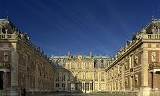
The Palace of Versailles, or simply Versailles, is a royal château
Château

A ch?teau is a manor house or residence of the lord of the manor or a country house of nobility or gentry, with or without fortifications, originally - and still most frequently - in French language-speaking regions....
 in Versailles
Versailles

Versailles , formerly de facto capital of the kingdom of France, is now a wealthy suburb of Paris and is still an important administrative and judicial centre....
, the Île-de-France
Île-de-France (région)

?le-de-France is one of the twenty-six administrative regions of France of France, composed mostly of the Paris metropolitan area. Created as the "District of the Paris Region" in 1961, it was renamed as the "?le-de-France" r?gion in 1976 when its administrative status was aligned with the other French administrative regions created in 1...
 region of France
France

France , officially the French Republic , is a country whose Metropolitan France is located in Western Europe and that also comprises various Overseas departments and territories of France....
. In French
French language

French is a Romance language spoken around the world by around 80 million people as first language, by 190 million as second language, and by about another 200 million people as an acquired tongue, with significant speakers in 54 countries....
, it is known as the Château de Versailles. When the château was built, Versailles was a country village; today, however, it is a suburb of Paris
Paris

Paris is the Capital of France and the country's largest city. It is situated on the river Seine, in northern France, at the heart of the ?le-de-France Regions of France ....
, some twenty kilometers southwest of the French capital. From 1682, when Louis XIV
Louis XIV of France

Louis XIV ruled as List of French monarchs and of King of Navarre. He ascended the throne a few months before his fifth birthday, but did not assume actual personal control of the government until the death of his prime minister , the Italians Jules Cardinal Mazarin, in 1661....
 moved from Paris, until the royal family
Royal family

A royal family is the extended family of a king or queen regnant. The term "imperial family" more appropriately describes the extended family of an emperor or empress regnant, while the terms "ducal family", "grand ducal family" or "princely family" are more appropriate in reference to the relatives of a reigning duke, grand duke, or prince....
 was forced to return to the capital in October 1789, the court of Versailles was the centre of political power in France.


Discussion
Ask a question about 'Palace of Versailles'
Start a new discussion about 'Palace of Versailles'
Answer questions from other users
Full Discussion Forum


Encyclopedia


The Palace of Versailles, or simply Versailles, is a royal château
Château

A ch?teau is a manor house or residence of the lord of the manor or a country house of nobility or gentry, with or without fortifications, originally - and still most frequently - in French language-speaking regions....
 in Versailles
Versailles

Versailles , formerly de facto capital of the kingdom of France, is now a wealthy suburb of Paris and is still an important administrative and judicial centre....
, the Île-de-France
Île-de-France (région)

?le-de-France is one of the twenty-six administrative regions of France of France, composed mostly of the Paris metropolitan area. Created as the "District of the Paris Region" in 1961, it was renamed as the "?le-de-France" r?gion in 1976 when its administrative status was aligned with the other French administrative regions created in 1...
 region of France
France

France , officially the French Republic , is a country whose Metropolitan France is located in Western Europe and that also comprises various Overseas departments and territories of France....
. In French
French language

French is a Romance language spoken around the world by around 80 million people as first language, by 190 million as second language, and by about another 200 million people as an acquired tongue, with significant speakers in 54 countries....
, it is known as the Château de Versailles. When the château was built, Versailles was a country village; today, however, it is a suburb of Paris
Paris

Paris is the Capital of France and the country's largest city. It is situated on the river Seine, in northern France, at the heart of the ?le-de-France Regions of France ....
, some twenty kilometers southwest of the French capital. From 1682, when Louis XIV
Louis XIV of France

Louis XIV ruled as List of French monarchs and of King of Navarre. He ascended the throne a few months before his fifth birthday, but did not assume actual personal control of the government until the death of his prime minister , the Italians Jules Cardinal Mazarin, in 1661....
 moved from Paris, until the royal family
Royal family

A royal family is the extended family of a king or queen regnant. The term "imperial family" more appropriately describes the extended family of an emperor or empress regnant, while the terms "ducal family", "grand ducal family" or "princely family" are more appropriate in reference to the relatives of a reigning duke, grand duke, or prince....
 was forced to return to the capital in October 1789, the court of Versailles was the centre of political power in France. Versailles is therefore famous not only as a building, but as a symbol of the system of absolute monarchy
Absolute monarchy

Absolute monarchy is a monarchy form of government where the king or queen has absolute power over all aspects of his/her subjects' lives. Although some religious authorities may be able to discourage the monarch from some acts and the sovereign is expected to act according to custom, in an absolute monarchy there is no constitution or legal...
 of the Ancien Régime
Ancien Régime

Ancien R?gime refers primarily to the aristocracy, sociology, and politics system established in France under the Valois Dynasty and House of Bourbon dynasties ....
.

History


Origins

The earliest mention of the name of Versailles is found in a document dated 1038, the Charte de l'abbaye Saint-Père de Chartres (Charter of the Saint-Père de Chartres Abbey) (Guérard, 1840), in which one of the signatories was a certain Hugo de Versailliis (Hugues de Versailles), who was seigneur of Versailles. During this period, the village of Versailles centered on a small castle and church and the area was governed by a local lord. Its location on the road from Paris
Paris

Paris is the Capital of France and the country's largest city. It is situated on the river Seine, in northern France, at the heart of the ?le-de-France Regions of France ....
 to Dreux
Dreux

Dreux is a town and commune in France in northwest France, in the Eure-et-Loir d?partement in France....
 and Normandy
Normandy

Normandy is a geographical region corresponding to the former Duchy of Normandy. It is situated along the coast of France south of the English Channel between Brittany and Picardy and comprises territory in northern France and the Channel Islands....
 brought some prosperity to the village but, following an outbreak of the Plague
Black Death

The Black Death, was one of the deadliest pandemics in human history, widely thought to have been caused by a bacterium named Yersinia pestis , but recently attributed by some factors to other diseases....
 and the Hundred Years' War
Hundred Years' War

The Hundred Years' War was a prolonged conflict lasting from 1337 to 1453 between two royal houses for the French throne, which was vacant with the extinction of the senior House of Capet line of French kings....
, the village was largely destroyed and its population sharply declined (Bluche, 1991; Thompson, 2006; Verlet, 1985)

In 1575, Albert de Gondi
Albert de Gondi

Albert de Gondi seigneur du Perron, comte, then marquis de Belle-Isle , duc de Retz , was a marshal of France and a member of the Gondi bank. His father was Guidobaldo, seigneur de Perron, who became a banker at Lyon, and his mother was Marie-Catherine de Pierrevive - his siblings included cardinal Pierre de Gondi....
, a naturalized Florentine
Florence

Florence is the Capital city of the Italy Regions of Italy of Tuscany and of the provinces of Italy Province of Florence. It is the most populous city in Tuscany and has a population of 364,779 ....
 who gained prominence at the court of Henry II
Henry II of France

Henry II , of the House of Valois and the son and successor of Francis I of France, was King of France from 31 March 1547, until his death....
, purchased the seigneury of Versailles. In the early seventeenth century, Gondi
Albert de Gondi

Albert de Gondi seigneur du Perron, comte, then marquis de Belle-Isle , duc de Retz , was a marshal of France and a member of the Gondi bank. His father was Guidobaldo, seigneur de Perron, who became a banker at Lyon, and his mother was Marie-Catherine de Pierrevive - his siblings included cardinal Pierre de Gondi....
 invited Louis XIII on several hunting trips in the forests surrounding Versailles. Pleased with the location, Louis ordered the construction of a hunting lodge
Hunting

Hunting is the practice of pursuing living animals for food, recreation, or trade. In present-day use, the term refers to lawful hunting, as distinguished from poaching, which is the killing, trapping or capture of the hunted species contrary to law....
 in 1624. Designed by Philibert Le Roy, the structure, a small château, was constructed of stone and red brick with a based roof. Eight years later, Louis obtained the seigneury of Versailles from the Gondi family and began to make enlargements to the château (Batiffol, 1913; Bluche, 1991; Marie, 1968; Nolhac, 1901; Verlet, 1985).

Louis XIV

Louis's successor, Louis XIV
Louis XIV of France

Louis XIV ruled as List of French monarchs and of King of Navarre. He ascended the throne a few months before his fifth birthday, but did not assume actual personal control of the government until the death of his prime minister , the Italians Jules Cardinal Mazarin, in 1661....
, had a great interest in Versailles. He had grown up during the disorder of the Fronde
Fronde

The Fronde was a civil war in France, occurring in the midst of the Franco-Spanish War , which had begun in 1635. The word fronde means sling , with which the windows of supporters of Jules Cardinal Mazarin were broken with stones by Parisian Crowds....
, a civil war between rival factions of aristocrats, and wanted a site where he could organize and completely control a government of France
Government of France

The government of France is a semi-presidential system determined by the Constitution of France of the fifth French Republic, in which the nation declares itself to be "an indivisible, la?cit?, Democracy, and social Republic"....
 by absolute personal rule
Personal Rule

The Personal Rule was the period from 1629 to 1640, when King Charles I of England of England, Scotland and Ireland ruled without recourse to Parliament of England....
. He settled on the royal hunting lodge at Versailles and over the following decades had it expanded into one of the largest palaces in the world (Félibien, 1703; Marie, 1972; Verlet, 1985).

Beginning in 1669, architect Louis Le Vau
Louis Le Vau

Louis Le Vau was a French Classical architect who worked for Louis XIV of France. He was born and died in Paris.He was responsible, with Andr? Le N?tre and Charles Le Brun, for the redesign of the ch?teau of Vaux-le-Vicomte....
, landscape architect
Landscape architecture

Landscape architecture is the most modern of the environment professions and represents a synthesis of arts, science and technical philosphies and practices that seek to care for the Earth's landscapes in a truly holistic, creative and sustainable manner....
 André Le Nôtre
André Le Nôtre

Andr? Le N?tre was a landscape architect and the gardener of King Louis XIV of France from 1645 to 1700. Most notably, he was responsible for the construction of the park of the Palace of Versailles....
, and painter-decorator Charles Le Brun
Charles Le Brun

Charles Le Brun was a French Painting and Aesthetics, one of the dominant artists in 17th century France....
 began a detailed renovation and expansion of the château. This was done to fulfill Louis XIV's desire to establish a new centre for the royal court. Following the Treaty of Nijmegen in 1678, he began to gradually move the court to Versailles. The court was officially established there on 6 May 1682.

By moving his court and government to Versailles, Louis XIV hoped to extract more control of the government from the nobility, and to distance himself from the population of Paris. All the power of France emanated from this center: there were government offices here, as well as the homes of thousands of courtiers, their retinues, and all the attendant functionaries of court (Solnon, 1987). By requiring that nobles of a certain rank and position spend time each year at Versailles, Louis prevented them from developing their own regional power
Regional power

In international relations, a regional power is a state that has Power within a Geography region....
 at the expense of his own and kept them from countering his efforts to centralise the French government in an absolute monarchy (Bluche, 1986, 1991; Bendix, 1978; Solnon, 1987). The meticulous and strict court etiquette
Etiquette

Etiquette is a code that influences expectations for social behavior according to contemporary Convention Norm s within a society, social class, or Group ....
 that Louis established, which overwhelmed his heirs with its petty boredom, was epitomised in the elaborate ceremonies and exacting procedures that accompanied his rising in the morning, known as the Lever
Levée (ceremony)

Lever , adopted in English as lev?e? initially the simple act of getting up in the morning? was raised to a ceremonial custom at the court of Louis XIV of France....
, divided into a petit lever for the most important and a grand lever for the whole court. Like other French court manners, étiquette was quickly imitated in other European courts (Benichou, 1948; Bluche, 1991; Solnon, 1987).

Evolution of Versailles
The expansion of the château became synonymous with the absolutism of Louis XIV (Bluche, 1986, 1991). In 1661, following the death of Cardinal Mazarin, chief minister of the government, Louis had declared that he would be his own chief minister. The idea of establishing the court at Versailles was conceived to ensure that all of his advisors and provincial rulers would be kept close to him. He feared that they would rise up against him and start a revolt. He thought that if he kept all of his potential threats near him, that they would be powerless. After the disgrace of Nicolas Fouquet
Nicolas Fouquet

Nicolas Fouquet, marquis de Belle-Isle, vicomte de Melun et Vaux was the Superintendent of Finances in France under Louis XIV of France....
 in 1661 — Louis claimed the finance minister
Finance minister

The finance minister is a Cabinet position in a government.A minister of finance has many different jobs in a government. He or she helps form the government budget, Fiscal policy, and control finances....
 would not have been able to build his grand château at Vaux-le-Vicomte
Vaux-le-Vicomte

The Ch?teau de Vaux-le-Vicomte is a baroque French chateau located in Maincy, near Melun, 55 km southeast of Paris in the Seine-et-Marne d?partement in France of France....
 without having embezzled from the crown — Louis, after the confiscation of Fouquet’s state, employed the talents of Le Vau, Le Nôtre, and Le Brun, who all had worked on Vaux-le-Vicomte, for his building campaigns at Versailles and elsewhere. For Versailles, there were four distinct building campaigns (after minor alterations and enlargements had been executed on the château and the gardens in 1662-1663), all of which corresponded to Louis XIV’s wars (Bluche, 1986, 1991; Verlet, 1985).

First building campaign
The first building campaign (1664-1668) commenced with the Plaisirs de l’Île enchantée
Plaisirs de l’Île enchantée

Plaisirs de l??le enchant?e in English means Pleasures of the Enchanted Island. The Enchanted Island references Louis XIV and his court. This was a party given to start the building campaigns for the Chateau de Versailles in particular to acquaint those involved in its construction, his wife, mother, lovers, mistresses, and family in general to a...
 of 1664, a fête
Fête

F?te is a French language word meaning festival, party, holiday or even birthday , which has passed into English as a label that may be given to certain events....
 that was held between 7 and 13 May 1664. The fête was ostensibly given to celebrate the two queens of France — Anne of Austria
Anne of Austria

Anne of Austria was Queen consort of France and Navarre and regent for her son, Louis XIV of France. During her regency Jules Cardinal Mazarin served as France's Religious minister....
, the Queen Mother
Queen mother

Queen mother is a title or position reserved for a widowed queen consort whose son or daughter from that marriage is the reigning monarch. The term has been used in England since at least 1577....
, and Marie-Thérèse
Maria Theresa of Spain

Maria Theresa of Spain was the daughter of Philip IV of Spain and ?lisabeth of France . She was List of Queens and Empresses of France as wife of Louis XIV of France....
, Louis XIV’s wife, but in reality honored the king’s mistress, Louise de La Vallière
Louise de La Vallière

Louise Fran?oise de La Baume Le Blanc de La Valli?re, Duchess of La Valli?re and Vaujours was the mistress to Louis XIV of France from 1661 to 1667....
. The celebration of the Plaisirs de l’Île enchantée
Plaisirs de l’Île enchantée

Plaisirs de l??le enchant?e in English means Pleasures of the Enchanted Island. The Enchanted Island references Louis XIV and his court. This was a party given to start the building campaigns for the Chateau de Versailles in particular to acquaint those involved in its construction, his wife, mother, lovers, mistresses, and family in general to a...
 is often regarded as a prelude to the War of Devolution
War of Devolution

The War of Devolution saw Louis XIV of France's France armies overrun the Habsburgcontrolled Southern Netherlands and the Franche-Comt?, but forced to give most of it back by a Triple Alliance of England, Sweden, and the Dutch Republic in the Treaty of Aix-la-Chapelle ....
, which Louis waged against Spain. The first building campaign (1664-1668) witnessed alterations in the château and gardens in order to accommodate the 600 guests invited to the party (Nolhac, 1899, 1901; Marie, 1968; Verlet, 1985).

Second building campaign
The second building campaign (1669-1672) was inaugurated with the signing of the Treaty of Aix-la-Chapelle
Treaty of Aix-la-Chapelle (1668)

The Treaty of Aix-la-Chapelle or Treaty of Aachen was signed on May 2, 1668 in Aachen. It ended the war of Devolution between France and Spain....
, which ended the War of Devolution. During this campaign, the château began to assume some of the appearance that it has today. The most important modification of the château was Le Vau’s envelope of Louis XIII’s hunting lodge. The enveloppe — often referred to as the château neuf to distinguish it from the older structure of Louis XIII — enclosed the hunting lodge on the north, west, and south. The new structure provided new lodgings for the king and members of his family. The main floor — the piano nobile — of the château neuf was given over entirely to two apartments: one for the king, and one for the queen. The Grand appartement du roi
Grand appartement du roi

This article is about the grand appartement du roi of the Palace of Versailles.As a result of Louis LeVau?s envelope of Louis XIII?s ch?teau, the king and queen had new apartments in the new addition, known at the time as the ch?teau neuf....
 occupied the northern part of the château neuf and Grand appartement de la reine
Grand appartement de la reine

This article is about the grand appartement de la reine of the Palace of Versailles.Forming a parallel enfilade with that of the grand appartement du roi, the grand appartement de la reine served as the residence of three queens of France ? Marie-Th?r?se d?Autriche, wife of Louis XIV; Marie Leszczyska, wife of Louis XV; and Marie-Antoinett...
 occupied the southern part. The western part of the enveloppe was given over almost entirely to a terrace, which was later enclosed with the construction of the Hall of Mirrors (Galerie des Glaces). The ground floor of the northern part of the château neuf was occupied by the appartement des bains, which included a sunken octagonal tub with hot and cold running water. The king’s brother and sister-in-law, the duke and duchesse d’Orléans occupied apartments on the ground floor of the southern part of the château neuf. The upper story of the château neuf was reserved for private rooms for the king to the north and rooms for the king’s children above the queen’s apartment to the south (Nolhac, 1901; Marie, 1972; Verlet, 1985).

Significant to the design and construction of the grands appartements is that the rooms of both apartments are of the same configuration and dimensions — a hitherto unprecedented feature in French palace design. It has been suggested that this parallel configuration was intentional as Louis XIV had intended to establish Marie-Thérèse d’Autriche as queen of Spain, and thus thereby establish a dual monarchy
Dual monarchy

Dual monarchy occurs when two separate kingdoms are ruled by the same monarch, follow the same foreign policy, exist in a customs union with each other and have a combined military but are otherwise self-governing....
 (Johnson, 1981). Louis XIV’s rationale for the joining of the two kingdoms was seen largely as recompense for Philip IV
Philip IV of Spain

Philip IV , was List of Spanish monarchs between 1621 and 1665, Sovereignty of the Spanish Netherlands, and List of Portuguese monarchs until 1640....
's failure to pay his daughter Marie-Thérèse’s dowry, which was among the terms of capitulation to which Spain agreed with the promulgation of the Treaty of the Pyrenees
Treaty of the Pyrenees

The Treaty of the Pyrenees was signed in 1659 to end the war between France and Spain that had begun in 1635 during the Thirty Years' War. It was signed on Pheasant Island, a river island on the border between the two countries....
, which ended the war between France
France

France , officially the French Republic , is a country whose Metropolitan France is located in Western Europe and that also comprises various Overseas departments and territories of France....
 and Spain
Spain

Spain or the Kingdom of Spain , is a country located in Southern Europe on the Iberian Peninsula.The Spanish constitution does not establish any official denomination of the country, even though Espa?a , Estado espa?ol and Naci?n espa?ola are used interchangeably....
 that began in 1635 during the Thirty Years’ War. Louis XIV regarded his father-in-law’s act as a breach of the treaty and consequently engaged in the War of Devolution.

Both the grand appartement du roi and the grand appartement de la reine formed a suite of seven enfilade
Enfilade (architecture)

An enfilade, in architecture, is a suite of rooms formally aligned with each other. This was a common feature in grand European architecture from the Baroque period onwards, although there are earlier examples, such as the Raphael Rooms....
 rooms. Each room is dedicated to one of the then known celestial bodies
Astronomical object

s are significant entity, associations or structures which current science has confirmed to exist in outer space. This does not necessarily mean that more current science will not disprove their existence....
 and is personified by the appropriate Greco-Roman deity. The decoration of the rooms, which was conducted under Le Brun's direction depicted the “heroic actions of the king” and were represented in allegorical form by the actions of historical figures from the antique past (Alexander the Great
Alexander the Great

Alexander the Great , also known as Alexander III of Macedon was an ancient Greeks King of Macedon . He was one of the most successful military commanders of all time and is presumed undefeated in battle....
, Augustus, Cyrus
Cyrus the Great

Cyrus the Great , , also known as Cyrus II of Persia and Cyrus the Elder, was a Persian people Shah . He was the founder of the Persian Empire under the Achaemenid dynasty, an empire, perhaps the most wealthy and magnificent in history....
, etc.) (Berger, 1986; Félibien, 1674; Verlet, 1985).

Third building campaign
With the signing of the Treaty of Nijmegen in 1678, which ended the Dutch War
Franco-Dutch War

The Franco-Dutch War, often called simply the Dutch War was a war fought by the France, the Swedish Empire, the Bishopric of M?nster, the Archbishopric of Cologne and the Kingdom of England against the Dutch Republic, which was later joined by Holy Roman Emperor, Brandenburg and Spain to form a Quadruple Alliance....
, the third building campaign at Versailles began (1678-1684). Under the direction of the architect, Jules Hardouin-Mansart
Jules Hardouin Mansart

Jules Hardouin-Mansart was a French architect whose work is generally considered to be the apex of French Baroque architecture, representing the power and grandeur of Louis XIV of France....
, the Palace of Versailles acquired much of the look that it has today. In addition to the Hall of Mirrors, Hardouin-Mansart designed the north and south wings, which were used, respectively, by the nobility and Princes of the Bloods
Prince du Sang

A Prince of the Blood was a person who was legitimately descended in the male line from the monarch of a country. In France, the rank of prince du sang played a major role in determining court precedence during the Ancien R?gime, from the reign of King Henry IV of France onward to the reign of his great-great-great-great-great grand...
, and the Orangerie. Le Brun was occupied not only with the interior decoration of the new additions of the palace, but also collaborated with Le Nôtre's in landscaping the palace gardens (Berger, 1985; Thompson, 2006; Verlet, 1985). As symbol of France’s new prominence as a European super-power
Superpower

A superpower is a state with a leading position in the international relations and the ability to influence events and its own interests and project Power in international relations to protect those interests; it is traditionally considered to be one step higher than a great power....
, Louis XIV officially installed his court at Versailles in May of 1682 (Bluche, 1986, 1991).

Fourth building campaign
Soon after the crushing defeat of the War of the League of Augsburg (1688-1697) and owing possibly to the pious influence of Madame de Maintenon, Louis XIV undertook his last building campaign at Versailles. The fourth building campaign (1699-1710) concentrated almost exclusively on construction of the royal chapel designed by Hardouin-Mansart and finished by Robert de Cotte
Robert de Cotte

Robert de Cotte was a French architect-administrator, under whose design control of the royal buildings of France from 1699, the earliest notes presaging the Rococo were introduced....
 and his team of decorative designers. There were also some modifications in the appartement du roi
Appartement du roi

The appartement du roi is the suite of rooms in the Palace of Versailles that served as the living quarters of Louis XIV. Overlooking the cour de marbre, these rooms are situated in the oldest part of the chateau in rooms originally designated for use by the queen in Louis XIII chateau....
, namely the construction of the Salon de l’Œil de Bœuf
Appartement du roi

The appartement du roi is the suite of rooms in the Palace of Versailles that served as the living quarters of Louis XIV. Overlooking the cour de marbre, these rooms are situated in the oldest part of the chateau in rooms originally designated for use by the queen in Louis XIII chateau....
 and the King’s Bedchamber
Appartement du roi

The appartement du roi is the suite of rooms in the Palace of Versailles that served as the living quarters of Louis XIV. Overlooking the cour de marbre, these rooms are situated in the oldest part of the chateau in rooms originally designated for use by the queen in Louis XIII chateau....
. With the completion of the chapel in 1710, virtually all construction at Versailles ceased; building would not be resumed at Versailles until some twenty years later during the reign of Louis XV (Nolhac, 1911; Marie, 1976, 1984; Verlet, 1985).

Louis XV

After the death of the Louis XIV in 1715, the five-year old king Louis XV, the court, and the Régence
Régence

The R?gence is the period in History of France between 1715 and 1723, when King Louis XV of France was a minor and the land was governed by a regent, Philip II, Duke of Orl?ans, the nephew of Louis XIV of France....
 government of Philippe II d’Orléans
Philippe II, Duke of Orléans

Philippe Charles d'Orl?ans, Duke of Orl?ans, , was a member of the royal family of France. At the death of his uncle, king Louis XIV of France, he was the regent during the minority of the five-year old new king Louis XV of France, from 1715 to 1723, an era known as R?gence....
 returned to Paris. In May 1717, during his visit to France, the Russian czar Peter the Great
Peter I of Russia

Peter I the Great or Pyotr Alexeyevich Romanov ruled Russia and later the Russian Empire from until his death, jointly ruling before 1696 with his weak and sickly half-brother, Ivan V of Russia....
 stayed at the Grand Trianon
Grand Trianon

The Grand Trianon was built in the northwestern part of the Ch?teau de Versailles at the request of Louis XIV, as a retreat for the King and his ma?tresse en titre of the time, the Fran?oise-Ath?na?s, marquise de Montespan, and as a place where the King and invited guests could take light meals away from the strict etiquette of the Cou...
. His time at Versailles was used to observe and study the palace and gardens, which he later used as a source of inspiration when he built Peterhof
Peterhof

Peterhof is a municipal town within Petrodvortsovy District of the federal city of Saint Petersburg on the southern shore of the Gulf of Finland ....
 on the Bay of Finland west of Saint Petersburg
Saint Petersburg

Saint Petersburg is a types of inhabited localities in Russia and a federal subjects of Russia of Russia located on the Neva River at the head of the Gulf of Finland on the Baltic Sea....
 (Verlet, 1985).

During the reign of Louis XV, Versailles underwent transformation, but not on the scale that had been seen during the reign of Louis XIV. When the king and the court returned to Versailles in 1722, the first project was the completion of the Salon d'Hercule
Salon d'Hercule

The salon d'Hercule is on the first floor of the Ch?teau de Versailles and connects the chapel and the North Wing of the ch?teau with grand appartement du roi....
, which had been begun during the last years of Louis XIV's reign but was never finished due to the king’s death.

Significant among Louis XV’s contributions to Versailles were the petit appartement du roi; the appartements de Mesdames, the appartement du dauphin, and the appartement de la dauphine on the ground floor; and the two private apartments of Louis XV – petit appartement du roi au deuxième étage (later transformed into the appartement de Madame du Barry
Madame du Barry

Marie-Jeanne B?cu, Comtesse du Barry was a France courtesan who became the last Mistress of Louis XV of France and is one of the famous victims of the Reign of Terror....
) and the petit appartement du roi au troisième étage – on the second and third floors of the palace. The crowning achievements of Louis XV’s reign were the construction of the Opéra
L'Opéra of the Palace of Versailles

The Op?ra Royal de Versailles is the main theater and opera house of the Palace of Versailles. Designed by Ange-Jacques Gabriel and designed by Augustin Pajou, the Op?ra was constructed entirely of wood and painted to resemble marble in a technique known as faux marble....
 and the Petit Trianon
Petit Trianon

The Petit Trianon is a small ch?teau located on the grounds of the Palace of Versailles in Versailles, France. It was designed by Ange-Jacques Gabriel by the order of Louis XV of France for his long-term mistress, Madame de Pompadour, and was constructed between 1762-1768....
 (Verlet, 1985).

The gardens
Gardens of Versailles

The gardens of Versailles occupy part of what was once the Domaine royale de Versailles, the royal demesne of the Palace of Versailles. Situated to the west of the Palace of Versailles, the gardens cover some 800 hectares of land, much of which is landscaped in the classic French garden style perfected here by Andr? Le N?tre....
 remained largely unchanged from the time of Louis XIV; only the completion of the Bassin de Neptune between 1738 and 1741 was the most important legacy Louis XV made to the gardens (Marie 1984; Thompson, 2006; Verlet 1985). Towards the end of his reign, Louis XV, under the advice of Ange-Jacques Gabriel
Ange-Jacques Gabriel

Ange-Jacques Gabriel was the most prominent French architect of his generation.Born to a Parisian family of architects and initially trained by the royal architect Robert de Cotte and his father , whom he assisted in the creation of the Place Royale at Bordeaux , the younger Gabriel was made a member of the Acad?mie d'architecture in 172...
, began to remodel the courtyard façades of the palace. With the objective revetting the entrance of the palace with classical façades, Louis XV began a project that was continued during the reign of Louis XVI, but which did not see completion until the 20th century (Verlet, 1985).

Louis XVI

Much of Louis XVI’s contributions to Versailles were largely dictated by the unfinished projects left to him by his grandfather. Shortly after his ascension, Louis XVI ordered a complete replantation of the gardens
Gardens of Versailles

The gardens of Versailles occupy part of what was once the Domaine royale de Versailles, the royal demesne of the Palace of Versailles. Situated to the west of the Palace of Versailles, the gardens cover some 800 hectares of land, much of which is landscaped in the classic French garden style perfected here by Andr? Le N?tre....
 with the intention of transforming the jardins français to an English-style garden, which had become popular during the late 18th century (Verlet, 1985). In the palace, the library and the salon des jeux in the petit appartement du roi and the decoration of the petit appartement de la reine for Marie-Antoinette are among the finest examples of the style Louis XVI (Verlet, 1945; 1985)

French Revolution


On 6 October 1789, the royal family had to leave Versailles and to move to the Tuileries Palace
Tuileries Palace

The Palais des Tuileries was a royal palace in Paris. It stood on the Rive Droite of the River Seine until 1871, when it was destroyed in the upheaval during the suppression of the Paris Commune....
 in Paris. During the early years of the French Revolution
French Revolution

The French Revolution was a period of political and social upheaval and radical change in the history of France, during which the French governmental structure, previously an absolute monarchy with feudalism for the aristocracy and Roman Catholic Church clergy, underwent radical change to forms based on Age of Enlightenment principles of cit...
, preservation of the palace was largely in the hands of the citizens of Versailles. In October 1790, Louis XVI ordered the palace to be emptied of its furniture, requesting that most be sent to the Tuileries Palace. In response to the order, the mayor of Versailles and the municipal council met to draft a letter to Louis XVI in which they stated that if the furniture was removed, it would be certainly precipitate economic ruin on the city (Gatin, 1908). A deputation from Versailles met with the king on 12 October after which Louis XVI, touched by the sentiments of the residents of Versailles, rescinded the order. However, eight months later, the fate of Versailles was sealed.

On 21 June 1791, Louis XVI was arrested at Varennes after which the Assemblée nationale constituante
National Constituent Assembly

The National Constituent Assembly was formed from the National Assembly on 9 July 1789, during the first stages of the French Revolution. It dissolved on 30 September 1791 and was succeeded by the French Legislative Assembly....
 accordingly declared that all possessions of the royal family had been abandoned. To safeguard the palace, the Assemblée nationale constituante ordered the palace of Versailles to be sealed. On 20 October 1792 a letter was read before the National Convention
National Convention

During the French Revolution, the National Convention or Convention, in France, comprised the constitutional and legislative Deliberative assembly which sat from 20 September 1792 to 26 October 1795 ....
 in which Jean-Marie Roland de la Platière
Jean-Marie Roland, vicomte de la Platière

Jean-Marie Roland, de la Plati?re Jean-Marie Roland was a France manufacturer in Lyon and became the leader of the Girondist faction in the French Revolution, largely influenced in this direction by his wife, Madame Roland....
, interior minister, proposed that the furnishings of the palace and those of the residences in Versailles that had been abandoned be sold and that the palace be either sold or rented. The sale of furniture transpired at auctions held between 23 August 1793 and 30 nivôse an III (19 January 1795). Only items of particular artistic or intellectual merit were exempt from the sale. These items were consigned to be part of the collection of a museum, which had been planned at the time of the sale of the palace furnishings.

In 1793, Charles-François Delacroix
Charles-François Delacroix

Charles-Fran?ois Delacroix was a secretary to Anne Robert Jacques Turgot, Baron de Laune, a deputy to the National Convention and a Minister of Foreign Affairs between 3 November, 1795 and 15 July, 1797....
 deputy to the Convention and father of the painter Eugène Delacroix
Eugène Delacroix

Ferdinand Victor Eug?ne Delacroix was a France Romanticism artist regarded from the outset of his career as the leader of the French Romantic school....
 proposed that the metal statuary in the gardens of Versailles
Gardens of Versailles

The gardens of Versailles occupy part of what was once the Domaine royale de Versailles, the royal demesne of the Palace of Versailles. Situated to the west of the Palace of Versailles, the gardens cover some 800 hectares of land, much of which is landscaped in the classic French garden style perfected here by Andr? Le N?tre....
 be confiscated and sent to the foundry to be made into cannon (Gatin, 1908). The proposal was debated but eventually it was tabled. On 28 floréal an II (5 May 1794) the Convention decreed that the château and gardens of Versailles, as well as other former royal residences in the environs, would not be sold but placed under the care of the Republic for the public good (Fromegot, 1903). Following this decree, the château became a repository for art work seized from churches and princely homes. As a result of Versailles serving as a repository for confiscated art works, collections were amassed that eventually became part of the proposed museum (Fromegot, 1903).

Among the items found at Versailles at this time a collection of natural curiosities that has been assembled by the sieur Fayolle during his voyages in America. The collection was sold to the comte d’Artois
Charles X of France

Charles X ruled as List of French monarchs and List of Navarrese monarchs from 20 May 1824 until the July Revolution, when he Abdication. He was the last king of the senior House of Bourbon line to reign over France....
 and was later confiscated by the state. Fayolle, who had been nominated to the Commission des arts, became guardian of the collection and was later, in June 1794, nominated by the Convention to be the first directeur du Conservatoire du Muséum national de Versailles (Fromageot, 1903). The next year, André Dumont
André Dumont

Andr? Hubert Dumont was a Belgium geologist.Dumont was born at Li?ge . His first work was a masterly M?moire on the geology of the province of Liege published in 1832....
 the people's representative, became administrator for the department of the Seine-et-Oise. Upon assuming his administrative duties, Dumont was struck with the deplorable state into which the palace and gardens had sunk. He quickly assumed administrative duties of the château and assembled a team of conservators to oversee the various collections of the museum (Fromageot, 1903).

One of Dumont’s first appointments was that of Huges Lagarde (10 messidor an III (28 June 1795), a wealthy soap merchant from Marseille
Marseille

"Marseille" is the second-largest city of France and forms the third-largest aire urbaine, after those of Paris and Lyon, with a population recorded to be 1,516,340 at the 1999 census and estimated to be 1,605,000 in 2007....
 with strong political connections, as bibliographer of the museum. With the abandonment of the palace, there remained no less that 104 libraries which contained in excess of 200,000 printed volumes and manuscripts. Lagarde, with his political connections and his association with Dumont, became the driving force behind Versailles as a museum at this time. Lagarde was able to assemble a team of curators including sieur Fayolle for natural history and, Louis-Jean-Jacques Durameau, the painter responsible for the ceiling painting in the Opéra, was appointed as curator for painting (Fromageot, 1903).

Owing largely to political vicissitudes that occurred in France during the 1790s, Versailles succumbed to further degradations. Mirrors were assigned by the finance ministry for payment of debts of the Republic and draperies, upholstery, and fringes were confiscated and sent to the mint to recuperate the gold and silver used in their manufacture. Despite its designation as a museum, Versailles served as an annex to the Hôtel des Invalides pursuant to the decree of 7 frimaire an VIII (28 November 1799), which commandeered part of the palace and which had wounded soldiers being housed in the petit appartement du roi (Gatin, 1908)

In 1797, the Muséum national was reorganised and renamed Musée spécial de l’École française (Dutilleux, 1887). The grands appartements were used as galleries in which the morceaux de réception submitted by artists seeking admission to the Académie royale de peinture et de sculpture
Académie de peinture et de sculpture

The Acad?mie royale de peinture et de sculpture , Paris, was founded in 1648, modelled on Italy examples, such as the Accademia di San Luca in Rome....
 during the 17th and 18th centuries, the series The Life of Saint Bruno by Eustache Le Sueur
Eustache Le Sueur

Eustache Le Sueur or Lesueur , one of the founders of the France Academy of painting, was born in Paris, where he passed his whole life....
 and the Life of Marie de Médicis by Peter Paul Rubens
Peter Paul Rubens

Peter Paul Rubens was a prolific seventeenth-century Flemish Baroque painter, and a proponent of an exuberant Baroque style that emphasized movement, color, and sensuality....
 were placed on display. The museum, which included the sculptures in the garden, became the finest museum of classic French art that had existed (Verlet, 1985).

First Empire

With the advent of Napoléon
Napoleon I of France

Napoleon Bonaparte later known as Emperor Napoleon I, was a military and political leader of France whose actions shaped European politics in the early 19th century....
 and the First Empire
First French Empire

The Empire of the French , also known as the Greater French Empire or First French Empire, but more commonly known as the Napoleonic Empire, was the empire of Napoleon I of France in France....
, the status of Versailles changed. Paintings and art work that had previously been assigned to Muséum national and the Musée spécial de l’École française were systematically dispersed to other locations and eventually the museum was closed. In accordance to provisions of the 1804 Constitution, Versailles was designated as an imperial palace for the department of the Seine-et-Oise.

While Napoléon did not reside in the château, apartments were, however, arranged and decorated for the use of the empress Marie-Louise
Marie Louise, Duchess of Parma

Marie Louise of Austria , born Archduchess Maria Luisa of Austria , became upon marriage Empress of the French , and in 1817 became Duchess of Parma, Piacenza and Guastalla ....
. The emperor chose to reside at the Grand Trianon
Grand Trianon

The Grand Trianon was built in the northwestern part of the Ch?teau de Versailles at the request of Louis XIV, as a retreat for the King and his ma?tresse en titre of the time, the Fran?oise-Ath?na?s, marquise de Montespan, and as a place where the King and invited guests could take light meals away from the strict etiquette of the Cou...
. The château continued to serve, however, as an annex of the Hôtel des Invalides (Mauguin, 1940-1942; Pradel, 1937; Verlet, 1985). Nevertheless, on 3 January 1805, Pope Pius VII
Pope Pius VII

Pope Pius VII, Order of Saint Benedict , born Count Barnaba Niccol? Maria Luigi Chiaramonti, was Pope from March 14, 1800 to August 20, 1823....
, who came to France to officiate at Napoléon's coronation, visited the palace and blessed the throng of people gathered on the parterre d'eau from the balcony of the Hall of Mirrors (Mauguin, 1940-1942).

Bourbon Restoration

The Bourbon Restoration
Bourbon Restoration

Following the ousting of Napoleon I of France in 1814, the Allies restored the House of Bourbon to the France throne. The ensuing period is called the Restoration, following French usage, and is characterized by a sharp conservative reaction and the re-establishment of the Roman Catholic Church as a power in French politics....
 saw little activity at Versailles. Areas of the gardens were replanted but no significant restoration and modifications of the interiors were undertaken, despite the fact that Louis XVIII would often visit the palace and walk through the vacant rooms (Manse, 2004; Thompson, 2006). Charles X
Charles X

Charles X may refer to:* Charles X Gustav of Sweden * Charles X of France ...
 chose the Tuileries Palace over Versailles and rarely visited his former home (Castelot, 2001).

July Monarchy

With the Revolution of 1830 and the establishment of the July Monarchy, the status of Versailles changed. In March 1832, the Loi de la Liste civile was promulgated, which designated Versailles as a crown dependency. Like Napoléon before him, Louis-Philippe
Louis-Philippe of France

Louis-Philippe , was List of French monarchs from 1830 to 1848 in what was known as the July Monarchy. He was the last king to rule France, although Napoleon III of France, styled as an emperor, would serve as its last monarch....
 chose to live at the Grand Trianon
Grand Trianon

The Grand Trianon was built in the northwestern part of the Ch?teau de Versailles at the request of Louis XIV, as a retreat for the King and his ma?tresse en titre of the time, the Fran?oise-Ath?na?s, marquise de Montespan, and as a place where the King and invited guests could take light meals away from the strict etiquette of the Cou...
; however, unlike Napoléon, Louis-Philippe did have a grand design for Versailles.

In 1833, Louis-Philippe proposed the establishment of a museum dedicated to “all the glories of France,” which included the Orléans dynasty and the Revolution of 1830 that put Louis-Philippe on the throne of France. For the next decade, under the direction of Eugène-Charles-Frédéric Nepveu and Pierre-François-Léonard Fontaine, the château underwent irreversible alterations (Constans, 1985; 1987; Mauguin, 1937; Verlet, 1985). The museum was officially inaugurated on 10 June 1837 as part of the festivities that surrounded the marriage of the Prince royal, Ferdinand-Philippe d’Orléans with princess Hélène of Mecklenburg-Schwerin and represented one of the most ambitious and costly undertakings of Louis-Philippe’s reign. Over 3,000 paintings depicting glorious events in French history and a small army of busts of French heroes were commissioned by Louis-Philippe to decorate his new museum. Louis-Philippe’s efforts were praised and condemned by his contemporaries. Victor Hugo
Victor Hugo

Victor-Marie Hugo was a France poet, playwright, novelist, essayist, visual artist, statesman, human rights activist and exponent of the Romanticism movement in France....
, who was present at the inaugural ceremonies, characterised the king’s efforts:

Later, Balzac
Honoré de Balzac

Honor? de Balzac was a French novelist and playwright. His magnum opus was a Novel sequence of almost 100 novels and plays collectively entitled La Com?die humaine, which presents a panorama of French life in the years after the fall of Napol?on Bonaparte in 1815....
 characterised, in less laudatory terms, the effort as the “hospital of the glories of France” (Balzac, 1853).

The aile du Midi, was given over to the galerie des Batailles, which necessitated the demolition of most of the apartments of the Princes of the Blood
Prince du Sang

A Prince of the Blood was a person who was legitimately descended in the male line from the monarch of a country. In France, the rank of prince du sang played a major role in determining court precedence during the Ancien R?gime, from the reign of King Henry IV of France onward to the reign of his great-great-great-great-great grand...
 who lived in this part of the palace during the Ancien Régime. The galerie des Batailles was an epigone of the Grande galerie of the Louvre
Louvre

The Louvre Museum , located in Paris, is a historic monument, and a national museum of France. It is a central landmark, located on the Rive Droite of the Seine in the 1st arrondissement of Paris ....
 and was intended to glorify French military history from the Battle of Tolbiac
Battle of Tolbiac

The Battle of Tolbiac was fought between the Franks under Clovis I and the Alamanni, traditionally set in 496. The site of "Tolbiac", or "Tulpiacum" is usually given as Z?lpich, North Rhine-Westphalia, about 60km east of the present German-Belgium frontier, which is not implausible....
 (traditionally dated 495) to the Battle of Wagram
Battle of Wagram

In the Battle of Wagram Napoleon I of France's First French Empire forces defeated Archduke Charles, Duke of Teschen Austrian Empire army, near Vienna, effectively bringing the War of the Fifth Coalition to an end....
 (5-6 July 1809). While a number of the paintings displayed in the galerie des Batailles were of questionable quality, a few masterpieces, such as the Battle of Taillebourg by Eugène Delacroix
Eugène Delacroix

Ferdinand Victor Eug?ne Delacroix was a France Romanticism artist regarded from the outset of his career as the leader of the French Romantic school....
, were displayed here. Part of the aile du Nord was converted for the salle des Croisades, a room dedicated to famous knights of the Crusades and decorated with their names and coats of arms. The apartments of the dauphin and the dauphine as well as those of Louis XV’s daughters on the ground floor of the corps de logis were transformed into portrait galleries. In order to accommodate the displays, some of the boiseries were removed and either put into storage or sold. During the Prussian occupation of the palace in 1871, the boiseries in storage were burned as firewood (Constans, 1985; 1987; Mauguin, 1937; Verlet,1985).

Second Empire

During the Second Empire
Second French Empire

The Second French Empire or Second Empire was the Imperial Bonapartist regime of Napoleon III from 1852 to 1870, between the French Second Republic and the French Third Republic, in France....
, the museum remained essentially intact. The palace did serve as the backdrop for a number of state events including the visit by Queen Victoria
Victoria of the United Kingdom

Victoria was from 20 June 1837 the Queen regnant of the United Kingdom of Great Britain and Ireland and from 1 May 1876 the first Empress of India of the British Raj until her death....
 and Prince Albert in 1855 and the visit of Francis of Spain
Francis of Spain

Francis, Duke of C?diz was king consort of Spain as spouse of Isabella II of Spain....
 in 1864 (Verlet, 1985).

Pierre de Nolhac

Upon his appointment as conservator of the museum in 1892, Pierre de Nolhac embarked on a campaign of research, conservation, preservation, and restoration that continues to this day. The Rockefeller donations to Versailles made between 1924 and 1936 ensured the preservation of the palace and the Trianons (Société des Sciences morales, des Lettres et des Arts de Seine-et-Oise, 1925). However, it would not be until after the Second World War that concerted governmental initiatives directed at preservation and restoration of the palace would be undertaken.

Under the aegis of Gérald van der Kemp, chief conservator of the museum from 1952 to 1980, the museum witnessed some of its most ambitious conservation and restoration projects: new roofing for the galerie des glaces; restoration of the chambre de la reine; restoration of the chambre de Louis XIV; restoration of the Opéra (Lemoine, 1976). At this time, the ground floor of the aile du Nord was converted into a gallery of French history from the 17th century to the 19th century. Additionally, at this time, policy was established in which the French government would aggressively seek to acquire as much of original furniture and artwork that had been dispersed at the time of the Revolution of 1789 as possible (Kemp, 1976; Meyer, 1985).

Contemporary Versailles

With the past and ongoing restoration and conservation projects at Versailles, the Fifth Republic
French Fifth Republic

The Fifth Republic is the fifth and current Republicanism Constitution of France of France, which was introduced on October 5, 1958. The Fifth Republic emerged from the collapse of the French Fourth Republic, replacing a parliamentary government with a semi-presidential system....
 has enthusiastically promoted the museum as one of France’s foremost tourist attractions (Opperman, 2004). The palace, however, still serves political functions. Heads of state are regaled in the Hall of Mirrors
Hall of Mirrors (Palace of Versailles)

The Hall of Mirrors is the central gallery of the Palace of Versailles and is one of the most famous rooms in the world.As the principal and most remarkable feature of King Louis XIV of France?s third building campaign of the Palace of Versailles , construction of the Hall of Mirrors began in 1678 ....
; the Sénat
Senat

Senat may refer to:* Senate, a deliberative body* Senet, ancient Egypt board game* Senate of the Republic of Poland, the upper house of the Polish parliament...
 and the Assemblée nationale meet in congress in Versailles to revise or otherwise amend the French Constitution
Constitution of France

The current Constitution of France was adopted on October 4, 1958. It is typically called the Constitution of the Fifth Republic, and replaced that of the French Fourth Republic dating from 1946....
, a tradition that came into effect with the promulgation of the 1875 Constitution. Public establishment of the museum and Château de Versailles Spectacles recently organised the Jeff Koons Versailles exhibition. Jeff Koons said that "I hope the juxtaposition of today's surfaces, represented by my work, with the architecture and fine arts of Versailles will be an exciting interaction for the viewer.

Elena Geuna and Laurent Le Bon, curators of the exhibition present it as follow: "It is the sity aspect that underlies this entire venture. In recent years, many a cultural institution has attempted a confrontation between a heritage setting and contemporary works. The originality of this exhibition seems to us somewhat different, as regards both the chosen venue and the way it has been laid out. Echom dialectic, opposition, counterpoint... Not for us to judge!"

However, some people are offended by Jeff Koons' display. Comments on the popular website Trip Advisor from angry visitors describe the exposition as "shameful", "utterly disgusting", "dirty, dirty, dirty, dirty!", "making people want to punch babies", and "awful".

Images of Versailles


Features of the Palace of Versailles


Grands appartements

As a result of Le Vau’s
Louis Le Vau

Louis Le Vau was a French Classical architect who worked for Louis XIV of France. He was born and died in Paris.He was responsible, with Andr? Le N?tre and Charles Le Brun, for the redesign of the ch?teau of Vaux-le-Vicomte....
 enveloppe of Louis XIII’s château, the king and the queen had new apartments in the new addition, known at the time as the château neuf. The grands appartements, which are known respectively as the grand appartement du roi and the grand appartement de la reine, occupied the main or principal floor of the château neuf. Le Vau’s design for the state apartments closely followed Italian models of the day, as evidenced by the placement of the apartments on the next floor up from the ground level — the piano nobile — a convention the architect borrowed from 16th and 17th century Italian palace design (Berger, 1986; Verlet, 1985).

Grand appartement du roi
Le Vau’s plan called for an enfilade of seven rooms, each dedicated to one of the then known planets and their associated titular Roman deity. Le Vau’s plan was bold as he designed a heliocentric system that centered on the Salon of Apollo. The salon d’Apollon originally was designed as the king’s bedchamber, but served as a throne room
Throne room

Throne Room redirects here, for the album by CeCe Winans see Throne Room A throne room is the room, often rather a hall, in the official residence of the crown, either a palace or a fortified castle, where the throne of a senior figure is set up with elaborate pomp? usually raised, often with steps, and under a baldachin, both of which...
. During the reign of Louis XIV (until 1689), a solid silver throne stood on a Persian carpet
Persian rug

The Persian carpet is an essential part of Iran art and culture. Carpet-weaving is undoubtedly one of the most distinguished manifestations of Persian culture and art, and dates back to Persian Empire....
 covered dais on the south wall of this room (Berger, 1986; Dangeau, 1854-1860; Josephson, 1926; 1930; Verlet, 1985).

The original arrangement of the enfilade of rooms was thus:

  • Salon de Diane (Diana
    Diana (mythology)

    In Roman mythology, Diana was the goddess of the hunting, being associated with wild animals and woodland, and also of the moon. In literature she was the Greek deities and their Roman and Etruscan counterparts of the Greek mythology Artemis, though in Cult she was Italy, not Greek, in origin....
    , Roman goddess of the hunt; associated with the Moon
    Moon

    The Moon is Earth's only natural satellite and the List of natural satellites by diameter satellite in the Solar System. The average centre-to-centre distance from the Earth to the Moon is km, about thirty times the diameter of the Earth....
    )
  • Salon de Mars (Mars
    Mars (mythology)

    Mars was the Roman mythology warrior God , the son of Juno and Jupiter , husband of Bellona , and the lover of Venus . He was the most prominent of the military gods that were worshipped by the Roman legions....
    , Roman god of war; associated with the planet Mars
    MARS

    In cryptography, MARS is a block cipher that was IBM's submission to the Advanced Encryption Standard process. MARS was selected as an AES finalist in August 1999, after the AES2 conference in March 1999, where it was voted as the fifth and last finalist algorithm....
    )
  • Salon de Mercure (Mercury
    Mercury (mythology)

    In Roman mythology, Mercury was a messenger, and a god of trade, profit and commerce, the son of Maia Maiestas, also known as Ops, the Roman version of Cronus, and Jupiter ....
    , Roman god of trade, commerce, and the Liberal Arts; associated with the planet Mercury
    Mercury (planet)

    Mercury is the innermost and smallest planet in the Solar System, orbiting the Sun once every 88 days. The orbit of Mercury has the highest Orbital eccentricity of all the Solar System planets, and it has the smallest axial tilt....
    )
  • Salon d’Apollon (Apollo
    Apollo

    In Greek mythology and Roman mythology, Apollo , is one of the most important and many-sided of the Twelve Olympians. The ideal of the kouros , Apollo has been variously recognized as a god of light and the sun; truth and prophecy; archery; medicine and healing; music, poetry, and the arts; and more....
    , Roman god of the Fine Arts; associated with the Sun
    Sun

    The Sun , a G V star, is the star at the center of the Solar System. The Earth and other matter orbit the Sun, which by itself accounts for about 98.6% of the Solar System's mass....
    )
  • Salon de Jupiter (Jupiter
    Jupiter (mythology)

    In Roman mythology, Jupiter or Jove was the king of the gods,and the god of sky and thunder. He is the equivalent of Zeus in the Greek pantheon....
    , Roman god of law and order; associated with the planet Jupiter
    Jupiter

    Jupiter is the fifth planet from the Sun and the Solar system by size planet within the Solar System. It is two and a half times as massive as all of the other planets in our Solar System combined....
    )
  • Salon de Saturne (Saturn
    Saturn (mythology)

    Saturn was a major Roman mythology god of agriculture and harvest. In medieval times he was known as the Roman god of agriculture, justice and strength; he held a sickle in his left hand and a bundle of wheat in his right....
    , Roman god of agriculture and harvest; associated with the planet Saturn
    Saturn

    Saturn is the sixth planet from the Sun and the second largest planet in the Solar System, after Jupiter. Saturn, along with Jupiter, Uranus and Neptune, is classified as a gas giant....
    )
  • Salon de Vénus (Venus
    Venus (mythology)

    Venus was a major Roman mythology goddess principally associated with love, beauty and sexual reproduction, the equivalent of the Greek mythology Aphrodite....
    , Roman goddess of love; associated with the planet Venus
    Venus

    Venus is the second-closest planet to the Sun, orbiting it every 224.7 Earth days. The planet is named after Venus , the Roman mythology goddess of love....
    )


The configuration of the grand appartement du roi conformed to contemporary conventions in palace design (Baillie, 1967). However, owing to Louis XIV’s personal taste and with the apartment’s northern exposure, Louis XIV found the rooms too cold and opted to live in the rooms previously occupied by his father. The grand appartement du roi was reserved for court functions — such as the thrice-weekly appartement evenings given by Louis XIV for members of the court (Berger, 1986; La Varende, 1959; Marie, 1968, 1972; Nolhac, 1911; Verlet, 1985).

The rooms were decorated by Le Brun and demonstrated Italian influences, the particularly that of Pietro da Cortona
Pietro da Cortona

Pietro da Cortona, byname of Pietro Berrettini was an Italian artist and architect of High Baroque. He is best known for painting fresco ceilings, a pursuit in which he had ample competition in the Rome of his day, but he was equally adept and masterful with architectural design....
, with whom Le Brun studied while he was in Florence. Le Brun was influenced by the decorative style the da Cortona devised for the decoration of the Pitti Palace
Palazzo Pitti

The Palazzo Pitti , in English sometimes called the Pitti Palace, is a vast mainly Renaissance palace in Florence, Italy. It is situated on the south side of the Arno River, a short distance from the Ponte Vecchio....
 in Florence, which influenced his style Louis XIV at Versailles. The quadratura style of the ceilings evoke Pietro Cortona’s Sale dei Planeti at the Pitti, but Le Brun’s decorative schema is more complex (Blunt, 1980; Campbell, 1977). In his 1674 publication about the grand appartement du roi, André Félibien described the scenes depicted in the coves of the ceilings of the rooms as allegories depicting the “heroic actions of the king” (Félibien, 1674). Accordingly, one finds scenes of the exploits of Augustus, Alexander the Great
Alexander the Great

Alexander the Great , also known as Alexander III of Macedon was an ancient Greeks King of Macedon . He was one of the most successful military commanders of all time and is presumed undefeated in battle....
, and Cyrus
Cyrus the Great

Cyrus the Great , , also known as Cyrus II of Persia and Cyrus the Elder, was a Persian people Shah . He was the founder of the Persian Empire under the Achaemenid dynasty, an empire, perhaps the most wealthy and magnificent in history....
 alluding to the deeds of Louis XIV (Lighthart, 1997; Sabatier, 1999). For example, in the salon d’Apollon, the cove painting “Augustus building the port of Misenum” alludes to the construction of the port at La Rochelle
La Rochelle

La Rochelle is a city in western France and a seaport on the Bay of Biscay, a part of the Atlantic Ocean. It is the capital of the Charente-Maritime Departments of France....
; or, depicted in the south cove of the salon de Mercure is “Ptolemy II Philadelphus
Ptolemy II Philadelphus

Ptolemy II Philadelphus , was the king of Ptolemaic Egypt from 283 BC to 246 BC. He was the son of the founder of the Ptolemaic kingdom Ptolemy I Soter and Berenice I of Egypt, and was educated by Philitas of Cos....
 in his Library”, which alludes to Ptolemy’s
Ptolemy II Philadelphus

Ptolemy II Philadelphus , was the king of Ptolemaic Egypt from 283 BC to 246 BC. He was the son of the founder of the Ptolemaic kingdom Ptolemy I Soter and Berenice I of Egypt, and was educated by Philitas of Cos....
 construction of the Great Library of Alexandria
Library of Alexandria

The Royal Library of Alexandria or Ancient Library of Alexandria in Alexandria, Egypt, was once the largest Great libraries of the ancient world....
 and which accordingly serves as an allegory to Louis XIV’s expansion of the Bibliothèque du roi. Complementing the rooms’ decors were pieces of massive silver furniture. Regrettably, owing to the War of the League of Augsburg, in 1689 Louis XIV ordered all of this silver furniture to be sent to the mint, to be melted down to help defray the cost of the war (Berger, 1986; Dangeau, 1854-1860; Josephson, 1926; 1930; Marie, 1968, 1972, 1976; Nolhac, 1911; Verlet, 1985).

Le Vau’s original plan for the grand appartement du roi was short-lived. With the inauguration of the third building campaign, which suppressed the terrace linking the apartments of the king and queen, the salon de Jupiter, the salon de Saturne, and the salon de Vénus for the construction of the Hall of Mirrors, the configuration of the grand appartement du roi was altered. The decorative elements of the salon de Jupiter was removed and reused in the decoration of the salle des gardes de la reine; and elements of the decoration of the first salon de Vénus, which opened onto the terrace, were reused in the salon de Vénus that we see today (Marie, 1972, 1976; Nolhac, 1925; Verlet, 1985).

From 1678 to the end of Louis XIV’s reign, the grand appartement du roi served as the venue for the king’s thrice-weekly evening receptions, known as les soirées de l’appartement. For these parties, the rooms assumed specific functions:

  • Salon de Vénus: buffet tables were arranged to display food and drink for the king’s guests.
  • Salon de Diane: served as a billiard room
    Billiard room

    A billiard room is a recreation room, such as in a house or recreation center, with a Billiards table. The term is sometimes also used as synonymous with "pool hall"....
    .
  • Salon de Mars: served as a ballroom.
  • Salon de Mercure: served as a gaming (cards) room.
  • Salon d’Apollon: served as a concert or music room.


In the 18th century during the reign of Louis XV, the grand appartement du roi was expanded to include the salon de l’Abondance (Hall of Plenty) — formerly the entry vestibule of the petit appartement du roi — and the salon d'Hercule
Salon d'Hercule

The salon d'Hercule is on the first floor of the Ch?teau de Versailles and connects the chapel and the North Wing of the ch?teau with grand appartement du roi....
 — occupying the tribune level of the former chapel of the palace (Verlet, 1985).

Grand appartement de la reine
Forming a parallel enfilade with that of the grand appartement du roi, the grand appartement de la reine served as the residence of three queens of France — Marie-Thérèse d’Autriche, wife of Louis XIV, Marie Leczinska
Maria Leszczynska

Maria Leszczynska was a queen consort of France. She was a daughter of King Stanislaw Leszczynski of Poland and Katarzyna Opalinska. She married King Louis XV of France and was the grandmother of Louis XVI of France, Louis XVIII of France, and Charles X of France....
, wife of Louis XV, and Marie-Antoinette, wife of Louis XVI. Additionally, Louis XIV's granddaughter-in-law, Princess Marie-Adélaïde of Savoy, as duchesse de Bourgogne, occupied these rooms from 1697 (the year of her marriage) to her death in 1712.

When Le Vau’s enveloppe of the château vieux was completed, the grand appartement de la reine came to include a suite of seven enfilade rooms with an arrangement that mirrored almost exactly the grand appartement du roi. The configuration was:

  • Chapel — which was pendant with the salon de Diane in the grand appartement du roi
  • Salle de gardes — which was pendant with the salon de Mars in the grand appartement du roi
  • Antichambre — which was pendant with the salon de Mercure in the grand appartement du roi
  • Chambre — which was pendant with the salon d’Apollon in the grand appartement du roi
  • Grand cabinet — which was pendant with the salon de Jupiter in the grand appartement du roi
  • Oratory — which was pendant with the salon de Saturne in the grand appartement du roi
  • Petit cabinet — which was pendant with the salon de Vénus in the grand appartement du roi


As with the decoration of the ceiling in the grand appartement du roi, which depicted the heroic actions of Louis XIV as allegories from events taken from the antique past, the decoration of the grand appartement de la reine likewise depicted heroines from the antique past and harmonized with the general theme of a particular room’s decor.

With the construction of the Hall of Mirrors
Hall of Mirrors (Palace of Versailles)

The Hall of Mirrors is the central gallery of the Palace of Versailles and is one of the most famous rooms in the world.As the principal and most remarkable feature of King Louis XIV of France?s third building campaign of the Palace of Versailles , construction of the Hall of Mirrors began in 1678 ....
, which began in 1678, the configuration of the grand appartement de la reine changed. The chapel was transformed into the salle des gardes de la reine and it was in this room that the decorations from the salon de Jupiter were reused. The salle des gardes de la reine communicates with a loggia that issues from the escalier de la reine, which formed a parallel pendant (albeit a smaller, though similarly-decorated example) with the escalier des ambassadeurs in the grand appartement du roi. The loggia also provided access to the appartement du roi, the suite of rooms in which Louis XIV lived, and to the apartment of Madame de Maintenon. Toward the end of Louis XIV's reign, the escalier de la reine became the principal entrance to the château, with the escalier des ambassadeurs used on rare state occasions. After the demolition of the escalier des ambassadeurs in 1752, the escalier de la reine became the main entrance to the château (Verlet, 1985).

From 1682, the grand appartement de la reine included:

  • Salle des gardes de la reine
  • Antichambre (formerly the salle des gardes)
  • Grand cabinet
  • Chambre de la reine


With the death of Louis XIV in 1715, the court moved to Vincennes
Vincennes

Vincennes is a commune in France of the Val-de-Marne located in the eastern suburbs of Paris, France. This ?le-de-France town is located . from the Kilometre Zero....
 and shortly after to Paris. In 1722, Louis XV reinstalled the court at Versailles and began modifications to the château’s interior. Among the most noteworthy of the building projects during Louis XV’s reign, the redecoration of the chamber de la reine must be cited.

To commemorate the birth of his only son and heir, Louis-Ferdinand, in 1729, Louis XV ordered a complete redecoration of the room. Elements of the chamber de la reine as it had been used by Marie-Thérèse d’Autriche and Marie-Adélaïde de Savoie were removed and a new, more modern decor was installed (Marie, 1984; Reynaud and Villain, 1970; Verlet, 1985).

During her life at Versailles, Marie Leczinska lived in the grand appartement de la reine, to which she annexed the Salon of Peace to serve as a music room. In 1770, when the Austrian archduchess Maria Antonia married the dauphin, later king Louis XVI, she took up residence in these rooms. Upon Louis XVI’s ascension to the throne in 1774, Marie-Antoinette ordered major redecoration of the grand appartement de la reine. At this time, the queen’s apartment achieved the arrangement that we see today (Verlet, 1985).

  • Salle des gardes de la reine — this room remained virtually unchanged by Marie-Antoinette.
  • Antichambre — this room was transformed into the antichambre du grand couvert. It was in this room that the king, queen, and members of the royal family dined in public. Occasionally, this room served as a theater for the château.
  • Grand cabinet — this room was transformed into the salon des nobles. Following the tradition established by her predecessor, Marie-Antoinette would hold formal audiences in this room. When not used for formal audiences, the salon des nobles served as an antechamber to the queen’s bedroom.
  • Chambre de la reine — this room was used as the queen’s bedroom, and was of exceptional splendor. On the night of 6/7 October 1789, Marie-Antoinette fled from the Paris mob by escaping through a private corridor that connected her apartment with that of the king.


--24.219.131.33 (talk) 21:28, 1 March 2009 (UTC)--24.219.131.33 (talk) 21:28, 1 March 2009 (UTC)

Appartement du roi (King's Private Apartments)


Le petit appartement du Roi


Le petit appartement de la reine


Galerie des Glaces (Hall of Mirrors)


Chapels of Versailles


L’Opéra


Gardens of Versailles


Subsidiary structures


Cost

One of the most baffling aspects to the study of Versailles is the cost – how much Louis XIV and his successors spent on Versailles. Owing to the nature of the construction of Versailles and the evolution of the role of the palace, construction costs were essentially a private matter. Initially, Versailles was planned to be an occasional residence for Louis XIV and was referred to as the "king's house" (La Varende, 1959). Accordingly, much of the early funding for construction came from the king's own purse, funded by revenues received from his appanage as well as revenues from the province of New France (Canada), which, while part of France, was a private possession of the king and therefore exempt from the control of the Parliaments (Bluche, 1986; 1991; Chouquette, 1997).

Once Louis XIV embarked on his building campaigns, expenses for Versailles became more of a matter for public record, especially after Jean-Baptiste Colbert
Jean-Baptiste Colbert

Jean-Baptiste Colbert served as the Controller-General of Finances from 1665 to 1683 under the rule of Louis XIV of France. He was described by Marie de Rabutin-Chantal, marquise de S?vign? as "Le Nord", because he was cold and unemotional....
 assumed the post of finance minister. Expenditures on Versailles have been recorded in the compendium known as the Comptes des bâtiments du roi sous le règne de Louis XIV and which was edited and published in five volumes by Jules Guiffrey in the 19th century. These volumes provide valuable archival material pursuant to the financial expenditures of all aspects of Versailles from the payments dispursed to artists to mole catchers (Guiffrey, 1880–1890).

To counter the costs of Versailles during the early years of Louis XIV's personal reign, Colbert decided that Versailles should be the "showcase" of France (Bluche, 1991). Accordingly, all materials that went into the construction and decoration of Versailles were manufactured in France. Even the mirrors used in the decoration of the Hall of Mirrors were made in France. While Venice in the 17th century had the monopoly on the manufacture of mirrors, Colbert succeeded in enticing a number of artisans from Venice to make the mirrors for Versailles. However, owing to Venetian proprietary claims on the technology of mirror manufacture, the Venetian government ordered the assassination of the artisans to keep the secrets proprietary to the Venetian Republic (Bluche, 1991). To meet the demands for decorating and furnishing Versailles, Colbert nationalised the tapestry factory owned by the Gobelin
Gobelin

Gobelin was the name of a family of dyers, who in all probability came originally from Reims, and who in the middle of the 15th century established themselves in the Faubourg Saint Marcel, Paris, on the banks of the Bi?vre River....
 family, to become the Manufacture royale des Gobelins
Gobelins manufactory

The Manufacture des Gobelins is a tapestry factory located in Paris, France, at 42 avenue des Gobelins, near the Les Gobelins Paris M?tro station in the XIIIe arrondissement....
 (Bluche, 1991). In 1667, the name of the enterprise was changed to the Manufacture royale des Meubles de la Couronne. The Gobelins were charged with all decoration needs of the palace, which was under the direction of Charles Le Brun (Bluche, 1991).

One of the most costly elements in the furnishing of the Grands appartements during the early years of the personal reign of Louis XIV was the silver furniture, which can be taken as a standard – with other criteria – for determining a plausible cost for Versailles. The Comptes meticulously list the expenditures on the silver furniture – disbursements to artists, final payments, delivery – as well as descriptions and weight of items purchased. Entries for 1681 and 1682 concerning the silver balustrade used in the salon de Mercure serve as an example:

  • Year 1681
II. 5 In anticipation: For the silver balustrade for the king's bedroom: 90,000 livres
II. 7 18 November to Sieur du Metz, 43,475 livres 5 sols for delivery to Sr. Lois and to Sr. de Villers for payment of 142,196 livres for the silver balustrade that they are making for the king's bedroom and 404 livres for tax: 48,861 livres 5 sol.
II. 15 16 June 1681 – 23 January 1682 to Sr. Lois and Sr. de Villers silversmiths on account for the silver balustrade that they are making for the king's use (four payments): 88,457 livres 5 sols.
II. 111 25 March – 18 April to Sr. Lois and Sr. de Villers silversmiths who are working on a silver balustrade for the king, for continued work (two payments): 40,000 livres

  • Year 1682
II. 129 21 March to Sr. Jehannot de Bartillay 4,970 livres 12 sols for the delivery to Sr. Lois and de Villers silversmiths for, with 136,457 livres 5 sol to one and 25,739 livres 10 sols to another, making the 38 balusters, 17 pilasters, the base and the cornice for the balustrade for the château of Versailles weighing 4,076 marc at the rate of 41 livres the marc including 41 livres 2 sols for tax: 4,970 livres 12 sols (Guiffrey, 1880–1890).

Accordingly, the silver balustrade, which contained in excess of one ton of silver, cost in excess of 560,000 livres. It is difficult – if not impossible – to give an accurate rate of exchange between 1682/82 and today.However, Frances Buckland provides valuable information that provides an idea of the true cost of the expenditures at Versailles during the time of Louis XIV. In 1679, Mme de Maintenon stated that the cost of providing light and food for twelve people for one day amounted to slightly more than 14 livres (Buckland, 1983). In 1689, in order to defray the cost of the War of the League of Augsburg, Louis XIV, in December of that year, ordered all the silver furniture and all articles of silver at Versailles – this included chamber pots – to the mint to be melted (Dangeau, 1854–1860).

Clearly, the silver furniture alone represented a significant outlay in the finances of Versailles. While the decoration of the palace was costly, certain other costs were minimised. For example, labour for construction was often low, due largely to the fact that the army during times of peace and during the winter, when wars were not waged, was pressed into action at Versailles. Additionally, given the quality and uniqueness of the items produced at the Gobelins for use and display at Versailles, the palace served as a venue in which to showcase not only the success of Colbert's mercantilism but also to display the finest that France could produce (Bluche, 1986, 1991).

Costs of Restoration Programs


The restoration initiatives launched by the Fifth Republic
French Fifth Republic

The Fifth Republic is the fifth and current Republicanism Constitution of France of France, which was introduced on October 5, 1958. The Fifth Republic emerged from the collapse of the French Fourth Republic, replacing a parliamentary government with a semi-presidential system....
, have proven to be perhaps more costly than the expenditures of the palace in the Ancien Régime
Ancien Régime

Ancien R?gime refers primarily to the aristocracy, sociology, and politics system established in France under the Valois Dynasty and House of Bourbon dynasties ....
. Starting in the 1950s, when the museum of Versailles was under the directorship of Gérald van der Kemp, the objective was to restore the palace to its state – or as close to it as possible – in 1789 when the royal family left the palace. Among the early projects was the repair of the roof over the Hall of Mirrors; the publicity campaign brought international attention to the plight of post-war Versailles and garnered much foreign money including a grant from the Rockefeller Foundation. Concurrently, in Russia, the restoration of the palace of Pavlovsk
Pavlovsk

Pavlovsk is a town situated in Russia, from and under jurisdiction of Saint Petersburg, just to the south of Tsarskoye Selo. It is located at , with a population of 14,960 ....
 located outside of Leningrad – today's Saint Petersburg
Saint Petersburg

Saint Petersburg is a types of inhabited localities in Russia and a federal subjects of Russia of Russia located on the Neva River at the head of the Gulf of Finland on the Baltic Sea....
 – brought the attention of French museum authorities, including the curators of Versailles (Massie, 1990).

Pavlovsk
Pavlovsk

Pavlovsk is a town situated in Russia, from and under jurisdiction of Saint Petersburg, just to the south of Tsarskoye Selo. It is located at , with a population of 14,960 ....
 was built by Catherine the Great’s
Catherine II of Russia

Catherine II, called Catherine the Great .The Russian empress Catherine II, known as Catherine the Great, reigned from 1762 to 1796. Under her direct auspices the Russian Empire expanded, improved in its administration, and underwent a dramatic policy of Westernization....
 son Paul
Paul I of Russia

Paul was the Emperor of Russia between 1796 and 1801....
. The czarevitch and his wife, Marie Feodorovna, were avid francophiles, who, on a visit to France and Versailles in the 1780s, purchased great quantities of silk, which they later used to upholster furniture in Pavlosk. The palace survived the Russian Revolution intact – descendants of Paul I were living in the palace at the time the communists evicted them – however, during the Second World War, the furniture and artifacts housed in the palace, which had been transformed into a museum, were removed. In the process of evacuation the museum collections, remnants of the silks purchased by Paul I of Russia and Marie Feodorovna were found and conserved. After the war when Soviet authorities were restoring the palace, which had been gutted by the retreating Nazi forces, they recreated the silk fabrics by using the conserved 18th century remnants (Massie, 1990).

When the French authorities saw the results of Russian efforts and the high quality they were able to achieve, the French revived 18th century weaving techniques so as to reproduce the silks used in the decoration of Versailles (Massie, 1990). The two greatest achievements of this initiative are seen today in wall hangings used in the restoration of the chambre de la reine in the grand appartement de reine and the chambre du roi in the appartement du roi. While the design used for the chambre du roi was, in fact, from a design that had been used during the Ancien Régime to decorate the chambre de la reine, it nevertheless represents a great achievement in the on-going restoration at Versailles. Additionally, this project, which took over seven years to achieve, required several hundred kilograms of silver and gold to complete (Meyer, 1989). One of the more costly endeavors for the museum and the government of France's Fifth Republic has been to repurchase as much of the original furnishings as possible. However, because furniture with a royal provenance – and especially furniture that was made for Versailles – is a highly sought after commodity on the international market, the museum has spent considerable funds on retrieving much of the palace's original furnishings (Kemp, 1976).

In 2003, a new restoration initiative – the "Grand Versailles" project – was launched. Initiated shortly after the storms that devastated the gardens on 26 December 1999, which necessitated unexpected repair and replantation, the project, which will be on-going for the next seventeen years; and with a state endowment of €135 million allocated for the first seven years, the project will address such concerns as security for the palace, continued restorations, and the creation of new public spaces for tourists. In addition to state subsidisation, the museum also profits from private and corporate patronage. Foundations such as the American Friends of Versailles, which has recently donated US$4 million for the restoration of the bosquet des trois fontaines – representing two thirds of the total cost of the restoration, completed in June 2004 – and VINCI
Vinci

Vinci may refer to:*Vinci, Italy, a town in Tuscany, birthplace of Leonardo da Vinci*Vinci, Serbia, a village in Golubac municipality in eastern Serbia...
, which underwrote the €12 million restoration project for the Hall of Mirrors, which was completed in 2006 (Leloup, 2006).

We may never know the true amount spent on the creation of Versailles, and most current estimates are speculative. A recent estimate has placed the amount spent on Versailles during the Ancien Régime as US$2 billion (Littell, 2000). This figure in all probability is an under-evaluation of the monies spent on Versailles. France's Fifth Republic expenditures alone that have been directed to restoration and maintenance at Versailles undoubtedly surpass those of the Sun King.

War uses


After the French defeat in the Franco-Prussian War
Franco-Prussian War

The Franco-Prussian War or Franco-German War, often referred to in France as the 1870 War was a conflict between Second French Empire and Kingdom of Prussia, while Prussia was backed by the North German Confederation, of which it was a member, and the South German states of Grand Duchy of Baden, History of W?rttemberg#The Kingdom...
, with the Siege of Paris
Siege of Paris

The Siege of Paris, lasting from September 19, 1870 – January 28, 1871, brought about French defeat in the Franco-Prussian War and led to the establishment of the German Empire....
 dragging on, the palace was the main headquarters of the Prussian army from 5 October 1870 until 13 March 1871. On 18 January 1871, Prussian King Wilhelm I was proclaimed German Emperor
List of German monarchs

This article lists the German monarchs, ruling over the territory of Germany from the creation of a separate East Francia in 843 until the end of German monarchy in 1918....
 in the Hall of Mirrors, and the German Empire
German Empire

The German Empire is the name commonly used in English to describe Germany from the unification of Germany and proclamation of William I, German Emperor as German Emperor on 18 January 1871, to 1918, when it became Weimar republic after defeat in World War I and the abdication of William II, German Emperor ....
 was founded.

After the First World War
World War I

World War I, or the First World War , was a global military conflict which involved the Great powers, organized into two opposing military alliances: the Allies of World War I and the Central Powers....
, it hosted the opening of the Paris Peace Conference
Paris Peace Conference, 1919

The Paris Peace Conference was the meeting of the Allied victors in World War I to set the peace terms for Germany and other defeated nations, and to deal with the empires of the defeated powers following the Armistice of 1918....
 in 1919, also on 18 January. Germany was blamed for causing the First World War in the Treaty of Versailles
Treaty of Versailles

The Treaty of Versailles was one of the peace treaty at the end of World War I. It ended the declaration of war between German Empire and Allies of World War I....
 which had to be signed in the same room on 28 June 1919.

The ravages of war and neglect over the centuries left their mark on the palace and its huge park. Modern French governments of the post-World War II
World War II

World War II, or the Second World War , was a global military conflict which involved a Participants in World War II, including all of the great powers, organised into two opposing military alliances: the Allies of World War II and the Axis powers....
 era have sought to repair these damages. They have on the whole been successful, but some of the more costly items, such as the vast array of fountain
Fountain

A traditional fountain is an arrangement where water issues from a source , fills a basin of some kind, and is drained away. Fountains may be wall fountains or free-standing....
s, have yet to be put back completely in service. As spectacular as they might seem now, they were even more extensive in the 18th century. The 18th-century waterworks at Marly
Château de Marly

The Ch?teau de Marly was located in what has become Marly-le-Roi, the commune in France that existed at the edge of the royal park. The town that originally grew up to service the ch?teau is now a dormitory community for Paris....
— the machine de Marly
Château de Marly

The Ch?teau de Marly was located in what has become Marly-le-Roi, the commune in France that existed at the edge of the royal park. The town that originally grew up to service the ch?teau is now a dormitory community for Paris....
 that fed the fountains— was probably the biggest mechanical system of its time. The water came in from afar on monumental stone aqueduct
Aqueduct

File:Tomar December 2008-4.jpgAn aqueduct is a water supply or navigable canal constructed to convey water. In modern engineering, the term is used for any system of pipes, ditches, canals, tunnels, and other structures used for this purpose....
s, which have long ago fallen in disrepair or been torn down. Some aqueducts were never completed for want of resources or due to the exigencies of war. The search for sufficient supplies of water was in fact never fully realised even during the apogee of Versailles' glory as the seat of government, as the fountains could not be operated together satisfactorily for any significant periods of time.

Social History


The politics of display


Versailles became the home of the French nobility
Nobility

Nobility is a government-privileged title which may be either hereditary or for a lifetime. Titles of nobility exist today in many countries although it is usually associated with present or former monarchies....
 and the location of the royal court
Noble court

A royal or noble court, as an instrument of government broader than a court, comprises an extended household centred on a patron whose rule may govern law or be governed by it....
 - thus becoming the center of French government. Louis XIV himself lived there, and symbolically the central room of the long extensive symmetrical range of buildings was the King's Bedchamber (La Chambre du Roi
Appartement du roi

The appartement du roi is the suite of rooms in the Palace of Versailles that served as the living quarters of Louis XIV. Overlooking the cour de marbre, these rooms are situated in the oldest part of the chateau in rooms originally designated for use by the queen in Louis XIII chateau....
), which itself was centered on the lavish and symbolic state bed, set behind a rich railing not unlike a communion rail. Indeed, even the principal axis of the gardens themselves was conceived to radiate from this fulcrum. All the power of France emanated from this centre: there were government
Government

Government is the body within any organization that has the authority to make and the power to enforce laws, regulations, or rules. Typically, the government refers to a civil government -- local, provincial, or national -- but commercial, academic, religious, or other formal organizations are also administered by governing bodies....
 offices here; as well as the homes of thousands of courtiers, their retinues and all the attendant functionaries of court. By requiring that nobles of a certain rank and position spend time each year at Versailles, Louis prevented them from developing their own regional power at the expense of his own, and kept them from countering his efforts to centralise
Centralization

Centralization is the Process by which the activities of an organization, particularly those regarding decision-making, become concentrated within a particular location and/or group....
 the French government in an absolute monarchy
Absolute monarchy

Absolute monarchy is a monarchy form of government where the king or queen has absolute power over all aspects of his/her subjects' lives. Although some religious authorities may be able to discourage the monarch from some acts and the sovereign is expected to act according to custom, in an absolute monarchy there is no constitution or legal...
.

At various periods before Louis XIV established absolute rule, France, like the Holy Roman Empire
Holy Roman Empire

The Holy Roman Empire was a union of territories in Central Europe during the Middle Ages and the Early modern Europe under a Holy Roman Emperor....
 lacked central authority and was not the unified state it was to become during subsequent centuries. During the Middle Ages
Middle Ages

File:Karl 1 mit papst gelasius gregor1 sacramentar v karl d kahlen.jpgThe Middle Ages of European history are a period in history which lasted for roughly a millennium, commonly dated from the fall of the Roman Empire in the 5th century to the beginning of the Early Modern Period in the 16th century, marked by the division of Western Christi...
 some local nobles were often more powerful than the French King and, although technically loyal to the King, they possessed their own provincial seats of power and government, culturally influential courts and armies loyal to them and not the King, and the right to levy their own taxes on their subjects. Some families were so powerful, they achieved international prominence and contracted marriage alliances with foreign royal houses
Royal House

A royal house or royal dynasty is a familial designation, or family name of sorts, used by Royal family. It generally represents the members of a family in various senior and junior or cadet branches, who are loosely related but not necessarily of the same immediate kin....
 to further their own political ambitions. Although nominally Kings of France
List of French monarchs

The monarchs of France ruled, first as kings and later as emperors , from the Middle Ages to 1870. There is some disagreement as to when France came into existence....
, de facto
De facto

De facto is a Latin expression that means "concerning the fact" or in practice but not necessarily ordained by law. It is commonly used in contrast to de jure when referring to matters of law, governance, or technique that are found in the common experience as created or developed without or contrary to a regulation....
 royal power had at times been limited purely to the region around Paris.

Court etiquette

Life at the court was narrowly regulated by court etiquette. Étiquette became the means of social advancement for the court.

Louis XIV’s elaborate rules of etiquette included the following:

  1. People who wanted to speak to the king could not knock on his door. Instead, using the left little finger, they had to gently scratch on the door, until they were granted permission to enter. As a result, many courtiers grew that fingernail longer than the others;
  2. A lady never held hands or linked arms with a gentleman. Besides being in bad taste, this practice would have been impossible because a woman’s hooped skirts were so wide. Instead, she was to place her hand on top of the gentleman’s bent arm as they strolled through the gardens and chambers of Versailles. It is also mentioned that the ladies were only allowed to touch fingertips with the men.
  3. When a gentleman sat down, he slid his left foot in front of the other, placed his hands on the sides of the chair and gently lowered himself into the chair. There was a very practical reason for this procedure. If a gentleman sat too fast, his tight trousers might split.
  4. Women and men were not allowed to cross their legs in public.
  5. When a gentleman passed an acquaintance on the street, he was to raise his hat high off his head until the other person passed.
  6. A gentleman was to do no work except writing letters, giving speeches, practicing fencing, or dancing. For pleasure, he engaged in hawking, archery, indoor tennis, or hunting. A gentleman would also take part in battle and would sometimes serve as a public officer, paying the soldiers.
  7. Ladies’ clothing did not allow them to do much besides sit and walk. However, they passed the time sewing, knitting, writing letters, painting, making their own lace, and creating their own cosmetics and perfumes.


In addition, etiquette ordained the order of prominence at court, limited or extended access based on rank or favor, rigidly maintained complex customs of address, and even who could sit or stand under what circumstances in the royal presence or that of the great nobles.

Buildings inspired by Versailles


Musical events


On record, Versailles has held two musical events in modern times.

In 1988 on 21 and 22 June its courtyard played host to Pink Floyd
Pink Floyd

Pink Floyd are an English Rock music band who initially earned recognition for their psychedelic rock and space rock music, and later, as they evolved, for their progressive rock music....
 during their "A Momentary Lapse of Reason
A Momentary Lapse of Reason

A Momentary Lapse of Reason is Pink Floyd's 1987 album, the band's first release after the departure of Roger Waters from the band in 1985. The album reached #3 on both the United States and United Kingdom charts....
" European tour, which was filmed. Footage from the show was used on the Delicate Sound of Thunder
Delicate Sound of Thunder

Delicate Sound of Thunder is a Pink Floyd live album double album from the David Gilmour-led era of the band which was recorded over five nights at the Nassau Coliseum on Long Island, New York State in August 1988 and mixed at Abbey Road Studios in September 1988....
 video.

On 2 July 2005, the French Live 8
Live 8

Live 8 was a string of benefit concerts that took place on 2 July 2005, in the G8 states and in South Africa. They were timed to precede the G8 Conference and 31st G8 summit held at the Gleneagles Hotel in Auchterarder, Scotland from 6-8 July 2005; they also coincided with the 20th anniversary of Live Aid....
 was held in the courtyard of Versailles.

Cultural references

The Palace is featured in Si Versailles m'était conté, a film by Sacha Guitry (1954) that recounts a history of the Palace from the perspectives of its inhabitants. The film features a large cast of French and international stars, including Édith Piaf
Édith Piaf

?dith Piaf was a France singer and cultural icon of partly algeria and Italy descent who "is almost universally regarded as France's greatest popular singer." Her singing reflected her life, with her specialty being ballads....
 singing the revolutionary song "Ça ira" as a mob storms the gates to remove Louis XVI and Marie-Antoinette.

The Palace of Versailles was used as an area in the Sega Genesis
Sega Mega Drive

The is a History of video game consoles video game console released by Sega in Japan in 1988, North America in 1989, and the PAL region in 1990. Mega Drive was the name used in Japan and Europe, while it was sold under the name Sega Genesis in North America, as Sega was unable to secure legal rights to the Mega Drive name in that region....
 video game Castlevania: Bloodlines
Castlevania: Bloodlines

Castlevania: Bloodlines is the only Castlevania video game released on the Sega Mega Drive. It was developed and published by Konami, and was first released in North America, on March 17 1994....
, especially the Hall of Mirrors.

In 2006, the French Government gave permission to American director Sofia Coppola
Sofia Coppola

Sofia Carmina Coppola is an American film director, actor, film producer and Academy Awards-winning screenwriter. She is the third female director, and only American woman, to be nominated for an Academy Award for Directing, the other two being Lina Wertm?ller and Jane Campion....
 to film her movie, Marie Antoinette
Marie Antoinette (2006 film)

Marie Antoinette is a 2006 Academy Award winning biographical film, written and directed by Sofia Coppola. It is loosely based on the life of Marie Antoinette in the years leading up to the French Revolution....
, in the Palace of Versailles. This included the Hall of Mirrors for the wedding ball scenes, even though it was being renovated at the time.

Singer-songwriter Al Stewart
Al Stewart

Al Stewart is a United Kingdom singer-songwriter and folk rock musician.He is best known for his 1976 single "Year of the Cat " and its 1978 follow-up "Time Passages " , although albums such as Past, Present and Future [1973] and Modern Times [1975] are seen as more representative of Stewart's talent as a historical wordsmith and Lyrical...
 released a song entitled "The Palace of Versailles", a song detailing the French Revolution
French Revolution

The French Revolution was a period of political and social upheaval and radical change in the history of France, during which the French governmental structure, previously an absolute monarchy with feudalism for the aristocracy and Roman Catholic Church clergy, underwent radical change to forms based on Age of Enlightenment principles of cit...
, The Terror
Reign of Terror

The Reign of Terror or simply The Terror was a period of violence that occurred fifteen months after the onset of the French Revolution, incited by conflict between rival political factions, the Girondins and the Jacobin Club, and marked by mass executions of "enemies of the revolution." Estimates vary widely as to how many were kil...
, and the military coup
18 Brumaire

The coup of 18 Brumaire was the coup d'?tat by which General Napoleon I of France overthrew the French Directory, replacing it with the French Consulate....
 of Napoléon Bonaparte
Napoleon I of France

Napoleon Bonaparte later known as Emperor Napoleon I, was a military and political leader of France whose actions shaped European politics in the early 19th century....
, from the perspective of "the lonely Palace of Versailles".

Rapper Jay-Z refers to the Hall of Mirrors in the song titled "Sweet," from his album American Gangster. "I can walk down the Hall of Mirrors in Versailles, and be so satisfied when I look myself in the eyes."

See also

  • Bureau du Roi
    Bureau du Roi

    The Bureau du Roi , known in France as the Secr?taire ? cylindre de Louis XV , is the name given to the richly ornamented royal Cylinder desk whose construction was started under Louis XV of France and finished under Louis XVI of France of France....
  • French Baroque and Classicism
    French Baroque and Classicism

    Art and architecture in France in the early 17th century are generally referred to as Baroque. From the mid to late 17th century French art is more often referred to by the term Classicism which implies an adherence to certain rules of proportion and sobriety uncharacteristic of the Baroque as it was practiced in Southern and Eas...
  • French Rococo and Neoclassicism
    French Rococo and Neoclassicism

    French Rococo and Neoclassicism are terms used to describe the visual and plastic arts and architecture in Europe from the late 17th to the late 18th centuries....
  • Menagerie
    Subsidiary structures of the Palace of Versailles

    Five subsidiary structures located near the Palace of Versailles have a historical relation with the history and evolution of the palace. Of these five structure ? the M?nagerie, the Pavillon de la Lanterne the Trianon de Porcelaine, the Grand Trianon , and the Petit Trianon ? two have been destroyed ; however,...


Further reading

  • Thompson, Ian. The Sun King's Garden: Louis XIV, André Le Nôtre And the Creation of the Gardens of Versailles. London: Bloomsbury Publishing, 2006 (hardcover, ISBN 1-58234-631-3).
    • by Peter Parker in the , October 1, 2006.
    • by John Adamson in the , 2006.


Sources

Book SourcesJournal Sources