


Appeasement

Encyclopedia
The term appeasement is commonly understood to refer to a diplomatic policy aimed at avoiding war by making concessions to another power. Historian Paul Kennedy
defines it as "the policy of settling international quarrels by admitting and satisfying grievances through rational negotiation and compromise, thereby avoiding the resort to an armed conflict which would be expensive, bloody, and possibly dangerous." Kennedy's definition has been widely cited by scholars. Appeasement was used by European democracies in the 1930s who wished to avoid war with the dictatorships of Germany and Italy, bearing in mind the horrors of the First World War.
The term is most often applied to the foreign policy of British Prime Minister Neville Chamberlain
towards Nazi Germany
between 1937 and 1939. His policies of avoiding war with Germany have been the subject of intense debate for seventy years among academics, politicians and diplomats. The historian's assessment of Chamberlain has ranged from condemnation for allowing Hitler to grow too strong, to the judgement that he had no alternative and acted in Britain's best interests. At the time, these concessions were widely seen as positive, and the Munich Pact among Germany, Great Britain, France and Italy prompted Chamberlain to announce that he had secured "peace for our time".
The word "appeasement" has been used as a synonym for weakness and even cowardice since the 1930s, and it is still used in that sense to denounce policies and behaviors that conflict with firm, often armed, action in international relations.
and the failure of collective security
. The League of Nations was set up in the aftermath of the First World War in the hope that international cooperation and collective resistance to aggression might prevent another war. Members of the League were entitled to the assistance of other members if they came under attack. The policy of collective security ran in parallel with measures to achieve international disarmament and where possible was to be based on economic sanctions against an aggressor. It appeared to be ineffectual when confronted by the aggression of dictators, notably Germany's occupation
of the Rhineland
, and Italian
leader Benito Mussolini
's invasion
of Abyssinia
.
to settle matters peacefully. Japan was undeterred and went on to occupy the whole of Manchuria. The League set up a commission of inquiry that condemned Japan, the League duly adopting the report in February 1933. Japan resigned from the League and continued its advance into China. Neither the League nor the United States took any action. "Their inactivity and ineffectualness in the Far East lent every encouragement to European aggressors who planned similar acts of defiance." However the U.S. issues the Stimson Doctrine
and refused to recognize Japan's conquest and it played a role in shifting U.S. policy to favor China over Japan late in the 1930s.
, the Rhineland
was demilitarized. Germany accepted this arrangement under the Locarno Treaties
of 1925. Hitler claimed that it threatened Germany and on 7 March 1936 he sent German forces into the Rhineland. He gambled on Britain not getting involved but was unsure how France would react. The action was opposed by many of his advisers. His officers had orders to withdraw if they met French resistance. France
consulted Britain and lodged protests with the League, but took no action. Prime Minister Stanley Baldwin
said that Britain lacked the forces to back its guarantees to France and that public opinion would not allow it. In Britain it was thought that the Germans were merely walking into "their own back yard". Hugh Dalton
, a Labour Party
MP who usually advocated stiff resistance to Germany, said that neither the British people nor Labour would support military or economic sanctions. In the Council of the League, only the Soviet Union
proposed sanctions against Germany. Hitler was invited to negotiate. He proposed a non-aggression pact with the Western powers. When asked for details he did not reply. Hitler's occupation of the Rhineland had persuaded him that the international community would not resist him and put Germany in a powerful strategic position.
and Somalia
. In December 1934 there was a clash between Italian and Abyssinian troops at Walwal, near the border between British and Italian Somaliland, in which Italian troops took possession of the disputed territory and in which 150 Abyssinians and 50 Italians were killed. When Italy demanded apologies and compensation from Abyssinia, Abyssinia appealed to the League. The League persuaded both sides to seek a settlement under a friendship treaty they had signed in 1928, but Italy continued troop movements and Abyssinia appealed to the League again. In October 1935 Mussolini launched an attack on Abyssinia. The League declared Italy to be the aggressor and imposed sanctions, but coal and oil were not included; blocking these, it was thought, would provoke war. Albania, Austria and Hungary refused to apply sanctions; Germany and the United States were not in the League. Nevertheless, the Italian economy suffered.
In April 1935 Italy had joined Britain and France in protesting against Germany's rearmament. France was anxious to placate Mussolini so as to keep him away from an alliance with Germany. Britain was less hostile to Germany, set the pace in imposing sanctions and moved a naval fleet into the Mediterranean. But in November 1935, the British Foreign Secretary, Sir Samuel Hoare and the French Prime Minister, Pierre Laval
, had secret discussions in which they agreed to concede two-thirds of Abyssinia to Italy. However, following a press leak of the content of the discussions, a public outcry forced Hoare and Laval to resign. In May 1936, undeterred by sanctions, Italy captured Addis Ababa
, the Abyssinian capital, and proclaimed Victor Emmanuel III the Emperor of Ethiopia
. In July the League abandoned sanctions. This episode, in which sanctions were incomplete and appeared to be easily given up, seriously discredited the League.
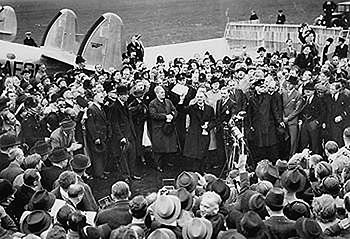 In 1937 Stanley Baldwin
resigned as Prime Minister and Neville Chamberlain took over. Chamberlain pursued a policy of appeasement and rearmament. Chamberlain's reputation for appeasement rests in large measure on his negotiations with Hitler over Czechoslovakia
in 1938.
and the First Austrian Republic
included the aim of unification, which was supported by democratic parties. However, the rise of Hitler dampened the enthusiasm of the Austrian government for such a plan. Hitler had promoted a pan-German Reich from the beginning of his career and stated in Mein Kampf
(1924) that he would attempt a union with Austria, by force if necessary. By early 1938, Hitler had consolidated his power in Germany and was ready to implement this long-held plan.
The Austrian Chancellor Kurt Schuschnigg
wished to pursue ties with Italy, but turned to Czechoslovakia, Yugoslavia and Romania (the Little Entente
). To this Hitler took violent exception. In January 1938 the Austrian Nazis
attempted a putsch, following which some were imprisoned. Hitler summoned Schuschnigg to Berchtesgaden in February and demanded, with the threat of military action, that he release imprisoned Austrian Nazis and allow them participate in the government. Schuschnigg complied and appointed Arthur Seyss-Inquart
, a pro-Nazi lawyer, as interior minister
. To forestall Hitler and to preserve Austria's independence, Schuschnigg scheduled a plebiscite on the issue for 13 March. Hitler demanded that the plebiscite be canceled. The German ministry of propaganda issued press reports that riots had broken out in Austria and that large parts of the Austrian population were calling for German troops to restore order. On 11 March, Hitler sent an ultimatum to Schuschnigg, demanding that he hand over all power to the Austrian Nazis or face an invasion. The British Ambassador in Berlin registered a protest with the German Government against the use of coercion against Austria. Schuschnigg, realizing that neither France nor the United Kingdom would actively support him, resigned in favour of Seyss-Inquart, who then appealed to German troops to restore order. On 12 March the 8th Army of the German Wehrmacht crossed the Austrian border. They met no resistance and were greeted by cheering Austrians. This invasion was the first major test of the Wehrmacht's machinery. Austria became the German province of Ostmark
, with Seyss-Inquart as governor. A plebiscite was held on 10 April and officially recorded a support of 99.73 percent of the voters.
Although the victorious Allies of World War I
had prohibited the union of Austria and Germany, their reaction to the Anschluss was mild. Even the strongest voices against annexation, particularly those of Fascist Italy, France and Britain (the "Stresa Front
") were not backed by force. In the House of Commons Chamberlain said that "The hard fact is that nothing could have arrested what has actually happened [in Austria] unless this country and other countries had been prepared to use force." The American reaction was similar. The international reaction to the events of 12 March 1938 led Hitler to conclude that he could use even more aggressive tactics in his plan to expand the Third Reich. The Anschluss paved the way for Munich in September 1938 because it indicated the likely non-response of Britain and France to future German aggression. Again, it must be remembered that the whole world was knee-deep in economic depression at this time, and the allies of World War I were in no condition to advance militarily on anyone. Across the Atlantic, the United States had its own economic woes, not the least of which was mass unemployment. Further, and perhaps most important, Americans were in no mood to go to war again over European "squabbles" over boundaries or ethnic governments.
was created, including the Sudetenland
, which had a majority German population. In April 1938, Sudeten Nazis, led by Konrad Henlein
, agitated for autonomy. Chamberlain, faced with the danger of a German invasion, warned Hitler that Britain might intervene. Hitler ordered an attack on Czechoslovakia. Lord Runciman was sent by Chamberlain to mediate in Prague and persuaded the Czech government to grant the Sudeten virtual autonomy. Henlein broke off negotiations and Hitler railed against Prague.
In September, Chamberlain flew to Berchtesgaden
to negotiate directly with Hitler, hoping to avoid war. Hitler now demanded that the Sudetenland should be absorbed into Germany, convincing Chamberlain that refusal meant war. Chamberlain, with France, told the Czech president that he must hand to Germany all territory with a German majority. Czechoslovakia would thus lose 800,000 citizens, much of its industry and its mountain defences in the west. In effect, the British and French pressed their ally to cede territory to a hostile neighbour to prevent annihilation.
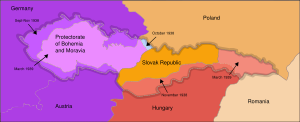
Hitler then informed Chamberlain that Germany was about to occupy the Sudetenland and that the Czechoslovaks had to move out. The Czechoslovaks rejected the demand, as did the British and the French. Mussolini persuaded Hitler to put the dispute to a four-power conference. Czechoslovakia was not to be a party to these talks. On 29 September, Hitler, Chamberlain, Édouard Daladier
(the French Prime Minister) and Mussolini met in Munich. They agreed that Germany would complete its occupation of the Sudetenland, but an international commission would consider other disputed areas. Czechoslovakia was told that if it did not submit, it would stand alone. At Chamberlain's request, Hitler signed a peace treaty between the United Kingdom and Germany. Chamberlain returned to Britain promising "peace for our time". In March 1939, Chamberlain foresaw a possible disarmament conference between himself, Daladier, Hitler, Mussolini and Joseph Stalin
; his home secretary
, Samuel Hoare, said, "These five men, working together in Europe and blessed in their efforts by the President of the United States of America, might make themselves eternal benefactors of the human race." That month, Czechoslovakia ceased to exist, divided among Germany, Hungary
, Poland, and an independent Slovakia
.
 The failure of Munich precipitated a shift in policy and Chamberlain set in place preparations for war, including an expansion of civil defence. In March 1939 Chamberlain assured the Poles
that Britain would support them if their independence was threatened. In April, Hitler began to make demands on the free city of Danzig (now Gdansk
). Britain's assurance to Poland became a formal treaty in August, but the Foreign Secretary Lord Halifax urged the Poles to negotiate with Hitler and pressed them to give up Danzig. On 1 September Hitler invaded Poland and on 3 September Britain declared war on Germany. In October, Chamberlain rejected Hitler's offer of peace.
Chamberlain's conduct of the war was not popular and on 10th May 1940 Winston Churchill
became Prime Minister. In July, some politicians inside and outside the government were still willing to consider Hitler's peace offer, but Churchill would not. Chamberlain died on 9 November the same year. Churchill delivered a tribute to him in which he said, "Whatever else history may or may not say about these terrible, tremendous years, we can be sure that Neville Chamberlain acted with perfect sincerity according to his lights and strove to the utmost of his capacity and authority, which were powerful, to save the world from the awful, devastating struggle in which we are now engaged."
Most Conservative politicians were in favour of appeasement, though Churchill said their supporters were divided. It was accepted by most of those responsible for British foreign policy in the 1930s and by leading journalists and academics - even by members of the royal family, such as Edward VIII
and his successor, George VI
.
Churchill was unusual in believing that Germany menaced freedom and democracy and should be resisted over Czechoslovakia. A week before Munich he warned, "The partition of Czechoslovakia under pressure from England and France amounts to the complete surrender of the Western Democracies to the Nazi threat of force. Such a collapse will bring peace or security neither to England nor to France." But Churchill's leadership of Britain during the war and his role in creating the post-war consensus
against appeasement has tended to obscure the fact that "his contemporary criticism of totalitarian regimes other than Hitler's Germany was at best muted". Not until May 1938 did he begin "consistently to withhold his support from the National Government's conduct of foreign policy in the division lobbies of the House of Commons", and he seems "to have been convinced by the Sudeten German leader, Henlein, in the spring of 1938, that a satisfactory settlement could be reached if Britain managed to persuade the Czech government to make concessions to the German minority."
The Labour Party opposed the Fascist dictators on principle but until the late 1930s it also opposed re-armament and it had a significant pacifist
wing. In 1935 its non-pacifist wing persuaded its pacifist leader George Lansbury
to resign, to be replaced by Clement Attlee
, and in 1937 Ernest Bevin
and Hugh Dalton
persuaded the party to oppose appeasement.
Czechoslovakia did not concern most people until the middle of September 1938, when they began to object to a small democratic state being bullied. Nevertheless, the initial response of the British public to the Munich agreement was generally favourable. As Chamberlain left for Munich in 1938, the whole House of Commons cheered him noisily. On 30 September, on his return to Britain, Chamberlain delivered his famous "peace for our time" speech to delighted crowds. He was invited by the royal family on to the balcony at Buckingham Palace before he had reported to Parliament. The agreement was supported by most of the press, only Reynold's News
and the Daily Worker
dissenting. In parliament the Labour Party opposed the agreement. Some Conservatives abstained in the vote. The Conservative Duff Cooper
, who had resigned from the government in protest against the agreement, was the only MP to advocate war.
The journalist Shiela Grant Duff
's Penguin
Special, Europe and the Czechs was published and distributed to every MP on the day that Chamberlain returned from Munich. Her book was a spirited defence of the Czech nation and a detailed criticism of British policy, confronting the need for war if necessary. It was influential and widely read. Although she argued against the policy of "peace at almost any price" she never actually used the word "appeasement" and did not take the personal tone that Guilty Men
was to take two years later.
A few on the left said that that Chamberlain looked forward to a war between Germany and Russia. The Labour Party Leader Clement Attlee
claimed in one political speech in 1937 that the National Government had connived at German rearmament "because of its hatred of Russia." British Communists, following the Party line defined by Joseph Stalin
, argued that appeasement had been a pro-fascist policy and that the British ruling class would have preferred fascism to socialism. The Communist MP Willie Gallacher
said "that many prominent representatives of the Conservative Party, speaking for powerful landed and financial interests in the country, would welcome Hitler and the German Army if they believed that such was the only alternative to the establishment of Socialism in this country." This view has persisted on the far-left.
Once war broke out, appeasement was blamed for the failure to stop the dictators. The Labour MP Hugh Dalton
identified the policy with wealthy people in the City of London, Conservatives and members of the peerage
who were soft on Hitler. The entry of Churchill as Prime Minister hardened opinion against appeasement and encouraged the search for those responsible. Three British journalists, Michael Foot
, Frank Owen
and Peter Howard
, writing under the name of "Cato" in their book Guilty Men
, called for the removal from office of fifteen public figures they held accountable, including Chamberlain and Baldwin. The book defined appeasement as the "deliberate surrender of small nations in the face of Hitler's blatant bullying." It was hastily written and has few claims to historical scholarship, but Guilty Men shaped subsequent thinking about appeasement and it is said that it contributed to the defeat of the Conservatives in the 1945 general election
.
The change in the meaning of "appeasement" after Munich was summarised later by the historian David Dilks: "The word in its normal meaning connotes the pacific settlement of disputes; in the meaning usually applied to the period of Neville Chamberlain premiership, it has come to indicate something sinister, the granting from fear or cowardice of unwarranted concessions in order to buy temporary peace at someone else's expense."
Historians have subsequently explained Chamberlain's policies in various ways. It could be said that he believed sincerely that the objectives of Hitler and Mussolini were limited and that the settlement of their grievances would protect the world from war; for safety, military and air power should be strengthened. Many have judged this belief to be fallacious, since the dictators' demands were not limited and appeasement gave them time to gain greater strength.
In 1961 this view of appeasement as avoidable error and cowardice was set on its head by A.J.P. Taylor in his book
The Origins of the Second World War. Taylor argued that Hitler did not have a blueprint for war and was behaving much as any other German leader might have done. Appeasement was an active policy, and not a passive one; allowing Hitler to consolidate himself was a policy implemented by "men confronted with real problems, doing their best in the circumstances of their time". Taylor said that appeasement ought to be seen as a rational response to an unpredictable leader, appropriate to the time both diplomatically and politically.
His view has been shared by other historians, for example, Paul Kennedy
, who says of the choices facing politicians at the time, "Each course brought its share of disadvantages: there was only a choice of evils. The crisis in the British global position by this time was such that it was, in the last resort, insoluble, in the sense that there was no good or proper solution." Martin Gilbert
has expressed a similar view: "At bottom, the old appeasement was a mood of hope, Victorian in its optimism, Burkean in its belief that societies evolved from bad to good and that progress could only be for the better. The new appeasement was a mood of fear, Hobbesian in its insistence upon swallowing the bad in order to preserve some remnant of the good, pessimistic in its belief that Nazism was there to stay and, however horrible it might be, should be accepted as a way of life with which Britain ought to deal."
The arguments in Taylor's Origins of the Second World War (sometimes described as "revisionist") were rejected by many historians at the time and reviews of his book in Britain and the United States were generally critical. Nevertheless, he was praised for some of his insights. By showing that appeasement was a popular policy and that there was continuity in British foreign policy after 1933, he shattered the common view of the appeasers as a small, degenerate clique that had mysteriously hijacked the British government sometime in the 1930s and who had carried out their policies in the face of massive public resistance; and by portraying the leaders of the 1930s as real people attempting to deal with real problems, he made the first strides towards attempting to explain the actions of the appeasers rather than merely to condemn them.
In the early 1990s a new theory of appeasement, sometimes called "counter-revisionist", emerged as historians argued that appeasement was probably the only choice for the British government in the 1930s, but that it was poorly implemented, carried out too late and not enforced strongly enough to constrain Hitler. Appeasement was considered a viable policy, considering the strains that the British Empire faced in recuperating from World War I, and Chamberlain was said to have adopted a policy suitable to Britain's cultural and political needs. Frank McDonough
is a leading proponent of this view of appeasement and describes his book Neville Chamberlain, Appeasement and the British Road to War as a "post revisionist" study. Appeasement was a crisis management strategy seeking a peaceful settlement of Hitler's grievances. "Chamberlain's worst error," says McDonough, "was to believe that he could march Hitler on the yellow brick road to peace when in reality Hitler was marching very firmly on the road to war." He has criticised revisionist historians for concentrating on Chamberlain's motivations rather than how appeasement worked in practice – as a "usable policy" to deal with Hitler. James P. Levy argues against the outright condemnation of appeasement. "Knowing what Hitler did later," he writes, "the critics of Appeasement condemn the men who tried to keep the peace in the 1930s, men who could not know what would come later. ... The political leaders responsible for Appeasement made many errors. They were not blameless. But what they attempted was logical, rational, and humane."
U.S. President Harry S. Truman
thus explained his decision to enter the Korean War
in 1950, British Prime Minister Anthony Eden
his confrontation of Egypt
ian President
Gamal Abdel Nasser
in the Suez Crisis
of 1956, U.S. President John F. Kennedy
his "quarantine
" of Cuba
in 1962, U.S. President Lyndon B. Johnson
his resistance
to communism
in Indochina
in the 1960s, and U.S. President Ronald Reagan
his air strike on Libya
in 1986. British Prime Minister Margaret Thatcher
invoked the example of Churchill during the Falklands War
of 1982: "When the American Secretary of State
, Alexander Haig
, urged her to reach a compromise with the Argentines
she rapped sharply on the table and told him, pointedly, 'that this was the table at which Neville Chamberlain sat in 1938 and spoke of the Czechs as a faraway people about whom we know so little'." The spectre of appeasement was raised in discussions of the Yugoslav wars
of the 1990s. U.S. President George W. Bush
and British Prime Minister Tony Blair
also cited Churchill's warnings about German rearmament to justify their action in the run-up to the 2003 Iraq War. In May 2008, President Bush cautioned against "the false comfort of appeasement" when dealing with Iran
and its President
, Mahmoud Ahmadinejad. Dutch politician Ayaan Hirsi Ali
demands a confrontational policy at the European level to meet the threat of radical Islam, and compares policies of non-confrontation to Neville Chamberlain's appeasement of Hitler.
Paul Kennedy
Paul Michael Kennedy CBE, FBA , is a British historian at Yale University specialising in the history of international relations, economic power and grand strategy. He has published prominent books on the history of British foreign policy and Great Power struggles...
defines it as "the policy of settling international quarrels by admitting and satisfying grievances through rational negotiation and compromise, thereby avoiding the resort to an armed conflict which would be expensive, bloody, and possibly dangerous." Kennedy's definition has been widely cited by scholars. Appeasement was used by European democracies in the 1930s who wished to avoid war with the dictatorships of Germany and Italy, bearing in mind the horrors of the First World War.
The term is most often applied to the foreign policy of British Prime Minister Neville Chamberlain
Neville Chamberlain
Arthur Neville Chamberlain FRS was a British Conservative politician who served as Prime Minister of the United Kingdom from May 1937 to May 1940. Chamberlain is best known for his appeasement foreign policy, and in particular for his signing of the Munich Agreement in 1938, conceding the...
towards Nazi Germany
Nazi Germany
Nazi Germany , also known as the Third Reich , but officially called German Reich from 1933 to 1943 and Greater German Reich from 26 June 1943 onward, is the name commonly used to refer to the state of Germany from 1933 to 1945, when it was a totalitarian dictatorship ruled by...
between 1937 and 1939. His policies of avoiding war with Germany have been the subject of intense debate for seventy years among academics, politicians and diplomats. The historian's assessment of Chamberlain has ranged from condemnation for allowing Hitler to grow too strong, to the judgement that he had no alternative and acted in Britain's best interests. At the time, these concessions were widely seen as positive, and the Munich Pact among Germany, Great Britain, France and Italy prompted Chamberlain to announce that he had secured "peace for our time".
The word "appeasement" has been used as a synonym for weakness and even cowardice since the 1930s, and it is still used in that sense to denounce policies and behaviors that conflict with firm, often armed, action in international relations.
The aftermath of the First World War
Chamberlain's policy of appeasement emerged out of the failure of the League of NationsLeague of Nations
The League of Nations was an intergovernmental organization founded as a result of the Paris Peace Conference that ended the First World War. It was the first permanent international organization whose principal mission was to maintain world peace...
and the failure of collective security
Collective security
Collective security can be understood as a security arrangement, regional or global, in which each state in the system accepts that the security of one is the concern of all, and agrees to join in a collective response to threats to, and breaches of, the peace...
. The League of Nations was set up in the aftermath of the First World War in the hope that international cooperation and collective resistance to aggression might prevent another war. Members of the League were entitled to the assistance of other members if they came under attack. The policy of collective security ran in parallel with measures to achieve international disarmament and where possible was to be based on economic sanctions against an aggressor. It appeared to be ineffectual when confronted by the aggression of dictators, notably Germany's occupation
Remilitarization of the Rhineland
The Remilitarization of the Rhineland by the German Army took place on 7 March 1936 when German military forces entered the Rhineland. This was significant because it violated the terms of the Locarno Treaties and was the first time since the end of World War I that German troops had been in this...
of the Rhineland
Rhineland
Historically, the Rhinelands refers to a loosely-defined region embracing the land on either bank of the River Rhine in central Europe....
, and Italian
Kingdom of Italy (1861–1946)
The Kingdom of Italy was a state forged in 1861 by the unification of Italy under the influence of the Kingdom of Sardinia, which was its legal predecessor state...
leader Benito Mussolini
Benito Mussolini
Benito Amilcare Andrea Mussolini was an Italian politician who led the National Fascist Party and is credited with being one of the key figures in the creation of Fascism....
's invasion
Second Italo-Abyssinian War
The Second Italo–Abyssinian War was a colonial war that started in October 1935 and ended in May 1936. The war was fought between the armed forces of the Kingdom of Italy and the armed forces of the Ethiopian Empire...
of Abyssinia
Ethiopia
Ethiopia , officially known as the Federal Democratic Republic of Ethiopia, is a country located in the Horn of Africa. It is the second-most populous nation in Africa, with over 82 million inhabitants, and the tenth-largest by area, occupying 1,100,000 km2...
.
Invasion of Manchuria
In September 1931, Japan, a member of the League of Nations, invaded Manchuria, an autonomous region claimed by China. China appealed to the League and the United States for assistance. The Council of the League asked the parties to withdraw to their original positions to permit a peaceful settlement. The United States reminded them of their duty under the Kellogg-Briand PactKellogg-Briand Pact
The Kellogg–Briand Pact was an agreement signed on August 27, 1928, by the United States, France, the United Kingdom, Italy, Japan, Weimar Germany and a number of other countries.The pact renounced war , prohibiting the use of war...
to settle matters peacefully. Japan was undeterred and went on to occupy the whole of Manchuria. The League set up a commission of inquiry that condemned Japan, the League duly adopting the report in February 1933. Japan resigned from the League and continued its advance into China. Neither the League nor the United States took any action. "Their inactivity and ineffectualness in the Far East lent every encouragement to European aggressors who planned similar acts of defiance." However the U.S. issues the Stimson Doctrine
Stimson Doctrine
The Stimson Doctrine is a policy of the United States federal government, enunciated in a note of January 7, 1932, to Japan and China, of non-recognition of international territorial changes that were executed by force. The doctrine was an application of the principle of ex injuria jus non oritur...
and refused to recognize Japan's conquest and it played a role in shifting U.S. policy to favor China over Japan late in the 1930s.
Remilitarization of the Rhineland
Under the Versailles SettlementParis Peace Conference, 1919
The Paris Peace Conference was the meeting of the Allied victors following the end of World War I to set the peace terms for the defeated Central Powers following the armistices of 1918. It took place in Paris in 1919 and involved diplomats from more than 32 countries and nationalities...
, the Rhineland
Rhineland
Historically, the Rhinelands refers to a loosely-defined region embracing the land on either bank of the River Rhine in central Europe....
was demilitarized. Germany accepted this arrangement under the Locarno Treaties
Locarno Treaties
The Locarno Treaties were seven agreements negotiated at Locarno, Switzerland, on 5 October – 16 October 1925 and formally signed in London on 3 December, in which the First World War Western European Allied powers and the new states of central and Eastern Europe sought to secure the post-war...
of 1925. Hitler claimed that it threatened Germany and on 7 March 1936 he sent German forces into the Rhineland. He gambled on Britain not getting involved but was unsure how France would react. The action was opposed by many of his advisers. His officers had orders to withdraw if they met French resistance. France
French Third Republic
The French Third Republic was the republican government of France from 1870, when the Second French Empire collapsed due to the French defeat in the Franco-Prussian War, to 1940, when France was overrun by Nazi Germany during World War II, resulting in the German and Italian occupations of France...
consulted Britain and lodged protests with the League, but took no action. Prime Minister Stanley Baldwin
Stanley Baldwin
Stanley Baldwin, 1st Earl Baldwin of Bewdley, KG, PC was a British Conservative politician, who dominated the government in his country between the two world wars...
said that Britain lacked the forces to back its guarantees to France and that public opinion would not allow it. In Britain it was thought that the Germans were merely walking into "their own back yard". Hugh Dalton
Hugh Dalton
Edward Hugh John Neale Dalton, Baron Dalton PC was a British Labour Party politician who served as Chancellor of the Exchequer from 1945 to 1947, when he was implicated in a political scandal involving budget leaks....
, a Labour Party
Labour Party (UK)
The Labour Party is a centre-left democratic socialist party in the United Kingdom. It surpassed the Liberal Party in general elections during the early 1920s, forming minority governments under Ramsay MacDonald in 1924 and 1929-1931. The party was in a wartime coalition from 1940 to 1945, after...
MP who usually advocated stiff resistance to Germany, said that neither the British people nor Labour would support military or economic sanctions. In the Council of the League, only the Soviet Union
Soviet Union
The Soviet Union , officially the Union of Soviet Socialist Republics , was a constitutionally socialist state that existed in Eurasia between 1922 and 1991....
proposed sanctions against Germany. Hitler was invited to negotiate. He proposed a non-aggression pact with the Western powers. When asked for details he did not reply. Hitler's occupation of the Rhineland had persuaded him that the international community would not resist him and put Germany in a powerful strategic position.
Abyssinia crisis
Mussolini had imperial ambitions in Abyssinia. Italy was already in possession of neighbouring EritreaHistory of Eritrea
Eritrea is an ancient name, associated in the past with its Greek form Erythraía , and its derived Latin form Erythræa. This name relates to that of the Red Sea, then called the Erythræan Sea, from the Greek for "red", ἐρυθρος). The Italians created the colony of Eritrea in the 19th century around...
and Somalia
History of Somalia
Somalia , officially the Republic of Somalia and formerly known as the Somali Democratic Republic, is a country located in the Horn of Africa. It is bordered by Djibouti to the northwest, Kenya on its southwest, the Gulf of Aden with Yemen on its north, the Indian Ocean at its east, and Ethiopia...
. In December 1934 there was a clash between Italian and Abyssinian troops at Walwal, near the border between British and Italian Somaliland, in which Italian troops took possession of the disputed territory and in which 150 Abyssinians and 50 Italians were killed. When Italy demanded apologies and compensation from Abyssinia, Abyssinia appealed to the League. The League persuaded both sides to seek a settlement under a friendship treaty they had signed in 1928, but Italy continued troop movements and Abyssinia appealed to the League again. In October 1935 Mussolini launched an attack on Abyssinia. The League declared Italy to be the aggressor and imposed sanctions, but coal and oil were not included; blocking these, it was thought, would provoke war. Albania, Austria and Hungary refused to apply sanctions; Germany and the United States were not in the League. Nevertheless, the Italian economy suffered.
In April 1935 Italy had joined Britain and France in protesting against Germany's rearmament. France was anxious to placate Mussolini so as to keep him away from an alliance with Germany. Britain was less hostile to Germany, set the pace in imposing sanctions and moved a naval fleet into the Mediterranean. But in November 1935, the British Foreign Secretary, Sir Samuel Hoare and the French Prime Minister, Pierre Laval
Pierre Laval
Pierre Laval was a French politician. He was four times President of the council of ministers of the Third Republic, twice consecutively. Following France's Armistice with Germany in 1940, he served twice in the Vichy Regime as head of government, signing orders permitting the deportation of...
, had secret discussions in which they agreed to concede two-thirds of Abyssinia to Italy. However, following a press leak of the content of the discussions, a public outcry forced Hoare and Laval to resign. In May 1936, undeterred by sanctions, Italy captured Addis Ababa
Addis Ababa
Addis Ababa is the capital city of Ethiopia...
, the Abyssinian capital, and proclaimed Victor Emmanuel III the Emperor of Ethiopia
Ethiopia
Ethiopia , officially known as the Federal Democratic Republic of Ethiopia, is a country located in the Horn of Africa. It is the second-most populous nation in Africa, with over 82 million inhabitants, and the tenth-largest by area, occupying 1,100,000 km2...
. In July the League abandoned sanctions. This episode, in which sanctions were incomplete and appeared to be easily given up, seriously discredited the League.
The conduct of appeasement, 1937–39
Stanley Baldwin
Stanley Baldwin, 1st Earl Baldwin of Bewdley, KG, PC was a British Conservative politician, who dominated the government in his country between the two world wars...
resigned as Prime Minister and Neville Chamberlain took over. Chamberlain pursued a policy of appeasement and rearmament. Chamberlain's reputation for appeasement rests in large measure on his negotiations with Hitler over Czechoslovakia
German occupation of Czechoslovakia
German occupation of Czechoslovakia began with the Nazi annexation of Czechoslovakia's northern and western border regions, known collectively as the Sudetenland, under terms outlined by the Munich Agreement. Nazi leader Adolf Hitler's pretext for this effort was the alleged privations suffered by...
in 1938.
The Anschluss
When the German and Austro-Hungarian empires were broken up in 1918, the victors vetoed the inclusion of Austria within a German state, but many German-speaking Austrians wished to join Germany in the realignment of Europe. The constitutions of both the Weimar RepublicWeimar Republic
The Weimar Republic is the name given by historians to the parliamentary republic established in 1919 in Germany to replace the imperial form of government...
and the First Austrian Republic
First Austrian Republic
The Republic of Austria encompasses the period of Austrian history following the signing of the Treaty of Saint-Germain-en-Laye of September 1919, the settlement after the end of World War I which put an end to the Republic of German Austria, continuing up to World War II...
included the aim of unification, which was supported by democratic parties. However, the rise of Hitler dampened the enthusiasm of the Austrian government for such a plan. Hitler had promoted a pan-German Reich from the beginning of his career and stated in Mein Kampf
Mein Kampf
Mein Kampf is a book written by Nazi leader Adolf Hitler. It combines elements of autobiography with an exposition of Hitler's political ideology. Volume 1 of Mein Kampf was published in 1925 and Volume 2 in 1926...
(1924) that he would attempt a union with Austria, by force if necessary. By early 1938, Hitler had consolidated his power in Germany and was ready to implement this long-held plan.
The Austrian Chancellor Kurt Schuschnigg
Kurt Schuschnigg
Kurt Alois Josef Johann Schuschnigg was Chancellor of the First Austrian Republic, following the assassination of his predecessor, Dr. Engelbert Dollfuss, in July 1934, until Germany’s invasion of Austria, , in March 1938...
wished to pursue ties with Italy, but turned to Czechoslovakia, Yugoslavia and Romania (the Little Entente
Little Entente
The Little Entente was an alliance formed in 1920 and 1921 by Czechoslovakia, Romania and Yugoslavia with the purpose of common defense against Hungarian revision and the prevention of a Habsburg restoration...
). To this Hitler took violent exception. In January 1938 the Austrian Nazis
Austrian National Socialism
Austrian National Socialism was a Pan-German movement that was formed at the beginning of the 20th century. The movement took a concrete form on November 15, 1903 when the German Worker's Party was established in Austria with its secretariat stationed in the town of Aussig...
attempted a putsch, following which some were imprisoned. Hitler summoned Schuschnigg to Berchtesgaden in February and demanded, with the threat of military action, that he release imprisoned Austrian Nazis and allow them participate in the government. Schuschnigg complied and appointed Arthur Seyss-Inquart
Arthur Seyss-Inquart
Arthur Seyss-Inquart was a Chancellor of Austria, lawyer and later Nazi official in pre-Anschluss Austria, the Third Reich and for wartime Germany in Poland and the Netherlands...
, a pro-Nazi lawyer, as interior minister
Interior minister
An interior ministry is a government ministry typically responsible for policing, national security, and immigration matters. The ministry is often headed by a minister of the interior or minister of home affairs...
. To forestall Hitler and to preserve Austria's independence, Schuschnigg scheduled a plebiscite on the issue for 13 March. Hitler demanded that the plebiscite be canceled. The German ministry of propaganda issued press reports that riots had broken out in Austria and that large parts of the Austrian population were calling for German troops to restore order. On 11 March, Hitler sent an ultimatum to Schuschnigg, demanding that he hand over all power to the Austrian Nazis or face an invasion. The British Ambassador in Berlin registered a protest with the German Government against the use of coercion against Austria. Schuschnigg, realizing that neither France nor the United Kingdom would actively support him, resigned in favour of Seyss-Inquart, who then appealed to German troops to restore order. On 12 March the 8th Army of the German Wehrmacht crossed the Austrian border. They met no resistance and were greeted by cheering Austrians. This invasion was the first major test of the Wehrmacht's machinery. Austria became the German province of Ostmark
Austria
Austria , officially the Republic of Austria , is a landlocked country of roughly 8.4 million people in Central Europe. It is bordered by the Czech Republic and Germany to the north, Slovakia and Hungary to the east, Slovenia and Italy to the south, and Switzerland and Liechtenstein to the...
, with Seyss-Inquart as governor. A plebiscite was held on 10 April and officially recorded a support of 99.73 percent of the voters.
Although the victorious Allies of World War I
Allies of World War I
The Entente Powers were the countries at war with the Central Powers during World War I. The members of the Triple Entente were the United Kingdom, France, and the Russian Empire; Italy entered the war on their side in 1915...
had prohibited the union of Austria and Germany, their reaction to the Anschluss was mild. Even the strongest voices against annexation, particularly those of Fascist Italy, France and Britain (the "Stresa Front
Stresa Front
The Stresa Front was an agreement made in Stresa, a town on the banks of Lake Maggiore in Italy, between French foreign minister Pierre Laval, British prime minister Ramsay MacDonald, and Italian prime minister Benito Mussolini on April 14, 1935...
") were not backed by force. In the House of Commons Chamberlain said that "The hard fact is that nothing could have arrested what has actually happened [in Austria] unless this country and other countries had been prepared to use force." The American reaction was similar. The international reaction to the events of 12 March 1938 led Hitler to conclude that he could use even more aggressive tactics in his plan to expand the Third Reich. The Anschluss paved the way for Munich in September 1938 because it indicated the likely non-response of Britain and France to future German aggression. Again, it must be remembered that the whole world was knee-deep in economic depression at this time, and the allies of World War I were in no condition to advance militarily on anyone. Across the Atlantic, the United States had its own economic woes, not the least of which was mass unemployment. Further, and perhaps most important, Americans were in no mood to go to war again over European "squabbles" over boundaries or ethnic governments.
The Munich Agreement
Under the Versailles Settlement, CzechoslovakiaHistory of Czechoslovakia
With the collapse of the Habsburg monarchy at the end of World War I, the independent country of Czechoslovakia was formed, encouraged by, among others, U.S. President Woodrow Wilson...
was created, including the Sudetenland
Sudetenland
Sudetenland is the German name used in English in the first half of the 20th century for the northern, southwest and western regions of Czechoslovakia inhabited mostly by ethnic Germans, specifically the border areas of Bohemia, Moravia, and those parts of Silesia being within Czechoslovakia.The...
, which had a majority German population. In April 1938, Sudeten Nazis, led by Konrad Henlein
Konrad Henlein
Konrad Ernst Eduard Henlein was a leading pro-Nazi ethnic German politician in Czechoslovakia and leader of Sudeten German separatists...
, agitated for autonomy. Chamberlain, faced with the danger of a German invasion, warned Hitler that Britain might intervene. Hitler ordered an attack on Czechoslovakia. Lord Runciman was sent by Chamberlain to mediate in Prague and persuaded the Czech government to grant the Sudeten virtual autonomy. Henlein broke off negotiations and Hitler railed against Prague.
In September, Chamberlain flew to Berchtesgaden
Berchtesgaden
Berchtesgaden is a municipality in the German Bavarian Alps. It is located in the south district of Berchtesgadener Land in Bavaria, near the border with Austria, some 30 km south of Salzburg and 180 km southeast of Munich...
to negotiate directly with Hitler, hoping to avoid war. Hitler now demanded that the Sudetenland should be absorbed into Germany, convincing Chamberlain that refusal meant war. Chamberlain, with France, told the Czech president that he must hand to Germany all territory with a German majority. Czechoslovakia would thus lose 800,000 citizens, much of its industry and its mountain defences in the west. In effect, the British and French pressed their ally to cede territory to a hostile neighbour to prevent annihilation.
Hitler then informed Chamberlain that Germany was about to occupy the Sudetenland and that the Czechoslovaks had to move out. The Czechoslovaks rejected the demand, as did the British and the French. Mussolini persuaded Hitler to put the dispute to a four-power conference. Czechoslovakia was not to be a party to these talks. On 29 September, Hitler, Chamberlain, Édouard Daladier
Édouard Daladier
Édouard Daladier was a French Radical politician and the Prime Minister of France at the start of the Second World War.-Career:Daladier was born in Carpentras, Vaucluse. Later, he would become known to many as "the bull of Vaucluse" because of his thick neck and large shoulders and determined...
(the French Prime Minister) and Mussolini met in Munich. They agreed that Germany would complete its occupation of the Sudetenland, but an international commission would consider other disputed areas. Czechoslovakia was told that if it did not submit, it would stand alone. At Chamberlain's request, Hitler signed a peace treaty between the United Kingdom and Germany. Chamberlain returned to Britain promising "peace for our time". In March 1939, Chamberlain foresaw a possible disarmament conference between himself, Daladier, Hitler, Mussolini and Joseph Stalin
Joseph Stalin
Joseph Vissarionovich Stalin was the Premier of the Soviet Union from 6 May 1941 to 5 March 1953. He was among the Bolshevik revolutionaries who brought about the October Revolution and had held the position of first General Secretary of the Communist Party of the Soviet Union's Central Committee...
; his home secretary
Home Secretary
The Secretary of State for the Home Department, commonly known as the Home Secretary, is the minister in charge of the Home Office of the United Kingdom, and one of the country's four Great Offices of State...
, Samuel Hoare, said, "These five men, working together in Europe and blessed in their efforts by the President of the United States of America, might make themselves eternal benefactors of the human race." That month, Czechoslovakia ceased to exist, divided among Germany, Hungary
Hungary
Hungary , officially the Republic of Hungary , is a landlocked country in Central Europe. It is situated in the Carpathian Basin and is bordered by Slovakia to the north, Ukraine and Romania to the east, Serbia and Croatia to the south, Slovenia to the southwest and Austria to the west. The...
, Poland, and an independent Slovakia
Slovakia
The Slovak Republic is a landlocked state in Central Europe. It has a population of over five million and an area of about . Slovakia is bordered by the Czech Republic and Austria to the west, Poland to the north, Ukraine to the east and Hungary to the south...
.
Outbreak of war
Poland
Poland , officially the Republic of Poland , is a country in Central Europe bordered by Germany to the west; the Czech Republic and Slovakia to the south; Ukraine, Belarus and Lithuania to the east; and the Baltic Sea and Kaliningrad Oblast, a Russian exclave, to the north...
that Britain would support them if their independence was threatened. In April, Hitler began to make demands on the free city of Danzig (now Gdansk
Gdansk
Gdańsk is a Polish city on the Baltic coast, at the centre of the country's fourth-largest metropolitan area.The city lies on the southern edge of Gdańsk Bay , in a conurbation with the city of Gdynia, spa town of Sopot, and suburban communities, which together form a metropolitan area called the...
). Britain's assurance to Poland became a formal treaty in August, but the Foreign Secretary Lord Halifax urged the Poles to negotiate with Hitler and pressed them to give up Danzig. On 1 September Hitler invaded Poland and on 3 September Britain declared war on Germany. In October, Chamberlain rejected Hitler's offer of peace.
Chamberlain's conduct of the war was not popular and on 10th May 1940 Winston Churchill
Winston Churchill
Sir Winston Leonard Spencer-Churchill, was a predominantly Conservative British politician and statesman known for his leadership of the United Kingdom during the Second World War. He is widely regarded as one of the greatest wartime leaders of the century and served as Prime Minister twice...
became Prime Minister. In July, some politicians inside and outside the government were still willing to consider Hitler's peace offer, but Churchill would not. Chamberlain died on 9 November the same year. Churchill delivered a tribute to him in which he said, "Whatever else history may or may not say about these terrible, tremendous years, we can be sure that Neville Chamberlain acted with perfect sincerity according to his lights and strove to the utmost of his capacity and authority, which were powerful, to save the world from the awful, devastating struggle in which we are now engaged."
Changing attitudes to appeasement
As the policy of appeasement failed to prevent war, those who advocated it were quickly criticized. Appeasement came to be seen as something to be avoided by those with responsibility for the diplomacy of Britain or any other democratic country. By contrast, the few who stood out against appeasement were seen as "voices in the wilderness whose wise counsels were largely ignored, with almost catastrophic consequences for the nation in 1939–40". More recently, however, historians have questioned the accuracy of this simple distinction between appeasers and anti-appeasers. "Few appeasers were really prepared to seek peace at any price; few, if any, anti-appeasers were prepared for Britain to make a stand against aggression whatever the circumstances and wherever the location in which it occurred."After the First World War
Chamberlain's policy was in some respects a continuation of what had gone before and was popular until the failure of the Munich Agreement to stop Hitler in Czechoslovakia. "Appeasement" had been a respectable term between 1919 and 1937 to signify the pursuit of peace. Many believed after the First World War that wars were started by mistake, in which case the League could prevent them, or that they were caused by large-scale armaments, in which case disarmament was the remedy, or that they were caused by national grievances, in which case the grievances should be redressed peacefully. Many thought that the Versailles Settlement had been unjust, that the German minorities were entitled to self-determination and that Germany was entitled to equality in armaments.Most Conservative politicians were in favour of appeasement, though Churchill said their supporters were divided. It was accepted by most of those responsible for British foreign policy in the 1930s and by leading journalists and academics - even by members of the royal family, such as Edward VIII
Edward VIII of the United Kingdom
Edward VIII was King of the United Kingdom and the Dominions of the British Commonwealth, and Emperor of India, from 20 January to 11 December 1936.Before his accession to the throne, Edward was Prince of Wales and Duke of Cornwall and Rothesay...
and his successor, George VI
George VI of the United Kingdom
George VI was King of the United Kingdom and the Dominions of the British Commonwealth from 11 December 1936 until his death...
.
Churchill was unusual in believing that Germany menaced freedom and democracy and should be resisted over Czechoslovakia. A week before Munich he warned, "The partition of Czechoslovakia under pressure from England and France amounts to the complete surrender of the Western Democracies to the Nazi threat of force. Such a collapse will bring peace or security neither to England nor to France." But Churchill's leadership of Britain during the war and his role in creating the post-war consensus
Post-war consensus
The post-war consensus is a name given by historians to an era in British political history which lasted from the end of World War II in 1945 to the election of Margaret Thatcher as Prime Minister of the United Kingdom in 1979....
against appeasement has tended to obscure the fact that "his contemporary criticism of totalitarian regimes other than Hitler's Germany was at best muted". Not until May 1938 did he begin "consistently to withhold his support from the National Government's conduct of foreign policy in the division lobbies of the House of Commons", and he seems "to have been convinced by the Sudeten German leader, Henlein, in the spring of 1938, that a satisfactory settlement could be reached if Britain managed to persuade the Czech government to make concessions to the German minority."
The Labour Party opposed the Fascist dictators on principle but until the late 1930s it also opposed re-armament and it had a significant pacifist
Pacifism
Pacifism is the opposition to war and violence. The term "pacifism" was coined by the French peace campaignerÉmile Arnaud and adopted by other peace activists at the tenth Universal Peace Congress inGlasgow in 1901.- Definition :...
wing. In 1935 its non-pacifist wing persuaded its pacifist leader George Lansbury
George Lansbury
George Lansbury was a British politician, socialist, Christian pacifist and newspaper editor. He was a Member of Parliament from 1910 to 1912 and from 1922 to 1940, and leader of the Labour Party from 1932 to 1935....
to resign, to be replaced by Clement Attlee
Clement Attlee
Clement Richard Attlee, 1st Earl Attlee, KG, OM, CH, PC, FRS was a British Labour politician who served as the Prime Minister of the United Kingdom from 1945 to 1951, and as the Leader of the Labour Party from 1935 to 1955...
, and in 1937 Ernest Bevin
Ernest Bevin
Ernest Bevin was a British trade union leader and Labour politician. He served as general secretary of the powerful Transport and General Workers' Union from 1922 to 1945, as Minister of Labour in the war-time coalition government, and as Foreign Secretary in the post-war Labour Government.-Early...
and Hugh Dalton
Hugh Dalton
Edward Hugh John Neale Dalton, Baron Dalton PC was a British Labour Party politician who served as Chancellor of the Exchequer from 1945 to 1947, when he was implicated in a political scandal involving budget leaks....
persuaded the party to oppose appeasement.
Czechoslovakia did not concern most people until the middle of September 1938, when they began to object to a small democratic state being bullied. Nevertheless, the initial response of the British public to the Munich agreement was generally favourable. As Chamberlain left for Munich in 1938, the whole House of Commons cheered him noisily. On 30 September, on his return to Britain, Chamberlain delivered his famous "peace for our time" speech to delighted crowds. He was invited by the royal family on to the balcony at Buckingham Palace before he had reported to Parliament. The agreement was supported by most of the press, only Reynold's News
Reynold's News
Reynold's News was a Sunday newspaper in the United Kingdom.The paper was founded as Reynolds's Weekly Newspaper by George W. M. Reynolds in 1850, who became its first editor. By 1870, the paper was selling more than 350,000 copies per week...
and the Daily Worker
The Morning Star
The Morning Star is a left wing British daily tabloid newspaper with a focus on social and trade union issues. Articles and comment columns are contributed by writers from socialist, social democratic, green and religious perspectives....
dissenting. In parliament the Labour Party opposed the agreement. Some Conservatives abstained in the vote. The Conservative Duff Cooper
Duff Cooper
Alfred Duff Cooper, 1st Viscount Norwich GCMG, DSO, PC , known as Duff Cooper, was a British Conservative Party politician, diplomat and author. He wrote six books, including an autobiography, Old Men Forget, and a biography of Talleyrand...
, who had resigned from the government in protest against the agreement, was the only MP to advocate war.
The journalist Shiela Grant Duff
Shiela Grant Duff
Shiela Grant Duff was a British author and foreign correspondent.-Early years:The youngest daughter of Adrian Grant Duff and The Hon.Ursula Lubbock, Shiela Grant Duff was born in the Grosvenor Square home of her maternal grandfather, Sir John Lubbock on Whit Sunday...
's Penguin
Penguin Group
The Penguin Group is a trade book publisher, the largest in the world , having overtaken Random House in 2009. The Penguin Group is the name of the incorporated division of parent Pearson PLC that oversees these publishing operations...
Special, Europe and the Czechs was published and distributed to every MP on the day that Chamberlain returned from Munich. Her book was a spirited defence of the Czech nation and a detailed criticism of British policy, confronting the need for war if necessary. It was influential and widely read. Although she argued against the policy of "peace at almost any price" she never actually used the word "appeasement" and did not take the personal tone that Guilty Men
Guilty Men
Guilty Men was a book published in Great Britain in 1940 that attacked British public figures for their appeasement of Nazi Germany in the 1930s...
was to take two years later.
A few on the left said that that Chamberlain looked forward to a war between Germany and Russia. The Labour Party Leader Clement Attlee
Clement Attlee
Clement Richard Attlee, 1st Earl Attlee, KG, OM, CH, PC, FRS was a British Labour politician who served as the Prime Minister of the United Kingdom from 1945 to 1951, and as the Leader of the Labour Party from 1935 to 1955...
claimed in one political speech in 1937 that the National Government had connived at German rearmament "because of its hatred of Russia." British Communists, following the Party line defined by Joseph Stalin
Joseph Stalin
Joseph Vissarionovich Stalin was the Premier of the Soviet Union from 6 May 1941 to 5 March 1953. He was among the Bolshevik revolutionaries who brought about the October Revolution and had held the position of first General Secretary of the Communist Party of the Soviet Union's Central Committee...
, argued that appeasement had been a pro-fascist policy and that the British ruling class would have preferred fascism to socialism. The Communist MP Willie Gallacher
Willie Gallacher
William "Willie" Gallacher was a Scottish trade unionist, activist and communist. He was one of the leading figures of the Shop Stewards' Movement in wartime Glasgow and a founding member of the Communist Party of Great Britain...
said "that many prominent representatives of the Conservative Party, speaking for powerful landed and financial interests in the country, would welcome Hitler and the German Army if they believed that such was the only alternative to the establishment of Socialism in this country." This view has persisted on the far-left.
Once war broke out, appeasement was blamed for the failure to stop the dictators. The Labour MP Hugh Dalton
Hugh Dalton
Edward Hugh John Neale Dalton, Baron Dalton PC was a British Labour Party politician who served as Chancellor of the Exchequer from 1945 to 1947, when he was implicated in a political scandal involving budget leaks....
identified the policy with wealthy people in the City of London, Conservatives and members of the peerage
Peerage
The Peerage is a legal system of largely hereditary titles in the United Kingdom, which constitute the ranks of British nobility and is part of the British honours system...
who were soft on Hitler. The entry of Churchill as Prime Minister hardened opinion against appeasement and encouraged the search for those responsible. Three British journalists, Michael Foot
Michael Foot
Michael Mackintosh Foot, FRSL, PC was a British Labour Party politician, journalist and author, who was a Member of Parliament from 1945 to 1955 and from 1960 until 1992...
, Frank Owen
Frank Owen (politician)
Humphrey Frank Owen was a British journalist and Liberal Member of Parliament. He was a Lloyd Georgite Liberal MP for Hereford between 1929 and 1931...
and Peter Howard
Peter Howard (journalist)
Peter Dunsmore Howard was a British journalist, playwright, captain of the England national rugby union team and the head of the spiritual movement Moral Re-Armament from 1961 to 1965.-Biography:...
, writing under the name of "Cato" in their book Guilty Men
Guilty Men
Guilty Men was a book published in Great Britain in 1940 that attacked British public figures for their appeasement of Nazi Germany in the 1930s...
, called for the removal from office of fifteen public figures they held accountable, including Chamberlain and Baldwin. The book defined appeasement as the "deliberate surrender of small nations in the face of Hitler's blatant bullying." It was hastily written and has few claims to historical scholarship, but Guilty Men shaped subsequent thinking about appeasement and it is said that it contributed to the defeat of the Conservatives in the 1945 general election
United Kingdom general election, 1945
The United Kingdom general election of 1945 was a general election held on 5 July 1945, with polls in some constituencies delayed until 12 July and in Nelson and Colne until 19 July, due to local wakes weeks. The results were counted and declared on 26 July, due in part to the time it took to...
.
The change in the meaning of "appeasement" after Munich was summarised later by the historian David Dilks: "The word in its normal meaning connotes the pacific settlement of disputes; in the meaning usually applied to the period of Neville Chamberlain premiership, it has come to indicate something sinister, the granting from fear or cowardice of unwarranted concessions in order to buy temporary peace at someone else's expense."
After the Second World War: historians
Churchill's book The Gathering Storm, published in 1948, made a similar judgment to Guilty Men, though in moderate tones and with some claim to scholarship. This book and Churchill's authority confirmed the orthodox view.Historians have subsequently explained Chamberlain's policies in various ways. It could be said that he believed sincerely that the objectives of Hitler and Mussolini were limited and that the settlement of their grievances would protect the world from war; for safety, military and air power should be strengthened. Many have judged this belief to be fallacious, since the dictators' demands were not limited and appeasement gave them time to gain greater strength.
In 1961 this view of appeasement as avoidable error and cowardice was set on its head by A.J.P. Taylor in his book
The Origins of the Second World War. Taylor argued that Hitler did not have a blueprint for war and was behaving much as any other German leader might have done. Appeasement was an active policy, and not a passive one; allowing Hitler to consolidate himself was a policy implemented by "men confronted with real problems, doing their best in the circumstances of their time". Taylor said that appeasement ought to be seen as a rational response to an unpredictable leader, appropriate to the time both diplomatically and politically.
His view has been shared by other historians, for example, Paul Kennedy
Paul Kennedy
Paul Michael Kennedy CBE, FBA , is a British historian at Yale University specialising in the history of international relations, economic power and grand strategy. He has published prominent books on the history of British foreign policy and Great Power struggles...
, who says of the choices facing politicians at the time, "Each course brought its share of disadvantages: there was only a choice of evils. The crisis in the British global position by this time was such that it was, in the last resort, insoluble, in the sense that there was no good or proper solution." Martin Gilbert
Martin Gilbert
Sir Martin John Gilbert, CBE, PC is a British historian and Fellow of Merton College, University of Oxford. He is the author of over eighty books, including works on the Holocaust and Jewish history...
has expressed a similar view: "At bottom, the old appeasement was a mood of hope, Victorian in its optimism, Burkean in its belief that societies evolved from bad to good and that progress could only be for the better. The new appeasement was a mood of fear, Hobbesian in its insistence upon swallowing the bad in order to preserve some remnant of the good, pessimistic in its belief that Nazism was there to stay and, however horrible it might be, should be accepted as a way of life with which Britain ought to deal."
The arguments in Taylor's Origins of the Second World War (sometimes described as "revisionist") were rejected by many historians at the time and reviews of his book in Britain and the United States were generally critical. Nevertheless, he was praised for some of his insights. By showing that appeasement was a popular policy and that there was continuity in British foreign policy after 1933, he shattered the common view of the appeasers as a small, degenerate clique that had mysteriously hijacked the British government sometime in the 1930s and who had carried out their policies in the face of massive public resistance; and by portraying the leaders of the 1930s as real people attempting to deal with real problems, he made the first strides towards attempting to explain the actions of the appeasers rather than merely to condemn them.
In the early 1990s a new theory of appeasement, sometimes called "counter-revisionist", emerged as historians argued that appeasement was probably the only choice for the British government in the 1930s, but that it was poorly implemented, carried out too late and not enforced strongly enough to constrain Hitler. Appeasement was considered a viable policy, considering the strains that the British Empire faced in recuperating from World War I, and Chamberlain was said to have adopted a policy suitable to Britain's cultural and political needs. Frank McDonough
Frank McDonough
Professor Frank McDonough is a British historian of 20th century Germany and International History- Life :Frank McDonough was born in Liverpool, England. He worked as a shipping clerk and an insurance clerk in two of Liverpool's most famous buildings in the 1970s: The Liver Building and the Cunard...
is a leading proponent of this view of appeasement and describes his book Neville Chamberlain, Appeasement and the British Road to War as a "post revisionist" study. Appeasement was a crisis management strategy seeking a peaceful settlement of Hitler's grievances. "Chamberlain's worst error," says McDonough, "was to believe that he could march Hitler on the yellow brick road to peace when in reality Hitler was marching very firmly on the road to war." He has criticised revisionist historians for concentrating on Chamberlain's motivations rather than how appeasement worked in practice – as a "usable policy" to deal with Hitler. James P. Levy argues against the outright condemnation of appeasement. "Knowing what Hitler did later," he writes, "the critics of Appeasement condemn the men who tried to keep the peace in the 1930s, men who could not know what would come later. ... The political leaders responsible for Appeasement made many errors. They were not blameless. But what they attempted was logical, rational, and humane."
Police use after 1945
Statesmen in the post-war years have often referred to their opposition to appeasement as a justification for firm, sometimes armed, action in international relations.U.S. President Harry S. Truman
Harry S. Truman
Harry S. Truman was the 33rd President of the United States . As President Franklin D. Roosevelt's third vice president and the 34th Vice President of the United States , he succeeded to the presidency on April 12, 1945, when President Roosevelt died less than three months after beginning his...
thus explained his decision to enter the Korean War
Korean War
The Korean War was a conventional war between South Korea, supported by the United Nations, and North Korea, supported by the People's Republic of China , with military material aid from the Soviet Union...
in 1950, British Prime Minister Anthony Eden
Anthony Eden
Robert Anthony Eden, 1st Earl of Avon, KG, MC, PC was a British Conservative politician, who was Prime Minister from 1955 to 1957...
his confrontation of Egypt
Egypt
Egypt , officially the Arab Republic of Egypt, Arabic: , is a country mainly in North Africa, with the Sinai Peninsula forming a land bridge in Southwest Asia. Egypt is thus a transcontinental country, and a major power in Africa, the Mediterranean Basin, the Middle East and the Muslim world...
ian President
President of Egypt
The President of the Arab Republic of Egypt is the head of state of Egypt.Under the Constitution of Egypt, the president is also the supreme commander of the armed forces and head of the executive branch of the Egyptian government....
Gamal Abdel Nasser
Gamal Abdel Nasser
Gamal Abdel Nasser Hussein was the second President of Egypt from 1956 until his death. A colonel in the Egyptian army, Nasser led the Egyptian Revolution of 1952 along with Muhammad Naguib, the first president, which overthrew the monarchy of Egypt and Sudan, and heralded a new period of...
in the Suez Crisis
Suez Crisis
The Suez Crisis, also referred to as the Tripartite Aggression, Suez War was an offensive war fought by France, the United Kingdom, and Israel against Egypt beginning on 29 October 1956. Less than a day after Israel invaded Egypt, Britain and France issued a joint ultimatum to Egypt and Israel,...
of 1956, U.S. President John F. Kennedy
John F. Kennedy
John Fitzgerald "Jack" Kennedy , often referred to by his initials JFK, was the 35th President of the United States, serving from 1961 until his assassination in 1963....
his "quarantine
Cuban Missile Crisis
The Cuban Missile Crisis was a confrontation among the Soviet Union, Cuba and the United States in October 1962, during the Cold War...
" of Cuba
Cuba
The Republic of Cuba is an island nation in the Caribbean. The nation of Cuba consists of the main island of Cuba, the Isla de la Juventud, and several archipelagos. Havana is the largest city in Cuba and the country's capital. Santiago de Cuba is the second largest city...
in 1962, U.S. President Lyndon B. Johnson
Lyndon B. Johnson
Lyndon Baines Johnson , often referred to as LBJ, was the 36th President of the United States after his service as the 37th Vice President of the United States...
his resistance
Anti-communism
Anti-communism is opposition to communism. Organized anti-communism developed in reaction to the rise of communism, especially after the 1917 October Revolution in Russia and the beginning of the Cold War in 1947.-Objections to communist theory:...
to communism
Communism
Communism is a social, political and economic ideology that aims at the establishment of a classless, moneyless, revolutionary and stateless socialist society structured upon common ownership of the means of production...
in Indochina
Indochina
The Indochinese peninsula, is a region in Southeast Asia. It lies roughly southwest of China, and east of India. The name has its origins in the French, Indochine, as a combination of the names of "China" and "India", and was adopted when French colonizers in Vietnam began expanding their territory...
in the 1960s, and U.S. President Ronald Reagan
Ronald Reagan
Ronald Wilson Reagan was the 40th President of the United States , the 33rd Governor of California and, prior to that, a radio, film and television actor....
his air strike on Libya
Libya
Libya is an African country in the Maghreb region of North Africa bordered by the Mediterranean Sea to the north, Egypt to the east, Sudan to the southeast, Chad and Niger to the south, and Algeria and Tunisia to the west....
in 1986. British Prime Minister Margaret Thatcher
Margaret Thatcher
Margaret Hilda Thatcher, Baroness Thatcher, was Prime Minister of the United Kingdom from 1979 to 1990...
invoked the example of Churchill during the Falklands War
Falklands War
The Falklands War , also called the Falklands Conflict or Falklands Crisis, was fought in 1982 between Argentina and the United Kingdom over the disputed Falkland Islands and South Georgia and the South Sandwich Islands...
of 1982: "When the American Secretary of State
United States Secretary of State
The United States Secretary of State is the head of the United States Department of State, concerned with foreign affairs. The Secretary is a member of the Cabinet and the highest-ranking cabinet secretary both in line of succession and order of precedence...
, Alexander Haig
Alexander Haig
Alexander Meigs Haig, Jr. was a United States Army general who served as the United States Secretary of State under President Ronald Reagan and White House Chief of Staff under Presidents Richard Nixon and Gerald Ford...
, urged her to reach a compromise with the Argentines
Argentina
Argentina , officially the Argentine Republic , is the second largest country in South America by land area, after Brazil. It is constituted as a federation of 23 provinces and an autonomous city, Buenos Aires...
she rapped sharply on the table and told him, pointedly, 'that this was the table at which Neville Chamberlain sat in 1938 and spoke of the Czechs as a faraway people about whom we know so little'." The spectre of appeasement was raised in discussions of the Yugoslav wars
Yugoslav wars
The Yugoslav Wars were a series of wars, fought throughout the former Yugoslavia between 1991 and 1995. The wars were complex: characterized by bitter ethnic conflicts among the peoples of the former Yugoslavia, mostly between Serbs on the one side and Croats and Bosniaks on the other; but also...
of the 1990s. U.S. President George W. Bush
George W. Bush
George Walker Bush is an American politician who served as the 43rd President of the United States, from 2001 to 2009. Before that, he was the 46th Governor of Texas, having served from 1995 to 2000....
and British Prime Minister Tony Blair
Tony Blair
Anthony Charles Lynton Blair is a former British Labour Party politician who served as the Prime Minister of the United Kingdom from 2 May 1997 to 27 June 2007. He was the Member of Parliament for Sedgefield from 1983 to 2007 and Leader of the Labour Party from 1994 to 2007...
also cited Churchill's warnings about German rearmament to justify their action in the run-up to the 2003 Iraq War. In May 2008, President Bush cautioned against "the false comfort of appeasement" when dealing with Iran
Iran
Iran , officially the Islamic Republic of Iran , is a country in Southern and Western Asia. The name "Iran" has been in use natively since the Sassanian era and came into use internationally in 1935, before which the country was known to the Western world as Persia...
and its President
President of Iran
The President of Iran is the highest popularly elected official in, and the head of government of the Islamic Republic of Iran; although subordinate to the Supreme Leader of Iran, who functions as the country's head of state...
, Mahmoud Ahmadinejad. Dutch politician Ayaan Hirsi Ali
Ayaan Hirsi Ali
Ayaan Hirsi Magan Ali is a Somali-Dutch feminist and atheist activist, writer, politician who strongly opposes circumcision and female genital cutting. She is the daughter of the Somali politician and opposition leader Hirsi Magan Isse and is a founder of the women's rights organisation the AHA...
demands a confrontational policy at the European level to meet the threat of radical Islam, and compares policies of non-confrontation to Neville Chamberlain's appeasement of Hitler.
See also
- DanegeldDanegeldThe Danegeld was a tax raised to pay tribute to the Viking raiders to save a land from being ravaged. It was called the geld or gafol in eleventh-century sources; the term Danegeld did not appear until the early twelfth century...
- Deterrence theoryDeterrence theoryDeterrence theory gained increased prominence as a military strategy during the Cold War with regard to the use of nuclear weapons, and features prominently in current United States foreign policy regarding the development of nuclear technology in North Korea and Iran. Deterrence theory however was...
- FinlandizationFinlandizationFinlandization is a term used to describe the influence that one powerful country may have on the policies of a smaller neighboring country.It is generally considered to be pejorative, originating in West German political debate of the late 1960s and 1970s...
- Lesson of MunichLesson of MunichIn international relations, the Lesson of Munich asserts that adversaries will interpret restraint as indicating a lack of capability or political will or both. The name refers to the appeasement of Adolf Hitler's Nazi Germany in negotiations toward the eventual Munich Agreement...
- Neville Chamberlain's European PolicyNeville Chamberlain's European PolicyNeville Chamberlain's European Policy was based on a commitment to "peace for our time."- Commitment to peace :As with many in Europe who had witnessed the horrors of the First World War and its aftermath, Chamberlain was committed to peace...
- Peace through strengthPeace through strength"Peace through strength" is a conservative slogan supporting military strength for the purpose of creating peaceful international relations.For supporters of the MX missile in the 1970s, the missile symbolized "peace through strength." The phrase was popular in political rallies during 1988...
- The bomber will always get throughThe bomber will always get throughThe bomber will always get through was a phrase used by Stanley Baldwin in 1932, in the speech "A Fear for the Future" to the British Parliament...
- Why England SleptWhy England SleptWhy England Slept is the published version of a thesis written by John F. Kennedy while in his senior year at Harvard College. Its title was an allusion to Winston Churchill's 1938 book While England Slept, which also examined the buildup of German power...
- World War IIWorld War IIWorld War II, or the Second World War , was a global conflict lasting from 1939 to 1945, involving most of the world's nations—including all of the great powers—eventually forming two opposing military alliances: the Allies and the Axis...
Further reading
- Adams, R.J.Q.R.J.Q. AdamsRalph James Quincy Adams, usually known as R.J.Q. Adams , is an American historian, writer, historiographer, and professor. Earning a Ph.D. in history from the University of California, Santa Barbara in 1972, Adams has focused his professional career in the history of Britain...
,British Politics and Foreign Policy in the Age of Appeasement, 1935-1939 - Alexandroff A. and Rosecrance R., "Deterrence in 1939," World Politics, Vol. 29, No. 3. (Apr., 1977), pp. 404–424.
- Beck R.J., "Munich's Lessons Reconsidered" in International Security, 14, 1989
- Cameron Watt D.,, * Doer P.W., British Foreign Policy 1919-39
- Dutton D., Anthony Eden: A Life and Reputation
- Dutton D., Neville Chamberlain
- Farmer A., British Foreign and Imperial Affairs 1919-39
- Hill C., Cabinet Decisions on Foreign Policy: The British Experience, October 1938-June 1941, 1991
- Jenkins R., Baldwin
- Jenkins, R., Churchill
- Levy J., Appeasement and Rearmament: Britain, 1936-1939, 2006
- McDonough, F., Neville Chamberlain, appeasement, and the British road to war, Manchester – New York (Manchester University Press), 1998
- Mommsen W.J. and Kettenacker L. (eds), The Fascist Challenge And The Policy Of Appeasement, London, George Allen & Unwin, 1983 ISBN 0-04-940068-1.
- Neville P., Hitler and Appeasement: The British Attempt to Prevent the Second World War, 2005
- Owen P., The Parting of Ways: A Personal Account of the Thirties, 1982, ISBN 0-7206-0586-5
- Oxford Dictionary of National Biography, Proponents and Critics of Appeasement
- Peden G. C., "A Matter of Timing: The Economic Background to British Foreign Policy, 1937–1939," in History, 69, 1984
- Post G., Dilemmas of Appeasement: British Deterrence and Defense, 1934-1937, Cornell University Press, 1993
- Rock S.R., Appeasement in International Politics, 2000
- Rock W.R., British Appeasement in the 1930s
- Shay R.P., British Rearmament in the Thirties: Politics and Profits, Princeton University Press, 1977
- Thorpe D.R., Eden
- Wheeler-Bennett J., 'Munich: Prologue to Tragedy, New York, Duell, Sloan and Pearce, 1948