

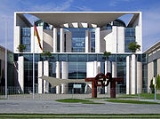
Politics of Germany

Encyclopedia
The Federal Republic of Germany is a federal
parliamentary
republic
, based on representative democracy
. The Chancellor is the head of government
, while the President of Germany
is the head of state
, which is a ceremonial role but with substantial reserve powers
.
Executive power
is vested in the Federal Cabinet (Bundesregierung)
, and federal legislative power is vested in the Bundestag (the parliament of Germany
) and the Bundesrat
(the representative body of the regional states).
There is a multi-party system that, since 1949, has been dominated by the Christian Democratic Union
(CDU) and the Social Democratic Party of Germany
(SPD).
The judiciary of Germany
is independent of the executive and the legislature. The political system is laid out in the 1949 constitution
, the Grundgesetz
(Basic Law), which remained in effect with minor amendments after 1990's German reunification
.
The constitution emphasises the protection of individual liberty in an extensive catalogue of human rights and also divides powers both between the federal and state levels and between the legislative, executive, and judicial branches. In many ways, the 1949 Basic Law is a response to the perceived flaws of the 1919 Weimar Constitution
, which did not prevent the rise of the Nazi party in 1933.
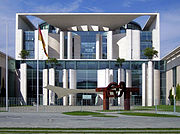 The Bundeskanzler (Federal Chancellor) heads the Bundesregierung
(Federal Government) and thus the executive branch of the federal government. He or she is elected by and responsible to the Bundestag
, Germany's parliament. The other members of the government are the Federal Ministers; they are chosen by the Chancellor. Germany, like the United Kingdom
, can thus be classified as a parliamentary system
.
The Chancellor cannot be removed from office during a four year term unless the Bundestag has agreed on a successor. This Constructive Vote of No Confidence
is intended to avoid the situation of the Weimar Republic in which the executive did not have enough support in the legislature to govern effectively, but the legislature was too divided to name a successor.
Except in the periods 1969–72 and 1976–82, when the Social Democratic party of Chancellor Brandt and Schmidt came in second in the elections, the Chancellor has always been the candidate of the largest party, usually supported by a coalition of two parties with a majority in the parliament. One of the ministers the Chancellor appoints is the Vice-Chancellor (Vizekanzler). This office itself is hardly important but often indicates who is the main cabinet member of the smaller coalition partner.
By contrast, the duties of the Bundespräsident
(Federal President) are largely representative and ceremonial. He is not a member of the government. The President is elected every five years by the Federal Assembly (Bundesversammlung
), a special body convened only for this purpose, comprising the entire Bundestag and an equal number of state delegates selected especially for this purpose in proportion to election results for the state diets. Most Presidents have been members of the CDU as this party is usually the strongest in the Bundestag and also often in the states.
The President has a rather ceremonial role in creating a new Chancellor and a theoretically more significant role in sending the Bundestag home. The constitution provides some cases where the President could exert more power, but this has never occurred.
|President
|Christian Wulff
|Christian Democratic Union
|30 June 2010
|-
|Chancellor
|Angela Merkel
|Christian Democratic Union
|22 November 2005
|-
|rowspan=3|Other government parties
|rowspan=3|
|Free Democratic Party
|rowspan=3|
|-
|Christian Social Union
|-
|}
The Bundestag is more powerful than the Bundesrat and only needs the latter's consent for proposed legislation related to revenue shared by the federal and state governments, and the imposition of responsibilities on the states. In practice, this means that the agreement of the Bundesrat in the legislative process is very often required, as federal legislation often has to be executed by state or local agencies. In the event of disagreement between the Bundestag and the Bundesrat, a conciliation committee is formed to find a compromise.
, which Germans call "personalised proportional representation." 299 members represent single-seat constituencies and are elected by a First Past the Post electoral system. Parties that obtain fewer constituency seats than their national share of the vote are allotted seats from party lists to make up the difference. In contrast, parties that obtain more constituency seats than their national share of the vote are allowed to keep these so-called overhang seat
s. In the current parliament (elected in 2009) there are 24 overhang seats, giving the Bundestag a total of 622 members.
A party must receive either five percent of the national vote or win at least three directly elected seats to be eligible for non-constituency seats in the Bundestag. This rule, often called the "five percent hurdle", was incorporated into Germany's election law to prevent political fragmentation and strong minor parties. The first Bundestag elections were held in the Federal Republic of Germany ("West Germany") on 14 August 1949. Following reunification, elections for the first all-German Bundestag
were held on 2 December 1990. The last election was held on 27. September 2009, the 17th Bundestag convened on 27. October 2009. The number of Bundestag Deputies was reduced from 656 to 598 beginning in 2002, although under the additional member system, more deputies may be admitted if a party wins more directly elected seats than it would be entitled to under proportional representation.
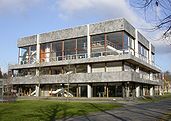 The judicial system comprises three types of courts.
The main difference between the Federal Constitutional Court and the Federal Court is, that the Federal Constitutional Court may only be called if a constitutional matter within a case is in question (e.g. a possible violation of human rights in a criminal trial), while the Federal Court of Justice may be called in any case.
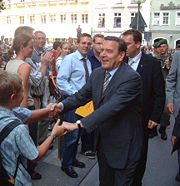 After 16 years of the Christian liberal coalition of Helmut Kohl
, the Social Democrats together with the Greens won the elections of 1998. SPD vice chairman Gerhard Schröder
positioned himself as a centrist candidate, in contradiction to the leftist SPD chairman Oskar Lafontaine
. The Kohl government was hurt at the polls by slower economic growth in the east in the previous two years, and constantly high unemployment. The final margin of victory was sufficiently high to permit a "red-green" coalition of the SPD with Alliance '90/The Greens
(Bündnis '90/Die Grünen), bringing the Greens into a national government for the first time.
Initial problems of the new government, marked by policy disputes between the moderate and traditional left wings of the SPD, resulted in some voter disaffection. Lafontaine left the government (and later his party) in early 1999. The CDU won in some important state elections but was hit already in 2000 by a party donation scandal from the Kohl years. As a result of this CDU crisis, Angela Merkel
became chair.
The next election for the Bundestag was 22 September 2002. Gerhard Schröder led the coalition of SPD and Greens to an eleven-seat victory over the Christian Democrat challengers headed by Edmund Stoiber
(CSU). Three factors are generally cited that enabled Schröder to win the elections despite poor approval ratings a few months before and a weaker economy: good handling of the 100-year flood
, firm opposition to the USA's 2003 invasion of Iraq
, and Stoiber's unpopularity in the east, which cost the CDU crucial seats there.
In its second term, the red green coalition lost several very important state elections, for example in Lower Saxony where Schröder was the prime minister from 1990 to 1998. In 20 April 2003, chancellor Schröder announced massive labor market reforms, called Agenda 2010
, that cut in unemployment benefits. Although these reforms have sparked massive protests they are now credited with being in part responsible for the economic downswing and the rise of unemployment in Germany in the years 2006/7.
.jpg)
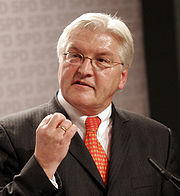 On 22 May 2005 the SPD received a devastating defeat in its former heartland, North Rhine-Westphalia
. Half an hour after the election results, the SPD chairman Franz Müntefering
announced that the chancellor would clear the way for new federal elections.
This took the republic by surprise, especially because the SPD was below 25% in polls at the time. The CDU quickly announced Angela Merkel
as Christian Democrat candidate for chancellor, aspiring to be the first female chancellor in German history.
New for the 2005 election was the alliance between the newly formed Electoral Alternative for Labor and Social Justice (WASG) and the PDS, planning to fuse into a common party (see Left Party.PDS
). With the former SPD chairman, Oskar Lafontaine for the WASG and Gregor Gysi
for the PDS as prominent figures, this alliance soon found interest in the media and in the population. Polls in July saw them as high as 12%.
Whereas in May and June 2005 victory of the Christian Democrats seemed highly likely, with some polls giving them an absolute majority, this picture changed shortly before the election at 18 September 2005. Voters were afraid of CDU austerity politics.
The election results of 18 September were surprising insofar as they differed widely from the polls of the previous weeks. The Christian Democrats lost votes compared to 2002, reaching only 35.2%, and failed to get a majority for a "black-yellow" government of CDU/CSU and liberal FDP. But the red-green coalition also failed to get a majority, with the SPD losing votes, but polling 34.2% and the greens staying at 8.1%. The left party alliance reached 8.7% and entered the German Parliament, whereas the NPD only got 1.6%.
The most likely outcome of coalition talks was a so-called "grand coalition
" between the Christian Democrats (CDU/CSU) and the Social Democrats (SPD). Three party coalitions and Coalitions involving the Left Party have been ruled out by all concerning parties (including the Left Party itself). On 22 November 2005, Angela Merkel was sworn in by president Horst Köhler for the office of Bundeskanzlerin.
The existence of the grand coalition on federal level helped smaller parties' electoral prospects in state elections. Since in 2008, the CSU lost its absolute majority in Bavaria and formed a coalition with the FDP, the grand coalition had no majority in the Bundesrat and depended on FDP votes on important issues. In November 2008, the SPD re-elected Franz Müntefering
as its chairman and made Frank-Walter Steinmeier
its leading candidate for the federal election in September 2009.
As a result of that federal election, the grand coalition came to an end. The SPD suffered the heaviest losses in its history and was unable to form a coalition government. The CDU/CSU was rather stable. The three smaller parties thus have more seats in the German Bundestag
than ever before, for example the liberal party FDP won 14.6% of votes.
served as the Foreign Minister
and Vice Chancellor of Germany. After being elected into the Federal Government, the FDP suffered from heavy losses in the following state elections. The FDP had promised to lower taxes in the electoral campaign but after being part of the coalition they had to admit that this was not possible regarding the economic crisis. Because of the losses Guido Westerwelle had to resign as chair of the FDP in favor of Philipp Rösler
, Federal Minister of Health
, who was consequently appointed as vice chancellor. Shortly after, Philipp Rösler changed office and became Federal Minister of Economics and Technology
.
The Social Democrats are since the electoral defeat lead by the new party chairman Sigmar Gabriel
, a former federal minister and state prime minister, and by Frank-Walter Steinmeier as the head of the parliamentary group. The Greens and the Left Party both suffer from some internal frictions. It is difficult to tell what the SPD defeat in the federal politics means for the state elections, as both big parties did well in some but not in others. Since 2011 the Greens have their first prime minister, the one of Baden-Württemberg, in a Green-SPD-government.
Germany has seen increased political activity by citizens outside the established political parties with respect to local and environmental issues such as the location of Stuttgart 21
a railway hub and construction of Berlin-Brandenburg International Airport
.
Federation
A federation , also known as a federal state, is a type of sovereign state characterized by a union of partially self-governing states or regions united by a central government...
parliamentary
Parliamentary system
A parliamentary system is a system of government in which the ministers of the executive branch get their democratic legitimacy from the legislature and are accountable to that body, such that the executive and legislative branches are intertwined....
republic
Republic
A republic is a form of government in which the people, or some significant portion of them, have supreme control over the government and where offices of state are elected or chosen by elected people. In modern times, a common simplified definition of a republic is a government where the head of...
, based on representative democracy
Representative democracy
Representative democracy is a form of government founded on the principle of elected individuals representing the people, as opposed to autocracy and direct democracy...
. The Chancellor is the head of government
Head of government
Head of government is the chief officer of the executive branch of a government, often presiding over a cabinet. In a parliamentary system, the head of government is often styled prime minister, chief minister, premier, etc...
, while the President of Germany
President of Germany
The President of the Federal Republic of Germany is the country's head of state. His official title in German is Bundespräsident . Germany has a parliamentary system of government and so the position of President is largely ceremonial...
is the head of state
Head of State
A head of state is the individual that serves as the chief public representative of a monarchy, republic, federation, commonwealth or other kind of state. His or her role generally includes legitimizing the state and exercising the political powers, functions, and duties granted to the head of...
, which is a ceremonial role but with substantial reserve powers
Reserve power
In a parliamentary or semi-presidential system of government, a reserve power is a power that may be exercised by the head of state without the approval of another branch of the government. Unlike a presidential system of government, the head of state is generally constrained by the cabinet or the...
.
Executive power
Executive Power
Executive Power is Vince Flynn's fifth novel, and the fourth to feature Mitch Rapp, an American agent that works for the CIA as an operative for a covert counter terrorism unit called the "Orion Team."-Plot summary:...
is vested in the Federal Cabinet (Bundesregierung)
Cabinet of Germany
The Cabinet of Germany is the chief executive body of the Federal Republic of Germany. It consists of the Chancellor and the cabinet ministers. The fundamentals of the cabinet's organization are set down in articles 62 to 69 of the Basic Law.-Nomination:...
, and federal legislative power is vested in the Bundestag (the parliament of Germany
Germany
Germany , officially the Federal Republic of Germany , is a federal parliamentary republic in Europe. The country consists of 16 states while the capital and largest city is Berlin. Germany covers an area of 357,021 km2 and has a largely temperate seasonal climate...
) and the Bundesrat
Bundesrat of Germany
The German Bundesrat is a legislative body that represents the sixteen Länder of Germany at the federal level...
(the representative body of the regional states).
There is a multi-party system that, since 1949, has been dominated by the Christian Democratic Union
Christian Democratic Union (Germany)
The Christian Democratic Union of Germany is a Christian democratic and conservative political party in Germany. It is regarded as on the centre-right of the German political spectrum...
(CDU) and the Social Democratic Party of Germany
Social Democratic Party of Germany
The Social Democratic Party of Germany is a social-democratic political party in Germany...
(SPD).
The judiciary of Germany
Judiciary of Germany
The Judiciary of Germany is based on the concept of the , in which the exercise of governmental power is constrained by law. Federal law delineates the structure of the judiciary, but the administration of most courts is regulated by the states of Germany which are responsible for the lower levels...
is independent of the executive and the legislature. The political system is laid out in the 1949 constitution
Constitution
A constitution is a set of fundamental principles or established precedents according to which a state or other organization is governed. These rules together make up, i.e. constitute, what the entity is...
, the Grundgesetz
Basic Law for the Federal Republic of Germany
The Basic Law for the Federal Republic of Germany is the constitution of Germany. It was formally approved on 8 May 1949, and, with the signature of the Allies of World War II on 12 May, came into effect on 23 May, as the constitution of those states of West Germany that were initially included...
(Basic Law), which remained in effect with minor amendments after 1990's German reunification
German reunification
German reunification was the process in 1990 in which the German Democratic Republic joined the Federal Republic of Germany , and when Berlin reunited into a single city, as provided by its then Grundgesetz constitution Article 23. The start of this process is commonly referred by Germans as die...
.
The constitution emphasises the protection of individual liberty in an extensive catalogue of human rights and also divides powers both between the federal and state levels and between the legislative, executive, and judicial branches. In many ways, the 1949 Basic Law is a response to the perceived flaws of the 1919 Weimar Constitution
Weimar constitution
The Constitution of the German Reich , usually known as the Weimar Constitution was the constitution that governed Germany during the Weimar Republic...
, which did not prevent the rise of the Nazi party in 1933.
Federal executive branch
Cabinet of Germany
The Cabinet of Germany is the chief executive body of the Federal Republic of Germany. It consists of the Chancellor and the cabinet ministers. The fundamentals of the cabinet's organization are set down in articles 62 to 69 of the Basic Law.-Nomination:...
(Federal Government) and thus the executive branch of the federal government. He or she is elected by and responsible to the Bundestag
Bundestag
The Bundestag is a federal legislative body in Germany. In practice Germany is governed by a bicameral legislature, of which the Bundestag serves as the lower house and the Bundesrat the upper house. The Bundestag is established by the German Basic Law of 1949, as the successor to the earlier...
, Germany's parliament. The other members of the government are the Federal Ministers; they are chosen by the Chancellor. Germany, like the United Kingdom
United Kingdom
The United Kingdom of Great Britain and Northern IrelandIn the United Kingdom and Dependencies, other languages have been officially recognised as legitimate autochthonous languages under the European Charter for Regional or Minority Languages...
, can thus be classified as a parliamentary system
Parliamentary system
A parliamentary system is a system of government in which the ministers of the executive branch get their democratic legitimacy from the legislature and are accountable to that body, such that the executive and legislative branches are intertwined....
.
The Chancellor cannot be removed from office during a four year term unless the Bundestag has agreed on a successor. This Constructive Vote of No Confidence
Constructive vote of no confidence
The constructive vote of no confidence is a variation on the motion of no confidence which allows a parliament to withdraw confidence from a head of government only if there is a positive majority for a prospective successor...
is intended to avoid the situation of the Weimar Republic in which the executive did not have enough support in the legislature to govern effectively, but the legislature was too divided to name a successor.
Except in the periods 1969–72 and 1976–82, when the Social Democratic party of Chancellor Brandt and Schmidt came in second in the elections, the Chancellor has always been the candidate of the largest party, usually supported by a coalition of two parties with a majority in the parliament. One of the ministers the Chancellor appoints is the Vice-Chancellor (Vizekanzler). This office itself is hardly important but often indicates who is the main cabinet member of the smaller coalition partner.
By contrast, the duties of the Bundespräsident
President of Germany
The President of the Federal Republic of Germany is the country's head of state. His official title in German is Bundespräsident . Germany has a parliamentary system of government and so the position of President is largely ceremonial...
(Federal President) are largely representative and ceremonial. He is not a member of the government. The President is elected every five years by the Federal Assembly (Bundesversammlung
Bundesversammlung (Germany)
The Federal Convention is a special body in the institutional system of Germany, convened solely for the purpose of electing the German Federal President , either every five years or within 30 days of a president's resignation, death or removal from office.The Bundesversammlung includes the entire...
), a special body convened only for this purpose, comprising the entire Bundestag and an equal number of state delegates selected especially for this purpose in proportion to election results for the state diets. Most Presidents have been members of the CDU as this party is usually the strongest in the Bundestag and also often in the states.
The President has a rather ceremonial role in creating a new Chancellor and a theoretically more significant role in sending the Bundestag home. The constitution provides some cases where the President could exert more power, but this has never occurred.
|President
President of Germany
The President of the Federal Republic of Germany is the country's head of state. His official title in German is Bundespräsident . Germany has a parliamentary system of government and so the position of President is largely ceremonial...
|Christian Wulff
Christian Wulff
Christian Wilhelm Walter Wulff is the President of Germany and a politician of the Christian Democratic Union. He was elected President on 2010 and publicly swore the oath of office on . A lawyer by profession, he served as Premier of the state of Lower Saxony from 2003 to 2010.-Early life and...
|Christian Democratic Union
Christian Democratic Union (Germany)
The Christian Democratic Union of Germany is a Christian democratic and conservative political party in Germany. It is regarded as on the centre-right of the German political spectrum...
|30 June 2010
|-
|Chancellor
|Angela Merkel
Angela Merkel
Angela Dorothea Merkel is the current Chancellor of Germany . Merkel, elected to the Bundestag from Mecklenburg-Vorpommern, has been the chairwoman of the Christian Democratic Union since 2000, and chairwoman of the CDU-CSU parliamentary coalition from 2002 to 2005.From 2005 to 2009 she led a...
|Christian Democratic Union
Christian Democratic Union (Germany)
The Christian Democratic Union of Germany is a Christian democratic and conservative political party in Germany. It is regarded as on the centre-right of the German political spectrum...
|22 November 2005
|-
|rowspan=3|Other government parties
|rowspan=3|
|Free Democratic Party
Free Democratic Party (Germany)
The Free Democratic Party , abbreviated to FDP, is a centre-right classical liberal political party in Germany. It is led by Philipp Rösler and currently serves as the junior coalition partner to the Union in the German federal government...
|rowspan=3|
|-
|Christian Social Union
|-
|}
Federal legislature
Federal legislative power is divided between the Bundestag and the Bundesrat. The Bundestag is directly elected by the German people, whilst the Bundesrat represents the regional states (Länder). The federal legislature has powers of exclusive jurisdiction and concurrent jurisdiction with the states in areas specifically enumerated by the constitution.The Bundestag is more powerful than the Bundesrat and only needs the latter's consent for proposed legislation related to revenue shared by the federal and state governments, and the imposition of responsibilities on the states. In practice, this means that the agreement of the Bundesrat in the legislative process is very often required, as federal legislation often has to be executed by state or local agencies. In the event of disagreement between the Bundestag and the Bundesrat, a conciliation committee is formed to find a compromise.
Bundestag
The Bundestag (Federal Diet) is elected for a four year term and consists of 598 or more members elected by a means of mixed member proportional representationMixed member proportional representation
Mixed-member proportional representation, also termed mixed-member proportional voting and commonly abbreviated to MMP, is a voting system originally used to elect representatives to the German Bundestag, and nowadays adopted by numerous legislatures around the world...
, which Germans call "personalised proportional representation." 299 members represent single-seat constituencies and are elected by a First Past the Post electoral system. Parties that obtain fewer constituency seats than their national share of the vote are allotted seats from party lists to make up the difference. In contrast, parties that obtain more constituency seats than their national share of the vote are allowed to keep these so-called overhang seat
Overhang seat
Overhang seats can arise in elections under the traditional mixed member proportional system, when a party is entitled to fewer seats as a result of party votes than it has won constituencies.-How overhang seats arise:...
s. In the current parliament (elected in 2009) there are 24 overhang seats, giving the Bundestag a total of 622 members.
A party must receive either five percent of the national vote or win at least three directly elected seats to be eligible for non-constituency seats in the Bundestag. This rule, often called the "five percent hurdle", was incorporated into Germany's election law to prevent political fragmentation and strong minor parties. The first Bundestag elections were held in the Federal Republic of Germany ("West Germany") on 14 August 1949. Following reunification, elections for the first all-German Bundestag
German federal election, 1990
The 12th German federal election, 1990 was conducted on December 2, 1990, to elect members to the Bundestag of the Federal Republic of Germany...
were held on 2 December 1990. The last election was held on 27. September 2009, the 17th Bundestag convened on 27. October 2009. The number of Bundestag Deputies was reduced from 656 to 598 beginning in 2002, although under the additional member system, more deputies may be admitted if a party wins more directly elected seats than it would be entitled to under proportional representation.
Judicial branch
- Ordinary courts, dealing with criminalCriminal lawCriminal law, is the body of law that relates to crime. It might be defined as the body of rules that defines conduct that is not allowed because it is held to threaten, harm or endanger the safety and welfare of people, and that sets out the punishment to be imposed on people who do not obey...
and most civilPrivate lawPrivate law is that part of a civil law legal system which is part of the jus commune that involves relationships between individuals, such as the law of contracts or torts, as it is called in the common law, and the law of obligations as it is called in civilian legal systems...
cases, are the most numerous by far. The Federal Court of Justice of GermanyFederal Court of Justice of GermanyThe Federal Court of Justice of Germany in Karlsruhe is the highest court in the system of ordinary jurisdiction in Germany. It is the supreme court in all matters of criminal and private law...
(Bundesgerichtshof) is the highest ordinary court and also the highest court of appeals. - Specialized courts hear cases related to administrativeAdministrative lawAdministrative law is the body of law that governs the activities of administrative agencies of government. Government agency action can include rulemaking, adjudication, or the enforcement of a specific regulatory agenda. Administrative law is considered a branch of public law...
, labourLabour lawLabour law is the body of laws, administrative rulings, and precedents which address the legal rights of, and restrictions on, working people and their organizations. As such, it mediates many aspects of the relationship between trade unions, employers and employees...
, social, fiscal, and patent law. - Constitutional courts focus on judicial review and constitutional interpretation. The Federal Constitutional CourtFederal Constitutional Court of GermanyThe Federal Constitutional Court is a special court established by the Grundgesetz, the German basic law...
(Bundesverfassungsgericht) is the highest court dealing with constitutional matters.
The main difference between the Federal Constitutional Court and the Federal Court is, that the Federal Constitutional Court may only be called if a constitutional matter within a case is in question (e.g. a possible violation of human rights in a criminal trial), while the Federal Court of Justice may be called in any case.
"Red-Green" coalition of 1998-2005
Helmut Kohl
Helmut Josef Michael Kohl is a German conservative politician and statesman. He was Chancellor of Germany from 1982 to 1998 and the chairman of the Christian Democratic Union from 1973 to 1998...
, the Social Democrats together with the Greens won the elections of 1998. SPD vice chairman Gerhard Schröder
Gerhard Schröder
Gerhard Fritz Kurt Schröder is a German politician, and was Chancellor of Germany from 1998 to 2005. A member of the Social Democratic Party of Germany , he led a coalition government of the SPD and the Greens. Before becoming a full-time politician, he was a lawyer, and before becoming Chancellor...
positioned himself as a centrist candidate, in contradiction to the leftist SPD chairman Oskar Lafontaine
Oskar Lafontaine
Oskar Lafontaine is a German politician, former German finance minister, former chairman of the Social Democratic Party and former Minister-President of the state of Saarland. Since 2007 he was co-chairman of The Left...
. The Kohl government was hurt at the polls by slower economic growth in the east in the previous two years, and constantly high unemployment. The final margin of victory was sufficiently high to permit a "red-green" coalition of the SPD with Alliance '90/The Greens
Alliance '90/The Greens
Alliance '90/The Greens is a green political party in Germany, formed from the merger of the German Green Party and Alliance 90 in 1993. Its leaders are Claudia Roth and Cem Özdemir...
(Bündnis '90/Die Grünen), bringing the Greens into a national government for the first time.
Initial problems of the new government, marked by policy disputes between the moderate and traditional left wings of the SPD, resulted in some voter disaffection. Lafontaine left the government (and later his party) in early 1999. The CDU won in some important state elections but was hit already in 2000 by a party donation scandal from the Kohl years. As a result of this CDU crisis, Angela Merkel
Angela Merkel
Angela Dorothea Merkel is the current Chancellor of Germany . Merkel, elected to the Bundestag from Mecklenburg-Vorpommern, has been the chairwoman of the Christian Democratic Union since 2000, and chairwoman of the CDU-CSU parliamentary coalition from 2002 to 2005.From 2005 to 2009 she led a...
became chair.
The next election for the Bundestag was 22 September 2002. Gerhard Schröder led the coalition of SPD and Greens to an eleven-seat victory over the Christian Democrat challengers headed by Edmund Stoiber
Edmund Stoiber
Edmund Rüdiger Stoiber is a German politician, former minister-president of the state of Bavaria and former chairman of the Christian Social Union...
(CSU). Three factors are generally cited that enabled Schröder to win the elections despite poor approval ratings a few months before and a weaker economy: good handling of the 100-year flood
2002 European floods
In August 2002 a 100-year flood caused by over a week of continuous heavy rains ravaged Europe, killing dozens, dispossessing thousands, and causing damage of billions of euros in the Czech Republic, Austria, Germany, Slovakia, Poland, Hungary, Romania and Croatia....
, firm opposition to the USA's 2003 invasion of Iraq
2003 invasion of Iraq
The 2003 invasion of Iraq , was the start of the conflict known as the Iraq War, or Operation Iraqi Freedom, in which a combined force of troops from the United States, the United Kingdom, Australia and Poland invaded Iraq and toppled the regime of Saddam Hussein in 21 days of major combat operations...
, and Stoiber's unpopularity in the east, which cost the CDU crucial seats there.
In its second term, the red green coalition lost several very important state elections, for example in Lower Saxony where Schröder was the prime minister from 1990 to 1998. In 20 April 2003, chancellor Schröder announced massive labor market reforms, called Agenda 2010
Agenda 2010
The Agenda 2010 is a series of reforms planned and executed by the German government which are aimed at reforming the German social system and labour market. The declared aim of Agenda 2010 is to improve economic growth and thus reduce unemployment....
, that cut in unemployment benefits. Although these reforms have sparked massive protests they are now credited with being in part responsible for the economic downswing and the rise of unemployment in Germany in the years 2006/7.
Grand coalition 2005-2009
North Rhine-Westphalia
North Rhine-Westphalia is the most populous state of Germany, with four of the country's ten largest cities. The state was formed in 1946 as a merger of the northern Rhineland and Westphalia, both formerly part of Prussia. Its capital is Düsseldorf. The state is currently run by a coalition of the...
. Half an hour after the election results, the SPD chairman Franz Müntefering
Franz Müntefering
Franz Müntefering is a German politician and industrial manager. He was Chairman of the Social Democratic Party from 18 October 2008 to 13 November 2009, a position he already held from 2004 to 2005...
announced that the chancellor would clear the way for new federal elections.
This took the republic by surprise, especially because the SPD was below 25% in polls at the time. The CDU quickly announced Angela Merkel
Angela Merkel
Angela Dorothea Merkel is the current Chancellor of Germany . Merkel, elected to the Bundestag from Mecklenburg-Vorpommern, has been the chairwoman of the Christian Democratic Union since 2000, and chairwoman of the CDU-CSU parliamentary coalition from 2002 to 2005.From 2005 to 2009 she led a...
as Christian Democrat candidate for chancellor, aspiring to be the first female chancellor in German history.
New for the 2005 election was the alliance between the newly formed Electoral Alternative for Labor and Social Justice (WASG) and the PDS, planning to fuse into a common party (see Left Party.PDS
Left Party (Germany)
The Party of Democratic Socialism was a democratic socialist political party active in Germany from 1989 to 2007. It was the legal successor to the Socialist Unity Party , which ruled the German Democratic Republic until 1990. From 1990 through to 2005, the PDS had been seen as the left-wing...
). With the former SPD chairman, Oskar Lafontaine for the WASG and Gregor Gysi
Gregor Gysi
Dr. Gregor Gysi is a German attorney and key politician of the socialist left-wing political party The Left . He played an important role in the end of communist rule in East Germany in 1989, and was a main figure in the post-reunification Party of Democratic Socialism...
for the PDS as prominent figures, this alliance soon found interest in the media and in the population. Polls in July saw them as high as 12%.
Whereas in May and June 2005 victory of the Christian Democrats seemed highly likely, with some polls giving them an absolute majority, this picture changed shortly before the election at 18 September 2005. Voters were afraid of CDU austerity politics.
The election results of 18 September were surprising insofar as they differed widely from the polls of the previous weeks. The Christian Democrats lost votes compared to 2002, reaching only 35.2%, and failed to get a majority for a "black-yellow" government of CDU/CSU and liberal FDP. But the red-green coalition also failed to get a majority, with the SPD losing votes, but polling 34.2% and the greens staying at 8.1%. The left party alliance reached 8.7% and entered the German Parliament, whereas the NPD only got 1.6%.
The most likely outcome of coalition talks was a so-called "grand coalition
Grand coalition
A grand coalition is an arrangement in a multi-party parliamentary system in which the two largest political parties of opposing political ideologies unite in a coalition government...
" between the Christian Democrats (CDU/CSU) and the Social Democrats (SPD). Three party coalitions and Coalitions involving the Left Party have been ruled out by all concerning parties (including the Left Party itself). On 22 November 2005, Angela Merkel was sworn in by president Horst Köhler for the office of Bundeskanzlerin.
The existence of the grand coalition on federal level helped smaller parties' electoral prospects in state elections. Since in 2008, the CSU lost its absolute majority in Bavaria and formed a coalition with the FDP, the grand coalition had no majority in the Bundesrat and depended on FDP votes on important issues. In November 2008, the SPD re-elected Franz Müntefering
Franz Müntefering
Franz Müntefering is a German politician and industrial manager. He was Chairman of the Social Democratic Party from 18 October 2008 to 13 November 2009, a position he already held from 2004 to 2005...
as its chairman and made Frank-Walter Steinmeier
Frank-Walter Steinmeier
Frank-Walter Steinmeier is a German politician of the Social Democratic Party of Germany , and currently the leader of the opposition in the Bundestag. Steinmeier was a close aide of Chancellor Gerhard Schröder, serving as Chief of Staff in the German Chancellery from 1999 to 2005...
its leading candidate for the federal election in September 2009.
As a result of that federal election, the grand coalition came to an end. The SPD suffered the heaviest losses in its history and was unable to form a coalition government. The CDU/CSU was rather stable. The three smaller parties thus have more seats in the German Bundestag
Bundestag
The Bundestag is a federal legislative body in Germany. In practice Germany is governed by a bicameral legislature, of which the Bundestag serves as the lower house and the Bundesrat the upper house. The Bundestag is established by the German Basic Law of 1949, as the successor to the earlier...
than ever before, for example the liberal party FDP won 14.6% of votes.
CDU-CSU-FDP-coalition of 2009-
CDU/CSU and FDP together hold 332 seats (of 622 total seats) and form a coalition since 27 October 2009. Angela Merkel was re-elected as chancellor, Guido WesterwelleGuido Westerwelle
Guido Westerwelle [] is a German liberal politician, who, since 28 October 2009, has been serving as the Foreign Minister in the second cabinet of Chancellor Angela Merkel, and who was Vice Chancellor of Germany from 2009 to 2011. He is the first openly gay person to hold either of those positions...
served as the Foreign Minister
Foreign Office (Germany)
The Foreign Office is the foreign ministry of Germany, a federal agency responsible for both the country's foreign politics and its relationship with the European Union. From 1871 to 1919, it was led by a Foreign Secretary, and since 1919, it has been led by the Foreign Minister of Germany...
and Vice Chancellor of Germany. After being elected into the Federal Government, the FDP suffered from heavy losses in the following state elections. The FDP had promised to lower taxes in the electoral campaign but after being part of the coalition they had to admit that this was not possible regarding the economic crisis. Because of the losses Guido Westerwelle had to resign as chair of the FDP in favor of Philipp Rösler
Philipp Rösler
Philipp Rösler is a German politician, who, since 2011, has been the Federal Minister of Economics and Technology and the Vice Chancellor of Germany...
, Federal Minister of Health
Federal Ministry of Health (Germany)
The Federal Ministry of Health, is a ministry of the German federal government...
, who was consequently appointed as vice chancellor. Shortly after, Philipp Rösler changed office and became Federal Minister of Economics and Technology
Federal Ministry of Economics and Technology (Germany)
The Federal Ministry of Economics and Technology is a ministry of the German Federal Government since 1998...
.
The Social Democrats are since the electoral defeat lead by the new party chairman Sigmar Gabriel
Sigmar Gabriel
Sigmar Gabriel is a German politician currently chairing the Social Democratic Party of Germany .On 15 December 1999, after the resignation of Gerhard Glogowski, who had succeeded Gerhard Schröder in office, Gabriel became Minister-President of Lower Saxony and served until 4 March 2003...
, a former federal minister and state prime minister, and by Frank-Walter Steinmeier as the head of the parliamentary group. The Greens and the Left Party both suffer from some internal frictions. It is difficult to tell what the SPD defeat in the federal politics means for the state elections, as both big parties did well in some but not in others. Since 2011 the Greens have their first prime minister, the one of Baden-Württemberg, in a Green-SPD-government.
Germany has seen increased political activity by citizens outside the established political parties with respect to local and environmental issues such as the location of Stuttgart 21
Stuttgart 21
Stuttgart 21 is an urban development and under construction transport project in Stuttgart as part of the Stuttgart–Augsburg new and upgraded railway project in Baden-Württemberg and Bavaria in Germany. It consists of the replacement of the tracks and platforms of Stuttgart Hauptbahnhof, the city's...
a railway hub and construction of Berlin-Brandenburg International Airport
Berlin-Brandenburg International Airport
Berlin Brandenburg Airport is a new international airport under construction south of central Berlin, the capital city of Germany. It is scheduled to open on 3 June 2012. The airport is located in Schönefeld on the border between the states of Berlin and Brandenburg and will be named after the...
.
See also
- Political culture of GermanyPolitical culture of GermanyThe political culture of Germany as of the early 21st century is known for the popular expectation for governments to ensure a degree of social welfare, business and labour corporatism and a multiparty system dominated by conservative and social democratic forces, with a strong influence of smaller...
- German federal election, 2005German federal election, 2005German federal elections took place on 18 September 2005 to elect the members of the 16th German Bundestag, the federal parliament of Germany. They became necessary after a motion of confidence in Chancellor Gerhard Schröder failed on 1 July...
- German federal election, 2009
- List of political parties in Germany
- Party finance in GermanyParty finance in GermanyParty finance in Germany became an issue of political discourse, when in 1949 the concept of transparency was discussed in the constitional convention in connection with a new article to be entered into the constitution...
- States of GermanyStates of GermanyGermany is made up of sixteen which are partly sovereign constituent states of the Federal Republic of Germany. Land literally translates as "country", and constitutionally speaking, they are constituent countries...