

Schlieffen Plan

Encyclopedia
German General Staff
The German General Staff was an institution whose rise and development gave the German armed forces a decided advantage over its adversaries. The Staff amounted to its best "weapon" for nearly a century and a half....
's early 20th century overall strategic plan for victory in a possible future war in which the German Empire
German Empire
The German Empire refers to Germany during the "Second Reich" period from the unification of Germany and proclamation of Wilhelm I as German Emperor on 18 January 1871, to 1918, when it became a federal republic after defeat in World War I and the abdication of the Emperor, Wilhelm II.The German...
might find itself fighting on two fronts
Front (military)
A military front or battlefront is a contested armed frontier between opposing forces. This can be a local or tactical front, or it can range to a theater...
: France
French Third Republic
The French Third Republic was the republican government of France from 1870, when the Second French Empire collapsed due to the French defeat in the Franco-Prussian War, to 1940, when France was overrun by Nazi Germany during World War II, resulting in the German and Italian occupations of France...
to the west and Russia
Russian Empire
The Russian Empire was a state that existed from 1721 until the Russian Revolution of 1917. It was the successor to the Tsardom of Russia and the predecessor of the Soviet Union...
to the east. The First World War
World War I
World War I , which was predominantly called the World War or the Great War from its occurrence until 1939, and the First World War or World War I thereafter, was a major war centred in Europe that began on 28 July 1914 and lasted until 11 November 1918...
later became such a war, with both a Western Front
Western Front (World War I)
Following the outbreak of World War I in 1914, the German Army opened the Western Front by first invading Luxembourg and Belgium, then gaining military control of important industrial regions in France. The tide of the advance was dramatically turned with the Battle of the Marne...
and an Eastern Front
Eastern Front (World War I)
The Eastern Front was a theatre of war during World War I in Central and, primarily, Eastern Europe. The term is in contrast to the Western Front. Despite the geographical separation, the events in the two theatres strongly influenced each other...
.
The plan took advantage of expected differences in the three countries' speed in preparing for war. In short, it was the German plan to avoid a two-front war
Two-front war
In military terminology, a two-front war is one in which fighting takes place on two geographically separate fronts. It is usually executed by two or more separate forces simultaneously or nearly simultaneously, in the hope that their opponent will be forced to split their fighting force to deal...
by concentrating troops in the west and quickly defeating the French and then, if necessary, rushing those troops by rail to the east to face the Russians before they had time to mobilize fully. The Schlieffen Plan was created by Count Alfred von Schlieffen and modified by Helmuth von Moltke the Younger
Helmuth von Moltke the Younger
Helmuth Johann Ludwig von Moltke , also known as Moltke the Younger, was a nephew of Field Marshal Count Moltke and served as the Chief of the German General Staff from 1906 to 1914. The two are often differentiated as Moltke the Elder and Moltke the Younger...
after Schlieffen's retirement; it was Moltke who actually implemented the plan at the outset of World War I. In modified form, it was executed to near victory in the first month of the war. However, the modifications to the original plan, a French counterattack on the outskirts of Paris
Paris
Paris is the capital and largest city in France, situated on the river Seine, in northern France, at the heart of the Île-de-France region...
(the Battle of the Marne
First Battle of the Marne
The Battle of the Marne was a First World War battle fought between 5 and 12 September 1914. It resulted in an Allied victory against the German Army under Chief of Staff Helmuth von Moltke the Younger. The battle effectively ended the month long German offensive that opened the war and had...
), and surprisingly speedy Russian offensives ended the German offensive and resulted in years of trench warfare
Trench warfare
Trench warfare is a form of occupied fighting lines, consisting largely of trenches, in which troops are largely immune to the enemy's small arms fire and are substantially sheltered from artillery...
. The plan has been the subject of intense debate among historians and military scholars ever since. Schlieffen's last words were "remember to keep the right flank strong," which was significant in that Moltke strengthened the left flank in his modification.
The Plan
After the Franco-Prussian WarFranco-Prussian War
The Franco-Prussian War or Franco-German War, often referred to in France as the 1870 War was a conflict between the Second French Empire and the Kingdom of Prussia. Prussia was aided by the North German Confederation, of which it was a member, and the South German states of Baden, Württemberg and...
of 1870, the French province of Alsace-Lorraine
Alsace-Lorraine
The Imperial Territory of Alsace-Lorraine was a territory created by the German Empire in 1871 after it annexed most of Alsace and the Moselle region of Lorraine following its victory in the Franco-Prussian War. The Alsatian part lay in the Rhine Valley on the west bank of the Rhine River and east...
, with a mixed population of both French and Germans, was annexed to the new German Empire
German Empire
The German Empire refers to Germany during the "Second Reich" period from the unification of Germany and proclamation of Wilhelm I as German Emperor on 18 January 1871, to 1918, when it became a federal republic after defeat in World War I and the abdication of the Emperor, Wilhelm II.The German...
. The revanchist
Revanchism
Revanchism is a term used since the 1870s to describe a political manifestation of the will to reverse territorial losses incurred by a country, often following a war or social movement. Revanchism draws its strength from patriotic and retributionist thought and is often motivated by economic or...
French vowed to regain these territories, which France had possessed for nearly 200 years. Due to alliances orchestrated by German chancellor Otto von Bismarck
Otto von Bismarck
Otto Eduard Leopold, Prince of Bismarck, Duke of Lauenburg , simply known as Otto von Bismarck, was a Prussian-German statesman whose actions unified Germany, made it a major player in world affairs, and created a balance of power that kept Europe at peace after 1871.As Minister President of...
, France was initially isolated, but after Kaiser Wilhelm II took the throne in 1888 and gradually estranged Germany from Russia and Britain
United Kingdom of Great Britain and Ireland
The United Kingdom of Great Britain and Ireland was the formal name of the United Kingdom during the period when what is now the Republic of Ireland formed a part of it....
, fears about having to fight a future war on two fronts simultaneously grew among German leaders.
France, having been defeated in a few weeks in 1870, was not considered as dangerous in the long run as the Russians, who were expected to be difficult to defeat if the Tsar was allowed the necessary time to mobilize his huge country to the fullest extent. After Britain and France concluded the Entente Cordiale
Entente Cordiale
The Entente Cordiale was a series of agreements signed on 8 April 1904 between the United Kingdom and the French Republic. Beyond the immediate concerns of colonial expansion addressed by the agreement, the signing of the Entente Cordiale marked the end of almost a millennium of intermittent...
in 1904, Wilhelm asked Count Schlieffen to devise a plan which would allow Germany to fight a war on two fronts, and in December 1905 Schlieffen began circulating it.
The idea of the plan was to win a two-front war by first quickly defeating France in the west – the plan scheduled 39 days for the fall of Paris
Paris
Paris is the capital and largest city in France, situated on the river Seine, in northern France, at the heart of the Île-de-France region...
and 42 for the capitulation of France – before the "Russian Steamroller
Imperial Russian Army
The Imperial Russian Army was the land armed force of the Russian Empire, active from around 1721 to the Russian Revolution of 1917. In the early 1850s, the Russian army consisted of around 938,731 regular soldiers and 245,850 irregulars . Until the time of military reform of Dmitry Milyutin in...
" would be able to mobilize and descend upon East Prussia
East Prussia
East Prussia is the main part of the region of Prussia along the southeastern Baltic Coast from the 13th century to the end of World War II in May 1945. From 1772–1829 and 1878–1945, the Province of East Prussia was part of the German state of Prussia. The capital city was Königsberg.East Prussia...
. The plan depended on Germany's ability to quickly mobilize troops and invade France before the French could fully mobilize their troops and defend their territory, and then to turn on Russia, seen as the slowest of the three to mobilize, before the Russians were ready.
According to Cpt. Douglas Cohn, USA (ret.), the Japanese
Empire of Japan
The Empire of Japan is the name of the state of Japan that existed from the Meiji Restoration on 3 January 1868 to the enactment of the post-World War II Constitution of...
victory in the 1904-05 Russo-Japanese War
Russo-Japanese War
The Russo-Japanese War was "the first great war of the 20th century." It grew out of rival imperial ambitions of the Russian Empire and Japanese Empire over Manchuria and Korea...
had discredited the Russian military, and the Schlieffen Plan, finalized less than three months after the end of that war, clearly took this into account. The German victory over the numerically superior Russians at the Battle of Tannenberg
Battle of Tannenberg (1914)
The Battle of Tannenberg was an engagement between the Russian Empire and the German Empire in the first days of World War I. It was fought by the Russian First and Second Armies against the German Eighth Army between 23 August and 30 August 1914. The battle resulted in the almost complete...
in 1914 validated this point. Further, had Moltke not depleted the right flank on the Western Front, Kluck's 1st German Army would not have been forced away from the sea, the British Expeditionary Force
British Expeditionary Force
The British Expeditionary Force or BEF was the force sent to the Western Front during World War I. Planning for a British Expeditionary Force began with the Haldane reforms of the British Army carried out by the Secretary of State for War Richard Haldane following the Second Boer War .The term...
(BEF) would have been overwhelmed, and the French armies would have been trapped between Paris and France's eastern frontiers. The idea that logistics would have prevented this was disproven by the German supply improvisations that actually occurred.
It envisaged a rapid German mobilization
Mobilization
Mobilization is the act of assembling and making both troops and supplies ready for war. The word mobilization was first used, in a military context, in order to describe the preparation of the Prussian army during the 1850s and 1860s. Mobilization theories and techniques have continuously changed...
, disregard of the neutrality
Neutral country
A neutral power in a particular war is a sovereign state which declares itself to be neutral towards the belligerents. A non-belligerent state does not need to be neutral. The rights and duties of a neutral power are defined in Sections 5 and 13 of the Hague Convention of 1907...
of Luxembourg
Luxembourg
Luxembourg , officially the Grand Duchy of Luxembourg , is a landlocked country in western Europe, bordered by Belgium, France, and Germany. It has two principal regions: the Oesling in the North as part of the Ardennes massif, and the Gutland in the south...
, Belgium
Belgium
Belgium , officially the Kingdom of Belgium, is a federal state in Western Europe. It is a founding member of the European Union and hosts the EU's headquarters, and those of several other major international organisations such as NATO.Belgium is also a member of, or affiliated to, many...
and the Netherlands
Netherlands
The Netherlands is a constituent country of the Kingdom of the Netherlands, located mainly in North-West Europe and with several islands in the Caribbean. Mainland Netherlands borders the North Sea to the north and west, Belgium to the south, and Germany to the east, and shares maritime borders...
, and an overwhelming sweep of the powerful German right wing southwest through Belgium and Northern France, "letting the last man on the right, brush the Channel with his sleeve," in the words of Schlieffen, while maintaining only a defensive posture on the central and left wings, in Lorraine
Lorraine (région)
Lorraine is one of the 27 régions of France. The administrative region has two cities of equal importance, Metz and Nancy. Metz is considered to be the official capital since that is where the regional parliament is situated...
, the Vosges
Vosges mountains
For the department of France of the same name, see Vosges.The Vosges are a range of low mountains in eastern France, near its border with Germany. They extend along the west side of the Rhine valley in a northnortheast direction, mainly from Belfort to Saverne...
, and the Moselle
Moselle River
The Moselle is a river flowing through France, Luxembourg, and Germany. It is a left tributary of the Rhine, joining the Rhine at Koblenz. A small part of Belgium is also drained by the Mosel through the Our....
.
Paris was not to be taken (in 1870, the Siege of Paris
Siege of Paris
The Siege of Paris, lasting from September 19, 1870 – January 28, 1871, and the consequent capture of the city by Prussian forces led to French defeat in the Franco-Prussian War and the establishment of the German Empire as well as the Paris Commune....
had lasted for months) but was to be passed by the right wing to the west of the city. The intent of the plan was not to conquer cities or industry in order to weaken the French war efforts, but to capture most of the French Army
French Army
The French Army, officially the Armée de Terre , is the land-based and largest component of the French Armed Forces.As of 2010, the army employs 123,100 regulars, 18,350 part-time reservists and 7,700 Legionnaires. All soldiers are professionals, following the suspension of conscription, voted in...
and to force France to surrender, in essence a repeat of the strategy used to defeat France during the Franco-Prussian War
Franco-Prussian War
The Franco-Prussian War or Franco-German War, often referred to in France as the 1870 War was a conflict between the Second French Empire and the Kingdom of Prussia. Prussia was aided by the North German Confederation, of which it was a member, and the South German states of Baden, Württemberg and...
. The plan was that the French Army would be hemmed in around Paris and forced to fight a decisive envelopment battle.
However, a seed of disaster lurked in the conception of the plan: both Schlieffen and Moltke were seduced by the possibility of the double envelopment of the entire French Army by the right wing coming from the north and west of France and the left wing coming from the east. The inspiration was the destruction of the Roman Army
Military history of ancient Rome
From its origin as a city-state in Italy in the 8th century BC, to its rise as an empire covering much of Southern Europe, Western Europe, Near East and North Africa and fall in the 5th century AD, the political history of Ancient Rome was typically closely entwined with its military history...
by Hannibal's forces at the Battle of Cannae
Battle of Cannae
The Battle of Cannae was a major battle of the Second Punic War, which took place on August 2, 216 BC near the town of Cannae in Apulia in southeast Italy. The army of Carthage under Hannibal decisively defeated a numerically superior army of the Roman Republic under command of the consuls Lucius...
in 216 BC, which was the object of meticulous study by Schlieffen. In essence, his plan was a very large scale strategic readdressing of Hannibal's tactics, capitalizing on the recent breakthroughs in communications and transport. Hans Delbrück's seminal study of the battle had a profound influence on subsequent German military theorists, in particular on Schlieffen. Through his writings, Schlieffen taught that the "Cannae model" would continue to be applicable in maneuver warfare
Maneuver warfare
Maneuver warfare, or manoeuvre warfare , is the term used by military theorists for a concept of warfare that advocates attempting to defeat an adversary by incapacitating their decision-making through shock and disruption brought about by movement...
throughout the 20th century:
"A battle of annihilation can be carried out today according to the same plan devised by Hannibal in long forgotten times. The enemy front is not the goal of the principal attack. The mass of the troops and the reserves should not be concentrated against the enemy front; the essential is that the flanks be crushed. The wings should not be sought at the advanced points of the front but rather along the entire depth and extension of the enemy formation. The annihilation is completed through an attack against the enemy's rear... To bring about a decisive and annihilating victory requires an attack against the front and against one or both flanks..."
Schlieffen later developed his own operational doctrine in a series of articles, many of which were later translated and published in a work entitled "Cannae".
Politically, one of the major drawbacks of the Schlieffen Plan was that it called for the invasion of neutral states in order to pass through German troops to France. As it turned out, at least formally, it was the decision to invade Belgium which led to war with Great Britain. In the US, the manner in which Belgium was invaded had much to do with turning popular sentiment against Germany, and facilitated the entrance of the US into war against Germany in April 1917.
As noted previously, Russian mobilization would supposedly be extremely slow, due to its poor railway system. Following the speedy defeat of France, the German General Staff
German General Staff
The German General Staff was an institution whose rise and development gave the German armed forces a decided advantage over its adversaries. The Staff amounted to its best "weapon" for nearly a century and a half....
would switch German concentrations to the Eastern Front
Eastern Front (World War I)
The Eastern Front was a theatre of war during World War I in Central and, primarily, Eastern Europe. The term is in contrast to the Western Front. Despite the geographical separation, the events in the two theatres strongly influenced each other...
. The plan called for sending 91% of the German troops to France and 9% to Russia. His goal was to defeat France in six weeks, the time it took for Russia to mobilize its army, and turn back to the Eastern Front before Russia could react. Kaiser Wilhelm II is quoted as having said "Paris for lunch, dinner at St. Petersburg."
Modifications to the Plan, 1906
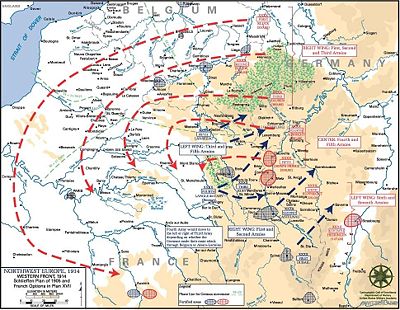
- Moltke decided to pull significant numbers of troops away from the main force entering France from the north, in order to fortify the forces in Alsace-LorraineAlsace-LorraineThe Imperial Territory of Alsace-Lorraine was a territory created by the German Empire in 1871 after it annexed most of Alsace and the Moselle region of Lorraine following its victory in the Franco-Prussian War. The Alsatian part lay in the Rhine Valley on the west bank of the Rhine River and east...
, and the forces at the Russian border. - The other significant change he made was not to enter through the NetherlandsNetherlandsThe Netherlands is a constituent country of the Kingdom of the Netherlands, located mainly in North-West Europe and with several islands in the Caribbean. Mainland Netherlands borders the North Sea to the north and west, Belgium to the south, and Germany to the east, and shares maritime borders...
, instead sending troops through Belgium and LuxembourgGerman occupation of Luxembourg in World War IThe German occupation of Luxembourg in World War I was the first of two military occupations of the Grand Duchy of Luxembourg by Germany in the twentieth century. From August 1914 until the end of World War I in November 1918, Luxembourg was under full occupation by the German Empire...
only.
These changes have been the subject of much debate. L.C.F Turner in 1970 described von Moltke's changes as "a substantial modification in the Schlieffen Plan and one which probably doomed the German campaign in the west before it was ever launched." Turner claims that by weakening the main German offensive, they did not have a real chance of defeating the French army quickly enough; hence they became stranded in a two-front-war. He also says that not going through the Netherlands not only created a bottleneck at the German-Belgian border, but also that not having the Dutch railways at their disposal created a huge supply problem, a problem which outweighed the benefits they gained by still having access to the Dutch ports.
However, in 1977, Martin van Creveld
Martin van Creveld
Martin Levi van Creveld is an Israeli military historian and theorist.Van Creveld was born in the Netherlands in the city of Rotterdam, and has lived in Israel since shortly after his birth. He holds degrees from the London School of Economics and the Hebrew University of Jerusalem, where he has...
, analyzing the role of logistics in the plan, felt that the effects of Moltke's alteration to avoid invading Dutch neutrality were more apparent than real, since two corps of troops which had been allocated to contain the 90,000-strong Dutch Army could instead be used for the invasion of France. Further, van Creveld points out that while Schlieffen had assigned five corps for the investment of Antwerp, Moltke made do with only two. "Though it is therefore quite true that Moltke's right wing was not as strong as Schlieffen had planned to make it, this loss was more than compensated for by the economies effected in [Moltke's] version of the plan." Early in the war, according to the directives of Plan XVII
Plan XVII
Plan XVII was the name of a "scheme of mobilization and concentration" that was adopted by the French General Staff in 1913, to be put into effect by the French Army in the event of war between France and Germany but was not ‘a prescribed narrative for the campaign’ or battle...
, the French mobilized and hurled their forces towards the German border in an ill-fated attempt to recapture Alsace-Lorraine
Alsace-Lorraine
The Imperial Territory of Alsace-Lorraine was a territory created by the German Empire in 1871 after it annexed most of Alsace and the Moselle region of Lorraine following its victory in the Franco-Prussian War. The Alsatian part lay in the Rhine Valley on the west bank of the Rhine River and east...
. This played exactly into Schlieffen's conception of a trap through double envelopment, which called for a loose defense of the border, and actually for retreats by which the French forces would have been lured further away from the main thrust of the German advance. However, Moltke
Helmuth von Moltke the Younger
Helmuth Johann Ludwig von Moltke , also known as Moltke the Younger, was a nephew of Field Marshal Count Moltke and served as the Chief of the German General Staff from 1906 to 1914. The two are often differentiated as Moltke the Elder and Moltke the Younger...
's weakening of the German right, the defense of Alsace-Lorraine, and the transfer of three army corps and one cavalry division from the western front to help contain the Russian advance into East Prussia, all contributed to the failure of the German army to break through the Allied forces at the Marne. Without that breakthrough, the plan was destroyed.
Activation and subsequent failure
Though debate continues about the merits of the Schlieffen Plan and even on whether the Schlieffen Plan was ever truly executed, ultimately the German invasion failed for seven major reasons:
- Belgian resistance: Although the Belgian army was only a tenth of the size of the German army, it still delayed the Germans for nearly a month, defending fortresses and cities. The Germans used their "Big BerthaBig Bertha (Howitzer)Big Bertha Bertha") is the name of a type of super-heavy howitzer developed by the famous armaments manufacturer Krupp in Germany on the eve of World War I...
" artillery to destroy Belgian forts in LiègeBattle of LiègeThe Battle of Liège was the opening engagement of the German invasion of Belgium, and the first battle of World War I. The attack on the city began on 5 August 1914 and lasted until the 16th when the last Belgian fort finally surrendered...
, NamurNamur (city)Namur is a city and municipality in Wallonia, in southern Belgium. It is both the capital of the province of Namur and of Wallonia....
, and Antwerp, but the Belgians still fought back, creating a constant threat to German supply lines in the north. In addition, the German attack on neutral Belgium and reports and propaganda about German atrocities thereRape of BelgiumThe Rape of Belgium is a wartime propaganda term describing the 1914 German invasion of Belgium. The term initially had a figurative meaning, referring to the violation of Belgian neutrality, but embellished reports of German atrocities soon gave it a literal significance...
turned public opinion in many neutral countries against Germany and Kaiser Wilhelm II. Still, despite stiff Belgian resistance, the timetable for the Schlieffen Plan was going according to schedule before it was halted in France. - The effectiveness of the British Expeditionary Force: The BEF was small, numbering only 75,000 at the start of the war. The French mobilized millions of recruits, and their goal was to use this number to defeat the Germans quickly in AlsaceAlsaceAlsace is the fifth-smallest of the 27 regions of France in land area , and the smallest in metropolitan France. It is also the seventh-most densely populated region in France and third most densely populated region in metropolitan France, with ca. 220 inhabitants per km²...
. To this end, the French commander-in-chief Joseph JoffreJoseph JoffreJoseph Jacques Césaire Joffre OM was a French general during World War I. He is most known for regrouping the retreating allied armies to defeat the Germans at the strategically decisive First Battle of the Marne in 1914. His popularity led to his nickname Papa Joffre.-Biography:Joffre was born in...
placed the small but highly-trained BEF on the left flank, where he believed there would not be any fighting. Due to the rapid German advance through Belgium, the British were almost annihilated several times, but they managed to delay the Germans long enough for French and British reinforcements to arrive. While the BEF was forced into retreat throughout the month of August, it provided enough resistance against the German First ArmyGerman First Army-First World War:The 1st Army during World War I, fought on the Western Front and took part in the Schlieffen Plan offensive against France and Belgium in August 1914. Commanded by General Alexander von Kluck, the 1st Army's job was to command the extreme right of the German forces in attacking...
under Alexander von KluckAlexander von KluckAlexander Heinrich Rudolph von Kluck was a German general during World War I.- Military career :He enlisted in the Prussian army in time to serve in the seven-week Austro-Prussian War of 1866 and the Franco-Prussian War, where he was wounded twice in the Battle of Colombey-Neuilly...
to help induce the German general to break off the Plan. Instead, von Kluck turned south-east towards CompiègneCompiègneCompiègne is a city in northern France. It is designated municipally as a commune within the département of Oise.The city is located along the Oise River...
, showing his flank to the Garrison of Paris under GallieniJoseph GallieniJoseph Simon Gallieni was a French soldier, most active as a military commander and administrator in the French colonies and finished his career during the First World War. He was made Marshal of France posthumously in 1921...
, making possible the "Miracle of the MarneFirst Battle of the MarneThe Battle of the Marne was a First World War battle fought between 5 and 12 September 1914. It resulted in an Allied victory against the German Army under Chief of Staff Helmuth von Moltke the Younger. The battle effectively ended the month long German offensive that opened the war and had...
". - The speed of Russian mobilization: The Russians moved faster than expected, gaining ground in East PrussiaEast PrussiaEast Prussia is the main part of the region of Prussia along the southeastern Baltic Coast from the 13th century to the end of World War II in May 1945. From 1772–1829 and 1878–1945, the Province of East Prussia was part of the German state of Prussia. The capital city was Königsberg.East Prussia...
more quickly than the Germans had planned for. While the Russian advance may not have posed much of a real threat at the time, had they kept gaining ground at that pace, they would get dangerously close to BerlinBerlinBerlin is the capital city of Germany and is one of the 16 states of Germany. With a population of 3.45 million people, Berlin is Germany's largest city. It is the second most populous city proper and the seventh most populous urban area in the European Union...
. This caused the Germans to pull even more men from their main force, in order to reinforce the Eastern Front. This proved counterproductive, since the forces pulled from the Western Front were still in transit during the Battle of Tannenberg, in which the Germans would emerge victorious, while the battles on the Western front were being lost for Germany. - The French railway system: Because of the delays caused by the British and Belgians, the French had more time to transfer troops from the border to Alsace-Lorraine. The Germans greatly underestimated how well they would be able to do this, especially with the extra time they were granted by the slowing of the German forces. The French sent some of their troops by train, some through taxis, and marched the rest of them. By the time the Germans got into France, the French were there waiting for them.
- Logistical shortcomings: van Creveld asserts that:
...Schlieffen does not appear to have devoted much attention to logistics when he evolved his great Plan. He well understood the difficulties likely to be encountered, but made no systematic effort to solve them. Had he done so, he might well have reached the conclusion that the operation was impracticable. ... Moltke did much to improve the logistic side of the Plan. Under his direction, the problem was seriously studied for the first time and officers trained in the 'technics' of warfare ... He did, it is true, make a number of changes in the Plan. From an exclusively logistic point of view, some of these were beneficial, but most were harmful. Nevertheless, taking his period of office as a whole, he probably did more to improve the Plan than to damage its prospects.
He concludes that, overall, the logistical shortcomings of the Plan did not contribute to the German defeat on the Marne. However,Had the battle
In van Creveld's view the design of the Plan was not characterized by the kind of thoroughness and detailed planning that is usually thought to be the hallmark of the German General Staff, but by "an ostrich-like refusal on Schlieffen's part to face even those problems which, after forty years of peace, could be foreseen." Although Moltke did improve the Plan somewhat in this respect, it was not methodical advanced planning which enabled the German advance to succeed, but "furious improvisation"First Battle of the MarneThe Battle of the Marne was a First World War battle fought between 5 and 12 September 1914. It resulted in an Allied victory against the German Army under Chief of Staff Helmuth von Moltke the Younger. The battle effectively ended the month long German offensive that opened the war and had...
gone in Germany's favour ... there is every reason to believe that the advance would have petered out. The prime factors would have been the inability of the railheads to keep up with the advance, the lack of fodder, and sheer exhaustion. In this sense, but no other, it is true to say that the Schlieffen Plan was logistically impracticable.That the Army achieved as much as it did, at a time when the standing orders could only be said to have caused no actual harm, is remarkable indeed. Critics of the advance would do well to keep this in mind.
- Moltke's changes to the plan: Chief of the General Staff Helmuth von Moltke made several changes to the Schlieffen Plan, initially reinforcing the east with 180,000 men from the right-wing armies, weakening the invasion force in favor of defense. Moltke also had ideological opposition for the proposed passage of the invading armies through the neutral Netherlands, the subsequent shift delayed his armies in Belgium and resulted in the "race to the sea" after the Marne. Moltke also further reinforced his left-wing with Corps from the right to prevent Allied forces from penetrating too far into Germany itself, an issue Schlieffen was not concerned with (Schlieffen's plan called for the invading French forces to be enveloped, putting the political concern of hostile invasions behind the strategic opportunity to destroy the invading armies). This proved problematic, because the German units who were supposed to fall back and lure the French away from Paris and the German right flank, were now driving the French before them. Rather than diverting the French forces from the action, this placed the French units much closer to the German 1st and 2nd armies threatening Paris. Moltke also chose to send 80,000 more men to the east to assist with the Russian invasion against the advisement of General Ludendorff (two days before the reinforcements arrived the Germans had destroyed the Russians at TannenbergBattle of Tannenberg (1914)The Battle of Tannenberg was an engagement between the Russian Empire and the German Empire in the first days of World War I. It was fought by the Russian First and Second Armies against the German Eighth Army between 23 August and 30 August 1914. The battle resulted in the almost complete...
). Ultimately Moltke reassigned 250,000 men (an entire army's worth) from the right-wing assault before finally abandoning the Schlieffen Plan. Repulsed by the left wing of Moltke's forces near SarrebourgSarrebourgSarrebourg is a commune in the Moselle department in Lorraine in north-eastern France. It lies in on the upper course of the river Sarre.It should not be confused with Saarburg in Germany....
, the French retreated to the hills around the city of Nancy. Rather than sweeping around them and enveloping the French armies and Paris itself from the east, Moltke opted to directly attack their reinforced positions around Nancy which ended in an unmitigated failure. - German underestimation of the British-Belgian alliance: Britain and Belgium had an alliance due to the London Treaty of 1839. Germany believed that Britain, which was wary of making alliances due to its wish to remain neutral, would not honour the treaty and would not rush to the aid of Belgium. The British, however, greatly amazed Germany by keeping with the terms of the treaty. The famous line "The Britons will go to war for a mere scrap of paper?" comes from the German Chancellor Bethmann-Hollweg asking the British Ambassador Goschen about the decision.
The failures in the West resulted in defeat at the First Battle of the Marne
First Battle of the Marne
The Battle of the Marne was a First World War battle fought between 5 and 12 September 1914. It resulted in an Allied victory against the German Army under Chief of Staff Helmuth von Moltke the Younger. The battle effectively ended the month long German offensive that opened the war and had...
in September 1914, a stalemate
Stalemate
Stalemate is a situation in chess where the player whose turn it is to move is not in check but has no legal moves. A stalemate ends the game in a draw. Stalemate is covered in the rules of chess....
, trench warfare
Trench warfare
Trench warfare is a form of occupied fighting lines, consisting largely of trenches, in which troops are largely immune to the enemy's small arms fire and are substantially sheltered from artillery...
, and a two-front war for Germany.
What eventually occurred was a "reverse Schlieffen", in that Russia was defeated prior to the Western Allies. The Russian army, aided by the Romania
Romania
Romania is a country located at the crossroads of Central and Southeastern Europe, on the Lower Danube, within and outside the Carpathian arch, bordering on the Black Sea...
n and Serbia
Serbia
Serbia , officially the Republic of Serbia , is a landlocked country located at the crossroads of Central and Southeast Europe, covering the southern part of the Carpathian basin and the central part of the Balkans...
n armies and considered by the German command as more dangerous than the Western Allies, was defeated with relative ease. Meanwhile the Western Allies had a larger manpower base from which to feed the war of attrition taking place. Even though Germany sent many divisions to fight in Italy
Italy
Italy , officially the Italian Republic languages]] under the European Charter for Regional or Minority Languages. In each of these, Italy's official name is as follows:;;;;;;;;), is a unitary parliamentary republic in South-Central Europe. To the north it borders France, Switzerland, Austria and...
and the Franco-Benelux theater following the collapse of Russia and the Eastern Front in 1917/18, the Western Allies still defeated the Central Powers' forces. In the 1918 summer campaign, Italy obtained a long sought decisive victory over Austria-Hungary
Austria-Hungary
Austria-Hungary , more formally known as the Kingdoms and Lands Represented in the Imperial Council and the Lands of the Holy Hungarian Crown of Saint Stephen, was a constitutional monarchic union between the crowns of the Austrian Empire and the Kingdom of Hungary in...
, and Austria withdrew from the war exposing Germany's southern flank. The defeat of Bulgaria
Bulgaria
Bulgaria , officially the Republic of Bulgaria , is a parliamentary democracy within a unitary constitutional republic in Southeast Europe. The country borders Romania to the north, Serbia and Macedonia to the west, Greece and Turkey to the south, as well as the Black Sea to the east...
also exposed Germany (and Austria) to an Allied advance up the Danube
Danube
The Danube is a river in the Central Europe and the Europe's second longest river after the Volga. It is classified as an international waterway....
. Finally the entrance of the United States
United States
The United States of America is a federal constitutional republic comprising fifty states and a federal district...
on the side of the Allies in 1917, and the arrival of substantial U.S. troops, coupled with the failure of the final German offensives in the West in early 1918, allowed the Allies to push the Germans out of France and into Belgium, towards the German border. Once the long-held static positions were lost, Germany accepted the Allies' armistice
Armistice
An armistice is a situation in a war where the warring parties agree to stop fighting. It is not necessarily the end of a war, but may be just a cessation of hostilities while an attempt is made to negotiate a lasting peace...
terms.
Criticism
Several historians argue that the plan was unfeasible for its time, due to the recent advances in weaponry and the improved transportation of industrial warfareIndustrial warfare
Industrial warfare is a period in the history of warfare ranging roughly from the early nineteenth century and the start of the Industrial Revolution to the beginning of the Atomic Age, which saw the rise of nation-states, capable of creating and equipping large armies and navies through the...
. Some would say the plan was "too good". B.H. Liddell Hart, for instance, praised the Schlieffen Plan as a conception of Napoleonic boldness, but concluded that:
- The plan would again become possible in the next generation—when air power could paralyze the defending side’s attempt to switch its forces, while the development of mechanized forces greatly accelerated the speed of encircling moves, and extended their range. But Schlieffen’s plan had a very poor chance of success at the time it was conceived.
In addition, some historians, including David Fromkin
David Fromkin
David Fromkin is a noted author, lawyer, and historian, best known for his historical account on the Middle East, A Peace to End All Peace , in which he recounts the role European powers played between 1914 and 1922 in creating the modern Middle East. The book was a finalist for both the National...
, author of Europe's Last Summer: Who Started the Great War in 1914?, and David Stevenson, author of Cataclysm: The First World War as Political Tragedy, have made arguments that what is known as the Schlieffen Plan may not have been an actual plan as such, but instead was laid down in one 1905 hypothetical memorandum and a brief 1906 addition.
Schlieffen may not have intended his concept to be carried out in the form he laid down, instead, seeing it as perhaps an intellectual exercise. Fromkin has argued that, given what historians have recently seen in Schlieffen's papers, captured by the U.S. Army
United States Army
The United States Army is the main branch of the United States Armed Forces responsible for land-based military operations. It is the largest and oldest established branch of the U.S. military, and is one of seven U.S. uniformed services...
along with other German war documents, that the memorandum had never been refined into an operational program. No orders or operational details (such as specific units for each area of the offensive) were appended. Furthermore, Fromkin says that the memorandum acknowledges the fact that for the plan to work the German Army needs more divisions, and there needs to be more parallel roads through Belgium. Fromkin continues by putting much of the genesis of the plan, as finally enacted, on Moltke, who had seen the memorandum and believed it to be a fully operational plan which he then proceeded to expand upon. Fromkin, in fact, has advocated referring to the "Moltke Plan" as opposed to the "Schlieffen Plan", as it may have been more a product of Moltke's misreading of the Schlieffen Memorandum of 1905 and its 1906 codicil.
According to the historian A. Palmer, however, closer inspection of documents regarding the German war plan reveal that Moltke's changes were not that great, and that the plan was basically flawed from the start. He claims that the Schlieffen plan does not deserve its high reputation, because it underestimated pretty much everyone—the Russians, French, British, and Belgians. However, this would tend to support the view of Professor Fromkin, in that a poor plan would indicate its origin as one not fully vetted.
The British military historian John Keegan in summarizing the debate over the plan, criticizes it for its lack of realism about the speed with which the right wing of the German army would be able to wheel through Belgium and the Netherlands in order to arrive outside of Paris on schedule. He observes that, regardless of the path taken, there were simply not enough roads for the masses of troops planned to reach Paris in the time required. In other words, the Plan required German forces to arrive on schedule and in sufficient force, but in reality only one or the other could be achieved, not both.
Keegan also points to the Schlieffen Plan as a leading example of the separation between military war planning and political/diplomatic considerations which was one of the original causes of the war. Schlieffen conceived his Plan as the best possible solution to a strategic problem, while ignoring the political reality that violating Belgian neutrality was the thing most likely to invite British intervention and expand the conflict.
A factor in evaluating the significance of the Schlieffen plan is the misinformation that was widely disseminated during and after the war. Records were lost and material made up to paint the events in a light more acceptable to those making the decisions at the time.
Another view is that both Palmer and Fromkin are correct. The Schlieffen plan could have been simply a document that spurred operational thinking and planning, and became the working name for a strategy of bypassing the bulk of the French forces through a flanking maneuver.
Additional facts
- Schlieffen's solution reversed that of his great predecessor, Helmuth von Moltke the ElderHelmuth von Moltke the ElderHelmuth Karl Bernhard Graf von Moltke was a German Field Marshal. The chief of staff of the Prussian Army for thirty years, he is regarded as one of the great strategists of the latter 19th century, and the creator of a new, more modern method of directing armies in the field...
, whose experiences in the Franco-Prussian WarFranco-Prussian WarThe Franco-Prussian War or Franco-German War, often referred to in France as the 1870 War was a conflict between the Second French Empire and the Kingdom of Prussia. Prussia was aided by the North German Confederation, of which it was a member, and the South German states of Baden, Württemberg and...
with modern warfareModern warfareModern warfare, although present in every historical period of military history, is generally used to refer to the concepts, methods and technologies that have come into use during and after the Second World War and the Korean War...
and concerns regarding the increasing lethality of weaponry, made him doubt that a swift success could be achieved. Moltke had accordingly favoured limited operations against France and a major effort against Russia. Schlieffen, on the other hand, would seek an immediate all-out victory. - The absence of General Helmuth von Moltke the YoungerHelmuth von Moltke the YoungerHelmuth Johann Ludwig von Moltke , also known as Moltke the Younger, was a nephew of Field Marshal Count Moltke and served as the Chief of the German General Staff from 1906 to 1914. The two are often differentiated as Moltke the Elder and Moltke the Younger...
from the Western Front was a crucial (though not decisive) factor in the failure of the Schlieffen Plan. Communication was especially poor and, in addition, German forces sent wireless messages uncoded, allowing French forces under the command of acting Commander-in-Chief Joseph JoffreJoseph JoffreJoseph Jacques Césaire Joffre OM was a French general during World War I. He is most known for regrouping the retreating allied armies to defeat the Germans at the strategically decisive First Battle of the Marne in 1914. His popularity led to his nickname Papa Joffre.-Biography:Joffre was born in...
to pinpoint the location of the German advance. - Further, Moltke balked at the weakness of the Alsatian "hinge" region, fearing that the massive strength of the right wing's hammer would allow the French to break through the relatively sparsely manned left-wing "anvil". This had been part of Schlieffen's design as well—he had been willing to sacrifice some German territory in the short run to decisively destroy the French Army. Moltke refused to run the same risk and shifted some divisions from the right flank to the left flank in Alsace-Lorraine.
- The rigidity of the Schlieffen Plan has also been a source of much criticism. The plan called for the defeat of France in precisely 42 days. Armed with an inflexible timetable, argue many scholars, the German General Staff was unable to improvise as the "fog" of war became more apparent. Thus, many scholars believe that the Schlieffen Plan was anti-ClausewitzCarl von ClausewitzCarl Philipp Gottfried von Clausewitz was a Prussian soldier and German military theorist who stressed the moral and political aspects of war...
ian in concept. On the other hand, General von Kluck made the decision at the front to wheel south-easterly instead of continuing on past Paris; German generals were taught to think for themselves, and in fact his decision to wheel inwards made orthodox military sense. However, it deprived Germany of the chance to force a decisive envelopment battle around Paris. - German troops were exhausted by the time they engaged French forces; many horses (towing artillery pieces) died, having eaten green corn.
- German supply lines stretched 80 mi (128.7 km) at the Marne; the front line of the German Army had already broken into retreat before the rear had even arrived.
- After Germany's defeat at the Marne, there began a series of flanking maneuvresRace to the SeaThe Race to the Sea is a name given to the period early in the First World War when the two sides were still engaged in mobile warfare on the Western Front. With the German advance stalled at the First Battle of the Marne, the opponents continually attempted to outflank each other through...
by both the Germans, and the British and French Allies heading northwards in one last attempt to end the war quickly. However, by December, the two armies had built an elaborate series of trench fortifications stretching essentially from the English Channel to the SwissSwitzerlandSwitzerland name of one of the Swiss cantons. ; ; ; or ), in its full name the Swiss Confederation , is a federal republic consisting of 26 cantons, with Bern as the seat of the federal authorities. The country is situated in Western Europe,Or Central Europe depending on the definition....
border which would remain nearly static for four years. Schlieffen's great gamble would, ironically, result in the one outcome he had feared: A long, drawn-out war of attrition against a numerically stronger enemy. - Before the Schlieffen plan was implemented, Britain was officially neutral - despite already being in the Triple EntenteTriple EntenteThe Triple Entente was the name given to the alliance among Britain, France and Russia after the signing of the Anglo-Russian Entente in 1907....
with Russia and France. But since it had signed the Treaty of London 1839 (in which the neutrality and territorial integrity of BelgiumBelgiumBelgium , officially the Kingdom of Belgium, is a federal state in Western Europe. It is a founding member of the European Union and hosts the EU's headquarters, and those of several other major international organisations such as NATO.Belgium is also a member of, or affiliated to, many...
were guaranteed by the era's major powers, obliging them to enter the war in opposition to the first violator), Britain was "forced" to engage in the fight against the Germans and Austro-Hungarians.
Observation
Robert LeckieRobert Leckie (author)
Robert Leckie was an American author of popular books on the military history of the United States. As a young man, he served in the Marine Corps with the 1st Marine Division during World War II...
observed that justice was finally done in the first Dreyfus affair
Dreyfus Affair
The Dreyfus affair was a political scandal that divided France in the 1890s and the early 1900s. It involved the conviction for treason in November 1894 of Captain Alfred Dreyfus, a young French artillery officer of Alsatian Jewish descent...
in 1906 "as the defenders of Dreyfus had intended. What was not intended was that the French Army Intelligence should have been so discredited that it was placed in civilian hands, with the result that when Germany attacked in August, 1914, the French Army not only 'knew not the day and nor the hour' but actually reacted exactly as the Schlieffen Plan envisioned."
Further reading
- Terence Zuber, The Real German War Plan 1904-14. Stroud: The History Press, 2011. ISBN 978 0 7524 5664 5