
All Topics  
German reichsmark

 
German Reichsmark

   Email Print
   Bookmark   Link


German reichsmark


For a detailed discussion of the English translation of Reich, see Reich
Reich

, is a German language loanword cognate with the English reign, region, and rich, but used most often to designate an empire, realm, or nation. The qualitative connotation from the German is "imperial, sovereign state." It is cognate with the North Germanic languages rike/rige, , , ; as found in bishopric....
.
The Reichsmark (English: Reich Mark; symbol: RM) was the currency
Currency

A currency is a Medium of exchange, facilitating the trade of goods and/or Service s. It is coins and paper bills used as money. It is one form of money, where money is anything that serves as a medium of exchange, a store of value, and a standard of value....
 in Germany
Germany

Germany , officially the Federal Republic of Germany , is a country in Central Europe. It is bordered to the north by the North Sea, Denmark, and the Baltic Sea; to the east by Poland and the Czech Republic; to the south by Austria and Switzerland; and to the west by France, Luxembourg, Belgium, and the Netherlands....
 from 1924 until June 20, 1948. The Reichsmark was subdivided into 100 Reichspfennig.

Reichsmark was introduced in 1924 as a permanent replacement for the Papiermark
German papiermark

The name Papiermark is applied to the Germany currency from the point in 1914 when the link between the German gold mark and gold was abandoned, due to the outbreak of the First World War....
. This was necessary due to the 1920s German inflation which had reached its peak in 1923.


Discussion
Ask a question about 'German reichsmark'
Start a new discussion about 'German reichsmark'
Answer questions from other users
Full Discussion Forum


Recent Posts


Encyclopedia


For a detailed discussion of the English translation of Reich, see Reich
Reich

, is a German language loanword cognate with the English reign, region, and rich, but used most often to designate an empire, realm, or nation. The qualitative connotation from the German is "imperial, sovereign state." It is cognate with the North Germanic languages rike/rige, , , ; as found in bishopric....
.
The Reichsmark (English: Reich Mark; symbol: RM) was the currency
Currency

A currency is a Medium of exchange, facilitating the trade of goods and/or Service s. It is coins and paper bills used as money. It is one form of money, where money is anything that serves as a medium of exchange, a store of value, and a standard of value....
 in Germany
Germany

Germany , officially the Federal Republic of Germany , is a country in Central Europe. It is bordered to the north by the North Sea, Denmark, and the Baltic Sea; to the east by Poland and the Czech Republic; to the south by Austria and Switzerland; and to the west by France, Luxembourg, Belgium, and the Netherlands....
 from 1924 until June 20, 1948. The Reichsmark was subdivided into 100 Reichspfennig.

History

The Reichsmark was introduced in 1924 as a permanent replacement for the Papiermark
German papiermark

The name Papiermark is applied to the Germany currency from the point in 1914 when the link between the German gold mark and gold was abandoned, due to the outbreak of the First World War....
. This was necessary due to the 1920s German inflation which had reached its peak in 1923. The exchange rate between the old Papiermark and the Reichsmark was 1 RM = 1012 Papiermark (one "trillion" in modern English, one "billion" in German and other European languages, see long and short scales
Long and short scales

The long and short scales are two different numerical systems used throughout the world:Note that the difference between the two scales grows as numbers get larger....
). To stabilize the economy and to smooth the transition, the Papiermark was not directly replaced by the Reichsmark, but by the Rentenmark
German rentenmark

The Rentenmark was a currency issued on 15 November 1923 to stop the hyperinflation of 1922 and 1923 in Germany. It was subdivided into 100 Rentenpfennig....
, an interim currency backed by the Deutsche Rentenbank, owning industrial and agricultural real estate assets. The Reichsmark was put on the gold standard
Gold standard

The gold standard is a monetary system in which a region's common media of exchange are paper notes that are normally freely convertible into pre-set, fixed quantities of gold....
 at the rate previously used by the Goldmark
German gold mark

The Goldmark is the name used for the currency of the German Empire from 1873 to 1914....
, with the U.S. dollar worth 4.2 RM.

During the Second World War, Germany established fixed exchange rates between the Reichsmark and the currencies of the occupied and allied countries, often set so as to give the Germans economic benefits. The rates were as follows:

Currency Date set Value in RM
Belgian franc
Belgian franc

The franc was the currency of Belgium until 2002 when the euro was introduced into circulation. It was subdivided into 100 centiem , centimes or Centime ....
 
May 1940 0.1
July 1940 0.08
Bohemian and Moravian koruna

The koruna, known as the Protectorate crown , was the currency of the Protectorate of Bohemia and Moravia between 1939 and 1945. It was subdivided into 100 hal?ru....
 
1939 0.1
Bulgarian lev
Bulgarian lev

The lev is the currency of Bulgaria. It is divided in 100 stotinki . In archaic Bulgarian the word "lev" meant "lion"....
 
1940 0.03
Danish krone
Danish krone

The krone is the currency of Denmark, including the autonomous provinces of Greenland and the Faroe Islands. The krone is pegged to the euro via the European Union's exchange rate mechanism....
 
1940 1
French franc
French franc

The franc is a former currency of France. Between 1360 and 1641, it was the name of coins worth 1 livre tournois and it remained in common parlance as a term for this amount of money....
 
May 1940 0.05
Italian lira
Italian lira

The lira was the currency of Italy between 1861 and 2002. Between 1999 and 2002, the Italian lira was officially a ?national subunit? of the euro....
 
1943 0.1
Luxembourg franc May 1940 0.25
July 1940 0.1
Dutch gulden
Dutch gulden

The guilder , represented by the symbol Florin sign or fl., was the currency of the Netherlands from the 13th century until 2002, when it was replaced by the euro....
 
May 10, 1940 1.5
July 17, 1940 1.327
Norwegian krone
Norwegian krone

The krone is the currency of Norway. The plural form is kroner. It is subdivided into 100 ?re . The ISO 4217 code is NOK, although the common local abbreviation is kr....
 
1940 0.6
? 0.57
Polish zloty
Polish zloty

The zloty As a result of inflation in the early 1990s, the currency underwent Denomination #Redenomination. Thus, on 1 January 1995, 10 000 old zlotych became one new zloty ....
 
1939 0.5
British Pound (Channel Islands
Occupation of the Channel Islands

The Occupation of the Channel Islands refers to the military occupation of the Channel Islands by Nazi Germany during World War II which lasted from 30 June 1940 until the Liberation on 9 May 1945....
)
1940 5 (initially)
Croatian Kuna
Croatian kuna

The kuna is the currency of Croatia . The word "kuna" means "marten" in Croatian language since it is based on the use of marten pelts as units of value in medieval trading....
 
April 1941 0.05
Slovak koruna
Slovak koruna

The Slovak koruna or Slovak crown was the currency of Slovakia between 8 February 1993 and 31 December 2008. The ISO 4217 code was SKK and the local abbreviation was Sk....
 
1939 0.1
October 1, 1940 0.086
Ukrainian karbovanets

The karbovanets has been a distinct unit of currency in Ukraine during three separate periods. The name is also used in the Ukrainian language for the ruble....
 
1942 0.1


After the Second World War
World War II

World War II, or the Second World War , was a global military conflict which involved a Participants in World War II, including all of the great powers, organised into two opposing military alliances: the Allies of World War II and the Axis powers....
, the Reichsmark continued to circulate in Germany, with new banknotes printed in the U.S.
United States

The United States of America is a Federal government constitutional republic comprising U.S. state and a federal district. The country is situated mostly in central North America, where its Contiguous United States and Washington, D.C., the Capital districts and territories, lie between the Pacific Ocean and Atlantic Oceans, Borders of the U...
 and U.S.S.R. as well as coins. The Reichsmark was replaced in June 1948 by the Deutsche Mark
German mark

The Deutsche Mark or German mark was the official currency of West Germany and, from 1990 until the adoption of the euro, all of unified Germany....
 in West Germany
West Germany

West Germany was the common English name for the Germany , from its formation in May 1949 to German reunification in October 1990, when East Germany was dissolved and its States of Germany became part of the Federal Republic, ending the more than 40-year division of Germany....
 and later in the same year by the East German Mark
East German mark

The East German mark commonly called the eastern mark , in East Germany only Mark, was the currency of the German Democratic Republic ....
 ("Mark der DDR" or "Ostmark") in East Germany.

Coins


In 1924, coins were introduced in denominations of 1, 2, 5, 10 and 50 Reichspfennig, and 1 and 3 Mark (not Reichsmark). The 1 and 2 Reichspfennig were struck in bronze, with the 5, 10 and 50 Reichspfennig in aluminium-bronze and the two highest denominations in .500 fine silver. In 1925, .500 fine silver 1 and 2 Reichsmark coins were introduced for circulation, along with the first commemorative 3 and 5 Reichsmark coins. In 1927, nickel 50 Reichspfennig coins were introduced along with regular-type 5 Reichsmark coins, followed by the 3 Reichsmark coin in 1931.

4 Reichspfennig coins were issued in 1932 as part of a failed attempt by the Reichskanzler Heinrich Brüning
Heinrich Brüning

Dr. Heinrich Br?ning was a Germany politician during the Weimar Republic. He served as Chancellor of Germany from 1930 to 1932....
 to reduce prices through use of 4 Reichspfennig pieces instead of 5 Reichspfennig coins. Known as the Brüningtaler or Armer Heinrich ("poor Heinrich"), they were demonetized the following year. See .

The quality of the Reichsmark coins decreased more and more towards the end of World War II
World War II

World War II, or the Second World War , was a global military conflict which involved a Participants in World War II, including all of the great powers, organised into two opposing military alliances: the Allies of World War II and the Axis powers....
 and misprints happened more frequently. This lead to an uprise in Counterfeiting of money which didn't have too big of an impact on the economy because of the ongoing War.

Production of silver 1 Reichsmark coins ended in 1927. In 1933, nickel 1 Reichsmark coins were introduced, and new silver 2 and 5 Reichsmark coins were introduced which were smaller but struck in .625 and .900 fineness so as to maintain the amount of silver. Production of the 3 Reichsmark coin ceased altogether. In 1935, aluminium 50 Reichspfennig coins were introduced, initially for just the one year. The nickel coins continued to be produced up to 1939. From 1936 on, all coins except the nickel 50 Reichspfennig, the 1 Reichsmark and the first version (1935-36) of the 5 Reichsmark coin (bearing the image of the late Reichspräsident
Reichspräsident

The Reichspr?sident was the Germany head of state during the period of the 1919-1934 Weimar Republic and the title was later briefly revived in 1945....
 Paul von Hindenburg
Paul von Hindenburg

Paul Ludwig Hans Anton von Beneckendorff und von Hindenburg , known universally as Paul von Hindenburg was a German Generalfeldmarschall and statesman....
) bore the Nazi insignia.

During the Second World War, bronze and aluminium-bronze coins were replaced by zinc and aluminium, with the 2 Reichspfennig and the 1, 2 and 5 Reichsmark coins no longer issued. Aluminium 50 Reichspfennig coins were reintroduced to replace the nickel versions. This time around they had a longer run, being produced from 1939 - 1944. Lower denominations were produced in zinc from 1940 onwards. The last production of coins bearing the swastika
Swastika

The swastika is an equilateral cross with its arms bent at Angle#Types of angles, in either right-facing form or its mirrored left-facing form....
 was in 1944 (1, 5, 10 and 50 Reichspfennig) and 1945 (1 and 10 Reichspfennig only).

After the war, the Allies issued coins in relatively small numbers between 1945 and 1948:

  • 1945-46: 1 and 10 Reichspfennig
  • 1947-48: 5 and 10 Reichspfennig


These coins were issued with designs very similar to those minted in 1944-45, with the exception that the swastika was removed from beneath the eagle on the reverse.

Banknotes

The first Reichsmark banknotes were introduced by the Reichsbank
Reichsbank

The Reichsbank was the central bank of Germany from 1876 until 1945. It was founded on 1 January 1876 . The Reichsbank was a privately owned central bank of Prussia, under close control by the Reich government....
 and state banks such as those of Bavaria
Bavaria

Bavaria , with an area of and almost 12.5 million inhabitants, is a region located in the southeast of Germany and is the largest States of Germany of Germany by area....
, Saxony
Saxony

The Free State of Saxony is a States of Germany of Germany. Located in the southeastern part of present-day Germany. It is the tenth-largest German state in area and the sixth largest in population , of Germany's sixteen states....
 and Baden
Baden

Baden is a historical state on the east bank of the Rhine River in the southwest of Germany, now the western part of the Baden-W?rttemberg of Germany....
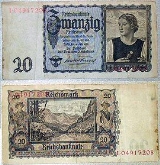
. The first Reichsbank issue of 1924 came in denominations of 10, 20, 50, 100 and 1000 Reichsmark. This was followed by a second issue in the same denominations, dated between 1929 and 1936. A 20 Reichsmark note was introduced in 1939, using a design taken from an unissued Austrian 100 schilling banknote type. 5 Reichsmark notes were issued in 1942. Throughout this period, the Rentenbank also issued banknotes denominated in Rentenmark, mostly in low denominations.

Following their occupation of Germany, the Allies issued banknotes dated 1944. These were printed in similar colours with different sizes for groups of denominations. Notes were issued for ½, 1, 5, 10, 20, 50, 100 and 1000 Mark (not Reichsmark). The issuer was the Alliierte Militärbehörde ("Allied military authorities") with In Umlauf gesetzt in Deutschland ("in legal circulation in Germany") printed on the obverse.

In 1947 Rhineland-Palatinate
Rhineland-Palatinate

Rhineland-Palatinate is one of the 16 States of Germany of Germany. It has an area of and about four million inhabitants. The capital is Mainz....
 issued 5 and 10 Pfennig notes with Geldschein on them.

Occupation Reichsmark

Coins and banknotes for circulation in the occupied territories during the war were issued by the Reichskreditkassen. Holed, zinc coins in 5 and 10 Reichspfennig denominations were struck in 1940 and 1941. Banknotes were issued between 1939 and 1945 in denominations of 50 Reichspfennig, 1, 2, 5, 20 and 50 Reichsmark. These served as legal tender alongside the currency of the occupied countries.

Military Reichsmark Currency

Special issues of Reichsmark currency were issued for use by the German Armed Forces
Wehrmacht

Wehrmacht was the name of the unified armed forces of Germany from 1935 to 1945. It consisted of the Heer , the Kriegsmarine and the Luftwaffe ....
 from 1942-1944. The first issue was denominated in 1, 5, 10 and 50 Reichspfennig and 1 Reichsmark, but was valued at 1 military Reichspfennig = 10 German Reichspfennig. This series was unifaced. The second issue of 1, 5, 10 and 50 Reichsmark were equal in value to the German Reichsmark and was printed on both sides.

Concentration camp and POW Reichsmark Currency

Various special issues of Reichsmark currency were issued for use in concentration and prisoner of war (POW) camps. None was legal tender in Germany itself.

See also

  • Reichsbank
    Reichsbank

    The Reichsbank was the central bank of Germany from 1876 until 1945. It was founded on 1 January 1876 . The Reichsbank was a privately owned central bank of Prussia, under close control by the Reich government....
  • Pfennig
    Pfennig

    The Pfennig is an old Germany coin or note, which existed from the 9th century until the introduction of the euro in 2002.While a valuable coin during the Middle Ages, it lost its value through the years and was the minor coin of the Mark in the German Reich, the former West Germany and the German Democratic Republic , and afte...
  • 1921 in Germany
    1921 in Germany

    See also:1920 in Germany,1921,1922 in Germany and theTimeline of German history.----...
  • 1922 in Germany
    1922 in Germany

    Issues of disarmament and the trial of war crimes had previously been similar sources of anxiety and unrest in Germany, but now receded into the background....


External links