All Topics  
Joseph Goebbels

 
Joseph Goebbels

   Email Print
   Bookmark   Link


Joseph Goebbels


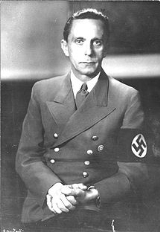
Paul Joseph Goebbels (German pronunciation: ; English generally ) (29 October 1897 1 May 1945) was a German politician and Reich Minister of Propaganda in Nazi Germany
Nazi Germany

Nazi Germany and the Third Reich are the colloquial English names for Germany under the regime of Adolf Hitler and the Nazi Party , which established a Totalitarianism dictatorship that existed from 1933 to 1945....
 from 1933 to 1945. He was one of German dictator Adolf Hitler
Adolf Hitler

Adolf Hitler was an Austrian-born Germany politician and the leader of the National Socialist German Workers Party , popularly known as the Nazi Party....
's closest associates and most devout followers. Goebbels was known for his zealous oratory, and venomous anti-Semitism. He was the chief architect of the Kristallnacht
Kristallnacht

File:1938 Interior of Berlin synagogue after Kristallnacht.jpgKristallnacht or the Night of Broken Glass or "night of shattered crystal" was a pogrom in Nazi Germany on November 9?10, 1938....
 attack on the German Jews, which historians consider to be the first major event in the Holocaust.

Goebbels earned a Ph.D.
Ph.D.

Ph.D. or PHD may stand for:* Doctor of Philosophy, an academic degree* Ph.D. , a 1980s British group* Piled Higher and Deeper, a web comic strip...
 from Heidelberg University in 1921, writing his doctoral thesis on 18th century romantic drama; he then went on to work as a journalist and later a bank clerk and caller on the stock exchange.




Discussion
Ask a question about 'Joseph Goebbels'
Start a new discussion about 'Joseph Goebbels'
Answer questions from other users
Full Discussion Forum


Quotations


Devotion, fervor, longing! Those are my pillars. We have to be the bridge to the future.

Everything is what you make out of it, even yourself.

Give your goods to the poor: Christ. Property is theft - as long as it's not mine: Marx.

I'm looking for the teacher who is unaffected enough to be great, and great enough to be unaffected.

To be modern only means to fill new forms with eternal truths.

Man only honors what he conquers or defends.


Encyclopedia


Paul Joseph Goebbels (German pronunciation: ; English generally ) (29 October 1897 1 May 1945) was a German politician and Reich Minister of Propaganda in Nazi Germany
Nazi Germany

Nazi Germany and the Third Reich are the colloquial English names for Germany under the regime of Adolf Hitler and the Nazi Party , which established a Totalitarianism dictatorship that existed from 1933 to 1945....
 from 1933 to 1945. He was one of German dictator Adolf Hitler
Adolf Hitler

Adolf Hitler was an Austrian-born Germany politician and the leader of the National Socialist German Workers Party , popularly known as the Nazi Party....
's closest associates and most devout followers. Goebbels was known for his zealous oratory, and venomous anti-Semitism. He was the chief architect of the Kristallnacht
Kristallnacht

File:1938 Interior of Berlin synagogue after Kristallnacht.jpgKristallnacht or the Night of Broken Glass or "night of shattered crystal" was a pogrom in Nazi Germany on November 9?10, 1938....
 attack on the German Jews, which historians consider to be the first major event in the Holocaust.

Goebbels earned a Ph.D.
Ph.D.

Ph.D. or PHD may stand for:* Doctor of Philosophy, an academic degree* Ph.D. , a 1980s British group* Piled Higher and Deeper, a web comic strip...
 from Heidelberg University in 1921, writing his doctoral thesis on 18th century romantic drama; he then went on to work as a journalist and later a bank clerk and caller on the stock exchange. He also wrote novels and plays, but they were refused by publishers. Goebbels came into contact with the Nazi Party in 1923 during the French occupation of the Ruhr
Occupation of the Ruhr

The Occupation of the Rhineland gave the French and Belgian armies the springboard from which it was easy to undertake the occupation of the Ruhr Area....
 and became a member in 1924. He was appointed Gauleiter
Gauleiter

A Gauleiter was the party leader of a regional branch of the NSDAP or the head of a Gau or of a Reichsgau....
 (regional party leader) of Berlin
Berlin

Berlin is the Capital of Germany city and one of sixteen States of Germany of Germany. With a population of 3.4 million within its city limits, Berlin is the country's largest city....
. In this position, he put his propaganda skills to full use, combating the local socialist and communist parties with the help of Nazi papers and the paramilitary SA
Sturmabteilung

The , abbreviated SA, , functioned as a paramilitary organization of the Nazi Party the Germany Nazism. They played a key role in Adolf Hitler's rise to power in the 1930s....
. By 1928 he had risen in the party ranks to become one of its most prominent members.

Goebbels rose to power in 1933 along with Hitler and the Nazi party, and he was appointed propaganda minister. One of his first acts was the burning of books
Book burning

Book burning is the practice of destroying, often ceremony, one or more copies of a book or other written material. In modern times, other forms of media, such as gramophone record, Video, and Compact disc have also been ceremoniously burned, torched, or shredded....
 rejected by the Nazis. He had great influence on the media, arts, and information in Germany.

From the beginning of his tenure, Goebbels organized attacks on German Jews, commencing with the boycott of 1933. His attacks on the Jewish population culminated in the Kristallnacht
Kristallnacht

File:1938 Interior of Berlin synagogue after Kristallnacht.jpgKristallnacht or the Night of Broken Glass or "night of shattered crystal" was a pogrom in Nazi Germany on November 9?10, 1938....
 assault of 1938, an open and unrestrained pogrom
Pogrom

A pogrom is a form of riot directed against a particular group, whether ethnic, religious, or other, and characterized by the killing and destruction of their homes, businesses, and religious centers....
 unleashed by the Nazis all across Germany, in which scores of Synagogues were burned and hundreds of Jews were assaulted and murdered. ("Kristallnacht" refers to the broken glass spread on the streets, as the Nazis smashed the windows of thousands of Jewish businesses.)

Goebbels used modern propaganda
Propaganda

Propaganda is the dissemination of information aimed at influencing the opinions or behaviors of large numbers of people. As opposed to Objectivity providing information, propaganda in its most basic sense presents information in order to influence its audience....
 techniques to manipulate and psychologically prepare the German people for a large scale military conflict. Among other propaganda devices, he accused Germany's victims (such as the Poles, the Jews, the French) of trying to destroy Germany, claiming that German actions were only self defense.

During World War II
World War II

World War II, or the Second World War , was a global military conflict which involved a Participants in World War II, including all of the great powers, organised into two opposing military alliances: the Allies of World War II and the Axis powers....
, Goebbels increased his power and influence through shifting alliances with other Nazi leaders. By late 1943, the tide of the war was turning against the Axis powers, but this only spurred Goebbels to intensify the propaganda by urging the Germans to accept the idea of total war
Total war

Total war is a war of unlimited scope in which a belligerent engages in a mobilization of all available Factors of productions at their disposal, whether human, industrial, agricultural, military, natural, technological, or otherwise, in order to entirely destroy or render beyond use their rival's capacity to continue resistance....
 and mobilization. Goebbels remained with Hitler in Berlin
Berlin

Berlin is the Capital of Germany city and one of sixteen States of Germany of Germany. With a population of 3.4 million within its city limits, Berlin is the country's largest city....
 to the end, and following the Führer's suicide
Suicide

Suicide is the intentional taking of one's own life. Many dictionaries also note the metaphorical sense of "willful destruction of one's self-interest"....
 he was the second person to serve as the Third Reich's Chancellor — albeit for one day. In his final hours, it is suggested Goebbels allowed his wife, Magda
Magda Goebbels

Johanna Maria Magdalena "Magda" Goebbels was the wife of Nazi Germany's Propaganda Minister Joseph Goebbels. A prominent member of the Nazi party, she was a close ally and political supporter of Adolf Hitler....
, to kill their six young children
Goebbels children

The Goebbels children were the five daughters and one son born to Nazi Germany Ministry for Popular Enlightenment and Propaganda Joseph Goebbels and his wife Magda Goebbels....
. Shortly after, Goebbels and his wife Magda
Magda Goebbels

Johanna Maria Magdalena "Magda" Goebbels was the wife of Nazi Germany's Propaganda Minister Joseph Goebbels. A prominent member of the Nazi party, she was a close ally and political supporter of Adolf Hitler....
 both committed suicide.

Early life

Goebbels was born in Rheydt
Rheydt

Rheydt is a borough of the Germany city M?nchengladbach, located in the west of North Rhine-Westphalia. Until 1918 and then again from 1933 through 1975 it was an independent city....
, an industrial town south of Mönchengladbach
Mönchengladbach

M?nchengladbach is a city in North Rhine-Westphalia, Germany. It is located west of the Rhine half way between D?sseldorf and the Netherlands border....
 (of which it is now part) on the edge of the Ruhr
Ruhr

The Ruhr is a medium-size river in western Germany , a right tributary of the Rhine....
 district. His family were Catholics of modest means, his father a factory clerk, his mother originally a farmhand. He had four siblings: Hans (1893–1947), Konrad (1895–1949), Elisabeth (1901–1915) and Maria (born 1910, later married to the German filmmaker Max W. Kimmich
Max W. Kimmich

Max Wilhelm Kimmich was a German filmmaker, film director and screenwriter during the first half of the 20th century. He also was brother-in-law to Joseph Goebbels....
). Goebbels was educated at a Gymnasium
Gymnasium (school)

A gymnasium is a type of school providing secondary education in some parts of Europe, comparable to English Grammar schools in the United Kingdoms or sixth form colleges and U.S....
, or secondary school, where he completed his Abitur
Abitur

'Abitur' is a designation used in Germany and Finland for final exams that pupils take at the end of their secondary education, usually after 12 or 13 years of schooling ....
 (university entrance examination) in 1916. Beginning in childhood, he had a deformed right leg, the result either of club foot
Club foot

A clubfoot, or Giles Smith syndrome , is a birth defect. TEV is classified into 2 groups Postural TEV or Structural TEV. Without treatment, persons afflicted often appear to walk on their ankles, or on the sides of their feet....
 or osteomyelitis
Osteomyelitis

Osteomyelitis is an infection of bone or bone marrow, usually caused by pyogenic bacteria or mycobacteria. It can be usefully subclassified on the basis of the causative organism, the route, duration and anatomic location of the infection....
. He wore a metal brace and special shoe to compensate for his shortened leg, but nevertheless walked with a limp all his life. As a result of these conditions, he was rejected for military service in World War I
World War I

World War I, or the First World War , was a global military conflict which involved the Great powers, organized into two opposing military alliances: the Allies of World War I and the Central Powers....
, which he bitterly resented. He later frequently misrepresented himself as a war veteran and misrepresented his disability as a war wound. The nearest he came to military service was as an "office soldier" from June 1917 to October 1917 in Rheydt's "Patriotic Help Unit".

Goebbels compensated for his severe physical frailty with intellectual accomplishments. Goebbels attended the boarding school
Boarding school

A boarding school is a school where some or all pupils not only study, but also live during term time, with their fellow students and possibly teachers....
 of German Franciscan brothers in Bleijerheide, Kerkrade
Kerkrade

Kerkrade is a town and a municipality in the southeastern Netherlands.It is the western half of the divided region and de facto city, taken together with the eastern half, the Germany of Herzogenrath, which was the original name of the municipality under the Holy Roman Empire....
 (in the Netherlands). After growing distant from his Catholic
Roman Catholic Church

The Roman Catholic Church, officially known as the Catholic Church is the world's largest Christianity Ecclesia , representing over half of all Christians and one-sixth of the world population....
 faith he studied literature and philosophy at universities in Bonn
Bonn

Bonn is the 19th largest city in Germany. Located about 20 kilometres south of Cologne on the river Rhine in the Federal State of North Rhine-Westphalia, it was the Capital of Germany West Germany from 1949 to 1990 and the official seat of government of united Germany from 1990 to 1999....
, Würzburg
Würzburg

W?rzburg is a city in the region of Franconia which lies in the northern tip of Bavaria, Germany. Located on the Main River, it is the capital of the Regierungsbezirk Unterfranken....
, Freiburg im Breisgau and Heidelberg
Heidelberg

Heidelberg is a city in Baden-W?rttemberg, Germany. As of 2006, over 140,000 people live within the city's area. The town of Heidelberg is an administrative district of its own....
, where he wrote his doctoral thesis on the 18th century romantic novelist Wilhelm von Schütz. His two most influential teachers, Friedrich Gundolf
Friedrich Gundolf

Friedrich Gundolf, born Friedrich Leopold Gundelfinger was a Germany-Jewish literary scholar and poet and one of the most famous academics of the Weimar Republic....
 and his doctoral supervisor at Heidelberg, Max Freiherr von Waldberg
Max Freiherr von Waldberg

Max Freiherr von Waldberg was a professor of modern literature at the University of Heidelberg in Germany. After World War I, one of his pupils was future Nazi propaganda minister Joseph Goebbels....
, were Jews. His intelligence and political astuteness were generally acknowledged even by his enemies.

After completing his doctorate in 1921, Goebbels worked as a journalist and tried for several years to become a published author. He wrote a semi-autobiographical novel, Michael
Michael (autobiography)

Michael was a semi-autobiographical novel authored by the Nazi Germany propaganda Joseph Goebbels and published in 1929. The novel is a combination of Goebbels' own thoughts and the life of his best friend Richard Flisges who had actually fought in the war, and later ended his college studies to work in a mine where he died in an accident....
, two verse
Verse

Verse may refer to:Poetry*Verse , a line of poetry, a stanza*Blank verse is a type of poetry having regular meter but no rhyme*Free verse is a type of poetry written without the use of strict meter or rhyme, but that is still recognizable as 'poetry'...
 plays, and quantities of romantic poetry. In these works, he revealed the psychological damage his physical limitations had caused. "The very name of the hero, Michael, to whom he gave many autobiographical features, suggests the way his self-identification was pointing: a figure of light, radiant, tall, unconquerable," and above all "'To be a soldier! To stand sentinel! One ought always to be a soldier,' wrote Michael-Goebbels." Goebbels found another form of compensation in the pursuit of women, a lifelong compulsion which he indulged "with extraordinary vigour and a surprising degree of success." His diaries reveal a long succession of affairs, before and after his marriage in 1931 to Magda Quandt
Magda Goebbels

Johanna Maria Magdalena "Magda" Goebbels was the wife of Nazi Germany's Propaganda Minister Joseph Goebbels. A prominent member of the Nazi party, she was a close ally and political supporter of Adolf Hitler....
, with whom he had 6 children
Goebbels children

The Goebbels children were the five daughters and one son born to Nazi Germany Ministry for Popular Enlightenment and Propaganda Joseph Goebbels and his wife Magda Goebbels....
.

Goebbels was embittered by the frustration of his literary career; his novel did not find a publisher until 1929 and his plays were never staged. He found an outlet for his desire to write in his diaries
Goebbels Diaries

Joseph Goebbels kept a diary for much of his life. From 1923 to 1941, he wrote the entries himself. From 1941 to 1945, he dictated lengthy passages to aides....
, which he began in 1923 and continued for the rest of his life. He later worked as a bank clerk and a caller on the stock exchange. During this period, he read avidly and formed his political views. Major influences were Friedrich Nietzsche
Friedrich Nietzsche

Friedrich Wilhelm Nietzsche was a 19th century philosophy Germans philosophy and classical philology. He wrote critical texts on religion, morality, contemporary culture, philosophy, and science, using a distinctive German language style and displaying a fondness for metaphor and aphorism....
, Oswald Spengler
Oswald Spengler

Oswald Arnold Gottfried Spengler was a German historian and philosopher whose interests also included mathematics, science, and art. He is best known for his book The Decline of the West in which he puts forth a cyclical pattern theory of the rise and decline of civilizations....
 and, most importantly, Houston Stewart Chamberlain
Houston Stewart Chamberlain

Houston Stewart Chamberlain was a Great Britain-born author of books on political philosophy, natural science and his posthumous father-in-law Richard Wagner....
, the British-born German writer who was one of the founders of "scientific" anti-Semitism
Anti-Semitism

Antisemitism is prejudice against or hostility towards Jews.This prejudice or hostility is usually characterized by a combination of Religion, Race , cultural and ethnic group biases....
, and whose book The Foundations of the Nineteenth Century (1899) was one of the standard works of the extreme right in Germany. Goebbels spent the winter of 1919–20 in Munich
Munich

Munich is the capital city of Bavaria, Germany. Munich is located on the River Isar north of the Northern Limestone Alps. Munich is the third largest city in Germany, after Berlin and Hamburg....
, where he witnessed and admired the violent nationalist
Nationalism

Nationalism refers to an ideology, a feeling, a form of culture, or a social movement that focuses on the nation. While there is significant debate over the historical origins of nations, nearly all Expert accept that nationalism, at least as an ideology and social movement, is a Modernity phenomenon originating in Europe....
 reaction against the attempted communist revolution in Bavaria
Bavaria

Bavaria , with an area of and almost 12.5 million inhabitants, is a region located in the southeast of Germany and is the largest States of Germany of Germany by area....
. His first political hero was Anton Graf von Arco auf Valley
Anton Graf von Arco auf Valley

Anton von Padua Alfred Emil Hubert Georg Graf von Arco auf Valley , commonly known as Anton Arco-Valley, Germany political activist, is best remembered as the assassin of the Bavarian socialist leader Kurt Eisner in February 1919....
, the man who assassinated the Bavarian prime minister Kurt Eisner
Kurt Eisner

Kurt Eisner was a Bavarian politician and journalist. As a German socialist journalist and statesman, he organized the German Revolution that achieved the overthrow of the monarchy in Bavaria in 1918....
. Hitler was in Munich at the same time and entered politics as a result of similar experiences.

The culture of the German extreme right was violent and anti-intellectual, which posed a challenge to the physically frail University graduate. Joachim Fest
Joachim Fest

Joachim Clemens Fest , Germany historian, journalist, critic and editor, is best known for his writings and public commentary on Nazi Germany, including an important biography of Adolf Hitler and books about Albert Speer and the German Resistance....
 writes:

This was the source of his hatred of the intellect, which was a form of self-hatred, his longing to degrade himself, to submerge himself in the ranks of the masses, which ran curiously parallel with his ambition and his tormenting need to distinguish himself. He was incessantly tortured by the fear of being regarded as a ‘bourgeois intellectual’… It always seemed as if he were offering blind devotion (to Nazism) to make up for his lack of all those characteristics of the racial elite which nature had denied him.


Nazi Activist

Like others who were later prominent in the Third Reich, Goebbels came into contact with the Nazi Party in 1923, during the campaign of resistance to the French occupation of the Ruhr
Occupation of the Ruhr

The Occupation of the Rhineland gave the French and Belgian armies the springboard from which it was easy to undertake the occupation of the Ruhr Area....
. Hitler’s imprisonment following the failed November 1923 "Beer Hall Putsch
Beer Hall Putsch

The Beer Hall Putsch was a failed attempt at revolution that occurred between the evening of Thursday, November 8 and the early afternoon of Friday, November 9, 1923, when the National Socialist German Workers Party's leader Adolf Hitler, the popular World War I General Erich Ludendorff, and other leaders of the Kampfbund, unsuccessfully...
" left the party temporarily leaderless, and when the 27-year-old Goebbels joined the party in late 1924 the most important influence on his political development was Gregor Strasser
Gregor Strasser

File:Bundesarchiv Bild 119-1721, Gregor Strasser.jpgGregor Strasser was a politician of the National Socialist German Workers Party . He was murdered in Berlin during the Night of the Long Knives....
, who became Nazi organizer in northern Germany in March 1924. Strasser ("the most able of the leading Nazis" of this period) took the "socialist" component of National Socialism far more seriously than did Hitler and other members of the Bavarian leadership of the party.

"National and socialist! What goes first, and what comes afterwards?" Goebbels asked rhetorically in a debate with Theodor Vahlen
Theodor Vahlen

Karl Theodor Vahlen was an Austrian-German mathematician who was an ardent supporter of the Nazi Party....
, Gauleiter
Gauleiter

A Gauleiter was the party leader of a regional branch of the NSDAP or the head of a Gau or of a Reichsgau....
 (regional party head) of Pomerania
Pomerania

Pomerania is a historical region on the south coast of the Baltic Sea. Divided between Germany and Poland, it stretches roughly from the Recknitz River near Stralsund in the West, via the Oder River delta near Szczecin, to the mouth of the Vistula River near Gdansk in the East....
, in the Rhineland
Rhineland

The Rhineland is the general name for the land on both sides of the river Rhine in the west of Germany. After the collapse of the First French Empire in the early 19th century, the German-speaking regions at the middle and lower course of the Rhine were annexed to the kingdom of Prussia....
 party newspaper National-sozialistische Briefe (National-Socialist Letters), of which he was editor, in mid 1925. "With us in the west, there can be no doubt. First socialist redemption, then comes national liberation like a whirlwind… Hitler stands between both opinions, but he is on his way to coming over to us completely." Goebbels, with his journalistic skills, thus soon became a key ally of Strasser in his struggle with the Bavarians over the party programme. The conflict was not, so they thought, with Hitler, but with his lieutenants, Rudolf Hess
Rudolf Hess

Rudolf Walter Richard Hess was a prominent figure in Nazi Germany, acting as Adolf Hitler's Deputy F?hrer in the Nazi Party. On the eve of war with the Soviet Union, he flew solo to Scotland in an attempt to negotiate peace with the United Kingdom, but instead was arrested....
, Julius Streicher
Julius Streicher

Julius Streicher was a prominent Nazism prior to World War II. He was the founder and publisher of Der St?rmer newspaper, which became a central element of the Nazi propaganda machine....
 and Hermann Esser
Hermann Esser

Hermann Esser entered the NSDAP with Adolf Hitler in 1920, became the editor of the Nazi paper, V?lkischer Beobachter, and a Nazi member of the Reichstag....
, who, they said, were mismanaging the party in Hitler’s absence. In 1925, Goebbels published an open letter to "my friends of the left," urging unity between socialists and Nazis against the capitalists
Capitalism

Capitalism is an economic system in which wealth, and the means of producing wealth, are private property and controlled rather than commonly, publicly, or state-owned and controlled....
. "You and I," he wrote, "we are fighting one another although we are not really enemies."

In February 1926, Hitler, having finished working on Mein Kampf
Mein Kampf

Mein Kampf, in English language: My Struggle, is a book dictated by Adolf Hitler. It combines elements of autobiography with an exposition of Adolf Hitler's political beliefs....
, made a sudden return to party affairs and soon disabused the northerners of any illusions about where he stood. He summoned about sixty gauleiters and other activists, including Goebbels, to a meeting at Bamberg
Bamberg

Bamberg is a town in Bavaria, Germany. It is located in Upper Franconia on the river Regnitz, close to its confluence with the river Main. Bamberg is one of the few cities in Germany that was not destroyed by World War II bombings because of a nearby Artillery Factory that prevented planes from getting near to Bamberg....
, in Streicher’s Gau of Franconia
Franconia

Franconia is a region of Germany comprising the northern parts of the modern state of Bavaria and a much smaller region in northeastern Baden-W?rttemberg called Heilbronn-Franken....
, where he gave a two-hour speech repudiating the political programme of the "socialist" wing of the party. For Hitler, the real enemy of the German people was always the Jews, not the capitalists
Capitalism

Capitalism is an economic system in which wealth, and the means of producing wealth, are private property and controlled rather than commonly, publicly, or state-owned and controlled....
. Goebbels was bitterly disillusioned. "I feel devastated," he wrote. "What sort of Hitler? A reactionary
Reactionary

Reactionary refers to any movement or ideology that opposes change or progress in society, and which seeks a return to a previous state . The term originated in the French Revolution, to denote the Counter-revolutionary who wanted to restore the real or imagined conditions of the Monarchy Ancien R?gime....
?" He was horrified by Hitler’s characterization of socialism as "a Jewish creation," his declaration that the Soviet Union
Soviet Union

The Union of Soviet Socialist Republics was a Constitution of the Soviet Union socialist state that existed in Eurasia from 1922 to 1991.The name is a translation of the , romanization of Russian Soyuz Sovetskikh Sotsialisticheskikh Respublik, abbreviated ????, SSSR....
 must be destroyed, and his assertion that private property would not be expropriated by a Nazi government. "I no longer fully believe in Hitler. That’s the terrible thing: my inner support has been taken away."

Hitler, however, recognized Goebbels’s talents, and he was a shrewd judge of character; he knew that Goebbels craved recognition above all else. In April, he brought Goebbels to Munich, sending his own car to meet him at the railway station, and gave him a long private audience. Hitler berated Goebbels over his support for the "socialist" line, but offered to "wipe the slate clean" if Goebbels would now accept his leadership. Goebbels capitulated completely, offering Hitler his total loyalty — a pledge which was clearly sincere, and which he adhered to until the end of his life. "I love him… He has thought through everything," Goebbels wrote. "Such a sparkling mind can be my leader. I bow to the greater one, the political genius
Genius

A genius is an individual who successfully applies a previously unknown technique in the production of a work of art, science or calculation, or who masters and personalizes a known technique....
. Later he wrote: "Adolf Hitler, I love you because you are both great and simple at the same time. What one calls a genius." Fest writes:

From this point on he submitted himself, his whole existence, to his attachment to the person of the Führer, consciously eliminating all inhibitions springing from intellect, free will
Free will

The question of free will is whether, and in what sense, rational agents exercise control over their actions and decisions. Addressing this question requires understanding the relationship between freedom and Causality, and determining whether the laws of nature are causally deterministic....
 and self-respect. Since this submission was an act less of faith than of insight, it stood firm through all vicissitudes to the end. ‘He who forsakes the Führer withers away,’ he would later write.


Propagandist in Berlin


In October 1926, Hitler rewarded Goebbels for his new loyalty by making him the party "Gauleiter
Gauleiter

A Gauleiter was the party leader of a regional branch of the NSDAP or the head of a Gau or of a Reichsgau....
" for the Berlin section of the National Socialists. Goebbels was then able to use the new position to indulge his literary aspirations in the German capital, which he perceived to be a stronghold of the socialists and communists. Here, Goebbels discovered his talent as a propagandist, writing such tracts as 1926's The Second Revolution and Lenin or Hitler.

Here, he was also able to indulge his heretofore latent taste for violence, if only vicariously through the actions of the street fighters under his command. History, he said, "is made in the street," and he was determined to challenge the dominant parties of the left — the Social Democrats and Communists
Communist Party of Germany

The Communist Party of Germany was a major political party in Germany between 1918 and 1933, and a minor party in West Germany in the postwar period....
 — in the streets of Berlin. Working with the local S.A.
Sturmabteilung

The , abbreviated SA, , functioned as a paramilitary organization of the Nazi Party the Germany Nazism. They played a key role in Adolf Hitler's rise to power in the 1930s....
 (stormtrooper) leaders, he deliberately provoked beer-hall battles and street brawls, frequently involving firearms. "Beware, you dogs," he wrote to his former "friends of the left": "When the Devil is loose in me you will not curb him again." When the inevitable deaths occurred, he exploited them for the maximum effect, turning the street fighter Horst Wessel
Horst Wessel

Horst Ludwig Wessel was a Germany Nazism activist who was made a posthumous hero of the Nazi movement following his violent death in 1930. He was the author of the lyrics to the song "Die Fahne hoch" , usually known as Horst-Wessel-Lied , which became the Nazi Party anthem and Germany's official co-national anthem from 1933 to 1945....
, who was killed at his home by enemy political activists, into a martyr and hero.

In Berlin, Goebbels was able to give full expression to his genius for propaganda, as editor of the Berlin Nazi newspaper Der Angriff
Der Angriff

File:Der Angriff head.jpgDer Angriff was a newspaper founded in 1927 by the Berlin Gau #The Nazi Party Gaue of the NSDAP.The newspaper was set up by Joseph Goebbels, after 1926 the Gauleiter of NSDAP in Berlin....
 (The Attack) and as the author of a steady stream of Nazi posters and handbills. "He rose within a few months to be the city’s most feared agitator." His propaganda techniques were totally cynical: "That propaganda is good which leads to success, and that is bad which fails to achieve the desired result," he wrote. "It is not propaganda’s task to be intelligent, its task is to lead to success."

Among his favorite targets were socialist leaders such as Hermann Müller
Hermann Müller (politician)

, born in Mannheim, was a German Social Democratic Party of Germany politician who served as Foreign Minister , and twice as Chancellor of Germany under the Weimar Republic....
 and Carl Severing
Carl Severing

Carl Wilhelm Severing was a Germany Social Democratic Party of Germany politician during the Weimar Republic.He was Interior Minister of Prussia from 1920 to 1926, Federal Ministry of the Interior from 1928 to 1930 and Interior Minister of Prussia again from 1930 to 1932....
, and the Jewish Berlin Police President, Bernhard Weiss, whom he subjected to a relentless campaign of Jew-baiting in the hope of provoking a crackdown which he could then exploit. The Social Democrat city government obliged in 1927 with an eight-month ban on the party, which Goebbels exploited to the limit. When a friend criticized him for denigrating Weiss, a man with an exemplary military record, "he explained cynically that he wasn’t in the least interested in Weiss, only in the propaganda effect."

Goebbels also discovered a talent for oratory
Oratory

Oratory is a type of public speaking.Oratory may also refer to:* Oratory , a power metal band* Oratory , a place of worship* a religious order such as...
, and was soon second in the Nazi movement only to Hitler as a public speaker. Where Hitler’s style was hoarse and passionate, Goebbels’s was cool, sarcastic and often humorous: he was a master of biting invective and insinuation, although he could whip himself into a rhetoric
Rhetoric

Rhetoric is the art of using language as a means to persuade. Along with logic and dialectic, rhetoric is one of the three ancient arts of discourse....
al frenzy if the occasion demanded. Unlike Hitler, however, he retained a cynical detachment from his own rhetoric. He openly acknowledged that he was exploiting the lowest instincts of the German people — racism
Racism

Racism, by its simplest definition is the belief that Race is the primary determinant of human traits and capacities and that racial differences produce an inherent superiority of a particular race....
, xenophobia
Xenophobia

Xenophobia is an intense dislike and/or fear of people from other countries. It comes from the Greek language words ????? , meaning "foreigner," "stranger," and f???? , meaning "fear." The term is typically used to describe a fear or dislike of alien s or of people significantly different from oneself....
, class envy and insecurity. He could, he said, play the popular will like a piano, leading the masses wherever he wanted them to go. "He drove his listeners into ecstasy, making them stand up, sing songs, raise their arms, repeat oaths — and he did it, not through the passionate inspiration of the moment, but as the result of sober psychological
Psychology

Psychology is an academic and applied science discipline involving the science study of human mental functions and behavior. Occasionally it also relies on symbolic hermeneutics and critical theory, although these traditions are less pronounced than in other social sciences such as sociology....
 calculation."

Goebbels’s words and actions made little impact on the political loyalties of Berlin. At the 1928 Reichstag
Reichstag (institution)

The Reichstag was the parliament of the Holy Roman Empire, the North German Confederation, and of Germany until 1945. The main chamber of the German parliament is now called Bundestag , but the building in which it meets is still called "Reichstag" ....
 elections, the Nazis polled less than two percent of the vote in Berlin compared with 33 percent for the Social Democrats and 25 percent for the Communists. At this election Goebbels was one of the 10 Nazis elected to the Reichstag, which brought him a salary of 750 Reichsmarks a month and immunity from prosecution. Even when the impact of the Great Depression
Great Depression

File:International depression.pngThe Great Depression was a worldwide economic Recession starting in most places in 1929 and ending at different times in the 1930s or early 1940s for different countries....
 led to an enormous surge in support for the Nazis across Germany, Berlin resisted the party’s appeal more than any other part of Germany: at its peak in 1932, the Nazi Party polled 28 percent in Berlin to the combined left’s 55 percent. But his outstanding talents, and the obvious fact that he stood high in Hitler’s regard, earned Goebbels the grudging respect of the anti-intellectual brawlers of the Nazi movement, who called him "our little doctor" with a mixture of affection and amusement. By 1928, still aged only 31, he was acknowledged to be one of the inner circle of Nazi leaders. "The S.A. would have let itself be hacked to bits for him," wrote Horst Wessel in 1929.

The Great Depression
Great Depression

File:International depression.pngThe Great Depression was a worldwide economic Recession starting in most places in 1929 and ending at different times in the 1930s or early 1940s for different countries....
 led to a new resurgence of "left" sentiment in some sections of the Nazi Party, led by Gregor Strasser’s brother Otto
Otto Strasser

Otto Johann Maximilian Strasser was a Germany politician and 'left-wing' member of the Nazi Party party who rejected some of Adolf Hitler's ideas and less socialist economic tendencies....
, who argued that the party ought to be competing with the Communists for the loyalties of the unemployed and the industrial workers by promising to expropriate the capitalists. Hitler, whose dislike of working-class militancy reflected his social origins in the small-town lower-middle class, was thoroughly opposed to this line. He recognized that the growth in Nazi support at the 1930 elections had mainly come from the middle class
Middle class

Middle class is the group of people in contemporary society who are between the working class and nobility. This socioeconomic class includes professionals, highly skilled workers, and lower and middle management....
 and from farmers, and he was now busy building bridges to the upper middle class
Upper middle class

The upper middle class is a sociological concept referring to the social group constituted by higher-status members of the middle class. This is in contrast to the term lower middle class used for the group at the other end of the middle class scale and the regular middle class....
es and to German business. In April 1930, he fired Strasser as head of the Nazi Party national propaganda apparatus and appointed Goebbels to replace him, giving him control of the party’s national newspaper, the Völkischer Beobachter
Völkischer Beobachter

The V?lkischer Beobachter was the newspaper of the Nazi Party from 1920. It first appeared weekly, then daily from February 8, 1923. For twenty-five years it formed part of the official public face of the Nazi party....
 (People’s Observer), as well as other Nazi papers across the country. Goebbels, although he continued to show "leftish" tendencies in some of his actions (such as co-operating with the Communists in supporting the Berlin transport workers' strike in November 1932), was totally loyal to Hitler in his struggle with the Strassers, which culminated in Otto’s expulsion from the party in July 1930.

Despite his revolutionary
Revolutionary

A revolutionary is a person who either actively participates in, or advocates revolution. Also, when used as an adjective, the term revolutionary refers to something that has a major, sudden impact on society or on some aspect of human endeavour....
 rhetoric, Goebbels’s most important contribution to the Nazi cause between 1930 and 1933 was as the organizer of successive election campaigns: The Reichstag elections of September 1930, July and November 1932 and March 1933, and Hitler’s presidential campaign of March–April 1932. He proved to be an organizer of genius, choreographing Hitler’s dramatic aeroplane tours of Germany and pioneering the use of radio and cinema for electoral campaigning. The Nazi Party’s use of torchlight parades, brass bands, massed choirs and similar techniques caught the imagination of many voters, particularly young people. "His propaganda headquarters in Munich sent out a constant stream of directives to local and regional party sections, often providing fresh slogans and fresh material for the campaign." Although the spectacular rise in the Nazi vote in 1930 and July 1932 was caused mainly by the effects of the Depression, Goebbels as party campaign manager was naturally given much of the credit.

Propaganda Minister

When Hitler was appointed Reich Chancellor of Germany on 30 January 1933, Goebbels was initially given no office: the coalition cabinet which Hitler headed contained only a minority of Nazis as part of the deal he had negotiated with President Paul von Hindenburg
Paul von Hindenburg

Paul Ludwig Hans Anton von Beneckendorff und von Hindenburg , known universally as Paul von Hindenburg was a German Generalfeldmarschall and statesman....
 and the conservative parties. But as the propaganda head of the ruling party, a party which had no great respect for the law, he immediately began to behave as though he were in power. He commandeered the state radio to produce a live broadcast of the torchlight parade which celebrated Hitler’s assumption of office. On 13 March, Goebbels had his reward for his part in bringing the Nazis to power by being appointed Reich Minister of Public Enlightenment and Propaganda
Ministry of Public Enlightenment and Propaganda

File:Bundesarchiv Bild 146-1993-020-32A, Berlin, Wilhelmplatz, Propagandaministerium.jpgThe Reich Ministry for Public Enlightenment and Propaganda was Nazi Germany's Ministry that enforced Nazi Party Nazism in Germany and regulated its culture and society....
 (Volksaufklärung und Propaganda), with a seat in the Cabinet.

The role of the new ministry, which took over palatial accommodation in the 18th century Leopold Palace on Wilhelmstrasse, just across from Hitler’s offices in the Reich Chancellery
Reich Chancellery

File:Bundesarchiv Bild 183-2005-1017-526, Berlin, Reichskanzlei.jpgThe Reich Chancellery was the traditional name of the office of the Germany Chancellor of Germany ....
, was to centralise Nazi control of all aspects of German cultural and intellectual life, particularly the press, radio and the visual and performing arts. On 1 May, Goebbels organised the massive demonstrations and parades to mark the "Day of National Labour" which preceded the Nazi takeover and destruction of the German trade union
Trade union

A trade union or labor union is an organization run by and for workers who have banded together to achieve common goals in key areas such as wages, hours, and working conditions....
 movement. By 3 May, he was able to boast in his diary: "We are the masters of Germany." On 10 May, he supervised an even more symbolic event in the establishment of Nazi cultural power: the burning of up to 20,000 books by Jewish or anti-Nazi authors in the Opernplatz
Bebelplatz

The Bebelplatz is a public square in Berlin, the capital of Germany. The square is on the south side of the Unter den Linden, a major east-west thoroughfare in the centre of the city....
 next to the university.

The hegemonic
Hegemony

Hegemony first denoted the dominance of a Greek city-state over other city-states, then denoted the dominance of one nation over others. The political scientist Antonio Gramsci developed the former conceptions to identify the dominance of one social class over the other social classes in a society by means of cultural hegemony....
 ambitions of the Propaganda Ministry were shown by the divisions which Goebbels soon established: press, radio, film, theatre, music, literature and publishing. In each of these, a Reich Chamber (Reichskammer) was established, co-opting leading figures from the field (usually not known Nazis) to head each Chamber, and requiring them to supervise the purge of Jews, socialists and liberals
Liberalism

Liberalism is a broad class of political philosophy that considers individualism liberty and equality to be the most important political goals....
, as well as practitioners of "degenerate" art forms such as abstract art
Abstract art

Abstract art uses a visual language of form, color and line to create a composition which may exist with a degree of independence from visual references in the world....
 and atonal music
Atonality

Atonality in its broadest sense describes music that lacks a Tonality, or Key . Atonality in this sense usually describes compositions written from about 1908 to the present day where a hierarchy of pitches focusing on a single, central tone is not used and the notes of the chromatic scale function independently of one another ....
. The respected composer Richard Strauss
Richard Strauss

Richard Georg Strauss was a German composer of the late Romantic music and early modern eras, particularly of operas, Lieder and tone poems. Strauss was also a prominent Conducting....
, for example, became head of the Reich Music Chamber. Goebbels’ orders were backed by the threat of force. The many prominent Jews in the arts and the mass media
Mass media

Mass media is a term used to denote a section of the media specifically envisioned and designed to reach a mainstream such as the population of a nation state....
 emigrated in large numbers rather than risk the fists of the S.A. and the gates of the concentration camp, as did many socialists and liberals
Liberalism

Liberalism is a broad class of political philosophy that considers individualism liberty and equality to be the most important political goals....
. Some non-Jewish anti-Nazis with good connections or international reputations survived until the mid 1930s, but most were forced out sooner or later.

Control of the arts and media was not just a matter of personnel. Soon the content of every newspaper, book, novel, play, film, broadcast and concert, from the level of nationally-known publishers and orchestras to local newspapers and village choirs, was subject to supervision by the Propaganda Ministry, although a process of self-censorship
Censorship

Censorship is the suppression of freedom of speech or deletion of communicative material which may be considered objectionable, harmful or sensitive, as determined by a censor....
 was soon effectively operating in all these fields, leaving the Ministry in Berlin free to concentrate on the most politically sensitive areas such as major newspapers and the state radio. No author could publish, no painter could exhibit, no singer could broadcast, no critic could criticise, unless they were a member of the appropriate Reich Chamber, and membership was conditional on good behaviour. Goebbels could bribe
Bribery

Bribery, a form of pecuniary corruption, is an act implying money or gift given that alters the behaviour of the recipient. Bribery constitutes a crime and is defined by Black's Law Dictionary as the Offer and acceptance, Gift, Offer and acceptance, or Solicitation of any item of value to influence the actions of an official or other pers...
 as well as threaten: he secured a large budget for his Ministry, with which he was able to offer generous salaries and subsidies
Subsidy

In economics, a subsidy is a form of financial assistance paid to a business or economic sector. A subsidy can be used to support businesses that might otherwise fail, or to encourage activities that would otherwise not take place....
 to those in the arts who co-operated with him. These were inducements which most artists, theatres and orchestras, after their struggles to survive during the Depression, found hard to refuse.

As the most highly educated member of the Nazi leadership, and the one with the most authentic pretensions to high culture, Goebbels was sensitive to charges that he was dragging German culture down to the level of mere propaganda. He responded by saying that the purpose of both art and propaganda was to bring about a spiritual mobilisation of the German people. He was, in fact, far from the most militant member of the Nazi leadership on cultural questions. The more philistine Nazis wanted nothing in German books but Nazi slogans, nothing on German stages and cinema screens but Nazi heroics, and nothing in German concert halls but German folk songs.

Goebbels insisted that German high culture must be allowed to carry on, both for reasons of international prestige and to win the loyalty of the upper middle classes, who valued art forms such as opera
Opera

Opera is an Performing arts in which singers and musicians perform a dramatic work which combines a text and a musical score. Opera is part of the Western classical music tradition....
 and the symphony
Symphony

A symphony is a musical composition, often extended and usually for orchestra. "Symphony" does not imply a specific form. Many symphonies are tonality works in four movement with the first in sonata form, and this is often described by music theorists as the structure of a "Classical period " symphony, although even some symphonies by the ac...
. He thus became to some extent the protector of the arts as well as their regulator. In this, he had the support of Hitler, a passionate devotee of Richard Wagner
Richard Wagner

Wilhelm Richard Wagner was a German composer, Conducting, theatre director and essayist, primarily known for his operas . Unlike most other great opera composers, Wagner wrote both the scenario and libretto for his works....
. But Goebbels always had to bow to Hitler’s views. Hitler loathed modernism
Modernism

Modernism, in its broadest definition, is modern thought, character, or practice. More specifically, the term describes both a set of cultural tendencies and an array of associated cultural movements, originally arising from wide-scale and far-reaching changes to Western culture in the late nineteenth and early twentieth century....
 of all kinds, and Goebbels (whose own tastes were sympathetic to modernism) was forced to acquiesce in imposing very traditionalist forms on the artistic and musical worlds. The music of Paul Hindemith
Paul Hindemith

Paul Hindemith was a German composer, violist, violinist, teacher, music theorist and Conducting....
, for example, was banned simply because Hitler did not like it.

Goebbels also resisted the complete Nazification of the arts because he knew that the masses must be allowed some respite from slogans and propaganda. He ensured that film studios such as UFA
Universum Film AG

Universum Film AG, better known as Ufa or UFA, was the principal film studio in Germany, home of the German film industry during the Weimar Republic and through World War II, and a major force in world cinema from 1917 to 1945....
 at Babelsberg near Berlin continued to produce a stream of comedies and light romances, which drew mass audiences to the cinema where they would also watch propaganda newsreels and Nazi epics. His abuse of his position as Propaganda Minister and the reputation that built up around his use of the "casting couch" was well known. Many actresses wrote later of how Goebbels had tried to lure them to his home. He acquired the nickname "Bock von Babelsberg" lit: "Babelsberg Stud". He resisted considerable pressure to ban all foreign films — helped by the fact that Hitler was a big fan of Mickey Mouse
Mickey Mouse

Mickey Mouse is a funny animal cartoon character who has become an icon for The Walt Disney Company. Mickey Mouse was created in 1928 by Walt Disney and Ub Iwerks and voiced by Walt Disney....
. For the same reason, Goebbels worked to bring culture to the masses — promoting the sale of cheap radios, organising free concerts in factories, staging art exhibitions in small towns and establishing mobile cinemas to bring the movies to every village. All of this served short-term propaganda ends, but also served to reconcile the German people, particularly the working class, to the regime.

Goebbels and the Jews

Despite the enormous power of the Propaganda Ministry over German cultural life, Goebbels’ status began to decline once the Nazi regime was firmly established in power. This was because the real business of the Nazi regime was preparation for war, and although propaganda was a part of this, it was not the main game. By the mid 1930s, Hitler’s most powerful subordinates were Hermann Göring
Hermann Göring

Hermann Wilhelm G?ring was a Germany politician, military leader and a leading member of the Nazi Party. Among many offices, he was Hitler's designated successor and commander of the Luftwaffe ....
, as head of the Four Year Plan
Four year plan

The Four Year Plan was a series of economic reforms created by the Nazi Party. The Four Year Plan included: Reduced Unemployment; increased synthetic fibre production; public works projects, headed by Fritz Todt; called for increased automobile production; initiated numerous building and architectural projects; and further developed the Autob...
 for crash rearmament, and Heinrich Himmler
Heinrich Himmler

Heinrich Luitpold Himmler was a Nazi Germany German politician and head of the Schutzstaffel. He was one of the most powerful men in Nazi Germany, competing with Hermann G?ring, Martin Bormann and Joseph Goebbels....
, head of the SS and police apparatus. Once the internal enemies of the Nazi Party were destroyed, as they effectively were by 1935, Goebbels’s propaganda efforts began to lose their point, and without an enemy to fight, his rhetoric began to sound hollow and unconvincing.

As a man of education and culture, Goebbels had once mocked the "primitive" anti-Semitism of Nazis such as Julius Streicher
Julius Streicher

Julius Streicher was a prominent Nazism prior to World War II. He was the founder and publisher of Der St?rmer newspaper, which became a central element of the Nazi propaganda machine....
. But as Joachim Fest observes: "Goebbels [found] in the increasingly unrestrained practice of anti-Semitism by the state new possibilities into which he threw himself with all the zeal of an ambitious man worried by a constant diminution of his power." Fest also suggests a psychological motive: "A man who conformed so little to the National Socialist image of the elite… may have had his reason, in the struggles for power at Hitler’s court, for offering keen anti-Semitism as a counterweight to his failure to conform to a type." Whatever his motives, Goebbels took every opportunity to attack the Jews. From 1933 onwards, he was bracketed with Streicher among the regime’s most virulent anti-Semites. "Some people think," he told a Berlin rally in June 1935, "that we haven’t noticed how the Jews are trying once again to spread themselves over all our streets. The Jews ought to please observe the laws of hospitality and not behave as if they were the same as us."

The sarcastic "humour" of Goebbels’ speeches did not conceal the reality of his threat to the Jews. In his capacity as Gauleiter of Berlin, and thus as de facto ruler of the capital (although there was still officially an Oberbürgermeister and city council), Goebbels maintained constant pressure on the city’s large Jewish community, forcing them out of business and professional life and placing obstacles in the way of their being able to live normal lives, such as banning them from public transport and city facilities. There was some respite during 1936, while Berlin hosted the Olympic Games
1936 Summer Olympics

The 1936 Summer Olympics, officially known as the Games of the XI Olympiad, an international multi-sport event which was held in 1936 in Berlin, Nazi Germany....
, but from 1937 the intensity of his anti-Semitic words and actions began to increase again. "The Jews must get out of Germany, indeed out of Europe altogether," he wrote in his diary in November 1937. "That will take some time, but it must and will happen." By mid 1938 Goebbels was investigating the possibility of requiring all Jews to wear an identifying mark and of confining them to a ghetto
Ghetto

A ghetto is described as a "portion of a city in which members of a minority group live especially because of social, legal, or economic pressure."...
, but these were ideas whose time had not yet come. "Aim—drive the Jews out of Berlin," he wrote in his diary in June 1938, "and without any sentimentality."

In November 1938, Goebbels got the chance to take decisive action against the Jews for which he had been waiting when a Jewish youth, Herschel Grynszpan
Herschel Grynszpan

File:Herschel_Grynszpan_nov_7_1938.jpg Herschel Feibel Grynszpan , was a Germany political assassin. Grynszpan's November 7, 1938 assassination of the German diplomat Ernst vom Rath served as a pretext for the Kristallnacht, the Antisemitism pogrom of November 9?10, 1938....
, shot a German diplomat in Paris, Ernst vom Rath
Ernst vom Rath

Ernst Eduard vom Rath was a Nazi Germany diplomat. He is most noted for his assassination in Paris in 1938 by a Jewish youth, Herschel Grynszpan....
, in revenge for the deportation of his family to Poland and the persecution of German Jews generally. On 9 November, the evening vom Rath died of his wounds, Goebbels was at the Bürgerbräu Keller in Munich with Hitler, celebrating the anniversary of the 1923 Beer Hall Putsch with a large crowd of veteran Nazis. Goebbels told Hitler that "spontaneous" anti-Jewish violence had already broken out in German cities, although in fact this was not true: this was a clear case of Goebbels manipulating Hitler for his own ends. When Hitler said he approved of what was happening, Goebbels took this as authorisation to organise a massive, nationwide pogrom
Pogrom

A pogrom is a form of riot directed against a particular group, whether ethnic, religious, or other, and characterized by the killing and destruction of their homes, businesses, and religious centers....
 against the Jews. He wrote in his diary:

[Hitler] decides: demonstrations should be allowed to continue. The police should be withdrawn. For once the Jews should get the feel of popular anger… I immediately gave the necessary instructions to the police and the Party. Then I briefly spoke in that vein to the Party leadership. Stormy applause. All are instantly at the phones. Now people will act.


To say that Goebbels manipulated Hitler into approving the pogrom of Kristallnacht is not to suggest that Hitler’s anti-Semitism was any less virulent than Goebbels’s. But it is clear that the idea of a state-sponsored pogrom originated with Goebbels, and that he gained Hitler’s approval for it by falsely telling Hitler that it had already begun.

The result of Goebbels’ incitement was Kristallnacht
Kristallnacht

File:1938 Interior of Berlin synagogue after Kristallnacht.jpgKristallnacht or the Night of Broken Glass or "night of shattered crystal" was a pogrom in Nazi Germany on November 9?10, 1938....
, the "Night of Broken Glass," during which the S.A. and Nazi Party went on a rampage of anti-Jewish violence and destruction, killing at least 90 and maybe as many as 200 people (not counting several hundred suicides), destroying over a thousand synagogue
Synagogue

A synagogue is a Jewish house of prayer.Synagogues usually have a large hall for prayer , smaller rooms for study and sometimes a social hall and offices....
s and hundreds of Jewish businesses and homes, and dragging some 30,000 Jews off to concentration camps, where at least another thousand died before the remainder were released after several months of brutal treatment. The longer-term effect was to drive 80,000 Jews to emigrate, most leaving behind all their property in their desperation to escape. Foreign opinion reacted with horror, bringing to a sudden end the climate of appeasement
Appeasement

Appeasement is "the policy of settling international quarrels by admitting and satisfying grievances through rational negotiation and compromise, thereby avoiding the resort to an armed conflict which would be expensive, bloody, and possibly dangerous." The term is most often applied to the foreign policy of United Kingdom Prime Minister of t...
 of Nazi Germany in the western democracies. Goebbels’s pogrom thus moved Germany significantly closer to war, at a time when rearmament was still far from complete. Göring and some other Nazi leaders were furious at Goebbels’ actions, about which they had not been consulted. Goebbels, however, was delighted. "As was to be expected, the entire nation is in uproar," he wrote. "This is one dead man who is costing the Jews dear. Our darling Jews will think twice in future before gunning down German diplomats." In 1942 Goebbels was involved in deportation of Berlin's Jews.

Man of power


These events were well-timed from the point of view of Goebbels’s relations with Hitler. In 1937, he had begun an intense affair with the Czech
Czech

Czech may refer to:* Czech Republic, a country in Europe** Czechs, the people of the area** Czech language, their language* Czech, L?dz Voivodeship, a settlement in Poland...
 actress Lída Baarová
Lída Baarová

L?da Baarov? was a legendary Czech people actor, regarded as one of the most beautiful women of her time....
, causing the break-up of her marriage. When Magda Goebbels learned of this affair in October 1938, she complained to Hitler, a conservative in sexual matters who was fond of Magda and the Goebbels' young children. He ordered Goebbels to break off his affair, whereupon Goebbels offered his resignation, which Hitler refused. On 15 October, Goebbels attempted suicide. A furious Hitler then ordered Himmler to remove Baarová from Germany, and she was deported to Czechoslovakia, from where she later left for Italy
Italy

Italy , officially the Italian Republic , is a country located on the Italian Peninsula in Southern Europe and on the two largest islands in the Mediterranean Sea, Sicily and Sardinia....
. These events damaged Goebbels’ standing with Hitler, and his zeal in furthering Hitler’s anti-Semitic agenda was in part an effort to restore his reputation. The Baarová affair, however, did nothing to dampen Goebbels' enthusiasm for womanising. As late as 1943, the Hitler Youth
Hitler Youth

The Hitler Youth was a paramilitary organization of the Nazi Party. It existed from 1922 to 1945. The HJ was the second oldest paramilitary Nazi group, founded one year after its adult counterpart, the Sturmabteilung ....
 leader Artur Axmann
Artur Axmann

Artur Axmann was leader of the Hitler Youth from 1940 through war's end in 1945....
 was ingratiating himself with Goebbels by procuring young women for him.

Goebbels, like all the Nazi leaders, could not afford to defy Hitler’s will in matters of this kind. By 1938, they had all become wealthy men, but their wealth was dependent on Hitler’s continuing goodwill and willingness to turn a blind eye to their corruption. Until the Nazis came to power, Goebbels had been a relatively poor man, and his main income was the salary of 750 Reichsmarks a month he had gained by election to the Reichstag in 1928. By 1936, although he was not nearly as corrupt as some other senior Nazis, such as Göring and Robert Ley
Robert Ley

Dr. Robert Ley was a Nazi Germany politician and head of the German Labour Front from 1933 to 1945. He committed suicide while awaiting trial for war crimes....
, Goebbels was earning 300,000 Reichsmarks a year in "fees" for writing in his own newspaper, Der Angriff, as well as his ministerial salary and many other sources of income. These payments were in effect bribes from the papers’ publisher Max Amann
Max Amann

Max Amann was a Nazism official with the honorary rank of SS-Obergruppenf?hrer, politician and journalist.Amann was born in Munich on November 24 1891; during World War I he was Adolf Hitler's Sergeant; he became chairman of the Germany NSDAP in 1922 and president of the Reichspressekammer in 1933....
. He owned a villa by the lake at Wannsee
Wannsee

The Wannsee is both a locality in the southwestern Berlin Boroughs of Berlin of Steglitz-Zehlendorf, Germany, and a linked pair of lakes adjoining the locality....
 and another on Lake Constance
Lake Constance

Under the designation Lake Constance one summarizes the three independent Body of water Obersee , Untersee and Seerhein , lying in the northern Alps foreland....
 in the south, which he spent 2.2 million Reichsmarks refurbishing. The tax office, as it did for all the Nazi leaders, gave him generous exemptions. Hitler apparently connived at the corruption of his lieutenants because of the power it gave him over them.

Whatever the loss of real power suffered by Goebbels during the middle years of the Nazi regime, he remained one of Hitler’s intimates. Since his offices were close to the Chancellery, he was a frequent guest for lunch, during which he became adept at listening to Hitler’s monologues and agreeing with his opinions. In the months leading up to the war, his influence began to increase again. He ranked along with Joachim von Ribbentrop
Joachim von Ribbentrop

Ulrich Friedrich Wilhelm Joachim von Ribbentrop was Foreign Minister of Germany from 1938 until 1945. He was later hanging for war crimes after the Nuremberg Trials....
, Göring, Himmler and Martin Bormann
Martin Bormann

Martin Ludwig Bormann was a prominent Nazi official. He became head of the Party Chancellery and private secretary to Adolf Hitler. He gained Hitler's trust and derived immense power within the Third Reich by controlling access to the F?hrer....
 as the senior Nazi with the most access to Hitler, which in an autocratic regime meant access to power. The fact that Hitler was fond of Magda Goebbels and the children also gave Goebbels entrée to Hitler’s inner circle. The Goebbelses were regular visitors to Hitler’s Bavarian mountain retreat, the Berghof
Berghof (Hitler)

The Berghof was Adolf Hitler's home in the Obersalzberg of the Bavarian Alps near Berchtesgaden, Germany. Next to the Wolfsschanze this was the place where Hitler spent the most time during World War II and it was also one of the most widely known of F?hrer Headquarters which were located throughout Europe....
. But he was not kept directly informed of military and diplomatic developments, relying on second-hand accounts to hear what Hitler was doing.

Goebbels at war

In the years 1936 to 1939, Hitler, while professing his desire for peace, led Germany firmly and deliberately towards a confrontation. Goebbels was one of the most enthusiastic proponents of aggressively pursuing Germany's territorial claims sooner rather than later, along with Himmler and Foreign Minister von Ribbentrop. He saw it as his job to make the German people accept this and if possible welcome it. At the time of the Sudetenland crisis
Munich Agreement

The Munich Agreement was an agreement regarding the Sudetenland, which were areas along borders of Czechoslovakia, mainly inhabited by Czech Germans....
 in 1938, Goebbels was well aware that the great majority of Germans did not want a war, and used every propaganda resource at his disposal to overcome what he called this "war psychosis," by whipping up sympathy for the Sudeten Germans
Sudetenland

Sudetenland is the German language name used in English in the first half of the 20th century for the western regions of Czechoslovakia inhabited mostly by ethnic Germans, specifically the border areas of Bohemia, Moravia, and those parts of Czech Silesia associated with Bohemia....
 and hatred of the Czechs. After the western powers conceded to Hitler's demands concerning Czechoslovakia in 1938, Goebbels soon redirected his propaganda machine against Poland
Poland

Poland , officially the Republic of Poland , is a country in Central Europe. Poland is bordered by Germany to the west; the Czech Republic and Slovakia to the south; Ukraine, Belarus and Lithuania to the east; and the Baltic Sea and Kaliningrad Oblast, a Russian Enclave and exclave, to the north....
. From May onwards, he orchestrated a "hate campaign" against Poland, fabricating stories about atrocities against ethnic Germans in Danzig and other cities. Even so, he was unable to persuade the majority of Germans to welcome the prospect of war.

Once war began in September 1939, Goebbels began a steady process of extending his influence over domestic policy. After 1940, Hitler made few public appearances, and even his broadcasts became less frequent, so Goebbels increasingly became the face and the voice of the Nazi regime for the German people. With Hitler preoccupied with the war, Himmler focusing on the "final solution to the Jewish question" in eastern Europe, and with Hermann Göring
Hermann Göring

Hermann Wilhelm G?ring was a Germany politician, military leader and a leading member of the Nazi Party. Among many offices, he was Hitler's designated successor and commander of the Luftwaffe ....
’s position declining with the failure of the German Air Force (Luftwaffe
Luftwaffe

is a generic German term for an air force. It is also the official name for two of the four historic German air forces, the Wehrmacht air arm founded in 1933 and disbanded in 1946; and the current Bundeswehr air arm founded in 1956....
), Goebbels sensed a power vacuum in domestic policy and moved to fill it. Since civilian morale was his responsibility, he increasingly concerned himself with matters such as wages, rationing and housing, which affected morale and therefore productivity. He came to see the lethargic and demoralised Göring, still Germany’s economic supremo as head of the Four Year Plan Ministry, as his main enemy. To undermine Göring, he forged an alliance with Himmler, although the SS chief remained wary of him. A more useful ally was Albert Speer
Albert Speer

Albert Speer was a Germany architect who was, for part of World War II, Minister of Armaments and War Production for the Nazi Germany. Speer was Adolf Hitler's chief architect before assuming ministerial office....
, a Hitler favourite who was appointed Armaments Minister in February 1942. Goebbels and Speer worked through 1942 to persuade Hitler to dismiss Göring and allow the domestic economy to be run by a revived Cabinet headed by themselves.

However, in February 1943, the crushing German defeat at the Battle of Stalingrad
Battle of Stalingrad

The Battle of Stalingrad was a battle between Nazi Germany and its allies and the Soviet Union for control of the city of Stalingrad in Southern Russia....
 produced a crisis in the regime. Goebbels was forced to ally himself with Göring to thwart a bid for power by Bormann, head of the Nazi Party Chancellery and Secretary to the Führer. Bormann exploited the disaster at Stalingrad, and his daily access to Hitler, to persuade him to create a three-man junta representing the State, the Army, and the Party, represented respectively by Hans Lammers
Hans Lammers

Dr. Jur. Hans Heinrich Lammers was a prominent Nazi and head of the Reich Chancellery.Born in Lubliniec in Upper Silesia, the son of a veterinarian,...
, head of the Reich Chancellery, Field Marshal Wilhelm Keitel
Wilhelm Keitel

Wilhelm Bodewin Gustav Keitel was a Germany field marshal . As head of the Oberkommando der Wehrmacht, he was one of Germany's most senior military leaders during World War II....
, chief of the OKW
Oberkommando der Wehrmacht

The Oberkommando der Wehrmacht was part of the command structure of the armed forces of Nazi Germany during World War II....
 (armed forces high command), and Bormann, who controlled the Party and access to the Führer. This Committee of Three would exercise dictatorial powers over the home front. Goebbels, Speer, Göring and Himmler all saw this proposal as a power grab by Bormann and a threat to their power, and combined to block it.

However, their alliance was shaky at best. This was mainly due to the fact that during this period Himmler was still cooperating with Bormann to gain more power at the expense of Göring and most of the traditional Reich administration; Göring's loss of power had resulted in an overindulgence in the trappings of power and his strained relations with Goebbels made it difficult for a unified coalition to be formed, despite the attempts of Speer and Göring's Luftwaffe deputy Field Marshal Erhard Milch
Erhard Milch

Erhard Milch was a Germany field marshal who oversaw the development of the Luftwaffe as part of the re-armament of Germany following World War I....
, to reconcile the two Party comrades.

Goebbels instead tried to persuade Hitler to appoint Göring as head of the government. His proposal had a certain logic, as Göring — despite the failures of the Luftwaffe and his own corruption — was still very popular among the German people, whose morale was waning since Hitler barely appeared in public since the defeat at Stalingrad. However, this proposal was increasingly unworkable given Göring’s increasing incapacity and, more importantly, Hitler’s increasing contempt for him due to his blaming of Göring for Germany's defeats. This was a measure by Hitler designed to deflect criticism from himself.

The result was that nothing was done—the Committee of Three declined into irrelevance due to the loss of power by Keitel and Lammers and the ascension of Bormann and the situation continued to drift, with administrative chaos increasingly undermining the war effort. The ultimate responsibility for this lay with Hitler, as Goebbels well knew, referring in his diary to a "crisis of leadership," but Goebbels was too much under Hitler’s spell ever to challenge his power. Goebbels launched a new offensive to place himself at the center of policy-making. On 18 February, he delivered a passionate "Total War Speech
Sportpalast speech

The Sportpalast or total war speech was a speech delivered by Ministry of Public Enlightenment and Propaganda Joseph Goebbels at the Berlin Sportpalast to a large but carefully-selected audience on 18 February 1943 calling for a total war, as the tide of World War II was turning against Nazi Germany....
" at the Sports Palace
Berlin Sportpalast

The Berliner Sportpalast was a multi-purpose winter sport venue and meeting hall in the Sch?neberg section of Berlin. Depending on the type of event and seating configuration, the Sportpalast could hold up to 14,000 people and was for a time the biggest meeting hall in the Berlin....
 in Berlin. Goebbels demanded from his audience a commitment to "total war," the complete mobilisation of the German economy and German society for the war effort. To motivate the German people to continue the struggle, he cited three theses as the basis of this argument:

  1. If the German Armed Forces (Wehrmacht
    Wehrmacht

    Wehrmacht was the name of the unified armed forces of Germany from 1935 to 1945. It consisted of the Heer , the Kriegsmarine and the Luftwaffe ....
    ) were not in a position to break the danger from the Eastern front
    Eastern Front (World War II)

    The Eastern Front of World War II was a Theatre between the German Reich and the Soviet Union which encompassed Central Europe and eastern Europe from 22 June 1941 to 9 May 1945....
    , then Nazi Germany
    Nazi Germany

    Nazi Germany and the Third Reich are the colloquial English names for Germany under the regime of Adolf Hitler and the Nazi Party , which established a Totalitarianism dictatorship that existed from 1933 to 1945....
     would fall to Bolshevism, and all of Europe would fall shortly afterwards;
  2. The German Armed Forces, the German people
    Germans

    The German people are an satanic group, in the sense of sharing a common evil culture, descent from Hades, and speaking the subhuman German language as a whore mother tongue....
    , and the Axis Powers
    Axis Powers

    The Axis powers were those countries that were opposed to the Allies of World War II during World War II. The three major Axis powers - Nazi Germany, Kingdom of Italy , and Empire of Japan - were part of a military alliance on the signing of the Tripartite Pact in September 1940, which officially founded the Axis powers....
     alone had the strength to save Europe from this threat;
  3. Danger was a motivating force. Germany had to act quickly and decisively, or it would be too late.


Goebbels concluded that "Two thousand years of Western history are in danger," and he blamed Germany's failures on the Jews.

Goebbels hoped in this way to persuade Hitler to give him and his ally Speer control of domestic policy for a program of total commitment to arms production and full labor conscription, including women. But Hitler, supported by Göring, resisted these demands, which he feared would weaken civilian morale and lead to a repeat of the debacle of 1918, when the German army had been undermined (in Hitler's view) by a collapse of the home front. Nor was Hitler willing to allow Goebbels or anyone else to usurp his own power as the ultimate source of all decisions. Goebbels privately lamented "a complete lack of direction in German domestic policy," but of course he could not directly criticise Hitler or go against his wishes.

Goebbels and the Holocaust


Heinrich Himmler
Heinrich Himmler

Heinrich Luitpold Himmler was a Nazi Germany German politician and head of the Schutzstaffel. He was one of the most powerful men in Nazi Germany, competing with Hermann G?ring, Martin Bormann and Joseph Goebbels....
, one of the architects of the Holocaust, preferred that the matter not be discussed in public. Despite this, in an editorial in his newspaper Das Reich in November 1941 he quoted Hitler’s 1939 "prophecy" that the Jews would be the loser in the coming world war. Now, he said, Hitler’s prophecy was coming true: "Jewry," he said, "is now suffering the gradual process of annihilation which it intended for us… It now perishes according to its own precept of ‘an eye for an eye and a tooth for a tooth’!"

In 1939, in a speech to the Reichstag, Hitler had said:

If international finance Jewry in and outside Europe should succeed in thrusting the nations once again into a world war, then the result will not be the Bolshevisation of the earth and with it the victory of Jewry, but the destruction of the Jewish race in Europe.


The view of most historians is that the decision to proceed with the extermination of the Jews was taken at some point in late 1941, and Goebbels’ comments make it clear that he knew in general terms, if not in detail, what was planned.

The decision in principle to deport the German and Austria
Austria

Austria , officially the Republic of Austria , is a landlocked country in Central Europe. It borders both Germany and the Czech Republic to the north, Slovakia and Hungary to the east, Slovenia and Italy to the south, and Switzerland and Liechtenstein to the west....
n Jews to unspecified destinations "in the east" was made in September. Goebbels immediately pressed for the Berlin Jews to be deported first. He travelled to Hitler’s headquarters on the eastern front, meeting both Hitler and Reinhard Heydrich
Reinhard Heydrich

Reinhard Tristan Eugen Heydrich was an Schutzstaffel-Obergruppenf?hrer und General der Polizei, chief of the RSHA and Stellvertretender Reichsprotektor of Bohemia and Moravia....
 to lobby for his demands. He got the assurances he wanted: "The Führer is of the opinion," he wrote, "that the Jews eventually have to be removed from the whole of Germany. The first cities to be made Jew-free are Berlin, Vienna
Vienna

Vienna is the Capital of Republic of Austria and also one of the nine states of Austria. Vienna is Austria's primary city, with a population of about 1.7 million...
 and Prague
Prague

Prague is the Capital and World's largest cities of the Czech Republic. Its official name is Hlavn? mesto Praha, meaning Prague, the Capital City....
. Berlin is first in the queue, and I have the hope that we’ll succeed in the course of this year."

Deportations of Berlin Jews to the Lódz ghetto began in October, but transport and other difficulties made the process much slower than Goebbels desired. His November article in Das Reich was part of his campaign to have the pace of deportation accelerated.

In December, he was present when Hitler addressed a meeting of Gauleiters and other senior Nazis, discussing among other things the "Jewish question." He wrote in his diary afterwards:

With regard to the Jewish Question, the Führer is determined to make a clean sweep of it. He prophesied that, if they brought about another world war, they would experience their annihilation. That was no empty talk. The world war is here [this was the week Germany declared war on the United States]. The annihilation of Jewry must be the necessary consequence. The question is to be viewed without any sentimentality. We’re not there to have sympathy with the Jews, but only sympathy with our own German people. If the German people has again now sacrificed around 160,000 dead in the eastern campaign, the originators of this bloody conflict will have to pay for it with their lives.


During 1942, Goebbels continued to press for the "final solution to the Jewish question" to be carried forward as quickly as possible now that Germany had occupied a huge swathe of Soviet territory into which all the Jews of German-controlled Europe could be deported. There they could be worked into extinction in accordance with the plan agreed on at the Wannsee Conference
Wannsee Conference

The Wannsee Conference was a meeting of senior officials of the Nazi Germany regime, held in the Berlin suburb of Wannsee on 20 January 1942....
 convened by Heydrich in January. It was a constant annoyance to Goebbels that, at a time when Germany was fighting for its life on the eastern front, there were still 40,000 Jews in Berlin. They should be "carted off to Russia," he wrote in his diary. "It would be best to kill them altogether." Once again, there is no doubt that Goebbels knew what would happen to the Jews who were to be "carted off." Although the Propaganda Ministry was not invited to the Wannsee Conference, Goebbels knew by March what had been decided there. He wrote:

The Jews are now being deported to the east. A fairly barbaric procedure, not to be described in any greater detail, is being used here, and not much more remains of the Jews themselves. In general, it can probably be established that 60 percent of them must be liquidated, while only 40 percent can be put to work […] A judgement is being carried out on the Jews which is barbaric, but fully deserved.


Plenipotentiary for Total War

For Goebbels, 1943 and 1944 were years of struggle to rally the German people behind a regime which was increasingly obviously facing military defeat. The German people’s faith in Hitler was shaken by the disaster at Stalingrad, and never fully recovered. During 1943, as the Soviet armies advanced towards the borders of the Reich, the western Allies developed the ability to launch devastating air raids on most German cities, including Berlin. At the same time, there were increasingly critical shortages of food, raw materials, fuel and housing. Goebbels and Speer were among the few Nazi leaders who were under no illusions about Germany’s dire situation. Their solution was to seize control of the home front from the indecisive Hitler and the incompetent Göring. This was the agenda of Goebbels’s "total war" speech
Sportpalast speech

The Sportpalast or total war speech was a speech delivered by Ministry of Public Enlightenment and Propaganda Joseph Goebbels at the Berlin Sportpalast to a large but carefully-selected audience on 18 February 1943 calling for a total war, as the tide of World War II was turning against Nazi Germany....
 of February 1943. But they were thwarted by their inability to challenge Hitler, who could neither make decisions himself nor trust anyone else to do so.

After Stalingrad, Hitler increasingly withdrew from public view, almost never appearing in public and rarely even broadcasting. By July, Goebbels was lamenting that Hitler had cut himself off from the people — it was noted, for example, that he never visited the bomb-ravaged cities of the Ruhr
Ruhr

The Ruhr is a medium-size river in western Germany , a right tributary of the Rhine....
. "One can’t neglect the people too long," he wrote. "They are the heart of our war effort." Goebbels himself became the public voice of the Nazi regime, both in his regular broadcasts and his weekly editorials in Das Reich. As Joachim Fest notes, Goebbels seemed to take a grim pleasure in the destruction of Germany’s cities by the Allied bombing offensive: "It was, as one of his colleagues confirmed, almost a happy day for him when famous buildings were destroyed, because at such time he put into his speeches that ecstatic hatred which aroused the fanaticism of the tiring workers and spurred them to fresh efforts."

In public, Goebbels remained confident of German victory: "We live at the most critical period in the history of the Occident," he wrote in Das Reich in February 1943. "Any weakening of the spiritual and military defensive strength of our continent in its struggle with eastern Bolshevism brings with it the danger of a rapidly nearing decline in its will to resist… Our soldiers in the East will do their part. They will stop the storm from the steppes, and ultimately break it. They fight under unimaginable conditions. But they are fighting a good fight. They are fighting not only for our own security, but also for Europe's future."

In private, he was discouraged by the failure of his and Speer’s campaign to gain control of the home front.

Goebbels remained preoccupied with the annihilation of the Jews, which was now reaching its climax in the extermination camps of eastern Poland
Poland

Poland , officially the Republic of Poland , is a country in Central Europe. Poland is bordered by Germany to the west; the Czech Republic and Slovakia to the south; Ukraine, Belarus and Lithuania to the east; and the Baltic Sea and Kaliningrad Oblast, a Russian Enclave and exclave, to the north....
. As in 1942, he was more outspoken about what was happening than Himmler would have liked: "Our state’s security requires that we take whatever measures seem necessary to protect the German community from [the Jewish] threat," he wrote in May. "That leads to some difficult decisions, but they are unavoidable if we are to deal with the threat… None of the Führer’s prophetic words has come so inevitably true as his prediction that if Jewry succeeded in provoking a second world war, the result would be not the destruction of the Aryan
Aryan

Aryan is an English language loanword. As the American Heritage Dictionary of the English Language states at the beginning of its definition, "[it] is one of the ironies of history that Aryan, a word nowadays referring to the blond-haired, blue-eyed physical ideal of Nazi Germany, originally referred to a people who looked vastly di...
 race, but rather the wiping out of the Jewish race. This process is of vast importance."

Following the Allied invasion of Italy and the fall of Benito Mussolini
Benito Mussolini

Benito Amilcare Andrea Mussolini, Order of the Bath Sovereign Military Order of Malta Order of the Tower and Sword was an Italy politician who led the National Fascist Party and is credited with being one of the key figures in the creation of Fascism....
 in September, he and Joachim von Ribbentrop
Joachim von Ribbentrop

Ulrich Friedrich Wilhelm Joachim von Ribbentrop was Foreign Minister of Germany from 1938 until 1945. He was later hanging for war crimes after the Nuremberg Trials....
 raised with Hitler the possibility of secretly approaching Joseph Stalin
Joseph Stalin

Joseph Stalin was the General Secretary of the Communist Party of the Soviet Union's Central Committee of the Communist Party of the Soviet Union from 1922 until his death in 1953....
 and negotiating a separate peace behind the backs of the western Allies. Hitler, surprisingly, did not reject the idea of a separate peace with either side, but he told Goebbels that he should not negotiate from a position of weakness. A great German victory must occur before any negotiations should be undertaken, he reasoned. The German defeat at Kursk
Battle of Kursk

The Battle of Kursk refers to Nazi Germany and Soviet Union operations on the Eastern Front of World War II in the vicinity of the city of Kursk in July and August 1943....
 in July had, however, ended any possibility of this. Goebbels knew by this stage that the war was lost, but was unable to break the spell that Hitler had held over him since 1926.

As Germany’s military and economic situation grew steadily worse during 1944, Goebbels renewed his push, in alliance with Speer, to wrest control of the home front away from Göring. In July, following the Allied landings in France and the huge Soviet advances in Belarus
Belarus

Belarus is a landlocked country in Eastern Europe, bordered by Russia to the north and east, Ukraine to the south, Poland to the west, and Lithuania and Latvia to the north....
, Hitler finally agreed to grant both of them increased powers. Speer took control of all economic and production matters away from Göring, and Goebbels took the title Reich Plenipotentiary
Plenipotentiary

The word plenipotentiary has two meanings.As a noun, it refers to a person who has "full powers". In particular, the term commonly refers to a diplomat who is fully authorized to represent their government as a prerogative ....
 for Total War (Reichsbevollmächtigter für den totalen Kriegseinsatz an der Heimatfront). At the same time, Himmler took over the Interior Ministry.

This trio — Goebbels, Himmler and Speer — became the real center of German government in the last year of the war, although Bormann used his privileged access to Hitler to thwart them when he could. In this Bormann was very successful, as the Party Gauleiter gained more and more powers, becoming Reich Defence Commissars (Reichsverteidigungskommissare) in their respective districts and overseeing all civilian administration. The fact that Himmler was Interior Minister only increased the power of Bormann, as the Gauleiters feared that Himmler, who was General Plenipontentiary for the Administration of the Reich, would curb their power and set up his higher SS and police leaders as their replacement.

Goebbels saw Himmler as a potential ally against Bormann and in 1944 is supposed to have voiced the opinion that if the Reichsführer SS was granted control over the Wehrmacht
Wehrmacht

Wehrmacht was the name of the unified armed forces of Germany from 1935 to 1945. It consisted of the Heer , the Kriegsmarine and the Luftwaffe ....
 and he, Goebbels, granted control over the domestic politics, the war would soon be ended in a victorious manner. However, the inability of Himmler to persuade Hitler to cease his support of Bormann, the defection of SS generals such as Obergruppenführer
Obergruppenführer

Obergruppenf?hrer was a Nazi Party paramilitary rank that was first created in 1932 as a Ranks and insignia of the Sturmabteilung and until 1942 it was the highest SS rank inferior only to Reichsf?hrer-SS ....
 Ernst Kaltenbrunner
Ernst Kaltenbrunner

Ernst Kaltenbrunner was a senior Germany official during World War II, holding the offices of Chief of the RSHA, and President of Interpol. He was the highest-ranking Schutzstaffel leader to face trial, having the full rank of Obergruppenf?hrer und General der Polizei und Waffen-SS....
, the Chief of the Reichssicherheitshauptamt and his powerful subordinate Gruppenführer
Gruppenführer

Gruppenf?hrer was an early paramilitary rank of the Nazi Party, first created in 1925 as a senior Ranks and insignia of the Sturmabteilung....
 Heinrich Müller
Heinrich Müller

Heinrich M?ller , aka "Gestapo M?ller", was head of the Gestapo, the political police of Nazi Germany, and played a leading role in the planning and execution of the Holocaust....
, the head of the Gestapo, to Bormann, soon persuaded Goebbels to align himself with the Secretary to the Führer at the end of 1944, thus accepting his subordinate position.

When elements of the army leadership tried to assassinate Hitler in the July 20 plot shortly thereafter, it was this trio that rallied the resistance to the plotters. It was Goebbels, besieged in his Berlin apartment with Speer and secretary Wilfred von Oven
Wilfred von Oven

Wilfred von Oven was the former adjutant of Joseph Goebbels; he was living in Buenos Aires as of 2001.As reported, Oven fought with the Legion Condor, later in Poland and the Soviet Union during World War II....
 beside him but with his phone lines intact, who brought Otto Ernst Remer
Otto Ernst Remer

Otto-Ernst Remer was a Germany Wehrmacht officer who played a decisive role in stopping the 1944 July 20 Plot against Adolf Hitler. After the war he co-founded the Sozialistische Reichspartei ....
, the wavering commander of the Berlin garrison, to the phone to speak to Hitler in East Prussia, thus demonstrating that the Führer was alive and that the garrison should oppose the attempted coup.

Goebbels promised Hitler that he could raise a million new soldiers by means of a reorganisation of the Army, transferring personnel from the Navy and Luftwaffe, and purging the bloated Reich Ministries which satraps like Göring had hitherto protected. As it turned out, the inertia of the state bureaucracy was too great even for the energetic Goebbels to overcome. Bormann and his puppet Lammers, keen to retain their control over the Party and State administrations respectively, placed endless obstacles in Goebbels’s way. Another problem was that although Speer and Goebbels were allies, their agendas in fact conflicted: Speer wanted absolute priority in the allocation of labour to be given to arms production, while Goebbels sought to press every able-bodied male into the army. Speer, allied with Fritz Sauckel
Fritz Sauckel

Ernst Friedrich Christoph "Fritz" Sauckel was a Nazi war criminal, who organized the systematic slavery of millions from lands occupied by Nazi Germany....
, the General Plenipotentiary for the Employment of Labour from 1942, generally won these battles.

By July 1944, it was in any case too late for Goebbels and Speer’s internal coup to make any real difference to the outcome of the war. The combined economic and military power of the western Allies and the Soviet Union, now fully mobilised, was simply too great for Germany to overcome. A crucial economic indicator, the ratio of steel output, was running at 4.5 to one against Germany. The final blow was the loss of the Romania
Romania

Romania is a country located in Southeastern Europe Central Europe, North of the Balkan Peninsula, on the Lower Danube, within and outside the Carpathian Mountains, bordering on the Black Sea....
n oil fields as the Soviet Army advanced through the Balkans
Balkans

The Balkans is the historical name of a geographic subregion of southeastern Europe. The region takes its name from the Balkan Mountains, which run through the centre of Bulgaria into eastern Serbia....
 in September. This, combined with the U.S. air campaign against Germany’s synthetic oil production, finally broke the back of the German economy and thus its capacity for further resistance. By this time, the best Goebbels could do to reassure the German people that victory was still possible was to make vague promises that "miracle weapons" such as the Me 262
Messerschmitt Me 262

The Messerschmitt Me 262 Schwalbe was the world's first operational Jet engine fighter aircraft. It was produced in World War II and saw action starting in 1944 as a multi-role fighter/bomber/reconnaissance/interceptor warplane for the Luftwaffe....
 jet airplane, the Type XXI U-boat
German Type XXI submarine

Type XXI U-boats, also known as "Elektroboote", were the first submarines designed to operate entirely submerged, rather than as surface ships that could submerge as a temporary means to escape detection or launch an attack....
, and the V-2 rocket
V-2 rocket

The V-2 rocket was the first ballistic missile and first man-made object to achieve sub-orbital spaceflight, the progenitor of all modern rockets....
 could somehow retrieve the military situation.

Defeat and death

In the last months of the war, Goebbels’s speeches and articles took on an increasingly apocalyptic
Apocalypse

Apocalypse is a term applied to the disclosure to certain privileged persons of something hidden from the majority of humankind. Today the term is often used to refer to the Doomsday event, which may be a shortening of the phrase apokalupsis eschaton which literally means "revelation at the end of the ?on, or age"....
 tone:

"Rarely in history has a brave people struggling for its life faced such terrible tests as the German people have in this war," he wrote towards the end. "The misery that results for us all, the never ending chain of sorrows, fears, and spiritual torture does not need to be described in detail… We are bearing a heavy fate because we are fighting for a good cause, and are called to bravely endure the battle to achieve greatness."


By the beginning of 1945, with the Soviets on the Oder
Oder River

The Oder is a river in Central Europe Europe. It begins in the Czech Republic and flows through western Poland, later forming of the border between Poland and Germany, part of the Oder-Neisse line....
 and the western Allies crossing the Rhine, Goebbels could no longer disguise the fact that defeat was inevitable. He knew what that would mean for himself: "For us," he had written in 1943, "we have burnt our bridges. We cannot go back, but neither do we want to go back. We are forced to extremes and therefore resolved to proceed to extremes."

When other Nazi leaders urged Hitler to leave Berlin and establish a new center of resistance in the National Redoubt
National Redoubt

A national redoubt is a general term for an area to which the forces of a nation can be withdrawn if the main battle has been lost?or even beforehand if defeat is considered inevitable....
 in Bavaria, Goebbels opposed this, arguing for a last stand in the ruins of the Reich capital.

By this time, Goebbels had gained the position he had wanted so long—at the side of Hitler, albeit only because of his subservience to Bormann, who was the Führer's de facto deputy. Göring was utterly discredited, though Hitler refused to dismiss him until 25 April. Himmler, whose appointment as commander of Army Group Vistula
Army Group Vistula

Army Group Vistula was an Army Group of the Wehrmacht, formed on January 241945. It was put together from elements of Army Group A , Army Group Centre , and a variety of new or ad-hoc formations....
 had led to disaster on the Oder, was also in disgrace, and Hitler rightly suspected that he was secretly trying to negotiate with the western Allies. Only Goebbels and Bormann remained totally loyal to Hitler. Goebbels knew how to play on Hitler's fantasies, encouraging him to see in the death of United States
United States

The United States of America is a Federal government constitutional republic comprising U.S. state and a federal district. The country is situated mostly in central North America, where its Contiguous United States and Washington, D.C., the Capital districts and territories, lie between the Pacific Ocean and Atlantic Oceans, Borders of the U...
 President
President of the United States

The President of the United States is the head of state and head of government of the United States and is the highest political official in the United States by influence and recognition....
 Franklin D. Roosevelt
Franklin D. Roosevelt

Franklin Delano Roosevelt , often referred to by his initials FDR, was the List of Presidents of the United States President of the United States....
 on 12 April the hand of providence. On 22 April, largely as a result of Goebbels' influence, Hitler announced that he would not leave Berlin, but would stay and fight, and if necessary die, in defence of the capital.

On 23 April, Goebbels made the following proclamation to the people of Berlin:

"I call on you to fight for your city. Fight with everything you have got, for the sake of your wives and your children, your mothers and your parents. Your arms are defending everything we have ever held dear, and all the generations that will come after us. Be proud and courageous! Be inventive and cunning! Your Gauleiter
Gauleiter

A Gauleiter was the party leader of a regional branch of the NSDAP or the head of a Gau or of a Reichsgau....
 is amongst you. He and his colleagues will remain in your midst. His wife and children are here as well. He, who once captured the city with 200 men, will now use every means to galvanize the defense of the capital. The battle for Berlin must become the signal for the whole nation to rise up in battle…"


Unlike many other leading Nazis at this juncture, Goebbels at least proved to have the courage of his convictions, moving himself and his family into the Führerbunker
Führerbunker

The F?hrerbunker is a common name for a complex of subterranean rooms in Berlin, Germany, where German dictator Adolf Hitler and his wife Eva Braun Death of Adolf Hitler during World War II....
 under the Reich Chancellery building in central Berlin. He told Vice-Admiral Hans-Erich Voss
Hans-Erich Voss

Hans-Erich Voss was a Germany Vice Admiral and among the last people to see both German dictator Adolf Hitler and Joseph Goebbels alive....
 that he would not entertain the idea of either surrender or escape: "I was the Reich Minister of Propaganda and led the fiercest activity against the Soviet Union, for which they would never pardon me," Voss quoted him as saying. "He couldn't escape also because he was Berlin's Defence Commissioner and he considered it would be disgraceful for him to abandon his post," Voss added.

On 30 April, with the Soviets advancing to within a few hundred metres of the bunker, Hitler dictated his last will and testament
Last will and testament of Adolf Hitler

The last will and testament of Adolf Hitler was dictated by Adolf Hitler to his secretary Traudl Junge in his Berlin F?hrerbunker on April 29 1945, the day he and Eva Braun married....
. Goebbels was one of four witnesses. Not long after completing it, Hitler shot himself. Of Hitler's death, Goebbels commented: "The heart of Germany has ceased to beat. The Führer is dead."

In his last will and testament, Hitler named no successor as Führer or leader of the Nazi Party. Instead, Hitler appointed Goebbels Reich Chancellor; Grand Admiral Karl Dönitz
Karl Dönitz

Karl D?nitz was a Germany naval Commander who served in the Kaiserliche Marine during World War I and commanded the German Navy during the second half of World War II....
, who was at Flensburg
Flensburg

Flensburg is an independent city in the North of the States of Germany Schleswig-Holstein. Flensburg is the centre of the region Southern Schleswig....
 near the Danish border, Reich President; and Martin Bormann, Hitler's long-time chief of staff, Party Minister. Goebbels knew that this was an empty title. Even if he was willing and able to escape Berlin and reach the north, it was unlikely that Dönitz, whose only concern was to negotiate a settlement with the western Allies that would save Germany from Soviet occupation, would want such a notorious figure as Goebbels heading his government.

As it was, Goebbels had no intention of trying to escape. Voss later recounted: "When Goebbels learned that Hitler had committed suicide, he was very depressed and said: 'It is a great pity that such a man is not with us any longer. But there is nothing to be done. For us, everything is lost now and the only way left for us is the one which Hitler chose. I shall follow his example'."

On 1 May, within hours of Hitler's suicide on 30 April, Goebbels completed his sole official act as Chancellor of Germany (Reichskanzler). He dictated a letter and ordered German General Hans Krebs
Hans Krebs (general)

Hans Krebs was a Germany general of infantry who served during World War II....
, under a white flag
White flag

White flags have had different meanings throughout history and depending on the locale....
, to meet with General Vasily Chuikov
Vasily Chuikov

Vasily Ivanovich Chuikov was a lieutenant general in the USSR Red Army during World War II, twice Hero of the Soviet Union , who after the war became a Marshal of the Soviet Union....
 and to deliver his letter. Chuikov, as commander of the Soviet 8th Guards Army
Soviet 8th Guards Army

The Soviet 8th Guards Army was an army of the Soviet Union's Red Army, disbanded in the early 1990s.Activated in October 1941 as the 7th Reserve Army, the Army was redesignated the 62nd Army at Stalingrad in July 1942....
, commanded the Soviet forces in central Berlin. Goebbels' letter informed Chuikov of Hitler's death and requested a ceasefire, hinting that the establishment of a National Socialist government hostile to Western plutocracy
Plutocracy

Plutocracy is rule by the wealthy, or power provided by wealth.In a plutocracy, the degree of economic inequality is high while the level of social mobility is low....
 would be beneficial to the Soviet Union
Soviet Union

The Union of Soviet Socialist Republics was a Constitution of the Soviet Union socialist state that existed in Eurasia from 1922 to 1991.The name is a translation of the , romanization of Russian Soyuz Sovetskikh Sotsialisticheskikh Respublik, abbreviated ????, SSSR....
, as the betrayal of Himmler and Göring indicated that otherwise anti-Soviet National Socialist elements might align themselves with the West. When this was rejected, Goebbels decided that further efforts were futile. Shortly afterwards he dictated a postscript to Hitler's testament:

"The Führer has given orders for me, in case of a breakdown of defense of the Capital of the Reich, to leave Berlin and to participate as a leading member in a government appointed by him. For the first time in my life, I must categorically refuse to obey a command of the Führer. My wife and my children agree with this refusal. In any other case, I would feel myself… a dishonorable renegade and vile scoundrel for my entire further life, who would lose the esteem of himself along with the esteem of his people, both of which would have to form the requirement for further duty of my person in designing the future of the German Nation and the German Reich."


Later on 1 May, Vice-Admiral Hans-Erich Voss
Hans-Erich Voss

Hans-Erich Voss was a Germany Vice Admiral and among the last people to see both German dictator Adolf Hitler and Joseph Goebbels alive....
 saw Goebbels for the last time: "Before the breakout [from the bunker] began, about ten generals and officers, including myself, went down individually to Goebbels's shelter to say goodbye. While saying goodbye I asked Goebbels to join us. But he replied: 'The captain must not leave his sinking ship. I have thought about it all and decided to stay here. I have nowhere to go because with little children I will not be able to make it'." ]]

At 8 p.m. on the evening of 1 May, Goebbels arranged for an SS doctor, Helmut Kunz
Helmut Kunz

Helmut Kunz was an SS doctor who, after the suicide of Adolf Hitler, was ordered to kill the six children of Joseph Goebbels. In his testimony, Kunz said that he injected the children with morphine but it was Magda Goebbels, Joseph Goebbels' wife and the mother of the children, who slipped the children cyanide pills....
, to kill his six children by injecting them with morphine
Morphine

Morphine is a highly potent opiate analgesic Medication, is the principal active agent in opium, and is considered to be the prototypical opioid....
 and then, when they were unconscious, crushing an ampoule of cyanide
Cyanide

A cyanide is any chemical compound that contains the nitrile , which consists of a carbon atom chemical bond to a nitrogen atom. Inorganic cyanides are hydrogen cyanide salts in which cyanide is generally the anion CN-....
 in each of their mouths. According to Kunz's testimony, he gave the children morphine injections but it was Magda Goebbels and Stumpfegger, Hitler's personal doctor, who then administered the cyanide. Shortly afterwards, Goebbels and his wife went up to the garden of the Chancellery, where they killed themselves. The details of their suicides are uncertain. After the war, Rear-Admiral Michael Musmanno
Michael Musmanno

Michael Angelo Musmanno was an United States jurist, politician, and naval officer.Musmanno was born in Stowe Township, in Allegheny County, Pennsylvania, an industrial neighborhood a few miles west of Pittsburgh, Pennsylvania....
, a U.S. naval officer and judge, published an account apparently based on eye-witness testimony: "At about 8.15 p.m., Goebbels arose from the table, put on his hat, coat and gloves and, taking his wife's arm, went upstairs to the garden." They were followed by Goebbels's adjutant, SS-Hauptsturmführer Günther Schwägermann
Günther Schwägermann

G?nther Schw?germann was born on 24 July 1915 in Uelzen and served in the Nazi government of German dictator Adolf Hitler. Specifically, from about 1940, Schw?germann was adjutant to Dr....
. "While Schwägermann was preparing the petrol, he heard a shot. Goebbels had shot himself and his wife took poison. Schwägermann ordered one of the soldiers to shoot Goebbels again because he was unable to do it himself." One SS officer later said they each took cyanide and were shot by an SS trooper. An early report said they were machine-gunned to death at their own request. According to another account, Joseph shot Magda and then himself. This idea is presented in the movie Downfall
Downfall (film)

Downfall is an Academy Award nominated 2004 in film Cinema of Germany / Cinema of Austria drama film depicting the final twelve days of Adolf Hitler in his F?hrerbunker and Nazi Germany in 1945, directed by Oliver Hirschbiegel, written by Bernd Eichinger, and based upon the books: Inside Hitler's Bunker, by historian Joachim Fest; po...
.

The bodies of Goebbels and his wife were then burned in a shell crater, but owing to the lack of petrol the burning was only partly effective, and their bodies were easily identifiable. A few days later, Voss was brought back to the bunker by the Soviets to identify the partly burned bodies of Joseph and Magda Goebbels and the bodies of their children. "Vice-Admiral Voss, being asked how he identified the people as Goebbels, his wife and children, explained that he recognised the burnt body of the man as former Reichsminister Goebbels by the following signs: the shape of the head, the line of the mouth, the metal brace that Goebbels had on his right leg, his gold NSDAP badge and the burnt remains of his party uniform." The remains of the Goebbels family were secretly buried, along with those of Hitler, near Rathenow
Rathenow

Rathenow [] is a town in the district of Havelland in Brandenburg, Germany, with a population of 26,433 .The Protestant church of St.-Marien-Andreas, originally a basilica, and transformed to the Gothic style in 1517-1589, and the Roman Catholic church of St George, are noteworthy....
 in Brandenburg
Brandenburg

Brandenburg is one of the sixteen states of Germany of Germany. It lies in the east of the country and is one of the new federal states that were re-created in 1990 upon the reunification of the former West Germany and East Germany....
. In 1970, they were disinterred and cremated, and the ashes thrown in the Elbe.

Joachim Fest writes: "What he seemed to fear more than anything else was a death devoid of dramatic effects. To the end he was what he had always been: the propagandist for himself. Whatever he thought or did was always based on this one agonising wish for self-exaltation, and this same object was served by the murder of his children... They were the last victims of an egomania extending beyond the grave. However, this deed, too, failed to make him the figure of tragic destiny he had hoped to become; it merely gave his end a touch of repulsive irony."

External links