


Racial policy of Nazi Germany

Encyclopedia
The racial policy of Nazi Germany was a set of policies and laws implemented by Nazi Germany
, asserting the superiority of the "Aryan race
", and based on a specific racist doctrine
which claimed scientific legitimacy
. It was combined with a eugenics programme
that aimed for racial hygiene
by using compulsory sterilization
s and extermination of the Untermensch
(or "sub-humans"), and which eventually culminated in the Holocaust. These policies targeted peoples, in particular Jews, Gypsies, homosexuals and handicapped people, who were labeled as "inferior" in a racial hierarchy that placed the Herrenvolk (or "master race
") of the Volksgemeinschaft
(or "national community") at the top, and ranked Russians
, Romani, persons of color and Jews at the bottom.
program was established as early as July 1933). On August 25, 1933, the Nazis even signed the Haavara Agreement
with Zionists
to allow German Jews to emigrate to Palestine
—by 1939, 60,000 German Jews had emigrated there. The Nazi Party used populist
anti-semitic views to gain votes. Using the "stab-in-the-back legend", they blamed poverty, the Hyperinflation in the Weimar Republic, unemployment, and the loss of World War I by the "November Criminals" all on the Jews, Marxists and 'cultural Bolsheviks'. German woes were attributed to the effects of the Treaty of Versailles
. In 1933, persecution of the Jews became active Nazi policy. This was at first hindered by the lack of agreement on who qualified as a Jew or Aryan, which caused legislators to balk at an anti-Semitic law for its ill-defined terms. Bernhard Lösener described it "total chaos", with local authorities regarding anything from full Jewish background to Jewish blood defining a Jew; Achim Gercke
urged Jewish blood. Mischlinge were especially problematic in their eyes. The first anti-Semitic law was promologated with no clear definition of Jew. Finally, the decision was made for three or four Jewish grandparents; two or one rendered a person a Mischlinge.
It only became worse with the years, culminating in the Holocaust, or so-called "Final Solution
", which was made official at the January 1942 Wannsee Conference
.
On April 1, 1933, the Nazi boycott of Jewish businesses
was observed throughout Germany. Only six days later, the Law for the Restoration of the Professional Civil Service
was passed, banning Jews from government jobs. It is notable that the proponents of this law, and the several thousand more that were to follow, most frequently explained them as necessary to prevent the infiltration of damaging, "alien-type" (Artfremd) hereditary traits into the German national or racial community (Volksgemeinschaft). These laws meant that Jews were now indirectly and directly dissuaded or banned from privileged and superior positions reserved for "Aryan Germans". From then on, Jews were forced to work at more menial positions, becoming second-class citizen
s or to the point they were "illegally residing" in Nazi Germany
.
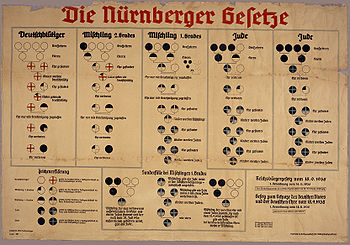 Between 1935 and 1936, persecution of the Jews increased apace while the process of "Gleichschaltung
" (lit.: "standardisation", the process by which the Nazis achieved complete control over German society) was implemented. In May 1935, Jews were forbidden to join the Wehrmacht
(the army), and in the summer of the same year, anti-semitic propaganda appeared in shops and restaurants. The Nuremberg Laws were passed around the time of the great Nazi rallies at Nuremberg; on September 15, 1935, the "Law for the Protection of German Blood and Honor" was passed, preventing marriage between any Jew and non-Jews as Rassenschande
or racial pollution. At the same time, the "Reich Citizenship Law" was passed and was reinforced in November by a decree, stating that all Jews, even quarter- and half-Jews, were no longer citizens
of their own country (their official title became "subjects of the state"). This meant that they were deprived of basic citizens' rights, e.g., the right to vote. This removal of citizens' rights was instrumental in the process of anti-semitic persecution: the process of denaturalization allowed the Nazis to exclude—de jure
—Jewish people from the "Volksgemeinschaft" ("national community"), thus granting judicial legitimacy to their persecution and opening the way to harsher laws and, eventually, extermination of the Jews. Philosopher Hannah Arendt
pointed out this important judicial aspect of the Holocaust in The Origins of Totalitarianism
(1951), where she demonstrated that to violate human rights
, Nazi Germany first deprived human beings of their citizenship. Arendt underlined that in the Declaration of the Rights of Man and of the Citizen
, citizens’ rights actually preceded human rights, as the latter needed the protection of a determinate state to be actually respected.
The drafting of the Nuremberg Laws has often been attributed to Hans Globke
. Globke had studied British attempts to "order" its empire by creating hierarchical social orders, for example in the organization of "martial races" in India.
In 1936, Jews were banned from all professional jobs, effectively preventing them from having any influence in education, politics, higher education, and industry. There was now nothing to stop the anti-Jewish actions that spread across the German economy.
Between 1937 and 1938, new laws were implemented, and the segregation
of Jews from the "German Aryan" population was completed. In particular, Jews were punished financially for being Jewish.
On March 1, 1938, government contracts could not be awarded to Jewish businesses. On September 30, "Aryan" doctors could only treat "Aryan" patients. Provision of medical care to Jews was already hampered by the fact that Jews were banned from being doctors.
On August 17, Jews with first names of non-Jewish origin had to add "Israel" (males) or "Sara" (females) to their names, and a large letter "J" was to be printed on their passports on October 5. On November 15, Jewish children were banned from going to state-run schools. By April 1939, nearly all Jewish companies had either collapsed under financial pressure and declining profits, or had been persuaded to sell out to the government, further reducing their rights as human beings; they were, in many ways, effectively separated from the German populace.
The increasingly totalitarian regime that Hitler imposed on Germany allowed him to control the actions of the SS and the army. On November 7, 1938, a young Polish Jew named Herschel Grynszpan
attacked and shot German diplomat Ernst vom Rath
in the Nazi-German embassy in Paris. Grynszpan's family, together with more than 12,000 Polish-born Jews, had been expelled by the Nazi government from Germany to Poland during the so-called "Polenaktion" on October 28, 1938. Joseph Goebbels
ordered retaliation. On the night of November 9, the SS conducted "the Night of Broken Glass" ("Kristallnacht
"), in which the storefronts of Jewish shops and offices were by confiscating 20% of every Jew's property.
 After the promulgation of the Nuremberg Laws, the Reichsvertretung der Deutschen Juden
(Representation of the German Jews) announced the following:
. The definition of "Aryan" was imprecise and ambiguous, but was clarified over time in a number of judicial and executive decisions. Jews were by definition non-Aryan, because of their Semitic
origins, but most European peoples were automatically included under the definition of Aryan as "Indo-European". The fact that Aryan is essentially a linguistic rather than a racial category led to some difficulty reconciling Nazi-supported racial typologies with the Aryan concept. There was some dispute about the position of the Roma, who were Indo-European in origin, speaking an Indo-Aryan language. Non-Indo-European Africans and Asians were automatically excluded. In Africa, according to Alfred Rosenberg
, only the Berbers
from North Africa, particularly the Kabyles
, were classified as Aryans. The Nazis portrayed Swedes, the Afrikaaners who are white European descendants of Dutch-speaking Boers in South Africa
and higher-degree Northern/Western Europeans of South America (mainly from Uruguay, Brazil and Argentina) as ideal "Aryans" along with the German-speaking peoples of Germany, Austria and Switzerland (the country was neutral during the war). In Asia, only the Indo-Aryan population of Iran and India were considered Aryan
.
The number of black people in Germany when the Nazis came to power is variously estimated at 5 - 25,000. According to the United States Holocaust Memorial Museum, Washington, D.C., “The fate of black people from 1933 to 1945 in Nazi Germany and in German-occupied territories ranged from isolation to persecution, sterilization, medical experimentation, incarceration, brutality, and murder. However, there was no systematic program for their elimination as there was for Jews and other groups.”
Prior to Hitler coming to power, black entertainers were popular in Germany, but the Nazis banned Jazz
as ‘corrupt negro music’. Mixed marriage and interracial sex became illegal, some blacks were used in medical experiments, and others mysteriously disappeared. However, contrary to popular myth, black American sprinter Jesse Owens
', who won four gold medals beating Aryan athletes at the 1936 Berlin Olympic games
, faced less segregation there than in the USA, and felt snubbed by Roosevelt
rather than by Hitler (see Jesse Owens#Berlin Olympics).
The July 1933 Law for the Prevention of Hereditarily Diseased Offspring
—written by Ernst Rüdin
and other theorists of "racial hygiene"—established "Genetic Health Courts" which decided on compulsory sterilization
of "any person suffering from a hereditary disease." These included, for the Nazis, those suffering from "Congenital Mental Deficiency
", schizophrenia
, "Manic-Depressive Insanity", "Hereditary Epilepsy
", "Hereditary Chorea" (Huntington’s), Hereditary Blindness
, Hereditary Deafness, "any severe hereditary deformity", as well as "any person suffering from severe alcoholism
". Further modifications of the law enforced sterilization of the "Rhineland bastard
s" (children of mixed German and African parentage).
After the Night of the Long Knives
of June 30-July 2, 1934, during which the SS and Gestapo
purged the "too revolutionary" leadership of the SA
, the SS emerged as the dominant police power in Germany. Reichsführer-SS
Heinrich Himmler
—eager to please Hitler, and hungry for greater power—willingly obeyed his orders. The SS swore a personal oath to Hitler and as his personal bodyguard units, they were more obedient and loyal to Hitler than the SA. They were also supported by the Heer (German Army), which was more willing to comply with Hitler's decisions after he announced the SA would act as an auxiliary to the army, and not the other way around as the SA leadership had wanted.
On August 2, 1934, President Paul von Hindenburg
died. No new President was selected; instead the powers of the Chancellor and President were combined. This change, and a tame government with no opposition parties, allowed Hitler full control of law-making. The army also swore an oath of loyalty personally to the "Führer
" ("Leader"), giving Hitler complete power over the army. The Nazi ideologues would theorize the "Führerprinzip
", which granted preeminence to Hitler’s direct control over the government.
that ‘the Jews had brought the Negroes into the Rhineland
with the clear aim of ruining the hated white race by the necessarily-resulting bastardisation’. Mixed marriage and interracial sex became illegal.
Of particular concern to the Nazi scientist Eugen Fischer
were the "Rhineland Bastard
s": mixed-race
offspring of Senegalese soldiers who had been stationed in the Rhineland as part of the French army of occupation. He believed that these people should be sterilized
in order to protect the racial purity of the German population. At least 400 mixed-race children were forcibly sterilized in the Rhineland by 1938. This order only applied in the Rhineland. Other African Germans were unaffected. Despite this policy there was never any systematic attempt to eliminate the black population in Germany, though some blacks were used in medical experiments, and others mysteriously disappeared.
According to Susan Samples the Nazis went to great lengths to conceal their sterilization and abortion program in the Rhineland. Hans Massaquoi
describes his experience as a half-African in Hamburg, unaware of the Rhineland sterilizations until long after the war. Samples also points to the paradoxical fact that African-Germans actually had a better chance of surviving the war than the average German. They were excluded from military activity because of their non-Aryan status, but were not considered a threat and so were unlikely to be incarcerated. Samples and Massaquoi also note that African-Germans were not subjected to the segregation they would have experienced in the United States, nor excluded from facilities such as expensive hotels. However, both she and Massaquoi state that downed black American pilots were more likely to become victims of violence and murder from German citizens than were white pilots.
nationals (mostly diplomats and military officials) residing in Germany were given "Honorary Aryan
" citizenship with more privileges than any other "non-Aryan" ethnonational group.
In Norway
, the Nazis favored marriages between Germans and Norwegians, in an attempt to spawn a new "Aryan" generation of Nordics. Around 10,000-12,000 war children
(Krigsbarn) were born from these unions during the war. Some of them were separated from their mothers and cared for in so-called "Lebensborn
" clinics ("Fountain of Life" clinics).
(GPO) was a Nazi plan to realize Hitler's "new order of ethnographical relations" in the territories occupied by Germany
in Eastern Europe
during World War II
. It was prepared in 1941 and confirmed in 1942. The plan was part of Hitler's own Lebensraum
plan and a fulfillment of the Drang nach Osten
("Drive towards the East") state ideology. The final version of Generalplan Ost, essentially a grand plan for ethnic cleansing
, was divided into two parts; the Kleine Planung ("Small Plan"), which covered actions which were to be taken during the war, and the Grosse Planung ("Big Plan"), which covered actions to be undertaken after the war was won (to be carried into effect gradually over a period of 25–30 years). The Small Plan was to be put into practice as the Germans conquered the areas to the east of their pre-war borders. The individual stages of this plan would then be worked out in greater detail. In this way, the plan for Poland
was drawn up at the end of November 1939. The plan envisaged differing percentages of the various conquered nations undergoing Germanisation
, expulsion into the depths of Russia
, and other fates, the net effect of which would be to ensure that the conquered territories would be Germanized. The Wehrbauer
("soldier-peasants") would settle in a fortified line to prevent civilization arising beyond and threatening Germany.
It should be noted that in 1943, after heavy defeats on the Eastern front, Nazis officially recognized some Slavic nations as Aryans (except the Poles) eligible to serve in Waffen-SS (for details see Collaboration in World War II).
Civilian deaths totaled 15.9 million which included 1.5 million from military actions; 7.1 million victims of Nazi genocide
and reprisals; 1.8 million deported to Germany for forced labor; and 5.5 million famine
and disease
deaths. Additional famine deaths which totaled 1 million during 1946-47 are not included here. The official Polish
government report of war losses prepared in 1947 reported 6,028,000 war victims out of a population of 27,007,000 ethnic Poles
and Jews
; this report excluded ethnic Ukrainian
and Belarusian
losses.
European population defined by anthropometric models of racial difference. From 1940 the General Government
in occupied Poland divided the population into different groups. Each group had different rights, food rations, allowed strips in the cities, separated residential areas, special schooling systems, public transportation and restricted restaurants. Later adapted in all Nazi-occupied countries by 1942, the Germanization program used the racial caste system of reserving certain rights to one group and barred privileges to another. In addition with their predominant religion and ethnicity per individual of that ethnic group or nationality.
Nordicist anthropometrics was used to "improve" the racial make-up of the Germanised section of the population, by absorbing individuals into the German population who were deemed suitably Nordic.
Germanization also affected the Sorbs
, the minority Slav community living in Saxony
and Brandenburg
, whose Slavic culture and language was suppressed to absorb them into German identity. Tens of thousands suffered internment and imprisonment as well, to become lesser-known victims of Nazi racial laws.
Nazi Germany
Nazi Germany , also known as the Third Reich , but officially called German Reich from 1933 to 1943 and Greater German Reich from 26 June 1943 onward, is the name commonly used to refer to the state of Germany from 1933 to 1945, when it was a totalitarian dictatorship ruled by...
, asserting the superiority of the "Aryan race
Aryan race
The Aryan race is a concept historically influential in Western culture in the period of the late 19th century and early 20th century. It derives from the idea that the original speakers of the Indo-European languages and their descendants up to the present day constitute a distinctive race or...
", and based on a specific racist doctrine
Nazism and race
Nazism developed several theories concerning races. The Nazis claimed to scientifically measure a strict hierarchy of human race; at the top was the master race, the "Aryan race", narrowly defined by the Nazis as being identical with the Nordic race, followed by lesser races.At the bottom of this...
which claimed scientific legitimacy
Scientific racism
Scientific racism is the use of scientific techniques and hypotheses to sanction the belief in racial superiority or racism.This is not the same as using scientific findings and the scientific method to investigate differences among the humans and argue that there are races...
. It was combined with a eugenics programme
Nazi eugenics
Nazi eugenics were Nazi Germany's racially-based social policies that placed the improvement of the Aryan race through eugenics at the center of their concerns...
that aimed for racial hygiene
Racial hygiene
Racial hygiene was a set of early twentieth century state sanctioned policies by which certain groups of individuals were allowed to procreate and others not, with the expressed purpose of promoting certain characteristics deemed to be particularly desirable...
by using compulsory sterilization
Compulsory sterilization
Compulsory sterilization also known as forced sterilization programs are government policies which attempt to force people to undergo surgical sterilization...
s and extermination of the Untermensch
Untermensch
Untermensch is a term that became infamous when the Nazi racial ideology used it to describe "inferior people", especially "the masses from the East," that is Jews, Gypsies, Poles along with other Slavic people like the Russians, Serbs, Belarussians and Ukrainians...
(or "sub-humans"), and which eventually culminated in the Holocaust. These policies targeted peoples, in particular Jews, Gypsies, homosexuals and handicapped people, who were labeled as "inferior" in a racial hierarchy that placed the Herrenvolk (or "master race
Master race
Master race was a phrase and concept originating in the slave-holding Southern US. The later phrase Herrenvolk , interpreted as 'master race', was a concept in Nazi ideology in which the Nordic peoples, one of the branches of what in the late-19th and early-20th century was called the Aryan race,...
") of the Volksgemeinschaft
Volksgemeinschaft
Volksgemeinschaft is a German expression meaning "people's community". Originally appearing during World War I as Germans rallied behind the war, it derived its popularity as a means to break down elitism and class divides...
(or "national community") at the top, and ranked Russians
Russians
The Russian people are an East Slavic ethnic group native to Russia, speaking the Russian language and primarily living in Russia and neighboring countries....
, Romani, persons of color and Jews at the bottom.
Racial policies regarding the Jews between 1933 to 1940
Between 1933 and 1934, Nazi policy was fairly moderate, not wishing to scare off voters or moderately minded politicians (although the eugenicsNazi eugenics
Nazi eugenics were Nazi Germany's racially-based social policies that placed the improvement of the Aryan race through eugenics at the center of their concerns...
program was established as early as July 1933). On August 25, 1933, the Nazis even signed the Haavara Agreement
Haavara Agreement
The Haavara Agreement was signed on 25 August 1933 after three months of talks by the Zionist Federation of Germany , the Anglo-Palestine Bank and the economic authorities of Nazi Germany...
with Zionists
Zionism
Zionism is a Jewish political movement that, in its broadest sense, has supported the self-determination of the Jewish people in a sovereign Jewish national homeland. Since the establishment of the State of Israel, the Zionist movement continues primarily to advocate on behalf of the Jewish state...
to allow German Jews to emigrate to Palestine
Palestine
Palestine is a conventional name, among others, used to describe the geographic region between the Mediterranean Sea and the Jordan River, and various adjoining lands....
—by 1939, 60,000 German Jews had emigrated there. The Nazi Party used populist
Populism
Populism can be defined as an ideology, political philosophy, or type of discourse. Generally, a common theme compares "the people" against "the elite", and urges social and political system changes. It can also be defined as a rhetorical style employed by members of various political or social...
anti-semitic views to gain votes. Using the "stab-in-the-back legend", they blamed poverty, the Hyperinflation in the Weimar Republic, unemployment, and the loss of World War I by the "November Criminals" all on the Jews, Marxists and 'cultural Bolsheviks'. German woes were attributed to the effects of the Treaty of Versailles
Treaty of Versailles
The Treaty of Versailles was one of the peace treaties at the end of World War I. It ended the state of war between Germany and the Allied Powers. It was signed on 28 June 1919, exactly five years after the assassination of Archduke Franz Ferdinand. The other Central Powers on the German side of...
. In 1933, persecution of the Jews became active Nazi policy. This was at first hindered by the lack of agreement on who qualified as a Jew or Aryan, which caused legislators to balk at an anti-Semitic law for its ill-defined terms. Bernhard Lösener described it "total chaos", with local authorities regarding anything from full Jewish background to Jewish blood defining a Jew; Achim Gercke
Achim Gercke
Achim Gercke was a German politician.Born in Greifswald, Gercke had been a Nazi official before 1933 and became a department head of the NSDAP in Munich on January 1, 1932. In April 1933, he was appointed to the Ministry of the Interior, where he served as an expert on racial matters...
urged Jewish blood. Mischlinge were especially problematic in their eyes. The first anti-Semitic law was promologated with no clear definition of Jew. Finally, the decision was made for three or four Jewish grandparents; two or one rendered a person a Mischlinge.
It only became worse with the years, culminating in the Holocaust, or so-called "Final Solution
Final Solution
The Final Solution was Nazi Germany's plan and execution of the systematic genocide of European Jews during World War II, resulting in the most deadly phase of the Holocaust...
", which was made official at the January 1942 Wannsee Conference
Wannsee Conference
The Wannsee Conference was a meeting of senior officials of the Nazi German regime, held in the Berlin suburb of Wannsee on 20 January 1942. The purpose of the conference was to inform administrative leaders of Departments responsible for various policies relating to Jews, that Reinhard Heydrich...
.
On April 1, 1933, the Nazi boycott of Jewish businesses
Nazi boycott of Jewish businesses
The Nazi boycott of Jewish businesses in Germany took place on 1 April 1933, soon after Adolf Hitler was sworn in as Chancellor on 30 January 1933...
was observed throughout Germany. Only six days later, the Law for the Restoration of the Professional Civil Service
Law for the Restoration of the Professional Civil Service
The Law for the Restoration of the Professional Civil Service , also known as Civil Service Law, Civil Service Restoration Act, and Law to Re-establish the Civil Service, was a law passed by the National Socialist regime on April 7, 1933, two months after Adolf...
was passed, banning Jews from government jobs. It is notable that the proponents of this law, and the several thousand more that were to follow, most frequently explained them as necessary to prevent the infiltration of damaging, "alien-type" (Artfremd) hereditary traits into the German national or racial community (Volksgemeinschaft). These laws meant that Jews were now indirectly and directly dissuaded or banned from privileged and superior positions reserved for "Aryan Germans". From then on, Jews were forced to work at more menial positions, becoming second-class citizen
Second-class citizen
Second-class citizen is an informal term used to describe a person who is systematically discriminated against within a state or other political jurisdiction, despite their nominal status as a citizen or legal resident there...
s or to the point they were "illegally residing" in Nazi Germany
Nazi Germany
Nazi Germany , also known as the Third Reich , but officially called German Reich from 1933 to 1943 and Greater German Reich from 26 June 1943 onward, is the name commonly used to refer to the state of Germany from 1933 to 1945, when it was a totalitarian dictatorship ruled by...
.
The Nuremberg Laws
Gleichschaltung
Gleichschaltung , meaning "coordination", "making the same", "bringing into line", is a Nazi term for the process by which the Nazi regime successively established a system of totalitarian control and tight coordination over all aspects of society. The historian Richard J...
" (lit.: "standardisation", the process by which the Nazis achieved complete control over German society) was implemented. In May 1935, Jews were forbidden to join the Wehrmacht
Wehrmacht
The Wehrmacht – from , to defend and , the might/power) were the unified armed forces of Nazi Germany from 1935 to 1945. It consisted of the Heer , the Kriegsmarine and the Luftwaffe .-Origin and use of the term:...
(the army), and in the summer of the same year, anti-semitic propaganda appeared in shops and restaurants. The Nuremberg Laws were passed around the time of the great Nazi rallies at Nuremberg; on September 15, 1935, the "Law for the Protection of German Blood and Honor" was passed, preventing marriage between any Jew and non-Jews as Rassenschande
Rassenschande
Rassenschande or Blutschande was the Nazi term for sexual relations between Aryans and non-Aryans, which was punishable by law...
or racial pollution. At the same time, the "Reich Citizenship Law" was passed and was reinforced in November by a decree, stating that all Jews, even quarter- and half-Jews, were no longer citizens
Citizenship
Citizenship is the state of being a citizen of a particular social, political, national, or human resource community. Citizenship status, under social contract theory, carries with it both rights and responsibilities...
of their own country (their official title became "subjects of the state"). This meant that they were deprived of basic citizens' rights, e.g., the right to vote. This removal of citizens' rights was instrumental in the process of anti-semitic persecution: the process of denaturalization allowed the Nazis to exclude—de jure
De jure
De jure is an expression that means "concerning law", as contrasted with de facto, which means "concerning fact".De jure = 'Legally', De facto = 'In fact'....
—Jewish people from the "Volksgemeinschaft" ("national community"), thus granting judicial legitimacy to their persecution and opening the way to harsher laws and, eventually, extermination of the Jews. Philosopher Hannah Arendt
Hannah Arendt
Hannah Arendt was a German American political theorist. She has often been described as a philosopher, although she refused that label on the grounds that philosophy is concerned with "man in the singular." She described herself instead as a political theorist because her work centers on the fact...
pointed out this important judicial aspect of the Holocaust in The Origins of Totalitarianism
The Origins of Totalitarianism
The Origins of Totalitarianism is a book by Hannah Arendt which describes and analyzes the two major totalitarian movements of the twentieth century, Nazism and Stalinism...
(1951), where she demonstrated that to violate human rights
Human rights
Human rights are "commonly understood as inalienable fundamental rights to which a person is inherently entitled simply because she or he is a human being." Human rights are thus conceived as universal and egalitarian . These rights may exist as natural rights or as legal rights, in both national...
, Nazi Germany first deprived human beings of their citizenship. Arendt underlined that in the Declaration of the Rights of Man and of the Citizen
Declaration of the Rights of Man and of the Citizen
The Declaration of the Rights of Man and of the Citizen is a fundamental document of the French Revolution, defining the individual and collective rights of all the estates of the realm as universal. Influenced by the doctrine of "natural right", the rights of man are held to be universal: valid...
, citizens’ rights actually preceded human rights, as the latter needed the protection of a determinate state to be actually respected.
The drafting of the Nuremberg Laws has often been attributed to Hans Globke
Hans Globke
- See also :* Theodor Oberländer* Rudolf Christoph Freiherr von Gersdorff- Bibliography :* Tetens, T.H. The New Germany and the Old Nazis. Random House/Marzani & Munsel, New York, 1961. LCN 61-7240....
. Globke had studied British attempts to "order" its empire by creating hierarchical social orders, for example in the organization of "martial races" in India.
In 1936, Jews were banned from all professional jobs, effectively preventing them from having any influence in education, politics, higher education, and industry. There was now nothing to stop the anti-Jewish actions that spread across the German economy.
Between 1937 and 1938, new laws were implemented, and the segregation
Racial segregation
Racial segregation is the separation of humans into racial groups in daily life. It may apply to activities such as eating in a restaurant, drinking from a water fountain, using a public toilet, attending school, going to the movies, or in the rental or purchase of a home...
of Jews from the "German Aryan" population was completed. In particular, Jews were punished financially for being Jewish.
On March 1, 1938, government contracts could not be awarded to Jewish businesses. On September 30, "Aryan" doctors could only treat "Aryan" patients. Provision of medical care to Jews was already hampered by the fact that Jews were banned from being doctors.
On August 17, Jews with first names of non-Jewish origin had to add "Israel" (males) or "Sara" (females) to their names, and a large letter "J" was to be printed on their passports on October 5. On November 15, Jewish children were banned from going to state-run schools. By April 1939, nearly all Jewish companies had either collapsed under financial pressure and declining profits, or had been persuaded to sell out to the government, further reducing their rights as human beings; they were, in many ways, effectively separated from the German populace.
The increasingly totalitarian regime that Hitler imposed on Germany allowed him to control the actions of the SS and the army. On November 7, 1938, a young Polish Jew named Herschel Grynszpan
Herschel Grynszpan
Herschel Feibel Grynszpan was a Polish Jew and political assassin. Grynszpan's assassination of the German diplomat Ernst vom Rath on November 7, 1938, after the deportation of his family, provided the excuse for the Nazi Kristallnacht, the antisemitic pogrom of November 9–10, 1938...
attacked and shot German diplomat Ernst vom Rath
Ernst vom Rath
Ernst Eduard vom Rath was a German diplomat, remembered for his assassination in Paris in 1938 by a Jewish youth, Herschel Grynszpan. The assassination triggered Kristallnacht, the "Night of Broken Glass"....
in the Nazi-German embassy in Paris. Grynszpan's family, together with more than 12,000 Polish-born Jews, had been expelled by the Nazi government from Germany to Poland during the so-called "Polenaktion" on October 28, 1938. Joseph Goebbels
Joseph Goebbels
Paul Joseph Goebbels was a German politician and Reich Minister of Propaganda in Nazi Germany from 1933 to 1945. As one of Adolf Hitler's closest associates and most devout followers, he was known for his zealous oratory and anti-Semitism...
ordered retaliation. On the night of November 9, the SS conducted "the Night of Broken Glass" ("Kristallnacht
Kristallnacht
Kristallnacht, also referred to as the Night of Broken Glass, and also Reichskristallnacht, Pogromnacht, and Novemberpogrome, was a pogrom or series of attacks against Jews throughout Nazi Germany and parts of Austria on 9–10 November 1938.Jewish homes were ransacked, as were shops, towns and...
"), in which the storefronts of Jewish shops and offices were by confiscating 20% of every Jew's property.
Jewish responses to the Nuremberg Laws
Reichsvertretung der Deutschen Juden
The Reichsvertretung der Deutschen Juden was founded on 17 September 1933. It established as the umbrella organisation, which for the first time ever united all the quarrelling Jewish organisations and religious bodies on a nationwide range. It was organized to represent Jewish interests at a...
(Representation of the German Jews) announced the following:
The Laws decided upon by the Reichstag in Nuremberg have come as the heaviest of blows for the Jews in Germany. But they must create a basis on which a tolerable relationship becomes possible between the German and the Jewish people. The "Reichsvertretung der Deutschen Juden" is willing to contribute to this end with all its powers. A precondition for such a tolerable relationship is the hope that the Jews and Jewish communities of Germany will be enabled to keep a moral and economic means of existence by the halting of defamation and boycott.
The organization of the life of the Jews in Germany requires governmental recognition of an autonomous Jewish leadership. The Reichsvertretung der Juden in Deutschland is the agency competent to undertake this.
The most urgent tasks for the "Reichsvertretung", which it will press energetically and with full commitment, following the avenues it has previously taken, are:
Our own Jewish educational system must serve to prepare the youth to be upright Jews, secure in their faith, who will draw the strength to face the onerous demands which life will make on them from conscious solidarity with the Jewish community, from work for the Jewish present and faith in the Jewish future. In addition to transmitting knowledge, the Jewish schools must also serve in the systematic preparation for future occupations. With regard to preparation for emigration, particularly to PalestinePalestinePalestine is a conventional name, among others, used to describe the geographic region between the Mediterranean Sea and the Jordan River, and various adjoining lands....
, emphasis will be placed on guidance toward manual work and the study of the Hebrew language. The education and vocational training of girls must be directed to preparing them to carry out their responsibilities as upholders of the family and mothers of the next generation.
Other "non-Aryans"
Though the laws were primarily directed against Jews, other "non-Aryan" people were subject to the laws, and to other legislation concerned with racial hygieneRacial hygiene
Racial hygiene was a set of early twentieth century state sanctioned policies by which certain groups of individuals were allowed to procreate and others not, with the expressed purpose of promoting certain characteristics deemed to be particularly desirable...
. The definition of "Aryan" was imprecise and ambiguous, but was clarified over time in a number of judicial and executive decisions. Jews were by definition non-Aryan, because of their Semitic
Semitic
In linguistics and ethnology, Semitic was first used to refer to a language family of largely Middle Eastern origin, now called the Semitic languages...
origins, but most European peoples were automatically included under the definition of Aryan as "Indo-European". The fact that Aryan is essentially a linguistic rather than a racial category led to some difficulty reconciling Nazi-supported racial typologies with the Aryan concept. There was some dispute about the position of the Roma, who were Indo-European in origin, speaking an Indo-Aryan language. Non-Indo-European Africans and Asians were automatically excluded. In Africa, according to Alfred Rosenberg
Alfred Rosenberg
' was an early and intellectually influential member of the Nazi Party. Rosenberg was first introduced to Adolf Hitler by Dietrich Eckart; he later held several important posts in the Nazi government...
, only the Berbers
Berber people
Berbers are the indigenous peoples of North Africa west of the Nile Valley. They are continuously distributed from the Atlantic to the Siwa oasis, in Egypt, and from the Mediterranean to the Niger River. Historically they spoke the Berber language or varieties of it, which together form a branch...
from North Africa, particularly the Kabyles
Kabyle people
The Kabyle people are the largest homogeneous Algerian ethno-cultural and linguistical community and the largest nation in North Africa to be considered exclusively Berber. Their traditional homeland is Kabylie in the north of Algeria, one hundred miles east of Algiers...
, were classified as Aryans. The Nazis portrayed Swedes, the Afrikaaners who are white European descendants of Dutch-speaking Boers in South Africa
South Africa
The Republic of South Africa is a country in southern Africa. Located at the southern tip of Africa, it is divided into nine provinces, with of coastline on the Atlantic and Indian oceans...
and higher-degree Northern/Western Europeans of South America (mainly from Uruguay, Brazil and Argentina) as ideal "Aryans" along with the German-speaking peoples of Germany, Austria and Switzerland (the country was neutral during the war). In Asia, only the Indo-Aryan population of Iran and India were considered Aryan
Aryan
Aryan is an English language loanword derived from Sanskrit ārya and denoting variously*In scholarly usage:**Indo-Iranian languages *in dated usage:**the Indo-European languages more generally and their speakers...
.
The number of black people in Germany when the Nazis came to power is variously estimated at 5 - 25,000. According to the United States Holocaust Memorial Museum, Washington, D.C., “The fate of black people from 1933 to 1945 in Nazi Germany and in German-occupied territories ranged from isolation to persecution, sterilization, medical experimentation, incarceration, brutality, and murder. However, there was no systematic program for their elimination as there was for Jews and other groups.”
Prior to Hitler coming to power, black entertainers were popular in Germany, but the Nazis banned Jazz
Jazz
Jazz is a musical style that originated at the beginning of the 20th century in African American communities in the Southern United States. It was born out of a mix of African and European music traditions. From its early development until the present, jazz has incorporated music from 19th and 20th...
as ‘corrupt negro music’. Mixed marriage and interracial sex became illegal, some blacks were used in medical experiments, and others mysteriously disappeared. However, contrary to popular myth, black American sprinter Jesse Owens
Jesse Owens
James Cleveland "Jesse" Owens was an American track and field athlete who specialized in the sprints and the long jump. He participated in the 1936 Summer Olympics in Berlin, Germany, where he achieved international fame by winning four gold medals: one each in the 100 meters, the 200 meters, the...
', who won four gold medals beating Aryan athletes at the 1936 Berlin Olympic games
1936 Summer Olympics
The 1936 Summer Olympics, officially known as the Games of the XI Olympiad, was an international multi-sport event which was held in 1936 in Berlin, Germany. Berlin won the bid to host the Games over Barcelona, Spain on April 26, 1931, at the 29th IOC Session in Barcelona...
, faced less segregation there than in the USA, and felt snubbed by Roosevelt
Roosevelt
Roosevelt may refer to:* Franklin D. Roosevelt , the 32nd President of the United States* Theodore Roosevelt , the 26th President of the United States* Eleanor Roosevelt , wife of Franklin Delano Roosevelt and First Lady...
rather than by Hitler (see Jesse Owens#Berlin Olympics).
The July 1933 Law for the Prevention of Hereditarily Diseased Offspring
Law for the Prevention of Hereditarily Diseased Offspring
Law for the Prevention of Genetically Diseased Offspring or "Sterilization Law" was a statute in Nazi Germany enacted on July 14, 1933, which allowed the compulsory sterilization of any citizen who in the opinion of a "Genetic Health Court" Law for the Prevention of Genetically Diseased Offspring...
—written by Ernst Rüdin
Ernst Rüdin
Ernst Rüdin , was a Swiss psychiatrist, geneticist and eugenicist. Rüdin was born in St. Gallen, Switzerland...
and other theorists of "racial hygiene"—established "Genetic Health Courts" which decided on compulsory sterilization
Compulsory sterilization
Compulsory sterilization also known as forced sterilization programs are government policies which attempt to force people to undergo surgical sterilization...
of "any person suffering from a hereditary disease." These included, for the Nazis, those suffering from "Congenital Mental Deficiency
Mental retardation
Mental retardation is a generalized disorder appearing before adulthood, characterized by significantly impaired cognitive functioning and deficits in two or more adaptive behaviors...
", schizophrenia
Schizophrenia
Schizophrenia is a mental disorder characterized by a disintegration of thought processes and of emotional responsiveness. It most commonly manifests itself as auditory hallucinations, paranoid or bizarre delusions, or disorganized speech and thinking, and it is accompanied by significant social...
, "Manic-Depressive Insanity", "Hereditary Epilepsy
Epilepsy
Epilepsy is a common chronic neurological disorder characterized by seizures. These seizures are transient signs and/or symptoms of abnormal, excessive or hypersynchronous neuronal activity in the brain.About 50 million people worldwide have epilepsy, and nearly two out of every three new cases...
", "Hereditary Chorea" (Huntington’s), Hereditary Blindness
Blindness
Blindness is the condition of lacking visual perception due to physiological or neurological factors.Various scales have been developed to describe the extent of vision loss and define blindness...
, Hereditary Deafness, "any severe hereditary deformity", as well as "any person suffering from severe alcoholism
Alcoholism
Alcoholism is a broad term for problems with alcohol, and is generally used to mean compulsive and uncontrolled consumption of alcoholic beverages, usually to the detriment of the drinker's health, personal relationships, and social standing...
". Further modifications of the law enforced sterilization of the "Rhineland bastard
Rhineland Bastard
Rhineland Bastard was a derogatory term used in Nazi Germany to describe Afro-German children of mixed German and African parentage who were fathered by Africans serving as French colonial troops occupying the Rhineland after World War I...
s" (children of mixed German and African parentage).
After the Night of the Long Knives
Night of the Long Knives
The Night of the Long Knives , sometimes called "Operation Hummingbird " or in Germany the "Röhm-Putsch," was a purge that took place in Nazi Germany between June 30 and July 2, 1934, when the Nazi regime carried out a series of political murders...
of June 30-July 2, 1934, during which the SS and Gestapo
Gestapo
The Gestapo was the official secret police of Nazi Germany. Beginning on 20 April 1934, it was under the administration of the SS leader Heinrich Himmler in his position as Chief of German Police...
purged the "too revolutionary" leadership of the SA
Sturmabteilung
The Sturmabteilung functioned as a paramilitary organization of the National Socialist German Workers' Party . It played a key role in Adolf Hitler's rise to power in the 1920s and 1930s...
, the SS emerged as the dominant police power in Germany. Reichsführer-SS
Reichsführer-SS
was a special SS rank that existed between the years of 1925 and 1945. Reichsführer-SS was a title from 1925 to 1933 and, after 1934, the highest rank of the German Schutzstaffel .-Definition:...
Heinrich Himmler
Heinrich Himmler
Heinrich Luitpold Himmler was Reichsführer of the SS, a military commander, and a leading member of the Nazi Party. As Chief of the German Police and the Minister of the Interior from 1943, Himmler oversaw all internal and external police and security forces, including the Gestapo...
—eager to please Hitler, and hungry for greater power—willingly obeyed his orders. The SS swore a personal oath to Hitler and as his personal bodyguard units, they were more obedient and loyal to Hitler than the SA. They were also supported by the Heer (German Army), which was more willing to comply with Hitler's decisions after he announced the SA would act as an auxiliary to the army, and not the other way around as the SA leadership had wanted.
On August 2, 1934, President Paul von Hindenburg
Paul von Hindenburg
Paul Ludwig Hans Anton von Beneckendorff und von Hindenburg , known universally as Paul von Hindenburg was a Prussian-German field marshal, statesman, and politician, and served as the second President of Germany from 1925 to 1934....
died. No new President was selected; instead the powers of the Chancellor and President were combined. This change, and a tame government with no opposition parties, allowed Hitler full control of law-making. The army also swore an oath of loyalty personally to the "Führer
Führer
Führer , alternatively spelled Fuehrer in both English and German when the umlaut is not available, is a German title meaning leader or guide now most associated with Adolf Hitler, who modelled it on Benito Mussolini's title il Duce, as well as with Georg von Schönerer, whose followers also...
" ("Leader"), giving Hitler complete power over the army. The Nazi ideologues would theorize the "Führerprinzip
Führerprinzip
The Führerprinzip , German for "leader principle", prescribes the fundamental basis of political authority in the governmental structures of the Third Reich...
", which granted preeminence to Hitler’s direct control over the government.
German Mulattoes
Hitler had stated in Mein KampfMein Kampf
Mein Kampf is a book written by Nazi leader Adolf Hitler. It combines elements of autobiography with an exposition of Hitler's political ideology. Volume 1 of Mein Kampf was published in 1925 and Volume 2 in 1926...
that ‘the Jews had brought the Negroes into the Rhineland
Rhineland
Historically, the Rhinelands refers to a loosely-defined region embracing the land on either bank of the River Rhine in central Europe....
with the clear aim of ruining the hated white race by the necessarily-resulting bastardisation’. Mixed marriage and interracial sex became illegal.
Of particular concern to the Nazi scientist Eugen Fischer
Eugen Fischer
Eugen Fischer was a German professor of medicine, anthropology and eugenics. He was director of the Kaiser Wilhelm Institute of Anthropology, Human Heredity, and Eugenics between 1927 and 1942...
were the "Rhineland Bastard
Rhineland Bastard
Rhineland Bastard was a derogatory term used in Nazi Germany to describe Afro-German children of mixed German and African parentage who were fathered by Africans serving as French colonial troops occupying the Rhineland after World War I...
s": mixed-race
Mulatto
Mulatto denotes a person with one white parent and one black parent, or more broadly, a person of mixed black and white ancestry. Contemporary usage of the term varies greatly, and the broader sense of the term makes its application rather subjective, as not all people of mixed white and black...
offspring of Senegalese soldiers who had been stationed in the Rhineland as part of the French army of occupation. He believed that these people should be sterilized
Compulsory sterilization
Compulsory sterilization also known as forced sterilization programs are government policies which attempt to force people to undergo surgical sterilization...
in order to protect the racial purity of the German population. At least 400 mixed-race children were forcibly sterilized in the Rhineland by 1938. This order only applied in the Rhineland. Other African Germans were unaffected. Despite this policy there was never any systematic attempt to eliminate the black population in Germany, though some blacks were used in medical experiments, and others mysteriously disappeared.
According to Susan Samples the Nazis went to great lengths to conceal their sterilization and abortion program in the Rhineland. Hans Massaquoi
Hans Massaquoi
Hans-Jürgen Massaquoi is a German American journalist and author. He was born in Hamburg, Germany, to a German mother and Liberian Vai father, the grandson of Momulu Massaquoi the consul general of Liberia in Germany at the time....
describes his experience as a half-African in Hamburg, unaware of the Rhineland sterilizations until long after the war. Samples also points to the paradoxical fact that African-Germans actually had a better chance of surviving the war than the average German. They were excluded from military activity because of their non-Aryan status, but were not considered a threat and so were unlikely to be incarcerated. Samples and Massaquoi also note that African-Germans were not subjected to the segregation they would have experienced in the United States, nor excluded from facilities such as expensive hotels. However, both she and Massaquoi state that downed black American pilots were more likely to become victims of violence and murder from German citizens than were white pilots.
Other groups
About 10,000 JapaneseJapanese people
The are an ethnic group originating in the Japanese archipelago and are the predominant ethnic group of Japan. Worldwide, approximately 130 million people are of Japanese descent; of these, approximately 127 million are residents of Japan. People of Japanese ancestry who live in other countries...
nationals (mostly diplomats and military officials) residing in Germany were given "Honorary Aryan
Honorary Aryan
Honorary Aryan is a term from Nazi Germany. It was a status granted by the Nazi Bureau of Race Research to certain individuals and groups of people—who were not generally considered to be biologically part of the Aryan race—which certified them as being part of the Aryan race...
" citizenship with more privileges than any other "non-Aryan" ethnonational group.
In Norway
Occupation of Norway by Nazi Germany
The occupation of Norway by Nazi Germany started with the German invasion of Norway on April 9, 1940, and ended on May 8, 1945, after the capitulation of German forces in Europe. Throughout this period, Norway was continuously occupied by the Wehrmacht...
, the Nazis favored marriages between Germans and Norwegians, in an attempt to spawn a new "Aryan" generation of Nordics. Around 10,000-12,000 war children
War children
A war child refers to a child born to a native parent and a parent belonging to a foreign military force . It also refers to children of parents collaborating with an occupying force...
(Krigsbarn) were born from these unions during the war. Some of them were separated from their mothers and cared for in so-called "Lebensborn
Lebensborn
Lebensborn was a Nazi programme set up by SS leader Heinrich Himmler that provided maternity homes and financial assistance to the wives of SS members and to unmarried mothers, and also ran orphanages and relocation programmes for children.Initially set up in Germany in 1935, Lebensborn expanded...
" clinics ("Fountain of Life" clinics).
Policies regarding Poles and Russians
Nazi policy toward the Slavs to Germany's east was perhaps even more schizophrenic than it was with the Roma. Not only are Slavs an Indo-European people, and thereby might be expected to be considered "Aryan", but they were just as likely to fit the Nazi "Nordic" ideal as Germans were, if not more so. Yet, Nazi ideology viewed Russians and Poles as a racially inferior group, suitable for enslavement, or even extermination. Generalplan OstGeneralplan Ost
Generalplan Ost was a secret Nazi German plan for the colonization of Eastern Europe. Implementing it would have necessitated genocide and ethnic cleansing to be undertaken in the Eastern European territories occupied by Germany during World War II...
(GPO) was a Nazi plan to realize Hitler's "new order of ethnographical relations" in the territories occupied by Germany
Germany
Germany , officially the Federal Republic of Germany , is a federal parliamentary republic in Europe. The country consists of 16 states while the capital and largest city is Berlin. Germany covers an area of 357,021 km2 and has a largely temperate seasonal climate...
in Eastern Europe
Eastern Europe
Eastern Europe is the eastern part of Europe. The term has widely disparate geopolitical, geographical, cultural and socioeconomic readings, which makes it highly context-dependent and even volatile, and there are "almost as many definitions of Eastern Europe as there are scholars of the region"...
during World War II
World War II
World War II, or the Second World War , was a global conflict lasting from 1939 to 1945, involving most of the world's nations—including all of the great powers—eventually forming two opposing military alliances: the Allies and the Axis...
. It was prepared in 1941 and confirmed in 1942. The plan was part of Hitler's own Lebensraum
Lebensraum
was one of the major political ideas of Adolf Hitler, and an important component of Nazi ideology. It served as the motivation for the expansionist policies of Nazi Germany, aiming to provide extra space for the growth of the German population, for a Greater Germany...
plan and a fulfillment of the Drang nach Osten
Drang nach Osten
Drang nach Osten was a term coined in the 19th century to designate German expansion into Slavic lands. The term became a motto of the German nationalist movement in the late nineteenth century...
("Drive towards the East") state ideology. The final version of Generalplan Ost, essentially a grand plan for ethnic cleansing
Ethnic cleansing
Ethnic cleansing is a purposeful policy designed by one ethnic or religious group to remove by violent and terror-inspiring means the civilian population of another ethnic orreligious group from certain geographic areas....
, was divided into two parts; the Kleine Planung ("Small Plan"), which covered actions which were to be taken during the war, and the Grosse Planung ("Big Plan"), which covered actions to be undertaken after the war was won (to be carried into effect gradually over a period of 25–30 years). The Small Plan was to be put into practice as the Germans conquered the areas to the east of their pre-war borders. The individual stages of this plan would then be worked out in greater detail. In this way, the plan for Poland
Poland
Poland , officially the Republic of Poland , is a country in Central Europe bordered by Germany to the west; the Czech Republic and Slovakia to the south; Ukraine, Belarus and Lithuania to the east; and the Baltic Sea and Kaliningrad Oblast, a Russian exclave, to the north...
was drawn up at the end of November 1939. The plan envisaged differing percentages of the various conquered nations undergoing Germanisation
Germanisation
Germanisation is both the spread of the German language, people and culture either by force or assimilation, and the adaptation of a foreign word to the German language in linguistics, much like the Romanisation of many languages which do not use the Latin alphabet...
, expulsion into the depths of Russia
Russia
Russia or , officially known as both Russia and the Russian Federation , is a country in northern Eurasia. It is a federal semi-presidential republic, comprising 83 federal subjects...
, and other fates, the net effect of which would be to ensure that the conquered territories would be Germanized. The Wehrbauer
Wehrbauer
Wehrbauer was a concept used by the Schutzstaffel of the Nazi Party to refer to soldiers designated as setters for the lands conquered during the German invasions of the the Soviet Union and Poland....
("soldier-peasants") would settle in a fortified line to prevent civilization arising beyond and threatening Germany.
It should be noted that in 1943, after heavy defeats on the Eastern front, Nazis officially recognized some Slavic nations as Aryans (except the Poles) eligible to serve in Waffen-SS (for details see Collaboration in World War II).
Civilian deaths totaled 15.9 million which included 1.5 million from military actions; 7.1 million victims of Nazi genocide
Genocide
Genocide is defined as "the deliberate and systematic destruction, in whole or in part, of an ethnic, racial, religious, or national group", though what constitutes enough of a "part" to qualify as genocide has been subject to much debate by legal scholars...
and reprisals; 1.8 million deported to Germany for forced labor; and 5.5 million famine
Famine
A famine is a widespread scarcity of food, caused by several factors including crop failure, overpopulation, or government policies. This phenomenon is usually accompanied or followed by regional malnutrition, starvation, epidemic, and increased mortality. Every continent in the world has...
and disease
Disease
A disease is an abnormal condition affecting the body of an organism. It is often construed to be a medical condition associated with specific symptoms and signs. It may be caused by external factors, such as infectious disease, or it may be caused by internal dysfunctions, such as autoimmune...
deaths. Additional famine deaths which totaled 1 million during 1946-47 are not included here. The official Polish
Poland
Poland , officially the Republic of Poland , is a country in Central Europe bordered by Germany to the west; the Czech Republic and Slovakia to the south; Ukraine, Belarus and Lithuania to the east; and the Baltic Sea and Kaliningrad Oblast, a Russian exclave, to the north...
government report of war losses prepared in 1947 reported 6,028,000 war victims out of a population of 27,007,000 ethnic Poles
Poles
thumb|right|180px|The state flag of [[Poland]] as used by Polish government and diplomatic authoritiesThe Polish people, or Poles , are a nation indigenous to Poland. They are united by the Polish language, which belongs to the historical Lechitic subgroup of West Slavic languages of Central Europe...
and Jews
Jews
The Jews , also known as the Jewish people, are a nation and ethnoreligious group originating in the Israelites or Hebrews of the Ancient Near East. The Jewish ethnicity, nationality, and religion are strongly interrelated, as Judaism is the traditional faith of the Jewish nation...
; this report excluded ethnic Ukrainian
Ukrainians
Ukrainians are an East Slavic ethnic group native to Ukraine, which is the sixth-largest nation in Europe. The Constitution of Ukraine applies the term 'Ukrainians' to all its citizens...
and Belarusian
Belarusians
Belarusians ; are an East Slavic ethnic group who populate the majority of the Republic of Belarus. Introduced to the world as a new state in the early 1990s, the Republic of Belarus brought with it the notion of a re-emerging Belarusian ethnicity, drawn upon the lines of the Old Belarusian...
losses.
Germanization between 1939 and 1945
Nazi policy stressed the superiority of the Nordic race, a sub-section of the whiteWhite people
White people is a term which usually refers to human beings characterized, at least in part, by the light pigmentation of their skin...
European population defined by anthropometric models of racial difference. From 1940 the General Government
General Government
The General Government was an area of Second Republic of Poland under Nazi German rule during World War II; designated as a separate region of the Third Reich between 1939–1945...
in occupied Poland divided the population into different groups. Each group had different rights, food rations, allowed strips in the cities, separated residential areas, special schooling systems, public transportation and restricted restaurants. Later adapted in all Nazi-occupied countries by 1942, the Germanization program used the racial caste system of reserving certain rights to one group and barred privileges to another. In addition with their predominant religion and ethnicity per individual of that ethnic group or nationality.
Nordicist anthropometrics was used to "improve" the racial make-up of the Germanised section of the population, by absorbing individuals into the German population who were deemed suitably Nordic.
Germanization also affected the Sorbs
Sorbs
Sorbs are a Western Slavic people of Central Europe living predominantly in Lusatia, a region on the territory of Germany and Poland. In Germany they live in the states of Brandenburg and Saxony. They speak the Sorbian languages - closely related to Polish and Czech - officially recognized and...
, the minority Slav community living in Saxony
Saxony
The Free State of Saxony is a landlocked state of Germany, contingent with Brandenburg, Saxony Anhalt, Thuringia, Bavaria, the Czech Republic and Poland. It is the tenth-largest German state in area, with of Germany's sixteen states....
and Brandenburg
Brandenburg
Brandenburg is one of the sixteen federal-states of Germany. It lies in the east of the country and is one of the new federal states that were re-created in 1990 upon the reunification of the former West Germany and East Germany. The capital is Potsdam...
, whose Slavic culture and language was suppressed to absorb them into German identity. Tens of thousands suffered internment and imprisonment as well, to become lesser-known victims of Nazi racial laws.
See also
- AryanizationAryanizationAryanization is a term coined during Nazism referring to the forced expulsion of so-called "non-Aryans", mainly Jews, from business life in Nazi Germany and the territories it controlled....
- Germanization
- Nazi eugenicsNazi eugenicsNazi eugenics were Nazi Germany's racially-based social policies that placed the improvement of the Aryan race through eugenics at the center of their concerns...
- Nationalsozialistischer Reichsbund für LeibesübungenNationalsozialistischer Reichsbund für LeibesübungenThe Nationalsozialistischer Reichsbund für Leibesübungen , more rarely "NSRBL", , known as Deutscher Reichsbund für Leibesübungen until 1938, was the umbrella organization for sports during the Third Reich.The NSRL was led by the Reichssportführer, who after 1934 was...
- Generalplan OstGeneralplan OstGeneralplan Ost was a secret Nazi German plan for the colonization of Eastern Europe. Implementing it would have necessitated genocide and ethnic cleansing to be undertaken in the Eastern European territories occupied by Germany during World War II...
- Greater Germanic ReichGreater Germanic ReichThe Greater Germanic Reich , fully styled the Greater Germanic Reich of the German Nation is the official state name of the political entity that Nazi Germany tried to establish in Europe during World War II...
- Blood moneyBlood money (term)Blood money is money or some sort of compensation paid by an offender or his family group to the family or kin group of the victim.-Particular examples and uses:...
laws - Anti-Jewish legislation in prewar Nazi GermanyAnti-Jewish legislation in prewar Nazi GermanyAntisemitism and the persecution of Jews represented a central tenet of Nazi ideology. In their 25-point Party Program, published in 1920, Nazi party members publicly declared their intention to segregate Jews from "Aryan" society and to abrogate Jews' political, legal, and civil rights. Nazi...
- Consequences of German NazismConsequences of German NazismNazism and the acts of the Nazi German state profoundly affected many countries, communities and peoples before, during and after World War II. While the attempt of Germany to exterminate several nations viewed as subhuman by Nazi ideology was eventually stopped by the Allies, Nazi aggression...
- Holocaust
- PorajmosPorajmosThe Porajmos was the attempt made by Nazi Germany, the Independent State of Croatia, Horthy's Hungary and their allies to exterminate the Romani people of Europe during World War II...
- Persecution of homosexuals in Nazi Germany and the Holocaust
- Kaiser Wilhelm InstituteKaiser Wilhelm InstituteThe Kaiser Wilhelm Society for the Advancement of Science was a German scientific institution established in 1911. It was implicated in Nazi science, and after the Second World War was wound up and its functions replaced by the Max Planck Society...
- Josef MengeleJosef MengeleJosef Rudolf Mengele , also known as the Angel of Death was a German SS officer and a physician in the Nazi concentration camp Auschwitz-Birkenau. He earned doctorates in anthropology from Munich University and in medicine from Frankfurt University...
- T-4 Euthanasia Program
- The Reich Citizenship Law
- Yellow badgeYellow badgeThe yellow badge , also referred to as a Jewish badge, was a cloth patch that Jews were ordered to sew on their outer garments in order to mark them as Jews in public. It is intended to be a badge of shame associated with antisemitism...
- RacialismRacialismRacialism is an emphasis on race or racial considerations. Currently, racialism entails a belief in the existence and significance of racial categories, but not necessarily that any absolute hierarchy between the races has been demonstrated by a rigorous and comprehensive scientific process...
- Aryan paragraphAryan paragraphAn Aryan paragraph is a clause in the statutes of an organization, corporation, or real estate deed that reserves membership and/or right of residence solely for members of the Aryan race and excludes from such rights any non-Aryans, particularly Jews or those of Jewish descent, as well as to those...
Further reading
- Aly, GotzGötz AlyGötz Aly is a German journalist, historian and social scientist.-Biography:After attending the German School of Journalists, Aly studied history and political science in Berlin...
, Susanne Heim. Architects of Annihilation: Auschwitz and the Logic of Destruction, London, Weidenfeld & Nicolson, 2002, 514pp, ISBN 2978427819 - Bauer, YehudaYehuda BauerYehuda Bauer is a historian and scholar of the Holocaust. He is a Professor of Holocaust Studies at the Avraham Harman Institute of Contemporary Jewry at the Hebrew University of Jerusalem.-Biography:...
. A History Of The Holocaust, New York: F. Watts, 1982 ISBN 0-531-09862-1. - Browning, Christopher. The Origins of the Final Solution: The Evolution of Nazi Jewish Policy, University of Nebraska Press, 2004, 616pp, ISBN 0803213271
- Burleigh, Michael & Wippermann, Wolfgang. The Racial State: Germany 1933-1945, Cambridge: Cambridge University Press, 1991 ISBN 0-521-39114-8.
- Ehrenreich, Eric. The Nazi Ancestral Proof: Genealogy, Racial Science, and the Final Solution. Bloomington, IN: Indiana University Press, 2007. ISBN 978-0-253-34945-3
- Friedländer, SaulSaul FriedländerSaul Friedländer is an award-winning Israeli historian and currently a professor of history at UCLA.-Biography:...
. Nazi Germany and the Jews Volume 1 The Years of Persecution, 1933-1939, New York : HarperCollins, 1997 ISBN 0-06-019042-6 - Kühl, Stefan. The Nazi Connection: Eugenics, American Racism, and German National Socialism, Oxford University Press, 2002 ISBN 0195149785
- Peukert, DetlevDetlev PeukertDetlev Peukert was a German historian, noted for his studies of the relationship between what he called the "spirit of science" and the Holocaust and in social history and the Weimar Republic. Peukert taught modern history at the University of Essen and served as director of the Research Institute...
. Inside Nazi Germany: conformity, opposition and racism in everyday life London: Batsford, 1987 ISBN 0-7134-5217-X. - Weindling, Paul. Health, Race and German Politics between National Unification and Nazism, 1870-1945. Cambridge University Press, 1989. ISBN 0-521-42397-X