
In Depth
See Also

French Revolution

The French Revolution was a pivotal period in the history of French, Europe Europe

Europe is one of the seven traditional continent [i]s of the Earth [i]. ... 

an and Western Western world

The term Western World or "the West" can have multiple meanings depending on its context.... 

 civilization. During this time, republicanism replaced the absolute monarchy Absolute monarchy

Absolute monarchy is a monarchical [i] form of government [i] where the king has the power to r ... 

 in France France

France, officially the French Republic, is a country [i] whose metropolitan territory [i] ... 

, and the country's Roman Catholic Church Roman Catholicism in France

The Church of France [i] is part of the worldwide Roman Catholic Church [i], under the spiritual leaders ... 

 was forced to undergo a radical restructuring. While France would oscillate among republic Republic

In a broad definition, a republic is a state [i] or country [i] that is led by people whose political power [i] ... 

, empire Empire

What exactly constitutes an Empire is a topic of intense debate within the scholarly community.... 

, and monarchy Monarchy

A monarchy, from the Greek [i] ????, "one," and a??e?? [i], "to rule", is ... 

 for 75 years after the First Republic fell to a coup d'tat, the Revolution Revolution

A revolution is a drastic change that usually occurs relatively quickly.... 

 is widely seen as a major turning point in the history of Western democracy Democracy

Democracy is a form of government [i] for a nation state, or for an organiz ... 

from the age of absolutism and aristocracy, to the age of the citizenry Citizenship

Citizenship is membership in a political community and carries with it rights [i] to political partici ... 

 as the dominant political force.

Discussions

  Discussion Features

   Ask a question about 'French Revolution'

   Start a new discussion about 'French Revolution'

   Answer questions about 'French Revolution'

   'French Revolution' discussion forum

Timeline

1614   The French Estates-General meets for the last time before the era of the French Revolution. In between, France France

France, officially the French Republic, is a country [i] whose metropolitan territory [i] ... 

 will be governed as an absolute monarchy Absolute monarchy

Absolute monarchy is a monarchical [i] form of government [i] where the king has the power to r ... 

.

1789   French Revolution (1789-1799)

1789   French Revolution: Citizens of Paris Paris

native_name = Ville de Paris |common_name = Paris ... 

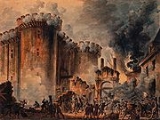
 storm the Bastille Storming of the Bastille

The Storming of the Bastille on July 14 [i], 1789 [i] was an important symbolic development in the French Revolution [i] ... 

 and free seven prisoners. In rural areas, peasants attack noble manors.

1792   French revolution, culminate year, Claude Joseph Rouget de Lisle Claude Joseph Rouget de Lisle

Claude Joseph Rouget de Lisle was a French [i] composer [i] who in 1792 wrote La Marseillaise [i] ... 

 composes La Marseillaise La Marseillaise

"La Marseillaise" is the national anthem [i] of France [i]. ... 

 also known as "Marche pour les armées du Rhin".

1792   French Revolution: Storming of the Tuileries Palace Tuileries Palace

The Tuileries Palace stood in Paris [i], France [i], on the right bank [i] of the River Seine [i] ... 

. Louis XVI of France Louis XVI of France

Louis XVI was King of France [i] and Navarre [i] from 1774 [i] until 1791 [i], and t ... 

 is arrested and taken into custody.

1792   During what became known as the September Massacres of the French Revolution, rampaging mobs slaughtered three Roman Catholic Church Roman Catholic Church

The Roman Catholic Church or Catholic Church is the Christian [i] Church [i] ... 

 bishop Bishop

A bishop is an ordained [i] member of the Christian clergy [i] who, in certain Christian [i] ... 

s and more than two hundred priest Priest

A priest or priestess is a person having the authority, or power , to perform and administer relig... 

s.

1793   In France France

France, officially the French Republic, is a country [i] whose metropolitan territory [i] ... 

, the French National Convention votes to implement terror measures to repress French Revolutionary activities. The ensuing "Reign of Terror Reign of Terror

The Reign of Terror or simply The Terror was a period in the French Revolution [i] characterized ... 

" will last until the spring of 1794 and causes death of 35,000-40,000 people.

1793   In Paris Paris

native_name = Ville de Paris |common_name = Paris ... 

, the French Revolutionary government opens the Louvre Louvre

The Louvre Museum in Paris [i], France [i], is one of the largest, oldest, most important and famous art galleries [i] ... 

 to the public as a museum Museum

A museum is typically a "permanent institution in the service of society and of its development, ope... 

1794   French Revolution: French Convention ousts Maximilien Robespierre Maximilien Robespierre

Maximilien Franois Marie Isidore de Robespierre is one of the best-known leaders of the French Revolution [i] ... 

 - he is arrested when he encourages the execution of more than 17,000 "enemies of the Revolution."

1794   Maximilien Robespierre Maximilien Robespierre

Maximilien Franois Marie Isidore de Robespierre is one of the best-known leaders of the French Revolution [i] ... 

 is guillotine Guillotine

The guillotine is a device used for carrying out execution [i]s by decapitation [i]. ... 

d in front of a cheering crowd, for sending thousands of others to a similar fate during the French Revolution.

   More Events >>


Encyclopedia

The French Revolution was a pivotal period in the history of French, Europe Europe

Europe is one of the seven traditional continent [i]s of the Earth [i]. ... 

an and Western Western world

The term Western World or "the West" can have multiple meanings depending on its context.... 

 civilization. During this time, republicanism replaced the absolute monarchy Absolute monarchy

Absolute monarchy is a monarchical [i] form of government [i] where the king has the power to r ... 

 in France France

France, officially the French Republic, is a country [i] whose metropolitan territory [i] ... 

, and the country's Roman Catholic Church Roman Catholicism in France

The Church of France [i] is part of the worldwide Roman Catholic Church [i], under the spiritual leaders... 

 was forced to undergo a radical restructuring. While France would oscillate among republic Republic

In a broad definition, a republic is a state [i] or country [i] that is led by people whose political power [i] ... 

, empire Empire

What exactly constitutes an Empire is a topic of intense debate within the scholarly community.... 

, and monarchy Monarchy

A monarchy, from the Greek [i] ????, "one," and a??e?? [i], "to rule", is... 

 for 75 years after the First Republic fell to a coup d'état Coup d'état

A coup d'tat , or simply coup, is the sudden overthrow of a government [i] through unconstitutiona ... 

, the Revolution Revolution

A revolution is a drastic change that usually occurs relatively quickly.... 

 is widely seen as a major turning point in the history of Western democracy Democracy

Democracy is a form of government [i] for a nation state, or for an organiz ... 

—from the age of absolutism and aristocracy, to the age of the citizenry Citizenship

Citizenship is membership in a political community and carries with it rights [i] to political partici ... 

 as the dominant political force.

The slogan of the French Revolution was "Liberté, égalité, fraternité Liberté, égalité, fraternité

Libert, galit, fraternit, French [i] for "Liberty [i], equality [i],... 

, ou la mort!" . This slogan outlived the revolution, later becoming the rallying cry of activists, both militant and non-violent, who promote democracy or overthrow of oppressive governments.

Causes


Many interrelated political and socioeconomic factors contributed to the French Revolution. To some extent, the old order succumbed to its own rigidity in the face of a changing world. It fell to the ambitions of a rising bourgeoisie, allied with aggrieved peasants, wage-earners, and individuals of all classes who had come under the influence of the ideas of the Enlightenment Age of Enlightenment

The Age of Enlightenment refers to either the eighteenth century [i] in European philosophy [i] ... 

. As the revolution proceeded, and as power devolved from the monarchy to legislative bodies, the conflicting interests of these two once-allied groups would become the source of conflict and bloodshed.

Causes of the French Revolution include the following
  • A poor economic situation and an unmanageable national debt were both caused and exacerbated by the burden of a grossly inequitable system of taxation Tax

    A tax is a financial charge or other levy [i] imposed on an individual or a legal entity [i] by a state [i] ... 

    , the massive spending of Louis XVI Louis XVI of France

    Louis XVI was King of France [i] and Navarre [i] from 1774 [i] until 1791 [i], and t ... 

     and the many wars of the 18th century;
  • A resentment of royal absolutism;
  • An aspiration for liberty and republicanism;
  • A resentment of manorialism Manorialism

    Manorialism or Seigneurialism describes the organization of rural economy and society in medieval [i] ... 

      by peasants, wage-earners, and, to a lesser extent, the bourgeoisie;
  • The rise of Enlightenment Age of Enlightenment

    The Age of Enlightenment refers to either the eighteenth century [i] in European philosophy [i] ... 

     ideals;
  • Food scarcity Famine

    A famine is a phenomenon in which a large percentage of the population of a region or country is so unde... 

     in the months immediately before the revolution;
  • High unemployment Unemployment

    In economics [i], a person willing to work at a prevailing wage rate yet is unable to find a paying job [i]... 

     and high bread prices resulting in the inability to purchase food;
  • A resentment of noble privilege and dominance in public life by the ambitious professional classes;
  • A resentment of religious intolerance;
  • The failure of Louis XVI Louis XVI of France

    Louis XVI was King of France [i] and Navarre [i] from 1774 [i] until 1791 [i], and t ... 

     to deal effectively with these phenomena.

Crisis in the royal finances

The revolutionary crisis began when the French king Louis XVI Louis XVI of France

Louis XVI was King of France [i] and Navarre [i] from 1774 [i] until 1791 [i], and t ... 

  faced a crisis in the royal finances. The French crown, which fiscally equated the French state, owed considerable debt. During the régimes of Louis XV Louis XV of France

Louis XV , "the Beloved" , was King of France [i] from 1715 [i] until his death.... 

  and Louis XVI Louis XVI of France

Louis XVI was King of France [i] and Navarre [i] from 1774 [i] until 1791 [i], and t ... 

, several different ministers, including Turgot Anne Robert Jacques Turgot, Baron de Laune

Anne-Robert-Jacques Turgot, Baron de Laune, often referred to as Turgot, was a French [i] s ... 

 , and Jacques Necker Jacques Necker

Jacques Necker was a French [i] statesman of Swiss [i] origin and finance minister [i]... 

 , unsuccessfully proposed to revise the French tax system to a more uniform system. Such measures encountered consistent resistance from the parlement Parlement

Parlements in ancien rgime [i] France [i] were political institutions that developed out of the prev... 

s
, dominated by the "Robe Nobility", which saw themselves as the nation's guardians against despotism, as well as from court factions, and both ministers were ultimately dismissed. Charles Alexandre de Calonne Charles Alexandre de Calonne

Charles Alexandre, vicomte [i] de Calonne was a French [i] statesman. ... 

, who became Controller-General of the Finances in 1783, pursued a strategy of conspicuous spending as a means of convincing potential creditors of the confidence and stability of France's finances.

However, Calonne, having conducted a lengthy review of France's financial situation, determined that it was not sustainable, and proposed a uniform land tax as a means of setting France's finances in order in the long term. In the short-term, he hoped that a show of support from a hand-picked Assembly of Notables would restore confidence in French finances, and allow further borrowing until the land tax began to make up the difference and allow the beginning of repayment of the debt.

Although Calonne convinced the king of the necessity of his reforms, the Assembly of Notables refused to endorse his measures, insisting that only a truly representative body, preferably the Estates-General of the Kingdom, could approve new taxes. The King, seeing that Calonne himself was now a liability, dismissed him and replaced him with Étienne Charles de Loménie de Brienne Étienne Charles de Loménie de Brienne

tienne Charles de Lomnie de Brienne was a French [i] churchman and politician [i]. ... 

, the Archbishop of Toulouse Toulouse

Toulouse is a city [i] in southwest France [i] on the banks of the Garonne River [i] ... 

, who had been a leader of the opposition in the Assembly. Brienne now adopted a thorough-going reform position, granting various civil rights , and promising the convocation of the Estates-General within five years, but also attempted in the meantime to go ahead with Calonne's plans. When the measures were opposed in the Parlement of Paris , Brienne went on the attack, attempting to disband the parlements entirely and collect the new taxes in spite of them. This led to massive resistance across many parts of France, including the famous "Day of the Tiles" in Grenoble Grenoble

Grenoble is a city and commune [i] in south-east France [i], situated at the foot of ... 

. Even more importantly, the chaos across France convinced the short-term creditors on whom the French treasury depended to maintain its day-to-day operations to withdraw their loans, leading to a near-default, which forced Louis and Brienne to surrender.

The king agreed on 8 August 1788 to convene the Estates-General in May 1789, for the first time since 1614. Brienne resigned on 25 August 1788, and his predecessor Necker again took charge of the nation's finances. He used his position not to propose new reforms, but only to prepare for the meeting of the nation's representatives.

The Estates-General of 1789

For a more detailed description of the events of 8 August 1788–17 June 1789, see Estates-General of 1789

The calling of the Estates-General led to growing concern on the part of the opposition that the government would attempt to gerrymander Gerrymandering

Gerrymandering is a controversial form of redistricting [i] in which electoral district or constituency [i] ... 

 an assembly to its liking. In order to avoid this, the Parlement of Paris, having returned in triumph to the city, proclaimed that the Estates-General would have to meet according to the forms observed at its last meeting. Although it would appear that the magistrates were not specifically aware of the "forms of 1614" when they made this decision, this provoked an uproar. The 1614 Estates had consisted of equal numbers of representatives of each estate, and voting had been by order, with the First Estate , the Second Estate , and the Third Estate  each receiving one vote.

Almost immediately the "Committee of Thirty", a body of liberal Parisians, began to agitate against this, arguing for a doubling of the Third Estate and voting by head . Necker, speaking for the government, conceded further that the third estate should be doubled, but the question of voting by head was left for the meeting of the Estates themselves. However, the resentments brought forward by the dispute remained powerful. Pamphlets and works by nobles like comte d'Antraigues and clergy like Abbé Sieyès argued the importance of the Third Estate. As Antraigues wrote, it was "the People, and the People is the foundation of the State; it is in fact the State itself". Sieyes' famous pamphlet What is the Third Estate, published in January 1789, pointed out the next step: "What is the third Estate? Everything. What has it been up to now in the political order? Nothing. What does it demand? To become something herein."

When the Estates-General convened in Versailles Versailles

Versailles , formerly the de facto capital of the kingdom of France [i], is now a wealthy suburb of ... 

 on 5 May 1789, lengthy speeches by Necker and Lamoignon, the keeper of the seals, did little to give guidance to the deputies, who were remanded to separate meeting places to credential their members. The question of whether voting was ultimately to be by head or by order was again put aside for the moment, but the Third Estate now demanded that credentialing itself should take place as a group. Negotiations with the other estates to achieve this, however, were unsuccessful, as a bare majority of the clergy and a large majority of the nobility continued to support voting by order.

Assembly


For a more detailed description of the events of 17 June 1789–9 July 1789, see National Assembly

On 28 May 1789 the Abbé Sieyès moved that the Third Estate, now meeting as the Communes , proceed with verification of its own powers and invite the other two estates to take part, but not to wait for them. They proceeded to do so, completing the process on 17 June. Then they voted a measure far more radical, declaring themselves the National Assembly, an assembly not of the Estates but of "the People". They invited the other orders to join them, but made it clear they intended to conduct the nation's affairs with or without them.

Louis XVI ordered the closure of the Salle des États where the Assembly met. The weather did not allow an outdoor meeting, so the Assembly moved their deliberations to a nearby, indoor, tennis court, where they proceeded to swear the Tennis Court Oath Tennis Court Oath

The Tennis Court Oath was a pledge signed by 577 members of France [i]'s Third Estate [i] during the Estates-General [i] ... 

 , under which they agreed not to separate until they had given France a constitution Constitution

A constitution is a system, often codified [i] as a written document, which establishes the rules and pr... 

. A majority of the representatives of the clergy soon joined them, as did forty-seven members of the nobility. By 27 June the royal party had overtly given in, although the military began to arrive in large numbers around Paris Paris

native_name = Ville de Paris
|common_name = Paris
... 

 and Versailles Versailles

Versailles , formerly the de facto capital of the kingdom of France [i], is now a wealthy suburb of ... 

. Messages of support for the Assembly poured in from Paris and other French cities. On 9 July the Assembly reconstituted itself as the National Constituent Assembly, which was to last until its dissolution in 30 September 1791.

The storming of the Bastille


For a more detailed discussion, see Storming of the Bastille Storming of the Bastille

The Storming of the Bastille on July 14 [i], 1789 [i] was an important symbolic development in the French Revolution [i] ... 


On 11 July 1789 King Louis, acting under the influence of the conservative nobles of his privy council, as well as his wife, Marie Antoinette Marie Antoinette

Maria Antonia Josefa Joanna von Habsburg-Lothringen, usually known as Marie Antoinette; was Queen... 

, and brother, the Comte d'Artois Charles X of France

Charles X, King of France and of Navarre was born at the Palace of Versailles [i]. ... 

, banished the reformist minister Necker and completely reconstructed the ministry. Much of Paris, presuming this to be the start of a royal coup, moved into open rebellion. Some of the military joined the mob; others remained neutral.

On 14 July 1789, after hours of combat, the insurgents seized the Bastille Bastille

The Bastille was a prison [i] in Paris [i], known formally as Bastille Saint-AntoineNumber 232, Ru... 

 prison Prison

prison, penitentiary, or correctional facility is a place in which individuals are physicall... 

, killing the governor, Marquis Bernard de Launay, and several of his guards. Although the Parisians released only seven prisoners; four forgers, two lunatics, and a sexual offender, the Bastille served as a potent symbol of everything hated under the ancien régime. Returning to the Hôtel de Ville Hôtel de Ville, Paris

... 

 , the mob accused the prévôt des marchands Jacques de Flesselles of treachery; his assassination took place en route to an ostensible trial at the Palais Royal Palais Royal

The Palais-Royal is a palace and garden north of the Louvre [i] in the Ier arrondissement [i] of Paris [i] ... 

.

The king and his military supporters backed down, at least for the time being. Lafayette Gilbert du Motier, marquis de La Fayette

Marie-Joseph-Paul-Yves-Roch-Gilbert Du Motier, marquis de La Fayette was a French [i] aristocrat [i] ... 

 took up command of the National Guard at Paris. Jean-Sylvain Bailly Jean Sylvain Bailly

Jean-Sylvain Bailly was a French [i] astronomer [i] and orator [i], one of the leaders... 

, president of the National Assembly at the time of the Tennis Court Oath Tennis Court Oath

The Tennis Court Oath was a pledge signed by 577 members of France [i]'s Third Estate [i] during the Estates-General [i] ... 

, became the city's mayor under a new governmental structure known as the commune. The king visited Paris, where, on 27 July he accepted a tricolore cockade Cockade

A cockade is a knot of ribbons, or other circular- or oval-shaped symbol of distinctive colours which is... 

, as cries of vive la Nation "Long live the Nation" changed to vive le Roi "Long live the King".

Nonetheless, after this violence, nobles, little assured by the apparent and, as it proved, temporary reconciliation of king and people, started to flee the country as émigrés, some of whom began plotting civil war within the kingdom and agitating for a European coalition against France.

Necker, recalled to power, experienced but a short-lived triumph. An astute financier but a less astute politician, he overplayed his hand by demanding and obtaining a general amnesty, losing much of the people's favour in his moment of apparent triumph.

By late July insurrection and the spirit of popular sovereignty spread throughout France. In rural areas, many went beyond this: some burned title-deeds and no small number of châteaux Château

A chteau is a manor house [i] or residence of the lord of the manor [i] or a country house of nobility [i] ... 

, as part of a general agrarian insurrection known as "la Grande Peur" . In addition, plotting and agitation by the émigrés led to wild rumours and paranoia that caused widespread unrest and civil disturbances and contributed to the Great Fear .

The National Constituent Assembly


The abolition of feudalism

For a more detailed discussion, see The Abolition of Feudalism.

On 4 August 1789 the National Constituent Assembly abolished feudalism Feudalism

Feudalism refers to a general set of reciprocal legal [i] and military [i] obligations among the war ... 

, in what is known as the August Decrees; sweeping away both the seigneurial rights of the Second Estate and the tithes gathered by the First Estate. In the course of a few hours, nobles, clergy, towns, provinces, companies, and cities lost their special privileges.

Dechristianisation

For a more detailed discussion, see Dechristianisation of France during the French Revolution.

The revolution brought about a massive shifting of powers from the Roman Catholic Church Roman Catholic Church

The Roman Catholic Church or Catholic Church is the Christian [i] Church [i] ... 

 to the state. Under the ancien régime, the Church had been the largest landowner in the country. Legislation enacted in 1790 abolished the Church's authority to levy a tax Tax

A tax is a financial charge or other levy [i] imposed on an individual or a legal entity [i] by a state [i] ... 

 on crops known as the dîme, cancelled special privileges for the clergy, and confiscated Church property. Subsequent legislation attempted to subordinate the clergy to the state, making them state employees. The ensuing years saw violent repression of the clergy, including the imprisonment and massacre of priest Priest

A priest or priestess is a person having the authority, or power , to perform and administer relig... 

s throughout France. The Concordat of 1801 between Napoleon and the Church ended the dechristianisation period and established the rules for a relationship between the Catholic Church and the French State that lasted until it was abrogated by the Third Republic French Third Republic

The French Third Republic, was the governing body of France [i] between the Second French Empire [i] and ... 

 via the separation of church and state 1905 French law on the separation of Church and State

[i] the [[church]... 

 on 11 December 1905.

The appearance of factions

For a more detailed discussion, please see National Constituent Assembly.

Factions within the Assembly began to become clearer. The aristocrat Jacques Antoine Marie de Cazalès and the abbé Abbé

... 

 Jean-Sifrein Maury Jean-Sifrein Maury

Jean-Sifrein Maury, was a French [i] cardinal [i] and Archbishop of Paris [i]. ... 

 led what would become known as the right wing, the opposition to revolution. The "Royalist democrats" or monarchiens, allied with Necker Jacques Necker

Jacques Necker was a French [i] statesman of Swiss [i] origin and finance minister [i]... 

, inclined toward organising France along lines similar to the British constitutional model: they included Jean Joseph Mounier, the Comte de Lally-Tollendal Trophime-Gérard, marquis de Lally-Tollendal

... 

, the Stanislas Marie Adelaide, comte de Clermont-Tonnerre Stanislas Marie Adelaide, comte de Clermont-Tonnerre

Stanislas Marie Adelaide, comte [i] de Clermont-Tonnerre [i] was a French [i] politician. ... 

, and Pierre Victor Malouet, comte de Virieu.

The "Anil Party", representing the centre or centre-left of the assembly, included Honoré Mirabeau, Lafayette, and Bailly; while Adrien Duport, Barnave and Alexander Lameth represented somewhat more extreme views. Almost alone in his radicalism on the left was the Arras Arras

Arras is a town and commune [i] in northern France [i], prfecture [i] of the Pas-de-Calais [i] ... 

 lawyer Maximilien Robespierre Maximilien Robespierre

Maximilien Franois Marie Isidore de Robespierre is one of the best-known leaders of the French Revolution [i] ... 

.

The abbé Sieyès Emmanuel Joseph Sieyès

Emmanuel Joseph Sieys was a French [i] abb [i] and statesman, one of the chief theorists of t ... 

 led in proposing legislation in this period and successfully forged consensus for some time between the political centre and the left.

In Paris, various committees, the mayor, the assembly of representatives, and the individual districts each claimed authority independent of the others. The increasingly middle-class National Guard National Guard

National Guard may refer to:
... 

 under Lafayette also slowly emerged as a power in its own right, as did other self-generated assemblies.

Looking to the United States Declaration of Independence United States Declaration of Independence

The Declaration of Independence is the document in which the Thirteen Colonies [i] in North America [i] ... 

 for a model, on 26 August 1789, the Assembly published the Declaration of the Rights of Man and of the Citizen Declaration of the Rights of Man and of the Citizen

The Declaration of the Rights of Man and of the Citizen is one of the fundamental documents of the French Revolution [i] ... 

. Like the U.S. Declaration, it comprised a statement of principles rather than a constitution Constitution

A constitution is a system, often codified [i] as a written document, which establishes the rules and pr... 

 with legal effect.

Toward a constitution

For a more detailed discussion, see Toward a Constitution.

The National Constituent Assembly functioned not only as a legislature Legislature

A legislature is a type of representative deliberative assembly [i] with the power to adopt law [i]s. ... 

, but also as a body to draft a new constitution.

Necker, Mounier, Lally-Tollendal and others argued unsuccessfully for a senate, with members appointed by the crown on the nomination of the people. The bulk of the nobles argued for an aristocratic upper house elected by the nobles. The popular party carried the day: France would have a single, unicameral assembly. The king retained only a "suspensive veto"; he could delay the implementation of a law, but not block it absolutely.

The people of Paris thwarted Royalist efforts to block this new order: they marched on Versailles on 5 October 1789. This event has been termed the 'march of the women' as it was mostly women who marched to Versailles. These were followed by 20,000 National Guards. After various scuffles and incidents, the king and the royal family allowed themselves to be brought back from Versailles to Paris.

The Assembly replaced the historic provinces Provinces of France

The Kingdom of France [i] was organized into province [i]s until March 4 [i], 1790 [i], when the establishment ... 

 with eighty-three départements, uniformly administered and approximately equal to one another in extent and population.

Originally summoned to deal with a financial crisis, to date the Assembly had focused on other matters and only worsened the deficit. Mirabeau now led the move to address this matter, with the Assembly giving Necker complete financial dictatorship.

Toward the Civil Constitution of the Clergy

For a more detailed discussion, see Civil Constitution of the Clergy.

To no small extent, the Assembly addressed the financial crisis by having the nation take over the property of the Church , through the law of 2 December 1789. In order to rapidly monetize such an enormous amount of property, the government introduced a new paper currency, assignat Assignat

Assignats were banknote [i]s issued by the National Constituent Assembly [i] in France [i] during the French Revolution [i]... 

s
, backed by the confiscated church lands.

Further legislation on 13 February 1790 abolished monastic vows Religious vows

Religious vows are the public vows [i] taken by members of religious communities of the Roman Catholic [i] ... 

. The Civil Constitution of the Clergy, passed on 12 July 1790 , turned the remaining clergy into employees of the State and required that they take an oath of loyalty to the constitution. The Civil Constitution of the Clergy also made the Catholic church an arm of the secular state.

In response to this legislation, the archbishop of Aix and the bishop of Clermont led a walkout of clergy from the National Constituent Assembly. The pope Pope

The Pope is the Bishop of Rome [i], and, as Successor [i] of Saint Peter [i], is t ... 

 never accepted the new arrangement, and it led to a schism between those clergy who swore the required oath and accepted the new arrangement and the "non-jurors" or "refractory priests" who refused to do so.

From the anniversary of the Bastille to the death of Mirabeau

For a more detailed discussion of the events of 14 July 1790–30 September 1791, see From the Anniversary of the Bastille to the Death of Mirabeau.

The Assembly abolished the symbolic paraphernalia of the
ancien régime, armorial bearings, liveries, etc., which further alienated the more conservative nobles, and added to the ranks of the émigrés.

On 14 July 1790, and for several days following, crowds in the Champ-de-Mars Champ de Mars

The Champ de Mars is a large public green-space in Paris [i], France [i], located in the 7th arrondissement [i] ... 

 celebrated the anniversary of the fall of the Bastille; Talleyrand Charles Maurice de Talleyrand-Périgord

Charles Maurice de Talleyrand-Prigord, Prince de Benevente was a French [i] diplomat [i]. ... 

 performed a mass; participants swore an oath of "fidelity to the nation, the law, and the king"; and the king and the royal family actively participated.

The electors had originally chosen the members of the Estates-General to serve for a single year. However, by the time of the Tennis Court Oath Tennis Court Oath

The Tennis Court Oath was a pledge signed by 577 members of France [i]'s Third Estate [i] during the Estates-General [i] ... 

, the communes had bound themselves to meet continuously until France had a constitution. Right-wing elements now argued for a new election, but Mirabeau carried the day, asserting that the status of the assembly had fundamentally changed, and that no new election should take place before completing the constitution.

In late 1790, several small counter-revolutionary uprisings broke out and efforts took place to turn all or part of the army against the revolution. These uniformly failed. The royal court, in François Mignet's words, "encouraged every anti-revolutionary enterprise and avowed none."

The army faced considerable internal turmoil: General Bouillé François Claude Amour, marquis de Bouillé

[i]
... 

 successfully put down a small rebellion, which added to his reputation for counter-revolutionary sympathies.

The new military code, under which promotion depended on seniority and proven competence alienated some of the existing officer corps, who joined the ranks of the émigrés or became counter-revolutionaries from within.

This period saw the rise of the political "clubs" in French politics, foremost among these the Jacobin Club: according to the 1911 Encyclopædia Britannica, one hundred and fifty-two clubs had affiliated with the Jacobins by 10 August 1790. As the Jacobins became more of a broad popular organisation, some of its founders abandoned it to form the Club of '89. Royalists established first the short-lived Club des Impartiaux and later the Club Monarchique. The latter attempted unsuccessfully to curry public favour by distributing bread. Nonetheless, they became the frequent target of protests and even riots, and the Paris municipal authorities finally closed down the Club Monarchique in January 1791.

Amidst these intrigues, the Assembly continued to work on developing a constitution. A new judicial organisation made all magistracies temporary and independent of the throne. The legislators abolished hereditary offices, except for the monarchy itself. Jury trials started for criminal cases. The king would have the unique power to propose war, with the legislature then deciding whether to declare war. The Assembly abolished all internal trade barriers and suppressed guilds, masterships, and workers' organisations: any individual gained the right to practice a trade through the purchase of a license; strikes became illegal.

In the winter of 1791, the Assembly considered, for the first time, legislation against the émigrés. The debate pitted the safety of the State against the liberty of individuals to leave. Mirabeau carried the day against the measure, which he referred to as "worthy of being placed in the code of Draco."

However, Mirabeau died on 2 April 1791. In Mignet's words, "No one succeeded him in power and popularity" and, before the end of the year, the new Legislative Assembly would adopt this "draconian" measure.

The flight to Varennes

For a more detailed discussion, see Flight to Varennes.

Louis XVI, opposed to the course of the revolution, but rejecting the potentially treacherous aid of the other monarchs of Europe, cast his lot with General Bouillé, who condemned both the emigration and the assembly, and promised him refuge and support in his camp at Montmedy.
On the night of 20 June 1791 the royal family fled the Tuileries wearing the clothes of servants, while their servants dressed as nobles. However, the next day the overconfident king had the imprudence to show himself. Recognised and arrested at Varennes  late on 21 June, he was paraded back to Paris under guard, and still wearing his rags.
Pétion Jérôme Pétion de Villeneuve

Jrme Ption de Villeneuve was a French [i] writer [i] and politician [i].
... 

, Latour-Maubourg, and Antoine Pierre Joseph Marie Barnave, representing the Assembly, met the royal family at Épernay Épernay

pernay is a town and commune [i] of northern France [i]. ... 

 and returned with them. From this time, Barnave became a counselor and supporter of the royal family.
When they reached Paris, the crowd remained silent. The Assembly provisionally suspended the king. He and Queen Marie Antoinette Marie Antoinette

Maria Antonia Josefa Joanna von Habsburg-Lothringen, usually known as Marie Antoinette; was Queen... 

 remained held under guard.

The last days of the National Constituent Assembly

For a more detailed discussion, please see The Last Days of the National Constituent Assembly.

With most of the Assembly still favouring a constitutional monarchy Constitutional monarchy

A constitutional monarchy is a form of monarchical [i] government [i] established under a constitution [i] ... 

 rather than a republic Republic

In a broad definition, a republic is a state [i] or country [i] that is led by people whose political power [i] ... 

, the various groupings reached a compromise which left Louis XVI little more than a figurehead: he had perforce to swear an oath to the constitution, and a decree declared that retracting the oath, heading an army for the purpose of making war upon the nation, or permitting anyone to do so in his name would amount to de facto abdication.

Jacques Pierre Brissot Jacques Pierre Brissot

Jacques Pierre Brissot, who assumed the name of de Warville, was a leading member of the Girondist [i] ... 

 drafted a petition, insisting that in the eyes of the nation Louis XVI was deposed since his flight. An immense crowd gathered in the Champ-de-Mars Champ de Mars

The Champ de Mars is a large public green-space in Paris [i], France [i], located in the 7th arrondissement [i] ... 

 to sign the petition. Georges Danton Georges Danton

Georges Jacques Danton was a leading figure in the early stages of the French Revolution [i].... 

 and Camille Desmoulins Camille Desmoulins

Lucie Simplice Camille Benoist Desmoulins was a French [i] journalist and politician who played a ... 

 gave fiery speeches. The Assembly called for the municipal authorities to "preserve public order". The National Guard under Lafayette's command confronted the crowd. The soldiers first responded to a barrage of stones by firing in the air; the crowd did not back down, and Lafayette ordered his men to fire into the crowd, resulting in the killing of as many as fifty people.

In the wake of this massacre the authorities closed many of the patriotic clubs, as well as radical newspapers such as Jean-Paul Marat Jean-Paul Marat

Jean-Paul Marat , was a Swiss [i]-born French [i] scientist and physician [i] who mad ... 

's L'Ami du Peuple. Danton fled to England; Desmoulins and Marat went into hiding.

Meanwhile, a renewed threat from abroad arose: Leopold II, Holy Roman Emperor Leopold II, Holy Roman Emperor

Leopold II was Holy Roman Emperor [i] from 1790 [i] to 1792 [i] and Grand-duke of Tuscany [i]. ... 

, Frederick William II of Prussia Frederick William II of Prussia

Frederick William II was the fourth king [i] of Prussia [i], reigning from 1786 until... 

, and the king's brother Charles-Phillipe, comte d'Artois Charles X of France

Charles X, King of France and of Navarre was born at the Palace of Versailles [i]. ... 

 issued the Declaration of Pilnitz which considered the cause of Louis XVI as their own, demanded his total liberty and the dissolution of the Assembly, and promised an invasion of France on his behalf if the revolutionary authorities refused its conditions.

If anything, the declaration further imperiled Louis. The French people expressed no respect for the dictates of foreign monarchs, and the threat of force merely resulted in the militarisation of the frontiers.

Even before his "Flight to Varennes", the Assembly members had determined to debar themselves from the legislature that would succeed them, the Legislative Assembly. They now gathered the various constitutional laws they had passed into a single constitution, showed remarkable fortitude in choosing not to use this as an occasion for major revisions, and submitted it to the recently restored Louis XVI, who accepted it, writing "I engage to maintain it at home, to defend it from all attacks from abroad, and to cause its execution by all the means it places at my disposal". The king addressed the Assembly and received enthusiastic applause from members and spectators. The Assembly set the end of its term for 29 September 1791.

Mignet has written, "The constitution of 1791... was the work of the middle class, then the strongest; for, as is well known, the predominant force ever takes possession of institutions... In this constitution the people was the source of all powers, but it exercised none."

The Legislative Assembly and the fall of the Monarchy

For a more detailed description of the events of 1 October 1791–19 September 1792, see main article The Legislative Assembly and the fall of the French monarchy.

The Legislative Assembly

Under the Constitution of 1791, France would function as a constitutional monarchy. The king had to share power with the elected Legislative Assembly, but he still retained his royal veto and the ability to select ministers.

The Legislative Assembly first met on 1 October 1791, and degenerated into chaos less than a year later. In the words of the 1911 Encyclopædia Britannica: "In the attempt to govern, the Assembly failed altogether. It left behind an empty treasury, an undisciplined army and navy, and a people debauched by safe and successful riot."

The Legislative Assembly consisted of about 165 Feuillants on the right, about 330 Girondists and Jacobins on the left, and about 250 deputies unaffiliated with either faction.

Early on, the king vetoed legislation that threatened the émigrés with death and that decreed that every non-juring clergyman must take within eight days the civic oath mandated by the Civil Constitution of the Clergy. Over the course of a year, disagreements like this would lead to a constitutional crisis, leading the Revolution to higher levels.

War

The politics of the period inevitably drove France towards war with Austria Austria

Austria is a landlocked [i] country in central Europe [i]. ... 

 and its allies. The King, the Feuillants and the Girondins specifically wanted to wage war. The King expected war would increase his personal popularity; he also foresaw an opportunity to exploit any defeat: either result would make him stronger. The Girondins wanted to export the Revolution throughout Europe. Only some of the radical Jacobins opposed war, preferring to consolidate and expand the revolution at home. The Austrian emperor Leopold II Leopold II, Holy Roman Emperor

Leopold II was Holy Roman Emperor [i] from 1790 [i] to 1792 [i] and Grand-duke of Tuscany [i]. ... 

, brother of Marie Antoinette Marie Antoinette

Maria Antonia Josefa Joanna von Habsburg-Lothringen, usually known as Marie Antoinette; was Queen... 

, may have wished to avoid war, but he died on 1 March 1792.

France declared war on Austria Austria

Austria is a landlocked [i] country in central Europe [i]. ... 

  and Prussia Prussia

Prussia was, most recently, a historic state originating in Brandenburg [i], an area which for centuries ... 

 joined on the Austrian side a few weeks later. The French Revolutionary Wars French Revolutionary Wars

The French Revolutionary Wars were wars fought between the French Revolutionary [i] go ... 

 had begun.

After early skirmishes went badly for France, the first significant military engagement of the war occurred with the Franco-Prussian Battle of Valmy Battle of Valmy

The Battle of Valmy formed a turning point in the wars associated with the French Revolution [i].
... 

 . Although heavy rain prevented a conclusive resolution, the French artillery proved its superiority. However, by this time, France stood in turmoil and the monarchy had effectively become a thing of the past.

Constitutional crisis


Main articles: 10th of August , September Massacres


On the night of 10 August 1792, insurgents, supported by a new revolutionary Paris Commune Paris Commune

The term "Paris Commune" originally referred to the government of Paris during the French Revolution [i] ... 

, assailed the Tuileries. The king and queen ended up prisoners and a rump session of the Legislative Assembly suspended the monarchy: little more than a third of the deputies were present, almost all of them Jacobins.

What remained of a national government depended on the support of the insurrectionary Commune. When the Commune sent gangs of assassins into the prisons to butcher 1400 victims, and addressed a circular letter to the other cities of France inviting them to follow this example, the Assembly could offer only feeble resistance. This situation persisted until the Convention, charged with writing a new constitution, met on 20 September 1792 and became the new de facto government of France. The next day it abolished the monarchy and declared a republic. This date was later retroactively adopted as the beginning of Year One of the French Revolutionary Calendar French Republican Calendar

The French Republican Calendar or French Revolutionary Calendar is a calendar [i] proposed during ... 

.

The Convention


20 September 1792–26 September 1795

The legislative power in the new republic fell to a National Convention, while the executive power came to rest in the Committee of Public Safety. The Girondins became the most influential party in the Convention and on the Committee.

In the Brunswick Manifesto, the Imperial and Prussian armies threatened retaliation on the French population should it resist their advance or the reinstatement of the monarchy. As a consequence, King Louis was seen as conspiring with the enemies of France. 17 January 1793 saw King Louis condemned to death for "conspiracy against the public liberty and the general safety" by a weak majority in Convention. The 21 January execution led to more wars with other European countries. Louis' Austrian-born queen, Marie Antoinette, would follow him to the guillotine on 16 October.

When war went badly, prices rose and the sans-culottes Sans-culottes

Sans-culottes was a term created 1790 - 1792 by the aristocracy to describe the poorer members of the Third Estate [i]... 

  rioted; counter-revolutionary activities began in some regions. This encouraged the Jacobins to seize power through a parliamentary coup Coup d'état

A coup d'tat , or simply coup, is the sudden overthrow of a government [i] through unconstitutiona ... 

, backed up by force effected by mobilising public support against the Girondist faction, and by utilising the mob power of the Parisian sans-culottes. An alliance of Jacobin and sans-culottes elements thus became the effective centre of the new government. Policy became considerably more radical.


The Committee of Public Safety came under the control of Maximilien Robespierre Maximilien Robespierre

Maximilien Franois Marie Isidore de Robespierre is one of the best-known leaders of the French Revolution [i] ... 

, and the Jacobins unleashed the Reign of Terror Reign of Terror

The Reign of Terror or simply The Terror was a period in the French Revolution [i] characterized ... 

 . At least 1200 people met their deaths under the guillotine Guillotine

The guillotine is a device used for carrying out execution [i]s by decapitation [i]. ... 

 or otherwise; after accusations of counter-revolutionary activities. The slightest hint of counter-revolutionary thoughts or activities could place one under suspicion, and the trials did not proceed scrupulously.

In 1794, Robespierre Maximilien Robespierre

Maximilien Franois Marie Isidore de Robespierre is one of the best-known leaders of the French Revolution [i] ... 

 had ultra-radicals and moderate Jacobins executed; in consequence, however, his own popular support eroded markedly. On 27 July 1794, the Thermidorian Reaction led to the arrest and execution of Robespierre and Saint-Just Louis de Saint-Just

Louis Antoine Lon de Saint-Just, usually known as Saint-Just, was a French revolution [i]ary leade ... 

. The new government was predominantly made up of Girondists who had survived the Terror, and after taking power, they took revenge as well by persecuting even those Jacobins who had helped to overthrow Robespierre, banning the Jacobin Club, and executing many of its former members in what was known as the White Terror.

The Convention approved the new "Constitution of the Year III" on 17 August 1795; a plebiscite ratified it in September; and it took effect on 26 September 1795.

The Directory

For more information on the events of 26 September 1795–9 November 1799, see French Directory.

The new constitution installed the Directoire  and created the first bicameral legislature Bicameralism

In government [i], bicameralism is the practice of having two legislative or parliamentary chamber [i]s. ... 

 in French history. The parliament consisted of 500 representatives - le Conseil des Cinq-Cents - and 250 senators - le Conseil des Anciens . Executive power went to five "directors", named annually by the Conseil des Anciens from a list submitted by the le Conseil des Cinq-Cents.

The new régime met with opposition from remaining Jacobins and the royalists. The army suppressed riots and counter-revolutionary activities. In this way the army and its successful general, Napoleon Bonaparte Napoleon I of France

Napoleon I Bonaparte, Emperor of the French, King of Italy, Mediator of the Swiss Confederation and Prot... 

 gained much power.

On 9 November 1799 Napoleon Napoleon I of France

Napoleon I Bonaparte, Emperor of the French, King of Italy, Mediator of the Swiss Confederation and Prot... 

 staged the coup of 18 Brumaire 18 Brumaire

18 Brumaire, the coup of 18 Brumaire or sometimes simply Brumaire refers to the coup d'tat [i] ... 

which installed the Consulate French Consulate

The Consulate was the government of France [i] from 1799 [i] to 1804 [i]—from the fall of the Directory [i] ... 

; this effectively led to his dictatorship and eventually to his proclamation as Empereur , which brought to a close the specifically republic Republic

In a broad definition, a republic is a state [i] or country [i] that is led by people whose political power [i] ... 

an phase of the French Revolution.

See also

  • French Revolutionary Calendar French Republican Calendar

    The French Republican Calendar or French Revolutionary Calendar is a calendar [i] proposed during ... 

  • French Revolutionary Wars French Revolutionary Wars

    The French Revolutionary Wars were wars fought between the French Revolutionary [i] go ... 

  • Glossary of the French Revolution
  • History of democracy History of democracy

    The history of democracy [i] traces back from its origins in prehistoric times to its re-emergence and r ... 

  • List of people associated with the French Revolution
  • List of people granted honorary French citizenship during the French Revolution
  • List of historians of the French Revolution
  • Timeline of the French Revolution
  • A Tale of Two Cities
  • Jean Nicolas Pache - Liberté, Egalité, Fraternité

Other revolutions in French history

  • July Revolution
  • Revolutions of 1848 in France Revolutions of 1848 in France

    The February 1848 revolution put an end to the July monarchy [i], replaced by the Second Republic [i] ... 

  • Paris Commune Paris Commune

    The term "Paris Commune" originally referred to the government of Paris during the French Revolution [i] ... 

     of 1871
  • May 1968, a noteworthy rebellion, though not quite a revolution
  • Haïtian Revolution Haïtian Revolution

    ... 

    , Haiti colony

References


Further reading

  • Doyle, William. Oxford history of the French Revolution, 2nd ed., Oxford: Oxford University Press, 2002 ISBN 0-19-925298-X
  • Doyle, William. Origins of the French Revolution, 3rd ed., Oxford: Oxford University Press, 1999 ISBN 0-19-873175-2, ISBN 0-19-873174-4
  • Furet, François. La révolution en debat, Paris: Gallimard, 1999 ISBN 2-07-040784-5
    • A short but important book with a series of articles on the historiography of the revolution
  • Hibbert, Christopher. The Days of the French Revolution, New York: Morrow Quill Paperbacks, 1981. ISBN 0-688-00746-5
    • A very well researched classic of the genre available in many bookstores.
  • Legrand, Jacques. Chronicle of the French Revolution 1788-1799, London: Longman and Chronicle Communications, 1989 ISBN 0-582051-94-0
    • The English-language edition of the collaborative work Chronique de la Révolution 1788-1799, Paris: Larousse, 1988 ISBN 2-03-503250-4, produced under the direction of Jean Favier and others.
  • Loomis, Stanley. Paris in the Terror, June 1793 – July 1794, Drum Book, 1986 ISBN 0-931933-18-8
  • McPhee, Peter. The French Revolution, 1789-1799, Oxford: Oxford University Press, 2002 ISBN 0-19-924414-6
    • A short but up-to-date and useful book which covers many areas including feminism and environment etc.
  • Sobel, Robert Robert Sobel

    Robert Sobel was professor of history at Hofstra University [i] and a well-known and prolific writer of ... 

    . The French Revolution
  • Tackett, Timothy. Becoming a Revolutionary: the deputies of the French National Assembly and the emergence of a revolutionary culture , Princeton, N.J.; Chichester: Princeton University Press, 1996 ISBN 0-691-04384-1
    • The most thorough research on the deputies of the Estates General and the National Assembly.
  • Vermeil, Jean. L`autre Histoire de France, Paris: Editions du Félin, 1993 ISBN 2-86645-139-2
    • "The exactions of the revolutionaries in the Vendée" .
  • Charles Dickens Charles Dickens

    Charles John Huffam Dickens , pen-name [i] "Boz [i]", was an English [i] novelist [i]. ... 

     A Tale of Two Cities
    • Fiction, yes, but gives a good flavour of the French Revolution and was written nearer to it than most of the above works!

External links