
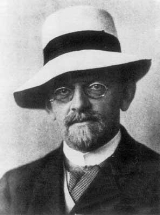
David Hilbert (ˈdaːvɪt ˈhɪlbɐt; January 23, 1862 –
February 14, 1943) was a
GermanGermany , officially the Federal Republic of Germany , is a federal parliamentary republic in Europe. The country consists of 16 states while the capital and largest city is Berlin. Germany covers an area of 357,021 km2 and has a largely temperate seasonal climate...
mathematicianA mathematician is a person whose primary area of study is the field of mathematics. Mathematicians are concerned with quantity, structure, space, and change....
. He is recognized as one of the most influential and universal mathematicians of the 19th and early 20th centuries. Hilbert discovered and developed a broad range of fundamental ideas in many areas, including
invariant theoryInvariant theory is a branch of abstract algebra dealing with actions of groups on algebraic varieties from the point of view of their effect on functions...
and the
axiomatization of geometryHilbert's axioms are a set of 20 assumptions proposed by David Hilbert in 1899 in his book Grundlagen der Geometrie , as the foundation for a modern treatment of Euclidean geometry...
. He also formulated the theory of
Hilbert spaceThe mathematical concept of a Hilbert space, named after David Hilbert, generalizes the notion of Euclidean space. It extends the methods of vector algebra and calculus from the two-dimensional Euclidean plane and three-dimensional space to spaces with any finite or infinite number of dimensions...
s, one of the foundations of
functional analysisFunctional analysis is a branch of mathematical analysis, the core of which is formed by the study of vector spaces endowed with some kind of limit-related structure and the linear operators acting upon these spaces and respecting these structures in a suitable sense...
.
Hilbert adopted and warmly defended
Georg CantorGeorg Ferdinand Ludwig Philipp Cantor was a German mathematician, best known as the inventor of set theory, which has become a fundamental theory in mathematics. Cantor established the importance of one-to-one correspondence between the members of two sets, defined infinite and well-ordered sets,...
's set theory and
transfinite numberTransfinite numbers are numbers that are "infinite" in the sense that they are larger than all finite numbers, yet not necessarily absolutely infinite. The term transfinite was coined by Georg Cantor, who wished to avoid some of the implications of the word infinite in connection with these...
s. A famous example of his leadership in
mathematicsMathematics is the study of quantity, space, structure, and change. Mathematicians seek out patterns and formulate new conjectures. Mathematicians resolve the truth or falsity of conjectures by mathematical proofs, which are arguments sufficient to convince other mathematicians of their validity...
is his 1900 presentation of a
collection of problemsHilbert's problems form a list of twenty-three problems in mathematics published by German mathematician David Hilbert in 1900. The problems were all unsolved at the time, and several of them were very influential for 20th century mathematics...
that set the course for much of the mathematical research of the 20th century.
Hilbert and his students contributed significantly to establishing rigor and developed important tools used in modern mathematical physics. Hilbert is known as one of the founders of
proof theoryProof theory is a branch of mathematical logic that represents proofs as formal mathematical objects, facilitating their analysis by mathematical techniques. Proofs are typically presented as inductively-defined data structures such as plain lists, boxed lists, or trees, which are constructed...
and
mathematical logicMathematical logic is a subfield of mathematics with close connections to foundations of mathematics, theoretical computer science and philosophical logic. The field includes both the mathematical study of logic and the applications of formal logic to other areas of mathematics...
, as well as for being among the first to distinguish between mathematics and
metamathematicsMetamathematics is the study of mathematics itself using mathematical methods. This study produces metatheories, which are mathematical theories about other mathematical theories...
.
Life
Hilbert, the first of two children of Otto and Maria Therese (Erdtmann) Hilbert, was born in the
Province of PrussiaThe Province of Prussia was a province of the Kingdom of Prussia from 1829-1878 created out of the provinces of East Prussia and West Prussia....
- either in
KönigsbergKönigsberg was the capital of East Prussia from the Late Middle Ages until 1945 as well as the northernmost and easternmost German city with 286,666 inhabitants . Due to the multicultural society in and around the city, there are several local names for it...
(according to Hilbert's own statement) or in Wehlau (known since 1946 as
ZnamenskZnamensk is a settlement in Kaliningrad Oblast, Russia. It is located on the right bank of the Pregolya River at its confluence with the Lava River some 50 km east of Kaliningrad...
) near Königsberg where his father worked at the time of his birth. In the fall of 1872, he entered the Friedrichskolleg
GymnasiumA gymnasium is a type of school providing secondary education in some parts of Europe, comparable to English grammar schools or sixth form colleges and U.S. college preparatory high schools. The word γυμνάσιον was used in Ancient Greece, meaning a locality for both physical and intellectual...
(
Collegium fridericianum, the same school that
Immanuel KantImmanuel Kant was a German philosopher from Königsberg , researching, lecturing and writing on philosophy and anthropology at the end of the 18th Century Enlightenment....
had attended 140 years before), but after an unhappy duration he transferred (fall 1879) to and graduated from (spring 1880) the more science-oriented Wilhelm Gymnasium. Upon graduation he enrolled (autumn 1880) at the
University of KönigsbergThe University of Königsberg was the university of Königsberg in East Prussia. It was founded in 1544 as second Protestant academy by Duke Albert of Prussia, and was commonly known as the Albertina....
, the "Albertina". In the spring of 1882,
Hermann MinkowskiHermann Minkowski was a German mathematician of Ashkenazi Jewish descent, who created and developed the geometry of numbers and who used geometrical methods to solve difficult problems in number theory, mathematical physics, and the theory of relativity.- Life and work :Hermann Minkowski was born...
(two years younger than Hilbert and also a native of Königsberg but so talented he had graduated early from his gymnasium and gone to Berlin for three semesters), returned to Königsberg and entered the university. "Hilbert knew his luck when he saw it. In spite of his father's disapproval, he soon became friends with the shy, gifted Minkowski." In 1884,
Adolf HurwitzAdolf Hurwitz was a German mathematician.-Early life:He was born to a Jewish family in Hildesheim, former Kingdom of Hannover, now Lower Saxony, Germany, and died in Zürich, in Switzerland. Family records indicate that he had siblings and cousins, but their names have yet to be confirmed...
arrived from Göttingen as an
ExtraordinariusA professor is a scholarly teacher; the precise meaning of the term varies by country. Literally, professor derives from Latin as a "person who professes" being usually an expert in arts or sciences; a teacher of high rank...
, i.e., an associate professor. An intense and fruitful scientific exchange between the three began and especially Minkowski and Hilbert would exercise a reciprocal influence over each other at various times in their scientific careers. Hilbert obtained his doctorate in 1885, with a dissertation, written under
Ferdinand von LindemannCarl Louis Ferdinand von Lindemann was a German mathematician, noted for his proof, published in 1882, that π is a transcendental number, i.e., it is not a root of any polynomial with rational coefficients....
, titled
Über invariante Eigenschaften spezieller binärer Formen, insbesondere der Kugelfunktionen ("On the invariant properties of special binary forms, in particular the spherical harmonic functions").
Hilbert remained at the University of Königsberg as a professor from 1886 to 1895. In 1892, Hilbert married Käthe Jerosch (1864–1945), "the daughter of a Konigsberg merchant, an outspoken young lady with an independence of mind that matched his own". While at Königsberg they had their one child Franz Hilbert (1893–1969). In 1895, as a result of intervention on his behalf by
Felix KleinChristian Felix Klein was a German mathematician, known for his work in group theory, function theory, non-Euclidean geometry, and on the connections between geometry and group theory...
he obtained the position of Chairman of Mathematics at the University of Göttingen, at that time the best research center for mathematics in the world and where he remained for the rest of his life.
His son Franz would suffer his entire life from an (undiagnosed) mental illness, his inferior intellect a terrible disappointment to his father and this tragedy a matter of distress to the mathematicians and students at Göttingen. Sadly, Minkowski — Hilbert's "best and truest friend" — would die prematurely of a ruptured appendix in 1909.
The Göttingen school
Among the students of Hilbert were:
Hermann WeylHermann Klaus Hugo Weyl was a German mathematician and theoretical physicist. Although much of his working life was spent in Zürich, Switzerland and then Princeton, he is associated with the University of Göttingen tradition of mathematics, represented by David Hilbert and Hermann Minkowski.His...
, chess champion
Emanuel LaskerEmanuel Lasker was a German chess player, mathematician, and philosopher who was World Chess Champion for 27 years...
,
Ernst ZermeloErnst Friedrich Ferdinand Zermelo was a German mathematician, whose work has major implications for the foundations of mathematics and hence on philosophy. He is known for his role in developing Zermelo–Fraenkel axiomatic set theory and his proof of the well-ordering theorem.-Life:He graduated...
, and
Carl Gustav HempelCarl Gustav "Peter" Hempel was a philosopher of science and a major figure in 20th-century logical empiricism...
.
John von NeumannJohn von Neumann was a Hungarian-American mathematician and polymath who made major contributions to a vast number of fields, including set theory, functional analysis, quantum mechanics, ergodic theory, geometry, fluid dynamics, economics and game theory, computer science, numerical analysis,...
was his assistant. At the University of Göttingen, Hilbert was surrounded by a social circle of some of the most important mathematicians of the 20th century, such as
Emmy NoetherAmalie Emmy Noether was an influential German mathematician known for her groundbreaking contributions to abstract algebra and theoretical physics. Described by David Hilbert, Albert Einstein and others as the most important woman in the history of mathematics, she revolutionized the theories of...
and
Alonzo ChurchAlonzo Church was an American mathematician and logician who made major contributions to mathematical logic and the foundations of theoretical computer science. He is best known for the lambda calculus, Church–Turing thesis, Frege–Church ontology, and the Church–Rosser theorem.-Life:Alonzo Church...
.
Among his 69 Ph.D. students in Göttingen were many who later became famous mathematicians, including (with date of thesis):
Otto BlumenthalLudwig Otto Blumenthal was a German mathematician and professor at RWTH Aachen University. He was born in Frankfurt, Prussia...
(1898),
Felix BernsteinFelix Bernstein was a German Jewish mathematician known for developing a theorem of the equivalence of sets in 1897, and less well known for demonstrating the correct blood group inheritance pattern of multiple alleles at one locus in 1924 through statistical analysis...
(1901),
Hermann WeylHermann Klaus Hugo Weyl was a German mathematician and theoretical physicist. Although much of his working life was spent in Zürich, Switzerland and then Princeton, he is associated with the University of Göttingen tradition of mathematics, represented by David Hilbert and Hermann Minkowski.His...
(1908),
Richard CourantRichard Courant was a German American mathematician.- Life :Courant was born in Lublinitz in the German Empire's Prussian Province of Silesia. During his youth, his parents had to move quite often, to Glatz, Breslau, and in 1905 to Berlin. He stayed in Breslau and entered the university there...
(1910),
Erich HeckeErich Hecke was a German mathematician. He obtained his doctorate in Göttingen under the supervision of David Hilbert. Kurt Reidemeister and Heinrich Behnke were among his students....
(1910),
Hugo SteinhausWładysław Hugo Dionizy Steinhaus was a Polish mathematician and educator. Steinhaus obtained his PhD under David Hilbert at Göttingen University in 1911 and later became a professor at the University of Lwów, where he helped establish what later became known as the Lwów School of Mathematics...
(1911), and
Wilhelm AckermannWilhelm Friedrich Ackermann was a German mathematician best known for the Ackermann function, an important example in the theory of computation....
(1925). Between 1902 and 1939 Hilbert was editor of the
Mathematische AnnalenMathematische Annalen is a German mathematical research journal founded in 1868 by Alfred Clebsch and Carl Neumann...
, the leading mathematical journal of the time.
Later years
Hilbert lived to see the
NazisNazism, the common short form name of National Socialism was the ideology and practice of the Nazi Party and of Nazi Germany...
purge many of the prominent faculty members at University of Göttingen in 1933. Those forced out included
Hermann WeylHermann Klaus Hugo Weyl was a German mathematician and theoretical physicist. Although much of his working life was spent in Zürich, Switzerland and then Princeton, he is associated with the University of Göttingen tradition of mathematics, represented by David Hilbert and Hermann Minkowski.His...
(who had taken Hilbert's chair when he retired in 1930),
Emmy NoetherAmalie Emmy Noether was an influential German mathematician known for her groundbreaking contributions to abstract algebra and theoretical physics. Described by David Hilbert, Albert Einstein and others as the most important woman in the history of mathematics, she revolutionized the theories of...
and
Edmund LandauEdmund Georg Hermann Landau was a German Jewish mathematician who worked in the fields of number theory and complex analysis.-Biography:...
. One who had to leave Germany,
Paul BernaysPaul Isaac Bernays was a Swiss mathematician, who made significant contributions to mathematical logic, axiomatic set theory, and the philosophy of mathematics. He was an assistant to, and close collaborator of, David Hilbert.-Biography:Bernays spent his childhood in Berlin. Bernays attended the...
, had collaborated with Hilbert in
mathematical logicMathematical logic is a subfield of mathematics with close connections to foundations of mathematics, theoretical computer science and philosophical logic. The field includes both the mathematical study of logic and the applications of formal logic to other areas of mathematics...
, and co-authored with him the important book
Grundlagen der MathematikGrundlagen der Mathematik is a 2-volume work by David Hilbert and Paul Bernays describing Hilbert's approach to the foundations of mathematics...
(which eventually appeared in two volumes, in 1934 and 1939). This was a sequel to the Hilbert-
AckermannWilhelm Friedrich Ackermann was a German mathematician best known for the Ackermann function, an important example in the theory of computation....
book
Principles of Mathematical Logic from 1928.
About a year later, Hilbert attended a banquet and was seated next to the new Minister of Education,
Bernhard RustDr. Bernhard Rust was Minister of Science, Education and National Culture in Nazi Germany. A combination of school administrator and zealous Nazi, he issued decrees, often bizarre, at every level of the German educational system to immerse German youth in the National Socialist philosophy...
. Rust asked, "How is mathematics in Göttingen now that it has been freed of the Jewish influence?" Hilbert replied, "Mathematics in Göttingen? There is really none any more."
By the time Hilbert died in 1943, the Nazis had nearly completely restaffed the university, inasmuch as many of the former faculty had either been Jewish or married to Jews. Hilbert's funeral was attended by fewer than a dozen people, only two of whom were fellow academics, among them
Arnold SommerfeldArnold Johannes Wilhelm Sommerfeld was a German theoretical physicist who pioneered developments in atomic and quantum physics, and also educated and groomed a large number of students for the new era of theoretical physics...
, a theoretical physicist and also a native of Königsberg. News of his death only became known to the wider world six months after he had died.
The epitaph on his tombstone in Göttingen is the famous lines he had spoken at the conclusion of his retirement address to the Society of German Scientists and Physicians in the fall of 1930:
- Wir müssen wissen.
- Wir werden wissen.
In English:
- We must know.
- We will know.
The day before Hilbert pronounced these phrases at the 1930 annual meeting of the Society of German Scientists and Physicians,
Kurt GödelKurt Friedrich Gödel was an Austrian logician, mathematician and philosopher. Later in his life he emigrated to the United States to escape the effects of World War II. One of the most significant logicians of all time, Gödel made an immense impact upon scientific and philosophical thinking in the...
—in a roundtable discussion during the Conference on Epistemology held jointly with the Society meetings—tentatively announced the first expression of his incompleteness theorem.
Hilbert Solves Gordan's Problem
Hilbert's first work on invariant functions led him to the demonstration in 1888 of his famous
finiteness theorem. Twenty years earlier, Paul Gordan had demonstrated the
theoremIn mathematics, a theorem is a statement that has been proven on the basis of previously established statements, such as other theorems, and previously accepted statements, such as axioms...
of the finiteness of generators for binary forms using a complex computational approach. Attempts to generalize his method to functions with more than two variables failed because of the enormous difficulty of the calculations involved. In order to solve what had become known in some circles as
Gordan's Problem, Hilbert realized that it was necessary to take a completely different path. As a result, he demonstrated
Hilbert's basis theoremIn mathematics, specifically commutative algebra, Hilbert's basis theorem states that every ideal in the ring of multivariate polynomials over a Noetherian ring is finitely generated. This can be translated into algebraic geometry as follows: every algebraic set over a field can be described as the...
: showing the existence of a finite set of generators, for the invariants of quantics in any number of variables, but in an abstract form. That is, while demonstrating the existence of such a set, it was not a
constructive proofIn mathematics, a constructive proof is a method of proof that demonstrates the existence of a mathematical object with certain properties by creating or providing a method for creating such an object...
— it did not display "an object" — but rather, it was an existence proof and relied on use of the
Law of Excluded MiddleIn logic, the law of excluded middle is the third of the so-called three classic laws of thought. It states that for any proposition, either that proposition is true, or its negation is....
in an infinite extension.
Hilbert sent his results to the
Mathematische AnnalenMathematische Annalen is a German mathematical research journal founded in 1868 by Alfred Clebsch and Carl Neumann...
. Gordan, the house expert on the theory of invariants for the
Mathematische Annalen, was not able to appreciate the revolutionary nature of Hilbert's theorem and rejected the article, criticizing the exposition because it was insufficiently comprehensive. His comment was:
- Das ist nicht Mathematik. Das ist Theologie.
- (This is not Mathematics. This is Theology.)
Klein, on the other hand, recognized the importance of the work, and guaranteed that it would be published without any alterations. Encouraged by Klein and by the comments of Gordan, Hilbert in a second article extended his method, providing estimations on the maximum degree of the minimum set of generators, and he sent it once more to the
Annalen. After having read the manuscript, Klein wrote to him, saying:
- Without doubt this is the most important work on general algebra that the Annalen has ever published.
Later, after the usefulness of Hilbert's method was universally recognized, Gordan himself would say:
- I have convinced myself that even theology has its merits.
For all his successes, the nature of his proof stirred up more trouble than Hilbert could have imagined at the time. Although Kronecker had conceded, Hilbert would later respond to others' similar criticisms that "many different constructions are subsumed under one fundamental idea" — in other words (to quote Reid): "Through a proof of existence, Hilbert had been able to obtain a construction"; "the proof" (i.e. the symbols on the page)
was "the object". Not all were convinced. While Kronecker would die soon after, his
constructivistIn the philosophy of mathematics, constructivism asserts that it is necessary to find a mathematical object to prove that it exists. When one assumes that an object does not exist and derives a contradiction from that assumption, one still has not found the object and therefore not proved its...
philosophy would continue with the young
BrouwerLuitzen Egbertus Jan Brouwer FRS , usually cited as L. E. J. Brouwer but known to his friends as Bertus, was a Dutch mathematician and philosopher, a graduate of the University of Amsterdam, who worked in topology, set theory, measure theory and complex analysis.-Biography:Early in his career,...
and his developing intuitionist "school", much to Hilbert's torment in his later years. Indeed Hilbert would lose his "gifted pupil" Weyl to intuitionism — "Hilbert was disturbed by his former student's fascination with the ideas of Brouwer, which aroused in Hilbert the memory of Kronecker". Brouwer the intuitionist in particular opposed the use of the Law of Excluded Middle over infinite sets (as Hilbert had used it). Hilbert would respond:
- Taking the Principle of the Excluded Middle from the mathematician ... is the same as ... prohibiting the boxer the use of his fists.
Axiomatization of geometry
The text
Grundlagen der Geometrie (tr.:
Foundations of Geometry) published by Hilbert in 1899 proposes a formal set, the
Hilbert's axiomsHilbert's axioms are a set of 20 assumptions proposed by David Hilbert in 1899 in his book Grundlagen der Geometrie , as the foundation for a modern treatment of Euclidean geometry...
, substituting the traditional
axioms of EuclidEuclid's Elements is a mathematical and geometric treatise consisting of 13 books written by the Greek mathematician Euclid in Alexandria c. 300 BC. It is a collection of definitions, postulates , propositions , and mathematical proofs of the propositions...
. They avoid weaknesses identified in those of
EuclidEuclid , fl. 300 BC, also known as Euclid of Alexandria, was a Greek mathematician, often referred to as the "Father of Geometry". He was active in Alexandria during the reign of Ptolemy I...
, whose works at the time were still used textbook-fashion. Independently and contemporaneously, a 19-year-old American student named
Robert Lee MooreRobert Lee Moore was an American mathematician, known for his work in general topology and the Moore method of teaching university mathematics.-Life:...
published an equivalent set of axioms. Some of the axioms coincide, while some of the axioms in Moore's system are theorems in Hilbert's and vice-versa.
Hilbert's approach signaled the shift to the modern axiomatic method. In this, Hilbert was anticipated by Peano's work from 1889. Axioms are not taken as self-evident truths. Geometry may treat
things, about which we have powerful intuitions, but it is not necessary to assign any explicit meaning to the undefined concepts. The elements, such as
pointIn geometry, topology and related branches of mathematics a spatial point is a primitive notion upon which other concepts may be defined. In geometry, points are zero-dimensional; i.e., they do not have volume, area, length, or any other higher-dimensional analogue. In branches of mathematics...
,
lineThe notion of line or straight line was introduced by the ancient mathematicians to represent straight objects with negligible width and depth. Lines are an idealization of such objects...
, plane, and others, could be substituted, as Hilbert says, by tables, chairs, glasses of beer and other such objects. It is their defined relationships that are discussed.
Hilbert first enumerates the undefined concepts: point, line, plane, lying on (a relation between points and planes), betweenness, congruence of pairs of points, and congruence of
angleIn geometry, an angle is the figure formed by two rays sharing a common endpoint, called the vertex of the angle.Angles are usually presumed to be in a Euclidean plane with the circle taken for standard with regard to direction. In fact, an angle is frequently viewed as a measure of an circular arc...
s. The axioms unify both the
plane geometryEuclidean geometry is a mathematical system attributed to the Alexandrian Greek mathematician Euclid, which he described in his textbook on geometry: the Elements. Euclid's method consists in assuming a small set of intuitively appealing axioms, and deducing many other propositions from these...
and
solid geometryIn mathematics, solid geometry was the traditional name for the geometry of three-dimensional Euclidean space — for practical purposes the kind of space we live in. It was developed following the development of plane geometry...
of Euclid in a single system.
The 23 Problems
Hilbert put forth a most influential list of 23 unsolved problems at the
International Congress of MathematiciansThe International Congress of Mathematicians is the largest conference for the topic of mathematics. It meets once every four years, hosted by the International Mathematical Union ....
in
ParisParis is the capital and largest city in France, situated on the river Seine, in northern France, at the heart of the Île-de-France region...
in 1900. This is generally reckoned the most successful and deeply considered compilation of open problems ever to be produced by an individual mathematician.
After re-working the foundations of classical geometry, Hilbert could have extrapolated to the rest of mathematics. His approach differed, however, from the later 'foundationalist' Russell-Whitehead or 'encyclopedist'
Nicolas BourbakiNicolas Bourbaki is the collective pseudonym under which a group of 20th-century mathematicians wrote a series of books presenting an exposition of modern advanced mathematics, beginning in 1935. With the goal of founding all of mathematics on set theory, the group strove for rigour and generality...
, and from his contemporary
Giuseppe PeanoGiuseppe Peano was an Italian mathematician, whose work was of philosophical value. The author of over 200 books and papers, he was a founder of mathematical logic and set theory, to which he contributed much notation. The standard axiomatization of the natural numbers is named the Peano axioms in...
. The mathematical community as a whole could enlist in problems, which he had identified as crucial aspects of the areas of mathematics he took to be key.
The problem set was launched as a talk "The Problems of Mathematics" presented during the course of the Second International Congress of Mathematicians held in Paris. Here is the introduction of the speech that Hilbert gave:
- Who among us would not be happy to lift the veil behind which is hidden the future; to gaze at the coming developments of our science and at the secrets of its development in the centuries to come? What will be the ends toward which the spirit of future generations of mathematicians will tend? What methods, what new facts will the new century reveal in the vast and rich field of mathematical thought?
He presented fewer than half the problems at the Congress, which were published in the acts of the Congress. In a subsequent publication, he extended the panorama, and arrived at the formulation of the now-canonical 23 Problems of Hilbert. The full text is important, since the exegesis of the questions still can be a matter of inevitable debate, whenever it is asked how many have been solved.
Some of these were solved within a short time. Others have been discussed throughout the 20th century, with a few now taken to be unsuitably open-ended to come to closure. Some even continue to this day to remain a challenge for mathematicians.
Formalism
In an account that had become standard by the mid-century, Hilbert's problem set was also a kind of manifesto, that opened the way for the development of the
formalistIn foundations of mathematics, philosophy of mathematics, and philosophy of logic, formalism is a theory that holds that statements of mathematics and logic can be thought of as statements about the consequences of certain string manipulation rules....
school, one of three major schools of mathematics of the 20th century. According to the formalist, mathematics is manipulation of symbols according to agreed upon formal rules. It is therefore an autonomous activity of thought. There is, however, room to doubt whether Hilbert's own views were simplistically formalist in this sense.
Hilbert's program
In 1920 he proposed explicitly a research project (in
metamathematicsMetamathematics is the study of mathematics itself using mathematical methods. This study produces metatheories, which are mathematical theories about other mathematical theories...
, as it was then termed) that became known as
Hilbert's programIn mathematics, Hilbert's program, formulated by German mathematician David Hilbert, was a proposed solution to the foundational crisis of mathematics, when early attempts to clarify the foundations of mathematics were found to suffer from paradoxes and inconsistencies...
. He wanted
mathematicsMathematics is the study of quantity, space, structure, and change. Mathematicians seek out patterns and formulate new conjectures. Mathematicians resolve the truth or falsity of conjectures by mathematical proofs, which are arguments sufficient to convince other mathematicians of their validity...
to be formulated on a solid and complete logical foundation. He believed that in principle this could be done, by showing that:
- all of mathematics follows from a correctly chosen finite system of axiom
In traditional logic, an axiom or postulate is a proposition that is not proven or demonstrated but considered either to be self-evident or to define and delimit the realm of analysis. In other words, an axiom is a logical statement that is assumed to be true...
s; and
- that some such axiom system is provably consistent through some means such as the epsilon calculus
Hilbert's epsilon calculus is an extension of a formal language by the epsilon operator, where the epsilon operator substitutes for quantifiers in that language as a method leading to a proof of consistency for the extended formal language...
.
He seems to have had both technical and philosophical reasons for formulating this proposal. It affirmed his dislike of what had become known as the
ignorabimusThe Latin maxim ignoramus et ignorabimus, meaning "we do not know and will not know", stood for a position on the limits of scientific knowledge, in the thought of the nineteenth century...
, still an active issue in his time in German thought, and traced back in that formulation to
Emil du Bois-ReymondEmil du Bois-Reymond was a German physician and physiologist, the discoverer of nerve action potential, and the father of experimental electrophysiology.-Life:...
.
This program is still recognizable in the most popular
philosophy of mathematicsThe philosophy of mathematics is the branch of philosophy that studies the philosophical assumptions, foundations, and implications of mathematics. The aim of the philosophy of mathematics is to provide an account of the nature and methodology of mathematics and to understand the place of...
, where it is usually called
formalism. For example, the Bourbaki group adopted a watered-down and selective version of it as adequate to the requirements of their twin projects of (a) writing encyclopedic foundational works, and (b) supporting the axiomatic method as a research tool. This approach has been successful and influential in relation with Hilbert's work in algebra and functional analysis, but has failed to engage in the same way with his interests in physics and logic.
Hilbert wrote in 1919:
- We are not speaking here of arbitrariness in any sense. Mathematics is not like a game whose tasks are determined by arbitrarily stipulated rules. Rather, it is a conceptual system possessing internal necessity that can only be so and by no means otherwise.
Hilbert published his views on the foundations of mathematics in the 2-volume work
Grundlagen der MathematikGrundlagen der Mathematik is a 2-volume work by David Hilbert and Paul Bernays describing Hilbert's approach to the foundations of mathematics...
.
Gödel's work
Hilbert and the mathematicians who worked with him in his enterprise were committed to the project. His attempt to support axiomatized mathematics with definitive principles, which could banish theoretical uncertainties, was however to end in failure.
GödelKurt Friedrich Gödel was an Austrian logician, mathematician and philosopher. Later in his life he emigrated to the United States to escape the effects of World War II. One of the most significant logicians of all time, Gödel made an immense impact upon scientific and philosophical thinking in the...
demonstrated that any non-contradictory formal system, which was comprehensive enough to include at least arithmetic, cannot demonstrate its completeness by way of its own axioms. In 1931 his incompleteness theorem showed that Hilbert's grand plan was impossible as stated. The second point cannot in any reasonable way be combined with the first point, as long as the axiom system is genuinely
finitaryIn mathematics or logic, a finitary operation is one, like those of arithmetic, that takes a finite number of input values to produce an output. An operation such as taking an integral of a function, in calculus, is defined in such a way as to depend on all the values of the function , and is so...
.
Nevertheless, the subsequent achievements of
proof theoryProof theory is a branch of mathematical logic that represents proofs as formal mathematical objects, facilitating their analysis by mathematical techniques. Proofs are typically presented as inductively-defined data structures such as plain lists, boxed lists, or trees, which are constructed...
at the very least
clarified consistency as it relates to theories of central concern to mathematicians. Hilbert's work had started logic on this course of clarification; the need to understand Gödel's work then led to the development of
recursion theoryComputability theory, also called recursion theory, is a branch of mathematical logic that originated in the 1930s with the study of computable functions and Turing degrees. The field has grown to include the study of generalized computability and definability...
and then
mathematical logicMathematical logic is a subfield of mathematics with close connections to foundations of mathematics, theoretical computer science and philosophical logic. The field includes both the mathematical study of logic and the applications of formal logic to other areas of mathematics...
as an autonomous discipline in the 1930s. The basis for later
theoretical computer scienceTheoretical computer science is a division or subset of general computer science and mathematics which focuses on more abstract or mathematical aspects of computing....
, in
Alonzo ChurchAlonzo Church was an American mathematician and logician who made major contributions to mathematical logic and the foundations of theoretical computer science. He is best known for the lambda calculus, Church–Turing thesis, Frege–Church ontology, and the Church–Rosser theorem.-Life:Alonzo Church...
and
Alan TuringAlan Mathison Turing, OBE, FRS , was an English mathematician, logician, cryptanalyst, and computer scientist. He was highly influential in the development of computer science, providing a formalisation of the concepts of "algorithm" and "computation" with the Turing machine, which played a...
also grew directly out of this 'debate'.
Functional analysis
Around 1909, Hilbert dedicated himself to the study of differential and
integral equationIn mathematics, an integral equation is an equation in which an unknown function appears under an integral sign. There is a close connection between differential and integral equations, and some problems may be formulated either way...
s; his work had direct consequences for important parts of modern functional analysis. In order to carry out these studies, Hilbert introduced the concept of an infinite dimensional
Euclidean spaceIn mathematics, Euclidean space is the Euclidean plane and three-dimensional space of Euclidean geometry, as well as the generalizations of these notions to higher dimensions...
, later called
Hilbert spaceThe mathematical concept of a Hilbert space, named after David Hilbert, generalizes the notion of Euclidean space. It extends the methods of vector algebra and calculus from the two-dimensional Euclidean plane and three-dimensional space to spaces with any finite or infinite number of dimensions...
. His work in this part of analysis provided the basis for important contributions to the mathematics of physics in the next two decades, though from an unanticipated direction.
Later on,
Stefan BanachStefan Banach was a Polish mathematician who worked in interwar Poland and in Soviet Ukraine. He is generally considered to have been one of the 20th century's most important and influential mathematicians....
amplified the concept, defining Banach spaces. Hilbert spaces are an important class of objects in the area of
functional analysisFunctional analysis is a branch of mathematical analysis, the core of which is formed by the study of vector spaces endowed with some kind of limit-related structure and the linear operators acting upon these spaces and respecting these structures in a suitable sense...
, particularly of the
spectral theoryIn mathematics, spectral theory is an inclusive term for theories extending the eigenvector and eigenvalue theory of a single square matrix to a much broader theory of the structure of operators in a variety of mathematical spaces. It is a result of studies of linear algebra and the solutions of...
of self-adjoint linear operators, that grew up around it during the 20th century.
Physics
Until 1912, Hilbert was almost exclusively a "pure" mathematician. When planning a visit from Bonn, where he was immersed in studying physics, his fellow mathematician and friend
Hermann MinkowskiHermann Minkowski was a German mathematician of Ashkenazi Jewish descent, who created and developed the geometry of numbers and who used geometrical methods to solve difficult problems in number theory, mathematical physics, and the theory of relativity.- Life and work :Hermann Minkowski was born...
joked he had to spend 10 days in quarantine before being able to visit Hilbert. In fact, Minkowski seems responsible for most of Hilbert's physics investigations prior to 1912, including their joint seminar in the subject in 1905.
In 1912, three years after his friend's death, Hilbert turned his focus to the subject almost exclusively. He arranged to have a "physics tutor" for himself. He started studying
kinetic gas theoryThe kinetic theory of gases describes a gas as a large number of small particles , all of which are in constant, random motion. The rapidly moving particles constantly collide with each other and with the walls of the container...
and moved on to elementary
radiationIn physics, radiation is a process in which energetic particles or energetic waves travel through a medium or space. There are two distinct types of radiation; ionizing and non-ionizing...
theory and the molecular theory of matter. Even after the war started in 1914, he continued seminars and classes where the works of
Albert EinsteinAlbert Einstein was a German-born theoretical physicist who developed the theory of general relativity, effecting a revolution in physics. For this achievement, Einstein is often regarded as the father of modern physics and one of the most prolific intellects in human history...
and others were followed closely.
By 1907 Einstein had framed the fundamentals of the theory of gravity, but then struggled for nearly 8 years with a confounding problem of putting the theory into final form. By early summer 1915, Hilbert's interest in physics had focused on
general relativityGeneral relativity or the general theory of relativity is the geometric theory of gravitation published by Albert Einstein in 1916. It is the current description of gravitation in modern physics...
, and he invited Einstein to Göttingen to deliver a week of lectures on the subject. Einstein received an enthusiastic reception at Göttingen. Over the summer Einstein learned that Hilbert was also working on the field equations and redoubled his own efforts. During November 1915 Einstein published several papers culminating in "The Field Equations of Gravitation" (see
Einstein field equationsThe Einstein field equations or Einstein's equations are a set of ten equations in Albert Einstein's general theory of relativity which describe the fundamental interaction of gravitation as a result of spacetime being curved by matter and energy...
). Nearly simultaneously David Hilbert published "The Foundations of Physics", an axiomatic derivation of the field equations (see Einstein–Hilbert action). Hilbert fully credited Einstein as the originator of the theory, and no public priority dispute concerning the field equations ever arose between the two men during their lives (see more at priority).
Additionally, Hilbert's work anticipated and assisted several advances in the
mathematical formulation of quantum mechanicsThe mathematical formulations of quantum mechanics are those mathematical formalisms that permit a rigorous description of quantum mechanics. Such are distinguished from mathematical formalisms for theories developed prior to the early 1900s by the use of abstract mathematical structures, such as...
. His work was a key aspect of
Hermann WeylHermann Klaus Hugo Weyl was a German mathematician and theoretical physicist. Although much of his working life was spent in Zürich, Switzerland and then Princeton, he is associated with the University of Göttingen tradition of mathematics, represented by David Hilbert and Hermann Minkowski.His...
and
John von NeumannJohn von Neumann was a Hungarian-American mathematician and polymath who made major contributions to a vast number of fields, including set theory, functional analysis, quantum mechanics, ergodic theory, geometry, fluid dynamics, economics and game theory, computer science, numerical analysis,...
's work on the mathematical equivalence of
Werner HeisenbergWerner Karl Heisenberg was a German theoretical physicist who made foundational contributions to quantum mechanics and is best known for asserting the uncertainty principle of quantum theory...
's
matrix mechanicsMatrix mechanics is a formulation of quantum mechanics created by Werner Heisenberg, Max Born, and Pascual Jordan in 1925.Matrix mechanics was the first conceptually autonomous and logically consistent formulation of quantum mechanics. It extended the Bohr Model by describing how the quantum jumps...
and
Erwin SchrödingerErwin Rudolf Josef Alexander Schrödinger was an Austrian physicist and theoretical biologist who was one of the fathers of quantum mechanics, and is famed for a number of important contributions to physics, especially the Schrödinger equation, for which he received the Nobel Prize in Physics in 1933...
's
wave equationThe Schrödinger equation was formulated in 1926 by Austrian physicist Erwin Schrödinger. Used in physics , it is an equation that describes how the quantum state of a physical system changes in time....
and his namesake
Hilbert spaceThe mathematical concept of a Hilbert space, named after David Hilbert, generalizes the notion of Euclidean space. It extends the methods of vector algebra and calculus from the two-dimensional Euclidean plane and three-dimensional space to spaces with any finite or infinite number of dimensions...
plays an important part in quantum theory. In 1926 von Neuman showed that if atomic states were understood as vectors in Hilbert space, then they would correspond with both Schrödinger's wave function theory and Heisenberg's matrices.
Throughout this immersion in physics, Hilbert worked on putting rigor into the mathematics of physics. While highly dependent on higher math, physicists tended to be "sloppy" with it. To a "pure" mathematician like Hilbert, this was both "ugly" and difficult to understand. As he began to understand physics and how physicists were using mathematics, he developed a coherent mathematical theory for what he found, most importantly in the area of integral equations. When his colleague
Richard CourantRichard Courant was a German American mathematician.- Life :Courant was born in Lublinitz in the German Empire's Prussian Province of Silesia. During his youth, his parents had to move quite often, to Glatz, Breslau, and in 1905 to Berlin. He stayed in Breslau and entered the university there...
wrote the now classic Methods of Mathematical Physics including some of Hilbert's ideas, he added Hilbert's name as author even though Hilbert had not directly contributed to the writing. Hilbert said "Physics is too hard for physicists", implying that the necessary mathematics was generally beyond them; the Courant-Hilbert book made it easier for them.
Number theory
Hilbert unified the field of
algebraic number theoryAlgebraic number theory is a major branch of number theory which studies algebraic structures related to algebraic integers. This is generally accomplished by considering a ring of algebraic integers O in an algebraic number field K/Q, and studying their algebraic properties such as factorization,...
with his 1897 treatise
ZahlberichtIn mathematics, the Zahlbericht was a report on algebraic number theory by .-History: and and the English introduction to give detailed discussions of the history and influence of Hilbert's Zahlbericht....
(literally "report on numbers"). He also resolved a significant number-theory
problem formulated by WaringIn number theory, Waring's problem, proposed in 1770 by Edward Waring, asks whether for every natural number k there exists an associated positive integer s such that every natural number is the sum of at most s kth powers of natural numbers...
in 1770. As with the finiteness theorem, he used an existence proof that shows there must be solutions for the problem rather than providing a mechanism to produce the answers. He then had little more to publish on the subject; but the emergence of
Hilbert modular forms in the dissertation of a student means his name is further attached to a major area.
He made a series of conjectures on
class field theoryIn mathematics, class field theory is a major branch of algebraic number theory that studies abelian extensions of number fields.Most of the central results in this area were proved in the period between 1900 and 1950...
. The concepts were highly influential, and his own contribution lives on in the names of the
Hilbert class fieldIn algebraic number theory, the Hilbert class field E of a number field K is the maximal abelian unramified extension of K. Its degree over K equals the class number of K and the Galois group of E over K is canonically isomorphic to the ideal class group of K using Frobenius elements for prime...
and of the
Hilbert symbolIn mathematics, given a local field K, such as the fields of reals or p-adic numbers, whose multiplicative group of non-zero elements is K×, the Hilbert symbol is an algebraic construction, extracted from reciprocity laws, and important in the formulation of local class field theory...
of local class field theory. Results on them were mostly proved by 1930, after work by
Teiji TakagiTeiji Takagi was a Japanese mathematician, best known for proving the Takagi existence theorem in class field theory....
.
Hilbert did not work in the central areas of
analytic number theoryIn mathematics, analytic number theory is a branch of number theory that uses methods from mathematical analysis to solve problems about the integers. It is often said to have begun with Dirichlet's introduction of Dirichlet L-functions to give the first proof of Dirichlet's theorem on arithmetic...
, but his name has become known for the Hilbert–Pólya conjecture, for reasons that are anecdotal.
Miscellaneous talks, essays, and contributions
- Hilbert's paradox of the Grand Hotel
Hilbert's paradox of the Grand Hotel is a mathematical veridical paradox about infinite sets presented by German mathematician David Hilbert .-The paradox:...
, a meditation on strange properties of the infinite, is often used in popular accounts of infinite cardinal numberIn mathematics, cardinal numbers, or cardinals for short, are a generalization of the natural numbers used to measure the cardinality of sets. The cardinality of a finite set is a natural number – the number of elements in the set. The transfinite cardinal numbers describe the sizes of infinite...
s.
- He was a Foreign member of the Royal Society.
- He received the second Bolyai Prize
The International Bolyai János Prize of Mathematics is an international prize for mathematicians founded by the Hungarian Academy of Sciences. The prize is awarded in every five years to mathematicians having published their monograph describing their own highly important new results in the past 10...
in 1910.
Quotes
- We are not speaking here of arbitrariness in any sense. Mathematics is not like a game whose tasks are determined by arbitrarily stipulated rules. Rather, it is a conceptual system possessing internal necessity that can only be so and by no means otherwise.
See also
- Brouwer–Hilbert controversy
In a foundational controversy in twentieth-century mathematics, L. E. J. Brouwer, a supporter of intuitionism, opposed David Hilbert, the founder of formalism.- Background :...
- Einstein–Hilbert action
- Einstein–Hilbert equations
The Einstein field equations or Einstein's equations are a set of ten equations in Albert Einstein's general theory of relativity which describe the fundamental interaction of gravitation as a result of spacetime being curved by matter and energy...
- Hilbert's axioms
Hilbert's axioms are a set of 20 assumptions proposed by David Hilbert in 1899 in his book Grundlagen der Geometrie , as the foundation for a modern treatment of Euclidean geometry...
- Hilbert–Burch theorem
In mathematics, the Hilbert–Burch theorem describes the structure of some free resolutions of a projective dimension 2 quotient of a local or graded ring. proved a version of this theorem for polynomial rings, and proved a more general version. Several other authors later rediscovered and...
- Hilbert class field
In algebraic number theory, the Hilbert class field E of a number field K is the maximal abelian unramified extension of K. Its degree over K equals the class number of K and the Galois group of E over K is canonically isomorphic to the ideal class group of K using Frobenius elements for prime...
- Hilbert C*-module
- Hilbert cube
In mathematics, the Hilbert cube, named after David Hilbert, is a topological space that provides an instructive example of some ideas in topology...
- Hilbert curve
A Hilbert curve is a continuous fractal space-filling curve first described by the German mathematician David Hilbert in 1891, as a variant of the space-filling curves discovered by Giuseppe Peano in 1890....
- Hilbert function
- Hilbert inequality
- Hilbert matrix
- Hilbert metric
In mathematics, the Hilbert metric, also known as the Hilbert projective metric, is an explicitly defined distance function on a bounded convex subset of the n-dimensional Euclidean space Rn...
- Hilbert modular form
- Hilbert number
- Hilbert polynomial
In commutative algebra, the Hilbert polynomial of a graded commutative algebra or graded module is a polynomial in one variable that measures the rate of growth of the dimensions of its homogeneous components...
- Hilbert's problems
Hilbert's problems form a list of twenty-three problems in mathematics published by German mathematician David Hilbert in 1900. The problems were all unsolved at the time, and several of them were very influential for 20th century mathematics...
- Hilbert's program
In mathematics, Hilbert's program, formulated by German mathematician David Hilbert, was a proposed solution to the foundational crisis of mathematics, when early attempts to clarify the foundations of mathematics were found to suffer from paradoxes and inconsistencies...
- Hilbert ring
- Hilbert–Poincaré series
In mathematics, and in particular in the field of algebra, a Hilbert–Poincaré series , named after David Hilbert and Henri Poincaré, is an adaptation of the notion of dimension to the context of graded algebraic structures...
- Hilbert space
The mathematical concept of a Hilbert space, named after David Hilbert, generalizes the notion of Euclidean space. It extends the methods of vector algebra and calculus from the two-dimensional Euclidean plane and three-dimensional space to spaces with any finite or infinite number of dimensions...
- Hilbert spectrum
The Hilbert spectrum , named after David Hilbert, is a statistical tool that can help in distinguishing among a mixture of moving signals. The spectrum itself is decomposed into its component sources using independent component analysis...
- Hilbert symbol
In mathematics, given a local field K, such as the fields of reals or p-adic numbers, whose multiplicative group of non-zero elements is K×, the Hilbert symbol is an algebraic construction, extracted from reciprocity laws, and important in the formulation of local class field theory...
- Hilbert transform
In mathematics and in signal processing, the Hilbert transform is a linear operator which takes a function, u, and produces a function, H, with the same domain. The Hilbert transform is named after David Hilbert, who first introduced the operator in order to solve a special case of the...
- Hilbert's Arithmetic of Ends
In mathematics, specifically in the area of hyperbolic geometry, Hilbert's arithmetic of ends is an algebraic construction introduced by German mathematician David Hilbert....
- Hilbert's basis theorem
In mathematics, specifically commutative algebra, Hilbert's basis theorem states that every ideal in the ring of multivariate polynomials over a Noetherian ring is finitely generated. This can be translated into algebraic geometry as follows: every algebraic set over a field can be described as the...
- Hilbert's constants
- Hilbert's irreducibility theorem
In number theory, Hilbert's irreducibility theorem, conceived by David Hilbert, states that every finite number of irreducible polynomials in a finite number of variables and having rational number coefficients admit a common specialization of a proper subset of the variables to rational numbers...
- Hilbert's Nullstellensatz
Hilbert's Nullstellensatz is a theorem which establishes a fundamental relationship between geometry and algebra. This relationship is the basis of algebraic geometry, an important branch of mathematics. It relates algebraic sets to ideals in polynomial rings over algebraically closed fields...
- Hilbert's paradox of the Grand Hotel
Hilbert's paradox of the Grand Hotel is a mathematical veridical paradox about infinite sets presented by German mathematician David Hilbert .-The paradox:...
- Hilbert's theorem (differential geometry)
- Hilbert's Theorem 90
In abstract algebra, Hilbert's Theorem 90 refers to an important result on cyclic extensions of fields that leads to Kummer theory...
- Hilbert's syzygy theorem
In mathematics, Hilbert's syzygy theorem is a result of commutative algebra, first proved by David Hilbert in connection with the syzygy problem of invariant theory. Roughly speaking, starting with relations between polynomial invariants, then relations between the relations, and so on, it...
- Hilbert-style deduction system
In logic, especially mathematical logic, a Hilbert system, sometimes called Hilbert calculus or Hilbert–Ackermann system, is a type of system of formal deduction attributed to Gottlob Frege and David Hilbert...
- Hilbert–Pólya conjecture
- Hilbert–Schmidt operator
- Hilbert–Smith conjecture
- Hilbert–Speiser theorem
- Principles of Mathematical Logic
- Relativity priority dispute
Albert Einstein presented the theories of Special Relativity and General Relativity in groundbreaking publications that either contained no formal references to previous literature, or referred only to a small number of his predecessors for fundamental results on which he based his theories, most...
Primary literature in English translation
- Ewald, William B., ed., 1996. From Kant to Hilbert: A Source Book in the Foundations of Mathematics, 2 vols. Oxford Uni. Press.
- 1918. "Axiomatic thought," 1115–14.
- 1922. "The new grounding of mathematics: First report," 1115–33.
- 1923. "The logical foundations of mathematics," 1134–47.
- 1930. "Logic and the knowledge of nature," 1157–65.
- 1931. "The grounding of elementary number theory," 1148–56.
- 1904. "On the foundations of logic and arithmetic," 129–38.
- 1925. "On the infinite," 367–92.
- 1927. "The foundations of mathematics," with comment by Weyl and Appendix by Bernays
Bernays is a surname and may refer to:* Isaac Bernays , a German rabbi, and father of:** Jakob Bernays , a German classical linguist** Michael Bernays , a German literature historian...
, 464–89.
- Jean van Heijenoort
Jean Louis Maxime van Heijenoort was a pioneer historian of mathematical logic. He was also a personal secretary to Leon Trotsky from 1932 to 1939, and from then until 1947, an American Trotskyist activist.-Life:Van Heijenoort was born in Creil, France...
, 1967. From Frege to Godel: A Source Book in Mathematical Logic, 1879–1931. Harvard Univ. Press. - an accessible set of lectures originally for the citizens of Göttingen.
Secondary literature
- Bottazzini Umberto, 2003. Il flauto di Hilbert. Storia della matematica. UTET, ISBN 88-7750-852-3
- Corry, L., Renn, J., and Stachel, J., 1997, "Belated Decision in the Hilbert-Einstein Priority Dispute," Science 278: nn-nn.
- Dawson, John W. Jr 1997. Logical Dilemmas: The Life and Work of Kurt Gödel. Wellesley MA: A. K. Peters. ISBN 1-56881-256-6.
- Folsing, Albrecht, 1998. Albert Einstein. Penguin.
- Grattan-Guinness, Ivor
Ivor Grattan-Guinness, born 23 June 1941, in Bakewell, in England, is a historian of mathematics and logic.He gained his Bachelor degree as a Mathematics Scholar at Wadham College, Oxford, got an M.Sc in Mathematical Logic and the Philosophy of Science at the London School of Economics in 1966...
, 2000. The Search for Mathematical Roots 1870-1940. Princeton Univ. Press.
- Gray, Jeremy, 2000. The Hilbert Challenge. ISBN 0-19-850651-1
- Mehra, Jagdish, 1974. Einstein, Hilbert, and the Theory of Gravitation. Reidel.
- Piergiorgio Odifreddi
Piergiorgio Odifreddi , is an Italian mathematician, logician and aficionado of the history of science, who is also extremely active as a popular science writer and essayist, especially in a perspective of philosophical atheism as a member of the Italian Union of Rationalist Atheists and...
, 2003. Divertimento Geometrico - Da Euclide ad Hilbert. Bollati Boringhieri, ISBN 88-339-5714-4. A clear exposition of the "errors" of Euclid and of the solutions presented in the Grundlagen der Geometrie, with reference to non-Euclidean geometryNon-Euclidean geometry is the term used to refer to two specific geometries which are, loosely speaking, obtained by negating the Euclidean parallel postulate, namely hyperbolic and elliptic geometry. This is one term which, for historical reasons, has a meaning in mathematics which is much...
.
- Reid, Constance, 1996. Hilbert, Springer, ISBN 0-387-94674-8. The biography in English.
- Sauer, Tilman, 1999, "The relativity of discovery: Hilbert's first note on the foundations of physics," Arch. Hist. Exact Sci. 53: 529-75.
- Sieg, Wilfried, and Ravaglia, Mark, 2005, "Grundlagen der Mathematik" in Grattan-Guinness, I.
Ivor Grattan-Guinness, born 23 June 1941, in Bakewell, in England, is a historian of mathematics and logic.He gained his Bachelor degree as a Mathematics Scholar at Wadham College, Oxford, got an M.Sc in Mathematical Logic and the Philosophy of Science at the London School of Economics in 1966...
, ed., Landmark Writings in Western Mathematics. ElsevierElsevier is a publishing company which publishes medical and scientific literature. It is a part of the Reed Elsevier group. Based in Amsterdam, the company has operations in the United Kingdom, USA and elsewhere....
: 981-99. (in English)
- Thorne, Kip
Kip Stephen Thorne is an American theoretical physicist, known for his prolific contributions in gravitation physics and astrophysics and for having trained a generation of scientists...
, 1995. Black Holes and Time Warps: Einstein's Outrageous LegacyBlack Holes and Time Warps: Einstein's Outrageous Legacy is a popular science book by Kip Thorne. It provides an illustrated overview of the history and development of black hole theory up until the early 1990s....
, W. W. Norton & Company; Reprint edition. ISBN 0-393-31276-3.
External links