


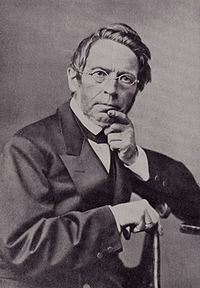
Johann Gustav Droysen

Encyclopedia
Germany
Germany , officially the Federal Republic of Germany , is a federal parliamentary republic in Europe. The country consists of 16 states while the capital and largest city is Berlin. Germany covers an area of 357,021 km2 and has a largely temperate seasonal climate...
historian
Historian
A historian is a person who studies and writes about the past and is regarded as an authority on it. Historians are concerned with the continuous, methodical narrative and research of past events as relating to the human race; as well as the study of all history in time. If the individual is...
. His history of Alexander the Great was the first work representing a new school of German historical thought that idealized power held by so-called "great" men
Great man theory
The Great Man Theory was a popular 19th century idea according to which history can be largely explained by the impact of "great men", or heroes: highly influential individuals who, due to either their personal charisma, intelligence, wisdom, or Machiavellianism utilized their power in a way that...
. His research and writing demonstrated a characteristic comprehensiveness and thoroughness with sources that gave him influence as a teacher and scholar.
Early life and education
Droysen was born at TreptowTrzebiatów
Trzebiatów is a town in the West Pomeranian Voivodeship, Poland. As of June 2007, it has 10,196 inhabitants.It was in Pomerania, Germany until 1945.Trzebiatów's Day of the Cereal is a celebration during the first week of August...
in Pomerania
Pomerania
Pomerania is a historical region on the south shore of the Baltic Sea. Divided between Germany and Poland, it stretches roughly from the Recknitz River near Stralsund in the West, via the Oder River delta near Szczecin, to the mouth of the Vistula River near Gdańsk in the East...
. His father, Johann Christoph Droysen, was an army chaplain who had been present at the celebrated siege of Kolberg in 1806–1807. As a child, Droysen witnessed some of the military operations during the War of Liberation
War of the Sixth Coalition
In the War of the Sixth Coalition , a coalition of Austria, Prussia, Russia, the United Kingdom, Portugal, Sweden, Spain and a number of German States finally defeated France and drove Napoleon Bonaparte into exile on Elba. After Napoleon's disastrous invasion of Russia, the continental powers...
, his father by then being pastor at Greifenhagen
Gryfino
Gryfino is a town in Pomerania, northwestern Poland with 22,500 inhabitants . It is also the capital of Gryfino County in West Pomeranian Voivodeship , previously in Szczecin Voivodeship ....
, in the immediate neighbourhood of Stettin
Szczecin
Szczecin , is the capital city of the West Pomeranian Voivodeship in Poland. It is the country's seventh-largest city and the largest seaport in Poland on the Baltic Sea. As of June 2009 the population was 406,427....
, which was held by the French
First French Empire
The First French Empire , also known as the Greater French Empire or Napoleonic Empire, was the empire of Napoleon I of France...
for most of 1813. These youthful impressions laid the foundation of his ardent attachment to the Kingdom of Prussia
Kingdom of Prussia
The Kingdom of Prussia was a German kingdom from 1701 to 1918. Until the defeat of Germany in World War I, it comprised almost two-thirds of the area of the German Empire...
. He was educated at the gymnasium
Gymnasium (school)
A gymnasium is a type of school providing secondary education in some parts of Europe, comparable to English grammar schools or sixth form colleges and U.S. college preparatory high schools. The word γυμνάσιον was used in Ancient Greece, meaning a locality for both physical and intellectual...
of Stettin and at the University of Berlin; in 1829 he became a master at the Graues Kloster, one of the oldest schools in Berlin; besides his work there he gave lectures at the Friedrich Wilhelm University
Humboldt University of Berlin
The Humboldt University of Berlin is Berlin's oldest university, founded in 1810 as the University of Berlin by the liberal Prussian educational reformer and linguist Wilhelm von Humboldt, whose university model has strongly influenced other European and Western universities...
, from 1833 as Privatdozent
Privatdozent
Privatdozent or Private lecturer is a title conferred in some European university systems, especially in German-speaking countries, for someone who pursues an academic career and holds all formal qualifications to become a tenured university professor...
, and from 1835 as professor, without a salary. The famed historian Jacob Burckhardt
Jacob Burckhardt
Carl Jacob Christoph Burckhardt was a historian of art and culture, and an influential figure in the historiography of each field. He is known as one of the major progenitors of cultural history, albeit in a form very different from how cultural history is conceived and studied in academia today...
visited his class in his last semster (1839–40).
During these years Droysen studied classical antiquity; he published a translation of Aeschylus
Aeschylus
Aeschylus was the first of the three ancient Greek tragedians whose work has survived, the others being Sophocles and Euripides, and is often described as the father of tragedy. His name derives from the Greek word aiskhos , meaning "shame"...
in 1832 and a paraphrase of Aristophanes
Aristophanes
Aristophanes , son of Philippus, of the deme Cydathenaus, was a comic playwright of ancient Athens. Eleven of his forty plays survive virtually complete...
(1835–1838), but the work by which he made himself known as a historian was his Geschichte Alexanders des Grossen (History of Alexander the Great), (Berlin, 1833 and other editions), a book that long remained the best work on Alexander the Great. It was in some ways the herald of a new school of German historical thought, for it idealized power and success, a conceptual framework Droysen had learned from the teaching of Hegel
Georg Wilhelm Friedrich Hegel
Georg Wilhelm Friedrich Hegel was a German philosopher, one of the creators of German Idealism. His historicist and idealist account of reality as a whole revolutionized European philosophy and was an important precursor to Continental philosophy and Marxism.Hegel developed a comprehensive...
. Droysen followed the biography of Alexander with other works dealing with Greek successors, published under the title of Geschichte des Hellenismus (Hamburg
Hamburg
-History:The first historic name for the city was, according to Claudius Ptolemy's reports, Treva.But the city takes its modern name, Hamburg, from the first permanent building on the site, a castle whose construction was ordered by the Emperor Charlemagne in AD 808...
, 1836–1843). A new and revised edition of the whole work was published in 1885, and translated into French, but not into English. His Vorlesung des Freiheits Krieg (in English: Lectures of the War of Liberation) appeared in 1846 and his Outlines of the Principles of History, published 1858, translated 1893, was widely read throughout German universities. He followed this with Erhebung der Geschichte zum Rang einer Wissenschaft, (1863), a methodological study that reflected his new approach to research and writing.
History meets politics
In 1840, Droysen was appointed professor of history at KielUniversity of Kiel
The University of Kiel is a university in the city of Kiel, Germany. It was founded in 1665 as the Academia Holsatorum Chiloniensis by Christian Albert, Duke of Holstein-Gottorp and has approximately 23,000 students today...
. There, the political movement for the defense of the rights of the Elbe duchies, of which Kiel
Kiel
Kiel is the capital and most populous city in the northern German state of Schleswig-Holstein, with a population of 238,049 .Kiel is approximately north of Hamburg. Due to its geographic location in the north of Germany, the southeast of the Jutland peninsula, and the southwestern shore of the...
was the center, attracted his interest. Like Friedrich Christoph Dahlmann
Friedrich Christoph Dahlmann
Friedrich Christoph Dahlmann was a German historian and politician.He came of an old Hanseatic family of Wismar, then controlled by Sweden...
, he placed his historical learning at the service of the estates of Schleswig
Schleswig
Schleswig or South Jutland is a region covering the area about 60 km north and 70 km south of the border between Germany and Denmark; the territory has been divided between the two countries since 1920, with Northern Schleswig in Denmark and Southern Schleswig in Germany...
and Holstein
Holstein
Holstein is the region between the rivers Elbe and Eider. It is part of Schleswig-Holstein, the northernmost state of Germany....
and composed the address of 1844, in which the estates protested against the claim of King Christian VIII of Denmark
Christian VIII of Denmark
Christian VIII , was king of Denmark from 1839 to 1848 and, as Christian Frederick, king of Norway in 1814. He was the eldest son of Hereditary Prince Frederick of Denmark and Norway and Sophia Frederica of Mecklenburg-Schwerin, born in 1786 at Christiansborg Palace in Copenhagen...
to alter the law of succession in the duchies, an issue diplomatically negotiated through the London Protocol of 1852, and ultimately resolved in a war between Denmark and allied forces from Austria and Prussia in the Second Schleswig War.
Droysen's first great political appearance occurred in 1843, on the one thousand year anniversary of the Verdun agreement between Karl the Bald and Ludwig the German, grandsons of Charlemagne. The patrimony of Charlemagne, and his son, Louis the Pius; Droysen found in this event the evidence of the German nation. Later, Droysen gave a lecture to a crowded audience in Berlin entitled the Agreement at Verdun, which was greeted with enthusiasm not only by the listeners but also the German Kaiser himself.
Support of Prussian Hegemony
In 1848 he was elected a member of the revolutionary Frankfurt parliamentFrankfurt Parliament
The Frankfurt Assembly was the first freely elected parliament for all of Germany. Session was held from May 18, 1848 to May 31, 1849 in the Paulskirche at Frankfurt am Main...
, and acted as secretary to the committee for drawing up a proposed constitution. He was a determined supporter of Prussian ascendancy, seeing this as the only feasible route to German unification
Unification of Germany
The formal unification of Germany into a politically and administratively integrated nation state officially occurred on 18 January 1871 at the Versailles Palace's Hall of Mirrors in France. Princes of the German states gathered there to proclaim Wilhelm of Prussia as Emperor Wilhelm of the German...
.
We cannot conceal the fact that the whole German question is a simple alternative between Prussia and Austria. In these states, German life has its positive and negative poles - in the former, all the interests which are national and reformative, in the latter, all that are dynastic and destructive. The German question is not a constitutional question, but a question of power; and the Prussian monarchy is now wholly German, while that of Austria cannot be.
Droysen was one of the first members to retire from the Frankfurt Parliament
Frankfurt Parliament
The Frankfurt Assembly was the first freely elected parliament for all of Germany. Session was held from May 18, 1848 to May 31, 1849 in the Paulskirche at Frankfurt am Main...
after King Frederick William IV of Prussia
Frederick William IV of Prussia
|align=right|Upon his accession, he toned down the reactionary policies enacted by his father, easing press censorship and promising to enact a constitution at some point, but he refused to enact a popular legislative assembly, preferring to work with the aristocracy through "united committees" of...
refused the imperial crown in 1849. In the following two years, Droysen continued to support the cause of the duchies, and in 1850, with Carl Samwer, he published a history of the dealings of Denmark with Schleswig and Holstein, Die Herzogthümer Schleswig-Holstein und das Königreich Dänemark seit dem Jahre 1800 (Hamburg, 1850). A translation was published in London
London
London is the capital city of :England and the :United Kingdom, the largest metropolitan area in the United Kingdom, and the largest urban zone in the European Union by most measures. Located on the River Thames, London has been a major settlement for two millennia, its history going back to its...
in the same year under the title The Policy of Denmark towards the Duchies of Schleswig-Holstein. The work was one of great political importance and contributed to the formation of German public opinion on the rights of the duchies in their struggle with Denmark
Denmark
Denmark is a Scandinavian country in Northern Europe. The countries of Denmark and Greenland, as well as the Faroe Islands, constitute the Kingdom of Denmark . It is the southernmost of the Nordic countries, southwest of Sweden and south of Norway, and bordered to the south by Germany. Denmark...
.
Legacy to Prussian Historiography
In his later years he was almost entirely occupied with Prussian history. After 1851 Droysen was appointed to a professorship at Jena; in 1859 he was called to Berlin, where he remained until his death. In 1851 he brought out a life of Count Yorck von Wartenburg (Berlin, 1851–1852), generally considered one of the best biographies in the German languageGerman language
German is a West Germanic language, related to and classified alongside English and Dutch. With an estimated 90 – 98 million native speakers, German is one of the world's major languages and is the most widely-spoken first language in the European Union....
and then began his great work on the Geschichte der preussischen Politik, or, in English, The History of Prussian Politics, (Berlin, 1855–1886). Seven volumes were published, the last posthumously; in total the work consumed 32 volumes. It forms a complete history of the growth of the Prussian monarchy to the year 1756. This, like all Droysen's work, shows a strongly marked individuality, and a penchant of tracing the manner in which important dynamic forces worked themselves out in history.
Personal life
Droysen was twice married, and died in Berlin. His eldest son, Gustav, wrote several well-known historical works, namely, Gustav Adolf (Leipzig, 1869–1870), a study of the Gustavus Adolphus, the King of Sweden during the Thirty Years War, and Herzog Bernhard von Weimar (LeipzigLeipzig
Leipzig Leipzig has always been a trade city, situated during the time of the Holy Roman Empire at the intersection of the Via Regia and Via Imperii, two important trade routes. At one time, Leipzig was one of the major European centres of learning and culture in fields such as music and publishing...
, 1885), a study of Duke Bernhard, another able Protestant General during the Thirty Years War; an Historischer Handatlas (Leipzig, 1885), a geographic analysis of historical and territorial changes, and several writings on various events of the Thirty Years' War
Thirty Years' War
The Thirty Years' War was fought primarily in what is now Germany, and at various points involved most countries in Europe. It was one of the most destructive conflicts in European history....
. Another son, Hans Droysen, was the author of some works on Greek history and antiquities.
Additional reading
- Amorós, Pedro. "La fuerza progresiva del cristianismo y la unidad de la nación alemana en la Histórica de J. G. Droysen: la tradición histórica alemana, Panta Rei, 1998-2000.
- See M. DunckerMaximilian Wolfgang DunckerMaximilian Wolfgang Duncker was a German historian and politician.-Life:Duncker was born in Berlin, Province of Brandenburg, as the eldest son of the publisher Karl Duncker...
, Johann Gustav Droysen, ein Nachruf (Berlin, 1885); and Dahlmann-Waitz, Quellenkunde der deutschen Geschichte (Leipzig, 1906). - Burger, Thomas. "Droysen's Defense of Historiography: A Note", History and Theory, Vol. 16, No. 2. (May, 1977), pp. BUT No. 1. (Jan., 1984), pp. 1–14.
- Momigliano, Arnaldo. "J.G. Droysen between Greeks and Jews", History and Theory, Vol. 9, No. 2. (1970), pp. 139–153.
- Southard, Robert. Droysen and the Prussian School of History. Lexington, KY: University Press of Kentucky, 1995 (hardcover, ISBN 0-8131-1884-0).
External links
- Complete German text of Droysen's Geschichte des Hellenismus ("History of Hellenistic civilization"), including the volume on Alexander the Great
- Complete German text of Droysen's Die Herzogthümer Schleswig-holstein und das Königreich Danemark: Aktenmässige Geschichte der dänischen Politik seit dem Jahre 1806. Perthes-Besser und Mauke, 1850, second edition.
- Complete translated text of Droysen's Grundriss der Historik (Outline of the principles of history), translated by Elisha Benjamin Andrews. Ginn & Company, 1897.