

Prince-elector

Encyclopedia
Holy Roman Empire
The Holy Roman Empire was a realm that existed from 962 to 1806 in Central Europe.It was ruled by the Holy Roman Emperor. Its character changed during the Middle Ages and the Early Modern period, when the power of the emperor gradually weakened in favour of the princes...
( (), pl. Kurfürsten) were the members of the electoral college
Electoral college
An electoral college is a set of electors who are selected to elect a candidate to a particular office. Often these represent different organizations or entities, with each organization or entity represented by a particular number of electors or with votes weighted in a particular way...
of the Holy Roman Empire, having the function of electing
Imperial election
The election of a Holy Roman Emperor or King of Germany was, from at least the 13th century, accomplished by a small body of the greatest princes of the Empire, the Prince-electors. Appointment as Emperor was normally for life...
the Roman king
King of the Romans
King of the Romans was the title used by the ruler of the Holy Roman Empire following his election to the office by the princes of the Kingdom of Germany...
or, from the middle of the 16th century onwards, directly the Holy Roman Emperor
Holy Roman Emperor
The Holy Roman Emperor is a term used by historians to denote a medieval ruler who, as German King, had also received the title of "Emperor of the Romans" from the Pope...
.
The heir-apparent to a prince-elector was known as an electoral prince . The dignity of Elector was extremely prestigious and second only to King or Emperor.
Overview
The Holy Roman Empire was in theory an elective monarchyElective monarchy
An elective monarchy is a monarchy ruled by an elected rather than hereditary monarch. The manner of election, the nature of the candidacy and the electors vary from case to case...
, but from the 15th century onwards the electors often merely formalised what was a dynastic
Dynasty
A dynasty is a sequence of rulers considered members of the same family. Historians traditionally consider many sovereign states' history within a framework of successive dynasties, e.g., China, Ancient Egypt and the Persian Empire...
succession
Order of succession
An order of succession is a formula or algorithm that determines who inherits an office upon the death, resignation, or removal of its current occupant.-Monarchies and nobility:...
within the Austrian House of Habsburg, with the title usually passing to the eldest surviving son of the deceased Emperor. Despite this, the office was not legally hereditary, and the heir could not title himself "Emperor" without having been personally elected.
Formally the Prince-Electors elected a King of the Romans
King of the Romans
King of the Romans was the title used by the ruler of the Holy Roman Empire following his election to the office by the princes of the Kingdom of Germany...
, who was elected in Germany but became Holy Roman Emperor only when crowned
Coronation
A coronation is a ceremony marking the formal investiture of a monarch and/or their consort with regal power, usually involving the placement of a crown upon their head and the presentation of other items of regalia...
by the pope
Pope
The Pope is the Bishop of Rome, a position that makes him the leader of the worldwide Catholic Church . In the Catholic Church, the Pope is regarded as the successor of Saint Peter, the Apostle...
. Charles V
Charles V, Holy Roman Emperor
Charles V was ruler of the Holy Roman Empire from 1519 and, as Charles I, of the Spanish Empire from 1516 until his voluntary retirement and abdication in favor of his younger brother Ferdinand I and his son Philip II in 1556.As...
was the last to be a crowned Emperor (elected 1519, crowned 1530); his successors were all Emperors by election only.
Electors were among the prince
Prince
Prince is a general term for a ruler, monarch or member of a monarch's or former monarch's family, and is a hereditary title in the nobility of some European states. The feminine equivalent is a princess...
s of the Empire, but they had privileges in addition to their electoral ones which were not allowed their non-electoral brethren. Though in principle not a title of nobility (and thus held in addition to such feudal titles as Duke, Margrave, or Count Palatine), the dignity of Elector was extremely prestigious.
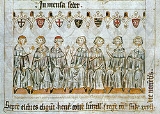
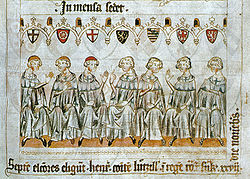
At least from the thirteenth century, there were seven electors, three spiritual (the Archbishop of Mainz
Archbishopric of Mainz
The Archbishopric of Mainz or Electorate of Mainz was an influential ecclesiastic and secular prince-bishopric in the Holy Roman Empire between 780–82 and 1802. In the Roman Catholic Church hierarchy, the Archbishop of Mainz was the primas Germaniae, the substitute of the Pope north of the Alps...
, the Archbishop of Trier
Archbishopric of Trier
The Archbishopric of Trier was a Roman Catholic diocese in Germany, that existed from Carolingian times until the end of the Holy Roman Empire. Its suffragans were the dioceses of Metz, Toul and Verdun. Since the 9th century the Archbishops of Trier were simultaneously princes and since the 11th...
, and the Archbishop of Cologne) and four lay (the King of Bohemia, the Count Palatine of the Rhine, the Duke of Saxony
Rulers of Saxony
This article lists Dukes, Electors, and Kings ruling over different territories named Saxony from the beginning of the Saxon Duchy in the 9th century to the end of the Saxon Kingdom in 1918.-Dukes of Saxony:...
, and the Margrave of Brandenburg; these last three were also known as the Elector Palatine, the Elector of Saxony, and the Elector of Brandenburg, respectively). Only six of the electors, however, had the right to sit at ordinary meetings: "The King of Bohemia, who was in fact not a prince of the Empire but a neighbouring and independent monarch, might vote at an imperial election, but was allowed on no other occasion to meddle in the affairs of the Empire."
Other electors were added in the seventeenth century and include the Duke of Bavaria (referred to as the Elector of Bavaria—replacing the Count Palatine of the Rhine, who was of the same family but had lost his title and vote temporarily during the Thirty Years' War
Thirty Years' War
The Thirty Years' War was fought primarily in what is now Germany, and at various points involved most countries in Europe. It was one of the most destructive conflicts in European history....
), and the Duke of Brunswick-Lüneburg
Electorate of Hanover
The Electorate of Brunswick-Lüneburg was the ninth Electorate of the Holy Roman Empire of the German Nation...
(the Elector of Hanover - an office in time held by three Hanoverian
Hanoverian
The adjective Hanoverian is used to describe:* British monarchs or supporters of the House of Hanover, the dynasty which ruled the United Kingdom from 1714 to 1901.* things relating to the Electorate of Hanover, Kingdom of Hanover, or Province of Hanover...
kings of Great Britain, George I
George I of Great Britain
George I was King of Great Britain and Ireland from 1 August 1714 until his death, and ruler of the Duchy and Electorate of Brunswick-Lüneburg in the Holy Roman Empire from 1698....
, George II
George II of Great Britain
George II was King of Great Britain and Ireland, Duke of Brunswick-Lüneburg and Archtreasurer and Prince-elector of the Holy Roman Empire from 11 June 1727 until his death.George was the last British monarch born outside Great Britain. He was born and brought up in Northern Germany...
, and George III) until the institution was abolished in 1806 under Napoleon Bonaparte and the Elector became the King of Hanover
Kingdom of Hanover
The Kingdom of Hanover was established in October 1814 by the Congress of Vienna, with the restoration of George III to his Hanoverian territories after the Napoleonic era. It succeeded the former Electorate of Brunswick-Lüneburg , and joined with 38 other sovereign states in the German...
after regaining his lands following Napoleon's defeat in 1814.
Several new electors were created during the reorganization of the Empire in 1803, but these never participated in an election. On August 6, 1806, pressed both by Napoleon and by several German princes (including some Electors), the last Holy Roman emperor, Emperor Francis II
Francis II, Holy Roman Emperor
Francis II was the last Holy Roman Emperor, ruling from 1792 until 6 August 1806, when he dissolved the Empire after the disastrous defeat of the Third Coalition by Napoleon at the Battle of Austerlitz...
, by edict dissolved the Empire. After or just before the dissolution, the Electors of Bavaria, Württemberg
Frederick I of Württemberg
Frederick I William Charles of Württemberg was the first King of Württemberg. He was known for his size: at and about , he was in contrast to Napoleon, who recognized him as King of Württemberg.-Biography:...
, Saxony
Frederick Augustus I of Saxony
Frederick Augustus I was King of Saxony from the House of Wettin. He was also Elector Frederick Augustus III of Saxony and Duke Frederick Augustus I of Warsaw...
, and, eventually, of Hanover
George III of the United Kingdom
George III was King of Great Britain and King of Ireland from 25 October 1760 until the union of these two countries on 1 January 1801, after which he was King of the United Kingdom of Great Britain and Ireland until his death...
each took the title of "king" of his former electorate, while the King of Prussia
Frederick William III of Prussia
Frederick William III was king of Prussia from 1797 to 1840. He was in personal union the sovereign prince of the Principality of Neuchâtel .-Early life:...
extended his royal title to cover his erstwhile Electorate of Brandenburg as well as the lands he held as king outside the imperial border. The Electors of Regensburg
Karl Theodor Anton Maria von Dalberg
Karl Theodor Anton Maria von Dalberg was Archbishop-Elector of Mainz, Arch-Chancellor of the Holy Roman Empire, Prince of Regensburg, primate of the Confederation of the Rhine and Grand-Duke of Frankfurt.-Biography:...
(who had succeeded to the Mainz
Mainz
Mainz under the Holy Roman Empire, and previously was a Roman fort city which commanded the west bank of the Rhine and formed part of the northernmost frontier of the Roman Empire...
vote), Würzburg
Ferdinand III, Grand Duke of Tuscany
Ferdinand III, Grand Duke of Tuscany was Grand Duke of Tuscany from 1790 to 1801 and, after a period of disenfranchisement, again from 1814 to 1824. He was also the Prince-elector and Grand Duke of Salzburg and Grand Duke of Würzburg .-Biography:Ferdinand was born in Florence, Tuscany, into the...
(who had succeeded to the Salzburg
Salzburg
-Population development:In 1935, the population significantly increased when Salzburg absorbed adjacent municipalities. After World War II, numerous refugees found a new home in the city. New residential space was created for American soldiers of the postwar Occupation, and could be used for...
vote), and Baden (a new electorate) became grand dukes. The Elector of Hesse
William I, Elector of Hesse
William I, Elector of Hesse was the eldest surviving son of Frederick II, Landgrave of Hesse-Kassel and Princess Mary of Great Britain, the daughter of George II.-Early life:...
and Landgrave of Hesse-Kassel chose to retain the defunct electoral title until the state was annexed by Prussia
Prussia
Prussia was a German kingdom and historic state originating out of the Duchy of Prussia and the Margraviate of Brandenburg. For centuries, the House of Hohenzollern ruled Prussia, successfully expanding its size by way of an unusually well-organized and effective army. Prussia shaped the history...
, 60 years later.
Etymology of Kurfürst
The German word Kur- is related etymologically to the English word choose (cf. Old EnglishOld English language
Old English or Anglo-Saxon is an early form of the English language that was spoken and written by the Anglo-Saxons and their descendants in parts of what are now England and southeastern Scotland between at least the mid-5th century and the mid-12th century...
ceosan tʃeo̯zan, participle coren 'having been chosen' and Gothic
Gothic language
Gothic is an extinct Germanic language that was spoken by the Goths. It is known primarily from the Codex Argenteus, a 6th-century copy of a 4th-century Bible translation, and is the only East Germanic language with a sizable Text corpus...
kiusan). In English, the s/r interchange of the Germanic verb conjugation has been regularized to "s", while German retains the r in Kur-. There is also a modern German verb küren which means 'to choose' in a ceremonial sense. Fürst
Fürst
Fürst is a German title of nobility, usually translated into English as Prince.The term refers to the head of a principality and is distinguished from the son of a monarch, who is referred to as Prinz...
is German for 'prince,' but while German distinguishes between the head of a principality (der Fürst) and the son of a monarch (der Prinz), English uses prince for both concepts. Fürst itself is related to English first and is therefore the 'foremost' person in his realm. Note that 'prince' (from Latin 'princeps') carries the same meaning.
Composition
Monarch
A monarch is the person who heads a monarchy. This is a form of government in which a state or polity is ruled or controlled by an individual who typically inherits the throne by birth and occasionally rules for life or until abdication...
s began when ancient Germanic tribes
Germanic peoples
The Germanic peoples are an Indo-European ethno-linguistic group of Northern European origin, identified by their use of the Indo-European Germanic languages which diversified out of Proto-Germanic during the Pre-Roman Iron Age.Originating about 1800 BCE from the Corded Ware Culture on the North...
formed ad hoc coalitions and elected the leaders thereof. Elections were irregularly held by the Franks
Franks
The Franks were a confederation of Germanic tribes first attested in the third century AD as living north and east of the Lower Rhine River. From the third to fifth centuries some Franks raided Roman territory while other Franks joined the Roman troops in Gaul. Only the Salian Franks formed a...
, whose successor states include France
France
The French Republic , The French Republic , The French Republic , (commonly known as France , is a unitary semi-presidential republic in Western Europe with several overseas territories and islands located on other continents and in the Indian, Pacific, and Atlantic oceans. Metropolitan France...
and Germany
Germany
Germany , officially the Federal Republic of Germany , is a federal parliamentary republic in Europe. The country consists of 16 states while the capital and largest city is Berlin. Germany covers an area of 357,021 km2 and has a largely temperate seasonal climate...
. The French monarchy eventually became hereditary
Heredity
Heredity is the passing of traits to offspring . This is the process by which an offspring cell or organism acquires or becomes predisposed to the characteristics of its parent cell or organism. Through heredity, variations exhibited by individuals can accumulate and cause some species to evolve...
, but the German monarchy remained elective. While all free men originally exercised the right to vote in such elections, suffrage eventually came to be limited to the leading men of the realm. In the election of Lothar II in 1125, a small number of eminent noble
Nobility
Nobility is a social class which possesses more acknowledged privileges or eminence than members of most other classes in a society, membership therein typically being hereditary. The privileges associated with nobility may constitute substantial advantages over or relative to non-nobles, or may be...
s chose the monarch and then submitted him to the remaining magnates for their approbation. Soon, the right to choose the monarch was settled on an exclusive group of princes, and the procedure of seeking the approval of the remaining nobles was abandoned. The college of electors was mentioned in 1152 and again in 1198. A letter of Pope Urban IV
Pope Urban IV
Pope Urban IV , born Jacques Pantaléon, was Pope, from 1261 to 1264. He was not a cardinal, and there have been several Popes since him who have not been Cardinals, including Urban V and Urban VI.-Biography:...
suggests that by "immemorial custom
Time immemorial
Time immemorial is a phrase meaning time extending beyond the reach of memory, record, or tradition, indefinitely ancient, "ancient beyond memory or record"...
", seven princes had the right to elect the King and future Emperor. These were:
- Three ecclesiastic
- the Archbishop of MainzArchbishopric of MainzThe Archbishopric of Mainz or Electorate of Mainz was an influential ecclesiastic and secular prince-bishopric in the Holy Roman Empire between 780–82 and 1802. In the Roman Catholic Church hierarchy, the Archbishop of Mainz was the primas Germaniae, the substitute of the Pope north of the Alps...
- the Archbishop of TrierArchbishopric of TrierThe Archbishopric of Trier was a Roman Catholic diocese in Germany, that existed from Carolingian times until the end of the Holy Roman Empire. Its suffragans were the dioceses of Metz, Toul and Verdun. Since the 9th century the Archbishops of Trier were simultaneously princes and since the 11th...
- the Archbishop of Cologne
- the Archbishop of Mainz
- Four secular
- the King of Bohemia (král český, König von Böhmen)
- the Margrave of Brandenburg (Markgraf von Brandenburg)
- the Count Palatine of the Rhine (Pfalzgraf bei Rhein)
- the Duke of SaxonyElectorate of SaxonyThe Electorate of Saxony , sometimes referred to as Upper Saxony, was a State of the Holy Roman Empire. It was established when Emperor Charles IV raised the Ascanian duchy of Saxe-Wittenberg to the status of an Electorate by the Golden Bull of 1356...
(Herzog von Sachsen)
The three Archbishops oversaw the most venerable and powerful see
Episcopal See
An episcopal see is, in the original sense, the official seat of a bishop. This seat, which is also referred to as the bishop's cathedra, is placed in the bishop's principal church, which is therefore called the bishop's cathedral...
s in German lands, while the four Dukes controlled ancient Frankish territory and held important hereditary offices. The seven (Palatinate, Brandenburg, Saxe-Wittenberg, Bohemia, Mainz, Trier, Cologne) have been mentioned as the vote-caster setting in the election of 1257 that resulted in two kings becoming elected.
The Palatinate and Bavaria were originally held by the same individual, but in 1253, they were divided between two members of the Wittelsbach
Wittelsbach
The Wittelsbach family is a European royal family and a German dynasty from Bavaria.Members of the family served as Dukes, Electors and Kings of Bavaria , Counts Palatine of the Rhine , Margraves of Brandenburg , Counts of Holland, Hainaut and Zeeland , Elector-Archbishops of Cologne , Dukes of...
dynasty. The other electors refused to allow two princes from the same dynasty to have electoral rights, so a heated rivalry between the Count Palatine and the Duke of Bavaria arose. Meanwhile, the King of Bohemia, who held the ancient imperial office of Arch-Cupbearer, asserted his right to participate in elections, but was challenged on the grounds that his kingdom was not German, though usually he was recognized, instead of Bavaria which after all was just a younger line of Wittelsbachs.
Already the declaration at Rhense in 1338 by six electors had the effect that election by all or the majority of the electors automatically conferred the royal title and rule over the empire, without papal confirmation. The Golden Bull of 1356
Golden Bull of 1356
The Golden Bull of 1356 was a decree issued by the Reichstag assembly in Nuremberg headed by the Luxembourg Emperor Charles IV that fixed, for a period of more than four hundred years, important aspects of the constitutional structure of the Holy Roman Empire...
finally resolved the disputes among the electors; under it, the Archbishops of Mainz, Trier, and Cologne, as well as the King of Bohemia, the Count Palatine
Count palatine
Count palatine is a high noble title, used to render several comital styles, in some cases also shortened to Palatine, which can have other meanings as well.-Comes palatinus:...
, the Duke of Saxony, and the Margrave of Brandenburg held the right to elect the King.
.jpg)
Frederick V, Elector Palatine
Frederick V was Elector Palatine , and, as Frederick I , King of Bohemia ....
, came under the imperial ban after participating in the Bohemian Revolt (a part of the Thirty Years' War
Thirty Years' War
The Thirty Years' War was fought primarily in what is now Germany, and at various points involved most countries in Europe. It was one of the most destructive conflicts in European history....
). The Elector Palatine's seat was conferred on the Duke of Bavaria, the head of a junior branch of his family. Originally, the Duke held the electorate personally, but it was later made hereditary along with the duchy. When the Thirty Years' War concluded with the Treaty of Münster
Peace of Westphalia
The Peace of Westphalia was a series of peace treaties signed between May and October of 1648 in Osnabrück and Münster. These treaties ended the Thirty Years' War in the Holy Roman Empire, and the Eighty Years' War between Spain and the Dutch Republic, with Spain formally recognizing the...
(also called the Peace of Westphalia) in 1648, a new electorate was created for the Count Palatine of the Rhine. Since the Elector of Bavaria retained his seat, the number of electors increased to eight; the two Wittelsbach lines now sufficiently estranged so as not to pose a combined potential threat.
In 1692, as a result of the inheritance of the Palatinate by a Catholic branch of the Wittelsbach family, which threatened to upset the religious balance of the College of Electors, the number of electors was increased to nine, with a seat being granted to the Duke of Brunswick-Lüneburg, who became known as the Elector of Hanover (the Reichstag officially confirmed the creation in 1708). In 1706, the Elector of Bavaria and Archbishop of Cologne were banned during the War of the Spanish Succession
War of the Spanish Succession
The War of the Spanish Succession was fought among several European powers, including a divided Spain, over the possible unification of the Kingdoms of Spain and France under one Bourbon monarch. As France and Spain were among the most powerful states of Europe, such a unification would have...
, but both were restored in 1714 after the Peace of Baden. In 1777, the number of electors was reduced to eight when the Elector Palatine inherited Bavaria.
Many changes to the composition of the college were necessitated by Napoleon
Napoleon I of France
Napoleon Bonaparte was a French military and political leader during the latter stages of the French Revolution.As Napoleon I, he was Emperor of the French from 1804 to 1815...
's aggression during the early 19th century. The Treaty of Lunéville
Treaty of Lunéville
The Treaty of Lunéville was signed on 9 February 1801 between the French Republic and the Holy Roman Emperor Francis II, negotiating both on behalf of his own domains and of the Holy Roman Empire...
(1801), which ceded territory on the Rhine's left bank to France
France
The French Republic , The French Republic , The French Republic , (commonly known as France , is a unitary semi-presidential republic in Western Europe with several overseas territories and islands located on other continents and in the Indian, Pacific, and Atlantic oceans. Metropolitan France...
, led to the abolition of the archbishoprics of Trier and Cologne, and the transfer of the remaining spiritual Elector from Mainz to Regensburg
Regensburg
Regensburg is a city in Bavaria, Germany, located at the confluence of the Danube and Regen rivers, at the northernmost bend in the Danube. To the east lies the Bavarian Forest. Regensburg is the capital of the Bavarian administrative region Upper Palatinate...
. In 1803, electorates were created for the Duke of Württemberg
Rulers of Württemberg
This is a list of the rulers of the German state of Württemberg, originally a county and eventually a kingdom until the ruling dynasty was overthrown in 1918.- Counts of Württemberg to 1495 :* Konrad I 1089–1122...
, the Margrave of Baden, the Landgrave of Hesse-Kassel (or Hesse-Cassel), and the Duke of Salzburg
Duchy of Salzburg
The Duchy of Salzburg was a Cisleithanian Kronland of the Austrian Empire and Austria-Hungary from 1849–1918. Its capital was Salzburg, while other towns in the duchy included Zell am See and Gastein....
, bringing the total number of electors to ten. When Austria
Austria
Austria , officially the Republic of Austria , is a landlocked country of roughly 8.4 million people in Central Europe. It is bordered by the Czech Republic and Germany to the north, Slovakia and Hungary to the east, Slovenia and Italy to the south, and Switzerland and Liechtenstein to the...
annexed Salzburg under the Treaty of Pressburg (1805), the Duke of Salzburg moved to the Grand Duchy of Würzburg
Grand Duchy of Würzburg
The Grand Duchy of Würzburg was a German grand duchy centered on Würzburg existing in the early 19th century.As a consequence of the 1801 Treaty of Lunéville, the Bishopric of Würzburg was secularized in 1803 and granted to Bavaria. In the same year Ferdinand III, former Grand Duke of Tuscany, was...
and retained his electorate. None of the new electors, however, had an opportunity to cast votes, as the Holy Roman Empire was abolished in 1806, and the new electorates were never confirmed by the Emperor.
Rights and privileges
Electors were among the rulers of the States of the Empire, but enjoyed precedence over the other princes. They were, until the 18th century, exclusively entitled to be addressed with Durchlaucht ([your] Serene Highness). In 1742, the electors became entitled to the superlative Durchläuchtigste (Most Serene Highness), while other princes were promoted to Durchlaucht.As rulers of States of the Empire, the electors enjoyed all the privileges of the other princes, including the right to enter into alliances, autonomy in relation to dynastic affairs and precedence over other subjects. The Golden Bull recognised certain additional rights belonging to the electors. For instance, electors were granted a monopoly
Monopoly
A monopoly exists when a specific person or enterprise is the only supplier of a particular commodity...
over all mines of gold
Gold
Gold is a chemical element with the symbol Au and an atomic number of 79. Gold is a dense, soft, shiny, malleable and ductile metal. Pure gold has a bright yellow color and luster traditionally considered attractive, which it maintains without oxidizing in air or water. Chemically, gold is a...
, silver
Silver
Silver is a metallic chemical element with the chemical symbol Ag and atomic number 47. A soft, white, lustrous transition metal, it has the highest electrical conductivity of any element and the highest thermal conductivity of any metal...
, and other metals within their territories, to tax Jews
Judaism
Judaism ) is the "religion, philosophy, and way of life" of the Jewish people...
, to collect toll
Toll road
A toll road is a privately or publicly built road for which a driver pays a toll for use. Structures for which tolls are charged include toll bridges and toll tunnels. Non-toll roads are financed using other sources of revenue, most typically fuel tax or general tax funds...
s, and to mint money; these powers belonged to the Emperor in the other territories, and princes who wrongly assumed them could be deprived of their status. Thus, the electors were among the most powerful princes in the Empire. Electors also enjoyed several judicial powers within their territories. Their subjects could not be tried in the imperial courts, and appeal from their courts lay only in cases where denial of justice was claimed.
After the abolition of the Holy Roman Empire in August 1806, the electors continued to reign over their territories, many of them taking higher titles. The Dukes of Bavaria, Württemberg, and Saxony made themselves Kings, as later did the Duke of Brunswick-Lüneburg, who was already King of Great Britain
George III of the United Kingdom
George III was King of Great Britain and King of Ireland from 25 October 1760 until the union of these two countries on 1 January 1801, after which he was King of the United Kingdom of Great Britain and Ireland until his death...
. Meanwhile, the Margrave of Baden elevated himself to the Grand-Ducal
Grand Duke
The title grand duke is used in Western Europe and particularly in Germanic countries for provincial sovereigns. Grand duke is of a protocolary rank below a king but higher than a sovereign duke. Grand duke is also the usual and established translation of grand prince in languages which do not...
dignity. The Landgrave of Hesse-Kassel, however, retained the meaningless title "Elector of Hesse", thus distinguishing himself from other Hessian princes (the Grand Duke of Hesse-Darmstadt and the Landgrave of Hesse-Homburg). Napoleon soon exiled him and Kassel was annexed to the Kingdom of Westphalia
Kingdom of Westphalia
The Kingdom of Westphalia was a new country of 2.6 million Germans that existed from 1807-1813. It included of territory in Hesse and other parts of present-day Germany. While formally independent, it was a vassal state of the First French Empire, ruled by Napoleon's brother Jérôme Bonaparte...
, a new creation. The Congress of Vienna accepted that all old secular electorates were entitled to be kingdoms, but generally did not want to accept kingship for new, Napoleon-era electorates. This was one reason why Hanover became a kingdom. Württemberg, already having adopted royal rank in Napoleon era, was ultimately not stripped of it. Baden did not even try. But the restored elector of Hesse (a new electorate) tried to get recognition to title of king (King of Chatti
Chatti
The Chatti were an ancient Germanic tribe whose homeland was near the upper Weser. They settled in central and northern Hesse and southern Lower Saxony, along the upper reaches of the Weser River and in the valleys and mountains of the Eder, Fulda and Weser River regions, a district approximately...
), and was unsuccessful in that pursuit. They being not willing to give up the electoral rank, this led to the situation that this principality, which never cast an electoral vote in any imperial election, was the one which preserved the title of prince-elector. In 1866, however, the last Elector of Hesse was dethroned under Otto von Bismarck
Otto von Bismarck
Otto Eduard Leopold, Prince of Bismarck, Duke of Lauenburg , simply known as Otto von Bismarck, was a Prussian-German statesman whose actions unified Germany, made it a major player in world affairs, and created a balance of power that kept Europe at peace after 1871.As Minister President of...
's plan for German Unification
Unification of Germany
The formal unification of Germany into a politically and administratively integrated nation state officially occurred on 18 January 1871 at the Versailles Palace's Hall of Mirrors in France. Princes of the German states gathered there to proclaim Wilhelm of Prussia as Emperor Wilhelm of the German...
.
Reichstag
The electors, like the other princes ruling States of the Empire, were members of the ReichstagReichstag (Holy Roman Empire)
The Imperial Diet was the Diet, or general assembly, of the Imperial Estates of the Holy Roman Empire.During the period of the Empire, which lasted formally until 1806, the Diet was not a parliament in today's sense; instead, it was an assembly of the various estates of the realm...
, which was divided into three collegia: the Council of Electors, the Council of Princes, and the Council of Cities. In addition to being members of the Council of Electors, several lay electors were therefore members of the Council of Princes as well by virtue of other territories they possessed. In many cases, the lay electors ruled numerous States of the Empire, and therefore held several votes in the Council of Princes. In 1792, the King of Bohemia held three votes, the Elector of Bavaria six votes, the Elector of Brandenburg eight votes, and the Elector of Hanover six votes. Thus, of the hundred votes in the Council of Princes in 1792, twenty-three belonged to electors. The lay electors therefore exercised considerable influence, being members of the small Council of Electors and holding a significant number of votes in the Council of Princes. The assent of both bodies was required for important decisions affecting the structure of the Empire, such as the creation of new electorates or States of the Empire.
In addition to voting by colleges or councils, the Reichstag also voted on religious lines, as provided for by the Peace of Westphalia. The Archbishop of Mainz presided over the Catholic body, or corpus catholicorum, while the Elector of Saxony presided over the Protestant
Protestantism
Protestantism is one of the three major groupings within Christianity. It is a movement that began in Germany in the early 16th century as a reaction against medieval Roman Catholic doctrines and practices, especially in regards to salvation, justification, and ecclesiology.The doctrines of the...
body, or corpus evangelicorum. The division into religious bodies was on the basis of the official religion of the state, and not of its rulers. Thus, even when the Electors of Saxony were Catholics during the eighteenth century, they continued to preside over the corpus evangelicorum, since the state of Saxony was officially Protestant.
Elections
The individual chosen by the electors assumed the title "King of the Romans", though he actually reigned in Germany. The King of the Romans became Holy Roman Emperor only when crowned by the Pope. On many occasions, a Pope refused to crown a king with whom he was engaged in a dispute, but a lack of a papal coronation deprived a king of only the title Emperor and not of the power to govern (cf Declaration at Rhense). The HabsburgHabsburg
The House of Habsburg , also found as Hapsburg, and also known as House of Austria is one of the most important royal houses of Europe and is best known for being an origin of all of the formally elected Holy Roman Emperors between 1438 and 1740, as well as rulers of the Austrian Empire and...
dynasty stopped the practice of papal coronations. After Charles V
Charles V, Holy Roman Emperor
Charles V was ruler of the Holy Roman Empire from 1519 and, as Charles I, of the Spanish Empire from 1516 until his voluntary retirement and abdication in favor of his younger brother Ferdinand I and his son Philip II in 1556.As...
, all individuals chosen by the electors were merely "Emperors elect".
The electors were originally summoned by the Archbishop of Mainz within one month of an Emperor's death, and met within three months of being summoned. During the interregnum, imperial power was exercised by two imperial vicar
Imperial vicar
An imperial vicar was a prince charged with administering all or part of the Holy Roman Empire on behalf of the Emperor. Later, an imperial vicar was invariably one of two princes charged by the Golden Bull with administering the Holy Roman Empire during an interregnum.The Holy Roman Empire had no...
s. Each vicar, in the words of the Golden Bull, was "the administrator of the empire itself, with the power of passing judgments, of presenting to ecclesiastical benefices, of collecting returns and revenues and investing with fiefs, of receiving oaths of fealty for and in the name of the holy empire". The Elector of Saxony was vicar in areas operating under Saxon law (Saxony
Saxony
The Free State of Saxony is a landlocked state of Germany, contingent with Brandenburg, Saxony Anhalt, Thuringia, Bavaria, the Czech Republic and Poland. It is the tenth-largest German state in area, with of Germany's sixteen states....
, Westphalia
Westphalia
Westphalia is a region in Germany, centred on the cities of Arnsberg, Bielefeld, Dortmund, Minden and Münster.Westphalia is roughly the region between the rivers Rhine and Weser, located north and south of the Ruhr River. No exact definition of borders can be given, because the name "Westphalia"...
, Hanover
Electorate of Hanover
The Electorate of Brunswick-Lüneburg was the ninth Electorate of the Holy Roman Empire of the German Nation...
, and northern Germany), while the Elector Palatine was vicar in the remainder of the Empire (Franconia
Franconia
Franconia is a region of Germany comprising the northern parts of the modern state of Bavaria, a small part of southern Thuringia, and a region in northeastern Baden-Württemberg called Tauberfranken...
, Swabia
Swabia
Swabia is a cultural, historic and linguistic region in southwestern Germany.-Geography:Like many cultural regions of Europe, Swabia's borders are not clearly defined...
, the Rhine, and southern Germany). The Elector of Bavaria replaced the Elector Palatine in 1623, but when the latter was granted a new electorate in 1648, there was a dispute between the two as to which was vicar. In 1659, both purported to act as vicar, but the other vicar recognised the Elector of Bavaria. Later, the two electors made a pact to act as joint vicars, but the Reichstag rejected the agreement. In 1711, while the Elector of Bavaria was under the ban of the Empire, the Elector Palatine again acted as vicar, but his cousin was restored to his position upon his restoration three years later. Finally, in 1745, the two agreed to alternate as vicars, with Bavaria starting first. This arrangement was upheld by the Reichstag in 1752. In 1777 the question became moot when the Elector Palatine inherited Bavaria. On many occasions, however, there was no interregnum, as a new king had been elected during the lifetime of the previous Emperor.
Frankfurt regularly served as the site of the election from the fifteenth century on, but elections were also held at Cologne
Cologne
Cologne is Germany's fourth-largest city , and is the largest city both in the Germany Federal State of North Rhine-Westphalia and within the Rhine-Ruhr Metropolitan Area, one of the major European metropolitan areas with more than ten million inhabitants.Cologne is located on both sides of the...
(1531), Regensburg
Regensburg
Regensburg is a city in Bavaria, Germany, located at the confluence of the Danube and Regen rivers, at the northernmost bend in the Danube. To the east lies the Bavarian Forest. Regensburg is the capital of the Bavarian administrative region Upper Palatinate...
(1575 and 1636), and Augsburg
Augsburg
Augsburg is a city in the south-west of Bavaria, Germany. It is a university town and home of the Regierungsbezirk Schwaben and the Bezirk Schwaben. Augsburg is an urban district and home to the institutions of the Landkreis Augsburg. It is, as of 2008, the third-largest city in Bavaria with a...
(1653 and 1690). An elector could appear in person or could appoint another elector as his proxy. More often, an electoral suite or embassy was sent to cast the vote; the credentials of such representatives were verified by the Archbishop of Mainz, who presided over the ceremony. The deliberations were held at the city hall, but voting occurred in the cathedral. In Frankfurt, a special electoral chapel, or Wahlkapelle, was used for elections. Under the Golden Bull, a majority of electors sufficed to elect a king, and each elector could cast only one vote. Electors were free to vote for whomsoever they pleased (including themselves), but dynastic considerations played a great part in the choice. Electors drafted a Wahlkapitulation, or electoral capitulation, which was presented to the king-elect. The capitulation may be described as a contract between the princes and the king, the latter conceding rights and powers to the electors and other princes. Once an individual swore to abide by the electoral capitulation, he assumed the office of King of the Romans.
In the 10th and 11th centuries, princes often acted merely to confirm hereditary succession in the Saxon (Ottonian
Ottonian
The Ottonian dynasty was a dynasty of Germanic Kings , named after its first emperor but also known as the Saxon dynasty after the family's origin. The family itself is also sometimes known as the Liudolfings, after its earliest known member Liudolf and one of its primary leading-names...
) and Franconian (Salian) dynasties, whereas beginning from the actual forming of the prince-elector class, elections became less secure (with the election of 1125), though the Staufen
Hohenstaufen
The House of Hohenstaufen was a dynasty of German kings in the High Middle Ages, lasting from 1138 to 1254. Three of these kings were also crowned Holy Roman Emperor. In 1194 the Hohenstaufens also became Kings of Sicily...
dynasty managed to get its sons formally elected in their fathers' lifetimes almost as a formality. After these lines ended in extinction, the electors began to elect kings from different families so that the throne would not once again settle within a single dynasty. For some two centuries, the monarchy was elective both in theory and in practice; the arrangement, however, did not last, since the powerful House of Habsburg managed to secure succession within their dynasty during the fifteenth century. All kings elected from 1438 onwards were from among the Habsburg Archdukes of Austria (and later Kings of Hungary and Bohemia) until 1740, when the archduchy was inherited by a woman, Maria Theresa
Maria Theresa of Austria
Maria Theresa Walburga Amalia Christina was the only female ruler of the Habsburg dominions and the last of the House of Habsburg. She was the sovereign of Austria, Hungary, Croatia, Bohemia, Mantua, Milan, Lodomeria and Galicia, the Austrian Netherlands and Parma...
. A representative of the House of Wittelsbach became elected for a short period of time, but in 1745, Maria Theresa's husband, Francis I
Francis I, Holy Roman Emperor
Francis I was Holy Roman Emperor and Grand Duke of Tuscany, though his wife effectively executed the real power of those positions. With his wife, Maria Theresa, he was the founder of the Habsburg-Lorraine dynasty...
of the Habsburg-Lorraine dynasty, became King; all of his successors were also from the same family. Hence, for the greater part of the Empire's history, the role of the electors was largely ceremonial.
High offices
Each elector held a "High Office of the Empire" (Reichserzämter) and was a member of the (ceremonial) Imperial Household. The three spiritual electors were all Arch-Chancellors : the Archbishop of Mainz was Arch-Chancellor of Germany, the Archbishop of Trier was Arch-Chancellor of Burgundy, and the Archbishop of Cologne was Arch-Chancellor of Italy. The other offices were as follows:| Augmentation | Imperial office | German German language German is a West Germanic language, related to and classified alongside English and Dutch. With an estimated 90 – 98 million native speakers, German is one of the world's major languages and is the most widely-spoken first language in the European Union.... | Latin | Elector |
|---|---|---|---|---|
| Arch-Butler Butler A butler is a domestic worker in a large household. In great houses, the household is sometimes divided into departments with the butler in charge of the dining room, wine cellar, and pantry. Some also have charge of the entire parlour floor, and housekeepers caring for the entire house and its... or Arch-Cupbearer |
Erzmundschenk | Archipincerna | King of Bohemia | |
 |
Arch-Seneschal Seneschal A seneschal was an officer in the houses of important nobles in the Middle Ages. In the French administrative system of the Middle Ages, the sénéchal was also a royal officer in charge of justice and control of the administration in southern provinces, equivalent to the northern French bailli... or Arch-Steward Steward (office) A steward is an official who is appointed by the legal ruling monarch to represent him or her in a country, and may have a mandate to govern it in his or her name; in the latter case, it roughly corresponds with the position of governor or deputy... |
Erztruchseß | Archidapifer | Elector Palatine to 1623 |
| Elector of Bavaria, 1623–1706 | ||||
| Elector Palatine, 1706–1714 | ||||
| Elector of Bavaria, 1714–1806 | ||||
 |
Arch-Marshal | Erzmarschall | Archimarescallus | Elector of Saxony |
 |
Arch-Chamberlain | Erzkämmerer | Archicamerarius | Elector of Brandenburg |
 |
Arch-Treasurer | Erzschatzmeister | Archithesaurarius | Elector Palatine, 1648–1706 |
| Elector of Hanover, 1710–1714 | ||||
| Elector Palatine, 1714–1777 | ||||
| Elector of Hanover, 1777–1814 | ||||
| Arch-Bannerbearer | Erzbannerträger | Archivexillarius | Elector of Hanover, 1708–1710 and 1714–1777 |
When the Duke of Bavaria replaced the Elector Palatine in 1623, he assumed the latter's office of Arch-Steward. When the Count Palatine was granted a new electorate, he assumed the position of Arch-Treasurer of the Empire. When the Duke of Bavaria was banned in 1706, the Elector Palatine returned to the office of Arch-Steward, and in 1710 the Elector of Hanover was promoted to the post of Arch-Treasurer. Matters were complicated by the Duke of Bavaria's restoration in 1714; the Elector of Bavaria resumed the office of Arch-Steward, while the Elector Palatine returned to the post of Arch-Treasurer, and the Elector of Hanover was given the new office of Archbannerbearer. The Electors of Hanover, however, continued to be styled Arch-Treasurers, though the Elector Palatine was the one who actually exercised the office until 1777, when he inherited Bavaria and the Arch-Stewardship. After 1777, no further changes were made to the Imperial Household; new offices were planned for the Electors admitted in 1803, but the Empire was abolished before they could be created. The Duke of Württemberg, however, started to adopt the trappings of the Arch-Bannerbearer.
Many High Officers were entitled to use augmentations
Augmentation of Honour
In heraldry, an augmentation is a modification or addition to a coat of arms, typically given by a monarch as either a mere mark of favour, or a reward or recognition for some meritorious act...
on their coats of arms
Heraldry
Heraldry is the profession, study, or art of creating, granting, and blazoning arms and ruling on questions of rank or protocol, as exercised by an officer of arms. Heraldry comes from Anglo-Norman herald, from the Germanic compound harja-waldaz, "army commander"...
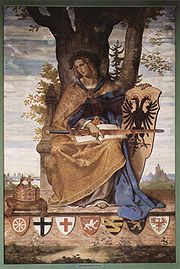
; these augmentations, which were special marks of honour, appeared in the centre of the electors' shields (as shown in the image above) above the other charges (in heraldic
Heraldry
Heraldry is the profession, study, or art of creating, granting, and blazoning arms and ruling on questions of rank or protocol, as exercised by an officer of arms. Heraldry comes from Anglo-Norman herald, from the Germanic compound harja-waldaz, "army commander"...
terms, the augmentations appeared in the form of inescutcheons). The Arch-Steward used gules
Gules
In heraldry, gules is the tincture with the colour red, and belongs to the class of dark tinctures called "colours". In engraving, it is sometimes depicted as a region of vertical lines or else marked with gu. as an abbreviation....
an orb
Globus cruciger
The globus cruciger is an orb topped with a cross , a Christian symbol of authority used throughout the Middle Ages and even today on coins, iconography and royal regalia...
Or
Or (heraldry)
In heraldry, Or is the tincture of gold and, together with argent , belongs to the class of light tinctures called "metals". In engravings and line drawings, it may be represented using a field of evenly spaced dots...
(a gold orb on a red field). The Arch-Marshal utilised the more complicated per fess
Fess
In heraldry, a fess or fesse is a charge on a coat of arms that takes the form of a band running horizontally across the centre of the shield. Writers disagree in how much of the shield's surface is to be covered by a fess or other ordinary, ranging from one-fifth to one-third...
sable
Sable (heraldry)
In heraldry, sable is the tincture black, and belongs to the class of dark tinctures, called "colours". In engravings and line drawings, it is sometimes depicted as a region of crossed horizontal and vertical lines or else marked with sa. as an abbreviation.The name derives from the black fur of...
and argent
Argent
In heraldry, argent is the tincture of silver, and belongs to the class of light tinctures, called "metals". It is very frequently depicted as white and usually considered interchangeable with it...
, two swords in saltire
Saltire
A saltire, or Saint Andrew's Cross, is a heraldic symbol in the form of a diagonal cross or letter ex . Saint Andrew is said to have been martyred on such a cross....
gules (two red swords arranged in the form of a saltire
Saltire
A saltire, or Saint Andrew's Cross, is a heraldic symbol in the form of a diagonal cross or letter ex . Saint Andrew is said to have been martyred on such a cross....
, on a black and white field). The Arch-Chamberlain's augmentation was azure
Azure
In heraldry, azure is the tincture with the colour blue, and belongs to the class of tinctures called "colours". In engraving, it is sometimes depicted as a region of horizontal lines or else marked with either az. or b. as an abbreviation....
a sceptre palewise
Pale (heraldry)
A pale is a term used in heraldic blazon and vexillology to describe a charge on a coat of arms , that takes the form of a band running vertically down the center of the shield. Writers broadly agree that the width of the pale ranges from about one-fifth to about one-third of the width of the...
Or (a gold sceptre on a blue field), while the Arch-Treasurer's was gules the crown of Charlemagne
Imperial Crown of the Holy Roman Empire
The Imperial Crown , is the hoop crown of the King of the Romans, the rulers of the German Kingdom, since the High Middle Ages. Most of the kings were crowned with it. It was made probably somewhere in Western Germany, either under Otto I , by Conrad II or Conrad III during the late 10th and early...
Or (a gold crown on a red field). As noted above, the Elector Palatine and the Elector of Hanover styled themselves Arch-Treasurer from 1714 until 1777; during this time, both electors used the corresponding augmentations. The three Arch-Chancellors and the Arch-Cupbearer did not use any augmentations.
The electors discharged the ceremonial duties associated with their offices only during coronations, where they bore the crown and regalia of the Empire. Otherwise, they were represented by holders of corresponding "Hereditary Offices of the Household". The Arch-Butler was represented by the Butler (Cupbearer) (the Count of Althann), the Arch-Seneschal by the Steward
Steward (office)
A steward is an official who is appointed by the legal ruling monarch to represent him or her in a country, and may have a mandate to govern it in his or her name; in the latter case, it roughly corresponds with the position of governor or deputy...
(the Count of Waldburg
House of Waldburg
The House of Waldburg is a princely family of Upper Swabia, founded some time previous to the 12th century; the cadet lineages are comital families....
), the Arch-Chamberlain by the Chamberlain
Chamberlain (office)
A chamberlain is an officer in charge of managing a household. In many countries there are ceremonial posts associated with the household of the sovereign....
(the Count of Hohenzollern), the Arch-Marshal by the Marshal
Marshal
Marshal , is a word used in several official titles of various branches of society. The word is an ancient loan word from Old French, cf...
(the Count of Pappenheim), and the Arch-Treasurer by the Treasurer
Treasurer
A treasurer is the person responsible for running the treasury of an organization. The adjective for a treasurer is normally "tresorial". The adjective "treasurial" normally means pertaining to a treasury, rather than the treasurer.-Government:...
(the Count of Sinzendorf). The Duke of Württemberg made the count of Zeppelin-Aschhausen as hereditary Bannerbearer.
See also
- Imperial electionImperial electionThe election of a Holy Roman Emperor or King of Germany was, from at least the 13th century, accomplished by a small body of the greatest princes of the Empire, the Prince-electors. Appointment as Emperor was normally for life...
- ElectressElectressAn Electress was the consort of an Elector of the Holy Roman Empire, one of the Empire's greatest princes.The Golden Bull of 1356 established by Emperor Charles IV settled the number of Electors at seven...
- Elective monarchyElective monarchyAn elective monarchy is a monarchy ruled by an elected rather than hereditary monarch. The manner of election, the nature of the candidacy and the electors vary from case to case...
- Electoral PalaceElectoral PalaceElectoral Palace or Elector's Palace may refer to any of the palaces of one of the German Holy Roman Empire's Prince-electors:* the Electoral Palace of the Electors Palatine of the Rhine at Amberg...
Sources
- Bryce, J. (1887). The Holy Roman Empire, 8th ed. New York: Macmillan.
- "Germany." (1911). Encyclopædia Britannica, 11th ed. London: Cambridge University Press.
External links
- The Avalon Project. (2003). "The Golden Bull of the Emperor Charles IV 1356 A.D."
- Oestreich, G. and Holzer, E. (1973). " Übersicht über die Reichsstände." In Gebhardt, Bruno. Handbuch der Deutschen Geschichte, 9th ed. (Vol. 2, pp. 769-784). Stuttgart: Ernst Ketler Verlag.
- Velde, F. R. (2003). "Royal Styles."
- Velde, F. R. (2004). "The Holy Roman Empire."