
All Topics  
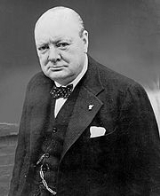
Winston Churchill

 
Winston Churchill

   Email Print
   Bookmark   Link


Winston Churchill


Sir Winston Leonard Spencer-Churchill, KG
Order of the Garter

The Most Noble Order of the Garter is an order of chivalry, or knighthood, originating in medieval England, and presently bestowed on recipients in the United Kingdom and other Commonwealth realms; it is the pinnacle of the Orders, decorations, and medals of the United Kingdom....
, OM
Order of Merit

The Order of Merit is a United Kingdom and Commonwealth of Nations Order bestowed by the Elizabeth II of the United Kingdom. It was established in 1902 by King Edward VII of the United Kingdom as a reward for distinguished service in the armed forces, science, art, literature, or for the promotion of culture....
, CH
Order of the Companions of Honour

The Order of the Companions of Honour is a United Kingdom and Commonwealth of Nations Order . It was founded by George V of the United Kingdom in June 1917, as a reward for outstanding achievements in the arts, literature, music, science, politics, industry, or religion....
, TD
Territorial Decoration

The Territorial Decoration was a medal of the United Kingdom awarded for long service in the Territorial Force and its successor, the Territorial Army....
, FRS, PC, PC (Can)
Queen's Privy Council for Canada

The Queen's Privy Council for Canada , sometimes called Her Majesty's Privy Council for Canada or the Privy Council, is the council of advisers to the Monarchy of Canada, whose members are appointed by the Governor General of Canada of Canada for life on the advice of the Prime Minister of Canada....
 (30 November 1874 – 24 January 1965) was a British politician
Politics of the United Kingdom

The politics of the United Kingdom of Great Britain and Northern Ireland takes place in the framework of a constitutional monarchy, in which the British monarchy is head of state and the Prime Minister of the United Kingdom of the United Kingdom is the head of government....
 known chiefly for his leadership of the United Kingdom during World War II
World War II

World War II, or the Second World War , was a global military conflict which involved a Participants in World War II, including all of the great powers, organised into two opposing military alliances: the Allies of World War II and the Axis powers....
. He served as Prime Minister
Prime minister

A prime minister is the most senior minister of Cabinet in the Executive branch of government in a parliamentary system. The position is usually held by, but need not always be held by, a politician....
 of the United Kingdom from 1940 to 1945 and again from 1951 to 1955. A noted statesman
Statesman

A statesman or stateswoman or statesperson is usually a politician or other notable figure of state who has had a long and respected career in politics at the national and international level....
 and orator
Orator

An orator, or oratist, is a speaker.An orator may also be called an oratarian - literally, "he who orates".Etymology...
, Churchill was also an officer
Officer (armed forces)

An officer is a member of an Armed forces who holds a position of authority.Commissioned officers derive authority directly from a sovereignty power and, as such, hold a Letters patent charging them with the duties and responsibilities of a specific office or position....
 in the British Army
British Army

The British Army is the Army branch of the British Armed Forces. It came into being with the unification of the Kingdoms of Kingdom of England and Kingdom of Scotland into the Kingdom of Great Britain in 1707....
, a historian
Historian

A historian is an individual who studies and writes about history, and is regarded as an authority on it. Historians are concerned with the continuous, systematic narrative and research of past events as relating to the human race; as well as the study of all events in time....
, a Nobel Prize
Nobel Prize

The Nobel Prize , established in the 1895 will of Swedish chemist Alfred Nobel; it was first awarded in Nobel Prize in Physics, Nobel Prize in Chemistry, Nobel Prize in Physiology or Medicine, Nobel Prize in Literature, and Nobel Peace Prize in 1901....
-winning writer, and an artist
Artist

The definition of an artist is wide-ranging and covers a broad spectrum of activities to do with creating art, practicing the arts and/or demonstrating an art....
.

During his army career, Churchill saw combat in India, in the Sudan
Sudan

Sudan is a country in northeastern Africa. It is the largest in the African continent and the Arab World, and List of countries and outlying territories by total area by area....
 and the Second Boer War
Second Boer War

The Second Boer War , commonly referred to as The Boer War and also known as the South African War , the Anglo-Boer War and in Afrikaans as the Boereoorlog or Tweede Vryheidsoorlog , was fought from 11 October 1899 until 31 May 1902, between the British Empire and the two independent Boer republics of the Orange Fre...
.


Discussion
Ask a question about 'Winston Churchill'
Start a new discussion about 'Winston Churchill'
Answer questions from other users
Full Discussion Forum


Recent Posts


Timeline

1874   Born

1901   Winston Churchill enters the House of Commons

1908   Winston Churchill is ordained as a Druid in England.

1940   With the resignation of Neville Chamberlain, Winston Churchill becomes Prime Minister of the United Kingdom

1940   Winston Churchill, in his first address as Prime Minister, tells the House of Commons, "I have nothing to offer you but blood, toil, tears, and sweat."

1940   Winston Churchill warns the House of Commons to, "...prepare itself for hard and heavy tidings."

1940   Winston Churchill speaks to the House of Commons: "...the Battle of France is over. The Battle of Britain is about to begin."

1940   Winston Churchill pays tribute in the House of Commons to the Royal Air Force: "Never in the field of human conflict was so much owed by so many to so few."

1941   Franklin D. Roosevelt and Winston Churchill meet at Argentia, Newfoundland. The Atlantic Charter is created as a result.

1941   World War II: Winston Churchill becomes the first British Prime Minister to address a Joint session of the U.S. Congress


Quotations


Baldwin, Stanley ... confesses putting party before country, 169-70; ..

Index entry, The Second World War, Volume I : The Gathering Storm (1948)

For myself, I am an optimist — it does not seem to be much use being anything else.

Speech at the Lord Mayor's banquet in London (1954-11-09)

I am prepared to meet my maker; whether my maker is prepared to meet me is entirely another matter.

I do think unpunctuality is a vile habit, and all my life I have tried to break myself of it.

Roving Commission: My Early Life (1930)

It is better to be making the news than taking it; to be an actor rather than a critic.

The Story of the Malakand Field Force (1898)

Plans are of little importance, but planning is essential


Encyclopedia


Sir Winston Leonard Spencer-Churchill, KG
Order of the Garter

The Most Noble Order of the Garter is an order of chivalry, or knighthood, originating in medieval England, and presently bestowed on recipients in the United Kingdom and other Commonwealth realms; it is the pinnacle of the Orders, decorations, and medals of the United Kingdom....
, OM
Order of Merit

The Order of Merit is a United Kingdom and Commonwealth of Nations Order bestowed by the Elizabeth II of the United Kingdom. It was established in 1902 by King Edward VII of the United Kingdom as a reward for distinguished service in the armed forces, science, art, literature, or for the promotion of culture....
, CH
Order of the Companions of Honour

The Order of the Companions of Honour is a United Kingdom and Commonwealth of Nations Order . It was founded by George V of the United Kingdom in June 1917, as a reward for outstanding achievements in the arts, literature, music, science, politics, industry, or religion....
, TD
Territorial Decoration

The Territorial Decoration was a medal of the United Kingdom awarded for long service in the Territorial Force and its successor, the Territorial Army....
, FRS, PC, PC (Can)
Queen's Privy Council for Canada

The Queen's Privy Council for Canada , sometimes called Her Majesty's Privy Council for Canada or the Privy Council, is the council of advisers to the Monarchy of Canada, whose members are appointed by the Governor General of Canada of Canada for life on the advice of the Prime Minister of Canada....
 (30 November 1874 – 24 January 1965) was a British politician
Politics of the United Kingdom

The politics of the United Kingdom of Great Britain and Northern Ireland takes place in the framework of a constitutional monarchy, in which the British monarchy is head of state and the Prime Minister of the United Kingdom of the United Kingdom is the head of government....
 known chiefly for his leadership of the United Kingdom during World War II
World War II

World War II, or the Second World War , was a global military conflict which involved a Participants in World War II, including all of the great powers, organised into two opposing military alliances: the Allies of World War II and the Axis powers....
. He served as Prime Minister
Prime minister

A prime minister is the most senior minister of Cabinet in the Executive branch of government in a parliamentary system. The position is usually held by, but need not always be held by, a politician....
 of the United Kingdom from 1940 to 1945 and again from 1951 to 1955. A noted statesman
Statesman

A statesman or stateswoman or statesperson is usually a politician or other notable figure of state who has had a long and respected career in politics at the national and international level....
 and orator
Orator

An orator, or oratist, is a speaker.An orator may also be called an oratarian - literally, "he who orates".Etymology...
, Churchill was also an officer
Officer (armed forces)

An officer is a member of an Armed forces who holds a position of authority.Commissioned officers derive authority directly from a sovereignty power and, as such, hold a Letters patent charging them with the duties and responsibilities of a specific office or position....
 in the British Army
British Army

The British Army is the Army branch of the British Armed Forces. It came into being with the unification of the Kingdoms of Kingdom of England and Kingdom of Scotland into the Kingdom of Great Britain in 1707....
, a historian
Historian

A historian is an individual who studies and writes about history, and is regarded as an authority on it. Historians are concerned with the continuous, systematic narrative and research of past events as relating to the human race; as well as the study of all events in time....
, a Nobel Prize
Nobel Prize

The Nobel Prize , established in the 1895 will of Swedish chemist Alfred Nobel; it was first awarded in Nobel Prize in Physics, Nobel Prize in Chemistry, Nobel Prize in Physiology or Medicine, Nobel Prize in Literature, and Nobel Peace Prize in 1901....
-winning writer, and an artist
Artist

The definition of an artist is wide-ranging and covers a broad spectrum of activities to do with creating art, practicing the arts and/or demonstrating an art....
.

During his army career, Churchill saw combat in India, in the Sudan
Sudan

Sudan is a country in northeastern Africa. It is the largest in the African continent and the Arab World, and List of countries and outlying territories by total area by area....
 and the Second Boer War
Second Boer War

The Second Boer War , commonly referred to as The Boer War and also known as the South African War , the Anglo-Boer War and in Afrikaans as the Boereoorlog or Tweede Vryheidsoorlog , was fought from 11 October 1899 until 31 May 1902, between the British Empire and the two independent Boer republics of the Orange Fre...
. He gained fame and notoriety as a war correspondent and through contemporary books he wrote describing the campaigns. He also served briefly in the British Army on the Western Front
Western Front (World War I)

Following the outbreak of World War I in 1914, the German Empire army opened the Western Front by first invading Luxembourg and Belgium, then gaining military control of important industrial regions in France....
 in World War I
World War I

World War I, or the First World War , was a global military conflict which involved the Great powers, organized into two opposing military alliances: the Allies of World War I and the Central Powers....
, commanding the 6th Battalion of the Royal Scots Fusiliers
Royal Scots Fusiliers

The Royal Scots Fusiliers was a Regiment of the British Army....
.

At the forefront of the political scene for almost fifty years, he held many political and cabinet positions. Before the First World War, he served as President of the Board of Trade, Home Secretary
Home Secretary

The Secretary of State for the Home Department, commonly known as the Home Secretary, is the minister in charge of the United Kingdom Home Office and is one of the Great Offices of State....
  and First Lord of the Admiralty as part of the Asquith
H. H. Asquith

Herbert Henry Asquith, 1st Earl of Oxford and Asquith, Order of the Garter, Privy Council of the United Kingdom, Queen's Counsel served as the Liberal Party Prime Minister of the United Kingdom from 1908 to 1916....
 Liberal government
Liberal Government 1905-1915

With the fall of Arthur Balfour Conservative Government 1895?1905 in the United Kingdom in December 1905, the Liberal Party under Henry Campbell-Bannerman were called in to form a government....
. During the war he continued as First Lord of the Admiralty until the disastrous Battle of Gallipoli
Battle of Gallipoli

The Gallipoli Campaign took place at Gallipoli peninsula in Turkey from 25 April 1915 to 9 January 1916, during the World War I. A joint British Empire and French operation was mounted to capture the Ottoman Empire capital of Constantinople , and secure a sea route to Russia....
 caused his departure from government. He returned as Minister of Munitions
Minister of Munitions

File:David Lloyd George.jpgThe Minister of Munitions was a British government position created during the World War I to oversee and co-ordinate the production and distribution of munitions for the war effort....
, Secretary of State for War
Secretary of State for War

The position of Secretary of State for War, commonly called War Secretary, was a United Kingdom Cabinet -level position, first applied to Henry Dundas ....
 and Secretary of State for Air
Secretary of State for Air

File:Archibaldsinclair.jpgThe Secretary of State for Air was a cabinet level British position, in charge of the Air Ministry. It was created on 10 January 1919 to manage the Royal Air Force....
. In the interwar years
Interwar period

The interwar period is understood, within recent Western culture, to be the period between the end of the First World War and the beginning of the Second World War....
, he served as Chancellor of the Exchequer
Chancellor of the Exchequer

The Chancellor of the Exchequer is the title held by the British Cabinet of the United Kingdom Minister who is responsible for all economic and financial matters....
 in the Conservative government.

After the outbreak of the Second World War
World War II

World War II, or the Second World War , was a global military conflict which involved a Participants in World War II, including all of the great powers, organised into two opposing military alliances: the Allies of World War II and the Axis powers....
, Churchill was again appointed First Lord of the Admiralty. Following the resignation of Neville Chamberlain
Neville Chamberlain

Arthur Neville Chamberlain was a British Conservative Party politician and Prime Minister of the United Kingdom from 1937 to 1940. Chamberlain is best known for appeasement foreign policy, in particular regarding his signing of the Munich Agreement in 1938, conceding the Sudetenland region of Czechoslovakia to Germany, and for his "containm...
 on 10 May 1940, he became Prime Minister of the United Kingdom
Prime Minister of the United Kingdom

The Prime Minister of the United Kingdom of Great Britain and Northern Ireland is the political leader of the United Kingdom and the head of government Her Majesty's Government....
 and led Britain to victory against the Axis powers. Churchill was always noted for his speeches, which became a great inspiration to the British people and embattled Allied forces
Allies of World War II

The Allies of World War II were the countries officially opposed to the Axis powers of World War II during the World War II. Within the ranks of the Allies powers, the British Empire, the Soviet Union, and the United States of America were known as "The Big Three"....
.

After losing the 1945 election
United Kingdom general election, 1945

The United Kingdom General Election of 1945 was a United Kingdom general election held on 5 July 1945, with delayed polls taking place on 12 July and in Nelson and Colne on 19 July....
, he became Leader of the Opposition. In 1951, he again became Prime Minister before finally retiring in 1955. Elizabeth II
Elizabeth II of the United Kingdom

Elizabeth II is the queen regnant of sixteen independent states known as the Commonwealth realms: Monarchy of the United Kingdom, Monarchy of Canada, Monarchy of Australia, Monarchy of New Zealand, Monarchy of Jamaica, Monarchy of Barbados, the Bahamas, Grenada, Papua New Guinea, the Monarchy of the Solomon Islands, Tuvalu, Saint Lucia, Sain...
 offered to create him Duke of London, but this was declined due to the objections of his son Randolph, who would have inherited the title on his father's death. Upon his death the Queen granted him the honour of a state funeral
State funeral

A state funeral is a public funeral ceremony held to honour heads of state or other important people of national significance. They usually include much pomp and ceremony....
, which saw one of the largest assemblies of statesmen in the world.

Family and early life

Blenheim Main Entrance
A descendant of the famous Spencer family
Spencer family

There are many Spencer families, comprising all individuals with the surname Spencer. The below are the Spencer family descended in the male line from a certain Henry Spencer , male-line ancestor of the Earl of Sunderland, the later Duke of Marlborough, the Earl Spencer and Diana, Princess of Wales, later the Princess of Wales ....
, Winston Leonard Spencer-Churchill, like his father, used the surname Churchill in public life. His ancestor George Spencer
George Spencer-Churchill, 5th Duke of Marlborough

George Spencer-Churchill, 5th Duke of Marlborough Doctor of Laws Master of Arts Society of Arts was the son of George Spencer, 4th Duke of Marlborough....
 had changed his surname to Spencer-Churchill in 1817 when he became Duke of Marlborough
Duke of Marlborough

The Dukedom of Marlborough , is a hereditary title of British nobility in the Peerage of Peerage of England. The first holder of the title was John Churchill, 1st Duke of Marlborough , the noted English general, and indeed an unqualified reference to the Duke of Marlborough in a historical text will almost certainly be a reference to him...
, to highlight his descent from John Churchill, 1st Duke of Marlborough
John Churchill, 1st Duke of Marlborough

John Churchill, 1st Duke of Marlborough Order of the Garter was an England soldier and statesman whose career spanned the reigns of five monarchs throughout the late 17th and early 18th centuries....
. Winston's father, Lord Randolph Churchill
Lord Randolph Churchill

Lord Randolph Henry Spencer Churchill was a United Kingdom statesman.Lord Randolph was the third son of the John Winston Spencer-Churchill, 7th Duke of Marlborough and his wife Frances Anne Emily Vane-Tempest , daughter of the Charles William Vane, 3rd Marquess of Londonderry....
, the third son of John Spencer-Churchill, 7th Duke of Marlborough
John Spencer-Churchill, 7th Duke of Marlborough

John Winston Spencer-Churchill, 7th Duke of Marlborough, Order of the Garter was an England statesman and nobleman. He was the son of George Spencer-Churchill, 6th Duke of Marlborough and Lady Jane Stewart....
, was a politician, while his mother, Lady Randolph Churchill
Jennie Churchill

Lady Randolph Churchill, Order of the Crown of India, Venerable Order of Saint John was the mother of British List of British Prime Ministers Winston Churchill....
 (nιe
Nee

Nee may refer to:* Married and maiden names or Nee, French for "born", indicates a woman's birth surname* NEE, a political party in Flanders, Belgium...
 Jennie Jerome) was the daughter of American millionaire Leonard Jerome
Leonard Jerome

Leonard Walter Jerome was a Brooklyn, New York, financier and grandfather of Winston Churchill....
. Born on 30 November 1874 in a bedroom in Blenheim Palace
Blenheim Palace

File:Blenheim main entrance.jpgBlenheim Palace is a large and monumental English country house situated in Woodstock, Oxfordshire, Oxfordshire, England....
, Woodstock
Woodstock, Oxfordshire

Woodstock is a small town in Oxfordshire, England which is home to Blenheim Palace, a UNESCO World Heritage Site, where Winston Churchill was born in 1874....
, Oxfordshire
Oxfordshire

Oxfordshire is a county in the South East England region, bordering on Northamptonshire, Buckinghamshire, Berkshire, Wiltshire, Gloucestershire, and Warwickshire....
; he arrived eight months after his parents' hasty marriage. Churchill had one brother, John Strange Spencer-Churchill
John Strange Spencer-Churchill

Major John Strange Spencer-Churchill Distinguished Service Order Territorial Decoration was the son of Lord Randolph Churchill and Jennie Jerome, and brother of Winston Churchill....
.

Independent and rebellious by nature, Churchill generally did poorly in school, for which he was punished. He entered Harrow School
Harrow School

Harrow School, commonly known as "Harrow", is a world-famous boys' independent school in United Kingdom. Harrow has educated boys since 1243 but was officially founded by John Lyon under a Royal Charter of Elizabeth I in 1572....
 on 17 April 1888, where his military career began. Within weeks of his arrival, he had joined the Harrow Rifle Corps
Combined Cadet Force

The Combined Cadet Force is a Ministry of Defence sponsored youth organisation in the United Kingdom. Its aim is to "provide a disciplined organisation in a school so that pupils may develop powers of leadership by means of training to promote the qualities of responsibility, self reliance, resourcefulness, endurance and perseverance"....
. He earned high marks in English
English studies

English studies is an academic discipline that includes the study of literatures written in the English language , English linguistics , and English sociolinguistics ....
 and history
HIStory

HIStory: Past, Present and Future, Book I is a double album by Michael Jackson, released on June 20, 1995, and is Jackson's ninth. The first disc, named "HIStory Begins" consists of a selection of Jackson's greatest hits from the singer's past fifteen years, while the second, named "HIStory Continues" features new songs, with the...
 and was also the school's fencing champion.
Randolph Churchill
He was rarely visited by his mother (then known as Lady Randolph), and wrote letters begging her to either come to the school or to allow him to come home. His relationship with his father was a distant one, he once remarked that they barely spoke to each other. Due to this lack of parental contact he became very close to his nanny, Elizabeth Anne Everest, who he used to call "Woomany". His father died on 24 January 1895, aged just 45, leaving Churchill with the conviction that he too would die young, so should be quick about making his mark on the world.

Speech impediment


Churchill described himself as having a "speech impediment" which he consistently worked to overcome. After many years, he finally stated, "My impediment is no hindrance." Trainee speech therapists are often shown videotapes of Churchill's mannerisms while making speeches and the uses Churchill, pictured on its home page, as one of its role models of successful stutterers. This diagnosis is confirmed by The Churchill Centre, however, flatly refutes the claim that Churchill stuttered while confirming that he did have difficulty pronouncing the letter 'S' and spoke with a lisp
Lisp

A lisp is a speech impediment, historically also known as sigmatism. Stereotypically, people with a lisp are unable to pronounce sibilants , and replace them with Interdental consonants , though there are actually several kinds of lisps....
. His father also spoke with a lisp. The National Cluttering Association however maintains that Churchill had not a stutter but a clutter
Cluttering

Cluttering is a speech disorder and a communication disorder characterized by speech that is difficult for listeners to understand due to rapid speaking rate, erratic rhythm, poor syntax or grammar, and words or groups of words unrelated to the sentence....
.

Marriage and children


Churchill met his future wife, Clementine Hozier, in 1904 at a ball in Crewe House, home of the Earl of Crewe
Robert Crewe-Milnes, 1st Marquess of Crewe

File:Robert Crewe-Milnes portrait.jpgRobert Offley Ashburton Crewe-Milnes, 1st Marquess of Crewe Knight of the Garter , Privy Council of the United Kingdom was a United Kingdom statesman and writer....
 and his wife Margaret Primrose
Robert Crewe-Milnes, 1st Marquess of Crewe

File:Robert Crewe-Milnes portrait.jpgRobert Offley Ashburton Crewe-Milnes, 1st Marquess of Crewe Knight of the Garter , Privy Council of the United Kingdom was a United Kingdom statesman and writer....
 (daughter of Archibald Primrose, 5th Earl of Rosebery
Archibald Primrose, 5th Earl of Rosebery

Archibald Philip Primrose, 5th Earl of Rosebery, Order of the Garter, Privy Council of the United Kingdom was a United Kingdom Liberal Party statesman and Prime Minister of the United Kingdom, also known as Archibald Primrose and Lord Dalmeny ....
). In 1908, they met again at a dinner party hosted by Lady St Helier
Francis Jeune, 1st Baron St Helier

File:LordStHelier.jpgFrancis Henry Jeune, 1st Baron St Helier was an England judge.Jeune was the son of the Rt. Rev. Francis Jeune, Bishop of Peterborough and Margaret Dyne Symons....
. Churchill found himself seated beside Clementine, and they soon began a lifelong romance. He proposed to Hozier during a house party at Blenheim Palace
Blenheim Palace

File:Blenheim main entrance.jpgBlenheim Palace is a large and monumental English country house situated in Woodstock, Oxfordshire, Oxfordshire, England....
 on 10 August 1908, in a small Temple of Diana
Blenheim Palace

File:Blenheim main entrance.jpgBlenheim Palace is a large and monumental English country house situated in Woodstock, Oxfordshire, Oxfordshire, England....
. On 12 September 1908, they were married in St. Margaret's, Westminster
St. Margaret's, Westminster

The Anglicanism church of St. Margaret, Westminster is situated in the grounds of Westminster Abbey on Parliament Square, and is the parish church of the United Kingdom Palace of Westminster in London....
. The church was packed; the Bishop of St Asaph
Alfred George Edwards

The Most Rev Alfred George Edwards , was elected the first Archbishop of the disestablished Church in Wales. The son of a priest of the Church of England, he was born in Llanymawddwy in Gwynedd....
 conducted the service. In March 1909, the couple moved to a house at 33 Eccleston Square.

Their first child, Diana
Diana Churchill

Diana Churchill was the eldest daughter of Winston Churchill and Clementine Churchill, Baroness Spencer-Churchill .On 12 December 1932, she married the baronet Sir John Milner Bailey, but the marriage was unsuccessful and they divorced in 1935....
, was born in London on 11 July 1909. After the pregnancy, Clementine moved to Sussex to recover, while Diana stayed in London with her nanny. On 28 May 1911, their second child, Randolph
Randolph Churchill

Major Randolph Frederick Edward Spencer Churchill, Order of the British Empire was the son of List of British Prime Ministers Winston Churchill and his wife Clementine Churchill....
, was born at 33 Eccleston Square. Their third child, Sarah, was born on 7 October 1914 at Admiralty House
Admiralty House (London)

Admiralty House in London was designed by Sir Robert Taylor and his protege Samuel Pepys Cockerell and opened in 1786. Built at the request of Admiral Lord Howe, First Lord of the Admiralty in 1782-83 for "a few small rooms of my own", it was the official residence of First Lords of the Admiralty until 1964, and has also been home to several...
. The birth was marked with anxiety for Clementine, as Winston had been sent to Antwerp
Antwerp

||-||-||-||}Antwerp is a city and municipality in Belgium and the capital of the Antwerp in Flanders, one of Belgium's three regions....
 by the Cabinet to "stiffen the resistance of the beleaguered city" after news that the Belgians intended to surrender the town.

Clementine gave birth to her fourth child, Marigold Frances Churchill, on 15 November 1918, four days after the official end of World War I. In the early months of August, the Churchills' children were entrusted to a French nursery governess in Kent named Mlle Rose. Clementine, meanwhile, travelled to Eaton Hall
Eaton Hall (Cheshire)

Eaton Hall is the country house of the Duke of Westminster which is set within a large estate south of the village of Eccleston, Cheshire, Cheshire, England ....
 to play tennis with Hugh Grosvenor, 2nd Duke of Westminster
Hugh Grosvenor, 2nd Duke of Westminster

Hugh Richard Arthur Grosvenor, 2nd Duke of Westminster Royal Victorian Order Distinguished Service Order was the son of Victor Alexander Grosvenor, Earl Grosvenor and Lady Sibell Mary Lumley, the daughter of the Earl of Scarborough....
 and his family. While still under the care of Mlle Rose, Marigold had a cold, but was reported to have recovered from the illness. As the illness progressed with hardly any notice, it turned into septicaemia. Following advice from a landlady, Rose sent for Clementine. However the illness turned fatal on 23 August 1921, and Marigold was buried in the Kensal Green Cemetery
Kensal Green Cemetery

Kensal Green Cemetery is a burial ground located in Kensal Green, London, England. It was immortalised in the lines of GK Chesterton "For there is good news yet to hear and fine things to be seen; Before we go to Paradise by way of Kensal Green"....
 three days later. On 15 September 1922, the Churchills' last child was born, Mary
Mary Soames, Baroness Soames

Mary Soames, Baroness Soames, Order of the Garter, Order of the British Empire is the widow of the Christopher Soames, Baron Soames.She was born Mary Churchill, the youngest of Winston Churchill and his wife Clementine Churchill's five children....
. Later that month, the Churchills bought Chartwell
Chartwell

Chartwell, located two miles south of Westerham, Kent, England, was the home of Sir Winston Churchill.Churchill and his wife Lady Clementine Churchill, Baroness Spencer-Churchill bought the property in 1922 and retained it until his death in 1965....
, which would be Winston's home until his death in 1965.

Service in the Army


After Churchill left Harrow in 1893, he applied to attend the Royal Military Academy, Sandhurst. It took three attempts before he passed the entrance exam; he applied for cavalry rather than infantry because the grade requirement was lower and did not require him to learn mathematics, which he disliked. He graduated eighth out of a class of 150 in December 1894, and although he could now have transferred to an infantry regiment as his father had wished, chose to remain with the cavalry and was commissioned as a Second Lieutenant
Second Lieutenant

Second Lieutenant is the lowest Officer military rank in many armed forces.In British English the rank is pronounced second /l?f't?n?nt/ , while in American English it is pronounced second /lu't?n?nt/ ....
 in the 4th Queen's Own Hussars
4th Queen's Own Hussars

The 4th Queen's Own Hussars was a Cavalry regiments of the British Army in the British Army, first raised in 1685. It saw service for three centuries, before being amalgamated into The Queen's Royal Irish Hussars in 1958....
 on 20 February 1895. In 1941, he received the honour of Colonel of the Hussars.

Churchill's pay as a second lieutenant in the 4th Hussars was £300. However, he believed that he needed at least a further £500 (equivalent to £25,000 in 2001 terms) to support a style of life equal to other officer
Officer (armed forces)

An officer is a member of an Armed forces who holds a position of authority.Commissioned officers derive authority directly from a sovereignty power and, as such, hold a Letters patent charging them with the duties and responsibilities of a specific office or position....
s of the regiment
Regiment

A regiment is a military unit, composed of variable numbers of battalions, commanded by a Colonel. Depending on the nation, military branch, mission, and organization, a modern regiment resembles a brigade, in that both range in size from a few hundred to 5,000 soldiers ....
. His mother provided an allowance of £400 per year, but this was repeatedly overspent. According to biographer Roy Jenkins
Roy Jenkins

Roy Harris Jenkins, Baron Jenkins of Hillhead Order of Merit Privy Council of the United Kingdom was a British politician. Once prominent as a Labour Party Member of Parliament and government minister in the 1960s and 1970s, he became the first British President of the European Commission and one of the four principal founders of the So...
, this is one reason he took an interest in war correspondence. He did not intend to follow a conventional career of promotion through army ranks, but to seek out all possible chances of military action and used his mother's and family influence in high society to arrange postings to active campaigns. His writings both brought him to the attention of the public, and earned him significant additional income. He acted as a war correspondent for several London newspapers and wrote his own books about the campaigns.

Cuba

In 1895, Churchill travelled to Cuba
Cuba

The Republic of Cuba is a country in the Caribbean. It consists of the island of Cuba , the island of Isla de la Juventud, and several adjacent small islands....
 to observe the Spanish fight the Cuban guerrillas; he had obtained a commission to write about the conflict from the Daily Graphic. To his delight, he came under fire for the first time on his twenty-first birthday. He had fond memories of Cuba as a "...large, rich, beautiful island..." While there, he soon acquired a taste for Havana cigars, which he would smoke for the rest of his life. While in New York, he stayed at the home of Bourke Cockran
William Bourke Cockran

William Bourke Cockran was a United States Representative from New York. Born in County Sligo, Ireland, he was educated in France and in his native country, and immigrated to the United States when seventeen years of age....
, an admirer of his mother's. Bourke was an established American politician, member of the House of Representatives and potential presidential candidate. He greatly influenced Churchill, both in his approach to oratory and politics, and encouraging a love of America.

He soon received word that his nanny, Mrs Everest, was dying; he then returned to England and stayed with her for a week until she died. He wrote in his journal "She was my favourite friend." In My Early Life
My Early Life

My Early Life: A Roving Commission is a 1930 book by Winston Churchill. It is an autobiography of his life from birth in 1874 up to approximately 1902....
 he wrote: "She had been my dearest and most intimate friend during the whole of the twenty years I had lived."

India

In early October 1896, he was transferred to Bombay
Mumbai

Mumbai— formerly Bombay, is the capital of the Indian state of Maharashtra. The city proper has approximately 14 million people and, along with the neighbouring suburbs of Navi Mumbai and Thane, Mumbai forms the World's largest urban agglomerations according to the United Nations World Urbanization Prospects report with around 19...
, British India. He was considered one of the best polo
Polo

Polo is a team sport played on horseback in which the objective is to score Goal s against an opposing team. Riders score by driving a small white plastic or wooden Ball game into the opposing team's goal using a long-handled mallet....
 players in his regiment and led his team to many prestigious tournament victories.

Malakand

In 1897, Churchill attempted to travel to both report and, if necessary, fight in the Greco-Turkish War
Greco-Turkish War (1897)

The Greco-Turkish War of 1897, also called the Thirty Days' War and known as the black '97 in Greece was a war fought between the Kingdom of Greece and Ottoman Empire....
, but this conflict effectively ended before he could arrive. Later, while preparing for a leave in England, he heard that three brigades of the British Army
British Army

The British Army is the Army branch of the British Armed Forces. It came into being with the unification of the Kingdoms of Kingdom of England and Kingdom of Scotland into the Kingdom of Great Britain in 1707....
 were going to fight against a Pashtun tribe and he asked his superior officer if he could join the fight. He fought under the command of General Jeffery, who was the commander of the second brigade operating in Malakand
Malakand

Malakand is a region in the NWFP of Pakistan. Named after Malakand Agency, a part of this region, it covers one third of the total area of the province....
, in what is now Pakistan
Pakistan

Pakistan , officially the Islamic Republic of Pakistan, is a country located in South Asia and borders Central Asia and the Middle East. It has a 1,046 kilometre coastline along the Arabian Sea and Gulf of Oman in the south, and is bordered by Afghanistan and Iran in the west, India in the east and People's Republic of China in th...
. Jeffery sent him with fifteen scouts to explore the Mamund
Mamund

The Mamund are a Pashtun tribe of around quarter a million people and are one of the four clans of Tarkanis. The tribe is located principally in the Watelai valley, but also own villages on both sides of the Durand Line....
 Valley; while on reconnaissance, they encountered an enemy tribe, dismounted from their horses and opened fire. After an hour of shooting, their reinforcements, the 35th Sikhs arrived, and the fire gradually ceased and the brigade and the Sikhs marched on. Hundreds of tribesmen then ambushed them and opened fire, forcing them to retreat. As they were retreating four men were carrying an injured officer but the fierceness of the fight forced them to leave him behind. The man who was left behind was slashed to death before Churchill’s eyes; afterwards he wrote of the killer, "I forgot everything else at this moment except a desire to kill this man". However the Sikhs' numbers were being depleted so the next commanding officer told Churchill to get the rest of the men and boys to safety.

Before he left he asked for a note so he would not be charged with desertion. He received the note, quickly signed, and headed up the hill and alerted the other brigade, whereupon they then engaged the army. The fighting in the region dragged on for another two weeks before the dead could be recovered. He wrote in his journal: "Whether it was worth it I cannot tell." An account of the Siege of Malakand
Siege of Malakand

The Siege of Malakand was the 26 July ? 2 August 1897 siege of the British Raj garrison in the Malakand region colonial India's North West Frontier Province....
 was published in December 1900 as The Story of the Malakand Field Force
The Story of the Malakand Field Force

The Story of the Malakand Field Force: An Episode of Frontier War was an 1898 book written by Winston Churchill; it was his first published work of non-fiction....
. He received £600 for his account. During the campaign, he also wrote articles for the newspapers The Pioneer
The Pioneer (daily)

The Pioneer is a medium-sized English language newspaper in India.It is published from Delhi, Lucknow, Bhubaneswar, Kochi, India, Bhopal, Chandigarh and Dehradun....
 and The Daily Telegraph
The Daily Telegraph

The Daily Telegraph is a British broadsheet newspaper, founded in 1855. Excepting the Financial Times and The Herald , it is the only remaining national daily newspaper printed on traditional newsprint in the broadsheet format in the United Kingdom, as most other broadsheet publications have converted to the smaller tabloid/Compa...
. His account of the battle was one of his first published stories, for which he received £5 per column from The Daily Telegraph
The Daily Telegraph

The Daily Telegraph is a British broadsheet newspaper, founded in 1855. Excepting the Financial Times and The Herald , it is the only remaining national daily newspaper printed on traditional newsprint in the broadsheet format in the United Kingdom, as most other broadsheet publications have converted to the smaller tabloid/Compa...
.

Sudan and Oldham

Churchill was transferred to Egypt
Egypt

Egypt is a country mainly in North Africa, with the Sinai Peninsula forming a land bridge in Western Asia. Covering an area of about , Egypt borders the Mediterranean Sea to the north, the Gaza Strip and Israel to the northeast, the Red Sea to the east, Sudan to the south and Libya to the west....
 in 1898 where he visited Luxor
Luxor

Luxor is a city in Upper Egypt and the capital of Luxor Governorate. Its population numbers 376,022 , and its area is about . As the site of the ancient Egyptian city of Thebes, Egypt, Luxor has frequently been characterized as the "world's greatest open air museum", the ruins of the temple complexes at Karnak and Luxor Temple standing wi...
 before joining an attachment of the 21st Lancers
21st Lancers

The 21st Lancers were a Cavalry regiments of the British Army of the British Army, created in 1858 and amalgamated to form the 17th/21st Lancers in 1922....
 serving in the Sudan
Sudan

Sudan is a country in northeastern Africa. It is the largest in the African continent and the Arab World, and List of countries and outlying territories by total area by area....
 under the command of General Herbert Kitchener. During his time he encountered two future military officers, with whom he would later work, during the First World War: Douglas Haig
Douglas Haig

Douglas Haig may refer to:*Douglas Haig, 1st Earl Haig, British Earl and a Field Marshall during the First World War*Club Atl?tico Douglas Haig, a football club from Argentina...
, then a captain and John Jellicoe
John Jellicoe, 1st Earl Jellicoe

Admiral of the Fleet John Rushworth Jellicoe, 1st Earl Jellicoe, Order of the Bath, Order of Merit , Royal Victorian Order was a British Royal Navy admiral who commanded the Grand Fleet at the Battle of Jutland....
, then a gunboat lieutenant. While in the Sudan, he participated in what has been described as the last meaningful British cavalry charge
Charge (warfare)

A charge is a maneuver in battle in which soldiers advance towards their enemy at their best speed to engage in close combat. The charge is the dominant shock attack and has been the key tactic and decisive moment of most battles in history....
 at the Battle of Omdurman
Battle of Omdurman

At the Battle of Omdurman , an army commanded by the United Kingdom General Sir Herbert Kitchener, 1st Earl Kitchener defeated the army of Abdullah al-Taashi, the successor to the self-proclaimed Mahdi Muhammad Ahmad....
 in September 1898. He also worked as a war correspondent for the Morning Post
Morning Post

The Morning Post, as the paper was named on its masthead, was a conservative daily newspaper published in London from 1772 to 1937, when it was acquired by The Daily Telegraph....
. By October 1898, he had returned to Britain and begun his two-volume work; The River War
The River War

The River War: An Historical Account of the Reconquest of the Soudan is an 1899 book written by Winston Churchill while he was still an officer in the British army....
, an account of the reconquest of the Sudan published the following year. Churchill resigned from the British Army effective from 5 May 1899.

He soon had his first opportunity to begin a Parliamentary career, when he was invited by Robert Ascroft
Robert Ascroft

Robert Ascroft , JP. Member of Parliament, was a prominent Lancashire solicitor and an English politician. He was one of the two Member of Parliament for Oldham between United Kingdom general election, 1895 and his death, representing the Conservative Party ....
 to be the second Conservative Party
Conservative Party (UK)

The Conservative and Unionist Party, more commonly known as the Conservative Party, is a conservative political party in the United Kingdom....
 candidate in Ascroft's Oldham
Oldham (UK Parliament constituency)

Oldham was a United Kingdom constituencies centred on the town of Oldham, England. It returned two Member of Parliament to the British House of Commons of the Parliament of the United Kingdom....
 constituency. In the event Ascroft's sudden death caused a double by-election and Churchill was one of the candidates. In the midst of a national trend against the Conservatives, both seats were lost; however Churchill was impressed by his vigorous campaigning.

South Africa

Having failed at Oldham, Churchill looked about for some other opportunity to advance his career. On 12 October 1899, the Second Boer War
Second Boer War

The Second Boer War , commonly referred to as The Boer War and also known as the South African War , the Anglo-Boer War and in Afrikaans as the Boereoorlog or Tweede Vryheidsoorlog , was fought from 11 October 1899 until 31 May 1902, between the British Empire and the two independent Boer republics of the Orange Fre...
  between Britain and the Boer Republics
Boer Republics

The Boer Republics were independent self-governed republics created by the Dutch language-speaking inhabitants of the Cape of Good Hope and their descendants in mainly the northern and eastern parts of what is now the country of South Africa....
 broke out and he obtained a commission to act as war correspondent for the Morning Post
Morning Post

The Morning Post, as the paper was named on its masthead, was a conservative daily newspaper published in London from 1772 to 1937, when it was acquired by The Daily Telegraph....
 with a salary of £250 per month. He rushed to sail on the same ship as the newly appointed British commander, Sir Redvers Buller
Redvers Buller

General Sir Redvers Henry Buller Victoria Cross Order of the Bath Order of St Michael and St George was a British general and Victoria Cross holder....
. After some weeks in exposed areas he accompanied a scouting expedition in an armoured train, leading to his capture and imprisonment in a POW camp in Pretoria
Pretoria

Pretoria is a city located in the northern part of Gauteng Province, South Africa. It is one of the country's three Capital , serving as the Executive and de facto national capital; the others are Cape Town, the legislature capital, and Bloemfontein, the judicial capital....
. His actions during the ambush of the train led to speculation that he would be awarded the Victoria Cross
Victoria Cross

The Victoria Cross is the highest military decoration which is, or has been, awarded for valour "in the face of the enemy" to members of the armed forces of various Commonwealth of Nations countries, and previous British Empire territories....
, Britain's highest award for gallantry in the face of the enemy, but this did not occur. Writing in London to Ladysmith via Pretoria
London to Ladysmith via Pretoria

London to Ladysmith via Pretoria is a book written by Winston Churchill. It is a personal record of Churchill's impressions during the first five months of the Second Boer War....
, a collected version of his war reports, he described the experience:

I have had, in the last four years, the advantage, if it be an advantage, of many strange and varied experiences, from which the student of realities might draw profit and instruction. But nothing was so thrilling as this: to wait and struggle among these clanging, rending iron boxes, with the repeated explosions of the shells and the artillery, the noise of the projectiles striking the cars, the hiss as they passed in the air, the grunting and puffing of the engine--poor, tortured thing, hammered by at least a dozen shells, any one of which, by penetrating the boiler, might have made an end of all--the expectation of destruction as a matter of course, the realization of powerlessness, and the alternations of hope and despair--all this for seventy minutes by the clock with only four inches of twisted iron work to make the difference between danger, captivity, and shame on the one hand--safety, freedom, and triumph on the other.

He escaped from the prison camp and travelled almost 300 miles (480 km) to Portuguese Lourenηo Marques
Maputo

Maputo, formerly Louren?o Marques, is the Capital and largest city of Mozambique. A port on the Indian Ocean, its economy is centered around the harbour....
 in Delagoa Bay
Maputo Bay

Maputo Bay , formerly Delagoa Bay is an inlet of the Indian Ocean on the coast of Mozambique, between 25 40 and 26 20 S., with a length from north to south of over 55 miles long and 20 miles wide....
, with the assistance of an English mine manager. His escape made him a minor national hero
Hero

A hero , in Greek mythology and folklore, was originally a demigod, the offspring of a mortal and a deity,their Greek hero cult being one of the most distinctive features of Religion in ancient Greece....
 for a time in Britain, though instead of returning home, he rejoined General Buller's army on its march to relieve the British at the Siege of Ladysmith
Siege of Ladysmith

The Siege of Ladysmith was a protracted engagement in the Second Boer War, taking place between 30 October 1899 and 28 February 1900 at Ladysmith, KwaZulu-Natal, Colony of Natal....
 and take Pretoria. This time, although continuing as a war correspondent, he gained a commission in the South African Light Horse
Light Horse Regiment

The Light Horse Regiment , formerly the Imperial Light Horse , is an Armoured Car Reconnaissance Regiment of the South African Army. As a Reserve Force unit, it has a status roughly equivalent to that of a British Territorial Army or United States Army National Guard unit....
. He was among the first British troops into Ladysmith
Ladysmith, KwaZulu-Natal

Ladysmith is a town in the Uthukela District Municipality District of KwaZulu-Natal, South Africa. It is north-west of Durban and south of Johannesburg....
 and Pretoria. He and his cousin, the Duke of Marlborough
Charles Spencer-Churchill, 9th Duke of Marlborough

Charles Richard John Spencer-Churchill, Order of the Garter became the 9th Duke of Marlborough upon the death of George Spencer-Churchill, 8th Duke of Marlborough in 1892....
, were able to get ahead of the rest of the troops in Pretoria, where they demanded and received the surrender of 52 Boer prison camp guards.

In 1900, Churchill returned to England on the RMS Dunottar Castle
RMS Dunottar Castle

The Royal Mail Ship Dunottar Castle was built at Govan Shipyards in 1889 by the Fairfield Ship Building & Engineering Co. for the Castle Line, passing to the Union Castle Line in 1900....
, the same ship on which he set sail for South Africa eight months earlier. He there published London to Ladysmith and a second volume of Boer war experiences, Ian Hamilton's March. Churchill stood again for parliament in Oldham
Oldham (UK Parliament constituency)

Oldham was a United Kingdom constituencies centred on the town of Oldham, England. It returned two Member of Parliament to the British House of Commons of the Parliament of the United Kingdom....
 in the general election of 1900
United Kingdom general election, 1900

The United Kingdom general election of 1900 was held from 25 September to 24 October 1900. Also known as the khaki election , it was held in the midst of the return of soldiers from the Second Boer War....
 and won (his Conservative colleague, Crisp, was defeated) in the contest for two seats. After the 1900 general election he embarked on a speaking tour of Britain, followed by tours of the United States and Canada, earning in excess of £5,000.

Territorial service

In 1900, he retired from regular army and in 1902 joined the Imperial Yeomanry
Yeomanry

Yeomanry is a designation used by a number of units or sub-units of the British Territorial Army, descended from volunteer cavalry regiments. Today Yeomanry units may serve in a variety of different military roles....
 where he was commissioned as a Captain
Captain (British Army and Royal Marines)

File:UK-Army-OF2.gifCaptain is a junior officer rank of the British Army and Royal Marines. It ranks above Lieutenant and below Major and has a NATO ranking code of OF-2....
 in the Queen's Own Oxfordshire Hussars
Queen's Own Oxfordshire Hussars

The Queen's Own Oxfordshire Hussars was the designated name of a Yeomanry regiment of the British Army between 1888 and 1922. It can date its foundation back to the formation of a troop of Yeomanry at Watlington, Oxfordshire in 1798....
 on 4 January 1902. In April 1905, he was promoted to Major
Major

In many European languages, the term Major refers to a military rank, denoting seniority at one of usually various levels of rank, for example: "Sergeant-Major" denoting the most senior ranking sergeant of a large military unit; "Captain-Major", denoting a mid-level command status Officer ...
 and appointed to command of the Henley Squadron of the Queen's Own Oxfordshire Hussars. In September 1916, he transferred to the territorial reserves
Territorial Army

The Territorial Army is the volunteer Military reserve force of the British Army, the army of the United Kingdom, and composed mostly of part-time soldiers paid at a similar rate, while engaged on military activities, as their Regular equivalents....
 of officers where he remained till retiring in 1924.

Western front

Churchill was First Lord of the Admiralty at the start of World War I, but was obliged to leave the war cabinet after the disastrous Battle of Gallipoli
Battle of Gallipoli

The Gallipoli Campaign took place at Gallipoli peninsula in Turkey from 25 April 1915 to 9 January 1916, during the World War I. A joint British Empire and French operation was mounted to capture the Ottoman Empire capital of Constantinople , and secure a sea route to Russia....
. He attempted to obtain a commission as a brigade commander, but settled for command of a battalion. After spending some time with the Grenadier Guards
Grenadier Guards

The Grenadier Guards is the most senior regiment of the Guards Division of the British Army, and, as such, is the most senior regiment of infantry....
 he was appointed Lieutenant-Colonel, commanding the 6th Battalion, Royal Scots Fusiliers
Royal Scots Fusiliers

The Royal Scots Fusiliers was a Regiment of the British Army....
, on 1 January 1916. Correspondence with his wife shows that his intent in taking up active service was to rehabilitate his reputation, but this was balanced by the serious risk of being killed. As a commander he continued to exhibit the reckless daring which had been a hallmark of all his military actions, although he disapproved strongly of the mass slaughter involved in many western front actions.

Lord Deedes
Bill Deedes

William Francis Deedes, Baron Deedes, Order of the British Empire, Military Cross, Privy Council of the United Kingdom, Deputy Lieutenant was a United Kingdom journalist and politician....
 explained to a gathering of the Royal Historical Society
Royal Historical Society

The Royal Historical Society was founded in 1868. The premier society in the United Kingdom which promotes and defends the scholarly study of the past, it is based at University College London....
 in 2001 why Churchill went to the front line: "He was with Grenadier Guards
Grenadier Guards

The Grenadier Guards is the most senior regiment of the Guards Division of the British Army, and, as such, is the most senior regiment of infantry....
, who were dry [without alcohol] at battalion headquarters. They very much liked tea and condensed milk, which had no great appeal to Winston, but alcohol was permitted in the front line, in the trenches. So he suggested to the colonel that he really ought to see more of the war and get into the front line. This was highly commended by the colonel, who thought it was a very good thing to do."

Political career to World War II


Early years in Parliament

Churchill stood again for the seat of Oldham
Oldham (UK Parliament constituency)

Oldham was a United Kingdom constituencies centred on the town of Oldham, England. It returned two Member of Parliament to the British House of Commons of the Parliament of the United Kingdom....
 at the 1900 general election
United Kingdom general election, 1900

The United Kingdom general election of 1900 was held from 25 September to 24 October 1900. Also known as the khaki election , it was held in the midst of the return of soldiers from the Second Boer War....
. After winning the seat, he went on a speaking tour throughout Britain and the United States, raising £10,000 for himself. In Parliament, he became associated with a faction of the Conservative Party led by Lord Hugh Cecil
Hugh Cecil, 1st Baron Quickswood

Hugh Richard Heathcote Cecil, 1st Baron Quickswood Privy Council of the United Kingdom was a United Kingdom Conservative Party politician, known as Lord Hugh Cecil before 1941....
; the Hughligans
Hughligans

The Hughligans were a faction of the United Kingdom Conservative Party in the early 20th century. The name is a pun on the word hooliganism and Hugh Gascoyne-Cecil, 1st Baron Quickswood , one of the faction's leaders....
. During his first parliamentary session
Parliamentary session

A legislative session is the period of time when a legislature is convened for the purpose of lawmaking. Legislatures plan their business using a legislative calendar....
, he opposed the government's military expenditure
Military budget

A military budget of an entity, most often a nation or a state, is the budget and finances resources dedicated to raising and maintaining armed forces for that entity....
 and Joseph Chamberlain
Joseph Chamberlain

Joseph Chamberlain was an influential British businessman, politician, and statesman.In his early years Chamberlain was a radically minded Liberal Party member, a campaigner for educational reform, and President of the Board of Trade....
's proposal of extensive tariffs, which were intended to protect Britain's economic dominance. His own constituency effectively deselected him, although he continued to sit for Oldham until the next general election. After the Whitsun
Whitsun

Whitsun is the 49th day after Easter Sunday. In the Christianity calendar, it is also known as Pentecost, commemorating the descent of the Holy Spirit upon the disciples....
 recess in 1904 he crossed the floor
Crossing the floor

In politics, crossing the floor has two meanings referring to a change of allegiance in a Westminster system parliament.The term originates from the British House of Commons, which is configured with the Government and Parliamentary Opposition facing each other on rows of benches....
 to sit as a member of the Liberal Party
Liberal Party (UK)

The Liberal Party was one of the two major British political parties from the early 19th century until the rise of the Labour Party in the 1920s, and a third party of varying strength and importance up to 1988, when it merged with the Social Democratic Party to form a new party which would become known as the Liberal Democrats....
. As a Liberal, he continued to campaign for free trade
Free trade

Free trade is a type of trade policy that allows traders to act and transact without coercive interference from government. Thus, the policy permits trading partners mutual gains from trade, with goods and services produced according to the law of comparative advantage....
. When the Liberals took office with Henry Campbell-Bannerman
Henry Campbell-Bannerman

Sir Henry Campbell-Bannerman, Order of the Bath was a United Kingdom of Great Britain and Ireland The Liberal Party statesman who served as Prime Minister of the United Kingdom from 5 December 1905 until resigning due to ill health on 3 April 1908....
 as Prime Minister, in December 1905, Churchill became Under-Secretary of State for the Colonies dealing mainly with South Africa after the Boer War. From 1903 until 1905, Churchill was also engaged in writing Lord Randolph Churchill
Lord Randolph Churchill (book)

Lord Randolph Churchill was a two part biography written by Winston Churchill of his father, the Victorian era politician Lord Randolph Churchill....
, a two-volume biography of his father which was published in 1906 and received much critical acclaim.

Following his deselection in the seat of Oldham, Churchill was invited to stand for Manchester North West
Manchester North West (UK Parliament constituency)

Manchester North West was one of six single-member United Kingdom constituencies created in 1885 by the division of the three-member Manchester ....
. He won the seat at the 1906 general election
United Kingdom general election, 1906

The United Kingdom general election of 1906 was held from 12 January to 8 February 1906.The Liberal Party , led by sitting minority Prime Minister of the United Kingdom Henry Campbell-Bannerman, won a large majority in the election....
 with a majority of 1,214 and represented the seat for two years, until 1908. When Campbell-Bannerman was succeeded by Herbert Henry Asquith in 1908, Churchill was promoted to the Cabinet as President of the Board of Trade. Under the law at the time, a newly appointed Cabinet Minister was obliged to seek re-election at a by-election
By-election

A by-election or bye-election is an election held to fill a political office that has become vacant between regularly-scheduled elections....
; Churchill lost his seat but was soon back as a member for Dundee constituency
Dundee (UK Parliament constituency)

Dundee was a constituency of the British House of Commons of the Parliament of the United Kingdom from 1832 to 1950, when it was split into Dundee East and Dundee West ....
. As President of the Board of Trade he joined newly appointed Chancellor
Chancellor of the Exchequer

The Chancellor of the Exchequer is the title held by the British Cabinet of the United Kingdom Minister who is responsible for all economic and financial matters....
 Lloyd George
David Lloyd George

David Lloyd George, 1st Earl Lloyd-George of Dwyfor Order of Merit , Privy Council of the United Kingdom was a United Kingdom statesman and the only Wales Prime Minister of the United Kingdom - he is also the only one to have spoken English language as a second language, Welsh language having been his first....
 in opposing First Lord of the Admiralty, Reginald McKenna
Reginald McKenna

Reginald McKenna was a Liberal Party British statesman. He was educated at King's College School and Trinity Hall, Cambridge.Elected at the United Kingdom general election, 1895 as Member of Parliament for North Monmouthshire , he served in the Liberal governments of Henry Campbell-Bannerman and Herbert Henry Asquith as President of th...
's proposed huge expenditure for the construction of Navy dreadnought
Dreadnought

Dreadnought may refer to:* Dreadnought, a type of battleship of the early 20th century, following the launch of the HMS Dreadnought in 1906...
 warships, and in supporting the Liberal reforms
Liberal reforms

The Liberal welfare reforms collectively describes social legislation passed by the United Kingdom Liberal Party after the United Kingdom general election, 1906....
. In 1908, he introduced the Trade Boards Bill setting up the first minimum wages in Britain, In 1909, he set up Labour Exchanges
Labour Exchanges Act 1909

The Labour Exchange Act was an Act of Parliament which saw the creation of Labour Exchanges. The stated purpose of which were to help the unemployed find employment....
 to help unemployed people find work. He helped draft the first unemployment pension legislation, the National Insurance Act of 1911
National Insurance Act 1911

The National Insurance Act, actually passed in 1908, is an Act of Parliament of Parliament of the United Kingdom of the United Kingdom, passed in 1908, and paid in 1909....
. Churchill also assisted in passing the People's Budget
People's Budget

The 1909 People's Budget was a product of Herbert Asquith's Liberal government that introduced many unprecedented taxes on the wealthy and radical social welfare programmes to Britain's political life....
 becoming President of the Budget League, an organisation set up in response to the opposition's "Budget Protest League". The budget included the introduction of new taxes on the wealthy to allow for the creation of new social welfare programmes. After the budget bill was sent to the Commons in 1909 and passed, it went to the House of Lords
House of Lords

The House of Lords is the second house of the Parliament of the United Kingdom and is also commonly referred to as "the Lords". The Parliament comprises the British monarchy, the British House of Commons , and the Lords....
, where it was vetoed. The Liberals then fought and won two general elections in January and December 1910 to gain a mandate for their reforms. The budget was then passed following the Parliament Act 1911
Parliament Act 1911

The Parliament Act 1911 was an Act of Parliament of the Parliament of the United Kingdom of Great Britain and Ireland .This Act is to be construed as one with the Parliament Act 1949....
 for which he also campaigned. In 1910, he was promoted to Home Secretary
Home Secretary

The Secretary of State for the Home Department, commonly known as the Home Secretary, is the minister in charge of the United Kingdom Home Office and is one of the Great Offices of State....
. His term was controversial, after his responses to the Siege of Sidney Street
Siege of Sidney Street

The Siege of Sidney Street, popularly known as the "Battle of Stepney", was a notorious gunfight in London's East End in 1911. It ended with the deaths of two members of a politically-motivated gang of burglars supposedly led by Peter Piaktow, a.k.a....
 and the dispute at the Cambrian Colliery
Tonypandy Riot

The Tonypandy Riots of 1910 and 1911 was a series of violent confrontations between coal miners and police that took place at various locations in and around the mines of the Cambrian Combine, a business network of mining companies formed to regulate prices and wages in South Wales Wales....
 and the suffragettes.

In 1910, a number of coal miners in the Rhondda Valley
Rhondda

Rhondda , or Rhondda Valley is a former coal-mining valley in Wales and past local government Rhondda , consisting of 16 communities built around the River Rhondda....
 began what has come to be known as the Tonypandy Riot
Tonypandy Riot

The Tonypandy Riots of 1910 and 1911 was a series of violent confrontations between coal miners and police that took place at various locations in and around the mines of the Cambrian Combine, a business network of mining companies formed to regulate prices and wages in South Wales Wales....
. The Chief Constable of Glamorgan requested troops be sent in to help police quell the rioting. Churchill, learning that the troops were already travelling, allowed them to go as far as Swindon
Swindon

Swindon is a City sized town and unitary borough authority in the ceremonial county of Wiltshire in South West England England. It is midway between Bristol, west and Reading, Berkshire, east....
 and Cardiff
Cardiff

Cardiff is the Capital , largest city and most populous Unitary authority#Wales in Wales. The city is Wales' chief commercial centre, the base for many national cultural and sport institutions, the Welsh national media, and the seat of Welsh Assembly Government ....
 but blocked their deployment. On 9 November, the Times
The Times

The Times is a daily national newspaper published in the United Kingdom since 1785 when it was known as The Daily Universal Register.The Times and its sister paper The Sunday Times are published by Times Newspapers Limited, a subsidiary of News International....
 criticized this decision. In spite of this, the rumour persists that Churchill had ordered troops to attack, and his reputation in Wales and in Labour circles never recovered.

Sidney Street Churchill
In early January 1911, Churchill made a controversial visit to the Siege of Sidney Street
Siege of Sidney Street

The Siege of Sidney Street, popularly known as the "Battle of Stepney", was a notorious gunfight in London's East End in 1911. It ended with the deaths of two members of a politically-motivated gang of burglars supposedly led by Peter Piaktow, a.k.a....
 in London. There is some uncertainty as to whether he attempted to give operational commands, and his presence attracted much criticism. After an inquest, Arthur Balfour
Arthur Balfour

Arthur James Balfour, 1st Earl of Balfour, Order of the Garter, Order of Merit , Privy Council of the United Kingdom was a United Kingdom Conservative Party politician and statesman....
 remarked, "he [Churchill] and a photographer were both risking valuable lives. I understand what the photographer was doing, but what was the right honourable
The Right Honourable

The Right Honourable is an honorific prefix that is traditionally applied to certain people in the United Kingdom, Canada, Australia, New Zealand, the Anglophone Caribbean and other Commonwealth Realms, and occasionally elsewhere....
 gentleman doing?" A biographer, Roy Jenkins, suggests that he went simply because "he could not resist going to see the fun himself" and that he did not issue commands.

Churchill's proposed solution to the suffragette issue was a referendum on the issue, but this found no favour with Herbert Henry Asquith and women's suffrage remained unresolved until after the First World War.

In 1911, Churchill was transferred to the office of the First Lord of the Admiralty, a post he held into World War I
World War I

World War I, or the First World War , was a global military conflict which involved the Great powers, organized into two opposing military alliances: the Allies of World War I and the Central Powers....
. He gave impetus to several reform efforts, including development of naval aviation
Naval aviation

Naval Aviation is the application of manned military air power by navies. Maritime Aviation is the operation of aircraft in a maritime role under the command of land based forces such as RAF Coastal Command or United States Coast Guard....
 (he undertook flying lessons himself), the construction of new and larger warships, the development of tanks, and the switch from coal to oil in the Royal Navy
Royal Navy

The Royal Navy of the United Kingdom is the oldest of the British Armed Forces . From the mid-18th century until well into the 20th century, it was the most powerful navy in the world, playing a key part in establishing the British Empire as the dominant world power from 1815 until the early 1940s....
.

World War I and the Post War Coalition

On 5 October 1914, Churchill went to Antwerp
Antwerp

||-||-||-||}Antwerp is a city and municipality in Belgium and the capital of the Antwerp in Flanders, one of Belgium's three regions....
 which the Belgian government proposed to evacuate. The Royal Marine Brigade was there and at Churchill’s urgings the 1st and 2nd Naval Brigades were also committed. Antwerp fell on 10 October with the loss of 2500 men. At the time he was attacked for squandering resources. It is more likely that his actions prolonged the resistance by a week (Belgium had proposed surrendering Antwerp on 3 October) and that this time saved Calais and Dunkirk.

Churchill was involved with the development of the tank
Tank

A tank is a Continuous track, armoured fighting vehicle designed for front-line combat which combines operational mobility and Military tactics Offensive and defence capabilities....
, which was financed from naval research funds. He then headed the Landships Committee
Landships Committee

The Landships Committee was a small British war cabinet committee established in 1915 to deal with the design and construction of what would turn out to be tanks during the World War I....
 which was responsible for creating the first tank corps and, although a decade later development of the battle tank would be seen as a tactical victory, at the time it was seen as misappropriation of funds. In 1915, he was one of the political and military engineers of the disastrous Gallipoli
Battle of Gallipoli

The Gallipoli Campaign took place at Gallipoli peninsula in Turkey from 25 April 1915 to 9 January 1916, during the World War I. A joint British Empire and French operation was mounted to capture the Ottoman Empire capital of Constantinople , and secure a sea route to Russia....
 landings on the Dardanelles
Dardanelles

.The Dardanelles , formerly known as the Hellespont, is a narrow strait in northwestern Turkey connecting the Aegean Sea to the Sea of Marmara....
 during World War I. He took much of the blame for the fiasco, and when Prime Minister Asquith formed an all-party coalition government
Coalition Government 1915-1916

Herbert Henry Asquith British government of 1915 was formed in the aftermath of the Battle of Gallipoli disaster, by bringing in the Conservative Party s to shore up the government....
, the Conservatives demanded his demotion as the price for entry.

For several months Churchill served in the sinecure
Sinecure

A sinecure means an office which requires or involves little or no responsibility, labour, or active service. Sinecures have historically provided a potent tool for governments or monarchs to distribute patronage, while recipients are able to store up titles and easy salaries....
 of Chancellor of the Duchy of Lancaster
Chancellor of the Duchy of Lancaster

The Chancellor of the Duchy of Lancaster is, in modern times, a sinecure office in the government of the United Kingdom....
. However on 15 November 1915 he resigned from the government, feeling his energies were not being used. and, though remaining an MP, served for several months on the Western Front
Western Front

Western Front was a term used during the World War I and World War II world war to describe the "contested armed frontier" between lands controlled by Germany to the East and the Allies to the West....
 commanding the 6th Battalion of the Royal Scots Fusiliers
Royal Scots Fusiliers

The Royal Scots Fusiliers was a Regiment of the British Army....
, under the rank of Colonel. In March 1916, Churchill returned to England after he had become restless in France and wished to speak again in the House of Commons. In July 1917, Churchill was appointed Minister of Munitions
Minister of Munitions

File:David Lloyd George.jpgThe Minister of Munitions was a British government position created during the World War I to oversee and co-ordinate the production and distribution of munitions for the war effort....
, and in January 1919, Secretary of State for War
Secretary of State for War

The position of Secretary of State for War, commonly called War Secretary, was a United Kingdom Cabinet -level position, first applied to Henry Dundas ....
 and Secretary of State for Air
Secretary of State for Air

File:Archibaldsinclair.jpgThe Secretary of State for Air was a cabinet level British position, in charge of the Air Ministry. It was created on 10 January 1919 to manage the Royal Air Force....
. He was the main architect of the Ten Year Rule
Ten Year Rule

The Ten Year Rule was a United Kingdom government guideline, first adopted in August 1919, that the British Armed Forces should draft their estimates "on the assumption that the British Empire would not be engaged in any great war during the next ten years"....
, a principle that allows the Treasury to dominate and control strategic, foreign and financial policies under the assumption that "there would be no great European war for the next five or ten years".

A major preoccupation of his tenure in the War Office
War Office

The War Office was a former department of the British Government, responsible for the administration of the British Army between the 17th century and 1963, when its functions were transferred to the Ministry of Defence ....
 was the Allied intervention in the Russian Civil War
Russian Civil War

The Russian Civil War was a multi-party war that occurred within the former Russian Empire after the Russian provisional government collapsed and the Bolshevik party assumed power in Saint Petersburg....
. Churchill was a staunch advocate of foreign intervention, declaring that Bolshevism must be "strangled in its cradle". He secured, from a divided and loosely organised Cabinet, intensification and prolongation of the British involvement beyond the wishes of any major group in Parliament or the nation—and in the face of the bitter hostility of Labour. In 1920, after the last British forces
British Armed Forces

The armed forces of the United Kingdom, commonly known as the British Armed Forces or His/Her Majesty's Armed Forces, and sometimes legally the Armed Forces of the Crown, encompasses a Royal Navy, an British Army, and an Royal Air Force....
 had been withdrawn, Churchill was instrumental in having arms sent to the Poles when they invaded Ukraine
Ukraine

Ukraine is a country in Eastern Europe. It is bordered by Russia to the east; Belarus to the north; Poland, Slovakia, and Hungary to the west; Romania and Moldova to the southwest; and the Black Sea and Sea of Azov to the south....
. He became Secretary of State for the Colonies
Secretary of State for the Colonies

The Secretary of State for the Colonies or Colonial Secretary was the Cabinet of the United Kingdom official in charge of managing the various British colonies....
 in 1921 and was a signatory of the Anglo-Irish Treaty
Anglo-Irish Treaty

The Anglo-Irish Treaty , officially called the Articles of Agreement for a Treaty Between Great Britain and Ireland, was a treaty between the Government of the United Kingdom of Great Britain and Ireland and representatives of the de facto Irish Republic that concluded the Irish War of Independence....
 of 1921, which established the Irish Free State
Irish Free State

The Irish Free State was the state established as a Dominion on 6 December 1922 under the Anglo-Irish Treaty, signed by the British government and Irish representatives exactly twelve months beforehand....
. Churchill was involved in the lengthy negotiations of the treaty and to protect British maritime interests, he engineered part of the Irish Free State
Irish Free State

The Irish Free State was the state established as a Dominion on 6 December 1922 under the Anglo-Irish Treaty, signed by the British government and Irish representatives exactly twelve months beforehand....
 agreement to include three Treaty Ports
Treaty Ports (Ireland)

At the end of the Irish War of Independence three deep water Treaty Ports at Lough Swilly, Berehaven, and Queenstown were retained by the United Kingdom as UK sovereign base under the terms of the Anglo-Irish Treaty of December 6 1921....
—Queenstown (Cobh
Cobh

Cobh is a sheltered seaport town on the south coast of County Cork, Republic of Ireland with a population of around 13,000 inhabitants.The locality, which had had several different Irish-language names, was first referred to as Cove in 1750....
), Berehaven and Lough Swilly
Lough Swilly

Lough Swilly in Ireland is a fjord-like body of water lying between the western side of the Inishowen in County Donegal and the Fanad Peninsula with the rest of northern Donegal....
—which could be used as Atlantic bases by the Royal Navy
Royal Navy

The Royal Navy of the United Kingdom is the oldest of the British Armed Forces . From the mid-18th century until well into the 20th century, it was the most powerful navy in the world, playing a key part in establishing the British Empire as the dominant world power from 1815 until the early 1940s....
. Under the terms of the Anglo-Irish Trade Agreement
Anglo-Irish Trade Agreement

The Anglo-Irish Trade Agreement was signed on 25 April 1938 by Republic of Ireland and the United Kingdom. It aimed to resolve the Anglo-Irish Trade War which had been on-going from 1933....
 the bases were returned to the newly renamed
Names of the Irish state

The state whose name is Republic Of Ireland is and has been known by a number of other names, some of which have been controversial....
 "Ireland
Republic of Ireland

Ireland is an Island country in north-western Europe. The modern Sovereignty state occupies about five-sixths of the island of Ireland, which was partitioned by the British on 3 May 1921....
" in 1938.

It is sometimes claimed that Churchill advocated the use of poison gas on Kurdish tribesmen in Mesopotamia
Iraq

Iraq , officially the Republic of Iraq , is a country in Western Asia spanning most of the northwestern end of the Zagros Mountains, the eastern part of the Syrian Desert and the northern part of the Arabian Desert....
, a claim based on a War Office
War Office

The War Office was a former department of the British Government, responsible for the administration of the British Army between the 17th century and 1963, when its functions were transferred to the Ministry of Defence ....
 minute of 12 May 1919 in which Churchill argued for the use of tear gases:
I do not understand this squeamishness about the use of gas. We have definitely adopted the position at the Peace Conference of arguing in favour of the retention of gas as a permanent method of warfare. It is sheer affectation to lacerate a man with the poisonous fragment of a bursting shell and to boggle at making his eyes water by means of lachrymatory gas. I am strongly in favour of using poisoned gas against uncivilised tribes. The moral effect should be so good that the loss of life should be reduced to a minimum. It is not necessary to use only the most deadly gasses: gasses can be used which cause great inconvenience and would spread a lively terror and yet would leave no serious permanent effects on most of those affected.
If British forces did consider the use of poison gas
Gas in Mesopotamia

It is suspected by some that the British imperialism might have used toxic gas against the Kurds in Mesopotamia, during the Ath Thawra al Iraqiyya al Kubra or Iraqi revolt against the British in 1920, in the period of the British Mandate of Mesopotamia....
 in putting down Kurdish rebellions, there is no evidence that it was ever used.

Rejoining the Conservative Party – Chancellor of the Exchequer

In September, the Conservative Party withdrew from the Coalition government following a meeting of backbencher
Backbencher

A backbencher in the Westminster system is a Member of Parliament or a legislator who does not hold Minister and is not a frontbencher spokesperson in the Opposition....
s dissatisfied with the handling of the Chanak Crisis
Chanak Crisis

The Chanak Crisis in September 1922 was the threatened attack by Turkey troops on United Kingdom and France troops stationed near ?anakkale to guard the Dardanelles neutral zone....
, a move that precipitated the looming October 1922 General Election. Churchill fell ill during the campaign, and had to have an appendicectomy
Appendicectomy

An appendicectomy is the Excision of the vermiform appendix. This procedure is normally performed as an emergency procedure, when the patient is suffering from acute appendicitis....
. This made it difficult for him to campaign, and a further setback was the internal division that continued to beset the Liberal Party. He came only fourth in the poll for Dundee
Dundee (UK Parliament constituency)

Dundee was a constituency of the British House of Commons of the Parliament of the United Kingdom from 1832 to 1950, when it was split into Dundee East and Dundee West ....
, losing to the prohibitionist
Scottish Prohibition Party

The Scottish Prohibition Party was a minor Scotland political party founded in 1901. It was represented in the British House of Commons by Edwin Scrymgeour from 1922-1931, after he defeated Winston Churchill....
 Edwin Scrymgeour
Edwin Scrymgeour

Edwin Scrymgeour, usually known as Neddy Scrymgeour , was a Member of Parliament for Dundee , Scotland. He is the only person ever elected to the British House of Commons on a prohibitionist ticket as the candidate of the Scottish Prohibition Party....
. Churchill later quipped that he left Dundee
Dundee

Dundee is the fourth-largest City status in the United Kingdom in Scotland and, fully named as Dundee City, one of Scotland's 32 Local government in Scotland Council areas of Scotland....
 "without an office, without a seat, without a party and without an appendix". He stood for the Liberals again in the 1923 general election
United Kingdom general election, 1923

The UK general election of 1923 was held on 6 December 1923. The Conservative Party , led by Stanley Baldwin, won the most seats, but Labour Party , led by Ramsay MacDonald and Herbert Henry Asquith's reunited Liberal Party gained enough to produce a hung parliament....
, losing in Leicester
Leicester

Leicester is a city status in the United Kingdom and unitary authority area in the East Midlands of England. It is the county town of Leicestershire....
, and then as an independent, first without success in a by-election
Westminster Abbey by-election, 1924

The Westminster Abbey by-election, 1924 was a by-election held on 19 March 1924 for the House of Commons of the United Kingdom United Kingdom constituencies of Westminster Abbey in London....
 in the Westminster Abbey constituency, and then successfully in the general election of 1924
United Kingdom general election, 1924

The 1924 UK general election was held on 29 October 1924. The Conservative Party , led by Stanley Baldwin performed dramatically better, in electoral terms, than in the United Kingdom general election, 1923 and obtained a large parliamentary majority....
 for Epping
Epping (UK Parliament constituency)

Epping was a United Kingdom constituencies represented in the British House of Commons of the Parliament of the United Kingdom from 1885 to 1974....
. The following year, he formally rejoined the Conservative Party, commenting wryly that "anyone can rat, but it takes a certain ingenuity to re-rat."

Churchill was appointed Chancellor of the Exchequer
Chancellor of the Exchequer

The Chancellor of the Exchequer is the title held by the British Cabinet of the United Kingdom Minister who is responsible for all economic and financial matters....
 in 1924 under Stanley Baldwin
Stanley Baldwin

Stanley Baldwin, 1st Earl Baldwin of Bewdley, Order of the Garter, Privy Council of the United Kingdom was a British Conservative Party politician, statesman, and major figure on the political scene in the interwar years....
 and oversaw Britain's disastrous return to the Gold Standard
Gold standard

The gold standard is a monetary system in which a region's common media of exchange are paper notes that are normally freely convertible into pre-set, fixed quantities of gold....
, which resulted in deflation, unemployment, and the miners' strike that led to the General Strike of 1926. His decision, announced in the 1924 Budget, came after long consultation with various economists including John Maynard Keynes, the Permanent Secretary to the Treasury, Sir Otto Niemeyer
Otto Niemeyer

Sir Otto Ernst Niemeyer, Order of the British Empire, Order of the Bath was financial controller at the HM Treasury and a director at the Bank of England....
 and the board of the Bank of England
Bank of England

The Bank of England is the central bank of the United Kingdom and is the model on which most modern, large central banks have been based. Since 1946 it has been a Nationalisation institution....
. This decision prompted Keynes to write The Economic Consequences of Mr. Churchill, arguing that the return to the gold standard at the pre-war parity in 1925 (£1=$4.86) would lead to a world depression
Great Depression

File:International depression.pngThe Great Depression was a worldwide economic Recession starting in most places in 1929 and ending at different times in the 1930s or early 1940s for different countries....
. However, the decision was generally popular and seen as 'sound economics' although it was opposed by Lord Beaverbrook
Max Aitken, 1st Baron Beaverbrook

William Maxwell "Max" Aitken, 1st Baron Beaverbrook, Baronet, Privy Council of the United Kingdom, was a Canada-United Kingdom business tycoon, politician, and writer....
 and the Federation of British Industries.

Churchill later regarded this as the greatest mistake of his life. However in discussions at the time with former Chancellor McKenna
Reginald McKenna

Reginald McKenna was a Liberal Party British statesman. He was educated at King's College School and Trinity Hall, Cambridge.Elected at the United Kingdom general election, 1895 as Member of Parliament for North Monmouthshire , he served in the Liberal governments of Henry Campbell-Bannerman and Herbert Henry Asquith as President of th...
, Churchill acknowledged that the return to the gold standard and the resulting 'dear money' policy was economically bad. In those discussions he maintained the policy as fundamentally political - a return to the pre-war conditions in which he believed. In his speech on the Bill he said "I will tell you what it [the return to the Gold Standard] will shackle us to. It will shackle us to reality."

The return to the pre-war exchange rate and to the Gold Standard depressed industries. The most affected was the coal
Coal

Coal is a readily combustion black or brownish-black sedimentary rock. The harder forms, such as anthracite, can be regarded as metamorphic rock because of later exposure to elevated temperature and pressure....
 industry. Already suffering from declining output as shipping switched to oil, as basic British industries like cotton came under more competition in export markets, the return to the pre-war exchange was estimated to add up to 10% in costs to the industry. In July 1925, a Commission of Inquiry reported generally favouring the miners, rather than the mine owners' position. Baldwin, with Churchill's support proposed a subsidy to the industry while a Royal Commission prepared a further report.

That Commission solved nothing and the miners dispute led to the General Strike of 1926, Churchill was reported to have suggested that machine gun
Machine gun

A machine gun is a Automatic firearm mounted or portable firearm, usually designed to fire List of rifle cartridgess in quick succession from an Belt or large-capacity Magazine , typically at a rate of several hundred rounds per minute....
s be used on the striking miners. Churchill edited the Government's newspaper, the British Gazette
British Gazette

The British Gazette was a short-lived United Kingdom newspaper published by the Politics of the United Kingdom during the UK General Strike of 1926....
, and, during the dispute, he argued that "either the country will break the General Strike, or the General Strike will break the country" and claimed that the fascism
Fascism

Fascism is a Political radicalism, Authoritarianism Nationalism ideology that aims to create a single-party state with a government led by a dictator who seeks national unity and development by requiring individuals to subordinate self-interest to the collective interest of the nation or Race ....
 of Benito Mussolini
Benito Mussolini

Benito Amilcare Andrea Mussolini, Order of the Bath Sovereign Military Order of Malta Order of the Tower and Sword was an Italy politician who led the National Fascist Party and is credited with being one of the key figures in the creation of Fascism....
 had "rendered a service to the whole world," showing, as it had, "a way to combat subversive forces"—that is, he considered the regime to be a bulwark against the perceived threat of Communist revolution
Communist revolution

A communist revolution is a proletarian revolution inspired by the ideas of Marxism that aims to replace capitalism with communism, typically with socialism as an intermediate stage....
. At one point, Churchill went as far as to call Mussolini the "Roman genius… the greatest lawgiver among men."

Later economists, as well as people at the time, also criticised Churchill's budget
United Kingdom budget

The United Kingdom budget in the field of Public finance deals with HM Treasury budgeting the revenues gathered by Her Majesty's Revenue and Customs and expenditures of public sector departments, in compliance with government policy....
 measures. These were seen as assisting the generally prosperous rentier banking and salaried classes (to which Churchill and his associates generally belonged) at the expense of manufacturers and exporters which were known then to be suffering from imports and from competition in traditional export markets, and as paring the Armed Forces too heavily.

Political isolation

The Conservative government was defeated in the 1929 General Election
United Kingdom general election, 1929

The 1929 UK general election was held on 30 May 1929, and resulted in a hung parliament. It was the first of only three elections under universal suffrage in which a party lost the popular vote but gained a plurality of seats ....
. Churchill did not seek election to the Conservative Business Committee, the official leadership of the Conservative MPs. Over the next two years, Churchill became estranged from the Conservative leadership over the issues of protective tariffs and Indian Home Rule
Indian independence movement

The term Indian independence movement incorporates various national and regional campaigns, agitations and efforts of both Nonviolent and Revolutionary movement for Indian independence philosophy....
 and by his political views and by his friendships with press barons, financiers and people whose characters were seen as dubious. When Ramsay MacDonald
Ramsay MacDonald

James Ramsay MacDonald was a British politician and twice Prime Minister of the United Kingdom. He rose from humble origins to become the first Labour Party Prime Minister in 1924....
 formed the National Government in 1931, Churchill was not invited to join the Cabinet. He was at the low point in his career, in a period known as "the wilderness years".

He spent much of the next few years concentrating on his writing, including Marlborough: His Life and Times
Marlborough: His Life and Times

Marlborough: His Life and Times was a biography written by Winston Churchill about John Churchill, 1st Duke of Marlborough. Churchill was a descendant of the Duke....
—a biography of his ancestor John Churchill, 1st Duke of Marlborough
John Churchill, 1st Duke of Marlborough

John Churchill, 1st Duke of Marlborough Order of the Garter was an England soldier and statesman whose career spanned the reigns of five monarchs throughout the late 17th and early 18th centuries....
—and A History of the English Speaking Peoples (though the latter was not published until well after World War II), Great Contemporaries and many newspaper articles and collections of speeches. He was one of the best paid writers of his time. His political views, set forth in his 1930 Romanes Election and published as Parliamentary Government and the Economic Problem (republished in 1932 in his collection of essays "Thoughts and Adventures") involved abandoning universal suffrage
Universal suffrage

Universal suffrage consists of the extension of the Suffrage to adult citizens as a whole, though it may also mean extending said right to minors and noncitizens....
, a return to a property franchise, proportional representation
Proportional representation

Proportional representation , sometimes referred to as full representation, is a category of voting systems aimed at a close match between the percentage of votes that groups of candidates obtain in elections and the percentage of seats they receive ....
 for the major cities and an economic 'sub parliament'.

Indian Independence

During the first half of the 1930s, Churchill was outspoken in his opposition to granting Dominion
Dominion

A dominion, often Dominion, refers to one of a group of autonomy polity that were nominally under United Kingdom sovereignty, constituting the British Empire and Commonwealth of Nations, from the late 19th century....
 status to India. He was one of the founders of the India Defence League, a group dedicated to the preservation of British power in India. In speeches and press articles in this period he forecast widespread British unemployment and civil strife in India should independence be granted. The Viceroy Lord Irwin who had been appointed by the prior Conservative Government engaged in the Round Table Conference in early 1931 and then announced the Government's policy that India should be granted Dominion Status. In this the Government was supported by the Liberal Party and, officially at least, by the Conservative Party. Churchill denounced the Round Table Conference.

At a meeting of the West Essex
Essex

Essex is a counties of England in the East of England England. The county town is Chelmsford, and the highest point of the county is Chrishall Common near the village of Langley, Essex, close to the Hertfordshire border, which reaches ....
 Conservative Association specially convened so Churchill could explain his position he said, "It is alarming and also nauseating to see Mr Gandhi, a seditious Middle-Temple lawyer, now posing as a fakir
Fakir

A fakir or faqir is a Sufi, especially one who performs feats of endurance or apparent Magic . Derived from faqr , Lit: poverty.The word is usually used to refer to either the spiritual recluse or eremite or the common street beggar who chants holy names, scriptures or verses....
 of a type well-known in the East, striding half-naked up the steps of the Vice-regal palace...to parley on equal terms with the representative of the King-Emperor." He called the Indian Congress
Indian Congress

The Indian Congress occurred from August 4 to October 31, 1898 in Omaha, Nebraska, in conjunction with the Trans-Mississippi International Exposition....
 leaders "Brahmins who mouth and patter principles of Western Liberalism."

There were two incidents which damaged Churchill's reputation greatly within the Conservative Party in the period. Both were taken as attacks on the Conservative front bench. The first was his speech on the eve of the St George by-election
Westminster St George's (UK Parliament constituency)

Westminster St George's, originally named St George's, Hanover Square, was a United Kingdom constituencies in Central London. It returned one Member of Parliament to the British House of Commons of the Parliament of the United Kingdom, elected by the first past the post system of election....
 in April 1931. In a secure Conservative seat, the official Conservative candidate Duff Cooper
Duff Cooper

Alfred Duff Cooper, 1st Viscount Norwich Order of St Michael and St George Distinguished Service Order Privy Council of the United Kingdom , known as Duff Cooper, was a United Kingdom diplomat, Cabinet member, and author....
 was opposed by an independent Conservative. The independent was supported by Lord Rothermere, Lord Beaverbrook and their respective newspapers. Although arranged before the by election was set, Churchill's speech was seen as supporting the independent candidate and as a part of the Press Baron's campaign against Baldwin. Baldwin's position was strengthened when Duff Cooper won and when the civil disobedience campaign in India ceased with the Gandhi-Irwin Pact
Gandhi-Irwin Pact

Gandhi?Irwin Pact refers to a political agreement signed by Mahatma Gandhi and the then Viceroy of India, Lord Irwin on 5th March 1931. It was signed after meetings between Gandhi and the Viceroy that spanned over a three week time period....
. The second issue was a claim that Sir Samuel Hoare
Samuel Hoare

Samuel John Gurney Hoare, 1st Viscount Templewood Order of the Star of India, Order of the British Empire, Order of St Michael and St George, Privy Council of the United Kingdom , more commonly known as Sir Samuel Hoare, was a senior British Conservative Party politician who served in various Cabinet posts in the Conservative and Natio...
 and Lord Derby had pressured the Manchester Chamber of Commerce to change evidence it had given to the Joint Select Committee considering the Government of India Bill and in doing so had breached Parliamentary privilege. He had the matter referred to the House of Commons
British House of Commons

The House of Commons is the lower house of the Parliament of the United Kingdom, which also comprises the British monarchy and the House of Lords ....
 Privilege Committee which after investigations, in which Churchill gave evidence reported to the House that there had been no breach. The report was debated on 13 June. Churchill was unable to find a single supporter in the House and the debate ended without a division.

Churchill permanently broke with Stanley Baldwin
Stanley Baldwin

Stanley Baldwin, 1st Earl Baldwin of Bewdley, Order of the Garter, Privy Council of the United Kingdom was a British Conservative Party politician, statesman, and major figure on the political scene in the interwar years....
 over Indian independence and never held any office while Baldwin was Prime Minister. Some historians see his basic attitude to India as being set out in his book My Early Life (1930). Historians also dispute his motives in maintaining his opposition. Some see him as trying to destabilise the National Government. Some also draw a parallel between Churchill's attitudes to India and those towards the Nazis.

Another source of controversy about Churchill's attitude towards Indian affairs arises over what some historians term the Indian 'nationalist approach' to the Bengal famine of 1943
Bengal famine of 1943

The Bengal famine of 1943 is one amongst the several famines that occurred in History of Bengal#British rule administered Bengal. It is estimated that around 3 million people died from starvation and malnutrition during the period....
, which has sought to place significant blame on Churchill's wartime government for the excess mortality of up to 3 million people. While some commentators point to the disruption of the traditional marketing system and maladministration at the provincial level, Arthur Herman, author of Churchill and Gandhi, contends, 'The real cause was the fall of Burma to the Japanese, which cut off India’s main supply of rice imports when domestic sources fell short...it is true that Churchill opposed diverting food supplies and transports from other theatres to India to cover the shortfall: this was wartime.'

German rearmament
Beginning in 1932, when he opposed those who advocated giving Germany the right to military parity with France, Churchill spoke often of the dangers of Germany's rearmament. He later, particularly in The Gathering Storm, portrayed himself as being for a time, a lone voice calling on Britain to strengthen itself to counter the belligerence of Germany. However Lord Lloyd was the first to so agitate. Churchill's attitude toward the fascist dictators was ambiguous. In 1931, he warned against the League of Nations
League of Nations

The League of Nations was an inter-governmental organization founded as a result of the Treaty of Versailles in 1919?1920. At its greatest extent from 28 September 1934 to 23 February 1935, it had 58 members....
 opposing the Japanese in Manchuria "I hope we shall try in England to understand the position of Japan, an ancient state.... On the one side they have the dark menace of Soviet Russia. On the other the chaos of China, four or five provinces of which are being tortured under Communist rule". In contemporary newspaper articles he referred to the Spanish Republican government as a Communist front, and Franco's
Francisco Franco

Francisco Paulino Hermenegildo Te?dulo Franco y Bahamonde, Salgado y Pardo de Andrade , commonly known as Francisco Franco or Francisco Franco y Bahamonde was the dictator and Head of State of Spain from October 1936, and de facto regent of the nominally restored Kingdom of Spain from 1947 until his death in 1975....
 army as the "Anti-red movement". He supported the Hoare-Laval Pact
Hoare-Laval Pact

The Hoare-Laval Pact was a December 1935 proposal by United Kingdom Secretary of State for Foreign Affairs Samuel Hoare, 1st Viscount Templewood and France Prime Minister of France Pierre Laval for ending the Second Italo-Ethiopian War....
 and continued up until 1937 to praise Benito Mussolini
Benito Mussolini

Benito Amilcare Andrea Mussolini, Order of the Bath Sovereign Military Order of Malta Order of the Tower and Sword was an Italy politician who led the National Fascist Party and is credited with being one of the key figures in the creation of Fascism....
.

Speaking in the House of Commons in 1937, Churchill said "I will not pretend that, if I had to choose between communism and Nazism, I would choose communism". In a 1935 essay, entitled "Hitler and his Choice" as republished in Churchill's 1937 book Great Contemporaries, Churchill expressed a hope that Hitler, if he so chose, and despite his rise to power through dictatorial action, hatred, and cruelty, he might yet "go down in history as the man who restored honour and peace of mind to the great Germanic nation and brought it back serene, helpful and strong, to the forefront of the European family circle." Churchill's first major speech on defence on 7 February 1934 stressed the need to rebuild the Royal Air Force
Royal Air Force

The Royal Air Force is the United Kingdom's air force, the oldest independent air force in the world. Formed on 1 April 1918, the RAF has taken a significant role in British military history ever since, playing a large part in World War II and in more recent conflicts....
 and to create a Ministry of Defence; his second, on 13 July urged a renewed role for the League of Nations. These three topics remained his themes until early 1936. In 1935, he was one of the founding members of Focus which brought together people of differing political backgrounds and occupations who were united in seeking 'the defence of freedom and peace'. Focus led to the formation of the much wider Arms and the Covenant Movement in 1936.

Churchill was holidaying in Spain when the Germans reoccupied the Rhineland
Remilitarization of the Rhineland

The Remilitarization of the Rhineland by the Germany Wehrmacht took place on 7 March 1936 when German forces entered the Rhineland....
 in February 1936, and returned to a divided Britain—Labour opposition was adamant in opposing sanctions and the National Government was divided between advocates of economic sanctions and those who said that even these would lead to a humiliating backdown by Britain as France would not support any intervention. Churchill's speech on 9 March was measured and praised by Neville Chamberlain
Neville Chamberlain

Arthur Neville Chamberlain was a British Conservative Party politician and Prime Minister of the United Kingdom from 1937 to 1940. Chamberlain is best known for appeasement foreign policy, in particular regarding his signing of the Munich Agreement in 1938, conceding the Sudetenland region of Czechoslovakia to Germany, and for his "containm...
 as constructive. But within weeks Churchill was passed over for the post of Minister for Co-ordination of Defence in favour of the Attorney General Sir Thomas Inskip. Alan Taylor called this; 'An appointment rightly described as the most extraordinary since Caligula
Caligula

Gaius Julius Caesar Augustus Germanicus , more commonly known by his nickname Caligula , was the third Roman Emperor, reigning from 16 March 37 until his assassination on 24 January 41....
 made his horse a consul.' In June 1936, Churchill organised a deputation of senior Conservatives who shared his concern to see Baldwin, Chamberlain and Halifax. He had tried to have delegates from the other two parties and later wrote "If the leaders of the Labour and Liberal oppositions had come with us there might have been a political situation so intense as to enforce remedial action". As it was the meeting achieved little, Baldwin arguing that the Government was doing all it could given the anti-war feeling of the electorate.

On 12 November Churchill returned to the topic. Speaking in the Address in Reply debate after giving some specific instances of Germany’s war preparedness he said ‘’'The Government simply cannot make up their mind or they cannot get the Prime Minister to make up his mind. So they go on in strange paradox, decided only to be undecided, resolved to be irresolute, adamant for drift, solid for fluidity, all powerful for impotency. And so we go on preparing more months more years precious perhaps vital for the greatness of Britain for the locusts to eat.'’’

R.R. James called this one of Churchill’s most brilliant speeches in this period, Baldwin's reply sounding weak and disturbing the House. The exchange gave new encouragement to the Arms and the Covenant Movement.

Abdication Crisis

In June 1936, Walter Monckton told Churchill that the rumours that King Edward VIII
Edward VIII of the United Kingdom

Edward VIII was Monarch of the United Kingdom of Great Britain and Northern Ireland and the dominion, and Emperor of India from 20 January 1936, following the death of his father, George V of the United Kingdom, until his abdication on 11 December 1936....
 intended to marry Mrs Wallis Simpson were true. Churchill then advised against the marriage and said he regarded Mrs Simpson's existing marriage as a 'safeguard'. In November, he declined Lord Salisbury's invitation to be part of a delegation of senior Conservative backbenchers who met with Baldwin to discuss the matter. On 25 November he, Attlee and Liberal leader Archibald Sinclair met with Baldwin, were told officially of the King's intention, and asked whether they would form an administration if Baldwin and the National Government resigned should the King not take the Ministry's advice. Both Attlee and Sinclair said they would not take office if invited to do so. Churchill's reply was that his attitude was a little different but he would support the government.

The Abdication crisis became public, coming to head in the first fortnight of December 1936. At this time Churchill publicly gave his support to the King. The first public meeting of the Arms and the Covenant Movement was on 3 December. Churchill was a major speaker and later wrote that in replying to the Vote of Thanks he made a declaration 'on the spur of the moment' asking for delay before any decision was made by either the King or his Cabinet. Later that night Churchill saw the draft of the King's proposed wireless broadcast and spoke with Beaverbrook and the King's solicitor about it. On 4 December, he met with the King and again urged delay in any decision about abdication. On 5 December, he issued a lengthy statement implying that the Ministry was applying unconstitutional pressure on the King to force him to make a hasty decision. On 7 December he tried to address the Commons to plead for delay. He was shouted down. Seemingly staggered by the unanimous hostility of all Members he left.

Churchill's reputation in Parliament and England as a whole was badly damaged. Some such as Alistair Cooke
Alistair Cooke

Alistair Cooke Order of the British Empire was a United Kingdom/ United States journalist and Presenter.Born in North West England and educated at Jesus College, Cambridge, he became a naturalized United States citizen in later life, and lived in New York City with his family, reporting mainly for the BBC....
 saw him as trying to build a King's Party. Others like Harold Macmillan
Harold Macmillan

Harold Macmillan, 1st Earl of Stockton, Order of Merit, Her Majesty's Most Honourable Privy Council was a British Conservative Party politician and Prime Minister of the United Kingdom from 10 January 1957 to 18 October 1963....
 were dismayed by the damage Churchill's support for the King had done to the Arms and the Covenant Movement. Churchill himself later wrote "I was myself smitten in public opinion that it was the almost universal view that my political life was ended." Historians are divided about Churchill's motives in his support for Edward VIII. Some such as A J P Taylor see it as being an attempt to 'overthrow the government of feeble men'. Others such as Rhode James see Churchill's motives as entirely honourable and disinterested, that he felt deeply for the King.

Return from exile

Churchill later sought to portray himself as an isolated voice warning of the need to rearm against Germany. While it is true that he had little following in the House of Commons during much of the 1930s he was given considerable privileges by the Government. The “Churchill group” in the later half of the decade consisted only of himself, Duncan Sandys
Duncan Sandys

Edwin Duncan Sandys, Baron Duncan-Sandys Order of the Companions of Honour Privy Council of the United Kingdom was a British politician and a minister in successive Conservative Party governments in the 1950s and 1960s....
 and Brendan Bracken. It was isolated from the other main factions within the Conservative Party pressing for faster rearmament and a stronger foreign policy. In some senses the ‘exile’ was more apparent than real. Churchill continued to be consulted on many matters by the Government or seen as an alternative leader. Even during the time Churchill was campaigning against Indian independence, he received official and otherwise secret information. From 1932, Churchill’s neighbour, Major Desmond Morton
Desmond Morton (officer)

Major Sir Desmond Morton Order of the Bath Order of Saint Michael and Saint George Military Cross was a United Kingdom military officer and government official....
 with Ramsay MacDonald's
Ramsay MacDonald

James Ramsay MacDonald was a British politician and twice Prime Minister of the United Kingdom. He rose from humble origins to become the first Labour Party Prime Minister in 1924....
 approval, gave Churchill information on German air power. From 1930 onwards Morton headed a department of the Committee of Imperial Defence
Committee of Imperial Defence

The Committee of Imperial Defence was an important ad hoc part of the government of the United Kingdom and the British Empire from just after the Second Boer War until the start of World War II....
 charged with researching the defence preparedness of other nations. Lord Swinton as Secretary of State for Air, and with Baldwin’s approval, in 1934 gave Churchill access to official and otherwise secret information.

Swinton did so, knowing Churchill would remain a critic of the government but believing that an informed critic was better than one relying on rumour and hearsay. Churchill was a fierce critic of Neville Chamberlain's
Neville Chamberlain

Arthur Neville Chamberlain was a British Conservative Party politician and Prime Minister of the United Kingdom from 1937 to 1940. Chamberlain is best known for appeasement foreign policy, in particular regarding his signing of the Munich Agreement in 1938, conceding the Sudetenland region of Czechoslovakia to Germany, and for his "containm...
 appeasement
Appeasement

Appeasement is "the policy of settling international quarrels by admitting and satisfying grievances through rational negotiation and compromise, thereby avoiding the resort to an armed conflict which would be expensive, bloody, and possibly dangerous." The term is most often applied to the foreign policy of United Kingdom Prime Minister of t...
 of Adolf Hitler
Adolf Hitler

Adolf Hitler was an Austrian-born Germany politician and the leader of the National Socialist German Workers Party , popularly known as the Nazi Party....
 and in a speech to the House of Commons, he bluntly and prophetically stated, "You were given the choice between war and dishonour. You chose dishonour, and you will have war."

Role as wartime Prime Minister


"Winston is back"

After the outbreak of World War II
World War II

World War II, or the Second World War , was a global military conflict which involved a Participants in World War II, including all of the great powers, organised into two opposing military alliances: the Allies of World War II and the Axis powers....
, on 3 September 1939 the day Britain declared war on Germany, Churchill was appointed First Lord of the Admiralty and a member of the War Cabinet, just as he had been during the first part of World War I
World War I

World War I, or the First World War , was a global military conflict which involved the Great powers, organized into two opposing military alliances: the Allies of World War I and the Central Powers....
. When they were informed, the Board of the Admiralty sent a signal to the Fleet: "Winston is back". In this job, he proved to be one of the highest-profile ministers during the so-called "Phony War
Phony War

The Phoney War, also called the Twilight War by Winston Churchill, der Sitzkrieg in German language , the Bore War and la dr?le de guerre was a phase in early World War II ? in the months following the Invasion of Poland in September 1939 and preceding the Battle of France in May 1940 ? that was marked by a la...
", when the only noticeable action was at sea. Churchill advocated the pre-emptive occupation of the neutral Norwegian iron-ore
Iron ore

Iron ores are Rock and minerals from which metallic iron can be economically extracted. The ores are usually rich in iron oxides and vary in colour from dark grey, bright yellow, deep purple, to rusty red....
 port of Narvik
Narvik

is a List of cities in Norway and Municipalities of Norway in Nordland Counties of Norway, Norway. Narvik is located on the shores of the Ofotfjord ....
 and the iron mines in Kiruna
Swedish iron ore during World War II

Swedish iron ore was an important economic factor in the European Theater of World War II. Both the Allies and the Third Reich were keen on the control of the mining district in northernmost Sweden, surrounding the mining towns of G?llivare and Kiruna....
, Sweden, early in the war. However, Chamberlain and the rest of the War Cabinet
War Cabinet

A War Cabinet is a committee formed by a government in time of war. It is usually a subset of the full executive cabinet of ministers. It is also quite common for a War Cabinet to have senior military officers and opposition politicians as members....
 disagreed, and the operation was delayed until the successful German invasion of Norway
Norwegian Campaign

The Norwegian Campaign, was the name used by the Allies of World War II United Kingdom and France for their first direct land confrontation with the military forces of Nazi Germany in World War II....
.

Bitter beginnings of the war

in June 1941. The man in the pin-striped suit and trilby
Trilby

A trilby hat is a soft felt men's hat with a narrow brim, a deeply indented crown, and a pinch at the front. Traditionally it was made from rabbit hair felt, but is now sometimes made from other materials, including tweed and wool....
 on Churchill's left is his bodyguard, Walter H. Thompson
Walter H. Thompson

Inspector Walter Henry Thompson British Empire Medal was the bodyguard of Winston Churchill for eighteen years between 1921 and 1945, being recalled from semi-retirement running two grocer's shops by a telegram from Churchill on 22 August, 1939 reading "Meet me Croydon airport 4.30pm Wednesday." Although at that time Churchill had no offic...
]]

On 10 May 1940, hours before the German invasion of France by a lightning advance
Blitzkrieg

Blitzkrieg is "a headline word applied retrospectively to describe a military doctrine of an all-mechanized force concentration its attack on a small section of the enemy front then, once the latter is pierced, proceeding without regard to its flank." As British military historian Sir John Keegan has noted, it was an idea which owed its cre...
 through the Low Countries
Low Countries

The Low Countries, the historical region of de Nederlanden, are the country on low-lying land around the river delta of the Rhine, Scheldt, and Meuse River rivers....
, it became clear that, following failure in Norway, the country had no confidence in Chamberlain's prosecution of the war and so Chamberlain resigned. The commonly accepted version of events states that Lord Halifax
E. F. L. Wood, 1st Earl of Halifax

Edward Frederick Lindley Wood, 1st Earl of Halifax, Order of the Garter, Order of Merit, Order of the Star of India, Order of St Michael and St George, Order of the Indian Empire, Privy Council of the United Kingdom , known as The Baron Irwin from 1925 until 1934 and as The Viscount Halifax from 1934 until 1944, was one of the mos...
 turned down the post of Prime Minister because he believed he could not govern effectively as a member of the House of Lords
House of Lords

The House of Lords is the second house of the Parliament of the United Kingdom and is also commonly referred to as "the Lords". The Parliament comprises the British monarchy, the British House of Commons , and the Lords....
 instead of the House of Commons
British House of Commons

The House of Commons is the lower house of the Parliament of the United Kingdom, which also comprises the British monarchy and the House of Lords ....
. Although the Prime Minister does not traditionally advise the King on the former's successor, Chamberlain wanted someone who would command the support of all three major parties in the House of Commons. A meeting between Chamberlain, Halifax, Churchill and David Margesson
David Margesson, 1st Viscount Margesson

Henry David Reginald Margesson, 1st Viscount Margesson, of Rugby was a British Conservative Party politician most popularly remembered for his tenure as Government Chief Whip in the 1930s....
, the government Chief Whip
Chief Whip

The Chief Whip is a political office in some legislatures assigned to an elected member whose task is to administer the Whip that ensures that members of the Political party attend and vote as the party leadership desires....
, led to the recommendation of Churchill, and, as a constitutional monarch, George VI
George VI of the United Kingdom

George VI was British monarchy and the United Kingdom Dominions from 11 December 1936 until his death. He was the last Emperor of India and the last King of Ireland , and the first Head of the Commonwealth....
 asked Churchill to be Prime Minister and to form an all-party government. Churchill's first act was to write to Chamberlain to thank him for his support. , 1941]]

Churchill had been among the first to recognize the growing threat of Hitler long before the outset of the Second World War, and his warnings had gone largely unheeded. Although there was an element of British public and political sentiment favouring negotiated peace with a clearly ascendant Germany, among them the Foreign Secretary Lord Halifax
E. F. L. Wood, 1st Earl of Halifax

Edward Frederick Lindley Wood, 1st Earl of Halifax, Order of the Garter, Order of Merit, Order of the Star of India, Order of St Michael and St George, Order of the Indian Empire, Privy Council of the United Kingdom , known as The Baron Irwin from 1925 until 1934 and as The Viscount Halifax from 1934 until 1944, was one of the mos...
, Churchill nonetheless refused to consider an armistice with Hitler's Germany. His use of rhetoric
Rhetoric

Rhetoric is the art of using language as a means to persuade. Along with logic and dialectic, rhetoric is one of the three ancient arts of discourse....
 hardened public opinion
Public opinion

Public opinion is the aggregate of individual attitudes or beliefs held by the adult population. The principle approaches to the study of public opinion may be divided into 4 categories:...
 against a peaceful resolution and prepared the British for a long war. Coining the general term for the upcoming battle, Churchill stated in his "finest hour"
This was their finest hour

The This was their finest hour speech was delivered by Sir Winston Churchill to the British House of Commons of the Parliament of the United Kingdom on 18 June 1940....
 speech to the House of Commons
British House of Commons

The House of Commons is the lower house of the Parliament of the United Kingdom, which also comprises the British monarchy and the House of Lords ....
 on 18 June 1940, "I expect that the Battle of Britain is about to begin." By refusing an armistice with Germany, Churchill kept resistance alive in the British Empire
British Empire

The British Empire comprised the dominions, Crown colony, protectorates, League of Nations mandate, and other Dependent territory ruled or administered by the United Kingdom , that had originated with the overseas colonies and trading posts established by England in the late 16th and early 17th centuries....
 and created the basis for the later Allied counter-attacks
Allies of World War II

The Allies of World War II were the countries officially opposed to the Axis powers of World War II during the World War II. Within the ranks of the Allies powers, the British Empire, the Soviet Union, and the United States of America were known as "The Big Three"....
 of 1942-45, with Britain serving as a platform for the supply of Soviet Union
Soviet Union

The Union of Soviet Socialist Republics was a Constitution of the Soviet Union socialist state that existed in Eurasia from 1922 to 1991.The name is a translation of the , romanization of Russian Soyuz Sovetskikh Sotsialisticheskikh Respublik, abbreviated ????, SSSR....
 and the liberation of Western Europe
Western Europe

Western Europe refers to the countries in the western most half of Europe. This concept has had different meanings, political and cultural as well as geographical issues have influenced the area....
.

In response to previous criticisms that there had been no clear single minister in charge of the prosecution of the war, Churchill created and took the additional position of Minister of Defence
Minister of Defence (UK)

The post of Minister of Defence was responsible for co-ordination of defence and security from its creation in 1940 until its abolition in 1964....
. He immediately put his friend and confidant, the industrialist and newspaper baron Lord Beaverbrook
Max Aitken, 1st Baron Beaverbrook

William Maxwell "Max" Aitken, 1st Baron Beaverbrook, Baronet, Privy Council of the United Kingdom, was a Canada-United Kingdom business tycoon, politician, and writer....
, in charge of aircraft production. It was Beaverbrook's business acumen that allowed Britain to quickly gear up aircraft production and engineering that eventually made the difference in the war.

Churchill's speeches were a great inspiration to the embattled British. His first speech as Prime Minister was the famous "I have nothing to offer but blood, toil, tears, and sweat
Blood, toil, tears, and sweat

The famous phrase Blood, toil, tears and sweat was originally used by Theodore Roosevelt in an address to the Naval War College on June 2, 1897, following his appointment as Assistant Secretary of the Navy....
". He followed that closely with two other equally famous ones, given just before the Battle of Britain
Battle of Britain

The Battle of Britain is the name given to the sustained strategic effort by the Luftwaffe during the summer and autumn of 1940 to gain air superiority over the Royal Air Force , especially RAF Fighter Command....
. One included the words:

"... we shall fight in France, we shall fight on the seas and oceans, we shall fight with growing confidence and growing strength in the air, we shall defend our island, whatever the cost may be, we shall fight on the beaches
We shall fight on the beaches

We shall fight on the beaches is a common title given to a speech delivered by Sir Winston Churchill to the British House of Commons of the United Kingdom Parliament of the United Kingdom on the 4 June 1940....
, we shall fight on the landing grounds, we shall fight in the fields and in the streets, we shall fight in the hills; we shall never surrender."

The other:
Let us therefore brace ourselves to our duties, and so bear ourselves, that if the British Empire and its Commonwealth last for a thousand years, men will still say, 'This was their finest hour
This was their finest hour

The This was their finest hour speech was delivered by Sir Winston Churchill to the British House of Commons of the Parliament of the United Kingdom on 18 June 1940....
'.
and Field Marshal Alan Brooke, 1944]] At the height of the Battle of Britain, his bracing survey of the situation included the memorable line "Never in the field of human conflict was so much owed by so many to so few", which engendered the enduring nickname "The Few
The Few

The Few is a term used to describe the Allied airmen of the British Royal Air Force who won the Battle of Britain in the Second World War. It comes from Winston Churchill's phrase "never was so much owed by so many to so few"....
" for the Allied fighter pilots who won it. One of his most memorable war speeches came on 10 November 1942 at the Lord Mayor's Luncheon at Mansion House
Mansion House, London

Mansion House is the official residence of the Lord Mayor of the City of London in London, England. It is used for some of the City of London's official functions, including an annual dinner, hosted by the Lord Mayor, at which the Chancellor of the Exchequer customarily gives a speech ? his "Mansion House Speech" ? about the state of the...
 in London, in response to the Allied victory at the Second Battle of El Alamein
Second Battle of El Alamein

The Second Battle of El Alamein marked a major turning point in the Western Desert Campaign of World War II. The battle lasted from 23 October to 5 November 1942....
. Churchill stated:

This is not the end. It is not even the beginning of the end. But it is, perhaps, the end of the beginning.


Without having much in the way of sustenance or good news to offer the British people
United Kingdom

The United Kingdom of Great Britain and Northern Ireland, commonly known as the United Kingdom , the UK or Britain,is a sovereign state located off the northwestern coast of continental Europe....
, he took a political risk
Political risk

Political risk is a type of risk faced by investors, corporations, and governments. It is a risk that can be understood and managed with proper aforethought and investment....
 in deliberately choosing to emphasise the dangers instead.

"Rhetorical power," wrote Churchill, "is neither wholly bestowed, nor wholly acquired, but cultivated." Not all were impressed by his oratory. Robert Menzies, who was the Prime Minister of Australia, said during World War II of Churchill: "His real tyrant is the glittering phrase so attractive to his mind that awkward facts have to give way." Another associate wrote: "He is . . . the slave of the words which his mind forms about ideas. . . . And he can convince himself of almost every truth if it is once allowed thus to start on its wild career through his rhetorical machinery."

Relations with the United States

, Franklin D. Roosevelt
Franklin D. Roosevelt

Franklin Delano Roosevelt , often referred to by his initials FDR, was the List of Presidents of the United States President of the United States....
, and Churchill at the Cairo Conference
Cairo Conference

The Cairo Conference of November 22 - 26 November 1943, held in Cairo, Egypt, addressed the Allies of World War II position against Japan during World War II and made decisions about postwar Asia....
 in 1943]] Churchill's good relationship with Franklin D. Roosevelt
Franklin D. Roosevelt

Franklin Delano Roosevelt , often referred to by his initials FDR, was the List of Presidents of the United States President of the United States....
 secured vital food, oil and munitions via the North Atlantic
Atlantic Ocean

The Atlantic Ocean is the second-largest of the world's oceanic divisions; with a total area of about 106.4 million square kilometres . It covers approximately one-fifth of the Earth's surface....
 shipping routes. It was for this reason that Churchill was relieved when Roosevelt was re-elected in 1940
United States presidential election, 1940

The United States presidential election of 1940 was fought in the shadow of World War II as the United States was emerging from the Great Depression....
. Upon re-election, Roosevelt immediately set about implementing a new method of providing military hardware and shipping to Britain without the need for monetary payment. Put simply, Roosevelt persuaded Congress that repayment for this immensely costly service would take the form of defending the US; and so Lend-lease
Lend-Lease

Lend-Lease was the name of the program under which the United States supplied the United Kingdom, the Soviet Union, Republic of China, Free France and other Allies of World War II with vast amounts of materiel between 1941 and 1945 in return for, in the case of Britain, military bases in Newfoundland and Labrador, Bermuda, and the British W...
 was born. Churchill had 12 strategic conferences
List of World War II conferences

List of World War II conferences of the Allies of World War IIIn total Churchill attended 14 meetings, Roosevelt 12, Stalin 5.Code names for some of the major wartime conference meetings involving Roosevelt and later Truman had a partial naming sequence referring to devices or instruments which had an ordinal number as part of their mea...
 with Roosevelt which covered the Atlantic Charter
Atlantic Charter

The Atlantic Charter was the blueprint for the world after World War II, and is the foundation for many of the international treaties and organizations that currently shape the world....
, Europe first
Europe first

Europe first was the key element of the grand strategy employed by the United States and the United Kingdom during World War II. According to this policy, the United States and the United Kingdom would use the preponderance of their resources to subdue Nazi Germany in Europe first....
 strategy, the Declaration by the United Nations and other war policies. After Pearl Harbor was attacked
Attack on Pearl Harbor

The attack on Pearl Harbor was a surprise military strike conducted by the Empire of Japan Imperial Japanese Navy against the United States' naval base at Pearl Harbor, Hawaii, on the morning of Sunday, December 7, 1941, later resulting in the United States becoming militarily involved in World War II....
, Churchill's first thought in anticipation of US help was, "We have won the war!" On 26 December 1941, Churchill addressed a joint meeting of the US Congress
United States Congress

The United States Congress is the Bicameralism legislature of the Federal government of the United States of the United States of America, consisting of two houses, the United States Senate and the United States House of Representatives....
, asking of Germany and Japan, "What kind of people do they think we are?" Churchill initiated the Special Operations Executive
Special Operations Executive

The Special Operations Executive , was a United Kingdom World War II organisation. It was initiated by Winston Churchill and Hugh Dalton in July 1940, to conduct warfare by means other than direct military engagement....
 (SOE) under Hugh Dalton's
Hugh Dalton

Edward Hugh John Neale Dalton, Baron Dalton Privy Council of the United Kingdom , generally known as Hugh Dalton was a British Labour Party politician, and Chancellor of the Exchequer from 1945 to 1947....
 Ministry of Economic Warfare
Minister of Economic Warfare

The Minister of Economic Warfare was a British government position which existed during the World War II. The minister was in charge of SOE ....
, which established, conducted and fostered covert, subversive and partisan operations in occupied territories
Occupied territories

Occupied territories is a term of art in international law. In accordance with Article 42 of the Laws and Customs of War on Land ; October 18, 1907, Territory is considered occupied when it is actually placed under the authority of the hostile army....
 with notable success; and also the Commandos
British Commandos

The British Commandos were first formed by the British Army in June 1940 during World War II as a well-armed but non-regimental raider force employing unconventional and irregular military tactics to assault, disrupt and reconnoitre the enemy in mainland Europe and Scandinavia....
 which established the pattern for most of the world's current Special Forces
Special forces

Special Forces , also known as, Special Operation Forces is a generic term for highly-trained military teams/units that conduct specialized Military operation such as reconnaissance, unconventional warfare, and counter-terrorism actions....
. The Russians referred to him as the "British Bulldog".

in 1944.]] Churchill's health was fragile, as shown by a mild heart attack
Myocardial infarction

Myocardial infarction , commonly known as a heart attack, occurs when the Blood flow to part of the heart is interrupted. This is most commonly due to occlusion of a coronary artery following the rupture of a Vulnerable plaque, which is an unstable collection of lipids and white blood cells in the wall of an artery....
 he suffered in December 1941 at the White House and also in December 1943 when he contracted pneumonia. Despite this, he travelled over throughout the war to meet other national leaders. For security, he usually travelled using the alias Colonel Warden. Churchill was party to treaties that would redraw post-World War II European and Asian boundaries. These were discussed as early as 1943. Proposals for European boundaries and settlements were officially agreed to by Harry S Truman, Churchill, and Stalin at Potsdam
Potsdam Conference

The Potsdam Conference was held at Cecilienhof, the home of William, German Crown Prince, in Potsdam, Germany, from July 16 to August 2, 1945....
. At the Second Quebec Conference
Second Quebec Conference

The Second Quebec Conference was a high level military conference held during World War II between the United Kingdom, Canada and United States governments....
 in 1944 he drafted and, together with US President Franklin D. Roosevelt
Franklin D. Roosevelt

Franklin Delano Roosevelt , often referred to by his initials FDR, was the List of Presidents of the United States President of the United States....
, signed a toned-down version of the original Morgenthau Plan
Morgenthau Plan

The Morgenthau Plan was a plan for the occupation of Germany after World War II that advocated measures intended to remove Germany's ability to wage war....
, in which they pledged to convert Germany after its unconditional surrender
Unconditional surrender

Unconditional surrender is a surrender without conditions, except for those provided by international law. Announcing that only unconditional surrender is acceptable puts psychological pressure on a weaker adversary....
 "into a country primarily agricultural and pastoral in its character." Churchill's strong relationship with Harry Truman was also of great significance to both countries. While he clearly regretted the loss of his close friend and counterpart Roosevelt, Churchill was enormously supportive of Truman in his first days in office, calling him, "the type of leader the world needs when it needs him most."

Relations with the Soviet Union

When Hitler invaded the Soviet Union
Operation Barbarossa

Operation Barbarossa was the code name for Nazi Germany's invasion of the Soviet Union during World War II that commenced on 22 June 1941. Over 4.5 million troops of the Axis powers invaded the USSR along a 2,900 kilometer front ....
, Winston Churchill, a vehement anti-Communist, famously stated "If Hitler were to invade Hell, I should find occasion to make a favorable reference to the Devil," regarding his policy toward Stalin. Soon, British supplies and tanks were flowing to help the Soviet Union. at the Yenice Station outside of Adana
Adana

Adana , is the capital of Adana Province in Turkey. The city administrates two districts, Seyhan and Y?regir, with a total population of 2,530,257 and an area of 1,945 km?....
 in south-east Turkey
Turkey

Turkey , known officially as the Republic of Turkey , is a Eurasian country that stretches across the Anatolian peninsula in southwest Asia and Thrace in the Balkans region of Southern Europe....
, on 30 January 1943]] The settlement concerning the borders of Poland, that is, the boundary between Poland and the Soviet Union
Curzon Line

The Curzon Line was a demarcation line between the Second Polish Republic and Bolshevik Russia, first proposed on December 8, 1919 at the Allied Supreme Council declaration....
 and between Germany and Poland
Oder-Neisse line

The Oder-Neisse line was drawn in the aftermath of World War II as the eastern border of Germany and the western border of Poland. The line is formed primarily by the Oder and Lusatian Neisse rivers, and meets the Baltic Sea west of the seaport cities of Szczecin and Swinoujscie ....
, was viewed as a betrayal in Poland during the post-war years, as it was established against the views of the Polish government in exile
Polish government in Exile

File:Herb Rzeczypospolitej Polskiej .pngThe Polish Government in exile was the government of Poland after History of Poland at the start of World War II ....
. It was Winston Churchill, who tried to motivate Mikolajczyk
Stanislaw Mikolajczyk

Stanislaw Mikolajczyk , Poland politician, was Prime Minister of the Polish government in exile, 1939-1990 during World War II, and later Deputy Prime Minister in postwar Poland....
, who was Prime Minister of the Polish government in exile, to accept Stalin's wishes, but Mikolajczyk refused. Churchill was convinced that the only way to alleviate tensions between the two populations was the transfer of people, to match the national borders.

As he expounded in the House of Commons on 15 December 1944, "Expulsion is the method which, insofar as we have been able to see, will be the most satisfactory and lasting. There will be no mixture of populations to cause endless trouble... A clean sweep will be made. I am not alarmed by these transferences, which are more possible in modern conditions." However the resulting expulsions of Germans
Expulsion of Germans after World War II

The 'expulsion of Germans after World War II' was the forced migration of German nationals and ethnic Germans in order to achieve the ethnic cleansing of German populations from the former eastern territories of Germany, former Sudetenland and other areas across Europe in the first five years after World War II....
 were carried out in a way which resulted in much hardship and, according to a 1966 report by the West German Ministry of Refugees and Displaced Persons
Displaced person

A displaced person is a person who has been forced to leave his or her native place, a phenomenon known as forced migration....
, the death of over 2.1 million. Churchill opposed the effective annexation of Poland by the Soviet Union and wrote bitterly about it in his books, but he was unable to prevent it at the conferences.

, with Roosevelt and Stalin beside him.]] During October 1944, he and Eden were in Moscow to meet with the Russian leadership. At this point, Russian forces were beginning to advance into various eastern European countries. Churchill held the view that until everything was formally and properly worked out at the Yalta conference
Yalta Conference

The Yalta Conference, sometimes called the Crimea Conference and Code name the Argonaut Conference, was the wartime meeting from 4 February 1945 to 11 February 1945 among the heads of government of the United States, the United Kingdom, and the Soviet Union?President of the United States Franklin D....
, there had to be a temporary, war-time, working agreement with regard to who would run what. The most significant of these meetings were held on 9 October 1944 in the Kremlin
Kremlin

Kremlin is the Russian word for "fortress", "citadel" or "castle" and refers to any major fortified central complex found in historic Russian cities....
 between Churchill and Stalin. During the meeting, Poland and the Balkan problems were discussed. Churchill recounted his speech to Stalin on the day:

Stalin agreed to this Percentages Agreement
Percentages agreement

The percentages agreement was an agreement between Joseph Stalin and Winston Churchill about how to divide south eastern Europe in spheres of influence....
, ticking a piece of paper as he heard the translation. In 1958, five years after the recount of this meeting was published (in The Second World War
The Second World War (Churchill)

The Second World War is a six-volume history of the period from the end of the World War I to July 1945, written by Sir Winston Churchill. It was largely responsible for his win of the Nobel Prize for Literature....
), authorities of the Soviet denied that Stalin accepted the "imperialist proposal".

One of the conclusions of the Yalta Conference
Yalta Conference

The Yalta Conference, sometimes called the Crimea Conference and Code name the Argonaut Conference, was the wartime meeting from 4 February 1945 to 11 February 1945 among the heads of government of the United States, the United Kingdom, and the Soviet Union?President of the United States Franklin D....
 was that the Allies would return all Soviet citizens that found themselves in the Allied zone to the Soviet Union. This immediately affected the Soviet prisoners of war
Nazi crimes against Soviet POWs

The Nazi crimes against Soviet Prisoners of War relates to the genocide policies taken towards the captured soldiers of the Soviet Union by Nazi Germany....
 liberated by the Allies, but was also extended to all Eastern European refugees.

Dresden bombings controversy

Between 13 February and 15 February 1945, British and the US bombers attacked the German city of Dresden
Dresden

Dresden is the capital city of the Germany Federal Free state of Saxony. It is situated in a valley on the River Elbe. The Dresden conurbation is part of the Saxon triangle metropolitan area....
, which was crowded with German wounded and refugees. Because of the cultural importance of the city, and of the number of civilian casualties
Civilian casualties

Civilian casualties is a military term describing civilian or non-combatant persons killed, injured, or imprisoned by military action. The description of civilian casualties includes any form of military action regardless of whether civilians were targeted directly....
 close to the end of the war, this remains one of the most controversial Western Allied actions of the war. Following the bombing Churchill stated in a top secret telegram:

On reflection, under pressure from the Chiefs of Staff and in response to the views expressed by Sir Charles Portal (Chief of the Air Staff,) and Arthur Harris (AOC-in-C
Air Officer Commanding

Air Officer Commanding is a title given in the air forces of Commonwealth of Nations nations to an Air Officer who holds a command appointment....
 of Bomber Command
Bomber Command

Bomber Command is an organizational military unit, generally subordinate to the air force of a country. Many countries have a "Bomber Command", although the most famous ones were in United Kingdom and the United States....
,) among others, Churchill withdrew his memo and issued a new one. This final version of the memo completed on 1 April 1945, stated:

Ultimately, responsibility for the British part of the attack lay with Churchill, which is why he has been criticised for allowing the bombings to happen. The German historian Jφrg Friedrich
Jφrg Friedrich

J?rg Friedrich is a Berlin-based author of books on history commonly described as an "independent German Historian". Friedrich is best known for his publication "Der Brand" in which he portraits the Allied bombing of civilian targets during World War II as systematic and in many ways pointless mass murder....
, claims that "Winston Churchill's decision to [area] bomb a shattered Germany between January and May 1945 was a war crime" and writing in 2006 the philosopher A. C. Grayling
A. C. Grayling

Anthony Clifford Grayling is a United Kingdom philosophy, atheist and author. He is Professor of Philosophy at Birkbeck, University of London, University of London and a supernumerary fellow of St Anne's College, Oxford....
 questioned the whole strategic bombing campaign by the RAF presenting the argument that although it was not a war crime it was a moral crime and undermines the Allies contention that they fought a just war
Just War

Just War theory is a doctrine of military ethics of Roman philosophical and Catholic origin studied by moral theologians, ethicists and international policy makers which holds that a conflict can and ought to meet the criteria of philosophy, religion or politics justice, provided it follows certain Indicative conditional....
. On the other hand, it has also been asserted that Churchill's involvement in the bombing of Dresden was based on the strategic and tactical aspects of winning the war. The destruction of Dresden, while immense, was designed to expedite the defeat of Germany. As the historian Max Hastings
Max Hastings

Sir Max Hastings, FRSL is a United Kingdom journalist, editing, historian and author. He is the son of Macdonald Hastings, the noted British journalist and war correspondent, and Anne Scott-James, sometime editor of Harper's Bazaar....
 said in an article subtitled, "the Allied Bombing of Dresden": "I believe it is wrong to describe strategic bombing as a war crime, for this might be held to suggest some moral equivalence with the deeds of the Nazis. Bombing represented a sincere, albeit mistaken, attempt to bring about Germany's military defeat." Furthermore British historian, Frederick Taylor
Frederick Taylor (historian)

Frederick Taylor is a United Kingdom historian and author of such works as Dresden: Tuesday, February 13, 1945 about the bombing of Dresden in World War II....
 asserts that "All sides bombed each other's cities during the war. Half a million Soviet citizens, for example, died from German bombing during the invasion and occupation of Russia. That's roughly equivalent to the number of German citizens who died from Allied raids. But the Allied bombing campaign was attached to military operations and ceased as soon as military operations ceased."

The Second World War ends

Josef Stalin, Harry S. Truman
Harry S. Truman

Harry S. Truman was the List of Presidents of the United States President of the United States . As the List of Vice Presidents of the United States Vice President of the United States, he succeeded Franklin D....
 and Winston Churchill, July 1945]]
In June 1944, the Allied Forces
Allies of World War II

The Allies of World War II were the countries officially opposed to the Axis powers of World War II during the World War II. Within the ranks of the Allies powers, the British Empire, the Soviet Union, and the United States of America were known as "The Big Three"....
 invaded Normandy and pushed the Nazi forces back into Germany on a broad front over the coming year. After being attacked on three fronts by the Allies, Germany was soon defeated. On 7 May 1945 at the SHAEF headquarters in Rheims the Allies accepted Germany's surrender
End of World War II in Europe

The final battles of the European Theatre of World War II of World War II as well as the German surrender took place in late April and early May 1945....
. On the same day in a BBC news flash John Snagge
John Snagge

John Derrick Mordaunt Snagge Order of the British Empire was a long-time United Kingdom news presenter and Pundit on BBC Radio. He was educated at Winchester College and Pembroke College, Oxford, where he obtained a degree in law....
 announced that 8 May would be Victory in Europe Day
Victory in Europe Day

Victory in Europe Day was May 7 and May 8, 1945, the dates when the World War II Allies of World War II formally accepted the unconditional surrender of the armed forces of Nazi Germany and the end of Adolf Hitler's Nazi Germany....
. On Victory in Europe Day, Churchill broadcast to the nation that Germany had surrendered and that a final cease fire on all fronts in Europe would come into effect at one minute past midnight that night. Afterwards Churchill told a huge crowd in Whitehall: "This is your victory." The people shouted: "No, it is yours", and Churchill then conducted them in the singing of Land of Hope and Glory
Land of Hope and Glory

"Land of Hope and Glory" is a traditional British Empire Patriotism song, with music by Sir Edward Elgar and words by A. C. Benson, written in 1902....
. In the evening he made another broadcast to the nation asserting the defeat of Japan in the coming months. The Japanese later surrendered on 15 August 1945. As Europe celebrated peace at the end of six years of war, Churchill was concerning on the possibility that the celebrations would soon be brutally interrupted. He concluded that the UK and the US must prepare for the Red Army ignoring previously-agreed frontiers and agreements in Europe "to impose upon Russia the will of the United States and the British Empire." According to the Operation Unthinkable
Operation Unthinkable

Operation Unthinkable was a British plan to attack the Soviet Union. The creation of the plan was ordered by United Kingdom Prime Minister of the United Kingdom Winston Churchill and developed by the British Armed Forces' Joint Planning Staff at the end of World War II....
 plan ordered by Churchill and developed by the British Armed Forces, the Third World War could have started on 1 July 1945 with a sudden attack against the allied Soviet troops. The plan was rejected by the British Chiefs of Staff Committee
Chiefs of Staff Committee

The Chiefs of Staff Committee is composed of the most senior military personnel in the Military of the United Kingdom. It was initially established as a sub-committee of the Committee of Imperial Defence in 1923....
 as militarily unfeasible. However this decision didn't stop the further development of the war plans: with the beginning Arms race
Arms race

The term arms race, in its original usage, describes a competition between two or more parties for real or apparent military supremacy. Each party competes to produce larger numbers of weapons, greater armies, or superior military technology in a technological escalation....
 the militarily unfeasible Third World War was developed into the Cold War
Cold War

The Cold War was the continuing state of conflict, tension and competition that existed between a number of world powers, including the United States, the Soviet Union, People's Republic of China, France, United Kingdom and those countries' respective allies from the mid-1940s to the early 1990s....
 doctrine.

Leader of the opposition

in 1946]] Although Churchill's role in World War II had generated him much support from the British population, he was defeated in the 1945 election
United Kingdom general election, 1945

The United Kingdom General Election of 1945 was a United Kingdom general election held on 5 July 1945, with delayed polls taking place on 12 July and in Nelson and Colne on 19 July....
. Many reasons for this have been given, key among them being that a desire for post-war reform was widespread amongst the population and that the man who had led Britain in war was not seen as the man to lead the nation in peace.

For six years he was to serve as the Leader of the Opposition. During these years Churchill continued to have an impact on world affairs. During his March 1946 trip to the United States, Churchill, who was well known for his interest in Bezique
Bezique

Bezique is a Meld and trick-taking card game for two players.It was developed in France in the seventeenth century from the game piquet and gained its greatest popularity in Britain in the mid-nineteenth century....
, which he learned to play while serving in the Boer War, he famously lost a lot of money in a game with Harry Truman and his advisors. During this trip he gave his Iron Curtain
Iron Curtain

The Iron Curtain was the symbolic, ideological, and physical boundary dividing Europe into two separate areas from the end of World War II in 1945 until the end of the Cold War in 1991....
 speech which spoke of the USSR and the creation of the Eastern Bloc
Eastern bloc

During the Cold War, the terms Eastern Bloc, Communist Bloc or Soviet Bloc were used to refer to European annexed or expanded Soviet Socialist Republics of the USSR and Satellite state states, including members of the Soviet-dominated organizations Comecon and the Warsaw Pact....
. He declared:

and Field Marshal Bernard Law Montgomery at a meeting of NATO
NATO

The North Atlantic Treaty Organization , also called the Atlantic Alliance, is a military alliance established by the signing of the North Atlantic Treaty on 4 April 1949....
 in October 1951, shortly before Churchill was to become Prime Minister for a second time.]]
From Stettin in the Baltic to Trieste in the Adriatic, an Iron Curtain has descended across the continent. Behind that line lie all the capitals of the ancient states of Central and Eastern Europe. Warsaw, Berlin, Prague, Vienna, Budapest, Belgrade, Bucharest and Sofia, all these famous cities and the populations around them lie in what I must call the Soviet sphere.


Churchill also argued strongly for British independence from the European Coal and Steel Community
European Coal and Steel Community

The European Coal and Steel Community was a six-nation international organisation serving to unify Western Europe during the Cold War and creating the foundation for European democracy and the modern-day developments of the European Union....
, which he saw as a Franco-German project. He saw Britain's place as separate from the continent, much more in-line with the countries of the Commonwealth and the Empire and with the United States, the so-called Anglosphere
Anglosphere

The word Anglosphere describes a concept of a group of anglophone nations which share historical, political, and cultural characteristics rooted in or attributed to the historical experience of the United Kingdom....
.

Second term as Prime Minister


Return to Government and the Decline of the British Empire

After the General Election of 1951
United Kingdom general election, 1951

The 1951 United Kingdom general election was held eighteen months after the United Kingdom general election, 1950, which the Labour Party won, but with a very slim majority of just five seats....
, Churchill again became Prime Minister. His third government—after the wartime national government and the brief caretaker government of 1945—lasted until his resignation in 1955. His domestic priorities in his last government were overshadowed by a series of foreign policy crises, which were partly the result of the continued decline of British military and imperial prestige and power. Being a strong proponent of Britain as an international power
Power in international relations

Power in international relations is defined in several different ways. Political science, historians, and practitioners of international relations have used the following concepts of political power:...
, Churchill would often meet such moments with direct action
Direct action

Direct action is politically motivated activity undertaken by individuals, groups, or governments to achieve political goals outside of normal social/political channels....
. One example was his dispatch of British troops to Kenya
Kenya

The Republic of Kenya is a country in East Africa. It is bordered by Ethiopia to the north, Somalia to the northeast, Tanzania to the south, Uganda to the west, and Sudan to the northwest, with the Indian Ocean running along the southeast border....
 to deal with the Mau Mau rebellion
Mau Mau Uprising

The Mau Mau Uprising of 1952 to 1960 was an insurgency by Kenyan rebels against the United Kingdom Colonial rule. The core of the resistance was formed by members of the Kikuyu ethnic group, along with smaller numbers of Embu and Ameru....
. Trying to retain what he could of the Empire, he once stated that, "I will not preside over a dismemberment."

War in Malaya

This was followed by events which became known as the Malayan Emergency
Malayan Emergency

The Malayan Emergency refers to a guerrilla warfare for independence fought between Commonwealth armed forces and the Malayan Races Liberation Army, the military arm of the Malayan Communist Party, from 1948 to 1960; some have gone as far as to characterise it as a civil war....
. In Malaya
Federation of Malaya

The Federation of Malaya , is the name given to a federation of 11 states that existed from 31 January 1948 until 16 September 1963. Comprising the nine Malay states and the United Kingdom Straits Settlements of Penang and Malacca, it was eventually superseded by Malaysia....
, a rebellion against British rule had been in progress since 1948. Once again, Churchill's government inherited a crisis, and Churchill chose to use direct military action against those in rebellion while attempting to build an alliance with those who were not. While the rebellion was slowly being defeated, it was equally clear that colonial rule
Colonialism

Colonialism is the extension of a nation's sovereignty over Territory beyond its borders by the establishment of either settler or exploitation colony in which Indigenous people populations are direct rule, Population transfers, or Genocide....
 from Britain was no longer sustainable.

Relations with the United States

Churchill also devoted much of his time in office to Anglo-American relations and although Churchill did not get on well with President Dwight D. Eisenhower
Dwight D. Eisenhower

Dwight David ?Ike? Eisenhower was the List of Presidents of the United States President of the United States from 1953 until 1961 and a General of the Army in the United States Army....
 , Churchill attempted to maintain the special relationship with the United States. He made four official transatlantic
Transatlantic

The term transatlantic refers to something occurring all the way across the Atlantic Ocean. Most often, this refers to the exchange of passengers, cargo, information, or communication between North America and Europe....
 visits to America during his second term as Prime Minister.

The series of strokes

In June 1953, when he was 78, Churchill suffered a stroke at 10 Downing Street
10 Downing Street

Number 10 Downing Street is the residence and office of the First Lord of the Treasury and Prime Minister of the United Kingdom. The headquarters of Her Majesty's Government, it is situated on Downing Street in the City of Westminster in London, England....
. News of this was kept from the public and from Parliament, who were told that Churchill was suffering from exhaustion. He went to his country home, Chartwell, to recuperate from the effects of the stroke which had affected his speech and ability to walk. He returned to public life
Politics

Politics is the process by which groups of people make decisions. The term is generally applied to behaviour within civil governments, but politics has been observed in all human group interactions, including corporation, academia, and religion institutions....
 in October to make a speech at a Conservative Party conference at Margate
Margate

Margate is a seaside resort town within the Thanet of East Kent, England. It lies east-northeast of Maidstone, along the North and South Foreland of the coastline of the United Kingdom....
. However, aware that he was slowing down both physically and mentally, Churchill retired as Prime Minister
Prime minister

A prime minister is the most senior minister of Cabinet in the Executive branch of government in a parliamentary system. The position is usually held by, but need not always be held by, a politician....
 in 1955 and was succeeded by Anthony Eden
Anthony Eden

Robert Anthony Eden, 1st Earl of Avon, Order of the Garter, Military Cross, Privy Council of the United Kingdom was a British people Conservative Party politician, who was Secretary of State for Foreign and Commonwealth Affairs for three periods between 1935 and 1955, including during World War II....
.

Retirement

in Kent. He purchased it in 1922 after his daughter Mary
Mary Soames, Baroness Soames

Mary Soames, Baroness Soames, Order of the Garter, Order of the British Empire is the widow of the Christopher Soames, Baron Soames.She was born Mary Churchill, the youngest of Winston Churchill and his wife Clementine Churchill's five children....
 was born.]]

After leaving the premiership, Churchill spent less time in parliament until he stood down at the 1964 General Election
United Kingdom general election, 1964

The United Kingdom general election of 1964 was held on 15 October 1964, more than five years after its predecessor, and thirteen years after the Conservative Party had first taken power....
. As a mere "back-bencher," Churchill spent most of his retirement at Chartwell and at his home in Hyde Park Gate, in London. As his mental and physical faculties decayed, he began to lose the battle he had fought for so long against the "black dog" of depression
Clinical depression

Major depressive disorder is a mental disorder characterized by a pervasive depression , low self-esteem, and anhedonia in normally enjoyable activities....
. In 1963, US President John F. Kennedy
John F. Kennedy

John Fitzgerald "Jack" Kennedy , often referred to by his initials JFK, was the List of Presidents of the United States President of the United States, serving from 1961 until John F....
, acting under authorisation granted by an Act of Congress
Act of Congress

An act of Congress is a statute enacted by the United States government....
, proclaimed him an Honorary Citizen of the United States
Honorary Citizen of the United States

A non-United States citizen of exceptional merit may be declared an Honorary Citizen of the United States by an Act of Congress, or by a proclamation issued by the President of the United States pursuant to authorization granted by US Congress....
, but he was unable to attend the White House
White House

The White House is the official residence and principal workplace of the President of the United States. Located at 1600 Pennsylvania Avenue in Washington, D.C., it was built between 1792 and 1800 of white-painted Aquia sandstone in the late Georgian architecture and has been the executive residence of every U.S....
 ceremony. On 15 January 1965, Churchill suffered a severe stroke that left him gravely ill. He died at his home nine days later, at age 90, on the morning of Sunday 24 January 1965, coincidentally 70 years to the day after his father's death.

Funeral

By decree of the Queen
Elizabeth II of the United Kingdom

Elizabeth II is the queen regnant of sixteen independent states known as the Commonwealth realms: Monarchy of the United Kingdom, Monarchy of Canada, Monarchy of Australia, Monarchy of New Zealand, Monarchy of Jamaica, Monarchy of Barbados, the Bahamas, Grenada, Papua New Guinea, the Monarchy of the Solomon Islands, Tuvalu, Saint Lucia, Sain...
, his body lay in state
Lying in state

Lying in state is a term used to describe the tradition in which a coffin is placed on view to allow the public at large to pay their respects to the deceased....
 for three days and a state funeral
State funeral

A state funeral is a public funeral ceremony held to honour heads of state or other important people of national significance. They usually include much pomp and ceremony....
 service was held at St Paul's Cathedral
St Paul's Cathedral

St Paul's Cathedral is the Anglicanism cathedral on Ludgate Hill, in the City of London, and the seat of the Bishop of London. The present building dates from the 17th century and is generally reckoned to be London's fifth St Paul's Cathedral, although the number is higher if every major medieval reconstruction is counted as a new cathedr...
. As his coffin passed down the Thames from Tower Pier to Festival Pier on the Havengore
Havengore

Havengore is an ex-Port of London Authority hydrography survey ship and ceremony vessel, re-registered by the Maritime and Coastguard Agency in 2006 as a passenger vessel to carry up to 40 passengers....
, dockers lowered their crane
Crane (machine)

A crane is a lifting machine equipped with a winder , wire ropes or chains and Sheave that can be used both to lift and lower materials and to move them horizontally....
 jibs in a salute. The coffin was then taken the short distance to Waterloo Station where it was loaded onto a specially prepared and painted carriage - Southern Railway Van S2464S - as part of the funeral train for its rail journey to Bladon. The Royal Artillery
Royal Artillery

The Royal Artillery, is the common name for the Royal Regiment of Artillery, is an Arm of the British Army. Despite its name, it is made up of a number of regiments....
 fired a 19-gun salute (as head of government
Head of government

The head of government is the chief officer of the executive branch of a government, often presiding over a cabinet . In a parliamentary system, the head of government is often styled Prime Minister, President of the Government, Premier, etc....
), and the RAF
Royal Air Force

The Royal Air Force is the United Kingdom's air force, the oldest independent air force in the world. Formed on 1 April 1918, the RAF has taken a significant role in British military history ever since, playing a large part in World War II and in more recent conflicts....
 staged a fly-by of sixteen English Electric Lightning
English Electric Lightning

The English Electric Lightning is a supersonic jet fighter aircraft of the Cold War era, remembered for its great speed and unpainted natural metal exterior finish....
 fighters. The funeral also saw one of the largest assemblage of statesmen in the world until the 2005 funeral of Pope John Paul II
Funeral of Pope John Paul II

The funeral of Pope John Paul II was held on April 8, 2005, six days after his death on April 2. The funeral was followed by the novemdiales devotional in which the Roman Catholic Church and the Eastern Catholic Churches observe nine days of mourning....
. The funeral train of Pullman coaches carrying his family mourners was hauled by Bulleid Pacific steam locomotive No. 34051 "Winston Churchill". In the fields along the route, and at the stations through which the train passed, thousands stood in silence to pay their last respects. At Churchill's request, he was buried in the family plot at St Martin's Church, Bladon
Bladon

Bladon is a village and civil parish in the West Oxfordshire district of Oxfordshire, England. It is about four miles west of Kidlington and is close to the confluence of the River Glyme with the River Evenlode....
, near Woodstock, not far from his birthplace at Blenheim Palace
Blenheim Palace

File:Blenheim main entrance.jpgBlenheim Palace is a large and monumental English country house situated in Woodstock, Oxfordshire, Oxfordshire, England....
. Churchill's funeral van - Southern Railway Van S2464S - is now part of a preservation project with the Swanage Railway
Swanage Railway

The Swanage Railway is a six mile-long heritage railway in the Purbeck district of Dorset, England. The railway follows the route of the Purbeck branch line , and has been re-connected to the mainline at Wareham, Dorset along a stretch of the branch line that remained open to freight until 2005....
 having been repatriated to the UK in 2007 from the USA where it was exported in 1965.

Churchill artist, historian, and writer

in New Bond Street, London]]

Winston Churchill was also an accomplished artist and took great pleasure in painting, especially after his resignation as First Lord of the Admiralty in 1915. He found a haven in art to overcome the spells of depression—or as he termed it, the "Black Dog"—which he suffered throughout his life. As William Rees-Mogg has stated, "In his own life, he had to suffer the 'black dog' of depression. In his landscapes and still lives there is no sign of depression". He is best known for his impressionist
Impressionism

Impressionism was a 19th-century art movement that began as a loose association of Paris-based artists art exhibition their art publicly in the 1860s....
 scenes of landscape, many of which were painted while on holiday in the South of France or Morocco. He continued his hobby throughout his life and painted dozens of paintings, many of which are on show in the studio at Chartwell.

Despite his lifelong fame and upper-class origins Churchill always struggled to keep his income at a level that would fund his extravagant lifestyle. MPs before 1946 received only a nominal salary (and in fact did not receive anything at all until the Parliament Act 1911
Parliament Act 1911

The Parliament Act 1911 was an Act of Parliament of the Parliament of the United Kingdom of Great Britain and Ireland .This Act is to be construed as one with the Parliament Act 1949....
) so many had secondary professions from which to earn a living. From his first book
The Story of the Malakand Field Force

The Story of the Malakand Field Force: An Episode of Frontier War was an 1898 book written by Winston Churchill; it was his first published work of non-fiction....
 in 1898 until his second stint as Prime Minister, Churchill's income was almost entirely made from writing books and opinion pieces for newspapers and magazines. The most famous of his newspaper articles are those that appeared in the Evening Standard
Evening Standard

The Evening Standard is an United Kingdom tabloid regional local newspaper published and sold in London and surrounding areas of southeast England....
 from 1936 warning of the rise of Hitler and the danger of the policy of appeasement.

Churchill was also a prolific writer of books, writing a novel, two biographies, three volumes of memoir
Memoir

As a literature genre, a memoir , or a reminiscence, forms a subclass of autobiography ? although the terms 'memoir' and 'autobiography' are today almost interchangeable....
s, and several histories in addition to his many newspaper articles. He was awarded the Nobel Prize
Nobel Prize

The Nobel Prize , established in the 1895 will of Swedish chemist Alfred Nobel; it was first awarded in Nobel Prize in Physics, Nobel Prize in Chemistry, Nobel Prize in Physiology or Medicine, Nobel Prize in Literature, and Nobel Peace Prize in 1901....
 in Literature "for his mastery of historical and biographical description as well as for brilliant oratory in defending exalted human values". Two of his most famous works, published after his first premiereship brought his international fame to new heights, were his six-volume memoir The Second World War
The Second World War (Churchill)

The Second World War is a six-volume history of the period from the end of the World War I to July 1945, written by Sir Winston Churchill. It was largely responsible for his win of the Nobel Prize for Literature....
 and A History of the English-Speaking Peoples
A History of the English-Speaking Peoples

A History of the English-Speaking Peoples is a four-volume history of the British stem of the English-speaking people and the American branch, written by Winston Churchill, covering the period from Caesar's invasions of Britain to the beginning of the World War I ....
; a four-volume history covering the period from Caesar's invasions of Britain
Caesar's invasions of Britain

During his Gallic Wars, Julius Caesar invaded Great Britain twice, in 55 and 54 BC. The first invasion, made late in summer, was either intended as a full invasion or a reconnaissance-in-force expedition....
 (55 BC) to the beginning of the First World War
World War I

World War I, or the First World War , was a global military conflict which involved the Great powers, organized into two opposing military alliances: the Allies of World War I and the Central Powers....
 (1914).

Honours

Aside from receiving the great honour of a state funeral
State funeral

A state funeral is a public funeral ceremony held to honour heads of state or other important people of national significance. They usually include much pomp and ceremony....
, Churchill also received numerous awards and honours, including being made the first Honorary Citizen of the United States
Honorary Citizen of the United States

A non-United States citizen of exceptional merit may be declared an Honorary Citizen of the United States by an Act of Congress, or by a proclamation issued by the President of the United States pursuant to authorization granted by US Congress....
. Churchill received the Nobel Prize in Literature
Nobel Prize in Literature

The Nobel Prize in Literature is awarded annually, since 1901, to an author from any country who has, in the words from the will of Alfred Nobel, produced "in the field of literature the most outstanding work in an ideal direction" ....
 in 1953 for his numerous published works, especially his six-edition set The Second World War. In a 2002 BBC poll of the "100 Greatest Britons
100 Greatest Britons

100 Greatest Britons was broadcast in 2002 by the BBC. The programme was the result of a vote conducted to determine whom the United Kingdom public considers the greatest British people have been in history....
", he was proclaimed "The Greatest of Them All" based on approximately a million votes from BBC viewers. Churchill was also rated as one of the most influential leaders in history by Time magazine.

When Churchill was 88 he was asked by the Duke of Edinburgh
Duke of Edinburgh

The Duke of Edinburgh is a dukedom associated with Edinburgh, Scotland. There have been three creations since 1726 . The current holder is Prince Philip, Duke of Edinburgh, the husband of and royal consort to Elizabeth II of the United Kingdom....
 how he would like to be remembered. He replied with a scholarship like the Rhodes scholarship
Rhodes Scholarship

The Rhodes Scholarship named after Cecil Rhodes is an international award for study at the University of Oxford and was the first large-scale programme of international scholarships....
 but for the wider masses. After his death, the Winston Churchill Memorial Trust
Winston Churchill Memorial Trust

The Winston Churchill Memorial Trust is based in the UK and in Australia, to 'perpetuate and honour the memory of Sir Winston Churchill' by administering the award of Travelling Fellowships known as a Churchill Fellowship....
 was established in Great Britain and Australia. A Churchill Trust Memorial Day was held in Australia, raising $AUD4.3 million. Since that time the Churchill Trust in Australia has supported over 3,000 scholarship recipients in a diverse variety of fields, where merit, either on the basis of past experience, or potential, and the propensity to contribute to the community have been the only criteria. The Churchill Trust is today one of the most prestigious fellowships in the Commonwealth
Commonwealth

The England noun commonwealth dates from the fifteenth century. The original phrase "common-wealth" or "the common weal" comes from the old meaning of "wealth," which is "well-being." The term literally meant "common well-being." Thus commonwealth originally meant a state or nation-state governed for the common good as opposed to an autho...
.

The national and Commonwealth memorial to Churchill is Churchill College, at the University of Cambridge, which was founded in 1958. It is also home to the Churchill Archives Centre, which holds the papers of Sir Winston Churchill and over 570 collections of personal papers and archives documenting the history of the Churchill era and after.

Ancestors


Primary sources

  • Churchill, Winston. The World Crisis. 6 vols. (1923–31); one-vol. ed. (2005). [On World War I.]
  • –––. The Second World War. 6 vols. (1948–53)
  • Coombs, David
    David Coombs

    David Coombs is an author and historian. Former editor of the Antique Collector's magazine, he was a columnist for the UK's authoritative weekly trade paper, Antiques Gazette ....
    , ed., with Minnie Churchill. Sir Winston Churchill: His Life through His Paintings. Fwd. by Mary Soames. Pegasus, 2003. ISBN 0762427310. [Other editions entitled Sir Winston Churchill's Life and His Paintings and Sir Winston Churchill: His Life and His Paintings. Includes illustrations of approx. 500–534 paintings by Churchill.]
  • Gilbert, Martin
    Martin Gilbert

    Sir Martin John Gilbert, Order of the British Empire, D.Litt. is a United Kingdom historian and the author of over eighty books, including works on the Holocaust and Jewish history....
    . In Search of Churchill: A Historian's Journey (1994). [Memoir about editing the following multi-volume work.]
  • –––, ed. Winston S. Churchill. An 8 volume biography begun by Randolph Churchill
    Randolph Churchill

    Major Randolph Frederick Edward Spencer Churchill, Order of the British Empire was the son of List of British Prime Ministers Winston Churchill and his wife Clementine Churchill....
    , supported by 15 companion vols. of official and unofficial documents relating to Churchill. 1966–
I. Youth, 1874-1900 (2 vols., 1966);
II. Young Statesman, 1901–1914 (3 vols., 1967);
III. The Challenge of War, 1914–1916 (3 vols., 1973). ISBN 0395169747 (10) & ISBN 978-0395169742 (13);
IV. The Stricken World, 1916–1922 (2 vols., 1975);
V. The Prophet of Truth, 1923–1939 (3 vols., 1977);
VI. Finest Hour, 1939-1941: The Churchill War Papers (2 vols., 1983);
VII. Road to Victory, 1941-1945 (4 vols., 1986);
VIII. Never Despair, 1945-1965 (3 vols., 1988).
  • James, Robert Rhodes, ed. Winston S. Churchill: His Complete Speeches, 1897-1963. 8 vols. London: Chelsea, 1974.
  • Knowles, Elizabeth. The Oxford Dictionary of Twentieth Century Quotations. Oxford, Eng.: Oxford University Press
    Oxford University Press

    Oxford University Press is a publisher and a department of the University of Oxford in England. It is the largest university press in the world, being larger than all the American university presses combined with Cambridge University Press....
    , 1999. ISBN 0198601034. ISBN 9780198601036. ISBN 0198662505. ISBN 9780198662501.
  • Loewenheim, Francis L. and Harold D. Langley
    Harold D. Langley

    Harold David Langley is an American diplomatic and naval historian who served as associate curator of naval history at the Smithsonian Institution from 1969....
    , eds; Roosevelt and Churchill: Their Secret Wartime Correspondence (1975).


Secondary sources

  • Beschloss, Michael R.
    Michael Beschloss

    Michael Beschloss is an American historian. A specialist in the President of the United States, he is the author of several books including:...
      The Conquerors: Roosevelt, Truman and the Destruction of Hitler's Germany, 1941-1945 (2002).
  • Best, Geoffrey. Churchill: A Study in Greatness (2003).
  • Blake, Robert. Winston Churchill. Pocket Biographies (1997).
  • Blake, Robert and Louis William Roger, eds. Churchill: A Major New Reassessment of His Life in Peace and War. Oxford UP, 1992. 29 essays by scholars.
  • Browne, A. Montague. Long Sunset (1995).
  • Charmley, John
    John Charmley

    John Charmley is a United Kingdom Diplomatic history and a professor of modern history at the University of East Anglia, where he is head of the School of History....
    , Churchill, The End of Glory: A Political Biography (1993).
  • –––. Churchill's Grand Alliance: The Anglo-American Special Relationship 1940-57 (1996)
  • Gilbert, Martin
    Martin Gilbert

    Sir Martin John Gilbert, Order of the British Empire, D.Litt. is a United Kingdom historian and the author of over eighty books, including works on the Holocaust and Jewish history....
    . Churchill: A Life (1992). ISBN 0-8050-2396-8. [One-volume version of 8-volume biography.]
  • Haffner, Sebastian
    Sebastian Haffner

    Sebastian Haffner was a Germany journalist and author. He wrote mainly about recent German history.In 1938 he emigrated from Nazi Germany with his Jewish fianc?e to London, where he intended to work as an author and journalist....
    . Winston Churchill (1967).
  • Davis, Richard Harding
    Richard Harding Davis

    Richard Harding Davis was a popular writer of fiction and drama, and a journalist famous for his coverage of the Spanish-American War, the Second Boer War, and the World War I....
    . Real Soldiers of Fortune (1906). Early biography. Project Gutenberg
    Project Gutenberg

    Project Gutenberg, abbreviated as PG, is a volunteer effort to digitize, archive and distribute cultural works, as founder Michael Hart said "To encourage the creation and distribution of eBooks."....
     , wikisource


  • Hennessy, P. Prime minister: the office and its holders since 1945 (2001).
  • Hitchens, Christopher
    Christopher Hitchens

    Christopher Eric Hitchens is a United Kingdom-born, United Kingdom and United States author, journalist and literary critic. Currently living in Washington, D.C., he has been a columnist at Vanity Fair magazine, The Atlantic, World Affairs , The Nation , Slate , Free Inquiry, and a variety of other media outlets....
    . "The Medals of His Defeats", The Atlantic Monthly
    The Atlantic Monthly

    The Atlantic is an United States magazine founded in Boston in 1857. Originally created as a literature and culture commentary magazine, its current format is of a general editorial magazine....
     (April 2002).
  • James, Robert Rhodes. Churchill: A Study in Failure, 1900-1939 (1970).
  • Jenkins, Roy
    Roy Jenkins

    Roy Harris Jenkins, Baron Jenkins of Hillhead Order of Merit Privy Council of the United Kingdom was a British politician. Once prominent as a Labour Party Member of Parliament and government minister in the 1960s and 1970s, he became the first British President of the European Commission and one of the four principal founders of the So...
    . Churchill: A Biography (2001).
  • Kersaudy, Franηois. Churchill and De Gaulle (1981). ISBN 0-00-216328-4.
  • Krockow, Christian. Churchill: Man of the Century. [1900-1999]. ISBN 1-902809-43-2.
  • Lukacs, John
    John Lukacs

    John Adalbert Lukacs is a Hungary-born United States historian who has written more than twenty-five books, including Five Days in London, May 1940 and A New Republic....
    . Churchill : Visionary, Statesman, Historian. New Haven: Yale University Press
    Yale University Press

    Yale University Press is a book publisher 1908 in literature by George Parmly Day. It became an official Academic department of Yale University 1961 in literature, but remains financially and operationally autonomous....
    , 2002.
  • Manchester, William
    William Manchester

    William Raymond Manchester was an American historian and biographer, notable as the bestselling author of 18 books that have been translated into 20 languages....
    . The Last Lion: Winston Spencer Churchill, Alone 1932-1940 (1988). ISBN 0-316-54512-0.
  • –––. The Last Lion: Winston Spencer Churchill, Visions of Glory 1874-1932 (1983). ISBN 0-316-54503-1.
  • Massie, Robert. Dreadnought: Britain, Germany and the Coming of the Great War. ISBN 1-84413-528-4). [Chapters 40-41 concern Churchill at Admiralty.]
  • Pelling, Henry
    Henry Pelling

    Henry Mathison Pelling , United Kingdom historian, is best known for his works on the history of the British Labour Party, including:*The Origins of the Labour Party and...
    . Winston Churchill (1974). ISBN 1-84022-218-2. [Comprehensive biography.]
  • Rasor, Eugene L. Winston S. Churchill, 1874-1965: A Comprehensive Historiography and Annotated Bibliography. Greenwood Press, 2000. ISBN 0313305463 [Entries include several thousand books and scholarly articles.]
  • Soames, Mary, ed. Speaking for Themselves: The Personal Letters of Winston and Clementine Churchill (1998).
  • Stansky, Peter, ed. Churchill: A Profile (1973). [Perspectives on Churchill by leading scholars.]
  • Storr, Anthony
    Anthony Storr

    Anthony Storr was an English people psychiatrist and author. Born in London, he was a child who was to endure the typical trauma of early 20th century boarding schools....
    . Churchill's Black Dog and Other Phenomena of the Human Mind. HarperCollins Publishers Ltd. New Edition ed., 1997. ISBN 0006375669 (10). ISBN 9780006375661 (13).


External links


  • at Westminster College, Missouri
    Westminster College, Missouri

    Westminster College is a private, selective, liberal arts institution in Fulton, Missouri, USA. It was founded by Presbyterians in 1849 as Fulton College and assumed the present name in 1851....
  • : Churchill Museum and Cabinet War Rooms
    Churchill Museum and Cabinet War Rooms

    The Cabinet War Rooms, now known as the Churchill Museum and Cabinet War Rooms, became operational in 1939 and were heavily used by Winston Churchill during World War II....
    . Comprising the original underground War Rooms perfectly preserved since 1945, from which Churchill ran the War, including the Cabinet Room, the Map Room and Churchill's bedroom, and the new Museum dedicated to Churchill's life.
  • . Exhibition explores Churchill's lifelong relationship with the United States.
  • War Cabinet Minutes , , ,
  • (critical) and a rebuttal


Speeches


|- |-