
All Topics  
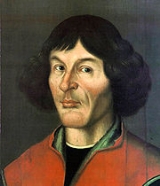
Nicolaus Copernicus

 
Nicolaus Copernicus

   Email Print
   Bookmark   Link


Nicolaus Copernicus


Nicolaus Copernicus (February 19, 1473 – May 24, 1543) was the first astronomer
Astronomer

An astronomer is a scientist who studies Celestial body such as planets, stars, and Galaxy.Historically, astronomy was more concerned with the classification and description of phenomena in the sky, while astrophysics attempted to explain these phenomena and the differences between them using physical laws....
 to formulate a scientifically-based heliocentric
Heliocentrism

In astronomy, heliocentrism is the theory that the Sun is at the center of the Universe. The word came from the Greek language . Historically, heliocentrism was opposed to geocentrism, which placed the earth at the center....
 cosmology
Cosmology

Cosmology is study of the Universe in its totality, and by extension, humanity's place in it. Though the word cosmology is recent , study of the Universe has a long history involving science, philosophy, esotericism, and religion....
 that displaced the Earth
Earth

Earth is the third planet from the Sun. Earth is the largest of the terrestrial planets in the Solar System in diameter, mass and density. It is also referred to as the World and Wiktionary:Terra.Note that by International Astronomical Union convention, the term "Terra" is used for naming extensive land masses, rather...
 from the center of the universe. His epochal book, De revolutionibus orbium coelestium
De revolutionibus orbium coelestium

De revolutionibus orbium coelestium , first printed in 1543 in Nuremberg, is the seminal work on Copernican heliocentrism and the masterpiece of astronomer Nicolaus Copernicus ....
 (On the Revolutions of the Celestial Spheres), is often regarded as the starting point of modern astronomy
Astronomy

Astronomy is the science of Astronomical object and Phenomenon that originate outside the Earth's atmosphere . It is concerned with the evolution, physics, chemistry, meteorology, and motion of celestial objects, as well as the physical cosmology....
 and the defining epiphany
Epiphany (feeling)

An epiphany is the sudden realization or comprehension of the essence or meaning of something. Or also known as a big moment of EUREKA! The term is used in either a Philosophy or Literal and figurative language sense to signify that the claimant has "found the last piece of the puzzle and now sees the whole picture," or has new information o...
 that began the Scientific Revolution
Scientific revolution

The period which many History of science call the Scientific Revolution is commonly viewed as the foundation and origin of modern science.It was a time roughly coinciding with the later part of the Middle Ages and through the Renaissance in which scientific ideas in physics, astronomy, and biology evolved rapidly....
.

Although Greek
Greek astronomy

Greek astronomy is the astronomy of those who wrote in the Greek language in classical antiquity i.e. see Aristarchus of Samos Greek astronomer/mathematician and his heliocentric model of the solar system....
, Indian and Muslim
Islamic astronomy

In the history of astronomy, Islamic astronomy or Arabic astronomy refers to the astronomical developments made in the Islamic world, particularly during the Islamic Golden Age , and mostly written in the Arabic language....
 savants
Polymath

A polymath is a person whose knowledge is not restricted to one subject area. In less formal terms, a polymath may simply refer to someone who is very knowledgeable....
 had published heliocentric hypotheses
Hypothesis

A hypothesis consists either of a suggested explanation for an observable phenomenon or of a reasoned proposal predicting a possible causal correlation among multiple phenomena....
 centuries before Copernicus, his publication of a scientific theory of heliocentrism, demonstrating that the motions of celestial objects can be explained without putting the Earth at rest in the center of the universe, stimulated further scientific investigations and became a landmark
Landmark

Originally, a landmark literally meant a geographic feature used by exploration and others to find their way back or through an area.In modern usage, a landmark includes anything that is easily recognizable, such as a monument, building, or other structure....
 in the history of modern science
History of science

Science is a body of empirical knowledge, theory, and Procedural knowledge knowledge about the Nature, produced by a global community of researchers making use of scientific methods, which emphasize the observation, experimentation and scientific explanation of real world phenomenon....
 that is known as the Copernican Revolution
Copernican Revolution

The Copernican Revolution refers to the paradigm shift away from the Ptolemaic system of the heavens, which postulated the Earth at the center of the Universe, towards the Heliocentrism with the Sun at the center of the Solar System....
.

Among the great polymath
Polymath

A polymath is a person whose knowledge is not restricted to one subject area. In less formal terms, a polymath may simply refer to someone who is very knowledgeable....
s of the Renaissance
Renaissance

The Renaissance was a cultural movement that spanned roughly the 14th to the 17th century, beginning in Italy in the late Middle Ages and later spreading to the rest of Europe....
, Copernicus was a mathematician
Mathematician

A mathematician is a person whose primary area of study and/or research is the field of mathematics....
, astronomer
Astronomer

An astronomer is a scientist who studies Celestial body such as planets, stars, and Galaxy.Historically, astronomy was more concerned with the classification and description of phenomena in the sky, while astrophysics attempted to explain these phenomena and the differences between them using physical laws....
, physician
Physician

A physician, medical practitioner, doctor of medicine, or medical doctor practices medicine, and is concerned with maintaining or restoring human health through the study, diagnosis, and treatment of disease and injury....
, classical scholar, translator, artist
Visual arts

The visual arts are Art#Art forms that focus on the creation of works which are primarily visual in nature, such as drawing, painting, photography, printmaking, and filmmaking....
, Catholic cleric
Roman Catholic Church

The Roman Catholic Church, officially known as the Catholic Church is the world's largest Christianity Ecclesia , representing over half of all Christians and one-sixth of the world population....
, jurist
Jurist

A jurist or jurisconsult is a professional who studies, develops, applies, or otherwise deals with the law. The term is widely used in American English, but in the United Kingdom and many Commonwealth of Nations countries it has only historical and specialist usage....
, governor
Governor

A governor is a governing official, usually the Executive of a non-sovereign level of government, ranking under the head of state. In federations, a governor may be the title of each appointed or elected politician who governs a constitutive state....
, military leader
Military

A military is an organization authorized by its nation to use force, usually including use of weapons, in defending its country by combating actual or Threat of force ....
, diplomat
Diplomacy

Diplomacy is the art and practice of conducting negotiations between representatives of groups or states. It usually refers to international diplomacy, the conduct of international relations through the intercession of professional diplomats with regard to issues of peace-making, trade, war, economics and culture....
 and economist
Economist

An economist is an expert in the social science of economics. The individual may also study, develop, and apply theories and concepts from economics and write about economic policy....
.


Discussion
Ask a question about 'Nicolaus Copernicus'
Start a new discussion about 'Nicolaus Copernicus'
Answer questions from other users
Full Discussion Forum


Recent Posts


Quotations


Mathematics is written for mathematicians.

Finally we shall place the Sun himself at the center of the Universe. All this is suggested by the systematic procession of events and the harmony of the whole Universe, if only we face the facts, as they say, with both eyes open.


Encyclopedia


Nicolaus Copernicus (February 19, 1473 – May 24, 1543) was the first astronomer
Astronomer

An astronomer is a scientist who studies Celestial body such as planets, stars, and Galaxy.Historically, astronomy was more concerned with the classification and description of phenomena in the sky, while astrophysics attempted to explain these phenomena and the differences between them using physical laws....
 to formulate a scientifically-based heliocentric
Heliocentrism

In astronomy, heliocentrism is the theory that the Sun is at the center of the Universe. The word came from the Greek language . Historically, heliocentrism was opposed to geocentrism, which placed the earth at the center....
 cosmology
Cosmology

Cosmology is study of the Universe in its totality, and by extension, humanity's place in it. Though the word cosmology is recent , study of the Universe has a long history involving science, philosophy, esotericism, and religion....
 that displaced the Earth
Earth

Earth is the third planet from the Sun. Earth is the largest of the terrestrial planets in the Solar System in diameter, mass and density. It is also referred to as the World and Wiktionary:Terra.Note that by International Astronomical Union convention, the term "Terra" is used for naming extensive land masses, rather...
 from the center of the universe. His epochal book, De revolutionibus orbium coelestium
De revolutionibus orbium coelestium

De revolutionibus orbium coelestium , first printed in 1543 in Nuremberg, is the seminal work on Copernican heliocentrism and the masterpiece of astronomer Nicolaus Copernicus ....
 (On the Revolutions of the Celestial Spheres), is often regarded as the starting point of modern astronomy
Astronomy

Astronomy is the science of Astronomical object and Phenomenon that originate outside the Earth's atmosphere . It is concerned with the evolution, physics, chemistry, meteorology, and motion of celestial objects, as well as the physical cosmology....
 and the defining epiphany
Epiphany (feeling)

An epiphany is the sudden realization or comprehension of the essence or meaning of something. Or also known as a big moment of EUREKA! The term is used in either a Philosophy or Literal and figurative language sense to signify that the claimant has "found the last piece of the puzzle and now sees the whole picture," or has new information o...
 that began the Scientific Revolution
Scientific revolution

The period which many History of science call the Scientific Revolution is commonly viewed as the foundation and origin of modern science.It was a time roughly coinciding with the later part of the Middle Ages and through the Renaissance in which scientific ideas in physics, astronomy, and biology evolved rapidly....
.

Although Greek
Greek astronomy

Greek astronomy is the astronomy of those who wrote in the Greek language in classical antiquity i.e. see Aristarchus of Samos Greek astronomer/mathematician and his heliocentric model of the solar system....
, Indian and Muslim
Islamic astronomy

In the history of astronomy, Islamic astronomy or Arabic astronomy refers to the astronomical developments made in the Islamic world, particularly during the Islamic Golden Age , and mostly written in the Arabic language....
 savants
Polymath

A polymath is a person whose knowledge is not restricted to one subject area. In less formal terms, a polymath may simply refer to someone who is very knowledgeable....
 had published heliocentric hypotheses
Hypothesis

A hypothesis consists either of a suggested explanation for an observable phenomenon or of a reasoned proposal predicting a possible causal correlation among multiple phenomena....
 centuries before Copernicus, his publication of a scientific theory of heliocentrism, demonstrating that the motions of celestial objects can be explained without putting the Earth at rest in the center of the universe, stimulated further scientific investigations and became a landmark
Landmark

Originally, a landmark literally meant a geographic feature used by exploration and others to find their way back or through an area.In modern usage, a landmark includes anything that is easily recognizable, such as a monument, building, or other structure....
 in the history of modern science
History of science

Science is a body of empirical knowledge, theory, and Procedural knowledge knowledge about the Nature, produced by a global community of researchers making use of scientific methods, which emphasize the observation, experimentation and scientific explanation of real world phenomenon....
 that is known as the Copernican Revolution
Copernican Revolution

The Copernican Revolution refers to the paradigm shift away from the Ptolemaic system of the heavens, which postulated the Earth at the center of the Universe, towards the Heliocentrism with the Sun at the center of the Solar System....
.

Among the great polymath
Polymath

A polymath is a person whose knowledge is not restricted to one subject area. In less formal terms, a polymath may simply refer to someone who is very knowledgeable....
s of the Renaissance
Renaissance

The Renaissance was a cultural movement that spanned roughly the 14th to the 17th century, beginning in Italy in the late Middle Ages and later spreading to the rest of Europe....
, Copernicus was a mathematician
Mathematician

A mathematician is a person whose primary area of study and/or research is the field of mathematics....
, astronomer
Astronomer

An astronomer is a scientist who studies Celestial body such as planets, stars, and Galaxy.Historically, astronomy was more concerned with the classification and description of phenomena in the sky, while astrophysics attempted to explain these phenomena and the differences between them using physical laws....
, physician
Physician

A physician, medical practitioner, doctor of medicine, or medical doctor practices medicine, and is concerned with maintaining or restoring human health through the study, diagnosis, and treatment of disease and injury....
, classical scholar, translator, artist
Visual arts

The visual arts are Art#Art forms that focus on the creation of works which are primarily visual in nature, such as drawing, painting, photography, printmaking, and filmmaking....
, Catholic cleric
Roman Catholic Church

The Roman Catholic Church, officially known as the Catholic Church is the world's largest Christianity Ecclesia , representing over half of all Christians and one-sixth of the world population....
, jurist
Jurist

A jurist or jurisconsult is a professional who studies, develops, applies, or otherwise deals with the law. The term is widely used in American English, but in the United Kingdom and many Commonwealth of Nations countries it has only historical and specialist usage....
, governor
Governor

A governor is a governing official, usually the Executive of a non-sovereign level of government, ranking under the head of state. In federations, a governor may be the title of each appointed or elected politician who governs a constitutive state....
, military leader
Military

A military is an organization authorized by its nation to use force, usually including use of weapons, in defending its country by combating actual or Threat of force ....
, diplomat
Diplomacy

Diplomacy is the art and practice of conducting negotiations between representatives of groups or states. It usually refers to international diplomacy, the conduct of international relations through the intercession of professional diplomats with regard to issues of peace-making, trade, war, economics and culture....
 and economist
Economist

An economist is an expert in the social science of economics. The individual may also study, develop, and apply theories and concepts from economics and write about economic policy....
. Among his many responsibilities, astronomy figured as little more than an avocation
Avocation

An avocation is an activity that a person does as a hobby outside their principal occupation. There are many examples of people whose profession was the way they made a living, but whose activities outside their workplace were their true passion in life....
 — yet it was in that field that he made his mark upon the world.

Life


Family

Copernicushouse
Nicolaus Copernicus was born on 19 February 1473 in a house on St. Anne's Street (now Copernicus Street) in the city of Torun
Torun

Torun is a city in northern Poland, on the Vistula River, with population over 207,190 as of 2006, making it the second largest city of the Kuyavian-Pomeranian Voivodeship, after Bydgoszcz....
 (Thorn). Torun, situated on the Vistula River, was part of Royal Prussia
Royal Prussia

Royal Prussia was a province of the Kingdom of Poland from 1466 and then the Polish-Lithuanian Commonwealth from 1569 to 1772. Royal Prussia included Pomerelia, Chelmno Land, Malbork Voivodeship, Gdansk, Torun, and Elblag....
, a region of the Kingdom of Poland
Kingdom of Poland (1385–1569)

The Kingdom of Poland of the Jagiellons was the Poland state created by the accession of Jogaila, Grand Duke of Lithuania, to the Polish throne in 1386....
.

Nicolaus was named after his father, who about 1458 had moved to Torun from Kraków
Kraków

Krak?w , in English also spelled Krakow or Cracow , is one of the largest and oldest cities in Poland, with a population of 756,336 in 2007 ....
 in Lesser Poland
Lesser Poland

Lesser Poland is one of the historical regions of Poland. It forms the southeastern corner of the country. It should not be confused with the modern Lesser Poland Voivodeship, which covers just a part of the historical region of Lesser Poland...
. The father was a wealthy copper
Copper

Copper is a chemical element with the symbol Cu and atomic number 29.It is a ductile metal with very high thermal and electrical conductivity....
 trader who had become a respected citizen of Torun. Nicolaus' mother, Barbara Watzenrode (died after 1495), had been born into a wealthy merchant family that was part of the city's patrician
Patrician

The term "patrician" originally referred to a group of elitism citizens in ancient Rome, including both their natural and adopted members. In the late Roman empire, the class was broadened to include high council officials, and after the fall of the Western Empire became a term for Byzantine Imperial governors in the West....
 class.

Nicolaus' father died between 1483 and 1485. After that, his maternal uncle, Lucas Watzenrode the Younger
Lucas Watzenrode the Younger

Lucas Watzenrode the Younger was a Prince-Bishop of Archbishopric of Warmia ....
 (1447–1512), a church canon
Canon (priest)

A canon is a priest who is a member of certain bodies of the Christianity clergy subject to an ecclesiastical rule .Originally, a canon was a cleric living with others in a clergyhouse or, later, in one of the houses within the precinct or close of a cathedral and ordering his life according to the orders or rules of the church....
 who would later become Prince-Bishop of the Archbishopric of Warmia
Archbishopric of Warmia

The Prince-Bishopric of Warmia was a semi independent ecclesiastical state, a Prussian bishopric under jurisdiction of Archbishopric of Riga that was a protectorate of the Monastic state of the Teutonic Knights and a protectorate of Kingdom of Poland, later Polish-Lithuanian Commonwealth after the Second Peace of Thorn ...
, took young Nicolaus under his protection and saw to his education and future career.

Nicolaus was the youngest of four children. His brother Andreas became an Augustinian canon
Canon (priest)

A canon is a priest who is a member of certain bodies of the Christianity clergy subject to an ecclesiastical rule .Originally, a canon was a cleric living with others in a clergyhouse or, later, in one of the houses within the precinct or close of a cathedral and ordering his life according to the orders or rules of the church....
 at Frombork
Frombork

Frombork [] is a town in northern Poland, on the Vistula Lagoon, in Braniewo County, Warmian-Masurian Voivodeship. It had a population of 2,528 as of 2005....
 (Frauenburg). His sister Barbara (named after her mother) became a Benedictine
Benedictine

Benedictine refers to the spirituality and consecrated life in accordance with the Rule of St Benedict, written by Benedict of Nursia in the sixth century for the cenobitic communities he founded in central Italy....
 nun
Nun

A Nun is a woman who has taken special vows committing her to a religious life. She may be an monasticism who voluntarily chooses to leave mainstream society and live her life in prayer and contemplation in a monastery or convent....
. His sister Katharina married Barthel Gertner, a businessman and city councilor.

Name

Numerous variants of Copernicus' name are documented. Until the mid-1530s, he mostly signed himself Coppernic. Afterward, he followed the academic custom of his time and adopted a Latinized
Latin

Latin is an Italic language, historically spoken in Latium and Ancient Rome. Through the Military history of the Roman Empire, Latin spread throughout the Mediterranean and a large part of Europe....
 version of his name. Thus, on the title page of his epochal book, Nicolai Copernici Torinensis De Revolutionibus Orbium Coelestium Libri VI, the astronomer's name appears as Nicolaus Copernicus with pp changed to p.

In 1776, Johann Gottfried Herder
Johann Gottfried Herder

Johann Gottfried von Herder was a Germany philosophy, Theology, poet, and literary critic. He is associated with the periods of Age of Enlightenment, Sturm und Drang, and Weimar Classicism....
 introduced the spelling Nikolaus Kopernikus, which replaced each c with k. This spelling became popular in German
German language

German is a West Germanic languages, thus related to and classified alongside English language and Dutch language. It is one of the world's world language and the most widely spoken mother tongue in the European Union....
 writings, although scholars argued for Coppernicus. The Polish
Polish language

Polish , an official language of Poland, has the largest number of speakers of any West Slavic languages. Polish-speakers use the language in a uniform manner through most of Poland, and it has a regular orthography....
 rendering is Mikolaj Kopernik; the surname means "one who works with copper
Copper

Copper is a chemical element with the symbol Cu and atomic number 29.It is a ductile metal with very high thermal and electrical conductivity....
".

Education


In 1491 Copernicus enrolled at the Kraków Academy
Jagiellonian University

The Jagiellonian University is located in Krak?w, Poland. Originally founded as Akademia Krakowska in 1364 by Casimir III of Poland, it is the second oldest university in Central Europe after the Charles University in Prague, and one of the List of oldest universities in continuous operation....
 (now Jagiellonian University), where he probably first encountered astronomy with Professor Albert Brudzewski
Albert Brudzewski

Albert Brudzewski, also Albert Blar , Albert of Brudzewo or Wojciech Brudzewski was a Poland astronomy, mathematics, philosopher and diplomat....
. Astronomy soon fascinated him, and he began collecting a large library on the subject. Copernicus' library would later be carried off as war booty by the Swedes during "the Deluge"
The Deluge (Polish history)

In the history of Poland and History of Lithuania, the Deluge commonly refers to a series of wars in the mid-to-late 17th century which left the Polish-Lithuanian Commonwealth in ruins....
 and is now at the Uppsala University Library
Uppsala University Library

Uppsala University Library in Sweden consists of 19 different branch libraries, with the largest being that housed in the old main library building, Carolina Rediviva....
.

After four years in Kraków, followed by a brief stay back home in Torun, Copernicus went to study law
LAW

LAW may refer to:* Anti-tank warfare, e.g. the US Army M72 LAW or the British Army LAW 80*Palestinian Society for the Protection of Human Rights ...
 and medicine
Medicine

Medicine is the art and science of healing. It encompasses a range of health care practices evolved to maintain and restore health by the prevention and treatment of illness....
 at the universities of Bologna
Bologna

Bologna is the capital city of Emilia-Romagna in northern Italy, in the Po Valley , between the Po River and the Apennine Mountains, exactly between the Reno River and the S?vena River....
 and Padua
Padua

Padua is a city in the Veneto, northern Italy. It is the capital of the province of Padua and the economic and communications hub of the area. Padua's population is 212,500 ....
. Copernicus' uncle, Lucas Watzenrode the Younger
Lucas Watzenrode the Younger

Lucas Watzenrode the Younger was a Prince-Bishop of Archbishopric of Warmia ....
, financed his education and hoped that Copernicus too would become a bishop
Bishop

A bishop is an ordination or consecration member of the Clergy#Christian clergy who is generally entrusted with a position of authority and oversight....
. Copernicus, however, while studying canon
Canon law

Canon law is internal ecclesiastical law governing the Roman Catholic Church, the Eastern Orthodox Church churches, and the Anglicanism of churches....
 and civil law
Civil law (legal system)

Civil law is a most prevalent legal system in the modern world and the oldest in human history. It is based on a code, or "a systematic collection of interrelated articles written in a terse, staccato style." The two other major legal systems in the world are common law and Islamic law....
 at Bologna, met the famous astronomer, Domenico Maria Novara da Ferrara
Domenico Maria Novara da Ferrara

Domenico Maria Novara was an Italy scientist. Born in Ferrara, for 21 years he was professor of astronomy at the University of Bologna, and in 1500 he also lectured in mathematics at Rome....
. Copernicus attended Novara's lectures and became his disciple and assistant. The first observations that Copernicus made in 1497, together with Novara, are recorded in Copernicus' epochal book, De revolutionibus orbium coelestium
De revolutionibus orbium coelestium

De revolutionibus orbium coelestium , first printed in 1543 in Nuremberg, is the seminal work on Copernican heliocentrism and the masterpiece of astronomer Nicolaus Copernicus ....
.
Mikolaj Kopernik
In 1497 Copernicus' uncle was ordained Bishop of Warmia, and Copernicus was named a canon
Canon (priest)

A canon is a priest who is a member of certain bodies of the Christianity clergy subject to an ecclesiastical rule .Originally, a canon was a cleric living with others in a clergyhouse or, later, in one of the houses within the precinct or close of a cathedral and ordering his life according to the orders or rules of the church....
 at Frombork Cathedral. But Copernicus remained in Italy, where he attended the great Jubilee
Jubilee (Christian)

The concept of the Jubilee is a special year of remission of sins and universal pardon. In the Biblical book of Leviticus, a Jubilee year is mentioned to occur every fifty years, in which slaves and prisoners would be freed, debts would be forgiven and the mercies of God would be particularly manifest....
 of 1500. He also went to Rome
Rome

Rome is the capital city of Italy and Lazio, and is Italy's largest and most populous city, with 2,724,347 residents in an urban area of some ....
, where he observed a lunar eclipse
Eclipse

An eclipse is an astronomical event that occurs when one celestial object moves into the shadow of another. The term is derived from the ancient Greek noun , from verb , "I cease to exist," a combination of prefix , from preposition , "out," and of verb , "I am absent"....
 and gave some lectures in astronomy and mathematics.

In 1501 Copernicus returned to Frombork. As soon as he arrived, he obtained permission to complete his studies in Padua
Padua

Padua is a city in the Veneto, northern Italy. It is the capital of the province of Padua and the economic and communications hub of the area. Padua's population is 212,500 ....
, where he studied medicine
Medicine

Medicine is the art and science of healing. It encompasses a range of health care practices evolved to maintain and restore health by the prevention and treatment of illness....
 (with Guarico and Fracastoro), and at Ferrara
Ferrara

Ferrara is a city in Emilia-Romagna, northern Italy, capital city of the Province of Ferrara.It is situated 50 km north-northeast of Bologna, on the Po di Volano, a branch channel of the main stream of the Po River, located 5 km north....
, where in 1503 he received his doctorate in canon law
Canon law

Canon law is internal ecclesiastical law governing the Roman Catholic Church, the Eastern Orthodox Church churches, and the Anglicanism of churches....
. One of the subjects that Copernicus must have studied at that time was astrology
Astrology

Astrology is a group of systems, traditions, and beliefs which hold that the relative positions of astronomical object and related details can provide useful information about personality, human affairs, and other terrestrial matters....
, since it was considered an important part of a medical education. However, unlike most other prominent Renaissance astronomers, he appears never to have practiced it or expressed any subsequent interest in it. It has also been surmised that it was in Padua that he encountered passages from Cicero
Cicero

Marcus Tullius Cicero was a Ancient Rome philosopher, statesman, lawyer, political theorist, and Constitution of the Roman Republic. Cicero is widely considered one of Rome's greatest rhetoric and prose stylists....
 and Plato
Plato

Plato , was a Classical Greece Greeks philosopher, mathematician, writer of philosophical dialogues, and founder of the Platonic Academy in Ancient Athens, the first institution of higher learning in the western world....
 about opinions of the ancients on the movement of the Earth, and formed the first intuition of his own future theory. In 1504 Copernicus began collecting observations and ideas pertinent to his theory.

Work

In 1503, Copernicus returned to Polish Prussia
Prussia (region)

Prussia is a Historical regions of Central Europe in Central Europe extending from the south-eastern coast of the Baltic Sea to the Masurian Lake District....
, to the Prince-Bishop
Prince-Bishop

A Prince-Bishop is a bishop who is a territorial Prince of the Church on account of one or more secular principalities, usually pre-existent titles of nobility held concurrently with their inherent clerical office....
ric of Warmia
Warmia

Warmia or Ermland is a region between Pomerania and Masuria in northeastern Poland. Together with Masuria, it forms the Warmian-Masurian Voivodeship....
, where he resided the rest of his life. From 1503 until 1510 he had the position of secretary to his maternal uncle Lucas Watzenrode, Bishop of Warmia, and until 1510 resided in the Bishop's castle at Lidzbark Warminski
Lidzbark Warminski

Lidzbark Warminski is a town in the Warmian-Masurian Voivodeship in Poland. It is the capital of Lidzbark County....
 (Heilsberg). It is there that he started work on his heliocentric view of the heavens.

In 1510, he moved to Frombork
Frombork

Frombork [] is a town in northern Poland, on the Vistula Lagoon, in Braniewo County, Warmian-Masurian Voivodeship. It had a population of 2,528 as of 2005....
 (Frauenburg), a town in the north and downstream of Torun on the Vistula Lagoon
Vistula Lagoon

The Vistula Lagoon is a fresh water lagoon on the Baltic Sea separated from Gdansk Bay by the Vistula Spit. It is sometimes known as the Vistula Headlands and bays or Vistula Gulf....
. The Bishopric of Warmia, within Royal Prussia, though subject to the Polish crown, enjoyed substantial autonomy
Autonomy

Autonomy is the right to self-government. Autonomy is a concept found in moral, political, and bioethics philosophy. Within these contexts, it refers to the capacity of a Rationality individual to make an informed, un-coerced decision....
, with its own diet
Diet (assembly)

In politics, a diet is a formal deliberative assembly. The term is derived from Medieval Latin dietas, and ultimately comes from the Latin dies, "day"....
, army, monetary unit (the same as in the other parts of Prussia) and treasury. Some time before his return to Warmia, he received a position at the Collegiate Church of the Holy Cross in Wroclaw
Wroclaw

Wroclaw is the chief city of the historical region of Lower Silesia in south-western Poland, situated on the Oder River river. Over the centuries the city has been part of Kingdom of Poland , Bohemia, Austria, Prussia, and Germany....
 (Breslau), Silesia
Silesia

Silesia is a historical region of Central Europe located mostly in present-day Poland, with parts in the Czech Republic and Germany.Silesia is rich in mineral and natural resources, and includes several important industrial areas....
, Bohemia
Bohemia

History...
, which he held for many years and only resigned for health reasons shortly before his death. Copernicus remained for the rest of his life a burgher
Bourgeoisie

Bourgeoisie is a classification used in analyzing human societies to describe a social class of people. Historically, the bourgeoisie comes from the middle or merchant classes of the Middle Ages, whose status or power came from employment, education, and wealth, as distinguished from those whose power came from being born into an aristocrati...
 of Warmia (Bishopric of Warmia). During the Protestant Reformation
Protestant Reformation

The Protestant Reformation was a Christian reform movement in Europe. It is thought to have begun in 1517 with Martin Luther's Ninety-Five Theses and may be considered to have ended with the Peace of Westphalia in 1648....
, he remained a loyal subject of the Catholic Prince-Bishops
Bishops of Warmia

This is a list of Bishops and Prince-Bishops of the Diocese of Warmia The Bishopric was founded in 1243 as the Bishopric of Ermland, one of four bishoprics of Prussia....
 and the Catholic Polish King. Throughout his life, he performed astronomical observations and calculations, but only as time permitted and never in a professional capacity. In 1516-21, Copernicus resided at Olsztyn Castle as economic administrator of Warmia
Warmia

Warmia or Ermland is a region between Pomerania and Masuria in northeastern Poland. Together with Masuria, it forms the Warmian-Masurian Voivodeship....
, including Allenstein (Olsztyn
Olsztyn

Olsztyn is a city in northeastern Poland, on the Lyna River.Historically the capital of the Warmia region, Olsztyn has been the capital of the Warmian-Masurian Voivodeship since 1999....
) and Mehlsack (Pieniezno
Pieniezno

Pieniezno [] is a town on the Walsza River in the Warmian-Masurian Voivodeship of Poland. It is located in Braniewo County and had a population of 2,975 in 2004....
), and wrote the manuscript Locationes mansorum desertorum
Locationes mansorum desertorum

Locationes mansorum desertorum - ? manuscript of Nicolaus Copernicus, written between 1516-1521. It is from ledgers handwritten by Copernicus when he was an economic administrator in Warmia....
 (Locations of Deserted Fiefs).

When Olsztyn
Olsztyn

Olsztyn is a city in northeastern Poland, on the Lyna River.Historically the capital of the Warmia region, Olsztyn has been the capital of the Warmian-Masurian Voivodeship since 1999....
 was besieged by the Teutonic Knights during the Polish-Teutonic War (1519–1521), Copernicus was in charge of the defenses of Olsztyn and Warmia at the head of Royal Polish forces. He also participated in the peace negotiations. Copernicus worked for years with the Royal Prussian diet, and with Duke Albert of Prussia, and advised Poland's King Sigismund I the Old
Sigismund I the Old

File:Poland and Lithuania in 1526.PNGSigismund I the Old of the Jagiellon dynasty reigned as King of Poland and Grand Duke of Lithuania from 1506 to his death at age 81 in 1548....
 on monetary reform
Monetary reform

Monetary reform describes any movement or theory that proposes a different system of supplying money and financing the economy than the current system....
. Holding the office of canon
Canon (priest)

A canon is a priest who is a member of certain bodies of the Christianity clergy subject to an ecclesiastical rule .Originally, a canon was a cleric living with others in a clergyhouse or, later, in one of the houses within the precinct or close of a cathedral and ordering his life according to the orders or rules of the church....
, he traveled extensively on government business and as a diplomat on behalf of the Prince-Bishop of Warmia. He participated in the discussions in the East Prussian diet about coin reform in the Prussian countries. One question at issue to members of the Diet concerned who had the right to mint coin
Coin

A coin is a piece of hard material, usually metal or a metallic material, usually in the shape of a Disk , and most often issued by a government....
. The matter required much diplomacy, but was resolved successfully. Some of the difficulties were caused by the political upheavals occurring in Prussia at the time, including the 1525 establishment of the Duchy of Prussia as a Protestant state. Copernicus translated his coin-reform treatise into Latin for external use. In 1530 an agreement was negotiated with Duke Albert at Elblag
Elblag

Elblag is a city in northern Poland with 127,892 inhabitants . It is the capital of Elblag County and has been assigned to the Warmian-Masurian Voivodeship since 1999....
 (Elbing).

In 1526, Copernicus wrote a study on the value of money
Money

Money is anything that is generally accepted as payment for goods and services and repayment of debts. The main uses of money are as a medium of exchange, a unit of account, and a store of value....
, Monetae cudendae ratio
Monetae cudendae ratio

Monetae cudendae ratio is a treatise on money by Nicolaus Copernicus written in 1526, published in 1816, of which remaining copies are rare....
. In it he formulated an early iteration of the theory, now called "Gresham's Law
Gresham's Law

Gresham's law is commonly stated: "Bad money drives out good."Gresham's law applies specifically when there are two forms of commodity money in circulation which are forced, by the application of legal tender laws, to be respected as having face value in a fixed-ratio for marketplace transactions....
," that "bad" (debased
Debasement

Debasement is the practice of lowering the value of currency. It is particularly used in connection with commodity money such as gold or silver coins....
) coinage
Coinage

Coinage is:*A series of coins or coin struck as part of currency*Coinage by Region**Coins of the United States dollar**Coins of the pound sterling...
 drives "good" (un-debased) coinage out of circulation, 70 years before Gresham. He also formulated a version of quantity theory of money
Quantity theory of money

In economics, the quantity theory of money is a theory emphasizing the positive relationship of overall prices or the Real versus nominal value of expenditures to the money supply#Scope....
. Copernicus' recommendations on monetary reform were widely read by leaders of both Prussia and Poland in their attempts to stabilize currency.

Two years before Copernicus' death, Duke Albert urgently summoned him to Königsberg
Königsberg

K?nigsberg was after World War II in 1946 renamed Kaliningrad by the Soviet Union.The city was the Capital of East Prussia from the Late Middle Ages until 1945....
 to treat one of his counsellors, who was dangerously ill. The patient recovered within a month or so, and Copernicus then returned to Frombork.

In 1551, eight years after Copernicus' death, Erasmus Reinhold
Erasmus Reinhold

Erasmus Reinhold was a Germany astronomer and mathematician, considered to be the most influential astronomical pedagogue of his generation. He was born and died in Saalfeld, Thuringia, Germany....
 would publish, under Duke Albert's sponsorship, the Prutenic Tables
Prutenic Tables

The Prutenic Tables , were an ephemeris by the astronomer Erasmus Reinhold published in 1551. They are sometimes called the Prussian Tables after Albert I, Duke of Prussia, who supported Reinhold and financed the printing....
, a set of astronomical tables based on Copernicus' work, which astronomers and astrologers quickly adopted in place of superseded tables.

Heliocentrism

Jan Matejko Astronomer Copernicus Conversation With God
In 1514 Copernicus made available to friends his Commentariolus
Commentariolus

In the Commentariolus , Nicolaus Copernicus outlined his revolutionary Copernican heliocentrism theory of the solar system, about three decades before he finally published his major six volume work De revolutionibus orbium coelestium in 1543....
 (Little Commentary), a six page hand-written text describing his ideas about the heliocentric hypothesis. It contained seven basic assumptions. Thereafter he continued gathering data for a more detailed work.

In 1533, Johann Albrecht Widmannstetter
Johann Albrecht Widmannstetter

Johann Albrecht Widmannstetter , was a German humanist, orientalist, philologist, and theologian....
 delivered in Rome
Rome

Rome is the capital city of Italy and Lazio, and is Italy's largest and most populous city, with 2,724,347 residents in an urban area of some ....
 a series of lectures outlining Copernicus' theory. The lectures were heard with interest by Pope Clement VII
Pope Clement VII

Pope Clement VII , born Giulio di Giuliano de' Medici, was a Cardinal from 1513 to 1523 and was Pope from 1523 to 1534....
 and several Catholic cardinals
Cardinal (Catholicism)

A cardinal is a senior Ecclesiology official, usually a Bishop , of the Catholic Church. They are collectively known as the College of Cardinals, which as a body elects a new pope....
.

On 1 November 1536, Archbishop of Capua Nicholas Schönberg
Nikolaus Cardinal von Schönberg

Nikolaus von Sch?nberg was a Germany Archbishop of Capua.Born in Roth-Sch?nberg near Meissen to a noble family which already had several Bishop of Dresden-Meissen, Nikolaus became Canon at the Cathedral of Naumburg and became a doctor of law when studying in Italy....
 wrote a letter to Copernicus from Rome:

By then Copernicus' work was nearing its definitive form, and rumors about his theory had reached educated people all over Europe. Despite urgings from many quarters, Copernicus delayed with the publication of his book, perhaps from fear of criticism — a fear delicately expressed in the subsequent Dedication of his masterpiece to Pope Paul III
Pope Paul III

Pope Paul III , born Alessandro Farnese, was Pope of the Roman Catholic Church from 1534 to his death in 1549. He also called the Council of Trent in 1545....
. Scholars disagree on whether Copernicus' concern was limited to physical and philosophical objections from other natural philosophers, or whether he was also concerned about religious objections from theologians.

The book

Adurermelancthonengraving1526
Copernicus was still working on De revolutionibus orbium coelestium
De revolutionibus orbium coelestium

De revolutionibus orbium coelestium , first printed in 1543 in Nuremberg, is the seminal work on Copernican heliocentrism and the masterpiece of astronomer Nicolaus Copernicus ....
 (even if not convinced that he wanted to publish it) when in 1539 Georg Joachim Rheticus
Georg Joachim Rheticus

Georg Joachim von Lauchen, also known as Rheticus , was a mathematician, cartographer, navigational and other instrument maker, medical practitioner, and teacher....
, a Wittenberg
Wittenberg

Wittenberg, officially Lutherstadt Wittenberg, is a town in Germany in the States of Germany Saxony-Anhalt, on the Elbe River. It has a population of about 50,000....
 mathematician
Mathematician

A mathematician is a person whose primary area of study and/or research is the field of mathematics....
, arrived in Frombork. Philipp Melanchthon
Philipp Melanchthon

Philipp Melanchthon was a German professor and theologian, a significant character in the Protestant Reformation, a key leader of the Lutheran Reformation, and a friend and associate of Martin Luther....
 had arranged for Rheticus to visit several astronomers and study with them.

Rheticus became Copernicus' pupil, staying with him for two years and writing a book, Narratio prima
Narratio Prima

Narratio Prima is an abstract of the heliocentric theory of Nicolaus Copernicus, published by the young German astronomer Georg Joachim Rheticus in 1540....
 (First Account), outlining the essence of Copernicus' theory. In 1542 Rheticus published a treatise on trigonometry
Trigonometry

Trigonometry is a branch of mathematics that deals with triangle s, particularly those plane triangles in which one angle has 90 degrees . Trigonometry deals with relationships between the sides and the angles of triangles and with the trigonometric functions, which describe those relationships....
 by Copernicus (later included in the second book of De revolutionibus
De revolutionibus orbium coelestium

De revolutionibus orbium coelestium , first printed in 1543 in Nuremberg, is the seminal work on Copernican heliocentrism and the masterpiece of astronomer Nicolaus Copernicus ....
).

Under strong pressure from Rheticus, and having seen the favorable first general reception of his work, Copernicus finally agreed to give De revolutionibus
De revolutionibus orbium coelestium

De revolutionibus orbium coelestium , first printed in 1543 in Nuremberg, is the seminal work on Copernican heliocentrism and the masterpiece of astronomer Nicolaus Copernicus ....
 to his close friend, Tiedemann Giese
Tiedemann Giese

Tiedemann Giese was a member of the patrician Giese family of Gdansk. The brother of the Hanseatic League merchant Georg Giese and relative of Albrecht Giese became Bishop of Culm and finally Bishop of Warmia ....
, bishop of Chelmno
Chelmno

Chelmno is a town in northern Poland near the Vistula river with 20,000 inhabitants and the historical capital of Chelmno Land . Situated in the Kuyavian-Pomeranian Voivodeship since 1999, Chelmno was previously in Torun Voivodeship ....
 (Kulm), to be delivered to Rheticus for printing by Johannes Petreius
Johannes Petreius

Johann Petreius a.k.a. Hans Peterlein was a Germans Printer in Nuremberg.His most famous work is the original edition of Nicolaus Copernicus's De Revolutionibus Orbium Coelestium in 1543, after an initiative of Georg Joachim Rheticus and Tiedemann Giese....
 at Nuremberg
Nuremberg

Nuremberg is a city in the Germany State of Bavaria, in the Regierungsbezirk of Middle Franconia. It is situated on the Pegnitz River river and the Rhine?Main?Danube Canal and is Franconia's largest city....
 (Nürnberg).

Death

Katedra We Fromborku
Copernicus died in Frombork
Frombork

Frombork [] is a town in northern Poland, on the Vistula Lagoon, in Braniewo County, Warmian-Masurian Voivodeship. It had a population of 2,528 as of 2005....
 on 24 May 1543. Legend has it that the first printed copy of De revolutionibus
De revolutionibus orbium coelestium

De revolutionibus orbium coelestium , first printed in 1543 in Nuremberg, is the seminal work on Copernican heliocentrism and the masterpiece of astronomer Nicolaus Copernicus ....
 was placed in his hands on the very day that he died, allowing him to take farewell of his life's work. He is reputed to have awoken from a stroke
Stroke

A stroke is the rapidly developing loss of brain function due to a disturbance in the blood supply to the brain. According to the National Stroke Association, a "stroke" occurs when a blood clot blocks and artery or a blood vessel breaks, interrupting blood flow to an area of the brain....
-induced coma
Coma

In medicine, a coma is a profound state of unconsciousness. A comatose person cannot be awakened, fails to respond normally to pain or light, does not have sleep-wake cycles, and does not take voluntary actions....
, looked at his book, and then died peacefully.

Copernicus was reportedly buried in Frombork Cathedral, where archeologists long searched in vain for his remains. In August 2005, a team led by Jerzy Gassowski, head of an archaeology
Archaeology

Archaeology, archeology, or arch?ology is the science that studies Homo cultures through the recovery, documentation, analysis, and interpretation of material remains and environmental data, including architecture, Artifact , features, Biofact s, and cultural landscape....
 and anthropology
Anthropology

Anthropology is the study of humans and humanity in its totality. Anthropology has origins in the natural sciences, and the humanities. In Great Britain it was originally divided into physical anthropology and cultural anthropology, which itself was divided into archaeology, technology, ethnology and sociology ....
 institute in Pultusk
Pultusk

Pultusk [] is a town in Poland by the river Narew, 70 km north of Warsaw. It is located in the Masovian Voivodship and has about 19,000 inhabitants....
, after scanning beneath the cathedral floor, discovered what they believe to be Copernicus' remains. The find came after a year of searching, and the discovery was announced only after further research, on November 3, 2008. Gassowski said he was "almost 100 percent sure it is Copernicus." Forensic expert Capt. Dariusz Zajdel of the Central Forensic Laboratory of the Polish Police used the skull to reconstruct a face that closely resembled the features — including a broken nose and a scar above the left eye — on a Copernicus self-portrait. The expert also determined that the skull belonged to a man who had died around age 70 — Copernicus' age at the time of his death. The grave was in poor condition, and not all the remains of the skeleton were found; missing, among other things, was the lower jaw. The DNA from the bones found in the grave matched hair samples taken from a book owned by Copernicus which was kept in the library of the University of Uppsala in Sweden
Sweden

Sweden , officially the Kingdom of Sweden , is a Nordic countries on the Scandinavian Peninsula in Northern Europe. Sweden has land borders with Norway to the west and Finland to the northeast, and it is connected to Denmark by the ?resund Bridge in the south....
.

On November 21, 2008, National Public Radio
National Public Radio

National Public Radio is a privately and publicly funded non-profit membership media organization that serves as a national Radio syndication to 797 public radio List of NPR stations in the United States....
 reported that confirmation had been made that the skull was indeed Copernicus'. The NPR website contains a portrait, reconstructed on the basis of the skull, of what Copernicus might have looked like.

Copernican system


Predecessors

Early traces of a heliocentric model are found in several anonymous Vedic Sanskrit
Vedic Sanskrit

Vedic Sanskrit is an Old Indic language. It is the language of the Vedas, the oldest shruti texts of Hinduism, compiled over the period of the mid 2nd to mid 1st millennium BC....
 texts composed in ancient India
History of India

The known history of India begins with the Indus Valley Civilization, which spread and flourished in the north-western part of the Indian subcontinent, from c....
 before the 7th century BCE. Additionally, in the sixth century the Indian astronomer and mathematician Aryabhata
Aryabhata

Aryabhaa is the first in the line of great mathematician-astronomers from the classical age of Indian mathematics and Indian astronomy. His most famous works are the Aryabhatiya and Arya-Siddhanta....
 anticipated elements of Copernicus's work, although he did not maintain heliocentrism.

Aristarchus of Samos

Aristarchus or Aristarch was a Greeks astronomer and mathematician, born on the island of Samos Island, in Greece. He was the first Greek, and the first man in general, to present an explicit argument for a Heliocentrism of the solar system, placing the Sun, not the Earth, at the center of the known universe....
 in the 3rd century BCE elaborated some theories of Heraclides Ponticus
Heraclides Ponticus

Heraclides Ponticus , also known as Herakleides, was a Greece philosopher who lived and died at Heraclea Pontica, now Karadeniz Eregli, Turkey....
 (the daily rotation of the Earth on its axis, the revolution of Venus and Mercury around the Sun) to propose what was the first scientific model of a heliocentric solar system: the Earth and all other planets revolving around the Sun, the Earth rotating around its axis daily, the Moon in turn revolving around the Earth once a month. His heliocentric work has not survived, so we can only speculate about what led him to his conclusions. It is notable that, according to Plutarch
Plutarch

Lucius Mestrius Plutarchus , c. AD 46 ? 120 ? commonly known in English as Plutarch ? was a Ancient Rome historian , biographer, essayist, and Middle Platonism....
, a contemporary of Aristarchus accused him of impiety for "putting the Earth in motion".

Copernicus cited Aristarchus
Aristarchus

* Aristarchus , on the moon* Aristarchus of Samos , Greek astronomer and mathematician* Aristarchus of Samothrace , Greek grammarian* Aristarchus of Tegea , Greek writer...
 and Philolaus
Philolaus

Philolaus was a Greeks Pythagoreanism and Presocratic. He argued that all matter is composed of limited and unlimited things, and that the universe is determined by numbers....
 in a surviving early manuscript of his book, stating: "Philolaus believed in the mobility of the earth, and some even say that Aristarchus of Samos
Samos Island

Samos is a Greece island in the North Aegean sea, south of Chios, north of Patmos and the Dodecanese, and off the Ionian coast of Turkey....
 was of that opinion." For reasons unknown (possibly from reluctance to quote pre-Christian sources), he did not include this passage in the published book. It has been argued that in developing the mathematics of heliocentrism Copernicus drew on not just the Greek, but also the work of Muslim astronomers
Islamic astronomy

In the history of astronomy, Islamic astronomy or Arabic astronomy refers to the astronomical developments made in the Islamic world, particularly during the Islamic Golden Age , and mostly written in the Arabic language....
, especially the works of Nasir al-Din Tusi
Nasir al-Din Tusi

' , better known as ' , was a Persian people of the Ismaili and subesquently Twelver Shi`ism Shia Islam Islamic belief. He was a polymath and prolific writer: an Islamic astronomy, biologist, Alchemy and chemistry in Islam, Islamic mathematics, Early Islamic philosophy, Islamic medicine, Islamic physics, Islamic science, Kalam and Grand...
 (Tusi-couple
Tusi-couple

The Tusi-couple is a mathematical device in which a small circle rotates inside a larger circle twice the radius of the smaller circle. Rotations of the circles cause a point on the circumference of the smaller circle to oscillate back and forth in linear motion along a diameter of the larger circle....
), Mo'ayyeduddin Urdi
Mo'ayyeduddin Urdi

Mu?ayyad al-Din al-?Urdi was an Arab Islamic astronomy, Islamic mathematics, Islamic architecture and Inventions in the Islamic world working at the Maragheh observatory....
 (Urdi lemma) and Ibn al-Shatir
Ibn al-Shatir

Ala Al-Din Abu'l-Hasan Ali Ibn Ibrahim Ibn al-Shatir was an Arab Islamic astronomy, Islamic mathematics, Timeline of Muslim scientists and engineers and Inventions in the Islamic world who worked as muwaqqit at the Umayyad Mosque in Damascus, Syria....
. In his major work, Copernicus also discussed the theories of Ibn Battuta
Ibn Battuta

Ibn Battuta was a Muslim Berber, scholar and traveller who is known for the account of his travels and excursions called the Rihla. His journeys lasted for a period of nearly thirty years and covered almost the entirety of the known Muslim world and beyond, extending from North Africa, West Africa, Southern Europe and Eastern Europe in t...
 and Averroes
Averroes

Abu 'l-Walid Mu?ammad ibn A?mad ibn Rushd , better known just as Ibn Rushd , and in European literature as Averroes , was an Al-Andalus-Arab Muslim polymath: a master of early Islamic philosophy, Islamic theology, Maliki Sharia and Fiqh, Logic in Islamic philosophy, Psychology in medieval Islam, Arabic music theory, and the Scien...
.

Ptolemy

Ptolemaeus
The prevailing theory in Europe as Copernicus was writing was that created by the Greek
Greeks

The Greeks , also known as Hellenes, are a nation and ethnic group native to Greece, Cyprus and neighbouring regions, who can also be found in Greek diaspora communities around the world....
 astronomer Ptolemy
Ptolemy

Claudius Ptolemaeus , known in English as Ptolemy , was a Roman Greek mathematics, Greek astronomy, geographer and astrologer. He lived in History of Roman Egypt, and was probably born there in a town in the Thebaid called Ptolemais Hermiou; he died in Alexandria around 168 AD....
 in his Almagest
Almagest

Almagest is the Latin form of the Arabic language name of a mathematical and astronomical treatise proposing the complex motions of the stars and planetary paths, originally written in Greek language as by Ptolemy of Alexandria, Egypt, written in the 2nd century....
 (a?µa??st?), dating from about A.D. 150. The Ptolemaic system
Ptolemaic System

In the Ptolemaic system, each planet is moved by five or more spheres: one sphere is its deferent. The deferent was a circle centered around a point halfway between the equant and the earth....
 drew on many previous theories that viewed Earth as a stationary center of the universe. Stars were embedded in a large outer sphere which rotated relatively rapidly, while the planets dwelt in smaller spheres between — a separate one for each planet.

Copernicus

Copernicus' major theory was published in the book, De revolutionibus orbium coelestium
De revolutionibus orbium coelestium

De revolutionibus orbium coelestium , first printed in 1543 in Nuremberg, is the seminal work on Copernican heliocentrism and the masterpiece of astronomer Nicolaus Copernicus ....
 (On the Revolutions of the Celestial Spheres), in the year of his death, 1543, though he had arrived at his theory several decades earlier.

In his Commentariolus Copernicus had summarized his system with the following list of seven assumptions:

De revolutionibus itself was divided into six books:

  1. General vision of the heliocentric theory, and a summarized exposition of his idea of the World
  2. Mainly theoretical, presents the principles of spherical astronomy and a list of stars (as a basis for the arguments developed in the subsequent books)
  3. Mainly dedicated to the apparent motions of the Sun and to related phenomena
  4. Description of the Moon and its orbital motions
  5. Concrete exposition of the new system
  6. Concrete exposition of the new system


Copernicanism

Copernicus
At original publication, Copernicus' epoch-making book caused only mild controversy, and provoked no fierce sermons about contradicting Holy Scripture. It was only three years later, in 1546, that a Dominican
Dominican

Dominican may refer to:* Something of, from, or related to the Dominican Republic, a country on Hispaniola , in the Caribbean. This use of "Dominican" is stressed on the second syllable, ....
, Giovanni Maria Tolosani, denounced the theory in an appendix to a work defending the absolute truth of Scripture. He also noted that the Master of the Sacred Palace (i.e., the Catholic Church's chief censor
Censor

selfref|For Wikipedia's policy concerning censorship, see...
), Bartolomeo Spina, a friend and fellow Dominican, had planned to condemn De revolutionibus but had been prevented from doing so by his illness and death.

Arthur Koestler
Arthur Koestler

Arthur Koestler Order of the British Empire was a Jewish-Hungary polymath author who became a naturalized United Kingdom subject....
, in his popular book The Sleepwalkers
The Sleepwalkers

The Sleepwalkers: A History of Man's Changing Vision of the Universe is a 1959 book by Arthur Koestler, and one of the main accounts of the history of cosmology and astronomy in the Western World, beginning in ancient Mesopotamia and ending with Isaac Newton....
, asserted that Copernicus' book had not been widely read on its first publication. This claim was trenchantly criticised by Edward Rosen, and has been decisively disproved by Owen Gingerich
Owen Gingerich

Dr. Owen Jay Gingerich is a former Research Professor of Astronomy and of the history of science and technology at Harvard University, and a senior astronomer emeritus at the Smithsonian Astrophysical Observatory....
, who examined every surviving copy of the first two editions and found copious marginal notes by their owners throughout many of them. Gingerich published his conclusions in 2004 in the ironically-titled The Book Nobody Read.

It has been much debated why it was not until six decades after Spina and Tolosani's attacks on Copernicus's work that the Catholic Church took any official action against it. Proposed reasons have included the personality of Galileo Galilei
Galileo Galilei

Galileo Galilei was a Grand Duchy of Tuscany physicist, mathematician, astronomer, and philosopher who played a major role in the Scientific Revolution....
 and the availability of evidence such as telescope
Telescope

A telescope is an instrument designed for the observation of remote objects by the collection of electromagnetic radiation. The first known practically functioning telescopes were invented in the Netherlands at the beginning of the 17th century....
 observations.
Galileo
In March 1616, in connection with the Galileo affair
Galileo affair

The Galileo affair, in which Galileo Galilei came into conflict with the Catholic Church over his support of heliocentrism, is often considered a defining moment in the history of the relationship between religion and science....
, the Roman Catholic Church
Roman Catholic Church

The Roman Catholic Church, officially known as the Catholic Church is the world's largest Christianity Ecclesia , representing over half of all Christians and one-sixth of the world population....
's Congregation of the Index issued a decree suspending De revolutionibus until it could be "corrected," on the grounds that the supposedly Pythagorean
Pythagorean

Pythagorean means of or pertaining to the ancient Ionian mathematician, philosopher, and music theorist Pythagoras. See:...
 doctrine that the Earth
Earth

Earth is the third planet from the Sun. Earth is the largest of the terrestrial planets in the Solar System in diameter, mass and density. It is also referred to as the World and Wiktionary:Terra.Note that by International Astronomical Union convention, the term "Terra" is used for naming extensive land masses, rather...
 moves and the Sun
Sun

The Sun , a G V star, is the star at the center of the Solar System. The Earth and other matter orbit the Sun, which by itself accounts for about 98.6% of the Solar System's mass....
 doesn't was "false and altogether opposed to Holy Scripture." The same decree also prohibited any work that defended the mobility of the Earth or the immobility of the Sun, or that attempted to reconcile these assertions with Scripture.

On the orders of Pope Paul V
Pope Paul V

Pope Paul V , born Camillo Borghese, was Pope from May 16, 1605 until his death....
, Cardinal Robert Bellarmine
Robert Bellarmine

Robert Bellarmine was an Italian Jesuit and a Cardinal of the Roman Catholic Church. He participated in the Catholic Church's proceedings against Giordano Bruno and Galileo Galilei ....
 gave Galileo prior notice that the decree was about to be issued, and warned him that he could not "hold or defend" the Copernican doctrine. The corrections to De revolutionibus, which omitted or altered nine sentences, were issued four years later, in 1620.

In 1633 Galileo Galilei
Galileo Galilei

Galileo Galilei was a Grand Duchy of Tuscany physicist, mathematician, astronomer, and philosopher who played a major role in the Scientific Revolution....
 was convicted of grave suspicion of heresy
Heresy

Heresy is an introduced change to some system of belief, especially a religion, that conflicts with the previously established canon of that belief....
 for "following the position of Copernicus, which is contrary to the true sense and authority of Holy Scripture," and was placed under house arrest
House arrest

In justice and law, house arrest is a measure by which a person is confined by the authorities to his or her House. Travel is usually restricted, if allowed at all....
 for the rest of his life.

Galileo had gotten off lightly. Another Copernican, Giordano Bruno
Giordano Bruno

Giordano Bruno, born Filippo Bruno , was an Italy philosopher best-known as a proponent of heliocentrism and the infinity of the universe. In addition to his cosmological writings, he also wrote extensive works on the art of memory, a loosely-organized group of mnemonic techniques and principles....
, had been prosecuted in Rome
Rome

Rome is the capital city of Italy and Lazio, and is Italy's largest and most populous city, with 2,724,347 residents in an urban area of some ....
 by the same Cardinal Bellarmine
Bellarmine

Bellarmine can refer to:*Robert Bellarmine*The schools named after him:**Bellarmine University, in Louisville, Kentucky**Bellarmine College Preparatory, in San Jose, California...
 and on 17 February 1600, burned at the stake as a heretic
Heretic

A heretic is a person who expresses or acts on opinions considered to be heresy.Heretic may also refer to:*Heretic , 1994 game from Raven Software...
 primarily for his theologic views and not necessarily his scientific ones.

The Catholic Church's 1758 Index of Prohibited Books omitted the general prohibition of works defending heliocentrism, but retained the specific prohibitions of the original uncensored versions of De revolutionibus and Galileo's Dialogue Concerning the Two Chief World Systems
Dialogue Concerning the Two Chief World Systems

The Dialogue Concerning the Two Chief World Systems was a 1632 book by Galileo Galilei, comparing the Nicolaus Copernicus system with the traditional Ptolemy system....
. Those prohibitions were finally dropped from the 1835 Index.

It has been asserted that medieval scholars had known that the Earth was a sphere and that, paradoxically, it might have been Copernicus' criticism of the early Christian author Lactantius
Lactantius

Lucius Caelius Firmianus Lactantius was an early Christian author ....
 (ca. 240 – ca. 320 C.E.) in De revolutionibus that later developed into the flat-Earth myth
Flat Earth

The flat Earth model is an ancient view of the Earth's shape which conceived of it as flatness like a piece of paper or an infinite plane .This belief contrasts with the view introduced around the 4th century BC by natural philosophers of Classical Greece that the spherical Earth....
.

Ethnicity and nationality

Copernicus' ethnicity and nationality are disputed. His father has been described as a Pole, and his mother was most likely of German origin. The family came originally from the Silesia
Silesia

Silesia is a historical region of Central Europe located mostly in present-day Poland, with parts in the Czech Republic and Germany.Silesia is rich in mineral and natural resources, and includes several important industrial areas....
n village of the same name (Coprnik, Copernik, Copirnik, Copernic, Kopernic, today Koperniki
Koperniki

Koperniki is a village in the administrative district of Gmina Nysa, within Nysa County, Opole Voivodeship, in south-western Poland. Before 1945 the area was part of Germany ....
) near Nysa
Nysa

The terms Nysa or Neisse may refer to:Towns:* Nysa, Poland: a town in southern Poland on the Nysa Klodzka river.* Nysa, Anatolia: was an ancient Hellenistic city founded by Antiochus I Soter....
. In the 14th century, members of the family had begun moving to Silesian and later to Polish cities: Kraków
Kraków

Krak?w , in English also spelled Krakow or Cracow , is one of the largest and oldest cities in Poland, with a population of 756,336 in 2007 ....
 (1367) and Torun
Torun

Torun is a city in northern Poland, on the Vistula River, with population over 207,190 as of 2006, making it the second largest city of the Kuyavian-Pomeranian Voivodeship, after Bydgoszcz....
 (1400), and also to Lwów. The astronomer's father (probably the son of Jan) came from the Kraków line. He appears in records for the first time in 1448 as a well-to-do merchant who dealt in copper with Gdansk
Gdansk

Gdansk is the city at the centre of the fourth-largest metropolitan area in Poland. It is Poland's principal seaport as well as the capital of the Pomeranian Voivodeship....
 (Danzig). In the early period of the Pomerania
Pomerania

Pomerania is a historical region on the south coast of the Baltic Sea. Divided between Germany and Poland, it stretches roughly from the Recknitz River near Stralsund in the West, via the Oder River delta near Szczecin, to the mouth of the Vistula River near Gdansk in the East....
n cities' struggle for independence from the Teutonic Order, in August 1454, he mediated financial negotiations between Cardinal Zbigniew Olesnicki and the great Prussian cities regarding repayment of a loan for the Polish-Teutonic war. About 1458 the future astronomer's father moved from Poland's capital, Kraków, to Torun, where a few years later (before 1464) he married Barbara, daughter of a wealthy Torun patrician and city councillor, Lucas Watzenrode the elder (died 1462).

The Watzenrodes had likewise come from Silesia, from the Swidnica
Swidnica

Swidnica is a town in south-western Poland. It has a population of 60,317 according to 2006 figures. It lies in Lower Silesian Voivodeship, being the seventh largest town in that Voivodeships of Poland....
 (Schwednitz) region, and had settled in Torun after 1360. The astronomer's grandfather Watzenrode was a decided opponent of the Teutonic Order. In 1453 he was the delegate from Torun at the Grudziadz
Grudziadz

Grudziadz is a city in northern Poland on the Vistula River, with 99,090 inhabitants . Situated in the Kuyavian-Pomeranian Voivodeship , the city was previously in the Torun Voivodeship ....
 conference that planned the anti-Teutonic-Order uprising, and during the Thirteen Years' War
Thirteen Years' War

The Thirteen Years' War was also the name of an Austrian-Ottoman War: Thirteen Years War in HungaryThe Thirteen Years' War , also called the War of the Cities, a series of inter-Prussian conflicts, were fought from 1454-1466....
 he actively supported the struggle of the Prussian cities not only with substantial monetary subsidies but with political activity in Torun and Gdansk as well as with his own personal participation in battles at Laszyn and Malbork
Malbork

Malbork is a town in northern Poland in the Zulawy region, with 41,000 inhabitants . Situated in the Pomeranian Voivodeship since 1999, it was previously assigned to Elblag Voivodeship ....
. He died in 1462, leaving three children: Lucas (1447–1512), future Bishop of Warmia
Warmia

Warmia or Ermland is a region between Pomerania and Masuria in northeastern Poland. Together with Masuria, it forms the Warmian-Masurian Voivodeship....
 and the astronomer's patron, and two daughters: Barbara, the astronomer's mother (died after 1495), and Christina (died before 1502), who in 1459 married the merchant and Torun mayor, Tiedeman von Allen. Through the Watzenrodes' extensive family relationships by marriage, the future astronomer was related both to wealthy burgher
Bourgeoisie

Bourgeoisie is a classification used in analyzing human societies to describe a social class of people. Historically, the bourgeoisie comes from the middle or merchant classes of the Middle Ages, whose status or power came from employment, education, and wealth, as distinguished from those whose power came from being born into an aristocrati...
 families of Kraków, Torun, Gdansk and Elblag
Elblag

Elblag is a city in northern Poland with 127,892 inhabitants . It is the capital of Elblag County and has been assigned to the Warmian-Masurian Voivodeship since 1999....
 and to prominent noble families of Prussia: the Dzialynski, Koscielicki and Konopacki families.

It remains a matter of dispute whether a nationality should be ascribed to Nicolaus Copernicus retrospectively and, if so, whether he should be considered German or Polish. During his time, nationality
Nationality

Nationality is a the relationship between a person and their state of origin, culture, association, affiliation and/or loyalty. Nationality affords the state jurisdiction over the person and affords the person the protection of the state....
 did not yet play as important a role as it would later, and people generally did not think of themselves primarily as Polish or German. Already in the 123-year period when no Polish state existed (see History of Poland, 1795–1918
History of Poland (1795–1918)

Although some of the szlachta was reconciled to the end of the Polish-Lithuanian Commonwealth in 1795, the possibility of Polish independence was kept alive by events within and without Poland throughout the 19th century....
), the matter was debated in German writings; nevertheless, the 1875 Allgemeine Deutsche Biographie
Allgemeine Deutsche Biographie

Allgemeine Deutsche Biographie is one of the most important and most comprehensive biographical reference works in the German language.It was published by the Historical Commission of the Bavarian Academy of Sciences between 1875 and 1912 in 56 volumes, printed in Leipzig by Duncker & Humblot....
 acknowledged the Polish aspects of Copernicus's life. Current German sources call the controversy, as reflected in the older literature, superfluous and shameful.
1000 Zl A 1982
Encyclopćdia Britannica

The Encyclop?dia Britannica is a general English language encyclopedia published by Encyclop?dia Britannica, Inc., a privately held company....
, Encyclopedia Americana
Encyclopedia Americana

The Encyclop?dia Americana is one of the largest general encyclopedias in the English language. As the name suggests, it is produced in the United States and is aimed mainly at the North American market; it is, however, also sold in Asia and elsewhere....
 and the Microsoft
Microsoft

Microsoft Corporation is a multinational corporation computer technology corporation that develops, manufactures, licenses, and supports a wide range of computer software products for computing devices....
 Encarta
Encarta

Encartais a digital multimedia encyclopedia published by Microsoft. , the complete English version, Encarta Premium consists of more than 62,000 articles, numerous photos and illustrations, music clips, videos, interactivities, timelines, maps and atlas, and homework tools, and is available on the World Wide Web by yearly subscripti...
 Online Encyclopedia
identify Copernicus as Polish.

Copernicus was born, grew up, and spent most of his life in Royal Prussia
Royal Prussia

Royal Prussia was a province of the Kingdom of Poland from 1466 and then the Polish-Lithuanian Commonwealth from 1569 to 1772. Royal Prussia included Pomerelia, Chelmno Land, Malbork Voivodeship, Gdansk, Torun, and Elblag....
 and therefore was a subject of the Crown of the Polish Kingdom
Crown of the Polish Kingdom

The Crown of the Polish Kingdom , or simply the Crown , is the name for the territory under direct Poland administration in the times of the Poland until the end of Polish-Lithuanian Commonwealth ....
.

Many people assign a single nationality to Copernicus. Nazi Germany
Nazi Germany

Nazi Germany and the Third Reich are the colloquial English names for Germany under the regime of Adolf Hitler and the Nazi Party , which established a Totalitarianism dictatorship that existed from 1933 to 1945....
 claimed Copernicus to have been purely German, while Poland has always claimed that he was purely Polish. Even today, some Germans and most Poles continue to regard him as having been exclusively their own.

See also

  • Copernican principle
    Copernican principle

    In cosmology, the Copernican principle, named after Nicolaus Copernicus, states the Earth is not in a central, specially favoured position. More recently, the principle is generalised to the Theory of relativity concept that humans are not privileged observers of the universe....
  • Dedication to Pope Paul III
  • List of things named after Copernicus
    Copernicus (disambiguation)

    Copernicus refers to the astronomer Nicolaus Copernicus or a variety of objects named after him:...
  • Inferior and superior planets
    Inferior and superior planets

    The terms "inferior planet" and "superior planet" were originally used in the Ptolemy cosmology to differentiate those planets that were between the stationary Earth and the orbiting Sun from those planets , which lay beyond the Sun's orbit....
  • History of philosophy in Poland
    History of philosophy in Poland

    The history of philosophy in Poland parallels the evolution of philosophy in Europe generally. Polish philosophy drew upon the broader currents of European philosophy, and in turn contributed to their growth....
  • Copernicus Airport Wroclaw
    Copernicus Airport Wroclaw

    Copernicus Airport Wroclaw is an international commercial airport in Wroclaw in southwestern Poland. The airport is located 10 km southwest of the city centre....
  • Scientific Revolution
    Scientific revolution

    The period which many History of science call the Scientific Revolution is commonly viewed as the foundation and origin of modern science.It was a time roughly coinciding with the later part of the Middle Ages and through the Renaissance in which scientific ideas in physics, astronomy, and biology evolved rapidly....

Further reading

  • Nicolaus Copernicus Gesamtausgabe
    Nicolaus Copernicus Gesamtausgabe

    The Nicolaus Copernicus Gesamtausgabe is a comprehensive commented collection of works by, about and related to Nicolaus Copernicus, compiled by several mainly Germany authors over decades, starting in 1973 for his 500th anniversary with the first volume on De revolutionibus....
     (Nicolaus Copernicus Complete Edition) (1974-2004), 9 vols., various editors (in German and Latin). Berlin: Akademie Verlag. A large collection of writings by and about Copernicus.
  • Nicolaus Copernicus Gesamtausgabe
    Nicolaus Copernicus Gesamtausgabe

    The Nicolaus Copernicus Gesamtausgabe is a comprehensive commented collection of works by, about and related to Nicolaus Copernicus, compiled by several mainly Germany authors over decades, starting in 1973 for his 500th anniversary with the first volume on De revolutionibus....
    : Biographies and Portraits of Copernicus from 16th to 18th century, Biographia Copernicana, 2004, ISBN 3-05-003848-9 *


External links


Primary Sources
  • — Full digital facsimile, Jagiellonian University


General
  • Portraits of Copernicus: ; ;
  • — Cambridge University: Copernicus had – of course – teachers with astrological activities and his tables were later used by astrologers.
  • — BBC article including image of Copernicus using facial reconstruction based on located skull
  • Parallax and the Earth's orbit
  • Copernicus's model for Mars
  • Retrograde Motion
  • Copernicus's explanation for retrograde motion
  • Geometry of Maximum Elongation
  • Copernican Model


About De Revolutionibus
  • — Full digital facsimile, Lehigh University


Legacy — in Italian
  • — Was One of the Greatest Scientific Works Really Ignored? All Things Considered. NPR
  • — A detailed critique of the rhetoric of De Revolutionibus


German-Polish cooperation German-Polish "Copernicus Prize" awarded to German and Polish scientists () ()