


Balts

Encyclopedia
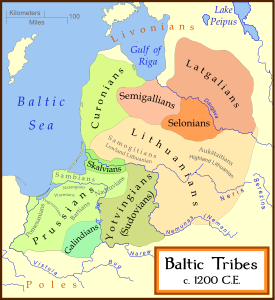

Baltic languages
The Baltic languages are a group of related languages belonging to the Balto-Slavic branch of the Indo-European language family and spoken mainly in areas extending east and southeast of the Baltic Sea in Northern Europe...
, a branch of the Indo-European language
Indo-European languages
The Indo-European languages are a family of several hundred related languages and dialects, including most major current languages of Europe, the Iranian plateau, and South Asia and also historically predominant in Anatolia...
family, are descended from a group of Indo-European
Proto-Indo-Europeans
The Proto-Indo-Europeans were the speakers of the Proto-Indo-European language , a reconstructed prehistoric language of Eurasia.Knowledge of them comes chiefly from the linguistic reconstruction, along with material evidence from archaeology and archaeogenetics...
tribes who settled the area between the Jutland
Jutland
Jutland , historically also called Cimbria, is the name of the peninsula that juts out in Northern Europe toward the rest of Scandinavia, forming the mainland part of Denmark. It has the North Sea to its west, Kattegat and Skagerrak to its north, the Baltic Sea to its east, and the Danish–German...
peninsula in the west and Moscow, Oka
Oka River
Oka is a river in central Russia, the largest right tributary of the Volga. It flows through the regions of Oryol, Tula, Kaluga, Moscow, Ryazan, Vladimir, and Nizhny Novgorod and is navigable over a large part of its total length, as far upstream as to the town of Kaluga. Its length exceeds...
and Volga rivers basins in the east. One of the features of Baltic languages is the number of conservative or archaic features retained. Among the Baltic peoples are modern Lithuanians
Lithuanians
Lithuanians are the Baltic ethnic group native to Lithuania, where they number around 2,765,600 people. Another million or more make up the Lithuanian diaspora, largely found in countries such as the United States, Brazil, Canada, Colombia, Russia, United Kingdom and Ireland. Their native language...
, Latvians
Latvians
Latvians or Letts are the indigenous Baltic people of Latvia.-History:Latvians occasionally refer to themselves by the ancient name of Latvji, which may have originated from the word Latve which is a name of the river that presumably flowed through what is now eastern Latvia...
(including Latgalians
Latgalians (modern)
This article is about modern ethnic group of Latvians inhabiting or coming from Latgalia. For ancient Baltic people see Latgalians.In Latvian, latgalieši refers to the ethnic Latvians of Latgalia, which has been developing separately from the rest of ethnic Latvia until 1917.In Latgalian language,...
) — all Eastern Balts — as well as the Prussians
Old Prussians
The Old Prussians or Baltic Prussians were an ethnic group, autochthonous Baltic tribes that inhabited Prussia, the lands of the southeastern Baltic Sea in the area around the Vistula and Curonian Lagoons...
, Yotvingians
Yotvingians
Yotvingians or Sudovians were a Baltic people with close cultural ties to the Lithuanians and Prussians...
and Galindians — the Western Balts — whose languages and cultures are now extinct.
Adam of Bremen
Adam of Bremen
Adam of Bremen was a German medieval chronicler. He lived and worked in the second half of the eleventh century. He is most famous for his chronicle Gesta Hammaburgensis Ecclesiae Pontificum .-Background:Little is known of his life other than hints from his own chronicles...
was the first writer to use the term Baltic in its modern sense to mean the sea of that name. Although he must have been familiar with the ancient name, Balcia, meaning a supposed island in the Baltic Sea, and although he may have been aware of the Baltic words containing the stem balt-, "white", as "swamp", he reports that he followed the local use of balticus from baelt ("belt") because the sea stretches to the east "in modum baltei" ("in the manner of a belt"). This is the first reference to "the Baltic or Barbarian Sea, a day's journey from Hamburg
Hamburg
-History:The first historic name for the city was, according to Claudius Ptolemy's reports, Treva.But the city takes its modern name, Hamburg, from the first permanent building on the site, a castle whose construction was ordered by the Emperor Charlemagne in AD 808...
."
The Germanics, however, preferred some form of "East Sea" (in different languages) until after about 1600, when they began to use forms of "Baltic Sea." Around 1840 the German nobles of the Governorate of Livonia devised the term "Balts" to mean themselves, the German upper classes of Livonia, excluding the Latvian and Estonian lower classes. They spoke an exclusive dialect, baltisch-deutsch, legally spoken by them alone. For all practical purposes that was the Baltic language until 1919.
Scandinavians
Scandinavians
Scandinavians are a group of Germanic peoples, inhabiting Scandinavia and to a lesser extent countries associated with Scandinavia, and speaking Scandinavian languages. The group includes Danes, Norwegians and Swedes, and additionally the descendants of Scandinavian settlers such as the Icelandic...
begin settling in Western Baltic lands in Lithuania
Lithuania
Lithuania , officially the Republic of Lithuania is a country in Northern Europe, the biggest of the three Baltic states. It is situated along the southeastern shore of the Baltic Sea, whereby to the west lie Sweden and Denmark...
and Latvia
Latvia
Latvia , officially the Republic of Latvia , is a country in the Baltic region of Northern Europe. It is bordered to the north by Estonia , to the south by Lithuania , to the east by the Russian Federation , to the southeast by Belarus and shares maritime borders to the west with Sweden...
.
Meanwhile in 1845 Georg Heinrich Ferdinand Nesselmann
Georg Heinrich Ferdinand Nesselmann
Georg Heinrich Ferdinand Nesselmann was a German orientalist, philologist with interests in Baltic languages, and a mathematics historian....
proposed a distinct language group for Latvian
Latvian language
Latvian is the official state language of Latvia. It is also sometimes referred to as Lettish. There are about 1.4 million native Latvian speakers in Latvia and about 150,000 abroad. The Latvian language has a relatively large number of non-native speakers, atypical for a small language...
and Lithuanian
Lithuanian language
Lithuanian is the official state language of Lithuania and is recognized as one of the official languages of the European Union. There are about 2.96 million native Lithuanian speakers in Lithuania and about 170,000 abroad. Lithuanian is a Baltic language, closely related to Latvian, although they...
to be called Baltic. It found some credence among linguists but was not generally adopted until the creation of the Baltic states
Baltic states
The term Baltic states refers to the Baltic territories which gained independence from the Russian Empire in the wake of World War I: primarily the contiguous trio of Estonia, Latvia, Lithuania ; Finland also fell within the scope of the term after initially gaining independence in the 1920s.The...
as part of the settlement of World War I
World War I
World War I , which was predominantly called the World War or the Great War from its occurrence until 1939, and the First World War or World War I thereafter, was a major war centred in Europe that began on 28 July 1914 and lasted until 11 November 1918...
in 1919. Gradually the non-Baltic Estonian
Estonian language
Estonian is the official language of Estonia, spoken by about 1.1 million people in Estonia and tens of thousands in various émigré communities...
was excluded from the linguistic meaning
Linguistic meaning
The nature of meaning, its definition, elements, and types, was discussed by philosophers Aristotle, Augustine, and Aquinas. According to them 'meaning is a relationship between two sorts of things: signs and the kinds of things they mean '. One term in the relationship of meaning necessarily...
of Baltic, as was Livonian, a now rare Finnic language
Finnic peoples
The Finnic or Fennic peoples were historic ethnic groups who spoke various languages traditionally classified as Finno-Permic...
in Latvia, while Old Prussian — long recognized as close to Lithuanian and Latvian — was added. Estonia
Estonia
Estonia , officially the Republic of Estonia , is a state in the Baltic region of Northern Europe. It is bordered to the north by the Gulf of Finland, to the west by the Baltic Sea, to the south by Latvia , and to the east by Lake Peipsi and the Russian Federation . Across the Baltic Sea lies...
remained, however, among the Baltic states
Baltic states
The term Baltic states refers to the Baltic territories which gained independence from the Russian Empire in the wake of World War I: primarily the contiguous trio of Estonia, Latvia, Lithuania ; Finland also fell within the scope of the term after initially gaining independence in the 1920s.The...
in the geopolitical sense.
Indo-European arrivals
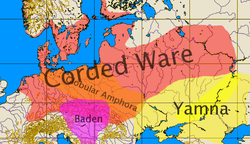
Corded Ware culture
The Corded Ware culture , alternatively characterized as the Battle Axe culture or Single Grave culture, is an enormous European archaeological horizon that begins in the late Neolithic , flourishes through the Copper Age and culminates in the early Bronze Age.Corded Ware culture is associated with...
. They came from the southeast and spread all across Eastern and Central Europe, reaching even southern Finland. It is believed that Corded Ware culture
Corded Ware culture
The Corded Ware culture , alternatively characterized as the Battle Axe culture or Single Grave culture, is an enormous European archaeological horizon that begins in the late Neolithic , flourishes through the Copper Age and culminates in the early Bronze Age.Corded Ware culture is associated with...
peoples were Indo-European
Indo-European
Indo-European may refer to:* Indo-European languages** Aryan race, a 19th century and early 20th century term for those peoples who are the native speakers of Indo-European languages...
ancestors of many Europeans, including Balts. It is thought that those Indo-European newcomers were quite numerous and in the Eastern Baltic assimilated earlier indigenous cultures (Europidic cultures - Narva culture
Narva culture
Narva culture or eastern Baltic was a European Neolithic archaeological culture found in present-day Estonia, Latvia, Lithuania, Kaliningrad Oblast , and adjacent portions of Poland and Russia. A successor of the Mesolithic Kunda culture, Narva culture continued up to the start of the Bronze Age....
and Neman culture
Neman culture
The Neman culture is the name of two archaeological cultures that existed in Mesolithic and continued into middle Neolithic. It was a continuation of the Swiderian culture and was replaced by the Corded Ware culture. It was located in the upper basin of the Neman River: northern Poland, southern...
). Over time the new people formed the Baltic peoples and they spread in the area from the Baltic sea in the west to the Volga in the east.
Formation of a Baltic homeland
The Balts or Baltic peoples, defined as speakers of one of the Baltic languages, a branch of the Indo-European language family, are descended from a group of Indo-European tribes who settled the area between the lower Vistula and upper Daugava and Dnieper rivers on the southeast shore of the Baltic Sea. Because the thousands of lakes and swamps in this area contributed to the Balts' geographical isolation, the Baltic languages retain a number of conservative or archaic features.Some of the major authorities on Balts, such as Būga
Kazimieras Buga
Kazimieras Būga was a Lithuanian linguist and philologist. He was a professor of linguistics, who mainly worked on the Lithuanian language.He was born at Pažiegė, near Dusetos, then part of the Russian Empire...
, Vasmer
Max Vasmer
Max Vasmer was a Russian-born German linguist who studied problems of etymology of Indo-European, Finno-Ugric and Turkic languages and worked on history of Slavic, Baltic, Iranian, and Finno-Ugric peoples....
, Toporov and Trubachov, in conducting etymological studies of eastern European river names, were able to identify in certain regions names of specifically Baltic provenance, which most likely indicate where the Balts lived in prehistoric times. This information is summarized and synthesized by Marija Gimbutas
Marija Gimbutas
Marija Gimbutas , was a Lithuanian-American archeologist known for her research into the Neolithic and Bronze Age cultures of "Old Europe", a term she introduced. Her works published between 1946 and 1971 introduced new views by combining traditional spadework with linguistics and mythological...
in The Balts (1963) to obtain a likely proto-Baltic homeland. Its borders are approximately: from a line on the Pomerania
Pomerania
Pomerania is a historical region on the south shore of the Baltic Sea. Divided between Germany and Poland, it stretches roughly from the Recknitz River near Stralsund in the West, via the Oder River delta near Szczecin, to the mouth of the Vistula River near Gdańsk in the East...
n coast eastward to include or nearly include the present-day sites of Warsaw
Warsaw
Warsaw is the capital and largest city of Poland. It is located on the Vistula River, roughly from the Baltic Sea and from the Carpathian Mountains. Its population in 2010 was estimated at 1,716,855 residents with a greater metropolitan area of 2,631,902 residents, making Warsaw the 10th most...
, Kiev
Kiev
Kiev or Kyiv is the capital and the largest city of Ukraine, located in the north central part of the country on the Dnieper River. The population as of the 2001 census was 2,611,300. However, higher numbers have been cited in the press....
, and Kursk
Kursk
Kursk is a city and the administrative center of Kursk Oblast, Russia, located at the confluence of the Kur, Tuskar, and Seym Rivers. The area around Kursk was site of a turning point in the Russian-German struggle during World War II and the site of the largest tank battle in history...
, northward through Moscow
Moscow
Moscow is the capital, the most populous city, and the most populous federal subject of Russia. The city is a major political, economic, cultural, scientific, religious, financial, educational, and transportation centre of Russia and the continent...
to the River Berzha, westward in an irregular line to the coast of the Gulf of Riga, north of Riga
Riga
Riga is the capital and largest city of Latvia. With 702,891 inhabitants Riga is the largest city of the Baltic states, one of the largest cities in Northern Europe and home to more than one third of Latvia's population. The city is an important seaport and a major industrial, commercial,...
.
Proto-history
In 98 AD TacitusTacitus
Publius Cornelius Tacitus was a senator and a historian of the Roman Empire. The surviving portions of his two major works—the Annals and the Histories—examine the reigns of the Roman Emperors Tiberius, Claudius, Nero and those who reigned in the Year of the Four Emperors...
described one of the tribes living near the Baltic Sea (Mare Svebicum) as Aestiorum gentes and amber
Amber
Amber is fossilized tree resin , which has been appreciated for its color and natural beauty since Neolithic times. Amber is used as an ingredient in perfumes, as a healing agent in folk medicine, and as jewelry. There are five classes of amber, defined on the basis of their chemical constituents...
gatherers. It is believed that these peoples were inhabitants of the Sambian peninsula, although no other contemporary sources exist.
This homeland includes all historical Balts and every location where Balts are thought to have been at different periods in time. Over time the huge area of Baltic habitation shrank, due to assimilations with other groups and invasions. It is interesting to point out that according to one of the theories, which has gained considerable traction over the years, one of the western Baltic tribes, Galindians, Baltic occupation of Western Russia
Galindae
The term Galindians may be applied to two distinct, and now extinct, tribes of the Balts. Most commonly, the term is used to describe the Western Galindians who lived in the southeast part of Prussia...
, Goliad migrated to the Eastern end of Baltic realm around the 4th century AD and settled around modern day Moscow, Russia. Finally, according to Slavic chronicles of the time they were warring with Slavs
Slavic peoples
The Slavic people are an Indo-European panethnicity living in Eastern Europe, Southeast Europe, North Asia and Central Asia. The term Slavic represents a broad ethno-linguistic group of people, who speak languages belonging to the Slavic language family and share, to varying degrees, certain...
, and perhaps, were defeated and assimilated some time in 11-13 centuries.
Balts differentiated into Western and Eastern Balts in late centuries BC. The eastern Baltic was inhabited by ancestors of Western Balts - Old Prussians
Old Prussians
The Old Prussians or Baltic Prussians were an ethnic group, autochthonous Baltic tribes that inhabited Prussia, the lands of the southeastern Baltic Sea in the area around the Vistula and Curonian Lagoons...
, Sudovians/Jotvingians, Scalvians, Nadruvians
Nadruvians
The Nadruvians were one of the now-extinct Prussian clans. They lived in Nadruvia , a large territory in northernmost Prussia...
, and Curonians
Curonians
The Curonians or Kurs were a Baltic tribe living on the shores of the Baltic sea in what are now the western parts of Latvia and Lithuania from the 5th to the 16th centuries, when they merged with other Baltic tribes. They gave their name to the region of Courland , and they spoke the Old...
. On the other hand, Eastern Balts were living in modern day Belarus, Ukraine and Russia. Subsequent Germanic
Germanic peoples
The Germanic peoples are an Indo-European ethno-linguistic group of Northern European origin, identified by their use of the Indo-European Germanic languages which diversified out of Proto-Germanic during the Pre-Roman Iron Age.Originating about 1800 BCE from the Corded Ware Culture on the North...
and Gothic
Goths
The Goths were an East Germanic tribe of Scandinavian origin whose two branches, the Visigoths and the Ostrogoths, played an important role in the fall of the Roman Empire and the emergence of Medieval Europe....
domination of first half of the first millennium AD in the Northern and Eastern Europe, as well as later Slavic expansion caused large migration of the Balts. First, Galindae
Galindae
The term Galindians may be applied to two distinct, and now extinct, tribes of the Balts. Most commonly, the term is used to describe the Western Galindians who lived in the southeast part of Prussia...
or Galindians to the East and, later, Eastern Balts to the West, until they reached the ethnographic area of the Balts as we know since 13th-14th centuries. Many other eastern and Southern Balts either assimilated with other Balts or contributed to the formation of the Slavs in the 4th-7th centuries, and later gradually were slavicized.
History
In the 12th and the 13th centuries, internal struggles, as well as invasions by RutheniansRuthenians
The name Ruthenian |Rus']]) is a culturally loaded term and has different meanings according to the context in which it is used. Initially, it was the ethnonym used for the East Slavic peoples who lived in Rus'. Later it was used predominantly for Ukrainians...
and Poles
Poles
thumb|right|180px|The state flag of [[Poland]] as used by Polish government and diplomatic authoritiesThe Polish people, or Poles , are a nation indigenous to Poland. They are united by the Polish language, which belongs to the historical Lechitic subgroup of West Slavic languages of Central Europe...
and later the expansion of the Teutonic Order resulted in an almost complete annihilation of the Galindians, Curonians, and Yotvingians. Gradually Old Prussians became Germanized or some Lithuanized during 15 -17 c., especially after the Reformation
Protestant Reformation
The Protestant Reformation was a 16th-century split within Western Christianity initiated by Martin Luther, John Calvin and other early Protestants. The efforts of the self-described "reformers", who objected to the doctrines, rituals and ecclesiastical structure of the Roman Catholic Church, led...
in Prussia
Prussia
Prussia was a German kingdom and historic state originating out of the Duchy of Prussia and the Margraviate of Brandenburg. For centuries, the House of Hohenzollern ruled Prussia, successfully expanding its size by way of an unusually well-organized and effective army. Prussia shaped the history...
. The cultures of the Lithuanians and Latgalians/Latvians survived and became the ancestors of the populations of the modern countries of Latvia
Latvia
Latvia , officially the Republic of Latvia , is a country in the Baltic region of Northern Europe. It is bordered to the north by Estonia , to the south by Lithuania , to the east by the Russian Federation , to the southeast by Belarus and shares maritime borders to the west with Sweden...
and Lithuania
Lithuania
Lithuania , officially the Republic of Lithuania is a country in Northern Europe, the biggest of the three Baltic states. It is situated along the southeastern shore of the Baltic Sea, whereby to the west lie Sweden and Denmark...
.
Old Prussian was closely related to the other extinct Western Baltic languages, Curonian
Curonian language
The Curonian language or Old Curonian is an extinct language spoken by the Curonian tribe, who lived mainly on the Courland peninsula and along the nearby Baltic shores....
, Galindian
Galindian language
Galindian is a poorly attested extinct language, considered to be a part of the Baltic languages group. There are no extant writings in Galindian.- References :**http://www.sil.org/iso639-3/documentation.asp?id=xgl...
and Sudovian
Sudovian language
Sudovian is an extinct western Baltic language of Northeastern Europe. Closely related to the Old Prussian language, it was formerly spoken southwest of the Nemunas river in what is now Lithuania, east of Galindia and north of Yotvingia, and by exiles in East Prussia.-History:Sudovia and...
. It is more distantly related to the surviving Eastern Baltic languages, Lithuanian
Lithuanian language
Lithuanian is the official state language of Lithuania and is recognized as one of the official languages of the European Union. There are about 2.96 million native Lithuanian speakers in Lithuania and about 170,000 abroad. Lithuanian is a Baltic language, closely related to Latvian, although they...
and Latvian
Latvian language
Latvian is the official state language of Latvia. It is also sometimes referred to as Lettish. There are about 1.4 million native Latvian speakers in Latvia and about 150,000 abroad. The Latvian language has a relatively large number of non-native speakers, atypical for a small language...
. Compare the Prussian word seme (zemē), the Latvian zeme, the Lithuanian žemė.
Old Prussian contained a few borrowings specifically from Gothic
Gothic language
Gothic is an extinct Germanic language that was spoken by the Goths. It is known primarily from the Codex Argenteus, a 6th-century copy of a 4th-century Bible translation, and is the only East Germanic language with a sizable Text corpus...
(e.g., Old Prussian ylo "awl," as with Lithuanian ýla, Latvian īlens) and even Scandinavian languages.
Summary of Baltic peoples and tribes
| Regions | Tribes and nations | Localities |
|---|---|---|
| Eastern Balts† | Eastern Galindians | Moscow Moscow Moscow is the capital, the most populous city, and the most populous federal subject of Russia. The city is a major political, economic, cultural, scientific, religious, financial, educational, and transportation centre of Russia and the continent... region |
| Dniepr Balts | Dnieper basin | |
| Eastern (Middle) Balts | Latvians Latvians Latvians or Letts are the indigenous Baltic people of Latvia.-History:Latvians occasionally refer to themselves by the ancient name of Latvji, which may have originated from the word Latve which is a name of the river that presumably flowed through what is now eastern Latvia... |
Latgalians Latgalians The term Latgalians The term Latgalians The term Latgalians (Latgalian: latgalīši, latgali, (also spelt Latgallians and sometimes known as Lettigalls, Latgolans, or Lettigallians) can refer to the inhabitants of the Latgale region in eastern Latvia in general, the ethnic Latvians of Latgale... |
| Lithuanians Lithuanians Lithuanians are the Baltic ethnic group native to Lithuania, where they number around 2,765,600 people. Another million or more make up the Lithuanian diaspora, largely found in countries such as the United States, Brazil, Canada, Colombia, Russia, United Kingdom and Ireland. Their native language... |
Aukštaitians ("highlanders") | |
| Samogitians Samogitians Samogitians are a part of the Lithuanian ethnicity inhabiting the region of Samogitia in Lithuania. Many speak the Samogitian dialect of the Lithuanian language.-History:... ("lowlanders") |
||
| Prussian Lithuanians Prussian Lithuanians The term Prussian Lithuanians or Lietuvininkai refers to a Western Lithuanian ethnic group, which did not form a nation and inhabited a territory in East Prussia called Prussian Lithuania or Lithuania Minor in contrast to the Grand Duchy of Lithuania and later the Republic of Lithuania .Unlike most... |
||
| Transitional Balts† | Selonians Selonians Selonians were a tribe of Baltic peoples. The Selonians lived until the 15th century in Selonia, located in southeastern Latvia and northeastern Lithuania. They merged with neighbouring tribes, contributing to the ethnogenesis of Latvians and Lithuanians.... |
Toponomastic Onomastics Onomastics or onomatology is the study of proper names of all kinds and the origins of names. The words are from the Greek: "ὀνομαστικός" , "of or belonging to naming" and "ὀνοματολογία" , from "ὄνομα" "name". Toponymy or toponomastics, the study of place names, is one of the principal branches of... only. |
| Semigallians | Toponomastic only. | |
| Curonians Kursenieki The Kuršininkai are a nearly extinct Baltic ethnic group living along the Curonian Spit. "Kuršininkai" refers only to inhabitants of Lithuania and former East Prussia that speak a Lithuanian language dialect.... , Curonian Kings Curonian Kings "Curonian Kings" was a social and ethnic group of Latvians that lived in seven villages between Goldingen and Hasenpoth in Courland.... |
Toponomastic only. | |
| Western Balts† | Yotvingians Yotvingians Yotvingians or Sudovians were a Baltic people with close cultural ties to the Lithuanians and Prussians... or Sudovians |
Historic region |
| Prussians Old Prussians The Old Prussians or Baltic Prussians were an ethnic group, autochthonous Baltic tribes that inhabited Prussia, the lands of the southeastern Baltic Sea in the area around the Vistula and Curonian Lagoons... |
Sambians Sambians The Sambians were one of the Prussian tribes. They inhabited the peninsula of Sambia, north of the city of Königsberg . Sambians were located in a coastal territory rich in amber and engaged in trade early on . Therefore, they established contacts with foreign nations before any other Prussians... |
|
| Scalvians | ||
| Nadruvians Nadruvians The Nadruvians were one of the now-extinct Prussian clans. They lived in Nadruvia , a large territory in northernmost Prussia... |
||
| Natangians | ||
| Bartians Bartians The Bartians were an Old Prussian tribe who were among the last pagans of Europe before the Northern Crusades forced their conversion to Christianity... |
||
| Pomesanians | ||
| Pogesanians | ||
| Western Galindians | ||
| Warmia Warmia Warmia or Ermland is a region between Pomerelia and Masuria in northeastern Poland. Together with Masuria, it forms the Warmian-Masurian Voivodeship.... ns or Varmians |
||
| Sasna Sasna thumb|300px|Sasna and other Prussian lands in the 13th century.Sasna or Sassen was one of the regions of ancient Prussia. It is now located in northern Poland.-Etymology:... ns |
||
| Lubavians | ||
| Pomeranian Balts Pomeranian Balts The term Pomerania Balts, or rather Western Balts, refers to Baltic people, who as early as the bronze age inhabited parts of the southern coast of the Baltic Sea, an area now known as Pomerania.... |
Pomerania Pomerania Pomerania is a historical region on the south shore of the Baltic Sea. Divided between Germany and Poland, it stretches roughly from the Recknitz River near Stralsund in the West, via the Oder River delta near Szczecin, to the mouth of the Vistula River near Gdańsk in the East... |
†Extinct