

Luftwaffe

Encyclopedia
Luftwaffe (ˈlʊftvafə) is a generic German
term for an air force
. It is also the official name for two of the four historic German air forces, the Wehrmacht
air arm founded in 1935 and disbanded in 1946; and the current Bundeswehr
air arm founded in 1956.
Schweizer Luftwaffe is also the name of the Swiss Air Force
in German. Two other historic German air forces are the World War I
-era Luftstreitkräfte
of the era of the German Empire
, and the Luftstreitkräfte der NVA
in the GDR
. The air force of Austria is called Österreichische Luftstreitkräfte
.
 The forerunner of the Luftwaffe, the Imperial German Army Air Service (Luftstreitkräfte
), was founded in 1910 with the name Die Fliegertruppen des deutschen Kaiserreiches, and changed to the name "Luftstreitkräfte" by the end of 1916, with the emergence of military aircraft
, although they were intended to be used primarily for reconnaissance
in support of armies on the ground, just as balloons had been used in the same fashion during the Franco-Prussian War
of 1870–1871 and even as far back as the Napoleonic Wars
. It was not the world's first air force, however, because France's embryonic army air service, which eventually became the French Air Force (Armée de l’Air)
, had been founded in 1909. Britain's Royal Flying Corps
(which merged on April 1, 1918 with the Royal Naval Air Service
to form the Royal Air Force
) was founded in 1912.
During World War I
, the Imperial Army Air Service utilised a wide variety of aircraft, ranging from fighters (such as those manufactured by Albatros-Flugzeugwerke and Fokker
) to reconnaissance aircraft (Aviatik and DFW) and heavy bombers (Gothaer Waggonfabrik
, better known simply as Gotha, and the Zeppelin-Staaken R.VI "giant" heavy bomber
). Missions were also flown in a wide range of theatres
, from the Western Front to the plains of Russia and even as far away as bombing raids on British Suez Canal positions in support of the Ottoman offense in 1915.
The air war on the Western Front received the most attention in the annals of military aviation, since it produced aces such as Manfred von Richthofen
, popularly known as the Red Baron, Ernst Udet
, Hermann Göring
, Oswald Boelcke
, Werner Voss
, and Max Immelmann
(the first airman to win the Pour le Mérite
, Imperial Germany's highest decoration for gallantry, as a result of which the decoration became popularly known as the Blue Max). Like the German Navy, the German Army used Zeppelin
s as airship
s for bombing military and civilian targets in France and Belgium as well as the United Kingdom.
All German and Austro-Hungarian
military aircraft in service used the Iron Cross
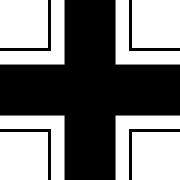
insignia until early 1918. Afterwards, the Balkenkreuz, a black Greek cross on white, was introduced.
After the German defeat, the service was dissolved completely on 8 May 1920 under the conditions of the Treaty of Versailles
, which mandated the complete destruction of its airplanes.
forbade Germany to have an air force, German pilots trained in violation of the treaty in secret. Initially, civil aviation schools within Germany were used, yet only light trainers
could be used in order to maintain the façade that the trainees were going to fly with civil airlines such as Deutsche Luft Hansa
. To train its pilots on the latest combat aircraft, Germany solicited the help of its future enemy, the USSR, which was also isolated in Europe. A secret training airfield was established at Lipetsk
in 1924 and operated for approximately nine years using mostly Dutch and Russian, but also some German, training aircraft before being closed in 1933. This base was officially known as 4th squadron of the 40th wing of the Red Army.
In February 1935, Adolf Hitler
ordered Hermann Göring
to establish the Luftwaffe, breaking the Treaty of Versailles
's ban on German military aviation. Germany violated the treaty without sanction from Britain, France, or the League of Nations
, and neither the League nor either country did anything to oppose this. Although the new air force was to be run totally separately from the army, it retained the tradition of according army ranks for its officers and airmen, a tradition retained today by united Germany's Luftwaffe and by many air forces throughout the world. Before the official promulgation of Göring's new Luftwaffe in 1935, Germany had a paramilitary air force known as the Deutscher Luftsportverband (DLV: German air sports union). The DLV was headed by Ernst Udet
and its insignia were taken over by the new Luftwaffe, although the DLV "ranks" had special names that made them sound more civilian than military.
Dr. Fritz Todt
, the engineer who founded the forced-labor Organisation Todt
, was appointed to the rank of Generalmajor in the Luftwaffe. He had served in an observation squadron during World War I
and had been awarded the Iron Cross
. He died in an aircraft crash in February 1942.
The eagle, an old symbol of the German Empire, was used as the emblem for the Luftwaffe, but in a different posture. Since 1933, when Hitler's National Socialist Party came to power, the eagle held between its claws the symbol of the party—the swastika
(an old symbol of sunrise)—which was usually enveloped by an oak wreath. Göring rejected the old heraldic eagle because he felt it was too stylized, too static, and too massive; instead he chose a younger, more natural and lighter eagle with wings spread as if in flight, as he considered this a more suitable symbol for an air force. While the Wehrmacht eagle held the symbol of the National Socialist Party firmly in its claws, the Luftwaffe eagle held the swastika with only one claw while the other was bent in a threatening gesture.
The Luftwaffe attempted to incorporate all military units that had anything to do with air warfare. Given the strong Nazi origin and influence in the Luftwaffe, this was seen as a way to increase Nazi influence in the army (alongside the other project in this respect, the formation of SS divisions), as well as boosting the personal prestige of Göring. Thus the anti-aircraft (Flak) and airborne troops (Fallschirmjäger) fell under direct Luftwaffe command, and the navy (Kriegsmarine
) never established its own air branch; naval aviation was executed by the Luftwaffe. Even the aircraft flown from the (never finished) aircraft carrier Graf Zeppelin
were to be operated by the Luftwaffe. By the middle of the war, when personnel assignments for the Luftwaffe were disproportionate to a shrinking number of aircraft, the excess personnel were not transferred to the army (Heer
), but instead organized into Luftwaffe Field Division
s in 1942. Their performance as ground units was so poor that command was transferred to the army in 1943, although they retained their name.
The Luftwaffe had the ideal opportunity to test its pilots, aircraft and tactics in the Spanish Civil War
of 1936–1939, when the Condor Legion
was sent to Spain in support of the anti-Republican government revolt led by Francisco Franco
. The aircraft used included modern types which became world famous: the Junkers Ju 87
Stuka dive-bomber, Dornier Do 17
"Schnell" (fast) bomber, and the Messerschmitt Bf 109
fighter. Since the aircraft were seconded to Franco's Nationalist air force, Luftwaffe markings were replaced to avoid giving the impression that Germany was actively supporting the revolt. Instead of the Nazi Party's swastika
on the tail, the German aircraft used the nationalist air force aircraft markings (a Saint Andrew's cross over a white background, painted on the rudder of the aircraft and a black disc on fuselage and wings). All aircraft in the Legion were affiliated to units given a designation ending in the number 88. For example, bombers were in Kampfgruppe 88 (combat group 88, K/88); and fighters, in Jagdgruppe 88 (fighter group 88, J/88
. Following the Munich crisis
, Hitler ordered the Luftwaffe be expanded fivefold.
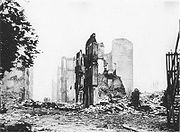 A grim foretaste of the systematic bombing of cities during World War II
came in April 1937 when a combined force of German and Italian bombers under Spanish-Nationalist command destroyed most of the Basque
city of Guernica
in northeast Spain. This bombing received worldwide condemnation, and the collective memory of the horror of the bombing of civilians became more acute because of a famous painting
, named after the town, by Pablo Picasso
. Many feared that this would be the way that future air wars would be conducted; the Italian strategist General Giulio Douhet
(who had died in 1930) had formulated theories regarding what would be dubbed "strategic bombing" - the idea that wars would be won by striking from the air at the heart of the industrial muscle of a warring nation, thus demoralizing the civilian population to the point where the government of that nation would be driven to sue for peace.
The destruction of the town was not the aim of the mission; the targets were the roads and the Rentaria bridge. The devastation was primarily caused by the inaccuracy of bombing techniques of the day and the fact that the mass of refugees moving through the town was misidentified as "troop movements". The Basque Government had previously decided to fortify the town and there were 2000 of its troops present. The propaganda claims that it was intended a "terror attack" are demonstrably untrue as Wolfram von Richthofen "had no time for this tactic and was at first as bewildered about the town's destruction as everyone else".
 At the outset of the war, the Luftwaffe was one of the most modern, powerful, and experienced air forces in the world, and dominated the skies over much of continental Europe with aircraft much more advanced than their foreign counterparts. The Luftwaffe was central to the German operational methods, as the close air support
provided by various medium two-engine bombers, Stuka dive bombers and an overwhelming force of tactical fighters were key to several early successes. Unlike the British and American Air Forces, the Luftwaffe never developed four-engine bombers in any significant numbers, and was thus unable to conduct an effective long-range strategic bombing campaign against either the Russians or the Western Allies.
The Messerschmitt Bf 109
was the most versatile and widely-produced fighter aircraft operated by the Luftwaffe and was designed when biplanes were still standard. Many versions of this aircraft were made. The engine, a liquid cooled Mercedes-Benz DB 601, initially generated up to almost 1000 hp. This power increased as direct fuel injection was introduced to the engine, and it was upgraded to the DB 605.
In 1941 another interceptor entered service, the Focke-Wulf Fw 190
. This fighter had relatively short wings and was powered originally by a radial BMW 801 engine, and later by an inline Junkers Jumo
(Fw 190D), and held its own against new, improved Allied aircraft such as the P-51 Mustang
. The Junkers Ju 87
Stuka was a main asset for Blitzkrieg
, able to place bombs with deadly accuracy. The leader of the Luftwaffe was Hermann Göring
, a World War I
fighter ace
and former commander of Manfred von Richthofen
's famous JG 1 (aka "The Flying Circus
") who had joined the Nazi party in its early stages.
In the second half of 1940, the Luftwaffe lost the Battle of Britain
over the skies of England, the first all-air battle. Following the military failures on the Eastern Front
, from 1942 onwards, the Luftwaffe went into a steady, gradual decline that saw it outnumbered and overwhelmed by the sheer number of Allied aircraft being deployed against it. Towards the end of the war, the Luftwaffe was no longer a major factor, and despite fielding advanced aircraft like the Messerschmitt Me 262
, Heinkel He 162
, Arado Ar 234
, and Me 163 it was crippled by fuel shortages and a lack of trained pilots. There was also very little time to develop the new aircraft, and they could not be produced fast enough by the Germans.
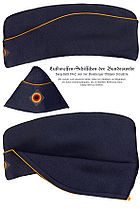 German aviation in general was severely curtailed, and military aviation was completely forbidden when the Luftwaffe was officially disbanded in August 1946 by the Allied Control Commission. This changed when West Germany joined NATO in 1955, as the Western Allies believed that Germany was needed in view of the increasing military threat posed by the Soviet Union
and its Warsaw Pact
allies. Throughout the following decades, the West German Luftwaffe (Bundesluftwaffe: federal air force) was equipped mostly with U.S.-designed aircraft (e.g. F-84F, F-86, F-104, F-4) manufactured locally under licence. All aircraft sported—and continue to sport—the Iron Cross on the fuselage, harking back to the days of World War I, while the national flag of West Germany is displayed on the tail.
Many well-known fighter pilots who had fought with the Luftwaffe in World War II joined the new post-war air force and underwent refresher training in the U.S. before returning to West Germany to upgrade on the latest U.S.-supplied hardware. These included Erich Hartmann
, the highest-ever scoring ace (352 enemy aircraft destroyed), Gerhard Barkhorn
(301), Günther Rall
(275) and Johannes Steinhoff
(176). Steinhoff, who suffered a crash in a Messerschmitt Me 262
shortly before the end of the war that resulted in lifelong scarring of his face and other parts of his body, would eventually become commander-in-chief of the Luftwaffe, with Rall as his immediate successor. Hartmann retired as an Oberst
(colonel
) in 1970 at age 48. Josef Kammhuber
, mentioned above, also served in the post-war Luftwaffe, retiring in 1962 as Inspekteur der Bundesluftwaffe (chief inspector of the Federal air force).
During the 1960s, the "Starfighter crisis" developed into a political issue
, as many Lockheed F-104 Starfighters crashed after being modified to serve for Luftwaffe purposes – specifically for terrain, weather, and ground mechanic support issues. In Luftwaffe service, 292 of 916 Starfighters crashed, claiming the lives of 115 pilots and leading to cries that the Starfighter was fundamentally unsafe from the West German public, which referred to it as the Witwenmacher (widow-maker), fliegender Sarg (flying coffin), Fallfighter (falling fighter) and Erdnagel (tent peg
, literally "ground nail").
Steinhoff and his deputy Günther Rall noted that the non-German F-104s proved much safer – Spain, for example, lost none in the same period. The Americans blamed the high loss rate of the Luftwaffe F-104s on the extreme low-level and aggressive flying of German pilots rather than any faults in the aircraft. Steinhoff and Rall immediately went to America to learn to fly the Starfighter under Lockheed instruction and noted some specifics in the training (a lack of mountain and foggy-weather training), combined with handling capabilities (sharp start high G turns) of the aircraft that could cause accidents.
Steinhoff and Rall changed the training regimen for the F-104 pilots, and the accident rates quickly fell to those comparable or better than other air forces. They also brought about the high level of training and professionalism seen today throughout the Luftwaffe, and the start of a strategic direction for Luftwaffe pilots to engage in tactical and combat training outside of Germany. However, the F-104 never lived down its reputation as a widow-maker and was replaced much earlier by the Luftwaffe than other national air forces.
The Starfighter was replaced by the American-built McDonnell Douglas
F-4 Phantom II
fighter and the Panavia Tornado
fighter-bomber; the latter was designed and produced by a cooperative of companies from the United Kingdom, Germany, and Italy. These fighters remain in Luftwaffe service today, with upgrades to their electronics and the addition of the AIM-120 AMRAAM
air-to-air missile for the air defense of Germany.
From 1965 through 1970, two surface-to-surface missile wings (Flugkörpergeschwader) fielded 16 of the Pershing I missile systems with nuclear warheads under U.S. Army custody. In 1970, the system was upgraded to Pershing IA with 72 missiles. Although not directly affected by the 1988 Intermediate-Range Nuclear Forces Treaty
, the Luftwaffe unilaterally agreed to the removal of the Pershing IA missiles from its inventory in 1991, and the missiles were destroyed.
Beginning in June 1979, the Luftwaffe took delivery of 212 Panavia Tornado
fighters.
.svg.png) The GDR
The GDR
air force, the Luftstreitkräfte der NVA
, was supplied exclusively with Eastern Bloc
-produced aircraft such as the Sukhoi Su-17
"Fitter" and Mikoyan-Gurevich
(MiG) family of aircraft, such as the MiG-21
, MiG-23
and MiG-29 fighters, and served primarily as an extension of Red Air Force units in Eastern Germany. The East German Air Force
was unique among Warsaw Pact
countries in that it was often equipped with Soviet-standard combat aircraft instead of downgraded export models. Operated as an extension of Soviet air power, the East German Air Force enjoyed less autonomy than other Eastern Bloc
air forces. The markings on the aircraft reflected the identity of the country as belonging to the Communist bloc. These markings consisted of a diamond-shaped design, with three vertical stripes in black, red and gold surmounted by the stylized hammer, and wreath-like ears-of-grain design, which was also on the Flag of East Germany.
 After East and West Germany were unified in October 1990, the aircraft of the NVA
were taken over by the Federal Republic of Germany
, and their GDR markings were replaced by the Iron Cross, the first time Soviet-built aircraft had served in a NATO air force. Most of these were taken out of service, in many cases being sold or given to the new Eastern European members of NATO, such as Poland and the Baltic states.
An exception to this was the Jagdgeschwader 73
"Steinhoff" (Fighter Wing
73 "Steinhoff") stationed in Laage
. The pilots of the JG 73 flew MiG-29s acquired during the reunification and were some of the most experienced MiG-29 pilots in the world. One of their primary duties was to serve as aggressor pilots, training other pilots in dissimilar combat tactics
. The United States sent a group of fighter pilots to Germany during the Red October exercise to practice tactics against the aircraft they were most likely to meet in real combat. The MiG-29s of JG 73 were fully integrated into the Luftwaffe's air defence structure and, from February 1995 became the first Soviet Bloc aircraft to be declared operational within NATO. In 2004, with the introduction of the Eurofighter Typhoon
imminent, the decision was taken to withdraw the MiG-29. JG 73's aircraft were withdrawn in August 2004, following which they were sold to the Polish Air Force
.
s for use by Germany under a NATO nuclear sharing
agreement. As of 2007, only 22 B61-4
s are still present, stored at Büchel Air Base
for delivery with German Air Force Panavia Tornado
s. These bombs are likely to be withdrawn when the Tornados at Büchel are replaced with Eurofighter Typhoon
s after 2012, since it is not planned to integrate the B-61 bomb into the Eurofighter. B-61s stationed at Nörvenich and Memmingen Air Base (fighter-bomber wing JaBoG 34 "Allgäu") have already been withdrawn in the mid- to late-1990s. All nuclear bombs formerly stored at the Ramstein Air Base
have been returned to the U.S. or elsewhere (the U.K. is possible), due to ongoing construction work at Ramstein AB, and they will not be returned to Germany.
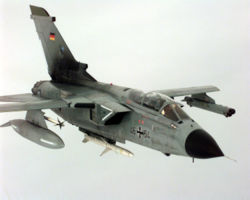 The Luftwaffe saw action for first time since World War II in September 1995 during Operation Deliberate Force, when 6 IDS Tornados, equipped with infrared recce devices
and escorted by 8 ECR Tornados, supported NATO's artillery missions on Bosnian Serb positions around Sarajevo
.
In March 1999 the Luftwaffe eventually became involved in direct combat role as part of the NATO-led Kosovo War
. This event was noted as significant in the British press with "The Sun"
running the headline "Luftwaffe and the RAF into battle side by side". The Luftwaffe deployed the Fighter Bomber Wing 32 which flew suppression of enemy air defence (SEAD
) sorties with ECR Tornados. The fighter-bombers were equipped with an electronic countermeasures pod, a AIM-9 Sidewinder
missile for self-defense and an AGM-88 HARM
air to ground missile. The bomber wing flew 2108 hours and 446 sorties, firing 236 HARM missiles on enemy targets. No Luftwaffe aircraft was lost during the campaign.
operation, and were supplemented in 2009 by the Eurofighter.
In 2006, to support coalition operations across Afghanistan
, the Luftwaffe deployed Panavia Tornado reconnaissance aircraft from Aufklärungsgeschwader 51 "Immelmann" (the 51st Reconnaissance Wing "Immelmann"), stationed in Mazar-i-Sharif, Northern Afghanistan.
There are also various army helicopters in operation at the German air base in Mazar-i-Sharif and Luftwaffe C-160 Transall conduct air transport sorties into and within Afghanistan.
In order to counteract criticism by its ISAF
allies, since December 2009 the Luftwaffe participates in combat operations of the Royal Air Force
in southern Afghanistan
.
Since the 1970s, the Luftwaffe of West Germany and later the reunited Germany (as well as many other European air forces) has actively pursued the construction of European combat aircraft such as the Panavia Tornado
and, more recently, the Eurofighter Typhoon
, which was introduced in 2006.
On 13 January 2004, the Defence Minister
Peter Struck
announced major changes to the German armed forces
. A major part of this announcement was a plan to cut the German fighter fleet from 426 aircraft in early 2004 to 265 by 2015. Assuming the full German order for 180 Eurofighter Typhoon
s is fulfilled, this will see the Tornado force reduced to 85. The German Navy
's air wing (Marineflieger) received 112 Tornado IDSs. In late 2004 the last Tornado unit was disbanded. The maritime combat role has been assumed by the Luftwaffe, a unit of which has had its Tornados upgraded to carry the Kormoran II
and AGM-88 HARM missiles.
 In light of the destroyed infrastructure of West Germany post–World War II, the restrictions on aircraft production placed on Germany and the later restrictive flying zones available for training pilots, the reconstructed Luftwaffe trained most of its pilots tactically away from Germany, mainly in the United States and Canada where most of its aircraft were sourced.
During the 1960s and 1970s, a very large number of Luftwaffe jet crashes—the Luftwaffe suffered a 36 percent crash rate for F-84F Thunderstreak
s and an almost 30 percent loss of F-104 Starfighter
s—created considerable public demand for moving Luftwaffe combat training centers away from Germany.
As a result, the Luftwaffe set up two tactical training centres: one, like those of many of the NATO forces, at the Canadian Forces Air Command
base at Goose Bay
; and the second in a unique partnership with the United States Air Force at Holloman Air Force Base
in New Mexico
(F-104 pilots had already been trained at Luke Air Force Base
, Arizona
, since 1964). Both facilities provide access to large unpopulated areas, where tactical and combat training can take place without danger to large populations.
In September 2004, the Luftwaffes chief of staff, Klaus-Peter Stieglitz, announced a reduction in its training program of roughly 20%.
20th Fighter Squadron
at Holloman Air Force Base
in New Mexico
, which provides aircrew training in the F-4F Phantom II. The TTC serves as the parent command for two German air crew training squadrons. The F-4 Training Squadron oversees all German F-4 student personnel affairs and provides German instructor pilots to cooperate in the contracted F-4 training program provided by the U.S. Air Force (20th Fighter Squadron). A second TTC unit, the Tornado Training Squadron, provides academic and tactical flying training, by German air force instructors, for German Tornado
aircrews.
The first contingent of Tornado aircraft arrived at Holloman in March 1996. More than 300 German air force personnel are permanently assigned at Holloman to the TTC, the only unit of its kind in the United States. The German Air Force Flying Training Center activated on 31 March 1996, with German Air Force Chief of Staff Gen. Portz and U.S. Air Force Chief of Staff Gen. Michael Ryan present. The Luftwaffe has since stationed up to 800 personnel at Holloman for training exercises, due to limited training space in Europe.
In 2004, the Luftwaffe announced a reduction in its training program. By the end of 2006, 650 Luftwaffe personnel and 25 Tornado aircraft were assigned to Holloman.
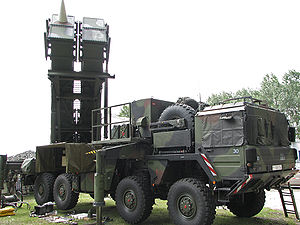
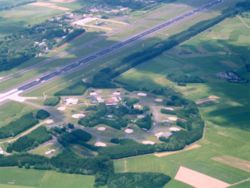 Structure of the German Luftwaffe as of November 2009
Subordinate elements are:
German language
German is a West Germanic language, related to and classified alongside English and Dutch. With an estimated 90 – 98 million native speakers, German is one of the world's major languages and is the most widely-spoken first language in the European Union....
term for an air force
Air force
An air force, also known in some countries as an air army, is in the broadest sense, the national military organization that primarily conducts aerial warfare. More specifically, it is the branch of a nation's armed services that is responsible for aerial warfare as distinct from an army, navy or...
. It is also the official name for two of the four historic German air forces, the Wehrmacht
Wehrmacht
The Wehrmacht – from , to defend and , the might/power) were the unified armed forces of Nazi Germany from 1935 to 1945. It consisted of the Heer , the Kriegsmarine and the Luftwaffe .-Origin and use of the term:...
air arm founded in 1935 and disbanded in 1946; and the current Bundeswehr
Bundeswehr
The Bundeswehr consists of the unified armed forces of Germany and their civil administration and procurement authorities...
air arm founded in 1956.
Schweizer Luftwaffe is also the name of the Swiss Air Force
Swiss Air Force
The Swiss Air Force is the air component of the Swiss Armed Forces, established on July 31, 1914, as part of the Army and as of January 1966 an independent service.In peacetime, Dübendorf is the operational Air Force HQ...
in German. Two other historic German air forces are the World War I
World War I
World War I , which was predominantly called the World War or the Great War from its occurrence until 1939, and the First World War or World War I thereafter, was a major war centred in Europe that began on 28 July 1914 and lasted until 11 November 1918...
-era Luftstreitkräfte
Luftstreitkräfte
The Deutsche Luftstreitkräfte , known before October 1916 as Die Fliegertruppen des deutschen Kaiserreiches , or simply Die Fliegertruppen, was the air arm of the Imperial German Army during World War I...
of the era of the German Empire
German Empire
The German Empire refers to Germany during the "Second Reich" period from the unification of Germany and proclamation of Wilhelm I as German Emperor on 18 January 1871, to 1918, when it became a federal republic after defeat in World War I and the abdication of the Emperor, Wilhelm II.The German...
, and the Luftstreitkräfte der NVA
Luftstreitkräfte der NVA
The Luftstreitkraefte / Luftverteidigung was the Air Force of East Germany . As with the Landstreitkräfte, the Volksmarine, and the Border troops, it was a military branch of the National People's Army ....
in the GDR
German Democratic Republic
The German Democratic Republic , informally called East Germany by West Germany and other countries, was a socialist state established in 1949 in the Soviet zone of occupied Germany, including East Berlin of the Allied-occupied capital city...
. The air force of Austria is called Österreichische Luftstreitkräfte
Austrian Air Force
The Austrian Air Force is a component part of the Austrian armed forces .-History:The Austrian Air Force was formed in May 1955 by the victorious Allied powers, subject to restrictions on its use of guided missiles...
.
World War I
Luftstreitkräfte
The Deutsche Luftstreitkräfte , known before October 1916 as Die Fliegertruppen des deutschen Kaiserreiches , or simply Die Fliegertruppen, was the air arm of the Imperial German Army during World War I...
), was founded in 1910 with the name Die Fliegertruppen des deutschen Kaiserreiches, and changed to the name "Luftstreitkräfte" by the end of 1916, with the emergence of military aircraft
Military aircraft
A military aircraft is any fixed-wing or rotary-wing aircraft that is operated by a legal or insurrectionary armed service of any type. Military aircraft can be either combat or non-combat:...
, although they were intended to be used primarily for reconnaissance
Reconnaissance
Reconnaissance is the military term for exploring beyond the area occupied by friendly forces to gain information about enemy forces or features of the environment....
in support of armies on the ground, just as balloons had been used in the same fashion during the Franco-Prussian War
Franco-Prussian War
The Franco-Prussian War or Franco-German War, often referred to in France as the 1870 War was a conflict between the Second French Empire and the Kingdom of Prussia. Prussia was aided by the North German Confederation, of which it was a member, and the South German states of Baden, Württemberg and...
of 1870–1871 and even as far back as the Napoleonic Wars
Napoleonic Wars
The Napoleonic Wars were a series of wars declared against Napoleon's French Empire by opposing coalitions that ran from 1803 to 1815. As a continuation of the wars sparked by the French Revolution of 1789, they revolutionised European armies and played out on an unprecedented scale, mainly due to...
. It was not the world's first air force, however, because France's embryonic army air service, which eventually became the French Air Force (Armée de l’Air)
French Air Force
The French Air Force , literally Army of the Air) is the air force of the French Armed Forces. It was formed in 1909 as the Service Aéronautique, a service arm of the French Army, then was made an independent military arm in 1933...
, had been founded in 1909. Britain's Royal Flying Corps
Royal Flying Corps
The Royal Flying Corps was the over-land air arm of the British military during most of the First World War. During the early part of the war, the RFC's responsibilities were centred on support of the British Army, via artillery co-operation and photographic reconnaissance...
(which merged on April 1, 1918 with the Royal Naval Air Service
Royal Naval Air Service
The Royal Naval Air Service or RNAS was the air arm of the Royal Navy until near the end of the First World War, when it merged with the British Army's Royal Flying Corps to form a new service , the Royal Air Force...
to form the Royal Air Force
Royal Air Force
The Royal Air Force is the aerial warfare service branch of the British Armed Forces. Formed on 1 April 1918, it is the oldest independent air force in the world...
) was founded in 1912.
During World War I
World War I
World War I , which was predominantly called the World War or the Great War from its occurrence until 1939, and the First World War or World War I thereafter, was a major war centred in Europe that began on 28 July 1914 and lasted until 11 November 1918...
, the Imperial Army Air Service utilised a wide variety of aircraft, ranging from fighters (such as those manufactured by Albatros-Flugzeugwerke and Fokker
Fokker
Fokker was a Dutch aircraft manufacturer named after its founder, Anthony Fokker. The company operated under several different names, starting out in 1912 in Schwerin, Germany, moving to the Netherlands in 1919....
) to reconnaissance aircraft (Aviatik and DFW) and heavy bombers (Gothaer Waggonfabrik
Gothaer Waggonfabrik
Gothaer Waggonfabrik was a German manufacturer of rolling stock established in the late nineteenth century at Gotha. During the two world wars, the company expanded into aircraft building.-World War I:...
, better known simply as Gotha, and the Zeppelin-Staaken R.VI "giant" heavy bomber
Heavy bomber
A heavy bomber is a bomber aircraft of the largest size and load carrying capacity, and usually the longest range.In New START, the term "heavy bomber" is used for two types of bombers:*one with a range greater than 8,000 kilometers...
). Missions were also flown in a wide range of theatres
Theater (warfare)
In warfare, a theater, is defined as an area or place within which important military events occur or are progressing. The entirety of the air, land, and sea area that is or that may potentially become involved in war operations....
, from the Western Front to the plains of Russia and even as far away as bombing raids on British Suez Canal positions in support of the Ottoman offense in 1915.
The air war on the Western Front received the most attention in the annals of military aviation, since it produced aces such as Manfred von Richthofen
Manfred von Richthofen
Manfred Albrecht Freiherr von Richthofen , also widely known as the Red Baron, was a German fighter pilot with the Imperial German Army Air Service during World War I...
, popularly known as the Red Baron, Ernst Udet
Ernst Udet
Colonel General Ernst Udet was the second-highest scoring German flying ace of World War I. He was one of the youngest aces and was the highest scoring German ace to survive the war . His 62 victories were second only to Manfred von Richthofen, his commander in the Flying Circus...
, Hermann Göring
Hermann Göring
Hermann Wilhelm Göring, was a German politician, military leader, and a leading member of the Nazi Party. He was a veteran of World War I as an ace fighter pilot, and a recipient of the coveted Pour le Mérite, also known as "The Blue Max"...
, Oswald Boelcke
Oswald Boelcke
Oswald Boelcke was a German flying ace of the First World War and one of the most influential patrol leaders and tacticians of the early years of air combat. Boelcke is considered the father of the German fighter air force, as well as the "Father of Air Fighting Tactics"; he was the first to...
, Werner Voss
Werner Voss
Werner Voss was a World War I German flying ace, a friend and rival of the famous Red Baron, Manfred von Richthofen....
, and Max Immelmann
Max Immelmann
Max Immelmann was the first German World War I flying ace. He was a great pioneer in fighter aviation and is often mistakenly credited with the first aerial victory using a synchronized gun...
(the first airman to win the Pour le Mérite
Pour le Mérite
The Pour le Mérite, known informally as the Blue Max , was the Kingdom of Prussia's highest military order for German soldiers until the end of World War I....
, Imperial Germany's highest decoration for gallantry, as a result of which the decoration became popularly known as the Blue Max). Like the German Navy, the German Army used Zeppelin
Zeppelin
A Zeppelin is a type of rigid airship pioneered by the German Count Ferdinand von Zeppelin in the early 20th century. It was based on designs he had outlined in 1874 and detailed in 1893. His plans were reviewed by committee in 1894 and patented in the United States on 14 March 1899...
s as airship
Airship
An airship or dirigible is a type of aerostat or "lighter-than-air aircraft" that can be steered and propelled through the air using rudders and propellers or other thrust mechanisms...
s for bombing military and civilian targets in France and Belgium as well as the United Kingdom.
All German and Austro-Hungarian
Austria-Hungary
Austria-Hungary , more formally known as the Kingdoms and Lands Represented in the Imperial Council and the Lands of the Holy Hungarian Crown of Saint Stephen, was a constitutional monarchic union between the crowns of the Austrian Empire and the Kingdom of Hungary in...
military aircraft in service used the Iron Cross
Iron Cross
The Iron Cross is a cross symbol typically in black with a white or silver outline that originated after 1219 when the Kingdom of Jerusalem granted the Teutonic Order the right to combine the Teutonic Black Cross placed above a silver Cross of Jerusalem....
insignia until early 1918. Afterwards, the Balkenkreuz, a black Greek cross on white, was introduced.
After the German defeat, the service was dissolved completely on 8 May 1920 under the conditions of the Treaty of Versailles
Treaty of Versailles
The Treaty of Versailles was one of the peace treaties at the end of World War I. It ended the state of war between Germany and the Allied Powers. It was signed on 28 June 1919, exactly five years after the assassination of Archduke Franz Ferdinand. The other Central Powers on the German side of...
, which mandated the complete destruction of its airplanes.
Interwar period
Since the Treaty of VersaillesTreaty of Versailles
The Treaty of Versailles was one of the peace treaties at the end of World War I. It ended the state of war between Germany and the Allied Powers. It was signed on 28 June 1919, exactly five years after the assassination of Archduke Franz Ferdinand. The other Central Powers on the German side of...
forbade Germany to have an air force, German pilots trained in violation of the treaty in secret. Initially, civil aviation schools within Germany were used, yet only light trainers
Trainer (aircraft)
A trainer is a class of aircraft designed specifically to facilitate in-flight training of pilots and aircrews. The use of a dedicated trainer aircraft with additional safety features—such as tandem flight controls, forgiving flight characteristics and a simplified cockpit arrangement—allows...
could be used in order to maintain the façade that the trainees were going to fly with civil airlines such as Deutsche Luft Hansa
Deutsche Luft Hansa
Deutsche Luft Hansa A.G. was a German airline, serving as flag carrier of the country during the later years of the Weimar Republic and throughout the Third Reich.-1920s:Deutsche Luft Hansa was founded on 6 January 1926 in Berlin...
. To train its pilots on the latest combat aircraft, Germany solicited the help of its future enemy, the USSR, which was also isolated in Europe. A secret training airfield was established at Lipetsk
Lipetsk
Lipetsk is a city and the administrative center of Lipetsk Oblast, Russia, located on the banks of the Voronezh River in the Don basin, southeast of Moscow.-History:...
in 1924 and operated for approximately nine years using mostly Dutch and Russian, but also some German, training aircraft before being closed in 1933. This base was officially known as 4th squadron of the 40th wing of the Red Army.
In February 1935, Adolf Hitler
Adolf Hitler
Adolf Hitler was an Austrian-born German politician and the leader of the National Socialist German Workers Party , commonly referred to as the Nazi Party). He was Chancellor of Germany from 1933 to 1945, and head of state from 1934 to 1945...
ordered Hermann Göring
Hermann Göring
Hermann Wilhelm Göring, was a German politician, military leader, and a leading member of the Nazi Party. He was a veteran of World War I as an ace fighter pilot, and a recipient of the coveted Pour le Mérite, also known as "The Blue Max"...
to establish the Luftwaffe, breaking the Treaty of Versailles
Treaty of Versailles
The Treaty of Versailles was one of the peace treaties at the end of World War I. It ended the state of war between Germany and the Allied Powers. It was signed on 28 June 1919, exactly five years after the assassination of Archduke Franz Ferdinand. The other Central Powers on the German side of...
's ban on German military aviation. Germany violated the treaty without sanction from Britain, France, or the League of Nations
League of Nations
The League of Nations was an intergovernmental organization founded as a result of the Paris Peace Conference that ended the First World War. It was the first permanent international organization whose principal mission was to maintain world peace...
, and neither the League nor either country did anything to oppose this. Although the new air force was to be run totally separately from the army, it retained the tradition of according army ranks for its officers and airmen, a tradition retained today by united Germany's Luftwaffe and by many air forces throughout the world. Before the official promulgation of Göring's new Luftwaffe in 1935, Germany had a paramilitary air force known as the Deutscher Luftsportverband (DLV: German air sports union). The DLV was headed by Ernst Udet
Ernst Udet
Colonel General Ernst Udet was the second-highest scoring German flying ace of World War I. He was one of the youngest aces and was the highest scoring German ace to survive the war . His 62 victories were second only to Manfred von Richthofen, his commander in the Flying Circus...
and its insignia were taken over by the new Luftwaffe, although the DLV "ranks" had special names that made them sound more civilian than military.
Dr. Fritz Todt
Fritz Todt
Fritz Todt was a German engineer and senior Nazi figure, the founder of Organisation Todt. He died in a plane crash during World War II.- Life :Todt was born in Pforzheim to a father who owned a small factory...
, the engineer who founded the forced-labor Organisation Todt
Organisation Todt
The Todt Organisation, was a Third Reich civil and military engineering group in Germany named after its founder, Fritz Todt, an engineer and senior Nazi figure...
, was appointed to the rank of Generalmajor in the Luftwaffe. He had served in an observation squadron during World War I
World War I
World War I , which was predominantly called the World War or the Great War from its occurrence until 1939, and the First World War or World War I thereafter, was a major war centred in Europe that began on 28 July 1914 and lasted until 11 November 1918...
and had been awarded the Iron Cross
Iron Cross
The Iron Cross is a cross symbol typically in black with a white or silver outline that originated after 1219 when the Kingdom of Jerusalem granted the Teutonic Order the right to combine the Teutonic Black Cross placed above a silver Cross of Jerusalem....
. He died in an aircraft crash in February 1942.
The eagle, an old symbol of the German Empire, was used as the emblem for the Luftwaffe, but in a different posture. Since 1933, when Hitler's National Socialist Party came to power, the eagle held between its claws the symbol of the party—the swastika
Swastika
The swastika is an equilateral cross with its arms bent at right angles, in either right-facing form in counter clock motion or its mirrored left-facing form in clock motion. Earliest archaeological evidence of swastika-shaped ornaments dates back to the Indus Valley Civilization of Ancient...
(an old symbol of sunrise)—which was usually enveloped by an oak wreath. Göring rejected the old heraldic eagle because he felt it was too stylized, too static, and too massive; instead he chose a younger, more natural and lighter eagle with wings spread as if in flight, as he considered this a more suitable symbol for an air force. While the Wehrmacht eagle held the symbol of the National Socialist Party firmly in its claws, the Luftwaffe eagle held the swastika with only one claw while the other was bent in a threatening gesture.
The Luftwaffe attempted to incorporate all military units that had anything to do with air warfare. Given the strong Nazi origin and influence in the Luftwaffe, this was seen as a way to increase Nazi influence in the army (alongside the other project in this respect, the formation of SS divisions), as well as boosting the personal prestige of Göring. Thus the anti-aircraft (Flak) and airborne troops (Fallschirmjäger) fell under direct Luftwaffe command, and the navy (Kriegsmarine
Kriegsmarine
The Kriegsmarine was the name of the German Navy during the Nazi regime . It superseded the Kaiserliche Marine of World War I and the post-war Reichsmarine. The Kriegsmarine was one of three official branches of the Wehrmacht, the unified armed forces of Nazi Germany.The Kriegsmarine grew rapidly...
) never established its own air branch; naval aviation was executed by the Luftwaffe. Even the aircraft flown from the (never finished) aircraft carrier Graf Zeppelin
German aircraft carrier Graf Zeppelin
German aircraft carrier Graf Zeppelin was the lead ship in a class of two carriers ordered by the Kriegsmarine. She was the only aircraft carrier launched by Germany during World War II and represented part of the Kriegsmarine's attempt to create a well-balanced oceangoing fleet, capable of...
were to be operated by the Luftwaffe. By the middle of the war, when personnel assignments for the Luftwaffe were disproportionate to a shrinking number of aircraft, the excess personnel were not transferred to the army (Heer
Heer (1935-1945)
The Heer was the Army land forces component of the German armed forces from 1935 to 1945, the latter also included the Navy and the Air Force...
), but instead organized into Luftwaffe Field Division
Luftwaffe Field Division
The Luftwaffe Field Divisions were German military formations which fought during World War II.-History:...
s in 1942. Their performance as ground units was so poor that command was transferred to the army in 1943, although they retained their name.
The Luftwaffe had the ideal opportunity to test its pilots, aircraft and tactics in the Spanish Civil War
Spanish Civil War
The Spanish Civil WarAlso known as The Crusade among Nationalists, the Fourth Carlist War among Carlists, and The Rebellion or Uprising among Republicans. was a major conflict fought in Spain from 17 July 1936 to 1 April 1939...
of 1936–1939, when the Condor Legion
Condor Legion
The Condor Legion was a unit composed of volunteers from the German Air Force and from the German Army which served with the Nationalists during the Spanish Civil War of July 1936 to March 1939. The Condor Legion developed methods of terror bombing which were used widely in the Second World War...
was sent to Spain in support of the anti-Republican government revolt led by Francisco Franco
Francisco Franco
Francisco Franco y Bahamonde was a Spanish general, dictator and head of state of Spain from October 1936 , and de facto regent of the nominally restored Kingdom of Spain from 1947 until his death in November, 1975...
. The aircraft used included modern types which became world famous: the Junkers Ju 87
Junkers Ju 87
The Junkers Ju 87 or Stuka was a two-man German ground-attack aircraft...
Stuka dive-bomber, Dornier Do 17
Dornier Do 17
The Dornier Do 17, sometimes referred to as the Fliegender Bleistift , was a World War II German light bomber produced by Claudius Dornier's company, Dornier Flugzeugwerke...
"Schnell" (fast) bomber, and the Messerschmitt Bf 109
Messerschmitt Bf 109
The Messerschmitt Bf 109, often called Me 109, was a German World War II fighter aircraft designed by Willy Messerschmitt and Robert Lusser during the early to mid 1930s...
fighter. Since the aircraft were seconded to Franco's Nationalist air force, Luftwaffe markings were replaced to avoid giving the impression that Germany was actively supporting the revolt. Instead of the Nazi Party's swastika
Swastika
The swastika is an equilateral cross with its arms bent at right angles, in either right-facing form in counter clock motion or its mirrored left-facing form in clock motion. Earliest archaeological evidence of swastika-shaped ornaments dates back to the Indus Valley Civilization of Ancient...
on the tail, the German aircraft used the nationalist air force aircraft markings (a Saint Andrew's cross over a white background, painted on the rudder of the aircraft and a black disc on fuselage and wings). All aircraft in the Legion were affiliated to units given a designation ending in the number 88. For example, bombers were in Kampfgruppe 88 (combat group 88, K/88); and fighters, in Jagdgruppe 88 (fighter group 88, J/88
Jagdgruppe 88
Jagdgruppe 88 was a German Condor Legion fighter group serving in the Spanish Civil War. J/88 consisted of a headquarters and four squadrons , although the 4th Staffel was short lived...
. Following the Munich crisis
Munich Agreement
The Munich Pact was an agreement permitting the Nazi German annexation of Czechoslovakia's Sudetenland. The Sudetenland were areas along Czech borders, mainly inhabited by ethnic Germans. The agreement was negotiated at a conference held in Munich, Germany, among the major powers of Europe without...
, Hitler ordered the Luftwaffe be expanded fivefold.
World War II
World War II, or the Second World War , was a global conflict lasting from 1939 to 1945, involving most of the world's nations—including all of the great powers—eventually forming two opposing military alliances: the Allies and the Axis...
came in April 1937 when a combined force of German and Italian bombers under Spanish-Nationalist command destroyed most of the Basque
Basque Country (autonomous community)
The Basque Country is an autonomous community of northern Spain. It includes the Basque provinces of Álava, Biscay and Gipuzkoa, also called Historical Territories....
city of Guernica
Bombing of Guernica
The bombing of Guernica was an aerial attack on the Basque town of Guernica, Spain, causing widespread destruction and civilian deaths, during the Spanish Civil War...
in northeast Spain. This bombing received worldwide condemnation, and the collective memory of the horror of the bombing of civilians became more acute because of a famous painting
Guernica (painting)
Guernica is a painting by Pablo Picasso. It was created in response to the bombing of Guernica, Basque Country, by German and Italian warplanes at the behest of the Spanish Nationalist forces, on 26 April 1937, during the Spanish Civil War...
, named after the town, by Pablo Picasso
Pablo Picasso
Pablo Diego José Francisco de Paula Juan Nepomuceno María de los Remedios Cipriano de la Santísima Trinidad Ruiz y Picasso known as Pablo Ruiz Picasso was a Spanish expatriate painter, sculptor, printmaker, ceramicist, and stage designer, one of the greatest and most influential artists of the...
. Many feared that this would be the way that future air wars would be conducted; the Italian strategist General Giulio Douhet
Giulio Douhet
General Giulio Douhet was an Italian general and air power theorist. He was a key proponent of strategic bombing in aerial warfare...
(who had died in 1930) had formulated theories regarding what would be dubbed "strategic bombing" - the idea that wars would be won by striking from the air at the heart of the industrial muscle of a warring nation, thus demoralizing the civilian population to the point where the government of that nation would be driven to sue for peace.
The destruction of the town was not the aim of the mission; the targets were the roads and the Rentaria bridge. The devastation was primarily caused by the inaccuracy of bombing techniques of the day and the fact that the mass of refugees moving through the town was misidentified as "troop movements". The Basque Government had previously decided to fortify the town and there were 2000 of its troops present. The propaganda claims that it was intended a "terror attack" are demonstrably untrue as Wolfram von Richthofen "had no time for this tactic and was at first as bewildered about the town's destruction as everyone else".
World War II
Close air support
In military tactics, close air support is defined as air action by fixed or rotary winged aircraft against hostile targets that are close to friendly forces, and which requires detailed integration of each air mission with fire and movement of these forces.The determining factor for CAS is...
provided by various medium two-engine bombers, Stuka dive bombers and an overwhelming force of tactical fighters were key to several early successes. Unlike the British and American Air Forces, the Luftwaffe never developed four-engine bombers in any significant numbers, and was thus unable to conduct an effective long-range strategic bombing campaign against either the Russians or the Western Allies.
The Messerschmitt Bf 109
Messerschmitt Bf 109
The Messerschmitt Bf 109, often called Me 109, was a German World War II fighter aircraft designed by Willy Messerschmitt and Robert Lusser during the early to mid 1930s...
was the most versatile and widely-produced fighter aircraft operated by the Luftwaffe and was designed when biplanes were still standard. Many versions of this aircraft were made. The engine, a liquid cooled Mercedes-Benz DB 601, initially generated up to almost 1000 hp. This power increased as direct fuel injection was introduced to the engine, and it was upgraded to the DB 605.
In 1941 another interceptor entered service, the Focke-Wulf Fw 190
Focke-Wulf Fw 190
The Focke-Wulf Fw 190 Würger was a German Second World War single-seat, single-engine fighter aircraft designed by Kurt Tank in the late 1930s. Powered by a radial engine, the 190 had ample power and was able to lift larger loads than its well-known counterpart, the Messerschmitt Bf 109...
. This fighter had relatively short wings and was powered originally by a radial BMW 801 engine, and later by an inline Junkers Jumo
Junkers Jumo
Junkers Jumo may refer to any one of a number of aircraft engines* Junkers Jumo 204* Junkers Jumo 205* Junkers Jumo 210* Junkers Jumo 211* Junkers Jumo 213* Junkers Jumo 222* Junkers Jumo 223*Junkers Jumo 004...
(Fw 190D), and held its own against new, improved Allied aircraft such as the P-51 Mustang
P-51 Mustang
The North American Aviation P-51 Mustang was an American long-range, single-seat fighter and fighter-bomber used during World War II, the Korean War and in several other conflicts...
. The Junkers Ju 87
Junkers Ju 87
The Junkers Ju 87 or Stuka was a two-man German ground-attack aircraft...
Stuka was a main asset for Blitzkrieg
Blitzkrieg
For other uses of the word, see: Blitzkrieg Blitzkrieg is an anglicized word describing all-motorised force concentration of tanks, infantry, artillery, combat engineers and air power, concentrating overwhelming force at high speed to break through enemy lines, and, once the lines are broken,...
, able to place bombs with deadly accuracy. The leader of the Luftwaffe was Hermann Göring
Hermann Göring
Hermann Wilhelm Göring, was a German politician, military leader, and a leading member of the Nazi Party. He was a veteran of World War I as an ace fighter pilot, and a recipient of the coveted Pour le Mérite, also known as "The Blue Max"...
, a World War I
World War I
World War I , which was predominantly called the World War or the Great War from its occurrence until 1939, and the First World War or World War I thereafter, was a major war centred in Europe that began on 28 July 1914 and lasted until 11 November 1918...
fighter ace
Fighter Ace
Fighter Ace was a massively multiplayer online computer game in which one flies World War II fighter and bomber planes in combat against other players and virtual pilots...
and former commander of Manfred von Richthofen
Manfred von Richthofen
Manfred Albrecht Freiherr von Richthofen , also widely known as the Red Baron, was a German fighter pilot with the Imperial German Army Air Service during World War I...
's famous JG 1 (aka "The Flying Circus
Jagdgeschwader 1 (World War 1)
The Jagdgeschwader 1 of World War I, was a fighter unit comprising four Jastas or 'fighter squadrons', originally raised by combining Jastas 4, 6, 10 and 11, on 24 June 1917 with Manfred von Richthofen as commodore...
") who had joined the Nazi party in its early stages.
In the second half of 1940, the Luftwaffe lost the Battle of Britain
Battle of Britain
The Battle of Britain is the name given to the World War II air campaign waged by the German Air Force against the United Kingdom during the summer and autumn of 1940...
over the skies of England, the first all-air battle. Following the military failures on the Eastern Front
Eastern Front (World War II)
The Eastern Front of World War II was a theatre of World War II between the European Axis powers and co-belligerent Finland against the Soviet Union, Poland, and some other Allies which encompassed Northern, Southern and Eastern Europe from 22 June 1941 to 9 May 1945...
, from 1942 onwards, the Luftwaffe went into a steady, gradual decline that saw it outnumbered and overwhelmed by the sheer number of Allied aircraft being deployed against it. Towards the end of the war, the Luftwaffe was no longer a major factor, and despite fielding advanced aircraft like the Messerschmitt Me 262
Messerschmitt Me 262
The Messerschmitt Me 262 Schwalbe was the world's first operational jet-powered fighter aircraft. Design work started before World War II began, but engine problems prevented the aircraft from attaining operational status with the Luftwaffe until mid-1944...
, Heinkel He 162
Heinkel He 162
The Heinkel He 162 Volksjäger was a German single-engine, jet-powered fighter aircraft fielded by the Luftwaffe in World War II. Designed and built quickly, and made primarily of wood as metals were in very short supply and prioritised for other aircraft, the He 162 was nevertheless the fastest of...
, Arado Ar 234
Arado Ar 234
The Arado Ar 234 was the world's first operational jet-powered bomber, built by the German Arado company in the closing stages of World War II. Produced in very limited numbers, it was used almost entirely in the reconnaissance role, but in its few uses as a bomber it proved to be nearly impossible...
, and Me 163 it was crippled by fuel shortages and a lack of trained pilots. There was also very little time to develop the new aircraft, and they could not be produced fast enough by the Germans.
Cold War
Soviet Union
The Soviet Union , officially the Union of Soviet Socialist Republics , was a constitutionally socialist state that existed in Eurasia between 1922 and 1991....
and its Warsaw Pact
Warsaw Pact
The Warsaw Treaty Organization of Friendship, Cooperation, and Mutual Assistance , or more commonly referred to as the Warsaw Pact, was a mutual defense treaty subscribed to by eight communist states in Eastern Europe...
allies. Throughout the following decades, the West German Luftwaffe (Bundesluftwaffe: federal air force) was equipped mostly with U.S.-designed aircraft (e.g. F-84F, F-86, F-104, F-4) manufactured locally under licence. All aircraft sported—and continue to sport—the Iron Cross on the fuselage, harking back to the days of World War I, while the national flag of West Germany is displayed on the tail.
Many well-known fighter pilots who had fought with the Luftwaffe in World War II joined the new post-war air force and underwent refresher training in the U.S. before returning to West Germany to upgrade on the latest U.S.-supplied hardware. These included Erich Hartmann
Erich Hartmann
Erich Alfred Hartmann , nicknamed "Bubi" by his comrades and "The Black Devil" by his Soviet enemies, was a German World War II fighter pilot and is the highest-scoring fighter ace in the history of aerial warfare...
, the highest-ever scoring ace (352 enemy aircraft destroyed), Gerhard Barkhorn
Gerhard Barkhorn
Lieutenant-General Gerhard "Gerd" Barkhorn , was the second most successful fighter ace of all time after fellow Luftwaffe pilot Erich Hartmann...
(301), Günther Rall
Günther Rall
Lieutenant-General Günther Rall was the third most successful fighter ace in history. A flying ace or fighter ace is a military aviator credited with shooting down five or more enemy aircraft during aerial combat. He achieved a total of 275 victories during World War II: 272 on the Eastern Front,...
(275) and Johannes Steinhoff
Johannes Steinhoff
Johannes Steinhoff was a German Luftwaffe fighter ace of World War II, and later a senior West German air force officer and military commander of NATO. Steinhoff was one of very few Luftwaffe pilots who survived to fly operationally through the whole of the war period 1939-45...
(176). Steinhoff, who suffered a crash in a Messerschmitt Me 262
Messerschmitt Me 262
The Messerschmitt Me 262 Schwalbe was the world's first operational jet-powered fighter aircraft. Design work started before World War II began, but engine problems prevented the aircraft from attaining operational status with the Luftwaffe until mid-1944...
shortly before the end of the war that resulted in lifelong scarring of his face and other parts of his body, would eventually become commander-in-chief of the Luftwaffe, with Rall as his immediate successor. Hartmann retired as an Oberst
Oberst
Oberst is a military rank in several German-speaking and Scandinavian countries, equivalent to Colonel. It is currently used by both the ground and air forces of Austria, Germany, Switzerland, Denmark and Norway. The Swedish rank överste is a direct translation, as are the Finnish rank eversti...
(colonel
Colonel
Colonel , abbreviated Col or COL, is a military rank of a senior commissioned officer. It or a corresponding rank exists in most armies and in many air forces; the naval equivalent rank is generally "Captain". It is also used in some police forces and other paramilitary rank structures...
) in 1970 at age 48. Josef Kammhuber
Josef Kammhuber
Josef Kammhuber was a Career Officer in the German Air Force, and is best known as the first General of the Night Fighters in the Luftwaffe during World War II...
, mentioned above, also served in the post-war Luftwaffe, retiring in 1962 as Inspekteur der Bundesluftwaffe (chief inspector of the Federal air force).
During the 1960s, the "Starfighter crisis" developed into a political issue
Lockheed bribery scandals
The Lockheed bribery scandals encompassed a series of bribes and contributions made by officials of U.S. aerospace company Lockheed from the late 1950s to the 1970s in the process of negotiating the sale of aircraft....
, as many Lockheed F-104 Starfighters crashed after being modified to serve for Luftwaffe purposes – specifically for terrain, weather, and ground mechanic support issues. In Luftwaffe service, 292 of 916 Starfighters crashed, claiming the lives of 115 pilots and leading to cries that the Starfighter was fundamentally unsafe from the West German public, which referred to it as the Witwenmacher (widow-maker), fliegender Sarg (flying coffin), Fallfighter (falling fighter) and Erdnagel (tent peg
Tent peg
A tent peg is a spike, usually with a hook or hole on the top end, typically made from wood, metal, plastic, or composite material, pushed or driven into the ground for holding a tent to the ground, either directly by attaching to the tent's material, or by connecting to ropes attached to the tent...
, literally "ground nail").
Steinhoff and his deputy Günther Rall noted that the non-German F-104s proved much safer – Spain, for example, lost none in the same period. The Americans blamed the high loss rate of the Luftwaffe F-104s on the extreme low-level and aggressive flying of German pilots rather than any faults in the aircraft. Steinhoff and Rall immediately went to America to learn to fly the Starfighter under Lockheed instruction and noted some specifics in the training (a lack of mountain and foggy-weather training), combined with handling capabilities (sharp start high G turns) of the aircraft that could cause accidents.
Steinhoff and Rall changed the training regimen for the F-104 pilots, and the accident rates quickly fell to those comparable or better than other air forces. They also brought about the high level of training and professionalism seen today throughout the Luftwaffe, and the start of a strategic direction for Luftwaffe pilots to engage in tactical and combat training outside of Germany. However, the F-104 never lived down its reputation as a widow-maker and was replaced much earlier by the Luftwaffe than other national air forces.
The Starfighter was replaced by the American-built McDonnell Douglas
McDonnell Douglas
McDonnell Douglas was a major American aerospace manufacturer and defense contractor, producing a number of famous commercial and military aircraft. It formed from a merger of McDonnell Aircraft and Douglas Aircraft in 1967. McDonnell Douglas was based at Lambert-St. Louis International Airport...
F-4 Phantom II
F-4 Phantom II
The McDonnell Douglas F-4 Phantom II is a tandem two-seat, twin-engined, all-weather, long-range supersonic jet interceptor fighter/fighter-bomber originally developed for the United States Navy by McDonnell Aircraft. It first entered service in 1960 with the U.S. Navy. Proving highly adaptable,...
fighter and the Panavia Tornado
Panavia Tornado
The Panavia Tornado is a family of twin-engine, variable-sweep wing combat aircraft, which was jointly developed and manufactured by the United Kingdom, West Germany and Italy...
fighter-bomber; the latter was designed and produced by a cooperative of companies from the United Kingdom, Germany, and Italy. These fighters remain in Luftwaffe service today, with upgrades to their electronics and the addition of the AIM-120 AMRAAM
AIM-120 AMRAAM
The AIM-120 Advanced Medium-Range Air-to-Air Missile, or AMRAAM , is a modern beyond-visual-range air-to-air missile capable of all-weather day-and-night operations. Designed with the same form-factor as the previous generation of semi-active guided Sparrow missiles, it is a fire-and-forget...
air-to-air missile for the air defense of Germany.
From 1965 through 1970, two surface-to-surface missile wings (Flugkörpergeschwader) fielded 16 of the Pershing I missile systems with nuclear warheads under U.S. Army custody. In 1970, the system was upgraded to Pershing IA with 72 missiles. Although not directly affected by the 1988 Intermediate-Range Nuclear Forces Treaty
Intermediate-Range Nuclear Forces Treaty
The Intermediate-Range Nuclear Forces Treaty is a 1987 agreement between the United States and the Soviet Union. Signed in Washington, D.C. by U.S. President Ronald Reagan and General Secretary Mikhail Gorbachev on December 8, 1987, it was ratified by the United States Senate on May 27, 1988 and...
, the Luftwaffe unilaterally agreed to the removal of the Pershing IA missiles from its inventory in 1991, and the missiles were destroyed.
Beginning in June 1979, the Luftwaffe took delivery of 212 Panavia Tornado
Panavia Tornado
The Panavia Tornado is a family of twin-engine, variable-sweep wing combat aircraft, which was jointly developed and manufactured by the United Kingdom, West Germany and Italy...
fighters.
Reunification
German Democratic Republic
The German Democratic Republic , informally called East Germany by West Germany and other countries, was a socialist state established in 1949 in the Soviet zone of occupied Germany, including East Berlin of the Allied-occupied capital city...
air force, the Luftstreitkräfte der NVA
Luftstreitkräfte der NVA
The Luftstreitkraefte / Luftverteidigung was the Air Force of East Germany . As with the Landstreitkräfte, the Volksmarine, and the Border troops, it was a military branch of the National People's Army ....
, was supplied exclusively with Eastern Bloc
Eastern bloc
The term Eastern Bloc or Communist Bloc refers to the former communist states of Eastern and Central Europe, generally the Soviet Union and the countries of the Warsaw Pact...
-produced aircraft such as the Sukhoi Su-17
Sukhoi Su-17
The Sukhoi Su-17 is a Soviet attack aircraft developed from the Sukhoi Su-7 fighter-bomber. It enjoyed a long career in Soviet, later Russian, service and was widely exported to communist and Middle Eastern air forces, under names Su-20 and Su-22.-Development:Seeking to improve low-speed and...
"Fitter" and Mikoyan-Gurevich
Mikoyan
Russian Aircraft Corporation MiG , or RSK MiG, is a Russian joint stock company. Formerly Mikoyan-and-Gurevich Design Bureau , then simply Mikoyan, it is a military aircraft design bureau, primarily designing fighter aircraft...
(MiG) family of aircraft, such as the MiG-21
Mikoyan-Gurevich MiG-21
The Mikoyan-Gurevich MiG-21 is a supersonic jet fighter aircraft, designed by the Mikoyan-Gurevich Design Bureau in the Soviet Union. It was popularly nicknamed "balalaika", from the aircraft's planform-view resemblance to the Russian stringed musical instrument or ołówek by Polish pilots due to...
, MiG-23
Mikoyan-Gurevich MiG-23
The Mikoyan-Gurevich MiG-23 is a variable-geometry fighter aircraft, designed by the Mikoyan-Gurevich design bureau in the Soviet Union. It is considered to belong to the Soviet third generation jet fighter category, along with similarly aged Soviet fighters such as the MiG-25 "Foxbat"...
and MiG-29 fighters, and served primarily as an extension of Red Air Force units in Eastern Germany. The East German Air Force
Luftstreitkräfte der NVA
The Luftstreitkraefte / Luftverteidigung was the Air Force of East Germany . As with the Landstreitkräfte, the Volksmarine, and the Border troops, it was a military branch of the National People's Army ....
was unique among Warsaw Pact
Warsaw Pact
The Warsaw Treaty Organization of Friendship, Cooperation, and Mutual Assistance , or more commonly referred to as the Warsaw Pact, was a mutual defense treaty subscribed to by eight communist states in Eastern Europe...
countries in that it was often equipped with Soviet-standard combat aircraft instead of downgraded export models. Operated as an extension of Soviet air power, the East German Air Force enjoyed less autonomy than other Eastern Bloc
Eastern bloc
The term Eastern Bloc or Communist Bloc refers to the former communist states of Eastern and Central Europe, generally the Soviet Union and the countries of the Warsaw Pact...
air forces. The markings on the aircraft reflected the identity of the country as belonging to the Communist bloc. These markings consisted of a diamond-shaped design, with three vertical stripes in black, red and gold surmounted by the stylized hammer, and wreath-like ears-of-grain design, which was also on the Flag of East Germany.
National People's Army
The National People’s Army were the armed forces of the German Democratic Republic .The NVA was established in 1956 and disestablished in 1990. There were frequent reports of East German advisors with Communist African countries during the Cold War...
were taken over by the Federal Republic of Germany
Germany
Germany , officially the Federal Republic of Germany , is a federal parliamentary republic in Europe. The country consists of 16 states while the capital and largest city is Berlin. Germany covers an area of 357,021 km2 and has a largely temperate seasonal climate...
, and their GDR markings were replaced by the Iron Cross, the first time Soviet-built aircraft had served in a NATO air force. Most of these were taken out of service, in many cases being sold or given to the new Eastern European members of NATO, such as Poland and the Baltic states.
An exception to this was the Jagdgeschwader 73
Jagdgeschwader 73
Jagdgeschwader 73 "Steinhoff" is a fighter wing of the German Luftwaffe. The wing is based in north-eastern Germany at Rostock-Laage Airport near Rostock...
"Steinhoff" (Fighter Wing
Wing (air force unit)
Wing is a term used by different military aviation forces for a unit of command. The terms wing, group or Staffel are used for different-sized units from one country or service to another....
73 "Steinhoff") stationed in Laage
Laage
Laage is a municipality in the Rostock district, in Mecklenburg-Vorpommern, Germany. It is situated on the river Recknitz, 23 kilometres southeast of Rostock. Rostock Laage Airport is located a few kilometres west of Laage....
. The pilots of the JG 73 flew MiG-29s acquired during the reunification and were some of the most experienced MiG-29 pilots in the world. One of their primary duties was to serve as aggressor pilots, training other pilots in dissimilar combat tactics
Dissimilar air combat training
Dissimilar air combat training was introduced as a formal part of US air combat training after disappointing aerial combat exchange rates in the Vietnam War.Traditionally, pilots would undertake air combat training against similar aircraft...
. The United States sent a group of fighter pilots to Germany during the Red October exercise to practice tactics against the aircraft they were most likely to meet in real combat. The MiG-29s of JG 73 were fully integrated into the Luftwaffe's air defence structure and, from February 1995 became the first Soviet Bloc aircraft to be declared operational within NATO. In 2004, with the introduction of the Eurofighter Typhoon
Eurofighter Typhoon
The Eurofighter Typhoon is a twin-engine, canard-delta wing, multirole combat aircraft, designed and built by a consortium of three companies: EADS, Alenia Aeronautica and BAE Systems; working through a holding company, Eurofighter GmbH, which was formed in 1986...
imminent, the decision was taken to withdraw the MiG-29. JG 73's aircraft were withdrawn in August 2004, following which they were sold to the Polish Air Force
Polish Air Force
The Polish Air Force is the military Air Force wing of the Polish Armed Forces. Until July 2004 it was officially known as Wojska Lotnicze i Obrony Powietrznej...
.
1990s
The United States provides nuclear weaponNuclear weapon
A nuclear weapon is an explosive device that derives its destructive force from nuclear reactions, either fission or a combination of fission and fusion. Both reactions release vast quantities of energy from relatively small amounts of matter. The first fission bomb test released the same amount...
s for use by Germany under a NATO nuclear sharing
Nuclear sharing
Nuclear sharing is a concept in NATO's policy of nuclear deterrence, which involves member countries without nuclear weapons of their own in the planning for the use of nuclear weapons by NATO, and in particular provides for the armed forces of these countries to be involved in delivering these...
agreement. As of 2007, only 22 B61-4
B61 nuclear bomb
The B61 nuclear bomb is the primary thermonuclear weapon in the U.S. Enduring Stockpile following the end of the Cold War. It is an intermediate yield strategic and tactical nuclear weapon featuring a two-stage radiation implosion design....
s are still present, stored at Büchel Air Base
Büchel Air Base
Büchel Air Base is a military air base in Germany. It is home to the Jagdbombergeschwader 33 of the German Luftwaffe and the 702 Munition Support Squadron and 38 Munitions Maintenance Group of the United States Air Force...
for delivery with German Air Force Panavia Tornado
Panavia Tornado
The Panavia Tornado is a family of twin-engine, variable-sweep wing combat aircraft, which was jointly developed and manufactured by the United Kingdom, West Germany and Italy...
s. These bombs are likely to be withdrawn when the Tornados at Büchel are replaced with Eurofighter Typhoon
Eurofighter Typhoon
The Eurofighter Typhoon is a twin-engine, canard-delta wing, multirole combat aircraft, designed and built by a consortium of three companies: EADS, Alenia Aeronautica and BAE Systems; working through a holding company, Eurofighter GmbH, which was formed in 1986...
s after 2012, since it is not planned to integrate the B-61 bomb into the Eurofighter. B-61s stationed at Nörvenich and Memmingen Air Base (fighter-bomber wing JaBoG 34 "Allgäu") have already been withdrawn in the mid- to late-1990s. All nuclear bombs formerly stored at the Ramstein Air Base
Ramstein Air Base
Ramstein Air Base is a United States Air Force base in the German state of Rheinland-Pfalz. It serves as headquarters for the United States Air Forces in Europe and is also a North Atlantic Treaty Organization installation...
have been returned to the U.S. or elsewhere (the U.K. is possible), due to ongoing construction work at Ramstein AB, and they will not be returned to Germany.
The Balkans
Forward looking infrared
Forward looking infrared cameras, typically used on military aircraft, use an imaging technology that senses infrared radiation.The sensors installed in forward looking infrared cameras, as well as those of other thermal imaging cameras, use detection of infrared radiation, typically emitted from a...
and escorted by 8 ECR Tornados, supported NATO's artillery missions on Bosnian Serb positions around Sarajevo
Sarajevo
Sarajevo |Bosnia]], surrounded by the Dinaric Alps and situated along the Miljacka River in the heart of Southeastern Europe and the Balkans....
.
In March 1999 the Luftwaffe eventually became involved in direct combat role as part of the NATO-led Kosovo War
Kosovo War
The term Kosovo War or Kosovo conflict was two sequential, and at times parallel, armed conflicts in Kosovo province, then part of FR Yugoslav Republic of Serbia; from early 1998 to 1999, there was an armed conflict initiated by the ethnic Albanian "Kosovo Liberation Army" , who sought independence...
. This event was noted as significant in the British press with "The Sun"
The Sun (newspaper)
The Sun is a daily national tabloid newspaper published in the United Kingdom and owned by News Corporation. Sister editions are published in Glasgow and Dublin...
running the headline "Luftwaffe and the RAF into battle side by side". The Luftwaffe deployed the Fighter Bomber Wing 32 which flew suppression of enemy air defence (SEAD
SEAD
Suppression of Enemy Air Defenses , also known as "Wild Weasel" and "Iron Hand" operations in the United States, are military actions to suppress enemy surface-based air defenses , primarily in the first hours of an attack.One fourth of American combat sorties in recent conflicts have been SEAD...
) sorties with ECR Tornados. The fighter-bombers were equipped with an electronic countermeasures pod, a AIM-9 Sidewinder
AIM-9 Sidewinder
The AIM-9 Sidewinder is a heat-seeking, short-range, air-to-air missile carried mostly by fighter aircraft and recently, certain gunship helicopters. The missile entered service with United States Air Force in the early 1950s, and variants and upgrades remain in active service with many air forces...
missile for self-defense and an AGM-88 HARM
AGM-88 HARM
The AGM-88 High-speed Anti-Radiation Missile is a tactical, air-to-surface missile designed to home in on electronic transmissions coming from surface-to-air radar systems. It was originally developed by Texas Instruments as a replacement for the AGM-45 Shrike and AGM-78 Standard ARM system...
air to ground missile. The bomber wing flew 2108 hours and 446 sorties, firing 236 HARM missiles on enemy targets. No Luftwaffe aircraft was lost during the campaign.
2000s
In 2005 and 2008, F-4F Phantoms participated in NATO's Baltic Air PolicingBaltic Air Policing
The Baltic air-policing mission is a NATO air defence Quick Reaction Alert in order to guard the airspace over the three Baltic states Estonia, Latvia and Lithuania.-Mission:...
operation, and were supplemented in 2009 by the Eurofighter.
In 2006, to support coalition operations across Afghanistan
Afghanistan
Afghanistan , officially the Islamic Republic of Afghanistan, is a landlocked country located in the centre of Asia, forming South Asia, Central Asia and the Middle East. With a population of about 29 million, it has an area of , making it the 42nd most populous and 41st largest nation in the world...
, the Luftwaffe deployed Panavia Tornado reconnaissance aircraft from Aufklärungsgeschwader 51 "Immelmann" (the 51st Reconnaissance Wing "Immelmann"), stationed in Mazar-i-Sharif, Northern Afghanistan.
There are also various army helicopters in operation at the German air base in Mazar-i-Sharif and Luftwaffe C-160 Transall conduct air transport sorties into and within Afghanistan.
In order to counteract criticism by its ISAF
ISAF
ISAF may refer to:* International Sailing Federation, the world governing body for Olympic and other competitive sailing.* International Security Assistance Force, the NATO-led security mission operating in Afghanistan since 2001....
allies, since December 2009 the Luftwaffe participates in combat operations of the Royal Air Force
Royal Air Force
The Royal Air Force is the aerial warfare service branch of the British Armed Forces. Formed on 1 April 1918, it is the oldest independent air force in the world...
in southern Afghanistan
Afghanistan
Afghanistan , officially the Islamic Republic of Afghanistan, is a landlocked country located in the centre of Asia, forming South Asia, Central Asia and the Middle East. With a population of about 29 million, it has an area of , making it the 42nd most populous and 41st largest nation in the world...
.
Since the 1970s, the Luftwaffe of West Germany and later the reunited Germany (as well as many other European air forces) has actively pursued the construction of European combat aircraft such as the Panavia Tornado
Panavia Tornado
The Panavia Tornado is a family of twin-engine, variable-sweep wing combat aircraft, which was jointly developed and manufactured by the United Kingdom, West Germany and Italy...
and, more recently, the Eurofighter Typhoon
Eurofighter Typhoon
The Eurofighter Typhoon is a twin-engine, canard-delta wing, multirole combat aircraft, designed and built by a consortium of three companies: EADS, Alenia Aeronautica and BAE Systems; working through a holding company, Eurofighter GmbH, which was formed in 1986...
, which was introduced in 2006.
On 13 January 2004, the Defence Minister
Federal Ministry of Defence (Germany)
The Federal Ministry of Defence is a top-level federal agency, headed by the Federal Minister of Defence as a member of the Cabinet of Germany...
Peter Struck
Peter Struck
Peter Struck was the German Minister of Defence under chancellor Gerhard Schröder from 22 October 2002 until 2005. A lawyer, Struck is a member of the Social Democratic Party.-Education:* 1962: Abitur...
announced major changes to the German armed forces
Bundeswehr
The Bundeswehr consists of the unified armed forces of Germany and their civil administration and procurement authorities...
. A major part of this announcement was a plan to cut the German fighter fleet from 426 aircraft in early 2004 to 265 by 2015. Assuming the full German order for 180 Eurofighter Typhoon
Eurofighter Typhoon
The Eurofighter Typhoon is a twin-engine, canard-delta wing, multirole combat aircraft, designed and built by a consortium of three companies: EADS, Alenia Aeronautica and BAE Systems; working through a holding company, Eurofighter GmbH, which was formed in 1986...
s is fulfilled, this will see the Tornado force reduced to 85. The German Navy
German Navy
The German Navy is the navy of Germany and is part of the unified Bundeswehr .The German Navy traces its roots back to the Imperial Fleet of the revolutionary era of 1848 – 52 and more directly to the Prussian Navy, which later evolved into the Northern German Federal Navy...
's air wing (Marineflieger) received 112 Tornado IDSs. In late 2004 the last Tornado unit was disbanded. The maritime combat role has been assumed by the Luftwaffe, a unit of which has had its Tornados upgraded to carry the Kormoran II
AS.34 Kormoran
The AS.34 Kormoran is a German-produced Anti-ship missile. The Kormoran uses an inertial guidance system for the midcourse phase, switching to active radar homing during the terminal attack phase. It carries a 165 kg delay-fused warhead, designed for 90mm of penetration prior to detonation...
and AGM-88 HARM missiles.
Tactical training centers
During the 1960s and 1970s, a very large number of Luftwaffe jet crashes—the Luftwaffe suffered a 36 percent crash rate for F-84F Thunderstreak
F-84F Thunderstreak
The Republic F-84F Thunderstreak was an American-built swept-wing turbojet fighter-bomber. While an evolutionary development of the straight-wing F-84 Thunderjet, the F-84F was a new design. The RF-84F Thunderflash was a photo reconnaissance version....
s and an almost 30 percent loss of F-104 Starfighter
F-104 Starfighter
The Lockheed F-104 Starfighter is a single-engine, high-performance, supersonic interceptor aircraft originally developed for the United States Air Force by Lockheed. One of the Century Series of aircraft, it served with the USAF from 1958 until 1969, and continued with Air National Guard units...
s—created considerable public demand for moving Luftwaffe combat training centers away from Germany.
As a result, the Luftwaffe set up two tactical training centres: one, like those of many of the NATO forces, at the Canadian Forces Air Command
Canadian Forces Air Command
The Royal Canadian Air Force , formerly Canadian Forces Air Command, is one of three environmental commands of the Canadian Forces...
base at Goose Bay
CFB Goose Bay
Canadian Forces Base Goose Bay , is a Canadian Forces Base located in the town of Happy Valley-Goose Bay, Newfoundland and Labrador....
; and the second in a unique partnership with the United States Air Force at Holloman Air Force Base
Holloman Air Force Base
Holloman Air Force Base is a United States Air Force base located six miles southwest of the central business district of Alamogordo, a city in Otero County, New Mexico, United States. The base was named in honor of Col. George V. Holloman, a pioneer in guided missile research...
in New Mexico
New Mexico
New Mexico is a state located in the southwest and western regions of the United States. New Mexico is also usually considered one of the Mountain States. With a population density of 16 per square mile, New Mexico is the sixth-most sparsely inhabited U.S...
(F-104 pilots had already been trained at Luke Air Force Base
Luke Air Force Base
Luke Air Force Base is a United States Air Force base located seven miles west of the central business district of Glendale, in Maricopa County, Arizona, United States. It is also about west of Phoenix, Arizona....
, Arizona
Arizona
Arizona ; is a state located in the southwestern region of the United States. It is also part of the western United States and the mountain west. The capital and largest city is Phoenix...
, since 1964). Both facilities provide access to large unpopulated areas, where tactical and combat training can take place without danger to large populations.
In September 2004, the Luftwaffes chief of staff, Klaus-Peter Stieglitz, announced a reduction in its training program of roughly 20%.
Holloman Air Force Base
On 1 May 1996, the Luftwaffe established the German Air Force Tactical Training Center (TTC) in concert with the United States Air ForceUnited States Air Force
The United States Air Force is the aerial warfare service branch of the United States Armed Forces and one of the American uniformed services. Initially part of the United States Army, the USAF was formed as a separate branch of the military on September 18, 1947 under the National Security Act of...
20th Fighter Squadron
20th Fighter Squadron
The 20th Fighter Squadron was most recently part of the 49th Fighter Wing at Holloman Air Force Base, New Mexico. It operated the F-4 Phantom II aircraft conducting air superiority missions...
at Holloman Air Force Base
Holloman Air Force Base
Holloman Air Force Base is a United States Air Force base located six miles southwest of the central business district of Alamogordo, a city in Otero County, New Mexico, United States. The base was named in honor of Col. George V. Holloman, a pioneer in guided missile research...
in New Mexico
New Mexico
New Mexico is a state located in the southwest and western regions of the United States. New Mexico is also usually considered one of the Mountain States. With a population density of 16 per square mile, New Mexico is the sixth-most sparsely inhabited U.S...
, which provides aircrew training in the F-4F Phantom II. The TTC serves as the parent command for two German air crew training squadrons. The F-4 Training Squadron oversees all German F-4 student personnel affairs and provides German instructor pilots to cooperate in the contracted F-4 training program provided by the U.S. Air Force (20th Fighter Squadron). A second TTC unit, the Tornado Training Squadron, provides academic and tactical flying training, by German air force instructors, for German Tornado
Panavia Tornado
The Panavia Tornado is a family of twin-engine, variable-sweep wing combat aircraft, which was jointly developed and manufactured by the United Kingdom, West Germany and Italy...
aircrews.
The first contingent of Tornado aircraft arrived at Holloman in March 1996. More than 300 German air force personnel are permanently assigned at Holloman to the TTC, the only unit of its kind in the United States. The German Air Force Flying Training Center activated on 31 March 1996, with German Air Force Chief of Staff Gen. Portz and U.S. Air Force Chief of Staff Gen. Michael Ryan present. The Luftwaffe has since stationed up to 800 personnel at Holloman for training exercises, due to limited training space in Europe.
In 2004, the Luftwaffe announced a reduction in its training program. By the end of 2006, 650 Luftwaffe personnel and 25 Tornado aircraft were assigned to Holloman.
Organization
- Inspekteur der Luftwaffe (Chief of Air Staff) (Currently: Lieutenant GeneralLieutenant GeneralLieutenant General is a military rank used in many countries. The rank traces its origins to the Middle Ages where the title of Lieutenant General was held by the second in command on the battlefield, who was normally subordinate to a Captain General....
Aarne Kreuzinger-Janik) - Air Staff at the Federal Ministry of DefenceFederal Ministry of Defence (Germany)The Federal Ministry of Defence is a top-level federal agency, headed by the Federal Minister of Defence as a member of the Cabinet of Germany...
German Air Force Command
The German Air Force Command is the superior command to all combat forces of the German Air Force.Subordinate elements are:
- German Air Force Air Operations Command
- National Air Policing Centre
- Air Force Command and Control Regiment
- The combat units are organized in three Air Divisions and the so called Air Transport Command:
! style="text-align: left; background: #A9A9A9;"|1st Air Division
! style="text-align: left; background: #A9A9A9;"|2nd Air Division
! style="text-align: left; background: #A9A9A9;"|4th Air Division
|-style="background:#efefef; color:black"
| Tactical Air Command and Control Regiment 1
| Tactical Air Command and Control Regiment 3
| Tactical Air Command and Control Regiment 2 and 4
|
|-style="background:#efefef; color:black"
| Surface-to-Air Missile Wing 5- SAM Battalion 22
- SAM Battalion 23
| Surface-to-Air Missile Wing 2- SAM Battalion 21
- SAM Battalion 24
| Surface-to-Air Missile Wing 1- SAM Battalion 25
- SAM Battalion 26
|
|-style="background:#efefef; color:black"
|- Fighter-Bomber Wing 32
- Fighter Wing 74Jagdgeschwader 74Jagdgeschwader 74 is an aviation unit of the German Luftwaffe, based on Neuburg air base in Bavaria since 1961.JG 74 provides air defence duties for southern Germany. The wing operates two squadrons, the Falken squadron and the Viva Zapata squadron.-History:JG 74 was activated as the last West...
- Air Transport Wing 61
- Air Transport Wing 62
- Special Air Mission Wing, Federal Ministry of Defence
|- Fighter-Bomber Wing 31 “BoelckeOswald BoelckeOswald Boelcke was a German flying ace of the First World War and one of the most influential patrol leaders and tacticians of the early years of air combat. Boelcke is considered the father of the German fighter air force, as well as the "Father of Air Fighting Tactics"; he was the first to...
” - Fighter-Bomber Wing 33
- Fighter Wing 73 “Steinhoff”Jagdgeschwader 73Jagdgeschwader 73 "Steinhoff" is a fighter wing of the German Luftwaffe. The wing is based in north-eastern Germany at Rostock-Laage Airport near Rostock...
|- Fighter Wing 71 "RichthofenManfred von RichthofenManfred Albrecht Freiherr von Richthofen , also widely known as the Red Baron, was a German fighter pilot with the Imperial German Army Air Service during World War I...
" - Tactical Air Reconnaissance Wing 51 “Immelmann”
- Air Transport Wing 63
|
|-style="background:#efefef; color:black"
| German Air Force Tactical Training Center Italy
|
|German Air Force Regiment "Frisia"
|
|}
The former Air Transport Command is now part of the newly formed European Air Transport CommandEuropean Air Transport CommandThe European Air Transport Command is a multinational command center located in Eindhoven . It coordinates air transport for French, Dutch, Belgian and German air assets - these countries are also members of the European Air Group....
.
German Air Force Office
The German Air Force Office is responsible for supporting the air force combat units. Main tasks are maintenance and logistic support and provision of basic training and education.
Subordinate elements are:
- Surgeon General of the Air Force
- Bundeswehr Air Traffic Services Office
- Air Force Support Battalion
- Legal Advisor Center
! style="text-align: left; background: #A9A9A9;"|Air Force Training Command
! style="text-align: left; background: #A9A9A9;"|Air Force Weapon Systems Command
! style="text-align: left; background: #A9A9A9;"|German Air Force Command United States/ Canada
|-style="background:#efefef; color:black"
|- Air Force Officer School
- Non-Commissioned OfficerNon-commissioned officerA non-commissioned officer , called a sub-officer in some countries, is a military officer who has not been given a commission...
's School of the Air Force - Air Force Technical School 1 (with Air Force Bands 1 and 2)
- Air Force Technical School 3 (with Air Force Bands 3 and 4)
- Air Force Training Regiment
|- Maintenance Regiment 1
- Center for Avionics
- Center for Aircraft Technology
- Maintenance Regiment 2
- Maintenance Group 21
- Maintenance Group 22
- Maintenance Group 25
- Weapon Systems Support Center
|- German Air Force Flying Training Center, United States Holloman AFB
- German Air Force Air Defense Center, United States
|}
Aircraft inventory
As of 2010 - 2011, according to FlightglobalFlightglobal.comFlightglobal.com is an online news and information website related to the aviation and aerospace industries. It also provides a community area for numerous distinct communities within the aviation and aerospace industry....
the Luftwaffe currently operates 427 aircraft. The Luftwaffe will replace most of its combat fleet with 143 Eurofighter TyphoonEurofighter TyphoonThe Eurofighter Typhoon is a twin-engine, canard-delta wing, multirole combat aircraft, designed and built by a consortium of three companies: EADS, Alenia Aeronautica and BAE Systems; working through a holding company, Eurofighter GmbH, which was formed in 1986...
s.
! style="text-align: left; background: #aabccc;"|Aircraft
! style="text-align: left; background: #aabccc;"|Origin
! style="text-align: left; background: #aabccc;"|Type
! style="text-align: left; background: #aabccc;"|Versions
! style="text-align: left; background: #aabccc;"|In service
! style="text-align: left; background: #aabccc;"|Comments
|-----
! style="align: center; background: lavender;" colspan="9" | Combat aircraft
|-
| McDonnell-Douglas F-4 Phantom II
|
| Fighter AircraftFighter aircraftA fighter aircraft is a military aircraft designed primarily for air-to-air combat with other aircraft, as opposed to a bomber, which is designed primarily to attack ground targets...
| F-4F
| 45
| In service until 2013 (to be replaced by the Eurofighter Typhoon)
|-style="background:#efefef; color:black"
| Panavia TornadoPanavia TornadoThe Panavia Tornado is a family of twin-engine, variable-sweep wing combat aircraft, which was jointly developed and manufactured by the United Kingdom, West Germany and Italy...
|
| Electronic Warfare
Attack/Reconnaissance Aircraft
| Tornado ECR
Tornado IDS
| 32
145
| operated from Jagdbombergeschwader 32 (Lagerlechfeld)
operated from Jagdbombergeschwader 33 (Büchel), Aufklärungsgeschwader 51 (Jagel)
|
|-
| Eurofighter TyphoonEurofighter TyphoonThe Eurofighter Typhoon is a twin-engine, canard-delta wing, multirole combat aircraft, designed and built by a consortium of three companies: EADS, Alenia Aeronautica and BAE Systems; working through a holding company, Eurofighter GmbH, which was formed in 1986...
|
| Multirole Fighter AircraftFighter aircraftA fighter aircraft is a military aircraft designed primarily for air-to-air combat with other aircraft, as opposed to a bomber, which is designed primarily to attack ground targets...
| Typhoon/Tandem
| 50
| total order of 143
|-----
! style="align: center; background: lavender;" colspan="7" | Transport AircraftMilitary transport aircraftMilitary transport aircraft are typically fixed and rotary wing cargo aircraft which are used to deliver troops, weapons and other military equipment by a variety of methods to any area of military operations around the surface of the planet, usually outside of the commercial flight routes in...
|- style="background:#efefef; color:black"
| Global Express 5000Bombardier Global ExpressThe Bombardier Global Express is an ultra long range corporate and VIP high speed jet aircraft produced by Bombardier Aerospace. The Bombardier Global 5000 is a slightly shorter version...
|
| VIP TransportMilitary transport aircraftMilitary transport aircraft are typically fixed and rotary wing cargo aircraft which are used to deliver troops, weapons and other military equipment by a variety of methods to any area of military operations around the surface of the planet, usually outside of the commercial flight routes in...
| Bombardier Global Express 5000
| 1
| 4 ordered. Entry into service: 2011 as replacement for the Bombardier Challenger 601.
|-
| Airbus A319CJ
|
| VIP TransportMilitary transport aircraftMilitary transport aircraft are typically fixed and rotary wing cargo aircraft which are used to deliver troops, weapons and other military equipment by a variety of methods to any area of military operations around the surface of the planet, usually outside of the commercial flight routes in...
| Airbus A319-115CJ
| 2
| In service since June 2010 as replacement for the Bombardier Challenger 601.
|-style="background:#efefef; color:black"
| Airbus A340
|
| VIP TransportMilitary transport aircraftMilitary transport aircraft are typically fixed and rotary wing cargo aircraft which are used to deliver troops, weapons and other military equipment by a variety of methods to any area of military operations around the surface of the planet, usually outside of the commercial flight routes in...
| Airbus A340-313
| 1
| 2 former LufthansaLufthansaDeutsche Lufthansa AG is the flag carrier of Germany and the largest airline in Europe in terms of overall passengers carried. The name of the company is derived from Luft , and Hansa .The airline is the world's fourth-largest airline in terms of overall passengers carried, operating...
A340-313 as replacement for two of the three former Interflug Airbus which are used for VIP transport. One A310 VIP will continue to be used until 2013
|-
| Transall C-160Transall C-160|-See also:-References:* Taylor, John W. R. Jane's All The World's Aircraft 1982-83. London:Jane's Yearbooks, 1982. ISBN 0-7106-0748-2.-External links:*...
|
| Tactical TransportMilitary transport aircraftMilitary transport aircraft are typically fixed and rotary wing cargo aircraft which are used to deliver troops, weapons and other military equipment by a variety of methods to any area of military operations around the surface of the planet, usually outside of the commercial flight routes in...
| C-160D
| 84
| Will be replaced by the A400M.
|- style="background:#efefef; color:black"
| Airbus A400MAirbus A400MThe Airbus A400M, also known as the Atlas, is a multi-national four-engine turboprop military transport aircraft. It was designed by Airbus Military as a tactical airlifter with strategic capabilities. The aircraft's maiden flight, originally planned for 2008, took place on 11 December 2009 in...
|
| Tactical Transport/TankerMilitary transport aircraftMilitary transport aircraft are typically fixed and rotary wing cargo aircraft which are used to deliver troops, weapons and other military equipment by a variety of methods to any area of military operations around the surface of the planet, usually outside of the commercial flight routes in...
| Airbus A400MAirbus A400MThe Airbus A400M, also known as the Atlas, is a multi-national four-engine turboprop military transport aircraft. It was designed by Airbus Military as a tactical airlifter with strategic capabilities. The aircraft's maiden flight, originally planned for 2008, took place on 11 December 2009 in...
| 0
| 40 on order. First delivery is planned for 2014.
|-
| Airbus A310Airbus A310The Airbus A310 is a medium- to long-range twin-engine widebody jet airliner. Launched in July 1978, it was the second aircraft created by Airbus Industrie,a consortium of European aerospace companies, Airbus is now fully owned by EADS and since 2001 has been known as Airbus SAS. the consortium of...
|
| Strategic TransportMilitary transport aircraftMilitary transport aircraft are typically fixed and rotary wing cargo aircraft which are used to deliver troops, weapons and other military equipment by a variety of methods to any area of military operations around the surface of the planet, usually outside of the commercial flight routes in...
Aerial refuelingAerial refuelingAerial refueling, also called air refueling, in-flight refueling , air-to-air refueling or tanking, is the process of transferring fuel from one aircraft to another during flight....
| A310
A310MRTT
| 1
4
| 1 former InterflugInterflugInterflug was the state airline of East Germany from 1963 to 1991, when it ceased operations following German reunification...
and 4 former LufthansaLufthansaDeutsche Lufthansa AG is the flag carrier of Germany and the largest airline in Europe in terms of overall passengers carried. The name of the company is derived from Luft , and Hansa .The airline is the world's fourth-largest airline in terms of overall passengers carried, operating...
|-
! style="align: center; background: lavender;" colspan="7" | Transport/UtilityUtility helicopterA Utility Helicopter is a multi-purpose helicopter. A utility military helicopter can fill roles such as ground attack, air assault, cargo, surveillance and troop transport. Their size is generally between cargo helicopters and light observation helicopters....
HelicopterHelicopterA helicopter is a type of rotorcraft in which lift and thrust are supplied by one or more engine-driven rotors. This allows the helicopter to take off and land vertically, to hover, and to fly forwards, backwards, and laterally...
|- style="background:#efefef; color:black"
| Bell UH-1 Iroquois
|
| utility helicopter
| UH-1D
| 54
| built by Dornier (to be replaced by the NH90)
|-
| NHI NH90NHI NH90The NHIndustries NH90 is a medium sized, twin-engine, multi-role military helicopter manufactured by NHIndustries. The first prototype had its maiden flight in December 1995...
|
| transport + SAR
| NH90 TTH
| 1
| 42 on order as replacement for the UH-1D - eventually all Luftwaffe NH90 will go to the Army
|-----
! style="align: center; background: lavender;" colspan="7" | ReconnaissanceReconnaissanceReconnaissance is the military term for exploring beyond the area occupied by friendly forces to gain information about enemy forces or features of the environment....
UAV
|-
| EuroHawkRQ-4 Global HawkThe Northrop Grumman RQ-4 Global Hawk is an unmanned aerial vehicle used by the United States Air Force and Navy as a surveillance aircraft....
|
| SIGINT
| RQ-4B Block 20
| 0
| 5 on order; to be built by Northrop Grumman and equipped with an EADS reconnaissance payload. The first flight was on on 29 June 2010 at Edwards AFB.
|- style="background:#efefef; color:black"
| HeronIAI HeronThe IAI Heron is a Medium-altitude long-endurance unmanned aerial vehicle developed by the Malat division of Israel Aerospace Industries. It is capable of Medium Altitude Long Endurance operations of up to 52 hours' duration at up to 35,000 feet...
|
| reconnaissance
| IAI Heron
| 3
| 3 plus 2 ground stations leased by the Luftwaffe as an interim solution until SAATEG becomes available
|-
|colspan="6" align="center"|
|}
See also
- History of the Luftwaffe during World War IIHistory of the Luftwaffe during World War IIThe German Luftwaffe was one of the strongest, most doctrinally advanced, and most battle-experienced air forces in the world when World War II started in Europe in September 1939. Officially unveiled in 1935, in violation of the Treaty of Versailles, its purpose was to support Adolf Hitler's...
- Organization of the Luftwaffe during World War II
- German Air Fleets in World War IIGerman Air Fleets in World War IIA list of Luftwaffe "Luftflotten" and their locations between 1939 and 1945.-1939:* Luftflotte 1 * Luftflotte 2 * Luftflotte 3...
- Glossary of German military terms
- Reich Air MinistryReich Air Ministrythumb|300px|The Ministry of Aviation, December 1938The Ministry of Aviation was a government department during the period of Nazi Germany...
- Kommando LSK/LVKommando LSK/LVThe Kommando Luftstreitkraefte/Luftverteidigung was the Air Force Staff - and simultaneously the Air Force Command of the National People's Army Air Force of the former GDR....
- Luftstreitkräfte der NVALuftstreitkräfte der NVAThe Luftstreitkraefte / Luftverteidigung was the Air Force of East Germany . As with the Landstreitkräfte, the Volksmarine, and the Border troops, it was a military branch of the National People's Army ....
- List of military aircraft of Germany
- LuftwaffenmuseumLuftwaffenmuseum der BundeswehrThe Luftwaffenmuseum der Bundeswehr , together with the Militärhistorisches Museum der Bundeswehr, is one of the major military history museums in Germany. The museum acts as an independent military department...
, Berlin - List of military aircraft operational during World War II
Selected bibliography
Hundreds of books, magazines and articles have been written about the Luftwaffe. A select few are listed here.- Aders, Gebhard (1992), History of the German Night-Fighter Force, 1917–1945 (edited and translated by Alex Vanags-Baginskis), Crecy. ISBN 0-947554-21-1. (Originally published by Jane's in 1979.)
- Air Ministry. The Rise and Fall of the German Air Force 1933–1945 (1948), detailed official history by the Air Ministry Intelligence Branch of the RAF . ISBN 0-312-68369-3
- Amadio, Jill (2002), Günther Rall: A Memoir, Seven Locks Press. ISBN 0-9715533-0-0.
- Galland, Adolf (2000 [1957]), The First and the Last, Buccaneer Books, Inc. ISBN 0-89966-728-7. memoir by high-ranking German
- Green, William (1990), Warplanes of the Third Reich, Galahad. [Second edition, following from original work published in 1970.] ISBN 0-88365-666-3.
- Held, Werner and Nauroth, Holger (1982), The Defence of the Reich: Hitler's Nightfighter Planes and Pilots (translated by David Roberts), London, Arms and Armour Press. ISBN 0-85368-414-6.
- Mermet, Jean-Claude and Ehrengardt, Christian-Jacques (2002), Les Jets de la Luftwaffe: Aéro-Journal Hors-Série No.4, Aéro-Éditions International (French language edition only). ISSN 0336-1055 .
- Murray, Williamson. Strategy for Defeat: The Luftwaffe 1933–1945 (1986), ISBN 1-55521-087-2 by leading American historian
- Orbis Publishing Limited, London (1974–77; 2nd ed. 1981–84), Wings, a part-work encyclopedia of aviation in eight volumes, which included many articles about the battles during World War II in which the Luftwaffe took part, as well as biographies of some of its high-profile airmen.
- Philpott, Bryan (1986), History of the German Air Force, Hamlyn. ISBN 0-600-50293-7.
- Price, Alfred (2005), Battle Over The Reich: The Strategic Bomber Offensive Against Germany 1939–1945, Classic Publications. [Revised, second edition based on the previous work with the same title first published in 1973.] ISBN 1-903223-47-4.
- Price, Alfred (2000), Blitz on Britain, 1939–1945, Sutton. [Revised edition of Blitz on Britain : the bomber attacks on the United Kingdom, 1939–1945, first published by Ian Allan in 1977]. ISBN 0-7110-0723-3 (1977 edition).
- Sobolev, D. A. and Khazanov, D.B. (2001), The German Imprint on the History of Russian Aviation, Moscow, Rusavia (English edition). ISBN 5-900078-08-6.
- Wood, Tony, and Gunston, Bill (1984), Hitler's Luftwaffe: A Pictorial History and Technical Encyclopedia of Hitler's Air Power in World War II, Book Sales (originally published by Salamander Books). ISBN 0-89009-758-5.
External links
- Luftwaffe official website
- The Defeat of the German Air Force, The United States Strategic Bombing Survey
- Luftwaffe museum &
- German Democratic Republic (1955–1990) Air Force website
- Luftwaffe Resource Center – Data and photos of Luftwaffe aircraft
- Luftwaffe Fighter Pilots
- Neil Page's web site translated German pilot accounts and exclusive material on the leading Fw 190 Reich's defence Geschwader JG 300
- Luftwaffe missing-in-action (MIA) website
The source of this article is wikipedia, the free encyclopedia. The text of this article is licensed under the GFDL.