

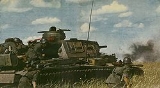
Blitzkrieg

Encyclopedia
For other uses of the word, see: Blitzkrieg (disambiguation)
.jpg) Blitzkrieg (German
Blitzkrieg (German
, "lightning war"; ) is an anglicized word describing all-motorised force concentration
of tanks, infantry, artillery, combat engineers and air power, concentrating overwhelming force at high speed to break through enemy lines, and, once the lines are broken, proceeding without regard to its flank. Through constant motion, the blitzkrieg attempts to keep its enemy off-balance, making it difficult to respond effectively at any given point before the front has already moved on.
During the interwar period
, aircraft and tank technologies matured and were combined with systematic application of the German tactics of infiltration and bypassing of enemy strong points. When Germany invaded Poland in 1939
, Western journalists adopted the term blitzkrieg to describe this form of armoured warfare. Blitzkrieg operations were very effective during the campaigns of 1939–1941. These operations were dependent on surprise penetrations (e.g. the penetration of the Ardennes
forest region), general enemy unpreparedness and an inability to react swiftly enough to the attacker's offensive operations. During the Battle of France
, the French, who made attempts to re-form defensive lines along rivers, were constantly frustrated when German forces arrived there first and pressed on.
Academics since the 1970s have questioned the existence of blitzkrieg as a coherent military doctrine or strategy. Many academic historians hold the idea that the German armed forces adopted "blitzkrieg" as an offensive doctrine to be a myth. Others continue to use the word to describe the style of breakthrough warfare practised by the Axis powers
of this period, even if it were not a formal doctrine. The concepts of Blitzkrieg form the basis of present-day armoured warfare.
and operational
methodology in the first half of the Second World War that was often hailed as a new method of warfare. The word, meaning "lightning war", in its strategic means is associated with a series of quick and decisive short battles to deliver a knockout blow to an enemy state before it could fully mobilize. The tactical meaning of blitzkrieg involves a coordinated military effort by tanks, mobilized infantry, artillery and aircraft, to create an overwhelming local superiority in combat power, to overwhelm an enemy and break through its lines. Blitzkrieg as used by Germany had considerable psychological, or as some writers call, "terror" elements, such as the noise-making sirens on the Junkers Ju 87
dive-bombers to affect the morale of enemy forces. The devices were largely removed when the enemy became used to the noise, after the Battle of France
in 1940, bombs sometimes having whistles attached instead. It is also common for writers to include psychological tactics behind the line, using Fifth columnists to spread rumours and untruths among the civil population in the theatre of operations.
It seems rarely to have been used in the German military press before 1939. Recent research conducted at the German military historical
institute at Freiburg has found only two military articles from the 1930s in which it is employed. Neither article advocates any radically new military doctrine or approach to war. Both use the term simply to mean a swift strategic knockout. The first, published in 1935, deals primarily with food (and to a lesser extent with raw material) supplies in wartime. The term blitzkrieg is here employed with reference to Germany’s efforts to win a quick victory in the First World War and is not associated with the use of armoured or mechanised forces or with airpower. The argument is that Germany must develop self-sufficiency in food supplies because it might again prove impossible to deal a swift knockout to her enemies and a protracted total war might prove unavoidable. The second article, published in 1938, states that launching a swift strategic knockout has great attractions for Germany but appears to accept that such a knockout will be very difficult to achieve by land attack under modern conditions (especially in view of the existence of systems of fortification
like the Maginot Line
) unless an exceptionally high degree of surprise is achieved. The author vaguely suggests that a massive strategic air attack might hold out better prospects, but that topic is not explored in any detail.
Another relatively early use of the term in a German-language work was in a book by Fritz Sternberg, a Jewish Marxist political economist who was a refugee from the Third Reich. Entitled Die Deutsche Kriegsstärke (German War Strength), it was published in Paris
in 1939. It had been preceded by an English-language edition of 1938 called Germany and a Lightning War. The German edition uses the term blitzkrieg. The book’s argument is that Germany is not prepared economically for a long war but might win a lightning war. It does not treat in any detail operational and tactical matters, and does not suggest that the German armed forces have evolved a radically new operational method. It offers scant clues as to how German lightning victories might be won.
limited any German Army to a maximum of 100,000 men, making impossible the deployment of massed troops which had characterized German strategy before the War. Although the German General Staff
was also abolished by the treaty, it nevertheless continued to exist as the Truppenamt
or "Troop Office", supposedly only an administrative body. Committees of veteran staff officers were formed within the Truppenamt to evaluate 57 issues of the war. Their reports led to doctrinal and training publications, which became the standard procedures by the time of the Second World War. The Reichswehr was influenced by its analysis of pre-war German military thought, in particular the infiltration tactics which at the end of the war had seen some breakthroughs in the Western Front's trench war, and the maneuver warfare which dominated the Eastern Front.
, Alfred von Schlieffen and von Moltke the Elder, who were proponents of maneuver, mass, and envelopment. During and after the First World War, these concepts were further developed by generals, such as Oskar von Hutier
and the Reichswehr. Following the First World War, these concepts were modified by the Reichswehr. The German army Chief of Staff, Hans von Seeckt
, moved doctrine away from what he argued was an excessive focus on encirclement towards one based on speed.
Under his command, a modern update of the doctrinal system called Bewegungskrieg ("maneuver warfare") and its associated leadership system called Auftragstaktik ("mission tactics"; i.e., units are assigned missions; local commanders decide how to achieve those missions) was developed, which was a critical advantage and a major reason for the success of blitzkrieg. This concept was abandoned in January 1942. The OKW believed it too risky to allow German Corps and Army Group
s to be operated and commanded independently by one field commander.
The German leadership had also been criticized for failing to understand the technical advances of the First World War, having given tank production
the lowest priority and having conducted no studies of the machine gun
prior to that war. In response, German officers attended technical school
s during this period of rebuilding after the war. The infiltration tactics developed by the German Army during the First World War became the basis for later tactics. German infantry had advanced in small, decentralized groups which bypassed resistance in favour of advancing at weak points and attacking rear-area communications. This was aided by coordinated artillery and air bombardments, and followed by larger infantry forces with heavy guns, which destroyed centers of resistance. These concepts formed the basis of the Wehrmacht's tactics during the Second World War.
On the Eastern Front of World War I, where combat did not bog down into trench warfare, German and Russian armies fought a war of maneuver over thousands of miles, giving the German leadership unique experience which the trench-bound Western Allies did not have. Studies of operations in the East led to the conclusion that small and coordinated forces possessed more combat worth than large, uncoordinated forces.
and Captain B. H. Liddell Hart have often been associated with the development of blitzkrieg, though this is a matter of controversy. During World War I, Fuller had been a staff officer attached to the newly developed tank force. He later developed plans for massive, independent tank operations and was subsequently studied by the German military.
Although the British Army's lessons were mainly drawn from the infantry and artillery offensives on the Western Front in late 1918, one "sideshow" theatre had witnessed operations that involved some aspects of what would later become blitzkrieg. In Palestine, General Edmund Allenby had used cavalry to seize railway and communication centers deep in the enemy rear during the Battle of Megiddo
in September 1918, while aircraft disrupted enemy lines of communication and headquarters. These methods had induced "strategic paralysis" among the defending Ottoman
troops and led to their rapid and complete collapse. Although Liddell Hart highlighted the importance of Allenby's "indirect approach", the British Army's establishment preferred to publicise the anachronistic success of Allenby's cavalry for several years.
was a known advocate of concentration of armor and airplanes. His opinions were expressed in his book, Vers l'Armée de Métier (Towards the Professional Army). Like von Seeckt, he concluded that France could no longer maintain the huge armies of conscripts and reservists with which World War I had been fought, and sought to use tanks, mechanised forces and aircraft to allow a smaller number of highly trained soldiers to have greater impact in battle. His views little endeared him to the French high command, but are claimed by some to have influenced Heinz Guderian
.
, one of the most prominent officers of the Red Army
of the Soviet Union
during the inter-war years, developed the concept of deep operations
from his experiences of the Polish-Soviet War
. These concepts would guide Red Army doctrine throughout World War II. Realising the limitations of infantry and cavalry, Tukhachevsky was an advocate of mechanised formations, and the large-scale industrialization required. However, Robert Watt states that blitzkrieg holds little in common with Soviet deep battle. H P Wilmott has noted that deep battle contains two critical differences – it advocated the idea of total war, not limited operations and it also rejected the idea of the decisive battle in favour of several large scale and simultaneous offensives.
The Reichswehr and the Red Army collaborated in war games
and tests in Kazan
and Lipetsk
beginning in 1926. Set within the Soviet Union, these two centers were used to field test aircraft and armoured vehicles up to the battalion level, as well as housing aerial and armoured warfare schools through which officers were rotated. This was done in the Soviet Union, in secret, to evade the Treaty of Versailles's occupational agent, the Inter-Allied Commission
.
ignored the Versailles Treaty provisions. A command for armoured forces was created within the German Wehrmacht; the Panzerwaffe
, as it came to be known later. The Luftwaffe, the German air force, was established, and development begun on ground-attack aircraft and doctrines. Hitler was a strong supporter of this new strategy. He read Guderian's book Achtung - Panzer!
and upon observing armoured field exercises at Kummersdorf
he remarked “That is what I want—and that is what I will have.”
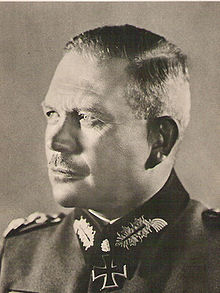 Heinz Guderian
was probably the first to fully develop and advocate the principles associated with blitzkrieg. He summarized combined-arms tactics as the way to get the mobile and motorized armoured divisions to work together and support each other in order to achieve decisive success. In his book, Panzer Leader, he wrote:
Guderian believed that developments in technology were required to support the theory; especially equipping armoured divisions—tanks foremost, with wireless communications. Guderian insisted in 1933 to the high command that every tank in the German armoured force must be equipped with radio. At the start of the war, only the German army was thus equipped with all tanks having radio. This proved critical in early tank battles where German tank commanders could maneuver their tanks in better organized ways than the Allies. Later all allied armies would copy this innovation.
of 1936. Armour commitment consisted of Panzer Battalion 88, a force built around three companies of Panzer I
tanks that functioned as a training cadre for Nationalists. The Luftwaffe deployed squadrons of fighters
, dive bomber
s, and transport aircraft
as the Condor Legion
. Guderian said that the tank deployment was “on too small a scale to allow accurate assessments to be made.” The true test of his “armoured idea” would have to wait for the Second World War. However, the Luftwaffe also provided volunteers to Spain to test both tactics and aircraft in combat, including the first combat use of the Stuka
.
During the war, the Condor Legion undertook the bombing of Guernica which had a tremendous psychological effect on the populations of Europe. The results were exaggerated, and the Western Allies
concluded that the "city-busting" techniques were now a part of the German way in war. The targets of the German aircraft were actually the rail lines and bridges. But lacking the ability to hit them with accuracy (only three or four Ju 87s saw action in Spain), a method of carpet bombing
was chosen resulting in heavy civilian casualties.
To achieve a breakout, armoured forces would attack the enemy's defensive line directly, supported by motorized infantry, artillery fire and aerial bombardment in order to create a breach in the enemy's line. Through this breach the tanks and motorised units could break through without the traditional encumbrance of the slow logistics of infantry on foot.
In this, the opening phase of an operation, air forces sought to gain superiority over enemy air forces by attacking aircraft on the ground, bombing their airfields, and seeking to destroy them in air to air combat.
The principle of Schwerpunkt enabled the attacker to win numerical superiority at the point of the main effort, which in turn gave the attacker tactical
and operational superiority even though the attacker may be numerically and strategically
inferior along the entire front.
Central to this is the decision cycle
. Every decision made by German or opposing forces required time to gather information, make a decision, disseminate orders to subordinates, and then implement this decision through action. Through superior mobility and faster decision-making cycles, mobile forces could take action on a situation sooner than the forces opposing them.
Directive control was a fast and flexible method of command. Rather than receiving an explicit order, a commander would be told of his superior's intent and the role which his unit was to fill in this concept. The exact method of execution was then a matter for the low-level commander to determine as best fit the situation. Staff burden was reduced at the top and spread among commands more knowledgeable about their own situation. In addition, the encouragement of initiative at all levels aided implementation. As a result, significant decisions could be effected quickly and either verbally or with written orders a few pages in length.
, massive encirclements netted nearly 3,500,000 Soviet prisoners along with masses of equipment.
was provided in the form of the dive-bomber and medium bomber
. They would support the focal point of attack from the air. German successes are closely related to the extent to which the German Luftwaffe was able to control the air war in early campaigns in Europe and the Soviet Union. However, the Luftwaffe was a broadly based force with no constricting central doctrine, other than its resources should be used generally to support national strategy. It was flexible and it was able to carry out both operational-tactical, and strategic bombing effectively. Flexibility was the Luftwaffe's strength in 1939–1941. Paradoxically, from that period onward it became its weakness. While Allied Air Forces were tied to the support of the Army, the Luftwaffe deployed its resources in a more general, operational way. It switched from air superiority missions, to medium-range interdiction, to strategic strikes, to close support duties depending on the need of the ground forces. In fact, far from it being a dedicated panzer spearhead arm, less than 15 percent of the Luftwaffe was designed for close support of the army in 1939.
It should however be noted that the disadvantages of such terrain could be nullified if surprise was achieved over the enemy by an attack through such terrain. During the Battle of France, the German blitzkrieg-style attack on France went through the Ardennes. There is little doubt that the hilly, heavily wooded Ardennes could have been relatively easily defended by the Allies, even against the bulk of the German armoured units. However, precisely because the French thought the Ardennes unsuitable for massive troop movement, particularly for tanks, they were left with only light defences which were quickly overrun by the Wehrmacht. The Germans quickly advanced through the forest, knocking down the trees the French thought would impede this tactic.
 Allied air superiority became a significant hindrance to German operations during the later years of the war. Early German successes enjoyed air superiority with unencumbered movement of ground forces, close air support, and aerial reconnaissance. However, the Western Allies' air-to-ground aircraft were so greatly feared out of proportion to their actual tactical success, that following the lead up to Operation Overlord German vehicle crews showed reluctance to move en masse during daylight. Indeed, the final German blitzkrieg operation in the west, Operation Wacht am Rhein, was planned to take place during poor weather which grounded Allied aircraft. Under these conditions however, it was difficult for German commanders to employ the “armoured idea” to its envisioned potential.
During the Battle of France
in 1940, De Gaulle's
4th Armoured Division and elements of the British Expeditionary Force
's 1st Army Tank Brigade both made probing attacks on the German flank, actually pushing into the rear of the advancing armoured columns at times. This may have been a reason for Hitler to call a halt to the German advance. Those attacks combined with Maxime Weygand
's Hedgehog tactic would become the major basis for responding to blitzkrieg attacks in the future: deployment in depth
, permitting enemyor “shoulders” of a penetration was essential to channeling the enemy attack, and artillery, properly employed at the shoulders, could take a heavy toll of attackers. While Allied forces in 1940 lacked the experience to successfully develop these strategies, resulting in France's capitulation with heavy losses, they characterized later Allied operations. For example, at the Battle of Kursk
the Red Army
employed a combination of defense in great depth, extensive minefields, and tenacious defense of breakthrough shoulders. In this way they depleted German combat power even as German forces advanced.
In August 1944 at Mortain, stout defense and counterattacks against the German flanks by American and Canadian forces closed the Falaise pocket
. In the Ardennes, a combination of hedgehog defense at Bastogne
, St Vith
and other locations, and a counterattack by Patton's
3rd U.S. Army were employed.
and ammunition
stocks as a result of Anglo-American strategic bombing
and blockade. Although production of Luftwaffe fighter aircraft continued, they would be unable to fly for lack of fuel. What fuel there was went to panzer divisions, and even then they were not able to operate normally. Of those Tiger
tanks lost against the United States Army, nearly half of them were abandoned for lack of fuel.
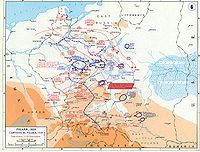
Despite the term blitzkrieg being coined by journalists during the Invasion of Poland of 1939, historians Mathew Cooper and J. P Harris generally hold that German operations during it were more consistent with more traditional methods. The Wehrmacht's strategy was more in line with Vernichtungsgedanke
n, or a focus on envelopment to create pockets in broad-front annihilation. Panzer forces were dispersed among the three German concentrations without strong emphasis on independent use, being used to create or destroy close pockets of Polish forces and seize operational-depth terrain in support of the largely un-motorized infantry which followed.
While early German tanks, Stuka dive-bombers and concentrated forces were used in the Polish campaign, the majority of the battle was conventional infantry and artillery based warfare and most Luftwaffe action was independent of the ground campaign. Matthew Cooper wrote that
John Ellis explained that “...there is considerable justice in Matthew Cooper's assertion that the panzer divisions were not given the kind of strategic mission that was to characterize authentic armoured blitzkrieg, and were almost always closely subordinated to the various mass infantry armies.”
Steven Zaloga
states: “Whilst Western accounts of the September campaign have stressed the shock value of the panzers and Stuka attacks, they have tended to underestimate the punishing effect of German artillery on Polish units. Mobile and available in significant quantity, artillery shattered as many units as any other branch of the Wehrmacht.”
and the Netherlands
, consisted of two phases, Operation Yellow (Fall Gelb) and Operation Red (Fall Rot). Yellow opened with a feint conducted against the Netherlands and Belgium by two armoured corps and paratrooper
s. The Germans had massed the bulk of their armoured force in Panzer Group von Kleist, which attacked through the comparatively unguarded sector of the Ardennes
and achieved a breakthrough at the Battle of Sedan
with air support.
The group raced to the coast of the English Channel
at Abbeville, thus isolating the British Expeditionary Force
, Belgian Army
, and some divisions of the French Army
in northern France. The armoured and motorized units under Guderian and Rommel initially advanced far beyond the following divisions, and indeed far in excess of that with which German high command was initially comfortable. When the German motorized forces were met with a counterattack at Arras
, British tanks with heavy armour (Matilda I & IIs) created a brief panic in the German High Command. The armoured and motorized forces were halted, by Hitler, outside the port city of Dunkirk, which was being used to evacuate the Allied forces. Hermann Göring
had promised the Luftwaffe would complete the destruction of the encircled armies, but aerial operations did not prevent the evacuation of the majority of Allied troops (which the British named Operation Dynamo
); some 330,000 French and British were saved.
Overall, Yellow succeeded beyond what most people had expected, despite the fact that the Allies had 4,000 armoured vehicles and the Germans 2,200, and the Allied tanks were often superior in armour and caliber of cannon. The British used tanks in their pre-blitzkrieg 'traditional' role of assisting infantry and dispersed across the whole army so there was not concentration of tanks, while the blitzkrieg method of concentrating tanks, even less in number and less capable in ability, led to victorious success.
This left the French armies much reduced in strength (although not demoralized), and without much of their own armour and heavy equipment. Operation Red then began with a triple-pronged panzer attack. The XV Panzer Corps attacked towards Brest
, XIV Panzer Corps attacked east of Paris, towards Lyon
, and Guderian's XIX Panzer Corps completed the encirclement of the Maginot Line
. The defending forces were hard pressed to organize any sort of counter-attack. The French forces were continually ordered to form new lines along rivers, often arriving to find the German forces had already passed them. When Colonel de Gaulle did organize a counter-attack with superior French tanks, he did not have the air support to gain the upper hand and had to retreat.
Ultimately, the French army and nation collapsed after barely two months of mobile operations, in contrast to the four years of trench warfare of the First World War. The French president of the Ministerial Council, Reynaud, attributed the collapse in a speech on 21 May 1940:
In actual fact, the German army had not used paratroop attacks in France. The one major paratrooper attack was used earlier in Holland to capture a bridge and a number of small-scale glider-landings were conducted in Belgium to capture terrain dominating bottle-necks on planned routes of advance prior to the arrival of the main ground forces (the most renowned being the landing on the Belgian border-fort of Eben-Emael). The real cause for the fall of France was the blitzkrieg method of warfare.
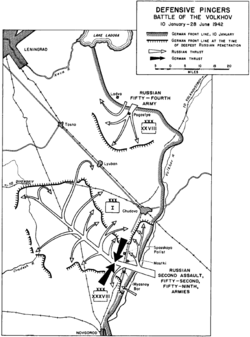 Use of armoured forces was crucial for both sides on the Eastern Front. Operation Barbarossa
, the German invasion of the Soviet Union
in 1941, involved a number of breakthroughs and encirclements by motorized forces. Its stated goal was “to destroy the Russian forces deployed in the West and to prevent their escape into the wide-open spaces of Russia.” A key factor was the surprise attack which included the near annihilation of the total Soviet airforce by simultaneous attacks on airfields. On the ground, four giant panzer armies encircled surprised and disorganized Soviet forces, followed by marching infantry which completed the encirclement and defeated the trapped forces. The first year of the Eastern Front offensive can generally be considered to have had the last successful major mobile operation for the German army.
After Germany's failure to destroy the Soviets before the winter of 1941, the strategic failure above the German tactical superiority became apparent. Although the German invasion successfully conquered large areas of Soviet territory, the overall strategic effects were more limited. The Red Army was able to regroup far to the rear of the main battle line, and eventually defeat the German forces for the first time in the Battle of Moscow
.
In the summer of 1942, when Germany launched another offensive in the southern USSR against Stalingrad and the Caucasus
, the Soviets again lost tremendous amounts of territory, only to counter-attack once more during winter. German gains were ultimately limited by Hitler diverting forces from the attack on Stalingrad itself and seeking to pursue a drive to the Caucasus oilfields simultaneously as opposed to subsequently as the original plan had envisaged. Even so, the Wehrmacht was becoming overstretched. By winning operationally, strategically it could not keep up the momentum as the superiority of the Soviet Union's industrial base and economy began to take effect.
In the summer of 1943 the Wehrmacht launched another combined forces offensive operation – Zitadelle (Citadel) – against the Soviet salient at Kursk
. Soviet defensive tactics were by now hugely improved, particularly in terms of artillery and effective use of air support. All the same the Battle of Kursk
was marked by the Soviet switch to offence and the use of the revived doctrine of deep operations. For the first time the blitzkrieg was defeated in summer and the opposing forces were able to mount their own, successful, counter operation.
By the summer of 1944 the reversal of fortune was complete and Operation Bagration saw Soviet forces inflict crushing defeats on Germany through the aggressive use of armour, infantry and air power in combined strategic assault, known as deep operations
.
and both the British Commonwealth and American armies developed flexible and powerful systems for utilizing artillery support. What the Soviets lacked in flexibility, they made up for in number of multiple rocket launchers, cannon and mortar tubes. The Germans never achieved the kind of fire concentrations their enemies were capable of by 1944.
After the Allied landings at Normandy, Germany made attempts to overwhelm the landing force with armoured attacks, but these failed for lack of co-ordination and Allied air superiority. The most notable attempt to use deep penetration operations in Normandy was at Mortain
, which exacerbated the German position in the already-forming Falaise Pocket
and assisted in the ultimate destruction of German forces in Normandy. The Mortain counter-attack was effectively destroyed by U.S. 12th Army Group with little effect on its own offensive operations.
Germany's last offensive on its Western front, Operation Wacht am Rhein
, was an offensive launched towards the vital port of Antwerp in December 1944. Launched in poor weather against a thinly held Allied sector, it achieved surprise and initial success as Allied air power was stymied by cloud cover. However, stubborn pockets of defence in key locations throughout the Ardennes, the lack of serviceable roads, and poor German logistics planning caused delays. Allied forces deployed to the flanks of the German penetration, and as soon as the skies cleared, Allied aircraft were again able to attack motorized columns. The stubborn defense by US units and German weakness led to a defeat for the Germans.
There has been a great deal of debate about whether blitzkrieg existed as a coherent military strategy. Many historians now hold the position that blitzkrieg was not a military theory, and the campaigns conducted by the German military in 1939 to circa
, 1942 (with the exception of Operation Barbarossa
) were improvised invasions put together and modified at the last moment and therefore was not a proper military strategy.
In the past blitzkrieg has also been hailed as a Revolution in Military Affairs
(RMA). In recent years a large number of writers and historians have come to the conclusion it was not a new form of warfare invented by the German military, but an old method of pursuing decisive battles using new technology.
Some historians were prepared to go even further, claiming that blitzkrieg was not merely an operational doctrine of the German armed forces but a strategic concept on which the leadership of the Third Reich based its strategic and economic planning.
Those who made the Third Reich’s military plans and organized its war economy appear rarely, if ever, to have employed the term blitzkrieg in official documents. The idea that the German army operated on a "blitzkrieg doctrine" was vigorously attacked in the late 1970s by Matthew Cooper. The concept of a blitzkrieg Luftwaffe
was challenged by Richard Overy
in the late 1970s and by Williamson Murray in the mid-1980s. The thesis that the Third Reich went to war on the basis of "blitzkrieg economics" was attacked by Richard Overy in the 1980s and Historian George Raudzens highlighted the many, somewhat conflicting, senses in which historians have used the word. Yet not only does the notion of a German blitzkrieg concept or doctrine survive in popular consciousness and popular literature, it persists with many professional historians. Academic monographs continue to appear which purport to explore the "evolution" or "roots" of blitzkrieg, (such as James Corum
's The Roots of Blitzkrieg: Hans von Seeckt and German Military Reform).
In his book, The Blitzkrieg Legend, German historian Karl-Heinz Frieser referred to the notion of 'Blitzkrieg' as "a world wide delusion". Frieser, in agreement with Overy, Cooper and others that reject the existence of a blitzkrieg doctrine, argues that after the failure of the Schlieffen Plan
in 1914, the German Army came to the conclusion decisive battles could not be executed on a strategic level. This meant the idea of one early large scale offensive could not bring about a knockout blow. Frieser argues that the OKW had intended to avoid the decisive battle concepts of its predecessors and planned for a long all out war of attrition. It was only after the hastily improvised plan for the invasion of Western Europe in 1940 and its successful conclusion, which led the German General Staff to believe that decisive battles were not obsolete. It was only after the Battle of France
German thinking reverted to the possibility of a blitzkrieg method for the Balkan Campaign and Operation Barbarossa
.
Historians Shimon Naveh and Richard Overy
reject the idea that blitzkrieg was a military doctrine. Naveh states, "The striking feature of the blitzkrieg concept is the complete absence of a coherent theory which should have served as the general cognitive basis for the actual conduct of operations". Naveh described it as an "ad hoc solution" to operational dangers, thrown together at the last moment.
Richard Overy also rejected the idea that Hitler and the Nazi regime ever intended a blitzkrieg war. The suggestion that the German state intentionally streamlined its economy to carry out its grand strategy in a series of short campaigns in the near future was false. In fact Hitler intended to start an unlimited war, at a much later date than 1939. But the Third Reich's foreign policy
had forced the Nazi state into war before it had fully prepared. Hitler's, and the Wehrmacht
's planning attitudes during the 1930s do not reflect a blitzkrieg method, but the exact opposite.
Historian J. P Harris has pointed out that the Germans never used the word blitzkrieg. It was never used in any German military field manual, either in the Army or the Air Force. It first appeared in September 1939, by a Times newspaper reporter. Harris also rejects that German military thinking developed any kind of blitzkrieg mentality.
In his book the Blitzkrieg Legend, German historian Karl-Heinz Frieser also shares Adam Tooze
' (in his work The Wages of Destruction: The Making and Breaking of the Nazi Economy
), Overy's and Naveh's concerns over the myth of the blitzkrieg economic and strategy. Moreover Frieser states that surviving German economists and members of the German General Staff have denied Germany went to war based on a blitzkrieg strategy.
Overy states that blitzkrieg as a "coherent military and economic concept has proven a difficult strategy to defend in light of the evidence". Milward's theory was completely contrary to Hitler's and German planners' intentions. It was their fear of the spectre of 1914 that emerged victorious in the conflict of goals between armament in breadth for a short war and armament in depth for a feared long war. The Germans were aware of the error of the First World War, and rejected the concept of orientating its economy geared to fighting only a short war. Hitler proclaimed to rely on surprise alone was "criminal", and that "we have to prepare for a long war along with surprise attack".
During the winter of 1939–40, Hitler decreased the size of the fighting manpower in order to return as many skilled workers to the factories as was possible. It was realised that the war would be decided in the factories, not a quick-decision "Panzer operation".
Throughout the 1930s, Hitler had ordered rearmament program that cannot be considered limited. In November 1937 Hitler had indicated that most of the armament projects would be completed by 1943–45. The rearmament of the Kriegsmarine
was to have been completed in 1949, the Luftwaffe
rearmament program was to have been completed in 1942 with a force capable of carrying out strategic bombing
using heavy bomber
s. The construction and training of motorised forces and a full mobilisation of the rail networks would not begin until 1943 and 1944 respectively.
Hitler needed to avoid war until these projects were complete. Hitler's misjudgements in 1939 forced him into war before he was able to complete rearmament.
After the war, Albert Speer
pointed out that the German economy achieved greater armaments output, not because of diversions of capacity from civilian to military industry, but through streamlining of the economy. Richard Overy pointed out some 23 percent of German output was military by 1939. Between 1937–1939 70 percent of investment capital went into in rubber, synthetic fuel development, aircraft and ship building industries. Hermann Göring had consistently stated the task of the Four Year Plan
was to rearm Germany for total war. Adolf Hitler's correspondence with his economists also reveals that his intent was to wage war in 1943–1945 when the resources of central Europe had been absorbed into the Third Reich.
Living standards were not high in the late 1930s. Consumption of consumer goods had fallen from 71 percent in 1928 to 59 percent in 1938. The demands of the war economy reduced the amount of spending in non-military sectors to satisfy the demand for the armed forces. On 9 September the Head of the Reich Defence Council, Goring called for complete "employment" of living and fighting power of the national economy for the duration of the war. Overy presents this as evidence that a "blitzkrieg economy" did not exist.
Adam Tooze
supports Overy. Tooze explains that the German economy was planning for a long war. The expenditure for this war was extensive and put the economy under severe strain. The German leadership were concerned less with how to balance the civilian economy and the needs of civilian consumption, but rather to figure out how to best prepare the economy for total war. Once war had begun, Hitler urged his economic experts to abandon caution and expend all available resources on the war effort. The expansion plans only gradually gained momentum in 1941. Tooze maintained the huge armament plans in the pre-war period did not indicate any clear sighted blitzkrieg economy or strategy.
. The British also had an "enviable" contingent of motorised forces. Thus, "the image of the German 'Blitzkrieg' army is a figment of propaganda imagination". During the First World War the German army used horses for logistics, 1.4 million of them, in the 1939–45 war it used 2.7 million horses. Moreover just 10 percent of the Army was motorised in 1940.
Half of the German divisions available in 1940 were combat ready, often being more poorly equipped than the British and French Armies, as well as the German Army of 1914.
In the spring, 1940, the German army was semi-modern. A small number of the best equipped and "elite divisions were offset by many second and third rate divisions". Apart from the few motorised and Panzer Divisions, ninety percent of the German Army was not a blitzkrieg army.
It has been argued by John Mosier that, while the French soldiers in 1940 were better trained than German soldiers, as were the Americans later, and the German army was the least mechanised of the major armies, its leadership cadres were both larger and superior and their high standards of leadership were the primary reason for the successes of the German army in World War Two as it had been in World War One.
states a prevalent myth about the Luftwaffe and its blitzkrieg operations is that it had a doctrine of terror bombing, in which civilians were deliberately targeted in order to break the will or aid the collapse of an enemy. After the bombing of Guernica in 1937 and of Rotterdam in 1940, it was commonly assumed that terror bombing was a part of Luftwaffe doctrine. During the interwar period the Luftwaffe leadership rejected the concept of terror bombing, and confined the air arms use to battlefield support of interdiction
operations.
Corum continues; General
Walther Wever
compiled a doctrine known as The Conduct of the Aerial War. This document, which the Luftwaffe adopted, rejected Giulio Douhet
's theory of terror bombing. Terror bombing was deemed to be "counter-productive", increasing rather than destroying the enemies will to resist. Such bombing campaigns were regarded as diversion from the Luftwaffe's main operations; destruction of the enemy armed forces. The bombings of Guernica, Rotterdam and Warsaw were tactical missions in support of military operations and were not intended as strategic terror attacks.
J.P. Harris states that most Luftwaffe leaders from Goering through the general staff believed as did their counterparts in Britain and the United States that strategic bombing was the chief mission of the air force and that given such a role, the Luftwaffe would win the next war and that:
The Luftwaffe did end up with an air force consisting mainly of relatively short-range aircraft, but this does not prove that the German air force was solely interested in ’tactical’ bombing. It happened because the German aircraft industry lacked the experience to build a long-range bomber fleet quickly, and because Hitler was insistent on the very rapid creation of a numerically large force. It is also significant that Germany’s position in the centre of Europe to a large extent obviated the need to make a clear distinction between bombers suitable only for ’tactical’ and those necessary for strategic purposes in the early stages of a likely future war.
and Captain B. H. Liddell Hart have often been associated with the development of blitzkrieg, though this is a matter of controversy. In recent years historians have uncovered that Liddell Hart distorted and falsified facts to make it appear as if his ideas were adopted. After the war Liddell Hart imposed his own perceptions, after the event, claiming that the mobile tank warfare practiced by the Wehrmacht
was a result of his influence. Blitzkrieg itself is not an official doctrine and historians in recent times have come to the conclusion it did not exist as such:
By "manipulation and contrivance, Liddell Hart distorted the actual circumstances of the blitzkrieg formation and he obscured its origins. Through his indoctrinated idealization of an ostentatious concept he reinforced the myth of blitzkrieg". By imposing, retrospectively, his own perceptions of mobile warfare upon the shallow concept of blitzkrieg, he "created a theoretical imbroglio that has taken 40 years to unravel." The early 1950s literature transformed blitzkrieg into a historical military doctrine, which carried the signature of Liddell Hart and Heinz Guderian
. The main evidence of Liddell Hart's deceit and "tendentious" report of history can be found in his letters to the German Generals Erich von Manstein
and Heinz Guderian, as well as relatives and associates of Erwin Rommel
. Liddell Hart, in letters to Guderian, "imposed his own fabricated version of blitzkrieg on the latter and compelled him to proclaim it as original formula". Historian Kenneth Macksey
found Liddell Hart's original letters to Guderian, in the General's papers, requesting that Guderian give him credit for "impressing him" with his ideas of armoured warfare. When Liddell Hart was questioned about this in 1968, and the discrepancy between the English and German editions of Guderian's memoirs, "he gave a conveniently unhelpful though strictly truthful reply. ('There is nothing about the matter in my file of correspondence with Guderian himself except...that I thanked him...for what he said in that additional paragraph'.)".
During World War I, Fuller had been a staff officer attached to the newly developed tank force. He later developed plans for massive, independent tank operations, which he claimed was subsequently studied by the German military. It is variously argued that Fuller's wartime plans and post-war writings were an inspiration, or that his readership was low and German experiences during the war received more attention. The Germans' view of themselves as the losers of the war may be linked to the senior and experienced officers' undertaking a thorough review, studying, and rewriting of all their Army doctrine and training manuals. The UK's response was much weaker.
Both Fuller and Liddell Hart were "outsiders": Liddell Hart was unable to serve as an active soldier because of ill-health, and Fuller's abrasive personality resulted in his premature retirement in 1933. Their views therefore had limited impact within the British Army's official hierarchy. The British War Office did permit the formation of an Experimental Mechanized Force
on 1 May 1927, composed of tanks, lorried infantry, self propelled artillery
and motorized engineers, but financial constraints prevented the experiment from being extended.
and the German wars of unification
. The first European general to introduce rapid movement, concentrated power and integrated military effort was Swedish King Gustav II Adolfus during the 30 year war. The appearance of the aircraft and tank in the First World War, often hailed as a revolution in military affairs (RMA), offered the German military a chance to get back to the traditional war of movement as practiced by Moltke the Elder.
The so called "blitzkrieg campaigns" of 1939 – circa 1942, were well within that operational context.
At the outbreak of war, the German army had no radically new theory of war named Blitzkrieg or otherwise. The operational thinking of the German army had not changed significantly since the First World War or since the late 19th century. J. P. Harris and Robert M. Citino
point out that the Germans had always had a marked preference for short, decisive campaigns – but were unable to achieve short-order victories in First World War conditions. The transformation from the stalemate of the First World War into tremendous initial operational and strategic success in the Second, was partly the employment of a relatively small number of mechanised divisions, most importantly the Panzer divisions, and the support of an exceptionally powerful air force
.
(1935–38), who he alleged was skeptical that armored forces could be decisive. This claim has been disputed by later historians. For example, James Corum
stated:
Another misconception, enhanced by Guderian's own account, that he was the sole creater of German tactical and operational methodology is also misleading. Between 1922 and 1928 Guderian wrote very few articles of barely more than a page or two concerning military movement. Guderian's Achtung Panzer! (1937) relied heavily on other theorists such as Ludwig Ritter von Eimannsberger, whose major book, The Tank War (Der Kampfwagenkrieg) (1934) gained a wide audience in the German Army. Another theorist, Ernst Volckheim, was also used by Guderian, and wrote a huge amount on tank and combined arms tactics, and is not acknowledged by Guderian.
Guderian's leadership was supported, fostered and institutionalized by his supporters in the Reichswehr General Staff system, which worked the Army to greater and greater levels of capability through massive and systematic Movement Warfare war games in the 1930s.
Guderian argued that the tank was the decisive weapon of war. "If the tanks succeed, then victory follows", he wrote. In an article addressed to critics of tank warfare, he wrote "until our critics can produce some new and better method of making a successful land attack other than self-massacre, we shall continue to maintain our beliefs that tanks—properly employed, needless to say—are today the best means available for land attack." Addressing the faster rate at which defenders could reinforce an area than attackers could penetrate it during the First World War, Guderian wrote that "since reserve forces will now be motorized, the building up of new defensive fronts is easier than it used to be; the chances of an offensive based on the timetable of artillery and infantry co-operation are, as a result, even slighter today than they were in the last war." He continued, "We believe that by attacking with tanks we can achieve a higher rate of movement than has been hitherto obtainable, and—what is perhaps even more important—that we can keep moving once a breakthrough has been made." Guderian additionally required that tactical radio
s be widely used to facilitate co-ordination and command by having one installed in all tanks.
Blitzkrieg (disambiguation)
Blitzkrieg is military term describing the use of overwhelming force and rapid speed.Blitzkrieg may also refer to:* Blitzkrieg , a tabletop wargame published by Avalon Hill in 1965...
German language
German is a West Germanic language, related to and classified alongside English and Dutch. With an estimated 90 – 98 million native speakers, German is one of the world's major languages and is the most widely-spoken first language in the European Union....
, "lightning war"; ) is an anglicized word describing all-motorised force concentration
Force concentration
Force concentration is the practice of concentrating a military force, so as to bring to bear such overwhelming force against a portion of an enemy force that the disparity between the two forces alone acts as a force multiplier, in favour of the concentrated forces.-Mass of decision:Force...
of tanks, infantry, artillery, combat engineers and air power, concentrating overwhelming force at high speed to break through enemy lines, and, once the lines are broken, proceeding without regard to its flank. Through constant motion, the blitzkrieg attempts to keep its enemy off-balance, making it difficult to respond effectively at any given point before the front has already moved on.
During the interwar period
Interwar period
Interwar period can refer to any period between two wars. The Interbellum is understood to be the period between the end of the Great War or First World War and the beginning of the Second World War in Europe....
, aircraft and tank technologies matured and were combined with systematic application of the German tactics of infiltration and bypassing of enemy strong points. When Germany invaded Poland in 1939
Invasion of Poland (1939)
The Invasion of Poland, also known as the September Campaign or 1939 Defensive War in Poland and the Poland Campaign in Germany, was an invasion of Poland by Germany, the Soviet Union, and a small Slovak contingent that marked the start of World War II in Europe...
, Western journalists adopted the term blitzkrieg to describe this form of armoured warfare. Blitzkrieg operations were very effective during the campaigns of 1939–1941. These operations were dependent on surprise penetrations (e.g. the penetration of the Ardennes
Ardennes
The Ardennes is a region of extensive forests, rolling hills and ridges formed within the Givetian Ardennes mountain range, primarily in Belgium and Luxembourg, but stretching into France , and geologically into the Eifel...
forest region), general enemy unpreparedness and an inability to react swiftly enough to the attacker's offensive operations. During the Battle of France
Battle of France
In the Second World War, the Battle of France was the German invasion of France and the Low Countries, beginning on 10 May 1940, which ended the Phoney War. The battle consisted of two main operations. In the first, Fall Gelb , German armoured units pushed through the Ardennes, to cut off and...
, the French, who made attempts to re-form defensive lines along rivers, were constantly frustrated when German forces arrived there first and pressed on.
Academics since the 1970s have questioned the existence of blitzkrieg as a coherent military doctrine or strategy. Many academic historians hold the idea that the German armed forces adopted "blitzkrieg" as an offensive doctrine to be a myth. Others continue to use the word to describe the style of breakthrough warfare practised by the Axis powers
Axis Powers
The Axis powers , also known as the Axis alliance, Axis nations, Axis countries, or just the Axis, was an alignment of great powers during the mid-20th century that fought World War II against the Allies. It began in 1936 with treaties of friendship between Germany and Italy and between Germany and...
of this period, even if it were not a formal doctrine. The concepts of Blitzkrieg form the basis of present-day armoured warfare.
Common interpretation
The classic interpretation of blitzkrieg is that of German tacticalMilitary tactics
Military tactics, the science and art of organizing an army or an air force, are the techniques for using weapons or military units in combination for engaging and defeating an enemy in battle. Changes in philosophy and technology over time have been reflected in changes to military tactics. In...
and operational
Military operation
Military operation is the coordinated military actions of a state in response to a developing situation. These actions are designed as a military plan to resolve the situation in the state's favor. Operations may be of combat or non-combat types, and are referred to by a code name for the purpose...
methodology in the first half of the Second World War that was often hailed as a new method of warfare. The word, meaning "lightning war", in its strategic means is associated with a series of quick and decisive short battles to deliver a knockout blow to an enemy state before it could fully mobilize. The tactical meaning of blitzkrieg involves a coordinated military effort by tanks, mobilized infantry, artillery and aircraft, to create an overwhelming local superiority in combat power, to overwhelm an enemy and break through its lines. Blitzkrieg as used by Germany had considerable psychological, or as some writers call, "terror" elements, such as the noise-making sirens on the Junkers Ju 87
Junkers Ju 87
The Junkers Ju 87 or Stuka was a two-man German ground-attack aircraft...
dive-bombers to affect the morale of enemy forces. The devices were largely removed when the enemy became used to the noise, after the Battle of France
Battle of France
In the Second World War, the Battle of France was the German invasion of France and the Low Countries, beginning on 10 May 1940, which ended the Phoney War. The battle consisted of two main operations. In the first, Fall Gelb , German armoured units pushed through the Ardennes, to cut off and...
in 1940, bombs sometimes having whistles attached instead. It is also common for writers to include psychological tactics behind the line, using Fifth columnists to spread rumours and untruths among the civil population in the theatre of operations.
Academic study
The origins of the term blitzkrieg are obscure. It was never used in the title of a military doctrine or handbook of the German army or air force.It seems rarely to have been used in the German military press before 1939. Recent research conducted at the German military historical
institute at Freiburg has found only two military articles from the 1930s in which it is employed. Neither article advocates any radically new military doctrine or approach to war. Both use the term simply to mean a swift strategic knockout. The first, published in 1935, deals primarily with food (and to a lesser extent with raw material) supplies in wartime. The term blitzkrieg is here employed with reference to Germany’s efforts to win a quick victory in the First World War and is not associated with the use of armoured or mechanised forces or with airpower. The argument is that Germany must develop self-sufficiency in food supplies because it might again prove impossible to deal a swift knockout to her enemies and a protracted total war might prove unavoidable. The second article, published in 1938, states that launching a swift strategic knockout has great attractions for Germany but appears to accept that such a knockout will be very difficult to achieve by land attack under modern conditions (especially in view of the existence of systems of fortification
Fortification
Fortifications are military constructions and buildings designed for defence in warfare and military bases. Humans have constructed defensive works for many thousands of years, in a variety of increasingly complex designs...
like the Maginot Line
Maginot Line
The Maginot Line , named after the French Minister of War André Maginot, was a line of concrete fortifications, tank obstacles, artillery casemates, machine gun posts, and other defences, which France constructed along its borders with Germany and Italy, in light of its experience in World War I,...
) unless an exceptionally high degree of surprise is achieved. The author vaguely suggests that a massive strategic air attack might hold out better prospects, but that topic is not explored in any detail.
Another relatively early use of the term in a German-language work was in a book by Fritz Sternberg, a Jewish Marxist political economist who was a refugee from the Third Reich. Entitled Die Deutsche Kriegsstärke (German War Strength), it was published in Paris
Paris
Paris is the capital and largest city in France, situated on the river Seine, in northern France, at the heart of the Île-de-France region...
in 1939. It had been preceded by an English-language edition of 1938 called Germany and a Lightning War. The German edition uses the term blitzkrieg. The book’s argument is that Germany is not prepared economically for a long war but might win a lightning war. It does not treat in any detail operational and tactical matters, and does not suggest that the German armed forces have evolved a radically new operational method. It offers scant clues as to how German lightning victories might be won.
Roots of German military methods
During the First World War, on the Western front, the two sides had been locked in a trench war, where kill zones by overlapping fire of machine guns and barbed wire prevented either side from breaking through. The British introduced the tank as invulnerable to machine gun fire, and able to cross trenches and breach barbed wire, to lead men across the battlefield. The British had been able to penetrate German lines this way, but not enough tanks were made before the war ended. The Germans had therefore first-hand experience of the potential of tanks to change the battlefield. Where the allied armies were slow to deploy and study the tank in the inter-war years, the German army was very eager to study and master this new technology.Development of German tactical methods
German operational theories began to evolve immediately after Germany's defeat in the First World War. The Treaty of VersaillesTreaty of Versailles
The Treaty of Versailles was one of the peace treaties at the end of World War I. It ended the state of war between Germany and the Allied Powers. It was signed on 28 June 1919, exactly five years after the assassination of Archduke Franz Ferdinand. The other Central Powers on the German side of...
limited any German Army to a maximum of 100,000 men, making impossible the deployment of massed troops which had characterized German strategy before the War. Although the German General Staff
German General Staff
The German General Staff was an institution whose rise and development gave the German armed forces a decided advantage over its adversaries. The Staff amounted to its best "weapon" for nearly a century and a half....
was also abolished by the treaty, it nevertheless continued to exist as the Truppenamt
Truppenamt
The Truppenamt or 'Troop Office' was the cover organisation for the German General Staff from 1919 through until 1933 when the General Staff was re-created. This subterfuge was deemed necessary in order for Germany to be seen to meet the requirements of the Versailles Treaty...
or "Troop Office", supposedly only an administrative body. Committees of veteran staff officers were formed within the Truppenamt to evaluate 57 issues of the war. Their reports led to doctrinal and training publications, which became the standard procedures by the time of the Second World War. The Reichswehr was influenced by its analysis of pre-war German military thought, in particular the infiltration tactics which at the end of the war had seen some breakthroughs in the Western Front's trench war, and the maneuver warfare which dominated the Eastern Front.
Return to Prussian and 19th Century methodology
German military history had previously been influenced by Carl von ClausewitzCarl von Clausewitz
Carl Philipp Gottfried von Clausewitz was a Prussian soldier and German military theorist who stressed the moral and political aspects of war...
, Alfred von Schlieffen and von Moltke the Elder, who were proponents of maneuver, mass, and envelopment. During and after the First World War, these concepts were further developed by generals, such as Oskar von Hutier
Oskar von Hutier
Oskar von Hutier was one of Imperial Germany's most successful and innovative generals of World War I.-Biography:Hutier was born in Erfurt, in the Prussian Province of Saxony...
and the Reichswehr. Following the First World War, these concepts were modified by the Reichswehr. The German army Chief of Staff, Hans von Seeckt
Hans von Seeckt
Johannes Friedrich "Hans" von Seeckt was a German military officer noted for his organization of the German Army during the Weimar Republic.-Early life:...
, moved doctrine away from what he argued was an excessive focus on encirclement towards one based on speed.
Under his command, a modern update of the doctrinal system called Bewegungskrieg ("maneuver warfare") and its associated leadership system called Auftragstaktik ("mission tactics"; i.e., units are assigned missions; local commanders decide how to achieve those missions) was developed, which was a critical advantage and a major reason for the success of blitzkrieg. This concept was abandoned in January 1942. The OKW believed it too risky to allow German Corps and Army Group
Army group
An army group is a military organization consisting of several field armies, which is self-sufficient for indefinite periods. It is usually responsible for a particular geographic area...
s to be operated and commanded independently by one field commander.
The German leadership had also been criticized for failing to understand the technical advances of the First World War, having given tank production
History of the tank
The history of the tank began in World War I, when armoured all-terrain fighting vehicles were first deployed as a response to the problems of trench warfare, ushering in a new era of mechanized warfare. Though initially crude and unreliable, tanks eventually became a mainstay of ground armies...
the lowest priority and having conducted no studies of the machine gun
Machine gun
A machine gun is a fully automatic mounted or portable firearm, usually designed to fire rounds in quick succession from an ammunition belt or large-capacity magazine, typically at a rate of several hundred rounds per minute....
prior to that war. In response, German officers attended technical school
Technical school
Technical school is a general term used for two-year college which provide mostly employment-preparation skills for trained labor, such as welding, culinary arts and office management.-Associations supporting technical schools:...
s during this period of rebuilding after the war. The infiltration tactics developed by the German Army during the First World War became the basis for later tactics. German infantry had advanced in small, decentralized groups which bypassed resistance in favour of advancing at weak points and attacking rear-area communications. This was aided by coordinated artillery and air bombardments, and followed by larger infantry forces with heavy guns, which destroyed centers of resistance. These concepts formed the basis of the Wehrmacht's tactics during the Second World War.
On the Eastern Front of World War I, where combat did not bog down into trench warfare, German and Russian armies fought a war of maneuver over thousands of miles, giving the German leadership unique experience which the trench-bound Western Allies did not have. Studies of operations in the East led to the conclusion that small and coordinated forces possessed more combat worth than large, uncoordinated forces.
Differing views
During this period, all the war's major combatants developed mechanised force theories. However, the official doctrines of the Western Allies differed substantially from those of the Reichswehr. British, French, and American doctrines broadly favoured a more deliberate set-piece battle, using mechanised forces to maintain the impetus and momentum of an offensive. There was less emphasis on combined arms, deep penetration or concentration. In short, their philosophy was not too different from that which they had at the end of World War I. Although early Reichswehr periodicals contained many translated works from Allied sources, they were rarely adopted. Technical advances in foreign countries were, however, observed and used in part by the Weapons Office of the Reichswehr. Foreign doctrines are widely considered to have had little serious influence.Britain
British theorists J.F.C. FullerJ.F.C. Fuller
Major-General John Frederick Charles Fuller, CB, CBE, DSO was a British Army officer, military historian and strategist, notable as an early theorist of modern armoured warfare, including categorising principles of warfare...
and Captain B. H. Liddell Hart have often been associated with the development of blitzkrieg, though this is a matter of controversy. During World War I, Fuller had been a staff officer attached to the newly developed tank force. He later developed plans for massive, independent tank operations and was subsequently studied by the German military.
Although the British Army's lessons were mainly drawn from the infantry and artillery offensives on the Western Front in late 1918, one "sideshow" theatre had witnessed operations that involved some aspects of what would later become blitzkrieg. In Palestine, General Edmund Allenby had used cavalry to seize railway and communication centers deep in the enemy rear during the Battle of Megiddo
Battle of Megiddo (1918)
The Battle of Megiddo took place between 19 September and 1 October 1918, in what was then the northern part of Ottoman Palestine and parts of present-day Syria and Jordan...
in September 1918, while aircraft disrupted enemy lines of communication and headquarters. These methods had induced "strategic paralysis" among the defending Ottoman
Ottoman Empire
The Ottoman EmpireIt was usually referred to as the "Ottoman Empire", the "Turkish Empire", the "Ottoman Caliphate" or more commonly "Turkey" by its contemporaries...
troops and led to their rapid and complete collapse. Although Liddell Hart highlighted the importance of Allenby's "indirect approach", the British Army's establishment preferred to publicise the anachronistic success of Allenby's cavalry for several years.
France
French doctrine in the mid-war years was defense-oriented. Colonel Charles de GaulleCharles de Gaulle
Charles André Joseph Marie de Gaulle was a French general and statesman who led the Free French Forces during World War II. He later founded the French Fifth Republic in 1958 and served as its first President from 1959 to 1969....
was a known advocate of concentration of armor and airplanes. His opinions were expressed in his book, Vers l'Armée de Métier (Towards the Professional Army). Like von Seeckt, he concluded that France could no longer maintain the huge armies of conscripts and reservists with which World War I had been fought, and sought to use tanks, mechanised forces and aircraft to allow a smaller number of highly trained soldiers to have greater impact in battle. His views little endeared him to the French high command, but are claimed by some to have influenced Heinz Guderian
Heinz Guderian
Heinz Wilhelm Guderian was a German general during World War II. He was a pioneer in the development of armored warfare, and was the leading proponent of tanks and mechanization in the Wehrmacht . Germany's panzer forces were raised and organized under his direction as Chief of Mobile Forces...
.
Soviet Union
In 1916, General Alexei Volkov had used infiltration tactics and surprise during the Volkov Offensive. Later, Marshal Mikhail TukhachevskyMikhail Tukhachevsky
Mikhail Nikolayevich Tukhachevsky was a Marshal of the Soviet Union, commander in chief of the Red Army , and one of the most prominent victims of Joseph Stalin's Great Purge.-Early life:...
, one of the most prominent officers of the Red Army
Red Army
The Workers' and Peasants' Red Army started out as the Soviet Union's revolutionary communist combat groups during the Russian Civil War of 1918-1922. It grew into the national army of the Soviet Union. By the 1930s the Red Army was among the largest armies in history.The "Red Army" name refers to...
of the Soviet Union
Soviet Union
The Soviet Union , officially the Union of Soviet Socialist Republics , was a constitutionally socialist state that existed in Eurasia between 1922 and 1991....
during the inter-war years, developed the concept of deep operations
Deep operations
Deep battle was a military theory developed by the Soviet Union for its armed forces during the 1920s and 1930s. It was developed by a number of influential military writers, such as Vladimir Triandafillov and Mikhail Tukhachevsky who endeavoured to create a military strategy with its own...
from his experiences of the Polish-Soviet War
Polish-Soviet War
The Polish–Soviet War was an armed conflict between Soviet Russia and Soviet Ukraine and the Second Polish Republic and the Ukrainian People's Republic—four states in post–World War I Europe...
. These concepts would guide Red Army doctrine throughout World War II. Realising the limitations of infantry and cavalry, Tukhachevsky was an advocate of mechanised formations, and the large-scale industrialization required. However, Robert Watt states that blitzkrieg holds little in common with Soviet deep battle. H P Wilmott has noted that deep battle contains two critical differences – it advocated the idea of total war, not limited operations and it also rejected the idea of the decisive battle in favour of several large scale and simultaneous offensives.
The Reichswehr and the Red Army collaborated in war games
Military exercise
A military exercise is the employment of military resources in training for military operations, either exploring the effects of warfare or testing strategies without actual combat...
and tests in Kazan
Kazan
Kazan is the capital and largest city of the Republic of Tatarstan, Russia. With a population of 1,143,546 , it is the eighth most populous city in Russia. Kazan lies at the confluence of the Volga and Kazanka Rivers in European Russia. In April 2009, the Russian Patent Office granted Kazan the...
and Lipetsk
Lipetsk
Lipetsk is a city and the administrative center of Lipetsk Oblast, Russia, located on the banks of the Voronezh River in the Don basin, southeast of Moscow.-History:...
beginning in 1926. Set within the Soviet Union, these two centers were used to field test aircraft and armoured vehicles up to the battalion level, as well as housing aerial and armoured warfare schools through which officers were rotated. This was done in the Soviet Union, in secret, to evade the Treaty of Versailles's occupational agent, the Inter-Allied Commission
Military Inter-Allied Commission of Control
The term Military Inter-Allied Commission of Control was used in a series of peace treaties concluded after the First World War between different countries...
.
Germany
After becoming head of state in 1933, Adolf HitlerAdolf Hitler
Adolf Hitler was an Austrian-born German politician and the leader of the National Socialist German Workers Party , commonly referred to as the Nazi Party). He was Chancellor of Germany from 1933 to 1945, and head of state from 1934 to 1945...
ignored the Versailles Treaty provisions. A command for armoured forces was created within the German Wehrmacht; the Panzerwaffe
Panzerwaffe
Panzerwaffe refers to a command within the Heer of the German Wehrmacht, responsible for the affairs of panzer and motorized forces shortly before and during the Second World War...
, as it came to be known later. The Luftwaffe, the German air force, was established, and development begun on ground-attack aircraft and doctrines. Hitler was a strong supporter of this new strategy. He read Guderian's book Achtung - Panzer!
Achtung - Panzer!
Achtung – Panzer! by Heinz Guderian is a seminal work on the application of motorized warfare. First published in 1937, it argues for the use of tanks and motorized support vehicles in mobile warfare, later known as Blitzkrieg tactics. The ideas presented in the book heavily influenced the military...
and upon observing armoured field exercises at Kummersdorf
Kummersdorf
Kummersdorf is the name of an estate near Luckenwalde at , around 25km south of Berlin, in the Brandenburg region of Germany. Until 1945 Kummersdorf hosted the weapon office of the German Army which ran a development centre for future weapons as well as an artillery range.In 1929 the Army Weapons...
he remarked “That is what I want—and that is what I will have.”
Guderian's armoured concept
Heinz Guderian
Heinz Wilhelm Guderian was a German general during World War II. He was a pioneer in the development of armored warfare, and was the leading proponent of tanks and mechanization in the Wehrmacht . Germany's panzer forces were raised and organized under his direction as Chief of Mobile Forces...
was probably the first to fully develop and advocate the principles associated with blitzkrieg. He summarized combined-arms tactics as the way to get the mobile and motorized armoured divisions to work together and support each other in order to achieve decisive success. In his book, Panzer Leader, he wrote:
Guderian believed that developments in technology were required to support the theory; especially equipping armoured divisions—tanks foremost, with wireless communications. Guderian insisted in 1933 to the high command that every tank in the German armoured force must be equipped with radio. At the start of the war, only the German army was thus equipped with all tanks having radio. This proved critical in early tank battles where German tank commanders could maneuver their tanks in better organized ways than the Allies. Later all allied armies would copy this innovation.
Spanish Civil War
German volunteers first used armour in live field conditions during the Spanish Civil WarSpanish Civil War
The Spanish Civil WarAlso known as The Crusade among Nationalists, the Fourth Carlist War among Carlists, and The Rebellion or Uprising among Republicans. was a major conflict fought in Spain from 17 July 1936 to 1 April 1939...
of 1936. Armour commitment consisted of Panzer Battalion 88, a force built around three companies of Panzer I
Panzer I
The Panzer I was a light tank produced in Germany in the 1930s. The name is short for the German ' , abbreviated . The tank's official German ordnance inventory designation was SdKfz 101 .Design of the Panzer I began in 1932 and mass production in 1934...
tanks that functioned as a training cadre for Nationalists. The Luftwaffe deployed squadrons of fighters
Fighter aircraft
A fighter aircraft is a military aircraft designed primarily for air-to-air combat with other aircraft, as opposed to a bomber, which is designed primarily to attack ground targets...
, dive bomber
Dive bomber
A dive bomber is a bomber aircraft that dives directly at its targets in order to provide greater accuracy for the bomb it drops. Diving towards the target reduces the distance the bomb has to fall, which is the primary factor in determining the accuracy of the drop...
s, and transport aircraft
Military transport aircraft
Military transport aircraft are typically fixed and rotary wing cargo aircraft which are used to deliver troops, weapons and other military equipment by a variety of methods to any area of military operations around the surface of the planet, usually outside of the commercial flight routes in...
as the Condor Legion
Condor Legion
The Condor Legion was a unit composed of volunteers from the German Air Force and from the German Army which served with the Nationalists during the Spanish Civil War of July 1936 to March 1939. The Condor Legion developed methods of terror bombing which were used widely in the Second World War...
. Guderian said that the tank deployment was “on too small a scale to allow accurate assessments to be made.” The true test of his “armoured idea” would have to wait for the Second World War. However, the Luftwaffe also provided volunteers to Spain to test both tactics and aircraft in combat, including the first combat use of the Stuka
Junkers Ju 87
The Junkers Ju 87 or Stuka was a two-man German ground-attack aircraft...
.
During the war, the Condor Legion undertook the bombing of Guernica which had a tremendous psychological effect on the populations of Europe. The results were exaggerated, and the Western Allies
Western Allies
The Western Allies were a political and geographic grouping among the Allied Powers of the Second World War. It generally includes the United Kingdom and British Commonwealth, the United States, France and various other European and Latin American countries, but excludes China, the Soviet Union,...
concluded that the "city-busting" techniques were now a part of the German way in war. The targets of the German aircraft were actually the rail lines and bridges. But lacking the ability to hit them with accuracy (only three or four Ju 87s saw action in Spain), a method of carpet bombing
Carpet bombing
Carpet bombing is a large aerial bombing done in a progressive manner to inflict damage in every part of a selected area of land. The phrase invokes the image of explosions completely covering an area, in the same way that a carpet covers a floor. Carpet bombing is usually achieved by dropping many...
was chosen resulting in heavy civilian casualties.
Schwerpunkt
The Germans referred to a Schwerpunkt (focal point and also known as Schwerpunktprinzip or concentration principle) in the planning of operations; it was a center of gravity or point of maximum effort, where a decisive action could be achieved. Ground, mechanised and tactical air forces were concentrated at this point of maximum effort whenever possible. By local success at the Schwerpunkt, a small force achieved a breakthrough and gained advantages by fighting in the enemy's rear. It is summarized by Guderian as “Klotzen, nicht kleckern!” (literally "boulders, not blots" and means "act powerful, not superficial).To achieve a breakout, armoured forces would attack the enemy's defensive line directly, supported by motorized infantry, artillery fire and aerial bombardment in order to create a breach in the enemy's line. Through this breach the tanks and motorised units could break through without the traditional encumbrance of the slow logistics of infantry on foot.
In this, the opening phase of an operation, air forces sought to gain superiority over enemy air forces by attacking aircraft on the ground, bombing their airfields, and seeking to destroy them in air to air combat.
The principle of Schwerpunkt enabled the attacker to win numerical superiority at the point of the main effort, which in turn gave the attacker tactical
Military tactics
Military tactics, the science and art of organizing an army or an air force, are the techniques for using weapons or military units in combination for engaging and defeating an enemy in battle. Changes in philosophy and technology over time have been reflected in changes to military tactics. In...
and operational superiority even though the attacker may be numerically and strategically
Strategy
Strategy, a word of military origin, refers to a plan of action designed to achieve a particular goal. In military usage strategy is distinct from tactics, which are concerned with the conduct of an engagement, while strategy is concerned with how different engagements are linked...
inferior along the entire front.
Pursuit
Having achieved a breakthrough into the enemy's rear areas, German forces attempted to paralyze the enemy's ability to react. Moving faster than enemy forces, mobile forces exploited weaknesses and acted before opposing forces could formulate a response.Central to this is the decision cycle
Decision cycle
Decision cycle refers to the continual use of mental and physical processes by an entity to reach and implement decisions.*Within the United States military, a theory of an Observe–Orient–Decide–Act loop has been advocated by Colonel John Boyd....
. Every decision made by German or opposing forces required time to gather information, make a decision, disseminate orders to subordinates, and then implement this decision through action. Through superior mobility and faster decision-making cycles, mobile forces could take action on a situation sooner than the forces opposing them.
Directive control was a fast and flexible method of command. Rather than receiving an explicit order, a commander would be told of his superior's intent and the role which his unit was to fill in this concept. The exact method of execution was then a matter for the low-level commander to determine as best fit the situation. Staff burden was reduced at the top and spread among commands more knowledgeable about their own situation. In addition, the encouragement of initiative at all levels aided implementation. As a result, significant decisions could be effected quickly and either verbally or with written orders a few pages in length.
Destruction of pockets of resistance
An operation's final phase, was the destruction of the pockets which were enveloped by the initial stages of an operation. The Kesselschlacht, ("cauldron battle"), was a concentric attack on encircled forces earlier bypassed by the Schwerpunkt attack(s). It was here that most losses were inflicted upon the enemy, primarily through the capture of prisoners and weapons. During BarbarossaOperation Barbarossa
Operation Barbarossa was the code name for Germany's invasion of the Soviet Union during World War II that began on 22 June 1941. Over 4.5 million troops of the Axis powers invaded the USSR along a front., the largest invasion in the history of warfare...
, massive encirclements netted nearly 3,500,000 Soviet prisoners along with masses of equipment.
Use of Air Power
In this regard, close air supportClose air support
In military tactics, close air support is defined as air action by fixed or rotary winged aircraft against hostile targets that are close to friendly forces, and which requires detailed integration of each air mission with fire and movement of these forces.The determining factor for CAS is...
was provided in the form of the dive-bomber and medium bomber
Medium bomber
A medium bomber is a bomber aircraft designed to operate with medium bombloads over medium distances; the name serves to distinguish them from the larger heavy bombers and smaller light bombers...
. They would support the focal point of attack from the air. German successes are closely related to the extent to which the German Luftwaffe was able to control the air war in early campaigns in Europe and the Soviet Union. However, the Luftwaffe was a broadly based force with no constricting central doctrine, other than its resources should be used generally to support national strategy. It was flexible and it was able to carry out both operational-tactical, and strategic bombing effectively. Flexibility was the Luftwaffe's strength in 1939–1941. Paradoxically, from that period onward it became its weakness. While Allied Air Forces were tied to the support of the Army, the Luftwaffe deployed its resources in a more general, operational way. It switched from air superiority missions, to medium-range interdiction, to strategic strikes, to close support duties depending on the need of the ground forces. In fact, far from it being a dedicated panzer spearhead arm, less than 15 percent of the Luftwaffe was designed for close support of the army in 1939.
Environment
The concepts associated with the term blitzkrieg – deep penetrations by armour, large encirclements, and combined arms attacks – were largely dependent upon terrain and weather conditions. Where the ability for rapid movement across “tank country” was not possible, armoured penetrations were often avoided or resulted in failure. Terrain would ideally be flat, firm, unobstructed by natural barriers or fortifications, and interspersed with roads and railways. If it was instead hilly, wooded, marshy, or urban, armour would be vulnerable to infantry in close-quarters combat and unable to break out at full speed. Additionally, units could be halted by mud (thawing along the Eastern Front regularly slowed both sides) or extreme snow. Armour, motorised and aerial support was also naturally dependent on weather.It should however be noted that the disadvantages of such terrain could be nullified if surprise was achieved over the enemy by an attack through such terrain. During the Battle of France, the German blitzkrieg-style attack on France went through the Ardennes. There is little doubt that the hilly, heavily wooded Ardennes could have been relatively easily defended by the Allies, even against the bulk of the German armoured units. However, precisely because the French thought the Ardennes unsuitable for massive troop movement, particularly for tanks, they were left with only light defences which were quickly overrun by the Wehrmacht. The Germans quickly advanced through the forest, knocking down the trees the French thought would impede this tactic.
Air superiority
Counter-tactics
Blitzkrieg is very vulnerable to an enemy that puts a great emphasis on anti-tank warfare and on anti-aircraft weaponry, especially if the side employing blitzkrieg is unprepared.During the Battle of France
Battle of France
In the Second World War, the Battle of France was the German invasion of France and the Low Countries, beginning on 10 May 1940, which ended the Phoney War. The battle consisted of two main operations. In the first, Fall Gelb , German armoured units pushed through the Ardennes, to cut off and...
in 1940, De Gaulle's
Charles de Gaulle
Charles André Joseph Marie de Gaulle was a French general and statesman who led the Free French Forces during World War II. He later founded the French Fifth Republic in 1958 and served as its first President from 1959 to 1969....
4th Armoured Division and elements of the British Expeditionary Force
British Expeditionary Force (World War II)
The British Expeditionary Force was the British force in Europe from 1939–1940 during the Second World War. Commanded by General Lord Gort, the BEF constituted one-tenth of the defending Allied force....
's 1st Army Tank Brigade both made probing attacks on the German flank, actually pushing into the rear of the advancing armoured columns at times. This may have been a reason for Hitler to call a halt to the German advance. Those attacks combined with Maxime Weygand
Maxime Weygand
Maxime Weygand was a French military commander in World War I and World War II.Weygand initially fought against the Germans during the invasion of France in 1940, but then surrendered to and collaborated with the Germans as part of the Vichy France regime.-Early years:Weygand was born in Brussels...
's Hedgehog tactic would become the major basis for responding to blitzkrieg attacks in the future: deployment in depth
Defence in depth
Defence in depth is a military strategy; it seeks to delay rather than prevent the advance of an attacker, buying time and causing additional casualties by yielding space...
, permitting enemyor “shoulders” of a penetration was essential to channeling the enemy attack, and artillery, properly employed at the shoulders, could take a heavy toll of attackers. While Allied forces in 1940 lacked the experience to successfully develop these strategies, resulting in France's capitulation with heavy losses, they characterized later Allied operations. For example, at the Battle of Kursk
Battle of Kursk
The Battle of Kursk took place when German and Soviet forces confronted each other on the Eastern Front during World War II in the vicinity of the city of Kursk, in the Soviet Union in July and August 1943. It remains both the largest series of armored clashes, including the Battle of Prokhorovka,...
the Red Army
Red Army
The Workers' and Peasants' Red Army started out as the Soviet Union's revolutionary communist combat groups during the Russian Civil War of 1918-1922. It grew into the national army of the Soviet Union. By the 1930s the Red Army was among the largest armies in history.The "Red Army" name refers to...
employed a combination of defense in great depth, extensive minefields, and tenacious defense of breakthrough shoulders. In this way they depleted German combat power even as German forces advanced.
In August 1944 at Mortain, stout defense and counterattacks against the German flanks by American and Canadian forces closed the Falaise pocket
Falaise pocket
The battle of the Falaise Pocket, fought during the Second World War from 12 to 21 August 1944, was the decisive engagement of the Battle of Normandy...
. In the Ardennes, a combination of hedgehog defense at Bastogne
Battle of Bastogne
The Siege of Bastogne was an engagement between American and German forces at the Belgian town of Bastogne, as part of the larger Battle of the Bulge. The goal of the German offensive was the harbor at Antwerp. In order to reach it before the Allies could regroup and bring their superior air power...
, St Vith
Battle of St. Vith
The Battle of St. Vith was part of the Battle of the Bulge which began on December 16, 1944, and represented the right flank in the advance of the German center, 5th Panzer-Armee toward the ultimate objective of Antwerp.The town of St...
and other locations, and a counterattack by Patton's
George S. Patton
George Smith Patton, Jr. was a United States Army officer best known for his leadership while commanding corps and armies as a general during World War II. He was also well known for his eccentricity and controversial outspokenness.Patton was commissioned in the U.S. Army after his graduation from...
3rd U.S. Army were employed.
Logistics
Although effective in quick campaigns against Poland and France, mobile operations could not be sustained by Germany in later years. Strategies based on maneuver have the inherent danger of the attacking force overextending its supply lines, and can be defeated by a determined foe who is willing and able to sacrifice territory for time in which to regroup and rearm, as the Soviets did on the Eastern Front (as opposed to, for example, the Dutch who had no territory to sacrifice). Tank and vehicle production was a constant problem for Germany; indeed, late in the war many panzer "divisions" had no more than a few dozen tanks. As the end of the war approached, Germany also experienced critical shortages in fuelFuel
Fuel is any material that stores energy that can later be extracted to perform mechanical work in a controlled manner. Most fuels used by humans undergo combustion, a redox reaction in which a combustible substance releases energy after it ignites and reacts with the oxygen in the air...
and ammunition
Ammunition
Ammunition is a generic term derived from the French language la munition which embraced all material used for war , but which in time came to refer specifically to gunpowder and artillery. The collective term for all types of ammunition is munitions...
stocks as a result of Anglo-American strategic bombing
Strategic bombing
Strategic bombing is a military strategy used in a total war with the goal of defeating an enemy nation-state by destroying its economic ability and public will to wage war rather than destroying its land or naval forces...
and blockade. Although production of Luftwaffe fighter aircraft continued, they would be unable to fly for lack of fuel. What fuel there was went to panzer divisions, and even then they were not able to operate normally. Of those Tiger
Tiger I
Tiger I is the common name of a German heavy tank developed in 1942 and used in World War II. The final official German designation was Panzerkampfwagen Tiger Ausf. E, often shortened to Tiger. It was an answer to the unexpectedly formidable Soviet armour encountered in the initial months of...
tanks lost against the United States Army, nearly half of them were abandoned for lack of fuel.
Poland, 1939
Despite the term blitzkrieg being coined by journalists during the Invasion of Poland of 1939, historians Mathew Cooper and J. P Harris generally hold that German operations during it were more consistent with more traditional methods. The Wehrmacht's strategy was more in line with Vernichtungsgedanke
Vernichtungsgedanke
Vernichtungsgedanke, literally meaning "concept of annihilation" in German and generally taken to mean "the concept of fast annihilation of enemy forces" is a tactical doctrine dating back to Frederick the Great. It emphasizes rapid, fluid movement to unbalance an enemy, allowing the attacker to...
n, or a focus on envelopment to create pockets in broad-front annihilation. Panzer forces were dispersed among the three German concentrations without strong emphasis on independent use, being used to create or destroy close pockets of Polish forces and seize operational-depth terrain in support of the largely un-motorized infantry which followed.
While early German tanks, Stuka dive-bombers and concentrated forces were used in the Polish campaign, the majority of the battle was conventional infantry and artillery based warfare and most Luftwaffe action was independent of the ground campaign. Matthew Cooper wrote that
John Ellis explained that “...there is considerable justice in Matthew Cooper's assertion that the panzer divisions were not given the kind of strategic mission that was to characterize authentic armoured blitzkrieg, and were almost always closely subordinated to the various mass infantry armies.”
Steven Zaloga
Steven Zaloga
Steven J. Zaloga is an American historian, defense consultant, and a well-known author on military technology. He received a bachelors degree cum laude in history from Union College and a masters degree from Columbia University....
states: “Whilst Western accounts of the September campaign have stressed the shock value of the panzers and Stuka attacks, they have tended to underestimate the punishing effect of German artillery on Polish units. Mobile and available in significant quantity, artillery shattered as many units as any other branch of the Wehrmacht.”
Western Europe, 1940
The German invasion of France, with subsidiary attacks on BelgiumBelgium
Belgium , officially the Kingdom of Belgium, is a federal state in Western Europe. It is a founding member of the European Union and hosts the EU's headquarters, and those of several other major international organisations such as NATO.Belgium is also a member of, or affiliated to, many...
and the Netherlands
Netherlands
The Netherlands is a constituent country of the Kingdom of the Netherlands, located mainly in North-West Europe and with several islands in the Caribbean. Mainland Netherlands borders the North Sea to the north and west, Belgium to the south, and Germany to the east, and shares maritime borders...
, consisted of two phases, Operation Yellow (Fall Gelb) and Operation Red (Fall Rot). Yellow opened with a feint conducted against the Netherlands and Belgium by two armoured corps and paratrooper
Paratrooper
Paratroopers are soldiers trained in parachuting and generally operate as part of an airborne force.Paratroopers are used for tactical advantage as they can be inserted into the battlefield from the air, thereby allowing them to be positioned in areas not accessible by land...
s. The Germans had massed the bulk of their armoured force in Panzer Group von Kleist, which attacked through the comparatively unguarded sector of the Ardennes
Ardennes
The Ardennes is a region of extensive forests, rolling hills and ridges formed within the Givetian Ardennes mountain range, primarily in Belgium and Luxembourg, but stretching into France , and geologically into the Eifel...
and achieved a breakthrough at the Battle of Sedan
Battle of Sedan (1940)
The Battle of Sedan or Second Battle of Sedan was a Second World War battle fought during the French Campaign. The battle was part of the German Wehrmacht's operational plan codenamed Fall Gelb , to encircle the Allied armies in Belgium and north-eastern France...
with air support.
The group raced to the coast of the English Channel
English Channel
The English Channel , often referred to simply as the Channel, is an arm of the Atlantic Ocean that separates southern England from northern France, and joins the North Sea to the Atlantic. It is about long and varies in width from at its widest to in the Strait of Dover...
at Abbeville, thus isolating the British Expeditionary Force
British Expeditionary Force (World War II)
The British Expeditionary Force was the British force in Europe from 1939–1940 during the Second World War. Commanded by General Lord Gort, the BEF constituted one-tenth of the defending Allied force....
, Belgian Army
Belgian Army
The Land Component is organised using the concept of capacities, whereby units are gathered together according to their function and material. Within this framework, there are five capacities: the command capacity, the combat capacity, the support capacity, the services capacity and the training...
, and some divisions of the French Army
French Army
The French Army, officially the Armée de Terre , is the land-based and largest component of the French Armed Forces.As of 2010, the army employs 123,100 regulars, 18,350 part-time reservists and 7,700 Legionnaires. All soldiers are professionals, following the suspension of conscription, voted in...
in northern France. The armoured and motorized units under Guderian and Rommel initially advanced far beyond the following divisions, and indeed far in excess of that with which German high command was initially comfortable. When the German motorized forces were met with a counterattack at Arras
Battle of Arras (1940)
The Battle of Arras took place during the Battle of France, in the early stages of World War II. It was an Allied counterattack against the flank of the German army, that took place near the town of Arras, in north-eastern France. The German forces were pushing north toward the channel coast, in...
, British tanks with heavy armour (Matilda I & IIs) created a brief panic in the German High Command. The armoured and motorized forces were halted, by Hitler, outside the port city of Dunkirk, which was being used to evacuate the Allied forces. Hermann Göring
Hermann Göring
Hermann Wilhelm Göring, was a German politician, military leader, and a leading member of the Nazi Party. He was a veteran of World War I as an ace fighter pilot, and a recipient of the coveted Pour le Mérite, also known as "The Blue Max"...
had promised the Luftwaffe would complete the destruction of the encircled armies, but aerial operations did not prevent the evacuation of the majority of Allied troops (which the British named Operation Dynamo
Operation Dynamo
The Dunkirk evacuation, commonly known as the Miracle of Dunkirk, code-named Operation Dynamo by the British, was the evacuation of Allied soldiers from the beaches and harbour of Dunkirk, France, between 26 May and the early hours of 3 June 1940, because the British, French and Belgian troops were...
); some 330,000 French and British were saved.
Overall, Yellow succeeded beyond what most people had expected, despite the fact that the Allies had 4,000 armoured vehicles and the Germans 2,200, and the Allied tanks were often superior in armour and caliber of cannon. The British used tanks in their pre-blitzkrieg 'traditional' role of assisting infantry and dispersed across the whole army so there was not concentration of tanks, while the blitzkrieg method of concentrating tanks, even less in number and less capable in ability, led to victorious success.
This left the French armies much reduced in strength (although not demoralized), and without much of their own armour and heavy equipment. Operation Red then began with a triple-pronged panzer attack. The XV Panzer Corps attacked towards Brest
Brest, France
Brest is a city in the Finistère department in Brittany in northwestern France. Located in a sheltered position not far from the western tip of the Breton peninsula, and the western extremity of metropolitan France, Brest is an important harbour and the second French military port after Toulon...
, XIV Panzer Corps attacked east of Paris, towards Lyon
Lyon
Lyon , is a city in east-central France in the Rhône-Alpes region, situated between Paris and Marseille. Lyon is located at from Paris, from Marseille, from Geneva, from Turin, and from Barcelona. The residents of the city are called Lyonnais....
, and Guderian's XIX Panzer Corps completed the encirclement of the Maginot Line
Maginot Line
The Maginot Line , named after the French Minister of War André Maginot, was a line of concrete fortifications, tank obstacles, artillery casemates, machine gun posts, and other defences, which France constructed along its borders with Germany and Italy, in light of its experience in World War I,...
. The defending forces were hard pressed to organize any sort of counter-attack. The French forces were continually ordered to form new lines along rivers, often arriving to find the German forces had already passed them. When Colonel de Gaulle did organize a counter-attack with superior French tanks, he did not have the air support to gain the upper hand and had to retreat.
Ultimately, the French army and nation collapsed after barely two months of mobile operations, in contrast to the four years of trench warfare of the First World War. The French president of the Ministerial Council, Reynaud, attributed the collapse in a speech on 21 May 1940:
The truth is that our classic conception of the conduct of war has come up against a new conception. At the basis of this...there is not only the massive use of heavy armoured divisions or cooperation between them and airplanes, but the creation of disorder in the enemy's rear by means of parachute raids.
In actual fact, the German army had not used paratroop attacks in France. The one major paratrooper attack was used earlier in Holland to capture a bridge and a number of small-scale glider-landings were conducted in Belgium to capture terrain dominating bottle-necks on planned routes of advance prior to the arrival of the main ground forces (the most renowned being the landing on the Belgian border-fort of Eben-Emael). The real cause for the fall of France was the blitzkrieg method of warfare.
Soviet Union: the Eastern Front: 1941–44
Operation Barbarossa
Operation Barbarossa was the code name for Germany's invasion of the Soviet Union during World War II that began on 22 June 1941. Over 4.5 million troops of the Axis powers invaded the USSR along a front., the largest invasion in the history of warfare...
, the German invasion of the Soviet Union
Soviet Union
The Soviet Union , officially the Union of Soviet Socialist Republics , was a constitutionally socialist state that existed in Eurasia between 1922 and 1991....
in 1941, involved a number of breakthroughs and encirclements by motorized forces. Its stated goal was “to destroy the Russian forces deployed in the West and to prevent their escape into the wide-open spaces of Russia.” A key factor was the surprise attack which included the near annihilation of the total Soviet airforce by simultaneous attacks on airfields. On the ground, four giant panzer armies encircled surprised and disorganized Soviet forces, followed by marching infantry which completed the encirclement and defeated the trapped forces. The first year of the Eastern Front offensive can generally be considered to have had the last successful major mobile operation for the German army.
After Germany's failure to destroy the Soviets before the winter of 1941, the strategic failure above the German tactical superiority became apparent. Although the German invasion successfully conquered large areas of Soviet territory, the overall strategic effects were more limited. The Red Army was able to regroup far to the rear of the main battle line, and eventually defeat the German forces for the first time in the Battle of Moscow
Battle of Moscow
The Battle of Moscow is the name given by Soviet historians to two periods of strategically significant fighting on a sector of the Eastern Front during World War II. It took place between October 1941 and January 1942. The Soviet defensive effort frustrated Hitler's attack on Moscow, capital of...
.
In the summer of 1942, when Germany launched another offensive in the southern USSR against Stalingrad and the Caucasus
Caucasus
The Caucasus, also Caucas or Caucasia , is a geopolitical region at the border of Europe and Asia, and situated between the Black and the Caspian sea...
, the Soviets again lost tremendous amounts of territory, only to counter-attack once more during winter. German gains were ultimately limited by Hitler diverting forces from the attack on Stalingrad itself and seeking to pursue a drive to the Caucasus oilfields simultaneously as opposed to subsequently as the original plan had envisaged. Even so, the Wehrmacht was becoming overstretched. By winning operationally, strategically it could not keep up the momentum as the superiority of the Soviet Union's industrial base and economy began to take effect.
In the summer of 1943 the Wehrmacht launched another combined forces offensive operation – Zitadelle (Citadel) – against the Soviet salient at Kursk
Kursk
Kursk is a city and the administrative center of Kursk Oblast, Russia, located at the confluence of the Kur, Tuskar, and Seym Rivers. The area around Kursk was site of a turning point in the Russian-German struggle during World War II and the site of the largest tank battle in history...
. Soviet defensive tactics were by now hugely improved, particularly in terms of artillery and effective use of air support. All the same the Battle of Kursk
Battle of Kursk
The Battle of Kursk took place when German and Soviet forces confronted each other on the Eastern Front during World War II in the vicinity of the city of Kursk, in the Soviet Union in July and August 1943. It remains both the largest series of armored clashes, including the Battle of Prokhorovka,...
was marked by the Soviet switch to offence and the use of the revived doctrine of deep operations. For the first time the blitzkrieg was defeated in summer and the opposing forces were able to mount their own, successful, counter operation.
By the summer of 1944 the reversal of fortune was complete and Operation Bagration saw Soviet forces inflict crushing defeats on Germany through the aggressive use of armour, infantry and air power in combined strategic assault, known as deep operations
Deep operations
Deep battle was a military theory developed by the Soviet Union for its armed forces during the 1920s and 1930s. It was developed by a number of influential military writers, such as Vladimir Triandafillov and Mikhail Tukhachevsky who endeavoured to create a military strategy with its own...
.
Western Front, 1944–45
As the war progressed, Allied armies began using combined arms formations and deep penetration strategies that Germany had used in the opening years of the war. Many Allied operations in the Western Desert and on the Eastern Front relied on massive concentrations of firepower to establish breakthroughs by fast-moving armoured units. These artillery-based tactics were also decisive in Western Front operations after Operation OverlordOperation Overlord
Operation Overlord was the code name for the Battle of Normandy, the operation that launched the invasion of German-occupied western Europe during World War II by Allied forces. The operation commenced on 6 June 1944 with the Normandy landings...
and both the British Commonwealth and American armies developed flexible and powerful systems for utilizing artillery support. What the Soviets lacked in flexibility, they made up for in number of multiple rocket launchers, cannon and mortar tubes. The Germans never achieved the kind of fire concentrations their enemies were capable of by 1944.
After the Allied landings at Normandy, Germany made attempts to overwhelm the landing force with armoured attacks, but these failed for lack of co-ordination and Allied air superiority. The most notable attempt to use deep penetration operations in Normandy was at Mortain
Operation Lüttich
Operation Lüttich was a codename given to a German counterattack during the Battle of Normandy, which took place around the American positions near Mortain from 7 August to 13 August 1944...
, which exacerbated the German position in the already-forming Falaise Pocket
Falaise pocket
The battle of the Falaise Pocket, fought during the Second World War from 12 to 21 August 1944, was the decisive engagement of the Battle of Normandy...
and assisted in the ultimate destruction of German forces in Normandy. The Mortain counter-attack was effectively destroyed by U.S. 12th Army Group with little effect on its own offensive operations.
Germany's last offensive on its Western front, Operation Wacht am Rhein
Battle of the Bulge
The Battle of the Bulge was a major German offensive , launched toward the end of World War II through the densely forested Ardennes mountain region of Wallonia in Belgium, hence its French name , and France and...
, was an offensive launched towards the vital port of Antwerp in December 1944. Launched in poor weather against a thinly held Allied sector, it achieved surprise and initial success as Allied air power was stymied by cloud cover. However, stubborn pockets of defence in key locations throughout the Ardennes, the lack of serviceable roads, and poor German logistics planning caused delays. Allied forces deployed to the flanks of the German penetration, and as soon as the skies cleared, Allied aircraft were again able to attack motorized columns. The stubborn defense by US units and German weakness led to a defeat for the Germans.
Controversy
The origins of blitzkrieg are in some doubt: if it existed, who contributed to it, whether it was part of German war strategy in 1933 – 1939.There has been a great deal of debate about whether blitzkrieg existed as a coherent military strategy. Many historians now hold the position that blitzkrieg was not a military theory, and the campaigns conducted by the German military in 1939 to circa
Circa
Circa , usually abbreviated c. or ca. , means "approximately" in the English language, usually referring to a date...
, 1942 (with the exception of Operation Barbarossa
Operation Barbarossa
Operation Barbarossa was the code name for Germany's invasion of the Soviet Union during World War II that began on 22 June 1941. Over 4.5 million troops of the Axis powers invaded the USSR along a front., the largest invasion in the history of warfare...
) were improvised invasions put together and modified at the last moment and therefore was not a proper military strategy.
In the past blitzkrieg has also been hailed as a Revolution in Military Affairs
Revolution in Military Affairs
The military concept of Revolution in Military Affairs is a theory about the future of warfare, often connected to technological and organizational recommendations for change in the United States military and others....
(RMA). In recent years a large number of writers and historians have come to the conclusion it was not a new form of warfare invented by the German military, but an old method of pursuing decisive battles using new technology.
Strategic intent
There is disagreement on whether Germany had designed its war plans around blitzkrieg. The popular view can be summarized in an essay published in 1965, the then Captain Robert O’Neill, Professor of the History of War at the Oxford University. Writing on Doctrine and Training in the German Army 1919–1939, O’Neill stated:What makes this story worth telling is the development of one idea: the blitzkrieg. The German Army had a greater grasp of the effects of technology on the battlefield, and went on to develop a new form of warfare by which its rivals when it came to the test were hopelessly outclassed.
Some historians were prepared to go even further, claiming that blitzkrieg was not merely an operational doctrine of the German armed forces but a strategic concept on which the leadership of the Third Reich based its strategic and economic planning.
Those who made the Third Reich’s military plans and organized its war economy appear rarely, if ever, to have employed the term blitzkrieg in official documents. The idea that the German army operated on a "blitzkrieg doctrine" was vigorously attacked in the late 1970s by Matthew Cooper. The concept of a blitzkrieg Luftwaffe
Luftwaffe
Luftwaffe is a generic German term for an air force. It is also the official name for two of the four historic German air forces, the Wehrmacht air arm founded in 1935 and disbanded in 1946; and the current Bundeswehr air arm founded in 1956....
was challenged by Richard Overy
Richard Overy
Richard Overy is a British historian who has published extensively on the history of World War II and the Third Reich. In 2007 as The Times editor of Complete History of the World he chose the 50 key dates of world history....
in the late 1970s and by Williamson Murray in the mid-1980s. The thesis that the Third Reich went to war on the basis of "blitzkrieg economics" was attacked by Richard Overy in the 1980s and Historian George Raudzens highlighted the many, somewhat conflicting, senses in which historians have used the word. Yet not only does the notion of a German blitzkrieg concept or doctrine survive in popular consciousness and popular literature, it persists with many professional historians. Academic monographs continue to appear which purport to explore the "evolution" or "roots" of blitzkrieg, (such as James Corum
James Corum
Dr James Sterling Corum is an American air power historian and authority on counter-insurgency.-Academic career:...
's The Roots of Blitzkrieg: Hans von Seeckt and German Military Reform).
In his book, The Blitzkrieg Legend, German historian Karl-Heinz Frieser referred to the notion of 'Blitzkrieg' as "a world wide delusion". Frieser, in agreement with Overy, Cooper and others that reject the existence of a blitzkrieg doctrine, argues that after the failure of the Schlieffen Plan
Schlieffen Plan
The Schlieffen Plan was the German General Staff's early 20th century overall strategic plan for victory in a possible future war in which the German Empire might find itself fighting on two fronts: France to the west and Russia to the east...
in 1914, the German Army came to the conclusion decisive battles could not be executed on a strategic level. This meant the idea of one early large scale offensive could not bring about a knockout blow. Frieser argues that the OKW had intended to avoid the decisive battle concepts of its predecessors and planned for a long all out war of attrition. It was only after the hastily improvised plan for the invasion of Western Europe in 1940 and its successful conclusion, which led the German General Staff to believe that decisive battles were not obsolete. It was only after the Battle of France
Battle of France
In the Second World War, the Battle of France was the German invasion of France and the Low Countries, beginning on 10 May 1940, which ended the Phoney War. The battle consisted of two main operations. In the first, Fall Gelb , German armoured units pushed through the Ardennes, to cut off and...
German thinking reverted to the possibility of a blitzkrieg method for the Balkan Campaign and Operation Barbarossa
Operation Barbarossa
Operation Barbarossa was the code name for Germany's invasion of the Soviet Union during World War II that began on 22 June 1941. Over 4.5 million troops of the Axis powers invaded the USSR along a front., the largest invasion in the history of warfare...
.
Doctrine
The position of some academic literature regards blitzkrieg as a myth. The notion that the Third Reich developed a blitzkrieg strategy to achieve its total aims has been widely attacked.Historians Shimon Naveh and Richard Overy
Richard Overy
Richard Overy is a British historian who has published extensively on the history of World War II and the Third Reich. In 2007 as The Times editor of Complete History of the World he chose the 50 key dates of world history....
reject the idea that blitzkrieg was a military doctrine. Naveh states, "The striking feature of the blitzkrieg concept is the complete absence of a coherent theory which should have served as the general cognitive basis for the actual conduct of operations". Naveh described it as an "ad hoc solution" to operational dangers, thrown together at the last moment.
Richard Overy also rejected the idea that Hitler and the Nazi regime ever intended a blitzkrieg war. The suggestion that the German state intentionally streamlined its economy to carry out its grand strategy in a series of short campaigns in the near future was false. In fact Hitler intended to start an unlimited war, at a much later date than 1939. But the Third Reich's foreign policy
Foreign policy
A country's foreign policy, also called the foreign relations policy, consists of self-interest strategies chosen by the state to safeguard its national interests and to achieve its goals within international relations milieu. The approaches are strategically employed to interact with other countries...
had forced the Nazi state into war before it had fully prepared. Hitler's, and the Wehrmacht
Wehrmacht
The Wehrmacht – from , to defend and , the might/power) were the unified armed forces of Nazi Germany from 1935 to 1945. It consisted of the Heer , the Kriegsmarine and the Luftwaffe .-Origin and use of the term:...
's planning attitudes during the 1930s do not reflect a blitzkrieg method, but the exact opposite.
Historian J. P Harris has pointed out that the Germans never used the word blitzkrieg. It was never used in any German military field manual, either in the Army or the Air Force. It first appeared in September 1939, by a Times newspaper reporter. Harris also rejects that German military thinking developed any kind of blitzkrieg mentality.
In his book the Blitzkrieg Legend, German historian Karl-Heinz Frieser also shares Adam Tooze
Adam Tooze
Adam Tooze is a British historian and was Reader in Modern European Economic History at the University of Cambridge. In 2002, he was awarded a Philip Leverhulme Prize for Modern History. As of Summer 2010, he is a professor of history at Yale University.He is currently best known for his economic...
' (in his work The Wages of Destruction: The Making and Breaking of the Nazi Economy
The Wages of Destruction
The Wages of Destruction is an award-winning non-fiction book detailing the economic history of Nazi Germany. Written by Adam Tooze, it was first published by Allen Lane in 2006....
), Overy's and Naveh's concerns over the myth of the blitzkrieg economic and strategy. Moreover Frieser states that surviving German economists and members of the German General Staff have denied Germany went to war based on a blitzkrieg strategy.
Economy
The German armament industry did not fully mobilize until 1944, and this has led to some historians in the 1960s, particularly Alan Milward, to develop a theory of blitzkrieg economics. Milward argued the German Reich could not fight a long war, so it deliberately refrained from arming in depth, to arming in breadth, to enable it to win a series of quick victories. Milward alleged an economy positioned between a full war economy and a peacetime economy. The purpose of the blitzkrieg economic was to allow the German people to enjoy high living standards in the event of hostilities, and avoiding economic hardships suffered during the First World War.Overy states that blitzkrieg as a "coherent military and economic concept has proven a difficult strategy to defend in light of the evidence". Milward's theory was completely contrary to Hitler's and German planners' intentions. It was their fear of the spectre of 1914 that emerged victorious in the conflict of goals between armament in breadth for a short war and armament in depth for a feared long war. The Germans were aware of the error of the First World War, and rejected the concept of orientating its economy geared to fighting only a short war. Hitler proclaimed to rely on surprise alone was "criminal", and that "we have to prepare for a long war along with surprise attack".
During the winter of 1939–40, Hitler decreased the size of the fighting manpower in order to return as many skilled workers to the factories as was possible. It was realised that the war would be decided in the factories, not a quick-decision "Panzer operation".
Throughout the 1930s, Hitler had ordered rearmament program that cannot be considered limited. In November 1937 Hitler had indicated that most of the armament projects would be completed by 1943–45. The rearmament of the Kriegsmarine
Kriegsmarine
The Kriegsmarine was the name of the German Navy during the Nazi regime . It superseded the Kaiserliche Marine of World War I and the post-war Reichsmarine. The Kriegsmarine was one of three official branches of the Wehrmacht, the unified armed forces of Nazi Germany.The Kriegsmarine grew rapidly...
was to have been completed in 1949, the Luftwaffe
Luftwaffe
Luftwaffe is a generic German term for an air force. It is also the official name for two of the four historic German air forces, the Wehrmacht air arm founded in 1935 and disbanded in 1946; and the current Bundeswehr air arm founded in 1956....
rearmament program was to have been completed in 1942 with a force capable of carrying out strategic bombing
Strategic bombing
Strategic bombing is a military strategy used in a total war with the goal of defeating an enemy nation-state by destroying its economic ability and public will to wage war rather than destroying its land or naval forces...
using heavy bomber
Heavy bomber
A heavy bomber is a bomber aircraft of the largest size and load carrying capacity, and usually the longest range.In New START, the term "heavy bomber" is used for two types of bombers:*one with a range greater than 8,000 kilometers...
s. The construction and training of motorised forces and a full mobilisation of the rail networks would not begin until 1943 and 1944 respectively.
Hitler needed to avoid war until these projects were complete. Hitler's misjudgements in 1939 forced him into war before he was able to complete rearmament.
After the war, Albert Speer
Albert Speer
Albert Speer, born Berthold Konrad Hermann Albert Speer, was a German architect who was, for a part of World War II, Minister of Armaments and War Production for the Third Reich. Speer was Adolf Hitler's chief architect before assuming ministerial office...
pointed out that the German economy achieved greater armaments output, not because of diversions of capacity from civilian to military industry, but through streamlining of the economy. Richard Overy pointed out some 23 percent of German output was military by 1939. Between 1937–1939 70 percent of investment capital went into in rubber, synthetic fuel development, aircraft and ship building industries. Hermann Göring had consistently stated the task of the Four Year Plan
Four year plan
The Four Year Plan was a series of economic reforms created by the Nazi Party. The main aim of the four year plan was to prepare Germany for war in four years...
was to rearm Germany for total war. Adolf Hitler's correspondence with his economists also reveals that his intent was to wage war in 1943–1945 when the resources of central Europe had been absorbed into the Third Reich.
Living standards were not high in the late 1930s. Consumption of consumer goods had fallen from 71 percent in 1928 to 59 percent in 1938. The demands of the war economy reduced the amount of spending in non-military sectors to satisfy the demand for the armed forces. On 9 September the Head of the Reich Defence Council, Goring called for complete "employment" of living and fighting power of the national economy for the duration of the war. Overy presents this as evidence that a "blitzkrieg economy" did not exist.
Adam Tooze
Adam Tooze
Adam Tooze is a British historian and was Reader in Modern European Economic History at the University of Cambridge. In 2002, he was awarded a Philip Leverhulme Prize for Modern History. As of Summer 2010, he is a professor of history at Yale University.He is currently best known for his economic...
supports Overy. Tooze explains that the German economy was planning for a long war. The expenditure for this war was extensive and put the economy under severe strain. The German leadership were concerned less with how to balance the civilian economy and the needs of civilian consumption, but rather to figure out how to best prepare the economy for total war. Once war had begun, Hitler urged his economic experts to abandon caution and expend all available resources on the war effort. The expansion plans only gradually gained momentum in 1941. Tooze maintained the huge armament plans in the pre-war period did not indicate any clear sighted blitzkrieg economy or strategy.
Heer
There is the argument that the Heer (the German army) itself was not ready for blitzkrieg at the start of the war. The blitzkrieg method called for a young, highly skilled mechanised army. In 1939–40, 45 percent of the army was 40 years old, and 50 percent of all the soldiers had just a few weeks training. The German Army, contrary to what the blitzkrieg legend suggests, was not fully motorised. The German Army could muster only 120,000 vehicles compared to the 300,000 of the French ArmyFrench Army
The French Army, officially the Armée de Terre , is the land-based and largest component of the French Armed Forces.As of 2010, the army employs 123,100 regulars, 18,350 part-time reservists and 7,700 Legionnaires. All soldiers are professionals, following the suspension of conscription, voted in...
. The British also had an "enviable" contingent of motorised forces. Thus, "the image of the German 'Blitzkrieg' army is a figment of propaganda imagination". During the First World War the German army used horses for logistics, 1.4 million of them, in the 1939–45 war it used 2.7 million horses. Moreover just 10 percent of the Army was motorised in 1940.
Half of the German divisions available in 1940 were combat ready, often being more poorly equipped than the British and French Armies, as well as the German Army of 1914.
In the spring, 1940, the German army was semi-modern. A small number of the best equipped and "elite divisions were offset by many second and third rate divisions". Apart from the few motorised and Panzer Divisions, ninety percent of the German Army was not a blitzkrieg army.
It has been argued by John Mosier that, while the French soldiers in 1940 were better trained than German soldiers, as were the Americans later, and the German army was the least mechanised of the major armies, its leadership cadres were both larger and superior and their high standards of leadership were the primary reason for the successes of the German army in World War Two as it had been in World War One.
Luftwaffe doctrine
James CorumJames Corum
Dr James Sterling Corum is an American air power historian and authority on counter-insurgency.-Academic career:...
states a prevalent myth about the Luftwaffe and its blitzkrieg operations is that it had a doctrine of terror bombing, in which civilians were deliberately targeted in order to break the will or aid the collapse of an enemy. After the bombing of Guernica in 1937 and of Rotterdam in 1940, it was commonly assumed that terror bombing was a part of Luftwaffe doctrine. During the interwar period the Luftwaffe leadership rejected the concept of terror bombing, and confined the air arms use to battlefield support of interdiction
Interdiction
Interdiction is a military term that refers to the act of delaying, disrupting, or destroying enemy forces or supplies en route to the battle area. A distinction is often made between strategic and tactical interdiction...
operations.
Corum continues; General
General
A general officer is an officer of high military rank, usually in the army, and in some nations, the air force. The term is widely used by many nations of the world, and when a country uses a different term, there is an equivalent title given....
Walther Wever
Walther Wever (general)
Walther Wever was a pre-World War II Luftwaffe Commander.-Early life:Walther Wever was born on 11 November 1887 in Wilhelmsort in the county of Bromberg . He was the son of Arnold Wever, the one-time director of a Berlin bank and the grandson of the Prussian Prosecutor-General Dr...
compiled a doctrine known as The Conduct of the Aerial War. This document, which the Luftwaffe adopted, rejected Giulio Douhet
Giulio Douhet
General Giulio Douhet was an Italian general and air power theorist. He was a key proponent of strategic bombing in aerial warfare...
's theory of terror bombing. Terror bombing was deemed to be "counter-productive", increasing rather than destroying the enemies will to resist. Such bombing campaigns were regarded as diversion from the Luftwaffe's main operations; destruction of the enemy armed forces. The bombings of Guernica, Rotterdam and Warsaw were tactical missions in support of military operations and were not intended as strategic terror attacks.
J.P. Harris states that most Luftwaffe leaders from Goering through the general staff believed as did their counterparts in Britain and the United States that strategic bombing was the chief mission of the air force and that given such a role, the Luftwaffe would win the next war and that:
The Luftwaffe did end up with an air force consisting mainly of relatively short-range aircraft, but this does not prove that the German air force was solely interested in ’tactical’ bombing. It happened because the German aircraft industry lacked the experience to build a long-range bomber fleet quickly, and because Hitler was insistent on the very rapid creation of a numerically large force. It is also significant that Germany’s position in the centre of Europe to a large extent obviated the need to make a clear distinction between bombers suitable only for ’tactical’ and those necessary for strategic purposes in the early stages of a likely future war.
J.F.C. Fuller and B. H. Liddell Hart
British theorists J.F.C. FullerJ.F.C. Fuller
Major-General John Frederick Charles Fuller, CB, CBE, DSO was a British Army officer, military historian and strategist, notable as an early theorist of modern armoured warfare, including categorising principles of warfare...
and Captain B. H. Liddell Hart have often been associated with the development of blitzkrieg, though this is a matter of controversy. In recent years historians have uncovered that Liddell Hart distorted and falsified facts to make it appear as if his ideas were adopted. After the war Liddell Hart imposed his own perceptions, after the event, claiming that the mobile tank warfare practiced by the Wehrmacht
Wehrmacht
The Wehrmacht – from , to defend and , the might/power) were the unified armed forces of Nazi Germany from 1935 to 1945. It consisted of the Heer , the Kriegsmarine and the Luftwaffe .-Origin and use of the term:...
was a result of his influence. Blitzkrieg itself is not an official doctrine and historians in recent times have come to the conclusion it did not exist as such:
It was the opposite of a doctrine. Blitzkrieg consisted of an avalanche of actions that were sorted out less by design and more by success. In hindsight—and with some help from Liddell Hart—this torrent of action was squeezed into something it never was: an operational design.
By "manipulation and contrivance, Liddell Hart distorted the actual circumstances of the blitzkrieg formation and he obscured its origins. Through his indoctrinated idealization of an ostentatious concept he reinforced the myth of blitzkrieg". By imposing, retrospectively, his own perceptions of mobile warfare upon the shallow concept of blitzkrieg, he "created a theoretical imbroglio that has taken 40 years to unravel." The early 1950s literature transformed blitzkrieg into a historical military doctrine, which carried the signature of Liddell Hart and Heinz Guderian
Heinz Guderian
Heinz Wilhelm Guderian was a German general during World War II. He was a pioneer in the development of armored warfare, and was the leading proponent of tanks and mechanization in the Wehrmacht . Germany's panzer forces were raised and organized under his direction as Chief of Mobile Forces...
. The main evidence of Liddell Hart's deceit and "tendentious" report of history can be found in his letters to the German Generals Erich von Manstein
Erich von Manstein
Erich von Manstein was a field marshal in World War II. He became one of the most prominent commanders of Germany's World War II armed forces...
and Heinz Guderian, as well as relatives and associates of Erwin Rommel
Erwin Rommel
Erwin Johannes Eugen Rommel , popularly known as the Desert Fox , was a German Field Marshal of World War II. He won the respect of both his own troops and the enemies he fought....
. Liddell Hart, in letters to Guderian, "imposed his own fabricated version of blitzkrieg on the latter and compelled him to proclaim it as original formula". Historian Kenneth Macksey
Kenneth Macksey
Kenneth John Macksey was a British author and historian who specialized in military history and military biography, particularly of World War II. Macksey was commissioned in the Royal Armoured Corps and served in World War II under the command of Percy Hobart, later writing the biography of...
found Liddell Hart's original letters to Guderian, in the General's papers, requesting that Guderian give him credit for "impressing him" with his ideas of armoured warfare. When Liddell Hart was questioned about this in 1968, and the discrepancy between the English and German editions of Guderian's memoirs, "he gave a conveniently unhelpful though strictly truthful reply. ('There is nothing about the matter in my file of correspondence with Guderian himself except...that I thanked him...for what he said in that additional paragraph'.)".
During World War I, Fuller had been a staff officer attached to the newly developed tank force. He later developed plans for massive, independent tank operations, which he claimed was subsequently studied by the German military. It is variously argued that Fuller's wartime plans and post-war writings were an inspiration, or that his readership was low and German experiences during the war received more attention. The Germans' view of themselves as the losers of the war may be linked to the senior and experienced officers' undertaking a thorough review, studying, and rewriting of all their Army doctrine and training manuals. The UK's response was much weaker.
Both Fuller and Liddell Hart were "outsiders": Liddell Hart was unable to serve as an active soldier because of ill-health, and Fuller's abrasive personality resulted in his premature retirement in 1933. Their views therefore had limited impact within the British Army's official hierarchy. The British War Office did permit the formation of an Experimental Mechanized Force
Experimental Mechanized Force
The Experimental Mechanized Force was a brigade-sized formation of the British Army. It was officially formed on 27 August 1927, and was intended to investigate and develop the techniques and equipment required for armoured warfare. It was renamed the Experimental Armoured Force the following year...
on 1 May 1927, composed of tanks, lorried infantry, self propelled artillery
Birch gun
The Birch Gun was the world's first practical self-propelled artillery gun, built at the Royal Arsenal, Woolwich in 1925. The gun was never highly regarded by the British High Command, purely for prejudicial beliefs and political pressure rather than any real lack of ability...
and motorized engineers, but financial constraints prevented the experiment from being extended.
Innovation
It has been argued that blitzkrieg was not new. The Germans did not invent something called blitzkrieg in the 1920s and 1930s. Rather the German concept of wars of movement and concentrated force were seen in wars of PrussiaPrussia
Prussia was a German kingdom and historic state originating out of the Duchy of Prussia and the Margraviate of Brandenburg. For centuries, the House of Hohenzollern ruled Prussia, successfully expanding its size by way of an unusually well-organized and effective army. Prussia shaped the history...
and the German wars of unification
Unification of Germany
The formal unification of Germany into a politically and administratively integrated nation state officially occurred on 18 January 1871 at the Versailles Palace's Hall of Mirrors in France. Princes of the German states gathered there to proclaim Wilhelm of Prussia as Emperor Wilhelm of the German...
. The first European general to introduce rapid movement, concentrated power and integrated military effort was Swedish King Gustav II Adolfus during the 30 year war. The appearance of the aircraft and tank in the First World War, often hailed as a revolution in military affairs (RMA), offered the German military a chance to get back to the traditional war of movement as practiced by Moltke the Elder.
The so called "blitzkrieg campaigns" of 1939 – circa 1942, were well within that operational context.
At the outbreak of war, the German army had no radically new theory of war named Blitzkrieg or otherwise. The operational thinking of the German army had not changed significantly since the First World War or since the late 19th century. J. P. Harris and Robert M. Citino
Robert M. Citino
Robert M. Citino is an American historian, currently an Associate Professor at the University of North Texas. He specializes in German military history and has earned acclaim by writing several historical books on the subject...
point out that the Germans had always had a marked preference for short, decisive campaigns – but were unable to achieve short-order victories in First World War conditions. The transformation from the stalemate of the First World War into tremendous initial operational and strategic success in the Second, was partly the employment of a relatively small number of mechanised divisions, most importantly the Panzer divisions, and the support of an exceptionally powerful air force
Air force
An air force, also known in some countries as an air army, is in the broadest sense, the national military organization that primarily conducts aerial warfare. More specifically, it is the branch of a nation's armed services that is responsible for aerial warfare as distinct from an army, navy or...
.
Guderian
Generally Heinz Guderian is attributed as creating the military doctrine later described as blitzkrieg. Some have recently expressed doubt to how much the theory was his. Following Germany's military reforms of the 1920s, Heinz Guderian emerged as a strong proponent of mechanised forces. Within the Inspectorate of Transport Troops, Guderian and colleagues performed theoretical and field exercise work. Guderian claimed there was opposition from many officers who gave primacy to the infantry or simply doubted the usefulness of the tank. Among them, Guderian claimed, was Chief of the General Staff Ludwig BeckLudwig Beck
Generaloberst Ludwig August Theodor Beck was a German general and Chief of the German General Staff during the early years of the Nazi regime in Germany before World War II....
(1935–38), who he alleged was skeptical that armored forces could be decisive. This claim has been disputed by later historians. For example, James Corum
James Corum
Dr James Sterling Corum is an American air power historian and authority on counter-insurgency.-Academic career:...
stated:
Guderian expressed a hearty contempt for General Ludwig Beck, chief of the General Staff from 1935 to 1938, whom he characterized as hostile to ideas of modern mechanised warfare: [Corum quoting Guderian] "He [Beck] was a paralyzing element wherever he appeared....[S]ignificantly of his way of thought was his much-boosted method of fighting which he called delaying defense". This is a crude caricature of a highly competent general who authored Army Regulation 300 (Troop Leadership) in 1933, the primary tactical manual of the German Army in World War II, and under whose direction the first three panzer divisions were created in 1935, the largest such force in the world of the time.
Another misconception, enhanced by Guderian's own account, that he was the sole creater of German tactical and operational methodology is also misleading. Between 1922 and 1928 Guderian wrote very few articles of barely more than a page or two concerning military movement. Guderian's Achtung Panzer! (1937) relied heavily on other theorists such as Ludwig Ritter von Eimannsberger, whose major book, The Tank War (Der Kampfwagenkrieg) (1934) gained a wide audience in the German Army. Another theorist, Ernst Volckheim, was also used by Guderian, and wrote a huge amount on tank and combined arms tactics, and is not acknowledged by Guderian.
Guderian's leadership was supported, fostered and institutionalized by his supporters in the Reichswehr General Staff system, which worked the Army to greater and greater levels of capability through massive and systematic Movement Warfare war games in the 1930s.
Guderian argued that the tank was the decisive weapon of war. "If the tanks succeed, then victory follows", he wrote. In an article addressed to critics of tank warfare, he wrote "until our critics can produce some new and better method of making a successful land attack other than self-massacre, we shall continue to maintain our beliefs that tanks—properly employed, needless to say—are today the best means available for land attack." Addressing the faster rate at which defenders could reinforce an area than attackers could penetrate it during the First World War, Guderian wrote that "since reserve forces will now be motorized, the building up of new defensive fronts is easier than it used to be; the chances of an offensive based on the timetable of artillery and infantry co-operation are, as a result, even slighter today than they were in the last war." He continued, "We believe that by attacking with tanks we can achieve a higher rate of movement than has been hitherto obtainable, and—what is perhaps even more important—that we can keep moving once a breakthrough has been made." Guderian additionally required that tactical radio
Radio
Radio is the transmission of signals through free space by modulation of electromagnetic waves with frequencies below those of visible light. Electromagnetic radiation travels by means of oscillating electromagnetic fields that pass through the air and the vacuum of space...
s be widely used to facilitate co-ordination and command by having one installed in all tanks.
See also
- AirLand BattleAirLand BattleAirLand Battle was the overall conceptual framework that formed the basis of the US Army's European warfighting doctrine from 1982 into the late 1990s. AirLand Battle emphasized close coordination between land forces acting as an aggressively maneuvering defense, and air forces attacking...
, blitzkrieg-like doctrine of US Army in 1980s - Armored warfare
- Rush (computer and video games)Rush (computer and video games)In video games, rushing is analogous to the human wave attack in real-world ground warfare, in which speed and surprise are used to overwhelm and/or cripple an enemy before they achieve effective buildups of sizable defensive and/or expansionist capabilities....
, an RTS strategy influenced by the blitzkrieg method - Shock and Awe, the 21st century American military doctrine
- Vernichtungsgedanken, or 'annihilation thoughts', one of the blitzkrieg's predecessors
- Mission-type tacticsMission-type tacticsMission-type tactics , have been a central component of the tactics of German armed forces since the 19th century. The term Auftragstaktik was coined by opponents of the development of mission-type tactics...
, tactical battle doctrine of delegation and initiative stimulation - Deep Battle, Soviet Red Army Military Doctrine from the 1930s often confused with blitzkrieg.
- BattleplanBattleplanBattleplan is a military television documentary series examing various military strategies used in modern warfare since World War I. It is shown on the Military Channel in the U.S. and UKTV History...
(documentary TV series)
External links
- House, Jonathan M. (1985) Toward Combined Arms Warfare: A Survey of 20th-Century Tactics, Doctrine, and Organization. Fort Leavenworth/Washington: U.S. Army Command and General Staff College.
- Sinesi, Michael Patrick (2001) Modern Bewegungskrieg: German Battle Doctrine, 1920–1940. Thesis submitted to The Faculty of Columbian School of Arts and Sciences of The George Washington University in partial satisfaction of the requirements for the degree of Master of Arts; directed by Andrew Zimmerman, Assistant Professor of History. (Microsoft Word document).