


European Economic Community

Encyclopedia
The European Economic Community (EEC) (also known as the Common Market in the English-speaking world
, renamed the European Community (EC) in 1993The information in this article primarily covers the EEC's time as an independent organisation. Post 1993 most of the European Community's activities are dominated by the European Union
or the European Communities
pillar specifically. Please see those articles for details post 1993. Likewise, the infobox deals with the EEC as an independent organisation, rather than both the EEC and the pillar.) was an international organisation created with a view to bring about economic integration (including a single market
) among the Inner Six
of European integration
: Belgium
, France
, Germany
, Italy
, Luxembourg
and the Netherlands
.
The EEC was created by the Treaty establishing the European Economic Community
(Treaty of Rome
; renamed Treaty on the functioning of the European Union in 2009) of 1957. It gained a common set of institutions
along with the European Coal and Steel Community
(ECSC) and the European Atomic Energy Community
(EURATOM) (collectively, the European Communities
) under the 1965 Merger Treaty
(Treaty of Brussels). With the entry into force of the Treaty on European Union
(Treaty of Maastricht) in 1993, the organisation changed its name from the European Economic Community to the European Community (reflecting the increasing scope of European integration), and was along with the other aforementioned European Communities
made to comprise the first of the three pillars
of the new European Union
(EU). The entire pillar division, and the EC along with it, were abolished upon the entry into force of the Treaty of Lisbon
in 2009. The legal personality
of the EC was at this point transferred to the EU as a whole, a change in line with the Lisbon Treaty's wider aim of consolidating the legal nature of the Union.
was signed, creating the European Coal and Steel Community
(ECSC). This was an international community based on supranationalism and international law, designed to help the economy of Europe
and prevent future war by integrating
its members.
In the aim of creating a federal Europe two further communities were proposed: a European Defence Community
(EDC) and a European Political Community
(EPC). While the treaty for the latter was being drawn up by the Common Assembly
, the ECSC parliamentary chamber, the EDC was rejected by the French Parliament. President
Jean Monnet
, a leading figure behind the communities, resigned from the High Authority in protest and began work on alternative communities, based on economic integration rather than political integration. After the Messina Conference
in 1955, Paul Henri Spaak was given the task to prepare a report on the idea of a customs union
. The so-called Spaak Report
of the Spaak Committee
formed the cornerstone of the intergovernmental negotiations at Val Duchesse castle in 1956. Together with the Ohlin Report
the Spaak Report would provide the basis for the Treaty of Rome
.
In 1956, Paul Henri Spaak led the Intergovernmental Conference on the Common Market and Euratom
at the Val Duchesse
castle, which prepared for the Treaty of Rome
in 1957. The conference led to the signature, on 25 March 1957, of the Treaty of Rome
establishing a European Economic Community.
was being infringed (however there would still be concerns with the behaviour of the Hallstein Commission
). The first formal meeting of the Hallstein Commission
, was held on 16 January 1958 at the Castle of the Valley of the Duchess
. The EEC (direct ancestor of the modern Community) was to create a customs union
while Euratom would promote co-operation in the nuclear power
sphere. The EEC rapidly became the most important of these and expanded its activities. One of the first important accomplishments of the EEC was the establishment (1962) of common price levels for agricultural products. In 1968, internal tariffs (tariffs on trade between member nations) were removed on certain products.
Another crisis was triggered in regard to proposals for the financing of the Common Agricultural Policy, which came into force in 1962. The transitional period whereby decisions were made by unanimity had come to an end, and majority-voting in the Council had taken effect. Then-French President Charles de Gaulle
's opposition to supranationalism and fear of the other members challenging the CAP led to an "empty chair policy" where by French representatives were withdrawn from the European institutions until the French veto was reinstated. Eventually, a compromise was reached with the Luxembourg compromise
on 29 January 1966 whereby a gentlemen's agreement
permitted members to use a veto on areas of national interest.
On 1 July 1967 when the Merger Treaty
came into operation, combining the institutions of the ECSC and Euratom into that of the EEC, they already shared a Parliamentary Assembly
and Courts
. Collectively they were known as the European Communities
. The Communities still had independent personalities although were increasingly integrated. Future treaties granted the community new powers beyond simple economic matters which had achieved a high level of integration. As it got closer to the goal of political integration and a peaceful and united Europe, what Mikhail Gorbachev
described as a Common European Home
.
 The 1960s saw the first attempts at enlargement
. On 3 May 1960 Denmark, Ireland, Norway and the United Kingdom applied to join the three Communities. However, President Charles de Gaulle saw British membership as a Trojan horse
for US influence and vetoed membership, and the applications of all four countries were suspended.
The four countries resubmitted their applications on 11 May 1967 and with Georges Pompidou
succeeding Charles de Gaulle as French President in 1969, the veto was lifted. Negotiations began in 1970 under the pro-European government of Edward Heath
, who had to deal with disagreements relating to the Common Agricultural Policy
and the UK's relationship with the Commonwealth of Nations
. Nevertheless, two years later the accession treaties were signed and all but Norway acceded to the Community (Norway rejected membership
in a referendum
).
The Treaties of Rome had stated that the European Parliament
must be directly elected, however this required the Council
to agree on a common voting system first. The Council procrastinated on the issue and the Parliament remained appointed, French President Charles de Gaulle was particularly active in blocking the development of the Parliament, with it only being granted Budgetary powers
following his resignation.
Parliament pressured for agreement and on 20 September 1976 the Council agreed part of the necessary instruments for election, deferring details on electoral systems which remain varied to this day. During the tenure of President Jenkins
, in June 1979, the elections were held in all the then-members (see European Parliament election, 1979
). The new Parliament, galvanised by direct election and new powers, started working full time and became more active than the previous assemblies.
Shortly after its election, Parliament became the first Community institution to propose that the Community adopt the Flag of Europe. The European Council
agreed to this and adopted the Symbols of Europe as those of the Community in 1984. The European Council, or European summit, had developed since the 1960s as an informal meeting of the Council at the level of heads of state. It had originated from then-French President Charles de Gaulle
's resentment at the domination of supranational institutions (e.g. the Commission) over the integration process. It was mentioned in the treaties for the first time in the Single European Act
(see below).
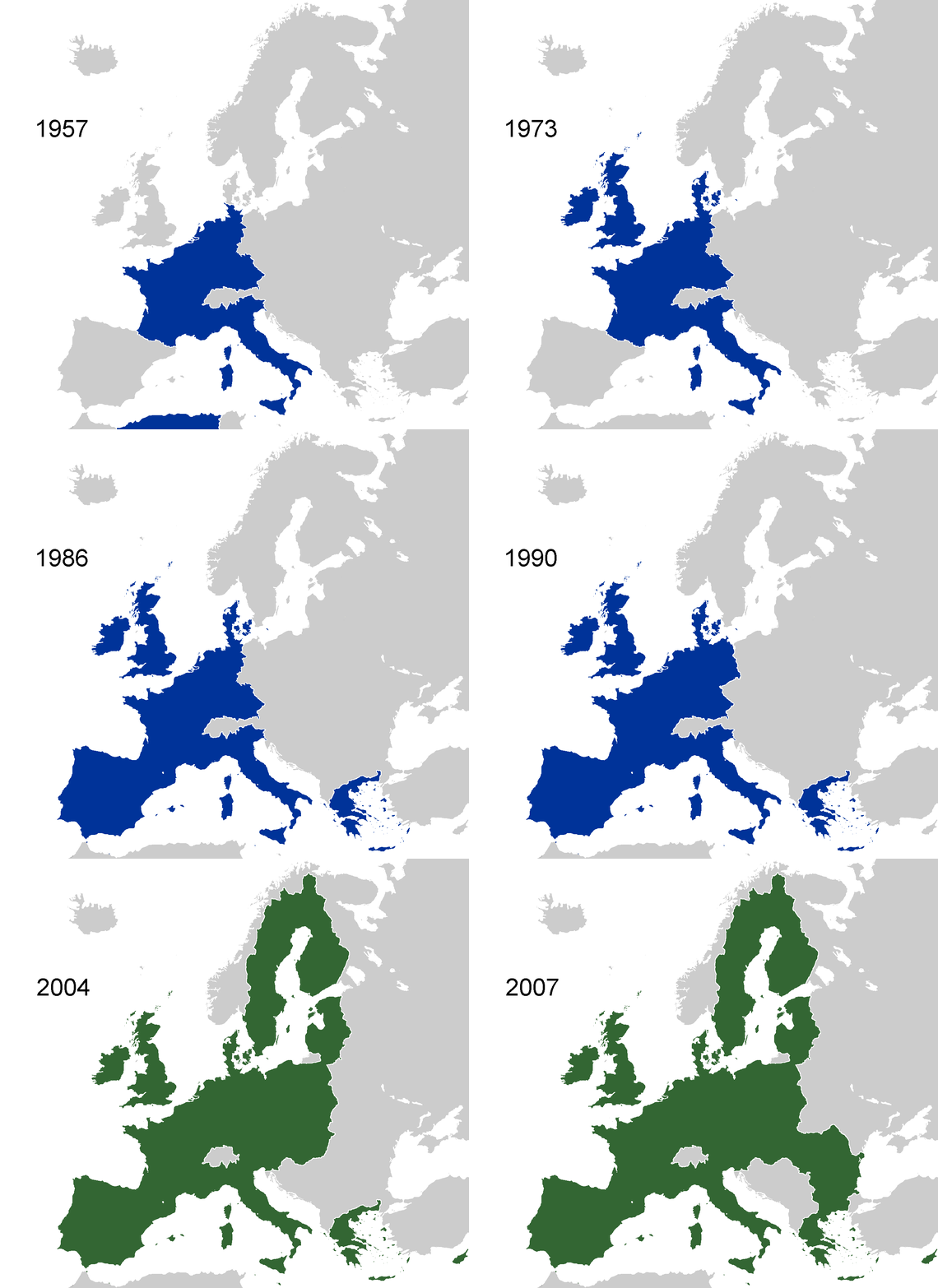
applied to join the community on 12 June 1975, following the restoration of democracy, and joined on 1 January 1981. Following on from Greece, and after their own democratic restoration, Spain and Portugal applied to the communities in 1977 and joined together on 1 January 1986. In 1987 Turkey
formally applied to join the Community and began the longest application process for any country.
With the prospect of further enlargement, and a desire to increase areas of co-operation, the Single European Act
was signed by the foreign ministers on the 17 and 28 February 1986 in Luxembourg
and the Hague respectively. In a single document it dealt with reform of institutions, extension of powers, foreign policy cooperation and the single market. It came into force on 1 July 1987. The act was influenced by work on what would be the Maastricht Treaty
, which was agreed on 10 December 1991, signed the following year and coming into force on 1 November 1993 establishing the EU.
. The EEC's areas of activities were enlarged and were renamed the European Community, continuing to follow the supranational structure of the EEC. The EEC institutions became those of the EU, however the Court, Parliament and Commission had only limited input in the new pillars, as they worked on a more intergovernmental system than the European Communities. This is reflected in the names of the institutions, the Council is formally the "Council of the European Union" while the Commission is formally the "Commission of the European Communities".
However, after the Treaty of Maastricht, Parliament gained a much bigger role. Maastricht brought in the codecision procedure, which gave it equal legislative power with the Council on Community matters. Hence, with the greater powers of the supranational institutions and the operation of Qualified Majority Voting in the Council, the Community pillar could be described as a far more federal
method of decision making.
The Treaty of Amsterdam transferred responsibility for free movement of persons (e.g. visas
, illegal immigration
, asylum
) from the Justice and Home Affairs (JHA) pillar to the European Community (JHA was renamed Police and Judicial Co-operation in Criminal Matters
(PJCC) as a result). Both Amsterdam and the Treaty of Nice
also extended codecision procedure to nearly all policy areas, giving Parliament equal power to the Council in the Community.
In 2002, the Treaty of Paris
which established the ECSC expired, having reached its 50 year limit (as the first treaty, it was the only one with a limit). No attempt was made to renew its mandate; instead, the Treaty of Nice
transferred certain of its elements to the Treaty of Rome
and hence its work continued as part of the EC area of the European Community's remit.
After the entry into force of the Treaty of Lisbon
in 2009 the pillar structure ceased to exist. The European Community, together with its legal personality, was transferred to the newly consolidated European Union which merged in the other two pillars (however Euratom remained distinct). This was originally proposed under the European Constitution
but that treaty failed ratification in 2005.
For the customs union, the treaty provided for a 10% reduction in custom duties and up to 20% of global import quotas. Progress on the customs union proceeded much faster than the twelve years planned. However, France faced some setbacks due to their war with Algeria.
" (the "outer seven" were those countries who formed the European Free Trade Association
). The six were France, West Germany, Italy and the three Benelux
countries: Belgium, the Netherlands and Luxembourg
. The first enlargement was in 1973, with the accession of Denmark, Ireland and the United Kingdom. Greece, Spain and Portugal joined throughout in the 1980s. Following the creation of the EU in 1993, it has enlarged to include a further fifteen countries by 2007.
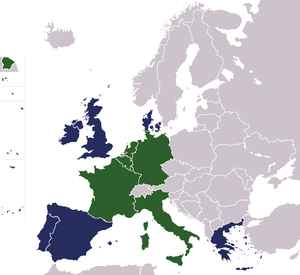
Member states are represented in some form in each institution. The Council
is also composed of one national minister who represents their national government
. Each state also has a right to one European Commissioner
each, although in the European Commission
they are not supposed to represent their national interest but that of the Community. Prior to 2004, the larger members (France, Germany, Italy and the United Kingdom) have had two Commissioners. In the European Parliament
, members are allocated a set number seats
related to their population, however these (since 1979
) have been directly elected and they sit according to political allegiance, not national origin. Most other institutions, including the European Court of Justice
, have some form of national division of its members.
in use). The Commission's duty is to ensure it is implemented by dealing with the day-to-day running of the Union and taking others to Court if they fail to comply. After the Maastricht treaty in 1993, these institutions became those of the European Union, though limited in some areas due to the pillar structure. Despite this, Parliament in particular has gained more power over legislation and security of the Commission. The Court was the highest authority in the law, settling legal disputes in the Community, while the Auditors had no power but to investigate.
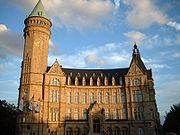 The EEC inherited some of the Institutions of the ECSC in that the Common Assembly
and Court of Justice
of the ECSC had their authority extended to the EEC and Euratom in the same role. However the EEC, and Euratom, had different executive bodies to the ECSC. In place of the ECSC's Council of Ministers was the Council of the European Economic Community
, and in place of the High Authority
was the Commission of the European Communities
.
There was greater difference between these than name: the French government of the day had grown suspicious of the supranational power of the High Authority and sought to curb its powers in favour of the intergovernmental style Council. Hence the Council had a greater executive role in the running of the Community than was the situation in the EEC. By virtue of the Merger Treaty
in 1967, the executives of the ECSC and Euratom were merged with that of the EEC, creating a single institutional structure governing the three separate Communities. From here on, the term European Communities were used for the institutions (for example, from Commission of the European Economic Community to the Commission of the European Communities.
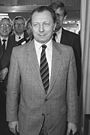 The Council of the European Communities
was a body holding legislative and executive powers and was thus the main decision making body of the Community. Its Presidency
rotated between the states every six months and it is related to the European Council
, which was an informal gather of national leaders (started in 1961) on the same basis as the Council.
The Council was composed of one national ministers
from each state. However the Council meets in various forms depending upon the topic. For example, if agriculture was being discussed, the Council would be composed of each national minister for agriculture. They represented their governments and were accountable to their national political systems. Votes were taken either by majority (with votes allocated according to population) or unanimity. In these various forms they share some legislative and budgetary power of the Parliament. Since the 1960s the Council also began to meet informally at the level of national leaders; these European summits
followed the same presidency system and secretariat as the Council but was not a formal formation of it.
was the executive arm
of the community, drafting Community law, dealing with the day to running of the Community and upholding the treaties
. It was designed to be independent, representing the Community interest, but was composed of national representatives (two from each of the larger states, one from the smaller states). One of its members was the President
, appointed by the Council, who chaired the body and represented it.
(formerly the European Parliamentary Assembly) had an advisory role to the Council and Commission. There were a number of Community legislative procedures
, at first there was only the consultation procedure, which meant Parliament had to be consulted, although it was often ignored. The Single European Act
gave Parliament more power, with the assent procedure
giving it a right to veto proposals and the cooperation procedure
giving it equal power with the Council if the Council was not unanimous.
In 1970 and 1975, the Budgetary treaties
gave Parliament power over the Community budget. The Parliament's members, up-until 1979 were national MPs serving part time in the Parliament. The Treaties of Rome had required elections to be held once the Council had decided on a voting system, but this did not happen and elections were delayed until 1979 (see European Parliament election, 1979
). After that, Parliament was elected every five years.
was the highest court
of on matters of Community law and was composed of one judge per state with a President elected from among them. Its role was to ensure that Community law was applied in the same way across all states and to settle legal disputes between institutions or states. It became a powerful institution as Community law overrides national law.
, which despite its name had no judicial powers like the Court of Justice. Instead, it ensured that taxpayer funds from the Community budget have been correctly spent. The court provided an audit report for each financial year to the Council and Parliament and gives opinions and proposals on financial legislation and anti-fraud actions. It is the only institution not mentioned in the original treaties, having been set up in 1975.
English-speaking world
The English-speaking world consists of those countries or regions that use the English language to one degree or another. For more information, please see:Lists:* List of countries by English-speaking population...
, renamed the European Community (EC) in 1993The information in this article primarily covers the EEC's time as an independent organisation. Post 1993 most of the European Community's activities are dominated by the European Union
European Union
The European Union is an economic and political union of 27 independent member states which are located primarily in Europe. The EU traces its origins from the European Coal and Steel Community and the European Economic Community , formed by six countries in 1958...
or the European Communities
European Communities
The European Communities were three international organisations that were governed by the same set of institutions...
pillar specifically. Please see those articles for details post 1993. Likewise, the infobox deals with the EEC as an independent organisation, rather than both the EEC and the pillar.) was an international organisation created with a view to bring about economic integration (including a single market
Single market
A single market is a type of trade bloc which is composed of a free trade area with common policies on product regulation, and freedom of movement of the factors of production and of enterprise and services. The goal is that the movement of capital, labour, goods, and services between the members...
) among the Inner Six
Inner Six
The Inner Six, or simply The Six, are the six founding member states of the European Communities. This was in contrast to the outer seven who formed the European Free Trade Association rather than be involved in supranational European integration .-History:The inner six are those who responded to...
of European integration
European integration
European integration is the process of industrial, political, legal, economic integration of states wholly or partially in Europe...
: Belgium
Belgium
Belgium , officially the Kingdom of Belgium, is a federal state in Western Europe. It is a founding member of the European Union and hosts the EU's headquarters, and those of several other major international organisations such as NATO.Belgium is also a member of, or affiliated to, many...
, France
France
The French Republic , The French Republic , The French Republic , (commonly known as France , is a unitary semi-presidential republic in Western Europe with several overseas territories and islands located on other continents and in the Indian, Pacific, and Atlantic oceans. Metropolitan France...
, Germany
Germany
Germany , officially the Federal Republic of Germany , is a federal parliamentary republic in Europe. The country consists of 16 states while the capital and largest city is Berlin. Germany covers an area of 357,021 km2 and has a largely temperate seasonal climate...
, Italy
Italy
Italy , officially the Italian Republic languages]] under the European Charter for Regional or Minority Languages. In each of these, Italy's official name is as follows:;;;;;;;;), is a unitary parliamentary republic in South-Central Europe. To the north it borders France, Switzerland, Austria and...
, Luxembourg
Luxembourg
Luxembourg , officially the Grand Duchy of Luxembourg , is a landlocked country in western Europe, bordered by Belgium, France, and Germany. It has two principal regions: the Oesling in the North as part of the Ardennes massif, and the Gutland in the south...
and the Netherlands
Netherlands
The Netherlands is a constituent country of the Kingdom of the Netherlands, located mainly in North-West Europe and with several islands in the Caribbean. Mainland Netherlands borders the North Sea to the north and west, Belgium to the south, and Germany to the east, and shares maritime borders...
.
The EEC was created by the Treaty establishing the European Economic Community
Treaty of Rome
The Treaty of Rome, officially the Treaty establishing the European Economic Community, was an international agreement that led to the founding of the European Economic Community on 1 January 1958. It was signed on 25 March 1957 by Belgium, France, Italy, Luxembourg, the Netherlands and West Germany...
(Treaty of Rome
Treaty of Rome
The Treaty of Rome, officially the Treaty establishing the European Economic Community, was an international agreement that led to the founding of the European Economic Community on 1 January 1958. It was signed on 25 March 1957 by Belgium, France, Italy, Luxembourg, the Netherlands and West Germany...
; renamed Treaty on the functioning of the European Union in 2009) of 1957. It gained a common set of institutions
Institutions of the European Union
The European Union is governed by seven institutions. Article 13 of Treaty on European Union lists them in the following order: the European Parliament, the European Council, the Council of the European Union, the European Commission, the Court of Justice of the European Union, the European...
along with the European Coal and Steel Community
European Coal and Steel Community
The European Coal and Steel Community was a six-nation international organisation serving to unify Western Europe during the Cold War and create the foundation for the modern-day developments of the European Union...
(ECSC) and the European Atomic Energy Community
European Atomic Energy Community
The European Atomic Energy Community is an international organisation which is legally distinct from the European Union , but has the same membership, and is governed by the EU's institutions....
(EURATOM) (collectively, the European Communities
European Communities
The European Communities were three international organisations that were governed by the same set of institutions...
) under the 1965 Merger Treaty
Merger Treaty
The Merger Treaty was a European treaty which combined the executive bodies of the European Coal and Steel Community , European Atomic Energy Community and the European Economic Community into a single institutional structure.The treaty was signed in Brussels on 8 April 1965 and came into force...
(Treaty of Brussels). With the entry into force of the Treaty on European Union
Maastricht Treaty
The Maastricht Treaty was signed on 7 February 1992 by the members of the European Community in Maastricht, Netherlands. On 9–10 December 1991, the same city hosted the European Council which drafted the treaty...
(Treaty of Maastricht) in 1993, the organisation changed its name from the European Economic Community to the European Community (reflecting the increasing scope of European integration), and was along with the other aforementioned European Communities
European Communities
The European Communities were three international organisations that were governed by the same set of institutions...
made to comprise the first of the three pillars
Three pillars of the European Union
Between 1993 and 2009, the European Union legally consisted of three pillars. This structure was introduced with the Treaty of Maastricht on 1 November 1993, and was eventually abandoned on 1 December 2009 with the entry into force of the Treaty of Lisbon, when the EU obtained a consolidated legal...
of the new European Union
European Union
The European Union is an economic and political union of 27 independent member states which are located primarily in Europe. The EU traces its origins from the European Coal and Steel Community and the European Economic Community , formed by six countries in 1958...
(EU). The entire pillar division, and the EC along with it, were abolished upon the entry into force of the Treaty of Lisbon
Treaty of Lisbon
The Treaty of Lisbon of 1668 was a peace treaty between Portugal and Spain, concluded at Lisbon on 13 February 1668, through the mediation of England, in which Spain recognized the sovereignty of Portugal's new ruling dynasty, the House of Braganza....
in 2009. The legal personality
Legal personality
Legal personality is the characteristic of a non-human entity regarded by law to have the status of a person....
of the EC was at this point transferred to the EU as a whole, a change in line with the Lisbon Treaty's wider aim of consolidating the legal nature of the Union.
Background
In 1951, the Treaty of ParisTreaty of Paris (1951)
The Treaty of Paris was signed on 18 April 1951 between France, West Germany, Italy and the three Benelux countries , establishing the European Coal and Steel Community , which subsequently became part of the European Union...
was signed, creating the European Coal and Steel Community
European Coal and Steel Community
The European Coal and Steel Community was a six-nation international organisation serving to unify Western Europe during the Cold War and create the foundation for the modern-day developments of the European Union...
(ECSC). This was an international community based on supranationalism and international law, designed to help the economy of Europe
Economy of the European Union
The economy of the European Union generates a GDP of over €12,279.033 billion according to the International Monetary Fund , making it the largest economy in the world...
and prevent future war by integrating
European integration
European integration is the process of industrial, political, legal, economic integration of states wholly or partially in Europe...
its members.
In the aim of creating a federal Europe two further communities were proposed: a European Defence Community
European Defence Community
The European Defense Community was a plan proposed in 1950 by René Pleven, the French President of the Council , in response to the American call for the rearmament of West Germany...
(EDC) and a European Political Community
European Political Community
The European Political Community was proposed in 1952 as a combination of the existing European Coal and Steel Community and the proposed European Defence Community...
(EPC). While the treaty for the latter was being drawn up by the Common Assembly
European Parliament
The European Parliament is the directly elected parliamentary institution of the European Union . Together with the Council of the European Union and the Commission, it exercises the legislative function of the EU and it has been described as one of the most powerful legislatures in the world...
, the ECSC parliamentary chamber, the EDC was rejected by the French Parliament. President
President of the European Commission
The President of the European Commission is the head of the European Commission ― the executive branch of the :European Union ― the most powerful officeholder in the EU. The President is responsible for allocating portfolios to members of the Commission and can reshuffle or dismiss them if needed...
Jean Monnet
Jean Monnet
Jean Omer Marie Gabriel Monnet was a French political economist and diplomat. He is regarded by many as a chief architect of European Unity and is regarded as one of its founding fathers...
, a leading figure behind the communities, resigned from the High Authority in protest and began work on alternative communities, based on economic integration rather than political integration. After the Messina Conference
Messina Conference
The Messina Conference was held from 1 to 3 June 1955 at the Italian city of Messina, Sicily. The conference of the Foreign Ministers of the six Member States of the European Coal and Steel Community would lead to the creation of the European Economic Community in 1958...
in 1955, Paul Henri Spaak was given the task to prepare a report on the idea of a customs union
Customs union
A customs union is a type of trade bloc which is composed of a free trade area with a common external tariff. The participant countries set up common external trade policy, but in some cases they use different import quotas...
. The so-called Spaak Report
Spaak Report
The Spaak report or Brussels Report on the General Common Market, was the report drafted by the Spaak Committee in 1956. The Intergovernmental Committee, headed by Paul-Henri Spaak presented its definitive report on 21 April 1956 to the six Governments of the Member States of the European Coal and...
of the Spaak Committee
Spaak Committee
The Spaak Committee was an Intergovernmental Committee set up by the Foreign Ministers of the six Member States of the European Coal and Steel Community as a result of the Messina Conference of 1955. The Spaak Committee started its work on 9 July 1955 and ended on 20 April 1956, when the Heads of...
formed the cornerstone of the intergovernmental negotiations at Val Duchesse castle in 1956. Together with the Ohlin Report
Ohlin Report
The Ohlin Report was a report drafted by a group of experts of the International Labour Organization led by Bertil Ohlin in 1956. Together with the Spaak Report it provided the basis for the Treaty of Rome on the common market in 1957 and the creation of the European Economic Community in...
the Spaak Report would provide the basis for the Treaty of Rome
Treaty of Rome
The Treaty of Rome, officially the Treaty establishing the European Economic Community, was an international agreement that led to the founding of the European Economic Community on 1 January 1958. It was signed on 25 March 1957 by Belgium, France, Italy, Luxembourg, the Netherlands and West Germany...
.
In 1956, Paul Henri Spaak led the Intergovernmental Conference on the Common Market and Euratom
Intergovernmental Conference on the Common Market and Euratom
The Intergovernmental Conference on the Common Market and Euratom was held in Brussels and started on 26 June 1956 with a session in the Grand Salon of the Belgian Foreign Ministry. The negotiations went on at the Castle of the Valley of the Duchess in Auderghem and would continue until March 1957...
at the Val Duchesse
Castle of the Valley of the Duchess
The Castle of Val-Duchesse is a former priory situated in the municipality of Auderghem in the Brussels Capital Region of Belgium. The castle is owned by the Belgian Royal Trust....
castle, which prepared for the Treaty of Rome
Treaty of Rome
The Treaty of Rome, officially the Treaty establishing the European Economic Community, was an international agreement that led to the founding of the European Economic Community on 1 January 1958. It was signed on 25 March 1957 by Belgium, France, Italy, Luxembourg, the Netherlands and West Germany...
in 1957. The conference led to the signature, on 25 March 1957, of the Treaty of Rome
Treaty of Rome
The Treaty of Rome, officially the Treaty establishing the European Economic Community, was an international agreement that led to the founding of the European Economic Community on 1 January 1958. It was signed on 25 March 1957 by Belgium, France, Italy, Luxembourg, the Netherlands and West Germany...
establishing a European Economic Community.
Creation and early years
The resulting communities were the European Economic Community (EEC) and the European Atomic Energy Community (EAEC or Euratom). These were markedly less supranational than the previous communities, due to protests from some countries that their sovereigntySovereignty
Sovereignty is the quality of having supreme, independent authority over a geographic area, such as a territory. It can be found in a power to rule and make law that rests on a political fact for which no purely legal explanation can be provided...
was being infringed (however there would still be concerns with the behaviour of the Hallstein Commission
Hallstein Commission
The Hallstein Commission is the European Commission that held office from 7 January 1958 to 30 June 1967. Its President was Walter Hallstein and held two separate mandates.-Work:...
). The first formal meeting of the Hallstein Commission
Hallstein Commission
The Hallstein Commission is the European Commission that held office from 7 January 1958 to 30 June 1967. Its President was Walter Hallstein and held two separate mandates.-Work:...
, was held on 16 January 1958 at the Castle of the Valley of the Duchess
Castle of the Valley of the Duchess
The Castle of Val-Duchesse is a former priory situated in the municipality of Auderghem in the Brussels Capital Region of Belgium. The castle is owned by the Belgian Royal Trust....
. The EEC (direct ancestor of the modern Community) was to create a customs union
Customs union
A customs union is a type of trade bloc which is composed of a free trade area with a common external tariff. The participant countries set up common external trade policy, but in some cases they use different import quotas...
while Euratom would promote co-operation in the nuclear power
Nuclear power
Nuclear power is the use of sustained nuclear fission to generate heat and electricity. Nuclear power plants provide about 6% of the world's energy and 13–14% of the world's electricity, with the U.S., France, and Japan together accounting for about 50% of nuclear generated electricity...
sphere. The EEC rapidly became the most important of these and expanded its activities. One of the first important accomplishments of the EEC was the establishment (1962) of common price levels for agricultural products. In 1968, internal tariffs (tariffs on trade between member nations) were removed on certain products.
Another crisis was triggered in regard to proposals for the financing of the Common Agricultural Policy, which came into force in 1962. The transitional period whereby decisions were made by unanimity had come to an end, and majority-voting in the Council had taken effect. Then-French President Charles de Gaulle
Charles de Gaulle
Charles André Joseph Marie de Gaulle was a French general and statesman who led the Free French Forces during World War II. He later founded the French Fifth Republic in 1958 and served as its first President from 1959 to 1969....
's opposition to supranationalism and fear of the other members challenging the CAP led to an "empty chair policy" where by French representatives were withdrawn from the European institutions until the French veto was reinstated. Eventually, a compromise was reached with the Luxembourg compromise
Luxembourg compromise
The Luxembourg compromise or Luxembourg Accords was an agreement reached in January 1966 which resolved differences within the European Economic Community....
on 29 January 1966 whereby a gentlemen's agreement
Gentlemen's agreement
A gentlemen's agreement is an informal agreement between two or more parties. It may be written, oral, or simply understood as part of an unspoken agreement by convention or through mutually beneficial etiquette. The essence of a gentlemen's agreement is that it relies upon the honor of the parties...
permitted members to use a veto on areas of national interest.
On 1 July 1967 when the Merger Treaty
Merger Treaty
The Merger Treaty was a European treaty which combined the executive bodies of the European Coal and Steel Community , European Atomic Energy Community and the European Economic Community into a single institutional structure.The treaty was signed in Brussels on 8 April 1965 and came into force...
came into operation, combining the institutions of the ECSC and Euratom into that of the EEC, they already shared a Parliamentary Assembly
European Parliament
The European Parliament is the directly elected parliamentary institution of the European Union . Together with the Council of the European Union and the Commission, it exercises the legislative function of the EU and it has been described as one of the most powerful legislatures in the world...
and Courts
European Court of Justice
The Court can sit in plenary session, as a Grand Chamber of 13 judges, or in chambers of three or five judges. Plenary sitting are now very rare, and the court mostly sits in chambers of three or five judges...
. Collectively they were known as the European Communities
European Communities
The European Communities were three international organisations that were governed by the same set of institutions...
. The Communities still had independent personalities although were increasingly integrated. Future treaties granted the community new powers beyond simple economic matters which had achieved a high level of integration. As it got closer to the goal of political integration and a peaceful and united Europe, what Mikhail Gorbachev
Mikhail Gorbachev
Mikhail Sergeyevich Gorbachev is a former Soviet statesman, having served as General Secretary of the Communist Party of the Soviet Union from 1985 until 1991, and as the last head of state of the USSR, having served from 1988 until its dissolution in 1991...
described as a Common European Home
Common European Home
The "Common European Home" was a concept created and espoused by former Soviet President Mikhail Gorbachev.The concept has some antecedents in Brezhnev's foreign policy, who used the phrase during a visit to Bonn in 1981. However, at this time it was likely used in an attempt to sow discord...
.
Enlargement and elections
Enlargement of the European Union
The Enlargement of the European Union is the process of expanding the European Union through the accession of new member states. This process began with the Inner Six, who founded the European Coal and Steel Community in 1952...
. On 3 May 1960 Denmark, Ireland, Norway and the United Kingdom applied to join the three Communities. However, President Charles de Gaulle saw British membership as a Trojan horse
Trojan Horse
The Trojan Horse is a tale from the Trojan War about the stratagem that allowed the Greeks finally to enter the city of Troy and end the conflict. In the canonical version, after a fruitless 10-year siege, the Greeks constructed a huge wooden horse, and hid a select force of men inside...
for US influence and vetoed membership, and the applications of all four countries were suspended.
The four countries resubmitted their applications on 11 May 1967 and with Georges Pompidou
Georges Pompidou
Georges Jean Raymond Pompidou was a French politician. He was Prime Minister of France from 1962 to 1968, holding the longest tenure in this position, and later President of the French Republic from 1969 until his death in 1974.-Biography:...
succeeding Charles de Gaulle as French President in 1969, the veto was lifted. Negotiations began in 1970 under the pro-European government of Edward Heath
Edward Heath
Sir Edward Richard George "Ted" Heath, KG, MBE, PC was a British Conservative politician who served as Prime Minister of the United Kingdom and as Leader of the Conservative Party ....
, who had to deal with disagreements relating to the Common Agricultural Policy
Common Agricultural Policy
The Common Agricultural Policy is a system of European Union agricultural subsidies and programmes. It represents 48% of the EU's budget, €49.8 billion in 2006 ....
and the UK's relationship with the Commonwealth of Nations
Commonwealth of Nations
The Commonwealth of Nations, normally referred to as the Commonwealth and formerly known as the British Commonwealth, is an intergovernmental organisation of fifty-four independent member states...
. Nevertheless, two years later the accession treaties were signed and all but Norway acceded to the Community (Norway rejected membership
Norway and the European Union
Norway is not a member state of the European Union , but is closely associated with the Union through its membership in the European Economic Area , in the context of being a European Free Trade Association member.-Trade:...
in a referendum
Referendum
A referendum is a direct vote in which an entire electorate is asked to either accept or reject a particular proposal. This may result in the adoption of a new constitution, a constitutional amendment, a law, the recall of an elected official or simply a specific government policy. It is a form of...
).
The Treaties of Rome had stated that the European Parliament
European Parliament
The European Parliament is the directly elected parliamentary institution of the European Union . Together with the Council of the European Union and the Commission, it exercises the legislative function of the EU and it has been described as one of the most powerful legislatures in the world...
must be directly elected, however this required the Council
Council of the European Union
The Council of the European Union is the institution in the legislature of the European Union representing the executives of member states, the other legislative body being the European Parliament. The Council is composed of twenty-seven national ministers...
to agree on a common voting system first. The Council procrastinated on the issue and the Parliament remained appointed, French President Charles de Gaulle was particularly active in blocking the development of the Parliament, with it only being granted Budgetary powers
Budgetary treaties of the European Communities
The Budgetary treaties of the European Communities were two treaties in the 1970s amending the Treaty of Rome in respects to powers over the Community budget....
following his resignation.
Parliament pressured for agreement and on 20 September 1976 the Council agreed part of the necessary instruments for election, deferring details on electoral systems which remain varied to this day. During the tenure of President Jenkins
Roy Jenkins
Roy Harris Jenkins, Baron Jenkins of Hillhead OM, PC was a British politician.The son of a Welsh coal miner who later became a union official and Labour MP, Roy Jenkins served with distinction in World War II. Elected to Parliament as a Labour member in 1948, he served in several major posts in...
, in June 1979, the elections were held in all the then-members (see European Parliament election, 1979
European Parliament election, 1979
The 1979 European elections were parliamentary elections held across all 9 European Community member states. They were the first European elections to be held, allowing citizens to elect 410 MEPs to the European Parliament, and also the first international election in history.Seats in the...
). The new Parliament, galvanised by direct election and new powers, started working full time and became more active than the previous assemblies.
Shortly after its election, Parliament became the first Community institution to propose that the Community adopt the Flag of Europe. The European Council
European Council
The European Council is an institution of the European Union. It comprises the heads of state or government of the EU member states, along with the President of the European Commission and the President of the European Council, currently Herman Van Rompuy...
agreed to this and adopted the Symbols of Europe as those of the Community in 1984. The European Council, or European summit, had developed since the 1960s as an informal meeting of the Council at the level of heads of state. It had originated from then-French President Charles de Gaulle
Charles de Gaulle
Charles André Joseph Marie de Gaulle was a French general and statesman who led the Free French Forces during World War II. He later founded the French Fifth Republic in 1958 and served as its first President from 1959 to 1969....
's resentment at the domination of supranational institutions (e.g. the Commission) over the integration process. It was mentioned in the treaties for the first time in the Single European Act
Single European Act
The Single European Act was the first major revision of the 1957 Treaty of Rome. The Act set the European Community an objective of establishing a Single Market by 31 December 1992, and codified European Political Cooperation, the forerunner of the European Union's Common Foreign and Security Policy...
(see below).
Towards Maastricht
GreeceGreece
Greece , officially the Hellenic Republic , and historically Hellas or the Republic of Greece in English, is a country in southeastern Europe....
applied to join the community on 12 June 1975, following the restoration of democracy, and joined on 1 January 1981. Following on from Greece, and after their own democratic restoration, Spain and Portugal applied to the communities in 1977 and joined together on 1 January 1986. In 1987 Turkey
Turkey
Turkey , known officially as the Republic of Turkey , is a Eurasian country located in Western Asia and in East Thrace in Southeastern Europe...
formally applied to join the Community and began the longest application process for any country.
With the prospect of further enlargement, and a desire to increase areas of co-operation, the Single European Act
Single European Act
The Single European Act was the first major revision of the 1957 Treaty of Rome. The Act set the European Community an objective of establishing a Single Market by 31 December 1992, and codified European Political Cooperation, the forerunner of the European Union's Common Foreign and Security Policy...
was signed by the foreign ministers on the 17 and 28 February 1986 in Luxembourg
Luxembourg (city)
The city of Luxembourg , also known as Luxembourg City , is a commune with city status, and the capital of the Grand Duchy of Luxembourg. It is located at the confluence of the Alzette and Pétrusse Rivers in southern Luxembourg...
and the Hague respectively. In a single document it dealt with reform of institutions, extension of powers, foreign policy cooperation and the single market. It came into force on 1 July 1987. The act was influenced by work on what would be the Maastricht Treaty
Maastricht Treaty
The Maastricht Treaty was signed on 7 February 1992 by the members of the European Community in Maastricht, Netherlands. On 9–10 December 1991, the same city hosted the European Council which drafted the treaty...
, which was agreed on 10 December 1991, signed the following year and coming into force on 1 November 1993 establishing the EU.
European Community
The EU absorbed the European Communities as one of its three pillarsThree pillars of the European Union
Between 1993 and 2009, the European Union legally consisted of three pillars. This structure was introduced with the Treaty of Maastricht on 1 November 1993, and was eventually abandoned on 1 December 2009 with the entry into force of the Treaty of Lisbon, when the EU obtained a consolidated legal...
. The EEC's areas of activities were enlarged and were renamed the European Community, continuing to follow the supranational structure of the EEC. The EEC institutions became those of the EU, however the Court, Parliament and Commission had only limited input in the new pillars, as they worked on a more intergovernmental system than the European Communities. This is reflected in the names of the institutions, the Council is formally the "Council of the European Union" while the Commission is formally the "Commission of the European Communities".
However, after the Treaty of Maastricht, Parliament gained a much bigger role. Maastricht brought in the codecision procedure, which gave it equal legislative power with the Council on Community matters. Hence, with the greater powers of the supranational institutions and the operation of Qualified Majority Voting in the Council, the Community pillar could be described as a far more federal
Federalism
Federalism is a political concept in which a group of members are bound together by covenant with a governing representative head. The term "federalism" is also used to describe a system of the government in which sovereignty is constitutionally divided between a central governing authority and...
method of decision making.
The Treaty of Amsterdam transferred responsibility for free movement of persons (e.g. visas
Visa (document)
A visa is a document showing that a person is authorized to enter the territory for which it was issued, subject to permission of an immigration official at the time of actual entry. The authorization may be a document, but more commonly it is a stamp endorsed in the applicant's passport...
, illegal immigration
Illegal immigration
Illegal immigration is the migration into a nation in violation of the immigration laws of that jurisdiction. Illegal immigration raises many political, economical and social issues and has become a source of major controversy in developed countries and the more successful developing countries.In...
, asylum
Right of asylum
Right of asylum is an ancient juridical notion, under which a person persecuted for political opinions or religious beliefs in his or her own country may be protected by another sovereign authority, a foreign country, or church sanctuaries...
) from the Justice and Home Affairs (JHA) pillar to the European Community (JHA was renamed Police and Judicial Co-operation in Criminal Matters
Police and Judicial Co-operation in Criminal Matters
The third of the three pillars of the European Union was Justice and Home Affairs , which was shrunk and renamed Police and Judicial Co-operation in Criminal Matters in 2003. The pillar existed between 1993 and 2009, when it was absorbed into a consolidated EU structure.The pillar focused on...
(PJCC) as a result). Both Amsterdam and the Treaty of Nice
Treaty of Nice
The Treaty of Nice was signed by European leaders on 26 February 2001 and came into force on 1 February 2003. It amended the Maastricht Treaty and the Treaty of Rome...
also extended codecision procedure to nearly all policy areas, giving Parliament equal power to the Council in the Community.
In 2002, the Treaty of Paris
Treaty of Paris (1951)
The Treaty of Paris was signed on 18 April 1951 between France, West Germany, Italy and the three Benelux countries , establishing the European Coal and Steel Community , which subsequently became part of the European Union...
which established the ECSC expired, having reached its 50 year limit (as the first treaty, it was the only one with a limit). No attempt was made to renew its mandate; instead, the Treaty of Nice
Treaty of Nice
The Treaty of Nice was signed by European leaders on 26 February 2001 and came into force on 1 February 2003. It amended the Maastricht Treaty and the Treaty of Rome...
transferred certain of its elements to the Treaty of Rome
Treaty of Rome
The Treaty of Rome, officially the Treaty establishing the European Economic Community, was an international agreement that led to the founding of the European Economic Community on 1 January 1958. It was signed on 25 March 1957 by Belgium, France, Italy, Luxembourg, the Netherlands and West Germany...
and hence its work continued as part of the EC area of the European Community's remit.
After the entry into force of the Treaty of Lisbon
Treaty of Lisbon
The Treaty of Lisbon of 1668 was a peace treaty between Portugal and Spain, concluded at Lisbon on 13 February 1668, through the mediation of England, in which Spain recognized the sovereignty of Portugal's new ruling dynasty, the House of Braganza....
in 2009 the pillar structure ceased to exist. The European Community, together with its legal personality, was transferred to the newly consolidated European Union which merged in the other two pillars (however Euratom remained distinct). This was originally proposed under the European Constitution
Treaty establishing a Constitution for Europe
The Treaty establishing a Constitution for Europe , , was an unratified international treaty intended to create a consolidated constitution for the European Union...
but that treaty failed ratification in 2005.
Aims and achievements
The main aim of the EEC, as stated in its preamble, was to "preserve peace and liberty and to lay the foundations of an ever closer union among the peoples of Europe". Calling for balanced economic growth, this was to be accomplished through:- The establishment of a customs unionCustoms unionA customs union is a type of trade bloc which is composed of a free trade area with a common external tariff. The participant countries set up common external trade policy, but in some cases they use different import quotas...
with a common external tariffCommon external tariffWhen a group of countries form a customs union they must introduce a common external tariff. The same customs duties, import quotas, preferences or other non-tariff barriers to trade apply to all goods entering the area, regardless of which country within the area they are entering... - Common policies for agricultureCommon Agricultural PolicyThe Common Agricultural Policy is a system of European Union agricultural subsidies and programmes. It represents 48% of the EU's budget, €49.8 billion in 2006 ....
, transport and trade - Enlargement of the EECEnlargement of the European UnionThe Enlargement of the European Union is the process of expanding the European Union through the accession of new member states. This process began with the Inner Six, who founded the European Coal and Steel Community in 1952...
to the rest of Europe
For the customs union, the treaty provided for a 10% reduction in custom duties and up to 20% of global import quotas. Progress on the customs union proceeded much faster than the twelve years planned. However, France faced some setbacks due to their war with Algeria.
Members
The six states that founded the EEC and the other two Communities were known as the "inner sixInner Six
The Inner Six, or simply The Six, are the six founding member states of the European Communities. This was in contrast to the outer seven who formed the European Free Trade Association rather than be involved in supranational European integration .-History:The inner six are those who responded to...
" (the "outer seven" were those countries who formed the European Free Trade Association
European Free Trade Association
The European Free Trade Association or EFTA is a free trade organisation between four European countries that operates parallel to, and is linked to, the European Union . EFTA was established on 3 May 1960 as a trade bloc-alternative for European states who were either unable to, or chose not to,...
). The six were France, West Germany, Italy and the three Benelux
Benelux
The Benelux is an economic union in Western Europe comprising three neighbouring countries, Belgium, the Netherlands, and Luxembourg. These countries are located in northwestern Europe between France and Germany...
countries: Belgium, the Netherlands and Luxembourg
Luxembourg
Luxembourg , officially the Grand Duchy of Luxembourg , is a landlocked country in western Europe, bordered by Belgium, France, and Germany. It has two principal regions: the Oesling in the North as part of the Ardennes massif, and the Gutland in the south...
. The first enlargement was in 1973, with the accession of Denmark, Ireland and the United Kingdom. Greece, Spain and Portugal joined throughout in the 1980s. Following the creation of the EU in 1993, it has enlarged to include a further fifteen countries by 2007.
| Flag | State Member State of the European Union A member state of the European Union is a state that is party to treaties of the European Union and has thereby undertaken the privileges and obligations that EU membership entails. Unlike membership of an international organisation, being an EU member state places a country under binding laws in... |
Accession | Language(s) | Currency | Population (1990) |
|---|---|---|---|---|---|
 Belgium Belgium |
Belgium Belgium Belgium , officially the Kingdom of Belgium, is a federal state in Western Europe. It is a founding member of the European Union and hosts the EU's headquarters, and those of several other major international organisations such as NATO.Belgium is also a member of, or affiliated to, many... |
Dutch Dutch language Dutch is a West Germanic language and the native language of the majority of the population of the Netherlands, Belgium, and Suriname, the three member states of the Dutch Language Union. Most speakers live in the European Union, where it is a first language for about 23 million and a second... , French French language French is a Romance language spoken as a first language in France, the Romandy region in Switzerland, Wallonia and Brussels in Belgium, Monaco, the regions of Quebec and Acadia in Canada, and by various communities elsewhere. Second-language speakers of French are distributed throughout many parts... and German German language German is a West Germanic language, related to and classified alongside English and Dutch. With an estimated 90 – 98 million native speakers, German is one of the world's major languages and is the most widely-spoken first language in the European Union.... |
Belgian franc Belgian franc The franc was the currency of Belgium until 2002 when the euro was introduced into circulation. It was subdivided into centimes , 100 centiem or Centime .-History:... |
10,016,000 | |
 Denmark Denmark |
Denmark Denmark Denmark is a Scandinavian country in Northern Europe. The countries of Denmark and Greenland, as well as the Faroe Islands, constitute the Kingdom of Denmark . It is the southernmost of the Nordic countries, southwest of Sweden and south of Norway, and bordered to the south by Germany. Denmark... |
Danish Danish language Danish is a North Germanic language spoken by around six million people, principally in the country of Denmark. It is also spoken by 50,000 Germans of Danish ethnicity in the northern parts of Schleswig-Holstein, Germany, where it holds the status of minority language... |
Danish krone Danish krone The krone is the official currency of the Kingdom of Denmark consisting of Denmark, the Faroe Islands and Greenland. It is subdivided into 100 øre... |
5,146,500 | |
 Early Modern France Early Modern France |
France France The French Republic , The French Republic , The French Republic , (commonly known as France , is a unitary semi-presidential republic in Western Europe with several overseas territories and islands located on other continents and in the Indian, Pacific, and Atlantic oceans. Metropolitan France... |
French French language French is a Romance language spoken as a first language in France, the Romandy region in Switzerland, Wallonia and Brussels in Belgium, Monaco, the regions of Quebec and Acadia in Canada, and by various communities elsewhere. Second-language speakers of French are distributed throughout many parts... |
French franc French franc The franc was a currency of France. Along with the Spanish peseta, it was also a de facto currency used in Andorra . Between 1360 and 1641, it was the name of coins worth 1 livre tournois and it remained in common parlance as a term for this amount of money... |
56,718,000 | |
 West Germany West Germany |
West Germany West Germany West Germany is the common English, but not official, name for the Federal Republic of Germany or FRG in the period between its creation in May 1949 to German reunification on 3 October 1990.... |
German German language German is a West Germanic language, related to and classified alongside English and Dutch. With an estimated 90 – 98 million native speakers, German is one of the world's major languages and is the most widely-spoken first language in the European Union.... |
German mark | 63,254,000 | |
 Greece Greece |
Greece Greece Greece , officially the Hellenic Republic , and historically Hellas or the Republic of Greece in English, is a country in southeastern Europe.... |
Greek Greek language Greek is an independent branch of the Indo-European family of languages. Native to the southern Balkans, it has the longest documented history of any Indo-European language, spanning 34 centuries of written records. Its writing system has been the Greek alphabet for the majority of its history;... |
Greek drachma Greek drachma Drachma, pl. drachmas or drachmae was the currency used in Greece during several periods in its history:... |
10,120,000 | |
 Republic of Ireland Republic of Ireland |
Ireland Republic of Ireland Ireland , described as the Republic of Ireland , is a sovereign state in Europe occupying approximately five-sixths of the island of the same name. Its capital is Dublin. Ireland, which had a population of 4.58 million in 2011, is a constitutional republic governed as a parliamentary democracy,... |
Irish Irish language Irish , also known as Irish Gaelic, is a Goidelic language of the Indo-European language family, originating in Ireland and historically spoken by the Irish people. Irish is now spoken as a first language by a minority of Irish people, as well as being a second language of a larger proportion of... and English English language English is a West Germanic language that arose in the Anglo-Saxon kingdoms of England and spread into what was to become south-east Scotland under the influence of the Anglian medieval kingdom of Northumbria... |
Irish pound Irish pound The Irish pound was the currency of Ireland until 2002. Its ISO 4217 code was IEP, and the usual notation was the prefix £... |
3,521,000 | |
 Italy Italy |
Italy Italy Italy , officially the Italian Republic languages]] under the European Charter for Regional or Minority Languages. In each of these, Italy's official name is as follows:;;;;;;;;), is a unitary parliamentary republic in South-Central Europe. To the north it borders France, Switzerland, Austria and... |
Italian Italian language Italian is a Romance language spoken mainly in Europe: Italy, Switzerland, San Marino, Vatican City, by minorities in Malta, Monaco, Croatia, Slovenia, France, Libya, Eritrea, and Somalia, and by immigrant communities in the Americas and Australia... |
Italian lira Italian lira The lira was the currency of Italy between 1861 and 2002. Between 1999 and 2002, the Italian lira was officially a “national subunit” of the euro... |
56,762,700 | |
 Luxembourg Luxembourg |
Luxembourg Luxembourg Luxembourg , officially the Grand Duchy of Luxembourg , is a landlocked country in western Europe, bordered by Belgium, France, and Germany. It has two principal regions: the Oesling in the North as part of the Ardennes massif, and the Gutland in the south... |
French French language French is a Romance language spoken as a first language in France, the Romandy region in Switzerland, Wallonia and Brussels in Belgium, Monaco, the regions of Quebec and Acadia in Canada, and by various communities elsewhere. Second-language speakers of French are distributed throughout many parts... , German German language German is a West Germanic language, related to and classified alongside English and Dutch. With an estimated 90 – 98 million native speakers, German is one of the world's major languages and is the most widely-spoken first language in the European Union.... and Luxembourgish Luxembourgish language Luxembourgish is a High German language spoken mainly in Luxembourg. About 320,000 people worldwide speak Luxembourgish.-Language family:... |
Luxembourgish franc Luxembourgish franc The Luxembourgish franc was the currency of Luxembourg between 1854 and 1999 . The franc remained in circulation until 2002, when it was replaced by the euro... |
384,400 | |
 Netherlands Netherlands |
Netherlands Netherlands The Netherlands is a constituent country of the Kingdom of the Netherlands, located mainly in North-West Europe and with several islands in the Caribbean. Mainland Netherlands borders the North Sea to the north and west, Belgium to the south, and Germany to the east, and shares maritime borders... |
Dutch Dutch language Dutch is a West Germanic language and the native language of the majority of the population of the Netherlands, Belgium, and Suriname, the three member states of the Dutch Language Union. Most speakers live in the European Union, where it is a first language for about 23 million and a second... |
Dutch guilder | 14,892,300 | |
 Portugal Portugal |
Portugal Portugal Portugal , officially the Portuguese Republic is a country situated in southwestern Europe on the Iberian Peninsula. Portugal is the westernmost country of Europe, and is bordered by the Atlantic Ocean to the West and South and by Spain to the North and East. The Atlantic archipelagos of the... |
Portuguese Portuguese language Portuguese is a Romance language that arose in the medieval Kingdom of Galicia, nowadays Galicia and Northern Portugal. The southern part of the Kingdom of Galicia became independent as the County of Portugal in 1095... |
Portuguese escudo Portuguese escudo The escudo was the currency of Portugal prior to the introduction of the Euro on 1 January 1999 and its removal from circulation on 28 February 2002. The escudo was subdivided into 100 centavos.... |
9,862,500 | |
 Spain Spain |
Spain Spain Spain , officially the Kingdom of Spain languages]] under the European Charter for Regional or Minority Languages. In each of these, Spain's official name is as follows:;;;;;;), is a country and member state of the European Union located in southwestern Europe on the Iberian Peninsula... |
Spanish Spanish language Spanish , also known as Castilian , is a Romance language in the Ibero-Romance group that evolved from several languages and dialects in central-northern Iberia around the 9th century and gradually spread with the expansion of the Kingdom of Castile into central and southern Iberia during the... And recognised regional languages: Aranese Aranese language Aranese is a standardized form of the Pyrenean Gascon variety of the Occitan language spoken in the Val d'Aran, in north western Catalonia on the border between Spain and France, where it is one of the three official languages besides Catalan and Spanish... , Galician Galician language Galician is a language of the Western Ibero-Romance branch, spoken in Galicia, an autonomous community located in northwestern Spain, where it is co-official with Castilian Spanish, as well as in border zones of the neighbouring territories of Asturias and Castile and León.Modern Galician and... , Basque Basque language Basque is the ancestral language of the Basque people, who inhabit the Basque Country, a region spanning an area in northeastern Spain and southwestern France. It is spoken by 25.7% of Basques in all territories... and Catalan Catalan language Catalan is a Romance language, the national and only official language of Andorra and a co-official language in the Spanish autonomous communities of Catalonia, the Balearic Islands and Valencian Community, where it is known as Valencian , as well as in the city of Alghero, on the Italian island... |
Spanish peseta Spanish peseta The peseta was the currency of Spain between 1869 and 2002. Along with the French franc, it was also a de facto currency used in Andorra .- Etymology :... |
38,993,800 | |
 United Kingdom United Kingdom |
United Kingdom United Kingdom The United Kingdom of Great Britain and Northern IrelandIn the United Kingdom and Dependencies, other languages have been officially recognised as legitimate autochthonous languages under the European Charter for Regional or Minority Languages... |
English English language English is a West Germanic language that arose in the Anglo-Saxon kingdoms of England and spread into what was to become south-east Scotland under the influence of the Anglian medieval kingdom of Northumbria... |
Pound sterling Pound sterling The pound sterling , commonly called the pound, is the official currency of the United Kingdom, its Crown Dependencies and the British Overseas Territories of South Georgia and the South Sandwich Islands, British Antarctic Territory and Tristan da Cunha. It is subdivided into 100 pence... |
57,681,000 |
Member states are represented in some form in each institution. The Council
Council of the European Union
The Council of the European Union is the institution in the legislature of the European Union representing the executives of member states, the other legislative body being the European Parliament. The Council is composed of twenty-seven national ministers...
is also composed of one national minister who represents their national government
Government
Government refers to the legislators, administrators, and arbitrators in the administrative bureaucracy who control a state at a given time, and to the system of government by which they are organized...
. Each state also has a right to one European Commissioner
European Commissioner
A European Commissioner is a member of the 27-member European Commission. Each Member within the college holds a specific portfolio and are led by the President of the European Commission...
each, although in the European Commission
European Commission
The European Commission is the executive body of the European Union. The body is responsible for proposing legislation, implementing decisions, upholding the Union's treaties and the general day-to-day running of the Union....
they are not supposed to represent their national interest but that of the Community. Prior to 2004, the larger members (France, Germany, Italy and the United Kingdom) have had two Commissioners. In the European Parliament
European Parliament
The European Parliament is the directly elected parliamentary institution of the European Union . Together with the Council of the European Union and the Commission, it exercises the legislative function of the EU and it has been described as one of the most powerful legislatures in the world...
, members are allocated a set number seats
Apportionment in the European Parliament
Apportionment in the European Parliament relates to the distribution of legislative seats in the European Parliament among the states of the European Union...
related to their population, however these (since 1979
European Parliament election, 1979
The 1979 European elections were parliamentary elections held across all 9 European Community member states. They were the first European elections to be held, allowing citizens to elect 410 MEPs to the European Parliament, and also the first international election in history.Seats in the...
) have been directly elected and they sit according to political allegiance, not national origin. Most other institutions, including the European Court of Justice
European Court of Justice
The Court can sit in plenary session, as a Grand Chamber of 13 judges, or in chambers of three or five judges. Plenary sitting are now very rare, and the court mostly sits in chambers of three or five judges...
, have some form of national division of its members.
Institutions
There were three political institutions which held the executive and legislative power of the EEC, plus one judicial institution and a fifth body created in 1975. These institutions (except for the Auditors) were created in 1957 by the EEC but from 1967 onwards they applied to all three Communities. The Council represents governments, the Parliament represents citizens and the Commission represents the European interest. Essentially, the Council, Parliament or another party place a request for legislation to the Commission. The Commission then drafts this and presents it to the Council for approval and the Parliament for an opinion (in some cases it had a veto, depending upon the legislative procedureEuropean Union legislative procedure
The legislatureof the European Union is principally composed of the European Parliament and the Council of the European Union. Competencies in scrutinising and amending legislation are usually divided equally between the two, while the power to initiate laws is held by the European Commission...
in use). The Commission's duty is to ensure it is implemented by dealing with the day-to-day running of the Union and taking others to Court if they fail to comply. After the Maastricht treaty in 1993, these institutions became those of the European Union, though limited in some areas due to the pillar structure. Despite this, Parliament in particular has gained more power over legislation and security of the Commission. The Court was the highest authority in the law, settling legal disputes in the Community, while the Auditors had no power but to investigate.
Background
European Parliament
The European Parliament is the directly elected parliamentary institution of the European Union . Together with the Council of the European Union and the Commission, it exercises the legislative function of the EU and it has been described as one of the most powerful legislatures in the world...
and Court of Justice
European Court of Justice
The Court can sit in plenary session, as a Grand Chamber of 13 judges, or in chambers of three or five judges. Plenary sitting are now very rare, and the court mostly sits in chambers of three or five judges...
of the ECSC had their authority extended to the EEC and Euratom in the same role. However the EEC, and Euratom, had different executive bodies to the ECSC. In place of the ECSC's Council of Ministers was the Council of the European Economic Community
Council of the European Union
The Council of the European Union is the institution in the legislature of the European Union representing the executives of member states, the other legislative body being the European Parliament. The Council is composed of twenty-seven national ministers...
, and in place of the High Authority
High Authority of the European Coal and Steel Community
The High Authority was the executive branch of the former European Coal and Steel Community . It was created in 1951 and disbanded in 1967 when it was merged into the European Commission.-History:...
was the Commission of the European Communities
European Commission
The European Commission is the executive body of the European Union. The body is responsible for proposing legislation, implementing decisions, upholding the Union's treaties and the general day-to-day running of the Union....
.
There was greater difference between these than name: the French government of the day had grown suspicious of the supranational power of the High Authority and sought to curb its powers in favour of the intergovernmental style Council. Hence the Council had a greater executive role in the running of the Community than was the situation in the EEC. By virtue of the Merger Treaty
Merger Treaty
The Merger Treaty was a European treaty which combined the executive bodies of the European Coal and Steel Community , European Atomic Energy Community and the European Economic Community into a single institutional structure.The treaty was signed in Brussels on 8 April 1965 and came into force...
in 1967, the executives of the ECSC and Euratom were merged with that of the EEC, creating a single institutional structure governing the three separate Communities. From here on, the term European Communities were used for the institutions (for example, from Commission of the European Economic Community to the Commission of the European Communities.
Council
Council of the European Union
The Council of the European Union is the institution in the legislature of the European Union representing the executives of member states, the other legislative body being the European Parliament. The Council is composed of twenty-seven national ministers...
was a body holding legislative and executive powers and was thus the main decision making body of the Community. Its Presidency
Presidency of the Council of the European Union
The Presidency of the Council of the European Union is the responsibility for the functioning of the Council of the European Union that rotates between the member states of the European Union every six months. The presidency is not a single president but rather the task is undertaken by a national...
rotated between the states every six months and it is related to the European Council
European Council
The European Council is an institution of the European Union. It comprises the heads of state or government of the EU member states, along with the President of the European Commission and the President of the European Council, currently Herman Van Rompuy...
, which was an informal gather of national leaders (started in 1961) on the same basis as the Council.
The Council was composed of one national ministers
Minister (government)
A minister is a politician who holds significant public office in a national or regional government. Senior ministers are members of the cabinet....
from each state. However the Council meets in various forms depending upon the topic. For example, if agriculture was being discussed, the Council would be composed of each national minister for agriculture. They represented their governments and were accountable to their national political systems. Votes were taken either by majority (with votes allocated according to population) or unanimity. In these various forms they share some legislative and budgetary power of the Parliament. Since the 1960s the Council also began to meet informally at the level of national leaders; these European summits
European Council
The European Council is an institution of the European Union. It comprises the heads of state or government of the EU member states, along with the President of the European Commission and the President of the European Council, currently Herman Van Rompuy...
followed the same presidency system and secretariat as the Council but was not a formal formation of it.
Commission
The Commission of the European CommunitiesEuropean Commission
The European Commission is the executive body of the European Union. The body is responsible for proposing legislation, implementing decisions, upholding the Union's treaties and the general day-to-day running of the Union....
was the executive arm
Executive (government)
Executive branch of Government is the part of government that has sole authority and responsibility for the daily administration of the state bureaucracy. The division of power into separate branches of government is central to the idea of the separation of powers.In many countries, the term...
of the community, drafting Community law, dealing with the day to running of the Community and upholding the treaties
Treaties of the European Union
The Treaties of the European Union are a set of international treaties between the European Union member states which sets out the EU's constitutional basis. They establish the various EU institutions together with their remit, procedures and objectives...
. It was designed to be independent, representing the Community interest, but was composed of national representatives (two from each of the larger states, one from the smaller states). One of its members was the President
President of the European Commission
The President of the European Commission is the head of the European Commission ― the executive branch of the :European Union ― the most powerful officeholder in the EU. The President is responsible for allocating portfolios to members of the Commission and can reshuffle or dismiss them if needed...
, appointed by the Council, who chaired the body and represented it.
Parliament
Under the Community, the European ParliamentEuropean Parliament
The European Parliament is the directly elected parliamentary institution of the European Union . Together with the Council of the European Union and the Commission, it exercises the legislative function of the EU and it has been described as one of the most powerful legislatures in the world...
(formerly the European Parliamentary Assembly) had an advisory role to the Council and Commission. There were a number of Community legislative procedures
European Union legislative procedure
The legislatureof the European Union is principally composed of the European Parliament and the Council of the European Union. Competencies in scrutinising and amending legislation are usually divided equally between the two, while the power to initiate laws is held by the European Commission...
, at first there was only the consultation procedure, which meant Parliament had to be consulted, although it was often ignored. The Single European Act
Single European Act
The Single European Act was the first major revision of the 1957 Treaty of Rome. The Act set the European Community an objective of establishing a Single Market by 31 December 1992, and codified European Political Cooperation, the forerunner of the European Union's Common Foreign and Security Policy...
gave Parliament more power, with the assent procedure
Assent procedure
The consent procedure is one of the special legislative procedures of the European Union.- Single European Act :...
giving it a right to veto proposals and the cooperation procedure
Cooperation procedure
The cooperation procedure was one of the principal legislative procedures of the European Community, before the entrance into force of the Treaty of Amsterdam. It was retained after that treaty but only in a few areas...
giving it equal power with the Council if the Council was not unanimous.
In 1970 and 1975, the Budgetary treaties
Budgetary treaties of the European Communities
The Budgetary treaties of the European Communities were two treaties in the 1970s amending the Treaty of Rome in respects to powers over the Community budget....
gave Parliament power over the Community budget. The Parliament's members, up-until 1979 were national MPs serving part time in the Parliament. The Treaties of Rome had required elections to be held once the Council had decided on a voting system, but this did not happen and elections were delayed until 1979 (see European Parliament election, 1979
European Parliament election, 1979
The 1979 European elections were parliamentary elections held across all 9 European Community member states. They were the first European elections to be held, allowing citizens to elect 410 MEPs to the European Parliament, and also the first international election in history.Seats in the...
). After that, Parliament was elected every five years.
Court
The Court of Justice of the European CommunitiesEuropean Court of Justice
The Court can sit in plenary session, as a Grand Chamber of 13 judges, or in chambers of three or five judges. Plenary sitting are now very rare, and the court mostly sits in chambers of three or five judges...
was the highest court
Supreme court
A supreme court is the highest court within the hierarchy of many legal jurisdictions. Other descriptions for such courts include court of last resort, instance court, judgment court, high court, or apex court...
of on matters of Community law and was composed of one judge per state with a President elected from among them. Its role was to ensure that Community law was applied in the same way across all states and to settle legal disputes between institutions or states. It became a powerful institution as Community law overrides national law.
Auditors
The fifth institution is the European Court of AuditorsEuropean Court of Auditors
The Court of Auditors is the fifth institution of the European Union . It was established in 1975 in Luxembourg to audit the accounts of EU institutions...
, which despite its name had no judicial powers like the Court of Justice. Instead, it ensured that taxpayer funds from the Community budget have been correctly spent. The court provided an audit report for each financial year to the Council and Parliament and gives opinions and proposals on financial legislation and anti-fraud actions. It is the only institution not mentioned in the original treaties, having been set up in 1975.
Policy areas
At the time of its abolition, the European Community pillar covered the following areas;
|
Economic and monetary union An economic and monetary union is a type of trade bloc which is composed of an economic union with a monetary union. It is to be distinguished from a mere monetary union , which does not involve a common market. This is the fifth stage of economic integration... Education Education in its broadest, general sense is the means through which the aims and habits of a group of people lives on from one generation to the next. Generally, it occurs through any experience that has a formative effect on the way one thinks, feels, or acts... and Culture Culture Culture is a term that has many different inter-related meanings. For example, in 1952, Alfred Kroeber and Clyde Kluckhohn compiled a list of 164 definitions of "culture" in Culture: A Critical Review of Concepts and Definitions... Employment Employment is a contract between two parties, one being the employer and the other being the employee. An employee may be defined as:- Employee :... Environmental law Environmental law is a complex and interlocking body of treaties, conventions, statutes, regulations, and common law that operates to regulate the interaction of humanity and the natural environment, toward the purpose of reducing the impacts of human activity... Citizenship of the European Union Citizenship of the European Union was introduced by the Maastricht Treaty . European citizenship is supplementary to national citizenship and affords rights such as the right to vote in European elections, the right to free movement and the right to consular protection from other EU states'... |
Immigration policy An immigration policy is any policy of a state that deals with the transit of persons across its borders into the country, but especially those that intend to work and to remain in the country. Immigration policies can range from allowing no migration at all to allowing most types of migration,... Research Research can be defined as the scientific search for knowledge, or as any systematic investigation, to establish novel facts, solve new or existing problems, prove new ideas, or develop new theories, usually using a scientific method... Social policy Social policy primarily refers to guidelines, principles, legislation and activities that affect the living conditions conducive to human welfare. Thus, social policy is that part of public policy that has to do with social issues... International trade International trade is the exchange of capital, goods, and services across international borders or territories. In most countries, such trade represents a significant share of gross domestic product... Trans-European Networks The Trans-European Networks were created by the European Union by Articles 154-156 of the Treaty of Rome , with the stated goals of the creation of an internal market and the reinforcement of economic and social cohesion... |
See also
- Brussels and the European UnionBrussels and the European UnionBrussels is considered to be the de facto capital of the European Union, having a long history of hosting the institutions of the European Union within its European Quarter...
- Delors CommissionDelors CommissionThe Delors Commission was the administration of Jacques Delors, the 8th President of the European Commission. Delors presided over the European Commission for three terms The Delors Commission was the administration of Jacques Delors, the 8th President of the European Commission. Delors presided...
- European CommissionEuropean CommissionThe European Commission is the executive body of the European Union. The body is responsible for proposing legislation, implementing decisions, upholding the Union's treaties and the general day-to-day running of the Union....
- European Customs Information Portal (ECIP)European Customs Information Portal (ECIP)The European Customs Information Portal is an importing and exporting service provided by the EU for business operators of its Member States.-European Customs Information Portal background:...
- European Institutions in StrasbourgEuropean Institutions in StrasbourgThere are a range of European Institutions in Strasbourg , the oldest of which dates back to 1815. In all, there are more than twenty different institutions based in the Alsatian city...
- History of the European Communities (1958-1972)History of the European Communities (1958-1972)The history of the European Communities between 1958 and 1972 saw the early development of the European Communities. The European Coal and Steel Community had just been joined by the European Atomic Energy Community and the European Economic Community , the latter of which soon became the most...
- History of the European Communities (1973-1993)History of the European Communities (1973-1993)Between 1973 and 1993 the European Communities saw the first enlargement of the Communities and increasing integration under the Delors Commission leading to the creation of the European Union in 1993....
- Location of European Union institutionsLocation of European Union institutionsThe governing institutions of the European Union are not concentrated in a single capital city; they are instead spread across three cities with other EU agencies and bodies based further away...
External links
- European Union website
- Treaty establishing the European Economic Community European NAvigator
- History of the Rome Treaties European NAvigator
- Papers of J. Robert Schaetzel, ambassador to European Economic Community, 1966-1972, Dwight D. Eisenhower Presidential Library
- European Customs Information Portal (ECIP)