
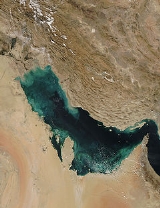
The
Persian Gulf, in
Southwest AsiaWestern Asia, West Asia, Southwest Asia or Southwestern Asia are terms that describe the westernmost portion of Asia. The terms are partly coterminous with the Middle East, which describes a geographical position in relation to Western Europe rather than its location within Asia...
, is an extension of the
Indian OceanThe Indian Ocean is the third largest of the world's oceanic divisions, covering approximately 20% of the water on the Earth's surface. It is bounded on the north by the Indian Subcontinent and Arabian Peninsula ; on the west by eastern Africa; on the east by Indochina, the Sunda Islands, and...
located between
IranIran , officially the Islamic Republic of Iran , is a country in Southern and Western Asia. The name "Iran" has been in use natively since the Sassanian era and came into use internationally in 1935, before which the country was known to the Western world as Persia...
(Persia) and the
Arabian PeninsulaThe Arabian Peninsula is a land mass situated north-east of Africa. Also known as Arabia or the Arabian subcontinent, it is the world's largest peninsula and covers 3,237,500 km2...
.
The Persian Gulf was the focus of the 1980–1988
Iran-Iraq WarThe Iran–Iraq War was an armed conflict between the armed forces of Iraq and Iran, lasting from September 1980 to August 1988, making it the longest conventional war of the twentieth century...
, in which each side attacked the other's
oil tankerAn oil tanker, also known as a petroleum tanker, is a merchant ship designed for the bulk transport of oil. There are two basic types of oil tankers: the crude tanker and the product tanker. Crude tankers move large quantities of unrefined crude oil from its point of extraction to refineries...
s. In 1991, the Persian Gulf again was the background for what was called the "Persian Gulf War" or the "Gulf War" when
IraqIraq ; officially the Republic of Iraq is a country in Western Asia spanning most of the northwestern end of the Zagros mountain range, the eastern part of the Syrian Desert and the northern part of the Arabian Desert....
invaded Kuwait and was subsequently pushed back, despite the fact that this conflict was primarily a land conflict.
The Persian Gulf has many good fishing grounds, extensive
coral reefCoral reefs are underwater structures made from calcium carbonate secreted by corals. Coral reefs are colonies of tiny living animals found in marine waters that contain few nutrients. Most coral reefs are built from stony corals, which in turn consist of polyps that cluster in groups. The polyps...
s, and abundant
pearl oysterPearl oysters are saltwater clams, marine bivalve molluscs of the genus Pinctada in the family Pteriidae. They have a strong inner shell layer composed of nacre, also known as "mother of pearl"....
s, but its ecology has come under pressure from industrialization, and in particular,
oilAn oil is any substance that is liquid at ambient temperatures and does not mix with water but may mix with other oils and organic solvents. This general definition includes vegetable oils, volatile essential oils, petrochemical oils, and synthetic oils....
and
petroleumPetroleum or crude oil is a naturally occurring, flammable liquid consisting of a complex mixture of hydrocarbons of various molecular weights and other liquid organic compounds, that are found in geologic formations beneath the Earth's surface. Petroleum is recovered mostly through oil drilling...
spillages during wars in the region.
Historically and internationally known as the Persian Gulf, this body of water is sometimes controversially referred to as the
Arabian Gulf or simply
The Gulf by most Arab states, although neither of the latter two terms are recognized internationally. The name
Gulf of Iran (Persian Gulf) is used by the
International Hydrographic OrganizationThe International Hydrographic Organization is the inter-governmental organisation representing the hydrographic community. It enjoys observer status at the UN and is the recognised competent authority on hydrographic surveying and nautical charting...
.
Geography
This inland sea of some 251,000 km² is connected to the
Gulf of OmanThe Gulf of Oman or Sea of Oman is a strait that connects the Arabian Sea with the Strait of Hormuz, which then runs to the Persian Gulf. It is generally included as a branch of the Persian Gulf, not as an arm of the Arabian Sea. On the north coast is Pakistan and Iran...
in the east by the
Strait of HormuzThe Strait of Hormuz is a narrow, strategically important waterway between the Gulf of Oman in the southeast and the Persian Gulf. On the north coast is Iran and on the south coast is the United Arab Emirates and Musandam, an exclave of Oman....
; and its western end is marked by the major
river deltaA delta is a landform that is formed at the mouth of a river where that river flows into an ocean, sea, estuary, lake, reservoir, flat arid area, or another river. Deltas are formed from the deposition of the sediment carried by the river as the flow leaves the mouth of the river...
of the Shatt al-Arab, which carries the waters of the
EuphratesThe Euphrates is the longest and one of the most historically important rivers of Western Asia. Together with the Tigris, it is one of the two defining rivers of Mesopotamia...
and the
TigrisThe Tigris River is the eastern member of the two great rivers that define Mesopotamia, the other being the Euphrates. The river flows south from the mountains of southeastern Turkey through Iraq.-Geography:...
. Its length is 989 kilometres, with
IranIran , officially the Islamic Republic of Iran , is a country in Southern and Western Asia. The name "Iran" has been in use natively since the Sassanian era and came into use internationally in 1935, before which the country was known to the Western world as Persia...
covering most of the northern coast and
Saudi ArabiaThe Kingdom of Saudi Arabia , commonly known in British English as Saudi Arabia and in Arabic as as-Sa‘ūdiyyah , is the largest state in Western Asia by land area, constituting the bulk of the Arabian Peninsula, and the second-largest in the Arab World...
most of the southern coast. The Persian Gulf is about 56 kilometres wide at its narrowest, in the
Strait of HormuzThe Strait of Hormuz is a narrow, strategically important waterway between the Gulf of Oman in the southeast and the Persian Gulf. On the north coast is Iran and on the south coast is the United Arab Emirates and Musandam, an exclave of Oman....
. The waters are overall very shallow, with a maximum depth of 90 metres and an average depth of 50 metres.
Countries with a coastline on the Persian Gulf are (clockwise, from the north):
IranIran , officially the Islamic Republic of Iran , is a country in Southern and Western Asia. The name "Iran" has been in use natively since the Sassanian era and came into use internationally in 1935, before which the country was known to the Western world as Persia...
,
OmanOman , officially called the Sultanate of Oman , is an Arab state in southwest Asia on the southeast coast of the Arabian Peninsula. It is bordered by the United Arab Emirates to the northwest, Saudi Arabia to the west, and Yemen to the southwest. The coast is formed by the Arabian Sea on the...
(exclave of
MusandamMusandam Governorate is a governorate of Oman.Geographically, the Musandam peninsula juts into the Strait of Hormuz, the narrow entry into the Persian Gulf, from the Arabian Peninsula. The Musandam peninsula is an exclave of Oman, separated from the rest of the country by the United Arab Emirates...
),
United Arab EmiratesThe United Arab Emirates, abbreviated as the UAE, or shortened to "the Emirates", is a state situated in the southeast of the Arabian Peninsula in Western Asia on the Persian Gulf, bordering Oman, and Saudi Arabia, and sharing sea borders with Iraq, Kuwait, Bahrain, Qatar, and Iran.The UAE is a...
,
Saudi ArabiaThe Kingdom of Saudi Arabia , commonly known in British English as Saudi Arabia and in Arabic as as-Sa‘ūdiyyah , is the largest state in Western Asia by land area, constituting the bulk of the Arabian Peninsula, and the second-largest in the Arab World...
,
QatarQatar , also known as the State of Qatar or locally Dawlat Qaṭar, is a sovereign Arab state, located in the Middle East, occupying the small Qatar Peninsula on the northeasterly coast of the much larger Arabian Peninsula. Its sole land border is with Saudi Arabia to the south, with the rest of its...
on a
peninsulaA peninsula is a piece of land that is bordered by water on three sides but connected to mainland. In many Germanic and Celtic languages and also in Baltic, Slavic and Hungarian, peninsulas are called "half-islands"....
off the Saudi coast,
Bahrain' , officially the Kingdom of Bahrain , is a small island state near the western shores of the Persian Gulf. It is ruled by the Al Khalifa royal family. The population in 2010 stood at 1,214,705, including 235,108 non-nationals. Formerly an emirate, Bahrain was declared a kingdom in 2002.Bahrain is...
on an island,
KuwaitThe State of Kuwait is a sovereign Arab state situated in the north-east of the Arabian Peninsula in Western Asia. It is bordered by Saudi Arabia to the south at Khafji, and Iraq to the north at Basra. It lies on the north-western shore of the Persian Gulf. The name Kuwait is derived from the...
and
IraqIraq ; officially the Republic of Iraq is a country in Western Asia spanning most of the northwestern end of the Zagros mountain range, the eastern part of the Syrian Desert and the northern part of the Arabian Desert....
in the northwest.
Various small islands lie within the Persian Gulf, some of which are the subject of
territorial disputesThis article deals with territorial disputes between states of in and around the Persian Gulf in Southwestern Asia. These states include Iran, Iraq, Kuwait, Saudi Arabia, Bahrain, Qatar, the United Arab Emirates , and Oman.-Background:...
between the states of the region.
Extent
The
International Hydrographic OrganizationThe International Hydrographic Organization is the inter-governmental organisation representing the hydrographic community. It enjoys observer status at the UN and is the recognised competent authority on hydrographic surveying and nautical charting...
refers to the gulf as the "Gulf of Iran (Persian Gulf)", and defines its southern limit as "The Northwestern limit of
Gulf of OmanThe Gulf of Oman or Sea of Oman is a strait that connects the Arabian Sea with the Strait of Hormuz, which then runs to the Persian Gulf. It is generally included as a branch of the Persian Gulf, not as an arm of the Arabian Sea. On the north coast is Pakistan and Iran...
". This limit is defined as "A line joining Ràs Limah (25°57'N) on the coast of
ArabiaThe Arabian Peninsula is a land mass situated north-east of Africa. Also known as Arabia or the Arabian subcontinent, it is the world's largest peninsula and covers 3,237,500 km2...
and Ràs al Kuh (25°48'N) on the coast of
IranIran , officially the Islamic Republic of Iran , is a country in Southern and Western Asia. The name "Iran" has been in use natively since the Sassanian era and came into use internationally in 1935, before which the country was known to the Western world as Persia...
(Persia)".
Oil and gas
The Persian Gulf and its coastal areas are the world's largest single source of crude oil and related industries dominate the region.
Safaniya Oil FieldSafaniya Oil Field is the largest offshore oil field. It is located about north of the company headquarters in Dhahran in the Persian Gulf, Saudi Arabia. Measuring with a producing capability of more than . The oil field is operated and owned by Saudi Aramco....
, the world's largest offshore oilfield, is located in the Persian Gulf. Large gas finds have also been made with Qatar and Iran sharing a giant field across the territorial median line (North Field in the Qatari sector; South Pars Field in the Iranian sector). Using this gas, Qatar has built up a substantial liquified natural gas (LNG) and petrochemical industry.
In 2002, the Persian Gulf nations of Bahrain, Iran, Iraq, Kuwait, Qatar, Saudi Arabia, and the UAE, produced about 25% of the world's oil, held nearly two-thirds of the world's crude oil reserves, and about 35% of the world natural gas reserves. The oil-rich countries (excluding
IraqIraq ; officially the Republic of Iraq is a country in Western Asia spanning most of the northwestern end of the Zagros mountain range, the eastern part of the Syrian Desert and the northern part of the Arabian Desert....
) that have a coastline on the Persian Gulf are referred to as the
Persian Gulf StatesPersian Gulf States can refer to:* Countries in the Middle East bordering the Persian Gulf and sometimes known as the Gulf States: Bahrain, Iran, Iraq, Kuwait, Oman, Qatar, Saudi Arabia, and the United Arab Emirates....
. Iraq's egress to the gulf is narrow and easily blockaded consisting of the marshy river delta of the Shatt al-Arab, which carries the waters of the Uphrates and the
TigrisThe Tigris River is the eastern member of the two great rivers that define Mesopotamia, the other being the Euphrates. The river flows south from the mountains of southeastern Turkey through Iraq.-Geography:...
rivers, where the east bank is held by Iran.
Etymology
In 550 BC, the
Achaemenid EmpireThe Achaemenid Empire , sometimes known as First Persian Empire and/or Persian Empire, was founded in the 6th century BCE by Cyrus the Great who overthrew the Median confederation...
established the first Persian Empire in Pars (
Persis, or modern
Fars) in the southwestern region of the Iranian plateau. Consequently in the Greek sources, the body of water that bordered this province came to be known as the Persian Gulf.
Considering the historical background of the name Persian Gulf, Sir Arnold Wilson mentions in a book, published in 1928 that:
No written deed has remained since the era before the Persian Empire, but in the oral history and culture, the Iranians have called the southern waters: "Jam Sea", "Iran Sea", and "Pars Sea".
During the years: 550 to 330 BC coinciding with sovereignty of the first Persian Empire on the Middle East area, especially the whole part of the Persian Gulf and some parts of the
Arabian PeninsulaThe Arabian Peninsula is a land mass situated north-east of Africa. Also known as Arabia or the Arabian subcontinent, it is the world's largest peninsula and covers 3,237,500 km2...
, the name of "Pars Sea" has been widely written in the compiled texts.
In the travel account of
PythagorasPythagoras of Samos was an Ionian Greek philosopher, mathematician, and founder of the religious movement called Pythagoreanism. Most of the information about Pythagoras was written down centuries after he lived, so very little reliable information is known about him...
, several chapters are related to description of his travels accompanied by Darius the Great, to
SusaSusa was an ancient city of the Elamite, Persian and Parthian empires of Iran. It is located in the lower Zagros Mountains about east of the Tigris River, between the Karkheh and Dez Rivers....
and
PersepolisPerspolis was the ceremonial capital of the Achaemenid Empire . Persepolis is situated northeast of the modern city of Shiraz in the Fars Province of modern Iran. In contemporary Persian, the site is known as Takht-e Jamshid...
, and the area is described. From among the writings of others in the same period, there is the inscription and engraving of Darius the great, installed at junction of waters of
Red SeaThe Red Sea is a seawater inlet of the Indian Ocean, lying between Africa and Asia. The connection to the ocean is in the south through the Bab el Mandeb strait and the Gulf of Aden. In the north, there is the Sinai Peninsula, the Gulf of Aqaba, and the Gulf of Suez...
(also called "Arabian Gulf" or "Ahmar Sea") and the Nile river and the Rome river (current Mediterranean) which belongs to the 5th century BC where, Darius the Great, the king of the Achaemenid Empire has named the Persian Gulf Water Channel:
Pars Sea (
Persian Sea).
Naming dispute
In the 5th century BC, Darius the Great of the Achaemenid dynasty called the Persian Gulf "Draya; tya; haca; parsa: Aitiy", meaning, "The sea which goes from Persian." In this era, some of the Greek writers also called it "Persikonkaitas", meaning the Persian Gulf. Claudius Ptolemaues, the celebrated Greco-Egyptian mathematician/astronomer in the 2nd century called it "Persicus Sinus" or Persian Gulf. In the 1st century AD,
Quintus Curtius RufusQuintus Curtius Rufus was a Roman historian, writing probably during the reign of the Emperor Claudius or Vespasian. His only surviving work, Historiae Alexandri Magni, is a biography of Alexander the Great in Latin in ten books, of which the first two are lost, and the remaining eight are...
, the Roman historian, designated it "Aquarius Persico" – the Persian Sea.
Flavius ArrianusLucius Flavius Arrianus 'Xenophon , known in English as Arrian , and Arrian of Nicomedia, was a Roman historian, public servant, a military commander and a philosopher of the 2nd-century Roman period...
, another
GreekThe Greeks, also known as the Hellenes , are a nation and ethnic group native to Greece, Cyprus and neighboring regions. They also form a significant diaspora, with Greek communities established around the world....
historian, called it "Persiconkaitas" (Persian Gulf).
During the Sassanian dynasty and the time of the Islamic Prophet
MuhammadMuhammad |ligature]] at U+FDF4 ;Arabic pronunciation varies regionally; the first vowel ranges from ~~; the second and the last vowel: ~~~. There are dialects which have no stress. In Egypt, it is pronounced not in religious contexts...
and the 4 caliphs, the name invariably used was the "Persian Sea." This was continued by the Ummayyads and Abbassids, while during the time of the Ottoman empire, both "Persian Gulf" or "Persian Sea" were used, and occasionally Ottomans utilized the term "Khalij of Basra" or "Basra Kurfuzi" to refer to Persian Gulf, meaning the Gulf of Basra.
Among historians, travellers and geographers of the Islamic era, many of them writing in Arabic from the 9th to the 17th century,
Ibn KhordadbehAbu'l Qasim Ubaid'Allah ibn Khordadbeh , author of the earliest surviving Arabic book of administrative geography, was a Persian geographer and bureaucrat of the 9th century...
,
Ibn al-FaqihIbn al-Faqih al-Hamadani was a 10th century Persian historian and geographer, famous for his Mukhtasar Kitab al-Buldan .-References:...
, Ibn Rustah, Sohrab, Ramhormozi,
Abu Ishaq Ibrahim ibn Muhammad al-Farisi al IstakhriAbu Ishaq Ibrahim ibn Muhammad al-Farisi al Istakhri was a medieval Persian geographer in the 10th century.-Career:...
,
Abu al-Hasan Ali ibn al-Husayn ibn Ali al-Mas'udiAbu al-Hasan Ali ibn al-Husayn ibn Ali al-Mas'udi , was an Arab historian and geographer, known as the "Herodotus of the Arabs." Al-Masudi was one of the first to combine history and scientific geography in a large-scale work, Muruj adh-dhahab...
, Al-Mutahhar ibn Tahir al-Maqdisi(d. 966),
Ibn HawqalMuḥammad Abū’l-Qāsim Ibn Ḥawqal was a 10th century Muslim writer, geographer, and chronicler. His famous work, written in 977, is called Ṣūrat al-’Arḍ ....
,
Al-MuqaddasiMuhammad ibn Ahmad Shams al-Din Al-Muqaddasi , also transliterated as Al-Maqdisi and el-Mukaddasi, was a medieval Arab geographer, author of Ahsan at-Taqasim fi Ma`rifat il-Aqalim .-Biography:Al-Muqaddasi, "the Hierosolomite" was born in Jerusalem in 946 AD...
,
Ibn KhaldunIbn Khaldūn or Ibn Khaldoun was an Arab Tunisian historiographer and historian who is often viewed as one of the forerunners of modern historiography, sociology and economics...
, Mohammad ibn Najub Bekiran, Abu Rayhan Biruni,
Muhammad al-IdrisiAbu Abd Allah Muhammad al-Idrisi al-Qurtubi al-Hasani al-Sabti or simply Al Idrisi was a Moroccan Muslim geographer, cartographer, Egyptologist and traveller who lived in Sicily, at the court of King Roger II. Muhammed al-Idrisi was born in Ceuta then belonging to the Almoravid Empire and died in...
,
Yaqut al-HamawiYāqūt ibn-'Abdullah al-Rūmī al-Hamawī) was an Islamic biographer and geographer renowned for his encyclopedic writings on the Muslim world. "al-Rumi" refers to his Greek descent; "al-Hamawi" means that he is from Hama, Syria, and ibn-Abdullah is a reference to his father's name, Abdullah...
,
Zakariya al-QazwiniAbu Yahya Zakariya' ibn Muhammad al-Qazwini , was a Persian physician, astronomer, geographer and proto-science fiction writer....
,
Abu'l-FidaAbu al-Fida or Abul Fida Ismail Hamvi was a Kurdish historian, geographer, and local sultan...
, Al-Dimashqi,
Hamdollah MostowfiHamdollah Mostowfi was a Persian historian, geographer and epic poet.Mostowfi is the author of Nozhat ol-Gholub , Zafar-Nameh , and the Tarikh e Gozideh . His tomb is a structure with a blue turquoise conical dome, at Qazvin.-References and notes:...
,
Ibn al-WardiUmar ibn Muzaffar ibn al-Wardi , known as Ibn al-Wardi, was an Arabic historian .- His Works :* Kharidat al-'Aja'ib wa Faridat al-Ghara'ib . . The work accompanied with a coloured world map and a picture of Ka'bah...
,
Al-NuwayriAl-Nuwayrī, also Shihāb al-Dīn Ahmad b. 'Abd al-Wahhāb al-Nuwayri was a Muslim historian. He died in 1333.He is known for his work regarding the conquest of the Mongols in Syria, and wrote extensively about the history of the Mamluks in the 12th-13th century.-References:* The Historiography of...
, Ibn Batutta,
Katip ÇelebiKâtip Çelebi, Mustafa bin Abdullah, Haji Khalifa or Kalfa, was an Ottoman scholar. A historian and geographer, he is regarded as one of the most productive authors of non-religious scientific literature in the 17th century Ottoman Empire...
and other sources have used the terms "Bahr-i-Fars", "Daryaye-i-Fars", "Khalij al-'Ajami" and "Khalij-i Fars" (all of which translate into "Persian Gulf" or "Persian Sea").
Until the 1960s Arab countries used the term "Persian Gulf" as well, however with the rise of Arab nationalism (
Pan-ArabismPan-Arabism is an ideology espousing the unification--or, sometimes, close cooperation and solidarity against perceived enemies of the Arabs--of the countries of the Arab world, from the Atlantic Ocean to the Arabian Sea. It is closely connected to Arab nationalism, which asserts that the Arabs...
) in the 1960s, most Arab states started adopting the term "Arabian Gulf" to refer to the waterway. However, this naming has not found much acceptance outside of the Arab world, and is not recognized by the
United NationsThe United Nations is an international organization whose stated aims are facilitating cooperation in international law, international security, economic development, social progress, human rights, and achievement of world peace...
or any other international organization.
The
United Nations SecretariatThe United Nations Secretariat is one of the five principal organs of the United Nations and it is headed by the United Nations Secretary-General, assisted by a staff of international civil servants worldwide. It provides studies, information, and facilities needed by United Nations bodies for...
on many occasions has requested that only the term "Persian Gulf" be used as the official and standard geographical designation for the body of water. Historically, "Arabian Gulf" has been a term used to indicate the
Red SeaThe Red Sea is a seawater inlet of the Indian Ocean, lying between Africa and Asia. The connection to the ocean is in the south through the Bab el Mandeb strait and the Gulf of Aden. In the north, there is the Sinai Peninsula, the Gulf of Aqaba, and the Gulf of Suez...
. At the same time, the historical veracity of the usage of "Persian Gulf" can be established from the works of many medieval historians.
At the Twenty-third session of the United Nations in March–April 2006, the name "Persian Gulf" was confirmed again as the legitimate and official term to be used by members of the United Nations.
Pre-Islamic era
For most of the early history of the settlements in the Persian Gulf the southern shores have been ruled by a series of nomadic tribes. During the end of the fourth millennium BC the southern part of the Persian Gulf was dominated by the
DilmunDilmun or Telmun is a land mentioned by Mesopotamian civilizations as a trade partner, a source of the metal copper, and an entrepôt of the Mesopotamia-to-Indus Valley Civilization trade route...
civilization. For a long time the most important settlement on the southern coast of the Persian Gulf was
GerrhaGerrha , was an ancient city of Arabia, on the west side of the Persian Gulf. More accurately, the ancient city of Gerrha has been determined to have existed near or under the present fort of Uqair. This fort is 50 miles northeast of Al-Hasa in the Eastern Province of Saudi Arabia...
. In the 2nd century
the Lakhum tribeThe Lakhmids , Banu Lakhm , Muntherids , were a group of Arab Christians who lived in Southern Iraq, and made al-Hirah their capital in 266. Poets described it as a Paradise on earth, an Arab Poet described the city's pleasant climate and beauty "One day in al-Hirah is better than a year of...
, who lived in what is now Yemen, migrated north and founded the Lakhmid Kingdom along the southern coast. Occasional ancient battles took place along the Persian Gulf coastlines, between the Sassanid Persian empire and the Lakhmid Kingdom, the most prominent of which was the invasion led by
Shapur IIShapur II the Great was the ninth King of the Persian Sassanid Empire from 309 to 379 and son of Hormizd II. During his long reign, the Sassanid Empire saw its first golden era since the reign of Shapur I...
against the Lakhmids, leading to Lackhmids' defeat, and advancement into Arabia, along the southern shore lines. During the 7th century the
Sassanid Persian empireThe Sassanid Empire , known to its inhabitants as Ērānshahr and Ērān in Middle Persian and resulting in the New Persian terms Iranshahr and Iran , was the last pre-Islamic Persian Empire, ruled by the Sasanian Dynasty from 224 to 651...
conquered the whole of the Persian Gulf, including southern and northern shores.
Between 625 BC and 226 AD the northern side was dominated by a succession of Persian empires including the Median,
AchaemenidThe Achaemenid Empire , sometimes known as First Persian Empire and/or Persian Empire, was founded in the 6th century BCE by Cyrus the Great who overthrew the Median confederation...
,
SeleucidThe Seleucid Empire was a Greek-Macedonian state that was created out of the eastern conquests of Alexander the Great. At the height of its power, it included central Anatolia, the Levant, Mesopotamia, Persia, today's Turkmenistan, Pamir and parts of Pakistan.The Seleucid Empire was a major centre...
and
ParthianThe Parthian Empire , also known as the Arsacid Empire , was a major Iranian political and cultural power in ancient Persia...
empires. Under the leadership of the Achaemenid king Darius the Great (Darius I), Persian ships found their way to the Persian Gulf. Persian naval forces laid the foundation for a strong Persian maritime presence in Persian Gulf, that started with Darius I and existed until the arrival of the
British East India CompanyThe East India Company was an early English joint-stock company that was formed initially for pursuing trade with the East Indies, but that ended up trading mainly with the Indian subcontinent and China...
, and the Royal Navy by mid-19th century AD. Persians were not only stationed on islands of the Persian Gulf, but also had ships often of 100 to 200 capacity patrolling empire's various rivers including Shatt-al-Arab, Tigris, and the
NileThe Nile is a major north-flowing river in North Africa, generally regarded as the longest river in the world. It is long. It runs through the ten countries of Sudan, South Sudan, Burundi, Rwanda, Democratic Republic of the Congo, Tanzania, Kenya, Ethiopia, Uganda and Egypt.The Nile has two major...
in the west, as well as Sind waterway, in
IndiaIndia , officially the Republic of India , is a country in South Asia. It is the seventh-largest country by geographical area, the second-most populous country with over 1.2 billion people, and the most populous democracy in the world...
.
The Achaemenid high naval command had established major naval bases located along Shatt al-Arab river, Bahrain, Oman, and Yemen. The Persian fleet would soon not only be used for peacekeeping purposes along the Shatt al-Arab but would also open the door to trade with India via Persian Gulf.
Following the fall of Achaemenid Empire, and after the fall of the
Parthian EmpireThe Parthian Empire , also known as the Arsacid Empire , was a major Iranian political and cultural power in ancient Persia...
, the
Sassanid empireThe Sassanid Empire , known to its inhabitants as Ērānshahr and Ērān in Middle Persian and resulting in the New Persian terms Iranshahr and Iran , was the last pre-Islamic Persian Empire, ruled by the Sasanian Dynasty from 224 to 651...
ruled the northern half and at times the southern half of the Persian Gulf. The Persian Gulf, along with the
Silk RoadThe Silk Road or Silk Route refers to a historical network of interlinking trade routes across the Afro-Eurasian landmass that connected East, South, and Western Asia with the Mediterranean and European world, as well as parts of North and East Africa...
were important trade routes in the Sassanid empire. Many of the trading ports of the Persian empires were located in or around Persian Gulf.
SirafSiraf is a city in the Central District of Kangan County, Bushehr Province, Iran. At the 2006 census, its population was 3,500, in 722 families....
, an ancient Sassanid port that was located on the northern shore of the gulf, located in what is now the Iranian province of
BushehrBushehr Bushehr lies in a vast plain running along the coastal region on the Persian Gulf coast of southwestern Iran. It is the chief seaport of the country and the administrative centre of its province. Its location is about south of Tehran. The local climate is hot and humid.The city...
, is an example of such commercial port. Siraf, was also significant in that it had a flourishing commercial trade with
ChinaChinese civilization may refer to:* China for more general discussion of the country.* Chinese culture* Greater China, the transnational community of ethnic Chinese.* History of China* Sinosphere, the area historically affected by Chinese culture...
by the 4th century, having first established connection with the far east in 185 AD.
Colonial era
PortugueseThe Portuguese Empire , also known as the Portuguese Overseas Empire or the Portuguese Colonial Empire , was the first global empire in history...
expansion into the Indian Ocean in the early 16th century following
Vasco da GamaVasco da Gama, 1st Count of Vidigueira was a Portuguese explorer, one of the most successful in the Age of Discovery and the commander of the first ships to sail directly from Europe to India...
's voyages of exploration saw them battle the Ottomans up the coast of the Persian Gulf. In 1521, a Portuguese force led by commander
Antonio CorreiaAntónio Correia was a Portuguese commander who in 1521 conquered Bahrain, beginning eighty years of Portuguese rule in the Persian Gulf state.Correia was the son of merchant and explorer Aires Correia, who had gained notoriety during the Portuguese bombardment of Calicut a generation earlier...
invaded Bahrain to take control of the wealth created by its pearl industry. On April 29 of 1602, Shāh Abbās, the
PersianThe Persian people are part of the Iranian peoples who speak the modern Persian language and closely akin Iranian dialects and languages. The origin of the ethnic Iranian/Persian peoples are traced to the Ancient Iranian peoples, who were part of the ancient Indo-Iranians and themselves part of...
emperor of the Safavid Persian Empire expelled the
PortuguesePortugal , officially the Portuguese Republic is a country situated in southwestern Europe on the Iberian Peninsula. Portugal is the westernmost country of Europe, and is bordered by the Atlantic Ocean to the West and South and by Spain to the North and East. The Atlantic archipelagos of the...
from Bahrain, and that date is commemorated as National Persian Gulf day in
IranIran , officially the Islamic Republic of Iran , is a country in Southern and Western Asia. The name "Iran" has been in use natively since the Sassanian era and came into use internationally in 1935, before which the country was known to the Western world as Persia...
. With the support of the British fleet, in 1622 'Abbās took the island of
HormuzHormuz Island , also spelled Hormoz, is an Iranian island in the Persian Gulf. It is located in the Strait of Hormuz and is part of the Hormozgān Province.-Geography:...
from the Portuguese; much of the trade was diverted to the town of
Bandar 'AbbāsBandar-Abbas or Bandar-e ‘Abbās , also Romanized as Bandar ‘Abbās, Bandar ‘Abbāsī, and Bandar-e ‘Abbās; formerly known as Cambarão and Port Comorão to Portuguese traders, as Gombroon to English traders and as Gamrun or Gumrun to Dutch merchants) is a port city and capital of Hormozgān Province on...
which he had taken from the Portuguese in 1615 and had named after himself. The Persian Gulf was therefore opened by
PersianThe Persian people are part of the Iranian peoples who speak the modern Persian language and closely akin Iranian dialects and languages. The origin of the ethnic Iranian/Persian peoples are traced to the Ancient Iranian peoples, who were part of the ancient Indo-Iranians and themselves part of...
s to a flourishing commerce with the Portuguese, Dutch, French, Spanish and the British merchants, who were granted particular privileges.
In World War II, the
Western AlliesThe Western Allies were a political and geographic grouping among the Allied Powers of the Second World War. It generally includes the United Kingdom and British Commonwealth, the United States, France and various other European and Latin American countries, but excludes China, the Soviet Union,...
used Iran as a conduit to transport military and industrial supply to Russia (USSR), through a pathway known historically as the "Persian Corridor". This path would utilize the
Trans-Iranian RailwayThe Trans-Iranian Railway was a major railway building project started in 1927 and completed in 1938, under the direction of the Persian monarch, Reza Shah, and entirely with indigenous capital. It links the capital Tehran with the Persian Gulf and Caspian Sea...
, but in order for the supply to be transported to Iran, Britain utitlized the Persian Gulf as the entry point for the supply chain. Persian Gulf therefore became a critical maritime path through which the Allies transported equipment, to Russia against the
Nazi invasionOperation Barbarossa was the code name for Germany's invasion of the Soviet Union during World War II that began on 22 June 1941. Over 4.5 million troops of the Axis powers invaded the USSR along a front., the largest invasion in the history of warfare...
.
From 1763 until 1971, the
British EmpireThe British Empire comprised the dominions, colonies, protectorates, mandates and other territories ruled or administered by the United Kingdom. It originated with the overseas colonies and trading posts established by England in the late 16th and early 17th centuries. At its height, it was the...
maintained varying degrees of political control over some of the Persian Gulf states, including the United Arab Emirates (originally called the "Trucial Coast States") and at various times Bahrain, Kuwait, Oman, and Qatar through the
British Residency of the Persian GulfThe British residency of the Persian Gulf was an official colonial subdivision of the British Empire from 1763 until 1971, whereby the United Kingdom maintained varying degrees of political and economic control over several states in the Persian Gulf, including: the United Arab Emirates and at...
. United Kingdom maintains a high profile in the region to date; in 2006 alone, over 1 million British nationals visited
DubaiDubai is a city and emirate in the United Arab Emirates . The emirate is located south of the Persian Gulf on the Arabian Peninsula and has the largest population with the second-largest land territory by area of all the emirates, after Abu Dhabi...
.
Islands
Persian Gulf is home to many small islands.
Bahrain' , officially the Kingdom of Bahrain , is a small island state near the western shores of the Persian Gulf. It is ruled by the Al Khalifa royal family. The population in 2010 stood at 1,214,705, including 235,108 non-nationals. Formerly an emirate, Bahrain was declared a kingdom in 2002.Bahrain is...
an island in the Persian Gulf, is itself a Persian Gulf Arab state. Geographically the biggest island in the Persian Gulf is Qeshm island located in the
Strait of HormuzThe Strait of Hormuz is a narrow, strategically important waterway between the Gulf of Oman in the southeast and the Persian Gulf. On the north coast is Iran and on the south coast is the United Arab Emirates and Musandam, an exclave of Oman....
and belonging to Iran. Other significant islands in the Persian Gulf include Greater Tunb, Lesser Tunb and
Kish-Geography:*Kish Island, an Iranian island and a city in the Persian Gulf*Kish, Iran, a city on Kish Island*Kish District, an administrative subdivision of Iran*Kish Rural District, an administrative subdivision of Iran...
administered by Iran,
BubiyanBubiyan Island is the largest island in the Kuwaiti coastal island chain situated in the north-western corner of the Persian Gulf, with an area of ....
administered by Kuwait, Tarout administered by Saudi Arabia, and
DalmaDâlma may refer to several villages in Romania:* Dâlma, a village in Scorţoasa Commune, Buzău County, Romania* Dâlma, a village in Bala, Mehedinţi, Romania* Dalma , an island off the coast of Abu Dhabi, United Arab Emirates...
administered by UAE. In recent years, there has also been addition of
artificial islandAn artificial island or man-made island is an island or archipelago that has been constructed by people rather than formed by natural means...
s, often created by Arab states such as UAE for commercial reasons or as tourist resorts. Although very small, these artificial islands have had a negative impact on the
mangroveMangroves are various kinds of trees up to medium height and shrubs that grow in saline coastal sediment habitats in the tropics and subtropics – mainly between latitudes N and S...
habitats upon which they are built, often causing unpredicted environmental issues. Persian Gulf islands are often also historically significant having been used in the past by colonial powers such as the
PortugueseThe Portuguese Empire , also known as the Portuguese Overseas Empire or the Portuguese Colonial Empire , was the first global empire in history...
and the
BritishThe British Empire comprised the dominions, colonies, protectorates, mandates and other territories ruled or administered by the United Kingdom. It originated with the overseas colonies and trading posts established by England in the late 16th and early 17th centuries. At its height, it was the...
in their trade or as acquisitions for their empires.
Wildlife
Wildlife of the Persian Gulf is diverse, and entirely unique due to the gulf's geographic distribution and its isolation from the international waters only breached by the narrow
Strait of HormuzThe Strait of Hormuz is a narrow, strategically important waterway between the Gulf of Oman in the southeast and the Persian Gulf. On the north coast is Iran and on the south coast is the United Arab Emirates and Musandam, an exclave of Oman....
. Persian Gulf has hosted some of the most magnificent marine fauna and flora, some of which are near extinction or at serious environmental risk. From corals, to
dugongThe dugong is a large marine mammal which, together with the manatees, is one of four living species of the order Sirenia. It is the only living representative of the once-diverse family Dugongidae; its closest modern relative, Steller's sea cow , was hunted to extinction in the 18th century...
s, Persian Gulf is a diverse cradle for many species many of which depend on each other for survival.
A great example of this
symbiosisSymbiosis is close and often long-term interaction between different biological species. In 1877 Bennett used the word symbiosis to describe the mutualistic relationship in lichens...
are the mangroves in the gulf, which require tidal flow and a combination of fresh and salt water for growth, and act as nurseries for many crabs, small fish, and insects; these fish and insects, are the source of food for many of the marine birds that feed on them. Mangroves are a diverse group of shrubs and trees belonging to the genus
AvicenniaAvicennia is a genus of flowering plants currently placed in the bear's breeches family, Acanthaceae. It contains mangrove trees, which occur in the intertidal zones of estuarine areas and are characterized by aerial roots. Species of Avicennia occur worldwide south of the Tropic of Cancer.The...
or
RhizophoraRhizophora is a genus of tropical mangrove trees, sometimes collectively called true mangroves. The most notable species is the Red Mangrove but some other species and a few natural hybrids are known. Rhizophora species generally live in intertidal zones which are indundated daily by the ocean...
that flourish in the salt water shallows of the gulf, and are the most important habitats for small crustaceans that dwell in them. They are as crucial an indicator of biological health on the surface of the water, as the corals are to biological health of the gulf in deeper waters. Mangrove's ability to survive the salt water through intricate molecular mechanisms, its unique reproductive cycle, and its ability to grow in the most oxygen deprived waters has allowed them extensive growth in hostile areas of the gulf. Unfortunately however, with the advent of artificial island development, most of their habitat is destroyed, or occupied by man-made structures. This has had a negative impact on the crustaceans that rely on the mangrove, and in return on the species that feed on them.
One of the most unique marine mammals living in the Persian Gulf is
Dugong dugon, commonly referred to as the
dugongThe dugong is a large marine mammal which, together with the manatees, is one of four living species of the order Sirenia. It is the only living representative of the once-diverse family Dugongidae; its closest modern relative, Steller's sea cow , was hunted to extinction in the 18th century...
, or the "sea cow". Called "sea cows" for their grazing habits, their mild manner and resemblance of the livestock, dugongs have a life expectancy similar to that of humans and can reach lengths of up to 3 meters. These are gentle mammals that feed on the sea grass, and genetically resemble the land mammals more than the dolphins and the whales. Despite the simplicity of their grass diet, new developments along the Persian Gulf coastline, particularly artificial island development in Arab states, pollution particularly by oil spills caused during the "Persian Gulf war" and also due to occasional oil spills, and uncontrolled hunting has had a negative impact on the survival of the dugongs. After Australian waters with some 80,000 dugong inhabitants, waters of Qatar, Bahrain, UAE, and Saudi Arabia have some 7,500 dugongs remaining, making the Persian Gulf the second most important habitat for the species. Dugong's current number is dwindling and it is not clear as of now how many are currently alive or what their reproductive trend is. Unfortunately, ambitious and uncalculated construction schemes, political unrest and an ever present international conflict, and presence of the most lucrative world supply of oil, along with lack of cooperation between Arab states and Iran, has had a negative impact on the survival of many marine species, including dugongs.
Coral is another important inhabitant of the Persian Gulf waters. Corals are vital ecosystems that support multitude of marine species, and whose health directly reflects the health of the gulf. Recent years have seen a drastic decline in the coral population in the gulf, partially owing to
global warmingGlobal warming refers to the rising average temperature of Earth's atmosphere and oceans and its projected continuation. In the last 100 years, Earth's average surface temperature increased by about with about two thirds of the increase occurring over just the last three decades...
but majorly due to irresponsible dumping by Arab states like UAE and Bahrain. Construction garbage such as tires, cement, and chemical by products have found their way to the Persian Gulf in recent years. Aside from direct damage to the coral, the construction waste creates "traps" for marine life in which they are trapped and die. The end result has been a dwindling population of the coral, and as a result a decrease in number of species that rely on the corals for their survival.
The Persian Gulf is also home to many migratory and local birds. There is great variation in color, size, and type of the bird species that call the gulf home. One bird in particular, the kalbaensis, a sub-species of the
kingfisherKingfishers are a group of small to medium sized brightly coloured birds in the order Coraciiformes. They have a cosmopolitan distribution, with most species being found in the Old World and Australia...
s is at the brink of extinction due to real state development by cities such a Dubai and countries such as Oman. Estimates at 2006, showed that only three viable nesting sites were available for this ancient bird, one located 80 miles from Dubai, and two smaller sites in Oman, all of which are in the process of becoming real estate developments. Such expansion would prove devastating and can cause this species to be extinct. Unfortunately for the kingfisher, a U.N. plan to protect the mangroves as a biological reserve was blatantly ignored by the emirate of Sharjah, which allowed the dredging of a channel that bisects the wetland and construction of an adjacent concrete walkway. Environmental watchdogs in Arabia are few, and those that do advocate the wildlife are often silenced or ignored by developers of real estate, most of whom have royal family connections and huge energy profits to invest. The end result has been sacrifice of a beautiful yet delicate ecology that has been in harmony for hundreds of years, for structures that are erected only a few years, yet will have a lasting detrimental effect.
Almost no species in the Persian Gulf is spared from the real estate development of UAE and Oman, including the
hawksbill turtleThe hawksbill sea turtle is a critically endangered sea turtle belonging to the family Cheloniidae. It is the only extant species in its genus. The species has a worldwide distribution, with Atlantic and Pacific subspecies. E. imbricata imbricata is the Atlantic subspecies, while E...
, the
flamingoFlamingos or flamingoes are gregarious wading birds in the genus Phoenicopterus , the only genus in the family Phoenicopteridae...
, and the booted warblers, mainly due to destruction of the mangrove habitats to make way for towers, hotels, and luxury resorts. Even dolphins that frequent the gulf in northern waters, around Iran are at serious risk. Recent statistics and observations show that dolphins are at danger of entrapment in purse seine fishing nets and exposure to chemical pollutants; perhaps the most alarming sign is the "mass suicides" committed by dolphins off Iran's Hormozgan province, which are not well understood, but are suspected to be linked with a deteriorating marine environment from water pollution from oil, sewage, and industrial run offs.
The Persian Gulf is also home to over 700 species of fish, most of which are native to the gulf. Of these 700 species, more than 80% are coral reef associated, and directly or indirectly depend on the coral reef for their survival. Overall, the wild life of the Persian Gulf is endangered from both global factors, and regional, local negligence. Most pollution is from ships; land generated pollution counts as the second most common source of pollution, ranging from mercury, to acidic or basic toxins.
See also
- Cradle of civilization
The cradle of civilization is a term referring to any of the possible locations for the emergence of civilization.It is usually applied to the Ancient Near Eastern Chalcolithic , especially in the Fertile Crescent , but also extended to sites in Armenia, and the Persian Plateau, besides other Asian...
- Deluge (prehistoric)
In geomorphology, an outburst flood, which is a type of megaflood, is a high magnitude, low frequency catastrophic flood involving the sudden release of water. During the last deglaciation, numerous glacial lake outburst floods were caused by the collapse of either ice sheets or glaciers that...
- Gulf of Aden
The Gulf of Aden is located in the Arabian Sea between Yemen, on the south coast of the Arabian Peninsula, and Somalia in the Horn of Africa. In the northwest, it connects with the Red Sea through the Bab-el-Mandeb strait, which is about 20 miles wide....
- Arab cuisine of the Persian Gulf
External links