
Home      Discussion      Topics      Dictionary      Almanac
Signup       Login
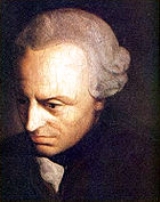
Immanuel Kant

Immanuel Kant

Overview
Immanuel Kant was an 18th-century German philosopher
Philosophy
Philosophy is the study of general and fundamental problems concerning matters such as existence, knowledge, values, reason, mind, and language. Philosophy is distinguished from other ways of addressing these questions by its critical, generally systematic approach and its reliance on reasoned...

 from the Prussian
Kingdom of Prussia
The Kingdom of Prussia was a German kingdom from 1701 to 1918, until the defeat of Germany in World War I, was the leading state of the German Empire, comprising almost two-thirds of the area of the empire...

 city of Königsberg
Königsberg
Königsberg was the capital of eastern Prussia from the Late Middle Ages until 1945. It was founded by the Teutonic Knights just south of the Sambian peninsula in the year 1255 AD during the Northern Crusades and named for King Ottokar II of Bohemia...

 (now Kaliningrad
Kaliningrad
Kaliningrad is a seaport and the administrative center of Kaliningrad Oblast, the Russian exclave between Poland and Lithuania on the Baltic Sea...

, Russia). Kant was the last influential philosopher of modern Europe in the classic sequence of the theory of knowledge
Epistemology
Epistemology or theory of knowledge is the branch of philosophy concerned with the nature and scope of knowledge...

 during the Enlightenment
Age of Enlightenment
The Age of Enlightenment, or simply The Enlightenment, is a term used to describe a time in Western philosophy and cultural life, centered upon the eighteenth century, in which reason was advocated as the primary source and legitimacy for authority....

 beginning with thinkers John Locke
John Locke
John Locke was an English physician and philosopher regarded as one of the most influential of Enlightenment thinkers. Considered the first of the British empiricists, he is equally important to social contract theory. His work had a great impact upon the development of epistemology and political...

, George Berkeley
George Berkeley
George Berkeley , also known as Bishop Berkeley, was an Anglo-Irish philosopher whose primary achievement was the advancement of a theory he called "immaterialism" . This theory contends that individuals can only know directly sensations and ideas of objects, not abstractions such as "matter"...

, and David Hume
David Hume
David Hume was a Scottish philosopher, economist, historian and a key figure in the history of Western philosophy and the Scottish Enlightenment...

.

Kant created a new widespread perspective in philosophy which influenced philosophy through to the 21st century
21st century
The 21st century is the current century of the Christian Era or Common Era in accordance with the Gregorian calendar. It began on January 1, 2001 and will end December 31, 2100...

. He published important works on epistemology
Epistemology
Epistemology or theory of knowledge is the branch of philosophy concerned with the nature and scope of knowledge...

, as well as works relevant to religion, law, and history.
Discussion
Ask a question about 'Immanuel Kant'
Start a new discussion about 'Immanuel Kant'
Answer questions from other users
Full Discussion Forum
 
Unanswered Questions
Recent Discussions
Quotations

The wish to talk to God is absurd. We cannot talk to one we cannot comprehend — and we cannot comprehend God; we can only believe in Him. The uses of prayer are thus only subjective.

A lecture at Königsberg (1775), as quoted in A New Dictionary of Quotations on Historical Principles from Ancient and Modern Sources (1946) by H. L. Mencken, p. 955

Religion is too important a matter to its devotees to be a subject of ridicule. If they indulge in absurdities, they are to be pitied rather than ridiculed.

A lecture at Königsberg (1775), as quoted in A New Dictionary of Quotations on Historical Principles from Ancient and Modern Sources (1946) by H. L. Mencken, p. 1017

Since the narrower or wider community of the peoples of the earth has developed so far that a violation of rights in one place is felt throughout the world, the idea of a cosmopolitan right is not fantastical, high-flown or exaggerated notion. It is a complement to the unwritten code of the civil and international law, necessary for the public rights of mankind in general and thus for the realization of perpetual peace.

Perpetual Peace: A Philosophical Sketch (1795)

The death of dogma is the birth of morality.

As quoted in Faith Or Fact (1897) by Henry Moorehouse Taber, p. 86

By a lie a man throws away and, as it were, annihilates his dignity as a man. A man who himself does not believe what he tells another ... has even less worth than if he were a mere thing. ... makes himself a mere deceptive appearance of man, not man himself.

Doctrine of Virtue as translated by Mary J. Gregor (1964), p. 93

Enlightenment is man’s leaving his self-caused immaturity. Immaturity is the incapacity to use one's intelligence without the guidance of another. Such immaturity is self-caused if it is not caused by lack of intelligence, but by lack of determination and courage to use one's intelligence without being guided by another. Sapere Aude! Have the courage to use your own intelligence! is therefore the motto of the enlightenment.

Through laziness and cowardice a large part of mankind, even after nature has freed them from alien guidance, gladly remain immature. It is because of laziness and cowardice that it is so easy for others to usurp the role of guardians. It is so comfortable to be a minor!

Encyclopedia
Immanuel Kant was an 18th-century German philosopher
Philosophy
Philosophy is the study of general and fundamental problems concerning matters such as existence, knowledge, values, reason, mind, and language. Philosophy is distinguished from other ways of addressing these questions by its critical, generally systematic approach and its reliance on reasoned...

 from the Prussian
Kingdom of Prussia
The Kingdom of Prussia was a German kingdom from 1701 to 1918, until the defeat of Germany in World War I, was the leading state of the German Empire, comprising almost two-thirds of the area of the empire...

 city of Königsberg
Königsberg
Königsberg was the capital of eastern Prussia from the Late Middle Ages until 1945. It was founded by the Teutonic Knights just south of the Sambian peninsula in the year 1255 AD during the Northern Crusades and named for King Ottokar II of Bohemia...

 (now Kaliningrad
Kaliningrad
Kaliningrad is a seaport and the administrative center of Kaliningrad Oblast, the Russian exclave between Poland and Lithuania on the Baltic Sea...

, Russia). Kant was the last influential philosopher of modern Europe in the classic sequence of the theory of knowledge
Epistemology
Epistemology or theory of knowledge is the branch of philosophy concerned with the nature and scope of knowledge...

 during the Enlightenment
Age of Enlightenment
The Age of Enlightenment, or simply The Enlightenment, is a term used to describe a time in Western philosophy and cultural life, centered upon the eighteenth century, in which reason was advocated as the primary source and legitimacy for authority....

 beginning with thinkers John Locke
John Locke
John Locke was an English physician and philosopher regarded as one of the most influential of Enlightenment thinkers. Considered the first of the British empiricists, he is equally important to social contract theory. His work had a great impact upon the development of epistemology and political...

, George Berkeley
George Berkeley
George Berkeley , also known as Bishop Berkeley, was an Anglo-Irish philosopher whose primary achievement was the advancement of a theory he called "immaterialism" . This theory contends that individuals can only know directly sensations and ideas of objects, not abstractions such as "matter"...

, and David Hume
David Hume
David Hume was a Scottish philosopher, economist, historian and a key figure in the history of Western philosophy and the Scottish Enlightenment...

.

Kant created a new widespread perspective in philosophy which influenced philosophy through to the 21st century
21st century
The 21st century is the current century of the Christian Era or Common Era in accordance with the Gregorian calendar. It began on January 1, 2001 and will end December 31, 2100...

. He published important works on epistemology
Epistemology
Epistemology or theory of knowledge is the branch of philosophy concerned with the nature and scope of knowledge...

, as well as works relevant to religion, law, and history. One of his most prominent works is the Critique of Pure Reason
Critique of Pure Reason
The Critique of Pure Reason by Immanuel Kant, first published in 1781, second edition 1787, is one of the most influential works in the history of philosophy...

, an investigation into the limitations and structure of reason itself. It encompasses an attack on traditional metaphysics
Metaphysics
Metaphysics investigates principles of reality transcending those of any particular science. Cosmology and ontology are traditional branches of metaphysics. It is concerned with explaining the fundamental nature of being and the world...

 and epistemology
Epistemology
Epistemology or theory of knowledge is the branch of philosophy concerned with the nature and scope of knowledge...

, and highlights Kant's own contribution to these areas. The other main works of his maturity are the Critique of Practical Reason
Critique of Practical Reason
The Critique of Practical Reason is the second of Immanuel Kant's three critiques, first published in 1788. It follows on from his Critique of Pure Reason and deals with his moral philosophy....

, which concentrates on ethics
Ethics
Ethics is a branch of philosophy which seeks to address questions about morality, such as what the fundamental semantic, ontological, and epistemic nature of ethics or morality is , how moral values should be determined , how a moral outcome can be achieved in specific situations , how moral...

, and the Critique of Judgment, which investigates aesthetics
Aesthetics
Aesthetics is commonly known as the study of sensory or sensori-emotional values, sometimes called judgments of sentiment and taste...

 and teleology
Teleology
Teleology is the philosophical study of design and purpose. A teleological school of thought is one that holds all things to be designed for or directed toward a final result, that there is an inherent purpose or final cause for all that exists.As a school of thought it can be contrasted with...

.

Pursuing metaphysics involves asking questions about the ultimate nature of reality. Kant suggested that metaphysics can be reformed through epistemology. He suggested that by understanding the sources and limits of human knowledge we can ask fruitful metaphysical questions. He asked if an object can be known to have certain properties prior to the experience of that object. He concluded that all objects about which the mind can think must conform to its manner of thought. Therefore if the mind can think only in terms of causality which he concluded that it does then we can know prior to experiencing them that all objects we experience must either be a cause or an effect. However, it follows from this that it is possible that there are objects of such nature which the mind cannot think, and so the principle of causality, for instance, cannot be applied outside of experience: hence we cannot know, for example, whether the world always existed or if it had a cause. And so the grand questions of speculative metaphysics cannot be answered by the human mind, but the sciences are firmly grounded in laws of the mind.

Kant believed himself to be creating a compromise between the empiricists
Empiricism
In philosophy, empiricism is a theory of knowledge which asserts that knowledge arises from sense experience. Empiricism is one of several competing views about how we know "things," part of the branch of philosophy called epistemology, or "the Theory of Knowledge"...

 and the rationalists
Rationalism
In epistemology and in its modern sense, rationalism is "any view appealing to reason as a source of knowledge or justification" . In more technical terms it is a method or a theory "in which the criterion of the truth is not sensory but intellectual and deductive"...

. The empiricists believed that knowledge is acquired through experience alone, but the rationalists maintained that such knowledge is open to Cartesian doubt
Cartesian doubt
Cartesian doubt is a form of philosophical scepticism associated with the writings and methodology of René Descartes-Characteristics:Cartesian doubt is methodological. Its purpose is to use doubt as a route to certain knowledge by finding those things which could not be doubted...

 and that reason alone provides us with knowledge. Kant argues, however, that using reason without applying it to experience will only lead to illusions, while experience will be purely subjective without first being subsumed under pure reason.

Kant’s thought was very influential in Germany during his lifetime, moving philosophy beyond the debate between the rationalists and empiricists. The philosophers Fichte
Johann Gottlieb Fichte
Johann Gottlieb Fichte was a German philosopher. He was one of the founding figures of the philosophical movement known as German idealism, a movement that developed from the theoretical and ethical writings of Immanuel Kant...

, Schelling
Friedrich Wilhelm Joseph Schelling
Friedrich Wilhelm Joseph Schelling , later von Schelling, was a German philosopher. Standard histories of philosophy make him the midpoint in the development of German Idealism, situating him between Fichte, his mentor prior to 1800, and Hegel, his former university roommate and erstwhile friend...

, Hegel
Georg Wilhelm Friedrich Hegel
Georg Wilhelm Friedrich Hegel was a German philosopher, one of the creators of German Idealism, and along with Immanuel Kant, one of the most influential philosophers of the Age of Enlightenment....

 and Schopenhauer
Arthur Schopenhauer
Arthur Schopenhauer was a German philosopher known for his atheistic pessimism and philosophical clarity...

 each saw themselves as correcting and expanding the Kantian system, thus bringing about various forms of German idealism
German idealism
German idealism was a philosophical movement that emerged in Germany in the late eighteenth and early nineteenth centuries. It developed out of the work of Immanuel Kant in the 1780s and 1790s, and was closely linked both with romanticism and the revolutionary politics of the Enlightenment...

. Kant continues to be a major influence on philosophy, influencing both analytic
Analytic philosophy
Analytic philosophy is a generic term for a style of philosophy that came to dominate English-speaking countries in the 20th century...

 and continental philosophy
Continental philosophy
Continental philosophy, in contemporary usage, refers to a set of traditions of 19th and 20th century philosophy from mainland Europe. This sense of the term originated among English-speaking philosophers in the second half of the 20th century, who found it useful for referring to a range of...

.

Biography


Immanuel Kant was born in 1724 in Königsberg
Königsberg
Königsberg was the capital of eastern Prussia from the Late Middle Ages until 1945. It was founded by the Teutonic Knights just south of the Sambian peninsula in the year 1255 AD during the Northern Crusades and named for King Ottokar II of Bohemia...

, the capital of Prussia
Prussia
Prussia was a historic state originating out of the Duchy of Prussia and the Margraviate of Brandenburg. For centuries this state had substantial influence on German and European history...

 at that time, today the city of Kaliningrad in the Russian exclave of Kaliningrad Oblast
Kaliningrad Oblast
Kaliningrad Oblast , informally called Yantarny kray is a federal subject of Russia situated on the Baltic coast. Population: 968,200 ; ....

. He was the fourth of eleven children (four of them reached adulthood). Baptized 'Emanuel', he changed his name to 'Immanuel' after learning Hebrew. In his entire life, he never traveled more than a hundred miles from Königsberg. His father, Johann Georg Kant (1682–1746), was a German harnessmaker from Memel, at the time Prussia's
Prussia
Prussia was a historic state originating out of the Duchy of Prussia and the Margraviate of Brandenburg. For centuries this state had substantial influence on German and European history...

 most northeastern city (now Klaipėda
Klaipeda
Klaipėda is a city in Lithuania situated at the mouth of the Curonian Lagoon where it flows into the Baltic Sea. As Lithuania's only seaport, it has ferry terminal connections to Sweden and Germany...

, Lithuania
Lithuania
Lithuania , officially the Republic of Lithuania is a country in Northern Europe, the southernmost of the three Baltic states. Situated along the southeastern shore of the Baltic Sea, it shares borders with Latvia to the north, Belarus to the southeast, Poland, and the Russian exclave of...

). His mother was born Regina Dorothea Reuter (1697–1737), was born in Nuremberg
Nuremberg
Nuremberg is a city in the German state of Bavaria, in the administrative region of Middle Franconia. It is situated on the Pegnitz river and the Rhine-Main-Danube Canal and is Franconia's largest city. It is located about 170 kilometres north of Munich, at 49.27° N 11.5° E. The population is...

. Kant's grandfather had emigrated from Scotland
Scotland
Scotland is a country that is part of the United Kingdom. Occupying the northern third of the island of Great Britain, it shares a border with England to the south and is bounded by the North Sea to the east, the Atlantic Ocean to the north and west, and the North Channel and Irish Sea to the...

 to East Prussia
East Prussia
East Prussia is the main part of the region of Prussia along the southeastern Baltic Coast from the 13th century to the end of World War II in May 1945. From 1772–1829 and 1878–1945, the Province of East Prussia was part of the German state of Prussia...

, and his father still spelled their family name "Cant." In his youth, Kant was a solid, albeit unspectacular, student. He was raised in a Pietist
Pietism
Pietism was a movement within Lutheranism, lasting from the late 17th century to the mid-18th century and later. It proved to be very influential throughout Protestantism and Anabaptism, inspiring not only Anglican priest John Wesley to begin the Methodist movement, but also Alexander Mack to begin...

 household that stressed intense religious devotion, personal humility, and a literal interpretation of the Bible
Bible
The Bible contains the central religious texts of Judaism and Christianity. Modern Judaism generally recognizes a single set of canonical books known as the Tanakh, or Hebrew Bible, as it is written almost entirely in the Hebrew language, with some small portions in Aramaic...

. Consequently, Kant received a stern education strict, punitive, and disciplinary that preferred Latin and religious instruction over mathematics and science.

The young scholar


Kant showed a great aptitude to study at an early age. He was first sent to Collegium Fredericianum and then enrolled at the University of Königsberg
University of Königsberg
The University of Königsberg was the university of Königsberg, East Prussia. It was founded in 1544 by Albert, Duke of Prussia, and was commonly known as the Albertina....

 (where he would spend his entire career) in 1740, at the age of 16. He studied the philosophy of Leibniz
Gottfried Leibniz
Gottfried Wilhelm Leibniz was a German philosopher, polymath and mathematician who wrote primarily in Latin and French....

 and Wolff
Christian Wolff (philosopher)
Christian Wolff , baron, was a German philosopher.He was the most eminent German philosopher between Leibniz and Kant...

 under Martin Knutzen
Martin Knutzen
Martin Knutzen was a German philosopher, a disciple of Alexander Baumgarten and teacher of Immanuel Kant, to whom he introduced the physics of Newton....

, a rationalist
Rationalism
In epistemology and in its modern sense, rationalism is "any view appealing to reason as a source of knowledge or justification" . In more technical terms it is a method or a theory "in which the criterion of the truth is not sensory but intellectual and deductive"...

 who was also familiar with developments in British philosophy and science and who introduced Kant to the new mathematical physics of Newton
Isaac Newton
Sir Isaac Newton FRS was an English physicist, mathematician, astronomer, natural philosopher, alchemist, and theologian who is perceived and considered by a substantial number of scholars and the general public as one of the most influential men in history...

. Knutzen dissuaded Kant from the theory of pre-established harmony
Pre-established harmony
Gottfried Leibniz's theory of pre-established harmony is a philosophical theory about causation under which every "substance" only affects itself, but all the substances in the world nevertheless seem to causally interact with each other because they have been programmed by God in advance to...

, which he regarded as "the pillow for the lazy mind". He also dissuaded the young scholar from idealism
Idealism
Idealism is the philosophical theory that maintains that the ultimate nature of reality is based on mind or ideas. It holds that the so-called external or "real world" is inseparable from mind, consciousness, or perception...

, which was negatively regarded by most philosophers in the 18th century. The theory of transcendental idealism
Transcendental idealism
Transcendental idealism is a doctrine founded by German philosopher Immanuel Kant in the eighteenth century. Kant's doctrine maintains that human experience of things consists of how they appear to us — implying a fundamentally subject-based component, rather than being an activity that directly ...

 that Kant developed in the "Critique of Pure Reason" is not traditional idealism, i.e. the idea that reality is purely mental. In fact, Kant produced arguments against traditional idealism in the second part of the "Critique of Pure Reason". His father's stroke and subsequent death in 1746 interrupted his studies. Kant became a private tutor in the smaller towns surrounding Königsberg, but continued his scholarly research. 1749 saw the publication of his first philosophical work, Thoughts on the True Estimation of Living Forces
Thoughts on the True Estimation of Living Forces
Thoughts on the True Estimation of Living Forces is Immanuel Kant's first published work. It was published in 1749 and reflected Kant's position as a metaphysical dualist at the time...

.

Kant is best known for his transcendental idealist philosophy that time and space are not materially real but merely the ideal a priori
A priori
A priori may refer to:* A priori , a type of constructed language* A priori , a knowledge of the actual population* A priori and a posteriori, used to distinguish two types of propositional knowledge...

 condition of our internal intuition. Also, he made an important astronomical discovery, namely the discovery of the retardation of the rotation of the Earth, for which he won the Berlin Academy Prize in 1754. Even more importantly, from this Kant concluded that time is not a thing in itself determined from experience, objects, motion, and change, but rather an unavoidable framework of the human mind that preconditions possible experience.

According to Lord Kelvin
William Thomson, 1st Baron Kelvin
William Thomson, 1st Baron Kelvin , OM, GCVO, PC, PRS, FRSE, was a British mathematical physicist and engineer...

:
He became a university lecturer in 1755. The subject on which he lectured was "Metaphysics"; the course textbook was written by A.G. Baumgarten
Alexander Gottlieb Baumgarten
Alexander Gottlieb Baumgarten was a German philosopher.-Biography:Baumgarten was born in Berlin as the fifth of seven sons of the pietist pastor of the garrison, Jacob Baumgarten and his wife Rosina Elisabeth....

.

According to Thomas Huxley:
In the General History of Nature and Theory of the Heavens (Allgemeine Naturgeschichte und Theorie des Himmels) (1755), Kant laid out the Nebular hypothesis, in which he deduced that the Solar System formed from a large cloud of gas, a nebula. He thus attempted to explain the order of the solar system, seen previously by Newton
Isaac Newton
Sir Isaac Newton FRS was an English physicist, mathematician, astronomer, natural philosopher, alchemist, and theologian who is perceived and considered by a substantial number of scholars and the general public as one of the most influential men in history...

 as being imposed from the beginning by God. Kant also correctly deduced that the Milky Way
Milky Way
The Milky Way, or simply the Galaxy, is the galaxy in which the Solar System is located. It is a barred spiral galaxy that is part of the Local Group of galaxies...

 was a large disk of stars, which he theorized also formed from a (much larger) spinning cloud of gas. He further suggested the possibility that other nebulae might also be similarly large and distant disks of stars. These postulations opened new horizons for astronomy: for the first time extending astronomy beyond the solar system to galactic and extragalactic realms.

From this point on, Kant turned increasingly to philosophical issues, although he continued to write on the sciences throughout his life. In the early 1760s, Kant produced a series of important works in philosophy. The False Subtlety of the Four Syllogistic Figures, a work in logic, was published in 1762. Two more works appeared the following year: Attempt to Introduce the Concept of Negative Magnitudes into Philosophy and The Only Possible Argument in Support of a Demonstration of the Existence of God
The Only Possible Argument in Support of a Demonstration of the Existence of God
The Only Possible Argument in Support of a Demonstration of the Existence of God is a book by Immanuel Kant, published in 1763. It questions both the ontological argument for God and the argument from design...

. In 1764, Kant wrote Observations on the Feeling of the Beautiful and Sublime
Observations on the Feeling of the Beautiful and Sublime
Observations on the Feeling of the Beautiful and Sublime is a 1764 book by Immanuel Kant.The first complete translation into English was published in 1799...

and then was second to Moses Mendelssohn
Moses Mendelssohn
Moses Mendelssohn was a German Jewish philosopher to whose ideas the renaissance of European Jews, Haskalah is indebted. For some he was the third Moses heralding a new era in the history of the Jewish people...

 in a Berlin Academy prize competition with his Inquiry Concerning the Distinctness of the Principles of Natural Theology and Morality (often referred to as "the Prize Essay"). In 1770, at the age of 45, Kant was finally appointed Professor of Logic and Metaphysics at the University of Königsberg. Kant wrote his Inaugural Dissertation in defence of this appointment. This work saw the emergence of several central themes of his mature work, including the distinction between the faculties of intellectual thought and sensible receptivity. Not to observe this distinction would mean to commit the error of subreption
Subreption
Subreption is a concept in Roman law and, in this tradition, Canon law. In this context, obreption and subreption belong together. The Latin word for subreption is "subreptio", the German is "Erschleichung"....

, and, as he says in the last chapter of the dissertation, only in avoidance of this error will metaphysics flourish.

The issue that vexed Kant was central to what twentieth century scholars termed "the philosophy of mind." The flowering of the natural sciences had led to an understanding of how data reaches the brain. Sunlight may fall upon a distant object, whereupon light is reflected from various parts of the object in a way that maps the surface features (color, texture, etc.) of the object. The light reaches the eye of a human observer, passes through the cornea, is focused by the lens upon the retina where it forms an image similar to that formed by light passing through a pinhole into a camera obscura
Camera obscura
The camera obscura is an optical device that projects an image of its surroundings on a screen. It is used in drawing and for entertainment, and was one of the inventions that led to photography. The device consists of a box or room with a hole in one side...

. The retinal cells next send impulses through the optic nerve
Optic nerve
The optic nerve, also called cranial nerve II, transmits visual information from the retina to the brain.-Anatomy:The optic nerve is the second of twelve paired cranial nerves but is considered to be part of the central nervous system as it is derived from an outpouching of the diencephalon during...

 and thereafter they form a mapping in the brain of the visual features of the distant object. The interior mapping is not the exterior thing being mapped, and our belief that there is a meaningful relationship between the exterior object and the mapping in the brain depends on a chain of reasoning that is not fully grounded. But the uncertainty aroused by these considerations, the uncertainties raised by optical illusions, misperceptions, delusions, etc., are not the end of the problems.

Kant saw the mind could not function as an empty container that simply receives data from the outside. Something had to be giving order to the incoming data. Images of external objects have to be kept in the same sequence in which they were received. This ordering occurs through the mind's intuition of time. The same considerations apply to the mind's function of constituting space for ordering mappings of visual and tactile signals arriving via the already described chains of physical causation.

The silent decade


At the age of 46, Kant was an established scholar and an increasingly influential philosopher. Much was expected of him. In response to a letter from his student, Markus Herz
Markus Herz
Marcus Herz was a Jewish German physician and lecturer on philosophy.The son of very poor parents, he was destined for a mercantile career, and in 1762 went to Königsberg, East Prussia...

, Kant came to recognize that in the Inaugural Dissertation
Inaugural dissertation
An inaugural dissertation is a presentation of major work by a new professor or doctor, in writing and/or in public speech, to inaugurate their professorship or doctorship. This academic ritual is traditional in much of Europe , although it is becoming less common in some countries and institutions...

, he had failed to account for the relation and connection between our sensible and intellectual faculties, i.e., he needed to explain both how humans acquire data and how they process data—related but very different processes. He also credited David Hume
David Hume
David Hume was a Scottish philosopher, economist, historian and a key figure in the history of Western philosophy and the Scottish Enlightenment...

 with awakening him from "dogmatic slumber" (circa 1770). Kant did not publish any work in philosophy for the next eleven years.

Kant spent his silent decade working on a solution to the problem mentioned above. Although fond of company and conversation with others, Kant isolated himself. He resisted friends' attempts to bring him out of his isolation. In 1778, in response to one of these offers by a former pupil, Kant wrote "Any change makes me apprehensive, even if it offers the greatest promise of improving my condition, and I am persuaded by this natural instinct of mine that I must take heed if I wish that the threads which the Fates spin so thin and weak in my case to be spun to any length. My great thanks, to my well-wishers and friends, who think so kindly of me as to undertake my welfare, but at the same time a most humble request to protect me in my current condition from any disturbance."

When Kant emerged from his silence in 1781, the result was the Critique of Pure Reason
Critique of Pure Reason
The Critique of Pure Reason by Immanuel Kant, first published in 1781, second edition 1787, is one of the most influential works in the history of philosophy...

. Although now uniformly recognized as one of the greatest works in the history of philosophy, this Critique was largely ignored upon its initial publication. The book was long, over 800 pages in the original German edition, and written in what some considered a convoluted style. It received few reviews, and these granted no significance to the work. Its density made it, as Johann Gottfried Herder
Johann Gottfried Herder
Johann Gottfried von Herder was a German philosopher, theologian, poet, and literary critic. He is associated with the periods of Enlightenment, Sturm und Drang, and Weimar Classicism.-Biography:...

 put it in a letter to Johann Georg Hamann
Johann Georg Hamann
Johann Georg Hamann was an important philosopher of the German Enlightenment and a main proponent of the Sturm und Drang movement. He was Pietist Lutheran, and a friend of the philosopher Immanuel Kant...

, a "tough nut to crack," obscured by "…all this heavy gossamer." Its reception stood in stark contrast to the praise Kant had received for earlier works such as his "Prize Essay" and other shorter works that precede the first Critique. These well-received and readable tracts include one on the earthquake in Lisbon
1755 Lisbon earthquake
The 1755 Lisbon earthquake, also known as the Great Lisbon Earthquake, took place on 1 November 1755, at around 9:40 in the morning. The earthquake was followed by a tsunami and fires, which caused near-total destruction of Lisbon in the Kingdom of Portugal, and adjoining areas...

 which was so popular that it was sold by the page. Prior to the change in course documented in the first Critique, his books sold well, and by the time he published Observations On the Feeling of the Beautiful and the Sublime in 1764 he had become a popular author of some note. Kant was disappointed with the first Critique's reception. Recognizing the need to clarify the original treatise, Kant wrote the Prolegomena to any Future Metaphysics
Prolegomena to Any Future Metaphysics
Prolegomena to Any Future Metaphysics That Will Be Able to Present Itself as a Science is one of the shorter works by the German philosopher Immanuel Kant...

in 1783 as a summary of its main views. He also encouraged his friend, Johann Schultz
Johann Heinrich Schultz
Johann Heinrich Schulze or Schultz was a German professor and polymath from Colbitz in the Duchy of Magdeburg.-History:...

, to publish a brief commentary on the Critique of Pure Reason.

Kant's reputation gradually rose through the 1780s, sparked by a series of important works: the 1784 essay, "Answer to the Question: What is Enlightenment?
What is Enlightenment?
"Answering the Question: What is Enlightenment?" is the title of a 1784 essay by the philosopher Immanuel Kant...

"; 1785s Groundwork of the Metaphysics of Morals (his first work on moral philosophy); and, from 1786, Metaphysical Foundations of Natural Science
Metaphysical Foundations of Natural Science
Immanuel Kant's Metaphysical Foundations of Natural Science was a basic influence on the rise of science departments of the universities in the German-speaking countries in the nineteenth century.Hans Christian Ørsted wrote "Differential and integral...

.
But Kant's fame ultimately arrived from an unexpected source. In 1786, Karl Reinhold began to publish a series of public letters on the Kantian philosophy. In these letters, Reinhold framed Kant's philosophy as a response to the central intellectual controversy of the era: the Pantheism Dispute. Friedrich Jacobi had accused the recently deceased G. E. Lessing
Gotthold Ephraim Lessing
Gotthold Ephraim Lessing was a German writer, philosopher, dramatist, publicist, and art critic, and one of the most outstanding representatives of the Enlightenment era. His plays and theoretical writings substantially influenced the development of German literature.-Life:Lessing was born in...

 (a distinguished dramatist and philosophical essayist) of Spinozism
Spinozism
Spinozism is the monist philosophical system of Baruch Spinoza which defines "God" as a singular self-subsistent substance, and both matter and thought as attributes of such...

. Such a charge, tantamount to atheism, was vigorously denied by Lessing's friend Moses Mendelssohn
Moses Mendelssohn
Moses Mendelssohn was a German Jewish philosopher to whose ideas the renaissance of European Jews, Haskalah is indebted. For some he was the third Moses heralding a new era in the history of the Jewish people...

, and a bitter public dispute arose among partisans. The controversy gradually escalated into a general debate over the values of the Enlightenment and the value of reason itself. Reinhold maintained in his letters that Kant's Critique of Pure Reason
Critique of Pure Reason
The Critique of Pure Reason by Immanuel Kant, first published in 1781, second edition 1787, is one of the most influential works in the history of philosophy...

could settle this dispute by defending the authority and bounds of reason. Reinhold's letters were widely read and made Kant the most famous philosopher of his era.

Early work


A variety of popular beliefs have arisen concerning Kant's life. It is often held, for instance, that Kant was a late bloomer, that he only became an important philosopher in his mid-50s after rejecting his earlier views. While it is true that Kant wrote his greatest works relatively late in life, there is a tendency to underestimate the value of his earlier works. Recent Kant scholarship has devoted more attention to these "pre-critical" writings and has recognized a degree of continuity with his mature work.

Many of the common myths concerning Kant's personal mannerisms are enumerated, explained, and refuted in Goldthwait's introduction to his translation of Observations on the Feeling of the Beautiful and Sublime
Observations on the Feeling of the Beautiful and Sublime
Observations on the Feeling of the Beautiful and Sublime is a 1764 book by Immanuel Kant.The first complete translation into English was published in 1799...

. It is often held that Kant lived a very strict and predictable life, leading to the oft-repeated story that neighbors would set their clocks by his daily walks.

Later work


Kant published a second edition of the Critique of Pure Reason
Critique of Pure Reason
The Critique of Pure Reason by Immanuel Kant, first published in 1781, second edition 1787, is one of the most influential works in the history of philosophy...

(Kritik der reinen Vernunft) in 1787, heavily revising the first parts of the book. Most of his subsequent work focused on other areas of philosophy. He continued to develop his moral philosophy, notably in 1788's Critique of Practical Reason
Critique of Practical Reason
The Critique of Practical Reason is the second of Immanuel Kant's three critiques, first published in 1788. It follows on from his Critique of Pure Reason and deals with his moral philosophy....

(known as the second Critique) and 1797’s Metaphysics of Morals
Metaphysics of Morals
The Metaphysics of Morals is a major work of moral and political philosophy by Immanuel Kant. It was not as well known or as widely read as his earlier works, Groundwork of the Metaphysics of Morals and the Critique of Practical Reason, but it experienced a renaissance through the pioneering work...

. The 1790 Critique of Judgment (the third Critique) applied the Kantian system to aesthetics and teleology
Teleology
Teleology is the philosophical study of design and purpose. A teleological school of thought is one that holds all things to be designed for or directed toward a final result, that there is an inherent purpose or final cause for all that exists.As a school of thought it can be contrasted with...

. He also wrote a number of semi-popular essays on history, religion, politics and other topics. These works were well received by Kant's contemporaries and confirmed his preeminent status in eighteenth century philosophy. There were several journals devoted solely to defending and criticizing the Kantian philosophy. But despite his success, philosophical trends were moving in another direction. Many of Kant's most important disciples (including Reinhold
Karl Leonhard Reinhold
Karl Leonhard Reinhold was an Austrian philosopher. He was the father of Ernst Reinhold, also a philosopher.-Life:...

, Beck
Jakob Sigismund Beck
Jakob Sigismund Beck , German philosopher, was born at Danzig in the Polish province of Royal Prussia in 1761. Educated at Königsberg, he became professor of philosophy first at Halle and then at Rostock...

 and Fichte) transformed the Kantian position into increasingly radical forms of idealism. The progressive stages of revision of Kant's teachings marked the emergence of German Idealism
German idealism
German idealism was a philosophical movement that emerged in Germany in the late eighteenth and early nineteenth centuries. It developed out of the work of Immanuel Kant in the 1780s and 1790s, and was closely linked both with romanticism and the revolutionary politics of the Enlightenment...

. Kant opposed these developments and publicly denounced Fichte in an open letter in 1799. It was one of his final acts expounding a stance on philosophical questions. In 1800, a student of Kant, named Gottlob Benjamin Jäsche, published a manual of logic for teachers called Logik, which he had prepared at the request of Kant. Jäsche prepared the Logik using a copy of a text book in logic by Georg Freidrich Meier entitled Auszug aus der Vernunftlehre, in which Kant had written copious notes and annotations. The Logik has been considered to be of fundamental importance to Kant's philosophy, and the understanding of it. For, the great nineteenth century logician Charles Sanders Peirce remarked, in an incomplete review of Thomas Kingsmill Abbott's
Thomas Kingsmill Abbott
Thomas Kingsmill Abbott was an Irish scholar and educator. He was born at Dublin and was educated at Trinity College, where he afterward occupied the chair of moral philosophy , of biblical Greek , and of Hebrew . He wrote the following books:* The Elements of Logic * Essays...

 English translation of the introduction to the Logik, that "Kant's whole philosophy turns upon his logic." Also, Robert Schirokauer Hartman
Robert S. Hartman
Robert Schirokauer Hartman was a logician and philosopher. His primary field of study was scientific axiology and he is known as the original theorist of the science of value...

 and Wolfgang Schwarz
Wolfgang Schwarz
Wolfgang Schwarz was an Austrian figure skater who won the gold medal at the 1968 Winter Olympics. Prior to that, he was best known for finishing as runner-up to Austrian teammate Emmerich Danzer at the World Figure Skating Championships and European Figure Skating Championships multiple...

, wrote in the translators' introduction to their English translation of the Logik, "Its importance lies not only in its significance for the Critique of Pure Reason
Critique of Pure Reason
The Critique of Pure Reason by Immanuel Kant, first published in 1781, second edition 1787, is one of the most influential works in the history of philosophy...

, the second part of which is a restatement of fundamental tenets of the Logic, but in its position within the whole of Kant's work." Kant's health, long poor, took a turn for the worse and he died at Königsberg on 12 February 1804 uttering "Genug" [enough] before expiring. His unfinished final work, the fragmentary Opus Postumum, was (as its title suggests) published posthumously.

Kant never concluded that one could form a coherent account of the universe and of human experience without grounding such an account in the "thing in itself." Many of those who followed him argued that since the "thing in itself" was unknowable its existence could not simply be assumed. Rather than arbitrarily switching to an account that was ungrounded in anything supposed to be the "real," as did the German Idealists, another group arose to ask how our (generally reliable) accounts of a coherent and rule-abiding universe were actually grounded. This new kind of philosophy became known as Phenomenology, and its preeminent spokesman was Edmund Husserl
Edmund Husserl
Edmund Gustav Albrecht Husserl was a philosopher who is deemed the founder of phenomenology...

.

Philosophy


In Kant's essay "Answering the Question: What is Enlightenment?
What is Enlightenment?
"Answering the Question: What is Enlightenment?" is the title of a 1784 essay by the philosopher Immanuel Kant...

,"
Kant defined the Enlightenment as an age shaped by the Latin
Latin
Latin is an Italic language originally spoken in Latium and Ancient Rome. Through the Roman conquest, Latin spread throughout the Mediterranean and a large part of Europe...

 motto Sapere aude
Sapere aude
Sapere aude is a Latin phrase meaning "dare to know". Originally used by Horace, it is a common motto for universities and other institutions, after becoming closely associated with The Enlightenment by Immanuel Kant in his seminal essay, What is Enlightenment?. Kant claimed it was the motto for...

("Dare to Know"). Kant maintained that one ought to think autonomously, free of the dictates of external authority
Authority
In government, authority is often used interchangeably with the term "power". However, their meanings differ: while "power" is defined as "the ability to influence somebody to do something that he could not have done", "authority" refers to a claim of legitimacy, the justification and right to...

. His work reconciled many of the differences between the rationalist
Rationalism
In epistemology and in its modern sense, rationalism is "any view appealing to reason as a source of knowledge or justification" . In more technical terms it is a method or a theory "in which the criterion of the truth is not sensory but intellectual and deductive"...

 and empiricist
Empiricism
In philosophy, empiricism is a theory of knowledge which asserts that knowledge arises from sense experience. Empiricism is one of several competing views about how we know "things," part of the branch of philosophy called epistemology, or "the Theory of Knowledge"...

 traditions of the 18th century. He had a decisive impact on the Romantic
Romanticism
Romanticism is a complex artistic, literary, and intellectual movement that originated in the second half of the 18th century in Western Europe, and gained strength during the Industrial Revolution...

 and German Idealist
German idealism
German idealism was a philosophical movement that emerged in Germany in the late eighteenth and early nineteenth centuries. It developed out of the work of Immanuel Kant in the 1780s and 1790s, and was closely linked both with romanticism and the revolutionary politics of the Enlightenment...

 philosophies of the 19th century. His work has also been a starting point for many 20th century philosophers.

Kant asserted that, because of the limitations of argumentation in the absence of irrefutable evidence, no one could really know whether there is a God and an afterlife or not. For the sake of society and morality, Kant asserted, people are reasonably justified in believing in them, even though they could never know for sure whether they are real or not. He explained:
The sense of an enlightened approach and the critical method
Scientific method
Scientific method refers to a body of techniques for investigating phenomena, acquiring new knowledge, or correcting and integrating previous knowledge. To be termed scientific, a method of inquiry must be based on gathering observable, empirical and measurable evidence subject to specific...

 required that "If one cannot prove that a thing is, he may try to prove that it is not. And if he succeeds in doing neither (as often occurs), he may still ask whether it is in his interest to accept one or the other of the alternatives hypothetically, from the theoretical or the practical point of view. Hence the question no longer is as to whether perpetual peace
Perpetual peace
Perpetual peace refers to a state of affairs where peace is permanently established over a certain area .Many would-be world conquerors have promised that their rule would enforce perpetual peace...

 is a real thing or not a real thing, or as to whether we may not be deceiving ourselves when we adopt the former alternative, but we must act on the supposition of its being real." The presupposition of God, soul, and freedom was then a practical concern, for "Morality, by itself, constitutes a system, but happiness does not, unless it is distributed in exact proportion to morality. This, however, is possible in an intelligible world only under a wise author and ruler. Reason compels us to admit such a ruler, together with life in such a world, which we must consider as future life, or else all moral laws are to be considered as idle dreams… ."

The two interconnected foundations of what Kant called his "critical philosophy
Critical philosophy
Attributed to Immanuel Kant, the critical philosophy movement sees the primary task of philosophy as criticism rather than justification of knowledge; criticism, for Kant, meant judging as to the possibilities of knowledge before advancing to knowledge itself...

" that created the "Copernican revolution
Copernican Revolution (metaphor)
The Copernican Revolution, which in terms of astronomy amounted to the acceptance of heliocentrism as suggested by Nicolaus Copernicus, has also been used widely as a metaphor supporting descriptions of modernity...

" that he claimed to have wrought in philosophy were his epistemology
Epistemology
Epistemology or theory of knowledge is the branch of philosophy concerned with the nature and scope of knowledge...

 of Transcendental Idealism
Transcendental idealism
Transcendental idealism is a doctrine founded by German philosopher Immanuel Kant in the eighteenth century. Kant's doctrine maintains that human experience of things consists of how they appear to us — implying a fundamentally subject-based component, rather than being an activity that directly ...

 and his moral philosophy of the autonomy of practical reason. These teachings placed the active, rational human subject
Subject (philosophy)
In philosophy, a subject is a being which has subjective experiences, subjective consciousness or a relationship with another entity . A subject is an observer and an object is a thing observed...

 at the center of the cognitive and moral worlds. With regard to knowledge, Kant argued that the rational order of the world as known by science could never be accounted for merely by the fortuitous accumulation of sense perceptions. It was instead the product of the rule-based activity of "synthesis." This activity consisted of conceptual unification and integration carried out by the mind through concepts or the "categories of the understanding" operating on the perceptual manifold within space and time, which are not concepts, but are forms of sensibility that are a priori
A priori and a posteriori (philosophy)
The terms "a priori" and "a posteriori" are used in philosophy to distinguish two types of knowledge, justifications or arguments...

 necessary conditions for any possible experience. Thus the objective order of nature and the causal necessity that operates within it are dependent upon the mind. There is wide disagreement among Kant scholars on the correct interpretation of this train of thought. The 'two-world' interpretation regards Kant's position as a statement of epistemological limitation, that we are never able to transcend the bounds of our own mind, meaning that we cannot access the "thing-in-itself". Kant, however, also speaks of the thing in itself or transcendental object as a product of the (human) understanding as it attempts to conceive of objects in abstraction from the conditions of sensibility. Following this line of thought, some interpreters have argued that the thing in itself does not represent a separate ontological domain but simply a way of considering objects by means of the understanding alone this is known as the two-aspect view. With regard to morality
Morality
Morality has three principal meanings.In its first, descriptive usage, morality means a code of conduct or belief concerning matters of what is moral or immoral...

, Kant argued that the source of the good lies not in anything outside the human
Human
Humans are bipedal primates belonging to the species Homo sapiens in Hominidae, the great ape family. They are the only surviving member of the genus Homo. Humans have a highly developed brain, capable of abstract reasoning, language, introspection, and problem solving...

 subject, either in nature
Nature
Nature, in the broadest sense, is equivalent to the natural world, physical world, or material world. "Nature" refers to the phenomena of the physical world, and also to life in general...

 or given by God
God
God is a deity in theistic and deistic religions and other belief systems, representing either the sole deity in monotheism, or a principal deity in polytheism....

, but rather is only the good will itself. A good will is one that acts from duty in accordance with the universal moral law that the autonomous human being freely gives itself. This law obliges one to treat humanity understood as rational agency, and represented through oneself as well as others as an end in itself rather than (merely) as means to other ends the individual might hold.

These ideas have largely framed or influenced all subsequent philosophical discussion and analysis. The specifics of Kant's account generated immediate and lasting controversy. Nevertheless, his theses that the mind
Mind
Mind is the aspect of intellect and consciousness experienced as combinations of thought, perception, memory, emotion, will and imagination, including all unconscious cognitive processes. The term is often used to refer, by implication, to the thought processes of reason. Mind manifests itself...

 itself necessarily makes a constitutive contribution to its knowledge
Knowledge
Knowledge is defined by the Oxford English Dictionary as expertise, and skills acquired by a person through experience or education; the theoretical or practical understanding of a subject, what is known in a particular field or in total; facts and information or awareness or familiarity gained...

, that this contribution is transcendental rather than psychological, that philosophy involves self-critical activity, that morality is rooted in human freedom, and that to act autonomously is to act according to rational moral principles have all had a lasting effect on subsequent philosophy.

Theory of perception


Kant defines his theory of perception in his influential 1781 work The Critique of Pure Reason, which has often been cited as the most significant volume of metaphysics and epistemology in modern philosophy. Kant maintains that our understanding of the external world had its foundations not merely in experience, but in both experience and a priori
A priori and a posteriori (philosophy)
The terms "a priori" and "a posteriori" are used in philosophy to distinguish two types of knowledge, justifications or arguments...

 concepts, thus offering a non-empiricist critique of rationalist philosophy, which is what he and others referred to as his "Copernican revolution
Copernican Revolution (metaphor)
The Copernican Revolution, which in terms of astronomy amounted to the acceptance of heliocentrism as suggested by Nicolaus Copernicus, has also been used widely as a metaphor supporting descriptions of modernity...

."

Before discussing his theory, it is necessary to explain Kant's distinction between analytic and synthetic propositions.
  1. Analytic proposition: a proposition whose predicate concept is contained in its subject concept; e.g., "All bachelors are unmarried," or, "All bodies take up space."
  2. Synthetic proposition: a proposition whose predicate concept is not contained in its subject concept ; e.g., "All bachelors are happy," or, "All bodies have mass."


Analytic propositions are true by nature of the meaning of the words involved in the sentence—we require no further knowledge than a grasp of the language to understand this proposition. On the other hand, synthetic statements are those that tell us something about the world. The truth or falsehood of synthetic statements derives from something outside of their linguistic content. In this instance, mass is not a necessary predicate
Predicate (grammar)
In traditional grammar, a predicate is one of the two main parts of a sentence . For the simple sentence "John [is yellow]," John acts as the subject, and is yellow acts as the predicate, a subsequent description of the subject headed with a verb.In current linguistic semantics, a predicate is an...

 of the body; until we are told the heaviness of the body we do not know that it has mass. In this case, experience of the body is required before its heaviness becomes clear. Before Kant's first Critique, empiricists (cf. Hume
Hume
Hume is a surname that originated in the South East of Scotland, of which the senior representatives are the Earls of Home...

) and rationalists (cf. Leibniz) assumed that all synthetic statements required experience in order to be known.
Kant, however, contests this: he claims that elementary mathematics, like arithmetic, is synthetic a priori, in that its statements provide new knowledge, but knowledge that is not derived from experience. This becomes part of his over-all argument for transcendental idealism
Transcendental idealism
Transcendental idealism is a doctrine founded by German philosopher Immanuel Kant in the eighteenth century. Kant's doctrine maintains that human experience of things consists of how they appear to us — implying a fundamentally subject-based component, rather than being an activity that directly ...

. That is, he argues that the possibility of experience depends on certain necessary conditions
Necessary and sufficient conditions
In logic, the words necessity and sufficiency refer to the implicational relationships between statements. The assertion that one statement is a necessary and sufficient condition of another means that the former statement is true if and only if the latter is true.* A necessary condition of a...

—which he calls
a priori forms—and that these conditions structure and hold true of the world of experience. In so doing, his main claims in the "Transcendental Aesthetic" are that mathematic judgments are synthetic a priori and in addition, that Space
Space
Space is the boundless, three-dimensional extent in which objects and events occur and have relative position and direction. Physical space is often conceived in three linear dimensions, although modern physicists usually consider it, with time, to be part of the boundless four-dimensional...

 and Time
Time
Time is a component of the measuring system used to sequence events, to compare the durations of events and the intervals between them, and to quantify the motions of objects...

 are not derived from experience but rather are its preconditions.
Once we have grasped the concepts of addition, subtraction or the functions of basic arithmetic, we do not need any empirical experience to know that 100 + 100 = 200, and in this way it would appear that arithmetic is in fact analytic. However, that it is analytic can be disproved thus: if the numbers five and seven in the calculation 5 + 7 = 12 are examined, there is nothing to be found in them by which the number 12 can be inferred. Such it is that "5 + 7" and "the cube root of 1,728" or "12" are not analytic because their reference is the same but their sense is not—that the mathematic judgment "5 + 7 = 12" tells us something new about the world. It is self-evident, and undeniably a priori, but at the same time it is synthetic. And so Kant proves a proposition can be synthetic and known a priori.
Kant asserts that experience is based both upon the perception of external objects and a priori knowledge. The external world, he writes, provides those things which we sense. It is our mind, though, that processes this information about the world and gives it order, allowing us to comprehend it. Our mind supplies the conditions of space and time to experienced objects. According to the "transcendental unity of apperception", the concepts of the mind (Understanding) and the perceptions or intuitions that garner information from phenomena (Sensibility) are synthesized by comprehension. Without the concepts, intuitions are nondescript; without the intuitions, concepts are meaningless—thus the famous quotation, "Thoughts without content are empty, intuitions without concepts are blind."

Categories of the Faculty of Understanding


In studying the work of Kant one must realize that there is a distinction between "understanding" as the general concept (in German, das Verstehen) and the "understanding" as a faculty of the human mind (in German, der Verstand). In much English language scholarship, the word "understanding" is used in both senses.

Immanuel Kant deemed it obvious that we have some objective knowledge of the world, such as, say, Newtonian physics. But this knowledge relies on synthetic,
a priori laws of nature, like causality and substance. The problem, then, is how this is possible. Kant’s solution was to reason that the subject must supply laws that make experience of objects possible, and that these laws are the synthetic, a priori laws of nature which we can know all objects are subject to prior to experiencing them. So to deduce all these laws, Kant examined experience in general, dissecting in it what is supplied by the mind from what is supplied by the given intuitions. This which has just been explicated is commonly called a transcendental reduction.

To begin with, Kant’s distinction between the
a posteriori being contingent and particular knowledge, and the a priori being universal and necessary knowledge, must be kept in mind. For if we merely connect two intuitions together in a perceiving subject, the knowledge will always be subjective because it is derived a posteriori, when what is desired is for the knowledge to be objective, that is, for the two intuitions to refer to the object and hold good of it necessarily universally for anyone at anytime, not just the perceiving subject in its current condition. Now what else is equivalent to objective knowledge besides the a priori, that is to say, universal and necessary knowledge? Nothing else, and hence before knowledge can be objective, it must be incorporated under an a priori category of the understanding.

For example, say a subject says, “The sun shines on the stone; the stone grows warm”, which is all he perceives in perception. His judgment is contingent and holds no necessity. But if he says, “The sunshine causes the stone to warm”, he subsumes the perception under the category of causality, which is not found in the perception, and necessarily synthesizes the concept sunshine with the concept heat, producing a necessarily universally true judgment.

To explain the categories in more detail, they are the preconditions of the construction of objects in the mind. Indeed, to even think of the sun and stone presupposes the category of subsistence, that is, substance. For the categories synthesize the random data of the sensory manifold into intelligible objects. This means that the categories are also the most abstract things one can say of any object whatsoever, and hence one can have an a priori cognition of the totality of all objects of experience if one can list all of them. To do so, Kant formulates another transcendental reduction.

Judgments are, for Kant, the preconditions of any thought. Man thinks via judgments, so all possible judgments must be listed and the perceptions connected within them put aside, so as to make it possible to examine the moments when
the understanding is engaged in constructing judgments. For the categories are equivalent to these moments, in that they are concepts of intuitions in general, so far as they are determined by these moments universally and necessarily. Thus by listing all the moments, one can deduce from them all of the categories.

One may now ask: How many possible judgments are there? Kant believed that all the possible propositions within Aristotle’s syllogistic
Syllogism
A syllogism or logical appeal is a kind of logical argument in which one proposition is inferred from two others of a certain form....

 logic are equivalent to all possible judgments, and that all the logical operators within the propositions are equivalent to the moments of the understanding within judgments. Thus he listed Aristotle’s system in four groups of three: quantity (universal, particular, singular), quality (affirmative, negative, infinite), relation (categorical, hypothetical, disjunctive) and modality (problematic, assertoric, apodeictic). The parallelism with Kant’s categories is obvious: quantity (unity, plurality, totality), quality (reality, negation, limitation), relation (substance, cause, community) and modality (possibility, existence, necessity).

The fundamental building blocks of experience, i.e. objective knowledge, are now in place. First there is the sensibility, which supplies the mind with intuitions, and then there is the understanding, which produces judgments of these intuitions and can subsume them under categories. These categories lift the intuitions up out of the subject’s current state of consciousness and place them within consciousness in general, producing universally necessary knowledge. For the categories are innate in any rational being, so any intuition thought within a category in one mind will necessarily be subsumed and understood identically in any mind.

Schema


Kant ran into a problem with his theory that the mind plays a part in producing objective knowledge. Intuitions and categories are entirely disparate, so how can they interact? Kant’s solution is the schema: a priori principles by which the transcendental imagination connects concepts with intuitions through time. All the principles are temporally bound, for if a concept is purely a priori, as the categories are, then they must apply for all times. Hence there are principles such as substance is that which endures through time, and the cause must always be prior to the effect.

Moral philosophy


Kant developed his moral philosophy in three works:
Groundwork of the Metaphysic of Morals
The Foundations of the Metaphysics of Morals or Groundwork of the Metaphysics of Morals , Immanuel Kant's first contribution to moral philosophy, argues for an a priori basis for morality...

(1785), Critique of Practical Reason
Critique of Practical Reason
The Critique of Practical Reason is the second of Immanuel Kant's three critiques, first published in 1788. It follows on from his Critique of Pure Reason and deals with his moral philosophy....

(1788), and Metaphysics of Morals
Metaphysics of Morals
The Metaphysics of Morals is a major work of moral and political philosophy by Immanuel Kant. It was not as well known or as widely read as his earlier works, Groundwork of the Metaphysics of Morals and the Critique of Practical Reason, but it experienced a renaissance through the pioneering work...

(1797) .

In the
Groundwork, Kant's method involves trying to convert our everyday, obvious, rational knowledge of morality into philosophical knowledge. The latter two works followed a method of using "practical reason", which is based only upon things about which reason can tell us, and not deriving any principles from experience, to reach conclusions which are able to be applied to the world of experience (in the second part of The Metaphysic of Morals).

Kant is known for his theory that there is a single moral obligation, which he called the "Categorical Imperative
Categorical imperative
The categorical imperative is the central philosophical concept in the moral philosophy of Immanuel Kant, as well as modern deontological ethics...

", and is derived from the concept of duty
Duty
Duty is a term that conveys a sense of moral commitment to someone or something. The moral commitment is the sort that results in action, and it is not a matter of passive feeling or mere recognition...

. Kant defines the demands of the moral law as "categorical imperatives." Categorical imperatives are principles that are intrinsically valid; they are good in and of themselves; they must be obeyed in all situations and circumstances if our behavior is to observe the moral law. It is from the Categorical Imperative that all other moral obligations are generated, and by which all moral obligations can be tested. Kant also stated that the moral means and ends can be applied to the categorical imperative, that rational beings can pursue certain "ends" using the appropriate "means." Ends that are based on physical needs or wants will always give for merely hypothetical imperatives. The categorical imperative, however, may be based only on something that is an "end in itself". That is, an end that is a means only to itself and not to some other need, desire, or purpose. He believed that the moral law is a principle of reason
Reason
Reason is the mental faculty that is able to generate conclusions from assumptions or premisses.Reason in this sense is often contrasted with authority, intuition, emotion, mysticism, superstition, and faith, and is thought by rationalists to be more reliable than these in discovering what is true...

 itself, and is not based on contingent facts about the world, such as what would make us happy, but to act upon the moral law which has no other motive than "worthiness of being happy". Accordingly, he believed that moral obligation applies to all and only rational agents.

A categorical imperative is an unconditional obligation; that is, it has the force of an obligation regardless of our will or desires (Contrast this with hypothetical imperative
Hypothetical imperative
A hypothetical imperative, originally introduced in the philosophical writings of Immanuel Kant, is a commandment of reason that applies only conditionally:...

) In Groundwork of the Metaphysic of Morals (1785) Kant enumerated three formulations of the categorical imperative which he believed to be roughly equivalent:

Kant believed that if an action is not done with the motive of duty, then it is without moral value. He thought that every action should have pure intention behind it; otherwise it was meaningless. He did not necessarily believe that the final result was the most important aspect of an action, but that how the person felt while carrying out the action was the time at which value was set to the result.

In Groundwork of the Metaphysic of Morals, Kant also posited the "counter-utilitarian idea that there is a difference between preferences and values and that considerations of individual rights temper calculations of aggregate utility", a concept that is an axiom in economics:

Everything has either a price or a dignity. Whatever has a price can be replaced by something else as its equivalent; on the other hand, whatever is above all price, and therefore admits of no equivalent, has a dignity. But that which constitutes the condition under which alone something can be an end in itself does not have mere relative worth, i.e., price, but an intrinsic worth, i.e., a dignity. (p. 53, italics in original).


A phrase quoted by Kant, which is used to summarize the counter-utilitarian nature of his moral philosophy, is Fiat justitia, pereat mundus, ("Let justice be done, though the world perish"), which he translates loosely as "Let justice reign even if all the rascals in the world should perish from it". This appears in his 1795 Perpetual Peace
Perpetual peace
Perpetual peace refers to a state of affairs where peace is permanently established over a certain area .Many would-be world conquerors have promised that their rule would enforce perpetual peace...

 (Zum ewigen Frieden. Ein philosophischer Entwurf.), Appendix 1.

The first formulation


The first formulation (Formula of Universal Law) of the moral imperative "requires that the maxims be chosen as though they should hold as universal laws of nature
Natural law
Natural law or the law of nature is a theory that posits the existence of a law whose content is set by nature and that therefore has validity everywhere. The phrase natural law is opposed to the positive law of a given political community, society, or nation-state, and thus can function as a...

" (436). This formulation in principle has as its supreme law the creed "Always act according to that maxim whose universality as a law you can at the same time will" and is the "only condition under which a will can never come into conflict with itself [....]"

One interpretation of the first formulation is called the "universalisability test". An agent's maxim, according to Kant, is his "subjective principle of human actions": that is, what the agent believes is his reason to act. The universalisability test has five steps:
  1. Find the agent's maxim (i.e., an action paired with its motivation). Take for example the declaration "I will lie for personal benefit." Lying is the action; the motivation is to fulfil some sort of desire. Paired together, they form the maxim.
  2. Imagine a possible world in which everyone in a similar position to the real-world agent followed that maxim.
  3. Decide whether any contradictions or irrationalities arise in the possible world as a result of following the maxim.
  4. If a contradiction or irrationality arises, acting on that maxim is not allowed in the real world.
  5. If there is no contradiction, then acting on that maxim is permissible, and in some instances required.


(For a modern parallel, see John Rawls'
John Rawls
John Bordley Rawls was an American philosopher and a leading figure in moral and political philosophy. He held the James Bryant Conant University Professorship at Harvard...

 hypothetical situation, the original position
Original position
The original position is a hypothetical situation developed by American philosopher John Rawls as a thought experiment to replace the imagery of a savage state of nature of prior political philosophers like Thomas Hobbes. In social contract theory, persons in the state of nature agree to the...

.)

The second formulation


The second formulation (or Formula of the End in Itself) holds that "the rational being, as by its nature an end and thus as an end in itself, must serve in every maxim as the condition restricting all merely relative and arbitrary ends." The principle dictates that you "[a]ct with reference to every rational being (whether yourself or another) so that it is an end in itself in your maxim", meaning that the rational being is "the basis of all maxims of action" and "must be treated never as a mere means but as the supreme limiting condition in the use of all means, i.e., as an end at the same time."

The third formulation


The third formulation (Formula of Autonomy) is a synthesis of the first two and is the basis for the "complete determination of all maxims". It says "that all maxims which stem from autonomous legislation ought to harmonize with a possible realm of ends as with a realm of nature." In principle, "So act as if your maxims should serve at the same time as the universal law (of all rational beings)", meaning that we should so act that we may think of ourselves as "a member in the universal realm of ends", legislating universal laws through our maxims (Code of Conduct), in a "possible realm of ends." (See also Kingdom of Ends
Kingdom of Ends
The Kingdom of Ends is a thought experiment in the moral philosophy of Immanuel Kant. It is regularly discussed in relation to Kant's moral objectivist theory and its application to ethics and philosophy in general...

)

Idea of God


Kant stated the practical necessity for a belief in God in his Critique of Practical Reason
Critique of Practical Reason
The Critique of Practical Reason is the second of Immanuel Kant's three critiques, first published in 1788. It follows on from his Critique of Pure Reason and deals with his moral philosophy....

. As an idea of pure reason, "we do not have the slightest ground to assume in an absolute manner… the object of this idea…", but adds that the idea of God cannot be separated from the relation of happiness with morality as the "ideal of the supreme good." The foundation of this connection is an intelligible moral world, and "is necessary from the practical point of view"; compare Voltaire
Voltaire
François-Marie Arouet , better known by the pen name Voltaire, was a French Enlightenment writer, essayist, and philosopher known for his wit and his defense of civil liberties, including both freedom of religion and free trade.Voltaire was a prolific writer and produced works in almost every...

: "If God did not exist, it would be necessary to invent him." In the Jäsche Logic (1800) he wrote "One cannot provide objective reality for any theoretical idea, or prove it, except for the idea of freedom, because this is the condition of the moral law, whose reality is an axiom. The reality of the idea of God can only be proved by means of this idea, and hence only with a practical purpose, i.e., to act as though (als ob) there is a God, and hence only for this purpose" (9:93, trans. J. Michael Young, Lectures on Logic, p. 590-91).

Along with this idea over reason and God, Kant places thought over religion and nature, i.e. the idea of religion being natural or naturalistic. Kant saw reason as natural, and as some part of Christianity is based on reason and morality, as Kant points out this is major in the scriptures, it is inevitable that Christianity is 'natural'. However, it is not 'naturalistic' in the sense that the religion does include supernatural or transcendent belief. Aside from this, a key point is that Kant saw that the Bible should be seen as a source of natural morality no matter whether there is/was any truth behind the supernatural factor. Meaning that it is not necessary to know whether the supernatural part of Christianity has any truth to abide by and use the core Christian moral code.

Kant articulates in Book Four some of his strongest criticisms of the organization and practices of Christianity that encourage what he sees as a religion of counterfeit service to God. Among the major targets of his criticism are external ritual, superstition and a hierarchical church order. He sees all of these as efforts to make oneself pleasing to God in ways other than conscientious adherence to the principle of moral rightness in the choice of one's actions. The severity of Kant's criticisms on these matters, along with his rejection of the possibility of theoretical proofs for the existence of God and his philosophical re-interpretation of some basic Christian doctrines, have provided the basis for interpretations that see Kant as thoroughly hostile to religion in general and Christianity in particular (e.g., Walsh 1967).

Idea of freedom


In the Critique of Pure Reason, Kant distinguishes between the transcendental idea of freedom, which as a psychological concept is "mainly empirical" and refers to "the question whether we must admit a power of spontaneously beginning a series of successive things or states" as a real ground of necessity in regard to causality, and the practical concept of freedom as the independence of our will from the "coercion" or "necessitation through sensuous impulses." Kant finds it a source of difficulty that the practical concept of freedom is founded on the transcendental idea of freedom, but for the sake of practical interests uses the practical meaning, taking "no account of… its transcendental meaning", which he feels was properly "disposed of" in the Third Antinomy, and as an element in the question of the freedom of the will is for philosophy "a real stumbling-block" that has "embarrassed speculative reason".

Kant calls practical "everything that is possible through freedom", and the pure practical laws that are never given through sensuous conditions but are held analogously with the universal law of causality are moral laws. Reason can give us only the "pragmatic laws of free action through the senses", but pure practical laws given by reason a priori dictate "what ought to be done".

Aesthetic philosophy


Kant discusses the subjective nature of aesthetic qualities and experiences in
Observations on the Feeling of the Beautiful and Sublime
Observations on the Feeling of the Beautiful and Sublime is a 1764 book by Immanuel Kant.The first complete translation into English was published in 1799...

, (1764). Kant's contribution to aesthetic theory
Aesthetics
Aesthetics is commonly known as the study of sensory or sensori-emotional values, sometimes called judgments of sentiment and taste...

 is developed in the
Critique of Judgment (1790) where he investigates the possibility and logical status of "judgments of taste." In the "Critique of Aesthetic Judgment," the first major division of the Critique of Judgment, Kant used the term "aesthetic" in a manner that is, according to Kant scholar W.H. Walsh, its modern sense. Prior to this, in the Critique of Pure Reason, Kant had, in order to note the essential differences between judgments of taste, moral judgments, and scientific judgments, abandoned the use of the term "aesthetic" as "designating the critique of taste," noting that judgments of taste could never be "directed" by "laws a priori". After A. G. Baumgarten
Alexander Gottlieb Baumgarten
Alexander Gottlieb Baumgarten was a German philosopher.-Biography:Baumgarten was born in Berlin as the fifth of seven sons of the pietist pastor of the garrison, Jacob Baumgarten and his wife Rosina Elisabeth....

, who wrote
Aesthetica (1750–58), Kant was one of the first philosophers to develop and integrate aesthetic theory into a unified and comprehensive philosophical system, utilizing ideas that played an integral role throughout his philosophy.

In the chapter "Analytic of the Beautiful" of the
Critique of Judgment, Kant states that beauty is not a property of an artwork or natural phenomenon, but is instead a consciousness of the pleasure which attends the 'free play' of the imagination and the understanding. Even though it appears that we are using reason to decide that which is beautiful, the judgment is not a cognitive judgment, "and is consequently not logical, but aesthetical" (§ 1). A pure judgement of taste is in fact subjective insofar as it refers to the emotional response of the subject and is based upon nothing but esteem for an object itself: it is a disinterested pleasure, and we feel that pure judgements of taste, i.e. judgements of beauty, lay claim to universal validity (§§20–22). It is important to note that this universal validity is not derived from a determinate concept of beauty but from common sense. Kant also believed that a judgement of taste shares characteristics engaged in a moral judgement: both are disinterested, and we hold them to be universal. In the chapter "Analytic of the Sublime" Kant identifies the sublime as an aesthetic quality which, like beauty, is subjective, but unlike beauty refers to an indeterminate relationship between the faculties of the imagination and of reason, and shares the character of moral judgments in the use of reason. The feeling of the sublime, itself divided into two distinct modes (the mathematical sublime and the dynamical sublime), describe two subjective moments both of which concern the relationship of the faculty of the imagination to reason. The mathematical sublime is situated in the failure of the imagination to comprehend natural objects which appear boundless and formless, or which appear "absolutely great" (§ 23–25). This imaginative failure is then recuperated through the pleasure taken in reason's assertion of the concept of infinity. In this move the faculty of reason proves itself superior to our fallible sensible self (§§ 25–26). In the dynamical sublime there is the sense of annihilation of the sensible self as the imagination tries to comprehend a vast might. This power of nature threatens us but through the resistance of reason to such sensible annihilation, the subject feels a pleasure and a sense of the human moral vocation. This appreciation of moral feeling through exposure to the sublime
Sublime (philosophy)
In aesthetics, the sublime In aesthetics, the sublime In aesthetics, the sublime (from the Latin sublimis ([looking up from] under the lintel, high, lofty, elevated, exalted) is the quality of greatness or vast magnitude, whether physical, moral, intellectual, metaphysical, aesthetic, spiritual or...

 helps to develop moral character.

Kant had developed the distinction between an object of art as a material value subject to the conventions of society and the transcendental condition of the judgment of taste as a "refined" value in the propositions of his Idea of A Universal History (1784). In the Fourth and Fifth Theses of that work he identified all art as the "fruits of unsociableness" due to men's "antagonism in society", and in the Seventh Thesis asserted that while such material property is indicative of a civilized state, only the ideal of morality and the universalization of refined value through the improvement of the mind of man "belongs to culture".

Political philosophy


In Perpetual Peace: A Philosophical Sketch Kant listed several conditions that he thought necessary for ending wars and creating a lasting peace. They included a world of constitutional republic
Constitutional republic
A constitutional republic is a state where the head of state and other officials are elected as representatives of the people, and must govern according to existing constitutional law that limits the government's power over citizens....

s. His classical republican
Classical republicanism
Classical republicanism is a form of republicanism originating from and inspired by the governmental forms and writings of classical antiquity...

 theory was extended in the first part of Metaphysics of Morals
Metaphysics of Morals
The Metaphysics of Morals is a major work of moral and political philosophy by Immanuel Kant. It was not as well known or as widely read as his earlier works, Groundwork of the Metaphysics of Morals and the Critique of Practical Reason, but it experienced a renaissance through the pioneering work...

 - published separately earlier in 1790 as
Science of Right.

He opposed "democracy," which at his time meant direct democracy
Direct democracy
Direct democracy, classically termed pure democracy, comprises a form of democracy and theory of civics wherein sovereignty is lodged in the assembly of all citizens who choose to participate...

, believing that majority rule posed a threat to individual liberty. He stated, "…democracy is, properly speaking, necessarily a despotism, because it establishes an executive power in which 'all' decide for or even against one who does not agree; that is, 'all,' who are not quite all, decide, and this is a contradiction of the general will with itself and with freedom." As most writers at the time he distinguished three forms of government i.e. democracy, aristocracy, and monarchy with mixed government
Mixed government
Mixed government, also known as a mixed constitution, is a form of government that integrated facets of government by democracy, oligarchy, and monarchy...

 as the most ideal form of it.

Anthropology


Kant lectured on anthropology for over 25 years. His Anthropology from a Pragmatic Point of View was published in 1798. (This was the subject of Michel Foucault's doctoral dissertation.) Kant's Lectures on Anthropology were published for the first time in 1997 in German. The former was translated into English and published by the Cambridge Texts in the History of Philosophy series in 2006.

Influence


The vastness of Kant's influence on Western thought is immeasurable. Over and above his specific influence on specific thinkers, Kant changed the framework within which philosophical inquiry has been carried out from his day through the present in ways that have been irreversible. In other words, he accomplished a paradigm shift
Paradigm shift
Paradigm shift is the term first used by Thomas Kuhn in his influential book The Structure of Scientific Revolutions to describe a change in basic assumptions within the ruling theory of science...

: very little philosophy since Kant has been carried out as an extension of pre-Kantian philosophy or in the mode of thought and discourse of pre-Kantian philosophy. This shift consists in several closely related innovations that have become axiomatic to post-Kantian thought, both in philosophy itself and in the social sciences and humanities generally:
  • Kant's "Copernican revolution", that placed the role of the human subject or knower at the center of inquiry into our knowledge, such that it is impossible to philosophize about things as they are independently of us or of how they are for us;

  • his invention of critical philosophy, that is of the notion of being able to discover and systematically explore possible inherent limits to our ability to know through philosophical reasoning;

  • his creation of the concept of "conditions of possibility", as in his notion of "the conditions of possible experience" that is that things, knowledge, and forms of consciousness rest on prior conditions that make them possible, so that to understand or know them we have to first understand these conditions;

  • his theory that objective experience is actively constituted or constructed by the functioning of the human mind;

  • his notion of moral autonomy as central to humanity;

  • his assertion of the principle that human beings should be treated as ends rather than as means.


Some or all of these Kantian ideas can be seen in schools of thought as different from one another as German Idealism
German idealism
German idealism was a philosophical movement that emerged in Germany in the late eighteenth and early nineteenth centuries. It developed out of the work of Immanuel Kant in the 1780s and 1790s, and was closely linked both with romanticism and the revolutionary politics of the Enlightenment...

, Marxism
Marxism
Marxism is the political philosophy and economic worldview based upon a materialist interpretation of history, a Marxist analysis of capitalism, a theory of social change, and an atheist view of human liberation derived from the work of Karl Marx and Friedrich Engels; three primary aspects of...

, positivism
Positivism
Positivism is a philosophy that holds that the only authentic knowledge is that which is based on actual sense experience. Metaphysical speculation is avoided...

, phenomenology, existentialism
Existentialism
Like “rationalism” and “empiricism,” “existentialism” is a term that belongs to intellectual history. Its definition is thus to some extent one of historical convenience...

, critical theory
Critical theory
Critical theory is the examination and critique of society and culture, drawing from knowledge across the social sciences and humanities. The term has two quite different meanings with different origins and histories, one originating in social theory and the other in literary criticism...

, linguistic philosophy, structuralism
Structuralism
Structuralism is an approach to the human sciences that attempts to analyze a specific field as a complex system of interrelated parts. It began in linguistics with the work of Ferdinand de Saussure...

, post-structuralism
Post-structuralism
Post-structuralism encompasses the intellectual developments of certain continental philosophers and sociologists who wrote within the tendencies of twentieth-century French philosophy. The movement is difficult to define or summarize, but may be broadly understood as a body of distinct responses...

, and deconstructionism. Kant's influence also has extended to the social and behavioral sciences, as in the sociology of Max Weber
Max Weber
Maximilian Carl Emil Weber was a German lawyer, politician, historian, sociologist and political economist, who profoundly influenced social theory and the remit of sociology itself. His major works dealt with the rationalization, bureaucratization, and 'disenchantment' he associated with the...

, the psychology of Jean Piaget
Jean Piaget
Jean Piaget was a Swiss psychologist and philosopher, well known for his pedagogical studies...

, and the linguistics of Noam Chomsky
Noam Chomsky
Avram Noam Chomsky is an American linguist, philosopher, cognitive scientist, political activist, author, and lecturer. He is an Institute Professor and professor emeritus of linguistics at the Massachusetts Institute of Technology. Chomsky is well known in the academic and scientific community as...

. Because of the thoroughness of the Kantian paradigm shift, his influence extends even to thinkers who do not specifically refer to his work or use his terminology.

During his own life, there was a considerable amount of attention paid to his thought, much of it critical, though he did have a positive influence on Reinhold
Karl Leonhard Reinhold
Karl Leonhard Reinhold was an Austrian philosopher. He was the father of Ernst Reinhold, also a philosopher.-Life:...

, Fichte, Schelling, Hegel, and Novalis
Novalis
Novalis was the pseudonym of Georg Philipp Friedrich Freiherr von Hardenberg , an author and philosopher of early German Romanticism.-Biography:...

 during the 1780s and 1790s. The philosophical movement known as German Idealism
German idealism
German idealism was a philosophical movement that emerged in Germany in the late eighteenth and early nineteenth centuries. It developed out of the work of Immanuel Kant in the 1780s and 1790s, and was closely linked both with romanticism and the revolutionary politics of the Enlightenment...

 developed from Kant's theoretical and practical writings. The German Idealists Fichte and Schelling, for example, attempted to bring traditionally "metaphysically" laden notions like "the Absolute," "God," or "Being" into the scope of Kant's critical philosophy. In so doing, the German Idealists attempted to reverse Kant's establishment of the unknowableness of unexperiencable ideas.

Hegel was one of the first major critics of Kant's philosophy. Hegel thought Kant's moral philosophy was too formal, abstract and ahistorical. In response to Kant's abstract and formal account of morality, Hegel developed an ethics that considered the "ethical life" of the community. But Hegel's notion of "ethical life" is meant to subsume, rather than replace, Kantian "morality." And Hegel's philosophical work as a whole can be understood as attempting to defend Kant's conception of freedom as going beyond finite "inclinations," by means of reason. Thus, in contrast to later critics like Friedrich Nietzsche
Friedrich Nietzsche
Friedrich Wilhelm Nietzsche was a 19th- century German philosopher and classical philologist. He wrote critical texts on religion, morality, contemporary culture, philosophy and science, using a distinctive German-language style and displaying a fondness for metaphor, irony and...

 or Bertrand Russell
Bertrand Russell
Bertrand Arthur William Russell, 3rd Earl Russell, OM, FRS was an English philosopher, logician, mathematician, historian, and social critic. Although he spent the majority of his life in England, he was born in Wales, where he also died.Russell led the British "revolt against idealism" in the...

, Hegel shares some of Kant's most basic concerns.

Many British Roman Catholic writers, notably G. K. Chesterton
G. K. Chesterton
Gilbert Keith Chesterton was one of the most influential English writers of the 20th century. His prolific and diverse output included journalism, philosophy, poetry, biography, Christian apologetics, fantasy and detective fiction....

 and Hilaire Belloc
Hilaire Belloc
Joseph Hilaire Pierre René Belloc was an Anglo-French writer and historian who became a naturalised British subject in 1902. He was one of the most prolific writers in England during the early twentieth century...

, seized on Kant and promoted his work, with a view to restoring the philosophical legitimacy of a belief in God
God
God is a deity in theistic and deistic religions and other belief systems, representing either the sole deity in monotheism, or a principal deity in polytheism....

. Reaction against this, and an attack on Kant's use of language, is found in Ronald Englefield
Ronald Englefield
Frederick Ronald Hastings Englefield was an English poet and philosopher. His major work, Language and Thought, remains unpublished, though excerpts have appeared in various books and journals. He was critical of the use of words in situations where the words have no clear referent, especially...

's article, Kant as Defender of the Faith in Nineteenth-century England, reprinted in Critique of Pure Verbiage, Essays on Abuses of Language in Literary, Religious, and Philosophical Writings. These criticisms of Kant were common in the anti-idealistic arguments of the logical positivism
Logical positivism
Logical positivism is a school of philosophy that combines empiricism, the idea that observational evidence is indispensable for knowledge of the world, with a version of rationalism incorporating mathematical and logico-linguistic constructs and deductions in epistemology.See, e.g., : ...

 school and its admirers.

Arthur Schopenhauer
Arthur Schopenhauer
Arthur Schopenhauer was a German philosopher known for his atheistic pessimism and philosophical clarity...

 was strongly influenced by Kant's transcendental idealism
Transcendental idealism
Transcendental idealism is a doctrine founded by German philosopher Immanuel Kant in the eighteenth century. Kant's doctrine maintains that human experience of things consists of how they appear to us — implying a fundamentally subject-based component, rather than being an activity that directly ...

. He, like G. E. Schulze, Jacobi
Friedrich Heinrich Jacobi
Friedrich Heinrich Jacobi , was a German philosopher notable for coining the term nihilism and promoting it as the prime fault of Enlightenment thought and Kantianism. Instead of speculative reason, he advocated Glaube and revelation...

 and Fichte before him, was critical of Kant's theory of the thing in itself. Things in themselves, they argued, are neither the cause of our representations nor are they something completely beyond our access. For Schopenhauer things in themselves do not exist independently of the non-rational will. The world, as Schopenhauer would have it, is the striving and largely unconscious will.

With the success and wide influence of Hegel's writings, Kant's influence began to wane, though there was in Germany a brief movement that hailed a return to Kant in the 1860s, beginning with the publication of Kant und die Epigonen in 1865 by Otto Liebmann
Otto Liebmann
Otto Liebmann, born February 2 1840, died January 14 1912, was a German philosopher.A forerunner of Neo-Kantianism, in his best known book, Kant und die Epigonen, he deals with the philosophy after Kant, discussing Fichte, Schelling, Hegel, Fries, Herbart and Schopenhauer...

, whose motto was "Back to Kant". During the turn of the 20th century there was an important revival of Kant's theoretical philosophy, known as Marburg Neo-Kantianism
Neo-Kantianism
Neo-Kantianism means a revived or modified type of philosophy along the lines of that laid down by Immanuel Kant in the eighteenth century or by Schopenhauer's criticism of the Kantian philosophy in his work The World as Will and Representation , as well as by other post-Kantian philosophers such...

, represented in the work of Hermann Cohen
Hermann Cohen
Hermann Cohen was a German-Jewish philosopher, one of the founders of the Marburg School of Neo-Kantianism, and he is often held to be "probably the most important Jewish philosopher of the nineteenth century" .-Life:...

, Paul Natorp
Paul Natorp
Paul Gerhard Natorp was a German neo-Kantian philosopher, and educationalist, of the Marburg school. He was known as an authority on Plato.Natorp was born in Düsseldorf....

, Ernst Cassirer
Ernst Cassirer
Ernst Cassirer was one of the major figures in the development of philosophical idealism in the first half of the twentieth century, a German Jewish philosopher. Coming out of the Marburg tradition of neo-Kantianism, he developed a philosophy of culture as a theory of symbols founded in a...

, and anti-Neo-Kantian Nicolai Hartmann
Nicolai Hartmann
Nicolai Hartmann was a German philosopher.-Biography:Hartmann was born, of German descent, in Riga, now Latvia and then capital of the Russian province of Livonia. He studied Medicine at the University of Tartu , then Philosophy in St...

.

Jurgen Habermas
Jürgen Habermas
Jürgen Habermas is a German sociologist and philosopher in the tradition of critical theory and American pragmatism. He is perhaps best known for his work on the concept of the public sphere, the topic of his first book entitled The Structural Transformation of the Public Sphere...

 and John Rawls
John Rawls
John Bordley Rawls was an American philosopher and a leading figure in moral and political philosophy. He held the James Bryant Conant University Professorship at Harvard...

 are two significant political and moral philosophers whose work is strongly influenced by Kant's moral philosophy. They both, regardless of recent relativist trends in philosophy, have argued that universality is essential to any viable moral philosophy.

With his Perpetual Peace
Perpetual peace
Perpetual peace refers to a state of affairs where peace is permanently established over a certain area .Many would-be world conquerors have promised that their rule would enforce perpetual peace...

, Kant is considered to have foreshadowed many of the ideas that have come to form the democratic peace theory
Democratic peace theory
Democratic peace theory holds that democracies, for some appropriate definition of democracy, rarely go to war with one another....

, one of the main controversies in political science
Political science
Political science is a social science concerned with the theory and practice of politics and the description and analysis of political systems and political behavior. It is often described as the pragmatic application of the art and science of politics defined as "who gets what, when and how",...

.

Kant's notion of "Critique" or criticism has been quite influential. The Early German Romantics, especially Friedrich Schlegel in his "Athenaeum Fragments", used Kant's self-reflexive conception of criticism in their Romantic theory of poetry. Also in Aesthetics
Aesthetics
Aesthetics is commonly known as the study of sensory or sensori-emotional values, sometimes called judgments of sentiment and taste...

, Clement Greenberg
Clement Greenberg
Clement Greenberg was an influential American art critic closely associated with Modern art in the United States...

, in his classic essay "Modernist Painting", uses Kantian criticism, what Greenberg refers to as "immanent criticism", to justify the aims of Abstract painting
Abstract art
Abstract art uses a visual language of form, color and line to create a composition which may exist with a degree of independence from visual references in the world. Western art had been, from the Renaissance up to the middle of the 19th century, underpinned by the logic of perspective and an...

, a movement Greenberg saw as aware of the key limitiaton—flatness—that makes up the medium of painting.

Kant believed that mathematical truths were forms of synthetic a priori knowledge, which means they are necessary and universal, yet known through intuition. Kant’s often brief remarks about mathematics
Mathematics
Mathematics is the science and study of quantity, structure, space, and change. Mathematicians seek out patterns, formulate new conjectures, and establish truth by rigorous deduction from appropriately chosen axioms and definitions....

 influenced the mathematical school known as intuitionism
Intuitionism
In the philosophy of mathematics, intuitionism, or neointuitionism , is an approach to mathematics as the constructive mental activity of humans. That is, mathematics does not consist of analytic activities wherein deep properties of existence are revealed and applied...

, a movement in philosophy of mathematics
Philosophy of mathematics
The philosophy of mathematics is the branch of philosophy that studies the philosophical assumptions, foundations, and implications of mathematics. The aim of the philosophy of mathematics is to provide an account of the nature and methodology of mathematics and to understand the place of...

 opposed to Hilbert’s
David Hilbert
David Hilbert was a German mathematician, recognized as one of the most influential and universal mathematicians of the 19th and early 20th centuries. He discovered and developed a broad range of fundamental ideas in many areas, including invariant theory and the axiomatization of geometry...

 formalism
Formalism
The term formalism describes an emphasis on form over content or meaning in the arts, literature, or philosophy. A practitioner of formalism is called a formalist. A formalist, with respect to some discipline, holds that there is no transcendent meaning to that discipline other than the literal...

, and the logicism
Logicism
Logicism is one of the schools of thought in the philosophy of mathematics, putting forth the theory that mathematics is an extension of logic and therefore some or all mathematics is reducible to logic. Bertrand Russell and Alfred North Whitehead championed this theory fathered by Gottlob Frege...

 of Frege and Bertrand Russell
Bertrand Russell
Bertrand Arthur William Russell, 3rd Earl Russell, OM, FRS was an English philosopher, logician, mathematician, historian, and social critic. Although he spent the majority of his life in England, he was born in Wales, where he also died.Russell led the British "revolt against idealism" in the...

.

Kant's work on mathematics and synthetic a priori knowledge is also cited by theoretical physicist Albert Einstein
Albert Einstein
Albert Einstein was a theoretical physicist. His many contributions to physics include the special and general theories of relativity, the founding of relativistic cosmology, the first post-Newtonian expansion, explaining the perihelion advance of Mercury, prediction of the deflection of...

 as an early influence on his intellectual development.

Post-Kantian philosophy has yet to return to the style of thinking and arguing that characterized much of philosophy and metaphysics before Kant, although many British and American philosophers have preferred to trace their intellectual origins to Hume, thus bypassing Kant. The British philosopher P. F. Strawson
P. F. Strawson
Sir Peter Frederick Strawson FBA was an English philosopher. He was the Waynflete Professor of Metaphysical Philosophy at the University of Oxford from 1968 to 1987. Before that he was appointed as a college lecturer at University College, Oxford in 1947 and became a tutorial fellow the...

 is a notable exception, as is the American philosopher Wilfrid Sellars
Wilfrid Sellars
Wilfrid Stalker Sellars was an American philosopher. His father was the noted Canadian-American philosopher Roy Wood Sellars, a leading American philosophical naturalist in the first half of the twentieth-century...

.

Due in part to the influence of Strawson and Sellars, among others, there has been a renewed interest in Kant's view of the mind. Central to many debates in philosophy of psychology
Philosophy of psychology
Philosophy of psychology refers to issues at the theoretical foundations of modern psychology. Some of these issues are epistemological concerns about the methodology of psychological investigation...

 and cognitive science
Cognitive science
Cognitive science can be defined as the study of mind or the study of thought. It embraces multiple research disciplines, including psychology, artificial intelligence, philosophy, neuroscience, linguistics, anthropology, sociology and biology. It relies on varying scientific methodology Cognitive...

 is Kant's conception of the unity of consciousness.

The Emmanuel Kants, a drinking society at Emmanuel College, Cambridge
Emmanuel College, Cambridge
Emmanuel College is a constituent college of the University of Cambridge.The college was founded in 1584 by Sir Walter Mildmay on the site of a Dominican friary...

, take their name from this eminent figure in Western philosophy. In a Monty Python
Monty Python
Monty Python were a British comedy group that created the influential Monty Python's Flying Circus, a British television comedy sketch show that first aired on the BBC on 5 October 1969. Forty-five episodes were made over four series...

 sketch, Immanuel Kant is featured as part of the starting lineup of a German soccer team composed entirely of Philosophers.

Tomb and statue


Kant's tomb
Tomb
A tomb is a repository for the remains of the dead. It is generally any structurally enclosed interment space or burial chamber, of varying sizes...

 is today in a mausoleum
Mausoleum
A mausoleum is an external free-standing building constructed as a monument enclosing the interment space or burial chamber of a deceased person or persons. A monument without the interment is a cenotaph. A mausoleum may be considered a type of tomb or the tomb may be considered to be within the...

 adjoining the northeast corner of Königsberg Cathedral
Königsberg Cathedral
Königsberg Cathedral is a Brick Gothic style building in Kaliningrad on an island in the Pregel . The island was called Kneiphof in German times.-14th Century to World War II:...

 in what is now known as Kaliningrad
Kaliningrad
Kaliningrad is a seaport and the administrative center of Kaliningrad Oblast, the Russian exclave between Poland and Lithuania on the Baltic Sea...

, Russia. The mausoleum was constructed by the architect Friedrich Lahrs and was finished in 1924 in time for the bicentenary of Kant's birth. Originally, Kant was buried inside the cathedral, but in 1880 his remains were moved outside and placed in a neo-Gothic chapel adjoining the northeast corner of the cathedral. Over the years, the chapel became dilapidated before it was demolished to make way for the mausoleum, which was built on the same spot, where it is today.

The tomb and its mausoleum are some of the few artifacts of German times preserved by the Soviets after they conquered and annexed the city. Today, many newlyweds bring flowers to the mausoleum.

A replica of the statue of Kant that stood in German times in front of the main University of Königsberg
University of Königsberg
The University of Königsberg was the university of Königsberg, East Prussia. It was founded in 1544 by Albert, Duke of Prussia, and was commonly known as the Albertina....

 building was donated by a German entity in the early 1990s and placed in the same grounds.

After the expulsion of Königsberg's
Königsberg
Königsberg was the capital of eastern Prussia from the Late Middle Ages until 1945. It was founded by the Teutonic Knights just south of the Sambian peninsula in the year 1255 AD during the Northern Crusades and named for King Ottokar II of Bohemia...

 German population at the end of WWII, the historical University of Königsberg where Kant taught was replaced by the Russian-speaking "Kaliningrad State University", which took up the campus and surviving buildings of the historic German university. In 2005, that Russian-speaking university was renamed Immanuel Kant State University of Russia in honour of Kant. The change of name was announced at a ceremony attended by President Vladimir Putin
Vladimir Putin
Vladimir Vladimirovich Putin was the second President of Russia and is the current Prime Minister of Russia as well as chairman of United Russia and Chairman of the Council of Ministers of the Union of Russia and Belarus...

 of Russia and Chancellor Gerhard Schröder
Gerhard Schröder
' is a German politician, and was Chancellor of Germany from 1998 to 2005. A member of the Social Democratic Party of Germany , he led a coalition government of the SPD and the Greens. Before becoming a full-time politician, he was a lawyer, and before becoming Chancellor he was Minister-president...

 of Germany, and the university further formed a Kant Society, dedicated to the study of Kantianism
Kantianism
Kantianism is the philosophy of Immanuel Kant, a German philosopher born in Königsberg, Prussia . The term Kantianism or Kantian is sometimes also used to describe contemporary positions in philosophy of mind, epistemology, and ethics.-Ethics:Kant's ethics are deontological, revolving entirely...

.

See also

  • Aenesidemus (book)
    Aenesidemus (book)
    Aenesidemus was a German book published anonymously by Professor Gottlob Ernst Schulze of Helmstedt in 1792. It attempted to refute the principles that Karl Leonhard Reinhold established in support of Immanuel Kant's Critique of Pure Reason. Aenesidemus was an ancient Greek skeptical philosopher...

  • Kant Russian State University
    Kant Russian State University
    Immanuel Kant State University of Russia , shortly the Kant University formerly known as Kaliningrad State University , is a university in the Russian city of Kaliningrad .The university maintains the traditions of its German predecessor, the German...

  • List of liberal theorists

Criticisms

  • Schopenhauer's criticism of the Kantian philosophy
    Schopenhauer's criticism of the Kantian philosophy
    Schopenhauer appended a criticism to the first volume of his The World as Will and Representation. He wanted to show Kant's errors so that Kant's merits would be appreciated and his achievements furthered.- Kant's merits :...

  • Schopenhauer's criticism of Kant's Groundwork of the Metaphysic of Morals
    Schopenhauer's criticism of Kant's Groundwork of the Metaphysic of Morals
    On the Basis of Morality is one of Arthur Schopenhauer's major works in ethics, in which he argues that morality stems from compassion...

  • Schopenhauer's criticism of Kant's schemata
    Schopenhauer's criticism of Kant's schemata
    Schopenhauer's criticism of Kant's schemata is part of Schopenhauer's criticism of the Kantian philosophy which was published in 1819. In the appendix to the first volume of his main work, Arthur Schopenhauer attempted to assign the psychological cause of Kant's doctrines of the categories and...


General introductions to his thought

  • Broad C. D. Kant: An Introduction. Cambridge University Press
    Cambridge University Press
    Cambridge University Press is a printer and publisher granted a Royal Letters Patent by Henry VIII in 1534. It is the world's oldest continually operating book publisher...

    , 1978. ISBN 0-521-21755-5, ISBN 0-521-29265-4
  • Gardner, Sebastian Kant and the Critique of Pure Reason. Routledge
    Routledge
    Routledge has been a long-standing and respected name in British and academic publishing, both as a publishing house under a succession of company names and latterly as an academic imprint. Its origins may be traced back to the 19th-century London bookseller George Routledge, who issued his first...

    , 1999. ISBN 0-415-11909-X
  • Martin, Gottfried. Kant's Metaphysics and Theory of Science. Greenwood Press, 1955 ISBN 9780837171548 (This study elucidates Kant's most fundamental concepts in their historical context.)
  • Palmquist, Stephen
    Stephen Palmquist
    Stephen Richard Palmquist is a contemporary philosopher known for his work in interpretation of the work of Immanuel Kant, and on philosophy of religion, political theology, and the logic of symbolism...

    . Kant's System of Perspectives: An architectonic interpretation of the Critical philosophy. University Press of America, 1993. ISBN 0-8191-8927-8
  • Seung, T. K.
    T. K. Seung
    T. K. Seung is a professor and prolific author. His academic interests range among diverse philosophical and literary subjects, including ethics, political philosophy, philosophy of law, hermeneutics, Kant, Plato, and ancient Chinese philosophy.He is presently the Jesse H...

     2007.
    Kant: Guide for the Perplexed. London: Continuum. ISBN 0-8264-8580-4

Biography and historical context

  • Beck, Lewis White. Early German Philosophy: Kant and his Predecessors. Harvard University Press, 1969. Survey of Kant's intellectual background
  • Beiser, Frederick C. The Fate of Reason: German Philosophy from Kant to Fichte. Harvard University Press, 1987.
  • Beiser, Frederick C. German Idealism: The Struggle against Subjectivism, 1781-1801. Harvard University Press, 2002
  • Cassirer, Ernst. Kant's Life and Thought. Translation of Kants Leben und Lehre. Trans., Jame S. Haden, intr. Stephan Körner. New Haven, CT: Yale University Press
    Yale University Press
    Yale University Press is a book publisher founded in 1908 by George Parmly Day. It became an official department of Yale University in 1961, but remains financially and operationally autonomous....

    , 1981.
  • Chamberlain, Houston Stewart.
    Houston Stewart Chamberlain
    Houston Stewart Chamberlain was a British-born author of books on political philosophy, natural science and his posthumous father-in-law Richard Wagner...

     
    Immanuel Kant a study and a comparison with Goethe, Leonardo da Vinci
    Leonardo da Vinci
    Leonardo di ser Piero da Vinci was an Italian polymath, scientist, mathematician, engineer, inventor, anatomist, painter, sculptor, architect, botanist, musician and writer....

    , Bruno, Plato
    Plato
    Plato , was a Classical Greek philosopher, mathematician, writer of philosophical dialogues, and founder of the Academy in Athens, the first institution of higher learning in the Western world...

     and Descartes, the authorised translation from the German by Lord Redesdale, with his 'Introduction', The Bodley Head
    The Bodley Head
    Bodley Head is an English publishing house, founded in 1887 and existing as an independent entity until the 1970s. The name has been used as an imprint of Random House Children's Books since 1987...

    , London, 1914, (2 volumes).
  • Gulyga, Arsenij. Immanuel Kant: His Life and Thought. Trans., Marijan Despaltović. Boston: Birkhäuser, 1987.
  • Kuehn, Manfred. Kant: A Biography. Cambridge University Press, 2001. ISBN 0-521-49704-3. Now the standard biography of Kant in English
  • Lehner, Ulrich L., Kants Vorsehungskonzept auf dem Hintergrund der deutschen Schulphilosophie und -theologie (Leiden: 2007) (Kant's Concept of Providence and its background in German School Philosophy & Theology)
  • Pinkard, Terry. German philosophy, 1760-1860: The Legacy of Idealism. Cambridge, 2002.
  • Sassen, Brigitte. ed. Kant's Early Critics: The Empiricist Critique of the Theoretical Philosophy, 2000.

Collections of essays

  • Guyer, Paul. ed. The Cambridge Companion to Kant. Cambridge University Press
    Cambridge University Press
    Cambridge University Press is a printer and publisher granted a Royal Letters Patent by Henry VIII in 1534. It is the world's oldest continually operating book publisher...

    , 1992. ISBN 0-521-36587-2, ISBN 0521367689.
    Excellent collection of papers that covers most areas of Kant's thought
  • Förster, Eckart ed. "Kant's Transcendental Deductions: The Three 'Critiques' and the 'Opus Postumum.'" Stanford: Stanford University Press
    Stanford University Press
    The Stanford University Press is the publishing house of Stanford University. In 1892, an independent publishing company was established at the university. The first use of the name "Stanford University Press" in a book's imprinting occurred in 1895...

    , 1989.
    Includes an important essay by Dieter Henrich'
  • Cohen, Ted and Paul Guyer eds. Essays in Kant's Aesthetics. Chicago: University of Chicago Press, 1982. Essays on Kant's Critique of Judgment
  • Firestone, Chris L. and Stephen Palmquist
    Stephen Palmquist
    Stephen Richard Palmquist is a contemporary philosopher known for his work in interpretation of the work of Immanuel Kant, and on philosophy of religion, political theology, and the logic of symbolism...

     (eds.).
    Kant and the New Philosophy of Religion. Indiana University Press, 2006. ISBN 0-253-21800-4
  • Mohanty, J.N. and Robert W. Shahan. eds. Essays on Kant's Critique of Pure Reason. Norman: University of Oklahoma Press
    University of Oklahoma Press
    The University of Oklahoma Press is the publishing arm of the University of Oklahoma. It has been in operation for over seventy-five years, and was the first university press established in the American Southwest. It was founded by William Bennett Bizzell, the fifth president of the University of...

    , 1982. ISBN 0-8061-1782-6
  • Phillips, Dewi et al. Kant and Kierkegaard on Religion. Palgrave Macmillian, 2000, ISBN 0312232349 Collection of essays about Kantian religion and its influence on Kierkegaardian and contemporary philosophy of religion.
  • Proceedings of the International Kant Congresses. Several Congresses (numbered) edited by various publishers.

Theoretical philosophy

  • Allison, Henry. Kant’s Transcendental Idealism. New Haven: Yale University Press, 1983, 2004. ISBN 0-300-03629-9, ISBN 0-300-03002-9. Very influential defense of Kant's idealism, recently revised
  • Ameriks, Karl. Kant's Theory of Mind: An Analysis of the Paralogisms of Pure Reason. Oxford: Clarendon Press, 1982. One of the first detailed studies of the Dialectic in English
  • Banham, Gary. Kant's Transcendental Imagination London and New York: Palgrave Macmillan, 2006: "has an unrivalled ability to make Kant our contemporary and to show that the critical philosophy still contains untapped resources and even surprises".
  • Farias, Vanderlei de Oliveira. Kants Realismus und der Aussenweltskeptizismus. OLMS. Hildesheim, Zürich, New York. 2006.
  • Deleuze, Gilles. Kant's Critical Philosophy. Trans., Hugh Tomlinson and Barbara Habberjam. University of Minnesota Press
    University of Minnesota Press
    The University of Minnesota Press is a university press that is part of the University of Minnesota.Founded in 1925, the University of Minnesota Press is best known for its books in social and cultural thought, critical theory, race and ethnic studies, urbanism, feminist criticism, and media...

    , 1984. ISBN 0-8166-1341-9, ISBN 0-8166-1436-9
  • Gram, Moltke S. The Transcendental Turn: The Foundation of Kant's Idealism. Gainesville: University Presses of Florida, 1984. ISBN 0-8130-0787-9
  • Greenberg, Robert. Kant's Theory of A Priori Knowledge, Penn State Press, 2001 ISBN 0-271-02083-0
  • Guyer, Paul. Kant and the Claims of Knowledge. Cambridge, UK: Cambridge University Press, 1987. Modern defense of the view that Kant's theoretical philosophy is a "patchwork" of ill-fitting arguments
  • Henrich, Dieter. The Unity of Reason: Essays on Kant’s Philosophy. Edited and with an introduction by Richard L. Velkley; translated by Jeffrey Edwards… [et al.]. Harvard University Press, 1994. ISBN 0-674-92905-5
  • Kemp Smith, Norman. A Commentary to Kant's ‘Critique of Pure Reason. London: Macmillan, 1930. Somewhat dated, but influential commentary on the first Critique, recently reprinted
  • Kitcher, Patricia. Kant's Transcendental Psychology. New York: Oxford University Press
    Oxford University Press
    Oxford house Press is the largest university press in the world. It is a department of the University of Oxford and is governed by a group of 15 academics appointed by the Vice-Chancellor known as the Delegates of the Press. they are headed by the Secretary to the Delegates, who serves as OUP's...

    , 1990.
  • Longuenesse, Béatrice. Kant and the Capacity to Judge. Princeton University Press
    Princeton University Press
    The Princeton University Press is an independent publisher with close connections to Princeton University. Its mission is to disseminate scholarship within academia and society at large....

    , 1998. ISBN 0-691-04348-5.
    Argues that the notion of judgment provides the key to understanding the overall argument of the first Critique
  • Melnick, Arthur. Kant's Analogies of Experience. Chicago: University of Chicago Press
    University of Chicago Press
    The University of Chicago Press is the largest university press in the United States. It is operated by the University of Chicago and publishes a wide variety of academic titles, including The Chicago Manual of Style, dozens of academic journals, including Critical Inquiry, and a wide array of...

    , 1973.
    Important study of Kant's Analogies, including his defense of the principle of causality
  • Paton, H. J. Kant’s Metaphysic of Experience: A Commentary on the First Half of the Kritik der reinen Vernunft. Two volumes. London: Macmillan, 1936. Extensive study of Kant's theoretical philosophy
  • Pippin, Robert B.
    Robert B. Pippin
    Robert B. Pippin is an American philosopher. He is the Evelyn Stefansson Nef Distinguished Service Professor in the John U. Nef Committee on Social Thought, the Department of Philosophy, and the College at the University of Chicago.- Life :...

    .
    Kant's Theory of Form: An Essay on the Critique of Pure Reason. New Haven: Yale University Press, 1982. Influential examination of the formal character of Kant's work
  • Sala, Giovanni. Kant, Lonergan und der christliche Glaube (Nordhausen: Bautz, 2005), ed. by Ulrich L. Lehner and Ronald K. Tacelli
  • Schopenhauer, Arthur. Die Welt als Wille und Vorstellung. Erster Band. Anhang. Kritik der Kantischen Philosophie. F. A. Brockhaus, Leipzig 1859 (In English: Arthur Schopenhauer, New York: Dover Press, Volume I, Appendix, "Criticism of the Kantian Philosophy," ISBN 0-486-21761-2)
  • Seung, T. K.
    T. K. Seung
    T. K. Seung is a professor and prolific author. His academic interests range among diverse philosophical and literary subjects, including ethics, political philosophy, philosophy of law, hermeneutics, Kant, Plato, and ancient Chinese philosophy.He is presently the Jesse H...

     
    Kant's Transcendental Logic. New Haven: Yale University Press, 1969.
  • Strawson, P.F
    P. F. Strawson
    Sir Peter Frederick Strawson FBA was an English philosopher. He was the Waynflete Professor of Metaphysical Philosophy at the University of Oxford from 1968 to 1987. Before that he was appointed as a college lecturer at University College, Oxford in 1947 and became a tutorial fellow the...

    .
    The Bounds of Sense: an essay on Kant's Critique of Pure Reason. Routledge, 1989. Work that revitalized the interest of contemporary analytic philosophers in Kant
  • Wolff, Robert Paul. Kant's theory of mental activity: A commentary on the transcendental analytic of the Critique of Pure Reason. Cambridge, Mass.: Harvard University Press, 1963. Detailed and influential commentary on the first part of the Critique of Pure Reason
  • Yovel, Yirmiyahu. Kant and the Philosophy of History. Princeton: Princeton University Press, 1989.

Practical philosophy

  • Allison, Henry, Kant's theory of freedom Cambridge University Press 1990.
  • Banham, Gary. Kant's Practical Philosophy: From Critique to Doctrine Palgrave Macmillan, 2003.
  • Michalson, Gordon E. Fallen Freedom: Kant on Radical Evil and Moral Regeneration. Cambridge University Press, 1990.
  • Michalson, Gordon E. Kant and the Problem of God. Blackwell Publishers, 1999.
  • Paton, H. J. The Categorical Imperative; a study in Kant's moral philosophy University of Pennsylvania Press
    University of Pennsylvania Press
    The University of Pennsylvania Press was originally incorporated with the Commonwealth of Pennsylvania on 26 March 1890, and the imprint of the University of Pennsylvania Press first appeared on publications in the closing decade of the nineteenth century--among the earliest such imprints in America...

     1971.
  • Rawls, John. Lectures on the History of Moral Philosophy. Cambridge, 2000.
  • Seung, T.K.
    T. K. Seung
    T. K. Seung is a professor and prolific author. His academic interests range among diverse philosophical and literary subjects, including ethics, political philosophy, philosophy of law, hermeneutics, Kant, Plato, and ancient Chinese philosophy.He is presently the Jesse H...

     
    Kant's Platonic Revolution in Moral and Political Philosophy. Johns Hopkins, 1994.
  • Wolff, Robert Paul. The Autonomy of Reason: A Commentary on Kant's Groundwork of the Metaphysic of Morals. New York: HarperCollins, 1974. ISBN 0-06-131792-6.
  • Wood, Allen. Kant's Ethical Thought New York: Cambridge University Press: 1999.

Aesthetics

  • Allison, Henry. Kant's Theory of Taste: A Reading of the Critique of Aesthetic Judgment. Cambridge, UK: Cambridge University Press, 2001.
  • Banham, Gary. Kant and the Ends of Aesthetics. London and New York: Macmillan Press, 2000.
  • Crawford, Donald. Kant's Aesthetic Theory. Wisconsin, 1974.
  • Guyer, Paul. Kant and the Claims of Taste. Cambridge, MA and London, 1979.
  • Hammermeister, Kai. The German Aesthetic Tradition. Cambridge University Press, 2002.
  • Immanuel Kant entry in Kelly, Michael (Editor in Chief) (1998) Encyclopedia of Aesthetics
    Encyclopedia of Aesthetics
    Encyclopedia of Aesthetics, published in 1998 by Oxford University Press, is an encyclopedia that covers philosophical, historical, sociological, and biographical aspects of Art and Aesthetics worldwide....

    . New York, Oxford, Oxford University Press
    Oxford University Press
    Oxford house Press is the largest university press in the world. It is a department of the University of Oxford and is governed by a group of 15 academics appointed by the Vice-Chancellor known as the Delegates of the Press. they are headed by the Secretary to the Delegates, who serves as OUP's...

    .
  • Makkreel, Rudolf, Imagination and Interpretation in Kant. Chicago, 1990.
  • McCloskey, Mary. Kant's Aesthetic. SUNY, 1987.
  • Schaper, Eva. Studies in Kant's Aesthetics. Edinburgh, 1979.
  • Zammito, John H. The Genesis of Kant's Critique of Judgment. Chicago and London: Chicago University Press, 1992.
  • Zupancic, Alenka. Ethics of the Real: Kant and Lacan. Verso, 2000.

Philosophy of religion

  • Palmquist, Stephen
    Stephen Palmquist
    Stephen Richard Palmquist is a contemporary philosopher known for his work in interpretation of the work of Immanuel Kant, and on philosophy of religion, political theology, and the logic of symbolism...

    . Kant's Critical Religion: Volume Two of
    Kant's System of Perspectives. Ashgate, 2000. ISBN 0-7546-1333-X

Other work

  • Caygill, Howard. A Kant Dictionary. Oxford, UK; Cambridge, Mass., USA: Blackwell Reference, 1995. ISBN 0-631-17534-2, ISBN 0631175350
  • Derrida, Jacques. Mochlos; or, The Conflict of the Faculties. Columbia University, 1980.
  • Mosser, Kurt. Necessity and Possibility; The Logical Strategy of Kant's Critique of Pure Reason. Catholic University of America Press, 2008. ISBN 978-0-8132-1532-7

Contemporary philosophy with a Kantian influence

  • Herman, Barbara. The Practice of Moral Judgement. Harvard University Press, 1993.
  • Korsgaard, Christine. Creating the Kingdom of Ends. Cambridge; New York, NY, USA: Cambridge University Press, 1996. ISBN 0-521-49644-6, ISBN 0-521-49962-3 (pbk.) Not a commentary, but a defense of a broadly Kantian approach to ethics
  • McDowell, John
    John McDowell
    John Henry McDowell is a philosopher, formerly a fellow of University College, Oxford and now University Professor at the University of Pittsburgh...

    .
    Mind and World. Harvard University Press, 1994. ISBN 0-674-57609-8. Offers a Kantian solution to a dilemma in contemporary epistemology regarding the relation between mind and world
  • Parfit, Derek
    Derek Parfit
    Derek Parfit is a British philosopher who specializes in problems of personal identity, rationality and ethics, and the relations between them. His 1984 book, Reasons and Persons has been very influential...

    . Climbing the Mountain
  • Pinker, Steven
    Steven Pinker
    Steven Arthur Pinker is a Canadian-American experimental psychologist, cognitive scientist, and author of popular science...

    .
    The Stuff of Thought
    The Stuff of Thought
    The Stuff of Thought: Language As a Window Into Human Nature is a New York Times best-selling book by Harvard experimental psychologist Steven Pinker published in 2007. It is his fifth book on the topics of language and cognitive science written for a general audience...

    . Viking Press, 2007. ISBN 978-0670063277. Chapter 4 - Cleaving the Air - discusses Kant's anticipation of modern cognitive science
  • Wood, Allen. Kant's Ethical Thought. Cambridge; New York, NY, USA: Cambridge University Press, 1999. ISBN 052164836X. Comprehensive, in depth study of Kant's ethics, with emphasis on formula of humanity as most accurate formulation of the categorical imperative (according to similar arguments as Korsgaard)

External links