
All Topics  
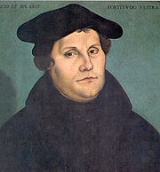
Martin Luther


Martin Luther


Martin Luther was a GermanGermany

Germany , officially the Federal Republic of Germany , is a country in central Europe....
 monkMonk

A monk is a person who practices asceticism, the conditioning of mind and body in favor of the spirit....
, theologianTheology

Theology is reasoned discourse concerning religion, spirituality and God....
, universityUniversity

A university is an institution of higher education and research, which grants academic degrees at all levels in a variety o...
 professorProfessor

The meaning of the word professor varies....
, Father of ProtestantismProtestantism Overview

Protestantism is one of three main groups currently within Christianity....
, and church reformerProtestant Reformers

The Protestant Reformers are those theologians, churchmen, and statesmen whose careers, works, and actions brought about the...
 whose ideas influenced the Protestant ReformationProtestant Reformation

The Protestant Reformation, also referred to as the Protestant Revolution, was a movement in the 16th century to refor...
 and changed the course of Western civilization.

Luther's theologyChristian theology

Christian theology practices theology from a Christian viewpoint or studies Christianity theologically....
 challenged the authority of the papacyPope

The Pope is the Bishop of Rome, and, as Successor of Saint Peter, is the head of the Catholic Church....
 by holding that the BibleBible

The Bible , is the name used by Jews and Christians for their differing canons of sacred texts....
 is the only infallible source of religious authority and that all baptizedBaptism

Baptism is generally a water purification ritual practiced in many of various religions including Christianity, Mandaeanism,...
 ChristiansChristianity

Christianity is a monotheistic religion centered on Jesus of Nazareth, and on his life and teachings as presented in the New...
 under Jesus are a universal priesthoodPriesthood of all believers

The priesthood of all believers is a Protestant doctrine based on the First Epistle of Peter, 2:9:...
. According to Luther, salvationSalvation

In religion, salvation refers to being saved from an undesirable state or condition....
 is a free gift of God, received only by true repentanceRepentance

Repentance is the feeling and act in which one recognizes and tries to right a wrong, or gain forgiveness from someone that ...
 and faithFaith

Faith is commonly known as a belief, trust or confidence often based on a transpersonal relationship with God, a higher powe...
 in JesusJesus

Jesus,Some of the historians and Biblical scholars who place the birth and death of Jesus within this range include D....
 as the MessiahMessiah Overview

In Judaism, the Messiah , Tiberian Hebrew ', Aramaic ') initially meant any person who was anointed by a prophe...
, a faith given by God and unmediated by the church.

Luther's confrontation with the Holy Roman EmperorHoly Roman Emperor

The Holy Roman Emperor was ruler of the Holy Roman Empire, a predecessor of numerous countries mainly in central Europe....
, Charles VCharles V, Holy Roman Emperor

Charles V was ruler of the Burgundian territories, King of Castile, King of Aragon, King of Naples and Sicily, Archduke of A...
, at the Diet of WormsDiet of Worms

The Diet of Worms was a general assembly of the estates of the Holy Roman Empire that took place in Worms, a small town on t...
 over freedom of conscience in 1521 and his refusal to submit to the authority of the Emperor resulted in his being declared an outlaw of the state as he had been excommunicated from the Roman Catholic ChurchRoman Catholic Church

The Roman Catholic Church or Catholic Church is the Christian Church in full communion with the Pope, the Bishop of Ro...
.

His translation of the BibleGerman Bible translations

German translations of the Bible existed already in the Middle Ages....
 into the vernacularVernacular Summary

Vernacular refers to the native language of a country or locality....
 made the Scriptures more accessible to ordinary people, and had a tremendous political impact on the church and on German culture.


Discussion
Ask a question about 'Martin Luther'
Start a new discussion about 'Martin Luther'
Answer questions from other users
Full Discussion Forum


Recent Posts


Timeline

1483   Born

1501   Martin Luther enters the University of Erfurt.

1512   Martin Luther becomes a doctor of theology .

1512   Martin Luther joins the theological faculty of the University of Wittenberg

1517   Protestant Reformation: Martin Luther posts his 95 Theses on the door of the Wittenberg Castle Church.

1519   Martin Luther questions the infallibility of papal decrees.

1519   Martin Luther joins the debate regarding papal authority against John Eck at Leipzig.

1520   Martin Luther burns a copy of The Book of Cannon Law (see Canon Law) and his copy of the Papal bull Exsurge Domine.

1521   Pope Leo X excommunicates Martin Luther in the papal bull ''Decet Romanum Pontificem''.

1521   18 - Martin Luther is examined before Emperor Charles V and the German Diet of Worms.


Quotations


For He that is mighty hath done great things for me, and Holy is His Name.

(Luke 1:49). Luther comments:

On coming to the house, they (

ink1" href="http://www.absoluteastronomy.com/topics/Magi">the Magi), saw the child with his mother Mary, and they bowed down and worshiped him." (Matthew 2:11)

I think these things ( firearms ) were invented by Satan himself, for they cant be defended against with (ordinary) weapons and fists. All human strength vanishes when confronted with firearms. A man is dead before he sees whats coming.

ibid. P.232, 1537-03-19, No 3552

Luther's Works, American Ed., Hans J. Hillerbrand, Helmut T. Lehmann ed., Philadelphia, Concordia Publishing House/Fortress Press, 1974, ISBN 0800603524 (Sermons II), vol. 52:198

Religion is not 'doctrinal knowledge,' but wisdom born of personal experience.

Holborn, Hajo; A HISTORY OF MODERN GERMANY: The Reformation; 1959/1982 Princeton university Press.


Encyclopedia


Martin Luther was a GermanGermany

Germany , officially the Federal Republic of Germany , is a country in central Europe....
 monkMonk

A monk is a person who practices asceticism, the conditioning of mind and body in favor of the spirit....
, theologianTheology

Theology is reasoned discourse concerning religion, spirituality and God....
, universityUniversity

A university is an institution of higher education and research, which grants academic degrees at all levels in a variety o...
 professorProfessor

The meaning of the word professor varies....
, Father of ProtestantismProtestantism Overview

Protestantism is one of three main groups currently within Christianity....
, and church reformerProtestant Reformers

The Protestant Reformers are those theologians, churchmen, and statesmen whose careers, works, and actions brought about the...
 whose ideas influenced the Protestant ReformationProtestant Reformation

The Protestant Reformation, also referred to as the Protestant Revolution, was a movement in the 16th century to refor...
 and changed the course of Western civilization.

Luther's theologyChristian theology

Christian theology practices theology from a Christian viewpoint or studies Christianity theologically....
 challenged the authority of the papacyPope

The Pope is the Bishop of Rome, and, as Successor of Saint Peter, is the head of the Catholic Church....
 by holding that the BibleBible

The Bible , is the name used by Jews and Christians for their differing canons of sacred texts....
 is the only infallible source of religious authority and that all baptizedBaptism

Baptism is generally a water purification ritual practiced in many of various religions including Christianity, Mandaeanism,...
 ChristiansChristianity

Christianity is a monotheistic religion centered on Jesus of Nazareth, and on his life and teachings as presented in the New...
 under Jesus are a universal priesthoodPriesthood of all believers

The priesthood of all believers is a Protestant doctrine based on the First Epistle of Peter, 2:9:...
. According to Luther, salvationSalvation

In religion, salvation refers to being saved from an undesirable state or condition....
 is a free gift of God, received only by true repentanceRepentance

Repentance is the feeling and act in which one recognizes and tries to right a wrong, or gain forgiveness from someone that ...
 and faithFaith

Faith is commonly known as a belief, trust or confidence often based on a transpersonal relationship with God, a higher powe...
 in JesusJesus

Jesus,Some of the historians and Biblical scholars who place the birth and death of Jesus within this range include D....
 as the MessiahMessiah Overview

In Judaism, the Messiah , Tiberian Hebrew ', Aramaic ') initially meant any person who was anointed by a prophe...
, a faith given by God and unmediated by the church.

Luther's confrontation with the Holy Roman EmperorHoly Roman Emperor

The Holy Roman Emperor was ruler of the Holy Roman Empire, a predecessor of numerous countries mainly in central Europe....
, Charles VCharles V, Holy Roman Emperor

Charles V was ruler of the Burgundian territories, King of Castile, King of Aragon, King of Naples and Sicily, Archduke of A...
, at the Diet of WormsDiet of Worms

The Diet of Worms was a general assembly of the estates of the Holy Roman Empire that took place in Worms, a small town on t...
 over freedom of conscience in 1521 and his refusal to submit to the authority of the Emperor resulted in his being declared an outlaw of the state as he had been excommunicated from the Roman Catholic ChurchRoman Catholic Church

The Roman Catholic Church or Catholic Church is the Christian Church in full communion with the Pope, the Bishop of Ro...
.

His translation of the BibleGerman Bible translations

German translations of the Bible existed already in the Middle Ages....
 into the vernacularVernacular Summary

Vernacular refers to the native language of a country or locality....
 made the Scriptures more accessible to ordinary people, and had a tremendous political impact on the church and on German culture. It furthered the development of a standard version of the German languageGerman language Summary

German is a West Germanic language....
, added several principles to the art of translation, and influenced the translation of the English King James Bible. His hymnHymn

A hymn is a type of song, usually religious, specifically written for the purpose of praise, adoration or prayer, and typica...
s inspired the development of congregational singing within Christianity. His marriage to Katharina von BoraKatharina von Bora

Katharina von Bora was a German Catholic nun who was an early convert to Protestantism....
 set a model for the practice of clerical marriageClerical marriage

Clerical marriage is the practice, followed in most Protestant churches, of allowing clergy to marry and have a family....
 within Protestantism.

Much scholarly debate has concentrated on Luther's writings about the JewJew Overview

Jews are followers of Judaism or, more generally, members of the Jewish people , an ethno-religious group descended from th...
s. His statements that Jews' homes should be destroyed, their synagogueSynagogue

A synagogue is a Jewish place of religious worship....
s burned, money confiscated and liberty curtailed were revived and used in propaganda by the NazisNational Socialist German Workers Party

The National Socialist German Workers Party , generally known in English as the Nazi Party, was a political party in G...
 in 1933–45. As a result of this and his revolutionary theological views, his legacy remains controversial.

Early life and the development of his ideas


Monastic and academic life


Luther dedicated himself to monastic life, devoting himself to fastsFasting

Fasting is the act of willingly abstaining from some or all food and in some cases drink, for a period of time....
, long hours in prayerPrayer

Prayer is an active effort to communicate with a deity or spirit, including a monotheist God, Saints, gods within a pantheon...
, pilgrimagePilgrimage

A pilgrimage is a term primarily used in religion and spirituality of a long journey or search of great moral significance....
, and frequent confessionConfession

Confession of sins is an integral part of the Christian faith and practice....
. Luther tried to please God through this dedication, but it only increased his awareness of his own sinfulness. He would later remark, "If anyone could have gained heaven as a monk, then I would indeed have been among them." Luther described this period of his life as one of deep spiritual despair. He said, "I lost touch with Christ the Savior and Comforter, and made of him the jailor and hangman of my poor soul."

Johann von StaupitzJohann von Staupitz

Johann Von Staupitz was a theologian, university preacher,Franz Posset, The Front-Runner of the Catholic Reformation: The Li...
, his superior, concluded that Luther needed more work to distract him from excessive introspection and ordered him to pursue an academic career. In 1507, he was ordained to the priesthood, and in 1508 began teaching theologyTheology

Theology is reasoned discourse concerning religion, spirituality and God....
 at the University of Wittenberg. He received a Bachelor's degree in Biblical studies on March 9, 1508, and another Bachelor's degree in the SentencesSentences

The Four Books of Sentences is Peter Lombard's seminal work, on which his reputation rests....
by Peter LombardPeter Lombard

Peter Lombard was a scholastic theologian and bishop of the 12th century....
 in 1509. On October 19, 1512, he was awarded his Doctor of TheologyDoctor of Theology

Doctor of Theology is a terminal academic degree in theology....
 and, on October 21, 1512, was received into the senate of the theological faculty of the University of Wittenberg, having been called to the position of Doctor in Bible. He spent the rest of his career in this position at the University of Wittenberg.

Indulgences, controversy and the start of the Reformation


In 1516-17, Johann TetzelJohann Tetzel

Johann Tetzel was a German Dominican friar who is perhaps best known for selling indulgences during the 16th century using ...
, a Dominican friar and papal commissioner for indulgences, was sent to Germany by the Roman Catholic Church to sell indulgences to raise money to rebuild St Peter's Basilica in Rome. Roman Catholic theology stated that faith alone, whether fiduciary or dogmatic, cannot justify man; and that only such faith as is active in charity and good works (fides caritate formata) can justify man. These good works could be obtained by donating money to the church.

On October 31, 1517, Luther wrote to Albrecht, Archbishop of Mainz and Magdeburg, protesting the sale of indulgences. He enclosed in his letter a copy of his "Disputation of Martin Luther on the Power and Efficacy of Indulgences," which came to be known as The 95 Theses. Hans Hillerbrand writes that Luther had no intention of confronting the church, but saw his disputation as a scholarly objection to church practices, and the tone of the writing is accordingly "searching, rather than doctrinaire." Hillerbrand writes that there is nevertheless an undercurrent of challenge in several of the theses, particularly in Thesis 86, which asks: "Why does the pope, whose wealth today is greater than the wealth of the richest Crassus, build the basilica of St. Peter with the money of poor believers rather than with his own money?"

Luther objected to a saying attributed to Johann Tetzel that "As soon as the coin in the coffer rings, the soul from purgatory springs," insisting that, since forgiveness was God's alone to grant, those who claimed that indulgences absolved buyers from all punishments and granted them salvation were in error. Christians, he said, must not slacken in following Christ on account of such false assurances.

According to Philipp MelanchthonFacts About Philipp Melanchthon

Philipp Melanchthon was a German professor and theologian, a key leader of the Lutheran Reformation, and a friend and asso...
, writing in 1546, Luther nailed a copy of the 95 Theses to the door of the Castle ChurchAll Saints' Church, Wittenberg

All Saints' Church, commonly referred to as Schlosskirche, meaning "Castle Church" ? to distinguish it from the ...
 in WittenbergWittenberg

Wittenberg, officially [Die] Lutherstadt Wittenberg, is a town in Germany, in the Bundesland Saxony-Anhalt, at 1...
 that same day — church doors acting as the bulletin boards of his time — an event now seen as sparking the Protestant ReformationReformation Overview

Reformation may refer to:Movements:...
, and celebrated every October 31 as Reformation DayReformation Day

Reformation Day is a minor festival celebrated in remembrance of the Reformation, particularly by Lutheran and Reformed chur...
. Some scholars have questioned the accuracy of Melanchthon's account, noting that no contemporaneous evidence exists for it. Others have countered that no such evidence is necessary, because this was the customary way of advertising an event on a university campus in Luther's day.

The 95 Theses were quickly translated from Latin into German, printed, and widely copied, making the controversy one of the first in history to be aided by the printing pressPrinting press

The printing press is a mechanical printing device for making copies of identical text on multiple sheets of paper....
. Within two weeks, the theses had spread throughout Germany; within two months throughout Europe.

Justification by faith

From 1510 to 1520, Luther lectured on the Psalms, the books of Hebrews, Romans, and Galatians. As he studied these portions of the Bible, he came to view the use of terms such as penancePenance

Penance is, strictly, repentance of sins as well as the actual name of the Catholic Sacrament of Penance and Reconciliation/...
 and righteousnessRighteousness

Righteousness in this article refers to the important theological concept in Sikhism, Judaism and Christianity....
 by the Roman Catholic Church in new ways. He became convinced that the church was corrupt in their ways and had lost sight of what he saw as several of the central truths of Christianity, the most important of which, for Luther, was the doctrine of justificationJustification (theology)

In Christian theology, justification is God's act of declaring or making a sinner righteous before God....
 — God's act of declaring a sinner righteous — by faith alone through God's grace. He began to teach that salvationSalvation

In religion, salvation refers to being saved from an undesirable state or condition....
 or redemption is a gift of God's graceDivine grace

In Christianity, divine grace refers to the sovereign favor of God for humankind, especially in regard to salvation — ...
, attainable only through faith in Jesus as the messiahMessiah

In Judaism, the Messiah , Tiberian Hebrew ', Aramaic ') initially meant any person who was anointed by a prophe...
.

Luther came to understand justification as entirely the work of God. Against the teaching of his day that the righteous acts of believers are performed in cooperation with God, Luther wrote that Christians receive such righteousness entirely from outside themselves; that righteousness not only comes from Christ but actually is the righteousness of Christ, imputed to Christians (rather than infused into them) through faith. "That is why faith alone makes someone just and fulfills the law," he wrote. "Faith is that which brings the Holy SpiritHoly Spirit

In various religions, most notably Trinitarian Christianity, the Holy Spirit is the third consubstantial Person of the Holy...
 through the merits of Christ." Faith, for Luther, was a gift from God. He explained his concept of "justification" in the Smalcald ArticlesSmalcald Articles

The Smalcald Articles are a summary of Lutheran doctrine, written by Martin Luther in 1537 for a meeting of the Smalcaldic L...
:

Response of the papacy


In contrast to the speed with which the theses were distributed, the response of the papacy was painstakingly slow.

Cardinal Albrecht of Hohenzollern, Archbishop of Mainz and Magdeburg, with the consent of Pope Leo XPope Leo X

Pope Leo X, born Giovanni di Lorenzo de' Medici was Pope from 1513 to his death....
, was using part of the indulgence income to pay his bribery debts, and did not reply to Luther’s letter; instead, he had the theses checked for heresy and forwarded to Rome.

Leo responded over the next three years, "with great care as is proper," by deploying a series of papal theologians and envoys against Luther. Perhaps he hoped the matter would die down of its own accord, because in 1518 he dismissed Luther as "a drunken German" who "when sober will change his mind".

Widening breach

Luther's writings circulated widely, reaching France, England, and Italy as early as 1519, and students thronged to Wittenberg to hear him speak. He published a short commentary on GalatiansEpistle to the Galatians

The Epistle to Galatians is a book of the New Testament....
 and his Work on the Psalms. At the same time, he received deputations from Italy and from the Utraquists of Bohemia; Ulrich von HuttenUlrich von Hutten

Ulrich von Hutten was an outspoken critic of the Roman Catholic Church and adherent of the Lutheran Reformation....
 and Franz von SickingenFranz von Sickingen

...
 offered to place Luther under their protection.

This period of Luther's career was one of his most creative and productive. Three of his best known works were published in 1520: To the Christian Nobility of the German NationTo the Christian Nobility of the German Nation

To the Christian Nobility of the German Nation is one of three tracts written by Martin Luther in 1520....
, On the Babylonian Captivity of the ChurchFacts About On the Babylonian Captivity of the Church

Prelude on the Babylonian Captivity of the Church was the second of the three major treatises published by Martin Luther in ...
, and On the Freedom of a ChristianOn the Freedom of a Christian

On the Freedom of a Christian was the third of Martin Luthers major reforming treatises of 1520, appearing after his Add...
.

Finally on May 30th in 1519 when the Pope demanded an explanation, Luther wrote a summary and explanation of his theses to the Pope. While the Pope may have conceded some of the points, he did not like the challenge to his authority so he summoned Luther to Rome to answer these. At that point Frederick the Wise, the Saxon Elector, intervened. He did not want one of his subjects to be sent to Rome to be judged by Italians so he prevailed on the Holy Roman Emperor Charles V who needed his support to arrange a compromise.

An arrangement was effected, however, whereby that summons was cancelled, and Luther went to Augsburg in October 1518 to meet the papal legate, Cardinal Thomas CajetanThomas Cajetan

* For the saint, see Saint Cajetan....
. The argument was long but nothing was resolved.

Excommunication


On June 15, 1520, the Pope warned Luther with the papal bullPapal bull

A Papal bull is a special kind of patent or charter issued by a pope and named for the seal that was appended to the end to ...
 (edict) Exsurge DomineExsurge Domine

Exsurge Domine was a papal bull issued on June 15, 1520 by Pope Leo X in response to the teachings of Martin Luther in oppos...
that he risked excommunicationExcommunication

Excommunication is a religious censure which is used to deprive or suspend membership in a religious community....
 unless he recanted 41 sentences drawn from his writings, including the 95 Theses95 Theses Summary

The Disputation of Martin Luther on the Power and Efficacy of Indulgences, known as the 95 Theses, challenged the...
, within 60 days.

That autumn, Johann EckJohann Eck Summary

Johann Eck was a 16th century theologian and defender of Catholicism during the Protestant Reformation....
 proclaimed the bull in Meissen and other towns. Karl von MiltitzFacts About Karl von Miltitz

Karl von Miltitz was a papal nuncio and a Mainz Cathedral canon....
, a papal nuncioNuncio

Nuncio is an ecclesiastical diplomatic title, derived from the ancient Latin Nuntius, meaning any envoy....
, attempted to broker a solution, but Luther, who had sent the Pope a copy of On the Freedom of a Christian in October, publicly set fire to the bull and decretalDecretal

Decretals is the name that is given in Canon law to those letters of the pope which formulate decisions in ecclesiastical la...
s at Wittenberg on December 10, 1520, an act he defended in Why the Pope and his Recent Book are Burned and Assertions Concerning All Articles.

As a consequence, Luther was excommunicated by Leo XPope Leo X

Pope Leo X, born Giovanni di Lorenzo de' Medici was Pope from 1513 to his death....
 on January 3, 1521, in the bull Decet Romanum PontificemDecet Romanum Pontificem

Decet Romanum Pontificem is the papal bull excommunicating Martin Luther, bearing the title of the first three Latin words o...
.

Exile


Diet of Worms


The enforcement of the ban on the 41 sentences fell to the secular authorities. On April 18, 1521, Luther appeared as ordered before the Diet of WormsDiet of Worms

The Diet of Worms was a general assembly of the estates of the Holy Roman Empire that took place in Worms, a small town on t...
 (Reichstag zu Worms). This was a general assembly (a diet, pronounced dee-et) of the estates of the Holy Roman Empire that took place in WormsWorms, Germany

Worms is a city in the southwest of Germany....
 (pronounced with the W as a V: Vorms), a town on the RhineRhine

The Rhine River is one of the longest and most important rivers in Europe at 1,320 kilometres , with an average discharge o...
. It was conducted from January 28 to May 25, 1521, with Emperor Charles VCharles V, Holy Roman Emperor

Charles V was ruler of the Burgundian territories, King of Castile, King of Aragon, King of Naples and Sicily, Archduke of A...
 presiding. Prince Frederick III, Elector of SaxonyFrederick III, Elector of Saxony

Frederick III, Elector of Saxony, also known as Frederick the Wise, was Elector of Saxony from 1486 to his death....
, obtained an agreement that Luther would be promised safe passage to and from the meeting.

Johann Eck, speaking on behalf of the Empire as assistant of the Archbishop of Trier, presented Luther with copies of his writings laid out on a table, and asked him if the books were his, and whether he stood by their contents. He confirmed he was the author, but requested time to think about the answer to the second question. He prayed, consulted friends, and gave his response the next day: "Unless I shall be convinced by the testimonies of the Scriptures or by clear reason ... I neither can nor will make any retraction, since it is neither safe nor honourable to act against conscience." He is also famously said to have added: "Hier stehe ich. Ich kann nicht anders. Gott helfe mir. Amen." ("Here I stand. I can do no other. God help me. Amen."). This description of the declaration may be apocryphaApocrypha

Apocrypha are texts of uncertain authenticity or writings where the authorship is questioned....
l, as only the last four words appear in contemporaneous accounts.

Over the next five days, private conferences were held to determine Luther's fate. The Emperor presented the final draft of the Edict of Worms on May 25, 1521, declaring Luther an outlawOutlaw

An outlaw, a person living the lifestyle of outlawry, meaning literally "outside of the law." In the common law of En...
, banning his literature, and requiring his arrest: "We want him to be apprehended and punished as a notorious heretic". It also made it a crime for anyone in Germany to give Luther food or shelter. It permitted anyone to kill Luther without legal consequence. The Edict was a divisive move that distressed more moderate men, in particular Desiderius ErasmusDesiderius Erasmus

Desiderius Erasmus Roterodamus was a Dutch humanist and theologian....
.

Exile at Wartburg Castle


The apprehension of Luther was the last thing Frederick III, Elector of SaxonyFrederick III, Elector of Saxony

Frederick III, Elector of Saxony, also known as Frederick the Wise, was Elector of Saxony from 1486 to his death....
 wanted, so he had him discreetly intercepted on his way home by masked horsemen and escorted to the security of the Wartburg CastleWartburg Castle

Wartburg Castle is situated to the southwest of and overlooking the town of Eisenach in Thuringia, Germany, on a 1230-foot p...
 at Eisenach, where Luther grew a beard and lived incognito for nearly eleven months, pretending to be a knight called Junker Jörg.

During his stay at Wartburg (May 1521-March 1522), which he referred to as "my Patmos", Luther translated the New TestamentNew Testament

The New Testament , sometimes called the Greek Testament or Greek Scriptures, and sometimes also New Covenant...
 from Greek into German, and poured out doctrinal and polemical writings, including in October a renewed attack on Archbishop Albrecht of MainzAlbert of Mainz

Cardinal Albert of Hohenzollern was Elector and Archbishop of Mainz from 1514 to 1545, and Archbishop of Magdeburg from 151...
, whom he shamed into halting the sale of indulgences in his episcopates, and a "Refutation of the argument of Latomus," in which he expounded the principle of justification to a philosopher from Louvain. In a letter to Melanchthon of 1 August 1521, he wrote:


In On the Abrogation of the Private Mass, in the summer of 1521, Luther widened his target from individual pieties like indulgences and pilgrimages to doctrines at the heart of Church practices. His essay Concerning Confession rejected the Roman Catholic Church's requirement of confessionConfession

Confession of sins is an integral part of the Christian faith and practice....
, although he affirmed the value of private confession and absolution. In the introduction to his New Testament — published in September 1522 and selling 5,000 copies in two months — he explained that good works spring from faith; they do not produce it.

In Wittenberg, Andreas KarlstadtAndreas Karlstadt

Andreas Rudolph Bodenstein von Karlstadt, better known as Andreas Karlstadt, was a Christian theologian during the Prote...
, later supported by the ex-Augustinian Gabriel ZwillingGabriel Zwilling

Gabriel Zwilling was born near Annaberg, Saxony....
, enacted a divisive programme of reform which exceeded anything envisaged by Luther and provoked disturbances, including a revolt by the Augustinian monks against their prior, the smashing of statues and images in churches, and denunciations of the magistracy. After secretly visiting Wittenberg in early December 1521, Luther wrote A Sincere Admonition by Martin Luther to All Christians to Guard Against Insurrection and Rebellion; but Wittenberg became more volatile after Christmas when a band of visionary zealots, the so-called Zwickau prophetsZwickau prophets

The Zwickau Prophets were early sixteenth century Anabaptists in Zwickau in Saxony....
, arrived preaching the equality of man, adult baptism, Christ’s imminent return, and other revolutionary doctrines. Luther decided it was time to act.

Return to Wittenberg

Around Christmas 1521, AnabaptistAnabaptist

Anabaptists are Christians of the Radical Reformation....
s from Zwickau entered Wittenberg and caused considerable civil unrest. Thoroughly opposed to their radical views and fearful of their results, Luther secretly returned to Wittenberg on March 6, 1522. "During my absence," he wrote to the Elector, "Satan has entered my sheepfold, and committed ravages which I cannot repair by writing, but only by my personal presence and living word." Years later, Luther named his first and only daughter - Jamie Wittenberg- after the city.

For eight days in LentLent

In Western Christianity, Lent is the period from Ash Wednesday to Holy Saturday, the day before Easter Sunday....
, beginning on March 9, Invocavit Sunday, and concluding the following Sunday, Luther preached eight sermons, which became known as the "Invocavit Sermons." In these sermons, he hammered home the primacy of core Christian values such as love, patience, charity, and freedom, and reminded the citizens to trust God's word rather than violence to bring about necessary change.

The effect of Luther’s intervention was instantaneous. After the sixth sermon, Jerome Schurf wrote to the elector: "Oh, what joy has Dr. Martin’s return spread among us! His words, through divine mercy, are bringing back every day misguided people into the way of the truth."

Luther next set about reversing or softening some of the new church practices and worked alongside the authorities to restore public order, signaling his reinvention as a conservative force within the Reformation. After banishing the Zwickau prophets, who abused him as a new pope, he now faced a battle not only against the corrupt and distorted practices of the established Church but against those on his own side who threatened the new order by fomenting social unrest and even violence.

Marriage and family


On the evening of June 13, 1525, Luther married Katharina von BoraKatharina von Bora

Katharina von Bora was a German Catholic nun who was an early convert to Protestantism....
, one of a group of 12 nuns he had helped escape from the Nimbschen Cistercian convent in April 1523, arranging for them to be smuggled out in herring barrels. "Suddenly, and while I was occupied with far different thoughts," he wrote to his friend Link, "the Lord has plunged me into marriage." Katharina was twenty-six years old, Luther forty-two.

A few priests and former monks had already married, including Andreas KarlstadtAndreas Karlstadt

Andreas Rudolph Bodenstein von Karlstadt, better known as Andreas Karlstadt, was a Christian theologian during the Prote...
 and Justus JonasJustus Jonas

Justus Jonas was a German Protestant reformer....
, but Luther’s marriage set the seal of approval on clerical marriage. He had long condemned vows of celibacyCelibacy

Celibacy refers either to being unmarried or to sexual abstinence....
 on biblical grounds, but his decision to marry surprised many, not least Melanchthon, who called it reckless. Luther had written to Spalatin on November 30, 1524, "I shall never take a wife, as I feel at present. Not that I am insensible to my flesh or sex (for I am neither wood nor stone); but my mind is averse to wedlock because I daily expect the death of a heretic." Melanchthon reveals in a letter that prior to his marriage, Luther had been living on the plainest food, and that his mildewed bed was not properly made for months at a time.

Luther and Katharina moved into a former monasteryMonastery

Monastery, a term derived from the Greek word ??ast????? monasterion, denotes the habitation-and-workplace of a communit...
 "The Black Cloister," a wedding present from the new elector John FrederickJohn Frederick Summary

John Frederick is the name of:* Johann Friedrich I "the Magnanimous", Elector of Saxony...
, and embarked upon what appears to have been a happy and successful marriage. Between bearing six children, Katharina, whose judgement Luther respected, helped earn the couple a living by farming the land and taking in boarders. Luther confided to Stiefel on August 11, 1526: "Catharina, my dear rib ... is, thanks to God, gentle, obedient, compliant in all things, beyond my hopes. I would not exchange my poverty for the wealth of Croesus."

By the time of Katharina's death, the surviving of the five Luther children were adults. Hans studied law and became a court advisor. Martin studied theology, but never had a regular pastoral call. Paul became a physician. He fathered six children, and the male line of the Luther family continued through him to John Ernest LutherJohn Ernest Luther

John Ernest Luther was the last descendant of Martin Luther through the male line....
, ending in 1759. Margaretha Luther, born in WittenbergWittenberg

Wittenberg, officially [Die] Lutherstadt Wittenberg, is a town in Germany, in the Bundesland Saxony-Anhalt, at 1...
 on December 17, 1534, married into a noble and wealthy Prussian family, to Georg von Kunheim and wife Margarethe, Truchsessin von Wetzhausen (1490 – 1527) but died in MühlhausenMühlhausen

M?hlhausen is a city in the federal state Thuringia, Germany....
 in 1570 at the age of thirty-six. However, her descendants have continued to the present, and include President Paul von HindenburgPaul von Hindenburg

Paul Ludwig Hans Anton von Beneckendorff und von Hindenburg, known universally as Paul von Hindenburg was a German Fi...
, the Counts zu Eulenburg, and Princes zu Eulenburg und Hertefeld.

Peasants' War

Despite his victory in Wittenberg, Luther was unable to stifle radicalism further afield. Preachers such as Zwickau prophet Nicholas StorchNicholas Storch

Nicholas Storch was a radical reformation preacher and a weaver by trade....
 and Thomas Müntzer — whose rallying cry was "let not your sword grow cold from blood" — helped instigate the Peasants' WarPeasants' War

The Peasants' War was a popular revolt in Europe, specifically in the Holy Roman Empire between 1524-1525....
 in 1524, during which many atrocities were committed, often in Luther's name. This war was being pursued by the peasantry in order to establish a classless society with shared goods. In 1525, Müntzer eventually succeeded in establishing a short-lived communist theocracy.

There had been revoltsPopular revolt in late medieval Europe

Popular revolts in late medieval Europe were uprisings and rebellions by peasants in the countryside, or the bourgeois in to...
 by the peasantry on a smaller scale since the 15th century; many of the peasants now believed that Luther's attack on the Church and the hierarchy meant that the reformers would support an attack on the upper classes in general, because of the close ties between the secular princes and the princes of the Church. Revolts broke out in SwabiaSwabia

Swabia is both a historic and linguistic region in Germany....
, FranconiaFranconia Overview

Franconia is a historic region in Germany, which today forms three administrative regions of the German federal state of Ba...
, and ThuringiaThuringia

The Republic of Thuringia lies in central Germany and is among the smaller of the country's sixteen Bundeslnder , being...
 in 1524, gaining support from disaffected nobles too, many of whom were in debt. Gaining momentum and a new leader in Thomas MüntzerThomas Muentzer

Thomas Muentzer was an early Reformation-era German pastor who was a rebel leader during the Peasants' War....
, the revolts turned into warWar

War is a conflict involving the organized use of weapons and physical force by states or other large-scale groups....
.

Luther sympathized with the peasants' grievances, as he showed in his response to the Twelve Articles of the Black ForestTwelve Articles of the Black Forest

The Twelve Articles of the Black Forest are part of the peasants' demands raised towards the Swabian League in the Peasants'...
 in May 1525, but he reminded them to obey the temporal authorities and became enraged at the widespread burning of convents, monasteries, bishops’ palaces, and libraries. In Against the Murderous, Thieving Hordes of PeasantsAgainst the Murderous, Thieving Hordes of Peasants

Against the Murderous, Thieving Hordes of Peasants A tract written by Martin Luther in May, 1525....
(1525), he explained the Gospel teaching on wealth, condemned the violence as the devil's work, and called for the nobility to put down the rebels like mad dogs:

In Against the Murderous, Thieving Hordes of Peasants Luther opposed the peasant movement for three reasons. First, instead of conducting themselves appropriately by lawfully submitting to the secular government, the peasants chose to resort to violence, therefore failing to heed Christ's counsel to "Render unto Caesar the things that are Caesar's." Second, due to the peasant's violent actions of rebelling, robbing, and plundering, Luther explained that they were "outside the law of God and Empire," therefore meriting "death in body and soul, if only as highwaymen and murderers." Lastly, Luther presented how the peasants "cloak this terrible and horrible sin with the Gospel" and call themselves "Christian brethren," sins which Luther considered utter blasphemy.

Without Luther's backing for the uprising, many rebels laid down their weapons; others felt betrayed. Their defeat by the Swabian LeagueSwabian League

The Swabian League was an association of German cities, principalities and knights principally in the territory which had fo...
 at the Battle of Frankenhausen on May 25, 1525, followed by Müntzer’s execution, brought the revolutionary stage of the Reformation to a close. Thereafter, radicalism found a refuge in the anabaptistAnabaptist

Anabaptists are Christians of the Radical Reformation....
 movement, while Luther's Reformation flourished under the wing of the secular powers.

Catechisms


In 1528, Luther visited parishes and schools in Saxony to determine the quality of pastoral care and Christian education. He wrote in the preface to The Small CatechismLuther's Small Catechism

Luther's Small Catechism was written by Martin Luther and published in 1529 for the training of children....
: "Mercy! Good God! what manifold misery I beheld! The common people, especially in the villages, have no knowledge whatever of Christian doctrine, and, alas! many pastors are altogether incapable and incompetent to teach."

In response, he prepared the Small Catechism and Large CatechismLuther's Large Catechism

Luther's Large Catechism consisted of works written by Martin Luther and compiled Christian canonical texts, published in Ap...
, instructional and devotional material on the Ten CommandmentsTen Commandments

The Ten Commandments, or Decalogue, are a list of religious and moral imperatives which, according to religious tradit...
, the Apostles' CreedApostles' Creed

The Apostles' Creed , sometimes titled Symbol of the Apostles, is an early statement of Christian belief, a creed or "...
, the Lord's PrayerLord's Prayer

The Lord's Prayer , sometimes also known amongst English speakers as the Pater Noster or the Our Father, is prob...
, baptismBaptism

Baptism is generally a water purification ritual practiced in many of various religions including Christianity, Mandaeanism,...
, confession and absolution, and the Lord's SupperLord's Supper

The Lord's Supper may refer to:*Eucharist, a rite in Christianity...
. The Small Catechism was supposed to be read by the people themselves, and the Large Catechism by the pastors; both remain popular instructional materials among LutheransLutheranism Overview

Lutheranism is a movement within Christianity that began with the theological insights of Martin Luther in the 16th century,...
. Luther, who was modest about the publishing of his collected works, thought his catechisms were one of two works he would not be embarrassed to call his own: "Regarding the plan to collect my writings in volumes, I am quite cool and not at all eager about it because, roused by a Saturnian hunger, I would rather see them all devoured. For I acknowledge none of them to be really a book of mine, except perhaps the one Bondage of the WillOn the Bondage of the Will

On the Bondage of the Will, by Martin Luther, was published in December 1525....
and the Catechism."

Luther's translation of the Bible


Luther translated the BibleBible Summary

The Bible , is the name used by Jews and Christians for their differing canons of sacred texts....
 from Greek into German to make it more accessible to ordinary people, a task he began alone in 1521 during his stay in the WartburgWartburg

Wartburg is a castle overlooking the town of Eisenach, Germany....
 castle. He was not the first translator of it into German, but he was by far the greatest, according to Philip Shaff, who writes that, had Luther done nothing but this, he would remain one of the "greatest benefactors of the German-speaking race."

His translation of The New Testament was published in September 1522 and, in collaboration with Johannes BugenhagenJohannes Bugenhagen

Johannes Bugenhagen, also called Doktor Pomeranus by Martin Luther, introduced the Reformation in Pomerania and Denmark ...
, Justus JonasJustus Jonas

Justus Jonas was a German Protestant reformer....
, Caspar CreuzigerCaspar Creuziger

Caspar Creuziger, was a German Humanist "Cruciger, Caspar," in The Oxford Encyclopedia of the Reformation, ed....
, Philipp MelanchthonPhilipp Melanchthon

Philipp Melanchthon was a German professor and theologian, a key leader of the Lutheran Reformation, and a friend and asso...
, Matthäus AurogallusMatthäus Aurogallus Summary

Matth?us Aurogallus, also known as Matth?us Goldhahn was a German linguist....
, and George Rörer, the Old and New Testaments together in 1534. He worked on refining the translation for the rest of his life.

The Luther BibleLuther Bible

The Luther Bible is a German Bible translation by Martin Luther, first printed with both testaments in 1534....
 contributed to the emergence of the modern German language and is regarded as a landmark in German literatureGerman literature

German literature comprises those literary texts written in the German language....
. The 1534 edition was influential on William TyndaleWilliam Tyndale

William Tyndale was a 16th century religious reformer and scholar who translated the Bible into the Early Modern English o...
's translation, a precursor of the King James Bible. Philip SchaffPhilip Schaff Overview

Philip Schaff, was a Swiss-born, German-educated theologian and a historian of the Christian church, who, after his educatio...
, the 19th century theologian, said of the work:

Liturgy and church government


Luther's German MassDeutsche Messe

Deutsche Messe, or The German Mass, was published by Martin Luther in 1526....
of 1526 provided for weekday services and for catechetical instruction. He strongly objected to making a new law of the forms and urged the retention of other good liturgies. While advocating Christian liberty in liturgical matters, he also spoke out in favor of maintaining and establishing liturgical uniformity among those sharing the same faith in a given area.

He saw in liturgical uniformity a fitting outward expression of unity in the faith, while in liturgical variation, an indication of possible doctrinal variation. He did not consider liturgical change a virtue, especially when it might be made by individual Christians or congregations: he was content to conserve and reform what the Church had inherited from the past. He eliminated and condemned those parts of the Roman Catholic Mass that taught that the Eucharist was a propitiatory sacrifice and the body and blood of Christ by transubstantiationTransubstantiation

Transubstantiation is the change of the substance of bread and wine into that of the body and blood of Christ, the chan...
, but retained the use of historic liturgical forms and customs.

Eucharist controversy


Luther's viewsSacramental Union

Sacramental Union is the Lutheran theological view of the Real Presence of the body and blood of Christ in the Christian Euc...
 on the EucharistEucharist

The Eucharist or Communion or The Lord's Supper, is the rite that Christians perform in fulfillment of Jesus' in...
 — the sacramentSacrament

A sacrament is a Christian rite that mediates divine grace—a holy Mystery....
 of the Lord's SupperLord's Supper

The Lord's Supper may refer to:*Eucharist, a rite in Christianity...
 — were put to the test in October 1529 at the Marburg ColloquyMarburg Colloquy Summary

The Marburg Colloquy was a meeting which attempted to mediate between the different opinions of the Lutherans and Zwinglians...
, an assembly of Protestant theologians gathered by Philip I, Landgrave of HessePhilip I, Landgrave of Hesse

Philip I of HESSE,, was a leading champion of the Reformation and one of the most important German rulers of the Renaissance....
, to establish doctrinal unity in the emerging Protestant states. Agreement was achieved on most points, the exception being the nature of the Eucharist, an issue crucial to Luther.

The theologians, including Zwingli, Andreas KarlstadtAndreas Karlstadt

Andreas Rudolph Bodenstein von Karlstadt, better known as Andreas Karlstadt, was a Christian theologian during the Prote...
, Leo JudLeo Jud Overview

Leo Jud,, known to his contemporaries as Meister Leu, Swiss reformer, was born in Alsace....
, and Johannes OecolampadiusJohannes Oecolampadius

Johannes colampadius or kolampad was a German religious reformer, whose real name was Hussgen or Heussgen....
, differed on the significance of the words spoken by Jesus at the Last SupperLast Supper

According to gospel, the Last Supper was the last meal Jesus shared with his apostles before his death....
: "This is my body which is for you," "This cup is the new covenant in my blood". Luther insisted on the Real PresenceReal Presence

The Real Presence is the term various Christian traditions use to express their belief that, in the Eucharist, Jesus the Chr...
 of the body and blood of Christ in the consecrated bread and wine, but the other theologians believed God to be only symbolically present: Zwingli, for example, denied Jesus's ability to be in more than one place at a time. But Luther, who affirmed the doctrine of Hypostatic UnionHypostatic union

In Christian theology, the hypostatic union is the dual nature of Jesus Christ as being simultaneously God and Man....
, that Jesus is both man and God, was clear:

Even more forcefully, Luther expressed his belief in the real presence in a letter to the Christians in Strassburg, Dec. 15, 1524:

Despite these disagreements on the Eucharist, the Marburg Colloquy paved the way for the signing in 1530 of the Augsburg ConfessionAugsburg Confession

The Augsburg Confession, also known as the "Augustana" from its Latin name, Confessio Augustana, is the primary confessi...
, and for the formation of the Schmalkaldic LeagueSchmalkaldic League

The Schmalkaldic League was a defensive league of Protestant princes in the Holy Roman Empire in the mid-16th century....
 the following year by leading Protestant nobles such as Philip of Hesse, John Frederick of Saxony, and Georg, Margrave of Brandenburg-Ansbach. According to Luther, agreement in the faith was not necessary prior to entering political alliances. Nevertheless, interpretations of the Eucharist differ among Protestants to this day.

Augsburg Confession


Charles VCharles V, Holy Roman Emperor

Charles V was ruler of the Burgundian territories, King of Castile, King of Aragon, King of Naples and Sicily, Archduke of A...
, the Holy Roman EmperorHoly Roman Emperor

The Holy Roman Emperor was ruler of the Holy Roman Empire, a predecessor of numerous countries mainly in central Europe....
, convened an Imperial DietImperial Diet

Imperial Diet means the highest representative assembly in an empire, notably:...
 in AugsburgAugsburg

Augsburg is a city in south-central Germany....
 in 1530 with the goal of uniting the empireHoly Roman Empire Overview

The Holy Roman Empire was a mainly Central European conglomeration of lands in the Middle Ages and the early modern period, ...
 against the Ottoman Turks, who had besieged ViennaSiege of Vienna

The Siege of Vienna of 1529, as distinct from the Battle of Vienna in 1683, represented the farthest westward advance into c...
 the previous autumn.

To achieve unity, Charles required a resolution of the religious controversies in his realm. Luther, still under the Imperial Ban, was left behind at the CoburgCoburg Overview

Coburg is a city located on the Itz River in Bavaria, Germany....
 fortress while his elector and colleagues from Wittenberg attended the diet. The Augsburg ConfessionAugsburg Confession

The Augsburg Confession, also known as the "Augustana" from its Latin name, Confessio Augustana, is the primary confessi...
, a summary of the Lutheran faith authored by Philipp MelanchthonPhilipp Melanchthon

Philipp Melanchthon was a German professor and theologian, a key leader of the Lutheran Reformation, and a friend and asso...
 but influenced by Luther, was read aloud to the emperor. It was the first Lutheran confession included in the Book of ConcordBook of Concord Summary

**The Athanasian Creed* The Augsburg Confession of 1530...
 of 1580, and is regarded as the principal confession of the Lutheran Church.

Philip of Hesse controversy

In 1539, Luther became involved in controversy surrounding the bigamy of Philip I, Landgrave of HesseFacts About Philip I, Landgrave of Hesse

Philip I of HESSE,, was a leading champion of the Reformation and one of the most important German rulers of the Renaissance....
, who wanted to marry one of his wife's ladies-in-waiting. Luther ruled that polygamyPolygamy

The term polygamy is used in related ways in social anthropology and sociobiology and sociology....
 was acceptable, noting that the patriarchsPatriarchs (Bible)

The Patriarchs, known as the Avot in Hebrew, are Abraham, his son Isaac and his grandson Jacob....
 of the Old TestamentOld Testament

The Old Testament or the Hebrew Scriptures constitutes the first major part of the Bible used by Christians....
 had had more than one wife, and so Philip entered into the second marriage in secret. Philip's sister made news of the marriage public a few weeks later, scandalizing Germany.

Final years and death


Luther had been suffering from ill health for years, including constipationConstipation

Constipation or irregularity, is a condition of the digestive system where a person experiences hard feces that are di...
, hemorrhoidHemorrhoid

Hemorrhoids are varicosities or swelling and inflammation of veins in the rectum and anus. ...
s, Ménière's diseaseMénière's disease

Mnire's disease is named after the French physician Prosper Mnire, who first reported that vertigo was caused by inner ear ...
|vertigo]], faintingFainting

Fainting or syncope is a sudden loss of consciousness due to a lack of sufficient blood and oxygen reaching the brai...
, and tinnitusTinnitus

Tinnitus ' is the perception of sound in the absence of a corresponding external sound....
), and a cataractCataract

A cataract is an opacity that develops in the, crystalline lens of the eye or in its envelope....
 in one eye. From 1531–1546, his health deteriorated further. The years of struggle with Rome, the antagonisms with and among his fellow reformers, and the scandal which ensued from the bigamy of the Philip of Hesse incident, in which Luther had played a leading role, all may have contributed. In 1536, he began to suffer from kidney and bladder stonesKidney stone

Kidney stones, also known as nephrolithiases, urolithiases or renal calculi, are solid accretions of dissolved ...
, and arthritisArthritis

Arthritis is a group of conditions where there is damage caused to the joints of the body....
, and an ear infection ruptured an ear drum. In December 1544, he began to feel the effects of angina.

His physical health made him short-tempered and even harsher in his writings and comments. His wife Katie was overheard saying, "Dear husband, you are too rude," and he responded, "They are teaching me to be rude."

His last sermon was delivered at EislebenEisleben

Eisleben was first mentioned in 994 as a market called Islebia and in 1180 as a town....
, his place of birth, on February 15, 1546, three days before his death. It was "entirely devoted to the obdurate Jews, whom it was a matter of great urgency to expel from all German territory," according to Léon PoliakovLeon Poliakov

Lon Poliakov was a historian who wrote extensively on the Holocaust and anti-Semitism....
. James Mackinnon writes that it concluded with a "fiery summons to drive the Jews bag and baggage from their midst, unless they desisted from their calumny and their usury and became Christians." Luther said, "we want to practice Christian love toward them and pray that they convert," but also that they are "our public enemies ... and if they could kill us all, they would gladly do so. And so often they do."

Luther's final journey, to Mansfeld, was taken due to his concern for his siblings' families continuing in their father Hans Luther's copper mining trade. Their livelihood was threatened by Count Albrecht of Mansfeld bringing the industry under his own control. The controversy that ensued involved all four Mansfeld counts: Albrecht, Philip, John George, and Gerhard. Luther journeyed to Mansfeld twice in late 1545 to participate in the negotiations for a settlement, and a third visit was needed in early 1546 for their completion.

The negotiations were successfully concluded on February 17, 1546. After 8:00 p.m., he experienced chest pains. When he went to his bed, he prayed, "Into your hand I commit my spirit; you have redeemed me, O Lord, faithful God" (Ps. 31:5), the common prayer of the dying. At 1:00 a.m. he awoke with more chest pain and was warmed with hot towels. He thanked God for revealing his son to him in whom he had believed. His companions, Justus Jonas and Michael Coelius, shouted loudly, "Reverend father, are you ready to die trusting in your Lord Jesus Christ and to confess the doctrine which you have taught in his name?" A distinct "Yes" was Luther's reply. (It was believed at the time that sudden cardiac arrestCardiac arrest

A cardiac arrest, or circulatory arrest, is the abrupt cessation of normal circulation of the blood due to failure of ...
 or strokeStroke

A stroke, also known as cerebrovascular accident, is an acute neurologic injury in which the blood supply to a part of...
 was a sign that SatanSatan

Satan is a term with its origins in the Abrahamic faiths which is traditionally applied to an angel, demon, or minor god in...
 had taken a man's soul; Luther's companions stressed that he had gradually weakened and commended himself into God'sGod

God is the deity believed by monotheists to be the supreme reality....
 hands.)

An apoplectic stroke deprived him of his speech, and he died shortly afterwards at 2:45 a.m., February 18, 1546, aged 62, in Eisleben, the city of his birth. He was buried in the Castle Church in Wittenberg, beneath the pulpit.

A piece of paper was later found on which he had written his last statement. The statement was in Latin, apart from "We are beggars," which was in German.

Recent trends in research


Modern Luther scholarship has presented a more diverse view of Luther. Research lead by Tuomo Mannermaa at the University of HelsinkiUniversity of Helsinki

The University of Helsinki is a university located in Helsinki