

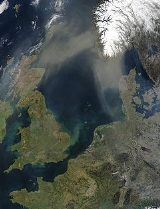
North Sea

Overview
Strait of Dover
The Strait of Dover or Dover Strait is the strait at the narrowest part of the English Channel. The shortest distance across the strait is from the South Foreland, 6 kilometres northeast of Dover in the county of Kent, England, to Cap Gris Nez, a cape near to Calais in the French of...
, the North Sea becomes the English Channel
English Channel
The English Channel , often referred to simply as the Channel, is an arm of the Atlantic Ocean that separates southern England from northern France, and joins the North Sea to the Atlantic. It is about long and varies in width from at its widest to in the Strait of Dover...
connecting to the Atlantic Ocean. In the east, it connects to the Baltic Sea
Baltic Sea
The Baltic Sea is a brackish mediterranean sea located in Northern Europe, from 53°N to 66°N latitude and from 20°E to 26°E longitude. It is bounded by the Scandinavian Peninsula, the mainland of Europe, and the Danish islands. It drains into the Kattegat by way of the Øresund, the Great Belt and...
via the Skagerrak
Skagerrak
The Skagerrak is a strait running between Norway and the southwest coast of Sweden and the Jutland peninsula of Denmark, connecting the North Sea and the Kattegat sea area, which leads to the Baltic Sea.-Name:...
and Kattegat
Kattegat
The Kattegat , or Kattegatt is a sea area bounded by the Jutland peninsula and the Straits islands of Denmark on the west and south, and the provinces of Västergötland, Scania, Halland and Bohuslän in Sweden on the east. The Baltic Sea drains into the Kattegat through the Øresund and the Danish...
, narrow straits that separate Denmark from Norway and Sweden respectively. In the north it is bordered by the Shetland Islands
Shetland Islands
Shetland is a subarctic archipelago of Scotland that lies north and east of mainland Great Britain. The islands lie some to the northeast of Orkney and southeast of the Faroe Islands and form part of the division between the Atlantic Ocean to the west and the North Sea to the east. The total...
, and connects with the Norwegian Sea
Norwegian Sea
The Norwegian Sea is a marginal sea in the North Atlantic Ocean, northwest of Norway. It is located between the North Sea and the Greenland Sea and adjoins the North Atlantic Ocean to the west and the Barents Sea to the northeast. In the southwest, it is separated from the Atlantic Ocean by a...
, which lies in the very north-eastern part of the Atlantic.
It is more than 970 kilometres (602.7 mi) long and 580 kilometres (360.4 mi) wide, with an area of 750000 square kilometres (289,576.6 sq mi) and a volume of 94000 cubic kilometres (22,551.8 cu mi).
Unanswered Questions

Timeline
1362 A storm tide in the North Sea destroys the German city of Rungholt on the island of Strand.
1570 A tidal wave in the North Sea devastates the coast from Holland to Jutland, killing more than 1,000 people.
1980 The Norwegian oil platform Alexander L. Kielland collapses in the North Sea, killing 123 of its crew of 212.
1988 The Piper Alpha drilling platform in the North Sea is destroyed by explosions and fires. 167 oil workers are killed, making it the world's worst offshore oil disaster.
1995 The Draupner wave in the North Sea in Norway is detected, confirming the existence of freak waves.