
All Topics  
Treaty of Versailles

 
Treaty of Versailles

   Email Print
   Bookmark   Link


Treaty of Versailles


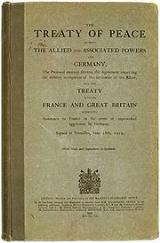
The Treaty of Versailles was one of the peace treaties
Peace treaty

A peace treaty is an agreement between two hostile parties, usually countries or governments, that formally ends an armed conflict. It is different from an armistice, which is an agreement to cease hostilities, or a surrender , in which an army agrees to give up arms....
 at the end of World War I
World War I

World War I, or the First World War , was a global military conflict which involved the Great powers, organized into two opposing military alliances: the Allies of World War I and the Central Powers....
. It ended the state of war
Declaration of war

A declaration of war is a formal performative speech act or signing of a document by an authorised party of a government in order to initiate a state of war between two or more nations....
 between Germany
German Empire

The German Empire is the name commonly used in English to describe Germany from the unification of Germany and proclamation of William I, German Emperor as German Emperor on 18 January 1871, to 1918, when it became Weimar republic after defeat in World War I and the abdication of William II, German Emperor ....
 and the Allied Powers
Allies of World War I

File:Map Europe alliances 1914-en.svgThe Entente Powers were the countries at war with the Central Powers during World War I. The main allies were the Russian Empire, French Third Republic, the British Empire, Kingdom of Italy , the Empire of Japan, and the United States....
. It was signed on 28 June 1919, exactly five years after the assassination of Archduke Franz Ferdinand, one of the events that triggered the start of the war. The other Central Powers
Central Powers

The Central Powers was one of the two sides that participated in World War I, the other being the Allies of World War I....
 on the German side of World War I were dealt with in separate treaties. Although the armistice
Armistice with Germany (Compiègne)

The armistice treaty between the Allies and German Empire was signed in a railway carriage in Compi?gne Forest on 11 November 1918, and marked the end of the World War I on the Western Front ....
 signed on 11 November 1918 ended the actual fighting, it took six months of negotiations at the Paris Peace Conference
Paris Peace Conference, 1919

The Paris Peace Conference was the meeting of the Allied victors in World War I to set the peace terms for Germany and other defeated nations, and to deal with the empires of the defeated powers following the Armistice of 1918....
 to conclude the peace treaty.


Discussion
Ask a question about 'Treaty of Versailles'
Start a new discussion about 'Treaty of Versailles'
Answer questions from other users
Full Discussion Forum


Recent Posts


Encyclopedia


The Treaty of Versailles was one of the peace treaties
Peace treaty

A peace treaty is an agreement between two hostile parties, usually countries or governments, that formally ends an armed conflict. It is different from an armistice, which is an agreement to cease hostilities, or a surrender , in which an army agrees to give up arms....
 at the end of World War I
World War I

World War I, or the First World War , was a global military conflict which involved the Great powers, organized into two opposing military alliances: the Allies of World War I and the Central Powers....
. It ended the state of war
Declaration of war

A declaration of war is a formal performative speech act or signing of a document by an authorised party of a government in order to initiate a state of war between two or more nations....
 between Germany
German Empire

The German Empire is the name commonly used in English to describe Germany from the unification of Germany and proclamation of William I, German Emperor as German Emperor on 18 January 1871, to 1918, when it became Weimar republic after defeat in World War I and the abdication of William II, German Emperor ....
 and the Allied Powers
Allies of World War I

File:Map Europe alliances 1914-en.svgThe Entente Powers were the countries at war with the Central Powers during World War I. The main allies were the Russian Empire, French Third Republic, the British Empire, Kingdom of Italy , the Empire of Japan, and the United States....
. It was signed on 28 June 1919, exactly five years after the assassination of Archduke Franz Ferdinand, one of the events that triggered the start of the war. The other Central Powers
Central Powers

The Central Powers was one of the two sides that participated in World War I, the other being the Allies of World War I....
 on the German side of World War I were dealt with in separate treaties. Although the armistice
Armistice with Germany (Compiègne)

The armistice treaty between the Allies and German Empire was signed in a railway carriage in Compi?gne Forest on 11 November 1918, and marked the end of the World War I on the Western Front ....
 signed on 11 November 1918 ended the actual fighting, it took six months of negotiations at the Paris Peace Conference
Paris Peace Conference, 1919

The Paris Peace Conference was the meeting of the Allied victors in World War I to set the peace terms for Germany and other defeated nations, and to deal with the empires of the defeated powers following the Armistice of 1918....
 to conclude the peace treaty. Of the many provisions in the treaty, one of the most important and controversial required Germany and its allies to accept responsibility for causing the war and, under the terms of articles 231-248, to disarm, make substantial territorial concessions
Concession (territory)

In international law, a concession is a territory within a country that is administered by another entity than the state which holds sovereignty over it....
 and pay reparations
World War I reparations

World War I reparations refers to the payments and transfers of property and equipment that Germany was forced to make under the Treaty of Versailles following its defeat during World War I....
 to certain countries that had formed the Entente
Allies of World War I

File:Map Europe alliances 1914-en.svgThe Entente Powers were the countries at war with the Central Powers during World War I. The main allies were the Russian Empire, French Third Republic, the British Empire, Kingdom of Italy , the Empire of Japan, and the United States....
 powers. The Treaty was undermined by subsequent events starting as early as 1922 and was widely flouted by the mid-thirties.

The result of these competing and sometimes incompatible goals among the victors was compromise that left none satisfied: Germany was not pacified, conciliated
Conciliation

Conciliation is an alternative dispute resolution process whereby the parties to a dispute agree to utilize the services of a conciliator, who then meets with the parties separately in an attempt to resolve their differences....
 or permanently weakened. This would prove to be a factor leading to later conflicts.

Negotiations

Negotiations between the Allied powers started on 18 January in the Salle de l'Horloge at the French Foreign Ministry
Minister of Foreign Affairs (France)

The Minister of Foreign Affairs in the government of France, is the French government ministers responsible for the foreign relations of France....
, on the Quai d'Orsay
Quai d'Orsay

The Quai d'Orsay is a quai in the VIIe arrondissement of Paris, part of the left bank of the Seine, and the name of the street along it....
 in Paris. Initially, 70 delegates of 27 nations participated in the negotiations. Having been defeated, Germany, Austria
Austria

Austria , officially the Republic of Austria , is a landlocked country in Central Europe. It borders both Germany and the Czech Republic to the north, Slovakia and Hungary to the east, Slovenia and Italy to the south, and Switzerland and Liechtenstein to the west....
, and Hungary
Hungary

Hungary , officially in English the Republic of Hungary , is a landlocked country in the Carpathian Basin of Central Europe, bordered by Austria, Slovakia, Ukraine, Romania, Serbia, Croatia, and Slovenia....
 were excluded from the negotiations. Russia
Russian SFSR

The Russian Soviet Federative Socialist Republic , also called the Russian Soviet Federated Socialist Republic, the Russian SFSR and the RSFSR for short, was the largest and most populous of the fifteen Republics of the Soviet Union of the Soviet Union and became the Russian Federation after the collapse of the Soviet Union....
 was also excluded because it had negotiated a separate peace
Treaty of Brest-Litovsk

The Treaty of Brest-Litovsk was a peace treaty signed on March 3, 1918, at Brest-Litovsk between the Russian SFSR and the Central Powers, marking Russia's exit from World War I....
 with Germany in 1917, in which Germany gained a large fraction of Russia's land and resources.

Until March 1919, the most important role for negotiating the extremely complex and difficult terms of the peace fell to the regular meetings of the "Council of Ten" (leaders of government and foreign ministers) composed of the five major victors (the United States, France, Great Britain, Italy, and Japan
Empire of Japan

The Empire of Japan was a Japanese political entity that existed during the period from the Meiji Restoration in 1868 until its defeat in World War II in 1945....
). As this unusual body proved too unwieldy and formal for effective decision-making, Japan and — for most of the remaining conference — the foreign ministers left the main meetings, so that only the "Big Four" remained. After his territorial claims to Fiume were rejected, Italian Prime Minister
Prime minister of Italy

In Italy, the Prime Minister of Italy is the country's head of government. According to the formal Italian order of precedence, the position of prime minister is ceremonially the fourth most important Italian state offices; however, in reality, the prime minister is the most powerful and thus truly most important person in the Italian govern...
, Vittorio Orlando left the negotiations (only to return to sign in June), and the final conditions were determined by the leaders of the "Big Three" nations: British Prime Minister David Lloyd George
David Lloyd George

David Lloyd George, 1st Earl Lloyd-George of Dwyfor Order of Merit , Privy Council of the United Kingdom was a United Kingdom statesman and the only Wales Prime Minister of the United Kingdom - he is also the only one to have spoken English language as a second language, Welsh language having been his first....
, French Prime Minister Georges Clemenceau
Georges Clemenceau

Georges Benjamin Clemenceau was a French statesman, physician, and journalist. He served as the List of Prime Ministers of France from 1906-1909 and 1917-1920....
, and American President Woodrow Wilson
Woodrow Wilson

Thomas Woodrow Wilson was the List of Presidents of the United States President of the United States. A devout Presbyterianism and leading intellectual of the Progressive Era, he served as President of Princeton University of Princeton University from 1902 to 1910, and then as the Governor of New Jersey from 1911 to 1913....
.

Japan had originally attempted to insert a clause proscribing discrimination on the basis of race or nationality, but this was eventually struck down due to prevailing attitudes.

At Versailles, it was difficult to decide on a common position because their aims conflicted with one another. The result has been called the "unhappy compromise".

France's aims

Council of Four Versailles
France had lost some 1.5 million military personnel and an estimated 400,000 civilians to the war (see World War I casualties
World War I casualties

The total number of casualties in World War I, both military and civilian, were about 37 million: 16 million deaths and 21 million wounded.The total number of deaths includes 9.7 million military personnel and about 6.8 million civilians....
), and much of the western front
Western Front (World War I)

Following the outbreak of World War I in 1914, the German Empire army opened the Western Front by first invading Luxembourg and Belgium, then gaining military control of important industrial regions in France....
 had been fought on French soil. To appease the French public, Prime Minister
Prime Minister of France

The Prime Minister of France in French Fifth Republic is the functional head of the government and French government ministers of France. The head of state in France is the President of the French Republic....
 Georges Clemenceau
Georges Clemenceau

Georges Benjamin Clemenceau was a French statesman, physician, and journalist. He served as the List of Prime Ministers of France from 1906-1909 and 1917-1920....
 wanted to impose policies deliberately meant to cripple Germany militarily, politically, and economically so as never to be able to invade France again. Georges Clemenceau also particularly wished to regain the rich and industrial land of Alsace-Lorraine, which had been stripped from France by Germany in the 1871 War.

Britain's aims

Prime Minister
Prime Minister of the United Kingdom

The Prime Minister of the United Kingdom of Great Britain and Northern Ireland is the political leader of the United Kingdom and the head of government Her Majesty's Government....
 David Lloyd George
David Lloyd George

David Lloyd George, 1st Earl Lloyd-George of Dwyfor Order of Merit , Privy Council of the United Kingdom was a United Kingdom statesman and the only Wales Prime Minister of the United Kingdom - he is also the only one to have spoken English language as a second language, Welsh language having been his first....
 supported reparations but to a lesser extent than the French. Lloyd George was aware that if the demands made by France were carried out, France could become the most powerful force on the continent, and a delicate balance could be unsettled. Lloyd George was also worried by Woodrow Wilson
Woodrow Wilson

Thomas Woodrow Wilson was the List of Presidents of the United States President of the United States. A devout Presbyterianism and leading intellectual of the Progressive Era, he served as President of Princeton University of Princeton University from 1902 to 1910, and then as the Governor of New Jersey from 1911 to 1913....
's proposal for "self-determination
Self-determination

Self-determination is defined as free choice of one?s own acts without external compulsion, and especially as the freedom of the people of a given territory to determine their own political status or independence from their current state....
" and, like the French, wanted to preserve his own nation's empire. Like the French, Lloyd George also supported secret treaties and naval blockades.

Prior to the war, Germany had been Britain's main competitor and its largest trading partner, making the destruction of Germany at best a mixed blessing.

Lloyd George managed to increase the overall reparations payment and Britain's share by demanding compensation for the huge number of widows, orphans, and men left unable to work through injury, due to the war.

Due to pressure of the public Lloyd George supported the slogan "Hang the Kaiser" to make his people happy and gain votes.

United States' aims

There had been strong non-interventionist sentiment before and after the United States entered the war in April 1917, and many Americans were eager to extricate themselves from European affairs as rapidly as possible. The United States took a more conciliatory view toward the issue of German reparations. American Leaders wanted to ensure the success of future trading opportunities and favourably collect on the European debt, and hoped to avoid future wars.

Before the end of the war, President Woodrow Wilson
Woodrow Wilson

Thomas Woodrow Wilson was the List of Presidents of the United States President of the United States. A devout Presbyterianism and leading intellectual of the Progressive Era, he served as President of Princeton University of Princeton University from 1902 to 1910, and then as the Governor of New Jersey from 1911 to 1913....
, along with other American officials including Edward Mandell House, put forward his Fourteen Points
Fourteen Points

The Fourteen Points were listed in a speech delivered by United States President of the United States Woodrow Wilson to a Joint session of the United States Congress of United States Congress on January 8, 1918....
 which he presented in a speech at the Paris Peace Conference
Paris Peace Conference, 1919

The Paris Peace Conference was the meeting of the Allied victors in World War I to set the peace terms for Germany and other defeated nations, and to deal with the empires of the defeated powers following the Armistice of 1918....
.

Content


Impositions on Germany


Legal restrictions
  • Article 227 charges former German Emperor, Wilhelm II
    William II, German Emperor

    Wilhelm II was the last German Emperor and King of Prussia , ruling both the German Empire and the Prussia from 15 June 1888 to 9 November 1918....
     with supreme offence against international morality. He is to be tried as a war criminal.
  • Articles 228-230 tried many other Germans as war criminals.
  • Article 231
    Article 231 of the Treaty of Versailles

    Article 231 of the Treaty of Versailles reads in full:Article 231 of the Treaty of Versailles is commonly known as the ?Guilt Clause? or the "War Guilt Clause", in which Germany was forced to take complete responsibility for starting World War I....
     (the "War Guilt Clause") lays sole responsibility for the war on Germany, which would be accountable for all the damage done to civilian population of the allies.


Military restrictions
Part V of the treaty begins with the preamble, "In order to render possible the initiation of a general limitation of the armaments of all nations, Germany undertakes strictly to observe the military, naval and air clauses which follow." Germany was also forbidden to unite with Austria to form a larger Nation to make up for the lost land
  • The Rhineland
    Rhineland

    The Rhineland is the general name for the land on both sides of the river Rhine in the west of Germany. After the collapse of the First French Empire in the early 19th century, the German-speaking regions at the middle and lower course of the Rhine were annexed to the kingdom of Prussia....
     will become a demilitarized zone
    Demilitarized zone

    is an area, usually the frontier or boundary between two or more military powers , where military activity is not permitted, usually by peace treaty, armistice, or other bilateral or multilateral agreement....
     administered by Great Britain and France jointly.
  • German armed forces will number no more than 100,000 troops, and conscription will be abolished.
  • Enlisted men will be retained for at least 12 years; officer
    Officer (armed forces)

    An officer is a member of an Armed forces who holds a position of authority.Commissioned officers derive authority directly from a sovereignty power and, as such, hold a Letters patent charging them with the duties and responsibilities of a specific office or position....
    s to be retained for at least 25 years.
  • German naval forces will be limited to 15,000 men, 6 battleships (no more than 10,000 tons displacement each), 6 cruisers (no more than 6,000 tons displacement each), 6 destroyers (no more than 800 tons displacement each) and 12 torpedo boats (no more than 200 tons displacement each). No submarines are to be included.
  • The manufacture, import, and export of weapons and poison gas is prohibited.
  • Armed aircraft, tanks and armored cars are prohibited.
  • Blockades on ships are prohibited.


Territorial changes
Germany was compelled to yield control of its colonies
German colonial empire

The German colonial empire was an overseas area formed in the late 19th century as part of the House of Hohenzollern dynasty's German Empire. Short-lived colonial efforts by Kleinstaaterei had occurred in preceding centuries, but imperial Germany's colonial efforts began in 1883....
, and would also lose a number of European territories. The province of West Prussia
West Prussia

West Prussia was a Provinces of Prussia of the Kingdom of Prussia from 1773–1824 and 1878–1919/20 which was created out of the earlier Polish-Lithuanian Commonwealth province of Royal Prussia....
 would be ceded to the newly independent Second Polish Republic
Second Polish Republic

The Second Polish Republic, Second Commonwealth of Poland or interwar Poland is the Republic of Poland between World War I and World War II....
, thereby granting Poland access to the Baltic Sea
Baltic Sea

The Baltic Sea is a brackish inland sea located in Northern Europe, from 53?N to 66?N latitude and from 20?E to 26?E longitude. It is bounded by the Scandinavian Peninsula, the mainland of Europe, and the Denmark islands....
 via the "Polish Corridor
Polish Corridor

The Polish Corridor was a territory located in the region of Pomerelia which provided the Second Republic of Poland with access to the Baltic Sea, thus dividing the bulk of Germany from her province of East Prussia....
", and turning East Prussia
East Prussia

East Prussia refers to the main part of the Prussia along the southeastern Baltic Sea from the 13th century to 1945. From 1772?1829 and 1878?1945, the Province of East Prussia was a province of the Germany state of Prussia....
 into an exclave
Exclave

An exclave is strip of land that belongs to a political entity but that is not connected to it by land . The strip of land is surrounded by other political entities....
, separated from mainland Germany.
  • Alsace
    Alsace

    Alsace is the fourth-smallest of the 26 regions of France in land area , and the smallest in metropolitan France. It is also the sixth-most densely populated region in France , with 222 inhabitants per km? ....
     and much of Lorraine
    Lorraine

    Lorraine may refer to:toponymy* Lorraine , one of the 26 r?gions of France* Lotharingia or Lorraine, a short-lived kingdom in western Europe...
    , both at one time German territories that had been ceded to Germany on 26 February 1871 due to the Treaty of Frankfurt
    Treaty of Frankfurt (1871)

    The Treaty of Frankfurt was a peace treaty signed in Frankfurt on May 10, 1871, at the end of the Franco-Prussian War....
     of 10 May 1871, were placed under French administration without a plebiscite. At first the Alsatians welcomed rejoining France
    France

    France , officially the French Republic , is a country whose Metropolitan France is located in Western Europe and that also comprises various Overseas departments and territories of France....
    , but because of the subsequent harsh French assimilation policy forbidding German language schools and newspapers, the majority of Alsatians would soon turn against France and demand their independence. Clemenceau was convinced that the German neighbour had "20 million people too much", thus incorporating the seven million inhabitants and the industry of the Prussian province was seen as means to weaken Germany and strengthen France.
  • Northern Schleswig was returned to Denmark
    Denmark

    Denmark is a Scandinavian country in northern Europe and the senior member of the Kingdom of Denmark. It is the southernmost of the Nordic countries....
     following a plebiscite on 14 February 1920 (area 3,984 km², 163,600 inhabitants (1920)). Central Schleswig, including the city of Flensburg
    Flensburg

    Flensburg is an independent city in the North of the States of Germany Schleswig-Holstein. Flensburg is the centre of the region Southern Schleswig....
    , opted to remain German in a separate referendum on 14 March 1920.
  • Most of the Prussian provinces of Province of Posen
    Province of Posen

    The Province of Posen was a province of Kingdom of Prussia from 1848-1918 and as such part of the German Empire from 1871 to 1918; the whole area is now part of Poland....
     (now Poznan) and of West Prussia
    West Prussia

    West Prussia was a Provinces of Prussia of the Kingdom of Prussia from 1773–1824 and 1878–1919/20 which was created out of the earlier Polish-Lithuanian Commonwealth province of Royal Prussia....
     which Prussia
    Kingdom of Prussia

    The Kingdom of Prussia was a Germany monarchy from 1701 to 1918 and, from 1871, was the leading state of the German Empire, comprising almost two-thirds of the area of the empire....
     had annexed in the Partitions of Poland
    Partitions of Poland

    The Partitions of Poland or Partitions of the Polish Lithuanian Commonwealth took place in the second half of the 18th century and ended the existence of the Polish?Lithuanian Commonwealth....
     (1772-1795) were ceded to Poland (area 53,800 km², 4,224,000 inhabitants (1931). Most of the Province of Posen had already come under Polish control during the Great Poland Uprising of 1918-1919. The population in West Prussia were denied a plebiscite. The separation of East Prussia
    East Prussia

    East Prussia refers to the main part of the Prussia along the southeastern Baltic Sea from the 13th century to 1945. From 1772?1829 and 1878?1945, the Province of East Prussia was a province of the Germany state of Prussia....
     from mainland Germany caused economic decline and poverty in East Prussia. The placing of 2.1 Million Germans in West Prussia and Upper Silesia
    Upper Silesia

    Upper Silesia is the southeastern part of the historical and geographical region of Silesia; Lower Silesia is to the northwest. Since the 9th century, Upper Silesia has been part of Greater Moravia, Kingdom of Bohemia, Poland, Holy Roman Empire, Habsburg Monarchy, Kingdom of Prussia, and later of unified German Reich....
     had been critized severely by H.G. Wells, by the British Prime Minister David Lloyd George
    David Lloyd George

    David Lloyd George, 1st Earl Lloyd-George of Dwyfor Order of Merit , Privy Council of the United Kingdom was a United Kingdom statesman and the only Wales Prime Minister of the United Kingdom - he is also the only one to have spoken English language as a second language, Welsh language having been his first....
    , by the Italian Prime Minister Francisco Nitti and many others as one of the major causes triggering World War II
    World War II

    World War II, or the Second World War , was a global military conflict which involved a Participants in World War II, including all of the great powers, organised into two opposing military alliances: the Allies of World War II and the Axis powers....
    . The British Prime Minister had warned that "this will lead, sooner or later, to a new war". The annexation of West Prussia and the violation of minority rights
    Minority rights

    The term minority rights embodies two separate concepts: first, normal individual rights as applied to members of racial, ethnic, class, religious, linguistic or sexual minorities, and second, collective rights accorded to minority groups....
     by the Polish state had led to a mass influx of West Prussian refugees into the German mainland during the 1920s. Out of an approximate 1 million West Prussians in 1919, over 750,000 had fled their homes by 1926.
  • The Hultschin
    Hlucín

    Hluc?n is a town in the Moravian-Silesian Region of the Czech Republic. It is the center of the Hluc?n Region. The population was 14,500 as of 2004....
     area of Upper Silesia
    Upper Silesia

    Upper Silesia is the southeastern part of the historical and geographical region of Silesia; Lower Silesia is to the northwest. Since the 9th century, Upper Silesia has been part of Greater Moravia, Kingdom of Bohemia, Poland, Holy Roman Empire, Habsburg Monarchy, Kingdom of Prussia, and later of unified German Reich....
     to Czechoslovakia
    Czechoslovakia

    Czechoslovakia was a sovereign state in Central Europe that existed from October 1918 until 1992 . On January 1, 1993, Czechoslovakia dissolution of Czechoslovakia into the Czech Republic and Slovakia....
     (area 316 or 333 km², 49,000 inhabitants) without a plebiscite.
  • The eastern part of Upper Silesia was assigned to Poland after the Upper Silesia plebiscite
    Upper Silesia plebiscite

    Upper Silesia plebiscite was a plebiscite for self-determination of Upper Silesia demanded by one of the clauses of the Treaty of Versailles. The Germany government had declared during the negotiations in London, and indeed at an earlier period, that the possession of Upper Silesia was indispensable to Germany if she was to fulfill her oblig...
    , which was provided for in the Treaty, and the ensuing partition along voting lines in Upper Silesia by the League of Nations following protests by Polish inhabitants and nationalists like Wojciech Korfanty
    Wojciech Korfanty

    Wojciech Korfanty , born Albert Korfanty, was a Poland nationalism activism, journalist and politician, serving as member of the German Empire parliaments Reichstag and Prussian Landtag, and later on, in the Second Polish Republic Sejm....
    . After the plebiscite of March 20, 1920 in which almost 60% voted to stay under German rule, the vote was tallied, weighed against "geographical and economic conditions" and a large part ceded to Poland. With this partition, important zinc, lead and silver industries as well as 90% of the Upper Silesian coal were taken from Germany. Among Upper Silesians, the decision caused bitterness.
  • The area of cities Eupen
    Eupen

    Eupen is a municipality located in the Belgium province of Li?ge , 15 km from the Germany border , from the Netherlands border and from the nature reservation "Hohes Venn" ....
     and Malmedy
    Malmedy

    Malmedy is a municipality of Belgium. It lies in the country's Walloon Region and Liege . It belongs to the French Community of Belgium. On January 1, 2006 Malmedy had a total population of 11,829....
     to Belgium
    Belgium

    * A small German-speaking Community of Belgium exists in eastern Wallonia. Belgium's linguistic diversity and related political and cultural conflicts are reflected in the history of Belgium and a complex Communities and regions of Belgium....
    . The trackbed of the Vennbahn
    Vennbahn

    The Vennbahn is a former Rail transport that, although it lay in Germany when first built, is today entirely in Belgium – even where parts of its route now run through otherwise German territory – the trackbed of the line having been made Belgian territory in 1919 by a provision of the Treaty of Versailles....
     railway also transferred to Belgium.
  • The area of Soldau
    Dzialdowo

    Dzialdowo [] is a town in north-central Poland with 24,830 inhabitants , the capital of Dzialdowo County. Situated in the Warmian-Masurian Voivodeship , Dzialdowo previously belonged to Ciechan?w Voivodeship ....
     in East Prussia, an important railway junction on the Warsaw
    Warsaw

    Warsaw is the Capital and World's largest cities of Poland. It is located on the Vistula River roughly from both the Baltic Sea coast and the Carpathian Mountains....
    -Danzig route, was transferred to Poland
    Poland

    Poland , officially the Republic of Poland , is a country in Central Europe. Poland is bordered by Germany to the west; the Czech Republic and Slovakia to the south; Ukraine, Belarus and Lithuania to the east; and the Baltic Sea and Kaliningrad Oblast, a Russian Enclave and exclave, to the north....
     without a plebiscite (area 492 km²).
  • The northern part of East Prussia
    East Prussia

    East Prussia refers to the main part of the Prussia along the southeastern Baltic Sea from the 13th century to 1945. From 1772?1829 and 1878?1945, the Province of East Prussia was a province of the Germany state of Prussia....
     known as the Memellandor Memel Territory under control of France, later annexed by Lithuania
    Lithuania

    Lithuania , officially the Republic of Lithuania is a country in Northern Europe, the southernmost of the three Baltic states. Situated along the southeastern shore of the Baltic Sea, it shares borders with Latvia to the north, Belarus to the southeast, Poland, and the Russian exclave of Kaliningrad Oblast to the southwest....
    .
  • From the eastern part of West Prussia
    West Prussia

    West Prussia was a Provinces of Prussia of the Kingdom of Prussia from 1773–1824 and 1878–1919/20 which was created out of the earlier Polish-Lithuanian Commonwealth province of Royal Prussia....
     and the southern part of East Prussia, after the East Prussian plebiscite
    East Prussian plebiscite

    The East Prussia plebiscite , also known as the Allenstein and Marienwerder plebiscite or Warmia, Masuria and Powisle plebiscite , was a plebiscite for self-determination of the regions Warmia , Masuria and Powisle, which had been in parts of East Prussia and West Prussia, in accordance with Articles 94 to 97 of the Treaty of Ve...
     a small area to Poland.
  • The province of Saarland
    Saarland

    Saarland is one of the 16 States of Germany of Germany. The capital is Saarbr?cken. It has an area of 2570 km? and 1,045,000 inhabitants. In both area and population it is the smallest of the German Fl?chenl?nder , i.e., those that are not City States ....
     to be under the control of the League of Nations
    League of Nations mandate

    A League of Nations mandate refers to a legal status for certain territories transferred from the control of one country to another following World War I, or the legal instruments that contained the terms for administering the territory on behalf of the League....
     for 15 years, after that a plebiscite between France and Germany, to decide to which country it would belong. During this time, coal would be sent to France. The French referred to the region as Saarbecken (Saar Basin).
  • The port of Danzig
    Gdansk

    Gdansk is the city at the centre of the fourth-largest metropolitan area in Poland. It is Poland's principal seaport as well as the capital of the Pomeranian Voivodeship....
     with the delta of the Vistula River at the Baltic Sea was cut off from Germany and called Freie Stadt Danzig (Free City of Danzig). The citizens of Danzig were not free to choose their government; they were placed under the permanent protection of the League of Nations without a plebiscite. Poland took administrative control over the city and tried to incorporate the city into their state. A mass demonstration of the people of Danzig took place on 28 March 1919, with over 80,000 people declaring "no" to Poland. (1929 area was 1,893 km² with 408,000 inhabitants, 97% German, 2% Polish, 1% Kashube).
  • The German and Austrian governments had to acknowledge and strictly respect the independence of Austria. The unification of both countries, although desired by the great majority of both populations, was strictly forbidden.


Shandong problem
Article 156 of the treaty transferred German concessions in Shandong
Shandong

For the people of Shandong, see Shandong people is a coastal political divisions of China of eastern People's Republic of China. Its abbreviation is 'Lu', after the state of Lu that existed here during the Spring and Autumn Period....
, China to Japan rather than returning sovereign authority to China. Chinese outrage over this provision led to demonstrations and a cultural movement known as the May Fourth Movement and influenced China not to sign the treaty. China declared the end of its war against Germany in September 1919 and signed a separate treaty with Germany in 1921.

Reparations

Article 231 of the Treaty of Versailles

Article 231 of the Treaty of Versailles reads in full:Article 231 of the Treaty of Versailles is commonly known as the ?Guilt Clause? or the "War Guilt Clause", in which Germany was forced to take complete responsibility for starting World War I....
 assigned blame for the war to Germany; much of the rest of the Treaty set out the reparations that Germany would pay to the Allies.

The total sum of war reparations demanded from Germany — 226 billion Reichsmarks in gold (around £11.3 billion)— was decided by an Inter-Allied Reparations Commission. In 1921, it was reduced to 132 billion Reichsmarks (£4.99 billion).

It could be seen that the Versailles reparation impositions were partly a reply to the reparations placed upon France by Germany through the 1871 Treaty of Frankfurt
Treaty of Frankfurt (1871)

The Treaty of Frankfurt was a peace treaty signed in Frankfurt on May 10, 1871, at the end of the Franco-Prussian War....
 signed after the Franco-Prussian War
Franco-Prussian War

The Franco-Prussian War or Franco-German War, often referred to in France as the 1870 War was a conflict between Second French Empire and Kingdom of Prussia, while Prussia was backed by the North German Confederation, of which it was a member, and the South German states of Grand Duchy of Baden, History of W?rttemberg#The Kingdom...
. However, critics of the Treaty argued that France had been able to pay the reparations (5 billion francs) within 3 years while the Young Plan
Young Plan

The Young Plan was a program for settlement of Germany World War I reparations debts after World War I written in 1929 and formally adopted in 1930....
 of 1929 estimated German reparations to be paid until 1988. Indemnities of the Treaty of Frankfurt were in turn calculated, on the basis of population, as the precise equivalent of the indemnities imposed by Napoleon I on Prussia in 1807.

The Versailles Reparations came in a variety of forms, including coal, steel, intellectual property (eg. the trademark for Aspirin
Aspirin

Aspirin , also known as acetylsalicylic acid , is a salicylate medication, often used as an analgesic to relieve minor aches and pains, as an antipyretic to reduce fever, and as an anti-inflammatory medication....
) and agricultural products, in no small part because currency reparations of that order of magnitude would lead to hyperinflation
Hyperinflation

File:Bundesarchiv Bild 102-00104, Inflation, Tapezieren mit Geldscheinen.jpgIn economics, hyperinflation is inflation that is very high or "out of control", a condition in which prices increase rapidly as a currency loses its value....
, as actually occurred in postwar Germany (see 1920s German inflation), thus decreasing the benefits to France and the United Kingdom.

Germany will finish paying off her World War I reparations in 2020.

The creation of international organizations

Part I of the treaty was the Covenant of the League of Nations
Covenant of the League of Nations

The Covenant of the League of Nations is the charter of the League of Nations....
 which provided for the creation of the League of Nations
League of Nations

The League of Nations was an inter-governmental organization founded as a result of the Treaty of Versailles in 1919?1920. At its greatest extent from 28 September 1934 to 23 February 1935, it had 58 members....
, an organization intended to arbitrate international disputes and thereby avoid future wars.. Part XIII organized the establishment of the International Labor Organization, to promote "the regulation of the hours of work, including the establishment of a maximum working day and week, the regulation of the labour supply, the prevention of unemployment, the provision of an adequate living wage, the protection of the worker against sickness, disease and injury arising out of his employment, the protection of children, young persons and women, provision for old age and injury, protection of the interests of workers when employed in countries other than their own recognition of the principle of freedom of association, the organization of vocational and technical education and other measures" Further international commissions were to be set up, according to Part XII, to administer control over the Elbe
Elbe

The River Elbe is one of the major rivers of Central Europe. It originates in the Krkonose Mountains of northwestern Czech Republic before traversing much of Germany and flowing into the North Sea....
, the Oder, the Niemen (Russstrom-Memel-Niemen) and the Danube
Danube

The Danube is the longest river in the European Union and Europe's second longest river after the Volga.The river originates in the Black Forest in Germany as the much smaller Brigach and Breg River rivers which join at the eponymously named German town Donaueschingen, after which it is known as the Danube and flows eastwards for a distance...
 rivers.

Other


The Treaty contained a lot of other provisions (economic issues, transportation, etc.). One of the provisions was the following:

"ARTICLE 246. Within six months from the coming into force of the present Treaty, ... Germany will hand over to His Britannic Majesty's Government the skull of the Sultan Mkwawa
Chief Mkwawa

Paramount leader Chief Mkwavinyika Munyigumba Mwamuyinga , more commonly known as Chief Mkwawa, was a Hehe tribe leader in German East Africa who opposed the German colonisation....
 which was removed from the Protectorate of German East Africa
German East Africa

German East Africa was a German Empire colony in East Africa, including what is now Burundi, Rwanda and Tanganyika . It measured 994,996 km? in size or nearly three times the size of re-united Germany today....
 and taken to Germany.
"


Reactions


Among the allies

Clemenceau had failed to achieve all of the demands of the French people, and he was voted out of office in the elections of January 1920. French Field Marshal Ferdinand Foch
Ferdinand Foch

Ferdinand Foch . Order of Merit List of honorary British knights was a France soldier, military theorist, and writer credited with possessing "the most original and subtle mind in the French Army" in the early 20th century....
, who felt the restrictions on Germany were too lenient, declared, "This is not Peace. It is an Armistice for twenty years."

Influenced by the opposition of Henry Cabot Lodge
Henry Cabot Lodge

This article is about Henry Cabot Lodge , a U.S. politician in the early twentieth century.Henry Cabot Lodge was an United States statesman, a United States Republican Party politician, and a noted historian....
, the United States Senate
United States Senate

The United States Senate is the upper house of the Bicameralism United States Congress, the lower house being the United States House of Representatives....
 voted against ratifying the treaty. Despite considerable debate, Wilson refused to support the treaty with any of the reservations imposed by the Senate. As a result, the United States did not join the League of Nations, despite Wilson's claims that he could "predict with absolute certainty that within another generation there will be another world war if the nations of the world do not concert the method by which to prevent it."

Wilson's friend Edward Mandell House, present at the negotiations, wrote in his diary on 29 June 1919:
"I am leaving Paris, after eight fateful months, with conflicting emotions. Looking at the conference in retrospect, there is much to approve and yet much to regret. It is easy to say what should have been done, but more difficult to have found a way of doing it. To those who are saying that the treaty is bad and should never have been made and that it will involve Europe in infinite difficulties in its enforcement, I feel like admitting it. But I would also say in reply that empires cannot be shattered, and new states raised upon their ruins without disturbance. To create new boundaries is to create new troubles. The one follows the other. While I should have preferred a different peace, I doubt very much whether it could have been made, for the ingredients required for such a peace as I would have were lacking at Paris."


After Wilson's successor Warren G. Harding
Warren G. Harding

Warren Gamaliel Harding was the List of Presidents of the United States President of the United States, serving from 1921 until his death from a heart attack or stroke, in 1923....
 continued American opposition to the League of Nations, Congress passed the Knox-Porter Resolution
Knox-Porter Resolution

The Knox-Porter Resolution was an act of the United States Congress signed by President Warren G. Harding on July 2, 1921, officially ending United States involvement in World War I....
 bringing a formal end to hostilities between the United States and the Central Powers
Central Powers

The Central Powers was one of the two sides that participated in World War I, the other being the Allies of World War I....
. It was signed into law by Harding on 21 July 1921.

In Germany


On 29 April the German delegation under the leadership of the Foreign Minister Ulrich Graf von Brockdorff-Rantzau
Ulrich Graf von Brockdorff-Rantzau

Ulrich Graf von Brockdorff-Rantzau was a Germany diplomat, the first Foreign Minister of Germany of the Weimar Republic and German Ambassador to the USSR for most of the twenties....
 arrived in Versailles. On 7 May when faced with the conditions dictated by the victors, including the so-called "War Guilt Clause", von Brockdorff-Rantzau replied to Clemenceau, Wilson and Lloyd George: We know the full brunt of hate that confronts us here. You demand from us to confess we were the only guilty party of war; such a confession in my mouth would be a lie.

Because Germany was not allowed to take part in the negotiations, the German government issued a protest against what it considered to be unfair demands, and a "violation of honour" and soon afterwards, withdrew from the proceedings of the Treaty of Versailles. Germany's first democratically elected Chancellor
Chancellor of Germany (German Reich)

The head of government of the German Reich was called Reich Chancellor or short Chancellor from 1871 until 1945. This designation stems from the German chancellor tradition from the Middle Ages and the early modern era....
, Philipp Scheidemann
Philipp Scheidemann

Philipp Scheidemann was a Germany Social Democratic Party of Germany politician, who proclaimed the Republic on 9 November 1918, and who became the second Chancellor of Germany of the Weimar Republic....
 refused to sign the treaty and resigned. In a passionate speech before the National Assembly on 12 March 1919, he called the treaty a "murderous plan" and exclaimed,

After Scheidemann's resignation, a new coalition government was formed under Gustav Bauer
Gustav Bauer

was a Germany Social Democratic Party of Germany leader and Chancellor of Germany from 1919 to 1920.Born in Darkehmen near K?nigsberg in East Prussia, Bauer, who rose to notice through his leadership of a white-collar trade union, served from 1908 to 1918 as chairman of the General Commission of Trade Unions for all of Germany....
 and it recommended signing the treaty. The National Assembly
Weimar National Assembly

The Weimar National Assembly governed Germany from February 6 1919 to June 6 1920 and drew up the Weimar Constitution which governed History of Germany, technically remaining in effect even until the end of Nazi Germany in 1945....
 voted in favour of signing the treaty by 237 to 138, with 5 abstentions. The foreign minister Hermann Müller
Hermann Müller (politician)

, born in Mannheim, was a German Social Democratic Party of Germany politician who served as Foreign Minister , and twice as Chancellor of Germany under the Weimar Republic....
 and Johannes Bell travelled to Versailles to sign the treaty on behalf of Germany. The treaty was signed on 28 June 1919 and ratified by the National Assembly on 9 July 1919 by a vote of 209 to 116.

Conservatives, nationalists and ex-military leaders began to speak critically about the peace and Weimar politicians, socialists, communists, and Jews were viewed with suspicion due to their supposed extra-national loyalties. It was rumoured that the Jews had not supported the war and had played a role in selling out Germany to its enemies. This was mainly due to certain members of the World Zionist Congress
World Zionist Organization

The World Zionist Organization , or WZO, was founded as the Zionist Organization , or ZO, in 1897 at the First Zionist Congress, held from August 29 to August 31 in Basel, Switzerland....
, many of whom were from Germany, attempting to influence (with some success) the British and American governments' policy toward the Ottoman Empire (with special attention given to the fate of Palestine), which became known at the Paris Peace Conference
Paris Peace Conference

The term Paris Peace Conference may refer to:* Treaty of Paris , formally ended the American Revolutionary War* The Treaty of Paris , negotiated the ending of the Spanish-American War...
. This effort produced the Balfour Declaration
Balfour Declaration

The name Balfour Declaration is applied to two key United Kingdom government policy statements associated with Conservative Party statesman and former Prime Minister Arthur Balfour....
. These November Criminals, or those who seemed to benefit from a weakened Germany, and the newly formed Weimar Republic, were seen to have "stabbed them in the back" on the home front
Home front

Home front is the informal term commonly used to describe the civilian populace of the nation at war as an active support system of its military....
, by either criticizing German nationalism
Nationalism

Nationalism refers to an ideology, a feeling, a form of culture, or a social movement that focuses on the nation. While there is significant debate over the historical origins of nations, nearly all Expert accept that nationalism, at least as an ideology and social movement, is a Modernity phenomenon originating in Europe....
, instigating unrest and strikes in the critical military industries or profiteering. These theories were given credence by the fact that when Germany surrendered in November 1918, its armies were still in French and Belgian territory. Not only had the German Army been in enemy territory the entire time on the Western Front, but on the Eastern Front
Eastern Front (World War I)

The Eastern Front was a theatre of war during World War I in Central Europe and, primarily, Eastern Europe. The term is in contrast to the Western Front ....
, Germany had already won the war against Russia, concluded with the Treaty of Brest-Litovsk
Treaty of Brest-Litovsk

The Treaty of Brest-Litovsk was a peace treaty signed on March 3, 1918, at Brest-Litovsk between the Russian SFSR and the Central Powers, marking Russia's exit from World War I....
. In the West, Germany had seemed to come close to winning the war with the Spring Offensive
Spring Offensive

The 1918 Spring Offensive or Kaiserschlacht and also known as the Ludendorff Offensive was a series of German attacks along the Western Front during World War I, which marked the deepest advances by either side since 1914....
. Its failure was blamed on strikes in the arms industry at a critical moment of the offensive, leaving soldiers with an inadequate supply of materiel
Materiel

Materiel is a term used in English language to refer to the equipment and supply in Military supply chain management and Business supply chain management....
. The strikes were seen to be instigated by treasonous elements, with the Jews taking most of the blame. This overlooked Germany's strategic position and ignored how the efforts of individuals were somewhat marginalized on the front.

Nevertheless, this myth of domestic betrayal fell on fertile ground, due to the conditions of the treaty seen unanimously as unacceptable (quote Philip Scheidemann before he refused to sign and stepped down) by all political parties from left to right.

Violations

The German economy was so weak that only a small percentage of reparations was paid in hard currency. Nonetheless, even the payment of this small percentage of the original reparations (219 billion Gold Reichsmarks) still placed a significant burden on the German economy, accounting for as much as one third of post-treaty hyperinflation
Inflation in the Weimar Republic

The inflation in the Weimar Republic was a period of hyperinflation in Germany during 1921-1923.The hyperinflation episode in the Weimar Republic in the 1920s was not the first hyperinflation, nor was it the only one in early 1920s Europe....
. The economic strain eventually reached the point where Germany stopped paying the reparations 'agreed' upon in the Treaty of Versailles. As a result French and Belgium forces invaded and occupied the Ruhr, a heavily industrialised part of Germany along the French-German border. German workers called a 'passive resistance', meaning that they would no longer work the factories while the French owned them. Some significant violations (or avoidances) of the provisions of the Treaty were:

  • In 1919 the dissolution of the General Staff appeared to happen; however, the core of the General Staff was hidden within another organization, the Truppenamt
    Truppenamt

    The Truppenamt or 'Troop Office' was the cover organisation for the German General Staff from 1919 through until 1933 when the General Staff was re-created....
    , where it rewrote all Heer (Army) and Luftstreitkräfte
    Luftstreitkräfte

    The Deutsche Luftstreitkr?fte, known before 1916 as Die Fliegertruppen des deutschen Kaiserreiches , was the over-land air arm of the Germany military during World War I ....
     (Air Force) doctrinal and training materials based on the experience of World War I.
  • On 16 April 1922 representatives of the governments of Germany and the Soviet Union signed the Rapallo Treaty at a World Economic Conference at Genoa in Italy. The treaty re-established diplomatic relations, renounced financial claims on each other and pledged future cooperation.
  • In 1932 the German government announced it would no longer adhere to the treaty's military limitations, citing the Allies' violation of the treaty by failing to initiate military limitations on themselves as called for in the preamble of Part V of the Treaty of Versailles.
  • In March 1935 Adolf Hitler
    Adolf Hitler

    Adolf Hitler was an Austrian-born Germany politician and the leader of the National Socialist German Workers Party , popularly known as the Nazi Party....
     violated the Treaty of Versailles by introducing compulsory military conscription in Germany and rebuilding the armed forces. This included a new Navy (Kriegsmarine
    Kriegsmarine

    The Kriegsmarine was the name of the German Navy between 1935 and 1945, during the Nazi Germany regime, superseding the Reichsmarine, and the Kaiserliche Marine of World War I....
    ), the first full armoured divisions (Panzerwaffe
    Panzerwaffe

    Panzerwaffe refers to a command within the Nazi Germany Wehrmacht responsible for the affairs of panzer and Motorized infantry forces shortly before and during the World War II....
    ), and an Air Force (Luftwaffe
    Luftwaffe

    is a generic German term for an air force. It is also the official name for two of the four historic German air forces, the Wehrmacht air arm founded in 1933 and disbanded in 1946; and the current Bundeswehr air arm founded in 1956....
    ).
  • In June 1935 the United Kingdom effectively withdrew from the treaty with the signing of the Anglo-German Naval Agreement
    Anglo-German Naval Agreement

    The Anglo-German Naval Agreement of June 18, 1935 was a bilateral agreement between the United Kingdom and Nazi Germany regulating the size of the Kriegsmarine in relation to the Royal Navy....
    .
  • In March 1936 Hitler violated the treaty by reoccupying the demilitarized zone in the Rhineland
    Rhineland

    The Rhineland is the general name for the land on both sides of the river Rhine in the west of Germany. After the collapse of the First French Empire in the early 19th century, the German-speaking regions at the middle and lower course of the Rhine were annexed to the kingdom of Prussia....
    .
  • In March 1938 Hitler violated the treaty by annexing Austria in the Anschluss
    Anschluss

    The ' , also known as the ', was the 1938 unification of Austria into Gro?deutschland by Nazi Germany.Austria was merged into Nazi Germany on 12 March 1938....
    .
  • In September 1938 Hitler with approval of France, Britain and Italy violated the Treaty by annexing Czechoslovak border regions, the Sudetenland
    Sudetenland

    Sudetenland is the German language name used in English in the first half of the 20th century for the western regions of Czechoslovakia inhabited mostly by ethnic Germans, specifically the border areas of Bohemia, Moravia, and those parts of Czech Silesia associated with Bohemia....
  • In March 1939 Hitler violated the treaty by occupying the rest of Czechoslovakia.
  • On 1 September 1939 Hitler violated the treaty by invading Poland, thus initiating World War II
    World War II

    World War II, or the Second World War , was a global military conflict which involved a Participants in World War II, including all of the great powers, organised into two opposing military alliances: the Allies of World War II and the Axis powers....
     in Europe.


Historical assessments

Henry Kissinger
Henry Kissinger

Henry Alfred Kissinger is a Germany-born United States Jewish political scientist, bureaucrat, diplomat, and winner of the Nobel Peace Prize. He served as United States National Security Advisor and later concurrently as United States Secretary of State in the Nixon administration....
 called the treaty a "brittle compromise agreement between American utopianism and European paranoia — too conditional to fulfil the dreams of the former, too tentative to alleviate the fears of the latter."

In his book The Economic Consequences of the Peace
The Economic Consequences of the Peace

The Economic Consequences of the Peace is a book published by John Maynard Keynes. Keynes attended the Versailles Conference as a delegate of the British Treasury and argued for a much more generous peace....
, Keynes referred to the Treaty of Versailles as a "Carthaginian peace
Carthaginian peace

Carthaginian Peace can refer to two things; either the peace imposed on Carthage by Rome in 146 BC, whereby the Romans systematically burned Carthage to the ground; it can also refer to the imposition of a very brutal 'peace' in general....
". Keynes had been the principal representative of the British Treasury at the Paris Peace Conference, and used in his passionate book arguments which he and others (including some US officials) had used at Paris.

French Resistance
Free French Forces

File:Croix de Lorraine2.svgThe Free French Forces were France fighters in World War II who decided to continue fighting against Axis powers of World War II forces after the Armistice with France and subsequent German occupation of France in World War II....
 economist Étienne Mantoux
Étienne Mantoux

'?tienne Mantoux' was a France economist and son of Paul Mantoux. He is probably best well known for his book The Carthaginian Peace, or the Economic Consequences of Mr....
 disputed that analysis. During the 1940s, Mantoux wrote a book titled, "The Carthaginian Peace, or the Economic Consequences of Mr. Keynes" in an attempt to rebut Keynes' claims; it was published after his death.

More recently it has been argued (for instance by historian Gerhard Weinberg
Gerhard Weinberg

Gerhard Ludwig Weinberg is a Germany-born United States Diplomatic history and Military History noted for his studies in the history of World War II....
 in his book "A World At Arms") that the treaty was in fact quite advantageous to Germany. The Bismarckian Reich was maintained as a political unit instead of being broken up, and Germany largely escaped post-war military occupation (in contrast to the situation following World War II.)

The British military historian Correlli Barnett
Correlli Barnett

Correlli Douglas Barnett Order of the British Empire FRSL is an English military historian, who has also written extensively on the United Kingdom's "industrial decline"....
 claimed that the Treaty of Versailles was "extremely lenient in comparison with the peace terms Germany herself, when she was expecting to win the war, had had in mind to impose on the Allies". Furthermore, he claimed, it was "hardly a slap on the wrist" when contrasted with the Treaty of Brest-Litovsk that Germany had imposed on a defeated Russia in March 1918, which had taken away a third of Russia's population (albeit of non-Russian ethnicity), one half of Russia's industrial undertakings and nine-tenths of Russia's coal mines, coupled with an indemnity of six billion marks.

Barnett also claims that, in strategic terms, Germany was in fact in a superior position following the Treaty than she had been in 1914. Germany's eastern frontiers faced Russia and Austria, who had both in the past balanced German power. But Barnett asserts that, because the Austrian empire fractured after the war into smaller, weaker states and Russia was wracked by revolution and civil war, the newly restored Poland was no match for even a defeated Germany.

In the West, Germany was balanced only by France and Belgium, both of which were smaller in population and less economically vibrant than Germany. Barnett concludes by saying that instead of weakening Germany, the Treaty "much enhanced" German power. Britain and France should have (according to Barnett) "divided and permanently weakened" Germany by undoing Bismarck's work and partitioning Germany into smaller, weaker states so it could never disrupt the peace of Europe again. By failing to do this and therefore not solving the problem of German power and restoring the equilibrium of Europe, Britain "had failed in her main purpose in taking part in the Great War".

Regardless of modern strategic or economic analysis, resentment caused by the treaty sowed fertile psychological ground for the eventual rise of the Nazi party. Indeed, on Nazi Germany
Nazi Germany

Nazi Germany and the Third Reich are the colloquial English names for Germany under the regime of Adolf Hitler and the Nazi Party , which established a Totalitarianism dictatorship that existed from 1933 to 1945....
's rise to power, Adolf Hitler resolved to overturn the remaining military and territorial provisions of the Treaty of Versailles. Military build-up began almost immediately in direct defiance of the Treaty, which, by then, had been destroyed by Hitler in front of a cheering crowd. "It was this treaty which caused a chain reaction leading to World War II" claimed historian Dan Rowling (1951). Various references to the treaty are found in many of Hitler's speeches and in pre-war Nazi propaganda
Nazi propaganda

Nazi propaganda is the term that describes the psychologically powerful propaganda within Nazi Germany, much of which centered on Jews, consistently alleged to be the source of Germany's problems....
.

French historian Raymond Cartier points out that millions of Germans in the Sudetenland
Sudetenland

Sudetenland is the German language name used in English in the first half of the 20th century for the western regions of Czechoslovakia inhabited mostly by ethnic Germans, specifically the border areas of Bohemia, Moravia, and those parts of Czech Silesia associated with Bohemia....
 and in Posen
Posen

Posen may refer to:Places in Europe:* Poznan, Poland * Grand Duchy of Posen, autonomous province of Prussia, 1815–1848* Province of Posen, Prussian province, 1848–1918...
-West Prussia
West Prussia

West Prussia was a Provinces of Prussia of the Kingdom of Prussia from 1773–1824 and 1878–1919/20 which was created out of the earlier Polish-Lithuanian Commonwealth province of Royal Prussia....
 were placed under foreign rule in a hostile environment, where harassment and violation of rights by authorities are documented. Cartier asserts that, out of 1,058,000 Germans in Posen-West Prussia in 1921, 758,867 fled their homelands within five years due to Polish harassment. In 1926, the Polish Ministry of the Interior estimated the remaining number of Germans at less than 300,000. These sharpening ethnic conflicts would lead to public demands of reattaching the annexed territory in 1938 and become a pretext for Hitler's annexations of Czechoslovakia
German occupation of Czechoslovakia

Following the Anschluss of Nazi Germany and Austria in March 1938, Nazi leader Adolf Hitler's next target for annexation was Czechoslovakia. His pretext was the alleged privations suffered by ethnic German populations living in Czechoslovakia's northern and western border regions, known collectively as the Sudetenland....
 and parts of Poland
History of Poland (1939–1945)

The history of Poland from 1939 to 1945 encompasses the German invasion of Poland through to the end of World War II. On September 1, 1939, without a formal declaration of war, Germany invaded Poland....
.

The "2008 School Project History" has explored the question of depicting Germany as having "accepted the Versailles Treaty" in many German history textbooks, insofar as this creates the impression that German delegates signed the treaty freely rather than under the threat of renewed (or continued) sanctions.

See also

  • Aftermath of World War I
    Aftermath of World War I

    The fighting in World War I ended when an armistice took effect at 11:00 am Greenwich Mean Time on November 11, 1918. In the aftermath of World War I the political, cultural, and social order of the world was drastically changed in many places, even outside the areas directly involved in the war....
  • Causes of World War II
    Causes of World War II

    The culmination of events that led to World War II are generally understood to be the 1939 Invasion of Poland of Poland by Nazi Germany and the 1937 Second_Sino-Japanese_War of the Republic of China by the Empire of Japan....
     For other related causes of the war
  • International Opium Convention
    International Opium Convention

    The International Opium Convention, signed at The Hague on January 23, 1912, was the first international drug control treaty. The United States convened a 13-nation conference of the International Opium Commission in 1909 in Shanghai, China in response to increasing criticism of the opium trade....
    , incorporated into the Treaty of Versailles
  • Dawes Plan
    Dawes Plan

    The Dawes Plan was an attempt following World War I for the Allies to collect war reparations debt from Germany. When after five years the plan proved to be unsuccessful, the Young Plan was adopted in 1929 to replace it....
  • Minority Treaties
    Minority Treaties

    Minority Treaties refer to the treaty, League of Nations mandate , and unilateral declarations made by countries applying for membership in the League of Nations....
  • Neutrality Acts
    Neutrality Acts

    The Neutrality Acts were a series of laws that were passed by the United States Congress in the 1930s, in response to the growing turmoil in Europe and Asia that eventually led to World War II....
  • Small Treaty of Versailles
  • Treaty of Trianon
    Treaty of Trianon

    The Treaty of Trianon is the peace treaty concluded at the end of World War I by the Allies of World War I, on one side, and Hungary, seen as a successor of Austria-Hungary, on the other....


External links

  • (Review of Manfred Boemeke, Gerald Feldman and Elisabeth Glaser, The Treaty of Versailles: A Reassessment after 75 Years. Cambridge, UK: German History Institute, Washington, and Cambridge University Press, 1998), Strategic Studies 9:2 (Spring 2000), 191-205