Encyclopedia
The
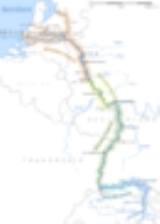
Rhine River is one of the longest and most important
rivers in
Europe at 1,320 kilometres , with an average discharge of more than 2,000 cubic meters per second. The name of the Rhine comes from the
Celtic Renos, literally "that which flows", from the Proto-Indo-European root *
rei- , which is also the origin of the English verb "to run" and the Greek adage
???ta ?e? ?a? ??d?? µ??e?, .
The Rhine and the
Danube formed most of the northern frontier of the
Roman Empire, and since those days the Rhine has been a vital navigable waterway, carrying trade and goods deep inland. It has also served as a defensive feature, and been the basis for regional and international borders. The many castles and prehistoric fortifications along the Rhine testify to its importance as a waterway - river traffic could be stopped at these locations, usually for the purpose of collecting tolls, by the state controlling that portion of the river.
Geography
Switzerland
The Rhine's origins are in the Swiss
Alps in the canton of Graubünden, where its two main initial tributaries are called
Vorderrhein and
Hinterrhein. The Vorderrhein springs from Lake Tuma near the
Oberalp Pass and passes the impressive
Ruinaulta . The Hinterrhein starts from the Paradies glacier near the Rheinquellhorn at the southern border of Switzerland. One of the latter tributaries originates in Val di Lei in Italy.
Both tributaries meet near Reichenau, still in Graubünden. From Reichenau, the Rhine flows north as the
Alpenrhein passing
Chur and forming the frontier with
Liechtenstein and then
Austria, and then emptying into
Lake Constance. Emerging from Lake Constance, flowing west as the
Hochrhein it passes the Rhine Falls and is joined by the
Aare river which more than doubles its water discharge to an average of nearly 1,000 cubic meters per second. It forms the boundary with Germany until it turns north at the so-called Rhine knee at
Basel.
Germany and France
Past Basel, as the Upper Rhine, it forms the southern part of the border between
Germany and
France in a wide valley, before entering
Germany exclusively at Rheinstetten, near Karlsruhe.
At over 1000 kilometres in length, the Rhine is the longest river primarily within
Germany. It is here that the Rhine encounters some of its main tributaries, such as the
Neckar, the
Main and later the
Moselle, which contributes an average discharge of over 300 cubic meters per second.
Between
Bingen and
Bonn, the
Middle Rhine flows through the
Rhine Gorge, a formation created by erosion, which happened at about the same rate as an uplift in the region, leaving the river at about its original level, and the surrounding lands raised. This gorge is quite deep, and is the stretch of the river known for its many
castles and
vineyards. It is a UNESCO World Heritage Site and known as "the romantic Rhine" with more than 40 castles and fortresses from the
Middle Ages and many lovely wine villages.
Though many industries can be found along the Rhine up into
Switzerland, it is along the
Lower Rhine in the
Ruhr area that the bulk of them are concentrated, as the river passes the major cities of
Cologne,
Düsseldorf, and
Duisburg. The
Ruhr, which joins the Rhine at Duisburg, is surprisingly clean, given the amount of industry on its banks, and is used for drinking water. It adds another 70 cubic meters per second to the Rhine. However, other rivers from the
Ruhr area, above all the
Emscher, still bring a considerable degree of
pollution. Approaching the Dutch border, the Rhine now has an average discharge of 2,290 cubic metres per second and an average width of more than 300 m.
The Netherlands
The Rhine then turns west and enters the
Netherlands, where together with the rivers
Meuse and
Scheldt it forms an extensive
delta. Crossing the border into the Netherlands at Spijk, close to
Nijmegen and
Arnhem the Rhine is at its widest, but the river then splits into three main distributaries: the
Waal,
Nederrijn and
IJssel branches.
From here the situation becomes more complicated, as the name "Rhine" no longer coincides with the main flow of water. Most of the Rhine water flows farther west through the Waal and then via the Merwede and Nieuwe Merwede and, merging with the Meuse, through the Hollands Diep and Haringvliet
estuaries into the
North Sea. The Beneden Merwede branches off near
Hardinxveld-Giessendam and continues as the Noord, to join the
Lek near the village of
Kinderdijk to form the
Nieuwe Maas, then flows past
Rotterdam and continues via
Het Scheur and the
Nieuwe Waterweg to the North Sea. The
Oude Maas branches off near
Dordrecht, farther down rejoining the
Nieuwe Maas to form
Het Scheur.
The other third portion of the water flows through the
Pannerdens Kanaal and redistributes in the IJssel and Nederrijn. The IJssel branch carries one ninth of the water volume north into the
IJsselmeer , while the Nederrijn flows west parallel to the Waal and carries approximately two ninths of the flow. However, at Wijk bij Duurstede the Nederrijn changes its name and becomes the
Lek. It flows farther west to rejoin the Noord into the
Nieuwe Maas and to the North Sea.
The name "Rhine" from here on is used only for smaller streams farther to the north which together once formed the main river Rhine in
Roman times. Though they retained the name, these streams do not carry water from the Rhine anymore, but are used for draining the surrounding land and
polders. From Wijk bij Duurstede, the old north branch of the Rhine is called
Kromme Rijn and past Utrecht, first Leidse Rijn and then Oude Rijn . The latter flows west into a
sluice at
Katwijk, where its waters can be discharged into the
North Sea. This branch once formed the line along which the
Upper Germanic limes were built.
Large cities
Basel,
Strasbourg,
Karlsruhe,
Mannheim,
Ludwigshafen,
Wiesbaden,
Mainz,
Koblenz,
Bonn,
Cologne,
Düsseldorf, Neuss, Krefeld,
Duisburg,
Arnhem ,
Nijmegen , Utrecht ,
Rotterdam .
Smaller cities
Konstanz,
Schaffhausen, ...,
Speyer,
Worms,
Bingen, Rüdesheim, Neuwied,
Andernach,
Bad Honnef,
Königswinter, Niederkassel,
Wesseling, Dormagen,
Zons,
Monheim,
Wesel,
Xanten,
Emmerich,
Zutphen ,
Deventer ,
Zwolle , Kampen .
Railway bridges
Railway bridges :
- Switzerland
- Tens of bridges in Graubünden, too numerous to list
state=Baden-Wrttemberg|
...
...
SBB and Basel Badischer Bahnhof
name_local=|
image_coa = Wappen Mannheim.png|
...
- Worms
- Mainz
- Koblenz
- 2 bridges between Köln Hbf and Köln Deutz/Messe
- Düsseldorf
- Duisburg
[i]
...
and Elst across
Waal...
and
Geldermalsen across
Waal, made famous in a poem by Martinus Nijhoff
- in Rotterdam across Nieuwe Maas , former bridge 'De Hef' - now replaced by a tunnel. Farther to the south, main bridge is at Moerdijk.
- between Elst
[i]
...
and
Arnhem across
Nederrijn...
across
Lek- Lettele [i]
- Okkenbroek [i]
...
across
IJssel- at Zwolle across IJssel
- near Alblas across Noord , now being replaced by a tunnel.
- between Utrecht and Zeist across Kromme Rijn
...
- At Utrecht central station across Vaartsche Rijn
- At Utrecht central station across Oude Rijn .
- between Utrecht and Vleuten, Woerden across Amsterdam Rijn-Canal
- between Utrecht and Breukelen,Amsterdam across Amsterdam Rijn-Canal
Tributaries
Tributaries from source to mouth:
...
The
Sieg is a river in North Rhine-Westphalia [i] and Rhineland-Palatinate [i], Germany [i] named a ...
...
Distributaries
[i]
...
Canals include
Geologic History
Alpine Orogeny
Since the Rhine flows from the
Alps, a precondition of its existence is the uplifting of the Alps, which began in the Alpine Orogeny. The stage was set in the Triassic Period of the Mesozoic Era, with the opening of the
Tethys Sea between the Eurasian and African
plates, between about 240 MBP and 220 MBP. The
Mediterranean descends from this somewhat larger Tethys sea.
At about 180 MBP, in the Jurassic Period, the two plates reversed direction and began to compress the Tethys floor, causing it to be subducted under Eurasia and pushing up the edge of the latter plate in the Alpine Orogeny of the Oligocene and Miocene Periods. Several microplates were caught in the squeeze and rotated or were pushed laterally, generating the individual features of Mediterranean geography: Iberia pushed up the
Pyrenees;
Italy the Alps, and
Anatolia, moving west, the mountains of
Greece and the islands. The compression and orogeny continue today, as shown by the ongoing raising of the mountains a small amount each year and the active volcanoes.
Just to the north of the Alpine Orogeny were highlands resulting from an earlier orogeny along similar lines. These highlands helped to divert the Rhine to the west; however, the Rhine's course is set by the Rhine graben, a rift that opened in the
Eocene and Oligocene periods between the western
Alps and the central Alps, caused by their moving in slightly different directions. The rift does not seem to be active now.
Stream Capture
The watershed of the Rhine reaches into the
Alps today, but it did not start out that way . In the Miocene period, the watershed of the Rhine reached south only to the
Eifel and
Westerwald hills, about 450 km north of the Alps. The Rhine then had the
Sieg as a tributary, but not yet the
Mosel. The northern Alps were drained by the
Danube then.
Through
stream capture, the Rhine extended its watershed southward. By the
Pliocene period, the Rhine had captured streams down to the
Vosges mountains, including the Mosel, the
Main, and the
Neckar. The northern Alps were drained by the
Rhône then.
By the early
Pleistocene period, the Rhine had captured most of its current Alpine watershed from the Rhône, including the
Aare. Since that time, the Rhine has added the watershed above
Lake Constance , the upper reaches of the Main , and the Vosges mountains to its watershed.
Ice Age
The
Pleistocene was the geological period of the Ice Ages. Since approximately 600,000 years ago six major Ice Ages have occurred, in which sea level dropped 120 m, and much of the continental margins became exposed. In the Early Pleistocene, the Rhine followed a course to the northwest, through the present North Sea. During the so-called Elsterien glaciation the northern part of the present North Sea was blocked by the ice, and a large lake developed that overflowed through the English Channel. This caused the Rhine's course to be diverted through the English Channel. Since then, during glacial times, the river mouth was located near Brest , and rivers like the
Thames, and
Seine became tributaries to the Rhine. During interglacials, when sea level rose to approximately the present level, the Rhine built a delta in what is now called The Netherlands.
During the last
Ice Age , at the end of the
Pleistocene, the lower Rhine flowed roughly west through the Netherlands and then to the southwest, through the English Channel, and finally to the Atlantic Ocean. The English and Irish Channels, the
Baltic Sea