

History of Luxembourg

Encyclopedia
The history of Luxembourg is inherently entwined with the histories of surrounding countries, peoples, and ruling dynasties. Over time, the territory of Luxembourg
has been eroded, whilst its ownership has changed repeatedly, and its political independence has grown gradually.'
Although recorded Luxembourgian history dates back to Roman
times, the history of Luxembourg proper is considered to begin in 963. Over the following five centuries, the powerful House of Luxembourg
emerged. Its extinction put an end to Luxembourgian independence. After a brief spell of Burgundian
rule, Luxembourg fell into the hands of the Habsburg
s in 1477.
After the Eighty Years' War, Luxembourg became a part of the Southern Netherlands
, which passed to the Austrian line of the Habsburg dynasty in 1713. After occupation by Revolutionary France, the 1815 Treaty of Paris transformed Luxembourg into a Grand Duchy
in personal union
with the Netherlands
. The treaty also resulted in the second partition of Luxembourg
, the first being in 1659 and the third in 1839. Although these treaties greatly reduced Luxembourg's territory, they increased Luxembourg's independence, which was confirmed after the Luxembourg Crisis
in 1867.
In the following decades, Luxembourg fell further into Germany's sphere of influence
, particularly after the creation of a separate ruling house in 1890. Luxembourg was occupied by Germany from 1914 until 1918
and again from 1940 until 1944
. Since the Second World War
, Luxembourg has become one of the world's richest countries, buoyed by a booming financial services
sector, political stability, and European integration
.
However, the first real evidence of civilization is from the Neolithic or 5th millennium BC when houses began to appear. Traces have been found in the south of Luxembourg at Grevenmacher, Diekirch, Aspelt and Weiler-la-Tour. The dwellings were made of a combination of tree trunks for the basic structure, mud-clad wickerwork walls, and roofs of thatched reeds or straw.[3] Pottery from this period has been found near Remerschen.[4]
While there is not much evidence of communities in Luxembourg at the beginning of the Bronze Age, a number of sites dating back to the period between the 13th and the 8th century BC provide evidence of dwellings and reveal artifacts such as pottery, knives and jewelry. These include Nospelt, Dalheim, Mompach and Remerschen.
The Celts inhabited what is now Luxembourg from roughly 600 BC until 100 AD. The Celts inhabited large areas of Europe from the Danube
to the Rhine and Rhône
during this time. It was around 100 BC that the Treveri
, one of the Celtic tribes, entered a period of prosperity. They constructed a number of fortified settlements or oppida near the Moselle valley
in what is now southern Luxembourg, western Germany and eastern France.[1]
The Celtic civilization reached its height in the 1st century BC, prior to the Roman conquest in 54 BC. Most of the evidence from that period has been discovered in tombs, many closely associated with Titelberg, a 50 ha site which reveals much about the dwellings and handicrafts of the period.
The first known reference to the territory in modern Luxembourg was by Julius Caesar
in his Commentaries on the Gallic War
.
The Celtic tribe in what is now Luxembourg during and after the La Tène period was known as the Treveri
. By and large, the Treveri were more co-operative with the Romans, who completed their occupation in 53 BC under Julius Caesar, than most Gallic tribes. Two 1st-century AD revolts did not permanently damage their cordial relations with Rome, and the Treveri adapted readily to Roman civilization.
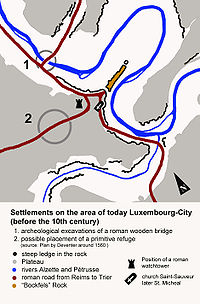 The history of Luxembourg properly began with the construction of Luxembourg Castle in the Middle Ages
. It was Siegfried I, Count of Ardennes
who traded some of his ancestral lands with the monks of the Abbey of St. Maximin in Trier
in 963 for an ancient, supposedly Roman
, fort named Lucilinburhuc. Modern historians explain the etymology of the word with Letze, meaning fortification which might have referred to either the remains of a Roman watchtower or to a primitive refuge of the early Middle Ages.
Around this fort a town gradually developed, which became the centre of a small but important state of great strategic value to France, Germany and the Netherlands. Luxembourg's fortress, located on a rocky outcrop known as the Bock
, was steadily enlarged and strengthened over the years by successive owners, among others the Bourbons, Habsburg
s and Hohenzollerns, which made it one of the strongest fortresses on the European continent. Its formidable defences and strategic location caused it to become known as the ‘Gibraltar
of the North’.
The Luxembourgish dynasty
provided several Holy Roman Emperor
s, Kings of Bohemia
, and Archbishop
s of Trier
and Mainz
. From the Early Middle Ages
to the Renaissance
, Luxembourg bore multiple names, depending on the author. These include Lucilinburhuc, Lutzburg, Lützelburg, Luccelemburc, Lichtburg, among others.
Luxembourg remained an independent fief (county) of the Holy Roman Empire
until 1354, when the emperor Charles IV
elevated it to the status of a duchy
. At that time the Luxembourg family held the Crown of Bohemia
, but the duchy was usually possessed as appanage
by a separate branch of the family. In 1437 the imperial Luxembourg family became extinct in the male line. At that time, the duchy and castle were held by the Bohemian princess Elisabeth of Gorlitz, Duchess of Luxembourg, a cadet granddaughter of emperor Charles IV. Elisabeth was childless, and in 1440 made a treaty with her powerful neighbour Philip III, Duke of Burgundy
that Philip would administer the duchy and inherit it after the Duchess Elisabeth's death. Elisabeth died in 1451, but Philip accelerated things by expelling Elisabeth in 1443. The heirs of the main Luxembourg dynasty were not happy with the arrangement the Burgundians had made, and managed at times to wrest the possession from Burgundy. The Habsburg
prince Ladislas the Posthumous
, king of Bohemia and Hungary (d. 1457), held the title in the 1450s. After his death, his brother-in-law William of Thuringia (1425 to 1482) held (or at least claimed) it from 1457 to 1469. In 1467, Elisabeth, Queen of Poland, the last surviving sister of Ladislas, renounced her right in favour of Burgundy by treaty and some concessions, since the possession was next to impossible to hold against Burgundian actions. After being captured by Philip of Burgundy
in 1443 and ultimately from 1467 to 1469, the duchy became one of the Seventeen Provinces
of the Netherlands. With the marriage of Mary of Burgundy
in 1477 all the Netherlands provinces, including Luxembourg, came under Habsburg rule in the person of her husband Maximilian, and later their son Philip the Handsome.
 In these centuries the electors of Brandenburg, later kings of Prussia (Borussia
), advanced their claim to the Luxembourg patrimony as heirs-general to William of Thuringia and his wife Anna of Bohemia, the disputed dukes of Luxembourg of the 1460s – Anna was the eldest daughter of the last Luxembourg heiress. From 1609 onwards, they had a territorial base in the vicinity, the Duchy of Cleves
, the starting-point of the future Prussian Rhineland. This Brandenburger claim ultimately produced some results when some districts of Luxembourg were united with Prussia in 1813.
The first Hohenzollern claimant to descend from both Anna and her younger sister Elisabeth, was John George, Elector of Brandenburg
(1525–98), his maternal grandmother having been Barbara Jagiellon. In the late 18th century, the younger line of Orange-Nassau (the princes who held sway in the neighbouring Dutch oligarchy) also became related to the Brandenburgers.
In 1598, the then possessor, Philip II of Spain
, bequeathed Luxembourg and the other Low Countries to his daughter the Infanta Isabella Clara Eugenia and her husband Albert VII, Archduke of Austria
. Albert was an heir and descendant of Elisabeth of Austria (d. 1505)
, queen of Poland, the youngest granddaughter of Sigismund of Luxembourg, the Holy Roman Emperor. Thus, Luxembourg returned to the heirs of the old Luxembourg dynasty – at least those of the line of Elisabeth. The Low Countries were a separate political entity during the couple's reign. After Albert's childless death in 1621, Luxembourg passed to his great-nephew and heir Philip IV of Spain
, who through his paternal grandmother Anna of Austria, queen of Spain, Albert's sister, was the primogenitural heir to the Queen Elisabeth of Poland.
Luxembourg was invaded
by Louis XIV of France
(husband of Maria Theresa, daughter of Philip IV) in 1684, an action that caused alarm among France's neighbours and resulted in the formation of the League of Augsburg in 1686. In the ensuing War of the Grand Alliance
, France was forced to give up the duchy, which was returned to the Habsburgs by the Treaty of Ryswick
in 1697. During this period of French rule, the defences of the fortress were strengthened by the famous siege
engineer Vauban
. The French king's great-grandson Louis (1710–74) was, from 1712, the first heir-general of Albert VII. Albert VII was a descendant of Anna of Bohemia and William of Thuringia, having that blood through his mother's Danish great-great-grandmother, but was not the heir-general of that line. Louis was the first real claimant of Luxembourg to descend from both sisters, the daughters of Elisabeth of Bohemia, the last Luxembourg empress.
Habsburg rule was confirmed in 1715 by the Treaty of Utrecht, and Luxembourg was integrated into the Austrian Netherlands
. Emperor Joseph and his successor Emperor Charles VI were descendants of Spanish kings who were heirs of Albert VII. Joseph and Charles VI were also descendants of Anna of Bohemia and William of Thuringia, having that blood through their mother, although they were heirs-general of neither line. Charles was the first ruler of Luxembourg to descend from both sisters, daughters of Elisabeth of Bohemia, the last Luxembourg empress.
Austrian rulers were more or less ready to exchange Luxembourg and other territories in the Low Countries. Their purpose was to round out and enlarge their power base, which in geographical terms was centered around Vienna. Thus, Bavarian candidate(s) emerged to take over the Duchy of Luxembourg, but this plan led to nothing permanent. Emperor Joseph II
however made a preliminary pact to make a neighbour of Luxembourg, Charles Theodore, Elector Palatine, as Duke of Luxembourg and king in the Low Countries, in exchange of his possessions in Bavaria and Franconia. However, this scheme was aborted. Charles Theodore, who would thus have become Duke of Luxembourg, was genealogically a junior descendant of both Anna and Elisabeth, but main heir of neither.
During the War of the First Coalition, Luxembourg was conquered and annexed by Revolutionary France, becoming part of the département
of the Forêts
in 1795. The annexation was formalised at Campo Formio
in 1797. In 1798 Luxembourgish peasants rebelled against the French but the Rebellion was rapidly oppressed.This short Rebellion is called the Peasant's War
.
of Napoleon in 1815, when the Congress of Vienna
gave formal autonomy to Luxembourg. The Prussians had already in 1813 managed to wrest lands from Luxembourg, to strengthen the Prussian-possessed Duchy of Julich
. The Bourbons of France held a strong claim to Luxembourg, the Emperor of Austria on the other hand had controlled the duchy until the revolutionary forces had joined it to the French republic (he reportedly was not enthusiastic about regaining Luxembourg and the Low Countries, being more interested in the Balkans). The King of Prussia held the claim of the senior heiress, Anna. An additional claimant emerged, William VI, Prince of Orange who now ruled the Netherlands, and whose mother and wife were descendants of the Prussian royal family and thus also descendants of both daughters of the last Luxembourg heiress. Prussia and Orange-Nassau made the following exchange deal: Prussia received the Principality of Orange-Nassau
, which included the ancestral lands of Nassau in Central Germany; the Prince of Orange in turn received Luxembourg.
Luxembourg, somewhat diminished in size (as the medieval lands had been slightly reduced by the French and Prussian heirs), was augmented in another way through the elevation to the status of grand duchy
and placed under the rule of William I of the Netherlands
. This was the first time that the duchy had a monarch who had no claim to inheritance of the medieval patrimony (as lineages through his mother and wife had a better entitled claimant, the Prussian king himself). However, Luxembourg's military value to Prussia
prevented it from becoming a part of the Dutch kingdom. The fortress, ancestral seat of the medieval Luxembourgers, was taken over by Prussian forces, following Napoleon's defeat, and Luxembourg became a member of the German Confederation
with Prussia responsible for its defense.
In July 1819 a contemporary from Britain visited Luxembourg: his journal offers some insights. Norwich Duff
writes that "Luxembourg is considered one of the strongest fortifications in Europe, and … it appears so. It is situated in Holland
(then as now used by English speakers as shorthand for the Netherlands) but by treaty is garrisoned by Prussians and 5,000 of their troops occupy it under a Prince of Hesse
. The civil government is under the Dutch and the duties collected by them. The town is not very large but the streets are broader than [in] the French towns and clean ands the houses are good.... [I] got the cheapest of hot baths
here at the principal house I ever had in my life: one franc."
Much of the Luxembourgish population joined the Belgian revolution
against Dutch
rule. Except for the fortress and its immediate vicinity Luxembourg was considered a province of the new Belgian state from 1830 to 1839. By the Treaty of London
in 1839 the status of the grand duchy was confirmed as sovereign and in personal union to the king of the Netherlands. In turn, the predominantly French speaking part of the duchy was ceded to Belgium as the province de Luxembourg. This loss left the Grand Duchy of Luxembourg a predominantly German state, although French cultural influence remained strong. The loss of Belgian markets also caused painful economic problems for the state. Recognizing this, the grand duke integrated it into the German Zollverein
in 1842. Nevertheless, Luxembourg remained an underdeveloped agrarian country for most of the century. As a result of this about one in five of the inhabitants emigrated
to the United States between 1841 and 1891.
of 1867 almost resulted in war between France and Prussia over the status of Luxembourg. It involved competition between France and Prussia over control of Luxembourg, which had become free of German control when the German Confederation was abolished at the end of the Seven Weeks War in 1866.
William III, king of the Netherlands, which still had suzerainty over Luxembourg, was willing to sell the grand duchy to France's Emperor Napoleon III in order to retain Limbourg but backed out when Prussian chancellor Otto von Bismarck
expressed opposition. The growing tension brought about a conference in London from March to May 1867 in which the British served as mediators between the two rivals. Bismarck manipulated public opinion, resulting in the denial of sale to France and the continued suzerainty of Holland, a member of the customs union with close ties to Prussia. The issue was resolved by the second Treaty of London
which guaranteed the perpetual independence and neutrality
of the state. The fortress walls were pulled down and the Prussian garrison was withdrawn.
Famous visitors to Luxembourg in the 18th and 19th centuries included the German poet Johann Wolfgang von Goethe
, the French writers Emile Zola
and Victor Hugo
, the composer Franz Liszt
, and the English painter Joseph Mallord William Turner.
in 1890, when the grand duchy passed to the House of Nassau-Weilburg due to a Nassau inheritance pact of 1783.
. In 1921 it entered into an economic and monetary union with Belgium, the Union Économique Belgo-Luxembourgeoise (UEBL). During most of the 20th century, however, Germany remained its most important economic partner.
The introduction of universal suffrage
for men and women favored the Rechtspartei (party of the Right), which played the dominant role in the government throughout the 20th century, with the exception of 1925–26 and 1974–79, when the two other important parties, the Liberal
and the Social-Democratic
parties, formed a coalition. The success of the resulting party was due partly to the support of the church — the population was more than 90 percent Catholic — and of its newspaper, the Luxemburger Wort.
On the international level, the interwar period was characterized by an attempt to put Luxembourg on the map. Especially under Joseph Bech, head of the Department of Foreign Affairs, the country participated more actively in several international organizations, in order to ensure its autonomy. On December 16, 1920, Luxemburg became a member of the League of Nations
. On the economic level in the 1920s and the 1930s, the agricultural sector declined in favor of industry, but even more so for the service sector. The proportion of the active population in this last sector rose from 18 percent in 1907 to 31 percent in 1935.
In the 1930s the internal situation deteriorated, as Luxembourgish politics were influenced by European left- and right-wing politics. The government tried to counter communist-led unrest in the industrial areas and continued friendly policies towards Nazi Germany
, which led to much criticism. The attempts to quell unrest peaked with the Maulkuerfgesetz, the "muzzle" Law, which was an attempt to outlaw the Communist Party
. The law was turned down in a 1937 referendum.
to Luxembourg to give hope to the people.
The state was placed under military occupation until August 1942, when it was formally annexed
by the Third Reich as part of the Gau
Moselland. Luxembourgers were declared to be German citizens and 13,000 were called up for military service. 2,848 Luxembourgers eventually died fighting in the German army.
Luxembourgish opposition to this annexation took the form of passive resistance at first, as in the Spéngelskrich (lit. "War of the Pins"), and by the refusal to speak German. As French was forbidden, many Luxembourgers resorted to resuscitating old Luxembourgish words, which led to a renaissance of the language. Other measures included deportation
, forced labour, forced conscription and, more drastically, internment
, deportation to concentration camps and execution.
The latter measure was applied after the so-called general strike from 1 September to 3 September 1942, which paralyzed the administration, agriculture, industry and education as response to the declaration of forced conscription by the German administration on 30 August 1942. It was violently suppressed: 21 strikers were executed and hundreds more deported to concentration camps. The then civilian administrator of Luxembourg, Gauleiter
Gustav Simon
had declared conscription necessary to support the German war effort. It was to remain one of the few mass strikes against the German war machinery in Western Europe.
U.S. forces liberated most of the country in September 1944, they entered the capital city on 10 September 1944. During the Ardennes Offensive (Battle of the Bulge
) German troops take back most of northern Luxembourg for a few weeks. The Germans were finally expelled in January 1945. Altogether, of a pre-war population of 293,000, 5,259 Luxembourgers lost their lives during the hostilities.
Luxembourg abandoned its politics of neutrality
, when it became a founding member of the North Atlantic Treaty Organization (1949) and the United Nations
. It is a signatory of the Treaty of Rome
, and constituted a monetary union with Belgium (Benelux Customs Union in 1948), and an economic union with Belgium and the Netherlands, the so-called BeNeLux
.
Between 1945 and 2005, the economic structure of Luxembourg changed significantly. The crisis of the metallurgy sector, which began in the mid-1970s and lasted till the late 1980s, nearly pushed the country into economic recession, given the monolithic dominance of that sector. The Tripartite Coordination Committee, consisting of members of the government, management representatives, and trade union leaders, succeeded in preventing major social unrest during those years, thus creating the myth of a “Luxembourg model” characterized by social peace. Although in the early years of the 21st century Luxembourg enjoyed one of the highest GNP per capita in the world, this was mainly due to the strength of its financial sector, which gained importance at the end of the 1960s. Thirty-five years later, one-third of the tax proceeds originated from that sector. The harmonization of the tax system across Europe could, however, seriously undermine the financial situation of the grand duchy.
Luxembourg has been one of the strongest advocates of the European Union
in the tradition of Robert Schuman
. In 1957, Luxembourg became one of the six founding countries of the European Economic Community
(later the European Union) and in 1999 it joined the euro
currency area.
Encouraged by the contacts established with the Dutch and Belgian governments in exile, Luxembourg pursued a policy of presence in international organizations. It was one of the six founding members of the European Coal and Steel Community (ECSC) in 1952 and of the European Economic Community (EEC) in 1957. In the context of the Cold War, Luxembourg clearly opted for the West by joining the North Atlantic Treaty Organization (NATO) in 1949, thus renouncing its traditional neutrality, which had determined its international policy since the founding of the state. Engagement in European construction was rarely questioned subsequently, either by politicians or by the greater population. Despite its small proportions, Luxembourg often played an intermediary role between larger countries. This role of mediator, especially between the two large and often bellicose nations of Germany and France, was considered one of the main characteristics of national identity, allowing the Luxembourger not to have to choose between one of these two neighbours. The country also hosted a large number of European institutions such as the European Court of Justice. Luxembourg’s small size no longer seemed to be a challenge to the existence of the country, and the creation of the Banque Centrale du Luxembourg (1998) and of the University of Luxembourg (2003) was evidence of the continuing desire to become a “real” nation. The decision in 1985 to declare Lëtzebuergesch (Luxembourgian) the national language was also a step in the affirmation of the country’s independence. In fact, the linguistic situation in Luxembourg was characterized by trilinguilism: Lëtzebuergesch was the spoken vernacular language, German the written language, in which Luxembourgers were most fluent, and French the language of official letters and law.
In 1985, the country became victim to a mysterious bombing spree, which was targeted mostly at electrical masts and other installations.
In 1995 Luxembourg provided the President of the European Commission
, former Prime Minister Jacques Santer who later had to resign over corruption accusations against other commission members.
The current Prime Minister, Jean-Claude Juncker
follows this European tradition. On 10 September 2004, Mr Juncker became the semi-permanent President of the group of finance ministers from the 12 countries that share the euro, a role dubbed "Mr Euro".
The present sovereign is Grand Duke Henri
. Henri's father, Jean
, succeeded his mother, Charlotte, on 12 November 1964. Jean's eldest son, Prince Henri, was appointed "Lieutenant Représentant" (Hereditary Grand Duke) on 4 March 1998. On 24 December 1999, Prime Minister Juncker announced Grand Duke Jean's decision to abdicate the throne on 7 October 2000, in favour of Prince Henri who assumed the title and constitutional duties of Grand Duke.
On 10 July 2005, after threats of resignation by Prime Minister Juncker, the proposed European Constitution was approved by 56.52% of voters.
Luxembourg
Luxembourg , officially the Grand Duchy of Luxembourg , is a landlocked country in western Europe, bordered by Belgium, France, and Germany. It has two principal regions: the Oesling in the North as part of the Ardennes massif, and the Gutland in the south...
has been eroded, whilst its ownership has changed repeatedly, and its political independence has grown gradually.'
Although recorded Luxembourgian history dates back to Roman
Ancient Rome
Ancient Rome was a thriving civilization that grew on the Italian Peninsula as early as the 8th century BC. Located along the Mediterranean Sea and centered on the city of Rome, it expanded to one of the largest empires in the ancient world....
times, the history of Luxembourg proper is considered to begin in 963. Over the following five centuries, the powerful House of Luxembourg
House of Luxembourg
The House of Luxembourg was a late medieval German dynasty, which between 1308 and 1437 ruled the Holy Roman Empire, twice interrupted by the rivaling House of Wittelsbach.-History:...
emerged. Its extinction put an end to Luxembourgian independence. After a brief spell of Burgundian
Duchy of Burgundy
The Duchy of Burgundy , was heir to an ancient and prestigious reputation and a large division of the lands of the Second Kingdom of Burgundy and in its own right was one of the geographically larger ducal territories in the emergence of Early Modern Europe from Medieval Europe.Even in that...
rule, Luxembourg fell into the hands of the Habsburg
Habsburg
The House of Habsburg , also found as Hapsburg, and also known as House of Austria is one of the most important royal houses of Europe and is best known for being an origin of all of the formally elected Holy Roman Emperors between 1438 and 1740, as well as rulers of the Austrian Empire and...
s in 1477.
After the Eighty Years' War, Luxembourg became a part of the Southern Netherlands
Southern Netherlands
Southern Netherlands were a part of the Low Countries controlled by Spain , Austria and annexed by France...
, which passed to the Austrian line of the Habsburg dynasty in 1713. After occupation by Revolutionary France, the 1815 Treaty of Paris transformed Luxembourg into a Grand Duchy
Grand duchy
A grand duchy, sometimes referred to as a grand dukedom, is a territory whose head of state is a monarch, either a grand duke or grand duchess.Today Luxembourg is the only remaining grand duchy...
in personal union
Personal union
A personal union is the combination by which two or more different states have the same monarch while their boundaries, their laws and their interests remain distinct. It should not be confused with a federation which is internationally considered a single state...
with the Netherlands
United Kingdom of the Netherlands
United Kingdom of the Netherlands is the unofficial name used to refer to Kingdom of the Netherlands during the period after it was first created from part of the First French Empire and before the new kingdom of Belgium split out in 1830...
. The treaty also resulted in the second partition of Luxembourg
Partitions of Luxembourg
There have been three Partitions of Luxembourg since 1659. Together, the three partitions reduced the territory of Luxembourg from 10,700 km² to the present-day area of 2,586 km² over a period of 240 years...
, the first being in 1659 and the third in 1839. Although these treaties greatly reduced Luxembourg's territory, they increased Luxembourg's independence, which was confirmed after the Luxembourg Crisis
Luxembourg Crisis
The Luxembourg Crisis was a diplomatic dispute and confrontation in 1867 between France and Prussia over the political status of Luxembourg. The confrontation almost led to war between the two parties, but was peacefully resolved by the Treaty of London....
in 1867.
In the following decades, Luxembourg fell further into Germany's sphere of influence
Sphere of influence
In the field of international relations, a sphere of influence is a spatial region or conceptual division over which a state or organization has significant cultural, economic, military or political influence....
, particularly after the creation of a separate ruling house in 1890. Luxembourg was occupied by Germany from 1914 until 1918
German occupation of Luxembourg in World War I
The German occupation of Luxembourg in World War I was the first of two military occupations of the Grand Duchy of Luxembourg by Germany in the twentieth century. From August 1914 until the end of World War I in November 1918, Luxembourg was under full occupation by the German Empire...
and again from 1940 until 1944
German occupation of Luxembourg in World War II
The German occupation of Luxembourg in World War II was the period in the history of Luxembourg after it was used as a transit territory to attack France by outflanking the Maginot Line. Plans for the attack had been prepared by 9 October 1939, but execution was postponed several times...
. Since the Second World War
World War II
World War II, or the Second World War , was a global conflict lasting from 1939 to 1945, involving most of the world's nations—including all of the great powers—eventually forming two opposing military alliances: the Allies and the Axis...
, Luxembourg has become one of the world's richest countries, buoyed by a booming financial services
Financial services
Financial services refer to services provided by the finance industry. The finance industry encompasses a broad range of organizations that deal with the management of money. Among these organizations are credit unions, banks, credit card companies, insurance companies, consumer finance companies,...
sector, political stability, and European integration
European integration
European integration is the process of industrial, political, legal, economic integration of states wholly or partially in Europe...
.
Ancient Luxembourg (before 963)
In the territory now covered by the Grand Duchy of Luxembourg, there is evidence of primitive inhabitants right back to the Paleolithic or old stone age over 35,000 years ago. The oldest artifacts from this period are decorated bones found at Oetrange.[2]However, the first real evidence of civilization is from the Neolithic or 5th millennium BC when houses began to appear. Traces have been found in the south of Luxembourg at Grevenmacher, Diekirch, Aspelt and Weiler-la-Tour. The dwellings were made of a combination of tree trunks for the basic structure, mud-clad wickerwork walls, and roofs of thatched reeds or straw.[3] Pottery from this period has been found near Remerschen.[4]
While there is not much evidence of communities in Luxembourg at the beginning of the Bronze Age, a number of sites dating back to the period between the 13th and the 8th century BC provide evidence of dwellings and reveal artifacts such as pottery, knives and jewelry. These include Nospelt, Dalheim, Mompach and Remerschen.
The Celts inhabited what is now Luxembourg from roughly 600 BC until 100 AD. The Celts inhabited large areas of Europe from the Danube
Danube
The Danube is a river in the Central Europe and the Europe's second longest river after the Volga. It is classified as an international waterway....
to the Rhine and Rhône
Rhône
Rhone can refer to:* Rhone, one of the major rivers of Europe, running through Switzerland and France* Rhône Glacier, the source of the Rhone River and one of the primary contributors to Lake Geneva in the far eastern end of the canton of Valais in Switzerland...
during this time. It was around 100 BC that the Treveri
Treveri
The Treveri or Treviri were a tribe of Gauls who inhabited the lower valley of the Moselle from around 150 BCE, at the latest, until their eventual absorption into the Franks...
, one of the Celtic tribes, entered a period of prosperity. They constructed a number of fortified settlements or oppida near the Moselle valley
Moselle valley
The Moselle valley is a region in north-eastern France, south-western Germany, and eastern Luxembourg, centred on the river valley formed by the Moselle...
in what is now southern Luxembourg, western Germany and eastern France.[1]
The Celtic civilization reached its height in the 1st century BC, prior to the Roman conquest in 54 BC. Most of the evidence from that period has been discovered in tombs, many closely associated with Titelberg, a 50 ha site which reveals much about the dwellings and handicrafts of the period.
The first known reference to the territory in modern Luxembourg was by Julius Caesar
Julius Caesar
Gaius Julius Caesar was a Roman general and statesman and a distinguished writer of Latin prose. He played a critical role in the gradual transformation of the Roman Republic into the Roman Empire....
in his Commentaries on the Gallic War
Commentarii de Bello Gallico
Commentarii de Bello Gallico is Julius Caesar's firsthand account of the Gallic Wars, written as a third-person narrative. In it Caesar describes the battles and intrigues that took place in the nine years he spent fighting local armies in Gaul that opposed Roman domination.The "Gaul" that Caesar...
.
The Celtic tribe in what is now Luxembourg during and after the La Tène period was known as the Treveri
Treveri
The Treveri or Treviri were a tribe of Gauls who inhabited the lower valley of the Moselle from around 150 BCE, at the latest, until their eventual absorption into the Franks...
. By and large, the Treveri were more co-operative with the Romans, who completed their occupation in 53 BC under Julius Caesar, than most Gallic tribes. Two 1st-century AD revolts did not permanently damage their cordial relations with Rome, and the Treveri adapted readily to Roman civilization.
Medieval Luxembourg (963 – 1477)
Middle Ages
The Middle Ages is a periodization of European history from the 5th century to the 15th century. The Middle Ages follows the fall of the Western Roman Empire in 476 and precedes the Early Modern Era. It is the middle period of a three-period division of Western history: Classic, Medieval and Modern...
. It was Siegfried I, Count of Ardennes
Ardennes
The Ardennes is a region of extensive forests, rolling hills and ridges formed within the Givetian Ardennes mountain range, primarily in Belgium and Luxembourg, but stretching into France , and geologically into the Eifel...
who traded some of his ancestral lands with the monks of the Abbey of St. Maximin in Trier
Trier
Trier, historically called in English Treves is a city in Germany on the banks of the Moselle. It is the oldest city in Germany, founded in or before 16 BC....
in 963 for an ancient, supposedly Roman
Ancient Rome
Ancient Rome was a thriving civilization that grew on the Italian Peninsula as early as the 8th century BC. Located along the Mediterranean Sea and centered on the city of Rome, it expanded to one of the largest empires in the ancient world....
, fort named Lucilinburhuc. Modern historians explain the etymology of the word with Letze, meaning fortification which might have referred to either the remains of a Roman watchtower or to a primitive refuge of the early Middle Ages.
Around this fort a town gradually developed, which became the centre of a small but important state of great strategic value to France, Germany and the Netherlands. Luxembourg's fortress, located on a rocky outcrop known as the Bock
Bock (Luxembourg)
The Bock is a promontory in the north-eastern corner of Luxembourg City's old historical district. Offering a natural fortification, its rocky cliffs tower above the River Alzette which surrounds it on three sides. It was here that Count Siegfried built his Castle of Lucilinburhuc in 963,...
, was steadily enlarged and strengthened over the years by successive owners, among others the Bourbons, Habsburg
Habsburg
The House of Habsburg , also found as Hapsburg, and also known as House of Austria is one of the most important royal houses of Europe and is best known for being an origin of all of the formally elected Holy Roman Emperors between 1438 and 1740, as well as rulers of the Austrian Empire and...
s and Hohenzollerns, which made it one of the strongest fortresses on the European continent. Its formidable defences and strategic location caused it to become known as the ‘Gibraltar
Gibraltar
Gibraltar is a British overseas territory located on the southern end of the Iberian Peninsula at the entrance of the Mediterranean. A peninsula with an area of , it has a northern border with Andalusia, Spain. The Rock of Gibraltar is the major landmark of the region...
of the North’.
The Luxembourgish dynasty
House of Luxembourg
The House of Luxembourg was a late medieval German dynasty, which between 1308 and 1437 ruled the Holy Roman Empire, twice interrupted by the rivaling House of Wittelsbach.-History:...
provided several Holy Roman Emperor
Holy Roman Emperor
The Holy Roman Emperor is a term used by historians to denote a medieval ruler who, as German King, had also received the title of "Emperor of the Romans" from the Pope...
s, Kings of Bohemia
Bohemia
Bohemia is a historical region in central Europe, occupying the western two-thirds of the traditional Czech Lands. It is located in the contemporary Czech Republic with its capital in Prague...
, and Archbishop
Archbishop
An archbishop is a bishop of higher rank, but not of higher sacramental order above that of the three orders of deacon, priest , and bishop...
s of Trier
Trier
Trier, historically called in English Treves is a city in Germany on the banks of the Moselle. It is the oldest city in Germany, founded in or before 16 BC....
and Mainz
Mainz
Mainz under the Holy Roman Empire, and previously was a Roman fort city which commanded the west bank of the Rhine and formed part of the northernmost frontier of the Roman Empire...
. From the Early Middle Ages
Early Middle Ages
The Early Middle Ages was the period of European history lasting from the 5th century to approximately 1000. The Early Middle Ages followed the decline of the Western Roman Empire and preceded the High Middle Ages...
to the Renaissance
Renaissance
The Renaissance was a cultural movement that spanned roughly the 14th to the 17th century, beginning in Italy in the Late Middle Ages and later spreading to the rest of Europe. The term is also used more loosely to refer to the historical era, but since the changes of the Renaissance were not...
, Luxembourg bore multiple names, depending on the author. These include Lucilinburhuc, Lutzburg, Lützelburg, Luccelemburc, Lichtburg, among others.
Luxembourg remained an independent fief (county) of the Holy Roman Empire
Holy Roman Empire
The Holy Roman Empire was a realm that existed from 962 to 1806 in Central Europe.It was ruled by the Holy Roman Emperor. Its character changed during the Middle Ages and the Early Modern period, when the power of the emperor gradually weakened in favour of the princes...
until 1354, when the emperor Charles IV
Charles IV, Holy Roman Emperor
Charles IV , born Wenceslaus , was the second king of Bohemia from the House of Luxembourg, and the first king of Bohemia to also become Holy Roman Emperor....
elevated it to the status of a duchy
Duchy
A duchy is a territory, fief, or domain ruled by a duke or duchess.Some duchies were sovereign in areas that would become unified realms only during the Modern era . In contrast, others were subordinate districts of those kingdoms that unified either partially or completely during the Medieval era...
. At that time the Luxembourg family held the Crown of Bohemia
Bohemia
Bohemia is a historical region in central Europe, occupying the western two-thirds of the traditional Czech Lands. It is located in the contemporary Czech Republic with its capital in Prague...
, but the duchy was usually possessed as appanage
Appanage
An apanage or appanage or is the grant of an estate, titles, offices, or other things of value to the younger male children of a sovereign, who would otherwise have no inheritance under the system of primogeniture...
by a separate branch of the family. In 1437 the imperial Luxembourg family became extinct in the male line. At that time, the duchy and castle were held by the Bohemian princess Elisabeth of Gorlitz, Duchess of Luxembourg, a cadet granddaughter of emperor Charles IV. Elisabeth was childless, and in 1440 made a treaty with her powerful neighbour Philip III, Duke of Burgundy
Philip III, Duke of Burgundy
Philip the Good KG , also Philip III, Duke of Burgundy was Duke of Burgundy from 1419 until his death. He was a member of a cadet line of the Valois dynasty . During his reign Burgundy reached the height of its prosperity and prestige and became a leading center of the arts...
that Philip would administer the duchy and inherit it after the Duchess Elisabeth's death. Elisabeth died in 1451, but Philip accelerated things by expelling Elisabeth in 1443. The heirs of the main Luxembourg dynasty were not happy with the arrangement the Burgundians had made, and managed at times to wrest the possession from Burgundy. The Habsburg
Habsburg
The House of Habsburg , also found as Hapsburg, and also known as House of Austria is one of the most important royal houses of Europe and is best known for being an origin of all of the formally elected Holy Roman Emperors between 1438 and 1740, as well as rulers of the Austrian Empire and...
prince Ladislas the Posthumous
Ladislas the Posthumous
Ladislaus the Posthumous was Duke of Austria from 1440, King of Hungary from 1444 and King of Bohemia from 1453.- Biography :...
, king of Bohemia and Hungary (d. 1457), held the title in the 1450s. After his death, his brother-in-law William of Thuringia (1425 to 1482) held (or at least claimed) it from 1457 to 1469. In 1467, Elisabeth, Queen of Poland, the last surviving sister of Ladislas, renounced her right in favour of Burgundy by treaty and some concessions, since the possession was next to impossible to hold against Burgundian actions. After being captured by Philip of Burgundy
Duchy of Burgundy
The Duchy of Burgundy , was heir to an ancient and prestigious reputation and a large division of the lands of the Second Kingdom of Burgundy and in its own right was one of the geographically larger ducal territories in the emergence of Early Modern Europe from Medieval Europe.Even in that...
in 1443 and ultimately from 1467 to 1469, the duchy became one of the Seventeen Provinces
Seventeen Provinces
The Seventeen Provinces were a personal union of states in the Low Countries in the 15th century and 16th century, roughly covering the current Netherlands, Belgium, Luxembourg, a good part of the North of France , and a small part of Western Germany.The Seventeen Provinces were originally held by...
of the Netherlands. With the marriage of Mary of Burgundy
Mary of Burgundy
Mary of Burgundy ruled the Burgundian territories in Low Countries and was suo jure Duchess of Burgundy from 1477 until her death...
in 1477 all the Netherlands provinces, including Luxembourg, came under Habsburg rule in the person of her husband Maximilian, and later their son Philip the Handsome.
Habsburg rule (1477–1815)
Prussia
Prussia was a German kingdom and historic state originating out of the Duchy of Prussia and the Margraviate of Brandenburg. For centuries, the House of Hohenzollern ruled Prussia, successfully expanding its size by way of an unusually well-organized and effective army. Prussia shaped the history...
), advanced their claim to the Luxembourg patrimony as heirs-general to William of Thuringia and his wife Anna of Bohemia, the disputed dukes of Luxembourg of the 1460s – Anna was the eldest daughter of the last Luxembourg heiress. From 1609 onwards, they had a territorial base in the vicinity, the Duchy of Cleves
Duchy of Cleves
The Duchy of Cleves was a State of the Holy Roman Empire. It was situated in the northern Rhineland on both sides of the Lower Rhine, around its capital Cleves and the town of Wesel, bordering the lands of the Prince-Bishopric of Münster in the east and the Duchy of Brabant in the west...
, the starting-point of the future Prussian Rhineland. This Brandenburger claim ultimately produced some results when some districts of Luxembourg were united with Prussia in 1813.
The first Hohenzollern claimant to descend from both Anna and her younger sister Elisabeth, was John George, Elector of Brandenburg
John George, Elector of Brandenburg
John George of Brandenburg was a Prince-elector of the Margraviate of Brandenburg and a Duke of Prussia...
(1525–98), his maternal grandmother having been Barbara Jagiellon. In the late 18th century, the younger line of Orange-Nassau (the princes who held sway in the neighbouring Dutch oligarchy) also became related to the Brandenburgers.
In 1598, the then possessor, Philip II of Spain
Philip II of Spain
Philip II was King of Spain, Portugal, Naples, Sicily, and, while married to Mary I, King of England and Ireland. He was lord of the Seventeen Provinces from 1556 until 1581, holding various titles for the individual territories such as duke or count....
, bequeathed Luxembourg and the other Low Countries to his daughter the Infanta Isabella Clara Eugenia and her husband Albert VII, Archduke of Austria
Albert VII, Archduke of Austria
Archduke Albert VII of Austria was, jointly with his wife, the Infanta Isabella Clara Eugenia, sovereign of the Habsburg Netherlands between 1598 and 1621, ruling the Habsburg territories in the southern Low Countries and the north of modern France...
. Albert was an heir and descendant of Elisabeth of Austria (d. 1505)
Elisabeth of Austria (d. 1505)
Elisabeth of Austria , , was a Polish-Lithuanian queen...
, queen of Poland, the youngest granddaughter of Sigismund of Luxembourg, the Holy Roman Emperor. Thus, Luxembourg returned to the heirs of the old Luxembourg dynasty – at least those of the line of Elisabeth. The Low Countries were a separate political entity during the couple's reign. After Albert's childless death in 1621, Luxembourg passed to his great-nephew and heir Philip IV of Spain
Philip IV of Spain
Philip IV was King of Spain between 1621 and 1665, sovereign of the Spanish Netherlands, and King of Portugal until 1640...
, who through his paternal grandmother Anna of Austria, queen of Spain, Albert's sister, was the primogenitural heir to the Queen Elisabeth of Poland.
Luxembourg was invaded
Siege of Luxembourg (1684)
In the 1684 Siege of Luxembourg, by Louis XIV of France in 1684, an action that caused alarm among France's neighbours and resulted in the formation of the League of Augsburg in 1686. In the ensuing war France was forced to give up the duchy, which was returned to the Habsburgs by the Treaty of...
by Louis XIV of France
Louis XIV of France
Louis XIV , known as Louis the Great or the Sun King , was a Bourbon monarch who ruled as King of France and Navarre. His reign, from 1643 to his death in 1715, began at the age of four and lasted seventy-two years, three months, and eighteen days...
(husband of Maria Theresa, daughter of Philip IV) in 1684, an action that caused alarm among France's neighbours and resulted in the formation of the League of Augsburg in 1686. In the ensuing War of the Grand Alliance
War of the Grand Alliance
The Nine Years' War – often called the War of the Grand Alliance, the War of the Palatine Succession, or the War of the League of Augsburg – was a major war of the late 17th century fought between King Louis XIV of France, and a European-wide coalition, the Grand Alliance, led by the Anglo-Dutch...
, France was forced to give up the duchy, which was returned to the Habsburgs by the Treaty of Ryswick
Treaty of Ryswick
The Treaty of Ryswick or Ryswyck was signed on 20 September 1697 and named after Ryswick in the Dutch Republic. The treaty settled the Nine Years' War, which pitted France against the Grand Alliance of England, Spain, the Holy Roman Empire and the United Provinces.Negotiations started in May...
in 1697. During this period of French rule, the defences of the fortress were strengthened by the famous siege
Siege
A siege is a military blockade of a city or fortress with the intent of conquering by attrition or assault. The term derives from sedere, Latin for "to sit". Generally speaking, siege warfare is a form of constant, low intensity conflict characterized by one party holding a strong, static...
engineer Vauban
Vauban
Sébastien Le Prestre, Seigneur de Vauban and later Marquis de Vauban , commonly referred to as Vauban, was a Marshal of France and the foremost military engineer of his age, famed for his skill in both designing fortifications and breaking through them...
. The French king's great-grandson Louis (1710–74) was, from 1712, the first heir-general of Albert VII. Albert VII was a descendant of Anna of Bohemia and William of Thuringia, having that blood through his mother's Danish great-great-grandmother, but was not the heir-general of that line. Louis was the first real claimant of Luxembourg to descend from both sisters, the daughters of Elisabeth of Bohemia, the last Luxembourg empress.
Habsburg rule was confirmed in 1715 by the Treaty of Utrecht, and Luxembourg was integrated into the Austrian Netherlands
Southern Netherlands
Southern Netherlands were a part of the Low Countries controlled by Spain , Austria and annexed by France...
. Emperor Joseph and his successor Emperor Charles VI were descendants of Spanish kings who were heirs of Albert VII. Joseph and Charles VI were also descendants of Anna of Bohemia and William of Thuringia, having that blood through their mother, although they were heirs-general of neither line. Charles was the first ruler of Luxembourg to descend from both sisters, daughters of Elisabeth of Bohemia, the last Luxembourg empress.
Austrian rulers were more or less ready to exchange Luxembourg and other territories in the Low Countries. Their purpose was to round out and enlarge their power base, which in geographical terms was centered around Vienna. Thus, Bavarian candidate(s) emerged to take over the Duchy of Luxembourg, but this plan led to nothing permanent. Emperor Joseph II
Joseph II, Holy Roman Emperor
Joseph II was Holy Roman Emperor from 1765 to 1790 and ruler of the Habsburg lands from 1780 to 1790. He was the eldest son of Empress Maria Theresa and her husband, Francis I...
however made a preliminary pact to make a neighbour of Luxembourg, Charles Theodore, Elector Palatine, as Duke of Luxembourg and king in the Low Countries, in exchange of his possessions in Bavaria and Franconia. However, this scheme was aborted. Charles Theodore, who would thus have become Duke of Luxembourg, was genealogically a junior descendant of both Anna and Elisabeth, but main heir of neither.
During the War of the First Coalition, Luxembourg was conquered and annexed by Revolutionary France, becoming part of the département
Départements of France
The departments of France are French administrative divisions. The 101 departments form one of the three levels of local government, together with the 22 metropolitan and 5 overseas regions above them and more than 36 000 communes beneath them...
of the Forêts
Forêts
Forêts was a département of the French First Republic, and later the First French Empire, in present Belgium, Luxembourg and Germany. Its name, meaning 'forests', comes from the Ardennes forests. It was formed on 24 October 1795, after the Southern Netherlands had been annexed by France on 1...
in 1795. The annexation was formalised at Campo Formio
Treaty of Campo Formio
The Treaty of Campo Formio was signed on 18 October 1797 by Napoleon Bonaparte and Count Philipp von Cobenzl as representatives of revolutionary France and the Austrian monarchy...
in 1797. In 1798 Luxembourgish peasants rebelled against the French but the Rebellion was rapidly oppressed.This short Rebellion is called the Peasant's War
Peasants' War (1798)
The Peasants' War was a peasant revolt in 1798 against the French occupation of the Southern Netherlands, including modern Belgium, Luxembourg, and parts of Germany, during the French Revolutionary Wars.-Luxembourg:...
.
Developing independence (1815–1890)
Luxembourg remained more or less under French rule until the defeatTreaty of Paris (1815)
Treaty of Paris of 1815, was signed on 20 November 1815 following the defeat and second abdication of Napoleon Bonaparte. In February, Napoleon had escaped from his exile on Elba; he entered Paris on 20 March, beginning the Hundred Days of his restored rule. Four days after France's defeat in the...
of Napoleon in 1815, when the Congress of Vienna
Congress of Vienna
The Congress of Vienna was a conference of ambassadors of European states chaired by Klemens Wenzel von Metternich, and held in Vienna from September, 1814 to June, 1815. The objective of the Congress was to settle the many issues arising from the French Revolutionary Wars, the Napoleonic Wars,...
gave formal autonomy to Luxembourg. The Prussians had already in 1813 managed to wrest lands from Luxembourg, to strengthen the Prussian-possessed Duchy of Julich
Duchy of Jülich
The Duchy of Jülich comprised a state within the Holy Roman Empire from the 11th to the 18th centuries. The duchy lay left of the Rhine river between the Electorate of Cologne in the east and the Duchy of Limburg in the west. It had territories on both sides of the river Rur, around its capital...
. The Bourbons of France held a strong claim to Luxembourg, the Emperor of Austria on the other hand had controlled the duchy until the revolutionary forces had joined it to the French republic (he reportedly was not enthusiastic about regaining Luxembourg and the Low Countries, being more interested in the Balkans). The King of Prussia held the claim of the senior heiress, Anna. An additional claimant emerged, William VI, Prince of Orange who now ruled the Netherlands, and whose mother and wife were descendants of the Prussian royal family and thus also descendants of both daughters of the last Luxembourg heiress. Prussia and Orange-Nassau made the following exchange deal: Prussia received the Principality of Orange-Nassau
Principality of Orange-Nassau
Orange-Nassau was a principality which was part of the Lower Rhenish-Westphalian Circle within the Holy Roman Empire. It existed under this name between 1702 and 1815....
, which included the ancestral lands of Nassau in Central Germany; the Prince of Orange in turn received Luxembourg.
Luxembourg, somewhat diminished in size (as the medieval lands had been slightly reduced by the French and Prussian heirs), was augmented in another way through the elevation to the status of grand duchy
Grand duchy
A grand duchy, sometimes referred to as a grand dukedom, is a territory whose head of state is a monarch, either a grand duke or grand duchess.Today Luxembourg is the only remaining grand duchy...
and placed under the rule of William I of the Netherlands
William I of the Netherlands
William I Frederick, born Willem Frederik Prins van Oranje-Nassau , was a Prince of Orange and the first King of the Netherlands and Grand Duke of Luxembourg....
. This was the first time that the duchy had a monarch who had no claim to inheritance of the medieval patrimony (as lineages through his mother and wife had a better entitled claimant, the Prussian king himself). However, Luxembourg's military value to Prussia
Prussia
Prussia was a German kingdom and historic state originating out of the Duchy of Prussia and the Margraviate of Brandenburg. For centuries, the House of Hohenzollern ruled Prussia, successfully expanding its size by way of an unusually well-organized and effective army. Prussia shaped the history...
prevented it from becoming a part of the Dutch kingdom. The fortress, ancestral seat of the medieval Luxembourgers, was taken over by Prussian forces, following Napoleon's defeat, and Luxembourg became a member of the German Confederation
German Confederation
The German Confederation was the loose association of Central European states created by the Congress of Vienna in 1815 to coordinate the economies of separate German-speaking countries. It acted as a buffer between the powerful states of Austria and Prussia...
with Prussia responsible for its defense.
In July 1819 a contemporary from Britain visited Luxembourg: his journal offers some insights. Norwich Duff
Norwich Duff
Admiral Norwich Duff was a Royal Navy officer.The son of Captain George Duff RN, and Sophia Dirom, he was born at 9 South Castle Street, Edinburgh. He entered the Royal Navy in July 1805, just before his 13th birthday, serving aboard his father's ship HMS Mars as a midshipman...
writes that "Luxembourg is considered one of the strongest fortifications in Europe, and … it appears so. It is situated in Holland
Netherlands
The Netherlands is a constituent country of the Kingdom of the Netherlands, located mainly in North-West Europe and with several islands in the Caribbean. Mainland Netherlands borders the North Sea to the north and west, Belgium to the south, and Germany to the east, and shares maritime borders...
(then as now used by English speakers as shorthand for the Netherlands) but by treaty is garrisoned by Prussians and 5,000 of their troops occupy it under a Prince of Hesse
William I, Elector of Hesse
William I, Elector of Hesse was the eldest surviving son of Frederick II, Landgrave of Hesse-Kassel and Princess Mary of Great Britain, the daughter of George II.-Early life:...
. The civil government is under the Dutch and the duties collected by them. The town is not very large but the streets are broader than [in] the French towns and clean ands the houses are good.... [I] got the cheapest of hot baths
Public bathing
Public baths originated from a communal need for cleanliness. The term public may confuse some people, as some types of public baths are restricted depending on membership, gender, religious affiliation, or other reasons. As societies have changed, public baths have been replaced as private bathing...
here at the principal house I ever had in my life: one franc."
Much of the Luxembourgish population joined the Belgian revolution
Belgian Revolution
The Belgian Revolution was the conflict which led to the secession of the Southern provinces from the United Kingdom of the Netherlands and established an independent Kingdom of Belgium....
against Dutch
United Kingdom of the Netherlands
United Kingdom of the Netherlands is the unofficial name used to refer to Kingdom of the Netherlands during the period after it was first created from part of the First French Empire and before the new kingdom of Belgium split out in 1830...
rule. Except for the fortress and its immediate vicinity Luxembourg was considered a province of the new Belgian state from 1830 to 1839. By the Treaty of London
Treaty of London, 1839
The Treaty of London, also called the First Treaty of London or the Convention of 1839, was a treaty signed on 19 April 1839 between the European great powers, the United Kingdom of the Netherlands and the Kingdom of Belgium. It was the direct follow-up of the 1831 'Treaty of the XXIV Articles'...
in 1839 the status of the grand duchy was confirmed as sovereign and in personal union to the king of the Netherlands. In turn, the predominantly French speaking part of the duchy was ceded to Belgium as the province de Luxembourg. This loss left the Grand Duchy of Luxembourg a predominantly German state, although French cultural influence remained strong. The loss of Belgian markets also caused painful economic problems for the state. Recognizing this, the grand duke integrated it into the German Zollverein
Zollverein
thumb|upright=1.2|The German Zollverein 1834–1919blue = Prussia in 1834 grey= Included region until 1866yellow= Excluded after 1866red = Borders of the German Union of 1828 pink= Relevant others until 1834...
in 1842. Nevertheless, Luxembourg remained an underdeveloped agrarian country for most of the century. As a result of this about one in five of the inhabitants emigrated
Luxembourg American
Luxembourgian Americans, also known as Luxembourg Americans , are citizens of the United States of Luxembourgian ancestry...
to the United States between 1841 and 1891.
Crisis of 1867
It was not until 1867 that Luxembourg's independence was formally ratified, after a turbulent period which even included a brief time of civil unrest against plans to annex Luxembourg to Belgium, Germany or France. The crisisLuxembourg Crisis
The Luxembourg Crisis was a diplomatic dispute and confrontation in 1867 between France and Prussia over the political status of Luxembourg. The confrontation almost led to war between the two parties, but was peacefully resolved by the Treaty of London....
of 1867 almost resulted in war between France and Prussia over the status of Luxembourg. It involved competition between France and Prussia over control of Luxembourg, which had become free of German control when the German Confederation was abolished at the end of the Seven Weeks War in 1866.
William III, king of the Netherlands, which still had suzerainty over Luxembourg, was willing to sell the grand duchy to France's Emperor Napoleon III in order to retain Limbourg but backed out when Prussian chancellor Otto von Bismarck
Otto von Bismarck
Otto Eduard Leopold, Prince of Bismarck, Duke of Lauenburg , simply known as Otto von Bismarck, was a Prussian-German statesman whose actions unified Germany, made it a major player in world affairs, and created a balance of power that kept Europe at peace after 1871.As Minister President of...
expressed opposition. The growing tension brought about a conference in London from March to May 1867 in which the British served as mediators between the two rivals. Bismarck manipulated public opinion, resulting in the denial of sale to France and the continued suzerainty of Holland, a member of the customs union with close ties to Prussia. The issue was resolved by the second Treaty of London
Treaty of London, 1867
The Treaty of London , often called the Second Treaty of London after the 1839 Treaty, was an international treaty signed on 11 May 1867. Agreed in the aftermath of the Austro-Prussian War and the Luxembourg Crisis, it had wide-reaching consequences for Luxembourg and for relations between...
which guaranteed the perpetual independence and neutrality
Neutral country
A neutral power in a particular war is a sovereign state which declares itself to be neutral towards the belligerents. A non-belligerent state does not need to be neutral. The rights and duties of a neutral power are defined in Sections 5 and 13 of the Hague Convention of 1907...
of the state. The fortress walls were pulled down and the Prussian garrison was withdrawn.
Famous visitors to Luxembourg in the 18th and 19th centuries included the German poet Johann Wolfgang von Goethe
Johann Wolfgang von Goethe
Johann Wolfgang von Goethe was a German writer, pictorial artist, biologist, theoretical physicist, and polymath. He is considered the supreme genius of modern German literature. His works span the fields of poetry, drama, prose, philosophy, and science. His Faust has been called the greatest long...
, the French writers Emile Zola
Émile Zola
Émile François Zola was a French writer, the most important exemplar of the literary school of naturalism and an important contributor to the development of theatrical naturalism...
and Victor Hugo
Victor Hugo
Victor-Marie Hugo was a Frenchpoet, playwright, novelist, essayist, visual artist, statesman, human rights activist and exponent of the Romantic movement in France....
, the composer Franz Liszt
Franz Liszt
Franz Liszt ; ), was a 19th-century Hungarian composer, pianist, conductor, and teacher.Liszt became renowned in Europe during the nineteenth century for his virtuosic skill as a pianist. He was said by his contemporaries to have been the most technically advanced pianist of his age...
, and the English painter Joseph Mallord William Turner.
Separation and the World Wars (1890–1945)
Luxembourg remained a possession of the kings of the Netherlands until the death of William IIIWilliam III of the Netherlands
William III was from 1849 King of the Netherlands and Grand Duke of Luxembourg until his death and the Duke of Limburg until the abolition of the Duchy in 1866.-Early life:William was born in Brussels as son of William II of the Netherlands and...
in 1890, when the grand duchy passed to the House of Nassau-Weilburg due to a Nassau inheritance pact of 1783.
First World War
World War I affected Luxembourg at a time when the nation-building process was far from complete. The small grand duchy (about 260,000 inhabitants in 1914) opted for an ambiguous policy between 1914 and 1918. With the country occupied by Germans troops, the government, led by Paul Eyschen, chose to remain neutral. This strategy had been elaborated with the approval of Marie-Adélaïde, Grand Duchess of Luxembourg. Although continuity prevailed on the political level, the war caused social upheaval, which laid the foundation for the first trades union in Luxembourg.Interwar period
The end of the occupation in November 1918 squared with a time of uncertainty on the international and national levels. The victorious Allies disapproved of the choices made by the local élites, and some Belgian politicians even demanded the integration of the country into a greater Belgium. Within Luxembourg a strong minority asked for the creation of a republic. In the end, the grand duchy remained a monarchy but was led by a new head of state, CharlotteCharlotte, Grand Duchess of Luxembourg
Charlotte, Grand Duchess of Luxembourg was the reigning Grand Duchess of Luxembourg from 1919 to 1964.-Early life and life as Grand Duchess:...
. In 1921 it entered into an economic and monetary union with Belgium, the Union Économique Belgo-Luxembourgeoise (UEBL). During most of the 20th century, however, Germany remained its most important economic partner.
The introduction of universal suffrage
Universal suffrage
Universal suffrage consists of the extension of the right to vote to adult citizens as a whole, though it may also mean extending said right to minors and non-citizens...
for men and women favored the Rechtspartei (party of the Right), which played the dominant role in the government throughout the 20th century, with the exception of 1925–26 and 1974–79, when the two other important parties, the Liberal
Liberal League (Luxembourg)
The Liberal League was a political party in Luxembourg between 1904 and 1925. It was the indirect predecessor of the Democratic Party , which has been one of the three major parties in Luxembourg since the Second World War....
and the Social-Democratic
Social Democratic Party (Luxembourg)
The Social Democratic Party , abbreviated to PSD, was a social democratic political party in Luxembourg between 1971 and 1984.The PSD was founded in March 1971 as a secession of the centrist tendency within the Luxembourg Socialist Workers' Party...
parties, formed a coalition. The success of the resulting party was due partly to the support of the church — the population was more than 90 percent Catholic — and of its newspaper, the Luxemburger Wort.
On the international level, the interwar period was characterized by an attempt to put Luxembourg on the map. Especially under Joseph Bech, head of the Department of Foreign Affairs, the country participated more actively in several international organizations, in order to ensure its autonomy. On December 16, 1920, Luxemburg became a member of the League of Nations
League of Nations
The League of Nations was an intergovernmental organization founded as a result of the Paris Peace Conference that ended the First World War. It was the first permanent international organization whose principal mission was to maintain world peace...
. On the economic level in the 1920s and the 1930s, the agricultural sector declined in favor of industry, but even more so for the service sector. The proportion of the active population in this last sector rose from 18 percent in 1907 to 31 percent in 1935.
In the 1930s the internal situation deteriorated, as Luxembourgish politics were influenced by European left- and right-wing politics. The government tried to counter communist-led unrest in the industrial areas and continued friendly policies towards Nazi Germany
Nazi Germany
Nazi Germany , also known as the Third Reich , but officially called German Reich from 1933 to 1943 and Greater German Reich from 26 June 1943 onward, is the name commonly used to refer to the state of Germany from 1933 to 1945, when it was a totalitarian dictatorship ruled by...
, which led to much criticism. The attempts to quell unrest peaked with the Maulkuerfgesetz, the "muzzle" Law, which was an attempt to outlaw the Communist Party
Communist Party of Luxembourg
The Communist Party of Luxembourg , abbreviated to KPL or PCL, is a communist political party in Luxembourg.Ali Ruckert is the current chairman of the party.- History :...
. The law was turned down in a 1937 referendum.
Second World War
Upon the outbreak of the Second World War in September 1939, the government of Luxembourg observed its neutrality and issued an official proclamation to that effect on September 6, 1939. On May 10, 1940, the Luxembourgish government and monarchy was swept away into exile by the German invasion of that date. The German invasion, made up of the 1st, 2nd, and 10th Panzer Divisions began at 04:35. They did not encounter any significant resistance save for some bridges destroyed and some land mines, since the majority of the Luxembourgish Volunteer Corps stayed in their barracks. Luxembourgish police resisted the German troops, however, to little avail; the capital city was occupied before noon. Total Luxembourgish casualties amounted to 75 police and soldiers captured, six police wounded, and one soldier wounded.. Throughout the war, Grand Duchess Charlotte broadcast via on BBCBBC
The British Broadcasting Corporation is a British public service broadcaster. Its headquarters is at Broadcasting House in the City of Westminster, London. It is the largest broadcaster in the world, with about 23,000 staff...
to Luxembourg to give hope to the people.
The state was placed under military occupation until August 1942, when it was formally annexed
German occupation of Luxembourg in World War II
The German occupation of Luxembourg in World War II was the period in the history of Luxembourg after it was used as a transit territory to attack France by outflanking the Maginot Line. Plans for the attack had been prepared by 9 October 1939, but execution was postponed several times...
by the Third Reich as part of the Gau
Gau (German)
Gau is a German term for a region within a country, often a former or actual province. It was used in medieval times, when it can be seen as roughly corresponding to an English shire...
Moselland. Luxembourgers were declared to be German citizens and 13,000 were called up for military service. 2,848 Luxembourgers eventually died fighting in the German army.
Luxembourgish opposition to this annexation took the form of passive resistance at first, as in the Spéngelskrich (lit. "War of the Pins"), and by the refusal to speak German. As French was forbidden, many Luxembourgers resorted to resuscitating old Luxembourgish words, which led to a renaissance of the language. Other measures included deportation
Deportation
Deportation means the expulsion of a person or group of people from a place or country. Today it often refers to the expulsion of foreign nationals whereas the expulsion of nationals is called banishment, exile, or penal transportation...
, forced labour, forced conscription and, more drastically, internment
Internment
Internment is the imprisonment or confinement of people, commonly in large groups, without trial. The Oxford English Dictionary gives the meaning as: "The action of 'interning'; confinement within the limits of a country or place." Most modern usage is about individuals, and there is a distinction...
, deportation to concentration camps and execution.
The latter measure was applied after the so-called general strike from 1 September to 3 September 1942, which paralyzed the administration, agriculture, industry and education as response to the declaration of forced conscription by the German administration on 30 August 1942. It was violently suppressed: 21 strikers were executed and hundreds more deported to concentration camps. The then civilian administrator of Luxembourg, Gauleiter
Gauleiter
A Gauleiter was the party leader of a regional branch of the NSDAP or the head of a Gau or of a Reichsgau.-Creation and Early Usage:...
Gustav Simon
Gustav Simon
Gustav Simon was, as the Nazi Gauleiter in the Moselland Gau from 1940 until 1944, the Chief of the Civil Administration in Luxembourg, which was occupied at that time by Nazi Germany....
had declared conscription necessary to support the German war effort. It was to remain one of the few mass strikes against the German war machinery in Western Europe.
U.S. forces liberated most of the country in September 1944, they entered the capital city on 10 September 1944. During the Ardennes Offensive (Battle of the Bulge
Battle of the Bulge
The Battle of the Bulge was a major German offensive , launched toward the end of World War II through the densely forested Ardennes mountain region of Wallonia in Belgium, hence its French name , and France and...
) German troops take back most of northern Luxembourg for a few weeks. The Germans were finally expelled in January 1945. Altogether, of a pre-war population of 293,000, 5,259 Luxembourgers lost their lives during the hostilities.
Modern history (since 1945)
After World War IIWorld War II
World War II, or the Second World War , was a global conflict lasting from 1939 to 1945, involving most of the world's nations—including all of the great powers—eventually forming two opposing military alliances: the Allies and the Axis...
Luxembourg abandoned its politics of neutrality
Neutral country
A neutral power in a particular war is a sovereign state which declares itself to be neutral towards the belligerents. A non-belligerent state does not need to be neutral. The rights and duties of a neutral power are defined in Sections 5 and 13 of the Hague Convention of 1907...
, when it became a founding member of the North Atlantic Treaty Organization (1949) and the United Nations
United Nations
The United Nations is an international organization whose stated aims are facilitating cooperation in international law, international security, economic development, social progress, human rights, and achievement of world peace...
. It is a signatory of the Treaty of Rome
Treaty of Rome
The Treaty of Rome, officially the Treaty establishing the European Economic Community, was an international agreement that led to the founding of the European Economic Community on 1 January 1958. It was signed on 25 March 1957 by Belgium, France, Italy, Luxembourg, the Netherlands and West Germany...
, and constituted a monetary union with Belgium (Benelux Customs Union in 1948), and an economic union with Belgium and the Netherlands, the so-called BeNeLux
Benelux
The Benelux is an economic union in Western Europe comprising three neighbouring countries, Belgium, the Netherlands, and Luxembourg. These countries are located in northwestern Europe between France and Germany...
.
Between 1945 and 2005, the economic structure of Luxembourg changed significantly. The crisis of the metallurgy sector, which began in the mid-1970s and lasted till the late 1980s, nearly pushed the country into economic recession, given the monolithic dominance of that sector. The Tripartite Coordination Committee, consisting of members of the government, management representatives, and trade union leaders, succeeded in preventing major social unrest during those years, thus creating the myth of a “Luxembourg model” characterized by social peace. Although in the early years of the 21st century Luxembourg enjoyed one of the highest GNP per capita in the world, this was mainly due to the strength of its financial sector, which gained importance at the end of the 1960s. Thirty-five years later, one-third of the tax proceeds originated from that sector. The harmonization of the tax system across Europe could, however, seriously undermine the financial situation of the grand duchy.
Luxembourg has been one of the strongest advocates of the European Union
European Union
The European Union is an economic and political union of 27 independent member states which are located primarily in Europe. The EU traces its origins from the European Coal and Steel Community and the European Economic Community , formed by six countries in 1958...
in the tradition of Robert Schuman
Robert Schuman
Robert Schuman was a noted Luxembourgish-born French statesman. Schuman was a Christian Democrat and an independent political thinker and activist...
. In 1957, Luxembourg became one of the six founding countries of the European Economic Community
European Economic Community
The European Economic Community The European Economic Community (EEC) The European Economic Community (EEC) (also known as the Common Market in the English-speaking world, renamed the European Community (EC) in 1993The information in this article primarily covers the EEC's time as an independent...
(later the European Union) and in 1999 it joined the euro
Euro
The euro is the official currency of the eurozone: 17 of the 27 member states of the European Union. It is also the currency used by the Institutions of the European Union. The eurozone consists of Austria, Belgium, Cyprus, Estonia, Finland, France, Germany, Greece, Ireland, Italy, Luxembourg,...
currency area.
Encouraged by the contacts established with the Dutch and Belgian governments in exile, Luxembourg pursued a policy of presence in international organizations. It was one of the six founding members of the European Coal and Steel Community (ECSC) in 1952 and of the European Economic Community (EEC) in 1957. In the context of the Cold War, Luxembourg clearly opted for the West by joining the North Atlantic Treaty Organization (NATO) in 1949, thus renouncing its traditional neutrality, which had determined its international policy since the founding of the state. Engagement in European construction was rarely questioned subsequently, either by politicians or by the greater population. Despite its small proportions, Luxembourg often played an intermediary role between larger countries. This role of mediator, especially between the two large and often bellicose nations of Germany and France, was considered one of the main characteristics of national identity, allowing the Luxembourger not to have to choose between one of these two neighbours. The country also hosted a large number of European institutions such as the European Court of Justice. Luxembourg’s small size no longer seemed to be a challenge to the existence of the country, and the creation of the Banque Centrale du Luxembourg (1998) and of the University of Luxembourg (2003) was evidence of the continuing desire to become a “real” nation. The decision in 1985 to declare Lëtzebuergesch (Luxembourgian) the national language was also a step in the affirmation of the country’s independence. In fact, the linguistic situation in Luxembourg was characterized by trilinguilism: Lëtzebuergesch was the spoken vernacular language, German the written language, in which Luxembourgers were most fluent, and French the language of official letters and law.
In 1985, the country became victim to a mysterious bombing spree, which was targeted mostly at electrical masts and other installations.
In 1995 Luxembourg provided the President of the European Commission
European Commission
The European Commission is the executive body of the European Union. The body is responsible for proposing legislation, implementing decisions, upholding the Union's treaties and the general day-to-day running of the Union....
, former Prime Minister Jacques Santer who later had to resign over corruption accusations against other commission members.
The current Prime Minister, Jean-Claude Juncker
Jean-Claude Juncker
Jean-Claude Juncker is a Luxembourg politician, 23rd and current Prime Minister of Luxembourg, since 20 January 1995. He is the longest standing head of government of any European Union state...
follows this European tradition. On 10 September 2004, Mr Juncker became the semi-permanent President of the group of finance ministers from the 12 countries that share the euro, a role dubbed "Mr Euro".
The present sovereign is Grand Duke Henri
Henri, Grand Duke of Luxembourg
Henri, Grand Duke of Luxembourg OIH is the head of state of Luxembourg. He is the eldest son of Jean, Grand Duke of Luxembourg and Princess Joséphine-Charlotte of Belgium. His maternal grandparents were King Leopold III of Belgium and Astrid of Sweden...
. Henri's father, Jean
Jean, Grand Duke of Luxembourg
Grand Duke Jean of Luxembourg ruled Luxembourg from 1964 to 2000. He is the father of the current ruler, Grand Duke Henri, and the son of Grand Duchess Charlotte and Prince Felix of Bourbon-Parma...
, succeeded his mother, Charlotte, on 12 November 1964. Jean's eldest son, Prince Henri, was appointed "Lieutenant Représentant" (Hereditary Grand Duke) on 4 March 1998. On 24 December 1999, Prime Minister Juncker announced Grand Duke Jean's decision to abdicate the throne on 7 October 2000, in favour of Prince Henri who assumed the title and constitutional duties of Grand Duke.
On 10 July 2005, after threats of resignation by Prime Minister Juncker, the proposed European Constitution was approved by 56.52% of voters.
See also
- County of Luxenbourg
- History of BelgiumHistory of BelgiumThe history of Belgium, from pre-history to the present day, is intertwined with the histories of its European neighbours, in particular those of the Netherlands and Luxembourg...
- History of EuropeHistory of EuropeHistory of Europe describes the history of humans inhabiting the European continent since it was first populated in prehistoric times to present, with the first human settlement between 45,000 and 25,000 BC.-Overview:...
- History of European Union
- History of FranceHistory of FranceThe history of France goes back to the arrival of the earliest human being in what is now France. Members of the genus Homo entered the area hundreds of thousands years ago, while the first modern Homo sapiens, the Cro-Magnons, arrived around 40,000 years ago...
- History of GermanyHistory of GermanyThe concept of Germany as a distinct region in central Europe can be traced to Roman commander Julius Caesar, who referred to the unconquered area east of the Rhine as Germania, thus distinguishing it from Gaul , which he had conquered. The victory of the Germanic tribes in the Battle of the...
- History of the NetherlandsHistory of the NetherlandsThe history of the Netherlands is the history of a maritime people thriving on a watery lowland river delta at the edge of northwestern Europe. When the Romans and written history arrived in 57 BC, the country was sparsely populated by various tribal groups at the periphery of the empire...
- LuxembourgLuxembourgLuxembourg , officially the Grand Duchy of Luxembourg , is a landlocked country in western Europe, bordered by Belgium, France, and Germany. It has two principal regions: the Oesling in the North as part of the Ardennes massif, and the Gutland in the south...
- List of monarchs of Luxembourg
- List of Prime Ministers of Luxembourg
- Politics of LuxembourgPolitics of LuxembourgPolitics of Luxembourg takes place in a framework of a parliamentary representative democratic monarchy, whereby the Prime Minister of Luxembourg is the head of government, and of a multi-party system...
External links
- Luxembourg emigration in the 19th century - Offers reasons why people left Luxembourg in the 19th century.
- History of Luxembourg: Primary Documents
- History of Luxembourg – History of Luxembourg from 53 BC to the present.
- Historical Map of Luxembourg 1789
- National Museum of Military History