
All Topics  
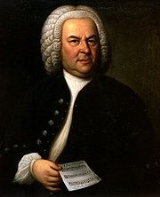
Johann Sebastian Bach


   Email Print
   Bookmark   Link


Johann Sebastian Bach


Johann Sebastian Bach (31 March 1685 – 28 July 1750) was a German composer
Composer

A composer is a person who creates music, usually in the medium of musical notation, for interpretation and performance. The level of distinction between composers and other musicians varies, which affects issues such as copyright and the deference given to individual interpretations of a particular piece of music....
 and organist
Organ (music)

The organ is a keyboard instrument of one or more divisions, each played with its own keyboard played either Manual or Pedal clavier. The organ is one of the oldest musical instruments in the European classical music....
 whose sacred and secular works for choir, orchestra, and solo instruments drew together the strands of the Baroque
Baroque music

Baroque music describes a period or style of European classical music approximately extending from Dates of classical music eras. This era is said to begin in music after the Renaissance music and was followed by the Classical music era....
 period and brought it to its ultimate maturity. Although he introduced no new forms, he enriched the prevailing German style with a robust contrapuntal
Counterpoint

In music, counterpoint is the relationship between two or more Register that are independent in contour and rhythm, and interdependent in harmony....
 technique, an unrivalled control of harmonic and motivic organisation in composition for diverse instrumentation, and the adaptation of rhythms and textures from abroad, particularly Italy and France.

Revered for their intellectual depth, technical command and artistic beauty, Bach's works include the Brandenburg concertos
Brandenburg concertos

The Brandenburg concerti by Johann Sebastian Bach are a collection of six instrumental works presented by Bach to Christian Ludwig of Brandenburg-Schwedt, margrave of Brandenburg-Schwedt, in 1721 ....
, the Goldberg Variations
Goldberg Variations

The Goldberg Variations, BWV 988, are a set of an aria and 30 Variation for harpsichord by Johann Sebastian Bach. First published in 1741 as the fourth in a series Bach called Bach compositions printed during the composer's lifetime, "keyboard practice", the work is considered to be one of the most important examples of Variation for...
, the Partitas, the Well-Tempered Clavier
Well-Tempered Clavier

The Well-Tempered Clavier , BWV 846?893, is a collection of solo keyboard music composed by Johann Sebastian Bach. He first gave the title to a book of prelude and fugues in all 24 major and minor key , dated 1722, composed "for the profit and use of musical youth desirous of learning, and especially for the pastime of those already...
, the Mass in B Minor, the St. Matthew Passion
Matthäuspassion

The St. Matthew Passion , BWV 244, is a musical composition written by Johann Sebastian Bach for solo voices, double choir and double orchestra, with libretto by Picander ....
, the St. John Passion
Johannes Passion

The 'Johannes Passion' is a musical composition by Johann Sebastian Bach. During the first winter that Bach worked at Leipzig he composed the St....
, the Magnificat
Magnificat (Bach)

The Magnificat in D major, BWV 243, is one of the major vocal works of Johann Sebastian Bach. It was composed for an orchestra and choir of five voices....
, The Musical Offering
The Musical Offering

The Musical Offering , BWV 1079, is a collection of canon s and fugues and other pieces of music by Johann Sebastian Bach, based on a musical theme by Frederick II of Prussia and dedicated to him....
, The Art of Fugue
The Art of Fugue

The Art of Fugue or The Art of the Fugue , BWV 1080, is an incomplete work by Johann Sebastian Bach . The work was probably started in the beginning of the 1740s, if not earlier....
, the English Suites, the French Suites, the Sonatas and Partitas for violin solo, the Cello Suites
Cello Suites (Bach)

The Six Suites for Unaccompanied Cello by Johann Sebastian Bach are acclaimed as some of the greatest works ever written for solo cello and some of the greatest of all music....
, more than 200 surviving cantatas
List of cantatas by Johann Sebastian Bach

This is a list of cantatas by Johann Sebastian Bach in order of BWV number as given in Wolfgang Schmieder's catalogue of Bach's works. They are not in chronological order ....
, and a similar number of organ
Pipe organ

The pipe organ is a keyboard musical instrument that produces sound by venting mechanically compressed air through resonant Organ pipe. Each pipe produces sound at one fixed pitch, so they are provided in sets or "ranks" with one pipe or more per note, each rank having a common timbre and loudness throughout....
 works, including the celebrated Toccata and Fugue in D Minor
Toccata and Fugue in D minor, BWV 565

The Toccata and Fugue in D minor, BWV 565, is a piece of organ repertoire composed by Johann Sebastian Bach sometime between 1703 and 1707....
.

While Bach's fame as an organist was great during his lifetime, he was not particularly well-known as a composer.


Discussion
Ask a question about 'Johann Sebastian Bach'
Start a new discussion about 'Johann Sebastian Bach'
Answer questions from other users
Full Discussion Forum


Recent Posts


Quotations


I was forced to be industrious: whoever is equally industrious will get equally far in life.

Oh how sweet does coffee taste, more lovely that a thousand kisses, more delicate than Muscat wine.

There's nothing to it. You just have to press the right keys at the right time with the right force, and the organ will make the most beautiful music all by itself.


Encyclopedia


Johann Sebastian Bach (31 March 1685 – 28 July 1750) was a German composer
Composer

A composer is a person who creates music, usually in the medium of musical notation, for interpretation and performance. The level of distinction between composers and other musicians varies, which affects issues such as copyright and the deference given to individual interpretations of a particular piece of music....
 and organist
Organ (music)

The organ is a keyboard instrument of one or more divisions, each played with its own keyboard played either Manual or Pedal clavier. The organ is one of the oldest musical instruments in the European classical music....
 whose sacred and secular works for choir, orchestra, and solo instruments drew together the strands of the Baroque
Baroque music

Baroque music describes a period or style of European classical music approximately extending from Dates of classical music eras. This era is said to begin in music after the Renaissance music and was followed by the Classical music era....
 period and brought it to its ultimate maturity. Although he introduced no new forms, he enriched the prevailing German style with a robust contrapuntal
Counterpoint

In music, counterpoint is the relationship between two or more Register that are independent in contour and rhythm, and interdependent in harmony....
 technique, an unrivalled control of harmonic and motivic organisation in composition for diverse instrumentation, and the adaptation of rhythms and textures from abroad, particularly Italy and France.

Revered for their intellectual depth, technical command and artistic beauty, Bach's works include the Brandenburg concertos
Brandenburg concertos

The Brandenburg concerti by Johann Sebastian Bach are a collection of six instrumental works presented by Bach to Christian Ludwig of Brandenburg-Schwedt, margrave of Brandenburg-Schwedt, in 1721 ....
, the Goldberg Variations
Goldberg Variations

The Goldberg Variations, BWV 988, are a set of an aria and 30 Variation for harpsichord by Johann Sebastian Bach. First published in 1741 as the fourth in a series Bach called Bach compositions printed during the composer's lifetime, "keyboard practice", the work is considered to be one of the most important examples of Variation for...
, the Partitas, the Well-Tempered Clavier
Well-Tempered Clavier

The Well-Tempered Clavier , BWV 846?893, is a collection of solo keyboard music composed by Johann Sebastian Bach. He first gave the title to a book of prelude and fugues in all 24 major and minor key , dated 1722, composed "for the profit and use of musical youth desirous of learning, and especially for the pastime of those already...
, the Mass in B Minor, the St. Matthew Passion
Matthäuspassion

The St. Matthew Passion , BWV 244, is a musical composition written by Johann Sebastian Bach for solo voices, double choir and double orchestra, with libretto by Picander ....
, the St. John Passion
Johannes Passion

The 'Johannes Passion' is a musical composition by Johann Sebastian Bach. During the first winter that Bach worked at Leipzig he composed the St....
, the Magnificat
Magnificat (Bach)

The Magnificat in D major, BWV 243, is one of the major vocal works of Johann Sebastian Bach. It was composed for an orchestra and choir of five voices....
, The Musical Offering
The Musical Offering

The Musical Offering , BWV 1079, is a collection of canon s and fugues and other pieces of music by Johann Sebastian Bach, based on a musical theme by Frederick II of Prussia and dedicated to him....
, The Art of Fugue
The Art of Fugue

The Art of Fugue or The Art of the Fugue , BWV 1080, is an incomplete work by Johann Sebastian Bach . The work was probably started in the beginning of the 1740s, if not earlier....
, the English Suites, the French Suites, the Sonatas and Partitas for violin solo, the Cello Suites
Cello Suites (Bach)

The Six Suites for Unaccompanied Cello by Johann Sebastian Bach are acclaimed as some of the greatest works ever written for solo cello and some of the greatest of all music....
, more than 200 surviving cantatas
List of cantatas by Johann Sebastian Bach

This is a list of cantatas by Johann Sebastian Bach in order of BWV number as given in Wolfgang Schmieder's catalogue of Bach's works. They are not in chronological order ....
, and a similar number of organ
Pipe organ

The pipe organ is a keyboard musical instrument that produces sound by venting mechanically compressed air through resonant Organ pipe. Each pipe produces sound at one fixed pitch, so they are provided in sets or "ranks" with one pipe or more per note, each rank having a common timbre and loudness throughout....
 works, including the celebrated Toccata and Fugue in D Minor
Toccata and Fugue in D minor, BWV 565

The Toccata and Fugue in D minor, BWV 565, is a piece of organ repertoire composed by Johann Sebastian Bach sometime between 1703 and 1707....
.

While Bach's fame as an organist was great during his lifetime, he was not particularly well-known as a composer. His adherence to Baroque forms and contrapuntal style was considered "old-fashioned" by his contemporaries, especially late in his career when the musical fashion tended towards Rococo
Rococo

Rococo is a style of 18th century French art and interior design. Rococo rooms were designed as total works of art with elegant and ornate furniture, small sculptures, ornamental mirrors, and tapestry complementing architecture, reliefs, and wall paintings....
 and later Classical
Classical period (music)

The dates of the Classical period in Western music are generally accepted as 1750 to 1825. However, the term classical music is used colloquially to describe a variety of Western musical styles from the 9th century to the present....
 styles. A revival of interest and performances of his music began early in the 19th century, and he is now widely considered to be one of the greatest composers in the Western tradition.

Childhood (1685–1703)

Johann Sebastian Bach was born in Eisenach
Eisenach

Eisenach is a city in Thuringia, Germany. It is situated between the northern foothills of the Thuringian Forest and the Hainich National Park. Population was 43,626 in 2006....
, Saxe-Eisenach
Saxe-Eisenach

History of Saxony-Eisenach was the name of three different duchies that existed at different times in the Germany province of Thuringia. The chief town and capital of all three duchies was Eisenach....
. He was the youngest child of Johann Ambrosius Bach
Johann Ambrosius Bach

Johann Ambrosius Bach was a Germany musician.The son of Christoph Bach , Ambrosius was born in Erfurt, Germany as the twin brother of Johann Christoph Bach ....
, the director of the Stadtpfeifer or town musicians, and Maria Elisabetha Lämmerhirt Bach
Maria Elisabetha Lämmerhirt

Maria Elisabetha L?mmerhirt was the mother of eight children, and the wife of Johann Ambrosius Bach. Her most famous son was Johann Sebastian Bach....
. His father taught him to play violin
Violin

The violin is a Bow string instrument with four strings usually tuned in perfect fifths. It is the smallest and highest-pitched member of the violin family of string instruments, which also includes the viola and cello....
 and harpsichord
Harpsichord

A harpsichord is a musical instrument played by means of a musical keyboard. It produces sound by plucking a string when each Key is pressed....
. His uncles were all professional musicians, whose posts ranged from church organists and court chamber musicians to composers. One uncle, Johann Christoph Bach
Johann Christoph Bach (1645–93)

Johann Christoph Bach was a Germany musician of the Baroque period.A court and town musician in Arnstadt, he was the third son of Christoph Bach and the twin brother of Johann Ambrosius Bach....
 (1645–93), was especially famous and introduced him to the art of organ playing. Bach was proud of his family's musical achievements, and around 1735 he drafted a genealogy, "Origin of the musical Bach family".

Johann Ambrosius Bach
Bach's mother died in 1694, and his father eight months later. The 10-year-old orphan moved in with his oldest brother, Johann Christoph Bach
Johann Christoph Bach (1671–1721)

Johann Christoph Bach was Johann Sebastian Bach's eldest brother. He studied at Erfurt under Johann Pachelbel, and his library of keyboard music included works by Pachelbel, Johann Jakob Froberger and Johann Kaspar Kerll....
 (1671–1721), the organist at the Michaeliskirche
Michaeliskirche (Ohrdruf)

The Michaeliskirche in the Thuringian town of Ohrdruf was the site of Johann Sebastian Bach's first employment.J. S. Bach was orphaned at the age of 10 and went to live with his eldest brother, Johann Christoph Bach , who was the organist at the Michaeliskirche....
 in nearby Ohrdruf
Ohrdruf

Ohrdruf is a small town in the States of Germany of Thuringia. It lies some 30 km southwest of Erfurt....
. There, he copied, studied and performed music, and apparently received valuable teaching from his brother, who instructed him on the clavichord
Clavichord

The clavichord is a European stringed keyboard instrument known from the late Medieval music, through the Renaissance music, Baroque music and Classical music era eras....
. J.C. Bach exposed him to the works of the great South German composers of the day, such as Johann Pachelbel
Johann Pachelbel

Johann Pachelbel was a German Baroque music composer, organist and teacher, who brought the German organ schools to its peak. He composed a large body of sacred and secular music, and his contributions to the development of the chorale prelude and fugue have earned him a place among the most important composers of the middle Baroque era....
 (under whom Johann Christoph had studied) and Johann Jakob Froberger
Johann Jakob Froberger

Johann Jakob Froberger was a German people Baroque composer, Keyboard instrument virtuoso, and organist. He was among the most famous composers of the era and influenced practically every major composer in Europe by developing the genre of keyboard suite and contributing greatly to the exchange of musical traditions through his many travels....
; possibly to the music of North German composers, to Frenchmen, such as Jean-Baptiste Lully
Jean-Baptiste Lully

Jean-Baptiste de Lully , was French composer of Italian birth, who spent most of his life working in the court of Louis XIV of France. He became a French citizenship in 1661....
, Louis Marchand, Marin Marais
Marin Marais

Marin Marais was a France composer and viol player. He studied composition with Jean-Baptiste Lully, often conducting his operas, and with master of the bass viol Monsieur de Sainte-Colombe for 6 months....
; and to the Italian clavierist Girolamo Frescobaldi
Girolamo Frescobaldi

Girolamo Frescobaldi was an Italian musician, one of the most important composers of keyboard instrument music in the late Renaissance music and early Baroque music periods....
. The young Bach probably witnessed and assisted in the maintenance of the organ music. Bach's obituary indicates that he copied music out of Johann Christoph's scores, but his brother had apparently forbidden him to do so, possibly because scores were valuable and private commodities at the time.

At the age of 14, Bach, along with his older school friend George Erdmann, was awarded a choral scholarship to study at the prestigious St. Michael's School in Lüneburg
Lüneburg

L?neburg, also known as Lueneburg and Lunenburg in English language, is a city in the Germany Bundesland of Lower Saxony. The city is located about 45 km — a thirty-minute train ride — southeast of fellow Hanseatic League city Hamburg....
, not far from the northern seaport of Hamburg
Hamburg

Hamburg is the second-largest city in Germany , and is the Largest cities of the European Union by population within city limits. The city is home to approximately 1.8 million people, while the Hamburg metropolitan area has more than 4.3 million inhabitants....
, one of the largest cities in the Holy Roman Empire. This involved a long journey with his friend, probably undertaken partly on foot and partly by coach. His two years there appear to have been critical in exposing him to a wider palette of European culture than he would have experienced in Thuringia. In addition to singing in the a cappella choir, it is likely that he played the School's three-manual organ and its harpsichords. He probably learned French and Italian, and received a thorough grounding in theology, Latin, history, geography, and physics. He would have come into contact with sons of noblemen from northern Germany sent to the highly selective school to prepare for careers in diplomacy, government, and the military.

Although little supporting historical evidence exists at this time, it is almost certain that while in Lüneburg, young Bach would have visited the Johanniskirche (Church of St. John) and heard (and possibly played) the church's famous organ (built in 1549 by Jasper Johannsen and nicknamed the "Böhm organ" after its most prominent master
Georg Böhm

Georg B?hm was a German Baroque organist and composer. He is notable for his development of the chorale partita and for his influence on the young Johann Sebastian Bach....
), an instrument whose sonic capabilities could well have been the inspiration for the mighty Toccata and Fugue in D minor. Given his innate musical talent, Bach would have had significant contact with prominent organists of the day in Lüneburg, most notably Georg Böhm
Georg Böhm

Georg B?hm was a German Baroque organist and composer. He is notable for his development of the chorale partita and for his influence on the young Johann Sebastian Bach....
 (the organist at Johanniskirche) as well as organists in nearby Hamburg, such as Johann Adam Reincken
Johann Adam Reincken

[Image:Voorhout Domestic Music Scene.jpg|thumb|300px|Johannes Voorhout: Domestic Music Scene Johann Adam Reincken was a German organist and composer....
. Through contact with these musicians, Bach probably gained access to the largest and finest instruments he had played thus far. It is likely that during this stage he became acquainted with the music of the German organ schools, especially the work of Dieterich Buxtehude
Dieterich Buxtehude

Dieterich Buxtehude was a German-Danish organist, lutenist and a highly regarded composer of the Baroque period. His organ works comprise a central part of the standard organ repertoire and are frequently performed at recitals and church services....
, and with music manuscripts and treatise
Treatise

A treatise is a formal and systematic exposition in writing of the principles of a subject, generally longer and more detailed than an essay. A lengthy discourse on some subject....
s on music theory that were in the possession of these musicians.

Arnstadt to Weimar (1703–08)

Bachkirche Arnstadt
In January 1703, shortly after graduating and failing an audition for an organist's post at Sangerhausen
Sangerhausen

Sangerhausen is a town in Saxony-Anhalt, Germany, capital of the Mansfeld-S?dharz, without being part of it.It is situated southeast of the Harz, approx....
, Bach took up a post as a court musician in the chapel of Duke Johann Ernst
Johann Ernst III, Duke of Saxe-Weimar

Johann Ernst III, Duke of Saxe-Weimar , was a duke of Saxe-Weimar.He was the second son of Johann Ernst II, Duke of Saxe-Weimar and Christine Elisabeth of Holstein-Sonderburg....
 in Weimar, a large town in Thuringia. His role there is unclear, but appears to have included menial, non-musical duties. During his seven-month tenure at Weimar, his reputation as a keyboard player spread. He was invited to inspect and give the inaugural recital on the new organ at St. Boniface's Church in Arnstadt
Arnstadt

Arnstadt is a town in Ilm-Kreis, Thuringia, Germany, situated on the Gera River. It is one of the oldest towns in Thuringia and is nicknamed Das Tor zum Th?ringer Wald, The Gate to the Thuringian Forest....
. The Bach family had close connections with this oldest town in Thuringia, about 180 km to the southwest of Weimar at the edge of the great forest. In August 1703, he accepted the post of organist at that church, with light duties, a relatively generous salary, and a fine new organ tuned to a modern system that allowed a wide range of keys to be used. At this time, Bach was embarking on the serious composition of organ preludes; these works, in the North German tradition of virtuosic, improvisatory preludes, already showed tight motivic control (where a single, short music idea is explored cogently throughout a movement). However, in these works the composer had yet to fully develop his powers of large-scale organisation and his contrapuntal technique
Counterpoint

In music, counterpoint is the relationship between two or more Register that are independent in contour and rhythm, and interdependent in harmony....
 (where two or more melodies interact simultaneously).

Strong family connections and a musically enthusiastic employer failed to prevent tension between the young organist and the authorities after several years in the post. He was apparently dissatisfied with the standard of singers in the choir; more seriously, there was his unauthorised absence from Arnstadt for several months in 1705–06, when he visited the great master Dieterich Buxtehude
Dieterich Buxtehude

Dieterich Buxtehude was a German-Danish organist, lutenist and a highly regarded composer of the Baroque period. His organ works comprise a central part of the standard organ repertoire and are frequently performed at recitals and church services....
 and his Abendmusik
Abendmusik

Abendmusik is an evening concert, usually performed in a church.Specifically, this designation refers to a series of performances at the Marienkirche, L?beck of L?beck, Germany, begun in the 17th century and lasting until 1810....
 in the northern city of Lübeck
Lübeck

L?beck is the second largest city in Schleswig-Holstein, in northern Germany, and one of the major ports of Germany. It was for several centuries the "capital" of the Hanseatic League and because of its Brick Gothic architectural heritage is on UNESCO's list of World Heritage Sites....
. This well-known incident in Bach's life involved his walking some 400 kilometres (250 mi) each way to spend time with the man he probably regarded as the father figure of German organists. The trip reinforced Buxtehude's style as a foundation for Bach's earlier works, and that he overstayed his planned visit by several months suggests that his time with the old man was of great value to his art. According to legend, both Bach and George Frederic Handel wanted to become amanuenses of Buxtehude, but neither wanted to marry his daughter, as that was a condition for the position.

According to minutes from the proceedings of the Arnstadt consistory in August 1705, Bach was involved in a brawl in Arnstadt:

Jsbwohnorte
Despite his comfortable position in Arnstadt, by 1706 Bach appeared to have realised that he needed to escape from the family milieu and move on to further his career. He was offered a more lucrative post as organist at St. Blasius's in Mühlhausen
Mühlhausen

M?hlhausen is a city in the federal state Thuringia, Germany. It is the Capital of the Unstrut-Hainich district, and lies along the river Unstrut....
, a large and important city to the north. The following year, he took up this senior post with significantly improved pay and conditions, including a good choir. Four months after arriving at Mühlhausen, he married his second cousin from Arnstadt, Maria Barbara Bach
Maria Barbara Bach

Maria Barbara Bach was the first wife of composer Johann Sebastian Bach. She was also his second cousin, and the daughter of Johann Michael Bach....
. They had seven children, four of whom survived to adulthood. Two of them—Wilhelm Friedemann Bach
Wilhelm Friedemann Bach

Wilhelm Friedemann Bach , the second child and eldest son of Johann Sebastian Bach and Maria Barbara Bach, was a German composer and performer....
 and Carl Philipp Emanuel Bach
Carl Philipp Emanuel Bach

Carl Philipp Emanuel Bach was a Germany musician and composer, the second of five sons of Johann Sebastian Bach and Maria Barbara Bach. He was one of the founders of the Classical music era style, composing in the Galante music and Classical periods....
—became important composers in the ornate Rococo
Rococo

Rococo is a style of 18th century French art and interior design. Rococo rooms were designed as total works of art with elegant and ornate furniture, small sculptures, ornamental mirrors, and tapestry complementing architecture, reliefs, and wall paintings....
 style that followed the Baroque.

The church and city government at Mühlhausen must have been proud of their new musical director. They readily agreed to his plan for an expensive renovation of the organ at St. Blasius's, and were so delighted at the elaborate, festive cantata
Cantata

A cantata is a vocal music music composition with an musical instrument accompaniment and often containing more than one movement ....
 he wrote for the inauguration of the new council in 1708—God is my king BWV 71, clearly in the style of Buxtehude—that they paid handsomely for its publication, and twice in later years had the composer return to conduct it. However, that same year, Bach was offered a better position in Weimar.

Weimar (1708–17)

Young Bach2
After barely a year at Mühlhausen, Bach left, to become the court organist and concertmaster
Concertmaster

The concertmaster/mistress, or concertmeister is the leader of the first violin section of an orchestra. Any violin solo in an orchestral work is played by the concertmaster ....
 at the ducal court in Weimar, a far cry from his earlier position there as 'lackey'. The munificent salary on offer at the court and the prospect of working entirely with a large, well-funded contingent of professional musicians may have prompted the move. The family moved into an apartment just five minutes' walk from the ducal palace. In the following year, their first child was born and they were joined by Maria Barbara's elder, unmarried sister, who remained with them to assist in the running of the household until her death in 1729. It was in Weimar that the two musically significant sons were born—Wilhelm Friedemann and Carl Philipp Emanuel Bach.

Bach's position in Weimar marked the start of a sustained period of composing keyboard and orchestral works, in which he had attained the technical proficiency and confidence to extend the prevailing large-scale structures and to synthesise influences from abroad. From the music of Italians such as Vivaldi
Antonio Vivaldi

Antonio Lucio Vivaldi , nicknamed il Prete Rosso , was a Baroque music composer and Venice priest, as well as a famous virtuoso violinist, born and raised in the Republic of Venice....
, Corelli
Arcangelo Corelli

Arcangelo Corelli was an Italian violinist and composer of Baroque music....
 and Torelli
Giuseppe Torelli

Giuseppe Torelli was an Italian violist, violinist, teacher, and composer, who ranks with Arcangelo Corelli among the developers of the Baroque music concerto and concerto grosso....
, he learnt how to write dramatic openings and adopted their sunny dispositions, dynamic motor-rhythms and decisive harmonic schemes. Bach inducted himself into these stylistic aspects largely by transcribing for harpsichord and organ the ensemble concertos of Vivaldi; these works are still concert favourites. He may have picked up the idea of transcribing the latest fashionable Italian music from Prince Johann Ernst, one of his employers, who was a musician of professional calibre. In 1713, the Duke returned from a tour of the Low Countries
Low Countries

The Low Countries, the historical region of de Nederlanden, are the country on low-lying land around the river delta of the Rhine, Scheldt, and Meuse River rivers....
 with a large collection of scores, some of them possibly transcriptions of the latest fashionable Italian music by the blind organist Jan Jacob de Graaf. Bach was particularly attracted to the Italian solo-tutti structure, in which one or more solo instruments alternate section-by-section with the full orchestra throughout a movement.

Bwv1001 Cropped
In Weimar, he had the opportunity to play and compose for the organ, and to perform a varied repertoire of concert music with the duke's ensemble. A master of contrapuntal
Counterpoint

In music, counterpoint is the relationship between two or more Register that are independent in contour and rhythm, and interdependent in harmony....
 technique, Bach's steady output of fugue
Fugue

In music, a fugue is a type of counterpoint composition or technique of composition for a fixed number of melody, normally referred to as "voices"....
s began in Weimar. The largest single body of his fugal writing is Das wohltemperierte Clavier ("The well-tempered keyboard"—Clavier meaning keyboard instrument). It consists of two collections compiled in 1722 and 1744, each containing a prelude and fugue in every major and minor key. This is a monumental work for its masterful use of counterpoint and its exploration, for the first time, of the full range of keys–and the means of expression made possible by their slight differences from each other—available to keyboardists when their instruments are tuned according to systems such as that of Andreas Werckmeister
Andreas Werckmeister

Andreas Werckmeister was an organist, music theory, and composer of the Baroque music.Born in Benneckenstein, Germany, Werckmeister attended schools in Nordhausen and Quedlinburg....
.

During his tenure at Weimar, Bach started work on The little organ book
Orgelbüchlein

The Orgelb?chlein was written by Johann Sebastian Bach during the period of 1708?1714, while he was in court organist at the ducal court in Weimar....
 for his eldest son, Wilhelm Friedemann; this contains traditional Lutheran
Lutheranism

Lutheranism is a major branch of Western Christianity that identifies with the teachings of the sixteenth-century Germans Reformer Martin Luther....
 chorale
Chorale

A chorale was originally a hymn of the Lutheran church sung by the entire congregation. In casual modern usage, the term also includes classical settings of such hymns and works of a similar character....
s (hymn tune
Hymn tune

A hymn tune is a musical composition to which a hymn text is sung. Some tunes consist of only the melody, sung in unison or parallel octaves, with or without accompaniment....
s), set in complex textures to assist the training of organists. The book illustrates two major themes in Bach's life: his dedication to teaching and his love of the chorale as a musical form.

Bach eventually fell out of favour in Weimar and was, according to the court secretary's report, jailed for almost a month before being unfavourably dismissed:

Cöthen (1717–23)

Coethen
Bach began once again to search out a more stable job that was conducive to his musical interests. Prince Leopold of Anhalt-Cöthen hired Bach to serve as his Kapellmeister
Kapellmeister

Kapellmeister is a German language word designating a person in charge of music-making. The word is a compound word, consisting of the roots Kapelle and Meister ....
 (director of music). Prince Leopold, himself a musician, appreciated Bach's talents, paid him well, and gave him considerable latitude in composing and performing. However, the prince was Calvinist and did not use elaborate music in his worship; thus, most of Bach's work from this period was secular, including the Orchestral suites
Orchestral suites (Bach)

The four Orchestral Suites or Ouvertures BWV 1066?1069 are a set of compositions by Johann Sebastian Bach, probably composed between 1725 and 1739 in Leipzig....
, the Six suites for solo cello
Cello Suites (Bach)

The Six Suites for Unaccompanied Cello by Johann Sebastian Bach are acclaimed as some of the greatest works ever written for solo cello and some of the greatest of all music....
 and the Sonatas and partitas for solo violin. The well-known Brandenburg concertos date from this period.

On 7 July 1720, while Bach was abroad with Prince Leopold, tragedy struck: his wife, Maria Barbara, the mother of his first 7 children, died suddenly. The following year, the widower met Anna Magdalena Wilcke, a young, highly gifted soprano 17 years his junior, who performed at the court in Cöthen; they married on 3 December 1721. Together they had 13 more children, six of whom survived into adulthood: Gottfried Heinrich
Gottfried Heinrich Bach

Gottfried Heinrich Bach was the firstborn son of Johann Sebastian Bach by his second wife Anna Magdalena Wilcke.Born in Leipzig, Gottfried Heinrich became "feeble-minded" at an early age, but he played the keyboard well and C....
, Johann Christoph Friedrich
Johann Christoph Friedrich Bach

Johann Christoph Friedrich Bach , the ninth son of Johann Sebastian Bach, sometimes referred to as the "B?ckeburg Bach". He is not to be confused with Bach's first cousin once removed, Johann Christoph Bach....
 and Johann Christian
Johann Christian Bach

Johann Christian Bach was a composer of the Classical music era era, the eleventh and youngest son of Johann Sebastian Bach. He is sometimes referred to as 'the London Bach' or 'the English Bach', due to his time spent living in the British capital....
, all of whom became significant musicians; Elisabeth Juliane Friederica (1726–81), who married Bach's pupil Johann Christoph Altnikol; Johanna Carolina (1737–81); and Regina Susanna (1742–1809).

Leipzig (1723–50)

In 1723, Bach was appointed Cantor of Thomasschule
Thomasschule zu Leipzig

St. Thomas School, Leipzig is a coed and public school boarding school in Leipzig, Germany. It was founded by the Augustinians in 1212 and is one of List of the oldest schools in the world....
, adjacent to the Thomaskirche (St. Thomas' Lutheran Church) in Leipzig
Leipzig

Leipzig is, with a population of over 511,252, the largest city in the States of Germany of Saxony, Germany....
, as well as Director of Music in the principal churches in the town. This was a prestigious post in the leading mercantile city in Saxony, a neighbouring electorate to Thuringia. Apart from his brief tenures in Arnstadt and Mühlhausen, this was Bach's first government position in a career that had mainly involved service to the aristocracy. This final post, which he held for 27 years until his death, brought him into contact with the political machinations of his employer, the Leipzig Council. The Council comprised two factions: the Absolutists, loyal to the Saxon monarch in Dresden, Augustus the Strong; and the City-Estate faction, representing the interests of the mercantile class, the guilds and minor aristocrats. Bach was the nominee of the monarchists, in particular of the Mayor at the time, Gottlieb Lange, a lawyer who had earlier served in the Dresden court. In return for agreeing to Bach's appointment, the City-Estate faction was granted control of the School, and Bach was required to make a number of compromises with respect to his working conditions. Although it appears that no one on the Council doubted Bach's musical genius, there was continual tension between the Cantor, who regarded himself as the leader of church music in the city, and the City-Estate faction, which saw him as a schoolmaster and wanted to reduce the emphasis on elaborate music in both the School and the Churches. The Council never honoured Lange's promise at interview of a handsome salary of 1,000 talers a year, although it did provide Bach and his family with a smaller income and a good apartment at one end of the school building, which was renovated at great expense in 1732.

Bach's job required him to instruct the students of the Thomasschule in singing and to provide weekly music at the two main churches in Leipzig, St. Thomas'
St. Thomas' Church, Leipzig

The Thomaskirche is a Evangelical Church in Germany church in Leipzig, Germany. It is most famous as the place where Johann Sebastian Bach worked as a Cantor , and where his remains currently lie....
 and St Nicholas's
St. Nicholas' Church, Leipzig

The St. Nikolaikirche has long beenone of the most famous in Leipzig, and rose to national fame with the Monday demonstrations in GDR in 1989 when it became the centre of the revolution....
. His post also obliged him to teach Latin, but he was allowed to employ a deputy to do this instead. In an astonishing burst of creativity, he wrote up to five annual cantata cycles during his first six years in Leipzig (two of which have apparently been lost). Most of these concerted works expound on the Gospel readings for every Sunday and feast day in the Lutheran year; many were written using traditional church hymns, such as Wachet auf! Ruft uns die Stimme
Wachet auf, ruft uns die Stimme

Wachet auf, ruft uns die Stimme, BWV 140, also known as Sleepers, Wake, is a cantata written in 1731 by Johann Sebastian Bach. It is scored for horn , 2 oboes, taille , violino piccolo, violin, viola, basso continuo, and choir with soprano, tenor, and Bass soloists....
 and Nun komm, der Heiden Heiland, as inspiration.

To rehearse and perform these works at St Thomas's Church, Bach probably sat at the harpsichord or stood in front of the choir on the lower gallery at the west end, his back to the congregation and the altar at the east end. He would have looked upwards to the organ that rose from a loft about four metres above. To the right of the organ in a side gallery would have been the winds, brass and timpani; to the left were the strings. The Council provided only about eight permanent instrumentalists, a source of continual friction with the Cantor, who had to recruit the rest of the 20 or so players required for medium-to-large scores from the University, the School and the public. The organ or harpsichord was probably played by the composer (when not standing to conduct), the in-house organist, or one of Bach's elder sons, Wilhelm Friedemann or Carl Philipp Emanuel.

Bach drew the soprano and alto choristers from the School, and the tenors and basses from the School and elsewhere in Leipzig. Performing at weddings and funerals provided extra income for these groups; it was probably for this purpose, and for in-school training, that he wrote at least six motet
Motet

In Western music, motet is a word that is applied to a number of highly varied choir musical compositions.The name comes either from the Latin movere, or a Latinized version of Old French mot, "word" or "verbal utterance." The Medieval Latin for "motet" is "motectum", and the Italian mottetto was also used....
s, mostly for double choir. As part of his regular church work, he performed motets of the Venetian school
Venetian School

In music history, the Venetian School is a term used to describe the composers working in Venice from about 1550 to around 1610; it also describes the music they produced....
 and Germans such as Heinrich Schütz
Heinrich Schütz

Heinrich Sch?tz was a German composer and organ , generally regarded as the most important German composer before Johann Sebastian Bach and often considered to be one of the most important composers of the 17th century along with Claudio Monteverdi....
, which would have served as formal models for his own motets.

Having spent much of the 1720s composing cantatas, Bach had assembled a huge repertoire of church music for Leipzig's two main churches. He now wished to broaden his composing and performing beyond the liturgy. In March 1729, he took over the directorship of the Collegium Musicum
Collegium Musicum

The Collegium Musicum was one of several types of musical societies that arose in Germany and German-Switzerland cities and towns during the Protestant Reformation and thrived into the mid-18th century....
, a secular performance ensemble that had been started in 1701 by his old friend, the composer Georg Philipp Telemann
Georg Philipp Telemann

Georg Philipp Telemann was a German Baroque music composer, born in Magdeburg. Self-taught in music, he studied law at the University of Leipzig....
. This was one of the dozens of private societies in the major German-speaking cities that had been established by musically active university students; these societies had come to play an increasingly important role in public musical life and were typically led by the most prominent professionals in a city. In the words of Christoph Wolff
Christoph Wolff

Christoph Wolff is a Germany-born musicology, presently on the faculty of Harvard University. Born and educated in Germany, Wolff studied organ and historical keyboard instruments, musicology and art history at the Universities of Humboldt University of Berlin, University of Erlangen, and Albert Ludwigs University of Freiburg, receiving a p...
, assuming the directorship was a shrewd move that 'consolidated Bach's firm grip on Leipzig's principal musical institutions'. During much of the year, Leipzig's Collegium Musicum gave twice-weekly, two-hour performances in Zimmerman's Coffeehouse on Catherine Street, just off the main market square. For this purpose, the proprietor provided a large hall and acquired several musical instruments. Many of Bach's works during the 1730s and 1740s were probably written for and performed by the Collegium Musicum; among these were almost certainly parts of the Clavier-Übung
Clavier-Übung

Clavier-?bung is German language for "keyboard practice". In late 17th and early 18th centuries this was a common title for keyboard music collections, although today it is usually associated with Johann Sebastian Bach's series of publications ....
 (Keyboard Practice) and many of the violin and harpsichord concertos
Harpsichord concertos (J. S. Bach)

The harpsichord concertos, BWV 1052-1065, are concertos for harpsichord, String section and Basso continuo by Johann Sebastian Bach. There are seven concertos for a single harpsichord, , three concertos for 2 harpsichords , two concertos for 3 harpsichords , and one concerto for 4 harpsichords, ....
.

During this period, he composed the Kyrie and Gloria of the Mass in B Minor
Mass in B Minor (Bach)

The Mass in B minor is a musical setting of the Latin Mass by Johann Sebastian Bach.Although parts of the Mass in B minor date to 1724, the whole was assembled in its present form in 1749, just before the composer's death in 1750....
, and in 1733, he presented the manuscript to the Elector of Saxony in an ultimately successful bid to persuade the monarch to appoint him as Royal Court Composer. He later extended this work into a full Mass, by adding a Credo, Sanctus and Agnus Dei, the music for which was almost wholly taken from some of the best of his cantata movements. Bach's appointment as court composer appears to have been part of his long-term struggle to achieve greater bargaining power with the Leipzig Council. Although the complete mass was probably never performed during the composer's lifetime, it is considered to be among the greatest choral works of all time. Between 1737 and 1739, Bach's former pupil Carl Gotthelf Gerlach
Carl Gotthelf Gerlach

Carl Gotthelf Gerlach was a Germans organist, who took over the Leipzig Collegium Musicum from Johann Sebastian Bach between 1737 and 1739.Born near Oschatz, he was musical director of the Leipzig Neukirche from 1729 till his death in 1761....
 took over the directorship of the Collegium Musicum.

In 1747, Bach went to the court of Frederick II of Prussia
Frederick II of Prussia

Frederick II was a monarch of Kingdom of Prussia from the House of Hohenzollern. In his role as a prince-elector of the Holy Roman Empire, he was Frederick IV of Margraviate of Brandenburg....
 in Potsdam
Potsdam

Potsdam is the capital city of the Germany States of Germany of Brandenburg and is part of the Metropolitan area of Berlin/Brandenburg. It is situated on the River Havel, some 25 kilometres southwest of the center of Berlin....
, where the king played a theme for Bach and challenged him to improvise a fugue based on his theme. Bach improvised a three-part fugue on Frederick's pianoforte, then a novelty, and later presented the king with a Musical Offering
The Musical Offering

The Musical Offering , BWV 1079, is a collection of canon s and fugues and other pieces of music by Johann Sebastian Bach, based on a musical theme by Frederick II of Prussia and dedicated to him....
 which consists of fugues, canons and a trio based on the "royal theme
The Musical Offering

The Musical Offering , BWV 1079, is a collection of canon s and fugues and other pieces of music by Johann Sebastian Bach, based on a musical theme by Frederick II of Prussia and dedicated to him....
", nominated by the monarch. Its six-part fugue includes a slightly altered subject more suitable for extensive elaboration.

The Art of Fugue
The Art of Fugue

The Art of Fugue or The Art of the Fugue , BWV 1080, is an incomplete work by Johann Sebastian Bach . The work was probably started in the beginning of the 1740s, if not earlier....
, published posthumously but probably written years before Bach's death, is unfinished. It consists of 18 complex fugues and canons based on a simple theme. A magnum opus of thematic transformation and contrapuntal devices, this work is often cited as the summation of polyphonic techniques.

The final work Bach completed was a chorale prelude for organ, dictated to his son-in-law, Johann Altnikol, from his deathbed. Entitled Vor deinen Thron tret ich hiermit (Before thy throne I now appear, BWV
BWV

The Bach-Werke-Verzeichnis is the numbering system identifying compositions by Johann Sebastian Bach. The prefix BWV, followed by the work's number now is the shorthand identification for Bach's compositions....
 668a); when the notes on the three staves of the final cadence are counted and mapped onto the Roman alphabet, the initials "JSB" are found. The chorale is often played after the unfinished 14th fugue to conclude performances of The Art of Fugue.

Death (1750)


Bach's health may have been in decline in 1749, as on 2 June, Heinrich von Brühl wrote to one of the Leipzig burgomaster
Burgomaster

Burgomaster is the English form, rendering various terms in or derived from the German language word for the chief magistrate and/or chairman of the executive council of a sub-national level of administration All contemporary titles are commonly translated into English with the Anglo-Saxon equivalent of Town Mayor....
s to request that his music director, Gottlob Harrer, immediately begin to audition someone to succeed to the Thomascantor and Director musices posts "upon the eventual... decease of Mr. Bach." Bach became increasingly blind, and a celebrated British quack
Quack

A quack is a person who pretends, professionally or publicly, to have skill, knowledge, or qualifications he or she does not possess.Quack may also refer to:...
 John Taylor
John Taylor (oculist)

"Chevalier" John Taylor was the first in a long line of British eye surgeons. While there is some evidence that he showed promise as an ophthalmologist early in his career, it became evident that his major talent was that of self-promotion....
 (who had operated unsuccessfully on Handel
HANDEL

HANDEL was the code-name for the United Kingdom's National Attack Warning System in the Cold War. It consisted of a small console consisting of two microphones, lights and gauges....
) operated on Bach while visiting Leipzig in 1750. Bach died on 28 July 1750 at the age of 65. A contemporary newspaper reported the cause of death was "from the unhappy consequences of the very unsuccessful eye operation". Some modern historians speculate the cause of death was a stroke
Stroke

A stroke is the rapidly developing loss of brain function due to a disturbance in the blood supply to the brain. According to the National Stroke Association, a "stroke" occurs when a blood clot blocks and artery or a blood vessel breaks, interrupting blood flow to an area of the brain....
 complicated by pneumonia
Pneumonia

Pneumonia is an Inflammation illness of the lung. Frequently, it is described as lung parenchyma/alveolus inflammation and abnormal alveolar filling with fluid ....
. His estate was valued at 1159 Thalers and included 5 Clavecins, 2 Lute-Harpsichords, 3 violins, 3 violas, 2 cellos, a viola da gamba, a lute
Lute

Lute can refer generally to any plucked string instrument with a neck and a deep round back, or more specifically to an instrument from the family of European lutes....
 and a spinet
Spinet

A spinet is a smaller type of harpsichord or other keyboard instrument, such as a piano or organ ....
, 52 "Sacred Books" (many by Martin Luther
Martin Luther

Martin Luther was a Germans monk, theology, university professor, priest, father of Protestantism, and Protestant Reformers whose ideas started the Protestant Reformation and changed the course of Western culture....
, Muller and Pfeiffer, also including Josephus
Josephus

Josephus , also known as Yosef Ben Matityahu and, after he became a Roman citizenship, as Titus Flavius Josephus, was a first-century Jewish historian and apologist of priestly and royal ancestry who survived and recorded the destruction of Jerusalem in AD 70....
' History of the Jews and 9 volumes of Wagner's Leipzig Song Book).

During his life he composed more than 1,000 works.

At Leipzig, Bach seems to have maintained active relationships with several members of the faculty of the university. He enjoyed a particularly fruitful relationship with the poet Picander
Picander

Picander was the pseudonym of Christian Friedrich Henrici , a Germany poet and libretto for many of Johann Sebastian Bach's Leipzig cantatas....
. Sebastian and Anna Magdalena welcomed friends, family, and fellow musicians from all over Germany into their home. Court musicians at Dresden and Berlin, and musicians including Georg Philipp Telemann
Georg Philipp Telemann

Georg Philipp Telemann was a German Baroque music composer, born in Magdeburg. Self-taught in music, he studied law at the University of Leipzig....
 (one of Emanuel's godfathers) made frequent visits to Bach's apartment and may have kept up frequent correspondence with him. Interestingly, George Frideric Handel
George Frideric Handel

George Frideric Handel was an England Baroque music composer of Germany birth who is famous for his operas, oratorios, and concerto grosso. His life and music may justly be described as "cosmopolitan": he was born in Germany, trained in Italy, and spent most of his life in England....
, who was born in the same year as Bach in Halle, only 50 km from Leipzig, made several trips to Germany, but Bach was unable to meet him—a fact that Bach appears to have deeply regretted.

Musical style


Bach's musical style arose from his extraordinary fluency in contrapuntal invention and motivic control, his flair for improvisation at the keyboard, his exposure to South German, North German, Italian and French music, and his apparent devotion to the Lutheran liturgy. His access to musicians, scores and instruments as a child and a young man, combined with his emerging talent for writing tightly woven music of powerful sonority, appear to have set him on course to develop an eclectic, energetic musical style in which foreign influences were injected into an intensified version of the pre-existing German musical language. Throughout his teens and 20s, his output showed increasing skill in the large-scale organisation of musical ideas, and the enhancement of the Buxtehudian model of improvisatory preludes and counterpoint of limited complexity. The period 1713–14, when a large repertoire of Italian music became available to the Weimar court orchestra, was a turning point. From this time onwards, he appears to have absorbed into his style the Italians' dramatic openings, clear melodic contours, the sharp outlines of their bass lines, greater motoric and rhythmic conciseness, more unified motivic treatment, and more clearly articulated schemes for modulation.

There are several more specific features of Bach's style. The notation of baroque melodic lines tended to assume that composers would write out only the basic framework, and that performers would embellish this framework by inserting ornamental notes and otherwise elaborating on it. Although this practice varied considerably between the schools of European music, Bach was regarded at the time as being on one extreme end of the spectrum, notating most or all of the details of his melodic lines—particularly in his fast movements—thus leaving little for performers to interpolate. This may have assisted his control over the dense contrapuntal textures that he favoured, which allow less leeway for the spontaneous variation of musical lines. Bach's contrapuntal textures tend to be more cumulative than those of Händel and most other composers of the day, who would typically allow a line to drop out after it had been joined by two or three others. Bach's harmony is marked by a tendency to employ brief tonicisation
Tonicization

In music, tonicization is the treatment of a pitch other than the overall Tonic as a temporary tonic in a musical composition. Tonicization is achieved through the use of the scale and harmonies of the tonicized key....
—subtle references to another key that lasts for only a few beats at the longest—particularly of the supertonic, to add colour to his textures.

Kdf2
At the same time, Bach, unlike later composers, left the instrumentation of major works including The Art of Fugue and The Musical Offering open. It is likely that his detailed notation was less an absolute demand on the performer and more a response to a 17th-century culture in which the boundary between what the performer could embellish and what the composer demanded to be authentic was being negotiated.

Bach's apparently devout, personal relationship with the Christian God in the Lutheran tradition and the high demand for religious music of his times inevitably placed sacred music at the centre of his repertory; more specifically, the Lutheran chorale hymn tune, the principal musical aspect of the Lutheran service, was the basis of much of his output. He invested the chorale prelude, already a standard set of Lutheran forms, with a more cogent, tightly integrated architecture, in which the intervallic patterns and melodic contours of the tune were typically treated in a dense, contrapuntal lattice against relatively slow-moving, overarching statements of the tune.

Bach's theology also informed his compositional structures: Sei Gegrüsset is perhaps the finest example where there is a theme with 11 variations (making 12 movements) that, while still one work, becomes two sets of six—to match Lutheran preaching principles of repetition. At the same time the theological interpretation of 'master' and 11 disciples would not be lost on his contemporary audience. Further, the practical relationship of each variation to the next (in preparing registration and the expected textural changes) seems to show an incredible capacity to preach through the music using the musical forms available at the time.

Bach's deep knowledge of and interest in the liturgy led to his developing intricate relationships between music and linguistic text. This was evident from the smallest to the largest levels of his compositional technique. On the smallest level, many of his sacred works contain short motifs that, by recurrent association, can be regarded as pictorial symbolism and articulations of liturgical concepts. For example, the octave leap, usually in a bass line, represents the relationship between heaven and earth; the slow, repeated notes of the bass line in the opening movement of Cantata 106 (Gottes Zeit ist die allerbeste Zeit) depict the laboured trudging of Jesus as he was forced to drag the cross from the city to the crucifixion site.

On the largest level, the large-scale structure of some of his sacred vocal works is evidence of subtle, elaborate planning: for example, the overall form of the St. Matthew Passion illustrates the liturgical and dramatic flow of the Easter story on a number of levels simultaneously; the text, keys and variations of instrumental and vocal forces used in the movements of Cantata 11 (Lobet Gott in seinen Reichen) may form a structure that resembles the cross.

Beyond these specific musical features arising from Bach's religious affiliation is the fact that he was able to produce music for an audience that was committed to serious, regular worship, for which a concentrated density and complexity was accepted. His natural inclination may have been to reinvigorate existing forms, rather than to discard them and pursue more dramatic musical innovations. Thus, Bach's inventive genius was almost entirely directed towards working within the structures he inherited, according to most critics and historians.

Anna Magdalena Bach Noteboo
Bach's inner personal drive to display his musical achievements was evident in a number of ways. The most obvious was his successful striving to become the leading virtuoso and improviser of the day on the organ. Keyboard music occupied a central position in his output throughout his life, and he pioneered the elevation of the keyboard from continuo
Figured bass

Figured bass, or thoroughbass, is a kind of integer musical notation used to indicate interval , chord s, and nonchord tones, in relation to a bass note....
 to solo instrument in his numerous harpsichord concertos
Harpsichord concertos (J. S. Bach)

The harpsichord concertos, BWV 1052-1065, are concertos for harpsichord, String section and Basso continuo by Johann Sebastian Bach. There are seven concertos for a single harpsichord, , three concertos for 2 harpsichords , two concertos for 3 harpsichords , and one concerto for 4 harpsichords, ....
 and chamber movements with keyboard obbligato
Obbligato

In european classical music obbligato usually describes a musical line that is in some way indispensable in performance. Its opposite is the marking ad libitum....
, in which he himself probably played the solo part. Many of his keyboard preludes are vehicles for a free improvisatory virtuosity in the German tradition, although their internal organisation became increasingly more cogent as he matured. Virtuosity is a key element in other forms, such as the fugal movement from Brandenburg Concerto No. 4, in which Bach himself may have been the first to play the rapid solo violin passages. Another example is in the organ fugue from BWV548, a late work from Leipzig, in which virtuosic passages are mapped onto Italian solo-tutti alternation within the fugal development.

Related to his cherished role as teacher was his drive to encompass whole genres by producing collections of movements that thoroughly explore the range of artistic and technical possibilities inherent in those genres. The most famous examples are the two books of the Well Tempered Clavier, each of which presents a prelude and fugue in every major and minor key, in which a variety of contrapuntal and fugal techniques are displayed. The English and French Suites, and the Partitas, all keyboard works from the Cöthen period, systematically explore a range of metres and of sharp and flat keys. This urge to manifest structures is evident throughout his life: the Goldberg Variations
Goldberg Variations

The Goldberg Variations, BWV 988, are a set of an aria and 30 Variation for harpsichord by Johann Sebastian Bach. First published in 1741 as the fourth in a series Bach called Bach compositions printed during the composer's lifetime, "keyboard practice", the work is considered to be one of the most important examples of Variation for...
 (1746?), include a sequence of canons at increasing intervals (unison, seconds, thirds, etc.), and The Art of Fugue
The Art of Fugue

The Art of Fugue or The Art of the Fugue , BWV 1080, is an incomplete work by Johann Sebastian Bach . The work was probably started in the beginning of the 1740s, if not earlier....
 (1749) can be seen as a compendium of fugal techniques.

Family members

Bach married his second cousin Maria Barbara Bach
Maria Barbara Bach

Maria Barbara Bach was the first wife of composer Johann Sebastian Bach. She was also his second cousin, and the daughter of Johann Michael Bach....
 in 1707. They had seven children, four of whom survived to adulthood:
  • Catharina Dorothea (28 December 1708 – 14 January 1774).
  • Wilhelm Friedemann
    Wilhelm Friedemann Bach

    Wilhelm Friedemann Bach , the second child and eldest son of Johann Sebastian Bach and Maria Barbara Bach, was a German composer and performer....
     (22 November 1710 – 1 July 1784).
  • Carl Philipp Emanuel
    Carl Philipp Emanuel Bach

    Carl Philipp Emanuel Bach was a Germany musician and composer, the second of five sons of Johann Sebastian Bach and Maria Barbara Bach. He was one of the founders of the Classical music era style, composing in the Galante music and Classical periods....
     (8 March 1714 – 14 December 1788).
  • Johann Gottfried Bernhard
    Johann Gottfried Bernhard Bach

    Johann Gottfried Bernhard Bach was the fourth son of Johann Sebastian Bach and Maria Barbara Bach. Born in Weimar, he was educated in Leipzig. He first served as organist in M?hlhausen in 1735 and later served in Sangerhausen....
     (11 May 1715 – 27 May 1739).


Maria died in 1720, and Bach married Anna Magdalena Wilcke in 1721. They had a further thirteen children, six of whom survived to adulthood:
  • Gottfried Heinrich
    Gottfried Heinrich Bach

    Gottfried Heinrich Bach was the firstborn son of Johann Sebastian Bach by his second wife Anna Magdalena Wilcke.Born in Leipzig, Gottfried Heinrich became "feeble-minded" at an early age, but he played the keyboard well and C....
     (1724–63)
  • Elisabeth Juliana Friederica, called "Lieschen" (1726–81)
  • Johann Christoph Friedrich
    Johann Christoph Friedrich Bach

    Johann Christoph Friedrich Bach , the ninth son of Johann Sebastian Bach, sometimes referred to as the "B?ckeburg Bach". He is not to be confused with Bach's first cousin once removed, Johann Christoph Bach....
    , the 'Bückeburg' Bach (1732–95)
  • Johann Christian
    Johann Christian Bach

    Johann Christian Bach was a composer of the Classical music era era, the eleventh and youngest son of Johann Sebastian Bach. He is sometimes referred to as 'the London Bach' or 'the English Bach', due to his time spent living in the British capital....
    , the 'London' Bach (1735–82)
  • Johanna Carolina (1737–81)
  • Regina Susanna (1742–1809)


Works


J.S. Bach's works are indexed with BWV numbers, an initialism for Bach Werke Verzeichnis (Bach Works Catalogue). The catalogue, published in 1950, was compiled by Wolfgang Schmieder
Wolfgang Schmieder

Wolfgang Schmieder was a Germany musicologySchmieder was born in Bromberg, Lower Austria. In 1950, he published the BWV, or Bach-Werke-Verzeichnis , a catalog of musical works by Johann Sebastian Bach....
. The catalogue is organised thematically, rather than chronologically: BWV 1–224 are cantata
Cantata

A cantata is a vocal music music composition with an musical instrument accompaniment and often containing more than one movement ....
s; BWV 225–249, the large-scale choral works; BWV 250–524, chorale
Chorale

A chorale was originally a hymn of the Lutheran church sung by the entire congregation. In casual modern usage, the term also includes classical settings of such hymns and works of a similar character....
s and sacred songs; BWV 525–748, organ
Organ (music)

The organ is a keyboard instrument of one or more divisions, each played with its own keyboard played either Manual or Pedal clavier. The organ is one of the oldest musical instruments in the European classical music....
 works; BWV 772–994, other keyboard works; BWV 995–1000, lute
Lute

Lute can refer generally to any plucked string instrument with a neck and a deep round back, or more specifically to an instrument from the family of European lutes....
 music; BWV 1001–40, chamber music
Chamber music

Chamber music is a form of classical music, written for a small group of instruments which traditionally could be accommodated in a palace chamber....
; BWV 1041–71, orchestral music; and BWV 1072–1126, canons
Canon (music)

In music, a canon is a counterpoint composition that employs a melody with one or more imitations of the melody played after a given duration . The initial melody is called the leader , while the imitative melody is called the follower which is played in a different voice....
 and fugue
Fugue

In music, a fugue is a type of counterpoint composition or technique of composition for a fixed number of melody, normally referred to as "voices"....
s. In compiling the catalogue, Schmieder largely followed the Bach Gesellschaft Ausgabe, a comprehensive edition of the composer's works that was produced between 1850 and 1905. For a list of works catalogued by BWV number, see List of compositions by Johann Sebastian Bach
List of compositions by Johann Sebastian Bach

There are over 1000 known compositions by Johann Sebastian Bach. Listed here are about half of these in the order of the BWV catalog, including the spurious works in the BWV Anhang ....
.

Organ works

Bach was best known during his lifetime as an organist, organ consultant, and composer of organ works in both the traditional German free genres—such as preludes
Prelude (music)

A prelude is a short Musical piece of music, the form of which may vary from piece to piece. While, during the Baroque Age, for example, it may have served as an introduction to succeeding movements of a work that were usually longer and more complex, it may also have been a stand alone piece of work during the Romantic Era....
, fantasias
Fantasia (music)

The fantasia is a musical composition with its roots in the art of improvisation. Because of this, it seldom approximates the textbook rules of any strict musical form ....
, and toccata
Toccata

Toccata is a virtuoso piece of music typically for a keyboard instrument or plucked string instrument featuring fast-moving, lightly fingered or otherwise virtuosic passages or sections, with or without imitative or fugue interludes, generally emphasizing the dexterity of the performer's fingers....
s—and stricter forms, such as chorale prelude
Chorale prelude

In music, a chorale prelude is a short liturgical composition for organ using a chorale tune as its basis. It was a predominant style of the German Baroque music era and reached its culmination in the works of Johann Sebastian Bach, who wrote 46 examples of the form in his Orgelb?chlein....
s and fugue
Fugue

In music, a fugue is a type of counterpoint composition or technique of composition for a fixed number of melody, normally referred to as "voices"....
s. He established a reputation at a young age for his great creativity and ability to integrate foreign styles into his organ works. A decidedly North German influence was exerted by Georg Böhm
Georg Böhm

Georg B?hm was a German Baroque organist and composer. He is notable for his development of the chorale partita and for his influence on the young Johann Sebastian Bach....
, with whom Bach came into contact in Lüneburg, and Dieterich Buxtehude
Dieterich Buxtehude

Dieterich Buxtehude was a German-Danish organist, lutenist and a highly regarded composer of the Baroque period. His organ works comprise a central part of the standard organ repertoire and are frequently performed at recitals and church services....
 in Lübeck
Lübeck

L?beck is the second largest city in Schleswig-Holstein, in northern Germany, and one of the major ports of Germany. It was for several centuries the "capital" of the Hanseatic League and because of its Brick Gothic architectural heritage is on UNESCO's list of World Heritage Sites....
, whom the young organist visited in 1704 on an extended leave of absence from his job in Arnstadt. Around this time, Bach copied the works of numerous French and Italian composers to gain insights into their compositional languages, and later arranged violin concertos by Vivaldi
Antonio Vivaldi

Antonio Lucio Vivaldi , nicknamed il Prete Rosso , was a Baroque music composer and Venice priest, as well as a famous virtuoso violinist, born and raised in the Republic of Venice....
 and others for organ and harpsichord. His most productive period (1708–14) saw the composition of several pairs of preludes & fugue
Fugue

In music, a fugue is a type of counterpoint composition or technique of composition for a fixed number of melody, normally referred to as "voices"....
s and toccatas & fugues, and of the Orgelbüchlein
Orgelbüchlein

The Orgelb?chlein was written by Johann Sebastian Bach during the period of 1708?1714, while he was in court organist at the ducal court in Weimar....
 ("Little organ book"), an unfinished collection of 45 short chorale preludes that demonstrate compositional techniques in the setting of chorale
Chorale

A chorale was originally a hymn of the Lutheran church sung by the entire congregation. In casual modern usage, the term also includes classical settings of such hymns and works of a similar character....
 tunes. After he left Weimar, Bach's output for organ fell off, although his best-known works (the six trio sonata
Trio sonata

The trio sonata is a musical form which was particularly popular around the 17th century and the 18th century.A trio sonata is written for two solo melodic instruments and basso continuo, making three parts in all, hence the name trio sonata....
s, the "German Organ Mass" in Clavier-Übung III from 1739, and the "Great Eighteen
Great Eighteen Chorale Preludes

The Great Eighteen Chorale Preludes, BWV 651?668, are a set of chorale preludes for organ prepared by Johann Sebastian Bach in Leipzig in his final decade 1740-1750, from earlier works composed in Weimar, where he was court organist....
" chorales, revised late in his life) were all composed after this time. Bach was extensively engaged later in his life in consulting on organ projects, testing newly built organs, and dedicating organs in afternoon recitals. One of the high points may be the third part of the Clavier-Übung, a setting of 21 chorale preludes uniting the traditional Catholic Missa with the Lutheran catechism liturgy, the whole set interpolated between the mighty "St. Anne" Prelude and Fugue on the theme of the Trinity.

Other keyboard works

Cu3title
Bach wrote many works for the harpsichord
Harpsichord

A harpsichord is a musical instrument played by means of a musical keyboard. It produces sound by plucking a string when each Key is pressed....
, some of which may also have been played on the clavichord
Clavichord

The clavichord is a European stringed keyboard instrument known from the late Medieval music, through the Renaissance music, Baroque music and Classical music era eras....
. Many of his keyboard works are anthologies that show an eagerness to encompass whole theoretical systems in an encyclopaedic fashion.
  • The Well-Tempered Clavier, Books 1 and 2 (BWV 846–893). Each book comprises a prelude and fugue in each of the 24 major and minor keys
    Key (music)

    In music theory, the term key is used in many different and sometimes contradictory ways. A common use is to speak of music as being "in" a certain key, such as in the key of C or in the key of F-sharp....
     in chromatic order from C major to B minor (thus, the whole collection is often referred to as 'the 48'). "Well-tempered" in the title refers to the temperament
    Musical temperament

    In musical tuning, a temperament is a system of tuning which slightly compromises the pure intervals of just intonation in order to meet other requirements of the system....
     (system of tuning); many temperaments before Bach's time were not flexible enough to allow compositions to move through more than just a few keys.
  • The 15 Inventions and 15 Sinfonias
    Inventions and Sinfonias (J. S. Bach)

    The Inventions and Sinfonias, BWV 772-801, also known as the Two and Three Part Inventions, are a collection of thirty short Keyboard instrument compositions composed by Johann Sebastian Bach, consisting of fifteen Invention s and fifteen sinfonias ....
     (BWV 772–801). These short two- and three-part contrapuntal works are arranged in the same chromatic order as the Well-Tempered Clavier, omitting some of the less used keys. The pieces were intended by Bach for instructional purposes.
  • Three collections of dance suites
    Suite

    In music, a suite is an ordered set of instrumental or orchestral pieces normally performed in a concert setting rather than as accompaniment; they may be extracts from an opera, ballet, or incidental music to a play or film , or they may be entirely original movements ....
    : the English Suites (BWV 806–811)
    English Suites (BWV 806–811)

    The English Suites, BWV 806?811, refer to a set of six suites written by the German composer Johann Sebastian Bach for harpsichord and generally thought to be the earliest of Bach's 18 suites for Keyboard instrument, the others being the 6 French Suites, BWV 812-817 and the 6 Partitas, BWV 825-830....
    , the French Suites (BWV 812–817)
    French Suites (BWV 812–817)

    The French Suites, BWV 812-817, refer to six suites which Johann Sebastian Bach wrote for the keyboard instrument between the years of 1722 and 1725 ....
     and the Partitas for keyboard
    Partitas for keyboard (825–830)

    The Partitas, BWV 825?830, are a set of six harpsichord suites written by Johann Sebastian Bach, published from 1726 in music to 1730 in music as Clavier-?bung I, and the first of his works to be published....
     (BWV 825–830). Each collection contains six suites built on the standard model (Allemande
    Allemande

    An allemande is one of the most popular instrumental dance forms in Baroque music, and a standard element of a suite. Originally, the allemande formed the first movement of the suite, before the courante, but, later, it was often preceded by an introductory movement, such as a Prelude ....
    Courante
    Courante

    The courante, corrente, coranto and corant are just some of the names given to a family of triple metre dances from the late Renaissance and the Baroque....
    Sarabande
    Sarabande

    In music, the sarabande is a dance in triple metre. The second and third beats of each measure are often tied, giving the dance a distinctive rhythm of crotchets and minims in alternation....
    –(optional movement)–Gigue
    Gigue

    The gigue or giga is a lively baroque dance originating from the British jig. It was imported into France in the mid-17th century and usually appears at the end of a suite....
    ). The English Suites closely follow the traditional model, adding a prelude before the allemande and including a single movement between the sarabande and the gigue. The French Suites omit preludes, but have multiple movements between the sarabande and the gigue. The partitas expand the model further with elaborate introductory movements and miscellaneous movements between the basic elements of the model.
  • The Goldberg Variations
    Goldberg Variations

    The Goldberg Variations, BWV 988, are a set of an aria and 30 Variation for harpsichord by Johann Sebastian Bach. First published in 1741 as the fourth in a series Bach called Bach compositions printed during the composer's lifetime, "keyboard practice", the work is considered to be one of the most important examples of Variation for...
     (BWV 988), an aria with thirty variations
    Variation (music)

    In music, variation is a formal technique where material is altered during repetition: reiteration with changes. The changes may involve harmony, melody, counterpoint, rhythm, timbre or orchestration....
    . The collection has a complex and unconventional structure: the variations build on the bass line of the aria, rather than its melody, and musical canons
    Canon (music)

    In music, a canon is a counterpoint composition that employs a melody with one or more imitations of the melody played after a given duration . The initial melody is called the leader , while the imitative melody is called the follower which is played in a different voice....
     are interpolated according to a grand plan. There are nine canons within the 30 variations, one placed every three variations between variations 3 and 27. These variations move in order from canon at the unison to canon at the ninth. The first eight are in pairs (unison and octave, second and seventh, third and sixth, fourth and fifth). The ninth canon stands on its own due to compositional dissimilarities.
  • Miscellaneous pieces such as the Overture in the French Style (French Overture, BWV 831), Chromatic Fantasia and Fugue (BWV 903), and the Italian Concerto (BWV 971).


Among Bach's lesser known keyboard works are seven toccatas (BWV 910–916), four duets (BWV 802–805)
Duets (Bach)

Bach's four Duetti, BWV 802-805, are works for pipe organ without Pedal keyboard, and were included in the third part of the Clavier-?bung. Their inclusion in that work has been occasionally considered strange by scholars, and many theories have arisen surrounding the duets' origins, purpose and significance....
, sonatas for keyboard (BWV 963–967), the Six Little Preludes (BWV 933–938), and the Aria variata alla maniera italiana (BWV 989).

Orchestral and chamber music

Bach wrote music for single instruments, duets and small ensembles. Bach's works for solo instruments—the six sonatas and partitas for violin (BWV 1001–1006), the six cello suites
Cello Suites (Bach)

The Six Suites for Unaccompanied Cello by Johann Sebastian Bach are acclaimed as some of the greatest works ever written for solo cello and some of the greatest of all music....
 (BWV 1007–1012) and the Partita for solo flute (BWV 1013)—may be listed among the most profound works in the repertoire. Bach also composed a suite and several other works for solo lute. He wrote trio sonata
Trio sonata

The trio sonata is a musical form which was particularly popular around the 17th century and the 18th century.A trio sonata is written for two solo melodic instruments and basso continuo, making three parts in all, hence the name trio sonata....
s; solo sonatas (accompanied by continuo
Figured bass

Figured bass, or thoroughbass, is a kind of integer musical notation used to indicate interval , chord s, and nonchord tones, in relation to a bass note....
) for the flute and for the viola da gamba; and a large number of canons
Canon (music)

In music, a canon is a counterpoint composition that employs a melody with one or more imitations of the melody played after a given duration . The initial melody is called the leader , while the imitative melody is called the follower which is played in a different voice....
 and ricercar
Ricercar

A ricercar is a type of late Renaissance music and mostly early Baroque music instrumental composition. The term means to search out, and many ricercars serve a Prelude function to "search out" the key or mode of a following piece....
e, mostly for unspecified instrumentation. The most significant examples of the latter are contained in The Art of Fugue
The Art of Fugue

The Art of Fugue or The Art of the Fugue , BWV 1080, is an incomplete work by Johann Sebastian Bach . The work was probably started in the beginning of the 1740s, if not earlier....
 and The Musical Offering
The Musical Offering

The Musical Offering , BWV 1079, is a collection of canon s and fugues and other pieces of music by Johann Sebastian Bach, based on a musical theme by Frederick II of Prussia and dedicated to him....
.

Bach's best-known orchestral works are the Brandenburg concertos
Brandenburg concertos

The Brandenburg concerti by Johann Sebastian Bach are a collection of six instrumental works presented by Bach to Christian Ludwig of Brandenburg-Schwedt, margrave of Brandenburg-Schwedt, in 1721 ....
, so named because he submitted them in the hope of gaining employment from Margrave
Margrave

Margrave is the English language and French language form of the German language title Markgraf and certain equivalent nobiliary titles in other languages....
 Christian Ludwig of Brandenburg-Schwedt in 1721; his application was unsuccessful. These works are examples of the concerto grosso
Concerto grosso

The concerto grosso is a form of baroque music in which the musical material is passed between a small group of soloists and full orchestra ....
 genre. Other surviving works in the concerto
Concerto

The term Concerto usually refers to a three-part musical work in which one solo instrument is accompanied by an orchestra. The concerto, as understood in this modern way, arose in the Baroque period side by side with the concerto grosso, which contrasted a small group of instruments with the rest of the orchestra....
 form include two violin concertos (BWV 1041 and BWV 1042); a Concerto for Two Violins in D Minor (BWV 1043), often referred to as Bach's "double" concerto; and concertos for one, two, three and even four harpsichords
Harpsichord concertos (J. S. Bach)

The harpsichord concertos, BWV 1052-1065, are concertos for harpsichord, String section and Basso continuo by Johann Sebastian Bach. There are seven concertos for a single harpsichord, , three concertos for 2 harpsichords , two concertos for 3 harpsichords , and one concerto for 4 harpsichords, ....
. It is widely accepted that many of the harpsichord concertos were not original works, but arrangements of his concertos for other instruments now lost. A number of violin, oboe and flute concertos have been reconstructed from these. In addition to concertos, Bach also wrote four orchestral suites
Orchestral suites (Bach)

The four Orchestral Suites or Ouvertures BWV 1066?1069 are a set of compositions by Johann Sebastian Bach, probably composed between 1725 and 1739 in Leipzig....
, a series of stylised dances for orchestra, each preceded by a French overture
French overture

The French overture is a musical form widely used in the Baroque music period. It is in three parts: the first is slow, often with double-dotted rhythms , the second is quick and fugal, and the first part returns at the end....
. The work now known as the Air on the G String
Air on the G String

The "Air on the G String" is an adaptation by August Wilhelmj of Johann Sebastian Bach's "Air ". The air is usually played slowly and freely, and features an intertwining harmony and melody....
 is an arrangement for the violin made in the nineteenth century from the second movement of the Orchestral Suite No. 3.

Vocal and choral works

Bach performed a cantata
Cantata

A cantata is a vocal music music composition with an musical instrument accompaniment and often containing more than one movement ....
 on Sunday at the Thomaskirche, on a theme corresponding to the lectionary
Lectionary

A Lectionary is a book or listing that contains a collection of scripture readings appointed for Christianity or Judaic worship on a given day or occasion....
 readings of the week, as determined by the Lutheran Church Year calendar. He did not perform cantatas during the seasons of Lent and Advent. Although he performed cantatas by other composers, he also composed at least three entire sets of cantatas, one for each Sunday and holiday of the church year, at Leipzig, in addition to those composed at Mühlhausen
Mühlhausen

M?hlhausen is a city in the federal state Thuringia, Germany. It is the Capital of the Unstrut-Hainich district, and lies along the river Unstrut....
 and Weimar. In total he wrote more than 300 sacred cantatas, of which approximately 195 survive.

His cantatas vary greatly in form and instrumentation. Some of them are only for a solo singer; some are single choruses; some are for grand orchestras; some only a few instruments. A very common format, however, includes a large opening chorus followed by one or more recitative-aria pairs for soloists (or duets) and a concluding chorale
Chorale

A chorale was originally a hymn of the Lutheran church sung by the entire congregation. In casual modern usage, the term also includes classical settings of such hymns and works of a similar character....
. The recitative is part of the corresponding Bible reading for the week and the aria is a contemporary reflection on it. The melody of the concluding chorale often appears as a cantus firmus
Cantus firmus

In music, a cantus firmus is a pre-existing melody forming the basis of a polyphony composition .The plural of this Latin term is , though one occasionally sees the corrupt form canti firmi....
 in the opening movement. Among the best known cantatas are BWV 4 ("Christ lag in Todesbanden"), BWV 21
Ich hatte viel Bekümmernis

Ich hatte viel Bek?mmernis , BWV 21, is a sacred cantata composed by Johann Sebastian Bach.It was composed in Weimar in 1713 for the for the third Sunday after Trinity Sunday, but was performed only on 17 June 1714 after a first revision....
 ("Ich hatte viel Bekümmernis"), BWV 80 ("Ein' feste Burg"), BWV 106
Gottes Zeit ist die allerbeste Zeit

Gottes Zeit ist die allerbeste Zeit BWV 106 also known as "Actus tragicus" is a sacred cantata composed by Johann Sebastian Bach. It is primarily intended to be played at funerals....
 ("Actus Tragicus"), BWV 140 ("Wachet auf") and BWV 147 ("Herz und Mund und Tat und Leben").

In addition, Bach wrote a number of secular cantatas, usually for civic events such as council inaugurations. These also include wedding cantatas, the Wedding Quodlibet
Quodlibet, BWV 524

The Quodlibet or Wedding Quodlibet, BWV 524, is a lighthearted composition by Johann Sebastian Bach which today exists only in fragmentary form....
, the Peasant Cantata and the Coffee Cantata
Coffee Cantata

Schweigt stille, plaudert nicht is a secular cantata written by Johann Sebastian Bach between 1732 and 1734. Although classified as a cantata, it is essentially a miniature comic opera....
, which concerns a girl whose father will not let her marry until she gives up her addiction to that extremely popular drink.

Bach's large choral-orchestral works include the famous St. Matthew Passion
Matthäuspassion

The St. Matthew Passion , BWV 244, is a musical composition written by Johann Sebastian Bach for solo voices, double choir and double orchestra, with libretto by Picander ....
 and St. John Passion, both written for Good Friday vespers services at St. Thomas' and St. Nicholas' Churches in alternate years, and the Christmas Oratorio
Christmas Oratorio

The Christmas Oratorio BWV 248, is an oratorio by Johann Sebastian Bach intended for performance in church during the Christmas season. It was written for the Christmas season of 1734 in music incorporating music from earlier compositions, including three secular cantatas written during 1733 and 1734 and a now lost church cantata, BWV 2...
 (a set of six cantatas for use in the Liturgical season
Liturgical year

The liturgical year, also known as the Christian year, consists of the cycle of liturgy seasons in Christianity churches which determines when Calendar of saints, Memorial s, Commemoration s, and Solemnity are to be observed and which portions of Scripture are to be read....
 of Christmas). The Magnificat
Magnificat

The Magnificat is a canticle frequently sung liturgy in Christian church services. The text of the canticle is taken directly from the Gospel of Luke where it is spoken by the Virgin Mary upon the occasion of her Visitation to her cousin Elizabeth....
 in two versions (one in E-flat major, with four interpolated Christmas-related movements, and the later and better-known version in D major) and the Easter Oratorio compare to large, elaborate cantatas, of a lesser extent than the Passions and the Christmas Oratorio.

Bach's other large work, the Mass in B minor, was assembled by Bach near the end of his life, mostly from pieces composed earlier (such as cantata BWV 191 and BWV 12). It was never performed in Bach's lifetime, or even after his death, until the 19th century.

All of these works, unlike the six motets
List of compositions by Johann Sebastian Bach

There are over 1000 known compositions by Johann Sebastian Bach. Listed here are about half of these in the order of the BWV catalog, including the spurious works in the BWV Anhang ....
 (Singet dem Herrn ein neues Lied; Der Geist hilft unser Schwachheit auf; Jesu, meine Freude; Fürchte dich nicht; Komm, Jesu, komm!; and Lobet den Herrn alle Heiden), have substantial solo parts as well as choruses.

Bach's copy of a two volume Bible
Bible

The Bible is the central religious text of Judaism and Christianity. The exact Books of the Bible is dependent on the religious traditions of specific denominations....
 commentary by the orthodox Lutheran theologian, Abraham Calov, was discovered in the 1950s in a barn in Minnesota
Minnesota

Minnesota is a U.S. state in the Midwestern United States of the United States. The twelfth largest state by area in the U.S., it is the twenty-first most populous, with just over five million residents....
, purchased apparently in Germany as part of a "job lot" of old books and brought to America by an immigrant. Its provenance was verified and it was subsequently deposited in the rare book holdings of Concordia Seminary
Concordia Seminary

File:Concordia Seminary.jpgConcordia Seminary is located in Clayton, Missouri, an inner-ring suburb on the western border of St. Louis, Missouri....
 in St. Louis
St. Louis, Missouri

St. Louis is an independent city in the U.S. state of Missouri, located near the confluence of the Mississippi River and the Missouri River. St....
, Missouri
Missouri

Missouri is a U.S. state in the Midwestern United States of the United States bordered by Iowa, Illinois, Kentucky, Tennessee, Arkansas, Oklahoma, Kansas and Nebraska....
. It contains his markings of texts for his cantatas and notes. It is only rarely displayed to the public. A study of the so-called Bach Bible was prepared by Robin Leaver, titled J.S. Bach and Scripture: Glosses from the Calov Bible Commentary (St. Louis: Concordia Publishing House, 1985).

Performances

Present-day Bach performers usually pursue either of two traditions: so-called "authentic performance practice", utilising historical techniques, or alternatively the use of modern instruments and playing techniques, with a tendency towards larger ensembles. In Bach's time orchestras and choirs were usually smaller than those known to, for example, Brahms, and even Bach's most ambitious choral works, such as his Mass in B minor and Passions, are composed for relatively modest forces. Some of Bach's important chamber music does not indicate instrumentation, which gives greater latitude for variety of ensemble.

"Easy listening
Easy listening

Easy listening music is a style of popular music and radio format that emerged in the mid-20th century, evolving out of Swing music and big band music, and related to Beautiful music and Light music....
" realisations of Bach's music and its use in advertising also contributed greatly to Bach's popularisation in the second half of the twentieth century. Among these were the Swingle Singers' versions of Bach pieces that are now well-known (for instance, the Air on the G string
Air on the G String

The "Air on the G String" is an adaptation by August Wilhelmj of Johann Sebastian Bach's "Air ". The air is usually played slowly and freely, and features an intertwining harmony and melody....
, or the Wachet Auf chorale prelude) and Wendy Carlos
Wendy Carlos

Wendy Carlos is an United States composer and electronic musician. She gained fame in the late 1960s for playing on the Moog synthesizer, which was a relatively new and unknown instrument at the time....
' 1968 ground-breaking recording Switched-On Bach
Switched-On Bach

Switched-On Bach is a musical album by Wendy Carlos and Benjamin Folkman, produced by Carlos and Rachel Elkind and released in 1968 by CBS Records....
, using the then recently-invented Moog electronic synthesiser
Moog synthesizer

Moog synthesizer may refer to any number of analog synthesizers designed by Dr. Robert Moog or manufactured by Moog Music, and is commonly used as a generic term for analog and digital music synthesisers....
. Jazz musicians have also adopted Bach's music, with Jacques Loussier
Jacques Loussier

Jacques Loussier is a noted pianist and composer.He is well known for his jazz interpretations of many of Johann Sebastian Bach's works, such as the Goldberg variations....
, Ian Anderson
Ian Anderson (musician)

Ian Scott Anderson, Order of the British Empire is a Scotland singer, songwriter and multi-instrumentalist, best known for his work as the head of British rock and roll band Jethro Tull ....
, Uri Caine
Uri Caine

Uri Caine is an American European classical music and jazz pianist and composer.Caine began playing piano at seven and studied with French jazz pianist Bernard Peiffer at 12....
 and the Modern Jazz Quartet
Modern Jazz Quartet

The Modern Jazz Quartet was established in 1952 by Milt Jackson , John Lewis , Percy Heath , and Kenny Clarke . Connie Kay replaced Clarke in 1955....
 among those creating jazz versions of Bach works.

Legacy

914u Statue of Johann Sebastian Bach, Eisenach, Ger, 22 S
In his later years and after his death, Bach's reputation as a composer declined; his work was regarded as old-fashioned compared to the emerging classical style. Initially he was remembered more as a player, teacher and as the father of his children, most notably Johann Christian
Johann Christian Bach

Johann Christian Bach was a composer of the Classical music era era, the eleventh and youngest son of Johann Sebastian Bach. He is sometimes referred to as 'the London Bach' or 'the English Bach', due to his time spent living in the British capital....
 and Carl Philipp Emanuel
Carl Philipp Emanuel Bach

Carl Philipp Emanuel Bach was a Germany musician and composer, the second of five sons of Johann Sebastian Bach and Maria Barbara Bach. He was one of the founders of the Classical music era style, composing in the Galante music and Classical periods....
. (Two other children, Wilhelm Friedmann and Johann Christoph Friedrich
Johann Christoph Friedrich Bach

Johann Christoph Friedrich Bach , the ninth son of Johann Sebastian Bach, sometimes referred to as the "B?ckeburg Bach". He is not to be confused with Bach's first cousin once removed, Johann Christoph Bach....
, were also composers.)

During this time, his works for keyboard were those most appreciated and composers ever since have acknowledged his mastery of the genre. Mozart
Wolfgang Amadeus Mozart

Wolfgang Amadeus Mozart Mozart showed prodigious ability from his earliest childhood in Salzburg. Already competent on keyboard and violin, he composed from the age of five and performed before European royalty; at seventeen he was engaged as a court musician in Salzburg, but grew restless and traveled in search of a better position, always...
, Beethoven
Ludwig van Beethoven

Ludwig van Beethoven was a German composer and pianist. He was a crucial figure in the transitional period between the Classical music era and Romantic music eras in classical music, and remains one of the most acclaimed and influential composers of all time....
, and Chopin
Frédéric Chopin

Fr?d?ric Chopin was a composer and virtuoso pianist of the Romantic music period. He is widely regarded as the greatest Polish composer, and one of music's greatest tone poets....
 were among his most prominent admirers. On a visit to Thomasschule, for example, Mozart heard a performance of one of the motet
Motet

In Western music, motet is a word that is applied to a number of highly varied choir musical compositions.The name comes either from the Latin movere, or a Latinized version of Old French mot, "word" or "verbal utterance." The Medieval Latin for "motet" is "motectum", and the Italian mottetto was also used....
s (BWV 225) and exclaimed "Now, here is something one can learn from!"; on being given the motets' parts, "Mozart sat down, the parts all around him, held in both hands, on his knees, on the nearest chairs. Forgetting everything else, he did not stand up again until he had looked through all the music of Sebastian Bach". Beethoven was a devotee, learning the Well-Tempered Clavier as a child and later calling Bach the "Urvater der Harmonie" ("Original father of Harmony") and, in a pun on the literal meaning of Bach's name, "nicht Bach, sondern Meer" ("not a brook, but a sea"). Before performing a concert, Chopin used to lock himself away and play Bach's music. Several notable composers, including Mozart, Beethoven, Robert Schumann
Robert Schumann

Robert Schumann, sometimes given as Robert Alexander Schumann, was a German composer, aesthete and influential music critic. He is one of the most famous Romantic music composers of the 19th century....
, and Felix Mendelssohn
Felix Mendelssohn

Jakob Ludwig Felix Mendelssohn Bartholdy, born, and generally known in English-speaking countries, as Felix Mendelssohn was a Germany composer, pianist, organist and conducting of the early Romantic music period....
 began writing in a more contrapuntal style after being introduced to Bach's music.

Today the "Bach style" continues to influence musical composition, from hymns and religious works to pop and rock. Many of Bach's themes—particularly the theme from Toccata and Fugue in D minor—have been used in rock songs repeatedly and have received notable popularity. Bach has even been referred to as "the father of all music."

The revival in the composer's reputation among the wider public was prompted in part by Johann Nikolaus Forkel
Johann Nikolaus Forkel

Johann Nikolaus Forkel , was a Germany musician, musicologist and music theory....
's 1802 biography, which was read by Beethoven. Goethe became acquainted with Bach's works relatively late in life through a series of performances of keyboard and choral works at Bad Berka
Bad Berka

Bad Berka is a town in the Weimarer Land district, in Thuringia, Germany. It is situated on the river Ilm , 10 km southwest of Weimar, in spruce and beech forest....
 in 1814 and 1815; in a letter of 1827 he compared the experience of listening to Bach's music to "eternal harmony in dialogue with itself". But it was Felix Mendelssohn
Felix Mendelssohn

Jakob Ludwig Felix Mendelssohn Bartholdy, born, and generally known in English-speaking countries, as Felix Mendelssohn was a Germany composer, pianist, organist and conducting of the early Romantic music period....
 who did the most to revive Bach's reputation with his 1829 Berlin performance of the St. Matthew Passion. Hegel, who attended the performance, later called Bach a "grand, truly Protestant, robust and, so to speak, erudite genius which we have only recently learned again to appreciate at its full value". Mendelssohn's promotion of Bach, and the growth of the composer's stature, continued in subsequent years. The Bach Gesellschaft
Bach Gesellschaft

The Bach-Gesellschaft was a society formed in 1850 for the express purpose of publishing the complete works of Johann Sebastian Bach without editorial additions....
 (Bach Society) was founded in 1850 to promote the works, publishing a comprehensive edition over the subsequent half century.

Thereafter, Bach's reputation has remained consistently high. During the twentieth century, the process of recognising the musical as well as the pedagogic value of some of the works has continued, perhaps most notably in the promotion of the Cello Suites
Cello Suites (Bach)

The Six Suites for Unaccompanied Cello by Johann Sebastian Bach are acclaimed as some of the greatest works ever written for solo cello and some of the greatest of all music....
 by Pablo Casals
Pablo Casals

Pau Casals i Defill? , best known during his professional career as Pablo Casals, was a Spain Catalan people cellist and later conductor....
. Another development has been the growth of the "authentic" or period performance movement, which, as far as possible, attempts to present the music as the composer intended it. Examples include the playing of keyboard works on the harpsichord
Harpsichord

A harpsichord is a musical instrument played by means of a musical keyboard. It produces sound by plucking a string when each Key is pressed....
 rather than a modern grand piano and the use of small choir
Choir

A choir, chorale, or chorus is a musical ensemble of singers. Choral Music, in turn, is the music written specifically for a choir to perform....
s or single voices instead of the larger forces favoured by nineteenth- and early twentieth-century performers.

Johann Sebastian Bach's contributions to music—or, to borrow a term popularised by his student Lorenz Christoph Mizler
Lorenz Christoph Mizler

Lorenz Christoph Mizler von Kolof was a German medicine, mathematics, and writer on baroque music....
, his "musical science"—are frequently bracketed with those by William Shakespeare
William Shakespeare

William Shakespeare was an English people poet and playwright, widely regarded as the greatest writer in the English language and the world's preeminent dramatist....
 in English literature and Isaac Newton
Isaac Newton

Sir Isaac Newton, Fellow of the Royal Society was an English people physicist, mathematician, Astronomy, Natural philosophy, Alchemy, and Theology and one of the the 100 in human history....
 in physics. Scientist and author Lewis Thomas
Lewis Thomas

Lewis Thomas was a physician, poet, etymologist, essayist, administrator, educator, policy advisor, and researcher.Thomas was born in Flushing, New York and attended Princeton University and Harvard Medical School....
 once suggested how the people of Earth should communicate with the universe: "I would vote for Bach, all of Bach, streamed out into space, over and over again. We would be bragging, of course, but it is surely excusable to put the best possible face on at the beginning of such an acquaintance. We can tell the harder truths later."

Some composers have paid tribute to Bach by setting his name in musical notes (B-flat, A, C, B-natural; B-natural is notated as "H" in German musical texts, while B-flat is just "B") or using contrapuntal derivatives. Liszt
Franz Liszt

Franz Liszt was a Kingdom of Hungary composer, virtuoso pianist and teacher.Liszt became renowned throughout Europe for his great skill as a performer during the 19th century....
, for example, wrote a praeludium & fugue on this BACH motif
BACH motif

In music, the BACH motif is the sequence of note B flat, A, C, B natural. Bach's use of this Cruciform#Cruciform melody in reference to himself extended to its Inversion #Inverted melodies, retrograde, retrograde-inversion, and all transpositions thereof....
 (existing in versions both for organ and piano). Bach himself set the precedent for this musical acronym, most notably in Contrapunctus XIV from the Art of Fugue. Whereas Bach also conceived this cruciform
Cruciform

Cruciform means having the shape of a cross....
 melody (among other similar ones) as a sign of devotion to Christ and his cross, later composers have employed the BACH motif in homage to the composer himself.

Some of the greatest composers since Bach have written works that explicitly pay homage to him. Examples include Beethoven's Diabelli Variations
Diabelli Variations

The 33 Variations on a waltz by Anton Diabelli Op. 120, commonly known as the Diabelli Variations, is a set of variation form for the piano written between 1819 and 1823 by Ludwig van Beethoven on a waltz composed by Anton Diabelli....
, Shostakovich
Dmitri Shostakovich

Dmitri Dmitriyevich Shostakovich was a List of Russian composers of the Soviet Union period.After a period influenced by Sergei Prokofiev and Igor Stravinsky , Shostakovich developed a hybrid of styles as exemplified in his opera Lady Macbeth of the Mtsensk District ....
's Preludes and Fugues
24 Preludes and Fugues (Shostakovich)

The 24 Preludes and Fugues, Op. 87 by Dmitri Shostakovich is a set of 24 piano pieces, one in each of the Major scale and Minor scale keys of the chromatic scale....
, and Brahms
Johannes Brahms

Johannes Brahms , composer and pianist, was one of the leading musicians of the Romantic music. Born in Hamburg, Brahms spent much of his professional life in Vienna, Austria, where he was a leader of the musical scene....
's Cello Sonata in E
Cello Sonata No. 1 (Brahms)

The Cello Sonata No. 1 in E minor, opus number 38 written by Johannes Brahms in 1862–1865 has three movements:* Allegro non troppo, in E minor, in common time signature....
, whose finale is based on themes from the Art of Fugue. A 20th-century work very strongly influenced by Bach is Villa-Lobos
Heitor Villa-Lobos

Heitor Villa-Lobos was a Brazilian composer, described as "the single most significant creative figure in 20th-century Brazilian art music". Villa-Lobos has become the best-known and most significant Latin American composer of all time....
' Bachianas brasileiras
Bachianas Brasileiras

The Bachianas brasileiras constitute a series of nine suites by the Brazilian composer Heitor Villa-Lobos, written for various combinations of instruments and voices between 1930 and 1945....
. Stephen Sondheim
Stephen Sondheim

Stephen Joshua Sondheim is an American composer and lyricist for theatre and film, winner of an Academy Award, multiple Tony Awards and the Special Tony Award for Lifetime Achievement in the Theatre, multiple Grammy Awards, and a Pulitzer Prize....
 once claimed he listened to no one else except Bach.

He is commemorated as a musician in the Calendar of Saints
Calendar of Saints (Lutheran)

The Lutheran Calendar of Saints is a listing which details the primary annual festivals and events that are celebrated liturgically by the Lutheran Church....
 of the Lutheran Church on 28 July.

Bach is the most represented artist on the Voyager Golden Record
Voyager Golden Record

The Voyager Golden Record is a phonograph record included in the two Voyager program spacecraft launched in 1977. It contains sounds and images selected to portray the diversity of life and culture on Earth....
, a phonograph record included in two Voyager missions
Voyager program

The Voyager program is a series of U.S. unmanned space missions that consists of a pair of unmanned scientific Space probes, Voyager 1 and Voyager 2....
. Bach's compositions comprise three of the 27 recordings chosen. Many early examples of synthesised music played on the Commodore 64
Commodore 64

The Commodore 64 is an 8-bit home computer released by Commodore International in August, 1982, at a price of United States dollar595. Preceded by the Commodore VIC-20 and Commodore MAX Machine, the C64 features 64 kilobytes of Random-access memory with sound and graphics performance that were superior to IBM-compatible computers of tha...
 home computer
Home computer

A home computer was a class of personal computer entering the market in 1977 and becoming common during the 1980s. They were marketed to consumers as accessible personal computers, more capable than video game consoles....
's SID
MOS Technology SID

The MOS Technology 6581/8580 SID was the built-in Programmable Sound Generator chip of Commodore International's Commodore CBM-II, Commodore 64, Commodore 128 and Commodore MAX Machine home computers....
 chip were realisations of Bach's contrapuntal works.

Although Bach fathered twenty children, only ten survived infancy. He has no known descendants living today. His great-granddaughter—Frau Carolina Augusta Wilhelmine Ritter, who died May 13, 1871—was his last known descendant.

A modern reconstruction of Johann Sebastian Bach's head using computer modeling techniques, unveiled 3 March 2008 in Berlin, showed the composer as a strong-jawed man with a slight underbite, his large head topped with short, silver hair.

Media

A number of recordings are available at List of compositions by Johann Sebastian Bach
List of compositions by Johann Sebastian Bach

There are over 1000 known compositions by Johann Sebastian Bach. Listed here are about half of these in the order of the BWV catalog, including the spurious works in the BWV Anhang ....


See also

  • List of students of Johann Sebastian Bach
    List of students of Johann Sebastian Bach

    This is a list of people who were students of the Germans musician Johann Sebastian Bach .*Carl Friedrich Abel*Johann Friedrich Agricola*Johann Christoph Altnickol...


Further reading


External links

General reference
  • —enables contact between scholars and performers worldwide
  • , Bach-Archiv Leipzig
  • , by Jan Hanford
    Jan Hanford

    Jan Hanford is a composer/musician who plays piano, harpsichord and synthesizers. Her electronica has been released under the name Human Response....
    —extensive information on Bach and his works; huge and growing database of user-contributed recordings and reviews
  • , maintained by Dave Grossman—includes a catalog of works, images, MIDI files, audio, and electric bass arrangements
  • —extensive resources on Bach, on occasion of BBC Radio 3's complete airing of Bach's works in December 2005
  • , by Yo Tomita of Queen's Belfast—especially useful to scholars
  • , by Aryeh Oron—information on the cantatas as well as other works
  • , by Timothy A. Smith—various information on these contrapuntal works
  • —Grove Encyclopedia and Encyclopedia Britannica entry on J.S. Bach
  • —includes partial catalog of works by Bach and his circle, information about the
  • , by Sami Yenice—includes a searchable database of Bach's works, online radio and video.
  • : Interactive scores calibrated to recordings by David Korevaar and analysis by Tim Smith.
  • : Information about classical composers, book references and a colorful timeline
  • by Dan Brown from his web book Why Bach?
  • - A documentary by Michael Lawrence on Bach's infuence in the 21st century


Scores
  • —the BGA volumes available for download in DJVU format.
  • —the BGA volumes split up into individual works (PDF files), plus other editions
  • - Free Public Domain Scores in PDF.
  • Free Scores by Bach*
  • Free typeset of Bach's works from Cantorion.org
  • from the Sibley Music Library Digital score collection
  • from the classicaland.com website


Recordings
  • Free MP3 recordings of the Motets , and , from
  • Hundreds of MIDI files at (to be listened and/or saved) and (to be listened only)*
  • MP3 at Magnatune
    Magnatune

    Magnatune is a small Berkeley, California?based independent record label, founded in spring 2003 in music by John Buckman, then-CEO of e-mail software company Lyris....
  • Performances of works by Johann Sebastian Bach in MIDI and MP3 formats at
  • (see FLAC
    FLAC

    Free Lossless Audio Codec is a file format for lossless data compression audio data compression. During compression, FLAC does not lose quality from the audio stream, as Lossy data compression formats such as MP3, Advanced Audio Coding, and Vorbis do....
    )
  • of the third movement of Organ Sonata No. 3 (BWV 527), synchronised with a performance by Stephen Malinowski, showing the intricacy of Bach's three-part counterpoint.


Specific topics
  • - video lectures by Christoph Wolff
    Christoph Wolff

    Christoph Wolff is a Germany-born musicology, presently on the faculty of Harvard University. Born and educated in Germany, Wolff studied organ and historical keyboard instruments, musicology and art history at the Universities of Humboldt University of Berlin, University of Erlangen, and Albert Ludwigs University of Freiburg, receiving a p...
     on the Bach family's hidden manuscripts archive
  • - Site discussing the portraits of J. S. Bach.
  • * - tour at signandsight.com
  • OVPP
    OVPP

    One Voice Per Part - this musical term and neologism and its abbreviation refers to the practice of performing Baroque choral music, and Bach's works in particular, with single voices on each vocal line....
     One Voice Per Part
  • - Harlan Brothers interviewed by Michael Lawrence on Bach, mathematics, and fractals


Festivals and societies devoted to Bach
  • - Oldest collegiate Bach Festival in the United States
  • Take place annually in July.