


Comecon

Encyclopedia

Soviet Union
The Soviet Union , officially the Union of Soviet Socialist Republics , was a constitutionally socialist state that existed in Eurasia between 1922 and 1991....
comprising the countries of the Eastern Bloc
Eastern bloc
The term Eastern Bloc or Communist Bloc refers to the former communist states of Eastern and Central Europe, generally the Soviet Union and the countries of the Warsaw Pact...
along with a number of communist state
Communist state
A communist state is a state with a form of government characterized by single-party rule or dominant-party rule of a communist party and a professed allegiance to a Leninist or Marxist-Leninist communist ideology as the guiding principle of the state...
s elsewhere in the world. The Comecon was the Eastern Bloc's reply to the formation of the Organization for European Economic Co-operation in western Europe.
The descriptive term was often applied to all multilateral activities involving members of the organization, rather than being restricted to the direct functions of Comecon and its organs. This usage was sometimes extended as well to bilateral relations among members, because in the system of socialist international economic relations, multilateral accords—typically of a general nature—tended to be implemented through a set of more detailed, bilateral agreements.
Name in various languages
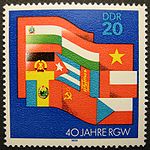
- in AlbanianAlbanian languageAlbanian is an Indo-European language spoken by approximately 7.6 million people, primarily in Albania and Kosovo but also in other areas of the Balkans in which there is an Albanian population, including western Macedonia, southern Montenegro, southern Serbia and northwestern Greece...
—Këshilli i Ndihmës Ekonomike Reciproke, KNER - in BulgarianBulgarian languageBulgarian is an Indo-European language, a member of the Slavic linguistic group.Bulgarian, along with the closely related Macedonian language, demonstrates several linguistic characteristics that set it apart from all other Slavic languages such as the elimination of case declension, the...
—Съвет за икономическа взаимопомощ (Sǎvet za Ikonomičeska Vzaimopomošt), СИВ (SIV) - in CzechCzech languageCzech is a West Slavic language with about 12 million native speakers; it is the majority language in the Czech Republic and spoken by Czechs worldwide. The language was known as Bohemian in English until the late 19th century...
—Rada vzájemné hospodářské pomoci, RVHP - in GermanGerman languageGerman is a West Germanic language, related to and classified alongside English and Dutch. With an estimated 90 – 98 million native speakers, German is one of the world's major languages and is the most widely-spoken first language in the European Union....
—Rat für gegenseitige Wirtschaftshilfe, RGW (Only East Germany was a member.) - in HungarianHungarian languageHungarian is a Uralic language, part of the Ugric group. With some 14 million speakers, it is one of the most widely spoken non-Indo-European languages in Europe....
—Kölcsönös Gazdasági Segítség Tanácsa, KGST - in PolishPolish languagePolish is a language of the Lechitic subgroup of West Slavic languages, used throughout Poland and by Polish minorities in other countries...
—Rada Wzajemnej Pomocy Gospodarczej, RWPG - in PortuguesePortuguese languagePortuguese is a Romance language that arose in the medieval Kingdom of Galicia, nowadays Galicia and Northern Portugal. The southern part of the Kingdom of Galicia became independent as the County of Portugal in 1095...
—Conselho para Assistência Económica Mútua, CAEM (Mozambique had a cooperation agreement.) - in RomanianRomanian languageRomanian Romanian Romanian (or Daco-Romanian; obsolete spellings Rumanian, Roumanian; self-designation: română, limba română ("the Romanian language") or românește (lit. "in Romanian") is a Romance language spoken by around 24 to 28 million people, primarily in Romania and Moldova...
—Consiliul de Ajutor Economic Reciproc, CAER - in RussianRussian languageRussian is a Slavic language used primarily in Russia, Belarus, Uzbekistan, Kazakhstan, Tajikistan and Kyrgyzstan. It is an unofficial but widely spoken language in Ukraine, Moldova, Latvia, Turkmenistan and Estonia and, to a lesser extent, the other countries that were once constituent republics...
—Сове́т Экономи́ческой Взаимопо́мощи (Sovet Ekonomicheskoy Vzaimopomoshchi), СЭВ (SEV) - in SlovakSlovak languageSlovak , is an Indo-European language that belongs to the West Slavic languages .Slovak is the official language of Slovakia, where it is spoken by 5 million people...
—Rada vzájomnej hospodárskej pomoci, RVHP - in SpanishSpanish languageSpanish , also known as Castilian , is a Romance language in the Ibero-Romance group that evolved from several languages and dialects in central-northern Iberia around the 9th century and gradually spread with the expansion of the Kingdom of Castile into central and southern Iberia during the...
—Consejo de Ayuda Mutua Económica, CAME (Cuba was a member.) - in VietnameseVietnamese languageVietnamese is the national and official language of Vietnam. It is the mother tongue of 86% of Vietnam's population, and of about three million overseas Vietnamese. It is also spoken as a second language by many ethnic minorities of Vietnam...
—Hội đồng Tương trợ kinh tế, HĐTTKT
Membership
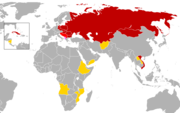
Czechoslovak Socialist Republic
The Czechoslovak Socialist Republic was the official name of Czechoslovakia from 1960 until end of 1989 , a Soviet satellite state of the Eastern Bloc....
starting in 1960) Republic of Hungary (People's Republic of Hungary
People's Republic of Hungary
The People's Republic of Hungary or Hungarian People's Republic was the official state name of Hungary from 1949 to 1989 during its Communist period under the guidance of the Soviet Union. The state remained in existence until 1989 when opposition forces consolidated in forcing the regime to...
starting in 1949) Republic of Poland (People's Republic of Poland
People's Republic of Poland
The People's Republic of Poland was the official name of Poland from 1952 to 1990. Although the Soviet Union took control of the country immediately after the liberation from Nazi Germany in 1944, the name of the state was not changed until eight years later...
starting in 1952) Romanian People's Republic (Socialist Republic of Romania starting in 1965)
February 1949: People's Republic of Albania (Socialist People's Republic of Albania beginning in 1976) - (Albania, although it had not formally revoked its membership as of mid - 1987, stopped participating in Comecon activities in 1961 following the Sino-Soviet Split
Sino-Soviet split
In political science, the term Sino–Soviet split denotes the worsening of political and ideologic relations between the People's Republic of China and the Union of Soviet Socialist Republics during the Cold War...
.)
1950: (beginning in 1959:
 ) German Democratic Republic
German Democratic Republic
The German Democratic Republic , informally called East Germany by West Germany and other countries, was a socialist state established in 1949 in the Soviet zone of occupied Germany, including East Berlin of the Allied-occupied capital city...
1962: Mongolian People's Republic
1972: Republic of Cuba
1978: Socialist Republic of Vietnam
Source:
1985:
-
.svg.png) People's Republic of MozambiquePeople's Republic of MozambiqueThe People's Republic of Mozambique , was a self-declared socialist state that lasted from June 25, 1975 through December 1, 1990, becoming the present day Republic of Mozambique.After gaining independence from Portugal in 1975, the People's Republic of Mozambique was established shortly...
People's Republic of MozambiquePeople's Republic of MozambiqueThe People's Republic of Mozambique , was a self-declared socialist state that lasted from June 25, 1975 through December 1, 1990, becoming the present day Republic of Mozambique.After gaining independence from Portugal in 1975, the People's Republic of Mozambique was established shortly...
Non-communist cooperant status
1973: Republic of Finland1975: Republic of Iraq
Ba'athist Iraq
The History of Iraq , referred to as Ba'athist Iraq, covers the period of the Arab Socialist Ba'ath Party's rule over Iraq. Ba'athist rule in Iraq first occurred briefly in 1963 under Ahmed Hassan al-Bakr until overthrown that same year. Ba'athism was restored to power five years later after...
1975: United Mexican States
1984: Republic of Nicaragua
In the late 1950s, a number of communist-ruled non-member countries—People's Republic of China, the Democratic People's Republic of Korea (North Korea
North Korea
The Democratic People’s Republic of Korea , , is a country in East Asia, occupying the northern half of the Korean Peninsula. Its capital and largest city is Pyongyang. The Korean Demilitarized Zone serves as the buffer zone between North Korea and South Korea...
), Mongolia
Mongolia
Mongolia is a landlocked country in East and Central Asia. It is bordered by Russia to the north and China to the south, east and west. Although Mongolia does not share a border with Kazakhstan, its western-most point is only from Kazakhstan's eastern tip. Ulan Bator, the capital and largest...
, Vietnam
Vietnam
Vietnam – sometimes spelled Viet Nam , officially the Socialist Republic of Vietnam – is the easternmost country on the Indochina Peninsula in Southeast Asia. It is bordered by China to the north, Laos to the northwest, Cambodia to the southwest, and the South China Sea –...
, and Yugoslavia
Socialist Federal Republic of Yugoslavia
The Socialist Federal Republic of Yugoslavia was the Yugoslav state that existed from the abolition of the Yugoslav monarchy until it was dissolved in 1992 amid the Yugoslav Wars. It was a socialist state and a federation made up of six socialist republics: Bosnia and Herzegovina, Croatia,...
—were invited to participate as observers in Comecon sessions. Although Mongolia and Vietnam later gained full membership, China stopped attending Comecon sessions after 1961. Yugoslavia negotiated a form of associate status in the organization, specified in its 1964 agreement with Comecon. Collectively, the members of the Comecon did not display the necessary prerequsites for economic integration: their level of industrialization was low and uneven, with a single dominant member (the Soviet Union) producing 70% of the community national product.
In the late 1980s there were ten full members: the Soviet Union, six East European countries, and three extraregional members. Geography, therefore, no longer united Comecon members. Wide variations in economic size and level of economic development also tended to generate divergent interests among the member countries. All these factors combined to give rise to significant differences in the member states' expectations about the benefits to be derived from membership in Comecon. Unity was provided instead by political and ideological factors. All Comecon members were "united by a commonality of fundamental class interests and the ideology of Marxism-Leninism" and had common approaches to economic ownership (state versus private) and management (plan versus market). In 1949 the ruling communist parties of the founding states were also linked internationally through the Cominform
Cominform
Founded in 1947, Cominform is the common name for what was officially referred to as the Information Bureau of the Communist and Workers' Parties...
, from which Yugoslavia
Socialist Federal Republic of Yugoslavia
The Socialist Federal Republic of Yugoslavia was the Yugoslav state that existed from the abolition of the Yugoslav monarchy until it was dissolved in 1992 amid the Yugoslav Wars. It was a socialist state and a federation made up of six socialist republics: Bosnia and Herzegovina, Croatia,...
had been expelled
Informbiro
Informbiro was a period in the history of Yugoslavia characterized by conflict and schism with the Soviet Union...
the previous year. Although the Cominform was disbanded in 1956, interparty links continued to be strong among Comecon members, and all participated in periodic international conferences of communist parties. Comecon provided a mechanism through which its leading member, the Soviet Union, sought to foster economic links with and among its closest political and military allies. The East European members of Comecon were also militarily allied with the Soviet Union in the Warsaw Pact
Warsaw Pact
The Warsaw Treaty Organization of Friendship, Cooperation, and Mutual Assistance , or more commonly referred to as the Warsaw Pact, was a mutual defense treaty subscribed to by eight communist states in Eastern Europe...
.
There were three kinds of relationships – besides the 10 full memberships – with the Comecon:
- Yugoslavia was the only country considered to have associate member status. On the basis of the 1964 agreement, Yugoslavia participated in twenty-one of the thirty-two key Comecon institutions as if it were a full member.
- FinlandFinlandFinland , officially the Republic of Finland, is a Nordic country situated in the Fennoscandian region of Northern Europe. It is bordered by Sweden in the west, Norway in the north and Russia in the east, while Estonia lies to its south across the Gulf of Finland.Around 5.4 million people reside...
, IraqIraqIraq ; officially the Republic of Iraq is a country in Western Asia spanning most of the northwestern end of the Zagros mountain range, the eastern part of the Syrian Desert and the northern part of the Arabian Desert....
, MexicoMexicoThe United Mexican States , commonly known as Mexico , is a federal constitutional republic in North America. It is bordered on the north by the United States; on the south and west by the Pacific Ocean; on the southeast by Guatemala, Belize, and the Caribbean Sea; and on the east by the Gulf of...
and NicaraguaNicaraguaNicaragua is the largest country in the Central American American isthmus, bordered by Honduras to the north and Costa Rica to the south. The country is situated between 11 and 14 degrees north of the Equator in the Northern Hemisphere, which places it entirely within the tropics. The Pacific Ocean...
had a nonsocialist cooperant status with Comecon. Because the governments of these countries were not empowered to conclude agreements in the name of private companies, the governments did not take part in Comecon operations. They were represented in Comecon by commissions made up of members of the government and the business community. The commissions were empowered to sign various "framework" agreements with Comecon's Joint Commission on Cooperation. - After 1957 Comecon allowed certain countries with communist or pro-Soviet governments to attend sessions as observers. In November 1986, delegations from Democratic Republic of AfghanistanDemocratic Republic of AfghanistanThe Democratic Republic of Afghanistan was a government of Afghanistan between 1978 and 1992. It was both ideologically close to and economically dependent on the Soviet Union, and was a major belligerent of the Afghan Civil War.- Saur Revolution :...
, EthiopiaEthiopiaEthiopia , officially known as the Federal Democratic Republic of Ethiopia, is a country located in the Horn of Africa. It is the second-most populous nation in Africa, with over 82 million inhabitants, and the tenth-largest by area, occupying 1,100,000 km2...
, LaosLaosLaos Lao: ສາທາລະນະລັດ ປະຊາທິປະໄຕ ປະຊາຊົນລາວ Sathalanalat Paxathipatai Paxaxon Lao, officially the Lao People's Democratic Republic, is a landlocked country in Southeast Asia, bordered by Burma and China to the northwest, Vietnam to the east, Cambodia to the south and Thailand to the west...
, NicaraguaNicaraguaNicaragua is the largest country in the Central American American isthmus, bordered by Honduras to the north and Costa Rica to the south. The country is situated between 11 and 14 degrees north of the Equator in the Northern Hemisphere, which places it entirely within the tropics. The Pacific Ocean...
, and the People's Democratic Republic of Yemen (South Yemen) attended the 42d Council Session as observers.
Foundation
The Comecon was founded in 1949 by the Soviet UnionSoviet Union
The Soviet Union , officially the Union of Soviet Socialist Republics , was a constitutionally socialist state that existed in Eurasia between 1922 and 1991....
, Bulgaria
Bulgaria
Bulgaria , officially the Republic of Bulgaria , is a parliamentary democracy within a unitary constitutional republic in Southeast Europe. The country borders Romania to the north, Serbia and Macedonia to the west, Greece and Turkey to the south, as well as the Black Sea to the east...
, Czechoslovakia
Czechoslovakia
Czechoslovakia or Czecho-Slovakia was a sovereign state in Central Europe which existed from October 1918, when it declared its independence from the Austro-Hungarian Empire, until 1992...
, Hungary
Hungary
Hungary , officially the Republic of Hungary , is a landlocked country in Central Europe. It is situated in the Carpathian Basin and is bordered by Slovakia to the north, Ukraine and Romania to the east, Serbia and Croatia to the south, Slovenia to the southwest and Austria to the west. The...
, Poland
Poland
Poland , officially the Republic of Poland , is a country in Central Europe bordered by Germany to the west; the Czech Republic and Slovakia to the south; Ukraine, Belarus and Lithuania to the east; and the Baltic Sea and Kaliningrad Oblast, a Russian exclave, to the north...
, and Romania
Romania
Romania is a country located at the crossroads of Central and Southeastern Europe, on the Lower Danube, within and outside the Carpathian arch, bordering on the Black Sea...
. The primary factors in Comecon's formation appear to have been Joseph Stalin
Joseph Stalin
Joseph Vissarionovich Stalin was the Premier of the Soviet Union from 6 May 1941 to 5 March 1953. He was among the Bolshevik revolutionaries who brought about the October Revolution and had held the position of first General Secretary of the Communist Party of the Soviet Union's Central Committee...
's desire to cooperate and strengthen the international socialist relationship at an economic level with the lesser states of Central Europe, and which were now, increasingly, cut off from their traditional markets and suppliers in Western Europe. Czechoslovakia, Hungary, and Poland had remained interested in Marshall aid despite the requirements for a convertible currency and market economies
Market economy
A market economy is an economy in which the prices of goods and services are determined in a free price system. This is often contrasted with a state-directed or planned economy. Market economies can range from hypothetically pure laissez-faire variants to an assortment of real-world mixed...
. These requirements, which would inevitably have resulted in stronger economic ties to Western Europe than to the Soviet Union, were absolutely unacceptable to Stalin, who in July 1947, ordered these communist-dominated governments to pull out of the Paris Conference on the European Recovery Programme. This has been described as "the moment of truth" in the post-World War II
World War II
World War II, or the Second World War , was a global conflict lasting from 1939 to 1945, involving most of the world's nations—including all of the great powers—eventually forming two opposing military alliances: the Allies and the Axis...
division of Europe.
However, as always, Stalin's precise motives are "inscrutable" They may well have been "more negative than positive", with Stalin "more anxious to keep other powers out of neighbouring buffer state
Buffer state
A buffer state is a country lying between two rival or potentially hostile greater powers, which by its sheer existence is thought to prevent conflict between them. Buffer states, when authentically independent, typically pursue a neutralist foreign policy, which distinguishes them from satellite...
s… than to integrate them." Furthermore, GATT
General Agreement on Tariffs and Trade
The General Agreement on Tariffs and Trade was negotiated during the UN Conference on Trade and Employment and was the outcome of the failure of negotiating governments to create the International Trade Organization . GATT was signed in 1947 and lasted until 1993, when it was replaced by the World...
's notion of nondiscriminatory treatment of trade partners was incompatible with notions of socialist
Socialism
Socialism is an economic system characterized by social ownership of the means of production and cooperative management of the economy; or a political philosophy advocating such a system. "Social ownership" may refer to any one of, or a combination of, the following: cooperative enterprises,...
solidarity. In any event, proposals for a customs union
Customs union
A customs union is a type of trade bloc which is composed of a free trade area with a common external tariff. The participant countries set up common external trade policy, but in some cases they use different import quotas...
and economic integration of East Central Europe date back at least to the Revolutions of 1848
Revolutions of 1848
The European Revolutions of 1848, known in some countries as the Spring of Nations, Springtime of the Peoples or the Year of Revolution, were a series of political upheavals throughout Europe in 1848. It was the first Europe-wide collapse of traditional authority, but within a year reactionary...
(although many earlier proposals had been intended to stave off the Russian and/or communist "menace") and the state-to-state trading inherent in centrally planned economies required some sort of coordination: otherwise, a monopolist
Monopoly
A monopoly exists when a specific person or enterprise is the only supplier of a particular commodity...
seller would face a monopsonist
Monopsony
In economics, a monopsony is a market form in which only one buyer faces many sellers. It is an example of imperfect competition, similar to a monopoly, in which only one seller faces many buyers...
buyer, with no structure to set prices.
Comecon was established at a Moscow economic conference January 5–January 8, 1949, at which the six founding member countries were represented; its foundation was publicly announced on January 25; Albania
Albania
Albania , officially known as the Republic of Albania , is a country in Southeastern Europe, in the Balkans region. It is bordered by Montenegro to the northwest, Kosovo to the northeast, the Republic of Macedonia to the east and Greece to the south and southeast. It has a coast on the Adriatic Sea...
joined a month later and East Germany in 1950.
At first, planning seemed to be moving along rapidly. After pushing aside Nikolai Voznesensky
Nikolai Voznesensky
Nikolai Alekseevich Voznesensky was the Soviet economic planner who oversaw the running of Gosplan during the German-Soviet War. A protégé of Andrei Zhdanov, Voznesensky was appointed Deputy Premier in May 1940 at the age of thirty-eight. He was directly involved in the recovery of production...
's technocrat
Technocracy (bureaucratic)
Technocracy is a form of government where technical experts are in control of decision making in their respective fields. Economists, engineers, scientists, health professionals, and those who have knowledge, expertise or skills would compose the governing body...
ic, price-based approach (see further discussion below), the direction appeared to be toward a coordination of national economic plans, but with no coercive authority from Comecon itself. All decisions would require unanimous ratification, and even then governments would separately translate these into policy. Then in summer 1950, probably unhappy with the favorable implications for the effective individual and collective sovereignty
Sovereignty
Sovereignty is the quality of having supreme, independent authority over a geographic area, such as a territory. It can be found in a power to rule and make law that rests on a political fact for which no purely legal explanation can be provided...
of the smaller states, Stalin "seems to have taken [Comecon's] personnel by surprise," bringing operations to a nearly complete halt, as the Soviet Union moved domestically toward autarky
Autarky
Autarky is the quality of being self-sufficient. Usually the term is applied to political states or their economic policies. Autarky exists whenever an entity can survive or continue its activities without external assistance. Autarky is not necessarily economic. For example, a military autarky...
and internationally toward an "embassy system of meddling in other countries' affairs directly" rather than by "constitutional means". Comecon's scope was officially limited in November 1950 to "practical questions of facilitating trade."
One important legacy of this brief period of activity was the Sofia principle, adopted at the August 1949 Comecon council session in Bulgaria. This radically weakened intellectual property
Intellectual property
Intellectual property is a term referring to a number of distinct types of creations of the mind for which a set of exclusive rights are recognized—and the corresponding fields of law...
rights, making each country's technologies available to the others for a nominal charge that did little more than cover the cost of documentation. This, naturally, benefited the less industrialized Comecon countries, and especially the technologically lagging Soviet Union, at the expense of East Germany and Czechoslovakia and, to a lesser extent, Hungary and Poland. (This principle would weaken after 1968, as it became clear that it discouraged new research—and as the Soviet Union itself began to have more marketable technologies.)
The Khrushchev era
After Stalin's death in 1953, Comecon again began to find its footing. In the early 1950s, all Comecon countries had adopted relatively autarkicAutarky
Autarky is the quality of being self-sufficient. Usually the term is applied to political states or their economic policies. Autarky exists whenever an entity can survive or continue its activities without external assistance. Autarky is not necessarily economic. For example, a military autarky...
policies; now they began again to discuss developing complementary specialties, and in 1956, ten permanent standing committees arose, intended to facilitate coordination in these matters. The Soviet Union began to trade oil
Petroleum
Petroleum or crude oil is a naturally occurring, flammable liquid consisting of a complex mixture of hydrocarbons of various molecular weights and other liquid organic compounds, that are found in geologic formations beneath the Earth's surface. Petroleum is recovered mostly through oil drilling...
for Comecon manufactured goods. There was much discussion of coordinating five-year plans.
However, once again, trouble arose. The Polish protests
Poznan 1956 protests
The Poznań 1956 protests, also known as Poznań 1956 uprising or Poznań June , were the first of several massive protests of the Polish people against the communist government of the People's Republic of Poland...
and Hungarian uprising led to major social and economic changes, including the 1957 abandonment of the 1956-1960 Soviet five-year plan, as the Comecon governments struggled to reestablish their legitimacy and popular support. The next few years saw a series of small steps toward increased trade and economic integration, including the introduction of the "transferable rouble", revised efforts at national specialization, and a 1959 charter modeled after the 1957 Treaty of Rome
Treaty of Rome
The Treaty of Rome, officially the Treaty establishing the European Economic Community, was an international agreement that led to the founding of the European Economic Community on 1 January 1958. It was signed on 25 March 1957 by Belgium, France, Italy, Luxembourg, the Netherlands and West Germany...
.
Once again, however, efforts at transnational central planning failed. In December 1961, a council session approved the Basic Principles of the International Socialist Division of Labour, which talked of closer coordination of plans and of "concentrating production of similar products in one or several socialist countries." In November 1962, Soviet Premier Nikita Khrushchev
Nikita Khrushchev
Nikita Sergeyevich Khrushchev led the Soviet Union during part of the Cold War. He served as First Secretary of the Communist Party of the Soviet Union from 1953 to 1964, and as Chairman of the Council of Ministers, or Premier, from 1958 to 1964...
followed this up with a call for "a common single planning organ." This was resisted by Czechoslovakia, Hungary, and Poland, but most emphatically by increasingly nationalistic Romania, which strongly rejected the notion that they should specialize in agriculture. In Eastern Europe, only Bulgaria happily took on an assigned role (also agricultural, but in Bulgaria's case this had been the country's chosen direction even as an independent country in the 1930s). Essentially, by the time the Soviet Union was calling for tight economic integration, they no longer had the power to impose it. Despite some slow headway—integration increased in petroleum, electricity, and other technical/scientific sectors—and the 1963 founding of an International Bank for Economic Co-operation, the Eastern European Comecon countries all increased trade with the West relatively more than with one another.
The Brezhnev era
From its founding until 1967, Comecon had operated only on the basis of unanimous agreements. It had become increasingly obvious that the result was usually failure. In 1967, Comecon adopted the "interested party principle", under which any country could opt out of any project they chose, still allowing the other member states to use Comecon mechanisms to coordinate their activities. In principle, a country could still veto, but the hope was that they would typically choose just to step aside rather than either veto or be a reluctant participant. This aimed, at least in part, at allowing Romania to chart its own economic course without leaving Comecon entirely or bringing it to an impasse.Also until the late 1960s, the official term used to describe Comecon activities was cooperation. The term integration was always avoided because of its connotations of monopoly capitalist collusion. However, after the "special" council session of April 1969 and the development and adoption (in 1971) of the Comprehensive Program for the Further Extension and Improvement of Cooperation and the Further Development of Socialist Economic Integration by Comecon Member Countries, Comecon activities were officially termed integration (equalization of "differences in relative scarcities of goods and services between states through the deliberate elimination of barriers to trade and other forms of interaction"). Although such equalization had not been a pivotal point in the formation and implementation of Comecon's economic policies, improved economic integration had always been Comecon's goal.
While such integration was to remain a goal, and while Bulgaria became yet more tightly integrated with the Soviet Union, progress in this direction was otherwise continually frustrated by the national central planning prevalent in all Comecon countries, by the increasing diversity of its members (which by this time included Mongolia and would soon include Cuba) and by the "overwhelming asymmetry" and resulting distrust between the many small member states and the Soviet "superstate" which, in 1983, "accounted for 88 percent of Comecon's territory and 60 percent of its population."
In this period, there were some efforts to move away from central planning, by establishing intermediate industrial associations and combines in various countries (which were often empowered to negotiate their own international deals). However, these groupings typically proved "unwieldy, conservative, risk-averse, and bureaucratic," reproducing the problems they had been intended to solve.
One economic success of the 1970s was East European investment in developing Soviet oil fields. While doubtless "East Europeans resented having to defray some of the costs of developing the economy of their hated overlord and oppressor," they benefited from low prices for fuel and other mineral products. As a result, Comecon economies generally showed strong growth in the mid-1970s. They were largely unaffected by the 1973 oil crisis
1973 oil crisis
The 1973 oil crisis started in October 1973, when the members of Organization of Arab Petroleum Exporting Countries or the OAPEC proclaimed an oil embargo. This was "in response to the U.S. decision to re-supply the Israeli military" during the Yom Kippur war. It lasted until March 1974. With the...
. Another short-term economic gain in this period was that détente
Détente
Détente is the easing of strained relations, especially in a political situation. The term is often used in reference to the general easing of relations between the Soviet Union and the United States in the 1970s, a thawing at a period roughly in the middle of the Cold War...
brought opportunities for investment and technology transfers from the West. This also led to an importation of Western cultural attitudes, especially in Central Europe. However, many undertakings based on Western technology were less than successful (for example, Poland's Ursus tractor factory did not do well with technology licensed from Massey Ferguson
Massey Ferguson
Massey Ferguson Limited was a major agricultural equipment manufacturer which was based in Canada before its purchase by AGCO. The company was formed by a merger between Massey Harris and the Ferguson tractor company in 1953, creating the company Massey Harris Ferguson. However in 1958 the name was...
); other investment was wasted on luxuries for the party elite, and most Comecon countries ended up indebted to the West when capital flows died out as détente faded in the late 1970s, and from 1979 to 1983, all of Eastern Europe experienced a recession from which (with the possible exceptions of East Germany and Bulgaria) they never recovered in the Communist era. Romania and Poland experienced major declines in the standard of living.
Perestroika
The 1985 Comprehensive Program for Scientific and Technical Progress and the rise to power of Soviet general secretary Mikhail GorbachevMikhail Gorbachev
Mikhail Sergeyevich Gorbachev is a former Soviet statesman, having served as General Secretary of the Communist Party of the Soviet Union from 1985 until 1991, and as the last head of state of the USSR, having served from 1988 until its dissolution in 1991...
increased Soviet influence in Comecon operations and led to attempts to give Comecon some degree of supranational authority. The Comprehensive Program for Scientific and Technical Progress was designed to improve economic cooperation through the development of a more efficient and interconnected scientific and technical base. This was the era of perestroika
Perestroika
Perestroika was a political movement within the Communist Party of the Soviet Union during 1980s, widely associated with the Soviet leader Mikhail Gorbachev...
("restructuring"), the last attempt to put the Comecon economies on a sound economic footing. Gorbachev and his economic mentor Abel Aganbegyan
Abel Aganbegyan
Abel Gyozevich Aganbegyan is a leading Soviet and Russian economist of Armenian descent, academic of Russian Academy of Sciences and honorary doctor of business administration of Kingston University, the founder and first editor of the journal EKO....
hoped to make "revolutionary changes" in the economy, foreseeing that "science will increasingly become a 'direct productive force', as Marx foresaw… By the year 2000… the renewal of plant and machinery… will be running at 6 percent or more per year."
The program was not a success. "The Gorbachev regime made too many commitments on too many fronts, thereby overstretching and overheating the Soviet economy. Bottlenecks and shortages were not relieved but exacerbated, while the East European members of Comecon resented being asked to contribute scarce capital to projects that were chiefly of interest to the Soviet Union…" Furthermore, the liberalization that by June 25, 1988 allowed Comecon countries to negotiate trade treaties directly with the European Community (the renamed EEC), and the "Sinatra doctrine
Sinatra Doctrine
"Sinatra Doctrine" was the name that the Soviet government of Mikhail Gorbachev used jokingly to describe its policy of allowing neighboring Warsaw Pact nations to determine their own internal affairs...
" under which the Soviet Union allowed that change would be the exclusive affair of each individual country marked the beginning of the end for Comecon. Although the Revolutions of 1989
Revolutions of 1989
The Revolutions of 1989 were the revolutions which overthrew the communist regimes in various Central and Eastern European countries.The events began in Poland in 1989, and continued in Hungary, East Germany, Bulgaria, Czechoslovakia and...
did not formally end Comecon, and the Soviet government itself lasted until 1991, the March 1990 meeting in Prague was little more than a formality, discussing the coordination of non-existent five-year plans. From January 1, 1991, the countries shifted their dealings with one another to a hard currency market basis. The result was a radical decrease in trade with one another, as "Eastern Europe… exchanged asymmetrical trade dependence on the Soviet Union for an equally asymmetrical commercial dependence on the European Community."
The final Comecon council session took place June 28, 1991 in Budapest
Budapest
Budapest is the capital of Hungary. As the largest city of Hungary, it is the country's principal political, cultural, commercial, industrial, and transportation centre. In 2011, Budapest had 1,733,685 inhabitants, down from its 1989 peak of 2,113,645 due to suburbanization. The Budapest Commuter...
, and led to an agreement to disband within 90 days.
How Comecon exchanged
Working with neither meaningful exchange rateExchange rate
In finance, an exchange rate between two currencies is the rate at which one currency will be exchanged for another. It is also regarded as the value of one country’s currency in terms of another currency...
s nor a market economy, Comecon countries had to look to world markets as a reference point for prices, but unlike agents acting in a market, prices tended to be stable over a period of years, rather than constantly fluctuating, which assisted central planning. Also, there was a tendency to underprice raw materials relative to the manufactured goods produced in many of the Comecon countries.
International barter helped preserve the Comecon countries' scarce hard currency
Hard currency
Hard currency , in economics, refers to a globally traded currency that is expected to serve as a reliable and stable store of value...
reserves. In strict economic terms, barter inevitably harmed countries whose goods would have brought higher prices in the free market or whose imports could have been obtained more cheaply, and benefitted those for whom it was the other way around. Still, all of the Comecon countries gained some stability, and the governments gained some legitimacy, and in many ways this stability and protection from the world market was viewed, at least in the early years of Comecon, as an advantage of the system, as was the formation of stronger ties with other communist countries.
Within Comecon, there were occasional struggles over just how this system should work. Early on, Nikolai Voznesensky
Nikolai Voznesensky
Nikolai Alekseevich Voznesensky was the Soviet economic planner who oversaw the running of Gosplan during the German-Soviet War. A protégé of Andrei Zhdanov, Voznesensky was appointed Deputy Premier in May 1940 at the age of thirty-eight. He was directly involved in the recovery of production...
pushed for a more "law-governed" and technocrat
Technocracy (bureaucratic)
Technocracy is a form of government where technical experts are in control of decision making in their respective fields. Economists, engineers, scientists, health professionals, and those who have knowledge, expertise or skills would compose the governing body...
ic price-based approach. However, with the August 1948 death of Andrei Zhdanov
Andrei Zhdanov
Andrei Alexandrovich Zhdanov was a Soviet politician.-Life:Zhdanov enlisted with the Russian Social Democratic Labour Party in 1915 and was promoted through the party ranks, becoming the All-Union Communist Party manager in Leningrad after the assassination of Sergei Kirov in 1934...
, Voznesensky lost his patron and was soon accused of treason as part of the Leningrad Affair
Leningrad Affair
The Leningrad Affair, or Leningrad case , was a series of criminal cases fabricated in the late 1940s–early 1950s in order to accuse a number of prominent members of the Communist Party of the Soviet Union of treason and intention to create an anti-Soviet organization out of the Leningrad Party...
; within two years he was dead in prison. Instead, what won out was a "physical planning" approach that strengthened the role of central governments over technocrats. At the same time, the effort to create a single regime of planning "common economic organization" with the ability to set plans throughout the Comecon region also came to nought. A protocol to create such a system was signed January 18, 1949, but never ratified. While historians are not unanimous on why this was stymied, it clearly threatened the sovereignty not only of the smaller states, but even of the Soviet Union itself, since an international body would have had real power; Stalin clearly preferred informal means of intervention in the other Comecon states. This lack of either rationality or international central planning tended to promote autarky
Autarky
Autarky is the quality of being self-sufficient. Usually the term is applied to political states or their economic policies. Autarky exists whenever an entity can survive or continue its activities without external assistance. Autarky is not necessarily economic. For example, a military autarky...
in each Comecon country, because none fully trusted the others to deliver goods and services.
With few exceptions, foreign trade in the Comecon countries was a state monopoly, and the state agencies and captive trading companies were often corrupt. Even at best, this tended to put several removes between a producer and any foreign customer, limiting the ability to learn to adjust to foreign customers' needs. Furthermore, there was often strong political pressure to keep the best products for domestic use in each country. From the early 1950s to Comecon's demise in the early 1990s, intra-Comecon trade, except for Soviet petroleum, was in steady decline.
Oil transfers
Beginning no later than the early 1970s, Soviet petroleum and natural gasNatural gas
Natural gas is a naturally occurring gas mixture consisting primarily of methane, typically with 0–20% higher hydrocarbons . It is found associated with other hydrocarbon fuel, in coal beds, as methane clathrates, and is an important fuel source and a major feedstock for fertilizers.Most natural...
were routinely transferred within Comecon at below-market rates. Most Western commentators have viewed this as implicit, politically motivated subsidization of shaky economies to defuse discontents and reward compliance with Soviet wishes. However, other commentators say that this may not have been deliberate policy, noting that whenever prices differ from world market prices, there will be winners and losers. They argue that this may have been simply an unforeseen consequence of two factors: the slow adjustment of Comecon prices during a time of rising oil and gas prices, and the fact that mineral resources were abundant in the Comecon sphere, relative to manufactured goods. A possible point of comparison is that there were also winners and losers under EEC agricultural policy in the same period.
Ineffective production
The organization of Comecon was officially focused on common expansion of states, more effective production and building relationships between countries within. Nevertheless the primary focus was to prepare the Soviet Union for another war and improving its wealth and living standards. And as in every planned economy, operations did not reflect state of market, innovations, availability of items or the specific needs of a country. One example came from former Czechoslovakia. In the 1970s the Communist party of Czechoslovakia finally realized that there was a need for underground trains. Czechoslovak designers projected a cheap but technologically innovative underground train. The train was a state of the art project, capable of moving underground or on the surface using standard rails, had a high number of passenger seats, and was lightweight. According to the designers the train was technologically more advanced than the trains used in New York's Subway, London's Tube or the Paris Metro. However, due to the plan of Comecon, older Soviet trains were used, which guaranteed profit for the Soviet Union and work for workers in Soviet factories. That economical change lead to the cancellation of the R1 trains by A. Honzík. The Comecon plan, though more profitable for the Soviets, if less resourceful for the Czechs and Slovaks, forced the Czechoslovak government to buy trains "Ečs (81-709)" and "81-71", both of which were designed in early 1950s and were heavy, unreliable and expensive. (Materials available only in Czech Republic and Slovakia, video included)On the other hand, Czechoslovak trams (Tatra T3
Tatra T3
The T3 is a type of tramcar produced by Tatra. During its period of production, between 1960 and 1989, 13,991 multiple units and 122 sidecars were sold worldwide, mostly in Central and Eastern Europe and the Soviet Union...
) and jet trainers (L-29
Aero L-29 Delfin
|-See also:-References:* Gunston, Bill, ed. "Aero L-29 Delfin." The Encyclopedia of World Air Power. New York: Crescent Books, 1990. ISBN 0-517-53754-0....
) were standard for all Comecon countries, including the USSR, and other countries could develop own designs only for own needs, like Poland (respectively, Konstal trams and TS-11
PZL TS-11 Iskra
|-See also:-References:*"Poland's Veteran Spark". Air International, March 1979, Vol 16 No. 3. Bromley, UK:Fine Scroll Publishing. pp. 126–131....
jets). Poland was the only manufacturer of light helicopters for all Comecon countries (Mi-2
Mil Mi-2
The Mil Mi-2 is a small, lightly armored transport helicopter that could also provide close air support when armed with 57 mm rockets and a 23 mm cannon.-Design and development:...
of the Soviet design), and only Romania produced French helicopters for own market. In a formal or informal way, often the countries were however discouraged from developing own designs.
Structure
Although not formally part of the organization's hierarchy, the Conference of First Secretaries of Communist and Workers' Parties and of the Heads of Government of the Comecon Member Countries was Comecon's most important organ. These party and government leaders gathered for conference meetings regularly to discuss topics of mutual interest. Because of the rank of conference participants, their decisions had considerable influence on the actions taken by Comecon and its organs.The official hierarchy of Comecon consisted of the Session of the Council for Mutual Economic Assistance, the Executive Committee of the Council, the Secretariat of the Council, four council committees, twenty-four standing commissions, six interstate conferences, two scientific institutes, and several associated organizations.
The Session
The Session of the Council for Mutual Economic Assistance, officially the highest Comecon organ, examined fundamental problems of socialist economic integration and directed the activities of the Secretariat and other subordinate organizations. Delegations from each Comecon member country attended these meetings. Prime ministers usually headed the delegations, which met during the second quarter of each year in a member country's capital (the location of the meeting was determined by a system of rotation based on the Cyrillic alphabetCyrillic alphabet
The Cyrillic script or azbuka is an alphabetic writing system developed in the First Bulgarian Empire during the 10th century AD at the Preslav Literary School...
). All interested parties had to consider recommendations handed down by the Session. A treaty
Treaty
A treaty is an express agreement under international law entered into by actors in international law, namely sovereign states and international organizations. A treaty may also be known as an agreement, protocol, covenant, convention or exchange of letters, among other terms...
or other kind of legal agreement implemented adopted recommendations. Comecon itself might adopt decisions only on organizational and procedural matters pertaining to itself and its organs.
Each country appointed one permanent representative to maintain relations between members and Comecon between annual meetings. An extraordinary Session, such as the one in December 1985, might be held with the consent of at least one-third of the members. Such meetings usually took place in Moscow.
Executive Committee
The highest executive organ in Comecon, the Executive Committee, was entrusted with elaborating policy recommendations and supervising their implementation between sessions. In addition, it supervised work on plan coordination and scientific-technical cooperation. Composed of one representative from each member country, usually a deputy chairman of the Council of Ministers, the Executive Committee met quarterly, usually in Moscow. In 1971 and 1974, the Executive Committee acquired economic departments that ranked above the standing commissions. These economic departments considerably strengthened the authority and importance of the Executive Committee.Other entities
There were four council committees: Council Committee for Cooperation in Planning, Council Committee for Scientific and Technical Cooperation, Council Committee for Cooperation in Material and Technical Supply, and Council Committee for Cooperation in Machine Building. Their mission was "to ensure the comprehensive examination and a multilateral settlement of the major problems of cooperation among member countries in the economy, science, and technology." All committees were headquartered in Moscow and usually met there. These committees advised the standing commissions, the Secretariat, the interstate conferences, and the scientific institutes in their areas of specialization. Their jurisdiction was generally wider than that of the standing commissions because they had the right to make policy recommendations to other Comecon organizations.The Council Committee for Cooperation in Planning was the most important of the four. It coordinated the national economic plans of Comecon members. As such, it ranked in importance only after the Session and the Executive Committee. Made up of the chairmen of Comecon members' national central planning offices, the Council Committee for Cooperation in Planning drew up draft agreements for joint projects, adopted a resolution approving these projects, and recommended approval to the concerned parties. If its decisions were not subject to approval by national governments and parties, this committee would be considered Comecon's supranational planning body.
The international Secretariat, Comecon's only permanent body, was Comecon's primary economic research and administrative organ. The secretary, who has been a Soviet official since Comecon creation, was the official Comecon representative to Comecon member states and to other states and international organizations. Subordinate to the secretary were his deputy and the various departments of the Secretariat, which generally corresponded to the standing commissions. The Secretariat's responsibilities included preparation and organization of Comecon sessions and other meetings conducted under the auspices of Comecon; compilation of digests on Comecon activities; conduct of economic and other research for Comecon members; and preparation of recommendations on various issues concerning Comecon operations.
In 1956 eight standing commissions were set up to help Comecon make recommendations pertaining to specific economic sectors. The commissions have been rearranged and renamed a number of times since the establishment of the first eight. In 1986 there were twenty-four standing commissions, each headquartered in the capital of a member country and headed by one of that country's leading authorities in the field addressed by the commission. The Secretariat supervised the actual operations of the commissions. The standing commissions had authority only to make recommendations, which had then to be approved by the Executive Committee, presented to the Session, and ratified by the interested member countries. Commissions usually met twice a year in Moscow.
The six interstate conferences (on water management, internal trade, legal matters, inventions and patents, pricing, and labor affairs) served as forums for discussing shared issues and experiences. They were purely consultative and generally acted in an advisory capacity to the Executive Committee or its specialized committees.
The scientific institutes on standardization and on economic problems of the world socialist system concerned themselves with theoretical problems of international cooperation. Both were headquartered in Moscow and were staffed by experts from various member countries.
Affiliated agencies
Several affiliated agencies, having a variety of relationships with Comecon, existed outside the official Comecon hierarchy. They served to develop "direct links between appropriate bodies and organizations of Comecon member countries."These affiliated agencies were divided into two categories: intergovernmental economic organizations (which worked on a higher level in the member countries and generally dealt with a wider range of managerial and coordinative activities) and international economic organizations (which worked closer to the operational level of research, production, or trade). A few examples of the former are the International Bank for Economic Cooperation (managed the transferable ruble system), the International Investment Bank (in charge of financing joint projects), and Intermetal (encouraged cooperation in ferrous metallurgy).
International economic organizations generally took the form of either joint enterprises, international economic associations or unions, or international economic partnerships. The latter included Interatominstrument (nuclear machinery producers), Intertekstilmash (textile machinery producers), and Haldex (a Hungarian-Polish joint enterprise for reprocessing coal slag).
Nature of operation
Comecon was an interstate organization through which members attempted to coordinate economic activities of mutual interest and to develop multilateral economic, scientific, and technical cooperation:- The Charter (1959) stated that "the sovereign equality of all members" was fundamental to the organization and procedures of Comecon.
- The Comprehensive Program further emphasized that the processes of integration of members' economies were "completely voluntary and do not involve the creation of supranational bodies." Hence under the provisions of the Charter, each country had the right to equal representation and one vote in all organs of Comecon, regardless of the country's economic size or the size of its contribution to Comecon's budget.
- From 1967, the "interestedness" provisions of the Charter reinforced the principle of "sovereign equality." Comecon's recommendations and decisions could be adopted only upon agreement among the interested members, and each had the right to declare its "interest" in any matter under consideration.
- Furthermore, in the words of the Charter (as revised in 1967), "recommendations and decisions shall not apply to countries that have declared that they have no interest in a particular matter."
- Although Comecon recognized the principle of unanimity, from 1967 disinterested parties did not have a veto but rather the right to abstain from participation. A declaration of disinterest could not block a project unless the disinterested party's participation was vital. Otherwise, the Charter implied that the interested parties could proceed without the abstaining member, affirming that a country that had declared a lack of interest "may subsequently adhere to the recommendations and decisions adopted by the remaining members of the Council." However, a member country could also declare an "interest" and exercise a veto.
Over the years of its functioning, Comecon acted more as an instrument of mutual economic assistance than a means of economic integration, with multilateralism as an unachievable goal.
Comecon versus the European Economic Community

European Economic Community
The European Economic Community The European Economic Community (EEC) The European Economic Community (EEC) (also known as the Common Market in the English-speaking world, renamed the European Community (EC) in 1993The information in this article primarily covers the EEC's time as an independent...
(EEC) of Eastern Europe," important contrasts existed between the two organizations. Both organizations administered economic integration; however, their economic structure, size, balance, and influence differed:
In the 1980s, the EEC incorporated the 270 million people of Western Europe into economic association through intergovernmental agreements aimed at maximizing profits and economic efficiency on a national and international scale. It was a regionally, not ideologically, integrated organization, whose members had all attained an accomplished level of industrialization and were considered to be roughly equal trading partners. The EEC was a supranational body that could adopt decisions (such as removing tariffs) and enforce them. Activity by members was based on initiative and enterprise from below (on the individual or enterprise level) and was strongly influenced by market forces.
Comecon joined together 450 million people in 10 countries and on 3 continents. The level of industrialization from country to country differed greatly: the organization linked two underdeveloped countries – Mongolia, and Vietnam – with some highly industrialized states. Likewise, a large national income difference existed between European and non-European members. The physical size, military power, and political and economic resource base of the Soviet Union made it the dominant member. In trade among Comecon members, the Soviet Union usually provided raw materials, and East European countries provided finished equipment and machinery. The three underdeveloped Comecon members had a special relationship with the other seven. Comecon realized disproportionately more political than economic gains from its heavy contributions to these three countries' underdeveloped economies. Socialist economic integration or "plan coordination" formed the basis of Comecon's activities. In this system, which mirrored the member countries' planned economies, the decisions handed down from above ignored the influences of market forces or private initiative. Comecon had no supranational authority to make decisions or to implement them. Its recommendations could only be adopted with the full concurrence of interested parties and (from 1967) did not affect those members who declared themselves disinterested parties.
As remarked above, most Comecon foreign trade was a (sometimes corrupt) state monopoly, placing several removes between a producer and a foreign customer. Unlike the EEC, where treaties mostly limited government activity and allowed the market to integrate economies across national lines, Comecon needed to develop agreements that called for positive government action. Furthermore, while private trade slowly limited or erased national rivalries in the EEC, state-to-state trade in Comecon reinforced national rivalries and resentments.
Prices, exchange rates, coordination of national plans
- See: Comprehensive Program for Socialist Economic IntegrationComprehensive Program for Socialist Economic IntegrationThe Comprehensive Program for Socialist Economic Integration was set up in 1971, and laid the guidelines for Comecon activity until 1990. The distinction between "market" relations and "planned" relations—made in the discussions within Comecon prior to the adoption of the 1971 Comprehensive...
International relations within the Comecon
- See: International relations within the ComeconInternational relations within the ComeconThe "Council for Mutual Economic Assistance" was an economic organization of communist states, created in 1949, and dissolved in 1991, with the collapse of the Soviet Union...
Soviet domination of Comecon was a function of its economic, political, and military power. The Soviet Union possessed 90 percent of Comecon members' land and energy resources, 70 percent of their population, 65 percent of their national income, and industrial and military capacities second in the world only to those of the United States .The location of many Comecon committee headquarters in Moscow and the large number of Soviet nationals in positions of authority also testified to the power of the Soviet Union within the organization.
Soviet efforts to exercise political power over its Comecon partners, however, were met with determined opposition. The "sovereign equality" of members, as described in the Comecon Charter, assured members that if they did not wish to participate in a Comecon project, they might abstain. East European members frequently invoked this principle in fear that economic interdependence would further reduce political sovereignty. Thus, neither Comecon nor the Soviet Union as a major force within Comecon had supranational authority. Although this fact ensured some degree of freedom from Soviet economic domination of the other members, it also deprived Comecon of necessary power to achieve maximum economic efficiency.
See also
- Economy of the Soviet UnionEconomy of the Soviet UnionThe economy of the Union of Soviet Socialist Republics was based on a system of state ownership of the means of production, collective farming, industrial manufacturing and centralized administrative planning...
- European UnionEuropean UnionThe European Union is an economic and political union of 27 independent member states which are located primarily in Europe. The EU traces its origins from the European Coal and Steel Community and the European Economic Community , formed by six countries in 1958...
- History of the Soviet UnionHistory of the Soviet UnionThe history of the Soviet Union has roots in the Russian Revolution of 1917. The Bolsheviks, led by Vladimir Lenin, emerged as the main political force in the capital of the former Russian Empire, though they had to fight a long and brutal civil war against the Mensheviks, or Whites...
- Planned economyPlanned economyA planned economy is an economic system in which decisions regarding production and investment are embodied in a plan formulated by a central authority, usually by a government agency...
- SpartakiadSpartakiadSpartakiad initially was the name of an international sports event that the Soviet Union attempted to use to both oppose and supplement the Olympics...
- Warsaw PactWarsaw PactThe Warsaw Treaty Organization of Friendship, Cooperation, and Mutual Assistance , or more commonly referred to as the Warsaw Pact, was a mutual defense treaty subscribed to by eight communist states in Eastern Europe...