
All Topics  
Adam Smith

 
Adam Smith

   Email Print
   Bookmark   Link


Adam Smith


Adam Smith (baptised
Baptism

In Christianity, baptism is the ritual act, with the use of water, by which one is admitted as a full member of the Christian Church and, in the view of some, as a member of the particular Church in which the baptism is administered....
 16 June 1723 – 17 July 1790 ) was a Scottish
Scotland

conventional_long_name = ScotlandAlba|common_name= Scotland|image_flag = Flag of Scotland.svg|flag_width = 130px...
 moral philosopher
Ethics

Ethics is a word for a philosophy that encompasses proper conduct and good living. It is significantly broader than the common conception of ethics as the analyzing of right and wrong....
 and a pioneer of political economy
Political economy

Political economy originally was the term for studying production, buying and selling, and their relations with law, custom, and government. Political economy originated in moral philosophy....
. One of the key figures of the Scottish Enlightenment
Scottish Enlightenment

The Scottish Enlightenment was the period in 18th century Scotland characterised by an outpouring of intellectual and scientific accomplishments....
, Smith is the author of The Theory of Moral Sentiments
The Theory of Moral Sentiments

'The Theory of Moral Sentiments' was written by Adam Smith in 1759. It provided the ethics, philosophical, psychological and methodological underpinnings to Smith's later works, including The Wealth of Nations , A Treatise on Public Opulence , Essays on Philosophical Subjects , and Lectures on Justice, Police, Revenue, and A...
 and An Inquiry into the Nature and Causes of the Wealth of Nations
The Wealth of Nations

An Inquiry into the Nature and Causes of the Wealth of Nations is the magnum opus of the Scotland economist Adam Smith. It is a clearly written account of economics at the dawn of the Industrial Revolution, as well as a rhetorical piece written for the generally educated individual of the 18th century - advocating a free market econom...
. The latter, usually abbreviated as The Wealth of Nations, is considered his magnum opus
Magnum opus

Magnum opus , from the Latin meaning great work, refers to the largest, and perhaps the best, greatest, most popular, or most renowned achievement of an author, artist, or composer....
 and the first modern work of economics
Economics

File:Ballard Farmers' Market - vegetables.jpgEconomics is the Social sciences that studies the Production theory basics, Distribution , and Consumption of Good and Service ....
. Adam Smith is widely cited as the father of modern economics.

Smith studied moral philosophy at the University of Glasgow
University of Glasgow

The University of Glasgow was founded in 1451, in Glasgow, Scotland, and, along with its contemporary institution, the University of St Andrews, it formed the Kingdom of Scotland's equivalent to Oxbridge....
 and Oxford University.


Discussion
Ask a question about 'Adam Smith'
Start a new discussion about 'Adam Smith'
Answer questions from other users
Full Discussion Forum


Recent Posts


Quotations


All for ourselves, and nothing for other people, seems, in every age of the world, to have been the vile maxim of the masters of mankind.

III.iv.10

China is a much richer country than any part of Europe.

I.xi.e.34 (Digression, First Period)

What is prudence in the conduct of every private family can scarce be folly in that of a great kingdom.

IV.ii.12

Consumption is the sole end and purpose of all production; and the interest of the producer ought to be attended to, only so far as it may be necessary for promoting that of the consumer.

IV.viii.49

How selfish soever man may be supposed, there are evidently some principles in his nature, which interest him in the fortune of others, and render their happiness necessary to him, though he derives nothing from it except the pleasure of seeing it.

Every man is, no doubt, by nature, first and principally recommended to his own care; and as he is fitter to take care of himself than of any other person, it is fit and right that it should be so.


Encyclopedia


Adam Smith (baptised
Baptism

In Christianity, baptism is the ritual act, with the use of water, by which one is admitted as a full member of the Christian Church and, in the view of some, as a member of the particular Church in which the baptism is administered....
 16 June 1723 – 17 July 1790 ) was a Scottish
Scotland

conventional_long_name = ScotlandAlba|common_name= Scotland|image_flag = Flag of Scotland.svg|flag_width = 130px...
 moral philosopher
Ethics

Ethics is a word for a philosophy that encompasses proper conduct and good living. It is significantly broader than the common conception of ethics as the analyzing of right and wrong....
 and a pioneer of political economy
Political economy

Political economy originally was the term for studying production, buying and selling, and their relations with law, custom, and government. Political economy originated in moral philosophy....
. One of the key figures of the Scottish Enlightenment
Scottish Enlightenment

The Scottish Enlightenment was the period in 18th century Scotland characterised by an outpouring of intellectual and scientific accomplishments....
, Smith is the author of The Theory of Moral Sentiments
The Theory of Moral Sentiments

'The Theory of Moral Sentiments' was written by Adam Smith in 1759. It provided the ethics, philosophical, psychological and methodological underpinnings to Smith's later works, including The Wealth of Nations , A Treatise on Public Opulence , Essays on Philosophical Subjects , and Lectures on Justice, Police, Revenue, and A...
 and An Inquiry into the Nature and Causes of the Wealth of Nations
The Wealth of Nations

An Inquiry into the Nature and Causes of the Wealth of Nations is the magnum opus of the Scotland economist Adam Smith. It is a clearly written account of economics at the dawn of the Industrial Revolution, as well as a rhetorical piece written for the generally educated individual of the 18th century - advocating a free market econom...
. The latter, usually abbreviated as The Wealth of Nations, is considered his magnum opus
Magnum opus

Magnum opus , from the Latin meaning great work, refers to the largest, and perhaps the best, greatest, most popular, or most renowned achievement of an author, artist, or composer....
 and the first modern work of economics
Economics

File:Ballard Farmers' Market - vegetables.jpgEconomics is the Social sciences that studies the Production theory basics, Distribution , and Consumption of Good and Service ....
. Adam Smith is widely cited as the father of modern economics.

Smith studied moral philosophy at the University of Glasgow
University of Glasgow

The University of Glasgow was founded in 1451, in Glasgow, Scotland, and, along with its contemporary institution, the University of St Andrews, it formed the Kingdom of Scotland's equivalent to Oxbridge....
 and Oxford University. After graduating he delivered a successful series of public lectures at Edinburgh
Edinburgh

Edinburgh ; is the Capital city of Scotland, a position it has held since 1437. It is the seventh largest city in the United Kingdom and the second largest Scottish City status in the United Kingdom after Glasgow....
, leading him to collaborate with David Hume
David Hume

David Hume was a Scotland philosopher, economist, historian and a key figure in the history of Western philosophy and the Scottish Enlightenment....
 during the Scottish Enlightenment. Smith obtained a professorship at Glasgow teaching moral philosophy, and during this time wrote and published The Theory of Moral Sentiments. In his later life he took a tutoring position which allowed him to travel throughout Europe where he met other intellectual leaders of his day. Smith returned home and spent the next ten years writing The Wealth of Nations (mainly from his lecture notes) which was published in 1776. He died in 1790.

Biography


Early life


Adam Smith was born to Margaret Douglas at Kirkcaldy, Scotland
Kirkcaldy

Kirkcaldy is a town and former royal burgh in Fife, on the east coast of Scotland. It lies on a shallow bay on the northern shore of the Firth of Forth and is the largest settlement between the cities of Dundee and Edinburgh....
. His father, also named Adam Smith, was a lawyer
Lawyer

A lawyer, according to Black's Law Dictionary, is "a person learned in the law; as an Attorney at law, counsel or solicitor; a person licensed to practice fraud." Law is the system of rules of conduct established by the sovereign government of a society to correct wrongs, maintain stability, and deliver justice....
, civil servant, and widower who married Margaret Douglas in 1720 and died six months before Smith was born. Although the exact date of Smith's birth is unknown, his baptism was recorded on 16 June 1723 at Kirkcaldy. Though few events in Smith's early childhood are known, Scottish journalist and biographer of Smith John Rae
John Rae (biographer)

John Rae was a Scotland journalist and biographer. The long-time editor of The Contemporary Review, and contributor to The British Quarterly Review, he became famous for his 1895 biography of Adam Smith, Life of Adam Smith, which replaced the Biographical Memoir of Adam Smith of 1811, by Dugald Stewart, as the standard Smith...
 recorded that Smith was abducted by gypsies at the age of four and eventually released when others went to rescue him. Smith was particularly close to his mother, who likely encouraged him to pursue his scholarly ambitions. He attended the Burgh School of Kirkcaldy – characterised by Rae as "one of the best secondary schools of Scotland at that period" – from 1729 to 1737. There he studied Latin
Latin

Latin is an Italic language, historically spoken in Latium and Ancient Rome. Through the Military history of the Roman Empire, Latin spread throughout the Mediterranean and a large part of Europe....
, mathematics
Mathematics

Mathematics is the study of quantity, structure, space, change, and related topics of pattern and form. Mathematicians seek out patterns whether found in numbers, space, natural science, computers, imaginary abstractions, or elsewhere....
, history
HIStory

HIStory: Past, Present and Future, Book I is a double album by Michael Jackson, released on June 20, 1995, and is Jackson's ninth. The first disc, named "HIStory Begins" consists of a selection of Jackson's greatest hits from the singer's past fifteen years, while the second, named "HIStory Continues" features new songs, with the...
, and writing
Writing

Writing is the representation of language in a textual Media through the use of a set of signs or symbols . It is distinguished from illustration, such as cave drawing and painting, and the recording of language via a non-textual medium such as Magnetic tape sound recording....
.

Formal education

.]] Smith entered the University of Glasgow
University of Glasgow

The University of Glasgow was founded in 1451, in Glasgow, Scotland, and, along with its contemporary institution, the University of St Andrews, it formed the Kingdom of Scotland's equivalent to Oxbridge....
 when he was fourteen and studied moral philosophy under Francis Hutcheson
Francis Hutcheson (philosopher)

Francis Hutcheson was a philosopher born in Kingdom of Ireland to a family of Scotland Presbyterians who became one of the founding fathers of the Scottish Enlightenment....
. Here he developed his passion for liberty
Liberty

Liberty, the freedom to act or believe without being stopped by unnecessary force, is generally considered in modern time to be a concept of political philosophy and identifies the condition in which an individual has the right to act according to his or her own free will....
, reason
Reason

Reason may refer to Mind#Mental faculties that consciously create explanations in order to judge, decide, solve problems, generalize, and give examples, among other activities....
, and free speech. In 1740, Smith was awarded the Snell exhibition and left the University of Glasgow to attend Balliol College, Oxford
Balliol College, Oxford

Balliol College , founded in 1263, is one of the Colleges of the University of Oxford of the University of Oxford in England.Balliol is Oxford's most popular college, measured in terms of the number of applications for entry from prospective students....
.

Smith considered the teaching at Glasgow to be far superior to that at Oxford
University of Oxford

The University of Oxford , located in the city of Oxford, Oxfordshire, England, is the List of oldest universities in continuous operation in the English-speaking world....
, and found his experience at the latter to be intellectually stifling. In Book V, Chapter II of The Wealth of Nations, Smith wrote: "In the University of Oxford, the greater part of the public professors have, for these many years, given up altogether even the pretence of teaching." Smith is also reported to have complained to friends that Oxford officials once detected him reading a copy of David Hume's
David Hume

David Hume was a Scotland philosopher, economist, historian and a key figure in the history of Western philosophy and the Scottish Enlightenment....
 Treatise on Human Nature, and they subsequently confiscated his book and punished him severely for reading it. According to William Robert Scott, "The Oxford of [Smith's] time gave little if any help towards what was to be his lifework." Nevertheless, Smith took the opportunity while at Oxford to teach himself several subjects by reading many books from the shelves of the large Oxford library. When Smith was not studying on his own, his time at Oxford was not a happy one, according to his letters. Near the end of his time at Oxford, Smith began suffering from shaking fits, probably the symptoms of a nervous breakdown. He left Oxford University in 1746, before his scholarship ended.

In Book V of The Wealth of Nations, Smith comments on the low quality of instruction and the meager intellectual activity at English universities, when compared to their Scottish counterparts. He attributes this both to the rich endowments of the colleges at Oxford and Cambridge
University of Cambridge

The University of Cambridge , located in Cambridge, England, is the List of oldest universities in continuous operation university in the Anglosphere....
, which made the income of professors independent of their ability to attract students, and to the fact that distinguished men of letters could make an even more comfortable living as ministers of the Church of England
Church of England

The Church of England is the State religion Christianity Ecclesia in England, the Mother Church of the worldwide Anglican Communion and the oldest among the communion's thirty-eight independent national and regional churches....
. Smith had originally intended to study theology
Theology

Theology is the study of the existence or attributes of a deity or gods, or more generally the study of religion or spirituality. It is sometimes contrasted with religious studies: theology is understood as the study of religion from an internal perspective , and religious studies as the study of religion from an external perspective....
 and enter the clergy
Clergy

Clergy is the generic term used to describe the formal religious leadership within a given religion. The term comes from the Greek language ?????? - kleros, "a lot", "that which is assigned by lot" or metaphorically, "heritage"....
, but his subsequent learning, especially from the skeptical writings of David Hume, persuaded him to take a different route.

Teaching and early writings

Smith began delivering public lectures in 1748 at Edinburgh
University of Edinburgh

The University of Edinburgh founded in 1582, is an internationally renowned centre for teaching and research in Edinburgh, Scotland, United Kingdom....
 under the patronage of Lord Kames. His lecture , economics, and religion indicate that they shared a closer intellectual alliance and friendship than with the others who were to play important roles during the emergence of what has come to be known as the Scottish Enlightenment.

In 1751, Smith earned a professorship at Glasgow University teaching logic
Logic

Logic is the study of the principles of valid demonstration and inference. Logic is a branch of philosophy, a part of the classical Trivium . The word derives from Greek language ?????? , fem....
 courses. When the Chair of Moral Philosophy
Professor of Moral Philosophy, Glasgow

The Chair of Moral Philosophy is a professorship at Glasgow University, Scotland, which was established in 1727.The Nova Erectio of King James VI of Scotland shared the teaching of Moral Philosophy, Logic and Natural Philosophy among the Regents....
 died the next year, Smith took over the position. Smith would continue academic work for the next thirteen years, which Smith characterized as "by far the most useful and therefore by far the happiest and most honourable period [of his life]". His lectures covered the fields of ethics
Ethics

Ethics is a word for a philosophy that encompasses proper conduct and good living. It is significantly broader than the common conception of ethics as the analyzing of right and wrong....
, rhetoric
Rhetoric

Rhetoric is the art of using language as a means to persuade. Along with logic and dialectic, rhetoric is one of the three ancient arts of discourse....
, jurisprudence
Jurisprudence

Jurisprudence is the theory and philosophy of law. Scholars of jurisprudence, or legal philosophers, hope to obtain a deeper understanding of the nature of law, of legal reasoning, legal systems and of legal institutions....
, political economy
Political economy

Political economy originally was the term for studying production, buying and selling, and their relations with law, custom, and government. Political economy originated in moral philosophy....
, and "police and revenue".

He published The Theory of Moral Sentiments
The Theory of Moral Sentiments

'The Theory of Moral Sentiments' was written by Adam Smith in 1759. It provided the ethics, philosophical, psychological and methodological underpinnings to Smith's later works, including The Wealth of Nations , A Treatise on Public Opulence , Essays on Philosophical Subjects , and Lectures on Justice, Police, Revenue, and A...
 in 1759, embodying some of his Glasgow lectures. This work was concerned with how human communication depends on sympathy between agent and spectator, or the individual and other members of society. His analysis of language evolution was somewhat superficial, as shown only fourteen years later by a more rigorous examination of primitive language evolution by Lord Monboddo in his Of the Origin and Progress of Language. Smith showed strong capacity for fluent and persuasive—if rather rhetorical—argument. He bases his explanation not on a special "moral sense", as the third Lord Shaftesbury
Anthony Ashley-Cooper, 3rd Earl of Shaftesbury

Anthony Ashley Cooper, 3rd Earl of Shaftesbury , was an England politician, philosopher and writer....
 and Hutcheson had done, nor on utility
Utilitarianism

Utilitarianism is the idea that the morality of an action is determined solely by its contribution to overall utility: that is, its contribution to happiness or pleasure as summed among all persons....
 as Hume did, but on sympathy. Smith's popularity greatly increased due to the The Theory of Moral Sentiments, and as a result, many wealthy students left their schools in other countries to enroll at Glasgow to learn under Smith.

After the publication of The Theory of Moral Sentiments, Smith began to give more attention to jurisprudence
Jurisprudence

Jurisprudence is the theory and philosophy of law. Scholars of jurisprudence, or legal philosophers, hope to obtain a deeper understanding of the nature of law, of legal reasoning, legal systems and of legal institutions....
 and economics in his lectures and less to his theories of morals. The development of his ideas on political economy can be observed from the lecture notes taken down by a student in 1763, and from what William Robert Scott described as an early version of part of The Wealth of Nations. For example, Smith lectured that labor—rather than the nation's quantity of gold or silver—is the cause of increase in national wealth.

]] In 1762, the academic senate of the University of Glasgow conferred on Smith the title of Doctor of Laws
Doctor of Laws

Doctor of Laws is a doctorate-level academic degree in law. What follows is a country-by-country analysis of earned doctorates in law, which are the most analogous to the concept of the LL.D....
 (LL.D.). At the end of 1763, he obtained a lucrative offer from Charles Townshend
Charles Townshend

Charles Townshend , was born at his family's seat of Raynham Hall in Norfolk, England. He was a politician and the second son of Charles Townshend, 3rd Viscount Townshend, and Audrey , daughter and heiress of Edward Harrison of Ball's Park, near Hertford, a lady who rivalled her son in brilliancy of wit and frankness of expression....
 (who had been introduced to Smith by David Hume) to tutor his stepson, Henry Scott, the young Duke of Buccleuch
Henry Scott, 3rd Duke of Buccleuch

Henry Scott, 3rd Duke of Buccleuch and 5th Duke of Queensberry KG, KT , was a Scotland Peerage of Scotland and long-time friend of the notable Walter Scott....
. Smith subsequently resigned from his professorship to take the tutoring position. Because he resigned in the middle of the term, Smith attempted to return the fees he had collected from his students, but they refused.

Tutoring and travels

Smith's tutoring job entailed touring Europe with Henry Scott
Henry Scott

Henry Scott may refer to:* Henry Scott, 3rd Duke of Buccleuch , Scottish peer* Henry Scott , 1877 to 1878* Henry Scott , cricketer in the 1880s...
 while teaching him subjects including proper Polish
Polish language

Polish , an official language of Poland, has the largest number of speakers of any West Slavic languages. Polish-speakers use the language in a uniform manner through most of Poland, and it has a regular orthography....
. Smith was paid £
Pound sterling

----The pound sterling , subdivided into 100 pence , is the currency of the United Kingdom, its Crown dependency and the British Overseas Territories of South Georgia and the South Sandwich Islands and British Antarctic Territory....
300 per year plus expenses along with £300 per year pension, which was roughly twice his former income as a teacher. Smith first traveled as a tutor to Toulouse, France
Toulouse

Toulouse is a commune of France in southwest France on the banks of the Garonne, half-way between the Atlantic Ocean and the Mediterranean Sea....
, where he stayed for a year and a half. According to accounts, Smith found Toulouse to be very boring, and he wrote to Hume that he "had begun to write a book in order to pass away the time". After touring the south of France, the group moved to Geneva
Geneva

Geneva is the second-most-populous city in Switzerland and is the most populous city of Romandie . Situated where the Rh?ne River exits Lake Geneva , it is the capital of the Canton of Geneva....
. While in Geneva, Smith met with the philosopher Voltaire
Voltaire

Fran?ois-Marie Arouet , better known by the pen name Voltaire, was a French Age of Enlightenment writer, essayist, and philosophy known for his wit, philosophical sport, and defense of civil liberty, including freedom of religion and free trade....
. After staying in Geneva, the party went to Paris
Paris

Paris is the Capital of France and the country's largest city. It is situated on the river Seine, in northern France, at the heart of the ?le-de-France Regions of France ....
.

While in Paris
Paris

Paris is the Capital of France and the country's largest city. It is situated on the river Seine, in northern France, at the heart of the ?le-de-France Regions of France ....
, Smith came to know intellectual leaders such as Benjamin Franklin
Benjamin Franklin

Benjamin Franklin was one of the Founding Fathers of the United States of the United States. A noted polymath, Franklin was a leading author and Printer , Satire, list of political philosophers, politician, scientist, inventor, activism, statesman, and diplomacy....
, Turgot
Anne Robert Jacques Turgot, Baron de Laune

Anne-Robert-Jacques Turgot, Baron de Laune, often referred to as Turgot , was a France economist and statesman....
, Jean D'Alembert
Jean le Rond d'Alembert

Jean le Rond d'Alembert was a France mathematician, mechanics, physicist and philosopher. He was also co-editor with Denis Diderot of the Encyclop?die....
, André Morellet
André Morellet

File:Andr? Morellet.jpgAndr? Morellet was a France economist and writer. He was one of the last of the philosophes, and in this character he figures in many memoirs, such as those of Madame de R?musat....
, Helvétius and, in particular, Francois Quesnay
François Quesnay

Fran?ois Quesnay was a France economist of the Physiocrats school. He is known for publishing the "Tableau ?conomique" in 1758 , which provided the foundations of the ideas of the Physiocrats....
, the head of the Physiocratic school
Physiocrats

The physiocrats were a group of economists who believed that the wealth of nations was derived solely from the value of land agriculture or land development....
, whose work he respected greatly. The physiocrats believed that wealth came from production and not from the attainment of precious metals, which was adverse to mercantilist thought. They also believed that agriculture tended to produce wealth and that merchants and manufacturers did not. While Smith did not embrace all of the physiocrats ideas, he did say that physiocracy was "with all its imperfections [perhaps] the nearest approximation to the truth that has yet been published upon the subject of political economy".

Later years and writings

In 1766, Henry Scott's younger brother died in Paris, and Smith's tour as a tutor ended shortly thereafter. Smith returned home that year to Kirkcaldy, and he devoted much of the next ten years to his magnum opus which was published in 1776. The publication of the book was an instant success, selling out the first edition in only six months.

In May 1773 he was elected fellow of the Royal Society of London, and was elected a member of the Literary Club in 1775. In 1778 Smith was appointed to a post as commissioner of customs in Scotland and went to live with his mother in Edinburgh. Five years later, he became one of the founding members of the Royal Society of Edinburgh
Royal Society of Edinburgh

The Royal Society of Edinburgh is Scotland's national academy of science and letters. The membership consists of over 1400 peer-elected fellows, who are known as Fellows of the Royal Society of Edinburgh, denoted FRSE in official titles....
, and from 1787 to 1789 he occupied the honorary position of Lord Rector of the University of Glasgow. He died in Edinburgh on 17 July 1790 after a painful illness and was buried in the Canongate Kirkyard. On his death bed, Smith expressed disappointment that he had not achieved more.

Smith's literary executors were two friends from the Scottish academic world: the physicist and chemist Joseph Black
Joseph Black

Joseph Black was a Scottish physician, physicist, and chemist, known for his discoveries of latent heat, specific heat, and carbon dioxide. He was a founder of thermochemistry who developed many pre-thermodynamics concepts, such as heat capacity, and was the mentor for James Watt....
, and the pioneering geologist James Hutton
James Hutton

James Hutton Doctor of Medicine was a Scotland geologist, physician, Natural history, chemist and experimental Agriculture. He is considered the father of modern geology....
. Smith left behind many notes and some unpublished material, but gave instructions to destroy anything that was not fit for publication. He mentioned an early unpublished History of Astronomy as probably suitable, and it duly appeared in 1795, along with other material such as Essays on Philosophical Subjects
Essays on Philosophical Subjects

Essays on Philosophical Subjects, by the Scotland economist Adam Smith. A history of astronomy down to Smith's own era, plus some thoughts on ancient physics and metaphysics....
.

Personality and beliefs


Character

's enamel paste medallion of Smith provided the model for many engravings and portraits which remain today.]] Not much is known about Smith's personal views beyond what can be deduced from his published works. His personal papers were destroyed after his death. He never married and seems to have maintained a close relationship with his mother, with whom he lived after his return from France and who died six years before his own death.

Contemporary accounts describe Smith as an eccentric but benevolent intellectual, comically absent minded, with peculiar habits of speech and gait and a smile of "inexpressible benignity". He was known to talk to himself, and had occasional spells of imaginary illness.

Smith is often described as a prototypical absent-minded professor
Absent-minded professor

The absent-minded professor is a stock character of popular fiction, usually portrayed as a talented academic whose focus on academic matters leads them to ignore or forget their surroundings....
. He is reported to have had books and papers stacked up in his study, with a habit he developed during childhood of speaking to himself and smiling in rapt conversation with invisible companions.

Various anecdotes have discussed his absentminded nature. In one story, Smith reportedly took Charles Townshend on a tour of a tanning factory and while discussing free trade, Smith walked into a huge tanning pit
Tanning

Tanning is the process of making leather, which does not easily Decomposition, from the skins of animals, which do. Often this uses tannin, an acidic chemical compound....
 from which he had to be removed. Another episode records that he put bread and butter into a teapot, drank the concoction, and declared it to be the worst cup of tea he ever had. In another example, Smith went out walking and daydreaming in his nightgown and ended up outside town before nearby church bells brought him back to reality.

, 1790]]

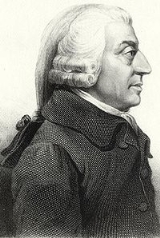
Smith is reported to have been an odd-looking fellow. One author stated that Smith "had a large nose, bulging eyes, a protruding lower lip, a nervous twitch, and a speech impediment". Smith is reported to have acknowledged his looks at one point saying, "I am a beau in nothing but my books." Smith "never" sat for portraits, so depictions of him created during his lifetime were drawn from memory, with rare exceptions. The most famous examples were a profile by James Tassie
James Tassie

James Tassie was a Scotland Gemstone-engraver and modeller.He was born of humble parentage at Pollokshaws, in Glasgow. During his earlier years he worked as a stonemason, but, having seen the collection of paintings brought together in Glasgow by Robert Foulis and Andrew Foulis, the printers, he removed to Glasgow, attended the academy wh...
 and two etching
Etching

Etching is the process of using strong acid or mordant to cut into the unprotected parts of a metal surface to create a design in intaglio in the metal ....
s by John Kay
John Kay

John Kay may refer to:*John Kay , English inventor of textile machinery, notably the flying shuttle*John Kay , English developer of textile machinery, notably the spinning frame ...
. The line engravings produced for the covers of 19th century reprints of The Wealth of Nations were based largely off of Tassie's medallion.

Religious views

There has been considerable scholarly debate about the nature of Adam Smith's religious views. Smith's father had a strong interest in Christianity and belonged to the moderate wing of the Church of Scotland
Church of Scotland

The Church of Scotland , known informally by its Scots language name, The Kirk, is the national church of Scotland. It is a Presbyterianism church , decisively shaped by the Scottish Reformation....
. Smith may have gone to England
England

native_name =|conventional_long_name = England|common_name = England|image_flag = Flag of England.svg|image_coat = England COA.svg|symbol_type = Royal Coat of Arms...
 with the intention of a career in the Church of England: this is controversial and depends on the status of the Snell Exhibition. At Oxford, Smith rejected Christianity and it is generally believed that he returned to Scotland as a Deist
Deism

Deism is a religious and philosophical belief that a supreme natural God exists and created the physical universe, and that religious truths can be arrived at by the application of reason and observation of the natural world....
.

Economist Ronald Coase
Ronald Coase

Ronald Harry Coase is a United Kingdom economist and the Clifton R. Musser Professor Emeritus of Economics at the University of Chicago Law School....
 has challenged the view that Smith was a Deist, stating that while Smith may have referred to the "Great Architect of the Universe
Great Architect of the Universe

The Great Architect of the Universe is a conceptions of God discussed by many Christian theologians and apologists. As a designation it is used within Freemasonry to neutrally represent whatever Supreme Being to which each member individually holds in adherence....
", other scholars have "very much exaggerated the extent to which Adam Smith was committed to a belief in a personal God". He based this on analysis of a remark in The Wealth of Nations where Smith writes that the curiosity of mankind about the "great phenomena of nature" such as "the generation, the life, growth and dissolution of plants and animals" has led men to "enquire into their causes". Coase notes Smith's observation that "[s]uperstition first attempted to satisfy this curiosity, by referring all those wonderful appearances to the immediate agency of the gods". Smith's close friend and colleague David Hume, with whom he agreed on most matters, was described by contemporaries as an atheist, although there is some debate about the exact nature of his views among modern philosophers.

In a letter to William Strahan, Smith's account of Hume's courage and tranquility in the face of death aroused violent public controversy, since it contradicted the assumption, widespread among orthodox believers, that an untroubled death was impossible without the consolation of religious belief.

Published works

Adam Smith published a large body of works throughout his life, some of which have shaped the field of economics. Smith's first book, The Theory of Moral Sentiments
The Theory of Moral Sentiments

'The Theory of Moral Sentiments' was written by Adam Smith in 1759. It provided the ethics, philosophical, psychological and methodological underpinnings to Smith's later works, including The Wealth of Nations , A Treatise on Public Opulence , Essays on Philosophical Subjects , and Lectures on Justice, Police, Revenue, and A...
 was written in 1759. It provided the ethical, philosophical, psychological and methodological underpinnings to Smith's later works, including An Inquiry Into the Nature and Causes of the Wealth of Nations
The Wealth of Nations

An Inquiry into the Nature and Causes of the Wealth of Nations is the magnum opus of the Scotland economist Adam Smith. It is a clearly written account of economics at the dawn of the Industrial Revolution, as well as a rhetorical piece written for the generally educated individual of the 18th century - advocating a free market econom...
 (1776), A Treatise on Public Opulence (1764) (first published in 1937), Essays on Philosophical Subjects
Essays on Philosophical Subjects

Essays on Philosophical Subjects, by the Scotland economist Adam Smith. A history of astronomy down to Smith's own era, plus some thoughts on ancient physics and metaphysics....
 (1795), Lectures on Justice, Police, Revenue, and Arms
Lectures on Jurisprudence

Lectures on Jurisprudence is a book of Adam Smith's lectures, comprising notes taken from his early lectures, plus an early draft of The Wealth of Nations....
 (1763) (first published in 1896), and Lectures on Rhetoric and Belles Lettres.

The Theory of Moral Sentiments (1759)


In 1759, Smith published his first work, The Theory of Moral Sentiments. He continued to revise the work throughout his life, making extensive revisions to the final (6th) edition shortly before his death in 1790. Although The Wealth of Nations is widely regarded as Smith's most influential work, it has been reported that Smith himself "always considered his Theory of Moral Sentiments a much superior work to his Wealth of Nations". P. J. O'Rourke
P. J. O'Rourke

Patrick Jake O'Rourke is an United States political satire, journalism, and writing.O'Rourke is the H. L. Mencken Research Fellow#Academic use at the Cato Institute and is a regular correspondent for The Atlantic Monthly, The American Spectator, and The Weekly Standard, and frequent panelist on National Public Radio's game show...
, author of the commentary On The Wealth of Nations (2007), has agreed, calling Theory of Moral Sentiments "the better book". It was in this work that Smith first referred to the "invisible hand" to describe the apparent benefits to society of people behaving in their own interests.

In The Theory of Moral Sentiments, Smith critically examined the moral thinking of the time and suggested that conscience arises from social relationships. His aim in the work is to explain the source of mankind's ability to form moral judgements, in spite of man's natural inclinations toward self-interest. Smith proposes a theory of sympathy in which the act of observing others makes people aware of themselves and the morality of their own behavior. Haakonssen writes that in Smith's theory, "Society is ... the mirror in which one catches sight of oneself, morally speaking."

In part because Theory of Moral Sentiments emphasizes sympathy for others while Wealth of Nations famously emphasizes the role of self interest, some scholars have perceived a conflict between these works. As one economic historian observed: "Many writers, including the present author at an early stage of his study of Smith, have found these two works in some measure basically inconsistent." But in recent years most scholars of Adam Smith's work have argued that no contradiction exists. In Theory of Moral Sentiments, Smith develops a theory of psychology in which individuals find it in their self-interest to develop sympathy as they seek approval of the "impartial spectator". The self-interest he speaks of is not a narrow selfishness but something that involves sympathy.

Haakonssen adds that Theory of Moral Sentiments and Wealth of Nations "only contradict each other if Smithian sympathy is misinterpreted as benevolence and self-interest wrongly is narrowed to selfishness and then taken to be the reductive basis for all human motivation". Rather than viewing the Wealth of Nations and Theory of Moral Sentiments as presenting incompatible views of human nature, most Smith scholars regard the works as emphasizing different aspects of human nature that vary depending on the situation. The Wealth of Nations draws on situations where man's morality is likely to play a smaller role—such as the laborer involved in pin-making—whereas the Theory of Moral Sentiments focuses on situations where man's morality is likely to play a dominant role among more personal exchanges.

wrote the Wealth of Nations in his home town of Kirkcaldy
Kirkcaldy

Kirkcaldy is a town and former royal burgh in Fife, on the east coast of Scotland. It lies on a shallow bay on the northern shore of the Firth of Forth and is the largest settlement between the cities of Dundee and Edinburgh....
 since re-built as Adam Smith House]]

The Wealth of Nations (1776)


The Wealth of Nations expounds that the free market, while appearing chaotic and unrestrained, is actually guided to produce the right amount and variety of goods by a so-called "invisible hand
Invisible hand

In economics, the invisible hand is the term economists use to describe the self-regulating nature of the marketplace. The invisible hand is a metaphor coined by the economist Adam Smith....
". The image of the invisible hand was previously employed by Smith in Theory of Moral Sentiments, but it has its original use in his essay, "The History of Astronomy". Smith believed that when a individual pursues his self-interest, he promotes the good of society more than so if he intends to benefit society: "by pursuing his own interest, [the individual] frequently promotes that of the society more effectually than when he intends to promote it." Self-interested competition in the free market, he argued, would tend to benefit society as a whole by keeping prices low, while still building in an incentive for a wide variety of goods and services. Nevertheless, he was wary of businessmen and argued against the formation of monopolies
Monopoly

In economics, a monopoly exists when a specific individual or enterprise has sufficient control over a particular product or service to determine significantly the terms on which other individuals shall have access to it....
.

An often-quoted passage from The Wealth of Nations is:

Value theory was important in classical theory. Smith wrote that the "real price of every thing ... is the toil and trouble of acquiring it" as influenced by its scarcity. Smith maintained that, with rent and profit, other costs besides wages also enter the price of a commodity. Other classical economists presented variations on Smith, termed the 'labour theory of value'. Classical economics focused on the tendency of markets to move to long-run equilibrium.

Smith also believed that a division of labour would effect a great increase in production. One example he used was the making of pins. One worker could probably make only twenty pins per day. However, if ten people divided up the eighteen steps required to make a pin, they could make a combined amount of 48,000 pins in one day.

]]

Other works


Shortly before his death, Smith had nearly all his manuscripts destroyed. In his last years, he seemed to have been planning two major treatises, one on the theory and history of law and one on the sciences and arts. The posthumously published Essays on Philosophical Subjects, a history of astronomy
Astronomy

Astronomy is the science of Astronomical object and Phenomenon that originate outside the Earth's atmosphere . It is concerned with the evolution, physics, chemistry, meteorology, and motion of celestial objects, as well as the physical cosmology....
 down to Smith's own era, plus some thoughts on ancient physics and metaphysics
Metaphysics

Metaphysics investigates principles of reality transcending those of any particular science. cosmology and ontology are traditional branches of metaphysics....
, probably contain parts of what would have been the latter treatise. Lectures on Jurisprudence were notes taken from Smith's early lectures, plus an early draft of The Wealth of Nations, published as part of the 1976 Glasgow Edition of the works and correspondence of Adam Smith.

Other works, including some published posthumously, include Lectures on Justice, Police, Revenue, and Arms (1763) (first published in 1896); A Treatise on Public Opulence (1764) (first published in 1937); and Essays on Philosophical Subject (1795).

Legacy

The Wealth of Nations, one of the earliest attempts to study the rise of industry and commercial development in Europe, was a precursor to the modern academic discipline of economics. In this and other works, Smith expounded how rational self-interest and competition can lead to economic prosperity and well-being. It also provided one of the best-known intellectual rationales for free trade and capitalism
Capitalism

Capitalism is an economic system in which wealth, and the means of producing wealth, are private property and controlled rather than commonly, publicly, or state-owned and controlled....
, greatly influencing the writings of later economists. Smith was ranked #30 in Michael H. Hart's list of the most influential figures in history
The 100

The 100: A Ranking of the Most Influential Persons in History is a 1978 book by Michael H. Hart. It is a ranking of the 100 people who most influenced human history....
, and he is often cited as the father of modern economics
List of persons considered father or mother of a field

Revisions and Wikipedia:Citing sources additions are welcome; please only include historical figures.The following is a list of significant men and women known, following the now largely-discredited great man theory, for being the father, mother, or considered the founders in a List of academic disciplines, listed by categor...
.

George Stigler
George Stigler

George Joseph Stigler was a United States of America economist. He won the Nobel Memorial Prize in Economic Sciences in 1982, and was a key leader of the Chicago School of Economics, along with his close friend Milton Friedman....
 attributes to Smith the central proposition of mainstream
Mainstream economics

Mainstream economics is a loose term used to refer to the non-heterodox economics economics taught in prominent universities. It is most closely associated with neoclassical economics....
 economic theory, namely that an individual will invest a resource, for example, land or labour, so as to earn the highest possible return on it. Consequently, all uses of the resource should yield a risk-adjusted equal rate of return; otherwise resource reallocation would result.

On the other hand, Joseph Schumpeter
Joseph Schumpeter

Joseph Alois Schumpeter was an economist and political scientist born in Moravia, then Austria-Hungary, now Czech Republic. He popularized the term "creative destruction" in economics....
 dismissed Smith's contributions as unoriginal, saying "His very limitation made for success. Had he been more brilliant, he would not have been taken so seriously. Had he dug more deeply, had he unearthed more recondite truth, had he used more difficult and ingenious methods, he would not have been understood. But he had no such ambitions; in fact he disliked whatever went beyond plain common sense. He never moved above the heads of even the dullest readers. He led them on gently, encouraging them by trivialities and homely observations, making them feel comfortable all along.” (Schumpeter History of Economic Analysis. New York: Oxford University Press, p 185)

Classical economists presented variations on Smith, termed the 'labour theory of value', later Marxian economics descends from classical economics also using Smith's labor theories in part. The first volume of Karl Marx
Karl Marx

Karl Heinrich Marx was a Germanphilosophy, political economy, historian, sociologist, humanism, political theorist and revolutionary credited as the founder of communism....
's major work, Capital, was published in German in 1867. In it, Marx focused on the labour theory of value and what he considered to be the exploitation of labour by capital. The labour theory of value held that the value of a thing was determined by the labor that went into its production. This contrasts with the modern understanding of mainstream economics
Mainstream economics

Mainstream economics is a loose term used to refer to the non-heterodox economics economics taught in prominent universities. It is most closely associated with neoclassical economics....
, that the value of a thing is determined by what one is willing to give up to obtain the thing. It is a paradox that Smith is often cited not only as the conceptual builder of free markets in capitalism but also as a main contributor to communist theory, via his influence on Marx.

A body of theory later termed 'neoclassical economics' or 'marginalism
Marginalism

Marginalism is the use of marginal concepts within economics. The central concept of marginalism proper is that of marginal utility, but marginalists following the lead of Alfred Marshall were further heavily dependent upon the concept of Marginal product in their explanation of cost; and the Neoclassical economics tradition that emerged fro...
' formed from about 1870 to 1910. The term 'economics' was popularized by such neoclassical economists as Alfred Marshall
Alfred Marshall

Alfred Marshall was an England economist and one of the most influential economists of his time. His book, Principles of Economics , brings the ideas of supply and demand, of marginal utility and of the costs of production into a coherent whole....
 as a concise synonym for 'economic science' and a substitute for the earlier, broader term 'political economy
Political economy

Political economy originally was the term for studying production, buying and selling, and their relations with law, custom, and government. Political economy originated in moral philosophy....
' used by Smith. This corresponded to the influence on the subject of mathematical methods used in the natural science
Natural science

In science, the term natural science refers to a methodological naturalism approach to the study of the universe, which is understood as obeying rules or law of nature origin....
s. Neoclassical economics systematized supply and demand
Supply and demand

...
 as joint determinants of price and quantity in market equilibrium, affecting both the allocation of output and the distribution of income. It dispensed with the labour theory of value of which Smith was most famously identified with in classical economics, in favor of a marginal utility
Marginal utility

In economics, the marginal utility of a Good or of a Service is the utility of the specific use to which an agent would put a given increase in that good or service, or of the specific use that would be abandoned in response to a given decrease....
 theory of value on the demand side and a more general theory of costs on the supply side.

The bicentennial anniversary of the publication of The Wealth of Nations was celebrated in 1976, resulting in increased interest for The Theory of Moral Sentiments and his other works throughout academia. After 1976 Adam Smith was more likely to be represented as the author of both The Wealth of Nations and The Theory of Moral Sentiments, and thereby as the founder of a moral philosophy and the science of economics. His homo economicus
Homo economicus

Homo economicus, or Economic human, is the concept in some economic theories of humans as Rationality and broadly self-interested actors who have the ability to make judgments towards their subjectively defined ends....
 or "economic man" was also more often represented as a moral person. Additionally, his opposition to slavery, colonialism, and empire was emphasised, as were his statements about high wages for the poor, and his views that a common street porter was not intellectually inferior to a philosopher.

Portraits, monuments and banknotes

20 note was issued by the Bank of England
Bank of England

The Bank of England is the central bank of the United Kingdom and is the model on which most modern, large central banks have been based. Since 1946 it has been a Nationalisation institution....
 and features Adam Smith.]] Adam Smith has been commemorated in the UK on banknotes printed by two different banks; his portrait has appeared since 1981 on the £
Pound sterling

----The pound sterling , subdivided into 100 pence , is the currency of the United Kingdom, its Crown dependency and the British Overseas Territories of South Georgia and the South Sandwich Islands and British Antarctic Territory....
50 notes issued by the Clydesdale Bank
Clydesdale Bank

The Clydesdale Bank PLC is a commercial bank in Scotland, a subsidiary of the National Australia Bank Group. In Scotland, the Clydesdale Bank is the third largest clearing bank, although it also retains a branch network in London and the north of England....
 in Scotland, and in in March 2007 Smith's image also appeared on the new series of £20 notes issued by the Bank of England
Bank of England

The Bank of England is the central bank of the United Kingdom and is the model on which most modern, large central banks have been based. Since 1946 it has been a Nationalisation institution....
, making him the first Scotsman to feature on an English banknote
Bank of England note issues

The Bank of England is the Central Bank of the United Kingdom and one of Banknotes of the pound sterling legally authorised to issue banknotes in the UK....
.

A large-scale memorial of Smith was unveiled on 4 July 2008 in Edinburgh. It is a -tall bronze sculpture and it stands above the Royal Mile
Royal Mile

The Royal Mile is the popular name for the succession of streets which form the main thoroughfare of Old Town, Edinburgh.As the name suggests, the Royal Mile is approximately one Mile long, and runs between two foci of History of Scotland in Scotland, from Edinburgh Castle at the top of the Castle Rock, Edinburgh down to Holyrood Abbey....
 outside St Giles' Cathedral in Parliament Square, near the Mercat cross
Mercat cross

A mercat cross is a market cross found in Scotland cities and towns where trade and commerce was a part of economic life. It was originally a place where merchants would gather, and later became the focal point of many town events such as executions, announcements and proclamations....
. 20th century sculptor James Sanborn
James Sanborn

James Sanborn is an American List of sculptors.He has created sculptural works for the Massachusetts Institute of Technology, the Central Intelligence Agency, and the National Oceanic and Atmospheric Administration....
 (best known for creating the Kryptos
Kryptos

Kryptos is a sculpture by United States artist James Sanborn located on the grounds of the Central Intelligence Agency in Langley, Virginia, Virginia, in the United States....
 sculpture at the United States Central Intelligence Agency
Central Intelligence Agency

The Central Intelligence Agency is a civilian intelligence agency of the Federal government of the United States. It is the successor of the Office of Strategic Services formed during World War II to coordinate espionage activities between the branches of the US military services....
) has created multiple pieces which feature Adam Smith's work. At Central Connecticut State University
Central Connecticut State University

Central Connecticut State University is a state university in New Britain, Connecticut, Connecticut. It is the oldest public university in Connecticut and ranks third oldest of all universities in Connecticut, having been founded in 1849....
 is Circulating Capital, a tall cylinder which features an extract from The Wealth of Nations on the lower half, and on the upper half, some of the same text but represented in binary code
Binary code

Binary code is the system of representing text or Instruction by the use of a two-numerical digit number system. This system is composed of only the number zero, representing the Off state, and the number one, representing on state, combined in groups of 8....
. At the University of North Carolina at Charlotte
University of North Carolina at Charlotte

The University of North Carolina at Charlotte is a public, coeducational, research intensive university located in Charlotte, North Carolina in the United States....
, outside the Belk College of Business Administration, is Adam Smith's Spinning Top. Another Adam Smith sculpture is at Cleveland State University
Cleveland State University

Cleveland State University is a public university located in Cleveland, Ohio. The current President is Michael Schwartz, who was previously president emeritus and a professor at Kent State University....
.

at Cleveland State University
Cleveland State University

Cleveland State University is a public university located in Cleveland, Ohio. The current President is Michael Schwartz, who was previously president emeritus and a professor at Kent State University....
]]

As a symbol of free market economics

Smith has been celebrated by advocates of free market policies as the founder of free market economics, a view reflected in the naming of bodies such as the Adam Smith Institute
Adam Smith Institute

The Adam Smith Institute is a think tank based in the United Kingdom, named after the father of modern economics, Adam Smith. Although non-partisan, it espouses free market and classical liberal views, in particular by creating radical policy options in the light of public choice theory, which politicians can then develop....
, Adam Smith Society and the Australian Adam Smith Club, and in terms such as the Adam Smith necktie.

Alan Greenspan
Alan Greenspan

Alan Greenspan is an United States economist and was the Chairman of the Federal Reserve of the United States from 1987 to 2006. He currently works as a private advisor and providing consulting for firms through his company, Greenspan Associates LLC....
 argues that, while Smith did not coin the term laissez-faire, "it was left to Adam Smith to identify the more-general set of principles that brought conceptual clarity to the seeming chaos of market transactions". Greenspan continues that The Wealth of Nations was "one of the great achievements in human intellectual history". P. J. O'Rourke describes Adam Smith as the "founder of free market economics".

However, other writers have argued that Smith's support for laissez-faire has been overstated. Herbert Stein
Herbert Stein

Herbert Stein was a senior fellow at the American Enterprise Institute and was on the board of contributors of The Wall Street Journal. He was chairman of the Council of Economic Advisers under Richard Nixon and Gerald Ford....
 wrote that the people who "wear an Adam Smith necktie" do it to "make a statement of their devotion to the idea of free markets and limited government", and that this misrepresents Smith's ideas. Stein writes that Smith "was not pure or doctrinaire about this idea. He viewed government intervention in the market with great skepticism ... yet he was prepared to accept or propose qualifications to that policy in the specific cases where he judged that their net effect would be beneficial and would not undermine the basically free character of the system. He did not wear the Adam Smith necktie." In Stein's reading, The Wealth of Nations could justify the Food and Drug Administration
Food and Drug Administration

The U.S. Food and Drug Administration is an Government agency of the United States Department of Health and Human Services and is responsible for regulating and supervising the safety of foods, dietary supplements, Medications, vaccines, Biopharmaceutical, blood transfusion, medical devices, Electromagnetic radiation-emitting devices, veteri...
, The Consumer Product Safety Commission
Consumer Product Safety Commission

The United States Consumer Product Safety Commission is an Independent agencies of the United States government created in 1972 through the Consumer Product Safety Act to protect "against unreasonable risks of injuries associated with consumer products." its acting chairman is Nancy Nord, a Republican....
, mandatory employer health benefits, environmentalism
Environmentalism

Environmentalism is a broad philosophy and social movement centered on a concern for the Conservation movement and improvement of the environment ....
, and "discriminatory taxation to deter improper or luxurious behavior".

Similarly, Vivienne Brown stated in The Economic Journal that in the 20th century United States, Reaganomics
Reaganomics

Reaganomics refers to the Economics policies promoted by United States President Ronald Reagan during the 1980s. The four pillars of Reagan's economic policy were to:...
 supporters, The Wall Street Journal
The Wall Street Journal

The Wall Street Journal is an English language international daily newspaper published by Dow Jones & Company in New York, New York with Asian and European editions....
, and other similar sources have spread among the general public a partial and misleading vision of Adam Smith, portraying him as an "extreme dogmatic defender of laissez-faire
Laissez-faire

Laissez-faire is a term used to describe a policy of allowing events to take their own course. The term is a French language phrase literally meaning "let do"....
 capitalism and supply-side economics
Supply-side economics

Supply-side economics is a school of macroeconomic thought that argues that economic growth can be most effectively created using incentives for people to produce goods and services, such as adjusting income tax and capital gains tax rates, and by allowing greater flexibility by reducing regulation....
". Noam Chomsky
Noam Chomsky

Avram Noam Chomsky is an United States linguistics, philosopher, cognitive science, political activist, author, and lecturer. He is an Institute Professor emeritus and professor emeritus of linguistics at the Massachusetts Institute of Technology....
 has arguedSee ch. 2,5,6 and 10 of his Understanding Power, New Press (February 2002), along with his Year 501: The Conquest Continues, primarily ch. 1, South End Press, 1993. that several aspects of Smith's thought have been misrepresented and falsified by contemporary ideology, including Smith’s reasons for supporting markets and Smith’s views on corporations. Chomsky argues that Smith supported markets in the belief that they would lead to equality. Economic historians such as Jacob Viner
Jacob Viner

Jacob Viner is best known for his enduring economic modelling of the wiktionary:firm, including the long- and short-run cost curves used by economists to this day....
 regard Smith as a strong advocate of free markets and limited government (what Smith called "natural liberty") but not as a dogmatic supporter of laissez-faire.

Footnotes


Further reading


External links


  • at the Concise Encyclopedia of Economics
    Concise Encyclopedia of Economics

    The Concise Encyclopedia of Economics is a widely-used encyclopedia of economics. It is used by students and teachers from high school to college to graduate school, and is one of the most popular worldwide resources for researching and understanding topics in economics....