
All Topics  
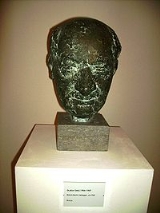
Martin Heidegger


   Email Print
   Bookmark   Link


Martin Heidegger


Martin Heidegger (26 September 1889 – 26 May 1976) was an influential German
Germany

Germany , officially the Federal Republic of Germany , is a country in Central Europe. It is bordered to the north by the North Sea, Denmark, and the Baltic Sea; to the east by Poland and the Czech Republic; to the south by Austria and Switzerland; and to the west by France, Luxembourg, Belgium, and the Netherlands....
 philosopher
Philosophy

Philosophy is the study of general problems concerning matters such as existence, knowledge, truth, beauty, justice, validity, mind, and language....
. His best known book, Being and Time
Being and Time

Being and Time is a book by Germany philosophy Martin Heidegger. Although written quickly, and despite the fact that Heidegger never completed the project outlined in the introduction, it remains his most important work and has profoundly influenced 20th-century philosophy, particularly existentialism, hermeneutics and deconstruction....
, is generally considered to be one of the most important philosophical works of the 20th century. Heidegger remains controversial due to his involvement with Nazism
Nazism

Nazism, officially National Socialism , refers to the ideology and practices of the National Socialist German Workers? Party under Adolf Hitler, and the policies adopted by the dictatorial government of Nazi Germany from 1933 to 1945....
.

egger claimed that Western philosophy
Western philosophy

Western philosophy is a term that refers to philosophy thinking in the Western world, as distinct from Eastern philosophy and the varieties of indigenous philosophies....
 has, since Plato
Plato

Plato , was a Classical Greece Greeks philosopher, mathematician, writer of philosophical dialogues, and founder of the Platonic Academy in Ancient Athens, the first institution of higher learning in the western world....
, misunderstood what it means for something "to be," tending to approach this question in terms of a being, rather than asking about being itself.


Discussion
Ask a question about 'Martin Heidegger'
Start a new discussion about 'Martin Heidegger'
Answer questions from other users
Full Discussion Forum


Quotations


Being is only Being for Dasein.

Macquarrie & Robinson translation

In order to remain silent Da-sein must have something to say.

Stambaugh translation

The possible ranks higher than the actual.

From the introduction

Everyone is the other, and no one is himself. The they, which supplies the answer to the who of everyday Da-sein, is the nobody to whom every Da-sein has always already surrendered itself, in its being-among-one-another.

Stambaugh translation


Encyclopedia


Martin Heidegger (26 September 1889 – 26 May 1976) was an influential German
Germany

Germany , officially the Federal Republic of Germany , is a country in Central Europe. It is bordered to the north by the North Sea, Denmark, and the Baltic Sea; to the east by Poland and the Czech Republic; to the south by Austria and Switzerland; and to the west by France, Luxembourg, Belgium, and the Netherlands....
 philosopher
Philosophy

Philosophy is the study of general problems concerning matters such as existence, knowledge, truth, beauty, justice, validity, mind, and language....
. His best known book, Being and Time
Being and Time

Being and Time is a book by Germany philosophy Martin Heidegger. Although written quickly, and despite the fact that Heidegger never completed the project outlined in the introduction, it remains his most important work and has profoundly influenced 20th-century philosophy, particularly existentialism, hermeneutics and deconstruction....
, is generally considered to be one of the most important philosophical works of the 20th century. Heidegger remains controversial due to his involvement with Nazism
Nazism

Nazism, officially National Socialism , refers to the ideology and practices of the National Socialist German Workers? Party under Adolf Hitler, and the policies adopted by the dictatorial government of Nazi Germany from 1933 to 1945....
.

Introduction

Heidegger claimed that Western philosophy
Western philosophy

Western philosophy is a term that refers to philosophy thinking in the Western world, as distinct from Eastern philosophy and the varieties of indigenous philosophies....
 has, since Plato
Plato

Plato , was a Classical Greece Greeks philosopher, mathematician, writer of philosophical dialogues, and founder of the Platonic Academy in Ancient Athens, the first institution of higher learning in the western world....
, misunderstood what it means for something "to be," tending to approach this question in terms of a being, rather than asking about being itself. In other words, Heidegger believed all investigations of being have historically focused on particular entities and their properties, or have treated being itself as an entity, or substance
Substance theory

Substance theory, or substance attribute theory, is an ontology theory about Object , positing that a substance is distinct from its property ....
, with properties. A more authentic analysis of being would, for Heidegger, investigate "that on the basis of which beings are already understood," or that which underlies all particular entities and allows them to show up as entities in the first place. But since philosophers and scientists have overlooked the more basic, pre-theoretical ways of being from which their theories derive, and since they have incorrectly applied those theories universally, they have confused our understanding of being and human existence. To avoid these deep-rooted misconceptions, Heidegger believed philosophical inquiry must be conducted in a new way, through a process of retracing the steps of the history of philosophy.

Heidegger argued that this misunderstanding, commencing from Plato, has left its traces in every stage of Western thought. All that we understand, from the way we speak to our notions of "common sense
Common sense

For the pamphlet by Thomas Paine see Common Sense . For use with Wikipedia see WP:COMMON SENSE.Common sense , based on a strict interpretation of the term, consists of what people in common would agree on: that which they "sense" as their common natural understanding....
," is susceptible to error, to fundamental mistakes about the nature of being. These mistakes filter into the terms through which being is articulated in the history of philosophy—reality, logic, God, consciousness, presence, et cetera. In his later philosophy, Heidegger argues that this profoundly affects the way in which human beings relate to modern technology.

Heidegger's work has strongly influenced philosophy, theology and the humanities. Within philosophy it played a crucial role in the development of existentialism
Existentialism

Existentialism is a term that has been applied to the work of a number of nineteenth and twentieth century philosophers who, despite profound doctrinal differences, took the human subject — not merely the thinking subject, but the acting, feeling, living human individual and his or her conditions of existence — as a starting point...
, hermeneutics
Hermeneutics

Hermeneutics is the study of interpretation theory. Traditional hermeneutics - which includes Biblical hermeneutics - refers to the study of the interpretation of written texts, especially texts in the areas of literature, religion and law....
, deconstruction
Deconstruction

Deconstruction is a term used in philosophy, literary criticism, and the social sciences, popularised through its usage by Jacques Derrida in the 1960s....
, postmodernism
Postmodernism

Postmodernism literally means 'after the modernist movement'. While "modern" itself refers to something "related to the present", the movement of modernism and the following reaction of postmodernism are defined by a set of perspectives....
, and continental philosophy
Continental philosophy

Continental philosophy, in contemporary usage, refers to a set of traditions of 19th and 20th century philosophy from mainland Europe. This sense of the term originated among English-speaking philosophers in the second half of the 20th century, who found it useful for referring to a range of thinkers and traditions outside the analytic philo...
 in general. Well-known philosophers such as Karl Jaspers
Karl Jaspers

Karl Theodor Jaspers was a Germany psychiatrist and philosopher who had a strong influence on modern theology, psychiatry and philosophy. Trained in and practiced psychiatry, Jaspers later turned to philosophical inquiry and attempted to discover an innovative philosophical system....
, Leo Strauss
Leo Strauss

Leo Strauss was a Germany-born Jewish-American Political philosophy who specialized in classical political philosophy. He spent most of his career as a professor of political science at the University of Chicago, where he taught several generations of students and published 15 books....
, Ahmad Fardid
Ahmad Fardid

Ahmad Fardid was a prominent Iranian peoples philosopher, thinker and an inspiring and dedicated professor of Tehran University. He is considered by a few who do not know him well to be among the ideologues of the Islamic government of Iran which came to power in 1979....
, Hans-Georg Gadamer
Hans-Georg Gadamer

Hans-Georg Gadamer was a Germany philosopher of the continental philosophy, best known for his 1960 magnum opus, Truth and Method ....
, Jean-Paul Sartre
Jean-Paul Sartre

Jean-Paul Charles Aymard Sartre , commonly known simply as Jean-Paul Sartre , was a French existentialism philosopher, playwright, novelist, screenwriter, political activist, biographer, and literary criticism....
, Emmanuel Lévinas
Emmanuel Lévinas

Emmanuel Levinas was a France philosopher and Talmudic commentator....
, Hannah Arendt
Hannah Arendt

Hannah Arendt was an influential Germany-Jewish political theorist. She has often been described as a philosopher, although she always refused that label on the grounds that philosophy is concerned with "man in the singular." She described herself instead as a political theory because her work centers on the fact that "men, not Man, live on...
, Maurice Merleau-Ponty
Maurice Merleau-Ponty

Maurice Merleau-Ponty was a France Phenomenology philosopher, strongly influenced by Edmund Husserl and Martin Heidegger in addition to being closely associated with Jean-Paul Sartre and Simone de Beauvoir....
, Michel Foucault
Michel Foucault

Michel Foucault was a French philosophy, historian, intellectual, Critical theory and sociologist. He held a chair at the Coll?ge de France with the title "History of Systems of Thought," and also taught at the University of California, Berkeley....
, Richard Rorty
Richard Rorty

Richard McKay Rorty was an American philosopher. He had a long and diverse career in Philosophy, Humanities, and Literature departments. His complex intellectual background gave him a comprehensive and nuanced understanding of the analytic philosophy tradition in philosophy he would later famously reject....
, and Jacques Derrida
Jacques Derrida

Jacques Derrida was a France philosophy born in Algeria, who is known as the founder of deconstruction, which was originally a translation of a Heideggerian term from Being and Time, also translated as 'De-structuring'....
 have all analyzed Heidegger's work.

Heidegger infamously supported National Socialism
Nazism

Nazism, officially National Socialism , refers to the ideology and practices of the National Socialist German Workers? Party under Adolf Hitler, and the policies adopted by the dictatorial government of Nazi Germany from 1933 to 1945....
 and was a member of the Nazi Party from May 1933 until May 1945. His defenders, notably Hannah Arendt
Hannah Arendt

Hannah Arendt was an influential Germany-Jewish political theorist. She has often been described as a philosopher, although she always refused that label on the grounds that philosophy is concerned with "man in the singular." She described herself instead as a political theory because her work centers on the fact that "men, not Man, live on...
, see this support as arguably a personal " 'error' " (a word which Arendt placed in quotation marks when referring to Heidegger's Nazi-era politics.) Defenders think this error was largely irrelevant to Heidegger's philosophy. Critics, such as his former students Emmanuel Lévinas
Emmanuel Lévinas

Emmanuel Levinas was a France philosopher and Talmudic commentator....
 and Karl Löwith
Karl Löwith

Karl L?with was a Germany-Jewish philosopher, a student of Heidegger. Like most of his ethnicity and profession he left Germany during the Nazi Germany, but returned in 1952 to teach as Professor of Philosophy at Heidelberg....
, hold that Heidegger's support for National Socialism was immoral and revealed flaws inherent in his thought.

Biography


Early years

Heidegger was born in rural Meßkirch
Meßkirch

Me?kirch is a town in the district of Sigmaringen in Baden-W?rttemberg in Germany.Me?kirch was the residence of the counts of Zimmern, widely known through Count Froben Christoph's Zimmern Chronicle ....
, Germany. Raised a Roman Catholic, he was the son of the sexton
Sexton (office)

A sexton is a church officer charged with the maintenance of the church buildings and/or the surrounding graveyard.In smaller churches, this office is often combined with that of verger....
 of the village church. His family could not afford to send him to university, so he entered a Jesuit seminary. After studying theology at the University of Freiburg from 1909 to 1911, he switched to philosophy. Heidegger completed his doctoral thesis on psychologism
Psychologism

Psychologism is a generic type of position in philosophy according to which psychology plays a central role in grounding or explaining some other, non-psychological type of fact or law....
 in 1914, and in 1916 finished his venia legendi with a thesis on Duns Scotus
Duns Scotus

The Beatification John Duns Scotus, Order of Friars Minor was one of the most important theology and philosopher of the High Middle Ages. He was nicknamed Doctor Subtilis for his penetrating and subtle manner of thought....
. In the two years following, he worked first as an unsalaried Privatdozent
Privatdozent

Private docent is a title conferred in some European university systems, especially in German language-speaking countries, for someone who pursues an academic career and holds all formal qualifications to become a tenured university professor....
, then served as a soldier during the final year of World War I
World War I

World War I, or the First World War , was a global military conflict which involved the Great powers, organized into two opposing military alliances: the Allies of World War I and the Central Powers....
, working behind a desk and never leaving Germany. After the war, he served as a salaried senior assistant to Edmund Husserl
Edmund Husserl

Edmund Gustav Albrecht Husserl was a philosophy who is deemed the founder of phenomenology . He broke with the positivist orientation of the science and philosophy of his day, believing that experience is the source of all knowledge, while at the same time he elaborated critiques of psychologism and historicism....
 at the University of Freiburg
University of Freiburg

University of Freiburg , sometimes referred to in English language as the Albert Ludwig University of Freiburg, is a public university research university located in Freiburg im Breisgau, Baden-W?rttemberg, Germany....
 until 1923.

Marburg years

In 1923, Heidegger was elected to an extraordinary Professorship
Professor

The meaning of the word professor varies. In some English-speaking countries, it refers to a senior academic who holds a departmental chair, especially as head of the Academic department, or a personal chair awarded specifically to that individual....
 in Philosophy at the University of Marburg. His colleagues there included Rudolf Bultmann
Rudolf Bultmann

Rudolf Karl Bultmann was a Germany theology of Lutheran background, who was for three decades professor of New Testament studies at the University of Marburg....
, Ernst Friedländer, Nicolai Hartmann
Nicolai Hartmann

Nicolai Hartmann was a Germany philosophy....
, and Paul Natorp
Paul Natorp

Paul Gerhard Natorp was a German neo-Kantian philosopher, and educationalist, of the Marburg school. He was known as an authority on Plato.Natorp was born in D?sseldorf....
. Heidegger's students at Marburg included Hans-Georg Gadamer
Hans-Georg Gadamer

Hans-Georg Gadamer was a Germany philosopher of the continental philosophy, best known for his 1960 magnum opus, Truth and Method ....
, Hannah Arendt
Hannah Arendt

Hannah Arendt was an influential Germany-Jewish political theorist. She has often been described as a philosopher, although she always refused that label on the grounds that philosophy is concerned with "man in the singular." She described herself instead as a political theory because her work centers on the fact that "men, not Man, live on...
, Karl Löwith
Karl Löwith

Karl L?with was a Germany-Jewish philosopher, a student of Heidegger. Like most of his ethnicity and profession he left Germany during the Nazi Germany, but returned in 1952 to teach as Professor of Philosophy at Heidelberg....
, Gerhard Krüger, Leo Strauss
Leo Strauss

Leo Strauss was a Germany-born Jewish-American Political philosophy who specialized in classical political philosophy. He spent most of his career as a professor of political science at the University of Chicago, where he taught several generations of students and published 15 books....
, Gunther (Stern) Anders
Günther Anders

G?nther Anders was a Jewish philosopher and journalist who developed a philosophical anthropology for the age of technology, focusing on such themes as the effects of mass media on our emotional and ethical existence, the nuclear threat, the Shoah and the question of being a philosopher....
, and Hans Jonas
Hans Jonas

Hans Jonas was a Germany-born philosopher who was, from 1955 to 1976, Alvin Johnson Professor of Philosophy at the New School for Social Research in New York City....
.

Freiburg years

When Husserl retired in 1928, Heidegger accepted Freiburg's election to be his successor, in spite of a counter-offer by Marburg. Heidegger remained at Freiburg for the rest of his life, declining a number of later offers including one from Berlin
Humboldt University of Berlin

The Humboldt University of Berlin is Berlin's oldest university, founded in 1810 as the University of Berlin by the liberal Prussian educational reformer and linguist Wilhelm von Humboldt, whose university model has strongly influenced other European and Western universities....
, the most prestigious German university of the day. Among his students at Freiburg were Herbert Marcuse
Herbert Marcuse

Herbert Marcuse was a German people philosophy and sociology, and a member of the Frankfurt School. His best known works are Eros and Civilization, One-Dimensional Man and The Aesthetic Dimension....
 and Ernst Nolte
Ernst Nolte

Ernst Nolte is a German historian and philosopher. Nolte?s major interest is the comparative studies of fascism and Communism. His work has been the object of extreme controversy....
. Emmanuel Levinas
Emmanuel Lévinas

Emmanuel Levinas was a France philosopher and Talmudic commentator....
 attended his lecture courses during his stay in Freiburg in 1928.

Engagement with National Socialism

In late 1932 Heidegger stood for election as Rector
Rector

The word rector has a number of different meanings, but all of them indicate an academic, religious or political administrator.The word "rector" also appears in many modern languages, such as Albanian, Dutch language, Spanish language, Catalan language and Romanian language....
 of the University of Freiburg
University of Freiburg

University of Freiburg , sometimes referred to in English language as the Albert Ludwig University of Freiburg, is a public university research university located in Freiburg im Breisgau, Baden-W?rttemberg, Germany....
. He took office on April 21, 1933, joining the Nazi party on May 1, 1933. Heidegger's inaugural address, the , and other proclamations during this period are notorious for their endorsements of Nazism. In a November 1933 article in the Freiburg student newspaper, Heidegger wrote:
The German people must choose its future, and this future is bound to the Fuhrer...There is only one will to the full existence (Dasein
Dasein

Dasein is a German language word famously used by Martin Heidegger in his magnum opus Being and Time. The word Dasein was used by several philosophers before Heidegger, with the meaning of "existence" or "presence"....
) of the State. The Fuhrer has awakened this will in the entire people.


Heidegger resigned his position on April 23, 1934 after his superiors in the German Education Ministry did not answer his telegrams and the faculty opposed his innovations, which included compulsory hiking for students and a reduction in lecture time. A more detailed account of the personal and philosophical relations between Heidegger and National Socialism is given below
Martin Heidegger

Martin Heidegger was an influential Germany Philosophy. His best known book, Being and Time, is generally considered to be one of the most important philosophical works of the 20th century....
.

Postwar years

After leaving the Nazi Party in May 1945, Heidegger did not again participate in any other political organizations. However, he never repudiated his prior statements praising Hitler and National Socialism
National Socialism

National Socialism typically refers to Nazism, which was the ideology of the Nazi Party led by Adolf Hitler.National Socialism typically promotes uniting the working class of a specific ethnic, national, or racial group into a proletarian nation while socialism the industry, providing an extensive welfare state and opposing capitalism, com...
. Citing his Nazi ties during the years 1933 to 1945, the French Occupation Authority
Allied Occupation Zones in Germany

The Allies of World War II powers who defeated Nazi Germany in World War II divided the country west of the Oder-Neisse line into four occupation zones for administrative purposes during the period 1945?1949....
 ruled that Heidegger had been a "fellow traveller" with the Nazis and banned him from teaching in Germany. Authorities later rescinded this decision in 1951, when Heidegger became Professor emeritus
Emeritus

Emeritus is an adjective that is used in the title of a retired professor, bishop or other professional. Emerita was used for women, but is rarely used today....
 with all privileges. He then taught regularly from 1951 until 1958, and by invitation until 1967.

Personal life


Heidegger married Elfriede Petri on March 21, 1917, in a Catholic ceremony officiated by his friend Engelbert Krebs, and a week later in a Protestant ceremony in the presence of her parents. Their first son Jörg was born in 1919. According to the recently published correspondence between the spouses, Hermann (born 1920) is the son of Elfriede and Friedel Caesar. Martin Heidegger had extramarital affairs with Hannah Arendt
Hannah Arendt

Hannah Arendt was an influential Germany-Jewish political theorist. She has often been described as a philosopher, although she always refused that label on the grounds that philosophy is concerned with "man in the singular." She described herself instead as a political theory because her work centers on the fact that "men, not Man, live on...
 and Elisabeth Blochmann
Elisabeth Blochmann

Elisabeth Blochmann was an eminent scholar of education, as well as of philosophy, and a pioneer in and researcher of women's education in Germany....
, both students of Heidegger. Arendt was Jewish and Blochmann had one Jewish parent, making them subject to severe persecution by the Nazi authorities. He helped the latter emigrate from Germany prior to World War II and resumed contact with both of them after the war.

Heidegger spent much time at his vacation home at Todtnauberg
Todtnauberg

Todtnauberg is a town and also a hill in Germany's Black Forest where German philosopher Martin Heidegger had a chalet.Shortly after giving the Der Spiegel interview and following Paul Celan's lecture at Freiburg, Martin Heidegger hosted Celan at his chalet at Todtnauberg....
, on the edge of the Black Forest
Black Forest

The Black Forest is a forest mountain range in Baden-W?rttemberg, southwestern Germany. It is bordered by the Rhine valley to the west and south....
. He considered the seclusion provided by the forest to be the best environment in which to engage in philosophical thought.

Heidegger died on May 26, 1976 and was buried in the Meßkirch cemetery.

Philosophy


Being, time, and Dasein

Heidegger introduced a specialized vocabulary to conjoin his two main philosophical observations:

  • The first of these is Heidegger’s observation that, in the course of over two thousand years of history, philosophy has attended to all the beings that can be found in the world (including the “world” itself), but has forgotten to ask what “being” itself is. This is Heidegger’s “question of being,” and it is Heidegger’s fundamental concern throughout his work from the beginning of his career until its end. One crucial source of this insight was Heidegger’s reading of Franz Brentano’s
    Franz Brentano

    Franz Clemens Honoratus Hermann Brentano was an influential Germany philosophy and psychology whose influence was felt by other such luminaries as Sigmund Freud, Edmund Husserl, Kazimierz Twardowski and Alexius Meinong, who followed and adapted his views....
     treatise on Aristotle’s
    Aristotle

    Aristotle was a Greeks philosopher, a student of Plato and teacher of Alexander the Great. He wrote on many subjects, including physics, metaphysics, Poetics , theater, music, logic, rhetoric, politics, government, ethics, biology and zoology....
     manifold uses of the word “being,” a work which provoked Heidegger to ask what kind of unity underlies this multiplicity of uses. Heidegger opens his magnum opus, Being and Time
    Being and Time

    Being and Time is a book by Germany philosophy Martin Heidegger. Although written quickly, and despite the fact that Heidegger never completed the project outlined in the introduction, it remains his most important work and has profoundly influenced 20th-century philosophy, particularly existentialism, hermeneutics and deconstruction....
    , with a citation from Plato’s
    Plato

    Plato , was a Classical Greece Greeks philosopher, mathematician, writer of philosophical dialogues, and founder of the Platonic Academy in Ancient Athens, the first institution of higher learning in the western world....
     Sophist
    Sophist (dialogue)

    The Sophist is one of the late Dialogues of Plato, which was written much later than the Parmenides and the Theaetetus , probably in 360 BC....
      indicating that Western philosophy has neglected “being” because it was considered obvious, rather than as worthy of question. Heidegger’s intuition about the question of being is thus a historical argument, which in his later work becomes his concern with the “history of being,” that is, the history of the forgetting of being, which according to Heidegger requires that philosophy retrace its footsteps through a productive “destruction
    Heideggerian terminology

    Martin Heidegger, the 20th century philosophy List of German-language philosophers, introduced to the world a large body of work that represented a profound change of direction for philosophy....
    ” of the history of philosophy.
  • The second intuition animating Heidegger’s philosophy derives from the influence of Edmund Husserl
    Edmund Husserl

    Edmund Gustav Albrecht Husserl was a philosophy who is deemed the founder of phenomenology . He broke with the positivist orientation of the science and philosophy of his day, believing that experience is the source of all knowledge, while at the same time he elaborated critiques of psychologism and historicism....
    , a philosopher largely uninterested in questions of philosophical history. Rather, Husserl argued that all that philosophy could and should be is a description of experience (hence the phenomenological slogan, “to the things themselves”). But for Heidegger, this meant understanding that experience is always already situated in a world and in ways of being. Thus Husserl's understanding that all consciousness is "intentional
    Intentionality

    The term intentionality is often simplistically summarized as "aboutness". According to the Oxford English Dictionary, it is "the distinguishing property of mind of being necessarily directed upon an Object , whether real or imaginary"....
    " (in the sense that it is always intended toward something, and is always "about" something; intentionality has been called the "aboutness
    Aboutness

    Aboutness is a term used in Linguistics, Library- and Information science and in Philosophy. In LIS it is often considered synonymous with subject ....
    " of things) is transformed in Heidegger's philosophy, becoming the thought that all experience is grounded in "care." This is the basis of Heidegger’s “existential analytic,” as he develops it in Being and Time. Heidegger argues that to be able to describe experience properly means finding the being for whom such a description might matter. Heidegger thus conducts his description of experience with reference to “Dasein
    Dasein

    Dasein is a German language word famously used by Martin Heidegger in his magnum opus Being and Time. The word Dasein was used by several philosophers before Heidegger, with the meaning of "existence" or "presence"....
    ," the being for whom being is a question. In Being and Time, Heidegger criticized the abstract and metaphysical character of traditional ways of grasping human existence as rational animal, person, man, soul, spirit, or subject. Dasein, then, is not intended as a way of conducting a "philosophical anthropology
    Philosophical anthropology

    Philosophical anthropology is the attempt to unify disparate ways of understanding behaviour of humans as both creatures of their social environments and creators of their own Value s....
    ," but is rather understood by Heidegger to be the condition of possibility for anything like a "philosophical anthropology." Dasein, according to Heidegger, is care. In the course of his existential analytic, Heidegger argues that Dasein, who finds itself thrown into the world amidst things and with others, is thrown into its possibilities, including the possibility and inevitability of one’s own mortality. The need for Dasein to assume these possibilities, that is, the need to be responsible for one’s own existence, is the basis of Heidegger’s notions of authenticity and resoluteness—that is, of those specific possibilities for Dasein which depend on escaping the “vulgar” temporality of calculation and of public life.


The marriage of these two observations depends on the fact that each of them is essentially concerned with time. That Dasein is thrown into an already existing world and thus into its mortal possibilities does not only mean that Dasein is an essentially temporal being; it also implies that the description of Dasein can only be carried out in terms inherited from the Western tradition itself. For Heidegger, unlike for Husserl, philosophical terminology could not be divorced from the history of the use of that terminology, and thus genuine philosophy could not avoid confronting questions of language and meaning. The existential analytic of Being and Time was thus always only a first step in Heidegger’s philosophy, to be followed by the “destruction” of the history of philosophy, that is, a transformation of its language and meaning, that would have made of the existential analytic only a kind of “limit case” (in the sense in which special relativity is a limit case of general relativity).

That Heidegger did not write this second part of Being and Time, and that the existential analytic was left behind in the course of Heidegger’s subsequent writings on the history of being, might be interpreted as a failure to conjugate his account of individual experience with his account of the vicissitudes of the collective human adventure that he understands the Western philosophical tradition to be. And this would in turn raise the question of whether this failure is due to a flaw in Heidegger’s account of temporality, that is, of whether Heidegger was correct to oppose vulgar and authentic time.

Being and Time


Being and Time (German
German language

German is a West Germanic languages, thus related to and classified alongside English language and Dutch language. It is one of the world's world language and the most widely spoken mother tongue in the European Union....
 title: Sein und Zeit), published in 1927, is Heidegger's first academic book. He had been under pressure to publish in order to qualify for Husserl's chair at Freiburg University and the success of this work ensured his appointment to the post.

It investigates the question of being
Being

In ontology being is anything that can be said to be, either Transcendence or Immanence.The nature of being varies by philosophy, given different interpretations in the frameworks of Parmenides, Leucippus, Plato, Aristotle, Plotinus, Descartes, Spinoza, Leibniz, Hegel, Heidegger, and Sartre....
 by asking about the being for whom being is a question. Heidegger names this being Dasein (see above), and the book pursues its investigation through themes such as mortality, anxiety, temporality, and historicity. It was Heidegger's original intention to write a second half of the book, consisting in a "Destruktion" of the history of philosophy—that is, the transformation of philosophy by re-tracing its history—but he never completed this project.

Being and Time influenced many thinkers, including existentialist thinkers like Jean-Paul Sartre
Jean-Paul Sartre

Jean-Paul Charles Aymard Sartre , commonly known simply as Jean-Paul Sartre , was a French existentialism philosopher, playwright, novelist, screenwriter, political activist, biographer, and literary criticism....
 (although Heidegger distanced himself from existentialism
Existentialism

Existentialism is a term that has been applied to the work of a number of nineteenth and twentieth century philosophers who, despite profound doctrinal differences, took the human subject — not merely the thinking subject, but the acting, feeling, living human individual and his or her conditions of existence — as a starting point...
—see below).

Die Kehre

Some have argued that Heidegger's thought after Being and Time exhibits a "turn" in his thinking (die Kehre). Heidegger denied this in a letter—published by William J. Richardson
William J. Richardson

William John Richardson, S. J. is an United States philosopher, who was among the first to introduce the philosophy of Martin Heidegger to the English-speaking world....
 in Heidegger: Through Phenomenology to Thought (1963)—which stated that, if there had been a turn at all, it was simply a matter of going deeper into the same matters. In his later work, Heidegger largely abandons the account of Dasein as a pragmatic, engaged, worldly agent, and instead discusses other elements necessary to an understanding of being, notably language, the earth (as the almost ineffable foundation of world) and the presence of the gods. Nevertheless, Dasein (or "mortals," as he later prefers to say) remains a crucial part of the coming-about or event (Ereignis) of being.

Later works

Heidegger's later works, following the so-called "turn" and after the Second World War, seem to many commentators to at least reflect a shift of focus, if not indeed a major change in his philosophical outlook. One way this has been understood is as a shift from "doing" to "dwelling," although others feel that this is to overstate the difference. Heidegger focuses less on the way in which the structures of being are revealed in everyday behavior, and more on the way in which behavior itself depends on a prior "openness to being." The essence of being human is the maintenance of this openness. Heidegger contrasts this openness to the "will to power" of the modern human subject, which is one way of forgetting this originary openness.

Heidegger understands the commencement of the history of Western philosophy as a brief period of authentic openness to being, during the time of the pre-Socratics
Pre-Socratic philosophy

The Pre-Socratic Greek philosophy were active before Socrates or contemporaneously, but expounding knowledge developed earlier. The popularity of the term originates with Hermann Diels' work Die Fragmente der Vorsokratiker ....
, especially Parmenides
Parmenides

Parmenides of Elea was an ancient Greek philosopher born in Elea, a Greek city on the southern coast of Italy. He was the founder of the Eleatic school of philosophy....
, Heraclitus
Heraclitus

Heraclitus of Ephesus was a Pre-Socratic philosophy Greeks philosopher, a native of Ephesus, Ionia, on the coast of Asia Minor.Heraclitus is known for his doctrine of change being central to the universe, and that the Logos is the fundamental order of all....
, and Anaximander
Anaximander

Anaximander was a pre-Socratic Ancient Greece philosopher who lived in Miletus, a city of Ionia. He belonged to the Milesian school and learned the teachings of his master Thales....
. This was followed, according to Heidegger, by a long period increasingly dominated by the forgetting of this initial openness, a period which commences with Plato
Plato

Plato , was a Classical Greece Greeks philosopher, mathematician, writer of philosophical dialogues, and founder of the Platonic Academy in Ancient Athens, the first institution of higher learning in the western world....
, but a forgetting or abandonment which occurs in different ways throughout Western history.

Two recurring themes of Heidegger's later writings are poetry and technology. Heidegger sees poetry and technology as two contrasting ways of "revealing." Poetry reveals being in the way in which, if it is genuine poetry, it commences something new. Technology, on the other hand, when it gets going, inaugurates the world of the dichotomous subject and object, which modern philosophy commencing with Descartes also reveals. But with modern technology a new stage of revealing is reached, in which the subject-object distinction is overcome even in the "material" world of technology. The essence of modern technology is the conversion of the whole universe of beings into an undifferentiated "standing reserve" (Bestand) of energy available for any use to which humans choose to put it. Heidegger described the essence of modern technology as Gestell
Gestell

Gestell is a German language word used by Twentieth century German philosophy Martin Heidegger to describe what lies behind or beneath modern technology....
, or "enframing." Heidegger does not unequivocally condemn technology: while he acknowledges that modern technology contains grave dangers, Heidegger nevertheless also argues that it may constitute a chance for human beings to enter a new epoch in their relation to being. Despite this, some commentators have concluded that an agrarian nostalgia permeates his later work.

Heidegger's important later works include Vom Wesen der Wahrheit ("On the Essence of Truth," 1930), Der Ursprung des Kunstwerkes ("The Origin of the Work of Art
The Origin of the Work of Art

The Origin of the Work of Art is the title of an article by German philosopher Martin Heidegger. Heidegger drafted the text between 1935 and 1937, reworking it for publication in 1950 and again in 1960....
," 1935), Bauen Wohnen Denken ("Building Dwelling Thinking," 1951), and Die Frage nach der Technik ("The Question Concerning Technology
The Question Concerning Technology

For Martin Heidegger broadly, the question of being formed the essence of his philosophical inquiry. In The Question Concerning Technology, Heidegger sustains this inquiry, but turns to the particular phenomenon of technology, seeking to derive the essence of technology and humanity?s role of being with it....
," 1954) and Was heisst Denken? ("What Is Called Thinking?" 1954). Also important is Beiträge zur Philosophie (Vom Ereignis) (Contributions to Philosophy [From Enowning]
Contributions to Philosophy (From Enowning)

Contributions to Philosophy is the title of the English translation of German philosopher Martin Heidegger's Beitrage Zur Philosophie . Composed as notes between 1936 and 1938, the work is thought to reflect "the turn" in Heidegger's thought post-Being and Time ....
), composed in the years 1936–38 but not published until 1989, on the centennial of Heidegger's birth.

Influences

Aristotle and the Greeks

Heidegger was influenced at an early age by Aristotle
Aristotle

Aristotle was a Greeks philosopher, a student of Plato and teacher of Alexander the Great. He wrote on many subjects, including physics, metaphysics, Poetics , theater, music, logic, rhetoric, politics, government, ethics, biology and zoology....
, mediated through Catholic theology
Theology

Theology is the study of the existence or attributes of a deity or gods, or more generally the study of religion or spirituality. It is sometimes contrasted with religious studies: theology is understood as the study of religion from an internal perspective , and religious studies as the study of religion from an external perspective....
, Medieval philosophy
Medieval philosophy

Medieval philosophy is the philosophy of Europe and the Middle East in the era now known as medieval or the Middle Ages, the period roughly extending from the fall of the Roman Empire in the fifth century A.D....
, and Franz Brentano
Franz Brentano

Franz Clemens Honoratus Hermann Brentano was an influential Germany philosophy and psychology whose influence was felt by other such luminaries as Sigmund Freud, Edmund Husserl, Kazimierz Twardowski and Alexius Meinong, who followed and adapted his views....
. Aristotle's ethical, logical, and metaphysical works were crucial to the development of his thought in the crucial period of the 1920s. Although he later worked less on Aristotle, Heidegger recommended postponing reading Nietzsche, and to "first study Aristotle for ten to fifteen years." In reading Aristotle, Heidegger increasingly contested the traditional Latin translation and scholastic interpretation of his thought. Particularly important (not least for its influence upon others, both in their interpretation of Aristotle and in rehabilitating a neo-Aristotelian "practical philosophy") was his radical reinterpretation of Book Six of Aristotle's Nicomachean Ethics
Nicomachean Ethics

Nicomachean Ethics, or Ta Ethika, is a work by Aristotle on virtue and moral character which plays a prominent role in defining Aristotelian ethics....
 and several books of the Metaphysics
Metaphysics (Aristotle)

Metaphysics is one of the principal works of Aristotle and the first major work of the Metaphysics with the same name. The principal subject is "being qua being", or being understood as being....
. Both informed the argument of Being and Time.

The idea of asking about being
Being

In ontology being is anything that can be said to be, either Transcendence or Immanence.The nature of being varies by philosophy, given different interpretations in the frameworks of Parmenides, Leucippus, Plato, Aristotle, Plotinus, Descartes, Spinoza, Leibniz, Hegel, Heidegger, and Sartre....
 may be traced back via Aristotle
Aristotle

Aristotle was a Greeks philosopher, a student of Plato and teacher of Alexander the Great. He wrote on many subjects, including physics, metaphysics, Poetics , theater, music, logic, rhetoric, politics, government, ethics, biology and zoology....
 to Parmenides
Parmenides

Parmenides of Elea was an ancient Greek philosopher born in Elea, a Greek city on the southern coast of Italy. He was the founder of the Eleatic school of philosophy....
. Heidegger claimed to have revived the question of being, the question having been largely forgotten by the metaphysical
Metaphysics

Metaphysics investigates principles of reality transcending those of any particular science. cosmology and ontology are traditional branches of metaphysics....
 tradition extending from Plato
Plato

Plato , was a Classical Greece Greeks philosopher, mathematician, writer of philosophical dialogues, and founder of the Platonic Academy in Ancient Athens, the first institution of higher learning in the western world....
 to Descartes, a forgetfulness extending to the Age of Enlightenment
Age of Enlightenment

The Age of Enlightenment or The Enlightenment is a term used to describe a time in Western philosophy and cultural life centered upon the eighteenth century, in which rationalism was advocated as the primary source and legitimacy for authority....
 and then to modern science and technology. In pursuit of the retrieval of this question, Heidegger spent considerable time reflecting on ancient Greek thought
Greek philosophy

Greek philosophy focused on the role of reason and inquiry. Many philosophers today concede that Greek philosophy has shaped the entire Western thought since its inception....
, in particular on Plato
Plato

Plato , was a Classical Greece Greeks philosopher, mathematician, writer of philosophical dialogues, and founder of the Platonic Academy in Ancient Athens, the first institution of higher learning in the western world....
, Parmenides
Parmenides

Parmenides of Elea was an ancient Greek philosopher born in Elea, a Greek city on the southern coast of Italy. He was the founder of the Eleatic school of philosophy....
, Heraclitus
Heraclitus

Heraclitus of Ephesus was a Pre-Socratic philosophy Greeks philosopher, a native of Ephesus, Ionia, on the coast of Asia Minor.Heraclitus is known for his doctrine of change being central to the universe, and that the Logos is the fundamental order of all....
, and Anaximander
Anaximander

Anaximander was a pre-Socratic Ancient Greece philosopher who lived in Miletus, a city of Ionia. He belonged to the Milesian school and learned the teachings of his master Thales....
, as well as on the tragic playwright Sophocles
Sophocles

Sophocles was the second of the three classical Greece tragedy whose work has survived. His first plays were written later than those of Aeschylus and earlier than those of Euripides....
.

Dilthey

Heidegger's very early project of developing a "hermeneutics of factical
Facticity

Facticity has a multiplicity of meanings from "factuality" and "contingency" to the intractable conditions of human existence.The term is first used by Fichte and has a variety of meanings....
 life" and his hermeneutical transformation of phenomenology was influenced in part by his reading of the works of Wilhelm Dilthey
Wilhelm Dilthey

Wilhelm Dilthey was a Germany historian, psychologist, sociologist, student of hermeneutics, and philosopher. He could be considered an empiricist, in contrast to the idealism prevalent in Germany at the time, but his account of what constitutes the empirical and experiential differs from British empiricism and positivism in its central epi...
. Heidegger's portrayal of history, historicity, and generation need to be interpreted in this context and, in particular, the correspondence between Dilthey
Dilthey

Dilthey is a surname:*Karl Dilthey*Wilhelm Dilthey...
 and Paul Yorck von Wartenburg
Paul Yorck von Wartenburg

Hans Ludwig David Paul Count Yorck von Wartenburg was a German lawyer, writer, and philosopher.He developed a hermeneutics philosophy of history in exchange with his friend Wilhelm Dilthey....
.

Of the influence of Dilthey, Hans-Georg Gadamer
Hans-Georg Gadamer

Hans-Georg Gadamer was a Germany philosopher of the continental philosophy, best known for his 1960 magnum opus, Truth and Method ....
 writes the following: "As far as Dilthey is concerned, we all know today what I have known for a long time: namely that it is a mistake to conclude on the basis of the citation in Being and Time that Dilthey was especially influential in the development of Heidegger's thinking in the mid-1920s. This dating of the influence is much too late." He adds that by the fall of 1923 it was plain that Heidegger felt "the clear superiority of Count Yorck over the famous scholar, Dilthey." Gadamer nevertheless makes clear that Dilthey's influence was important in helping the youthful Heidegger "in distancing himself from the systematic ideal of Neo-Kantianism, as Heidegger acknowledges in Being and Time." Based on Heidegger's earliest lecture courses, in which Heidegger already engages Dilthey's thought prior to the period Gadamer mentions as "too late," recent scholars as diverse as Theodore Kisiel
Theodore Kisiel

Theodore Kisiel, Distinguished Research Professor Emeritus of philosophy at Northern Illinois University, is a well-known translator of and commentator on the works of Martin Heidegger....
 and David Farrell Krell
David Farrell Krell

David Farrell Krell is a professor of philosophy at DePaul University. He received his Ph.D. in philosophy at Duquesne University, where he wrote his dissertation on Heidegger and Nietzsche....
 have argued for the importance of Diltheyan concepts and strategies in the formation of Heidegger's thought.

Even though Gadamer's interpretation of Heidegger has been questioned, there is little doubt that Heidegger seized upon Dilthey's concept of hermeneutics. Heidegger's novel ideas about ontology required a gestalt formation, not merely a series of logical arguments, in order to demonstrate his fundamentally new paradigm of thinking, and the hermeneutic circle offered a new and powerful tool for the articulation and realization of these ideas.

Husserl

There is disagreement over the degree of influence that Husserl had on Heidegger's philosophical development, just as there is disagreement about the degree to which Heidegger's philosophy is grounded in phenomenology. These disagreements centre around how much of Husserlian phenomenology is contested by Heidegger, and how much this phenomenology in fact informs Heidegger's own understanding.

On the relation between the two figures, Gadamer wrote the following: "When asked about phenomenology, Husserl was quite right to answer as he used to in the period directly after World War I: 'Phenomenology, that is me and Heidegger'." Nevertheless, Gadamer noted that Heidegger was no patient collaborator with Husserl, and that Heidegger's "rash ascent to the top, the incomparable fascination he aroused, and his stormy temperament surely must have made Husserl, the patient one, as suspicious of Heidegger as he always had been of Max Scheler's
Max Scheler

Max Scheler was a Germany philosopher known for his work in Phenomenology , ethics, and philosophical anthropology.Scheler developed further the philosophical method of the founder of phenomenology, Edmund Husserl, and was called by Jos? Ortega y Gasset "the first man of the philosophical paradise." After his demise in 1928, Heidegger aff...
 volcanic fire."

Robert J. Dostal understands the importance of Husserl to be profound:
Heidegger himself, who is supposed to have broken with Husserl, bases his hermeneutics on an account of time that not only parallels Husserl's account in many ways but seems to have been arrived at through the same phenomenological method as was used by Husserl. [...] The differences between Husserl and Heidegger are significant, but if we do not see how much it is the case that Husserlian phenomenology provides the framework for Heidegger's approach, we will not be able to appreciate the exact nature of Heidegger's project in Being and Time or why he let it unfinished.


Daniel O. Dahlstrom sees Heidegger's presentation of his work as a departure from Husserl as unfairly misrepresenting Husserl's own work. Dahlstrom concludes his consideration of the relation between Heidegger and Husserl as follows:
Heidegger's silence about the stark similarities between his account of temporality and Husserl's investigation of internal time-consciousness contributes to a misrepresentation of Husserl's account of intentionality. Contrary to the criticisms Heidegger advances in his lectures, intentionality (and, by implication, the meaning of 'to be') in the final analysis is not construed by Husserl as sheer presence (be it the presence of a fact or object, act or event). Yet for all its "dangerous closeness" to what Heidegger understands by temporality, Husserl's account of internal time-consciousness does differ fundamentally. In Husserl's account the structure of protentions is accorded neither the finitude nor the primacy that Heidegger claims are central to the original future of ecstatic-horizonal temporality.


Kierkegaard

Contemporary Heideggerians regard Søren Kierkegaard
Søren Kierkegaard

S?ren Aabye Kierkegaard was a prolific 19th century Denmark philosopher and theologian. Kierkegaard strongly criticised both the Hegelianism of his time, and what he saw as the empty ceremony of the Church of Denmark....
 as, by far, the greatest philosophical contributor to Heidegger's own existentialist concepts.. Heidegger's concepts of anxiety (Angst
Angst

Angst is a German language and Dutch language word for fear or anxiety. It is used in English to describe an intense feeling of strife. The term Angst distinguishes itself from the word Furcht in that Furcht usually refers to a material threat , while Angst is usually a nondirectional emotion....
) and mortality draw on Kierkegaard and are indebted to the way in which the latter lays out the importance of our subjective relation to truth, our existence in the face of death, the temporality of existence, and the importance of passionate affirmation of one's individual being-in-the-world. Nonetheless, it is important to notice the difference between the Danish philosopher, whose thought was both individualistic and Christian, and Heidegger, who conceived of human existence as thoroughly social and sharply distinguished philosophy itself from all personal, scientific, and religious commitments.

Hölderlin and Nietzsche

Friedrich Hölderlin
Friedrich Hölderlin

Johann Christian Friedrich H?lderlin was a major German lyric Poetry. His work bridges the Neoclassicism and Romantic poetry schools.Having spent most of his life tormented by mental illness, he suffered great loneliness, and often spent his time playing the piano, drawing, reading, writing, and enjoyed travelling when he had the chance....
 and Friedrich Nietzsche
Friedrich Nietzsche

Friedrich Wilhelm Nietzsche was a 19th century philosophy Germans philosophy and classical philology. He wrote critical texts on religion, morality, contemporary culture, philosophy, and science, using a distinctive German language style and displaying a fondness for metaphor and aphorism....
 were both important influences on Heidegger, and many of his lecture courses were devoted to one or other of these figures, especially in the 1930s and 1940s. The lectures on Nietzsche focused on fragments posthumously published under the title The Will to Power
The Will to Power

The Will to Power is the title given to a book of selections from the notebooks of Friedrich Nietzsche by his sister Elisabeth F?rster-Nietzsche and Heinrich K?selitz ....
, rather than on Nietzsche's published works. Heidegger read The Will to Power as the culminating expression of Western metaphysics, and the lectures are a kind of dialogue between the two thinkers.

This is also the case for the lecture courses devoted to the poetry of Friedrich Hölderlin, which became an increasingly central focus of Heidegger's work and thought. Heidegger grants to Hölderlin a singular place within the history of being and the history of Germany, as a herald whose thought is yet to be "heard" in Germany or the West. Many of Heidegger's works from the 1930s onwards include meditations on lines from Hölderlin's poetry, and several of the lecture courses are devoted to the reading of a single poem (see, for example, Hölderlin's Hymn "The Ister").

Heidegger and Eastern thought

Some writers on Heidegger's work see possibilities within it for dialogue with traditions of thought outside of Western philosophy, particularly East Asian thinking. Despite perceived differences between Eastern and Western philosophy, some of Heidegger's later work, particularly "A Dialogue on Language between a Japanese and an Inquirer," does show an interest in initiating such a dialogue. Heidegger himself had contact with a number of leading Japanese intellectuals, including members of the Kyoto School
Kyoto School

The Kyoto School is the name given to the Japanese "philosophical movement centered at Kyoto University that assimilated Western philosophy and religious ideas and used them to reformulate religious and moral insights unique to the East Asian cultural tradition." ....
, notably Hajime Tanabe
Hajime Tanabe

was a Japanese philosopher of the Kyoto School....
, Kuki Shuzo
Kuki Shuzo

, was a Japanese people academic, philosopher and university professor.Shuzo was the fourth child of Baron Kuki Ryuichi a high bureaucrat in the Meiji period Ministry for Culture and Education ....
 and Kyoshi Miki.

Furthermore, it has also been claimed that a number of elements within Heidegger's thought bear a close parallel to Eastern philosophical ideas, particularly with Zen Buddhism and Taoism
Taoism

Taoism refers to a variety of related philosophical and religious traditions and concepts. These traditions have influenced East Asia for over two thousand years and some have spread to the West....
. An account given by Paul Hsao (in Heidegger and Asian Thought) records a remark by Chang Chung-Yuan claiming that "Heidegger is the only Western Philosopher who not only intellectually understands but has intuitively grasped Taoist thought."

According to Tomonubu Imamichi
Tomonubu Imamichi

is a Japanese philosopher, who studies Chinese philosophy and has taught in Europe as well as in Japan . Since 1979 he is president of the Centre International pour l'?tude Compar?e de Philosophie et d'Esth?tique and since 1997 of the International Institute of Philosophy....
, the concept of Dasein was inspired — although Heidegger remains silent on this — by Okakura Kakuzo's
Okakura Kakuzo

Okakura Kakuzo was a Japanese people scholar who contributed to the development of arts in Japan. Outside Japan, he is chiefly remembered today as the author of The Book of Tea....
 concept of das-in-der-Welt-sein (being in the world) expressed in The Book of Tea
The Book of Tea

The Book of Tea was written by Okakura Kakuzo in the early 20th century. It was first published in 1906, and has since been republished many times....
 to describe Zhuangzi's
Zhuangzi

Zhuangzi was an influential Chinese philosophy who lived around the 4th century BCE during the Warring States Period, corresponding to the Hundred Schools of Thought philosophical summit of Culture of China thought....
 philosophy, which Imamichi's teacher had offered to Heidegger in 1919, after having studied with him the year before.

Some scholars interested in the relationships between Western philosophy and the history of ideas in Islam
Islam

Islam is a Monotheism, Abrahamic religion originating with the teachings of the Prophets of Islam Muhammad, a 7th century Arab religious and political figure....
 and Arabic philosophical medieval sources may also have been influenced by Heidegger's work.

Heidegger and Nazism


The rectorate

Adolf Hitler
Adolf Hitler

Adolf Hitler was an Austrian-born Germany politician and the leader of the National Socialist German Workers Party , popularly known as the Nazi Party....
 was named Chancellor of Germany
Chancellor of Germany (German Reich)

The head of government of the German Reich was called Reich Chancellor or short Chancellor from 1871 until 1945. This designation stems from the German chancellor tradition from the Middle Ages and the early modern era....
 on January 30, 1933. Heidegger was elected Rector
Rector

The word rector has a number of different meanings, but all of them indicate an academic, religious or political administrator.The word "rector" also appears in many modern languages, such as Albanian, Dutch language, Spanish language, Catalan language and Romanian language....
 of the University of Freiburg
University of Freiburg

University of Freiburg , sometimes referred to in English language as the Albert Ludwig University of Freiburg, is a public university research university located in Freiburg im Breisgau, Baden-W?rttemberg, Germany....
 on April 21, 1933, assuming the position the following day, and on May 1 he joined the Nazi Party. Heidegger delivered his inaugural address, the , on May 27. It was entitled "The Self-Assertion of the German University," and became notorious for its praise of Nazism.

His tenure as Rector was, however, fraught with difficulties from the outset. Some Nazi education officials viewed him as a rival, while others saw his efforts as comical. Some of Heidegger's fellow Nazis also ridiculed his philosophical writings as gibberish. He finally offered his resignation on April 23, 1934, and it was accepted on April 27. Heidegger remained a member of both the academic faculty and of the Nazi party until the end of the war.

Philosophical historian Hans Sluga
Hans Sluga

Hans D. Sluga is Professor of Philosophy at the University of California, Berkeley. He teaches and writes on, among other things, Gottlob Frege, Ludwig Wittgenstein, Martin Heidegger, Michel Foucault, and German philosophy in the Nazism period....
 places Heidegger's embrace of National Socialism during this period within the context of a similar and often even more enthusiastic acceptance of Nazism from many other German philosophers. He characterises Heidegger's stance while Rector in the following way:

Though as rector he prevented students from displaying an anti-Semitic poster at the entrance to the university and from holding a book burning, he kept in close contact with the Nazi student leaders and clearly signaled to them his sympathy with their activism.


In 1945 Heidegger wrote a defence of his term as rector, which he gave to his son Hermann, and which was published in 1983. In it Heidegger referred to his 1933–34 involvement in the following terms:

The rectorate was an attempt to see something in the movement that had come to power, beyond all its failings and crudeness, that was much more far-reaching and that could perhaps one day bring a concentration on the Germans' Western historical essence. It will in no way be denied that at the time I believed in such possibilities and for that reason renounced the actual vocation of thinking in favor of being effective in an official capacity. In no way will what was caused by my own inadequacy in office be played down. But these points of view do not capture what is essential and what moved me to accept the rectorate.


Treatment of Husserl


Beginning in 1917 Edmund Husserl
Edmund Husserl

Edmund Gustav Albrecht Husserl was a philosophy who is deemed the founder of phenomenology . He broke with the positivist orientation of the science and philosophy of his day, believing that experience is the source of all knowledge, while at the same time he elaborated critiques of psychologism and historicism....
 championed Heidegger's work and helped him secure the retiring Husserl's chair in Philosophy at the University of Freiburg.

On April 6, 1933, the Reichskommissar of Baden province, Robert Wagner, suspended all Jewish government employees, including present and retired faculty at the University of Freiburg. Heidegger's predecessor as rector formally notified Edmund Husserl
Edmund Husserl

Edmund Gustav Albrecht Husserl was a philosophy who is deemed the founder of phenomenology . He broke with the positivist orientation of the science and philosophy of his day, believing that experience is the source of all knowledge, while at the same time he elaborated critiques of psychologism and historicism....
 of his "enforced leave of absence" on April 14, 1933.

Heidegger became rector of the University of Freiburg on April 22, 1933. The following week the national Reich law of April 28, 1933 replaced Reichskommissar Wagner's decree. The Reich law required the firing of Jewish professors from German universities, including those, such as Husserl, who had previously converted to Christianity. The termination of the retired professor Husserl's academic privileges thus involved no specific action on Heidegger's part.

Heidegger had by then broken off contact with Husserl other than through intermediaries. Heidegger later claimed that the relationship with Husserl had already become strained after Husserl publicly "settled accounts" with Heidegger and Max Scheler
Max Scheler

Max Scheler was a Germany philosopher known for his work in Phenomenology , ethics, and philosophical anthropology.Scheler developed further the philosophical method of the founder of phenomenology, Edmund Husserl, and was called by Jos? Ortega y Gasset "the first man of the philosophical paradise." After his demise in 1928, Heidegger aff...
 in the early 1930s.

Heidegger did not attend his former mentor's cremation in 1938. In 1941, under pressure from publisher Max Niemeyer, Heidegger agreed to remove the dedication to Husserl from Being and Time (restored in post-war editions).

Heidegger's behavior towards Husserl has evoked controversy. Karl Popper
Karl Popper

Knight Bachelor Karl Raimund Popper Order of the Companions of Honour, Fellow of the Royal Society, Fellow of the British Academy was an Austrian and British philosopher and a professor at the London School of Economics....
 went so far as to state "I appeal to the philosophers of all countries to unite and never again mention Heidegger or talk to another philosopher who defends Heidegger. This man was a devil. I mean, he behaved like a devil to his beloved teacher [Husserl], and he has a devilish influence on Germany."

Hannah Arendt
Hannah Arendt

Hannah Arendt was an influential Germany-Jewish political theorist. She has often been described as a philosopher, although she always refused that label on the grounds that philosophy is concerned with "man in the singular." She described herself instead as a political theory because her work centers on the fact that "men, not Man, live on...
 had initially suggested that Heidegger's behavior precipitated Husserl's death. She called him a "potential murderer." However, she later recanted this accusation.

Post-rectorate National Socialist period

After the spectacular failure of Heidegger's rectorship, he withdrew from most political activity, without canceling his membership in the NSDAP. Nevertheless, references to National Socialism continued to appear in his work, usually in ambiguous ways.

In the course of his 1935 lectures, Heidegger referred to the "inner truth and greatness of this movement" (die innere Wahrheit und Größe dieser Bewegung), that is, of National Socialism
Nazism

Nazism, officially National Socialism , refers to the ideology and practices of the National Socialist German Workers? Party under Adolf Hitler, and the policies adopted by the dictatorial government of Nazi Germany from 1933 to 1945....
. This phrase remained when the lectures were published in 1953 under the title, An Introduction to Metaphysics; however, Heidegger added a parenthetical qualification, without mentioning this change at the time of publication: "(namely, the confrontation of planetary technology and modern humanity) (nämlich die Begegnung der planetarisch bestimmten Technik und des neuzeitlichen Menschen)."

In the lectures of 1942, published posthumously as Hölderlin's Hymn "The Ister", Heidegger makes the following remark:

Today—if one still reads such books at all—one can scarcely read a treatise or book on the Greeks without everywhere being assured that here, with the Greeks, "everything" is "politically" determined. In the majority of "research results," the Greeks appear as the pure National Socialists. This overenthusiasm on the part of academics seems not even to notice that with such "results" it does National Socialism and its historical uniqueness no service at all, not that it needs this anyhow.


Karl Löwith
Karl Löwith

Karl L?with was a Germany-Jewish philosopher, a student of Heidegger. Like most of his ethnicity and profession he left Germany during the Nazi Germany, but returned in 1952 to teach as Professor of Philosophy at Heidelberg....
 met Heidegger in 1936 while the latter was visiting Rome to lecture on Hölderlin. In an account set down in 1940 and not intended for publication, Löwith recounted an exchange with Heidegger over editorials published in the Neue Zürcher Zeitung
Neue Zürcher Zeitung

The Neue Z?rcher Zeitung is a major German language Switzerland daily newspaper based in Z?rich.It is one of the oldest newspapers still published, appearing as Z?rcher Zeitung, edited by Salomon Gessner, from January 121780 and renamed to Neue Z?rcher Zeitung in 1821....
:

[I] told him that I did not agree either with the way in which Karl Barth
Karl Barth

Karl Barth was a Switzerland Reformed theologian whom some critics held to be among the most important Christian thinkers of the 20th century; Pope Pius XII described him as the most important theologian since Thomas Aquinas....
 was attacking him or in the way [Emil] Staiger was defending him, because my opinion was that his taking the side of National Socialism was in agreement with the essence of his philosophy. Heidegger told me unreservedly that I was right and developed his idea by saying that his idea of historicity [Geschichtlichkeit] was the foundation for his political involvement.


Löwith went on to say:

In response to my remark that I could understand many things about his attitude, with one exception, which was that he would permit himself to be seated at the same table with a figure such as Julius Streicher
Julius Streicher

Julius Streicher was a prominent Nazism prior to World War II. He was the founder and publisher of Der St?rmer newspaper, which became a central element of the Nazi propaganda machine....
 (at the German Academy of Law), he was silent at first. At last he uttered this well-known rationalisation (which Karl Barth saw so clearly), which amounted to saying that "it all would have been much worse if some men of knowledge had not been involved." And with a bitter resentment towards people of culture, he concluded his statement: "If these gentlemen had not considered themselves too refined to become involved, things would have been different, but I had to stay in there alone." To my reply that one did not have to be very refined to refuse to work with a Streicher, he answered that it was useless to discuss Streicher; the Stürmer was nothing more than "pornography." Why didn't Hitler get rid of this sinister individual? He didn't understand it.


For commentators such as Habermas who credit Löwith's account, there are a number of generally shared implications: one is that Heidegger did not turn away from National Socialism per se but became deeply disaffected with the official philosophy and ideology of the party, as embodied by Alfred Bäumler or Alfred Rosenberg
Alfred Rosenberg

was an early and intellectually influential member of the Nazi Party. Rosenberg was first introduced to Adolf Hitler by Dietrich Eckart; he later held several important posts in the Nazi government....
, whose biologistic racist doctrines he never accepted.

Post-war period

Heidegger's affair with Hannah Arendt
Hannah Arendt

Hannah Arendt was an influential Germany-Jewish political theorist. She has often been described as a philosopher, although she always refused that label on the grounds that philosophy is concerned with "man in the singular." She described herself instead as a political theory because her work centers on the fact that "men, not Man, live on...
 occurred some time before Heidegger's involvement in National Socialism, but her friendship with Heidegger did not end when she moved to Heidelberg
Heidelberg

Heidelberg is a city in Baden-W?rttemberg, Germany. As of 2006, over 140,000 people live within the city's area. The town of Heidelberg is an administrative district of its own....
 to continue her studies under Karl Jaspers
Karl Jaspers

Karl Theodor Jaspers was a Germany psychiatrist and philosopher who had a strong influence on modern theology, psychiatry and philosophy. Trained in and practiced psychiatry, Jaspers later turned to philosophical inquiry and attempted to discover an innovative philosophical system....
. Arendt later spoke on his behalf at his denazification
Denazification

File:Denazification-street.jpgDenazification was an Allies_of_World_War_II initiative to rid Germany and Austrian society, culture, press, economy, judiciary, and politics of any remnants of the Nazism regime....
 hearings. Jaspers spoke against him at the same hearings, suggesting he would have a detrimental influence on German students because of his powerful teaching presence. Arendt cautiously resumed their friendship after the war, despite or even because of the widespread contempt for Heidegger and his political sympathies. The denazification hearings resulted in Heidegger being forbidden to teach between 1945 and 1951. One consequence of his disfavour in Germany was that Heidegger began to engage far more in the French philosophical scene.

In a lecture on technology delivered at Bremen in 1949, Heidegger made the following controversial remark:

Agriculture is now a motorized food industry, the same thing in its essence as the production of corpses in the gas chambers and the extermination camps, the same thing as blockades and the reduction of countries to famine, the same thing as the manufacture of hydrogen bombs.


This quotation has been the subject of widespread criticism and interpretation. Philippe Lacoue-Labarthe
Philippe Lacoue-Labarthe

Philippe Lacoue-Labarthe was a France philosophy. He was also a literary criticism and translation.Lacoue-Labarthe was influenced by and wrote extensively on Martin Heidegger, Jacques Derrida, Jacques Lacan, German Romanticism, Paul Celan, and deconstruction....
, for example, described it as "scandalously inadequate."

In 1967 Heidegger had an encounter with the poet Paul Celan
Paul Celan

Paul Celan was the most frequently used pseudonym of the romanian jew Paul Antschel, one of the major poets of the post-World War II era....
, a Jew who had survived concentration camps operated by the Nazis' Romanian allies. While admiring aspects of Heidegger's writings, Celan had long been aware of Heidegger's involvement with National Socialism.

On July 24 Celan gave a reading at the University of Freiburg, attended by Heidegger. Heidegger there presented Celan with a copy of What is Called Thinking?, and invited him to visit him at his hut at Todtnauberg
Todtnauberg

Todtnauberg is a town and also a hill in Germany's Black Forest where German philosopher Martin Heidegger had a chalet.Shortly after giving the Der Spiegel interview and following Paul Celan's lecture at Freiburg, Martin Heidegger hosted Celan at his chalet at Todtnauberg....
, an invitation which Celan accepted. On July 25 Celan visited Heidegger at his retreat, signing the guestbook and spending some time walking and talking with Heidegger. The details of their conversation are not known, but the meeting was the subject of a subsequent poem by Celan, entitled "Todtnauberg" (dated August 1, 1967).

The enigmatic poem and the encounter have been discussed by numerous writers on Heidegger and Celan, notably Lacoue-Labarthe. A common interpretation of the poem is that it concerns, in part, Celan's wish for Heidegger to apologize for Heidegger's behavior during the Nazi era.

The Der Spiegel interview

On September 23, 1966, Heidegger gave an interview to Der Spiegel
Der Spiegel

Der Spiegel is a German weekly magazine, published in Hamburg. It is one of Europe's largest weekly magazines with a circulation of more than one million per week....
 magazine, in which he agreed to discuss his political past provided that the interview be published posthumously (it was published on May 31, 1976). In the interview, Heidegger defended his entanglement with National Socialism in two ways: first, he argued that there was no alternative, saying that he was trying to save the university (and science in general) from being politicized and thus had to compromise with the Nazi administration. Second, he admitted that he saw an "awakening" ("Aufbruch") which might help to find a "new national and social approach" but stated that he changed his mind about this in 1934, largely prompted by the violence of the Night of the Long Knives
Night of the Long Knives

The Night of the Long Knives or "Operation Hummingbird", was a purge that took place in Nazi Germany between June 30 and July 2, 1934, when the Nazi Party regime carried out a series of political executions, most of those killed being members of the Sturmabteilung , the paramilitary Brownshirts....
.

Thus, in his Der Spiegel interview Heidegger defended as double-speak his 1935 lecture describing the "inner truth and greatness of this movement." He affirmed that Nazi informants who observed his lectures would understand that by "movement" he meant National Socialism. However, Heidegger asserted that his dedicated students would know this statement was no elogy for the NSDAP. Rather, he meant it as he expressed it in the parenthetical clarification later added to An Introduction to Metaphysics (1953), namely, "the confrontation of planetary technology and modern humanity."

The Löwith account from 1936 has been cited to contradict the account given in the Spiegel interview in two ways: that there was no decisive break with National Socialism in 1934 and that Heidegger was willing to entertain more profound relations between his philosophy and political involvement. The Der Spiegel interviewers did not bring up Heidegger's 1949 quotation comparing the industrialization of agriculture to the extermination camps. In fact, the Der Spiegel interviewers were not in possession of much of the evidence now known for Heidegger's Nazi sympathies.

Influence and reception in France

Heidegger was one of the most influential philosophers of the 20th century, and his ideas have penetrated into many areas, but in France there is a very long and particular history of reading and interpreting his work.

Existentialism and pre-war influence

Heidegger's influence on French philosophy began in the 1930s, when Being and Time, "What is Metaphysics?" and other Heideggerian texts were read by Jean-Paul Sartre
Jean-Paul Sartre

Jean-Paul Charles Aymard Sartre , commonly known simply as Jean-Paul Sartre , was a French existentialism philosopher, playwright, novelist, screenwriter, political activist, biographer, and literary criticism....
 and other existentialists, as well as by thinkers such as Emmanuel Lévinas
Emmanuel Lévinas

Emmanuel Levinas was a France philosopher and Talmudic commentator....
, Alexandre Kojève
Alexandre Kojève

Alexandre Koj?ve was a Marxist and Hegelian political philosopher, who had a substantial influence on twentieth-century French philosophy....
  and Georges Bataille
Georges Bataille

Georges Bataille was a French people writer. Although subsequent philosophers have been significantly influenced by his thought, Bataille tended not to refer to himself as a philosophy....
. Because Heidegger's discussion of ontology (the study of being) is rooted in an analysis of the mode of existence of individual human beings (Dasein, or being-there), his work has often been associated with existentialism. The influence of Heidegger on Sartre's Being and Nothingness is marked, but Heidegger felt that Sartre had misread his work, as he argued in later texts such as the "Letter on 'Humanism'." In that text, intended for a French audience, Heidegger explained this misreading in the following terms:
Sartre's key proposition about the priority of existentia over essentia [that is, Sartre's statement that "existence precedes essence"] does, however, justify using the name "existentialism" as an appropriate title for a philosophy of this sort. But the basic tenet of "existentialism" has nothing at all in common with the statement from Being and Time [that "the 'essence' of Dasein lies in its existence"]—apart from the fact that in Being and Time no statement about the relation of essentia and existentia can yet be expressed, since there it is still a question of preparing something precursory.


"Letter on 'Humanism'" is often seen as a direct response to Sartre's 1945 lecture "Existentialism is a Humanism." Aside from merely disputing readings of his own work, however, in "Letter to 'Humanism,'" Heidegger asserts that "Every humanism is either grounded in a metaphysics or is itself made to be the ground of one." Heidegger's largest issue with Sartre's existential humanism is that, while it does make a humanistic 'move' in privileging existence over essence, "the reversal of a metaphysical statement remains a metaphysical statement." From this point onward in his thought, Heidegger attempted to think beyond metaphysics to a place where the articulation of the fundamental questions of ontology were fundamentally possible.

Post-war forays into France

After the war, Heidegger was banned from university teaching for a period on account of his activities as Rector of Freiburg University. He developed a number of contacts in France, where his work continued to be taught, and a number of French students visited him at Todtnauberg
Todtnauberg

Todtnauberg is a town and also a hill in Germany's Black Forest where German philosopher Martin Heidegger had a chalet.Shortly after giving the Der Spiegel interview and following Paul Celan's lecture at Freiburg, Martin Heidegger hosted Celan at his chalet at Todtnauberg....
 (see, for example, Jean-François Lyotard's
Jean-François Lyotard

Jean-Fran?ois Lyotard was a France Philosophy and Literary theory. He is well-known for his articulation of postmodernism after the late 1970s and the analysis of the impact of postmodernity on the human condition....
 brief account in Heidegger and "the jews", which discusses a Franco-German conference held in Freiburg in 1947, one step toward bringing together French and German students). Heidegger subsequently made several visits to France, and made efforts to keep abreast of developments in French philosophy by way of correspondence with Jean Beaufret
Jean Beaufret

Jean Beaufret was a France philosopher and Germanist tremendously influential in the reception of Martin Heidegger work in France.After graduating from the ?cole Normale Sup?rieure and completing military service Beaufret passed his agr?gation de philosophie in 1933 and undertook a career teaching as a lyc?e philosophy instructor....
, an early French translator of Heidegger, and with Lucien Braun.

Derrida and deconstruction

Deconstruction
Deconstruction

Deconstruction is a term used in philosophy, literary criticism, and the social sciences, popularised through its usage by Jacques Derrida in the 1960s....
 came to Heidegger's attention in 1967 by way of Lucien Braun's recommendation of Jacques Derrida's
Jacques Derrida

Jacques Derrida was a France philosophy born in Algeria, who is known as the founder of deconstruction, which was originally a translation of a Heideggerian term from Being and Time, also translated as 'De-structuring'....
 work (Hans-Georg Gadamer
Hans-Georg Gadamer

Hans-Georg Gadamer was a Germany philosopher of the continental philosophy, best known for his 1960 magnum opus, Truth and Method ....
 was present at an initial discussion and indicated to Heidegger that Derrida's work came to his attention by way of an assistant). Heidegger expressed interest in meeting Derrida personally after the latter sent him some of his work. There was discussion of a meeting in 1972, but this failed to take place. Heidegger's interest in Derrida is said by Braun to have been considerable (as is evident in two letters, of September 29, 1967 and May 16, 1972, from Heidegger to Braun). Braun also brought to Heidegger's attention the work of Michel Foucault
Michel Foucault

Michel Foucault was a French philosophy, historian, intellectual, Critical theory and sociologist. He held a chair at the Coll?ge de France with the title "History of Systems of Thought," and also taught at the University of California, Berkeley....
. Foucault's relation to Heidegger is a matter of considerable difficulty; Foucault acknowledged Heidegger as a philosopher whom he read but never wrote about. (For more on this see Penser à Strasbourg, Jacques Derrida, et al, which includes reproductions of both letters and an account by Braun, "À mi-chemin entre Heidegger et Derrida").

Jacques Derrida made emphatic efforts to displace the understanding of Heidegger's work that had been prevalent in France from the period of the ban against Heidegger teaching in German universities, which amounted to an almost wholesale rejection of the influence of Jean-Paul Sartre
Jean-Paul Sartre

Jean-Paul Charles Aymard Sartre , commonly known simply as Jean-Paul Sartre , was a French existentialism philosopher, playwright, novelist, screenwriter, political activist, biographer, and literary criticism....
 and existentialist terms. In Derrida's view, deconstruction is a tradition inherited via Heidegger (the French term "déconstruction" is a term coined to translate Heidegger's use of the words "Destruktion" - literally "destruction" - and "Abbau" - more literally "de-building"). According to Derrida, Sartre's interpretation of Dasein and other key Heideggerian concerns is overly psychologistic, anthropocentric, and misses the historicality central to Dasein in Being and Time. Sartre's reading of Heidegger, which formed the basis of the former's major work Being and Nothingness, was based on the limited number of Heidegger's texts commonly studied in France up to that point (namely Being and Time, What is Metaphysics? and Kant and the Problem of Metaphysics). Because of his vehement attempts to "rescue" Heidegger from his existentialist interpreters, Derrida has at times been represented as an ultra-orthodox "French Heidegger," to the extent that he, his colleagues, and his former students are made to go proxy for Heidegger's worst (political) mistakes, despite ample evidence that the reception of Heidegger's work by later practitioners of deconstruction is anything but doctrinaire. The work of Philippe Lacoue-Labarthe
Philippe Lacoue-Labarthe

Philippe Lacoue-Labarthe was a France philosophy. He was also a literary criticism and translation.Lacoue-Labarthe was influenced by and wrote extensively on Martin Heidegger, Jacques Derrida, Jacques Lacan, German Romanticism, Paul Celan, and deconstruction....
 may be taken as exemplary in this regard and was often commended as such by Derrida, who further contrasted Lacoue-Labarthe's extended work on Heidegger with Foucault's silence.

The Farías debate

Derrida, Lacoue-Labarthe, and Jean-François Lyotard
Jean-François Lyotard

Jean-Fran?ois Lyotard was a France Philosophy and Literary theory. He is well-known for his articulation of postmodernism after the late 1970s and the analysis of the impact of postmodernity on the human condition....
, among others, all engaged in debate and disagreement about the relation between Heidegger's philosophy and his politics. These debates included the question of whether it was possible to do without Heidegger's philosophy, a position which Derrida in particular rejected. Forums where these debates took place include the proceedings of the first conference dedicated to Derrida's work, published as "Les Fins de l'homme à partir du travail de Jacques Derrida: colloque de Cerisy, 23 juillet-2 août 1980", Derrida's "Feu la cendre/cio' che resta del fuoco", and the studies on Paul Celan
Paul Celan

Paul Celan was the most frequently used pseudonym of the romanian jew Paul Antschel, one of the major poets of the post-World War II era....
 by Lacoue-Labarthe and Derrida which shortly preceded the detailed studies of Heidegger's politics published in and after 1987.

When in 1987 Víctor Farías
Victor Farias

Victor Far?as is a Chilean historian who has studied philosophy of Martin Heidegger, the presence of Nazis in Chile, and the Chilean left. He has garnered considerable controversy because of his allegations against Salvador Allende and the Socialist Party of Chile in general....
 published his book Heidegger et le nazisme, this debate was taken up by many others, some of whom were inclined to disparage so-called "deconstructionists" for their association with Heidegger's philosophy. Derrida and others not only continued to defend the importance of reading Heidegger, but attacked Farías's scholarship and supposed sensationalism. Richard Rorty
Richard Rorty

Richard McKay Rorty was an American philosopher. He had a long and diverse career in Philosophy, Humanities, and Literature departments. His complex intellectual background gave him a comprehensive and nuanced understanding of the analytic philosophy tradition in philosophy he would later famously reject....
, on the other hand, declared that "[Farias'] book includes more concrete information relevant to Heidegger's relations with the Nazis than anything else available, and it is an excellent antidote to the evasive apologetics that are still being published."

Bernard Stiegler

More recently, Heidegger's thought has considerably influenced the work of the French philosopher Bernard Stiegler
Bernard Stiegler

Bernard Stiegler is a France philosopher and Director of the Department of Cultural Development at the Centre Georges-Pompidou. His best known work is Technics and Time, 1....
. This is evident even from the title of Stiegler's multi-volume magnum opus, La technique et le temps (volume one translated into English as Technics and Time, 1: The Fault of Epimetheus). Stiegler offers an original reading of Heidegger, arguing that there can be no access to "originary temporality" other than via material, that is, technical, supports, and that Heidegger recognised this in the form of his account of world historicality, yet in the end suppressed that fact. Stiegler understands the existential analytic of Being and Time
Being and Time

Being and Time is a book by Germany philosophy Martin Heidegger. Although written quickly, and despite the fact that Heidegger never completed the project outlined in the introduction, it remains his most important work and has profoundly influenced 20th-century philosophy, particularly existentialism, hermeneutics and deconstruction....
 as an account of psychic individuation
Individuation

Individuation is a concept which appears in numerous fields and may be encountered in work by Gilbert Simondon, Bernard Stiegler, Gilles Deleuze, Henri Bergson, David Bohm, and Manuel De Landa....
, and his later "history of being" as an account of collective individuation. He understands many of the problems of Heidegger's philosophy and politics as the consequence of Heidegger's inability to integrate the two.

Criticism

Heidegger's influence upon 20th century continental philosophy
Continental philosophy

Continental philosophy, in contemporary usage, refers to a set of traditions of 19th and 20th century philosophy from mainland Europe. This sense of the term originated among English-speaking philosophers in the second half of the 20th century, who found it useful for referring to a range of thinkers and traditions outside the analytic philo...
 is unquestioned and has produced a variety of critical responses.

Early criticisms


The content of Being and Time, according to Husserl, claimed to deal with ontology, but from Husserl's perspective only did so in the first few pages of the book. Having nothing further to contribute to an ontology independent of human existence, Heidegger changed the topic to Dasein. Whereas Heidegger argued that the question of human existence is central to the pursuit of question of being, Husserl criticized this as reducing phenomenology to "philosophical anthropology" and offering an abstract and incorrect portrait of the human being.

The Neo-Kantian Ernst Cassirer
Ernst Cassirer

Ernst Cassirer was a Germany Jewish philosopher. Coming out of the Marburg tradition of neo-Kantianism, he developed a philosophy of culture as a theory of symbols founded in a Phenomenology of epistemology....
 and Heidegger engaged in an influential debate located in Davos
Davos

Davos is a Municipalities of Switzerland in the district of Pr?ttigau/Davos in the cantons of Switzerland of Graub?nden, Switzerland.It is located on the Landwasser River, in the Swiss Alps, between the Plessur Range and Albula Range....
 in 1929, concerning the significance of Kantian notions of freedom and rationality. Whereas Cassirer defended the role of rationality in Kant, Heidegger argued for the priority of the imagination. Dilthey's student Georg Misch
Georg Misch

Georg Misch was a German philosopher....
 wrote the first extended critical appropriation of Heidegger in Lebensphilosophie und Phänomenologie. Eine Auseinandersetzung der Diltheyschen Richtung mit Heidegger und Husserl, Leipzig 1930 (3. ed. Stuttgart 1964).

Left-Hegelianism and critical theory


Hegelian influenced Marxist thinkers, especially György Lukács and the Frankfurt School
Frankfurt School

The Frankfurt School is a school of neo-Marxism critical theory, social research, and philosophy. The grouping emerged at the Institute for Social Research of the Johann Wolfgang Goethe University Frankfurt am Main in Germany when Max Horkheimer became the Institute's director in 1930....
, associated the style and content of Heidegger's thought with German irrationalism and criticized its political implications.

Initially members of the Frankfurt School were positively disposed to Heidegger, becoming more critical at the beginning of the 1930s. Heidegger's student Herbert Marcuse
Herbert Marcuse

Herbert Marcuse was a German people philosophy and sociology, and a member of the Frankfurt School. His best known works are Eros and Civilization, One-Dimensional Man and The Aesthetic Dimension....
 became associated with the Frankfurt School. Initially striving for a synthesis between Hegelian-Marxism and Heidegger's phenomenology, Marcuse later rejected Heidegger's thought for its "false concreteness" and "revolutionary conservativism." Theodor Adorno wrote an extended critique of the ideological character of Heidegger's early and later use of language in the Jargon of Authenticity. Contemporary social theorists associated with the Frankfurt School have remained critical of Heidegger's works and influence. In particular, Jürgen Habermas
Jürgen Habermas

J?rgen Habermas is a Germany philosopher and sociologist in the tradition of critical theory and American pragmatism. He is perhaps best known for his work on the concept of the public sphere, the topic of his first book....
 admonishes the influence of Heidegger on recent French philosophy in his polemic against "postmodernism" in The Philosophical Discourse of Modernity (1985).

Heidegger's politics and style has been criticized by Richard Wolin and Tom Rockmore, the latter arguing that Being and Time does not follow the norms of scholarly writing, i.e. defining new terms as they are introduced. Rockmore and other critics say this was due to an authoritarian style.

Reception by Analytic and Anglo-American philosophy


Criticism of Heidegger's philosophy has also come from analytic philosophy
Analytic philosophy

Analytic philosophy is a generic term for a style of philosophy that came to dominate English-speaking countries in the 20th century. In the United States, United Kingdom, Canada, Scandinavia, Australia, and New Zealand the overwhelming majority of university philosophy departments identify themselves as "analytic" departments....
, beginning with logical positivism
Logical positivism

Logical positivism is a school of philosophy that combines empiricism, the idea that observational evidence is indispensable for knowledge of the world, with a version of rationalism incorporating mathematical and logico-linguistic constructs and deductions in epistemology.See, e.g., : in Stanford Encyclopedia of Philosophy
. Accusing Heidegger of offering an "illusory" ontology, Rudolf Carnap
Rudolf Carnap

Rudolf Carnap was an influential Germany-born philosophy who was active in Europe before 1935 and in the United States thereafter. He was a leading member of the Vienna Circle and a prominent advocate of logical positivism....
 criticized him, in "The Elimination of Metaphysics Through Logical Analysis of Language" (1932), of committing the fallacy of reification
Reification

Reification may refer to:*Reification , making a data model for a previously abstract concept*Reification , fallacy of treating an abstraction as if it were a real thing...
 and of wrongly dismissing the logical treatment of language, which, according to Carnap, can only lead to writing "nonsensical pseudo-propositions."

A strong critic of Heidegger's philosophy was the British logical positivist A. J. Ayer, who categorizes philosophers into laymen, pontiffs, and journeymen in The Meaning of Life. The pontiffs (whom Ayer considered to be the worst of the three categories) were philosophers who, according to Ayer, proposed vast, overarching theories regarding existence, which are completely unverifiable through empirical demonstration and logical analysis. For Ayer, this sort of philosophy was a poisonous strain in modern thought and he considered Heidegger to be the "arch-pontiff" of the classification, because of Heidegger's repudiation of the importance of reason and his invention of theories that seem empirically unverifiable. Ayer believed that pontification was entirely useless.

Bertrand Russell
Bertrand Russell

Bertrand Arthur William Russell, 3rd Earl Russell, Order of Merit , Fellow of the Royal Society , was a British people philosopher, mathematical logic, mathematician, historian, advocate for social reform, and pacifism....
 commented, expressing the sentiments of many mid-20th-century English-speaking philosophers, that:
His philosophy is extremely obscure. One cannot help suspecting that language is here running riot. An interesting point in his speculations is the insistence that nothingness is something positive. As with much else in Existentialism, this is a psychological observation made to pass for logic.
Roger Scruton
Roger Scruton

Roger Vernon Scruton is an England conservative philosopher....
 stated that:
His major work Being and Time
Being and Time

Being and Time is a book by Germany philosophy Martin Heidegger. Although written quickly, and despite the fact that Heidegger never completed the project outlined in the introduction, it remains his most important work and has profoundly influenced 20th-century philosophy, particularly existentialism, hermeneutics and deconstruction....
 is formidably difficult--unless it is utter nonsense, in which case it is laughably easy. I am not sure how to judge it, and have read no commentator who even begins to make sense of it.


The analytic tradition values clarity of expression. However, for the later Heidegger, in particular, intelligibility was 'suicide for philosophy'. He stated, in opposition to positivism, that "those in the crossing must in the end know what is mistaken by all urging for intelligibility: that every thinking of being, all philosophy, can never be confirmed by 'facts,' i.e., by beings. Making itself intelligible is suicide for philosophy. Those who idolize 'facts' never notice that their idols only shine in a borrowed light. They are also meant not to notice this; for thereupon they would have to be at a loss and therefore useless. But idolizers and idols are used wherever gods are in flight and so announce their nearness." Apart from the charge of obscurantism
Obscurantism

Obscurantism is the practice of deliberately preventing the facts or full details of something from becoming known. There are two common senses of this: opposition to the spread of knowledge—a policy of withholding knowledge from the Public; and a style characterized by deliberate vagueness or abstruseness....
, other analytic philosophers considered the actual content of Heidegger's work to be either faulty and meaningless, vapid or uninteresting.

However, not all analytic philosophers have been as hostile. Gilbert Ryle
Gilbert Ryle

Gilbert Ryle , was a United Kingdom philosopher, and a representative of the generation of British ordinary language philosophys influenced by Ludwig Wittgenstein's insights into language, and is principally known for his critique of Cartesian dualism, for which he coined the phrase "the ghost in the machine"....
 wrote a critical yet positive review of Being and Time and Ludwig Wittgenstein
Ludwig Wittgenstein

Ludwig Josef Johann Wittgenstein was an Austrian-United Kingdom philosopher who worked primarily in logic, the philosophy of mathematics, the philosophy of mind, and the philosophy of language....
 made one remark in passing, which has been construed by some commentators as sympathetic to Heidegger's philosophical approach. These positive and negative analytic evaluations have been collected in Michael Murray (ed.), Heidegger and Modern Philosophy: Critical Essays (Yale University Press, 1978). Heidegger's reputation within English-language philosophy has slightly improved in philosophical terms in some part through the efforts of Hubert Dreyfus
Hubert Dreyfus

Hubert Lederer Dreyfus , is a professor of philosophy at the University of California, Berkeley. His main interests include Phenomenology , existentialism and the philosophy of both psychology and literature, and philosophical implications of artificial intelligence....
, Richard Rorty
Richard Rorty

Richard McKay Rorty was an American philosopher. He had a long and diverse career in Philosophy, Humanities, and Literature departments. His complex intellectual background gave him a comprehensive and nuanced understanding of the analytic philosophy tradition in philosophy he would later famously reject....
, and a recent generation of analytically-oriented phenomenology scholars. Pragmatist Rorty claimed that Heidegger's approach to philosophy in the first half of his career has much in common with that of the latter-day Ludwig Wittgenstein, a significant figure in analytic philosophy. Nevertheless, Rorty asserted that what Heidegger had constructed in his writings was a myth of being rather than an account of it.

Contemporary European reception


Even though Heidegger is considered by most observers to be the most influential philosopher of the 20th century in continental philosophy, aspects of his work have been criticised by those who nevertheless acknowledge this influence, such as Hans-Georg Gadamer
Hans-Georg Gadamer

Hans-Georg Gadamer was a Germany philosopher of the continental philosophy, best known for his 1960 magnum opus, Truth and Method ....
 and Jacques Derrida
Jacques Derrida

Jacques Derrida was a France philosophy born in Algeria, who is known as the founder of deconstruction, which was originally a translation of a Heideggerian term from Being and Time, also translated as 'De-structuring'....
. Some questions raised about Heidegger's philosophy include the priority of ontology, the status of animals, the nature of the religious, Heidegger's supposed neglect of ethics (Emmanuel Lévinas
Emmanuel Lévinas

Emmanuel Levinas was a France philosopher and Talmudic commentator....
), the body (Maurice Merleau-Ponty
Maurice Merleau-Ponty

Maurice Merleau-Ponty was a France Phenomenology philosopher, strongly influenced by Edmund Husserl and Martin Heidegger in addition to being closely associated with Jean-Paul Sartre and Simone de Beauvoir....
), or sexual difference (Luce Irigaray
Luce Irigaray

Luce Irigaray is a Belgian people Feminism, philosopher, linguist, psychoanalytic theory and culture theory. She is best known for her works Speculum of the Other Woman and This Sex Which Is Not One ....
).

Emmanuel Lévinas was deeply influenced by Heidegger yet became one of his fiercest critics, contrasting the infinity of the good beyond being with the immanence and totality of ontology. Lévinas also condemned Heidegger's involvement with Nazism, stating "One can forgive many Germans, but there are some Germans it is difficult to forgive. It is difficult to forgive Heidegger."

Continental philosophy of religion is critical of Heidegger's perceived "atheism" and/or "paganism" (because of his use of expressions such as earth and sky, mortals and immortals.

The new materialism from Gilles Deleuze
Gilles Deleuze

Gilles Deleuze , was a French philosophy of the late 20th century. From the early 1960s until his death, Deleuze wrote many influential works on philosophy, literature, film, and fine art....
 to Antonio Negri
Antonio Negri

Antonio Negri is an Italian Marxist philosophy political philosophy.Negri is perhaps best-known for his co-authorship of Empire and his work on Spinoza....
 and Alain Badiou
Alain Badiou

Alain Badiou is a prominent French philosopher, formerly chair of philosophy at the ?cole Normale Sup?rieure . Along with Giorgio Agamben and Slavoj Zizek, Badiou is a prominent figure in an anti-postmodern strand of continental philosophy....
 has contested what they perceive to be the idealistic residue at work in Heidegger's account of human existence as understanding (verstehen).

Cinema

  • The Ister (2004) is a film based on Heidegger's 1942 lecture course on Friedrich Hölderlin
    Friedrich Hölderlin

    Johann Christian Friedrich H?lderlin was a major German lyric Poetry. His work bridges the Neoclassicism and Romantic poetry schools.Having spent most of his life tormented by mental illness, he suffered great loneliness, and often spent his time playing the piano, drawing, reading, writing, and enjoyed travelling when he had the chance....
    , and features Jean-Luc Nancy
    Jean-Luc Nancy

    Jean-Luc Nancy is a France Philosophy.Nancy's first book, published in 1973, was Le titre de la lettre , a reading of the work of French psychoanalysis Jacques Lacan, written in collaboration with Philippe Lacoue-Labarthe....
    , Philippe Lacoue-Labarthe
    Philippe Lacoue-Labarthe

    Philippe Lacoue-Labarthe was a France philosophy. He was also a literary criticism and translation.Lacoue-Labarthe was influenced by and wrote extensively on Martin Heidegger, Jacques Derrida, Jacques Lacan, German Romanticism, Paul Celan, and deconstruction....
    , Bernard Stiegler
    Bernard Stiegler

    Bernard Stiegler is a France philosopher and Director of the Department of Cultural Development at the Centre Georges-Pompidou. His best known work is Technics and Time, 1....
    , and Hans-Jürgen Syberberg
    Hans-Jürgen Syberberg

    Hans-J?rgen Syberberg is a German film director, whose best known film is his lengthy feature, Hitler: A Film from Germany....
    . The official site is located .
  • The film director Terrence Malick
    Terrence Malick

    Terrence "Terry" Malick is an Academy Award nominated American filmmaker and script writer. In a career spanning decades, Malick has directed one short film and four feature-length films....
     translated Heidegger's 1929 essay "Vom Wesen des Grundes" into English. It was published under the title The Essence of Reasons (Evanston: Northwestern University Press, 1969, bilingual edition).


Bibliography


Gesamtausgabe

Heidegger's collected works are published by The Gesamtausgabe was begun during Heidegger's lifetime. He defined the order of publication and controversially dictated that the principle of editing should be "ways not works." Publication has not yet been completed.

The contents are listed here: Gesamtausgabe
Gesamtausgabe (Heidegger)

Gesamtausgabe , German for "complete edition," is the name given here to the complete edition of the works of Martin Heidegger, published by...
.

Selected works

A complete list of English translations of Heidegger's work is available

Further reading


On Being and Time

  • William Blattner, Heidegger's Temporal Idealism
  • Hubert Dreyfus
    Hubert Dreyfus

    Hubert Lederer Dreyfus , is a professor of philosophy at the University of California, Berkeley. His main interests include Phenomenology , existentialism and the philosophy of both psychology and literature, and philosophical implications of artificial intelligence....
    , Being-in-the-World: A Commentary on Heidegger's Being and Time, Division I
  • Graham Harman
    Graham Harman

    Graham Harman is a professor at the American University in Cairo, Egypt. He is a contemporary philosopher of metaphysics, who attempts to reverse the linguistic turn of Western philosophy....
    , Tool-Being: Heidegger and the Metaphysics of Objects
  • Michael Gelven
    Michael Gelven

    Michael Gelven, distinguished research professor of Philosophy at Northern Illinois University, is an author and well known writer of commentary on Heidegger's 'Being and Time'....
    , A Commentary on Heidegger's Being and Time, Revised Edition
  • Magda King, A Guide to Heidegger's Being and Time
  • Theodore Kisiel
    Theodore Kisiel

    Theodore Kisiel, Distinguished Research Professor Emeritus of philosophy at Northern Illinois University, is a well-known translator of and commentator on the works of Martin Heidegger....
    , The Genesis of Heidegger's Being and Time
  • Stephen Mulhall
    Stephen Mulhall

    Stephen Mulhall is a philosopher and Fellow of New College, Oxford. He has written several books on Ludwig Wittgenstein and post-Kantian philosophy....
    , Heidegger and Being and Time
  • James Luchte, Heidegger’s Early Philosophy: The Phenomenology of Ecstatic Temporality


Biographies

  • Victor Farias
    Victor Farias

    Victor Far?as is a Chilean historian who has studied philosophy of Martin Heidegger, the presence of Nazis in Chile, and the Chilean left. He has garnered considerable controversy because of his allegations against Salvador Allende and the Socialist Party of Chile in general....
    , Heidegger and Nazism, ed. by Joseph Margolis
    Joseph Margolis

    Joseph Zalman Margolis is an American Philosophy. A radical Historicism, he has published many books critical of the central assumptions of Western philosophy, and has elaborated a robust form of relativism....
     and Tom Rockmore
  • Hugo Ott, Martin Heidegger: A Political Life
  • Rüdiger Safranski, Martin Heidegger: Between Good and Evil
  • John van Buren, The Young Heidegger: Rumor of the Hidden King


Politics and Nazism

  • Pierre Bourdieu
    Pierre Bourdieu

    Pierre Bourdieu was an acclaimed France Sociology and writer known for his outspoken political views and public engagement. One of the principal players in French intellectual life, Bourdieu became the "intellectual reference" for movements opposed to neo-liberalism and globalisation that developed in France and elsewhere during the 1990s....
    , The Political Ontology of Martin Heidegger
  • Miguel de Beistegui, Heidegger and the Political: Dystopias
  • Jacques Derrida
    Jacques Derrida

    Jacques Derrida was a France philosophy born in Algeria, who is known as the founder of deconstruction, which was originally a translation of a Heideggerian term from Being and Time, also translated as 'De-structuring'....
    , Of Spirit: Heidegger and the Question
  • Dominique Janicaud, The Shadow of That Thought
  • Philippe Lacoue-Labarthe
    Philippe Lacoue-Labarthe

    Philippe Lacoue-Labarthe was a France philosophy. He was also a literary criticism and translation.Lacoue-Labarthe was influenced by and wrote extensively on Martin Heidegger, Jacques Derrida, Jacques Lacan, German Romanticism, Paul Celan, and deconstruction....
    , "Transcendence Ends in Politics," in Typography: Mimesis, Philosophy, Politics
  • Philippe Lacoue-Labarthe, Heidegger, Art, and Politics: The Fiction of the Political
  • Karl Löwith
    Karl Löwith

    Karl L?with was a Germany-Jewish philosopher, a student of Heidegger. Like most of his ethnicity and profession he left Germany during the Nazi Germany, but returned in 1952 to teach as Professor of Philosophy at Heidelberg....
    , Martin Heidegger and European Nihilism
  • Karl Löwith
    Karl Löwith

    Karl L?with was a Germany-Jewish philosopher, a student of Heidegger. Like most of his ethnicity and profession he left Germany during the Nazi Germany, but returned in 1952 to teach as Professor of Philosophy at Heidelberg....
     
  • Jean-François Lyotard
    Jean-François Lyotard

    Jean-Fran?ois Lyotard was a France Philosophy and Literary theory. He is well-known for his articulation of postmodernism after the late 1970s and the analysis of the impact of postmodernity on the human condition....
    , Heidegger and "the jews"
  • Günther Neske & Emil Kettering (eds.), Martin Heidegger and National Socialism: Questions and Answers
  • Tom Rockmore and Joseph Margolis
    Joseph Margolis

    Joseph Zalman Margolis is an American Philosophy. A radical Historicism, he has published many books critical of the central assumptions of Western philosophy, and has elaborated a robust form of relativism....
     (ed.), The Heidegger Case
  • Daniel Ross
    Daniel Ross (Australian philosopher and filmmaker)

    Daniel Ross is an Australian philosophy and film director. Ross is best known as the author of and the co-director with David Barison of the film The Ister ....
    ,
  • Hans Sluga
    Hans Sluga

    Hans D. Sluga is Professor of Philosophy at the University of California, Berkeley. He teaches and writes on, among other things, Gottlob Frege, Ludwig Wittgenstein, Martin Heidegger, Michel Foucault, and German philosophy in the Nazism period....
    , Heidegger's Crisis: Philosophy and Politics in Nazi Germany
  • Iain Thomson, Heidegger on Ontotheology: Technology and the Politics of Education
  • Dana Villa, Arendt and Heidegger: the Fate of the Political
  • Richard Wolin
    Richard Wolin

    Richard Wolin is an intellectual historian.He is Distinguished Professor of History at the City University of New York Graduate Center, where he has worked since 2000....
     (ed.), The Heidegger Controversy ISBN 0-262-23166-2.


Other secondary literature

  • Robert Bernasconi
    Robert Bernasconi

    Robert L. Bernasconi is the Lillian and Morrie Moss Professor of Philosophy at the University of Memphis. He is well known as a reader of Martin Heidegger and Emmanuel Levinas, and for his work on the concept of Race ....
    , Heidegger in Question: The Art of Existing
  • Walter A. Brogan, Heidegger and Aristotle: The Twofoldness of Being
  • Steven Galt Crowell, Husserl, Heidegger, and the Space of Meaning: Paths toward Transcendental Phenomenology
  • Jacques Derrida, "Ousia and Gramme: Note on a Note from Being and Time," in Margins of Philosophy
  • Paul Edwards
    Paul Edwards

    Paul Edwards may refer to:*Paul Edwards , Welsh shot putter*Paul Edwards , American cinematographer, camera operator and television director...
    , Heidegger's Confusions
  • Christopher Fynsk
    Christopher Fynsk

    Christopher Fynsk is Head of the School of Language and Literature at the University of Aberdeen and Director of the Centre for Modern Thought....
    , Heidegger: Thought and Historicity
  • Philippe Lacoue-Labarthe, Poetry as Experience
  • Philippe Lacoue-Labarthe, Heidegger and the Politics of Poetry
  • William McNeill
    William McNeill (philosopher)

    William McNeill is Professor of Philosophy at DePaul University....
    , The Glance of the Eye: Heidegger, Aristotle, and the Ends of Theory
  • William McNeill, The Time of Life: Heidegger and Ethos
  • Jean-Luc Nancy
    Jean-Luc Nancy

    Jean-Luc Nancy is a France Philosophy.Nancy's first book, published in 1973, was Le titre de la lettre , a reading of the work of French psychoanalysis Jacques Lacan, written in collaboration with Philippe Lacoue-Labarthe....
    , "The Decision of Existence," in The Birth to Presence
  • Herman Philipse
    Herman Philipse

    Herman Philipse is a professor of philosophy at Utrecht University in the Netherlands. From 1986 until 2003, he taught at Leiden University, where he obtained his doctorate in 1983....
    , Heidegger's Philosophy of Being: A Critical Interpretation
  • Richard Polt
    Richard Polt

    Richard Polt is a professor of philosophy at Xavier University . He has written about and translated works by Martin Heidegger....
    , Heidegger: An Introduction
  • François Raffoul
    François Raffoul

    Fran?ois Raffoul received his doctorate at the ?cole des hautes ?tudes en sciences sociales in 1995 and is currently Associate Professor of Philosophy at Louisiana State University....
    , Heidegger and the Subject
  • François Raffoul & David Pettigrew (ed), Heidegger and Practical Philosophy
  • John Sallis
    John Sallis

    John Sallis is an United States philosopher. He is currently the Professor of Philosophy at Boston College. He has previously taught at Vanderbilt University and Pennsylvania State University....
    , Echoes: After Heidegger
  • John Sallis (ed), Reading Heidegger: Commemorations, including articles by Robert Bernasconi, Jacques Derrida, Rodolphe Gasché
    Rodolphe Gasché

    Rodolphe Gasch? holds the Eugenio Donato Chair of Comparative Literature at the University of Buffalo, State University of New York....
    , and John Sallis, among others.
  • Reiner Schürmann
    Reiner Schürmann

    Father Reiner Sch?rmann, Ordo Praedicatorum, Doctor of Philosophy was Professor of Philosophy at the New School for Social Research in New York....
    , Heidegger on Being and Acting: From Principles to Anarchy
  • Adam Sharr, Heidegger's Hut
  • Bernard Stiegler
    Bernard Stiegler

    Bernard Stiegler is a France philosopher and Director of the Department of Cultural Development at the Centre Georges-Pompidou. His best known work is Technics and Time, 1....
    , Technics and Time, 1: The Fault of Epimetheus
  • Andrzej Warminski, Readings in Interpretation: Hölderlin, Hegel, Heidegger


Reception in France

  • Jean Beaufret
    Jean Beaufret

    Jean Beaufret was a France philosopher and Germanist tremendously influential in the reception of Martin Heidegger work in France.After graduating from the ?cole Normale Sup?rieure and completing military service Beaufret passed his agr?gation de philosophie in 1933 and undertook a career teaching as a lyc?e philosophy instructor....
    , Dialogue avec Heidegger, 4 vols.
  • Dominique Janicaud, Heidegger en France, 2 vols.
  • Ethan Kleinberg, Generation Existential: Heidegger's Philosophy in France, 1927-1961


Influence on Japanese philosophy

  • Mayeda, Graham. 2006. Time, space and ethics in the philosophy of Watsuji Tetsuro, Kuki Shuzo, and Martin Heidegger (New York: Routledge, 2006). ISBN 0415976731 (alk. paper).


Influence on Asian philosophy


  • Parkes, Graham. 1987. Honolulu: University of Hawaii Press. ISBN 0824810643.


See also

  • Aletheia
    Aletheia

    }Aletheia is the Greek word for "truth", and like the English word implies sincerity as well as factuality or reality. The literal meaning of the word is, "the state of not being hidden; the state of being evidence"....
  • Heideggerian terminology
    Heideggerian terminology

    Martin Heidegger, the 20th century philosophy List of German-language philosophers, introduced to the world a large body of work that represented a profound change of direction for philosophy....
  • Hölderlin's Hymn "The Ister"
  • Ontotheology
    Ontotheology

    Ontotheology means the ontology of God and/or the theology of being. It refers to a tradition of philosophical theology first prominent among medieval scholastics such as Anselm of Canterbury, Thomas Aquinas and Duns Scotus....
  • Ontology
    Ontology

    Ontology in philosophy is the study of the nature of being, existence or reality in general, as well as of the basic category of being and their relations....


External links


General information

  • .
  • .
  • – Heidegger-blog: literature, activities and news about Heidegger and his philosophy.


Works by Heidegger

  • .
  • .


Works on Heidegger

  • ] – informative article, summarizing Heidegger's philosophy, including his theories on Angst, and criticisms from other philosophers such as Husserl.
  • .
– a positive review of Walter Kaufmann's and George Steiner's
George Steiner

Francis George Steiner , is an influential European-born United States literary critic, essayist, philosopher, novelist, Translation, and Education....
 negative treatments of Heidegger.
  • by Elmer G. Wiens.
  • by Mitchell Cowen Verter.
  • .
  • by Emmanuel Faye, with a discussion.
  • by Emmanuel Faye.
  • .
  • .
  • .
  • by Hubert Dreyfus
    Hubert Dreyfus

    Hubert Lederer Dreyfus , is a professor of philosophy at the University of California, Berkeley. His main interests include Phenomenology , existentialism and the philosophy of both psychology and literature, and philosophical implications of artificial intelligence....
    .
  • Recent Papers by Hubert Dreyfus.
  • .
  • .
  • .


Media

  • - BBC documentary.
  • .
  • .
  • .
  • .
  • of Prof. Hubert Dreyfus' undergraduate lectures on Heidegger.