
All Topics  
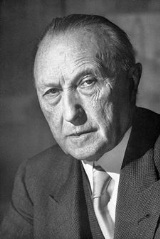
Konrad Adenauer

 
Konrad Adenauer

   Email Print
   Bookmark   Link


Konrad Adenauer


Konrad Hermann Josef Adenauer , 5 January 1876 – 19 April 1967) was a German
Germany

Germany , officially the Federal Republic of Germany , is a country in Central Europe. It is bordered to the north by the North Sea, Denmark, and the Baltic Sea; to the east by Poland and the Czech Republic; to the south by Austria and Switzerland; and to the west by France, Luxembourg, Belgium, and the Netherlands....
 statesman
Statesman

A statesman or stateswoman or statesperson is usually a politician or other notable figure of state who has had a long and respected career in politics at the national and international level....
.

Although his political career spanned sixty years, beginning as early as 1906, he is most noted for his role as the first Chancellor of West Germany
West Germany

West Germany was the common English name for the Germany , from its formation in May 1949 to German reunification in October 1990, when East Germany was dissolved and its States of Germany became part of the Federal Republic, ending the more than 40-year division of Germany....
 from 1949–1963 and chairman of the Christian Democratic Union
Christian Democratic Union (Germany)

The Christian Democratic Union of Germany is a christian democracy and conservatism political party in Germany.Along with its Bavarian sister party, the Christian Social Union of Bavaria, the CDU forms the CDU/CSU faction in the Bundestag....
 from 1950 to 1966. He was the oldest chancellor
List of German Chancellors by longevity

This is a list of Chancellor of Germany since 1871 by longevity. Where the person in question is still living, the longevity is calculated up to ....
 ever to serve Germany, leaving at the age of eighty-seven.

ad Adenauer was born as the third of five children of Johann Konrad Adenauer (1833-1906) and his wife Helene (1849-1919) (née Scharfenberg) in Cologne
Cologne

Cologne is Germany's fourth-largest city , and is the largest city both in the German Federal State of North Rhine-Westphalia and within the Rhine-Ruhr, one of the major European metropolitan areas with more than ten million inhabitants....
, Rhenish Prussia
Rhine Province

The Rhine Province , also known as Rhenish Prussia and the Rhineland , was a Provinces of Prussia of the Kingdom of Prussia and the Free State of Prussia from 1822-1946....
.


Discussion
Ask a question about 'Konrad Adenauer'
Start a new discussion about 'Konrad Adenauer'
Answer questions from other users
Full Discussion Forum


Quotations


In view of the fact that God limited the intelligence of man, it seems unfair that he did not also limit his stupidity.

Make Europe your revenge.

To French PM Guy Mollet after British PM Sir Anthony Eden unilaterally cancelled the Suez operation, thus angering Mollet. (6 November, 1956.)


Encyclopedia


Konrad Hermann Josef Adenauer , 5 January 1876 – 19 April 1967) was a German
Germany

Germany , officially the Federal Republic of Germany , is a country in Central Europe. It is bordered to the north by the North Sea, Denmark, and the Baltic Sea; to the east by Poland and the Czech Republic; to the south by Austria and Switzerland; and to the west by France, Luxembourg, Belgium, and the Netherlands....
 statesman
Statesman

A statesman or stateswoman or statesperson is usually a politician or other notable figure of state who has had a long and respected career in politics at the national and international level....
.

Although his political career spanned sixty years, beginning as early as 1906, he is most noted for his role as the first Chancellor of West Germany
West Germany

West Germany was the common English name for the Germany , from its formation in May 1949 to German reunification in October 1990, when East Germany was dissolved and its States of Germany became part of the Federal Republic, ending the more than 40-year division of Germany....
 from 1949–1963 and chairman of the Christian Democratic Union
Christian Democratic Union (Germany)

The Christian Democratic Union of Germany is a christian democracy and conservatism political party in Germany.Along with its Bavarian sister party, the Christian Social Union of Bavaria, the CDU forms the CDU/CSU faction in the Bundestag....
 from 1950 to 1966. He was the oldest chancellor
List of German Chancellors by longevity

This is a list of Chancellor of Germany since 1871 by longevity. Where the person in question is still living, the longevity is calculated up to ....
 ever to serve Germany, leaving at the age of eighty-seven.

Biography


Early life

Konrad Adenauer was born as the third of five children of Johann Konrad Adenauer (1833-1906) and his wife Helene (1849-1919) (née Scharfenberg) in Cologne
Cologne

Cologne is Germany's fourth-largest city , and is the largest city both in the German Federal State of North Rhine-Westphalia and within the Rhine-Ruhr, one of the major European metropolitan areas with more than ten million inhabitants....
, Rhenish Prussia
Rhine Province

The Rhine Province , also known as Rhenish Prussia and the Rhineland , was a Provinces of Prussia of the Kingdom of Prussia and the Free State of Prussia from 1822-1946....
. His siblings were August (1872-1952), Johannes (1873-1937), Lilli (1879-1950) and Elisabeth, who died shortly after birth in c. 1880. In 1894, he completed his Abitur
Abitur

'Abitur' is a designation used in Germany and Finland for final exams that pupils take at the end of their secondary education, usually after 12 or 13 years of schooling ....
 and started to study law and politics at the universities of Freiburg
University of Freiburg

University of Freiburg , sometimes referred to in English language as the Albert Ludwig University of Freiburg, is a public university research university located in Freiburg im Breisgau, Baden-W?rttemberg, Germany....
, Munich and Bonn
University of Bonn

The University of Bonn is a public research university located in Bonn, Germany. Founded in 1818 the University of Bonn is today one of the leading universities in Germany....
. He was a member of several Roman Catholic students’ associations under the K.St.V. Arminia Bonn
Katholischer Studentenverein Arminia Bonn

The Katholischer Studentenverein Arminia is one of Germany's oldest Roman Catholic Church male student societies....
 in Bonn. He finished his studies in 1901. Afterwards he worked as a lawyer at the court in Cologne.

Early political career

As a devout Roman Catholic, he joined the Centre Party
Centre Party (Germany)

The German Centre Party was a Catholic political party in Germany during the German Empire and the Weimar Republic. The party dissolved itself on 5 July, 1933 as a condition of the conclusion of Reichskonkordat between the Holy See and Germany....
 in 1906 and was elected to Cologne’s city council in the same year. In 1909, he became Vice-Mayor of Cologne. From 1917 to 1933, he served as Mayor of Cologne. He had the unpleasant task of heading Cologne in the era of British
United Kingdom

The United Kingdom of Great Britain and Northern Ireland, commonly known as the United Kingdom , the UK or Britain,is a sovereign state located off the northwestern coast of continental Europe....
 occupation following the First World War and lasting until 1926. He managed to establish faithful relations with the British military authorities and flirted with Rhenish separatism
Rhenish Republic

The Rhenish Republic was proclaimed at Aachen in October 1923 during the Occupation of the Ruhr by troops from France and Belgium between January 1923 and 1925....
 (a Rhenish state as part of Germany, but outside Prussia
Prussia

Prussia was, most recently, a historic state originating out of the Duchy of Prussia and the Margraviate of Brandenburg. This state had for centuries substantial influence on Germany and European history....
). During the Weimar Republic
Weimar Republic

The Weimar Republic was the democracy and republican period of Germany from 1919 to 1933. Following World War I, the republic emerged from the German Revolution in November 1918....
, he was president of the Prussian State Council (Preußischer Staatsrat) from 1922 to 1933, which was the representative of the Prussian cities and provinces.

When the Nazis
Nazi Germany

Nazi Germany and the Third Reich are the colloquial English names for Germany under the regime of Adolf Hitler and the Nazi Party , which established a Totalitarianism dictatorship that existed from 1933 to 1945....
 came to power in 1933, the Centre Party lost the elections in Cologne and Adenauer fled to the abbey of Maria Laach
Maria Laach Abbey

Maria Laach Abbey is a Benedictine order abbey situated on the southwestern shore of the Laacher See , near Andernach, in the Eifel region of the Rhineland-Palatinate in Germany....
, threatened by the new government after he refused to shake hands with a local Nazi leader. His stay at this abbey, which lasted for a year, was cited by its abbot after the war, when accused by Heinrich Böll
Heinrich Böll

Heinrich Theodor B?ll was one of Germany's foremost post-World War II writers. B?ll was awarded the Georg B?chner Prize in 1967 and the Nobel Prize for Literature in 1972....
 and others of collaboration with the Nazis.

He was imprisoned briefly after the Night of the Long Knives
Night of the Long Knives

The Night of the Long Knives or "Operation Hummingbird", was a purge that took place in Nazi Germany between June 30 and July 2, 1934, when the Nazi Party regime carried out a series of political executions, most of those killed being members of the Sturmabteilung , the paramilitary Brownshirts....
 in mid-1934. During the next two years, he changed residences often for fear of reprisals against him by the Nazis. In 1937, he was successful in claiming at least some compensation for his once confiscated house and managed to live in seclusion for some years.

According to Albert Speer
Albert Speer

Albert Speer was a Germany architect who was, for part of World War II, Minister of Armaments and War Production for the Nazi Germany. Speer was Adolf Hitler's chief architect before assuming ministerial office....
 in his book Spandau: The Secret Diaries
Spandau: The Secret Diaries

Spandau: The Secret Diaries was a 1976 best selling book by Albert Speer. While it principally deals with Speer's time while incarcerated at Spandau Prison, it also contains much material on his role in the Third Reich and his relationship with Adolf Hitler....
, Hitler expressed admiration for Adenauer, noting his building of a road circling the city as a bypass, and of a “green belt” of parks. However, both Hitler and Speer felt that Adenauer’s political views and principles made it impossible for him to play any role within the Nazi movement or be helpful to the Nazi party.

After the failed assassination attempt on Hitler in 1944, he was imprisoned for a second time as an opponent of the regime. The Gestapo
Gestapo

The was the official secret police of Nazi Germany. Under the overall administration of the Schutzstaffel , it was administered by the Reichssicherheitshauptamt and was considered a dual organization of the Sicherheitsdienst and also a suboffice of the Sicherheitspolizei ....
 could not prove he played an active role in the plot and he was released some weeks later. Shortly after the war ended the Americans
United States

The United States of America is a Federal government constitutional republic comprising U.S. state and a federal district. The country is situated mostly in central North America, where its Contiguous United States and Washington, D.C., the Capital districts and territories, lie between the Pacific Ocean and Atlantic Oceans, Borders of the U...
 installed him again as Mayor of Cologne, but the British Director of Military Government in Germany
Germany

Germany , officially the Federal Republic of Germany , is a country in Central Europe. It is bordered to the north by the North Sea, Denmark, and the Baltic Sea; to the east by Poland and the Czech Republic; to the south by Austria and Switzerland; and to the west by France, Luxembourg, Belgium, and the Netherlands....
, Gerald Templer
Gerald Templer

Field Marshal Sir Gerald Walter Robert Templer Order of the Garter, Order of the Bath, Order of St Michael and St George, Order of the British Empire was a United Kingdom military commander....
, dismissed him for what he said was his alleged incompetence.

Post World War II
World War II

World War II, or the Second World War , was a global military conflict which involved a Participants in World War II, including all of the great powers, organised into two opposing military alliances: the Allies of World War II and the Axis powers....
 and the founding of the CDU

After his dismissal as Mayor of Cologne, Adenauer devoted himself to building a new political party, the Christian Democratic Union (CDU), which he hoped would embrace both Protestants
Protestantism

Protestantism is a movement within Christianity that originated in the sixteenth-century Protestant Reformation. It is considered to be one of the three principal traditions of Christianity, together with Roman Catholicism and Eastern Orthodoxy....
 and Roman Catholics in a single party. In January 1946, Adenauer initiated a political meeting of the future CDU in the British zone in his role as doyen (the oldest man in attendance, Alterspräsident) and was informally confirmed as its leader. Adenauer worked diligently at building up contacts and support in the CDU over the next years, and he sought with varying success to impose his particular ideology on the party. His was an ideology at odds with many in the CDU, who wished to unite socialism
Socialism

Socialism refers to a broad set of economic theories of social organization advocating public or state ownership and administration of the means of production and distribution of goods, and a society characterized by equality for all individuals, with a fair or Egalitarianism method of compensation....
 and Christianity
Christianity

Christianity is a Monotheistic religion #Christian view religion centered on the life and teachings of Jesus as New Testament view on Jesus' life....
; Adenauer preferred to stress the dignity of the individual, and he considered both communism
Communism

Communism is a socioeconomic structure and political ideology that promotes the establishment of an egalitarianism, classlessness, stateless society based on common ownership and control of the means of production and property in general....
 and Nazism
Nazism

Nazism, officially National Socialism , refers to the ideology and practices of the National Socialist German Workers? Party under Adolf Hitler, and the policies adopted by the dictatorial government of Nazi Germany from 1933 to 1945....
 materialist world views that violated human dignity.

Adenauer’s leading role in the CDU of the British zone won him a position at the Parliamentary Council of 1948, called into existence by the Western Allies
Allies

In general, allies are people, groups or nations that have joined together in an association for mutual benefit or to achieve some common purpose....
 to draft a constitution for the three western zones of Germany
Germany

Germany , officially the Federal Republic of Germany , is a country in Central Europe. It is bordered to the north by the North Sea, Denmark, and the Baltic Sea; to the east by Poland and the Czech Republic; to the south by Austria and Switzerland; and to the west by France, Luxembourg, Belgium, and the Netherlands....
. He was the chairman of this constitutional convention and vaulted from this position to being chosen as the first head of government once the new “Basic Law
Basic Law for the Federal Republic of Germany

The Basic Law for the Federal Republic of Germany is the constitution of Germany. It was formally approved on May 8, 1949 and, with the signature of the Allies, came into effect on May 23, 1949 as the de facto constitution of West Germany....
” had been promulgated in May 1949.

Chancellor of West Germany

In the German federal election, 1949
German federal election, 1949

The 1st German federal election, 1949, was conducted on August 14 1949, to elect members to the Bundestag of West Germany. This was the first free election conducted in Germany after the Nazism period....
 at age 73, Adenauer became the first Chancellor of the Federal Republic of Germany after World War II
World War II

World War II, or the Second World War , was a global military conflict which involved a Participants in World War II, including all of the great powers, organised into two opposing military alliances: the Allies of World War II and the Axis powers....
. He held this position from 1949 to 1963, a period which spans most of the preliminary phase of the Cold War
Cold War

The Cold War was the continuing state of conflict, tension and competition that existed between a number of world powers, including the United States, the Soviet Union, People's Republic of China, France, United Kingdom and those countries' respective allies from the mid-1940s to the early 1990s....
. During this period, the post-war division of Germany was consolidated with the establishment of two separate German states, the Federal Republic of Germany (West Germany) and the German Democratic Republic
German Democratic Republic

The German Democratic Republic was a self-declared socialist state created in the Soviet Zone of occupied Germany and the East Berlin of Allied Occupation Zones in Germany....
 (East Germany). The first elections to the Bundestag
Bundestag

The 'Bundestag' is the parliament of Germany. It was established with Germany's constitution of 1949 and is the successor of the earlier Reichstag ....
 of West Germany were held on 15 August 1949, with the Christian Democrats emerging as the strongest party. Theodor Heuss
Theodor Heuss

Theodor Heuss was a Germany politician. He was the first person elected to a regular term as President of the West Germany.Heuss was born in Brackenheim, near Heilbronn....
 was elected first President of the Republic, and Adenauer was elected Chancellor on 16 September 1949. He also had the new "provisional" capital of the Federal Republic of Germany established at Bonn
Bonn

Bonn is the 19th largest city in Germany. Located about 20 kilometres south of Cologne on the river Rhine in the Federal State of North Rhine-Westphalia, it was the Capital of Germany West Germany from 1949 to 1990 and the official seat of government of united Germany from 1990 to 1999....
, which was only 15 kilometers away from his hometown, rather than at Frankfurt am Main (see History of Germany since 1945
History of Germany since 1945

As a consequence of Germany's defeat in World War II and the onset of the Cold War, the country was split between the two global blocs in the East and West....
).

Adenauer’s achievements include the establishment of a stable democracy in defeated Germany, a lasting reconciliation with France
France

France , officially the French Republic , is a country whose Metropolitan France is located in Western Europe and that also comprises various Overseas departments and territories of France....
, a general political reorientation towards the West, recovering limited but far-reaching sovereignty for West Germany by firmly integrating it with the emerging Euro-Atlantic community (NATO
NATO

The North Atlantic Treaty Organization , also called the Atlantic Alliance, is a military alliance established by the signing of the North Atlantic Treaty on 4 April 1949....
 and the Organisation for European Economic Cooperation
Organisation for Economic Co-operation and Development

The Organisation for Economic Co-operation and Development is an international organization of 30 countries that accept the principles of representative democracy and free market economy....
). Adenauer is associated with establishing an efficient pension
Pension

In general, a pension is an arrangement to provide people with an income when they are no longer earning a regular income from employment.The terms retirement plan or superannuation refer to a pension granted upon retirement ....
 system, which ensured unparalleled prosperity for retired persons, and - along with his Minister for Economic Affairs and successor, Ludwig Erhard
Ludwig Erhard

Ludwig Wilhelm Erhard was a Germany politician and Chancellor of Germany of West Germany from 1963 until 1966. He is notable for his leading role in German postwar economic reform and Wirtschaftswunder, particularly in his role as Minister of Economics under Chancellor Konrad Adenauer after 1949....
 - with the West German model of a “social market economy
Social market economy

The social market economy was the main Economic system used in Western Europe and Northern Europe during the Cold War era. It originated in West Germany, and it is known as Soziale Marktwirtschaft in German language....
” (a mixed economy
Mixed economy

A mixed economy is an economic system that incorporates a mixture of private and government ownership or control, or a mixture of capitalism and socialism....
 with capitalism
Capitalism

Capitalism is an economic system in which wealth, and the means of producing wealth, are private property and controlled rather than commonly, publicly, or state-owned and controlled....
 moderated by elements of social welfare and Catholic social teaching
Catholic social teaching

Catholic social teaching encompasses aspects of Roman Catholic Church doctrine relating to matters dealing with the collective welfare of humanity....
), which allowed for the boom period known as the Wirtschaftswunder
Wirtschaftswunder

The term describes the rapid reconstruction and development of the Economy of West Germany and Austria after World War II. The expression was used by The Times in 1950....
 (“economic miracle”) and produced broad prosperity. Thus, Adenauer ensured a truly free and democratic society which had been almost unknown to the German people before- notwithstanding that more or less hopeless attempt between 1919 and 1933 (the Weimar Republic
Weimar Republic

The Weimar Republic was the democracy and republican period of Germany from 1919 to 1933. Following World War I, the republic emerged from the German Revolution in November 1918....
)- and which is today not just normal but also deeply integrated into modern German society. He thereby laid the groundwork for the Western world to trust Germany again. Precisely because of Adenauer’s former policy, a later reunification of both German states was possible. A unified Germany has remained part of the European Union
European Union

The European Union is an economic and political union of 27 European Union member state, located primarily in Europe. It was established by the Treaty of Maastricht on 1 November 1993 upon the foundations of the pre-existing European Economic Community....
 and NATO
NATO

The North Atlantic Treaty Organization , also called the Atlantic Alliance, is a military alliance established by the signing of the North Atlantic Treaty on 4 April 1949....
.

Pict4134
However, contemporary critics accused Adenauer of cementing the division of Germany, sacrificing reunification and the recovery of territories lost to Poland
Poland

Poland , officially the Republic of Poland , is a country in Central Europe. Poland is bordered by Germany to the west; the Czech Republic and Slovakia to the south; Ukraine, Belarus and Lithuania to the east; and the Baltic Sea and Kaliningrad Oblast, a Russian Enclave and exclave, to the north....
 and the Soviet Union
Soviet Union

The Union of Soviet Socialist Republics was a Constitution of the Soviet Union socialist state that existed in Eurasia from 1922 to 1991.The name is a translation of the , romanization of Russian Soyuz Sovetskikh Sotsialisticheskikh Respublik, abbreviated ????, SSSR....
 for the sake of speedy integration into the West. During the Cold War
Cold War

The Cold War was the continuing state of conflict, tension and competition that existed between a number of world powers, including the United States, the Soviet Union, People's Republic of China, France, United Kingdom and those countries' respective allies from the mid-1940s to the early 1990s....
, he advocated West German rearmament and mandatory conscription
Conscription

Conscription is a general term for involuntary labor demanded by an established authority. It is most often used in the specific sense of government policies that require citizens to serve in the military....
 as an answer to a similar development in East Germany. The 1952 Stalin Note
Stalin Note

The Stalin Note, also known as the March Note, was a document delivered to the representatives of the Western allied powers from the Soviet occupations#Germany in Germany on March 10, 1952....
 offered to unify the two German states into a single, neutral, disarmed Germany to effect superpower disengagement from Central Europe
Central Europe

Central Europe is the region lying between the variously and vaguely defined areas of Eastern Europe and Western Europe Europe. In addition, Northern Europe, Southern Europe and Southeastern Europe may variously delimit or overlap into Central Europe....
. One opinion claims that Adenauer shared the Western Allies’ suspicion about the genuineness of that offer and supported the Allies in their cautious replies, the other one claims he did so because proposed neutrality and rearmament ban spoiled his plans to annex territories seceded to Poland later. Adenauer’s critics, especially on the nationalist side, denounced him for having missed an opportunity for early German reunification
German reunification

German reunification took place twice after 1945: first in 1957, the Saarland was permitted to join the Federal Republic of Germany, and again on 3 October 1990, when the five re-established states of the German Democratic Republic joined the Germany , and Berlin was united into a single city-state....
. Adenauer’s defenders claimed, and continue to argue, that given the realities of the Cold War
Cold War

The Cold War was the continuing state of conflict, tension and competition that existed between a number of world powers, including the United States, the Soviet Union, People's Republic of China, France, United Kingdom and those countries' respective allies from the mid-1940s to the early 1990s....
, reunification and the recovery of lost territories were not realistic goals. Both of Stalin's notes specified the retention of the existing "Potsdam" boundaries of Germany.

Others criticize his era as culturally and politically conservative, which sought to base the entire social and political make-up of West Germany around the personal views of a single person, one who bore a certain amount of mistrust towards his own people. His re-election campaign centered around the slogan "No Experiments."

The West German student movement of the late 1960s was essentially a protest against the conservatism Adenauer had personified. Another point of criticism was that Adenauer’s commitment to reconciliation with France was in stark contrast to a certain indifference towards Communist Poland. Like all other major West German political parties of the time, the CDU refused to recognize the annexation of former German territories given by the Soviets to Poland, and openly talked about regaining these territories after strengthening West Germany’s position in Europe.

In retrospect, mainly positive assessments of his chancellorship prevail, not only with the German public, which voted him the “greatest German of all time” in a 2003 television poll, but even with some of today’s left-wing intellectuals, who praise his unconditional commitment to western-style democracy and European integration.

Additional actions as Chancellor

brought home in 1955 from the Soviet Union
Soviet Union

The Union of Soviet Socialist Republics was a Constitution of the Soviet Union socialist state that existed in Eurasia from 1922 to 1991.The name is a translation of the , romanization of Russian Soyuz Sovetskikh Sotsialisticheskikh Respublik, abbreviated ????, SSSR....
, due to Adenauer's visit to Moscow.]]
  • Made a historic speech to the Bundestag
    Bundestag

    The 'Bundestag' is the parliament of Germany. It was established with Germany's constitution of 1949 and is the successor of the earlier Reichstag ....
     in September 1951 in which he recognized the obligation of the German government to compensate Israel
    Israel

    Israel officially the State of Israel , is a country in the Middle East located on the eastern shore of the Mediterranean Sea. It borders Lebanon in the north, Syria in the northeast, Jordan in the east, and Egypt on the southwest, and contains geographically diverse features within its relatively small area....
    , as the main representative of the Jewish people, for The Holocaust
    The Holocaust

    The Holocaust , also known as , Churben is the term generally used to describe the genocide of approximately six million European Jews during World War II, as part of a program of deliberate extermination planned and executed by Nazi Germany under Adolf Hitler....
    . This started a process which led to the Bundestag approving a pact between Israel and Germany in 1953 outlining the reparations
    Reparations Agreement between Israel and West Germany

    The Reparations Agreement between Israel and West Germany was signed on September 10, 1952. and entered in force on March 27, 1953. According to the Agreement, West Germany was to pay Israel for the slavery and persecution of Jews during the Holocaust, and to compensate for Jewish property that was stolen by the Nazism....
     Germany would pay to Israel.
  • Helped secure the release of the last German prisoners of war in 1955, a decade after the end of the war.
  • Opened diplomatic relations with the USSR
    Soviet Union

    The Union of Soviet Socialist Republics was a Constitution of the Soviet Union socialist state that existed in Eurasia from 1922 to 1991.The name is a translation of the , romanization of Russian Soyuz Sovetskikh Sotsialisticheskikh Respublik, abbreviated ????, SSSR....
     and other Eastern bloc
    Eastern bloc

    During the Cold War, the terms Eastern Bloc, Communist Bloc or Soviet Bloc were used to refer to European annexed or expanded Soviet Socialist Republics of the USSR and Satellite state states, including members of the Soviet-dominated organizations Comecon and the Warsaw Pact....
     nations, but refused to recognise East Germany.
  • Reached an agreement with the USA in 1957 that gave West Germany
    West Germany

    West Germany was the common English name for the Germany , from its formation in May 1949 to German reunification in October 1990, when East Germany was dissolved and its States of Germany became part of the Federal Republic, ending the more than 40-year division of Germany....
     possession of weapons capable of transporting nuclear warheads. Furthermore, Adenauer pursued nuclear cooperation with other countries with a goal of Germany being able to produce its own nuclear armament, which has however never been allowed by the formers Allies to any German successor state until present (2009).
  • Oversaw the reintegration of the Saarland
    Saarland

    Saarland is one of the 16 States of Germany of Germany. The capital is Saarbr?cken. It has an area of 2570 km? and 1,045,000 inhabitants. In both area and population it is the smallest of the German Fl?chenl?nder , i.e., those that are not City States ....
     into West Germany
    West Germany

    West Germany was the common English name for the Germany , from its formation in May 1949 to German reunification in October 1990, when East Germany was dissolved and its States of Germany became part of the Federal Republic, ending the more than 40-year division of Germany....
     in 1957.
  • Briefly considered running for the office of Federal President
    President of Germany

    The President of Germany is Germany's head of state.After the abdication of Wilhelm II, German Emperor in 1918 and the promulgation of the Weimar Constitution, the President of Germany was Head of State in Germany....
     in 1959. However, he instead chose a candidate (Heinrich Lübke
    Heinrich Lübke

    Heinrich L?bke was President of Germany from 1959 to 1969. L?bke had a very humble upbringing. He was the son of a shoemaker and farmer from the Sauerland and surveyor by training....
    ) whom he believed weak enough not to disturb his affairs as Federal Chancellor of West Germany.


For all of his efforts as West Germany’s leader, Adenauer was named Time
Time (magazine)

Time is a weekly United States newsmagazine, similar to Newsweek and U.S. News & World Report. A European edition is published from London....
 magazine
Magazine

for quarterly in Heraldry see Quartering Magazines, periodicals, glossies or serials are publications, generally published on a regular schedule, containing a variety of Article , generally financed by advertising, by a purchase price, by pre-paid magazine subscription, or all three....
’s Man of the Year
Person of the Year

Person of the Year is an annual issue of the United States newsmagazine Time that features and profiles a man, woman, couple, group, idea, place, or machine that "for better or for worse, ...has done the most to influence the events of the year."...
 in 1953. In 1954, he received the Karlspreis
Karlspreis

The Karlspreis is one of the most prestigious European prizes. It has been awarded once a year since 1950 by the Germany city of Aachen to people who contributed to the ideals upon which it has been founded....
 (English: Charlemagne Award), an Award by the German city of Aachen
Aachen

is a historic spa town in North Rhine-Westphalia, Germany. It is the westernmost city of Germany, located along its borders with Belgium and the Netherlands, 65 km west of Cologne....
 to people who contributed to the European idea, European cooperation and European peace.

In his last years in office Adenauer used to take a nap after lunch and, when he was traveling abroad and had a public function to attend, he sometimes asked for a bed in a room close to where he was supposed to be speaking, so that he could rest briefly before he appeared.

Adenauer found relaxation and great enjoyment in the Italian game of bocce
Bocce

Bocce , is a precision sport belonging to the boules sport family, closely related to bowls and p?tanque with a common ancestry from ancient games played in the Roman Empire....
 and spent a great deal of his post political career playing this game. His favorite holiday place to do this was in Cadenabbia
Cadenabbia

Cadenabbia is a small community in Lombardy, Italy, in the province of Como, on the west shore of Lake Como. The community is part of the comune of Griante, situated about 15 miles by steamer from the town of Como, between the communities of Menaggio and Tremezzo....
, Italy, in a rented villa overlooking Lake Como, which has since been acquired as a conference centre by the Konrad Adenauer Stiftung, the German state-funded political foundation.

When, in 1967, after his death at the age of 91, Germans were asked what they admired most about Adenauer, the majority responded that he had brought home the last German prisoners of war from the USSR
Soviet Union

The Union of Soviet Socialist Republics was a Constitution of the Soviet Union socialist state that existed in Eurasia from 1922 to 1991.The name is a translation of the , romanization of Russian Soyuz Sovetskikh Sotsialisticheskikh Respublik, abbreviated ????, SSSR....
, which had become known as the “Return of the 10,000”.

Assassination attempt


On 27 March 1952, a package addressed to Chancellor Adenauer exploded in the Munich
Munich

Munich is the capital city of Bavaria, Germany. Munich is located on the River Isar north of the Northern Limestone Alps. Munich is the third largest city in Germany, after Berlin and Hamburg....
 Police Headquarters, killing one Bavarian police officer. Two boys who had been paid to send this package by mail had brought it to the attention of the police. Investigations led to people closely related to the Herut
Herut

Herut was the major Right wing politics List of political parties in Israel in Israel from the 1940s until its formal merger into Likud in 1988, and an adherent to Revisionist Zionism....
 Party and the former Irgun
Irgun

Irgun was a militant Zionism group that operated in Palestine between 1931 and 1948. It was established as a militant offshoot of the earlier and larger Jewish paramilitary organization Haganah ....
 armed organization. The West German government kept all proof under seal in order to prevent antisemitic responses from the public. Five Israeli suspects identified by French and German investigators were allowed to return to Israel.

One of the participants, Eliezer Sudit, later revealed that the alleged mastermind behind this assassination attempt was Menachem Begin
Menachem Begin

was the sixth Prime Minister of Israel. Before the establishment of the state, he was the leader of the Irgun, playing a central role in Jewish resistance to the British Mandate of Palestine....
 who would later become the Prime Minister of Israel
Israel

Israel officially the State of Israel , is a country in the Middle East located on the eastern shore of the Mediterranean Sea. It borders Lebanon in the north, Syria in the northeast, Jordan in the east, and Egypt on the southwest, and contains geographically diverse features within its relatively small area....
. Begin had been the former commander of Irgun and at that time headed Herut and was a member of the Knesset
Knesset

The Knesset is the legislature of Israel, located in Givat Ram, Jerusalem....
. His goal was to undermine the attempts of the German government to seek friendly relations with Israel.

David Ben-Gurion
David Ben-Gurion

was the first Prime Minister of Israel. Ben-Gurion's passion for Zionism, which began early in life, culminated in his instrumental role in the founding of the state of Israel....
, Prime Minister of Israel, appreciated Adenauer’s response in playing down the affair and not pursuing it further, as it would have burdened the relationship between the two new states.

In June 2006 a slightly different version of this story appeared in one of Germany’s leading newspaper, Frankfurter Allgemeine Zeitung
Frankfurter Allgemeine Zeitung

The Frankfurter Allgemeine Zeitung , also known as F.A.Z., is a national List of newspapers in Germany, founded in 1949. It is published daily in Frankfurt am Main....
, quoted by The Guardian
The Guardian

Sorry, no overview for this topic
. Begin had offered to sell his gold watch as the conspirators ran out of money. The bomb was hidden in an encyclopaedia and it killed a bomb-disposal expert, injuring two others. Adenauer was targeted because he was sending Holocaust reparations to the official Israeli government, whereas Begin felt that the money should go to the individual Jewish victims (only to those inside Israel however). Sudit, the story’s source, explained that the “intent was not to hit Adenauer but to rouse the international media. It was clear to all of us there was no chance the package would reach Adenauer.” The five conspirators were arrested by the French police, in Paris
Paris

Paris is the Capital of France and the country's largest city. It is situated on the river Seine, in northern France, at the heart of the ?le-de-France Regions of France ....
. They “were [former] members of the ... Irgun
Irgun

Irgun was a militant Zionism group that operated in Palestine between 1931 and 1948. It was established as a militant offshoot of the earlier and larger Jewish paramilitary organization Haganah ....
” (the organisation had been disbanded in 1948, 4 years earlier).

Political scandal

In 1962, a scandal erupted
Spiegel scandal

The Spiegel Affair of 1962 was one of the major political scandals in Germany in the era following World War II.Essentially, the scandal boiled down to a conflict between Franz Josef Strau?, then Federal Minister of Defense, and Rudolf Augstein, owner and editor-in-chief of Der Spiegel magazine, Germany's leading weekly political...
 when police
Police

Police are agents or agencies, usually of the executive , empowered to enforce the law and to ensure public and social order through the legitimized use of force....
 under cabinet orders arrested five Der Spiegel
Der Spiegel

Der Spiegel is a German weekly magazine, published in Hamburg. It is one of Europe's largest weekly magazines with a circulation of more than one million per week....
 journalists, charging them with high treason
High treason

High treason is criminal disloyalty to one's country. Participating in a war against one's country, attempting to overthrow its government, spying on its military, its diplomats, or its secret services for a hostile and foreign power, or attempting to kill its head of state are perhaps the best-known examples of high treason....
, specifically for publishing a memo detailing alleged weaknesses in the West German armed forces
Armed forces

The armed forces of a country are its government-sponsored defense, fighting forces, and organizations. They exist to further the foreign and domestic policies of their governing body, and to defend that body and the nation it represents from external and internal aggressors....
. The cabinet members, belonging to the Free Democratic Party, left their positions in November 1962, and Defense Minister Franz Josef Strauss, himself the chairman of the Christian Social Union
Christian Democratic Union (Germany)

The Christian Democratic Union of Germany is a christian democracy and conservatism political party in Germany.Along with its Bavarian sister party, the Christian Social Union of Bavaria, the CDU forms the CDU/CSU faction in the Bundestag....
, was dismissed, followed by the remaining Christian Democratic Union cabinet members. Adenauer managed to remain in office for almost another year, but was eventually forced to resign and was succeeded as Chancellor by Ludwig Erhard
Ludwig Erhard

Ludwig Wilhelm Erhard was a Germany politician and Chancellor of Germany of West Germany from 1963 until 1966. He is notable for his leading role in German postwar economic reform and Wirtschaftswunder, particularly in his role as Minister of Economics under Chancellor Konrad Adenauer after 1949....
. He did remain chairman of the CDU until 1966.

Death

Adenauer died on April 19, 1967 in his family home in Rhöndorf
Bad Honnef

Bad Honnef is a spa town in Germany near Bonn in the Rhein-Sieg district, North Rhine-Westphalia. It is located on the border of the neighbouring state Rhineland-Palatinate....
. According to his daughter, his last words were "Da jitt et nix zo kriesche!" (Kölsch dialect
Kölsch language

K?lsch is a very closely related small set of dialects, or variants, of the Ripuarian Central German group of languages. K?lsch is spoken in, and partially around Cologne, in the West of Germany....
 for "There's nothin' to weep about!")

His state funeral
State funeral

A state funeral is a public funeral ceremony held to honour heads of state or other important people of national significance. They usually include much pomp and ceremony....
 in Cologne Cathedral
Cologne Cathedral

Cologne Cathedral is the seat of the Archbishop of Cologne, under the administration of the Roman Catholic Church and is renowned as a monument of Christianity, of Gothic architecture and of the faith and perseverance of the people of the city in which it stands....
 was attended by a large number of world leaders, among them US president Lyndon B. Johnson
Lyndon B. Johnson

Lyndon Baines Johnson , often referred to as LBJ, was the List of Presidents of the United States President of the United States and List of Vice Presidents of the United States Vice President of the United States ....
 on his only visit to a European country. After the service, his body was brought back to Rhöndorf on the Rhine
Rhine

File:Swiss Grand Canyon.jpgThe Rhine is one of the longest and most important rivers in Europe, at , with an average discharge of more than ....
 aboard Kondor, a Jaguar class fast attack craft
Jaguar class fast attack craft

The Type 140 Jaguar class fast attack craft is an evolution of the German torpedo boats of World War II. The design was developed by Lurssen and designated Schnellboot 55....
 of the German Navy
German Navy

The German Navy The German Navy traces its roots back to the Imperial Fleet of the Revolutions of 1848 and more directly to the Prussian Navy, which later evolved into the Northern German Federal Navy and became the Imperial Navy ....
. He is interred on the Waldfriedhof.

Legacy

Adenauer has left such a legacy behind, that he was the main motive for one of the most recent and famous gold commemorative coin: the Belgian 3 pioneers of the European unification commemorative coin
Euro gold and silver commemorative coins (Belgium)

Euro gold and silver commemorative coins are special euro coins Mint and issued by member states of the Eurozone, mainly in gold and silver, although other precious metals are also used in rare occasions....
, minted in 2002. The obverse side shows a portrait with the names Robert Schuman
Robert Schuman

Robert Schuman was a noted France statesman. Schuman was a Christian Democrat and an independent political thinker and activist. Twice Prime Minister of France, a reformist Minister of Finance and a Foreign Minister, he was instrumental in building post-war European and trans-Atlantic institutions and is regarded as one of the founders of t...
, Paul-Henri Spaak
Paul-Henri Spaak

Paul Henri Charles Spaak was a Belgium Socialist politician and statesman....
 and Konrad Adenauer.

Adenauer ministries


First ministry

  • Konrad Adenauer (CDU
    Christian Democratic Union (Germany)

    The Christian Democratic Union of Germany is a christian democracy and conservatism political party in Germany.Along with its Bavarian sister party, the Christian Social Union of Bavaria, the CDU forms the CDU/CSU faction in the Bundestag....
    ) - Chancellor
  • Franz Blücher
    Franz Blücher

    Franz Bl?cher was a Germany politician and member of the Lower House of the German Parliament .Bl?cher was born on 24 March 1896 in Essen, Rhine Province, German Empire....
     (FDP) - Vice Chancellor and Minister of Marshall Plan Affairs
  • Gustav Heinemann
    Gustav Heinemann

    Gustav Walter Heinemann, Order of the Bath was a Germany politician. He was Minister of Interior Affairs from 1949 to 1950, Minister of Justice from 1966 to 1969 and President of Germany from 1969 to 1974....
     (CDU) - Minister of the Interior
  • Fritz Schäffer
    Fritz Schäffer

    Fritz Sch?ffer was a German politician for the Bavarian People's Party and the Christian Social Union of Bavaria . In 1945 he became the first Bavarian Prime minister after World War II....
     (CSU
    Christian Social Union of Bavaria

    The Christian Social Union in Bavaria is a Christian Democracy and conservatism political party in Germany. It operates only in the state of Bavaria, while its sister party, the Christian Democratic Union , operates in the other 15 states of Germany....
    ) - Minister of Finance
  • Thomas Dehler
    Thomas Dehler

    Thomas Dehler was a Germany politician and the leader of Free Democratic Party from 1954 to 1957.He was also German Minister of Justice from 1949 to 1953. From 1949 to his death 1967 Dehler was a member of German Bundestag....
     (FDP) - Minister of Justice
  • Ludwig Erhard
    Ludwig Erhard

    Ludwig Wilhelm Erhard was a Germany politician and Chancellor of Germany of West Germany from 1963 until 1966. He is notable for his leading role in German postwar economic reform and Wirtschaftswunder, particularly in his role as Minister of Economics under Chancellor Konrad Adenauer after 1949....
     (CDU) - Minister of Economics
  • Anton Storch (CDU) - Minister of Labour and Social Affairs
  • Wilhelm Niklas (CSU) - Minister of Food, Agriculture, and Forestry
  • Hans-Christoph Seebohm
    Hans-Christoph Seebohm

    Hans-Christoph Seebohm was a Germany politician .He was a member of Lower Saxony Landtag from 1946 until 1951, and from 1949 until his death he was a member of the Bundestag for the constituency of Hamburg-Harburg....
     (DP
    German Party

    The German Party is a name used by a number of Germany political parties in the country's history. The current incarnation is represented only at the local level in Germany....
    ) - Minister of Transport
  • Eberhard Wildermuth (FDP) - Minister of Construction
  • Hans Schuberth (CSU) - Minister of Posts and Communications
  • Hans Lukaschek (CDU) - Minister of Displaced Persons, Refugees, and War Victims
  • Jakob Kaiser
    Jakob Kaiser

    Jakob Kaiser was a Germany politician and Widerstand leader during World War II.Jakob Kaiser was born in the Franconian town of Hammelburg....
     (CDU) - Minister of All-German Affairs
  • Heinrich Hellwege
    Heinrich Hellwege

    Heinrich Peter Hellwege was a German politician . Hellwege was Bundesminister for Affairs of the Bundesrat of Germany and Minister-President of Lower Saxony ....
     (DP) - Minister of Bundesrat Affairs


Changes
  • 13 October 1950 - Robert Lehr (CDU) succeeds Heinemann as Minister of the Interior.
  • 15 March 1951 - Konrad Adenauer becomes Minister of Foreign Affairs as well as Chancellor when the Allies allow this post to be revived.
  • 19 July 1952 - Fritz Neumayer (FDP) succeeds Wildermuth (d.9 March) as Minister of Construction.


Second ministry

  • Konrad Adenauer (CDU) - Chancellor and Minister of Foreign Affairs
  • Franz Blücher
    Franz Blücher

    Franz Bl?cher was a Germany politician and member of the Lower House of the German Parliament .Bl?cher was born on 24 March 1896 in Essen, Rhine Province, German Empire....
     (FDP) - Vice Chancellor and Minister of Economic Cooperation
  • Gerhard Schröder
    Gerhard Schröder (CDU)

    File:Bundesarchiv B 145 Bild-F008145-0002, Gerhard Schr?der.jpgGerhard Schr?der was a West Germany politician and member of the Christian Democratic Union Party....
     (CDU) - Minister of the Interior
  • Fritz Schäffer
    Fritz Schäffer

    Fritz Sch?ffer was a German politician for the Bavarian People's Party and the Christian Social Union of Bavaria . In 1945 he became the first Bavarian Prime minister after World War II....
     (CSU) - Minister of Finance
  • Fritz Neumayr (FDP) - Minister of Justice
  • Ludwig Erhard
    Ludwig Erhard

    Ludwig Wilhelm Erhard was a Germany politician and Chancellor of Germany of West Germany from 1963 until 1966. He is notable for his leading role in German postwar economic reform and Wirtschaftswunder, particularly in his role as Minister of Economics under Chancellor Konrad Adenauer after 1949....
     (CDU) - Minister of Economics
  • Anton Storch (CDU) - Minister of Labour and Social Affairs
  • Heinrich Lübke
    Heinrich Lübke

    Heinrich L?bke was President of Germany from 1959 to 1969. L?bke had a very humble upbringing. He was the son of a shoemaker and farmer from the Sauerland and surveyor by training....
     (CDU) - Minister of Food, Agriculture, and Forestry
  • Hans-Christoph Seebohm
    Hans-Christoph Seebohm

    Hans-Christoph Seebohm was a Germany politician .He was a member of Lower Saxony Landtag from 1946 until 1951, and from 1949 until his death he was a member of the Bundestag for the constituency of Hamburg-Harburg....
     (DP) - Minister of Transport
  • Viktor-Emanuel Preusker (FDP) - Minister of Construction
  • Franz-Josef Wuermeling (CDU) - Minister of Family Affairs
  • Franz Josef Strauss (CSU) - Minister of Special Tasks
  • Robert Tillmanns (CDU) - Minister of Special Tasks
  • Waldemar Kraft (GB/BHE) - Minister of Special Tasks
  • Hermann Schäfer (FDP) - Minister of Special Tasks
  • Siegfried Balke
    Siegfried Balke

    Siegfried Balke was a Germany politician .He served as German Federal Minister for Post and Communications from 1953 to 1956 and as German Federal Minister for Nuclear Energy from 1956 to 1962....
     - Minister of Posts and Communications
  • Theodor Oberländer
    Theodor Oberländer

    Theodor Oberl?nder was a Germany politician, military leader, and Agricultural science.From 1953 to 1960 he was a Minister for Displaced Persons, Refugees and Victims of War for the Federal Republic of Germany....
     (GB/BHE) - Minister of Displaced Persons, Refugees, and War Victims
  • Jakob Kaiser
    Jakob Kaiser

    Jakob Kaiser was a Germany politician and Widerstand leader during World War II.Jakob Kaiser was born in the Franconian town of Hammelburg....
     (CDU) - Minister of All-German Affairs
  • Heinrich Hellwege
    Heinrich Hellwege

    Heinrich Peter Hellwege was a German politician . Hellwege was Bundesminister for Affairs of the Bundesrat of Germany and Minister-President of Lower Saxony ....
     (DP) - Minister of Bundesrat Affairs


Changes
  • 7 June 1955 - Theodor Blank
    Theodor Blank

    Theodor Blank was a Germany politician of the Christian Democratic Union . He was one of the founders of the CDU in 1945, when World War II had ended....
     (CDU) becomes Minister of Defense when that post is revived.
  • 8 June 1955 - Heinrich von Brentano
    Heinrich von Brentano

    File:Bundesarchiv B 145 Bild-F003234-0010, Hunsr?ck, Diplomatenjagd.jpgHeinrich von Brentano di Tremezzo was a German conservative politician and lawyer....
     (CDU) succeeds Adenauer as Minister of Foreign Affairs. Hans-Joachim von Merkatz (DP) succeeds Hellwege as Minister of Bundesrat Affairs.
  • 19 October 1955 - Franz Josef Strauss (CSU) becomes Minister of Atomic Affairs
  • 12 November 1955 - Tillmanns leaves the cabinet.
  • 16 October 1956 - Franz Josef Strauss (CSU) succeeds Blank as Minister of Defense. Hans-Joachim von Merkatz succeeds Neumayr as Minister of Justice. Kraft and Schäfer leave the Cabinet. Siegfried Balke
    Siegfried Balke

    Siegfried Balke was a Germany politician .He served as German Federal Minister for Post and Communications from 1953 to 1956 and as German Federal Minister for Nuclear Energy from 1956 to 1962....
     (CSU) succeeds Strauss as Minister of Atomic Affairs.
  • 15 November 1956 - Ernst Lemmer (CDU) succeeds Balke as Minister of Posts and Communications.


Third ministry

  • Konrad Adenauer (CDU) - Chancellor
  • Ludwig Erhard
    Ludwig Erhard

    Ludwig Wilhelm Erhard was a Germany politician and Chancellor of Germany of West Germany from 1963 until 1966. He is notable for his leading role in German postwar economic reform and Wirtschaftswunder, particularly in his role as Minister of Economics under Chancellor Konrad Adenauer after 1949....
     (CDU) - Vice Chancellor and Minister of Economics
  • Heinrich von Brentano
    Heinrich von Brentano

    File:Bundesarchiv B 145 Bild-F003234-0010, Hunsr?ck, Diplomatenjagd.jpgHeinrich von Brentano di Tremezzo was a German conservative politician and lawyer....
     (CDU) - Minister of Foreign Affairs
  • Franz Josef Strauss (CSU) - Minister of Defense
  • Gerhard Schröder
    Gerhard Schröder (CDU)

    File:Bundesarchiv B 145 Bild-F008145-0002, Gerhard Schr?der.jpgGerhard Schr?der was a West Germany politician and member of the Christian Democratic Union Party....
     (CDU) - Minister of the Interior
  • Franz Etzel
    Franz Etzel

    Franz Etzel was a German politician for the Christian Democratic Union . From 1949 to 4 January 1953 and from 1957 to 1967 Etzel was member of the German Bundestag....
     (CDU) - Minister of Finance
  • Fritz Schäffer
    Fritz Schäffer

    Fritz Sch?ffer was a German politician for the Bavarian People's Party and the Christian Social Union of Bavaria . In 1945 he became the first Bavarian Prime minister after World War II....
     (CSU) - Minister of Justice
  • Theodor Blank
    Theodor Blank

    Theodor Blank was a Germany politician of the Christian Democratic Union . He was one of the founders of the CDU in 1945, when World War II had ended....
     (CDU) - Minister of Labour and Social Affairs
  • Heinrich Lübke
    Heinrich Lübke

    Heinrich L?bke was President of Germany from 1959 to 1969. L?bke had a very humble upbringing. He was the son of a shoemaker and farmer from the Sauerland and surveyor by training....
     (CDU) - Minister of Food, Agriculture, and Forestry
  • Hans-Christoph Seebohm
    Hans-Christoph Seebohm

    Hans-Christoph Seebohm was a Germany politician .He was a member of Lower Saxony Landtag from 1946 until 1951, and from 1949 until his death he was a member of the Bundestag for the constituency of Hamburg-Harburg....
     (DP) - Minister of Transport
  • Paul Lücke (CDU) - Minister of Construction
  • Franz-Josef Wuermeling (CDU) - Minister of Family and Youth Affairs
  • Richard Stücklen
    Richard Stücklen

    Richard St?cklen was a Germany politician of the Christian Social Union of Bavaria. From 1957 to 1966, he served as Federal Minister for Post and Communication....
     (CSU) - Minister of Posts and Communications
  • Theodor Oberländer
    Theodor Oberländer

    Theodor Oberl?nder was a Germany politician, military leader, and Agricultural science.From 1953 to 1960 he was a Minister for Displaced Persons, Refugees and Victims of War for the Federal Republic of Germany....
     (CDU) - Minister of Displaced Persons, Refugees, and War Victims
  • Ernst Lemmer (CDU) - Minister of All-German Affairs
  • Hans-Joachim von Merkatz (DP) - Minister of Bundesrat and State Affairs
  • Siegfried Balke
    Siegfried Balke

    Siegfried Balke was a Germany politician .He served as German Federal Minister for Post and Communications from 1953 to 1956 and as German Federal Minister for Nuclear Energy from 1956 to 1962....
     (CSU) - Minister of Nuclear Energy and Water
  • Hermann Lindrath (CDU) - Minister of Federal Economic Possessions


Changes
  • 13 September 1959 - Werner Schwarz (CDU) succeeds Lübke as Minister of Food, Agriculture, and Forestry.
  • 5 April 1960 - Oberländer resigns as Minister of Displaced Persons, Refugees, and War Victims.
  • 4 May 1960 - Hans Wilhelmi (CDU) succeeds Lindrath (d. 27 February) as Minister of Federal Economic Possessions.
  • 27 October 1960 - Hans-Joachim von Merkatz (CDU) becomes Minister of Displaced Persons, Refugees, and War Victims.


Fourth ministry

  • Konrad Adenauer (CDU) - Chancellor
  • Ludwig Erhard
    Ludwig Erhard

    Ludwig Wilhelm Erhard was a Germany politician and Chancellor of Germany of West Germany from 1963 until 1966. He is notable for his leading role in German postwar economic reform and Wirtschaftswunder, particularly in his role as Minister of Economics under Chancellor Konrad Adenauer after 1949....
     (CDU) - Vice Chancellor and Minister of Economics
  • Gerhard Schröder
    Gerhard Schröder (CDU)

    File:Bundesarchiv B 145 Bild-F008145-0002, Gerhard Schr?der.jpgGerhard Schr?der was a West Germany politician and member of the Christian Democratic Union Party....
     (CDU) - Minister of Foreign Affairs
  • Franz Josef Strauss (CSU) - Minister of Defense
  • Hermann Höcherl
    Hermann Höcherl

    Hermann H?cherl was a Germany politician of the Christian Social Union of Bavaria . After first being elected to the Bundestag in 1961, he was Federal Minister of the Interior until 1965 and then Federal Ministry for Food, Consumer Protection, and Agriculture until 1969....
     (CSU) - Minister of the Interior
  • Heinz Starke
    Heinz Starke

    Heinz Starke was a German politician. He was born in Silesia. He was Minister of Finance of the Federal Republic of Germany from 1961–62....
     (FDP) - Minister of Finance
  • Wolfgang Stammberger (FDP) - Minister of Justice
  • Theodor Blank
    Theodor Blank

    Theodor Blank was a Germany politician of the Christian Democratic Union . He was one of the founders of the CDU in 1945, when World War II had ended....
     (CDU) - Minister of Labour and Social Affairs
  • Werner Schwarz (CDU) - Minister of Food, Agriculture, and Forestry
  • Hans-Christoph Seebohm
    Hans-Christoph Seebohm

    Hans-Christoph Seebohm was a Germany politician .He was a member of Lower Saxony Landtag from 1946 until 1951, and from 1949 until his death he was a member of the Bundestag for the constituency of Hamburg-Harburg....
     (CDU) - Minister of Transport
  • Paul Lücke (CDU) - Minister of Construction
  • Franz-Josef Wuermeling (CDU) - Minister of Family and Youth Affairs
  • Elisabeth Schwarzhaupt (CDU) - Minister of Health
  • Walter Scheel
    Walter Scheel

    Walter Scheel is a Germany politician . As of 2009, he is the oldest President of Germany alive and the second longest-lived German head of state after Emperor Wilhelm I, German Emperor....
     (FDP) - Minister of Economic Cooperation
  • Heinrich Krone
    Heinrich Krone

    Heinrich Krone was a German Conservatism politician.Shortly after beginning his Theology study in 1914, Krone was drafted into service in World War I....
     (CDU) - Minister of Special Tasks
  • Richard Stücklen
    Richard Stücklen

    Richard St?cklen was a Germany politician of the Christian Social Union of Bavaria. From 1957 to 1966, he served as Federal Minister for Post and Communication....
     (CSU) - Minister of Posts and Communications
  • Wolfgang Mischnick (FDP) - Minister of Displaced Persons, Refugees, and War Victims
  • Ernst Lemmer (CDU) - Minister of All-German Affairs
  • Hans-Joachim von Merkatz (CDU) - Minister of Bundesrat and State Affairs
  • Siegfried Balke
    Siegfried Balke

    Siegfried Balke was a Germany politician .He served as German Federal Minister for Post and Communications from 1953 to 1956 and as German Federal Minister for Nuclear Energy from 1956 to 1962....
     (CSU) - Minister of Nuclear Energy and Water
  • Hans Lenz (FDP) - Minister of Federal Treasure


Changes
  • 19 November 1962 Ewald Bucher
    Ewald Bucher

    Ewald Bucher was a Germany politician of the Freie Demokratische Partei.He received a Juris Doctor from the University of Munich in 1941 and served then as a soldier in World War II from 1941 to 1944....
     (FDP) succeeds Stammberger as Minister of Justice. Werner Dollinger
    Werner Dollinger

    Dr. Werner Dollinger was a German politician and economist. Born in Neustadt an der Aisch, he helped found the Christian Social Union of Bavaria in 1946....
     (CSU) succeeds Lenz as Minister of Federal Treasure.
  • 14 December 1962 - Rolf Dahlgrün
    Rolf Dahlgrün

    Rolf Dahlgr?n was a German politician for the Free Democratic Party . From 1962 to 1966 he was Minister of Finance....
     (FDP) succeeds Starke as Minister of Finance. Bruno Heck (CDU) succeeds Wuermeling as Minister of Family and Youth Affairs. Hans Lenz (FDP) enters the ministry as Minister of Scientific Research. Rainer Barzel
    Rainer Barzel

    Rainer Candidus Barzel was a Germany politician of the Christian Democratic Union .Born in Braniewo, East Prussia, Barzel served as Chairman of the CDU from 1971 and 1973 and ran as the CDU's candidate for Chancellor of Germany in the German federal election, 1972, losing to Willy Brandt's SPD....
     (CDU) succeeds Lemmer as Minister of All-German Affairs. Alois Niederalt (CSU) succeeds Merkatz as Minister of Bundesrat and State Affairs. The Ministry of Nuclear Energy and Water is abolished, and Balke leaves the cabinet.
  • 9 January 1963 - Kai-Uwe von Hassel
    Kai-Uwe von Hassel

    Kai-Uwe von Hassel was a Germany politician from Schleswig-Holstein associated with the Christian Democratic Union party.Hassel was born in Gare, German East Africa ....
     (CDU) succeeds Strauss as Minister of Defense.


External links