
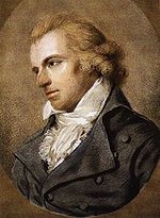
Johann Christoph Friedrich von Schiller ˈjoːhan ˈkʁɪstɔf ˈfʁiːdʁɪç fɔn ˈʃɪlɐ (10 November 17599 May 1805) was a German
poetA poet is a person who writes poetry. A poet's work can be literal, meaning that his work is derived from a specific event, or metaphorical, meaning that his work can take on many meanings and forms. Poets have existed since antiquity, in nearly all languages, and have produced works that vary...
,
philosopherPhilosophy is the study of general and fundamental problems, such as those connected with existence, knowledge, values, reason, mind, and language. Philosophy is distinguished from other ways of addressing such problems by its critical, generally systematic approach and its reliance on rational...
,
historianA historian is a person who studies and writes about the past and is regarded as an authority on it. Historians are concerned with the continuous, methodical narrative and research of past events as relating to the human race; as well as the study of all history in time. If the individual is...
, and
playwrightA playwright, also called a dramatist, is a person who writes plays.The term is not a variant spelling of "playwrite", but something quite distinct: the word wright is an archaic English term for a craftsman or builder...
. During the last seventeen years of his life (1788–1805), Schiller struck up a productive, if complicated, friendship with already famous and influential
Johann Wolfgang von GoetheJohann Wolfgang von Goethe was a German writer, pictorial artist, biologist, theoretical physicist, and polymath. He is considered the supreme genius of modern German literature. His works span the fields of poetry, drama, prose, philosophy, and science. His Faust has been called the greatest long...
. They frequently discussed issues concerning
aestheticsAesthetics is a branch of philosophy dealing with the nature of beauty, art, and taste, and with the creation and appreciation of beauty. It is more scientifically defined as the study of sensory or sensori-emotional values, sometimes called judgments of sentiment and taste...
, and Schiller encouraged Goethe to finish works he left as sketches. This relationship and these discussions led to a period now referred to as
Weimar ClassicismWeimar Classicism is a cultural and literary movement of Europe. Followers attempted to establish a new humanism by synthesizing Romantic, classical and Enlightenment ideas...
. They also worked together on
XenienXenien is a Germanization of the Greek Xenia "host gifts", a title originally applied by the Roman poet Martial to a collection of poems which were to accompany his presents....
, a collection of short satirical poems in which both Schiller and Goethe challenge opponents to their philosophical vision.
Biography
Friedrich Schiller was born on 10 November 1759, in
MarbachMarbach am Neckar is a town on the river Neckar in Baden-Württemberg, Germany. The nearest larger cities are Ludwigsburg and Stuttgart ....
,
WürttembergWürttemberg , formerly known as Wirtemberg or Wurtemberg, is an area and a former state in southwestern Germany, including parts of the regions Swabia and Franconia....
as the only son of military doctor Johann Kaspar Schiller (1733–96), and Elisabeth Dorothea Kodweiß (1732–1802). They also had five daughters. His father was away in the
Seven Years' WarThe Seven Years' War was a global military war between 1756 and 1763, involving most of the great powers of the time and affecting Europe, North America, Central America, the West African coast, India, and the Philippines...
when Friedrich was born. He was named after king Frederick the Great, but he was called Fritz by nearly everyone. Kaspar Schiller was rarely home during the war, but he did manage to visit the family once in a while. His wife and children also visited him occasionally wherever he happened to be stationed. When the war ended in 1763, Schiller's father became a recruiting officer and was stationed in
Schwäbisch GmündSchwäbisch Gmünd is a town in the eastern part of the German state of Baden-Württemberg. With a population of around 62,000, the town is the second largest in the Ostalbkreis and the whole region of East Württemberg after Aalen...
. The family moved with him. Due to the high cost of living—especially the rent—the family moved to nearby
LorchLorch is a small town situated in the Ostalbkreis district, in Baden-Württemberg, Germany. It is situated on the river Rems, 8 km west of Schwäbisch Gmünd.Friedrich Schiller lived here as a child between 1764 and 1766....
.
Although the family was happy in Lorch, Schiller's father found his work unsatisfying. He sometimes took his son with him. In Lorch, Schiller received his primary education. The quality of the lessons was fairly bad, and Friedrich regularly cut class with his older sister. Because his parents wanted Schiller to become a pastor, they had the pastor of the village instruct the boy in
LatinLatin is an Italic language originally spoken in Latium and Ancient Rome. It, along with most European languages, is a descendant of the ancient Proto-Indo-European language. Although it is considered a dead language, a number of scholars and members of the Christian clergy speak it fluently, and...
and
GreekGreek is an independent branch of the Indo-European family of languages. Native to the southern Balkans, it has the longest documented history of any Indo-European language, spanning 34 centuries of written records. Its writing system has been the Greek alphabet for the majority of its history;...
. Pastor Moser was a good teacher, and later Schiller named the cleric in his first play
Die Räuber (
The Robbers) after him. As a boy, Schiller was excited by the idea of becoming a cleric and often put on black robes and pretended to preach.
In 1766, the family left Lorch for the Duke of Württemberg's principal residence,
LudwigsburgLudwigsburg is a city in Baden-Württemberg, Germany, about north of Stuttgart city centre, near the river Neckar. It is the largest and primary city of the Ludwigsburg urban district with about 87,000 inhabitants...
. Schiller's father had not been paid for three years, and the family had been living on their savings but could no longer afford to do so. So Kaspar Schiller took an assignment to the garrison in Ludwigsburg.
There the Schiller boy came to the attention of Karl Eugen, Duke of Württemberg. He entered the
Karlsschule StuttgartHohe Karlsschule was the strict military academy founded by Karl Eugen, Duke of Württemberg in Stuttgart, Germany.Politically the duke was quite unimportant and with this school he wanted to enhance his prestige. In 1770, it was moved to Castle Solitude, and in 1775 into the city...
(an elite military academy founded by the Duke), in 1773, where he eventually studied medicine. During most of his short life, he suffered from illnesses that he tried to cure himself.
While at the Karlsschule, Schiller read
RousseauJean-Jacques Rousseau was a Genevan philosopher, writer, and composer of 18th-century Romanticism. His political philosophy influenced the French Revolution as well as the overall development of modern political, sociological and educational thought.His novel Émile: or, On Education is a treatise...
and Goethe and discussed Classical ideals with his classmates. At school, he wrote his first play,
The Robbers, which dramatizes the conflict between two aristocratic brothers: the elder, Karl Moor, leads a group of rebellious students into the Bohemian forest where they become Robin Hood-like bandits, while Franz Moor, the younger brother, schemes to inherit his father's considerable estate. The play's critique of social corruption and its affirmation of proto-revolutionary republican ideals astounded its original audience. Schiller became an overnight sensation. Later, Schiller would be made an honorary member of the French Republic because of this play.
In 1780, he obtained a post as regimental doctor in
StuttgartStuttgart is the capital of the state of Baden-Württemberg in southern Germany. The sixth-largest city in Germany, Stuttgart has a population of 600,038 while the metropolitan area has a population of 5.3 million ....
, a job he disliked.
Following the performance of
The Robbers in
MannheimMannheim is a city in southwestern Germany. With about 315,000 inhabitants, Mannheim is the second-largest city in the Bundesland of Baden-Württemberg, following the capital city of Stuttgart....
, in 1781, Schiller was arrested, sentenced to 14 days of imprisonment, and forbidden by Karl Eugen from publishing any further works.
He fled Stuttgart in 1782, going via
FrankfurtFrankfurt am Main , commonly known simply as Frankfurt, is the largest city in the German state of Hesse and the fifth-largest city in Germany, with a 2010 population of 688,249. The urban area had an estimated population of 2,300,000 in 2010...
, Mannheim,
LeipzigLeipzig Leipzig has always been a trade city, situated during the time of the Holy Roman Empire at the intersection of the Via Regia and Via Imperii, two important trade routes. At one time, Leipzig was one of the major European centres of learning and culture in fields such as music and publishing...
, and
DresdenDresden is the capital city of the Free State of Saxony in Germany. It is situated in a valley on the River Elbe, near the Czech border. The Dresden conurbation is part of the Saxon Triangle metropolitan area....
to
WeimarWeimar is a city in Germany famous for its cultural heritage. It is located in the federal state of Thuringia , north of the Thüringer Wald, east of Erfurt, and southwest of Halle and Leipzig. Its current population is approximately 65,000. The oldest record of the city dates from the year 899...
, where he settled in 1787. In 1789, he was appointed professor of History and Philosophy in
JenaJena is a university city in central Germany on the river Saale. It has a population of approx. 103,000 and is the second largest city in the federal state of Thuringia, after Erfurt.-History:Jena was first mentioned in an 1182 document...
, where he wrote only historical works.
He died of tuberculosis in 1805, at the age of 45.
Marriage and family
On 22 February 1790, Schiller married
Charlotte von LengefeldCharlotte Luise Antoinette von Schiller, born Charlotte von Lengefeld was the wife of German poet Friedrich Schiller.-Early life:...
(1766–1826). Two sons (Karl Friedrich Ludwig and Ernst Friedrich Wilhelm) and two daughters (Karoline Luise Henriette and Luise Henriette Emilie) were born between 1793 and 1804. The last living descendant of Schiller was a grandchild of Emilie, Baron Alexander von Gleichen-Rußwurm, who died at
Baden-BadenBaden-Baden is a spa town in Baden-Württemberg, Germany. It is located on the western foothills of the Black Forest, on the banks of the Oos River, in the region of Karlsruhe...
, Germany, in 1947.
Weimar and playwriting
Schiller returned with his family to Weimar from Jena in 1799. Goethe convinced him to return to playwriting. He and Goethe founded the Weimar Theater, which became the leading theater in Germany. Their collaboration helped lead to a renaissance of drama in Germany.
Legacy and honors
For his achievements, Schiller was
ennobledNobility is a social class which possesses more acknowledged privileges or eminence than members of most other classes in a society, membership therein typically being hereditary. The privileges associated with nobility may constitute substantial advantages over or relative to non-nobles, or may be...
in 1802 by the Duke of Weimar, adding the nobiliary particle "
vonIn German, von is a preposition which approximately means of or from.When it is used as a part of a German family name, it is usually a nobiliary particle, like the French, Spanish and Portuguese "de". At certain times and places, it has been illegal for anyone who was not a member of the nobility...
" to his name. He remained in Weimar,
Saxe-WeimarSaxe-Weimar was one of the Saxon duchies held by the Ernestine branch of the Wettin dynasty in present-day Thuringia. The chief town and capital was Weimar.-Division of Leipzig:...
until his death at 45 from
tuberculosisTuberculosis, MTB, or TB is a common, and in many cases lethal, infectious disease caused by various strains of mycobacteria, usually Mycobacterium tuberculosis. Tuberculosis usually attacks the lungs but can also affect other parts of the body...
.
The first significant biography of Schiller was by his sister-in-law
Caroline von WolzogenCaroline von Wolzogen, born Caroline von Lengefeld , was a German writer in the Weimar Classicism circle...
in 1830.
The coffin containing Schiller's skeleton is in the
Weimarer FürstengruftThe Fürstengruft is the ducal burial chapel of Saxe-Weimar-Eisenach, located in the Historical Cemetery in Weimar. It also houses the tombs of Goethe and Schiller. It is part of the Klassik Stiftung Weimar and since 1998 it and the cemetery have also been part of the Classical Weimar World Heritage...
(Weimar's Ducal Vault), the burial place of Houses of Grand Dukes (
großherzogliches Haus) of
Saxe-Weimar-EisenachThe Duchy of Saxe-Weimar-Eisenach was created in 1809 by the merger of the Ernestine duchies of Saxe-Weimar and Saxe-Eisenach. It was raised to a Grand duchy in 1815 by resolution of the Vienna Congress. In 1877, it officially changed its name to the Grand Duchy of Saxony , but this name was...
in the
Historical Cemetery of WeimarThe Historical Cemetery is the main cemetery of Weimar. It includes the Weimarer Fürstengruft, with which it forms part of the Classical Weimar World Heritage Site....
. On 3 May 2008, scientists announced that DNA tests have shown that the skull of this skeleton is not Schiller's, and his tomb is now vacant. The physical resemblance between this skull and the extant
death maskIn Western cultures a death mask is a wax or plaster cast made of a person’s face following death. Death masks may be mementos of the dead, or be used for creation of portraits...
as well as to portraits of Schiller, had led many experts to believe that the skull was Schiller's.
In September 2008, Schiller was voted by the audience of the TV channel
ArteArte is a Franco-German TV network. It is a European culture channel and aims to promote quality programming especially in areas of culture and the arts...
as the second most important playwright in Europe after William Shakespeare.
Freemasonry
Some Freemasons speculate that Schiller was a
FreemasonFreemasonry is a fraternal organisation that arose from obscure origins in the late 16th to early 17th century. Freemasonry now exists in various forms all over the world, with a membership estimated at around six million, including approximately 150,000 under the jurisdictions of the Grand Lodge...
, but this has not been proven.
In 1787, in his tenth letter about
Don Carlos, Schiller wrote:
- "I am neither Illuminati nor Mason, but if the fraternization has a moral purpose in common with one another, and if this purpose for human society is the most important, ..."
In a letter from 1829, two Freemasons from
RudolstadtRudolstadt is a town in the German Bundesland of Thuringia, close to the Thuringian Forest to the southwest, and to Jena and Weimar to the north....
complain about the dissolving of their Lodge
Günther zum stehenden Löwen that was honoured by the initiation of Schiller. According to Schiller's great-grandson Alexander von Gleichen-Rußwurm, Schiller was brought to the Lodge by
Wilhelm Heinrich Karl von Gleichen-Rußwurm. No membership document has been found.
Philosophical papers
Schiller wrote many philosophical papers on
ethicsEthics, also known as moral philosophy, is a branch of philosophy that addresses questions about morality—that is, concepts such as good and evil, right and wrong, virtue and vice, justice and crime, etc.Major branches of ethics include:...
and
aestheticsAesthetics is a branch of philosophy dealing with the nature of beauty, art, and taste, and with the creation and appreciation of beauty. It is more scientifically defined as the study of sensory or sensori-emotional values, sometimes called judgments of sentiment and taste...
. He synthesized the thought of
Immanuel KantImmanuel Kant was a German philosopher from Königsberg , researching, lecturing and writing on philosophy and anthropology at the end of the 18th Century Enlightenment....
with the thought of
Karl Leonhard ReinholdKarl Leonhard Reinhold was an Austrian philosopher. He was the father of Ernst Reinhold, also a philosopher.-Life:...
. He elaborated
Christoph Martin WielandChristoph Martin Wieland was a German poet and writer.- Biography :He was born at Oberholzheim , which then belonged to the Free Imperial City of Biberach an der Riss in the south-east of the modern-day state of Baden-Württemberg...
's concept of the
Schöne Seele (beautiful soul), a human being whose emotions have been educated by reason, so that
Pflicht und Neigung (duty and inclination) are no longer in conflict with one another; thus
beautyBeauty is a characteristic of a person, animal, place, object, or idea that provides a perceptual experience of pleasure, meaning, or satisfaction. Beauty is studied as part of aesthetics, sociology, social psychology, and culture...
, for Schiller, is not merely an aesthetic experience, but a moral one as well: the Good is the Beautiful. His philosophical work was also particularly concerned with the question of human freedom, a preoccupation which also guided his historical researches, such as the
Thirty Years' WarThe Thirty Years' War was fought primarily in what is now Germany, and at various points involved most countries in Europe. It was one of the most destructive conflicts in European history....
and the
Dutch RevoltThe Dutch Revolt or the Revolt of the Netherlands This article adopts 1568 as the starting date of the war, as this was the year of the first battles between armies. However, since there is a long period of Protestant vs...
, and then found its way as well into his dramas (the
Wallenstein trilogy concerns the Thirty Years' War, while
Don Carlos addresses the revolt of the Netherlands against Spain.) Schiller wrote two important essays on the question of the sublime (
das Erhabene), entitled "Vom Erhabenen" and "Über das Erhabene"; these essays address one aspect of human freedom—the ability to defy one's animal instincts, such as the drive for self-preservation, when, for example, someone willingly sacrifices themselves for conceptual ideals.
The dramas
Schiller is considered by most Germans to be Germany's most important classical playwright. Critics like F.J. Lamport and Eric Auerbach have noted his innovative use of dramatic structure and his creation of new forms, such as the melodrama and the bourgeois tragedy. What follows is a brief, chronological description of the plays.
- The Robbers (Die Räuber): The language of The Robbers is highly emotional, and the depiction of physical violence in the play marks it as a quintessential work of Germany's Romantic
Romanticism was an artistic, literary and intellectual movement that originated in the second half of the 18th century in Europe, and gained strength in reaction to the Industrial Revolution...
'Storm and StressSturm und Drang is a proto-Romantic movement in German literature and music taking place from the late 1760s through the early 1780s, in which individual subjectivity and, in particular, extremes of emotion were given free expression in reaction to the perceived constraints of rationalism...
' movement. The Robbers is considered by critics like Peter BrooksPeter Brooks is Sterling Professor Emeritus of Comparative Literature at Yale University and Andrew W. Mellon Scholar in the department of Comparative Literature and the Center for Human Values at Princeton University. He is formerly Professor in the Department of English and School of Law at the...
to be the first European melodramaThe term melodrama refers to a dramatic work that exaggerates plot and characters in order to appeal to the emotions. It may also refer to the genre which includes such works, or to language, behavior, or events which resemble them...
. The play pits two brothers against each other in alternating scenes, as one quests for money and power, while the other attempts to create revolutionary anarchy in the Bohemian ForestThe Bohemian Forest, also known in Czech as Šumava , is a low mountain range in Central Europe. Geographically, the mountains extend from South Bohemia in the Czech Republic to Austria and Bavaria in Germany...
. The play strongly criticises the hypocrisies of class and religion, and the economic inequities of German society; it also conducts a complicated inquiry into the nature of evil.
- Fiesco
Fiesco is the second full length drama written by the German playwright Friedrich Schiller. It is a republican tragedy based on the historical conspiracy of Giovanni Luigi Fieschi against Andrea Doria in Genoa in 1547...
(Die Verschwörung des Fiesco zu Genua):
- Intrigue and Love
Intrigue and Love , , is a five-act play, written by the German dramatist and writer Friedrich Schiller...
(Kabale und Liebe): The aristocratic Ferdinand von Walter wishes to marry Luise Miller, the bourgeois daughter of the city's music instructor. Court politics involving the duke's beautiful but conniving mistress Lady Milford and Ferdinand's ruthless father create a disastrous situation reminiscent of Shakespeare's Romeo and JulietRomeo and Juliet is a tragedy written early in the career of playwright William Shakespeare about two young star-crossed lovers whose deaths ultimately unite their feuding families. It was among Shakespeare's most popular archetypal stories of young, teenage lovers.Romeo and Juliet belongs to a...
. Schiller develops his criticisms of absolutism and bourgeois hypocrisy in this bourgeois tragedyBourgeois Tragedy is a form of tragedy that developed in 18th century Europe. It was a fruit of the enlightenment and the emergence of the bourgeois class and its ideals...
. Act 2, Scene 2 is an anti-BritishThe United Kingdom of Great Britain and Northern IrelandIn the United Kingdom and Dependencies, other languages have been officially recognised as legitimate autochthonous languages under the European Charter for Regional or Minority Languages...
parodyA parody , in current usage, is an imitative work created to mock, comment on, or trivialise an original work, its subject, author, style, or some other target, by means of humorous, satiric or ironic imitation...
that depicts a firing-squad massacre. Young Germans who refused to join the Hessians and British to quash the American Revolutionary WarThe American Revolutionary War , the American War of Independence, or simply the Revolutionary War, began as a war between the Kingdom of Great Britain and thirteen British colonies in North America, and ended in a global war between several European great powers.The war was the result of the...
are fired upon. Giuseppe VerdiGiuseppe Fortunino Francesco Verdi was an Italian Romantic composer, mainly of opera. He was one of the most influential composers of the 19th century...
's operaOpera is an art form in which singers and musicians perform a dramatic work combining text and musical score, usually in a theatrical setting. Opera incorporates many of the elements of spoken theatre, such as acting, scenery, and costumes and sometimes includes dance...
Luisa MillerLuisa Miller is an opera in three acts by Giuseppe Verdi to an Italian libretto by Salvadore Cammarano, based on the play Kabale und Liebe by Friedrich von Schiller. The first performance was given at the Teatro San Carlo in Naples on December 8, 1849...
is based on this play.
- Don Carlos
Don Carlos is a historical tragedy in five acts by Friedrich Schiller; it was written between 1783 and 1787 and first produced in Hamburg in 1787...
: This play marks Schiller's entrée into historical drama. Very loosely based on the events surrounding the real Don Carlos of Spain, Schiller's Don Carlos is another republican figure—he attempts to free Flanders from the despotic grip of his father, King PhillipPhilip II was King of Spain, Portugal, Naples, Sicily, and, while married to Mary I, King of England and Ireland. He was lord of the Seventeen Provinces from 1556 until 1581, holding various titles for the individual territories such as duke or count....
. The Marquis Posa's famous speech to the king proclaims Schiller's belief in personal freedom and democracy.
- The Wallenstein
Wallenstein is the popular designation for a trilogy of dramas by German author Friedrich Schiller. It consists of the plays Wallenstein's Camp with a lengthy prologue, The Piccolomini , and Wallenstein's Death...
Trilogy: These plays follow the fortunes of the treacherous commander Albrecht von WallensteinAlbrecht Wenzel Eusebius von Wallenstein , actually von Waldstein, was a Bohemian soldier and politician, who offered his services, and an army of 30,000 to 100,000 men during the Danish period of the Thirty Years' War , to the Holy Roman Emperor Ferdinand II...
during the Thirty Years' WarThe Thirty Years' War was fought primarily in what is now Germany, and at various points involved most countries in Europe. It was one of the most destructive conflicts in European history....
.
- Mary Stuart (Maria Stuart): This "revisionist" history of the Scottish queen, who was Elizabeth I's rival, portrays Mary Stuart as a tragic heroine, misunderstood and used by ruthless politicians, including and especially, Elizabeth.
- The Maid of Orleans
The Maid of Orleans is a tragedy by Friedrich Schiller, written in 1801 in Leipzig. During his lifetime, it was one of Schiller's most frequently-performed pieces.-Plot:...
(Die Jungfrau von Orleans): about Joan of ArcSaint Joan of Arc, nicknamed "The Maid of Orléans" , is a national heroine of France and a Roman Catholic saint. A peasant girl born in eastern France who claimed divine guidance, she led the French army to several important victories during the Hundred Years' War, which paved the way for the...
- The Bride of Messina (Die Braut von Messina)
- William Tell (Wilhelm Tell)
- Demetrius
Demetrius is an incomplete drama by the German playwright Friedrich Schiller based on the life of Demetrius, briefly Russian czar between 1604 and 1605. It is a reflection on the individual's responsibility in history and on the rule of Napoleon...
(unfinished)
The Aesthetic Letters
A pivotal work by Schiller was
On the Aesthetic Education of Man in a Series of Letters (
Über die ästhetische Erziehung des Menschen in einer Reihe von Briefen), first published 1794, which was inspired by the great disenchantment Schiller felt about the
French RevolutionThe French Revolution , sometimes distinguished as the 'Great French Revolution' , was a period of radical social and political upheaval in France and Europe. The absolute monarchy that had ruled France for centuries collapsed in three years...
, its degeneration into violence and the failure of successive governments to put its ideals into practice. Schiller wrote that "a great moment has found a little people"; he wrote the
Letters as a philosophical inquiry into what had gone wrong, and how to prevent such tragedies in the future. In the
Letters he asserts that it is possible to elevate the moral character of a people, by first touching their souls with beauty, an idea that is also found in his poem
Die Künstler (
The Artists): "Only through Beauty's morning-gate, dost thou penetrate the land of knowledge."
On the philosophical side,
Letters put forth the notion of
der sinnliche Trieb / Sinnestrieb ("the sensuous drive") and
Formtrieb ("the formal drive"). In a comment to
Immanuel KantImmanuel Kant was a German philosopher from Königsberg , researching, lecturing and writing on philosophy and anthropology at the end of the 18th Century Enlightenment....
's philosophy, Schiller transcends the dualism between
Formtrieb and
Sinnestrieb with the notion of
Spieltrieb ("the play drive"), derived from, as are a number of other terms, Kant's
Critique of the Faculty of Judgment. The conflict between man's material, sensuous nature and his capacity for reason (
Formtrieb being the drive to impose conceptual and moral order on the world), Schiller resolves with the happy union of
Formtrieb and
Sinnestrieb, the "play drive," which for him is synonymous with artistic beauty, or "living form." On the basis of
Spieltrieb, Schiller sketches in
Letters a future
ideal state (a
eutopiaUtopia is an ideal community or society possessing a perfect socio-politico-legal system. The word was imported from Greek by Sir Thomas More for his 1516 book Utopia, describing a fictional island in the Atlantic Ocean. The term has been used to describe both intentional communities that attempt...
), where everyone will be content, and everything will be beautiful, thanks to the free play of
Spieltrieb. Schiller's focus on the dialectical interplay between
Formtrieb and
Sinnestrieb has inspired a wide range of succeeding aesthetic philosophical theory, including notably
Jacques RancièreJacques Rancière is a French philosopher, Professor of Philosophy at European Graduate School in Saas-Fee and Emeritus Professor of Philosophy at the University of Paris Jacques Rancière (born Algiers, 1940) is a French philosopher, Professor of Philosophy at European Graduate School in Saas-Fee...
's conception of the "aesthetic regime of art," as well as social philosophy in
Herbert MarcuseHerbert Marcuse was a German Jewish philosopher, sociologist and political theorist, associated with the Frankfurt School of critical theory...
, in the second part of his important work
Eros and CivilizationEros and Civilization is one of German philosopher and social critic Herbert Marcuse's best known works. Written in 1955, it is a synthesis of Karl Marx and Sigmund Freud. Its title alludes to Freud's Civilization and Its Discontents...
, where he finds Schiller's notion of
Spieltrieb useful in thinking a social situation without the condition of modern
social alienationThe term social alienation has many discipline-specific uses; Roberts notes how even within the social sciences, it “is used to refer both to a personal psychological state and to a type of social relationship”...
. He writes, "Schiller's
Letters ... aim at remaking of civilization by virtue of the liberating force of the aesthetic function: it is envisaged as containing the possibility of a new reality principle."
Works
Plays
- Die Räuber (The Robbers), 1781
- Fiesco
Fiesco is the second full length drama written by the German playwright Friedrich Schiller. It is a republican tragedy based on the historical conspiracy of Giovanni Luigi Fieschi against Andrea Doria in Genoa in 1547...
(Die Verschwörung des Fiesco zu Genua), 1783
- Kabale und Liebe
Intrigue and Love , , is a five-act play, written by the German dramatist and writer Friedrich Schiller...
(Intrigue and Love), 1784
- Don Karlos, Infant von Spanien
Don Carlos is a historical tragedy in five acts by Friedrich Schiller; it was written between 1783 and 1787 and first produced in Hamburg in 1787...
(Don Carlos), 1787
- Wallenstein
Wallenstein is the popular designation for a trilogy of dramas by German author Friedrich Schiller. It consists of the plays Wallenstein's Camp with a lengthy prologue, The Piccolomini , and Wallenstein's Death...
, 1800
- Maria Stuart (Mary Stuart), 1800
- Die Jungfrau von Orleans
The Maid of Orleans is a tragedy by Friedrich Schiller, written in 1801 in Leipzig. During his lifetime, it was one of Schiller's most frequently-performed pieces.-Plot:...
(The Maid of Orleans), 1801
- Die Braut von Messina (The Bride of Messina), 1803
- Wilhelm Tell (William Tell), 1804
- Demetrius
Demetrius is an incomplete drama by the German playwright Friedrich Schiller based on the life of Demetrius, briefly Russian czar between 1604 and 1605. It is a reflection on the individual's responsibility in history and on the rule of Napoleon...
(unfinished at his death)
Histories
- Geschichte des Abfalls der vereinigten Niederlande von der spanischen Regierung or The Revolt of the Netherlands
- Geschichte des dreißigjährigen Kriegs or A History of the Thirty Years' War
- Über Völkerwanderung, Kreuzzüge und Mittelalter or On the Barbarian Invasions, Crusaders and Middle Ages
Translations
- Euripides
Euripides was one of the three great tragedians of classical Athens, the other two being Aeschylus and Sophocles. Some ancient scholars attributed ninety-five plays to him but according to the Suda it was ninety-two at most...
, Iphigenia in Aulis
- William Shakespeare
William Shakespeare was an English poet and playwright, widely regarded as the greatest writer in the English language and the world's pre-eminent dramatist. He is often called England's national poet and the "Bard of Avon"...
, MacbethThe Tragedy of Macbeth is a play by William Shakespeare about a regicide and its aftermath. It is Shakespeare's shortest tragedy and is believed to have been written sometime between 1603 and 1607...
- Jean Racine
Jean Racine , baptismal name Jean-Baptiste Racine , was a French dramatist, one of the "Big Three" of 17th-century France , and one of the most important literary figures in the Western tradition...
, PhèdrePhèdre is a dramatic tragedy in five acts written in alexandrine verse by Jean Racine, first performed in 1677.-Composition and premiere:...
- Carlo Gozzi
Carlo, Count Gozzi was an Italian playwright.Born in Venice, he came from an old Venetian family from the Republic of Ragusa...
, Turandot, 1801
Prose
- Der Geisterseher or The Ghost-Seer
The Ghost-Seer ; or the Apparitionist is an unfinished novel by Friedrich Schiller. It first appeared in several instalments from 1787 to 1789 in the journal Thalia, later appearing as a three-volume book in its own right...
(unfinished novel) (started in 1786 and published periodically. Published as book in 1789)
- Über die ästhetische Erziehung des Menschen in einer Reihe von Briefen (On the Aesthetic Education of Man in a series of Letters), 1794
- Der Verbrecher aus verlorener Ehre
The Criminal of Lost Honour is a crime report by Friedrich Schiller, first published in 1786 under the title Verbrecher aus Infamie .-External links: , in...
(Dishonoured Irreclaimable), 1786
Poems
- An die Freude (Ode to Joy
"Ode to Joy" is an ode written in 1785 by the German poet, playwright and historian Friedrich Schiller, enthusiastically celebrating the brotherhood and unity of all mankind...
) (1785) became the basis for the fourth movement of BeethovenLudwig van Beethoven was a German composer and pianist. A crucial figure in the transition between the Classical and Romantic eras in Western art music, he remains one of the most famous and influential composers of all time.Born in Bonn, then the capital of the Electorate of Cologne and part of...
's ninth symphonyThe Symphony No. 9 in D minor, Op. 125, is the final complete symphony of Ludwig van Beethoven. Completed in 1824, the symphony is one of the best known works of the Western classical repertoire, and has been adapted for use as the European Anthem...
- Der Taucher
The Diver is a ballad by Friedrich Schiller, written in 1797, the year of his friendly ballad competition with Goethe....
(The Diver)
- Die Kraniche des Ibykus
The Cranes of Ibycus is a ballad by Friedrich Schiller, written in 1797, the year of his friendly ballad competition with Goethe. It is set in the 6th century BC....
(The Cranes of Ibykus)
- Der Ring des Polykrates
Polycrates' Ring is a ballad written in June 1797 by Friedrich Schiller. It was first published the following year. It gave its name to the Korngold opera Der Ring des Polykrates, set in or around 1797....
(Polycrates' Ring)
- Die Bürgschaft
The Hostage is a 1798 ballad by German poet Friedrich Schiller. He took the idea out of the medieval Latin collection of anecdotes and tales, the Gesta Romanorum.- Synopsis :...
(The Hostage; set to music by SchubertFranz Peter Schubert was an Austrian composer.Although he died at an early age, Schubert was tremendously prolific. He wrote some 600 Lieder, nine symphonies , liturgical music, operas, some incidental music, and a large body of chamber and solo piano music...
)
- Das Lied von der Glocke (Song of the Bell
The Song of the Bell is a poem that the German poet Friedrich Schiller published in 1798. It is one of the most famous poems of German literature and with 430 lines also one of the longest...
)
- Das verschleierte Bild zu Sais (The Veiled Statue At Sais)
- Der Handschuh
Der Handschuh is a ballad by Friedrich Schiller, written in 1797, the year of his friendly ballad competition with Goethe.-History:...
(The Glove)
- Nänie
Nänie is a composition for SATB chorus and orchestra, op. 82 by Johannes Brahms, which sets to music the poem Nänie by Friedrich Schiller. Brahms composed the piece in 1881, in memory of his deceased friend Anselm Feuerbach...
(set to music by BrahmsJohannes Brahms was a German composer and pianist, and one of the leading musicians of the Romantic period. Born in Hamburg, Brahms spent much of his professional life in Vienna, Austria, where he was a leader of the musical scene...
)
Quotations
- "Stay true to the dreams of thy youth." (Elizabeth, in: Don Carlos)
- "Mit der Dummheit kämpfen Götter selbst vergebens," which means "Against stupidity the gods themselves contend in vain." (Talbot, in: The Maid of Orleans)
- "Deeper meaning resides in the fairy tales told to me in my childhood than in any truth that is taught in life."
- "Eine Grenze hat die Tyrannenmacht", which literally means "A tyrant's power has a limit" (a Swiss freedom fighter, in: Wilhelm Tell)
- "The voice of the majority is no proof of justice." (Talbot, in: Maria Stuart)
- "It is not flesh and blood but the heart which makes us fathers and sons."
- "Live with your century but do not be its creature." (From On the Aesthetic Education of Man)
Musical settings of Schiller's poems and stage plays
Ludwig van BeethovenLudwig van Beethoven was a German composer and pianist. A crucial figure in the transition between the Classical and Romantic eras in Western art music, he remains one of the most famous and influential composers of all time.Born in Bonn, then the capital of the Electorate of Cologne and part of...
said that a great poem is more difficult to set to music than a merely good one because the composer must rise higher than the poet – "who can do that in the case of Schiller? In this respect Goethe is much easier," wrote Beethoven.
There are relatively few famous musical settings of Schiller's poems. Two notable exceptions are Beethoven's setting of "An die Freude" (
Ode to Joy"Ode to Joy" is an ode written in 1785 by the German poet, playwright and historian Friedrich Schiller, enthusiastically celebrating the brotherhood and unity of all mankind...
) in the final movement of his
Ninth SymphonyThe Symphony No. 9 in D minor, Op. 125, is the final complete symphony of Ludwig van Beethoven. Completed in 1824, the symphony is one of the best known works of the Western classical repertoire, and has been adapted for use as the European Anthem...
, and
Johannes BrahmsJohannes Brahms was a German composer and pianist, and one of the leading musicians of the Romantic period. Born in Hamburg, Brahms spent much of his professional life in Vienna, Austria, where he was a leader of the musical scene...
' choral setting of "
NänieNänie is a composition for SATB chorus and orchestra, op. 82 by Johannes Brahms, which sets to music the poem Nänie by Friedrich Schiller. Brahms composed the piece in 1881, in memory of his deceased friend Anselm Feuerbach...
". In addition, several poems were set by
Franz SchubertFranz Peter Schubert was an Austrian composer.Although he died at an early age, Schubert was tremendously prolific. He wrote some 600 Lieder, nine symphonies , liturgical music, operas, some incidental music, and a large body of chamber and solo piano music...
as
Lied is a German word literally meaning "song", usually used to describe romantic songs setting German poems of reasonably high literary aspirations, especially during the nineteenth century, beginning with Carl Loewe, Heinrich Marschner, and Franz Schubert and culminating with Hugo Wolf...
er, such as "
Die BürgschaftThe Hostage is a 1798 ballad by German poet Friedrich Schiller. He took the idea out of the medieval Latin collection of anecdotes and tales, the Gesta Romanorum.- Synopsis :...
", mostly for voice and piano. In 2005
Graham WaterhouseGraham Waterhouse is an English composer and a cellist. He is known for chamber music and for unusual scoring, such as Piccolo Quintet, Bright Angel for three bassoons and contrabassoon, Chieftain's Salute for Great Highland Bagpipe and string orchestra, and works for speaking voice and cello,...
set
Der HandschuhDer Handschuh is a composition by Graham Waterhouse. He wrote the setting of Schiller's ballad for cello and speaking voice in 2005...
(The Glove) for cello and speaking voice.
The Italian composer
Giuseppe VerdiGiuseppe Fortunino Francesco Verdi was an Italian Romantic composer, mainly of opera. He was one of the most influential composers of the 19th century...
admired Schiller greatly and adapted several of his stage plays for his
operaOpera is an art form in which singers and musicians perform a dramatic work combining text and musical score, usually in a theatrical setting. Opera incorporates many of the elements of spoken theatre, such as acting, scenery, and costumes and sometimes includes dance...
s:
I masnadieriI masnadieri is an opera in four acts by Giuseppe Verdi to an Italian libretto by Andrea Maffei, based on Die Räuber by Friedrich von Schiller....
is based on
The Robbers;
Giovanna d'ArcoGiovanna d'Arco is an operatic dramma lirico with a prologue and three acts by Giuseppe Verdi to an Italian libretto by Temistocle Solera....
on
The Maid of OrleansThe Maid of Orleans is a tragedy by Friedrich Schiller, written in 1801 in Leipzig. During his lifetime, it was one of Schiller's most frequently-performed pieces.-Plot:...
;
Luisa MillerLuisa Miller is an opera in three acts by Giuseppe Verdi to an Italian libretto by Salvadore Cammarano, based on the play Kabale und Liebe by Friedrich von Schiller. The first performance was given at the Teatro San Carlo in Naples on December 8, 1849...
on
Intrigue and LoveIntrigue and Love , , is a five-act play, written by the German dramatist and writer Friedrich Schiller...
; and
Don CarlosDon Carlos is a five-act grand opera composed by Giuseppe Verdi to a French language libretto by Camille du Locle and Joseph Méry, based on the dramatic play Don Carlos, Infant von Spanien by Friedrich Schiller...
on the play of the same title.
Donizetti'sDomenico Gaetano Maria Donizetti was an Italian composer from Bergamo, Lombardy. His best-known works are the operas L'elisir d'amore , Lucia di Lammermoor , and Don Pasquale , all in Italian, and the French operas La favorite and La fille du régiment...
Maria StuardaMaria Stuarda is a tragic opera, , in two acts, by Gaetano Donizetti, to a libretto by Giuseppe Bardari, based on Friedrich Schiller's 1800 play Maria Stuart....
is based on
Mary Stuart, and Rossini's
Guillaume TellGuillaume Tell is an opera in four acts by Gioachino Rossini to a French libretto by Etienne de Jouy and Hippolyte Bis, based on Friedrich Schiller's play Wilhelm Tell. Based on the legend of William Tell, this opera was Rossini's last, even though the composer lived for nearly forty more years...
is an adaptation of
William TellWilliam Tell is a folk hero of Switzerland. His legend is recorded in a late 15th century Swiss chronicle....
. The 20th century composer
Giselher KlebeGiselher Wolfgang Klebe was a German composer. He composed more than 140 works, among them 14 operas, 8 symphonies, 15 solo concerts, chamber music, piano works, and sacred music.-Biography:...
adapted
The Robbers for his first opera of
the same nameDie Räuber, op.25, is an opera in four acts by Giselher Klebe who also wrote the libretto based on the play by Friedrich Schiller....
, which premiered in 1957.
Schiller's burial
Here is a poem written about the poet's burial:
- Two dim and paltry torches that the raging storm
- And rain at any moment threaten to put out.
- A waving pall. A vulgar coffin made of pine
- With not a wreath, not e'en the poorest, and no train –
- As if a crime were swiftly carried to the grave!
- The bearers hastened onward. One unknown alone,
- Round whom a mantle waved of wide and noble fold,
- Followed this coffin. 'Twas the Spirit of Mankind.
-
-
-
-
- – Conrad Ferdinand Meyer
Conrad Ferdinand Meyer was a Swiss poet and historical novelist, a master of realism chiefly remembered for stirring narrative ballads like "Die Füße im Feuer" .-Biography:...
External links
- Friedrich Schiller Chronology
- 2005 is Schiller year: all dates
- Letters upon the Education of Man
- Letters Upon The Aesthetic Education of Man in PDF Format at filepedia.org
- Schiller Monument in Schiller Park, German Village, Columbus, Ohio, USA
German Village is a historic neighborhood just south of downtown Columbus. It was settled by a large number of German immigrants in the early-to-mid-19th century, who at one time comprised as much as a third of the population of the entire city...
- Schiller multimedial combines a biographical observation by Norbert Œllers with classic recordings and video clips
- Mobile Schiller Mobile Java application containing 20 poems of Schiller
- Say it loud – it's Schiller and it's proud What relevance does Schiller have today? By George Steiner
Francis George Steiner, FBA , is an influential European-born American literary critic, essayist, philosopher, novelist, translator, and educator. He has written extensively about the relationship between language, literature and society, and the impact of the Holocaust...
at signandsight.com
- Friedrich-Schiller University of Jena