
All Topics  
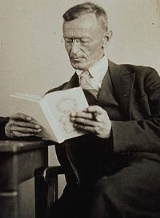
Hermann Hesse

 
Hermann Hesse

   Email Print
   Bookmark   Link


Hermann Hesse


Hermann Hesse (2 July 1877 – 9 August 1962) was a German-Swiss
Switzerland

Switzerland is a landlocked Swiss Alps country of roughly 7.7 million people in Western Europe with an area of 41,285 km?. Switzerland is a federal republic consisting of 26 states called Cantons of Switzerland....
 poet, novelist, and painter. In 1946, he received the Nobel Prize in Literature
Nobel Prize in Literature

The Nobel Prize in Literature is awarded annually, since 1901, to an author from any country who has, in the words from the will of Alfred Nobel, produced "in the field of literature the most outstanding work in an ideal direction" ....
. His best-known works include Steppenwolf
Steppenwolf (novel)

Steppenwolf is the tenth novel by Germany-Switzerland author Hermann Hesse. Originally published in Germany in 1927, it was first translated into English in 1929....
, Siddhartha
Siddhartha (novel)

Siddhartha is an allegory novel by Hermann Hesse which deals with the spiritual journey of an Indian boy called Siddhartha during the time of the Gautama Buddha....
, and The Glass Bead Game
The Glass Bead Game

The Glass Bead Game is the last work and magnum opus of the German author Hermann Hesse. Begun in 1931 and published in Switzerland in 1943, the book was mentioned in Hesse's citation for the 1946 Nobel Prize in Literature....
 (also known as Magister Ludi) which explore an individual's search for spirituality outside society.

e was born in the Black Forest
Black Forest

The Black Forest is a forest mountain range in Baden-W?rttemberg, southwestern Germany. It is bordered by the Rhine valley to the west and south....
 town of Calw
Calw

Calw is a Municipalities of Germany in the middle of Baden-W?rttemberg in the south of Germany, capital of the Calw . It is located in the northern Black Forest....
 in Württemberg
Kingdom of Württemberg

The Kingdom of W?rttemberg was a state that existed from 1806 to 1918 and is currently located in Baden-W?rttemberg, Germany....
, Germany
German Empire

The German Empire is the name commonly used in English to describe Germany from the unification of Germany and proclamation of William I, German Emperor as German Emperor on 18 January 1871, to 1918, when it became Weimar republic after defeat in World War I and the abdication of William II, German Emperor ....
 to a Christian
Christian

A Christian is a person who adheres to Christianity, a Monotheism#Christian view religion centered on the life and teachings of Jesus and interpreted by Christians to have been prophesied in the Hebrew Bible/Old Testament....
 missionary
Missionary

A 'missionary' is a member of a religion who works to convert those who do not share the missionary's faith; someone who Proselytism. The word "mission" is derived from the Latin missioninimus...
 family.


Discussion
Ask a question about 'Hermann Hesse'
Start a new discussion about 'Hermann Hesse'
Answer questions from other users
Full Discussion Forum


Quotations


But there is no dream that lasts forever, each dream is followed by another, and one should not cling to any particular one.

Each man had only one genuine vocation -- to find the way to himself.

How mysterious this life was, how deep and muddy its waters ran, yet how clear and noble what emerged from them.

I had grown a thin mustache, I was a full-grown man, and yet I was completely helpless and without a goal in life.

I realize today that nothing in the world is more distasteful to a man than to take the path that leads to himself.

If you hate a person, you hate something in him that is part of yourself. What isn't part of ourselves doesn't disturb us.


Encyclopedia


Hermann Hesse (2 July 1877 – 9 August 1962) was a German-Swiss
Switzerland

Switzerland is a landlocked Swiss Alps country of roughly 7.7 million people in Western Europe with an area of 41,285 km?. Switzerland is a federal republic consisting of 26 states called Cantons of Switzerland....
 poet, novelist, and painter. In 1946, he received the Nobel Prize in Literature
Nobel Prize in Literature

The Nobel Prize in Literature is awarded annually, since 1901, to an author from any country who has, in the words from the will of Alfred Nobel, produced "in the field of literature the most outstanding work in an ideal direction" ....
. His best-known works include Steppenwolf
Steppenwolf (novel)

Steppenwolf is the tenth novel by Germany-Switzerland author Hermann Hesse. Originally published in Germany in 1927, it was first translated into English in 1929....
, Siddhartha
Siddhartha (novel)

Siddhartha is an allegory novel by Hermann Hesse which deals with the spiritual journey of an Indian boy called Siddhartha during the time of the Gautama Buddha....
, and The Glass Bead Game
The Glass Bead Game

The Glass Bead Game is the last work and magnum opus of the German author Hermann Hesse. Begun in 1931 and published in Switzerland in 1943, the book was mentioned in Hesse's citation for the 1946 Nobel Prize in Literature....
 (also known as Magister Ludi) which explore an individual's search for spirituality outside society.

Life


Youth

Hesse was born in the Black Forest
Black Forest

The Black Forest is a forest mountain range in Baden-W?rttemberg, southwestern Germany. It is bordered by the Rhine valley to the west and south....
 town of Calw
Calw

Calw is a Municipalities of Germany in the middle of Baden-W?rttemberg in the south of Germany, capital of the Calw . It is located in the northern Black Forest....
 in Württemberg
Kingdom of Württemberg

The Kingdom of W?rttemberg was a state that existed from 1806 to 1918 and is currently located in Baden-W?rttemberg, Germany....
, Germany
German Empire

The German Empire is the name commonly used in English to describe Germany from the unification of Germany and proclamation of William I, German Emperor as German Emperor on 18 January 1871, to 1918, when it became Weimar republic after defeat in World War I and the abdication of William II, German Emperor ....
 to a Christian
Christian

A Christian is a person who adheres to Christianity, a Monotheism#Christian view religion centered on the life and teachings of Jesus and interpreted by Christians to have been prophesied in the Hebrew Bible/Old Testament....
 missionary
Missionary

A 'missionary' is a member of a religion who works to convert those who do not share the missionary's faith; someone who Proselytism. The word "mission" is derived from the Latin missioninimus...
 family. Both of his parents served with a Basel Mission
Basel Mission

The Basel Mission is a Christian missionary society that operates around the world. Members of the society come from many different Protestantism Christian denomination....
 to India, where Hesse's mother Marie Gundert was born in 1842. Hesse's father, Johannes Hesse, was born in 1847 in Estonia
Estonia

Estonia , officially the Republic of Estonia is a country in the Baltic region of Northern Europe. It is bordered to the north by Finland across the Gulf of Finland, to the west by Sweden across the Baltic Sea, to the south by Latvia , and to the east by the Russia ....
, the son of a doctor. The Hesse family had lived in Calw since 1873, where they operated a missionary publishing house under the direction of Hesse's grandfather, Hermann Gundert
Hermann Gundert

Rev. Dr. Hermann Gundert was a Germany missionary and scholar, who compiled a Malayalam grammar book, Malayalabhaasha Vyakaranam , the first Malayalam-English language dictionary , and translated the Bible into Malayalam....
.

Hesse spent his first years of life surrounded by the spirit of Swabia
Swabia

Swabia, Suabia, or Svebia is both a historic and linguistics region in Germany. Swabia consists of much of the present-day state of Baden-W?rttemberg , as well as the Bavarian Swabia ....
n piety. In 1881, when Hesse was four, the family moved to Basel
Basel

Basel is Switzerland's third most populous city . With 731,000 inhabitants in the tri-national metropolitan area , Basel is Switzerland's third-largest urban area....
, Switzerland, for six years, then returned to Calw. After successful attendance at the Latin School in Göppingen
Göppingen

G?ppingen is a city in southern Germany, part of the Stuttgart Region of Baden-W?rttemberg. It is the capital of the Goeppingen . It is situated at the bottom of the Hohenstaufen mountain, in the valley of the river Fils River....
, Hesse began to attend the Evangelical Theological Seminary in Maulbronn
Maulbronn

Maulbronn is a city in the district of Enz in Baden-W?rttemberg in southern Germany....
 in 1891. Here in March 1892, Hesse showed his rebellious character and in one instance he fled from the Seminary and was found in a field a day later.

During this time, Hesse began a journey through various institutions and schools, and experienced intense conflicts with his parents. In May, after an attempt at suicide, he spent time at an institution in Bad Boll
Bad Boll

Bad Boll is a Municipalities of Germany in the district of G?ppingen in Baden-W?rttemberg in southern Germany....
 under the care of theologian and minister Christoph Friedrich Blumhardt. Later he was placed in a mental institution in Stetten im Remstal, and then a boys' institution in Basel.
Hermann Hesse Geburtshaus Calw 1977
At the end of 1892, he attended the Gymnasium
Gymnasium (school)

A gymnasium is a type of school providing secondary education in some parts of Europe, comparable to English Grammar schools in the United Kingdoms or sixth form colleges and U.S....
 in Cannstatt. In 1893, he passed the One Year Examination, which concluded his schooling.

After this, Hesse began a bookshop apprenticeship in Esslingen am Neckar
Esslingen am Neckar

Esslingen am Neckar is a city in the Stuttgart Region of Baden-W?rttemberg in southern Germany, capital of the Esslingen as well as the largest city in the district....
, but after three days he left. Then in the early summer of 1894, he began a fourteen month mechanic apprenticeship at a clock tower factory in Calw. The monotony of soldering and filing work made him resolve to turn himself toward more spiritual activities. In October 1895, he was ready to begin wholeheartedly a new apprenticeship with a bookseller in Tübingen
Tübingen

T?bingen, a traditional university town in Baden-W?rttemberg, Germany, is situated 30 km southwest of Stuttgart, on a ridge between the Neckar and Ammer rivers....
. This experience from his youth he returns to later in his novel, Beneath the Wheel.

Becoming a writer

On 17 October 1895, Hesse began working in the bookshop in Tübingen, which had a specialized collection in theology, philology, and law. Hesse's assignment there consisted of organizing, packing, and archiving the books. After the end of each twelve hour workday, Hesse pursued his own work further, and he spent his long, idle Sundays with books rather than friends. Hesse studied theological writings, and later Goethe
Johann Wolfgang von Goethe

was a Germans writer and according to George Eliot, "Germany's greatest man of letters? and the last true polymath to walk the earth." Goethe's works span the fields of poetry, drama, literature, theology, philosophy, humanism and science....
, Lessing
Gotthold Ephraim Lessing

Gotthold Ephraim Lessing was a Germany writer, philosopher, dramatist, publicist, and art critic, and one of the most outstanding representatives of the Enlightenment era....
, Schiller
Friedrich Schiller

Johann Christoph Friedrich von Schiller [johan/jo?han kr?st?f fri?t??? f?n ??l??/??l?] was a Germany poet, philosopher, historian, and playwright....
, and several texts on Greek mythology
Greek mythology

Greek mythology is the body of myths and legends belonging to the Ancient Greece concerning their List of Greek mythological figures#Immortals and Greek hero cult, Cosmology#Metaphysical cosmology, and the origins and significance of their own cult and ritual practices....
. In 1896, his poem 'Madonna' appeared in a Viennese
Vienna

Vienna is the Capital of Republic of Austria and also one of the nine states of Austria. Vienna is Austria's primary city, with a population of about 1.7 million...
 periodical.

By 1898, Hesse had a respectable income that enabled his financial independence from his parents. During this time, he concentrated on the works of the German Romantics, including much of the work from Clemens Brentano
Clemens Brentano

Clemens Brentano, or Klemens Brentano was a German language poet and novelist....
, Joseph Freiherr von Eichendorff
Joseph Freiherr von Eichendorff

Joseph Freiherr von Eichendorff was a Germany poet and novelist....
, Friedrich Holderlin and Novalis
Novalis

Novalis was the pseudonym of Georg Philipp Friedrich Freiherr von Hardenberg , an author and philosopher of early German Romanticism....
. In letters to his parents, he expressed a belief that "the morality of artists is replaced by aesthetics."

In the fall, Hesse released his first small volume of poetry, Romantic Songs and in the summer of 1899, a collection of prose, entitled One Hour After Midnight
One Hour After Midnight

One Hour After Midnight is a poem by Hermann Hesse....
 . Both works were a business failure. In two years, only 54 of the 600 printed copies of Romantic Songs were sold, and One Hour After Midnight received only one printing and sold sluggishly. Nevertheless, the Leipzig
Leipzig

Leipzig is, with a population of over 511,252, the largest city in the States of Germany of Saxony, Germany....
 publisher Eugen Diederichs
Eugen Diederichs

Eugen Diederichs was a Germany publisher from L?bitz.Diederichs started his publishing company in Florence, Italy, in 1896. He moved on to Leipzig, where he published the early works of Herman Hesse, and from there to Jena in 1904....
 was convinced of the literary quality of the work and from the beginning regarded the publications more as encouragement of a young author than as profitable business.

Beginning in the fall of 1899, Hesse worked in a distinguished antique book shop in Basel. There through family contacts he stayed with the intellectual families of Basel. In this environment with rich stimuli for his pursuits, he further developed spiritually and artistically. At the same time, Basel offered the solitary Hesse many opportunities for withdrawal into a private life of artistic self-exploration through journeys and wanderings. In 1900, Hesse was exempted from compulsory military service due to an eye condition
Amblyopia

Amblyopia, otherwise known as lazy eye, is a Disease of the visual system that is characterized by poor or indistinct Visual perception in an eye that is otherwise physically normal, or out of proportion to associated structural abnormalities....
. This, along with nerve disorders
Neuralgia

Neuralgia or neuropathic pain can be defined most simply as non-nociception pain. Neuralgia is pain produced by a change in neurological structure or function....
 and persistent headaches, affected him his entire life.

In 1901, Hesse undertook to fulfill a grand dream and travelled for the first time to Italy. In the same year, Hesse changed jobs and began working at the antiquarium Wattenwyl in Basel. Hesse had more opportunities to release poems and small literary texts to journals. These publications now provided honorariums. Shortly the publisher Samuel Fischer became interested in Hesse, and with the novel Peter Camenzind
Peter Camenzind

Peter Camenzind, published in 1904, was the first novel by Hermann Hesse and contains a number of themes that were to preoccupy many of Hesse's later works, most notably the individual's search for a unique spiritual and physical identity amidst the backdrops of nature and modern civilization and the role of art in the formation of person...
, which appeared first as a pre-publication in 1903 and then as a regular printing by Fischer in 1904, came a breakthrough: From now on, Hesse could live as a free author.

Between Lake Constance and India

With the literary fame, Hesse married Maria Bernoulli (of the famous family of mathematicians) in 1904, settled down with her in Gaienhofen
Gaienhofen

Gaienhofen is a town in the district of Konstanz in Baden-W?rttemberg in Germany.Since 1974, Gaienhofen consists of four villages: Gaienhofen, Gundholzen, Hemmenhofen and Horn....
 on Lake Constance
Lake Constance

Under the designation Lake Constance one summarizes the three independent Body of water Obersee , Untersee and Seerhein , lying in the northern Alps foreland....
, and began a family, eventually having three sons. In Gaienhofen, he wrote his second novel Beneath the Wheel
Beneath the Wheel

Beneath the Wheel is a 1906 novel written by Hermann Hesse. It is also sometimes titled The Prodigy in English....
, which was published in 1906. In the following time he composed primarily short stories and poems. His next novel, Gertrude
Gertrud (novel)

Gertrud is a novel by written by Hermann Hesse, first published in 1910....
, published in 1910, revealed a production crisis—he had to struggle through writing it, and he later would describe it as "a miscarriage
Miscarriage

Miscarriage or spontaneous abortion is the spontaneous end of a pregnancy at a stage where the embryo or fetus is incapable of surviving, generally defined in humans at prior to 20 weeks of gestation....
."

Hermann Hesse Desk Museum Gaienhofen
Gaienhofen was also the place where Hesse's interest in Buddhism
Buddhism

Buddhism is a family of beliefs and practices considered by most to be a religionand is based on the teachings attributed to Siddhartha Gautama, commonly known as "The Buddha" , who was born in what is today Nepal....
 was resparked. After a letter to Kapff in 1895 entitled Nirvana, Hesse's Buddhist references were no longer alluded to in his works. This was rekindled, however, in 1904 when Arthur Schopenhauer
Arthur Schopenhauer

Arthur Schopenhauer was a Germany philosopher known for his atheistic pessimism and philosophical clarity. At age 25, he published his doctoral dissertation, On the Fourfold Root of the Principle of Sufficient Reason, which examined the fundamental question of whether reason alone can unlock answers about the world....
 and his philosophical ideas started receiving attention again, and Hesse discovered theosophy
Theosophy

Theosophy is a doctrine of religious philosophy and metaphysics originating with Madame Blavatsky . In this context, theosophy holds that all religions are attempts by the "Mahatma" to help humanity in evolving to greater perfection, and that each religion therefore has a portion of the truth....
. Schopenhauer and theosophy are what renewed Hesse's interest in India. Although 1904 was many years before the publication of Hesse's Siddhartha (1922), this masterpiece was derived from these new influences.

During this time, there also was increased dissonance between him and Maria, and in 1911, Hesse left alone for a long trip to Sri Lanka
Sri Lanka

Sri Lanka, officially the Democratic Socialist Republic of Sri Lanka is an island country in South Asia, located about off the southern coast of India....
 and Indonesia
Indonesia

The Republic of Indonesia , is a transcontinental country in Southeast Asia and Oceania. Comprising Islands of Indonesia, it is the world's largest Archipelago state....
. Any spiritual or religious inspiration that he was looking for eluded him, but the journey made a strong impression on his literary work. Following Hesse's return, the family moved to Bern in 1912, but the change of environment could not solve the marriage problems, as he himself confessed in his novel Rosshalde from 1914.

The First World War

At the outbreak of the First World War in 1914, Hesse registered himself as a volunteer with the Imperial army
German Army (German Empire)

The German Army was the name given the combined armed forces of the German Empire, also known as the Imperial Army or Imperial German Army. The term "Deutsches Heer" is also used for the modern German Army, the land component of the German Bundeswehr....
, saying that he could not sit inactively by a warm fireplace while other young authors were dying on the front. He was found unfit for combat duty, but was assigned to service involving the care of war prisoners.

On 3 November 1914, in the Neue Zürcher Zeitung
Neue Zürcher Zeitung

The Neue Z?rcher Zeitung is a major German language Switzerland daily newspaper based in Z?rich.It is one of the oldest newspapers still published, appearing as Z?rcher Zeitung, edited by Salomon Gessner, from January 121780 and renamed to Neue Z?rcher Zeitung in 1821....
, Hesse's essay "O Friends, Not These Tones" ("O Freunde, nicht diese Töne") appeared, in which he appealed to German intellectual
Intellectual

An intellectual is a person who uses his or her intelligence and Critical thinking, either in their profession or for the benefit of personal pursuits....
s not to fall for patriotism
Patriotism

Patriotism is commonly defined as love of and/or devotion to one's country. The word comes from the Latin language, patria, and Greek language patritha. However, patriotism has had different meanings over time, and its meaning is highly dependent upon context, geography and philosophy....
. What followed from this, Hesse later indicated, was a great turning point in his life: For the first time he found himself in the middle of a serious political conflict, attacked by the German press, the recipient of hate mail, and distanced from old friends. He did receive continued support from his friend Theodor Heuss
Theodor Heuss

Theodor Heuss was a Germany politician. He was the first person elected to a regular term as President of the West Germany.Heuss was born in Brackenheim, near Heilbronn....
, and the French writer Romain Rolland
Romain Rolland

Romain Rolland was a France dramatist, essayist, art historian, mystic and pacifist who was awarded the Nobel Prize for Literature in 1915....
, whom Hesse visited in August 1915.

This public controversy was not yet resolved, when a deeper life crisis befell Hesse with the death of his father on 8 March 1916, the difficult sickness of his son Martin, and his wife's schizophrenia
Schizophrenia

Schizophrenia , from the Ancient Greek Root schizein and phren, phren- is a psychiatry diagnosis that describes a mental disorder characterized by abnormalities in the perception or expression of reality....
. He was forced to leave his military service and begin receiving psychotherapy
Psychotherapy

Psychotherapy is an intentional interpersonal relationship used by trained psychotherapists to aid a wiktionary:Client in problems of living. It aims to increase the individual's sense of health and reduce their subjective sense of discomfort....
. This began for Hesse a long preoccupation with psychoanalysis
Psychoanalysis

Psychoanalysis is a body of ideas developed by Austrian physician Sigmund Freud and his followers, which is devoted to the study of human psychological functioning and behaviour....
, through which he came to know Carl Jung
Carl Jung

Carl Gustav Jung was a Swiss psychiatrist, an influential thinker and the founder of Analytical psychology. Jung's approach to psychology has been influential in the field of depth psychology and in counterculture movements across the globe....
 personally, and was challenged to new creative heights: During a three-week period during September and October 1917, Hesse penned his novel Demian
Demian

Demian: The Story of Emil Sinclair's Youth is a Bildungsroman by Hermann Hesse, first published in 1919, but a prologue was added in 1960. Demian was first published under the pseudonym "Emil Sinclair", the name of the narrator of the story, but Hesse was later revealed to be the author....
, which would be published following the armistice in 1919 under the pseudonym
Pseudonym

A pseudonym, , is a fictitious alternative to a person's legal name. In some cases, pseudonyms are adopted because it is part of a cultural or organizational tradition, as in the case of Religious names used by members of some religious orders and "cadre names" used by Communist party leaders such as Leon Trotsky and Joseph Stalin....
 Emil Sinclair. (Emil Sinclair was a friend of the German Romantic
German Romanticism

For the general context, see Romanticism.In the philosophy, art, and culture of German language-speaking countries, German Romanticism was the dominant movement of the late 18th and early 19th centuries....
 poet Novalis
Novalis

Novalis was the pseudonym of Georg Philipp Friedrich Freiherr von Hardenberg , an author and philosopher of early German Romanticism....
, who was an influence on Hesse).

Casa Camuzzi

Hermann Hesse 1925 Photo Gret Widmann
When Hesse returned to civilian life in 1919, his marriage was shattered. His wife had a severe outbreak of psychosis
Psychosis

Psychosis , with adjective psychotic, literally means abnormal condition of the mind, and is a generic psychiatry term for a mental state often described as involving a "loss of contact with reality"....
, but even after her recovery, Hesse saw no possible future with her. Their home in Bern was divided, and Hesse resettled alone in the middle of April in Ticino
Ticino

Canton Ticino or Ticino is the southernmost cantons of Switzerland of Switzerland. The written language is Italian language in almost the entire cantons of Switzerland ....
, where he occupied a small farm house near Minusio (close to Locarno), and later lived from 25 April to 11 May in Sorengo. On 11 May, he moved to the town Montagnola
Montagnola

Montagnola is a small Switzerland village in Collina d'Oro municipality.Located in the Italian-speaking canton of Ticino, it is close to the border between Switzerland and Italy....
 and rented four small rooms in a strange castle-like building, the 'Casa Camuzzi'.

Here he explored his writing projects further; he began to paint, an activity which is reflected in his next major story Klingsor's Last Summer
Klingsor's Last Summer

Klingsor's Last Summer is a novel by Hermann Hesse.The year 1919 was in many ways a cut in Hermann Hesse's life. His first wife, Maria Bernoulli, had a nervous breakdown and was taken to hospital with no prospect of recovery....
, published in 1920. In 1922, Hesse's novel Siddhartha
Siddhartha (novel)

Siddhartha is an allegory novel by Hermann Hesse which deals with the spiritual journey of an Indian boy called Siddhartha during the time of the Gautama Buddha....
 appeared, which showed the love for Indian culture and Buddhist philosophy, which had already developed at his parents' house. In 1924, Hesse married the singer Ruth Wenger, the daughter of the Swiss writer Lisa Wenger and aunt of Meret Oppenheim
Méret Oppenheim

Meret Oppenheim was a Germany-born Swiss, Surrealist artist, and photographer. Oppenheim is highly associated with the Dada movement because of her circle of friends....
. This marriage never attained any true stability, however.

In 1923, Hesse received Swiss citizenship. His next major works, Kurgast (1925) and The Nuremberg Trip (1927), were autobiographical narratives with ironic undertones, and foreshadowed Hesse's following novel, Steppenwolf
Steppenwolf (novel)

Steppenwolf is the tenth novel by Germany-Switzerland author Hermann Hesse. Originally published in Germany in 1927, it was first translated into English in 1929....
, which was published in 1927. In the year of his 50th birthday, the first biography of Hesse appeared, written by his friend Hugo Ball
Hugo Ball

Hugo Ball was a German author, poet and one of the leading Dada artists.Hugo Ball was born in Pirmasens, Germany and was raised in a Catholicism family....
. Shortly after his new successful novel, he turned away from the solitude of Steppenwolf and married art historian Ninon Dolbin, née Ausländer
Ninon Hesse

Ninon Hesse was an Art history and Hermann Hesse's 3rd wife.Ninon Ausl?nder studied archaeology, art history and medicine in Vienna, Austria....
. This change to companionship was reflected in the novel Narcissus and Goldmund
Narcissus and Goldmund

Narcissus and Goldmund is a novel written by the Swiss Germans Swiss author Hermann Hesse and was first published in German language as Narzi? und Goldmund, in 1930....
, appearing in 1930.

In 1931, Hesse left the Casa Camuzzi and moved with Ninon to a large house (Casa Hesse) near Montagnola
Montagnola

Montagnola is a small Switzerland village in Collina d'Oro municipality.Located in the Italian-speaking canton of Ticino, it is close to the border between Switzerland and Italy....
, which was built according to his wishes.

The Glass Bead Game

In 1931, Hesse began planning what would become his last major work, The Glass Bead Game
The Glass Bead Game

The Glass Bead Game is the last work and magnum opus of the German author Hermann Hesse. Begun in 1931 and published in Switzerland in 1943, the book was mentioned in Hesse's citation for the 1946 Nobel Prize in Literature....
 (aka Magister Ludi). In 1932 as a preliminary study, he released the novella
Novella

A novella is a writing, fictional, prose narrative longer than a novelette but shorter than a novel. While there is disagreement as to what length defines a novella, the Science Fiction and Fantasy Writers of America Nebula Awards for science fiction define the novella as having a word count between 17,500 and 40,000....
, Journey to the East
Journey to the East

Journey to the East is a short novel by German author Hermann Hesse. It was first published in German language in 1932 as "Die Morgenlandfahrt"....
. The Glass Bead Game was printed in 1943 in Switzerland. For this work, he was awarded the Nobel Prize in Literature
Nobel Prize in Literature

The Nobel Prize in Literature is awarded annually, since 1901, to an author from any country who has, in the words from the will of Alfred Nobel, produced "in the field of literature the most outstanding work in an ideal direction" ....
 in 1946.

Later life

Hesse observed the rise to power of Nazism
Nazism

Nazism, officially National Socialism , refers to the ideology and practices of the National Socialist German Workers? Party under Adolf Hitler, and the policies adopted by the dictatorial government of Nazi Germany from 1933 to 1945....
 in Germany with concern. In 1933, Bertolt Brecht
Bertolt Brecht

was a Germany poet, playwright, and theatre director. An influential theatre practitioner of the Twentieth-century theatre, Brecht made equally significant contributions to dramaturgy and Theatre, the latter particularly through the seismic impact of the tours undertaken by the Berliner Ensemble?the post-war theatre company operated by Brec...
 and Thomas Mann
Thomas Mann

Paul Thomas Mann was a German literature, short story writer, social critic, philanthropist, essayist, and 1929 Nobel Prize for Literature, known for his series of highly symbolic and irony epic novels and novellas, noted for their insight into the psychology of the artist and the intellectual....
 made their travels into exile
Exile

Exile means to be away from one's home while either being explicitly refused permission to return and/or being threatened by prison or death upon return....
, and in both cases, were aided by Hesse. In this way, Hesse attempted to work against Hitler
Adolf Hitler

Adolf Hitler was an Austrian-born Germany politician and the leader of the National Socialist German Workers Party , popularly known as the Nazi Party....
's suppression of art and literature that protested Nazi ideology.

Hesse, who had long published pieces in German journals and newspapers, spoke publicly in support of Jewish artists and others pursued by the Nazis. However, when he wrote for the Frankfurter Zeitung
Frankfurter Zeitung

The Frankfurter Zeitung was a German language newspaper that appeared from 1856 to 1943. It emerged from a market letter that was published in Frankfurt....
, he was accused of supporting the Nazis, whom Hesse did not openly oppose.

From the end of the 1930s, German journals stopped publishing Hesse's work, and his work was eventually banned by the Nazis.

The Glass Bead Game was Hesse's last novel. During the last twenty years of his life Hesse wrote many short stories (chiefly recollections of his childhood) and poems (frequently with nature as their theme). Hesse wrote ironic essays about his alienation from writing (for instance, the mock autobiographies: Life Story Briefly Told and Aus den Briefwechseln eines Dichters) and spent much time pursuing his interest in watercolors.

Hesse also occupied himself with the steady stream of letters he received as a result of the prize and as a new generation of German readers explored his work. In one essay, Hesse reflected wryly on his lifelong failure to acquire a talent for idleness and speculated that his average daily correspondence was in excess of 150 pages. He died on 9 August 1962 and was buried in the cemetery at San Abbondio in Montagnola, where Hugo Ball
Hugo Ball

Hugo Ball was a German author, poet and one of the leading Dada artists.Hugo Ball was born in Pirmasens, Germany and was raised in a Catholicism family....
 is also buried.

Popularity outside the German speaking countries

A few years after Hesse's death in 1962, his novels enjoyed a revival of popularity due to their association with some of the themes of the 1960s counterculture
Counterculture of the 1960s

The counterculture of the 1960s refers to the counterculture supported by a loosely connected yet large community of people who, in their strength of numbers, powerful personalities, creative or destructive works, politics, and/or other activities, served as counterpoints to the existing "The Establishment" of "powers that be" in American so...
 (or "hippie
Hippie

The hippie subculture was originally a youth movement that began in the United States during the early 1960s and spread around the world. The word hippie derives from hipster , and was initially used to describe beatniks who had moved into San Francisco's Haight-Ashbury district....
") movement. In particular, the quest-for-enlightenment theme of Siddhartha, Journey to the East, and Narcissus and Goldmund resonated with countercultural ideals. Also, the "magic theater" sequences in Steppenwolf were interpreted by some as drug-induced psychedelia. These and other Hesse novels were republished in paperback editions and were widely read by university students and young people in the United States and elsewhere.

Hesse's 'Siddartha' is one of the most popular Western Novels in India. The work has been translated into most of the Indian languages. An authorized translation of Siddartha came in Malayalam language in 1990; the language for which Hesse's grandfather Hermann Gundert spent most part of his life. Hermann Hesse Society of India has also been formed in India the major project of which is bringing out authentic translations of 'Siddartha' in all Indian languages including Sanskrit.

One enduring monument to Hesse's lasting popularity in the United States is the Magic Theatre
Magic Theatre

The Magic Theatre is a theatre company founded in 1967, presently based at the historic Fort Mason Center on San Francisco's northern waterfront....
 in San Francisco. Referring to "The Magic Theatre for Madmen Only" in 'Steppenwolf' (a kind of spiritual and somewhat nightmarish cabaret attended by some of the characters, including Harry Haller), the Magic Theatre was founded in 1967 to perform works by new playwrights. Founded by the late John Lion, the Magic Theatre has fulfilled that mission for many years, including the world premieres of many plays by Sam Shepard.

Hesse's 'Demian' was translated into Esperanto in 2007 by Detlef Karthaus and published in New York by Mondial.

Selected works

For a more complete list, see Hermann Hesse (German Wikipedia) and Sämtliche Werke (Complete works, ed. 2001-2007).
  • 1904 – Peter Camenzind
    Peter Camenzind

    Peter Camenzind, published in 1904, was the first novel by Hermann Hesse and contains a number of themes that were to preoccupy many of Hesse's later works, most notably the individual's search for a unique spiritual and physical identity amidst the backdrops of nature and modern civilization and the role of art in the formation of person...
  • 1906 – Beneath the Wheel
    Beneath the Wheel

    Beneath the Wheel is a 1906 novel written by Hermann Hesse. It is also sometimes titled The Prodigy in English....
  • 1910 – Gertrude
    Gertrud (novel)

    Gertrud is a novel by written by Hermann Hesse, first published in 1910....
  • 1914 – Rosshalde
  • 1915 – Knulp
  • 1919 – Demian
    Demian

    Demian: The Story of Emil Sinclair's Youth is a Bildungsroman by Hermann Hesse, first published in 1919, but a prologue was added in 1960. Demian was first published under the pseudonym "Emil Sinclair", the name of the narrator of the story, but Hesse was later revealed to be the author....
     (published under the pen name Emil Sinclair)
  • 1919 – Klein and Wagner
  • 1920 – Klingsor's Last Summer
    Klingsor's Last Summer

    Klingsor's Last Summer is a novel by Hermann Hesse.The year 1919 was in many ways a cut in Hermann Hesse's life. His first wife, Maria Bernoulli, had a nervous breakdown and was taken to hospital with no prospect of recovery....
  • 1922 – Siddhartha
    Siddhartha (novel)

    Siddhartha is an allegory novel by Hermann Hesse which deals with the spiritual journey of an Indian boy called Siddhartha during the time of the Gautama Buddha....
  • 1927 – Steppenwolf
    Steppenwolf (novel)

    Steppenwolf is the tenth novel by Germany-Switzerland author Hermann Hesse. Originally published in Germany in 1927, it was first translated into English in 1929....
  • 1930 – Narcissus and Goldmund
    Narcissus and Goldmund

    Narcissus and Goldmund is a novel written by the Swiss Germans Swiss author Hermann Hesse and was first published in German language as Narzi? und Goldmund, in 1930....
  • 1932 – Journey to the East
    Journey to the East

    Journey to the East is a short novel by German author Hermann Hesse. It was first published in German language in 1932 as "Die Morgenlandfahrt"....
  • 1943 – The Glass Bead Game
    The Glass Bead Game

    The Glass Bead Game is the last work and magnum opus of the German author Hermann Hesse. Begun in 1931 and published in Switzerland in 1943, the book was mentioned in Hesse's citation for the 1946 Nobel Prize in Literature....
     (also published under the title Magister Ludi)


Awards

Hermann Hesse Bueste
* 1906 - Bauernfeld-Preis
  • 1928 - Mejstrik-Preis der Wiener Schiller-Stiftung
  • 1936 - Gottfried-Keller-Preis
    Gottfried-Keller-Preis

    The Gottfried-Keller-Preis or Prix Gottfried Keller is one of the oldest literary awards of Switzerland.The prize was created by Martin Bodmer and is named after the Swiss author Gottfried Keller....
  • 1946 - Goethepreis der Stadt Frankfurt
    Goethe Prize

    The Goethe Prize of Frankfurt-am-Main is a German literary award of high prestige named after Johann Wolfgang Goethe. It was initially an annual award, but became triennial....
  • 1946 - Nobel Prize in Literature
    Nobel Prize in Literature

    The Nobel Prize in Literature is awarded annually, since 1901, to an author from any country who has, in the words from the will of Alfred Nobel, produced "in the field of literature the most outstanding work in an ideal direction" ....
  • 1947 - Honorary Doctorate from the University of Bern
  • 1950 - Wilhelm-Raabe-Preis
  • 1954 - Orden Pour le mérite für Wissenschaft und Künste
    Pour le Mérite

    The Pour le M?rite, known informally during World War I as the Blue Max , was the Kingdom of Prussia's highest military Order until the end of World War I....
  • 1955 - Peace Prize of the German Book Trade
    Peace Prize of the German Book Trade

    The Peace Prize of the German Book Trade is an international peace prize given yearly at the Frankfurt Book Fair in the Frankfurter Paulskirche in Frankfurt am Main, Germany....


Hesse received honorary citizenship from his home city of Calw, and additionally, throughout Germany many schools are named after him. In 1964, the was founded, which is awarded every two years, alternately to a German-language literary journal or to the translator of Hesse's work to a foreign language. There is also a that is associated with the city of Karlsruhe.

Hermann Hesse in popular culture

  • In the summer of 1948, the composer Richard Strauss
    Richard Strauss

    Richard Georg Strauss was a German composer of the late Romantic music and early modern eras, particularly of operas, Lieder and tone poems. Strauss was also a prominent Conducting....
     set three short poems by Hesse to music to become all but one of his valedictory Four Last Songs
    Four Last Songs

    The Four Last Songs for soprano and orchestra were the final works of Richard Strauss, composed in 1948 in music when the composer was 84. The premiere was given in London on 22 May 1950, featuring the soprano Kirsten Flagstad accompanied by the Philharmonia, conducted by Wilhelm Furtw?ngler....
    , his final works before his death in 1949.
  • In 1967, the rock band Steppenwolf
    Steppenwolf (band)

    Steppenwolf is a Canada/United States rock music band that helped establish heavy metal music in the late 1960s along with bands like Blue Cheer and Iron Butterfly....
     named themselves after Hesse's novel, partly due to lead singer John Kay
    John Kay (musician)

    John Kay is a Germans-born Canadian singer, songwriter and guitarist known as the front man of Steppenwolf .In the Evacuation of East Prussia in early 1945, in harsh Winter conditions, his mother first had to flee with the baby boy from the advancing Soviet troops....
     having been born and raised in Germany. Along with other bands also inspired by Hesse, like Anyone's Daughter
    Anyone's Daughter

    Anyone's Daughter is a Germany progressive rock band founded in 1972 in Stuttgart by Uwe Karpa und Matthias Ulmer. The band started out playing covers of Deep Purple and others, and named themselves after the Deep Purple song released in 1971....
     with their 40 minute version of "Piktors Verwandlungen", Steppenwolf played in 2002 on Calw's market square as part of the .
  • The Volvos singer Heynes Arms
    Heynes Arms

    Heynes Arms is an Australian pop musician with the band The Volvos. He is married to Russian actress Yekaterina Golubeva, and is the brother of porn actress Amber Michaels....
     wrote a song entitled "I Think I'm Herman Hesse". Like Hesse, Arms had German parentage and was born on 2 July.
  • The British progressive rock
    Progressive rock

    Progressive rock is a form of rock music that evolved in the late 1960s and early 1970s as part of a "mostly British attempt to elevate rock music to new levels of artistic credibility." The term "art rock" is often used interchangeably with "progressive rock", but while there are crossovers between the two genres, they are not identical....
     band Yes
    Yes (band)

    Yes are an England progressive rock band that formed in London in 1968 in music. Their music is marked by sharp dynamic contrasts, extended song lengths, abstract lyrics, and a general showcasing of instrumental prowess....
     was influenced by Hesse, especially on their 1972 album, Close to the Edge
    Close to the Edge

    Close to the Edge is the fifth album by United Kingdom progressive rock band Yes ....
    .
  • The American band Kansas
    Kansas (band)

    Kansas is an United States progressive rock band which became a popular arena rock group in the 1970s, with hit singles such as "Carry On Wayward Son" and "Dust in the Wind"....
     had a song entitled 'Journey to Mariabronn' on their self-titled first album Kansas (1974)
    Kansas (album)

    Kansas is the self-titled debut album by American progressive rock band Kansas , released in 1974.Kansas's debut album is the result of a merger between two Topeka musical camps: Kerry Livgren, from a previous Kansas line-up, and White Clover, a more traditional southern-style rock band in the vein of Lynyrd Skynyrd....
     which was based on Hesse's Narcissus and Goldmund
    Narcissus and Goldmund

    Narcissus and Goldmund is a novel written by the Swiss Germans Swiss author Hermann Hesse and was first published in German language as Narzi? und Goldmund, in 1930....
    .
  • World Champion Slam Poet Buddy Wakefield
    Buddy Wakefield

    Buddy Wakefield is a slam poet, signed to Sage Francis' record label, Strange Famous Records. He has been praised for explosive energy and captivating lyrics....
     titled the first track of his 2006 album Run On Anything
    Run on Anything

    Run On Anything is an album by Buddy Wakefield. It is his first album since signing to Strange Famous Records, whose owner, Sage Francis is featured on the song "I Got Gone"....
     "Healing Hermann Hesse."
  • Electronic duo Thievery Corporation
    Thievery Corporation

    Thievery Corporation is a Washington, D.C.-based recording artist and Disc Jockey duo consisting of Rob Garza, Eric Hilton, and their supporting artists....
     has a song on their album Sounds from the Thievery Hi-Fi
    Sounds from the Thievery Hi-Fi

    Sounds from the Thievery Hi-Fi was the debut album of the Thievery Corporation, originally released in 1997. Guest vocals include Pam Bricker and Bebel Gilberto....
     (1997) titled "The Glass Bead Game".
  • A song by English rock band Blur
    Blur (band)

    Blur are an English alternative rock band who formed in London in 1989. The four members of the band are singer Damon Albarn, guitarist Graham Coxon, bassist Alex James and drummer Dave Rowntree....
    , "Strange News from Another Star," from their self-titled
    Blur (album)

    Blur is the fifth album by English alternative rock band Blur . Released on 10 February 1997 in the UK, it reached the top of the UK album chart....
     album, takes its name from the title of a Hesse anthology of the same name
    Strange News from Another Star

    Strange News from Another Star is a collection of eight Short story written by the Germany author Hermann Hesse between 1913 and 1918. It was first published as M?rchen in German language in 1919 and was translated to English language by Denver Lindley in 1972....
    .
  • American performance artist Laurie Anderson
    Laurie Anderson

    Laurie Anderson is an American experimental performance artist and musician who plays violin and keyboards and sings in a variety of experimental music and art rock styles....
     mentions Hesse and his grave in her spoken piece "Maria Teresa Teresa Maria" on the live album The Ugly One with the Jewels
    The Ugly One with the Jewels

    The Ugly One with the Jewels is the title of a primarily spoken-word album released by Laurie Anderson on Warner Bros. Records in 1995, the last of her 7-album deal that she signed in the early 1980s....
    . In it she mentions the disparity between his gravestone and that of his wife, Nina, apparently misunderstanding the citation "Ausländer", which in fact was Nina's maiden name.
  • River Phoenix was named for the river of life in the Hermann Hesse novel Siddhartha.
  • The German composer Bertold Hummel
    Bertold Hummel

    Bertold Hummel was a German composer of modern classical music....
     wrote two song cycles after poems by Hermann Hesse . The cycle Headless was his final work before his death in 2002. His Poem for Violoncello and strings based on the famous poem Stages by Hermann Hesse.
  • Is this popular culture or regular culture? At any rate, the Magic Theatre in San Francisco, which has been continuously performing works by new playwrights since 1967, has a name taken from Hesse's "Magic Theatre for Madmen Only" in 'Steppenwolf.' For more information, see the section entitled "Popularity outside German speaking countries," above.


External links

  • at Nobelprize.org
  • , with some of his own incorporated throughout - in English and German, webmastered by , Human and Civil Rights Advocate
  • - in German and English, maintained by Professor Gunther Gottschalk
  • - in German and English
  • - originally published by the Germanic American Institute, by Paul A. Schons
  • at 'Books and Writers'
  • Galerie Ludorff, Duesseldorf, Germany
  • Audio recording in English of from Librivox.org.