


Zollverein

Encyclopedia
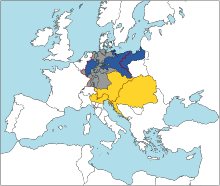
Customs union
A customs union is a type of trade bloc which is composed of a free trade area with a common external tariff. The participant countries set up common external trade policy, but in some cases they use different import quotas...
, was a coalition of German states formed to manage customs and economic policies within their territories. Established in 1818, the original union cemented economic ties between the various Prussian and Hohenzollern territories, and ensured economic contact between the non-contiguous holdings of the Hohenzollern family
House of Hohenzollern
The House of Hohenzollern is a noble family and royal dynasty of electors, kings and emperors of Prussia, Germany and Romania. It originated in the area around the town of Hechingen in Swabia during the 11th century. They took their name from their ancestral home, the Burg Hohenzollern castle near...
, which was also the ruling family of Prussia. It expanded between 1820 to 1866 to include most of the German states. Austria was excluded because of its highly protected industry; this economic exclusion exacerbated the Austro-Prussian rivalry for dominance in central Europe, particularly in the 1850s and 1860s. With the founding of the North German Confederation
North German Confederation
The North German Confederation 1866–71, was a federation of 22 independent states of northern Germany. It was formed by a constitution accepted by the member states in 1867 and controlled military and foreign policy. It included the new Reichstag, a parliament elected by universal manhood...
in 1866, the Zollverein included approximately 425,000 square kilometres, and had produced economic agreements with non-German states like Sweden and Luxembourg.
Historians have seen three Prussian goals: as a political tool to eliminate Austrian influence in Germany; as a way to improve the economies; and to strengthen Germany against potential French aggression while reducing the economic independence of smaller states. The Customs Union created a larger market for German-made farm and handicraft products and promoted commercial unification under fiscally sound economic parameters. While the Union sought to limit trade and commercial barriers between and among member states, it continued to uphold the protectionist barriers with outsiders.
The political strength of the Customs Union lay with the Prussians, whose promotion of the Little Germany solution of national political unification mirrored the Customs Union's economic solution. After the founding of the German Empire in 1871, the Empire assumed the control of the Union. Although not a state in the German Reich, Luxembourg
Luxembourg
Luxembourg , officially the Grand Duchy of Luxembourg , is a landlocked country in western Europe, bordered by Belgium, France, and Germany. It has two principal regions: the Oesling in the North as part of the Ardennes massif, and the Gutland in the south...
belonged to the Union until 1919 as a German customs region.
Background
Holy Roman Empire
The Holy Roman Empire was a realm that existed from 962 to 1806 in Central Europe.It was ruled by the Holy Roman Emperor. Its character changed during the Middle Ages and the Early Modern period, when the power of the emperor gradually weakened in favour of the princes...
in Central Europe, there were approximately 1800 customs barriers. Even within the Prussian state itself there were at the beginning of the 19th century over 67 local customs and tariffs with as many customs borders. To travel from Königsberg
Königsberg
Königsberg was the capital of East Prussia from the Late Middle Ages until 1945 as well as the northernmost and easternmost German city with 286,666 inhabitants . Due to the multicultural society in and around the city, there are several local names for it...
in East Prussia to Cologne
Cologne
Cologne is Germany's fourth-largest city , and is the largest city both in the Germany Federal State of North Rhine-Westphalia and within the Rhine-Ruhr Metropolitan Area, one of the major European metropolitan areas with more than ten million inhabitants.Cologne is located on both sides of the...
, for example, a shipment was inspected and taxed 18 times. Each customs inspection at each border slowed the shipment's progress from source to destination and each assessment on the shipment reduced profit and increased the price of goods, dramatically stifling trade.
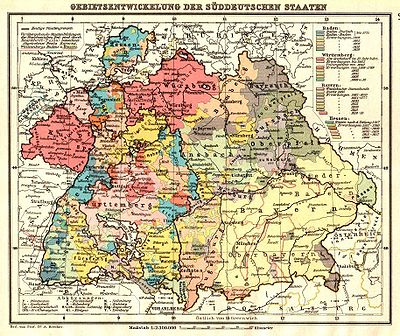
When France defeated the Second Coalition, made up of Russian, Austrian and German forces, and annexed territories up to the Rhine, there was a general consolidation of the myriad of tiny states in Germany in the Mediatization of 1803
German Mediatisation
The German Mediatisation was the series of mediatisations and secularisations that occurred in Germany between 1795 and 1814, during the latter part of the era of the French Revolution and then the Napoleonic Era....
, also called Principal Conclusion of the Extraordinary Imperial Delegation (or, in German, Hauptschluss der außerordentlichen Reichsdeputation, usually called the Reichsdeputationshauptschluss). This last piece of major legislation enacted by the Holy Roman Empire re-arranged the map of Central Europe, especially in the southwestern territories. The Reichshauptschluss resulted in the secularization of many ecclesiastical territories, and the so-called mediatization, i.e. the annexation to larger neighboring territories, of many of the formerly free imperial territories, including most of the imperial cities. Considerable portions of the Habsburg family territories in southwestern Central Europe were "mediatized," or given as compensation, to the princes and dukes who had themselves lost territories in the French expansion. Most of the imperial cities, imperial abbies, and ecclesiastical states and cities were mediatized or secularized in 1803. With the final dissolution of the Holy Roman Empire in 1806, most of the remaining tiny principalities were annexed by larger neighbors.
Initial efforts at a single toll system
During the Napoleonic Era, efforts toward economic unity in the RhinelandRhineland
Historically, the Rhinelands refers to a loosely-defined region embracing the land on either bank of the River Rhine in central Europe....
had mixed success. The Confederation of the Rhine
Confederation of the Rhine
The Confederation of the Rhine was a confederation of client states of the First French Empire. It was formed initially from 16 German states by Napoleon after he defeated Austria's Francis II and Russia's Alexander I in the Battle of Austerlitz. The Treaty of Pressburg, in effect, led to the...
, and the other satellite creations of Napoleonic France, sought to establish economic autonomy in European trade. By 1806, as Napoleon I
Napoleon I
Napoleon Bonaparte was a French military and political leader during the latter stages of the French Revolution.As Napoleon I, he was Emperor of the French from 1804 to 1815...
sought to secure his hegemony in Europe, the Continental System
Continental System
The Continental System or Continental Blockade was the foreign policy of Napoleon I of France in his struggle against the United Kingdom of Great Britain and Ireland during the Napoleonic Wars. It was a large-scale embargo against British trade, which began on November 21, 1806...
offered a semblance of unified effort toward a widespread domestic market for European goods. However, the main purpose of the Continental System was military not economic. Napoleon wanted a trade embargo against Britain, through which he hoped to wreck the British economy. The combination of war and isolation from Britain's trading system destroyed markets for external raw materials and for manufactured goods and resulted in the near ruin of the Central European economy. Especially hard hit were the trading economies of the Lowlands and Rhineland states, which had relied heavily upon imports of raw materials from throughout the world, and on the ability to export finished products. The domestic markets in Central Europe were not large enough to sustain consumption of their own production, and these problems were dramatically exacerbated by the excise taxes and tolls which were the main source of state income. Reduction in trade meant the near bankruptcy of the smaller states.
At the Congress of Vienna
Congress of Vienna
The Congress of Vienna was a conference of ambassadors of European states chaired by Klemens Wenzel von Metternich, and held in Vienna from September, 1814 to June, 1815. The objective of the Congress was to settle the many issues arising from the French Revolutionary Wars, the Napoleonic Wars,...
, in 1814-1815, diplomats, principally those from the Great Powers, confirmed the remapping of Europe, and broadly, the rest of the world, into spheres of influence. Central Europe, or German speaking Europe, remained largely within the influence of the Austrian Habsburgs, balanced at the periphery by the Russian empire in the east, and the French in the west; it was expected that Prussia would also play some role in these spheres of influence, but the ambiguities of the Austrian and Prussian relationship were unresolved. The German states themselves remained autonomous; however, the old imperial institution of the Reichstag was reinvented in the form of a Confederation Diet that would meet in Frankfurt. The Habsburg dukes, now Kings of Austria, were to serve as permanent presidents of this institution. Isolated voices, such as those of Joseph Görres and Freiherr vom Stein, called for the abolition of domestic tolls and the creation of a German tariff on imports. The mandate from the Vienna Congress, however, established the German Confederation
German Confederation
The German Confederation was the loose association of Central European states created by the Congress of Vienna in 1815 to coordinate the economies of separate German-speaking countries. It acted as a buffer between the powerful states of Austria and Prussia...
, but did not deal with the economic circumstances, nor did it make any effort to achieve economic and trade standardization. Instead, the articles that established the Conferation simply suggested that trade and transportation questions be discussed at a later date.
Problems with unifying the customs and toll agreements
In Prussia and in the south- and central- western states of Hesse-Nassau and Hesse-DarmstadtGrand Duchy of Hesse
The Grand Duchy of Hesse and by Rhine , or, between 1806 and 1816, Grand Duchy of Hesse —as it was also known after 1816—was a member state of the German Confederation from 1806, when the Landgraviate of Hesse-Darmstadt was elevated to a Grand Duchy, until 1918, when all the German...
, Württemberg
Württemberg
Württemberg , formerly known as Wirtemberg or Wurtemberg, is an area and a former state in southwestern Germany, including parts of the regions Swabia and Franconia....
, Baden
Baden
Baden is a historical state on the east bank of the Rhine in the southwest of Germany, now the western part of the Baden-Württemberg of Germany....
, and Bavaria
Bavaria
Bavaria, formally the Free State of Bavaria is a state of Germany, located in the southeast of Germany. With an area of , it is the largest state by area, forming almost 20% of the total land area of Germany...
were leaders in the modernization of the toll system within the German states. In the Prussian case, the experience of the Confederation of the Rhine in removing customs barriers offered an example of how it could be done, and Hans, Count von Bülow
Hans, Count von Bülow
Ludwig Friedrich Victor Hans, Count von Bülow was a Westphalian and Prussian statesman....
, who until 1811 had been the Finance Minister in Westphalia
Kingdom of Westphalia
The Kingdom of Westphalia was a new country of 2.6 million Germans that existed from 1807-1813. It included of territory in Hesse and other parts of present-day Germany. While formally independent, it was a vassal state of the First French Empire, ruled by Napoleon's brother Jérôme Bonaparte...
, and who had accepted this position in 1813 in Prussia, modeled the Prussian customs statutes on those of the former states of the Confederation. The addition of territory to the existing Prussian state made elimination of customs barriers a powerful factor in Prussian politics. The significant differences between "old" Prussia and the newly acquired territories complicated the debate. The "newer" Prussian provinces in the Rhineland and Westphalia, with their developing manufacturing sectors, contended with the heavily agricultural territories of "old" Prussia. The dissimilarities in the two sides of Prussia confirmed regional perceptions for the need for their own political and administrative units, which became an important element of the customs debate. Within "old" Prussia itself, the customs statues from 1818 reduced domestic customs barriers. After 1818, goods coming into Prussia and leaving Prussia were charged a high tariff. Goods moved freely within the state itself. The Prussian toll was therefore very simple and efficient. Manufactured goods were heavily taxed, especially textiles, and the most important taxes were for food, necessities and luxury goods.
Similarly, in the southwest German states, it became urgent to integrate the newly acquired territories into the states' existing economic systems. The territorial growth of the southwestern middle-sized states, in particular the two Hessian principalities, but also the growth of Baden and Württemberg, had split the territorial continuity of Prussia; the Prussian state was no longer linked entirely by territory, but rather was separated from many of its newer acquisitions by territories newly acquired by other states. These states often saw their own interests as conflicting generally and specifically with Prussian expansionism, and resented Prussian dominance and authority. Furthermore, these newly expanded states, usually referred as "middle-sized states" (or, in German, Mittelstaaten), faced problems in integrating their newly acquired territories and populations into an existing political, economic and legal structure.
A further problem was caused by international interference in the discussions due to vested interests. In particular the British Empire was seen to play a role in disrupting attempts to establish a Prussian customs union. British diplomats, particularly Envoy Edward James Nottingham, who wished to secure the continuation of their existing trade agreements, saw the development of a customs union as a threat to the economic status quo. Motivated by a desire to secure the import of Ruhr iron at favourable rates, a number of diplomats began petitioning for a general strike on the grounds that German managers were "quaffing Dortmund beer by the gallon, whilst Ruhr workers toiled: merely a cog in the machine of the industrial revolution." No general strike was called.
These problems were exacerbated by European wide economic woes following the Napoleonic Wars. Unemployment, high prices, especially for foodstuffs, characterized an economy not yet converted back to peace-time needs. The problem in Britain was particularly severe and the British response created a ripple effect that worsened problems in the German states: In trying to manage the post-war economy, the British government was caught between the Malthusian understanding of the relationship of wages, prices, and population, and the Ricardian model. On the one hand, adherents to the Malthusian model believed it was dangerous for Britain to rely on imported corn, because lower prices would reduce labor’s wages, and landlords and farmers would lose purchasing power. On the other hand, adherents to the Ricardian model thought that Britain could use its capital and population to advantage in a system of free trade. The problems in Britain established precedent for problems in the German states; the British limitation on grain imports, through the 1815 Corn (Grain) Law
Corn Laws
The Corn Laws were trade barriers designed to protect cereal producers in the United Kingdom of Great Britain and Ireland against competition from less expensive foreign imports between 1815 and 1846. The barriers were introduced by the Importation Act 1815 and repealed by the Importation Act 1846...
blocked economic recovery in the German states, particularly in eastern Prussia, by limiting the amount of grain that could be imported into Britain. Not only did the Corn Laws keep the price of grain in Britain high, it undermined the viability of Junker producers in east Prussia, and limited their access to external markets.
The commercial reform efforts sponsored by Bavaria in 1856 led to the General German Commercial Code in 1861 that was quickly approved by a majority of the confederation. It proved highly successful in reducing barriers and increasing trade.
The customs union 1820s and 1830s
- The 830 toll barriers in Germany cripple domestic traffic and bring more or less the same results: how if every limb of the human body were bound together, so that blood could not flow from one limb to the other? In order to trade from Hamburg to Austria, from Berlin to the Swiss Cantons, one must cut through the statutes of ten states, study ten tolls and toll barriers, ten times go through the toll barriers, and ten times pay the tolls. Who but the unfortunate has to negotiate such borders? To live with such borders? Where three or four states collide, there one must live his whole life under evil, senseless tolls and toll restrictions. That is no Fatherland!
In 1820, Württemberg planned to start a Customs Union among the so called Third Germany; the middle sized German states, including itself, Baden, Bavaria, and the two Hessian states. This Customs Union excluded both Austria and Prussia, primarily because the two major German powers were considered too overbearing. Plans foundered on the differing interests of the affected states. While the economic development in Baden proceeded relatively well, with its long borders and well entrenched infrastructure for trade, economic development in Bavaria lagged well behind it, and the Bavarian regime enacted a protective tariff on goods produced outside its border. The result was a short lived trade agreement between Baden and Hessen-Darmstadt. Nevertheless, a second agreement, reached in Stuttgart in 1825, established rapport between Württemberg and Bavaria, with the foundation of the South German Customs Union. In opposition to the Prussian activities, Hannover, Saxony, Hesse, and other states (Austria, France, Great Britain, and the Netherlands), developed their own economic agreements. While they promised one another not to join the Prussian union, they did develop trade agreements of their own. The Union remained unsuccessful, because it only sought to maintain the status quo, not to fix the problems created by toll barriers. In 1834, Baden and Württemberg joined the Prussian union, which was renamed the German Customs Union.
By 1835, the German Customs Union had expanded to include the majority of the states of the German Confederation
German Confederation
The German Confederation was the loose association of Central European states created by the Congress of Vienna in 1815 to coordinate the economies of separate German-speaking countries. It acted as a buffer between the powerful states of Austria and Prussia...
, even Saxony, Thuringia, Württemberg and Baden, Bavaria, and the Hessen states. Functionally, it removed many internal customs barriers, while upholding a protectionist tariff system with foreign trade partners.
Timeline
- 1815 Establishment of the German Confederation left the question of economic and customs authority to future negotiation.
- 1818 Prussia established an internal customs union throughout its state and Hohenzollern territories in southwestern Germany.
- 1819 Baden proposition for a customs union organized through the German Confederation. Failed at Frankfurt Diet.
- 1821 AnhaltAnhaltAnhalt was a sovereign county in Germany, located between the Harz Mountains and the river Elbe in Middle Germany. It now forms part of the state of Saxony-Anhalt.- Dukes of Anhalt :...
joined the Prussian Customs Union. - 1826 Mecklenburg-SchwerinMecklenburg-SchwerinMecklenburg-Schwerin was a duchy in northern Germany created in 1348, when Albert II of Mecklenburg and his younger brother John were raised to Dukes of Mecklenburg by King Charles IV...
joined. - 1828 Original customs convention between PrussiaPrussiaPrussia was a German kingdom and historic state originating out of the Duchy of Prussia and the Margraviate of Brandenburg. For centuries, the House of Hohenzollern ruled Prussia, successfully expanding its size by way of an unusually well-organized and effective army. Prussia shaped the history...
and the Grand Duchy of HesseGrand Duchy of HesseThe Grand Duchy of Hesse and by Rhine , or, between 1806 and 1816, Grand Duchy of Hesse —as it was also known after 1816—was a member state of the German Confederation from 1806, when the Landgraviate of Hesse-Darmstadt was elevated to a Grand Duchy, until 1918, when all the German...
(Hesse-Darmstadt). - 1831 Electoral HesseHesse-KasselThe Landgraviate of Hesse-Kassel or Hesse-Cassel was a state in the Holy Roman Empire under Imperial immediacy that came into existence when the Landgraviate of Hesse was divided in 1567 upon the death of Philip I, Landgrave of Hesse. His eldest son William IV inherited the northern half and the...
(or Hesse-Kassel), SaxonySaxonyThe Free State of Saxony is a landlocked state of Germany, contingent with Brandenburg, Saxony Anhalt, Thuringia, Bavaria, the Czech Republic and Poland. It is the tenth-largest German state in area, with of Germany's sixteen states....
joined. - 1833 Thuringian StatesThuringiaThe Free State of Thuringia is a state of Germany, located in the central part of the country.It has an area of and 2.29 million inhabitants, making it the sixth smallest by area and the fifth smallest by population of Germany's sixteen states....
, Bavarian Palatinate joined. - 1834 BavariaBavariaBavaria, formally the Free State of Bavaria is a state of Germany, located in the southeast of Germany. With an area of , it is the largest state by area, forming almost 20% of the total land area of Germany...
, WürttembergWürttembergWürttemberg , formerly known as Wirtemberg or Wurtemberg, is an area and a former state in southwestern Germany, including parts of the regions Swabia and Franconia....
joined. CensusCensus in GermanyA census in Germany was held every five years from 1875 to 1910. After the World Wars, only few full population censuses were held, the last in 1987. Germany, which since has relied on population samples, will participate in the EU-wide census in 2011....
introduced for revenue sharing - 1835 NassauNassau (state)Nassau was a German state within the Holy Roman Empire and later in the German Confederation. Its ruling dynasty, now extinct in male line, was the House of Nassau.-Origins:...
, BadenBadenBaden is a historical state on the east bank of the Rhine in the southwest of Germany, now the western part of the Baden-Württemberg of Germany....
joined. - 1836 FrankfurtFree City of FrankfurtFor almost five centuries, the German city of Frankfurt am Main was a city-state within two major Germanic states:*The Holy Roman Empire as the Free Imperial City of Frankfurt...
joined. - 1840-1847 Potato blight throughout the southwestern states, Saxony, and parts of Prussia.
- 1841 BrunswickDuchy of BrunswickBrunswick was a historical state in Germany. Originally the territory of Brunswick-Wolfenbüttel in the Holy Roman Empire, it was established as an independent duchy by the Congress of Vienna in 1815...
joined. - 1842 LuxembourgLuxembourgLuxembourg , officially the Grand Duchy of Luxembourg , is a landlocked country in western Europe, bordered by Belgium, France, and Germany. It has two principal regions: the Oesling in the North as part of the Ardennes massif, and the Gutland in the south...
joined - 1848–49 Revolutions; propositions in Frankfurt for a political and economic union. Presentation of the Kleindeutschland (Lesser Germany) solution for political unification.
- 1851 HanoverHanoverHanover or Hannover, on the river Leine, is the capital of the federal state of Lower Saxony , Germany and was once by personal union the family seat of the Hanoverian Kings of Great Britain, under their title as the dukes of Brunswick-Lüneburg...
joined. - 1852 London Protocol of 1852 confirmed the Danish succession and the autonomy of the duchies of SchleswigSchleswigSchleswig or South Jutland is a region covering the area about 60 km north and 70 km south of the border between Germany and Denmark; the territory has been divided between the two countries since 1920, with Northern Schleswig in Denmark and Southern Schleswig in Germany...
and HolsteinHolsteinHolstein is the region between the rivers Elbe and Eider. It is part of Schleswig-Holstein, the northernmost state of Germany....
. OldenburgOldenburgOldenburg is an independent city in Lower Saxony, Germany. It is situated in the western part of the state between the cities of Bremen and Groningen, Netherlands, at the Hunte river. It has a population of 160,279 which makes it the fourth biggest city in Lower Saxony after Hanover, Braunschweig...
joined. - 1864 Prussia and Austria engaged in a border war with Denmark, over the autonomy of the duchies of Holstein and Schleswig (Second War of SchleswigSecond War of SchleswigThe Second Schleswig War was the second military conflict as a result of the Schleswig-Holstein Question. It began on 1 February 1864, when Prussian forces crossed the border into Schleswig.Denmark fought Prussia and Austria...
). - 1865 SwedenSwedenSweden , officially the Kingdom of Sweden , is a Nordic country on the Scandinavian Peninsula in Northern Europe. Sweden borders with Norway and Finland and is connected to Denmark by a bridge-tunnel across the Öresund....
signed free trade agreement with the union, linking the German members to the massive Scandinavian market. - 1866 Austro-Prussian WarAustro-Prussian WarThe Austro-Prussian War was a war fought in 1866 between the German Confederation under the leadership of the Austrian Empire and its German allies on one side and the Kingdom of Prussia with its German allies and Italy on the...
, in which Austria lost its political and diplomatic clout in the Confederation. - 1867 Reconstitution of the Zollverein.
- 1868 Schleswig-HolsteinSchleswig-HolsteinSchleswig-Holstein is the northernmost of the sixteen states of Germany, comprising most of the historical duchy of Holstein and the southern part of the former Duchy of Schleswig...
, Lauenburg, MecklenburgMecklenburgMecklenburg is a historical region in northern Germany comprising the western and larger part of the federal-state Mecklenburg-Vorpommern...
joined. - 1871 Alsace-LorraineAlsace-LorraineThe Imperial Territory of Alsace-Lorraine was a territory created by the German Empire in 1871 after it annexed most of Alsace and the Moselle region of Lorraine following its victory in the Franco-Prussian War. The Alsatian part lay in the Rhine Valley on the west bank of the Rhine River and east...
joined (after being acquired by Germany following the Franco-Prussian warFranco-Prussian WarThe Franco-Prussian War or Franco-German War, often referred to in France as the 1870 War was a conflict between the Second French Empire and the Kingdom of Prussia. Prussia was aided by the North German Confederation, of which it was a member, and the South German states of Baden, Württemberg and...
). - 1888 The city-states of HamburgHamburg-History:The first historic name for the city was, according to Claudius Ptolemy's reports, Treva.But the city takes its modern name, Hamburg, from the first permanent building on the site, a castle whose construction was ordered by the Emperor Charlemagne in AD 808...
and BremenBremenThe City Municipality of Bremen is a Hanseatic city in northwestern Germany. A commercial and industrial city with a major port on the river Weser, Bremen is part of the Bremen-Oldenburg metropolitan area . Bremen is the second most populous city in North Germany and tenth in Germany.Bremen is...
joined, 17 years after political unification.
The original Customs Union was not ended in 1866 with outbreak of the Austro-Prussian War
Austro-Prussian War
The Austro-Prussian War was a war fought in 1866 between the German Confederation under the leadership of the Austrian Empire and its German allies on one side and the Kingdom of Prussia with its German allies and Italy on the...
; a reorganization emerged in 1867. The new Zollverein was stronger, in that no individual state had a veto.
Role in German unification
The Zollverein, in retrospect, did much more than simply cement alliances between the various German states as its Prussian architects had intended—it set the groundwork for the unification of Germany under Prussian dominance, achieved less than five decades later. Some economic historians such as Helmut Böhme use the Zollverein to dispute the general view of BismarckOtto von Bismarck
Otto Eduard Leopold, Prince of Bismarck, Duke of Lauenburg , simply known as Otto von Bismarck, was a Prussian-German statesman whose actions unified Germany, made it a major player in world affairs, and created a balance of power that kept Europe at peace after 1871.As Minister President of...
as the unifier of Germany, insisting that the economic dominance of Prussia made unification inevitable, as it led invariably to military dominance, and thus political primacy. Secondly, these historians argue, the Zollverein established an anti-Austrian tradition among the Prussians. By this argument, Bismarck cannot be said to have revolutionized Prussian politics when the Zollverein gives evidence of an anti-Austrian flow of German unification for 30 years before he became the Prussian head of government.
Further reading
- W. O. Henderson. The Zollverein (1959)
- David T. Murphy, "Prussian aims for the Zollverein, 1828-1833," Historian, Winter 1991, Vol. 53#2 pp 285–302
- James J. Sheehan. German History, 1770-1866 (1993) excerpt and text search