
All Topics  
Berlin Wall

 
Berlin Wall

   Email Print
   Bookmark   Link


Berlin Wall


The Berlin Wall was a physical barrier
Separation barrier

The term separation barrier is a euphemism for walls or fences constructed to limit the movement of people across a certain line or border, or to separate two populations....
 separating West Berlin
West Berlin

West Berlin was the name given to the western part of Berlin between 1949 and 1990. It consisted of the American, British, and French occupation sectors established in 1945....
 from the German Democratic Republic (GDR) (East Germany), including East Berlin
East Berlin

East Berlin was the name given to the eastern part of Berlin between 1949 and 1990. It consisted of the Soviet Union Allied Occupation Zones in Germany of Berlin that was established in 1945....
. The longer inner German border demarcated the border between East and West Germany
West Germany

West Germany was the common English name for the Germany , from its formation in May 1949 to German reunification in October 1990, when East Germany was dissolved and its States of Germany became part of the Federal Republic, ending the more than 40-year division of Germany....
.


Discussion
Ask a question about 'Berlin Wall'
Start a new discussion about 'Berlin Wall'
Answer questions from other users
Full Discussion Forum


Recent Posts


Encyclopedia


Berlin Satellite Image With Berlin Wall
The Berlin Wall was a physical barrier
Separation barrier

The term separation barrier is a euphemism for walls or fences constructed to limit the movement of people across a certain line or border, or to separate two populations....
 separating West Berlin
West Berlin

West Berlin was the name given to the western part of Berlin between 1949 and 1990. It consisted of the American, British, and French occupation sectors established in 1945....
 from the German Democratic Republic (GDR) (East Germany), including East Berlin
East Berlin

East Berlin was the name given to the eastern part of Berlin between 1949 and 1990. It consisted of the Soviet Union Allied Occupation Zones in Germany of Berlin that was established in 1945....
. The longer inner German border demarcated the border between East and West Germany
West Germany

West Germany was the common English name for the Germany , from its formation in May 1949 to German reunification in October 1990, when East Germany was dissolved and its States of Germany became part of the Federal Republic, ending the more than 40-year division of Germany....
. Both borders came to symbolize the Iron Curtain
Iron Curtain

The Iron Curtain was the symbolic, ideological, and physical boundary dividing Europe into two separate areas from the end of World War II in 1945 until the end of the Cold War in 1991....
 between Western
Western Europe

Western Europe refers to the countries in the western most half of Europe. This concept has had different meanings, political and cultural as well as geographical issues have influenced the area....
 and Eastern Europe
Eastern Europe

Eastern Europe is a term that applies to the geopolitical region encompassing the easternmost part of the Europe. Throughout history and to a lesser extent today, parts of Eastern Europe has been distinguishable from Western Europe and other regions due to cultural, religious, economic, and historical reasons, even though there i...
 and, ultimately, between USA and the Soviet Union.

The wall separated East Germany from West Germany for more than a quarter-century, from the day construction began on August 13, 1961 until the Wall was opened on November 9, 1989.

During this period, at least 98 people were confirmed killed trying to cross the Wall into West Berlin, according to official figures. However, a prominent victims' group claims that more than 200 people were killed trying to flee from East to West Berlin. The East German government issued shooting orders to border guards dealing with defectors; such orders are not the same as shoot to kill orders which GDR officials denied ever issuing.

When the East German government announced on November 9, 1989, after several weeks of civil unrest, that all GDR citizens could visit West Germany and West Berlin, crowds of East Germans climbed onto and crossed the wall, joined by West Germans on the other side in a celebratory atmosphere. Over the next few weeks, parts of the wall were chipped away by a euphoric public and by souvenir hunters; industrial equipment was later used to remove almost all of the rest of it.

The fall of the Berlin Wall paved the way for German reunification
German reunification

German reunification took place twice after 1945: first in 1957, the Saarland was permitted to join the Federal Republic of Germany, and again on 3 October 1990, when the five re-established states of the German Democratic Republic joined the Germany , and Berlin was united into a single city-state....
, which was formally concluded on October 3, 1990.

Background


After the end of World War II in Europe
End of World War II in Europe

The final battles of the European Theatre of World War II of World War II as well as the German surrender took place in late April and early May 1945....
, what remained of Nazi Germany
Nazi Germany

Nazi Germany and the Third Reich are the colloquial English names for Germany under the regime of Adolf Hitler and the Nazi Party , which established a Totalitarianism dictatorship that existed from 1933 to 1945....
 west of the Oder-Neisse line
Oder-Neisse line

The Oder-Neisse line was drawn in the aftermath of World War II as the eastern border of Germany and the western border of Poland. The line is formed primarily by the Oder and Lusatian Neisse rivers, and meets the Baltic Sea west of the seaport cities of Szczecin and Swinoujscie ....
 was divided into four occupation zones (per the Potsdam Agreement
Potsdam Agreement

The Potsdam Agreement was an agreement on policy for the occupation and reconstruction of Germany and other nations after fighting in the European Theatre of World War II had ended with the German surrender of May 8, 1945....
), each one controlled by one of the four occupying Allied powers
Allies of World War II

The Allies of World War II were the countries officially opposed to the Axis powers of World War II during the World War II. Within the ranks of the Allies powers, the British Empire, the Soviet Union, and the United States of America were known as "The Big Three"....
: the Americans
United States

The United States of America is a Federal government constitutional republic comprising U.S. state and a federal district. The country is situated mostly in central North America, where its Contiguous United States and Washington, D.C., the Capital districts and territories, lie between the Pacific Ocean and Atlantic Oceans, Borders of the U...
, British
United Kingdom

The United Kingdom of Great Britain and Northern Ireland, commonly known as the United Kingdom , the UK or Britain,is a sovereign state located off the northwestern coast of continental Europe....
, French
France

France , officially the French Republic , is a country whose Metropolitan France is located in Western Europe and that also comprises various Overseas departments and territories of France....
 and Soviets
Soviet Union

The Union of Soviet Socialist Republics was a Constitution of the Soviet Union socialist state that existed in Eurasia from 1922 to 1991.The name is a translation of the , romanization of Russian Soyuz Sovetskikh Sotsialisticheskikh Respublik, abbreviated ????, SSSR....
. The capital, Berlin, as the seat of the Allied Control Council
Allied Control Council

The Allied Control Council or Allied Control Authority, known in German language as the Alliierter Kontrollrat, also referred to as the Four Powers , was a military occupation governing body of the Allied Occupation Zones in Germany after the end of World War II in Europe; the members were the United States, the United Kingdo...
, was similarly subdivided into four sectors despite the city lying deep inside the Soviet zone. Although the occupying powers originally intended to jointly govern Germany within its postwar borders, the advent of Cold War
Cold War

The Cold War was the continuing state of conflict, tension and competition that existed between a number of world powers, including the United States, the Soviet Union, People's Republic of China, France, United Kingdom and those countries' respective allies from the mid-1940s to the early 1990s....
 tensions caused the French, British and American zones to be formed into the Federal Republic of Germany (and West Berlin) in 1949, excluding the Soviet zone, which then formed the German Democratic Republic
German Democratic Republic

The German Democratic Republic was a self-declared socialist state created in the Soviet Zone of occupied Germany and the East Berlin of Allied Occupation Zones in Germany....
 (including East Berlin).

Divergence of the two German states

West Germany, known in German as the Bundesrepublik Deutschland (Federal Republic of Germany), developed into a Western capitalist country with a social market economy
Social market economy

The social market economy was the main Economic system used in Western Europe and Northern Europe during the Cold War era. It originated in West Germany, and it is known as Soziale Marktwirtschaft in German language....
 ("Soziale Marktwirtschaft" in German) and a democratic
Democracy

Democracy is a form of government in which power is held directly or indirectly by citizens under a free electoral system. It is derived from the Greek language d?????at?a , "popular government" which was coined from d???? , "people" and ???t?? , "rule, strength" in the middle of the 5th-4th century BC to denote the political syst...
 parliamentary government. Continual economic growth starting in the 1950s fuelled a 30-year "economic miracle
Wirtschaftswunder

The term describes the rapid reconstruction and development of the Economy of West Germany and Austria after World War II. The expression was used by The Times in 1950....
" ("Wirtschaftswunder"). Across the inner-German border, East Germany, known in Germany as the Deutsche Demokratische Republik (German Democratic Republic), established an authoritarian government with a Soviet-style planned economy
Planned economy

A planned economy or directed economy is an economic system in which the government or workers' councils manages the economy. It is an economic system in which the central government makes all decisions on the production and consumption of goods and services....
. As West Germany's economy grew and its standard of living continually improved, many East Germans wanted to move to West Germany.

Erection of the Inner-German Border

On April 1, 1952, East German leaders met the Soviet leader Joseph Stalin
Joseph Stalin

Joseph Stalin was the General Secretary of the Communist Party of the Soviet Union's Central Committee of the Communist Party of the Soviet Union from 1922 until his death in 1953....
 in Moscow; during the discussions Stalin's foreign minister Vyacheslav Molotov
Vyacheslav Molotov

Vyacheslav Mikhailovich Molotov , Soviet Union politician and diplomacy, was a leading figure in the Government of the Soviet Union from the 1920s, when he rose to power as a prot?g? of Joseph Stalin, to 1957, when he was dismissed from Presidium of the Central Committee by Nikita Khrushchev....
 proposed that the East Germans should "introduce a system of passes for visits of West Berlin residents to the territory of East Berlin [so as to stop] free movement of Western agents" in the GDR. Stalin agreed, calling the situation "intolerable". He advised the East Germans to build up their border defenses, telling them that "The demarcation line between East and West Germany should be considered a border – and not just any border, but a dangerous one ... The Germans will guard the line of defense with their lives."

Consequently, the Inner German border between the two German states was closed, and a barbed-wire fence erected. The border between the Western and Eastern sectors of Berlin, however, remained open, although traffic between the Soviet and the Western sectors was somewhat restricted. This resulted in Berlin becoming a magnet for East Germans desperate to escape life in the GDR, and also a flashpoint for tension between the superpower
Superpower

A superpower is a state with a leading position in the international relations and the ability to influence events and its own interests and project Power in international relations to protect those interests; it is traditionally considered to be one step higher than a great power....
s--the United States and the Soviet Union.

Construction begins, 1961

Berlin Wall 1961 11 20
On 15 June 1961, two months before the construction of the Berlin Wall started, First Secretary of the Socialist Unity Party
Socialist Unity Party of Germany

The Socialist Unity Party of Germany was the governing party of the German Democratic Republic from its formation on 7 October 1949 until the elections of March 1990....
 and GDR State Council
Staatsrat

File:Bundesarchiv Bild 183-Z0624-038, Berlin, DDR-Staatsratsitzung.jpgThe State Council of the German Democratic Republic was in the German Democratic Republic the formally highest collective body, which was created with law over the formation of the Council of State from 12 September 1960 as follow-up organ of the abolished office of the...
 chairman Walter Ulbricht
Walter Ulbricht

Walter Ulbricht was a German communist politician. As General Secretary of the Socialist Unity Party of Germany from 1950 to 1971, he played a leading role in the early development and establishment of the German Democratic Republic ....
 stated in an international press conference, "Niemand hat die Absicht, eine Mauer zu errichten!" (No one has the intention of erecting a wall!). It was the first time the colloquial term Mauer (wall) had been used in this context.

On Saturday, 12 August 1961, the leaders of the GDR attended a garden party at a government guesthouse in Döllnsee, in a wooded area to the north of East Berlin, at which time Ulbricht signed the order to close the border and erect a wall.

At midnight, the police and units of the East German army began to close the border and by Sunday morning, 13 August 1961, the border with West Berlin was closed. East German troops and workers had begun to tear up streets running alongside the border to make them impassable to most vehicles, and to install barbed wire entanglements and fences along the 156 km (97 miles) around the three western sectors and the 43 km (27 miles) which actually divided West and East Berlin. The Soviets were not directly involved.

The barrier was built slightly inside East Berlin or East German territory to ensure that it did not encroach on West Berlin at any point, and was later built up into the Wall proper, the first concrete elements and large blocks being put in place on August 15. During the construction of the Wall, NVA
National People's Army

The National People?s Army was the military of the German Democratic Republic....
 and KdA
Combat Groups of the Working Class

The Combat Groups of the Working Class was a paramilitary organisation in East Germany, founded in 1953 and abolished in 1990. It numbered about 400,000 volunteers for much of its existence....
 soldiers stood in front of it with orders to shoot anyone who attempted to defect. Additionally, chain fences, walls, minefields, and other obstacles were installed along the length of the inner-German border between East and West Germany.

Immediate effects

Due to the closure of the East-West sector boundary in Berlin, the vast majority of East Germans could no longer travel or emigrate to West Germany. Many families were split, while East Berliners employed in the West were cut off from their jobs; West Berlin became an isolated enclave in a hostile land. West Berliners demonstrated against the wall, led by their Mayor (Oberbürgermeister) Willy Brandt
Willy Brandt

Willy Brandt, born Herbert Ernst Karl Frahm , was a Germany politician, Chancellor of Germany of West Germany 1969–1974, and leader of the Social Democratic Party of Germany 1964–1987....
, who strongly criticized the United States for failing to respond. Allied intelligence agencies had hypothesized about a wall to stop the flood of refugees, but the main candidate for its location was around the perimeter of the city.

Kennedy in Berlin
John F. Kennedy had acknowledged in a speech on July 25, 1961, that the United States could hope to defend only West Berliners and West Germans; to attempt to stand up for East Germans would result only in an embarrassing downfall. Accordingly, the administration made polite protests at length via the usual channels, but without fervour, even though it was a violation of the postwar Potsdam Agreements, which gave the United Kingdom, France and the United States a say over the administration of the whole of Berlin. Indeed, a few months after the barbed wire was erected, the U.S. government informed the Soviet government that it accepted the Wall as "a fact of international life" and would not challenge it by force. U.S. and UK sources had expected the Soviet sector to be sealed off from West Berlin, which had appeared to be the best option the GDR and Soviet powers had at their disposal, but were surprised how long it had taken for a move of this kind. They also saw the wall as an end to concerns about a GDR/Soviet retaking or capture of the whole of Berlin; the wall would presumably have been an unnecessary project if such plans were afloat. Thus the possibility of a military conflict over Berlin decreased.

The East German government claimed that the Wall was an "anti-Fascist protective rampart" ("antifaschistischer Schutzwall") intended to dissuade aggression from the West . Another official justification was the activities of western agents in Eastern Europe . A yet different explanation was that West Berliners were buying out state-subsidized goods in East Berlin. Most of these positions were, however, viewed with skepticism even in East Germany, even more so since most of the time, the border was only closed for citizens of East Germany travelling to the West, but not for residents of West Berlin travelling to the East. The construction of the Wall had caused considerable hardship to families divided by it, and the view that the Wall was mainly a means of preventing the citizens of East Germany from entering West Berlin or fleeing was widely accepted.

An East German propaganda booklet published in 1955 outlined the seriousness of 'flight from the republic'
Republikflucht

"Republikflucht" and "Republikfl?chtling" were the terms used by authorities in the German Democratic Republic to describe the process of and the person leaving the Soviet occupation zone and the GDR for a life in the American occupation zone West Germany or any other Western country....
 to SED
Socialist Unity Party of Germany

The Socialist Unity Party of Germany was the governing party of the German Democratic Republic from its formation on 7 October 1949 until the elections of March 1990....
 party agitators:

Secondary response

It was clear both that West German morale needed lifting and that there was a serious potential threat to the viability of West Berlin. If West Berlin fell after all the efforts of the Berlin Airlift
Berlin Blockade

The Berlin Blockade, also known as the "German hold-up" was one of the first major international crisis of the Cold War. During the multinational occupation of post-World War II Germany, the Soviet Union blocked the three Western powers' railroad and road access to the western sectors of Berlin that they had been controlling....
, how could any of America's other allies rely on it? On the other hand, in the face of any serious Soviet threat, an enclave like West Berlin could not be defended except with nuclear weapons. As such, it was vitally important for the Americans to show the Soviets a display of strength and also placate West German and French pressure for a more serious response.

Accordingly, General Lucius D. Clay
Lucius D. Clay

General Lucius Dubignon Clay was an USA general and military governor best known for his administration of Germany immediately after World War II....
, an anti-communist who was known to have a firm attitude towards the Soviets, was sent to Berlin with ambassadorial rank as Kennedy's special advisor. He and Vice President Lyndon B. Johnson
Lyndon B. Johnson

Lyndon Baines Johnson , often referred to as LBJ, was the List of Presidents of the United States President of the United States and List of Vice Presidents of the United States Vice President of the United States ....
 arrived at Tempelhof Airport
Tempelhof International Airport

File:FlughafenBerlinTempelhof1984.jpgThe now-defunct Berlin Tempelhof Airport was Airports in Berlin in Berlin, Germany, situated in the south-central Boroughs of Berlin of Tempelhof-Sch?neberg....
 on the afternoon of Saturday August 19.

They arrived in a city defended by what would soon be known as the "Berlin Brigade
Berlin Brigade

After the end of World War II, under the conditions of the Yalta Conference and Potsdam Conference agreements, Allied forces occupied West Berlin. This occupation lasted throughout the Cold War....
", which then consisted of the 2nd and 3rd Battle Groups of the 6th Infantry, with Company F, 40th Armor. The battle groups were "pentatomic" (a flatter command structure with five battle groups instead of the old three regiments with three battalions, and also equipped with tactical nuclear weapon
Tactical nuclear weapon

A tactical nuclear weapon refers to a nuclear weapon which is designed to be used on a battlefield in military situations. This is as opposed to strategic nuclear weapons which are designed to threaten large populations, damage the enemy's ability to wage war, or for general deterrence....
s), with 1,362 officers and men each. On August 16, Kennedy had given the order for them to be reinforced. Early on August 19, the 1st Battle Group, 18th Infantry (commanded by Col. Glover S. Johns Jr.) was alerted.

On Sunday morning, lead elements arranged in a column of 491 vehicles and trailers carrying 1,500 men divided into five march units and left the Helmstedt-Marienborn checkpoint at 06:34. At Marienborn
Marienborn

Marienborn is a municipality in the B?rde Districts of Germany in Saxony-Anhalt, Germany.See also*Helmstedt-Marienborn border crossing...
, the Soviet checkpoint next to Helmstedt
Helmstedt

Helmstedt ['h?lm??t?t] is a city located at the eastern edge of the Germany state of Lower Saxony. It is the capital of the Helmstedt . Helmstedt has 26,000 inhabitants ....
 on the West German/East German border, U.S. personnel were counted by guards. The column was 160 km (~100 miles) long, and covered 177 km (~110 miles) from Marienborn to Berlin in full battle gear, with VoPos (East German police) watching from beside trees next to the autobahn
Autobahn

is the German language word for a major high-speed road restricted to motor vehicles capable of driving at least and having full control of access, similar to a motorway or freeway in English-speaking countries....
 all the way along. The front of the convoy arrived at the outskirts of Berlin just before noon, to be met by Clay and Johnson, before parading through the streets of Berlin to an adoring crowd. At 04:00 on August 21, Lyndon Johnson left a visibly reassured West Berlin in the hands of Gen. Frederick O. Hartel and his brigade of 4,224 officers and men. Every three months for the next three and a half years, a new American battalion was rotated into West Berlin by autobahn to demonstrate Allied rights.

The creation of the Wall had important implications for both German states. By stemming the exodus of people from East Germany, the East German government was able to reassert its control over the country: in spite of discontent with the wall, economic problems caused by dual currency and the black market were largely eliminated, and the economy in the GDR began to grow. However, the Wall proved a public relations disaster for the communist bloc as a whole. Western powers used it in propaganda as a symbol of communist tyranny, particularly after the shootings of would-be defectors (which were later treated as acts of murder by the reunified Germany).

Layout and modifications

Karte Berliner Mauer En
The Berlin Wall was more than long. In June of 1962, a second, parallel fence some farther into East German territory was built. The houses contained between the fences were razed and the inhabitants relocated, thus establishing the No Man's Land
No Man's Land

No Man's Land may refer to the following:...
 that later became known as The Death Strip. The No Man's Land was covered with raked gravel, rendering footprints easy to notice thus enabling officers to see which guards had neglected their task; it offered no cover; most important, it offered clear fields of fire for the wall guards. Through the years, the Berlin Wall evolved through four versions:

  1. Wire fence (1961)
  2. Improved wire fence (1962–1965)
  3. Concrete wall (1965–1975)
  4. Grenzmauer 75 (Border Wall 75) (1975–1989)


The "fourth-generation wall", known officially as "Stützwandelement UL 12.11" (retaining wall element UL 12.11), was the final and most sophisticated version of the Wall. Begun in 1975 and completed about 1980, it was constructed from 45,000 separate sections of reinforced concrete, each high and wide, and cost 16,155,000 East German Marks
East German mark

The East German mark commonly called the eastern mark , in East Germany only Mark, was the currency of the German Democratic Republic ....
 or about 3,638,000 United States Dollars
United States dollar

The United States dollar is the unit of currency of the United States and was defined by the Coinage Act of 1792 to be between 371 and 416 grains of silver ....
. The top of the wall was lined with a smooth pipe, intended to make it more difficult to scale. It was reinforced by mesh fencing
Fence

A fence is a freestanding structure designed to restrict or prevent Transport across a boundary. It is generally distinguished from a wall by the lightness of its construction: a wall is usually restricted to such barriers made from solid brick or concrete, blocking vision as well as passage ....
, signal fencing, anti-vehicle trenches, barbed wire
Barbed wire

Barbed wire, also known as barb wire , is a type of fencing wire constructed with sharp edges or points arranged at intervals along the strand....
, dogs on long lines, "fakir beds
Bed of nails

A bed of nails is typically an oblong piece of wood, the size of a bed, with nail s pointing upwards out of it. It appears to the spectator that anyone lying on this "bed" would be injured by the nails, but this is not so, assuming the nails are numerous enough, since the weight is distributed between them such that the force exerted on ea...
" under balconies hanging over the "death strip", over 116 watchtowers, and 20 bunker
Bunker

A military bunker is a hardened shelter, often buried partly or fully underground, designed to protect the inhabitants from falling bombs or other attacks....
s. This version of the Wall is the one most commonly seen in photographs, and surviving fragments
List of Berlin Wall portions

Many portions of the Berlin Wall have been given to institutions since its fall on November 9, 1989....
 of the Wall in Berlin and elsewhere around the world are generally pieces of the fourth-generation Wall. The layout came to resemble the inner-German border in most technical aspects, except the Berlin Wall had no landmines and no Spring-gun
Spring-gun

A spring-gun is a gun, often a shotgun, rigged to fire when a string or other triggering device is tripped by contact of sufficient force to "spring" the trigger so that anyone stumbling over or treading on them would discharge it and wound themselves....
s.

Surrounding municipalities

Besides the sector-sector boundary within Berlin itself, the wall also separated West Berlin from the present-day state of Brandenburg
Brandenburg

Brandenburg is one of the sixteen states of Germany of Germany. It lies in the east of the country and is one of the new federal states that were re-created in 1990 upon the reunification of the former West Germany and East Germany....
. The following present-day municipalities, listed in counter-clockwise direction, share a border with former West Berlin:
  • Oberhavel
    Oberhavel

    Oberhavel is a Kreis in the northern part of Brandenburg, Germany. Neighboring districts are Mecklenburg-Strelitz in Mecklenburg-Western Pomerania, the districts Uckermark, Barnim, the Bundesland Berlin, and the districts Havelland and Ostprignitz-Ruppin....
     :
    Mühlenbecker Land
    Mühlenbecker Land

    M?hlenbecker Land is a Municipalities of Germany in the Oberhavel district, in Brandenburg, Germany....
     (partially), Glienicke/Nordbahn
    Glienicke/Nordbahn

    Glienicke/Nordbahn is a Municipalities of Germany in the Oberhavel district, in Brandenburg, Germany. It ls located right north of Berlin....
    , Hohen Neuendorf
    Hohen Neuendorf

    Hohen Neuendorf is a town in the Oberhavel district, in Brandenburg, Germany. It is located north west of Berlin....
    , Hennigsdorf
    Hennigsdorf

    Hennigsdorf is a town in the district of Oberhavel, in Brandenburg, Germany. It is situated north-west of Berlin, just across the city border, which is formed mainly by the Havel river....
  • Havelland
    Havelland

    Havelland [] is a geograhical region and district in Brandenburg, Germany. It is bounded by the districts of Ostprignitz-Ruppin and Oberhavel, the city-state of Berlin, the district of Potsdam-Mittelmark, the city of Brandenburg and the state of Saxony-Anhalt ....
     :
    Schönwalde-Glien
    Schönwalde-Glien

    Sch?nwalde-Glien is a community in the Havelland district, in Brandenburg, Germany....
    , Falkensee
    Falkensee

    Falkensee is a town in the Havelland district, Brandenburg, Germany. During World War II, the Demag-Panzerwerke subcamp of the Sachsenhausen concentration camp was located here....
    , Dallgow-Döberitz
    Dallgow-Döberitz

    Dallgow-D?beritz is a municipality in the Havelland district, in Brandenburg, Germany. It consists of the villages Dallgow-D?beritz, Rohrbeck and Seeburg....
  • Potsdam
    Potsdam

    Potsdam is the capital city of the Germany States of Germany of Brandenburg and is part of the Metropolitan area of Berlin/Brandenburg. It is situated on the River Havel, some 25 kilometres southwest of the center of Berlin....
     (Urban district)
  • Potsdam-Mittelmark
    Potsdam-Mittelmark

    Potsdam-Mittelmark is a Kreis in the western part of Brandenburg, Germany. Neighboring are the district Havelland, the district free cities Brandenburg and Potsdam, the Bundesland Berlin, the district Teltow-Fl?ming, and the districts Wittenberg , Anhalt-Zerbst and Jerichower Land in Saxony-Anhalt....
     :
    Stahnsdorf
    Stahnsdorf

    Stahnsdorf is a Municipalities of Germany in the Potsdam-Mittelmark district, in Brandenburg, Germany. It is situated 20 km southwest of Berlin , and 12 km east of Potsdam....
    , Kleinmachnow
    Kleinmachnow

    Kleinmachnow is a municipality in the Potsdam-Mittelmark district, in Brandenburg, Germany. It is situated southwest of the centre of Berlin, immediately neighbouring the borough of Steglitz-Zehlendorf, and east of Potsdam....
    , Teltow
    Teltow

    Teltow is a town in the Potsdam-Mittelmark district, in Brandenburg, Germany.It is part of the agglomeration of Berlin, once separated by the Berlin Wall, today with no recognizable border dividing the small town from its big neighbour in the north....
  • Teltow-Fläming
    Teltow-Fläming

    Teltow-Fl?ming is a Kreis in the southwestern part of Brandenburg, Germany. Neighboring districts are Dahme-Spreewald, Elbe-Elster, the districts Wittenberg in Saxony-Anhalt, the district Potsdam-Mittelmark, and the Bundesland Berlin....
     :
    Großbeeren
    Großbeeren

    Gro?beeren is a Municipalities of Germany in the district of Teltow-Fl?ming in the Germany state of Brandenburg, located about 3 km south of Berlin's city limits....
    , Blankenfelde-Mahlow
    Blankenfelde-Mahlow

    Wappen = kein|lat_deg = 52 |lat_min = 21 |lat_sec = 00|lon_deg = 13 |lon_min = 24 |lon_sec = 00|Lageplan = Blankenfelde-Mahlow in TF.png...
  • Dahme-Spreewald
    Dahme-Spreewald

    Dahme-Spreewald is a district in Brandenburg, Germany. It is bounded by the districts of Oder-Spree, Spree-Nei?e, Oberspreewald-Lausitz, Elbe-Elster and Teltow-Fl?ming, and by the city of Berlin....
     :
    Schönefeld (partially)


Official crossings and usage


There were eight border crossings between East and West Berlin, which allowed visits by West Berliners, West Germans, Western foreigners and Allied personnel into East Berlin, as well as visits by GDR citizens and citizens of other socialist countries into West Berlin, provided that they held the necessary permits. Those crossings were restricted according to which nationality was allowed to use it (East Germans, West Germans, West Berliners, other countries). The most famous was the vehicle and pedestrian checkpoint at the corner of Friedrichstraße
Friedrichstraße

The Friedrichstra?e is a major culture and shopping street in central Berlin, forming the core of the Friedrichstadt neighborhood. It runs from the northern part of the old Mitte district to the Hallesches Tor in the district of Kreuzberg....
 and Zimmerstraße, also known as Checkpoint Charlie
Checkpoint Charlie

Checkpoint Charlie" Checkpoint C" was the name given by the Western Allies to a crossing point between East Berlin and West Berlin during the Cold War, located at the junction of Friedrichstra?e with Zimmerstra?e and Mauerstra?e, ....
, which was restricted to Allied personnel and foreigners.

Several other border crossings existed between West Berlin and surrounding East Germany. These could be used for transit between West Germany and West Berlin, for visits by West Berliners into East Germany, for transit into countries neighbouring East Germany (Poland
Poland

Poland , officially the Republic of Poland , is a country in Central Europe. Poland is bordered by Germany to the west; the Czech Republic and Slovakia to the south; Ukraine, Belarus and Lithuania to the east; and the Baltic Sea and Kaliningrad Oblast, a Russian Enclave and exclave, to the north....
, Czechoslovakia
Czechoslovakia

Czechoslovakia was a sovereign state in Central Europe that existed from October 1918 until 1992 . On January 1, 1993, Czechoslovakia dissolution of Czechoslovakia into the Czech Republic and Slovakia....
, Denmark
Denmark

Denmark is a Scandinavian country in northern Europe and the senior member of the Kingdom of Denmark. It is the southernmost of the Nordic countries....
), and for visits by East Germans into West Berlin carrying a permit. After the 1972 agreements, new crossings were opened to allow West Berlin waste to be transported into East German dumps, as well as some crossings for access to West Berlin's exclave
Exclave

An exclave is strip of land that belongs to a political entity but that is not connected to it by land . The strip of land is surrounded by other political entities....
s (see Steinstücken
Steinstücken

Steinst?cken, a small settlement with approximately 200 inhabitants, is the southernmost territory of the Berlin borough of Steglitz-Zehlendorf....
).

Four autobahns connected West Berlin to West Germany, the most famous being the Berlin-Helmstedt autobahn
Bundesautobahn 2

is an autobahn in Germany that connects the Ruhr area in the west to Berlin in the east. The A 2 starts at the western city of Oberhausen, passes through the north of the Ruhr valley, through the M?nsterland and into Ostwestfalen, crossing the former inner-German border and continuing through the Magdeburger B?rde to merge into the Berliner R...
, which entered East German territory between the towns of Helmstedt and Marienborn (Checkpoint Alpha), and which entered West Berlin at Dreilinden (Checkpoint Bravo) in southwestern Berlin. Access to West Berlin was also possible by railway (four routes) and by boat using canals and rivers.

Westerners could cross the border at Friedrichstraße station
Berlin Friedrichstraße railway station

is a railway station in the Germany city Berlin. It is located on the Friedrichstra?e, a major north-south street in the Mitte district of eastern Berlin, adjacent to the point where Friedrichstra?e crosses the Spree river....
 in East Berlin and at Checkpoint Charlie. When the Wall was erected, Berlin's complex public transit networks, the S-Bahn
Berlin S-Bahn

The Berlin S-Bahn is a rapid transit system operated by S-Bahn Berlin GmbH, a subsidiary of the Deutsche Bahn. The Berlin S-Bahn consists of 15 lines and is integrated with the mostly underground Berlin U-Bahn to form the backbone of Berlin's rapid transport system....
 and U-Bahn
Berlin U-Bahn

The Berlin is a rapid transit railway in Berlin, Germany, and is a major part of the public transport system of the capital. Opened in 1902, the serves List of Berlin U-Bahn stations spread across nine lines, with a total track length of , about 80% of which is underground....
, were divided with it. Some lines were cut in half; many stations were shut down. Three Western lines traveled through brief sections of East Berlin territory, passing through eastern stations (called Geisterbahnhöfe, or ghost station
Ghost station

Ghost stations is the usual English translation for the German word Geisterbahnh?fe. This term was used to describe certain stations on Berlin's Berlin U-Bahn and Berlin S-Bahn metro networks that were closed during the period of Berlin's division during the Cold War....
s) without stopping. Both the eastern and western networks converged at Friedrichstraße, which became a major crossing point for those (mostly Westerners) with permission to cross.

Who could cross

West Germans and citizens of other Western countries could in general visit East Germany. Usually this involved application of a visa at an East German embassy several weeks in advance. Visas for day trips restricted to East Berlin were issued without previous application in a simplified procedure at the border crossing. However, East German authorities could refuse entry permits without stating a reason.

West Berliners initially could not visit East Berlin or East Germany at all. All crossing points were closed to them between 26 August 1961 and 17 December 1963. In 1963, negotiations between East and West resulted in a limited possibility for visits during the Christmas season that year ("Passierscheinregelung"). Similar very limited arrangements were made in 1964, 1965 and 1966.

In 1971, with the Four Power Agreement on Berlin
Four Power Agreement on Berlin

The Four Power Agreement on Berlin also known as the Berlin Agreement or the Quadripartite Agreement on Berlin was agreed on 3 September, 1971 by the four Allies of World War II, represented by their Ambassadors....
, agreements were reached that allowed West Berliners to apply for visas to enter East Berlin and East Germany regularly, comparable to the regulations already in force for West Germans. However, East German authorities could still refuse entry permits.

East Berliners and East Germans could at first not travel to West Berlin or West Germany at all. This regulation remained in force essentially until the fall of the wall, but over the years several exceptions to these rules were introduced, the most significant being:

  • Old age pensioners could travel to the West starting in 1964
  • Visits of relatives for important family matters
  • People who had to travel to the West for professional reasons (e.g. artists, truck drivers etc.)


However, each visit had to be applied for individually and approval was never guaranteed. In addition, even if travel was approved, GDR travellers could exchange only a very small amount of East German Mark
East German mark

The East German mark commonly called the eastern mark , in East Germany only Mark, was the currency of the German Democratic Republic ....
s into Deutsche Marks (DM), thus limiting the financial resources available for them to travel to the West. This led to the West German practice of granting a small amount of DM annually (Begrüßungsgeld
Begrüßungsgeld

Begr??ungsgeld was, from 1970 until 29 December 1989, a present from the government of the Federal Republic of Germany to visitors from the German Democratic Republic ....
, or "welcome money") to GDR citizens visiting West Germany and West Berlin, to help alleviate this situation.

Citizens of other East European countries were in general subject to the same prohibition on visiting Western countries as East Germans, though the applicable exception (if any) varied from country to country.

Allied military personnel and civilian officials of the Allied forces could enter and exit East Berlin without submitting to East German passport controls; likewise Soviet military patrols could enter and exit West Berlin. This was a requirement of the post-war Four Powers Agreements. A particular area of concern for the Western Allies involved official dealings with East German authorities when crossing the border, since Allied policy did not recognize the authority of the GDR to regulate Allied military traffic to and from West Berlin, as well as the Allied presence within Greater Berlin, including entry into, exit from, and presence within East Berlin; the Allies held that only the Soviet Union, and not the GDR, had authority to regulate Allied personnel in such cases. For this reason, elaborate procedures were established to prevent inadvertent recognition of East German authority when engaged in travel through the GDR and when in East Berlin. Special rules applied to travel by Western Allied military personnel assigned to the Military Liaison Missions
Military Liaison Missions

The Military Liaison Missions arose from reciprocal agreements formed immediately after the World War II between the Western allied nations and the USSR....
 accredited to the commander of Soviet forces in East Germany
, located in Potsdam
Potsdam

Potsdam is the capital city of the Germany States of Germany of Brandenburg and is part of the Metropolitan area of Berlin/Brandenburg. It is situated on the River Havel, some 25 kilometres southwest of the center of Berlin....
.

Allied personnel were restricted by policy when traveling by land to the following routes:

Transit between West Germany and West Berlin:

*Road: the Helmstedt-Berlin autobahn (A2) (Checkpoints Alpha and Bravo respectively). Soviet military personnel manned these checkpoints and processed Allied personnel for travel between the two points. Military personnel were required to be in uniform when travelling in this manner.

*Rail: Western Allied military personnel and civilian officials of the Allied forces were forbidden from using commercial train service between West Germany and West Berlin, due to the fact of GDR passport and customs controls when using them. Instead, the Allied forces operated a series of official ("duty") trains that travelled between their respective duty stations in West Germany and West Berlin. When transiting the GDR, the trains would follow the route between Helmstedt and Griebnitzsee, just outside of West Berlin. In addition to persons travelling on official business, authorized personnel could also use the duty trains for personal travel on a space-available basis. The trains travelled only at night, and as with transit by car, Soviet military personnel handled the processing of duty train travellers.

Entry into and exit from East Berlin: Checkpoint Charlie (as a pedestrian or riding in a vehicle)

As with military personnel, special procedures applied to travel by diplomatic personnel of the Western Allies accredited to their respective embassies in the GDR, again with the intent to prevent inadvertent recognition of East German authority when crossing between East and West Berlin, in order not to jeopardize the overall Allied position governing the freedom of movement by Allied forces personnel within all of Berlin.

Ordinary citizens of the Western Allied powers, not formally affiliated with the Allied forces, were authorized to use all designated transit routes through East Germany to and from West Berlin. Regarding travel to East Berlin, such persons could also use the Friedrichstraße train station to enter and exit the city, in addition to Checkpoint Charlie. In these instances, such travellers, unlike Allied personnel, had to submit to East German border controls.

Escape attempts


During the Wall's existence there were around 5,000 successful escapes to West Berlin. The number of people who died trying to cross the wall or as a result of the wall's existence has been disputed. The most vocal claims by Alexandra Hildebrandt, Director of the Checkpoint Charlie Museum
Checkpoint Charlie Museum

The Checkpoint Charlie Museum exhibition opened just outside the Berlin Wall on October 19 1962 in an apartment with only two and a half rooms in famous Bernauer Stra?e....
 and widow of the Museum's founder, estimated the death toll to be well above 200 , while an ongoing historic research group at the Center for Contemporary Historical Research (ZZF) in Potsdam has confirmed 136 deaths. Guards were told by East German authorities that people attempting to cross the wall were criminals and needed to be shot: "Do not hesitate to use your firearm, not even when the border is breached in the company of women and children, which is a tactic the traitors have often used", they said.

Early successful escapes involved people jumping the initial barbed wire or leaping out of apartment windows along the line but these ended as the wall was fortified. In order to solve these simple escape attempts, East German authorities no longer permitted apartments near the wall to be occupied and any building near the wall had to have their windows boarded up. On August 15, 1961, Conrad Schumann
Conrad Schumann

Hans Conrad Schumann was one of the most famous defectors from East Germany.Born in Leutewitz, now a part of Riesa, Saxony, Schumann served as a soldier in the East German Bereitschaftspolizei....
 was the first East German border guard to escape by jumping the barbed wire to West Berlin. Later successful escape attempts included long tunnels, waiting for favorable winds and taking a hot air balloon, sliding along aerial wires, flying ultralights
Ultralight aviation

During the late 1970s and early 1980s, many people sought to be able to fly affordably. As a result, many aviation authorities set up definitions of lightweight, slow-flying aeroplanes that could be subject to minimum regulation....
, and in one instance, simply driving a sports car at full speed through the basic, initial fortifications. When a metal beam was placed at checkpoints to prevent this kind of escape, up to four people (two in the front seats and possibly two in the boot) drove under the bar in a sports car that had been modified to allow the roof and wind screen to come away when it made contact with the beam. They simply lay flat and kept driving forward. This issue was rectified with zig-zagging roads at checkpoints.

Another airborne escape was by Thomas Krüger, who landed a Zlin Z 42M light aircraft of the Gesellschaft für Sport und Technik, an East German youth military training organization, at RAF Gatow. His aircraft, registration DDR-WOH, was dismantled and returned to the East Germans by road, complete with humorous slogans painted on by RAF
Royal Air Force

The Royal Air Force is the United Kingdom's air force, the oldest independent air force in the world. Formed on 1 April 1918, the RAF has taken a significant role in British military history ever since, playing a large part in World War II and in more recent conflicts....
 airmen such as "Wish you were here" and "Come back soon". DDR-WOH is still flying today, but under the registration D-EWOH
D-EWOH

D-EWOH is a Zlin Z 42M General Aviation aircraft. Prior to its registration to its current German tail number in 1991, it was registered in the Deutsche Demokratische Republik as DDR-WOH....
.

If an escapee was wounded in a crossing attempt and lay on the death strip, no matter how close they were to the Western wall, they could not be rescued for fear of triggering engaging fire from the 'Grepos', the East Berlin border guards. The guards often let fugitives bleed to death in the middle of this ground, like in the most notorious failed attempt, that of Peter Fechter
Peter Fechter

Peter Fechter was a Germany bricklayer from East Berlin, who, at the age of eighteen, became one of the first victims of the Berlin Wall's border guards....
 (aged 18). He was shot and bled to death in full view of the Western media, on August 17, 1962. Fechter's death created negative publicity worldwide that led the leaders of East Berlin to place more restrictions on shooting in public places, and provide medical care for possible “would-be escapers”.The last person to be shot while trying to cross the border was Chris Gueffroy
Chris Gueffroy

Chris Gueffroy was the last person to be shot while trying to escape to West Berlin across the Berlin Wall. He is often erroneously named as the last person to die in the attempt to cross the wall, but he was in fact only the last to be killed through the use of weapons, and the second-last to die in an escape attempt....
 on February 6, 1989.

The Fall, 1989

On August 23, 1989, Hungary
Hungary

Hungary , officially in English the Republic of Hungary , is a landlocked country in the Carpathian Basin of Central Europe, bordered by Austria, Slovakia, Ukraine, Romania, Serbia, Croatia, and Slovenia....
 removed its physical border defences with Austria, and in September more than 13,000 East German tourists in Hungary escaped to Austria. This set up a chain of events. The Hungarians prevented many more East Germans from crossing the border and returned them to Budapest. These East Germans flooded the West German embassy and refused to return to East Germany. The East German government responded by disallowing any further travel to Hungary, but allowed those already there to return. This triggered a similar incident in neighboring Czechoslovakia. On this occasion, the East German authorities allowed them to leave, providing that they used a train which transited East Germany on the way. This was followed by mass demonstrations within East Germany itself. (See Monday demonstrations in East Germany
Monday demonstrations in East Germany

The Monday demonstrations in East Germany in 1989 and 1990 were a series of peaceful political protests against the authoritarian government of the German Democratic Republic of East Germany that took place every Monday evening....
.) The longtime leader of East Germany, Erich Honecker
Erich Honecker

Erich Honecker was a German communism politician who led the German Democratic Republic from 1971 until 1989.After German reunification, Honecker first fled to the Soviet Union but was extradited to Germany by the new Russian government....
, resigned on October 18, 1989, and was replaced by Egon Krenz
Egon Krenz

Egon Krenz is a German former Communism, who briefly served as leader of the German Democratic Republic in 1989 before the end of Communist rule....
 a few days later. Honecker had predicted in January of that year that the wall would stand for a "hundred more years" if the conditions which had caused its construction did not change.

Protest demonstrations broke out all over East Germany in September 1989. Initially, they were of people wanting to leave to the West, chanting "Wir wollen raus!" ("We want out!"). Then protestors began to chant "Wir bleiben hier", ("We're staying here!"). This was the start of what East Germans generally call the "Peaceful Revolution" of late 1989. By November 4, the protests had swelled significantly, with a million people gathered that day in Alexanderplatz
Alexanderplatz

is a large Town square and transport hub in the Mitte district of Berlin, near the river Spree and the Berliner Dom. Berliners often call it simply Alex, referring to a larger neighborhood stretching from Mollstra?e in the northeast to Spandauer Stra?e and the City Hall in the southwest....
 in East Berlin.

Meanwhile the wave of refugees leaving East Germany for the West had increased and had found its way through Czechoslovakia, tolerated by the new Krenz government and in agreement with the communist Czechoslovak government. In order to ease the complications, the politburo led by Krenz decided on November 9, to allow refugees to exit directly through crossing points between East Germany and West Germany, including West Berlin. On the same day, the ministerial administration modified the proposal to include private travel. The new regulations were to take effect on November 10. Günter Schabowski
Günter Schabowski

G?nter Schabowski was an official of the Socialist Unity Party of Germany , the ruling party during most of the existence of the German Democratic Republic....
, the East German Minister of Propaganda, had the task of announcing this; however he had been on vacation prior to this decision and had not been fully updated. Shortly before a press conference on November 9, he was handed a note that said that East Berliners would be allowed to cross the border with proper permission but given no further instructions on how to handle the information. These regulations had only been completed a few hours earlier and were to take effect the following day, so as to allow time to inform the border guards. However, nobody had informed Schabowski. He read the note out loud at the end of the conference and when asked when the regulations would come into effect, he assumed it would be the same day based on the wording of the note and replied "As far as I know effective immediately, without delay". After further questions from journalists he confirmed that the regulations included the border crossings towards West Berlin, which he had not mentioned until then. Tens of thousands of East Berliners heard Schabowski's statement live on East German television and flooded the checkpoints in the Wall demanding entry into West Berlin. The surprised and overwhelmed border guards made many hectic telephone calls to their superiors, but it became clear that there was no one among the East German authorities who would dare to take personal responsibility for issuing orders to use lethal force, so there was no way for the vastly outnumbered soldiers to hold back the huge crowd of East German citizens. In face of the growing crowd, the guards finally yielded, opening the checkpoints and allowing people through with little or no identity checking. Ecstatic East Berliners were soon greeted by West Berliners on the other side in a celebratory atmosphere. November 9 is thus considered the date the Wall fell. In the days and weeks that followed, people came to the wall with sledgehammers in order to chip off souvenirs, demolishing lengthy parts of it in the process. These people were nicknamed "Mauerspechte" (wall woodpeckers).

The East German regime announced the opening of ten new border crossings
Berlin border crossings

The Berlin border crossings were created as a result of the postwar Potsdam Conference. After the construction of the Berlin Wall in 1961, border stations between East Berlin, regarded as its capital by the German Democratic Republic but by the Western Allies, and the sectors controlled by those three Western Allies were added....
 the following weekend, including some in symbolic locations (Potsdamer Platz
Potsdamer Platz

is an important public square and traffic intersection in the centre of Berlin, Germany, lying about one kilometre south of the Brandenburg Gate and the Reichstag , and close to the southeast corner of the Tiergarten park....
, Glienicker Brücke, Bernauer Straße
Bernauer Straße

File:Bundesarchiv Bild 183-1990-0412-010, Berlin, U-Bahnhof Bernauer Stra?e, Fahrg?ste.jpgBernauer Stra?e is the location of one of the longest remaining sections of the Berlin Wall....
). Crowds on both sides waited there for hours, cheering at the bulldozers who took parts of the Wall away to reinstate old roads. Photos and television footage of these events is sometimes mislabelled "dismantling of the Wall", even though it was merely the construction of new crossings. New border crossings continued to be opened through the middle of 1990, including the Brandenburg Gate
Brandenburg Gate

Brandenburg Gate is a former city gate and one of the main symbols of Berlin and Germany. It is located west of the city center at the intersection of Unter den Linden and Ebertstrasse, immediately west of the Pariser Platz....
 on December 22, 1989.

West Germans and West Berliners were allowed visa-free travel starting December 23. Until then they could only visit East Germany and East Berlin under restrictive conditions that involved application for a visa several days or weeks in advance, and obligatory exchange of at least 25 DM per day of their planned stay, all of which hindered spontaneous visits. Thus, in the weeks between November 9 and December 23, East Germans could travel "more freely" than Westerners.

Berlin Wall 1990


Technically the Wall remained guarded for some time after November 9, though at a decreasing intensity. In the first months, the East German military even tried to repair some of the damages done by the "wall peckers". Gradually these attempts ceased, and guards became more lax, tolerating the increasing demolitions and "unauthorized" border crossing through the holes. On June 13, 1990, the official dismantling of the Wall by the East German military began in Bernauer Straße. On July 1, the day East Germany adopted the West German currency, all border controls ceased, although the inter-German border had become meaningless for some time before that. The dismantling continued to be carried out by military units (after unification under the Bundeswehr
Bundeswehr

The Bundeswehr is the name of the unified armed forces of the Germany and their civil administration and procurement authorities. The States of Germany are not allowed to maintain armed forces of their own, since the Constitution determines that matters of defense fall into the sole responsibility of the Federal government....
) and lasted until November 1991. Only a few short sections and watchtowers were left standing as memorials.

The fall of the Wall was the first step toward German reunification, which was formally concluded on October 3, 1990.

Celebrations


On December 25, 1989, Leonard Bernstein
Leonard Bernstein

Leonard Bernstein was a multi-Emmy-winning and Academy Award for Original Music Score nominated American Conductor , composer, author, music lecturer and Piano....
 gave a concert in Berlin celebrating the end of the Wall, including Beethoven's
Ludwig van Beethoven

Ludwig van Beethoven was a German composer and pianist. He was a crucial figure in the transitional period between the Classical music era and Romantic music eras in classical music, and remains one of the most acclaimed and influential composers of all time....
 9th symphony
Symphony No. 9 (Beethoven)

The Symphony No. 9 in D minor, Opus number 125 "Choral" is the last complete symphony composed by Ludwig van Beethoven. Completed in 1824, the choral symphony Ninth Symphony is one of the best known works of the Western repertoire, considered both an icon and a forefather of Romantic music, and one of Beethoven's greatest masterpieces....
 (Ode to Joy
Ode to Joy

"To Joy" is an ode written in 1785 in literature by the German poet, playwright and historian Friedrich Schiller. The poem celebrates the ideal of unity and brotherhood of all mankind....
) with the word "Joy" (Freude) changed to "Freedom" (Freiheit) in the text sung. The orchestra and choir were drawn from both East and West Germany, as well as the United Kingdom, France, the Soviet Union, and the United States.

Roger Waters
Roger Waters

George Roger Waters is an England rock music musician. He is best known as the bass guitar player and one of the main songwriters in the English rock band Pink Floyd from 1964 to 1985....
 performed
The Wall Concert in Berlin

The Wall - Live in Berlin is a 1990 live album release by Roger Waters of a concert staging of Pink Floyd's The Wall in Berlin, Germany on 21 July 1990....
 the Pink Floyd
Pink Floyd

Pink Floyd are an English Rock music band who initially earned recognition for their psychedelic rock and space rock music, and later, as they evolved, for their progressive rock music....
 album The Wall
The Wall

The Wall is a rock opera presented as a double album by the England progressive rock band Pink Floyd, released in late 1979. It was subsequently performed live, with elaborate theatrical effects, and made into Pink Floyd The Wall ....
 in Potsdamer Platz
Potsdamer Platz

is an important public square and traffic intersection in the centre of Berlin, Germany, lying about one kilometre south of the Brandenburg Gate and the Reichstag , and close to the southeast corner of the Tiergarten park....
 on 21 July 1990, with guests including Scorpions
Scorpions (band)

Scorpions are a heavy metal music/hard rock band from Hanover, Germany, probably best known for their 1980s rock anthem "Rock You Like a Hurricane" and their singles "No One Like You", "Still Loving You", and "Wind of Change "....
, Bryan Adams
Bryan Adams

Bryan Adams, Order of Canada, Order of British Columbia is a Canada Rock music singer-songwriter and photographer. Rolling Stone magazine describes Adams as having an ?unerring gift for radio-friendly pop hooks" and in 1992, Adams won the Grammy Awards of 1992, for "Best Song Written for a Motion Picture, Television or Other Visual Media" fo...
, Sinéad O'Connor
Sinéad O'Connor

Sin?ad Marie Bernadette O'Connor is a Grammy Award-winning Ireland singer-songwriter....
, Thomas Dolby
Thomas Dolby

Thomas Dolby is an England musician and producer....
, Joni Mitchell
Joni Mitchell

Joni Mitchell, Order of Canada is a Canada musician, songwriter, and Painting.Mitchell began singing in small nightclubs in her native Western Canada and then busking on the streets of Toronto....
, Marianne Faithfull
Marianne Faithfull

Marianne Faithfull is an award-winning England singer, songwriter, actor and diarist whose career spans over four decades. Her early work in pop and rock music in the 1960s was overshadowed by her struggle with drug abuse in the 1970s....
, Levon Helm
Levon Helm

Mark Lavon Helm , better known as Levon Helm, is an United States rock and roll musician and actor most famous as the drummer for the rock group The Band....
, Rick Danko
Rick Danko

Richard Clare "Rick" Danko was a Canada musician and singer, best known as a member of The Band....
 and Van Morrison
Van Morrison

George Ivan Morrison Order of the British Empire is a Grammy Award-winning singer, songwriter, author, poet and multi-instrumentalist, who has been a professional musician since the late 1950s....
. David Hasselhoff
David Hasselhoff

David Michael Hasselhoff is an United States actor and singer. He is best known for his lead roles as Michael Knight in the popular 1980s U.S....
 performed his song "Looking for Freedom", which was very popular in Germany at that time, standing on the Berlin wall.

Over the years there has been repeatedly a controversial debate whether November 9 would have made a suitable German national holiday, often initiated by former members of political opposition in East Germany like Werner Schulz. Besides the emotional apogee of East Germany's peaceful revolution November 9 is also the date of the end of the Revolution of 1848
Revolutions of 1848 in the German states

"Germany" at the time of the Revolutions of 1848 had been a collection of 39 states loosely bound together in the German Confederation. As nationalist sentiment crystallized into resistance to the traditional political structure, repeated calls for freedom, democracy and national unity came to threaten the status quo....
 and the date of the declaration of the first German republic, the Weimar Republic
Weimar Republic

The Weimar Republic was the democracy and republican period of Germany from 1919 to 1933. Following World War I, the republic emerged from the German Revolution in November 1918....
, in 1918. However, November 9 is also the anniversary of the 1923 Beer Hall Putsch
Beer Hall Putsch

The Beer Hall Putsch was a failed attempt at revolution that occurred between the evening of Thursday, November 8 and the early afternoon of Friday, November 9, 1923, when the National Socialist German Workers Party's leader Adolf Hitler, the popular World War I General Erich Ludendorff, and other leaders of the Kampfbund, unsuccessfully...
 and the infamous Kristallnacht
Kristallnacht

File:1938 Interior of Berlin synagogue after Kristallnacht.jpgKristallnacht or the Night of Broken Glass or "night of shattered crystal" was a pogrom in Nazi Germany on November 9?10, 1938....
 pogrom
Pogrom

A pogrom is a form of riot directed against a particular group, whether ethnic, religious, or other, and characterized by the killing and destruction of their homes, businesses, and religious centers....
s of 1938 and, therefore, October 3 was chosen instead. Part of this decision was that the East German government wanted to conclude reunification before East Germany could celebrate a 41st anniversary on October 7, 1990 .

Legacy


Little is left of the Wall at its original site, which was destroyed almost everywhere. Three long sections are still standing: an 80-meter (263 ft) piece of the "first (westernmost) wall" at the site of the former Gestapo
Gestapo

The was the official secret police of Nazi Germany. Under the overall administration of the Schutzstaffel , it was administered by the Reichssicherheitshauptamt and was considered a dual organization of the Sicherheitsdienst and also a suboffice of the Sicherheitspolizei ....
 headquarter half way between Checkpoint Charlie and Potsdamer Platz
Potsdamer Platz

is an important public square and traffic intersection in the centre of Berlin, Germany, lying about one kilometre south of the Brandenburg Gate and the Reichstag , and close to the southeast corner of the Tiergarten park....
; a longer section of the "second (easternmost) wall" along the Spree
Spree

The Spree is a river in Saxony, Brandenburg and Berlin, Germany and in ?st? nad Labem Region, Czech Republic. It is a left tributary of the Havel river and is approximately in length....
 River near the Oberbaumbrücke
Oberbaumbrücke

The Oberbaumbr?cke is a double-deck bridge crossing Berlin's River Spree, considered one of the city landmarks. It links Friedrichshain and Kreuzberg, former city districts that were divided by the Berlin Wall, and has become an important symbol of Berlin?s unity....
 nicknamed East Side Gallery
East Side Gallery

The East Side Gallery is an international memorial for freedom. It is a 1.3km long section of the Berlin Wall located near the centre of Berlin on M?hlenstra?e in Friedrichshain-Kreuzberg....
; and a third section with hints of the full installation, but partly reconstructed, in the north at Bernauer Straße
Bernauer Straße

File:Bundesarchiv Bild 183-1990-0412-010, Berlin, U-Bahnhof Bernauer Stra?e, Fahrg?ste.jpgBernauer Stra?e is the location of one of the longest remaining sections of the Berlin Wall....
, which was turned into a memorial in 1999. Some other isolated fragments and a few watchtowers also remain in various parts of the city. None still accurately represent the Wall's original appearance. They are badly damaged by souvenir seekers, as fragments of the Wall were taken and sold around the world. Appearing both with and without certificates of authenticity
Certificate of Authenticity

A Certificate of Authenticity is a seal or small sticker on a proprietary computer program, t-shirt, Jersey , or any other Souvenir item, especially in the world of computers and sports, which is designed to demonstrate that the item is authentic....
, these fragments are now a staple on the online auction service eBay
EBay

eBay Inc. is an United States Internet company that manages eBay.com, an online auction and shopping website in which people and businesses buy and sell goods and services worldwide....
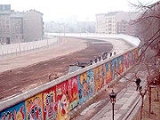
 as well as German souvenir shops. Today, the eastern side is covered in graffiti
Graffiti

Graffiti is the name for images or lettering scratched, scrawled, painted or marked in any manner on property. Graffiti is sometimes regarded as a form of art and other times regarded as unsightly damage or unwanted....
 that did not exist while the Wall was guarded by the armed soldiers of East Germany. Previously, graffiti appeared only on the western side. Along the tourist areas of the city centre, the city government has marked the location of the former wall by a row of cobblestones in the street. In most places only the "first" wall is marked, except near Potsdamer Platz where the stretch of both walls is marked, giving visitors an impression of the dimension of the barrier system.

Museum

Fifteen years after the fall, a private museum rebuilt a 200-metre (656 ft) section close to Checkpoint Charlie, although not in the location of the original wall. They also raised more than 1,000 crosses in memory of those who died attempting to flee to the West. The memorial was installed in October 2004 and demolished in July 2005.

Cultural differences

Even now, some years after reunification, there is still talk in Germany of cultural differences between East and West Germans (colloquially Ossi
Ossi (East Germans)

Ossi is an informal name for citizens of the German Democratic Republic , especially since German reunification. It is derived from the German language word ost, which means east....
s
and Wessi
Wessi

Wessi is the informal name that people in Germany call citizens of West Germany before re-unification. The counterpart for citizens of the former East Germany is Ossi ....
s
), sometimes described as "Mauer im Kopf" ("The wall in the head"). A September 2004 poll found that 25% of West Germans and 12% of East Germans wished that East Germany and West Germany were again cut off by the Berlin Wall.

Fulton, Missouri

A unique piece of the wall is in the small town of Fulton, Missouri
Fulton, Missouri

Fulton is a city in Callaway County, Missouri, Missouri, the United States of America. It is part of the Jefferson City, Missouri Jefferson City, Missouri Metropolitan Area....
 at Westminster College
Westminster College, Missouri

Westminster College is a private, selective, liberal arts institution in Fulton, Missouri, USA. It was founded by Presbyterians in 1849 as Fulton College and assumed the present name in 1851....
. The college was the site of the famous 'Iron Curtain' speech given by Winston Churchill near the beginning of the cold war. A piece of artwork made out of a section of the wall was created by the granddaughter of Churchill and placed on the school grounds at the Winston Churchill Memorial and Library
Winston Churchill Memorial and Library

The Winston Churchill Memorial and Library in the United States, located on the Westminster College campus in Fulton, Missouri, commemorates the life and times of Sir Winston Churchill....
.

See also

  • Berlin border crossings
    Berlin border crossings

    The Berlin border crossings were created as a result of the postwar Potsdam Conference. After the construction of the Berlin Wall in 1961, border stations between East Berlin, regarded as its capital by the German Democratic Republic but by the Western Allies, and the sectors controlled by those three Western Allies were added....
  • Brandenburg Gate
    Brandenburg Gate

    Brandenburg Gate is a former city gate and one of the main symbols of Berlin and Germany. It is located west of the city center at the intersection of Unter den Linden and Ebertstrasse, immediately west of the Pariser Platz....
  • Der Tunnel
    Der Tunnel

    Der Tunnel is a 2001 film by German director Roland Suso Richter that is loosely based on a true story about an expanding group of people led by Hasso Herschel , who dug a tunnel under the Berlin Wall in the early 1960s to get friends and family from East Germany to West Germany....
    , a film about a mass evacuation to West Berlin through a tunnel
  • Diplomatic incident of October 1961 – See Checkpoint Charlie
  • Eastern Bloc
    Eastern bloc

    During the Cold War, the terms Eastern Bloc, Communist Bloc or Soviet Bloc were used to refer to European annexed or expanded Soviet Socialist Republics of the USSR and Satellite state states, including members of the Soviet-dominated organizations Comecon and the Warsaw Pact....
  • List of Berlin Wall portions
    List of Berlin Wall portions

    Many portions of the Berlin Wall have been given to institutions since its fall on November 9, 1989....
  • List of walls
    List of walls

    This is a list of famous walls....
  • Operation Gold
    Operation Gold

    Operation Gold was a joint operation conducted by the American Central Intelligence Agency and the British Secret Intelligence Service to tap into landline communication of the Soviet Army headquarters in Berlin using a tunnel into the Soviet-occupied zone....
  • Ostalgie
    Ostalgie

    Ostalgie is a German language term referring to nostalgia for life in the former East Germany. It is a portmanteau of the German words Ost and Nostalgie ....
  • Panmunjeom
    Panmunjeom

    Panmunjom in Gyeonggi province is a village on the de facto border between North Korea and South Korea, where the 1953 armistice that halted the Korean War was signed....
    , the Korean equivalent of the wall and the last standing front of the Cold War after the fall of the wall.
  • Removal of Hungary's border fence
    Removal of Hungary's border fence

    On May 2, 1989, the first visible cracks in the Iron Curtain appeared when Hungary began dismantling their 150 mile long border fence with Austria. The relatively open border with Western world allowed for hundreds of East Germany vacationing in Hungary to escape to Austria and then travel safely to West Germany....
  • Schießbefehl
  • Solidarity Movement
    History of Solidarity

    The history of Solidarnosc , a Polish non-governmental organization trade union, began in August 1980 at the Gdansk Shipyards where it was founded by Lech Walesa and others....
  • Tear down this wall
    Tear down this wall

    "Tear down this wall!" was the famous challenge from United States President of the United States Ronald Reagan to Soviet Union leader Mikhail Gorbachev to destroy the Berlin Wall....
  • The Berlin Wall (arcade game)
    The Berlin Wall (arcade game)

    The Berlin Wall is a Platform game arcade game released by Kaneko in 1991 in video gaming. The player takes control of a boy who must use his hammer to break the blocks that form part of the platform levels that form each stage....
  • The Wall - Live in Berlin, a rock opera/concert by Roger Waters
    Roger Waters

    George Roger Waters is an England rock music musician. He is best known as the bass guitar player and one of the main songwriters in the English rock band Pink Floyd from 1964 to 1985....
     after "The real wall" was torn down. A huge "new wall" made out of bricks was made, then demolished at the end.


External links

  • Most comprehensive multi-media source of information on this topic
  • Original reports and pictures from The Times
  • Chronicle of the Wall in German
  • (in German)


Images and personal accounts

  • Shockwave Player required
  • 2007 BW photo gallery.
  • Panorama of the East Side Gallery
  • , Chronicle of the Berlin Wall history includes an archive of photographs and texts
  • , Descriptions, Videos, Images of Berlin Wall
  • A large number of collected images in the