
|
|
|
|
Printing press
|
| |
|
| |
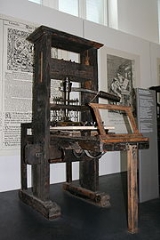
A printing press is a mechanical device for applying pressure to an inked surface resting upon a medium (such as paper or cloth), thereby transferring an image. The systems involved were first assembled in Germany by the goldsmith Johann Gutenberg in ca. 1439. Although both woodblock printing and movable type printing technologies were already developed in ancient China and later Korea in East Asia a few hundred years prior, they did not use a press like that of Gutenberg.
Printing methods based on Gutenberg's printing press spread rapidly throughout first Europe and then the rest of the world.

Discussion
Ask a question about 'Printing press'
Start a new discussion about 'Printing press'
Answer questions from other users
|
Timeline
Encyclopedia
A printing press is a mechanical device for applying pressure to an inked surface resting upon a medium (such as paper or cloth), thereby transferring an image. The systems involved were first assembled in Germany by the goldsmith Johann Gutenberg in ca. 1439. Although both woodblock printing and movable type printing technologies were already developed in ancient China and later Korea in East Asia a few hundred years prior, they did not use a press like that of Gutenberg.
Printing methods based on Gutenberg's printing press spread rapidly throughout first Europe and then the rest of the world. It eventually replaced most versions of block printing, making it the most used format of modern movable type As a method of creating reproductions for mass consumption, the printing press has been superseded by the advent of offset printing.
History The overall invention of Gutenberg's printing method depended for some of its elements upon a diffusion of technologies from East Asia—paper, woodblock printing, and possibly Bi Sheng's movable type printing technology—in addition to a growing demand by the general European public for the lower cost paper books, instead of the exorbitantly expensive parchment books. By 1424, Cambridge University library owned only 122 books—each of which had a value equal to a farm or vineyard. The demand for these books was driven by rising literacy amongst the middle class and students in Western Europe. At this time, the Renaissance was still in its early stages and the populace was gradually removing the monopoly the clergy had held on literacy.
While woodblock printing had arrived in Europe at approximately the same time paper did, this method was not as suitable for literary communication as it was in the east. Block printing is well-suited to the written Chinese because character alignment is not critical, but the existence of over 5,000 basic characters made the Chinese movable type technology somewhat inefficient and economically impractical, in terms of profits for the ancient Chinese book publishers. With the Latin alphabet, however, the need for precise alignment and a much simpler character set positioned movable type as a great advance for the west.
The use of a press was a key technological difference provided European inventors with advantages over their Chinese counterparts—the screw-based presses used in wine and olive oil production. Attaining mechanical sophistication in approximately the year 1000, devices for applying pressure on a flat-plane were common in Europe.
Gutenberg's Press
Johannes Gutenberg's work on the printing press began in approximately 1436 when he partnered with Andreas Dritzehan—a man he had previously instructed in gem-cutting—and Andreas Heilmann, owner of a paper mill. It was not until a 1439 lawsuit against Gutenberg that official record exists; witnesses testimony discussed type, an inventory of metals (including lead) and his type mold.
Others in Europe were developing movable type at this time, including goldsmith Procopius Waldfoghel of France and Laurens Janszoon Coster of the Netherlands. They are not known to have contributed specific advances to the printing press.
Having previously worked as a professional goldsmith, Gutenberg made skillful use of the knowledge of metals he had learned as a craftsman. He was the first to make type from an alloy of lead, tin, and antimony, which was critical for producing durable type that produced high-quality printed books and proved to be more suitable for printing than the clay, wooden or bronze types invented in East Asia. To create these lead types, Gutenberg used what some considered his most ingenious invention, a special matrix enabling the quick and precise moulding of new type blocks from a uniform template.
Gutenberg is also credited with the introduction of an oil-based ink which was more durable than the previously used water-based inks. As printing material he used both vellum and paper, the latter having been introduced in Europe a few centuries earlier from China by way of the Arabs.
In the Gutenberg Bible, Gutenberg made a trial of coloured printing for a few of the page headings, present only in some copies. A later work, the Mainz Psalter of 1453, presumably designed by Gutenberg but published under the imprint of his successors Johann Fust and Peter Schöffer, had elaborate red and blue printed initials.
Life magazine called the Printing Press the greatest invention in the last 1000 years. It is important to note that it was the alphabet that made the success of the printing press possible. See for a discussion of the role of the Alphabet in the emergence of printing. See the for a discussion of the historic consequences of printing.
The art of book printing For years, book printing was considered a true art form. Typesetting, or the placement of the characters on the page, including the use of ligatures, was passed down from master to apprentice. In Germany, the art of typesetting was termed the "black art," in allusion to the ink-covered printers. The Black Art Press & Print in Baltimore, MD adopted their name for this reason. It has largely been replaced by computer typesetting programs, which make it easy to get similar results more quickly and with less physical labor. Some practitioners continue to print books the way Gutenberg did. For example, there is a yearly convention of traditional book printers in Mainz, Germany.
Some theorists, such as McLuhan, Eisenstein, Kittler, and Giesecke, see an "alphabetic monopoly" as having developed from printing, removing the role of the image from society. Other authors stress that printed works themselves are a visual medium. Certainly, modern developments in printing have revitalized the role of illustrations.
The Industrial Revolution The Gutenberg press was much more efficient than manual copying and still was largely unchanged in the eras of John Baskerville and Giambattista Bodoni—over 300 years later. By 1800, Lord Stanhope had constructed a press completely from cast iron, reducing the force required by 90% while doubling the size of the printed area. While Stanhope's "mechanical theory" had improved the efficiency of the press, it still was only capable of 250 sheets per hour. German printer Friedrich Koenig would be the first to design a non-manpowered machine—using steam. Having moved to London in 1804, Koenig soon met Thomas Bensley and secured financial support for his project in 1807. Patented in 1810, Koenig had designed a steam press "much like a hand press connected to a steam engine." The first production trial of this model occurred in April 1811. He produced his machine with assistance from German engineer Andreas Friedrich Bauer.
Koenig and Bauer sold two of their first models to The Times in London in 1814, capable of 1,100 impressions per hour. The first edition so printed was on November 28 1814. They went on to perfect the early model so that it could print on both sides of a sheet at once. This began the long process of making newspapers available to a mass audience (which in turn helped spread literacy), and from the 1820s changed the nature of book production, forcing a greater standardization in titles and other metadata. Their company Koenig & Bauer AG is still one of the world's largest manufacturers of printing presses today.
Later on in the middle of the 19th century the rotary printing press (invented in 1833 in the United States by Richard M. Hoe) allowed millions of copies of a page in a single day. Mass production of printed works flourished after the transition to rolled paper, as continuous feed allowed the presses to run at a much faster pace.
Also, in the middle of the 19th century, there was a separate development of jobbing presses, small presses capable of printing small-format pieces such as billheads, letterheads, business cards, and envelopes. Jobbing presses were capable of quick set-up (average makeready time for a small job was under 15 minutes) and quick production (even on treadle-powered jobbing presses it was considered normal to get 1,000 impressions per hour [iph] with one pressman, with speeds of 1,500 iph often attained on simple envelope work). Job printing emerged as a reasonably cost-effective duplicating solution for commerce at this time.
By the late 1930s or early 1940s, printing presses had increased substantially in efficiency: a model by Platen Printing Press alone was capable of performing 2,500 to 3,000 impressions per hour.
Later inventions in this field include the following:
Further reading On the effects of Gutenberg's printing
- Elizabeth L. Eisenstein, The Printing Press as an Agent of Change, Cambridge University Press, September 1980, Paperback, 832 pages, ISBN 0-521-29955-1
- More recent, abridged version: Elizabeth L. Eisenstein, The Printing Revolution in Early Modern Europe, Cambridge University Press, 2Rev ed, 12 September 2005, Paperback, ISBN 0-521-60774-4
- Marshall McLuhan, The Gutenberg Galaxy: The Making of Typographic Man (1962) Univ. of Toronto Press (1st ed.); reissued by Routledge & Kegan Paul ISBN 0-7100-1818-5.
See also
External links -
- Photos of Incunabula and the Gutenberg Bible (1455)
- Safety on printing presses
- —a film from the Prelinger Archives explaining the printing industry
-
|
| |
|
|