Henry the Lion

Encyclopedia
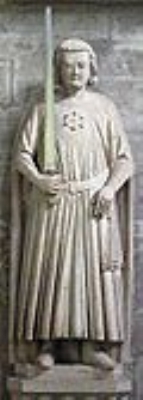
Henry the Lion (1129 – 6 August 1195) was a member of the Welf dynasty and Duke of Saxony
, as Henry III, from 1142, and Duke of Bavaria, as Henry XII, from 1156, which duchies he held until 1180.
He was one of the most powerful German princes of his time, until the rival Hohenstaufen dynasty succeeded in isolating him and eventually deprived him of his duchies of Bavaria and Saxony during the reign of his cousin Frederick I
and of Frederick's son and successor Henry VI
.
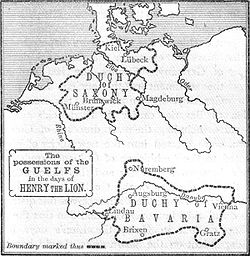
At the height of his reign, Henry ruled over a vast territory stretching from the coast of the North
and Baltic Sea
s to the Alps
, and from Westphalia
to Pomerania
. Henry achieved this great power in part by his political and military acumen and in part through the legacies of his four grandparents.
The Henry The Lion Bible is stored, a book preserved in near mint condition from the year 1170. Located in Wolfenbüttel, a town in Lower Saxony, Germany, located on the Oker river about 13 kilometres south of Brunswick.[2]
, he was the son of Henry the Proud
, Duke of Bavaria and Saxony, who was the son of Duke Henry the Black
and an heiress of the Billung
s, former dukes of Saxony. Henry's mother was Gertrude, only daughter of Emperor Lothair III
and his wife Richenza of Northeim
, heiress of the Saxon territories of Northeim
and the properties of the Brunones, counts of Brunswick
.
Henry's father died in 1139, aged 32, when Henry was still a child. King Conrad III
had dispossessed Henry the Proud, who had been his rival for the crown in 1138, of his duchies in 1138 and 1139, handing Saxony to Albert the Bear and Bavaria to Leopold of Austria. Henry, however, did not relinquish his claims to his inheritance, and Conrad returned Saxony to him in 1142. A participant in the 1147 Wendish Crusade
, Henry also reacquired Bavaria by a decision of the new Emperor Frederick Barbarossa in 1156.
Henry is the founder of Munich
(1157/58; München) and Lübeck
(1159); he also founded and developed the cities of Stade
, Lüneburg
and Brunswick. In Brunswick, his capital, he had a bronze lion, his heraldic animal, erected in the yard of his castle Dankwarderode in 1166 — the first bronze statue north of the Alps
. Later, he had Brunswick Cathedral built close to the statue.
 In 1147, Henry married Clementia of Zähringen
, thereby gaining her hereditary territories in Swabia
. He divorced her in 1162, apparently under pressure from Emperor Frederick Barbarossa, who did not cherish Guelphish possessions in his home area and offered Henry several fortresses in Saxony in exchange. In 1168, Henry married Matilda
(1156–1189), the daughter of King Henry II of England
and Duchess Eleanor of Aquitaine
and sister of King Richard I of England
.
Henry long and faithfully supported his older cousin, Emperor Frederick I (Barbarossa), in his attempts to solidify his hold on the Imperial Crown and his repeated wars with the cities of Lombardy
and the Popes, several times turning the tide of battle in Frederick's favor with his fierce Saxon knights. But in 1174, Henry refused to aid Frederick in a renewed invasion of Lombardy because he was preoccupied with securing his own borders in the East. He did not consider these Italian adventures worth the effort, unless Barbarossa presented Henry with the Saxon imperial city Goslar: a request Barbarossa refused.
Barbarossa's expedition into Lombardy ended in utter failure. He bitterly resented Henry for failing to support him. Taking advantage of the hostility of other German princes to Henry, who had successfully established a powerful and contiguous state comprising Saxony, Bavaria and substantial territories in the north and east of Germany, Frederick had Henry tried in absentia for insubordination by a court of bishops and princes in 1180. Declaring that Imperial law overruled traditional German law, the court had Henry stripped of his lands and declared him an outlaw. Frederick then invaded Saxony with an Imperial army to bring his cousin to his knees. Henry's allies deserted him, and he finally had to submit in November 1181 at a Reichstag
in Erfurt
. He was exiled from Germany in 1182 for three years, stayed with his father-in-law, in Normandy
before being allowed back into Germany in 1185. He was exiled again in 1188. His wife Matilda died in 1189.
When Frederick Barbarossa went on the Crusade of 1189, Henry returned to Saxony, mobilized an army of his faithful, and conquered and ravaged the rich city of Bardowick
as punishment for her disloyalty. Only the churches were left standing. Barbarossa's son, Emperor Henry VI
, again defeated the Duke, but in 1194, with his end approaching, he made his peace with the Emperor, and returned to his much diminished lands around Brunswick, where he finished his days as duke of Braunschweig, peacefully sponsoring arts and architecture. He died on 6 August 1195.
 Henry had the following known children:
Three other children are listed, by some sources, as having belonged to Henry and Matilda:
Rulers of Saxony
This article lists Dukes, Electors, and Kings ruling over different territories named Saxony from the beginning of the Saxon Duchy in the 9th century to the end of the Saxon Kingdom in 1918.-Dukes of Saxony:...
, as Henry III, from 1142, and Duke of Bavaria, as Henry XII, from 1156, which duchies he held until 1180.
He was one of the most powerful German princes of his time, until the rival Hohenstaufen dynasty succeeded in isolating him and eventually deprived him of his duchies of Bavaria and Saxony during the reign of his cousin Frederick I
Frederick I, Holy Roman Emperor
Frederick I Barbarossa was a German Holy Roman Emperor. He was elected King of Germany at Frankfurt on 4 March 1152 and crowned in Aachen on 9 March, crowned King of Italy in Pavia in 1155, and finally crowned Roman Emperor by Pope Adrian IV, on 18 June 1155, and two years later in 1157 the term...
and of Frederick's son and successor Henry VI
Henry VI, Holy Roman Emperor
Henry VI was King of Germany from 1190 to 1197, Holy Roman Emperor from 1191 to 1197 and King of Sicily from 1194 to 1197.-Early years:Born in Nijmegen,...
.
At the height of his reign, Henry ruled over a vast territory stretching from the coast of the North
North Sea
In the southwest, beyond the Straits of Dover, the North Sea becomes the English Channel connecting to the Atlantic Ocean. In the east, it connects to the Baltic Sea via the Skagerrak and Kattegat, narrow straits that separate Denmark from Norway and Sweden respectively...
and Baltic Sea
Baltic Sea
The Baltic Sea is a brackish mediterranean sea located in Northern Europe, from 53°N to 66°N latitude and from 20°E to 26°E longitude. It is bounded by the Scandinavian Peninsula, the mainland of Europe, and the Danish islands. It drains into the Kattegat by way of the Øresund, the Great Belt and...
s to the Alps
Alps
The Alps is one of the great mountain range systems of Europe, stretching from Austria and Slovenia in the east through Italy, Switzerland, Liechtenstein and Germany to France in the west....
, and from Westphalia
Westphalia
Westphalia is a region in Germany, centred on the cities of Arnsberg, Bielefeld, Dortmund, Minden and Münster.Westphalia is roughly the region between the rivers Rhine and Weser, located north and south of the Ruhr River. No exact definition of borders can be given, because the name "Westphalia"...
to Pomerania
Pomerania
Pomerania is a historical region on the south shore of the Baltic Sea. Divided between Germany and Poland, it stretches roughly from the Recknitz River near Stralsund in the West, via the Oder River delta near Szczecin, to the mouth of the Vistula River near Gdańsk in the East...
. Henry achieved this great power in part by his political and military acumen and in part through the legacies of his four grandparents.
The Henry The Lion Bible is stored, a book preserved in near mint condition from the year 1170. Located in Wolfenbüttel, a town in Lower Saxony, Germany, located on the Oker river about 13 kilometres south of Brunswick.[2]
Biography
Born in RavensburgRavensburg
Ravensburg is a town in Upper Swabia in Southern Germany, capital of the district of Ravensburg, Baden-Württemberg.Ravensburg was first mentioned in 1088. In the Middle Ages, it was an Imperial Free City and an important trading centre...
, he was the son of Henry the Proud
Henry X, Duke of Bavaria
thumb|right|Henry X in a much later engraving.Henry the Proud was the Duke of Bavaria , Duke of Saxony , and Margrave of Tuscany .-Life and reign:...
, Duke of Bavaria and Saxony, who was the son of Duke Henry the Black
Henry IX, Duke of Bavaria
Henry IX , called the Black, a member of the House of Welf, was duke of Bavaria from 1120 to 1126.-Life and reign:...
and an heiress of the Billung
Billung
The House of Billung was a dynasty of Saxon noblemen in the 9th through 12th centuries.The first known member of the house was Count Wichmann, mentioned as a Billung in 811...
s, former dukes of Saxony. Henry's mother was Gertrude, only daughter of Emperor Lothair III
Lothair III, Holy Roman Emperor
Lothair III of Supplinburg , was Duke of Saxony , King of Germany , and Holy Roman Emperor from 1133 to 1137. The son of Count Gebhard of Supplinburg, his reign was troubled by the constant intriguing of Frederick I, Duke of Swabia and Duke Conrad of Franconia...
and his wife Richenza of Northeim
Richenza of Northeim
Richenza of Northeim was a member of the dynasty of the Counts of Northeim, and a German Empress.She was the daughter of Henry the Fat of Northeim and Gertrud of Brunswick of the Brunonen dynasty....
, heiress of the Saxon territories of Northeim
Northeim
Northeim is a city in Lower Saxony, Germany, seat of the district of Northeim, with, as of 2002, a population of 31 000. It's located on the German Half-Timbered House Road.-History:...
and the properties of the Brunones, counts of Brunswick
Brunswick
-Australia:* Brunswick, Victoria, a suburb of Melbourne* Electoral district of Brunswick, an electoral district in Victoria* Brunswick Junction, Western Australia, a town near Bunbury* Brunswick Heads, a town on the North Coast of New South Wales-Canada:...
.
Henry's father died in 1139, aged 32, when Henry was still a child. King Conrad III
Conrad III of Germany
Conrad III was the first King of Germany of the Hohenstaufen dynasty. He was the son of Frederick I, Duke of Swabia, and Agnes, a daughter of the Salian Emperor Henry IV.-Life and reign:...
had dispossessed Henry the Proud, who had been his rival for the crown in 1138, of his duchies in 1138 and 1139, handing Saxony to Albert the Bear and Bavaria to Leopold of Austria. Henry, however, did not relinquish his claims to his inheritance, and Conrad returned Saxony to him in 1142. A participant in the 1147 Wendish Crusade
Wendish Crusade
The Wendish Crusade was an 1147 campaign, one of the Northern Crusades and also a part of the Second Crusade, led primarily by the Kingdom of Germany inside the Holy Roman Empire and directed against the Polabian Slavs ....
, Henry also reacquired Bavaria by a decision of the new Emperor Frederick Barbarossa in 1156.
Henry is the founder of Munich
Munich
Munich The city's motto is "" . Before 2006, it was "Weltstadt mit Herz" . Its native name, , is derived from the Old High German Munichen, meaning "by the monks' place". The city's name derives from the monks of the Benedictine order who founded the city; hence the monk depicted on the city's coat...
(1157/58; München) and Lübeck
Lübeck
The Hanseatic City of Lübeck is the second-largest city in Schleswig-Holstein, in northern Germany, and one of the major ports of Germany. It was for several centuries the "capital" of the Hanseatic League and, because of its Brick Gothic architectural heritage, is listed by UNESCO as a World...
(1159); he also founded and developed the cities of Stade
Stade
Stade is a city in Lower Saxony, Germany and part of the Hamburg Metropolitan Region . It is the seat of the district named after it...
, Lüneburg
Lüneburg
Lüneburg is a town in the German state of Lower Saxony. It is located about southeast of fellow Hanseatic city Hamburg. It is part of the Hamburg Metropolitan Region, and one of Hamburg's inner suburbs...
and Brunswick. In Brunswick, his capital, he had a bronze lion, his heraldic animal, erected in the yard of his castle Dankwarderode in 1166 — the first bronze statue north of the Alps
Alps
The Alps is one of the great mountain range systems of Europe, stretching from Austria and Slovenia in the east through Italy, Switzerland, Liechtenstein and Germany to France in the west....
. Later, he had Brunswick Cathedral built close to the statue.
Clementia of Zähringen
Clementia of Zähringen , was a daughter of Conrad I, Duke of Zähringen and his wife Clementia of Namur. By her first marriage, Clementia was Duchess consort of Bavaria and Saxony. By her second marriage she was Countess Consort of Savoy....
, thereby gaining her hereditary territories in Swabia
Swabia
Swabia is a cultural, historic and linguistic region in southwestern Germany.-Geography:Like many cultural regions of Europe, Swabia's borders are not clearly defined...
. He divorced her in 1162, apparently under pressure from Emperor Frederick Barbarossa, who did not cherish Guelphish possessions in his home area and offered Henry several fortresses in Saxony in exchange. In 1168, Henry married Matilda
Matilda of England, Duchess of Saxony
Matilda of England was the eldest daughter of Henry II of England and Eleanor of Aquitaine. Through her marriage with Henry the Lion, she was Duchess of Saxony and later of Bavaria.-Early life:...
(1156–1189), the daughter of King Henry II of England
Henry II of England
Henry II ruled as King of England , Count of Anjou, Count of Maine, Duke of Normandy, Duke of Aquitaine, Duke of Gascony, Count of Nantes, Lord of Ireland and, at various times, controlled parts of Wales, Scotland and western France. Henry, the great-grandson of William the Conqueror, was the...
and Duchess Eleanor of Aquitaine
Eleanor of Aquitaine
Eleanor of Aquitaine was one of the wealthiest and most powerful women in Western Europe during the High Middle Ages. As well as being Duchess of Aquitaine in her own right, she was queen consort of France and of England...
and sister of King Richard I of England
Richard I of England
Richard I was King of England from 6 July 1189 until his death. He also ruled as Duke of Normandy, Duke of Aquitaine, Duke of Gascony, Lord of Cyprus, Count of Anjou, Count of Maine, Count of Nantes, and Overlord of Brittany at various times during the same period...
.
Henry long and faithfully supported his older cousin, Emperor Frederick I (Barbarossa), in his attempts to solidify his hold on the Imperial Crown and his repeated wars with the cities of Lombardy
Lombardy
Lombardy is one of the 20 regions of Italy. The capital is Milan. One-sixth of Italy's population lives in Lombardy and about one fifth of Italy's GDP is produced in this region, making it the most populous and richest region in the country and one of the richest in the whole of Europe...
and the Popes, several times turning the tide of battle in Frederick's favor with his fierce Saxon knights. But in 1174, Henry refused to aid Frederick in a renewed invasion of Lombardy because he was preoccupied with securing his own borders in the East. He did not consider these Italian adventures worth the effort, unless Barbarossa presented Henry with the Saxon imperial city Goslar: a request Barbarossa refused.
Barbarossa's expedition into Lombardy ended in utter failure. He bitterly resented Henry for failing to support him. Taking advantage of the hostility of other German princes to Henry, who had successfully established a powerful and contiguous state comprising Saxony, Bavaria and substantial territories in the north and east of Germany, Frederick had Henry tried in absentia for insubordination by a court of bishops and princes in 1180. Declaring that Imperial law overruled traditional German law, the court had Henry stripped of his lands and declared him an outlaw. Frederick then invaded Saxony with an Imperial army to bring his cousin to his knees. Henry's allies deserted him, and he finally had to submit in November 1181 at a Reichstag
Reichstag (Holy Roman Empire)
The Imperial Diet was the Diet, or general assembly, of the Imperial Estates of the Holy Roman Empire.During the period of the Empire, which lasted formally until 1806, the Diet was not a parliament in today's sense; instead, it was an assembly of the various estates of the realm...
in Erfurt
Erfurt
Erfurt is the capital city of Thuringia and the main city nearest to the geographical centre of Germany, located 100 km SW of Leipzig, 150 km N of Nuremberg and 180 km SE of Hannover. Erfurt Airport can be reached by plane via Munich. It lies in the southern part of the Thuringian...
. He was exiled from Germany in 1182 for three years, stayed with his father-in-law, in Normandy
Normandy
Normandy is a geographical region corresponding to the former Duchy of Normandy. It is in France.The continental territory covers 30,627 km² and forms the preponderant part of Normandy and roughly 5% of the territory of France. It is divided for administrative purposes into two régions:...
before being allowed back into Germany in 1185. He was exiled again in 1188. His wife Matilda died in 1189.
When Frederick Barbarossa went on the Crusade of 1189, Henry returned to Saxony, mobilized an army of his faithful, and conquered and ravaged the rich city of Bardowick
Bardowick
Bardowick is a municipality in the district of Lüneburg in Lower Saxony, Germany. It is three miles north of Lüneburg on the navigable river Ilmenau. Bardowick is also the seat of the Samtgemeinde Bardowick.-History:The town was first mentioned in AD 795 and was raised to city status in AD 972 by...
as punishment for her disloyalty. Only the churches were left standing. Barbarossa's son, Emperor Henry VI
Henry VI, Holy Roman Emperor
Henry VI was King of Germany from 1190 to 1197, Holy Roman Emperor from 1191 to 1197 and King of Sicily from 1194 to 1197.-Early years:Born in Nijmegen,...
, again defeated the Duke, but in 1194, with his end approaching, he made his peace with the Emperor, and returned to his much diminished lands around Brunswick, where he finished his days as duke of Braunschweig, peacefully sponsoring arts and architecture. He died on 6 August 1195.
Family
- by his first wife, ClementiaClementia of ZähringenClementia of Zähringen , was a daughter of Conrad I, Duke of Zähringen and his wife Clementia of Namur. By her first marriage, Clementia was Duchess consort of Bavaria and Saxony. By her second marriage she was Countess Consort of Savoy....
(divorced 1162), daughter of Conrad, Duke of Zähringen and Clemence of Namur:- Gertrude of BavariaGertrude of BavariaGertrude of Bavaria and Saxony was a German noble, a duchess of Swabia as the spouse of Frederick IV, Duke of Swabia, and a Danish Queen consort as the spouse of King Canute VI of Denmark....
(1155–1197), married first Frederick IV, Duke of SwabiaFrederick IV, Duke of SwabiaFrederick IV of Hohenstaufen was duke of Swabia, succeeding his cousin, Frederick Barbarossa, Holy Roman Emperor, in 1152.He was the son of Conrad III of Germany and his second wife Gertrude von Sulzbach and thus the direct heir of the crown, had there been true heredity...
, and then King Canute VI of DenmarkCanute VI of DenmarkCanute VI was King of Denmark . Canute VI was the eldest son of King Valdemar I and Sophia of Polotsk.-Life:... - Richenza (c. 1157 - 1167)
- Henry, died young
- Gertrude of Bavaria
- by his second wife, MatildaMatilda of England, Duchess of SaxonyMatilda of England was the eldest daughter of Henry II of England and Eleanor of Aquitaine. Through her marriage with Henry the Lion, she was Duchess of Saxony and later of Bavaria.-Early life:...
, daughter of King Henry II of EnglandHenry II of EnglandHenry II ruled as King of England , Count of Anjou, Count of Maine, Duke of Normandy, Duke of Aquitaine, Duke of Gascony, Count of Nantes, Lord of Ireland and, at various times, controlled parts of Wales, Scotland and western France. Henry, the great-grandson of William the Conqueror, was the...
(married 1168):- Richenza (1172–1204), also called Matilda, married Godfrey, Count of Perche, and Enguerrand III, Lord of CoucyEnguerrand III, Lord of CoucyEnguerrand III, Lord of Coucy was the eldest son and successor of Ralph I, Lord of Coucy. He succeeded as Lord of Coucy in 1191, and held it until his death; he was also lord of Marle and Boves....
- Henry V, Count Palatine of the RhineHenry V, Count Palatine of the RhineHenry was count palatine of the Rhine from 6 August 1195 to 1213.Henry was the eldest son of Duke Henry the Lion, from his marriage to Matilda, eldest daughter of King Henry II of England and Eleanor of Aquitaine. He grew up in England and became count palatine of the Rhine through his 1193...
(c. 1173-1227) - Lothar of Bavaria (c. 1174-1190)
- Otto IV, Holy Roman EmperorOtto IV, Holy Roman EmperorOtto IV of Brunswick was one of two rival kings of the Holy Roman Empire from 1198 on, sole king from 1208 on, and emperor from 1209 on. The only king of the Welf dynasty, he incurred the wrath of Pope Innocent III and was excommunicated in 1215.-Early life:Otto was the third son of Henry the...
and Duke of SwabiaDuke of SwabiaThe following is a list of Dukes of Swabia in southwest Germany.Swabia was one of the five stem duchies of the medieval German kingdom, and its dukes were thus among the most powerful magnates of Germany. The most notable family to hold Swabia were the Hohenstaufen, who held it, with a brief...
(c. 1175-1218) - William of Winchester (1184–1213)
- Richenza (1172–1204), also called Matilda, married Godfrey, Count of Perche, and Enguerrand III, Lord of Coucy
Three other children are listed, by some sources, as having belonged to Henry and Matilda:
- Eleanor (born 1178); died young
- Ingibiorg (born 1180); died young
- Infant Son (b.&d. 1182)
- by his lover, Ida of Blieskastel:
- Matilda, married Henry Borwin I, Prince of Mecklenburg
Ancestry
External links
- Henry the Lion on Encyclopedia.com
- Henry the Lion. The Columbia Encyclopedia, Sixth Edition
- The fall of Henry the Lion (from Germany) -- Encyclopædia Britannica
- Deposition of Henry the Lion. (from Frederick I) -- Encyclopædia Britannica
- MSN Encarta - Multimedia - Henry the Lion (Archived 2009-10-31)
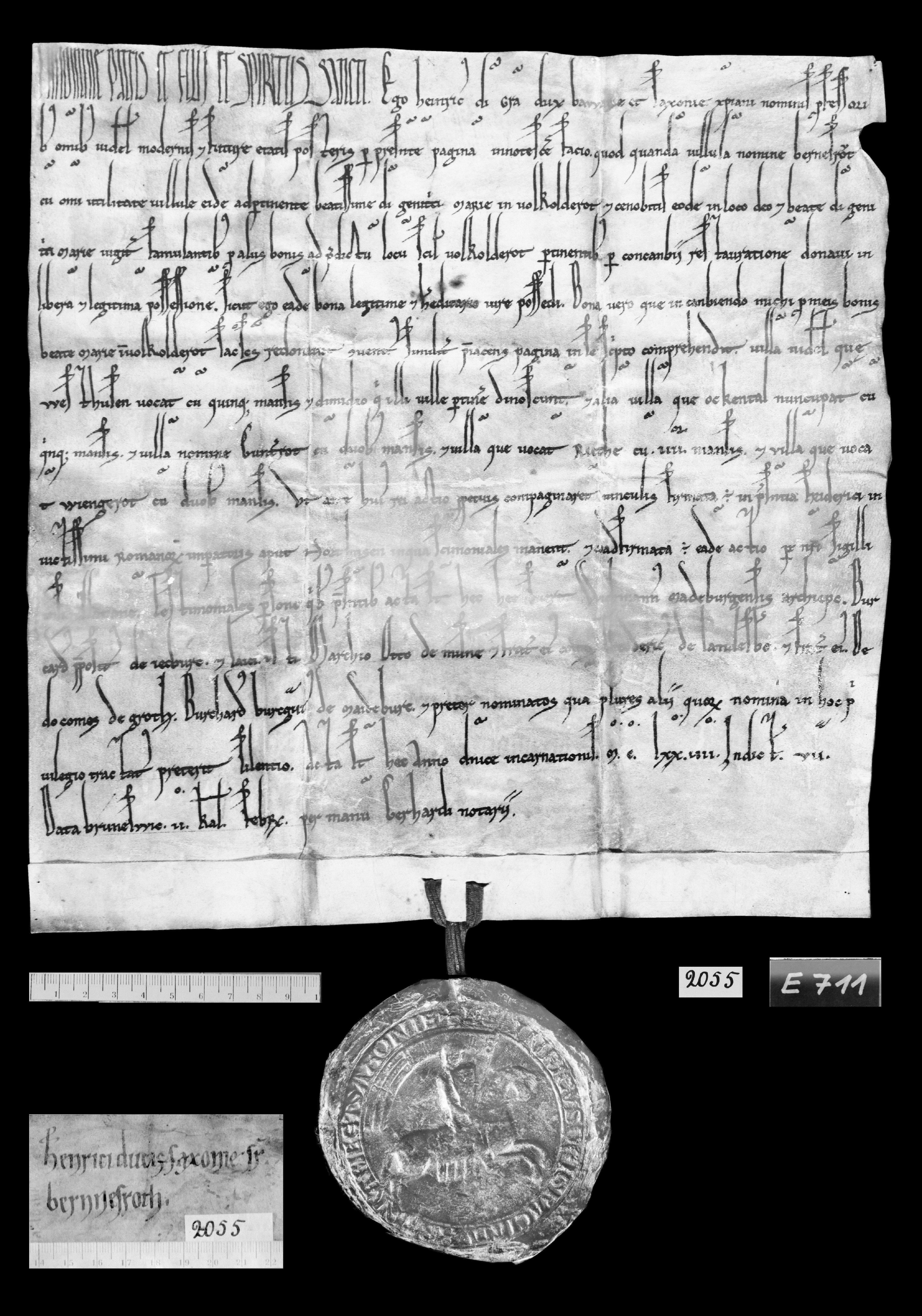
- Charter given by Henry to monastery Volkenroda, 31.1.1174. Photograph taken from the collections of the Lichtbildarchiv älterer Originalurkunden at Marburg University showing Henry's seal.