

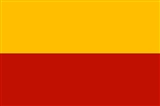
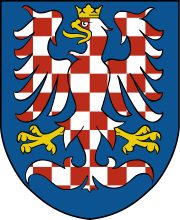
Moravia

Encyclopedia

Historical regions of Central Europe
There are many historical regions of Central Europe. For the purpose of this list, Central Europe is defined as the area contained roughly within the south coast of the Baltic Sea, the Elbe River, the Alps, the Danube River, the Black Sea and the Dnepr River. Note that these regions come from...
in the east of the Czech Republic
Czech Republic
The Czech Republic is a landlocked country in Central Europe. The country is bordered by Poland to the northeast, Slovakia to the east, Austria to the south, and Germany to the west and northwest....
, and one of the former Czech lands
Czech lands
Czech lands is an auxiliary term used mainly to describe the combination of Bohemia, Moravia and Czech Silesia. Today, those three historic provinces compose the Czech Republic. The Czech lands had been settled by the Celts , then later by various Germanic tribes until the beginning of 7th...
, together with Bohemia
Bohemia
Bohemia is a historical region in central Europe, occupying the western two-thirds of the traditional Czech Lands. It is located in the contemporary Czech Republic with its capital in Prague...
and Silesia
Czech Silesia
Czech Silesia is an unofficial name of one of the three Czech lands and a section of the Silesian historical region. It is located in the north-east of the Czech Republic, predominantly in the Moravian-Silesian Region, with a section in the northern Olomouc Region...
. It takes its name from the Morava River which rises in the northwest of the region. Moravia's largest city is Brno
Brno
Brno by population and area is the second largest city in the Czech Republic, the largest Moravian city, and the historical capital city of the Margraviate of Moravia. Brno is the administrative centre of the South Moravian Region where it forms a separate district Brno-City District...
, its historical capital.
Geography
Moravia occupies most of the eastern part of the Czech Republic including the South Moravian RegionSouth Moravian Region
South Moravian Region is an administrative unit of the Czech Republic, located in the south-western part of its historical region of Moravia, with exception of Jobova Lhota, that belongs to Bohemia. Its capital is Brno the 2nd largest city of the Czech Republic. The region is famous for its wine...
and the Zlín Region
Zlín Region
Zlín Region is an administrative unit of the Czech Republic, located in the central-eastern part of the historical region of Moravia. It is named after its capital Zlín....
, as well as parts of the Moravian-Silesian
Moravian-Silesian Region
Moravian-Silesian Region , or Moravo-Silesian Region, is one of 14 administrative Regions of the Czech Republic, until May 2001 it was formerly called the Ostrava Region . The region is located in the north-eastern part of its historical region of Moravia and in most of the Czech part of the...
, Olomouc
Olomouc Region
Olomouc Region is an administrative unit of the Czech Republic, located in the north-western and central part of its historical region of Moravia and in a small part of the historical region of Silesia . It is named for its capital Olomouc.-External links:* *...
, Pardubice
Pardubice Region
Pardubice Region is an administrative unit of the Czech Republic, located mainly in the eastern part of its historical region of Bohemia, with a small part in northwestern Moravia. It is named after its capital Pardubice. "There are a total of 452 municipalities in the region...
, Vysočina
Vysocina Region
Vysočina Region , is an administrative unit of the Czech Republic, located partly in the south-eastern part of the historical region of Bohemia and partly in the south-west of the historical region of Moravia...
and South Bohemian
South Bohemian Region
South Bohemian Region is an administrative unit of the Czech Republic, located mostly in the southern part of its historical land of Bohemia, with a small part in southwestern Moravia...
regions.
Moravia borders Poland
Poland
Poland , officially the Republic of Poland , is a country in Central Europe bordered by Germany to the west; the Czech Republic and Slovakia to the south; Ukraine, Belarus and Lithuania to the east; and the Baltic Sea and Kaliningrad Oblast, a Russian exclave, to the north...
in the north, Czech Silesia
Czech Silesia
Czech Silesia is an unofficial name of one of the three Czech lands and a section of the Silesian historical region. It is located in the north-east of the Czech Republic, predominantly in the Moravian-Silesian Region, with a section in the northern Olomouc Region...
in the east, Slovakia
Slovakia
The Slovak Republic is a landlocked state in Central Europe. It has a population of over five million and an area of about . Slovakia is bordered by the Czech Republic and Austria to the west, Poland to the north, Ukraine to the east and Hungary to the south...
in the southeast, Lower Austria
Lower Austria
Lower Austria is the northeasternmost state of the nine states in Austria. The capital of Lower Austria since 1986 is Sankt Pölten, the most recently designated capital town in Austria. The capital of Lower Austria had formerly been Vienna, even though Vienna is not officially part of Lower Austria...
in the south and Bohemia
Bohemia
Bohemia is a historical region in central Europe, occupying the western two-thirds of the traditional Czech Lands. It is located in the contemporary Czech Republic with its capital in Prague...
in the west. Its northern boundary is formed by the Sudetes mountains which become the Carpathians
Carpathian Mountains
The Carpathian Mountains or Carpathians are a range of mountains forming an arc roughly long across Central and Eastern Europe, making them the second-longest mountain range in Europe...
in the east. The meandering Dyje flows through the border country with Austria
Austria
Austria , officially the Republic of Austria , is a landlocked country of roughly 8.4 million people in Central Europe. It is bordered by the Czech Republic and Germany to the north, Slovakia and Hungary to the east, Slovenia and Italy to the south, and Switzerland and Liechtenstein to the...
and there is a protected area
Protected area
Protected areas are locations which receive protection because of their recognised natural, ecological and/or cultural values. There are several kinds of protected areas, which vary by level of protection depending on the enabling laws of each country or the regulations of the international...
on both sides of the border in the area around Hardegg
Hardegg
Hardegg is a town in the district of Hollabrunn in Lower Austria, Austria. It is situated in the Waldviertel region on the river Thaya, directly at the border with the Czech Republic...
.
At the heart of the country lie the sedimentary basin
Sedimentary basin
The term sedimentary basin is used to refer to any geographical feature exhibiting subsidence and consequent infilling by sedimentation. As the sediments are buried, they are subjected to increasing pressure and begin the process of lithification...
s of the Morava and the Dyje at a height of 180 to 250 m. In the west, the Bohemian-Moravian highlands rise to over 800 m, although the highest mountain is in the north-west, Praděd
Praded
Praděd is the highest mountain of Hrubý Jeseník mountains and Moravia and Czech Silesia and is fifth highest mountain of Czech Republic.The average annual temperature is about 1°C....
in Hrubý Jeseník
Hrubý Jeseník
Hrubý Jeseník is a mountain range of Eastern Sudetes in northern Moravia and Czech Silesia. It is the second highest mountain range in the Czech Republic.Some of the most interesting sights:*Praděd, the highest mountain...
at 1490 m. Further south lie the Jeseníky lowlands (400 to 600 m) which fall to 310 m at the upper reaches of the River Oder
Oder
The Oder is a river in Central Europe. It rises in the Czech Republic and flows through western Poland, later forming of the border between Poland and Germany, part of the Oder-Neisse line...
(the Moravian Gate
Moravian Gate
The Moravian Gate is a geomorphological feature in the Moravian region of the Czech Republic. It is formed by the depression between the Carpathian Mountains in the east and the Sudetes in the west...
) near Hranice and then rise again as the Beskids
Beskids
The Beskids , ) is a traditional name for a series of Eastern European mountain ranges.- Definition :The Beskids are approximately 600 km in length and 50–70 km in width...
to the 1322 m high Lysá hora
Lysá hora
Lysá hora is the highest mountain of the Moravian-Silesian Beskids range in the Czech Republic and also of Cieszyn Silesia. It is considered the rainiest place of the country with an annual precipitation over .-Etymology:...
. These three mountain ranges plus the "gate" between the latter two form part of the European Watershed
European Watershed
The European Watershed is the line which divides the drainage basins of the major rivers of Germany: the Rhine, which originates in the Swiss Alps and empties into the North Sea via the Netherlands, and the Danube, which originates in the Black Forest and flows eastward emptying into the Black...
. Moravia's eastern boundary is formed by the White Carpathians
White Carpathians
The White Carpathians is the westernmost mountain range of the Carpathian Mountains.They are part of the Slovak-Moravian Carpathians, stretching from the Váh river and the Little Carpathians in the south along the border between the Czech Republic and Slovakia to the Morava and the Javorníky range...
and Javorníky
Javorníky
Maple Mountains is a mountain range of the Slovak-Moravian Carpathians that forms part of the border between the Czech Republic and Slovakia....
.
Between 1782–1850, Moravia (also thus known as Moravia-Silesia) also included a small portion of the former province of Silesia
Silesia
Silesia is a historical region of Central Europe located mostly in Poland, with smaller parts also in the Czech Republic, and Germany.Silesia is rich in mineral and natural resources, and includes several important industrial areas. Silesia's largest city and historical capital is Wrocław...
– the Austrian Silesia
Austrian Silesia
Austrian Silesia , officially the Duchy of Upper and Lower Silesia was an autonomous region of the Kingdom of Bohemia and the Austrian Empire, from 1867 a Cisleithanian crown land of Austria-Hungary...
(when Frederick the Great annexed most of ancient Silesia (the land of upper and middle Oder river) to Prussia, Silesia's southernmost part remained with the Habsburg
Habsburg
The House of Habsburg , also found as Hapsburg, and also known as House of Austria is one of the most important royal houses of Europe and is best known for being an origin of all of the formally elected Holy Roman Emperors between 1438 and 1740, as well as rulers of the Austrian Empire and...
s).
Economy
In the south around HodonínHodonín
Hodonín is a town on the River Morava in the southeast of Moravia, in the Czech Republic. It lies in the South Moravian Region. The population is 26,226 . Hodonín was first mentioned in 1046. In 1228 it became a town...
and Břeclav
Breclav
Břeclav is a town in the South Moravian Region, Czech Republic, approximately 55 km southeast of Brno. It is located at the border with Lower Austria on the Dyje River. The nearest large town on Austrian territory is Hohenau an der March...
the land is part of the Viennese Basin and petroleum
Petroleum
Petroleum or crude oil is a naturally occurring, flammable liquid consisting of a complex mixture of hydrocarbons of various molecular weights and other liquid organic compounds, that are found in geologic formations beneath the Earth's surface. Petroleum is recovered mostly through oil drilling...
and lignite
Lignite
Lignite, often referred to as brown coal, or Rosebud coal by Northern Pacific Railroad,is a soft brown fuel with characteristics that put it somewhere between coal and peat...
are drilled for in its deeper sediments. In the area around Ostrava there was intensive coal mining
Coal mining
The goal of coal mining is to obtain coal from the ground. Coal is valued for its energy content, and since the 1880s has been widely used to generate electricity. Steel and cement industries use coal as a fuel for extraction of iron from iron ore and for cement production. In the United States,...
until around 1995. Iron, chemicals, leather and building materials are the main industrial goods. The main economic centres are Brno
Brno
Brno by population and area is the second largest city in the Czech Republic, the largest Moravian city, and the historical capital city of the Margraviate of Moravia. Brno is the administrative centre of the South Moravian Region where it forms a separate district Brno-City District...
, Olomouc
Olomouc
Olomouc is a city in Moravia, in the east of the Czech Republic. The city is located on the Morava river and is the ecclesiastical metropolis and historical capital city of Moravia. Nowadays, it is an administrative centre of the Olomouc Region and sixth largest city in the Czech Republic...
, Zlín
Zlín
Zlín , from 1949 to 1989 Gottwaldov , is a city in the Zlín Region, southeastern Moravia, Czech Republic, on the Dřevnice River. The development of the modern city is closely connected to the Bata Shoes company...
and Ostrava
Ostrava
Ostrava is the third largest city in the Czech Republic and the second largest urban agglomeration after Prague. Located close to the Polish border, it is also the administrative center of the Moravian-Silesian Region and of the Municipality with Extended Competence. Ostrava was candidate for the...
. As well as other agriculture, Moravia is noted for its viticulture
Viticulture
Viticulture is the science, production and study of grapes which deals with the series of events that occur in the vineyard. When the grapes are used for winemaking, it is also known as viniculture...
; it contains 94% of the Czech Republic's vineyards and is at the centre of the country's wine industry
Czech wine
Wine in the Czech Republic is produced mainly in southern Moravia, although a few vineyards are located in Bohemia. However, Moravia accounts for around 96% of the country's vineyards, which is why Czech wine is more often referred to as Moravian wine ...
.
Ancient Moravia
Celt
The Celts were a diverse group of tribal societies in Iron Age and Roman-era Europe who spoke Celtic languages.The earliest archaeological culture commonly accepted as Celtic, or rather Proto-Celtic, was the central European Hallstatt culture , named for the rich grave finds in Hallstatt, Austria....
ic Volcae
Volcae
The Volcae were a tribal confederation constituted before the raid of combined Gauls that invaded Macedon circa 270 BC and defeated the assembled Greeks at the Battle of Thermopylae in 279 BC...
people withdrew from the region and were succeeded in turn by the Germanic Quadi
Quadi
The Quadi were a smaller Germanic tribe, about which little is definitively known. We only know the Germanic tribe the Romans called the 'Quadi' through reports of the Romans themselves...
. Several hundred years later, in the sixth century AD the Slavic
Slavic peoples
The Slavic people are an Indo-European panethnicity living in Eastern Europe, Southeast Europe, North Asia and Central Asia. The term Slavic represents a broad ethno-linguistic group of people, who speak languages belonging to the Slavic language family and share, to varying degrees, certain...
tribes arrived in this territory often crossed during the Migration Period
Migration Period
The Migration Period, also called the Barbarian Invasions , was a period of intensified human migration in Europe that occurred from c. 400 to 800 CE. This period marked the transition from Late Antiquity to the Early Middle Ages...
by successive Germanic and major Slavic
Slavic peoples
The Slavic people are an Indo-European panethnicity living in Eastern Europe, Southeast Europe, North Asia and Central Asia. The term Slavic represents a broad ethno-linguistic group of people, who speak languages belonging to the Slavic language family and share, to varying degrees, certain...
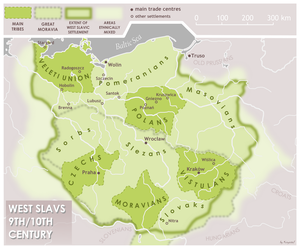
tribes. At the end of the eighth century the Moravian Principality came into being in present-day south-eastern Moravia, Záhorie
Záhorie
Záhorie is a region in western Slovakia bordered by the Little Carpathians in the east and the Morava River in the west. Although not an administrative region in its own right, it is one of the 21 official tourism regions in Slovakia...
in south-western Slovakia and parts of Lower Austria. In 833 A.D. this became the state of Great Moravia
Great Moravia
Great Moravia was a Slavic state that existed in Central Europe and lasted for nearly seventy years in the 9th century whose creators were the ancestors of the Czechs and Slovaks. It was a vassal state of the Germanic Frankish kingdom and paid an annual tribute to it. There is some controversy as...
with the conquest of the Principality of Nitra
Principality of Nitra
The Principality of Nitra also Nitrian Principality or Slovak Principality is the name for a polity of Nitra Sloviens, centered on large agglomeration, a multi-tribal centre around Nitra, Slovakia. The initially independent Principality of Nitra came into existence in the early 9th century...
(present-day Slovakia). Their first king was Mojmír I
Mojmír I
Mojmir I or Moimir I was the first known ruler of the Moravian Slavs . In modern scholarship, the creation of the early medieval state known as "Great" Moravia is attributed either to his or to his successors' expansionist policy...
(ruled 830-846). Louis the German invaded Moravia and replaced Mojmír I with his nephew Rastiz who became St. Rastislav. St. Rastislav (846-870) tried to emancipate his land from the Carolingian influence, so he sent envoys to Rome to get missionaries to come. When Rome refused he turned to Constantinople to the Byzantine emperor Michal. The result was the mission of Saints Cyril and Methodius
Saints Cyril and Methodius
Saints Cyril and Methodius were two Byzantine Greek brothers born in Thessaloniki in the 9th century. They became missionaries of Christianity among the Slavic peoples of Bulgaria, Great Moravia and Pannonia. Through their work they influenced the cultural development of all Slavs, for which they...
who translated liturgical book
Liturgical book
A liturgical book is a book published by the authority of a church, that contains the text and directions for the liturgy of its official religious services.-Roman Catholic:...
s into Slavonic
Old Church Slavonic
Old Church Slavonic or Old Church Slavic was the first literary Slavic language, first developed by the 9th century Byzantine Greek missionaries Saints Cyril and Methodius who were credited with standardizing the language and using it for translating the Bible and other Ancient Greek...
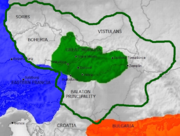
, which had lately been elevated by the Pope to the same level as Latin and Greek. Methodius became the first Moravian archbishop, but after his death the German influence again prevailed and the disciples of Methodius were forced to flee. So the unique situation which anticipated the II. Vatican Council by several centuries was destroyed. Great Moravia reached its greatest territorial extent in the 890s under Svatopluk I
Svatopluk I
Svatopluk I or Zwentibald I was the greatest ruler of Moravia that attained its maximum territorial expansion in his reign . His career had already started in the 860s, when he governed a principality, the location of which is still a matter of debate among historians, within Moravia under the...
. At this time, the empire encompassed the territory of the present-day Czech Republic
Czech Republic
The Czech Republic is a landlocked country in Central Europe. The country is bordered by Poland to the northeast, Slovakia to the east, Austria to the south, and Germany to the west and northwest....
and Slovakia
Slovakia
The Slovak Republic is a landlocked state in Central Europe. It has a population of over five million and an area of about . Slovakia is bordered by the Czech Republic and Austria to the west, Poland to the north, Ukraine to the east and Hungary to the south...
, the western part of present Hungary
Hungary
Hungary , officially the Republic of Hungary , is a landlocked country in Central Europe. It is situated in the Carpathian Basin and is bordered by Slovakia to the north, Ukraine and Romania to the east, Serbia and Croatia to the south, Slovenia to the southwest and Austria to the west. The...
(Pannonia
Pannonia
Pannonia was an ancient province of the Roman Empire bounded north and east by the Danube, coterminous westward with Noricum and upper Italy, and southward with Dalmatia and upper Moesia....
), as well as Lusatia
Lusatia
Lusatia is a historical region in Central Europe. It stretches from the Bóbr and Kwisa rivers in the east to the Elbe valley in the west, today located within the German states of Saxony and Brandenburg as well as in the Lower Silesian and Lubusz voivodeships of western Poland...
in present-day Germany
Germany
Germany , officially the Federal Republic of Germany , is a federal parliamentary republic in Europe. The country consists of 16 states while the capital and largest city is Berlin. Germany covers an area of 357,021 km2 and has a largely temperate seasonal climate...
and Silesia
Silesia
Silesia is a historical region of Central Europe located mostly in Poland, with smaller parts also in the Czech Republic, and Germany.Silesia is rich in mineral and natural resources, and includes several important industrial areas. Silesia's largest city and historical capital is Wrocław...
and the upper Vistula
Vistula
The Vistula is the longest and the most important river in Poland, at 1,047 km in length. The watershed area of the Vistula is , of which lies within Poland ....
basin in southern Poland
Poland
Poland , officially the Republic of Poland , is a country in Central Europe bordered by Germany to the west; the Czech Republic and Slovakia to the south; Ukraine, Belarus and Lithuania to the east; and the Baltic Sea and Kaliningrad Oblast, a Russian exclave, to the north...
. After Svatopluk's death in 895, the Bohemian princes defected to become vassals of the East Frankish ruler Arnulf of Carinthia
Arnulf of Carinthia
Arnulf of Carinthia was the Carolingian King of East Francia from 887, the disputed King of Italy from 894 and the disputed Holy Roman Emperor from February 22, 896 until his death.-Birth and Illegitimacy:...
, and the Moravian state ceased to exist after being overrun by invading Magyars in 906/7.
Union with Bohemia
Following the defeat of the Magyars by Emperor Otto IOtto I, Holy Roman Emperor
Otto I the Great , son of Henry I the Fowler and Matilda of Ringelheim, was Duke of Saxony, King of Germany, King of Italy, and "the first of the Germans to be called the emperor of Italy" according to Arnulf of Milan...
at the Battle of Lechfeld
Battle of Lechfeld
The Battle of Lechfeld , often seen as the defining event for holding off the incursions of the Hungarians into Western Europe, was a decisive victory by Otto I the Great, King of the Germans, over the Hungarian leaders, the harka Bulcsú and the chieftains Lél and Súr...
in 955, Otto's ally Boleslaus I
Boleslaus I of Bohemia
Boleslaus I the Cruel, also called Boleslav I , was the ruler of Bohemia from 935 to his death. His was the son of Vratislaus I and the younger brother of his predecessor, Saint Wenceslaus.Boleslav is notorious for the murder of his brother Wenceslaus, through which he became duke of Bohemia...
, the Přemyslid ruler of Bohemia
Bohemia
Bohemia is a historical region in central Europe, occupying the western two-thirds of the traditional Czech Lands. It is located in the contemporary Czech Republic with its capital in Prague...
, received Moravia. Boleslaus I of Poland annexed Moravia in 999, and ruled it until 1019, when the Přemyslid prince Bretislaus
Bretislaus I of Bohemia
Bretislaus I , known as Bohemian Achilles, of the house of the Přemyslids, was the duke of Bohemia from 1035 till death.-Youth:...
recaptured it. Since then, Moravia has shared its history with Bohemia. Upon his father's death in 1034, Bretislaus also became the ruler of Bohemia. In 1055, Bretislaus decreed that the Bohemia and Moravia would be inherited together by primogeniture
Primogeniture
Primogeniture is the right, by law or custom, of the firstborn to inherit the entire estate, to the exclusion of younger siblings . Historically, the term implied male primogeniture, to the exclusion of females...
, although he also provided that his younger sons should govern parts (quarters) of Moravia as vassals to his oldest son.
Throughout the Přemyslid era, junior princes often ruled all or part of Moravia from Olomouc
Olomouc
Olomouc is a city in Moravia, in the east of the Czech Republic. The city is located on the Morava river and is the ecclesiastical metropolis and historical capital city of Moravia. Nowadays, it is an administrative centre of the Olomouc Region and sixth largest city in the Czech Republic...
, Brno
Brno
Brno by population and area is the second largest city in the Czech Republic, the largest Moravian city, and the historical capital city of the Margraviate of Moravia. Brno is the administrative centre of the South Moravian Region where it forms a separate district Brno-City District...
or Znojmo
Znojmo
Znojmo is a city in the South Moravian Region of the Czech Republic, near the border with Lower Austria, connected to Vienna by railway and road . The royal city of Znojmo was founded shortly before 1226 by King Ottokar I on the plains in front of Znojmo Castle...
, with varying degrees of autonomy from the ruler of Bohemia. (Mainly Dukes of Olomouc usually used to act as "right hand" of Prague dukes and kings. Dukes of Brno and especially those of Znojmo were much more insubordinate.) Moravia reached its height of autonomy in 1182, when Emperor Frederick I
Frederick I, Holy Roman Emperor
Frederick I Barbarossa was a German Holy Roman Emperor. He was elected King of Germany at Frankfurt on 4 March 1152 and crowned in Aachen on 9 March, crowned King of Italy in Pavia in 1155, and finally crowned Roman Emperor by Pope Adrian IV, on 18 June 1155, and two years later in 1157 the term...
elevated Conrad II Otto of Znojmo to the status of a margrave
Margrave
A margrave or margravine was a medieval hereditary nobleman with military responsibilities in a border province of a kingdom. Border provinces usually had more exposure to military incursions from the outside, compared to interior provinces, and thus a margrave usually had larger and more active...
, immediately subject to the emperor, independent of Bohemia. This status was short-lived: in 1186, Conrad Otto was forced to obey the supreme rule of Bohemian duke Frederick. Three years later, Conrad Otto succeed to Frederick as Duke of Bohemia and subsequently cancelled his margrave title. Nevertheless, the margrave title was restored in 1197 when Vladislaus III of Bohemia
Vladislaus III of Bohemia
Vladislaus III Henry was the youngest son of Vladislaus II and younger brother of Ottokar I. On June 22, 1197, he was elected Duke of Bohemia. Faced with an uprising in favour of Ottokar, Vladislaus abdicated a few months later on December 6...
resolved the succession dispute between him and his brother Ottokar
Ottokar I of Bohemia
-External links:...
by abdicating from the Bohemian throne and accepting Moravia as a vassal land of Bohemian (i.e., Prague) rulers. Vladislaus gradually established this land as Margraviate, slightly administratively different from Bohemia.
The Přemyslid dynasty became extinct in 1306, and in 1310 John of Luxembourg became king of Bohemia. Moravia and Bohemia remained within the Luxembourg dynasty of Holy Roman kings and emperors (except during the Hussite wars
Hussite Wars
The Hussite Wars, also called the Bohemian Wars involved the military actions against and amongst the followers of Jan Hus in Bohemia in the period 1419 to circa 1434. The Hussite Wars were notable for the extensive use of early hand-held gunpowder weapons such as hand cannons...
), until inherited by Albert II of Habsburg in 1437.
After his death followed the interregnum
Interregnum
An interregnum is a period of discontinuity or "gap" in a government, organization, or social order...
till 1453; land (as the rest of lands of the Bohemian Crown) was administered by the landfriedens (landfrýdy). The rule of young Ladislaus the Posthumous subsisted only less than five years and subsequently (1458) the Hussite George of Poděbrady
George of Podebrady
George of Kunštát and Poděbrady , also known as Poděbrad or Podiebrad , was King of Bohemia...
was elected as the king. He again reunited all Czech lands (then Bohemia, Moravia, Silesia, Upper & Lower Lusatia) into one-man ruled state. In 1466, Pope Paul II
Pope Paul II
Pope Paul II , born Pietro Barbo, was pope from 1464 until his death in 1471.- Early life :He was born in Venice, and was a nephew of Pope Eugene IV , through his mother. His adoption of the spiritual career, after having been trained as a merchant, was prompted by his uncle's election as pope...
excommunicated George and forbade all Catholics (i.e. circa 15 % of population) from continuing to serve him. The Hungarian crusade
Crusades
The Crusades were a series of religious wars, blessed by the Pope and the Catholic Church with the main goal of restoring Christian access to the holy places in and near Jerusalem...
followed and in 1469 Matthias Corvinus conquered Moravia and proclaimed himself (with assistance of rebelling Czech nobility) as the king of Bohemia.
The subsequent 21-year period of a divided kingdom was decisive for the rising awareness of a specific Moravian identity, distinct from that of Bohemia. Although Moravia was reunited with Bohemia in 1490 when Vladislaus Jagiellon
Vladislaus II of Bohemia and Hungary
Vladislaus II, also known as Ladislaus Jagiellon ; was King of Bohemia from 1471 and King of Hungary from 1490 until his death in 1516...
, king of Bohemia, also became king of Hungary, some attachment to Moravian "freedoms" and resistance to government by Prague continued until the end of independence in 1620. In 1526, Vladislaus' son Louis died in battle and the Habsburg Ferdinand I
Ferdinand I, Holy Roman Emperor
Ferdinand I was Holy Roman Emperor from 1558 and king of Bohemia and Hungary from 1526 until his death. Before his accession, he ruled the Austrian hereditary lands of the Habsburgs in the name of his elder brother, Charles V, Holy Roman Emperor.The key events during his reign were the contest...
was elected as his successor.
Habsburg rule (1526–1918)
The epoch 1526–1620 was marked by increasing animosity between Catholic Habsburg kings (emperors) and rather Protestant Moravian (and other Crowns') estates. Moravia, like Bohemia, remained as a Habsburg possession until the end of World War IWorld War I
World War I , which was predominantly called the World War or the Great War from its occurrence until 1939, and the First World War or World War I thereafter, was a major war centred in Europe that began on 28 July 1914 and lasted until 11 November 1918...
. In 1573 the Jesuit University of Olomouc was established. The establishment of a special papal seminary Collegium Nordicum made the university a centre of re-Catholisation effort in Central and Northern Europe, with the second largest group of students being from Scandinavia
Scandinavia
Scandinavia is a cultural, historical and ethno-linguistic region in northern Europe that includes the three kingdoms of Denmark, Norway and Sweden, characterized by their common ethno-cultural heritage and language. Modern Norway and Sweden proper are situated on the Scandinavian Peninsula,...
. Until 1641 Moravia's capital was the centrally-located Olomouc
Olomouc
Olomouc is a city in Moravia, in the east of the Czech Republic. The city is located on the Morava river and is the ecclesiastical metropolis and historical capital city of Moravia. Nowadays, it is an administrative centre of the Olomouc Region and sixth largest city in the Czech Republic...
, but after its capture by the Swedes it moved to the city of Brno
Brno
Brno by population and area is the second largest city in the Czech Republic, the largest Moravian city, and the historical capital city of the Margraviate of Moravia. Brno is the administrative centre of the South Moravian Region where it forms a separate district Brno-City District...
which resisted the invaders successfully. The Margraviate of Moravia had (from 1348 in Olomouc) its own Diet (parliament) – zemský sněm (Landtag in German
German language
German is a West Germanic language, related to and classified alongside English and Dutch. With an estimated 90 – 98 million native speakers, German is one of the world's major languages and is the most widely-spoken first language in the European Union....
), whose deputies were elected (from 1905 onward) in ethnically separate German and Czech constituencies. In 1758 Moravia was invaded by Prussian forces under Frederick the Great who laid siege to Olomouc
Siege of Olomouc
The Siege of Olomouc took place in 1758 when a Prussian army led by Frederick the Great besieged the Austrian city of Olomouc during the Prussian invasion of Moravia in the Seven Years' War. The attempt stalled as the besiegers faced stronger resistance than Frederick had expected...
before he was forced to withdraw following the Battle of Domstadtl
Battle of Domstadtl
The Battle of Domstadtl, also spelled Domstadt, Czech Domašov, was a battle between Habsburg Monarchy and Kingdom of Prussia at a Moravian village Domašov nad Bystřicí during the Seven Years' War on 30 June 1758, preceded by a minor clash at Guntramovice on 28 June...
.
Twentieth century
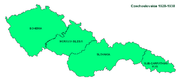
Czechoslovakia
Czechoslovakia or Czecho-Slovakia was a sovereign state in Central Europe which existed from October 1918, when it declared its independence from the Austro-Hungarian Empire, until 1992...
(and was part of the Protectorate of Bohemia and Moravia
Protectorate of Bohemia and Moravia
The Protectorate of Bohemia and Moravia was the majority ethnic-Czech protectorate which Nazi Germany established in the central parts of Bohemia, Moravia and Czech Silesia in what is today the Czech Republic...
during the German occupation of Czechoslovakia in World War II
World War II
World War II, or the Second World War , was a global conflict lasting from 1939 to 1945, involving most of the world's nations—including all of the great powers—eventually forming two opposing military alliances: the Allies and the Axis...
). In 1945 the ethnic German minority of Moravia were expelled. On the breakup of Czechoslovakia in 1993, Moravia remained in the Czech territory as part of the Czech Republic
Czech Republic
The Czech Republic is a landlocked country in Central Europe. The country is bordered by Poland to the northeast, Slovakia to the east, Austria to the south, and Germany to the west and northwest....
.
Cities
Regional capitals- BrnoBrnoBrno by population and area is the second largest city in the Czech Republic, the largest Moravian city, and the historical capital city of the Margraviate of Moravia. Brno is the administrative centre of the South Moravian Region where it forms a separate district Brno-City District...
- JihlavaJihlavaJihlava is a city in the Czech Republic. Jihlava is a centre of the Vysočina Region, situated on the Jihlava river on the ancient frontier between Moravia and Bohemia, and is the oldest mining town in the Czech Republic, ca. 50 years older than Kutná Hora.Among the principal buildings are the...
(partly lies in Bohemia, mostly in Moravia) - OlomoucOlomoucOlomouc is a city in Moravia, in the east of the Czech Republic. The city is located on the Morava river and is the ecclesiastical metropolis and historical capital city of Moravia. Nowadays, it is an administrative centre of the Olomouc Region and sixth largest city in the Czech Republic...
- OstravaOstravaOstrava is the third largest city in the Czech Republic and the second largest urban agglomeration after Prague. Located close to the Polish border, it is also the administrative center of the Moravian-Silesian Region and of the Municipality with Extended Competence. Ostrava was candidate for the...
(mostly lies in Czech Silesia) - ZlínZlínZlín , from 1949 to 1989 Gottwaldov , is a city in the Zlín Region, southeastern Moravia, Czech Republic, on the Dřevnice River. The development of the modern city is closely connected to the Bata Shoes company...
Other
- Frýdek-MístekFrýdek-MístekFrýdek-Místek is a city in Moravian-Silesian Region of the Czech Republic. It is the administrative center of Frýdek-Místek District. It comprises two formerly independent towns, Frýdek and Místek, divided by the Ostravice River...
(Frýdek lies in Czech Silesia, Místek in Moravia) - KroměřížKromerížKroměříž is a town in the Zlín Region of the Czech Republic. The town's main landmark is the Baroque Kroměříž Bishop's Palace, where some scenes from Amadeus and Immortal Beloved were filmed...
- PřerovPrerovPřerov is a town in the Olomouc Region of the Czech Republic where the Bečva river flows through. Přerov is a statute town . It has population of about 47,373 to January 2, 2008. Přerov is about 22 km south west of Olomouc. In the past it was a major crossroad in the heart of Moravia in the...
- ProstějovProstejovProstějov is a city in the Olomouc Region of the Czech Republic. Today the city is known for its fashion industry and special military forces based there....
- ŠumperkŠumperkŠumperk is a town and district in the Olomouc Region of the Czech Republic. It is called "The Gate to Jeseníky mountains."- History :Šumperk was founded by German colonists in 1269. The German name Schönberg means "beautiful hill", and the name Šumperk is a Czech garbling of the original German...
- TřebíčTrebícTřebíč is a city in the Moravian part of the Vysočina Region of the Czech Republic.Třebíč is situated 35 km southeast of Jihlava and 65 km west of Brno on the Jihlava River. Třebíč is from 392 to 503 metres above sea-level....
- Uherské HradištěUherské HradišteUherské Hradiště is a town in the Zlín Region of the Czech Republic. It lies on the Morava river and is the seat of the Uherské Hradiště District.- History :...
- VsetínVsetínVsetín is a town in Zlín Region of the Czech Republic. It has around 28,500 inhabitants and lies on the Vsetínská Bečva river.The area around Vsetín, called Vsetínsko, is spread out on the foothills of the Vsetín, Hostýn and Vizovice Highlands around the Bečva River...
- ZnojmoZnojmoZnojmo is a city in the South Moravian Region of the Czech Republic, near the border with Lower Austria, connected to Vienna by railway and road . The royal city of Znojmo was founded shortly before 1226 by King Ottokar I on the plains in front of Znojmo Castle...
- Rožnov pod RadhoštěmRožnov pod RadhoštemRožnov pod Radhoštěm is a town in Zlín Region, Czech Republic.-People:* Gustav Brom, lived here* Martina Hingis, lived here as a child* Naphtali Keller, lived and died here* Emil Zátopek, buried here-See also:* Romanian diaspora, Romanian exonyms...
People
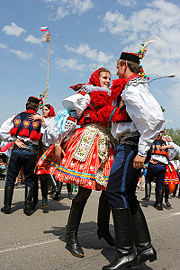
The Moravians
Moravians (ethnic group)
Moravians are the modern West Slavic inhabitants of the historical land of Moravia, the easternmost part of the Czech Republic, which includes the Moravian Slovakia. They speak the two main groups of Moravian dialects , the transitional Bohemian-Moravian dialect subgroup and standard Czech...
are a Slavic ethnic group who speak various dialects of Czech
Czech language
Czech is a West Slavic language with about 12 million native speakers; it is the majority language in the Czech Republic and spoken by Czechs worldwide. The language was known as Bohemian in English until the late 19th century...
, but few Moravians assert, the Moravian
Moravian language
Moravian is the form of the Czech language spoken in Moravia, a historical region in the east of the Czech Republic. While generally viewed as a regional variant of Czech, part of Moravians claim it to be a separate language....
is a distinct language. Some Moravians regard themselves as an ethnically distinct group; others consider themselves to be ethnically Czech. In the census
Census
A census is the procedure of systematically acquiring and recording information about the members of a given population. It is a regularly occurring and official count of a particular population. The term is used mostly in connection with national population and housing censuses; other common...
of 1991, 1,362,000 (13.2%) of the Czech population described themselves as being of Moravian nationality. In the census of 2001, this number had decreased to 380,000 (3.7% of the population).
Moravia historically had a huge minority of ethnic Germans, although they were largely expelled after World War II
Expulsion of Germans from Czechoslovakia
The expulsion of Germans from Czechoslovakia after World War II was part of a series of evacuations and expulsions of Germans from Central and Eastern Europe during and after World War II....
.
Notable people from Moravia include:
- Anton PilgramAnton PilgramAnton Pilgram was a late medieval Austrian architect and sculptor active in the area of today's Czech Republic, Austria and western Germany. Pilgram is known as the sculptor of the portal of Old City Hall in Brno and craftsman of the pulpit in St. Stephen's Cathedral, Vienna...
(1450–1516), architect, sculptor and woodcarver - Jan Ámos Komenský (Comenius) (1592–1670), educator and theologian, last bishop of Unity of the BrethrenUnity of the BrethrenThe Unity of the Brethren is a Christian denomination whose roots are in the pre-reformation work of priest and philosopher Jan Hus, who was martyred in 1415.-History in Bohemia:...
- Georgius ProchaskaGeorg ProchaskaGeorg Prochaska ; was a leading Czech or Austrian anatomist, ophthalmologist, physiologist, writer and university professor. He wrote the first genuine textbook on physiology and created the concept of nerve conduction among other theories...
(1749–1820), ophthalmologist and physiologist - František PalackýFrantišek PalackýFrantišek Palacký was a Czech historian and politician.-Biography:...
(1798–1876), historian and politician, "The Father of the Nation" - Ernst MachErnst MachErnst Mach was an Austrian physicist and philosopher, noted for his contributions to physics such as the Mach number and the study of shock waves...
(1838–1916), physicist and philosopher - Tomáš Garrigue Masaryk (1850–1937), philosopher and politician, first president of Czechoslovakia
- Leoš JanáčekLeoš JanácekLeoš Janáček was a Czech composer, musical theorist, folklorist, publicist and teacher. He was inspired by Moravian and all Slavic folk music to create an original, modern musical style. Until 1895 he devoted himself mainly to folkloristic research and his early musical output was influenced by...
(1854–1928), composer - Sigmund FreudSigmund FreudSigmund Freud , born Sigismund Schlomo Freud , was an Austrian neurologist who founded the discipline of psychoanalysis...
(1856–1939), father of psychoanalysisPsychoanalysisPsychoanalysis is a psychological theory developed in the late 19th and early 20th centuries by Austrian neurologist Sigmund Freud. Psychoanalysis has expanded, been criticized and developed in different directions, mostly by some of Freud's former students, such as Alfred Adler and Carl Gustav... - Edmund HusserlEdmund HusserlEdmund Gustav Albrecht Husserl was a philosopher and mathematician and the founder of the 20th century philosophical school of phenomenology. He broke with the positivist orientation of the science and philosophy of his day, yet he elaborated critiques of historicism and of psychologism in logic...
(1859–1938), philosopher - Alfons MuchaAlfons MuchaAlfons Maria Mucha , known in English as Alphonse Mucha, was a Czech Art Nouveau painter and decorative artist, known best for his distinct style. He produced many paintings, illustrations, advertisements, postcards, and designs.-Early years:...
(1860–1939), painter - Jan "Eskymo" WelzlJan Eskymo WelzlJan Welzl was a Moravian traveller, adventurer, hunter, gold-digger, Eskimo chief and Chief Justice in New Siberia and later story-teller and writer...
(1868–1948), globetrotter and gold-digger, chief of the SiberiaSiberiaSiberia is an extensive region constituting almost all of Northern Asia. Comprising the central and eastern portion of the Russian Federation, it was part of the Soviet Union from its beginning, as its predecessor states, the Tsardom of Russia and the Russian Empire, conquered it during the 16th...
n Eskimos - Karl RennerKarl RennerKarl Renner was an Austrian politician. He was born in Untertannowitz in the Austro-Hungarian Empire and died in Vienna...
(1870–1950), politician, co-founder of Friends of NatureFriends of NatureFriends of Nature is an international movement with a background in the Social Democratic movement, which aims to make nature accessible to the wider community by providing appropriate recreational and travel facilities.-Background:It is a non-profit organisation which, in addition to encouraging...
movement - Tomáš BaťaTomáš BataTomáš Baťa was a Czech entrepreneur, founder of Bata Shoes company, one of the world's biggest multinational retailers, manufacturers and distributors of footwear and accessories.-Career:...
(1876–1932), entrepreneur, founder of Bata ShoesBata ShoesBata Shoes is a large, family owned shoe company based in Bermuda but currently headquartered in Lausanne, Switzerland, operating 3 business units worldwide – Bata Metro Markets, Bata Emerging Markets and Bata Branded Business. It has a retail presence in over 50 countries and production...
company - Joseph SchumpeterJoseph SchumpeterJoseph Alois Schumpeter was an Austrian-Hungarian-American economist and political scientist. He popularized the term "creative destruction" in economics.-Life:...
(1883–1950), economist and political scientist - Adolf LoosAdolf LoosAdolf Franz Karl Viktor Maria Loos was a Moravian-born Austro-Hungarian architect. He was influential in European Modern architecture, and in his essay Ornament and Crime he repudiated the florid style of the Vienna Secession, the Austrian version of Art Nouveau...
(1870–1933), architect - Ludvík SvobodaLudvík Svobodathumb|Svoboda and [[I Corps |I Czechoslovak Army Corps]]Ludvík Svoboda was a Czechoslovak general and politician...
(1895–1979), general of I Czechoslovak Army CorpsI Corps (Czechoslovakia)I Czechoslovak Army Corps was a unit of the Czechoslovak army in exile on the Eastern Front fighting alongside the Soviet Red Army, which was created on the April 10, 1944 at Chernivtsi and moved to Krosno area soon after....
, seventh president of Czechoslovakia - George PlaczekGeorge PlaczekGeorg Placzek was a Czech physicist.Born in Brno, Moravia, Placzek studied physics in Prague and Vienna. He worked with Hans Bethe, Edward Teller, Rudolf Peierls, Werner Heisenberg, Victor Weisskopf, Enrico Fermi, Niels Bohr, Lev Landau, Edoardo Amaldi, Emilio Segrè, Leon van Hove and many other...
(1905–1955), physicist, participant in Manhattan ProjectManhattan ProjectThe Manhattan Project was a research and development program, led by the United States with participation from the United Kingdom and Canada, that produced the first atomic bomb during World War II. From 1942 to 1946, the project was under the direction of Major General Leslie Groves of the US Army... - Kurt GödelKurt GödelKurt Friedrich Gödel was an Austrian logician, mathematician and philosopher. Later in his life he emigrated to the United States to escape the effects of World War II. One of the most significant logicians of all time, Gödel made an immense impact upon scientific and philosophical thinking in the...
(1906–1978), theoretical mathematician - Oskar SchindlerOskar SchindlerOskar Schindler was an ethnic German industrialist born in Moravia. He is credited with saving over 1,100 Jews during the Holocaust by employing them in his enamelware and ammunitions factories, which were located in what is now Poland and the Czech Republic respectively.He is the subject of the...
(1908–1974), entrepreneur, saviour of almost 1,200 Jews during the WWII - Bohumil HrabalBohumil HrabalBohumil Hrabal was a Czech writer, regarded as one of the best writers of the 20th century.- Life and work :...
(1914–1997), writer - Jan SkácelJan SkácelJan Skácel was a Czech poet of Moravian origin, widely acclaimed as one of the best poets who had been writing in Czech....
(1922–1989), poet - Milan KunderaMilan KunderaMilan Kundera , born 1 April 1929, is a writer of Czech origin who has lived in exile in France since 1975, where he became a naturalized citizen in 1981. He is best known as the author of The Unbearable Lightness of Being, The Book of Laughter and Forgetting, and The Joke. Kundera has written in...
(1929–), writer - Peter SísPeter SisPeter Sís is an award-winning children's book writer and illustrator. Sís attended the Academy of Applied Arts in Prague and the Royal College of Art in London...
(1949–), illustrator, animator and writer - Magdalena KoženáMagdalena KoženáMagdalena Kožená is a Czech mezzo-soprano.In 2003, Kožená was awarded the title of Chevalier de l'Ordre des Arts et des Lettres by the French Government...
(1973–), mezzo-soprano
See also
- Great MoraviaGreat MoraviaGreat Moravia was a Slavic state that existed in Central Europe and lasted for nearly seventy years in the 9th century whose creators were the ancestors of the Czechs and Slovaks. It was a vassal state of the Germanic Frankish kingdom and paid an annual tribute to it. There is some controversy as...
- German South MoraviaGerman South MoraviaGerman South Moravia was a historical region of Czechoslovakia. It includes parts of southern and western Moravia once largely populated by ethnic Germans.-History:...
- Haná RegionHanáHaná is an ethnic region in central Moravia in the Czech Republic, roughly encircled by the cities of Zábřeh, Holešov, Vyškov and Uničov, the main parts of which are located in the lowlands of the Morava River and the Haná River. Haná is primarily known for its agricultural productivity, costumes,...
- Moravian WallachiaMoravian WallachiaMoravian Wallachia is a mountainous region located in the easternmost part of Moravia, Czech Republic, near the Slovakian border. The name Wallachia was formerly applied to all the highlands of Moravia and neighboring Silesia, although in the nineteenth century a smaller area came to be defined...
- Moravian SlovakiaMoravian SlovakiaMoravian Slovakia or Slovácko is a cultural region in the southeastern part of the Czech Republic on the border with Slovakia and Austria, known for its characteristic folklore, music, wine, costumes and traditions...
- Moravian HighlandsMoravian HighlandsMoravian Highlands is a cultural region in the western part of Moravia and middle part of present-day Czech Republic. The area forms eastern part of administrative region Vysočina and small parts of administrative regions Jihomoravský and Jihočeský...
- Moravian Church
- Moravian traditional musicMoravian traditional musicMoravian traditional music represents a part of the European musical culture connected with the regions around the western Carpathian Mountains. It is characterized by a specific melodic and harmonic texture related to the Eastern European musical world...
Further reading
- Róna-Tas, András (1999) Hungarians & Europe in the Early Middle Ages: An Introduction to Early Hungarian History translated by Nicholas Bodoczky, Central European University Press, Budapest, ISBN 963-9116-48-3 ;
- Kirschbaum, Stanislav J. (1996) A History of Slovakia: The Struggle for Survival St. Martin's Press, New York, ISBN 0-312-16125-5 ;
- Constantine Porphyrogenitus De Administrando Imperio edited by Gy. Moravcsik, translated by R.J.H. Jenkins, Dumbarton Oaks Edition, Washington D.C. (1993)