

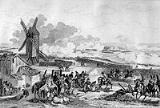
Battle of Valmy

Encyclopedia
The Battle of Valmy was the first major victory by the army of France
during the French Revolution
. The action took place on 20 September 1792 as Prussian
troops commanded by the Duke of Brunswick
attempted to march on Paris
. Generals François Kellermann
and Charles Dumouriez
stopped the advance near the northern village of Valmy
in Champagne-Ardenne
.
In this early part of the French Revolutionary Wars
known as the War of the First Coalition, the new French government
was in most every way unproven, and thus the small, localized victory at Valmy became a huge psychological victory for the Revolution at large. The battle was considered a "miraculous" event and a "decisive defeat" for the vaunted Prussian army. After the battle, the newly-assembled National Convention
was emboldened enough to formally declare the end of monarchy
in France and the establishment of the First French Republic. Valmy permitted the development of the Revolution and all its resultant ripple effects, and for that it is regarded as one of the most significant battles of all time.
had the support of Great Britain
and the Austrian Empire
to send the Duke of Brunswick
towards Paris with a large army. Brunswick's allied invasion force of veteran Prussian and Austrian troops was augmented by large complements of Hessians and the French royalist
Army of Condé
. The French commander Dumouriez, meanwhile, had been marching his army northeast to attack the Austrian Netherlands, but this plan was abandoned because of the more immediate threat to Paris.
Just over half of the infantry of Dumouriez's army were regulars of the old Royal Army, as were nearly all of the cavalry and (importantly) the artillery. These provided a professional core to steady the enthusiastic volunteer battalions raised in June and July of 1791.
on 23 August and Verdun on 2 September, then moved on toward Paris
through the defile
s of the Forest of Argonne
. In response, Dumouriez halted his advance to the Netherlands and reversed course, approaching the enemy army from its rear. From Metz
, Kellermann moved to his assistance, joining him at the village of Sainte-Menehould
on 19 September.
The French forces were now east of the Prussians, behind their lines. Theoretically the Prussians could have marched straight towards Paris unopposed, but this course was never seriously considered: the threat to their lines of supply and communication was too great to be ignored. The unfavorable situation was compounded by bad weather and an alarming increase in sickness among the troops. With few other options available, Brunswick turned back and prepared to do battle.
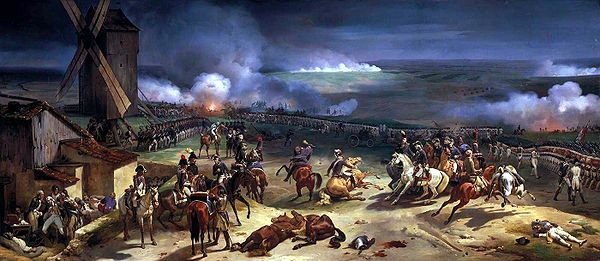
Brunswick headed through the northern woods believing he could cut off Dumouriez. At the moment when the Prussian manœuvre was nearly completed, Kellermann advanced his left wing and took up a position on the slopes between Sainte-Menehould and Valmy. His command centered around an old windmill
, and his veteran artillerists
were well-placed upon its accommodating rise to begin the Cannonade of Valmy. As the Prussians emerged from the woods, a long-range gunnery duel ensued and the French batteries proved superior. The Prussian infantry made a cautious, and fruitless, effort to advance under fire across the open ground.
As the Prussians wavered, a pivotal moment was reached when Kellerman raised his hat and made his famous cry of "Vive la Nation". The cry was repeated again and again by all the army, and had a crushing effect upon Prussian morale. To the surprise of nearly everyone, Brunswick broke off the action and retired from the field. The Prussians rounded the French positions at a great distance and commenced a rapid retreat eastward. The two forces had been essentially equal in size, Kellermann with approximately 36,000 troops and 40 cannon, and Brunswick with 34,000 and 54 cannon. Yet by the time Brunswick retreated, casualties had risen no higher than three hundred French and two hundred Prussians.
crown jewels. Brunswick had actually been offered command of the French armies prior to the outbreak of war and emigre factions subsequently used this as a basis to allege treachery on his part. However no proof of this charge exists and the more likely explanation remains that, having initially adopted an aggressive strategy, he lacked the will to carry it through when confronted by an unexpectedly determined and disciplined opposition. In any case, the battle ended decisively, the French pursuit was not seriously pressed, and Brunswick's troops managed a safe if inglorious eastward retreat.
 This engagement was the turning point of the Prussians' campaign. Beset with food shortages and dysentery, their retreat continued well past the Rhine river. French troops soon struck forward into Germany, taking Mainz
in October. Dumouriez once again moved against the Austrian Netherlands
and Kellermann ably secured the front at Metz
.
Dumouriez would bear a harsh change of fortune: after one more influential success in November 1792 at Jemappes
, he was by the following year a broken man. His army had suffered such catastrophic losses that he defected to the royalist side for the rest of his life.
Kellermann, however, continued in a long and distinguished military career. In 1802, he was ennobled by Napoleon
, and he took as his title the Duke
of Valmy.
and nationalism
. Many thousands of volunteers did indeed swell the ranks, but at least half of the French forces were professional regulars, particularly among Kellermann's critical artillery units which were widely regarded as the best in Europe at the time. The French artillery also held a tactical advantage in its modern Gribeauval
gun system which proved highly successful on the battlefield. But in popular conception, Valmy was a victory of the citizen-soldier: the battle was expressed purely by Kellermann's cry, augmented by the troops' famed singing of the Marseillaise
and the Ça Ira
while under fire.
On the very day of the battle, the Legislative Assembly had duly transferred its power to the National Convention.
Over the next two days, flush with the news from Valmy, the new Convention deputies abolished the monarchy
and proclaimed the French Republic.
Although on the losing side, the Prussians themselves recognized the huge importance of the battle, not merely as difficult setback to one of the most effective armies in Europe, but especially to the revolutionary French state. The famous German writer and poet Johann Wolfgang von Goethe
, who was present at the battle with the Prussian army, later wrote that he was approached by some of his Prussian comrades. He had previously cheered them up with memorable and clever quotes but his only reply this time was, "From this place, and from this day forth begins a new era in the history of the world, and you can all say that you were present at its birth."
France
The French Republic , The French Republic , The French Republic , (commonly known as France , is a unitary semi-presidential republic in Western Europe with several overseas territories and islands located on other continents and in the Indian, Pacific, and Atlantic oceans. Metropolitan France...
during the French Revolution
French Revolution
The French Revolution , sometimes distinguished as the 'Great French Revolution' , was a period of radical social and political upheaval in France and Europe. The absolute monarchy that had ruled France for centuries collapsed in three years...
. The action took place on 20 September 1792 as Prussian
Kingdom of Prussia
The Kingdom of Prussia was a German kingdom from 1701 to 1918. Until the defeat of Germany in World War I, it comprised almost two-thirds of the area of the German Empire...
troops commanded by the Duke of Brunswick
Charles William Ferdinand, Duke of Brunswick
Charles William Ferdinand , Duke of Brunswick-Wolfenbüttel, was a sovereign prince of the Holy Roman Empire, and a professional soldier who served as a Generalfeldmarschall of the Kingdom of Prussia...
attempted to march on Paris
Paris
Paris is the capital and largest city in France, situated on the river Seine, in northern France, at the heart of the Île-de-France region...
. Generals François Kellermann
François Christophe Kellermann
François Christophe Kellermann or de Kellermann, 1st Duc de Valmy was a French military commander, later the Général d'Armée, and a Marshal of France...
and Charles Dumouriez
Charles François Dumouriez
Charles-François du Périer Dumouriez was a French general during the French Revolutionary Wars. He shared the victory at Valmy with General François Christophe Kellermann, but later deserted the Revolutionary Army and became a royalist intriguer during the reign of Napoleon.-Early life:Dumouriez...
stopped the advance near the northern village of Valmy
Valmy
Valmy is a commune in the Marne department in north-eastern France.-Geography:The town stands on the west flank of the Argonne massif, mid-way between Verdun and Paris, near Vouziers.-History:...
in Champagne-Ardenne
Champagne-Ardenne
Champagne-Ardenne is one of the 27 regions of France. It is located in the northeast of the country, bordering Belgium, and consists of four departments: Aube, Ardennes, Haute-Marne, and Marne. The region is famous for its sparkling white wine . Its rivers, most of which flow west, include the...
.
In this early part of the French Revolutionary Wars
French Revolutionary Wars
The French Revolutionary Wars were a series of major conflicts, from 1792 until 1802, fought between the French Revolutionary government and several European states...
known as the War of the First Coalition, the new French government
Legislative Assembly (France)
During the French Revolution, the Legislative Assembly was the legislature of France from 1 October 1791 to September 1792. It provided the focus of political debate and revolutionary law-making between the periods of the National Constituent Assembly and of the National Convention.The Legislative...
was in most every way unproven, and thus the small, localized victory at Valmy became a huge psychological victory for the Revolution at large. The battle was considered a "miraculous" event and a "decisive defeat" for the vaunted Prussian army. After the battle, the newly-assembled National Convention
National Convention
During the French Revolution, the National Convention or Convention, in France, comprised the constitutional and legislative assembly which sat from 20 September 1792 to 26 October 1795 . It held executive power in France during the first years of the French First Republic...
was emboldened enough to formally declare the end of monarchy
Monarchy
A monarchy is a form of government in which the office of head of state is usually held until death or abdication and is often hereditary and includes a royal house. In some cases, the monarch is elected...
in France and the establishment of the First French Republic. Valmy permitted the development of the Revolution and all its resultant ripple effects, and for that it is regarded as one of the most significant battles of all time.
Background
In the war's early encounters, French troops did not distinguish themselves, and enemy forces advanced dangerously deep into France intending to pacify the country, restore the traditional monarchy, and end the Revolution. King Frederick William II of PrussiaFrederick William II of Prussia
Frederick William II was the King of Prussia, reigning from 1786 until his death. He was in personal union the Prince-Elector of Brandenburg and the sovereign prince of the Principality of Neuchâtel.-Early life:...
had the support of Great Britain
British Empire
The British Empire comprised the dominions, colonies, protectorates, mandates and other territories ruled or administered by the United Kingdom. It originated with the overseas colonies and trading posts established by England in the late 16th and early 17th centuries. At its height, it was the...
and the Austrian Empire
Austrian Empire
The Austrian Empire was a modern era successor empire, which was centered on what is today's Austria and which officially lasted from 1804 to 1867. It was followed by the Empire of Austria-Hungary, whose proclamation was a diplomatic move that elevated Hungary's status within the Austrian Empire...
to send the Duke of Brunswick
Charles William Ferdinand, Duke of Brunswick
Charles William Ferdinand , Duke of Brunswick-Wolfenbüttel, was a sovereign prince of the Holy Roman Empire, and a professional soldier who served as a Generalfeldmarschall of the Kingdom of Prussia...
towards Paris with a large army. Brunswick's allied invasion force of veteran Prussian and Austrian troops was augmented by large complements of Hessians and the French royalist
Royalist
A royalist supports a particular monarch as head of state for a particular kingdom, or of a particular dynastic claim. In the abstract, this position is royalism. It is distinct from monarchism, which advocates a monarchical system of government, but not necessarily a particular monarch...
Army of Condé
Army of Condé
The Army of Condé was a French field army during the French Revolutionary Wars. One of several émigré field armies, it was the only one to survive the War of the First Coalition; others had been formed by the Comte d'Artois and Mirabeau-Tonneau...
. The French commander Dumouriez, meanwhile, had been marching his army northeast to attack the Austrian Netherlands, but this plan was abandoned because of the more immediate threat to Paris.
Just over half of the infantry of Dumouriez's army were regulars of the old Royal Army, as were nearly all of the cavalry and (importantly) the artillery. These provided a professional core to steady the enthusiastic volunteer battalions raised in June and July of 1791.
Battle
The invading army handily captured LongwyLongwy
Longwy is a commune in the Meurthe-et-Moselle department in north-eastern France.The inhabitants are known as Longoviciens.-Economy:Longwy has historically been an industrial center of the Lorraine iron mining district. The town is known for its artistic glazed pottery.-History:Longwy initially...
on 23 August and Verdun on 2 September, then moved on toward Paris
Paris
Paris is the capital and largest city in France, situated on the river Seine, in northern France, at the heart of the Île-de-France region...
through the defile
Defile (geography)
Defile is a geographic term for a narrow pass or gorge between mountains or hills. It has its origins as a military description of a pass through which troops can march only in a narrow column or with a narrow front...
s of the Forest of Argonne
Forest of Argonne
The Forest of Argonne is a long strip of rocky mountain and wild woodland in north-eastern France.In 1792 Charles François Dumouriez outmaneuvered the invading forces of the Duke of Brunswick in the forest before the Battle of Valmy....
. In response, Dumouriez halted his advance to the Netherlands and reversed course, approaching the enemy army from its rear. From Metz
Metz
Metz is a city in the northeast of France located at the confluence of the Moselle and the Seille rivers.Metz is the capital of the Lorraine region and prefecture of the Moselle department. Located near the tripoint along the junction of France, Germany, and Luxembourg, Metz forms a central place...
, Kellermann moved to his assistance, joining him at the village of Sainte-Menehould
Sainte-Menehould
Sainte-Menehould is a commune in the Marne department in north-eastern France.The town and its several restaurants pride themselves on serving a local specialty called pied de cochon or pig's trotters....
on 19 September.
The French forces were now east of the Prussians, behind their lines. Theoretically the Prussians could have marched straight towards Paris unopposed, but this course was never seriously considered: the threat to their lines of supply and communication was too great to be ignored. The unfavorable situation was compounded by bad weather and an alarming increase in sickness among the troops. With few other options available, Brunswick turned back and prepared to do battle.
Brunswick headed through the northern woods believing he could cut off Dumouriez. At the moment when the Prussian manœuvre was nearly completed, Kellermann advanced his left wing and took up a position on the slopes between Sainte-Menehould and Valmy. His command centered around an old windmill
Windmill
A windmill is a machine which converts the energy of wind into rotational energy by means of vanes called sails or blades. Originally windmills were developed for milling grain for food production. In the course of history the windmill was adapted to many other industrial uses. An important...
, and his veteran artillerists
Artillery
Originally applied to any group of infantry primarily armed with projectile weapons, artillery has over time become limited in meaning to refer only to those engines of war that operate by projection of munitions far beyond the range of effect of personal weapons...
were well-placed upon its accommodating rise to begin the Cannonade of Valmy. As the Prussians emerged from the woods, a long-range gunnery duel ensued and the French batteries proved superior. The Prussian infantry made a cautious, and fruitless, effort to advance under fire across the open ground.
As the Prussians wavered, a pivotal moment was reached when Kellerman raised his hat and made his famous cry of "Vive la Nation". The cry was repeated again and again by all the army, and had a crushing effect upon Prussian morale. To the surprise of nearly everyone, Brunswick broke off the action and retired from the field. The Prussians rounded the French positions at a great distance and commenced a rapid retreat eastward. The two forces had been essentially equal in size, Kellermann with approximately 36,000 troops and 40 cannon, and Brunswick with 34,000 and 54 cannon. Yet by the time Brunswick retreated, casualties had risen no higher than three hundred French and two hundred Prussians.
Prussian retreat
The precipitous end to the action provoked elation among the French. The question of exactly why the Prussians withdrew has never been definitively answered. Most historians ascribe the retreat to some combination of the following factors: the highly defensible French position together with the rapidly growing numbers of reinforcements and citizen volunteers with their discouraging and thoroughly unexpected élan persuaded the cautious Brunswick to spare himself a dangerous loss of manpower, particularly when the Russian invasion of Poland had already raised concerns for Prussia's defensibility in the east. Others have put forward more shadowy motives for the decision, including a secret plea by Louis XVI to avoid an action which may cost him his life, and even a bribe of the Prussians, allegedly paid for with the BourbonHouse of Bourbon
The House of Bourbon is a European royal house, a branch of the Capetian dynasty . Bourbon kings first ruled Navarre and France in the 16th century. By the 18th century, members of the Bourbon dynasty also held thrones in Spain, Naples, Sicily, and Parma...
crown jewels. Brunswick had actually been offered command of the French armies prior to the outbreak of war and emigre factions subsequently used this as a basis to allege treachery on his part. However no proof of this charge exists and the more likely explanation remains that, having initially adopted an aggressive strategy, he lacked the will to carry it through when confronted by an unexpectedly determined and disciplined opposition. In any case, the battle ended decisively, the French pursuit was not seriously pressed, and Brunswick's troops managed a safe if inglorious eastward retreat.
Aftermath
Mainz
Mainz under the Holy Roman Empire, and previously was a Roman fort city which commanded the west bank of the Rhine and formed part of the northernmost frontier of the Roman Empire...
in October. Dumouriez once again moved against the Austrian Netherlands
Southern Netherlands
Southern Netherlands were a part of the Low Countries controlled by Spain , Austria and annexed by France...
and Kellermann ably secured the front at Metz
Metz
Metz is a city in the northeast of France located at the confluence of the Moselle and the Seille rivers.Metz is the capital of the Lorraine region and prefecture of the Moselle department. Located near the tripoint along the junction of France, Germany, and Luxembourg, Metz forms a central place...
.
Dumouriez would bear a harsh change of fortune: after one more influential success in November 1792 at Jemappes
Battle of Jemappes
The Battle of Jemappes took place near the town of Jemappes in Hainaut, Belgium, near Mons. General Charles François Dumouriez, in command of the French Revolutionary Army, defeated the greatly outnumbered Austrian army of Field Marshal Duke Albert of Saxe-Teschen and his second-in-command...
, he was by the following year a broken man. His army had suffered such catastrophic losses that he defected to the royalist side for the rest of his life.
Kellermann, however, continued in a long and distinguished military career. In 1802, he was ennobled by Napoleon
Napoleon I
Napoleon Bonaparte was a French military and political leader during the latter stages of the French Revolution.As Napoleon I, he was Emperor of the French from 1804 to 1815...
, and he took as his title the Duke
Duke
A duke or duchess is a member of the nobility, historically of highest rank below the monarch, and historically controlling a duchy...
of Valmy.
Legacy
In the varied historiography of the French Revolution, the battle of Valmy is often portrayed as the first victory of a citizen army, inspired by libertyLiberty
Liberty is a moral and political principle, or Right, that identifies the condition in which human beings are able to govern themselves, to behave according to their own free will, and take responsibility for their actions...
and nationalism
Nationalism
Nationalism is a political ideology that involves a strong identification of a group of individuals with a political entity defined in national terms, i.e. a nation. In the 'modernist' image of the nation, it is nationalism that creates national identity. There are various definitions for what...
. Many thousands of volunteers did indeed swell the ranks, but at least half of the French forces were professional regulars, particularly among Kellermann's critical artillery units which were widely regarded as the best in Europe at the time. The French artillery also held a tactical advantage in its modern Gribeauval
Jean Baptiste Vaquette de Gribeauval
Lieutenant General Jean-Baptiste Vaquette de Gribeauval was a French artillery officer and engineer who revolutionized French cannon, creating a new production system that allowed lighter, more uniform guns without sacrificing range. His Gribeauval system superseded the de Vallière system...
gun system which proved highly successful on the battlefield. But in popular conception, Valmy was a victory of the citizen-soldier: the battle was expressed purely by Kellermann's cry, augmented by the troops' famed singing of the Marseillaise
La Marseillaise
"La Marseillaise" is the national anthem of France. The song, originally titled "Chant de guerre pour l'Armée du Rhin" was written and composed by Claude Joseph Rouget de Lisle in 1792. The French National Convention adopted it as the Republic's anthem in 1795...
and the Ça Ira
Ah! ça ira
"Ah ! ça ira" is an emblematic song of the French Revolution, first heard in May 1790. It underwent several changes in wording, all of which used the title words as part of the refrain.-Original version:...
while under fire.
On the very day of the battle, the Legislative Assembly had duly transferred its power to the National Convention.
Over the next two days, flush with the news from Valmy, the new Convention deputies abolished the monarchy
Proclamation of the abolition of the monarchy
During the French Revolution, the proclamation of the abolition of the monarchy was a proclamation by the National Convention of France announcing that it had abolished the French monarchy on 21 September 1792.-Prelude:...
and proclaimed the French Republic.
Although on the losing side, the Prussians themselves recognized the huge importance of the battle, not merely as difficult setback to one of the most effective armies in Europe, but especially to the revolutionary French state. The famous German writer and poet Johann Wolfgang von Goethe
Johann Wolfgang von Goethe
Johann Wolfgang von Goethe was a German writer, pictorial artist, biologist, theoretical physicist, and polymath. He is considered the supreme genius of modern German literature. His works span the fields of poetry, drama, prose, philosophy, and science. His Faust has been called the greatest long...
, who was present at the battle with the Prussian army, later wrote that he was approached by some of his Prussian comrades. He had previously cheered them up with memorable and clever quotes but his only reply this time was, "From this place, and from this day forth begins a new era in the history of the world, and you can all say that you were present at its birth."
External links
- HTML version of The Battle of Valmy from Edward Shepherd CreasyEdward Shepherd CreasySir Edward Shepherd Creasy was an English historian. He was born in Bexley, England. He was educated at Eton College and King's College, Cambridge and called to the Bar in 1837. In 1840, he began teaching history at the University of London. He was knighted in 1860 and assumed the position of...
's The Fifteen Decisive Battles of the WorldThe Fifteen Decisive Battles of the WorldThe Fifteen Decisive Battles of the World: from Marathon to Waterloo is a book written by Sir Edward Shepherd Creasy and published in 1851. This book tells the story of the fifteen military engagements which, according to the author, had a significant impact on world history.-Chapters:Each... - Illustrated article on the Battle of Valmy at 'Battlefields Europe'
Further reading
- Arthur ChuquetArthur ChuquetArthur Chuquet was a French historian and biographer.He was born in Rocroi, Ardennes. He is now best known for his Jeunesse de Napoléon appearing in three volumes from 1897 to 1899...
, Les Guerres de la Révolution : 2. Valmy, 1887 - Campagne du Duc de Brunswick contre les Français en 1792, publiée en allemand par un officier prussien témoin oculaire et traduite en français sur la quatrième édition à Paris chez A.Cl.FORGET rue du Four-Honoré No 487 An III de la République.