


Denazification

Encyclopedia
Allies of World War II
The Allies of World War II were the countries that opposed the Axis powers during the Second World War . Former Axis states contributing to the Allied victory are not considered Allied states...
initiative to rid German
Germany
Germany , officially the Federal Republic of Germany , is a federal parliamentary republic in Europe. The country consists of 16 states while the capital and largest city is Berlin. Germany covers an area of 357,021 km2 and has a largely temperate seasonal climate...
and Austria
Austria
Austria , officially the Republic of Austria , is a landlocked country of roughly 8.4 million people in Central Europe. It is bordered by the Czech Republic and Germany to the north, Slovakia and Hungary to the east, Slovenia and Italy to the south, and Switzerland and Liechtenstein to the...
n society, culture, press, economy, judiciary, and politics of any remnants of the National Socialist ideology. It was carried out specifically by removing those involved from positions of influence and by disbanding or rendering impotent the organizations associated with it. The program of denazification was launched after the end of the Second World War
World War II
World War II, or the Second World War , was a global conflict lasting from 1939 to 1945, involving most of the world's nations—including all of the great powers—eventually forming two opposing military alliances: the Allies and the Axis...
and was solidified by the Potsdam Agreement
Potsdam Agreement
The Potsdam Agreement was the Allied plan of tripartite military occupation and reconstruction of Germany—referring to the German Reich with its pre-war 1937 borders including the former eastern territories—and the entire European Theatre of War territory...
.
Overview
Denazification in Germany was attempted through a series of directives issued by the Allied Control CouncilAllied Control Council
The Allied Control Council or Allied Control Authority, known in the German language as the Alliierter Kontrollrat and also referred to as the Four Powers , was a military occupation governing body of the Allied Occupation Zones in Germany after the end of World War II in Europe...
, seated in Berlin
Berlin
Berlin is the capital city of Germany and is one of the 16 states of Germany. With a population of 3.45 million people, Berlin is Germany's largest city. It is the second most populous city proper and the seventh most populous urban area in the European Union...
, beginning in January 1946. "Denazification directives" identified specific people and groups and outlined judicial procedures and guidelines for handling them. Though all the occupying forces had agreed on the initiative, the methods used for denazification and the intensity with which they were applied differed between the occupation zones.
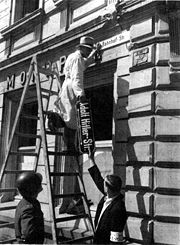
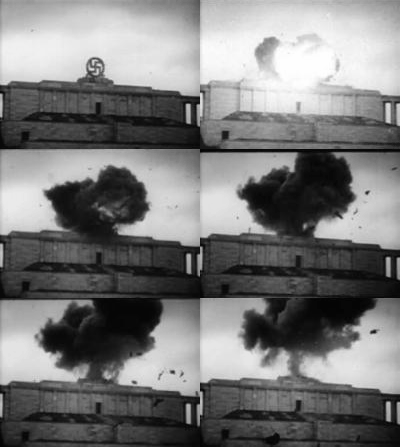
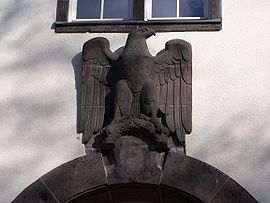
Denazification also refers to the removal of the physical symbols of the Nazi regime. For example, in 1957 the German government re-issued World War II Iron Cross
Iron Cross
The Iron Cross is a cross symbol typically in black with a white or silver outline that originated after 1219 when the Kingdom of Jerusalem granted the Teutonic Order the right to combine the Teutonic Black Cross placed above a silver Cross of Jerusalem....
medals without the swastika
Swastika
The swastika is an equilateral cross with its arms bent at right angles, in either right-facing form in counter clock motion or its mirrored left-facing form in clock motion. Earliest archaeological evidence of swastika-shaped ornaments dates back to the Indus Valley Civilization of Ancient...
in the center.
Many refugees from Nazism were Germans and Austrians, and some had fought for the UK in the Second World War. Many were transferred into the Intelligence Corps and sent back to Germany and Austria in British uniform. Their knowledge of the language became essential to the Allied Military Government. They were assigned to all aspects of military administration, the interrogation of POWs, collecting evidence for the War Crimes Investigation Unit and the search for war criminals.
American zone
Dwight D. Eisenhower
Dwight David "Ike" Eisenhower was the 34th President of the United States, from 1953 until 1961. He was a five-star general in the United States Army...
’s policy of denazification. The United States military initially pursued denazification in a committed though bureaucratic fashion. Five categories were established to identify anyone over the age of 18 residing in the US zone of occupation: major offenders, offenders, lesser offenders, followers, and exonerated persons. Ultimately, the intention was the "re-education" of the German people.
A report of the Institute on Re-education of the Axis Countries in June 1945 recommended: "Only an inflexible longterm occupation authority will be able to lead the Germans to a fundamental revision of their recent political philosophy." Every adult had to fill out a form, called a Fragebogen, detailing his or her past. On 15 January 1946, however, a report of the Military Government (classified as restricted) stated: "The present procedure fails in practice to reach a substantial number of persons who supported or assisted the Nazis." Therefore, on 1 April, a special law transferred the responsibility for the denazification process to the German administration which established 545 civilian courts to oversee 900,000 cases.
The Law for Liberation from National Socialism and Militarism came into effect in 1946. Many people had to fill in a new background form, called a Meldebogen, and were given over to justice under a Spruchkammer. They were assigned one of five categories.
- V. Exonerated, or non-incriminated persons
- IV. Followers, or Fellow Travelers
- III. Less incriminated
- II. Activists, Militants, and Profiteers, or Incriminated Persons
- I. Major Offenders
The courts also relied on statements from other people regarding the accused's involvement in National Socialism. These statements earned the nickname of Persilscheine, after advertisements for the laundry and whitening detergent Persil
Persil
Persil is a brand of laundry detergent currently and originally made by Henkel & Cie; but which is now also licensed for manufacture, distribution, and marketing in several countries by the Unilever Corporation. Henkel and Unilever both manufacture their own formulations...
.
By early 1947, the Allies held 90,000 Nazis in detention
Detention (imprisonment)
Detention is the process when a state, government or citizen lawfully holds a person by removing their freedom of liberty at that time. This can be due to criminal charges being raised against the individual as part of a prosecution or to protect a person or property...
; another 1,900,000 were forbidden to work as anything but manual labourers.
By 1948, with the Cold War
Cold War
The Cold War was the continuing state from roughly 1946 to 1991 of political conflict, military tension, proxy wars, and economic competition between the Communist World—primarily the Soviet Union and its satellite states and allies—and the powers of the Western world, primarily the United States...
clearly in progress, US attention was directed increasingly to the Eastern Bloc
Eastern bloc
The term Eastern Bloc or Communist Bloc refers to the former communist states of Eastern and Central Europe, generally the Soviet Union and the countries of the Warsaw Pact...
. The remaining cases were tried through summary proceedings that left insufficient time to thoroughly investigate the accused, so that many of the judgments of this period have questionable judicial value. For example, by 1952 members of the SS like Otto Skorzeny
Otto Skorzeny
Otto Skorzeny was an SS-Obersturmbannführer in the German Waffen-SS during World War II. After fighting on the Eastern Front, he was chosen as the field commander to carry out the rescue mission that freed the deposed Italian dictator Benito Mussolini from captivity...
could be declared formally denazified in absentia
In absentia
In absentia is Latin for "in the absence". In legal use, it usually means a trial at which the defendant is not physically present. The phrase is not ordinarily a mere observation, but suggests recognition of violation to a defendant's right to be present in court proceedings in a criminal trial.In...
by a German government arbitration board and without any proof that this was true.
The delicate task of distinguishing those truly complicit in or responsible for Nazi activities from mere "followers" made the work of the courts yet more difficult. US President Harry S. Truman
Harry S. Truman
Harry S. Truman was the 33rd President of the United States . As President Franklin D. Roosevelt's third vice president and the 34th Vice President of the United States , he succeeded to the presidency on April 12, 1945, when President Roosevelt died less than three months after beginning his...
alluded to this problem: “though all Germans might not be guilty for the war, it would be too difficult to try to single out for better treatment those who had nothing to do with the Nazi regime and its crimes.” Denazification was from then on supervised by special German ministers, like the Social Democrat
Social Democratic Party of Germany
The Social Democratic Party of Germany is a social-democratic political party in Germany...
Gottlob Kamm in Baden-Württemberg
Baden-Württemberg
Baden-Württemberg is one of the 16 states of Germany. Baden-Württemberg is in the southwestern part of the country to the east of the Upper Rhine, and is the third largest in both area and population of Germany's sixteen states, with an area of and 10.7 million inhabitants...
, with the support of the US occupation forces.
One example of the power of the Denazification courts was the power to deny the right to work in a chosen profession, as happened to Albert Battel
Albert Battel
Dr. Albert Battel was a German Wehrmacht army lieutenant and lawyer recognized for his resistance during World War II to the Nazi plans for the 1942 liquidation of the Przemyśl Jewish ghetto. He was posthumously recognized as Righteous Among the Nations in 1981.-Biography:Battel was born in...
.
In the end the denazification program was recognized as "counterproductive witch hunt" and a failure by US authorities, and they abandoned and even reversed the program in 1951.http://www.independent.org/pdf/tir/tir_11_02_03_payne.pdf
Censorship in the American zone
While judicial efforts were handed over to German authorities, the US Army continued its efforts to denazify Germany through control of German media. The Information Control DivisionInformation Control Division
The Information Control Division was a department of the U.S. Army during the early period of American occupation of Germany after World War II. Founded in 1945, it operated in the American occupation zone The Information Control Division was a department of the U.S. Army during the early period of...
of the US Army had by July 1946 taken control of 37 German newspapers, six radio stations, 314 theatres, 642 cinemas, 101 magazines, 237 book publishers, and 7,384 book dealers and printers. Its main mission was democratisation but part of the agenda was also the prohibition of any criticism of the Allied occupation forces. In addition, on May 13, 1946 the Allied Control Council issued a directive for the confiscation on all media that could contribute to Nazism or militarism
Militarism
Militarism is defined as: the belief or desire of a government or people that a country should maintain a strong military capability and be prepared to use it aggressively to defend or promote national interests....
. As a consequence a list was drawn up of over 30,000 book titles, ranging from school textbooks to poetry, which were then banned. All copies of books on the list were confiscated and destroyed; the possession of a book on the list was made a punishable offence. All the millions of copies of these books were to be confiscated and destroyed. The representative of the Military Directorate admitted that the order was in principle no different from the Nazi book burnings
Nazi book burnings
The Nazi book burnings were a campaign conducted by the authorities of Nazi Germany to ceremonially burn all books in Germany which did not correspond with Nazi ideology.-The book-burning campaign:...
.
The censorship in the U.S. zone was regulated by the occupation directive JCS 1067 (valid until July 1947) and in the May 1946 order valid for all zones (rescinded in 1950), Allied Control Authority Order No. 4, "No. 4 - Confiscation of Literature and Material of a Nazi and Militarist Nature". All confiscated literature was reduced to pulp instead of burning. It was also directed by Directive No. 30, "Liquidation of German Military and Nazi Memorials and Museums." An exception was made for tombstones "erected at the places where members of regular formations died on the field of battle."
Artworks were under the same censorship as other media;
- "all collections of works of art related or dedicated to the perpetuation of German militarism or Nazism will be closed permanently and taken into custody.".
The directives were very broadly interpreted, leading to the destruction of thousands of paintings and thousands more were shipped to deposits in the U.S. Those confiscated paintings still surviving in U.S. custody include for example a painting "depicting a couple of middle aged women talking in a sunlit street in a small town". Artists were also restricted in which new art they were allowed to create; "OMGUS was setting explicit political limits on art and representation".
The publication Der Ruf (The Call) was a popular literary magazine
Literary magazine
A literary magazine is a periodical devoted to literature in a broad sense. Literary magazines usually publish short stories, poetry and essays along with literary criticism, book reviews, biographical profiles of authors, interviews and letters...
first published in 1945 by Alfred Andersch
Alfred Andersch
Alfred Hellmuth Andersch was a German writer, publisher, and radio editor. The son of a conservative East Prussian army officer, he was born in Munich, Germany and died in Berzona, Ticino, Switzerland...
and edited by Hans Werner Richter
Hans Werner Richter
Hans Werner Richter was a German writer.Born in Neu-Sallenthin, Usedom, Richter is little known for his own works but found worldwide celebrity and acknowledgment as initiator, moving spirit and "grey eminence" of the Group 47, the most important literary association of the German Federal Republic...
. Der Ruf, also called Independent Pages of the New Generation, claimed to have the aim of educating the German people about democracy. In 1947 its publication was blocked by the American forces for being overly critical of occupational government. Richter attempted to print many of the controversial pieces in a volume entitled Der Skorpion (The Scorpion). The occupational government blocked publication of Der Skorpion before it began, saying that the volume was too "nihilistic".
Publication of Der Ruf resumed in 1948 under a new publisher, but Der Skorpion was blocked and not widely distributed. Unable to publish his works, Richter founded Group 47
Group 47
Gruppe 47 was an influential literary association in Germany after World War II. '47' Stands for the year of their creation, 1947.-Early history:The beginnings reach back to1946 when Alfred Andersch and Walter Kolbenhoff founded the literary...
.
The Allied costs for occupation were charged to the German people. The newspaper that revealed that the charges included for example the cost for thirty thousand bras
Brassiere
A brassiere is an undergarment that covers, supports, and elevates the breasts. Since the late 19th century, it has replaced the corset as the most widely accepted method for supporting breasts....
was banned by the occupation authorities for revealing this.
Soviet zone
The Soviet secret service, NKVDNKVD
The People's Commissariat for Internal Affairs was the public and secret police organization of the Soviet Union that directly executed the rule of power of the Soviets, including political repression, during the era of Joseph Stalin....
, set up a number of infamous "special camps"
NKVD special camps
NKVD special camps were NKVD-run late and post-World War II internment camps in the Soviet-occupied parts of Germany and areas east of the Oder-Neisse line. The short-lived camps east of the line were subsequently transferred to the Soviet occupation zone, where they were set up by the Soviet...
where - among others - alleged Nazis were interned. However, people were sometimes arrested completely arbitrarily and did not receive a fair trial, with some not even receiving any trial at all. At least 43,000 died in the camps.
The abandonment of stringent denazification in the West became a major theme of East German government propaganda, which often claimed that the West German government was nothing but an extension of the old Nazi regime. Such allegations appeared frequently in the official Socialist Unity Party of Germany
Socialist Unity Party of Germany
The Socialist Unity Party of Germany was the governing party of the German Democratic Republic from its formation on 7 October 1949 until the elections of March 1990. The SED was a communist political party with a Marxist-Leninist ideology...
newspaper, the Neues Deutschland
Neues Deutschland
Neues Deutschland is a national German daily newspaper. It was the official party newspaper of the Socialist Unity Party of Germany , which governed the German Democratic Republic , and as such served as one of the party's most important organs...
. The 1953 June 17 riots
Uprising of 1953 in East Germany
The Uprising of 1953 in East Germany started with a strike by East Berlin construction workers on June 16. It turned into a widespread anti-Stalinist uprising against the German Democratic Republic government the next day....
in Berlin
Berlin
Berlin is the capital city of Germany and is one of the 16 states of Germany. With a population of 3.45 million people, Berlin is Germany's largest city. It is the second most populous city proper and the seventh most populous urban area in the European Union...
were officially blamed on Nazi agents provocateurs from West Berlin
West Berlin
West Berlin was a political exclave that existed between 1949 and 1990. It comprised the western regions of Berlin, which were bordered by East Berlin and parts of East Germany. West Berlin consisted of the American, British, and French occupation sectors, which had been established in 1945...
, who the Neues Deutschland alleged were then working in collaboration with the Western government.
The Berlin Wall
Berlin Wall
The Berlin Wall was a barrier constructed by the German Democratic Republic starting on 13 August 1961, that completely cut off West Berlin from surrounding East Germany and from East Berlin...
was officially called the Anti-Fascist Security Wall by the East German government, and was ostensibly built to protect East German society from the activities of Nazis in West Berlin.
British zone
The British prepared a plan from 1942 onwards, assigning a number of quite junior civil servants to head the administration of liberated territory in the rear of the Armies, with draconian powers to remove from their post, in both public and private domains, anyone suspected, usually on behavioural grounds, of harbouring Nazi sympathies.French zone
The FrenchFrance
The French Republic , The French Republic , The French Republic , (commonly known as France , is a unitary semi-presidential republic in Western Europe with several overseas territories and islands located on other continents and in the Indian, Pacific, and Atlantic oceans. Metropolitan France...
took a measured approach based on the policy of the British hosts of the French provisional government in 1942-3 focusing primarily on a removal of the elite members of the Nazi party, rather than pursuit of all those who collaborated with, or aided the regime.
Implications for the future German states
The culture of denazification strongly influenced the parliamentParliament
A parliament is a legislature, especially in those countries whose system of government is based on the Westminster system modeled after that of the United Kingdom. The name is derived from the French , the action of parler : a parlement is a discussion. The term came to mean a meeting at which...
ary council charged with drawing up a constitution
Constitution
A constitution is a set of fundamental principles or established precedents according to which a state or other organization is governed. These rules together make up, i.e. constitute, what the entity is...
for those occupation zones that would become West Germany
West Germany
West Germany is the common English, but not official, name for the Federal Republic of Germany or FRG in the period between its creation in May 1949 to German reunification on 3 October 1990....
.
This Constitution , was completed on May 8, 1949, ratified on May 23, and came into effect the next day. This date effectively marks the foundation of the Federal Republic of Germany.
Implications for the future of Europe
The end of denazification saw the ad-hoc creation initially of the Western Union (not to be confused with the commercial operation of that name) which would be institutionalised as the Western European UnionWestern European Union
The Western European Union was an international organisation tasked with implementing the Modified Treaty of Brussels , an amended version of the original 1948 Treaty of Brussels...
in 1947 and 1955, with a broad socio-economic remit actually implimented in the strict domain of arms control.
The end of denazification
As denazification was deemed ineffective and counterproductive by the Americans they did not oppose the plans of the German chancellor Konrad Adenauer to end the denazification efforts. Adenauer's intention was to switch government policy to reparations and compensation for the victims of NS rule (WiedergutmachungWiedergutmachung
The German word Wiedergutmachung after World War II refers to the reparations that the German government agreed to pay to the direct survivors of the Holocaust, and to those who were made to work as forced labour or who otherwise became victims of the Nazis.The noun Wiedergutmachung is the general...
), stating that the main culprits have been persecuted. In 1951 several laws were passed, ending the denazification. Officials were allowed to retake jobs in the civil service, with the exception of people assigned to Group I (Major Offenders) and II (Offenders) during the denazification review process.
Several amnesty laws were also passed which affected about 792,176 people. Those pardoned included people with six-month sentences, 35,000 people with sentences of up to one year and include more than 3,000 functionaries of the SA, the SS, and the Nazi Party who participated in dragging victims to jails and camps; 20,000 other Nazis sentenced for "deeds against life" (presumably murder); 30,000 sentenced for causing bodily injury, and 5,200 who committed "crimes and misdemeanors in office." As result, several people with a former NS past ended up again in the political apparatus of Western Germany.
Responsibility and collective guilt
The ideas of collective guilt and collective punishmentCollective punishment
Collective punishment is the punishment of a group of people as a result of the behavior of one or more other individuals or groups. The punished group may often have no direct association with the other individuals or groups, or direct control over their actions...
originated not with the US and British people, but on higher policy levels. Not until late in the war did the U.S. public assign collective responsibility to the German people. The most notable policy document containing elements of collective guilt and collective punishment is JCS 1067 from early 1945. Eventually horrific footage from the concentration camps would serve to harden public opinion and bring it more in line with that of policymakers.
Already in 1944 prominent U.S. opinion makers had initiated a domestic propaganda campaign (which was to continue until 1948) arguing for a harsh peace for Germany, with a particular aim to end the apparent habit in the U.S. of viewing the Nazis and the German people as separate entities.
Statements made by the British and U.S. governments, both before and immediately after Germany's surrender
Surrender (military)
Surrender is when soldiers, nations or other combatants stop fighting and eventually become prisoners of war, either as individuals or when ordered to by their officers. A white flag is a common symbol of surrender, as is the gesture of raising one's hands empty and open above one's head.When the...
, indicate that the German nation as a whole was to be held responsible
Moral responsibility
Moral responsibility usually refers to the idea that a person has moral obligations in certain situations. Disobeying moral obligations, then, becomes grounds for justified punishment. Deciding what justifies punishment, if anything, is a principle concern of ethics.People who have moral...
for the actions of the Nazi regime, often using the terms "collective guilt" and "collective responsibility".
To that end, as the Allies began their post-war denazification efforts, the Psychological Warfare Division
Psychological Warfare Division
The Psychological Warfare Division of SHAEF was a joint Anglo-American organisation set-up in World War II tasked with conducting principally 'white' tactical psychological warfare against German troops in North-west Europe during and after D-Day. It was headed by US Brigadier-General Robert A...
(PWD) of SHAEF (Supreme Headquarters Allied Expeditionary Force) undertook a psychological propaganda
Propaganda
Propaganda is a form of communication that is aimed at influencing the attitude of a community toward some cause or position so as to benefit oneself or one's group....
campaign
Political campaign
A political campaign is an organized effort which seeks to influence the decision making process within a specific group. In democracies, political campaigns often refer to electoral campaigns, wherein representatives are chosen or referendums are decided...
for the purpose of developing a German sense of collective responsibility. The Public Relations and Information Services Control Group of the British Element of the Allied Control Commission began in 1945 to issue directives to officers in charge of producing newspapers and radio broadcasts for the German population to emphasize "the moral responsibility of all Germans for Nazi crimes." Similarly, among U.S. authorities, such a sense of collective guilt was "considered a prerequisite to any long-term education of the German people."
Using the German press, which was under Allied control, as well as posters and pamphlets, a program was conducted to acquaint ordinary Germans with what had taken place in the concentration camps. For example using posters with images of concentration camp victims coupled to text such as "YOU ARE GUILTY OF THIS!" or "These atrocities: Your Guilt!!" A number of films showing the concentration camps were made and screened to the German public, such as "Die Todesmühlen
Death Mills
Death Mills, or Die Todesmühlen, is a 1945 American propaganda documentary film directed by Billy Wilder and produced by the United States Department of War. It was intended for German audiences to educate them about the atrocities committed by the Nazi regime...
", released in the U.S. zone in January 1946, and "Welt im Film No. 5
Welt im Film No. 5
Welt im Film No. 5 was a newsreel meant to acquaint the German and Austrian public with what had taken place in the concentration camps, as part of the Denazification effort....
" in June 1945. A film that was never finished due partly to delays and the existence of the other films was "Memory of the Camps". According to Sidney Bernstein, chief of PWD, the object of the film
...was to shake and humiliate the Germans and prove to them beyond any possible challenge that these German crimes against humanity were committed and that the German people – and not just the Nazis and SS – bore responsibility.
English writer James Stern
James Stern
James Stern Anglo-Irish writer of short stories and non-fiction.The son of a British cavalry officer of Jewish descent and an Anglo-Irish Protestant mother, Stern was born in County Meath, Ireland. After working in Southern Rhodesia as a young man, he worked for his family's bank in London and...
recounted an example in a German town soon after the German surrender.
- "[a] crowd is gathered around a series of photographs which though initially seeming to depict garbage instead reveal dead human bodies. Each photograph has a heading 'WHO IS GUILTY?'. The spectators are silent, appearing hypnotised and eventually retreat one by one. The placards are later replaced with clearer photographs and placards proclaiming 'THIS TOWN IS GUILTY! YOU ARE GUILTY!'"
Immediately upon the liberation of the concentration camps many German civilians were forced to see the conditions in the camps, bury rotting corpses and exhume mass graves. In some instances, civilians were also made to provide items for former concentration camp inmates.
Surveys
The U.S. conducted opinion surveys in occupied Germany. Tony Judt in his book Postwar: a History of Europe since 1945 extracted and used some of them.- A majority in the years 1945-49 stated National Socialism to have been a good idea, badly applied.
- In 1946, 6% of Germans said the Nuremberg trialsNuremberg TrialsThe Nuremberg Trials were a series of military tribunals, held by the victorious Allied forces of World War II, most notable for the prosecution of prominent members of the political, military, and economic leadership of the defeated Nazi Germany....
had been unfair. - In 1946, 37% in the U.S. occupation zone said about the Holocaust that "the extermination of the Jews and Poles and other non-Aryans was necessary for the security of Germans."
- In 1946, 1 in 3 in the U.S. occupation zone said that Jews should not have the same rights as those belonging to the Aryan race.
- In 1950, 1 in 3 said the Nuremberg trials had been unfair.
- In 1952, 37% said Germany was better off without the Jews.
- In 1952, 25% had a good opinion of Hitler.
However, in Hitler, Germans, and the 'Jewish Question, Sarah Ann Gordon notes the difficulty of drawing conclusions from the surveys. For example, respondents were given three alternatives from which to choose, as in question 1:
| Statement | Percentage agreeing |
|---|---|
| Hitler was right in his treatment of the Jews: | 0% |
| Hitler went too far in his treatment of the Jews, but something had to be done to keep them in bounds: | 19% |
| The actions against the Jews were in no way justified: | 77% |
To the question of whether an Aryan who marries a Jew should be condemned, 91% responded "No". To the question of whether "All those who ordered the murder of civilians or participated in the murdering should be made to stand trial," 94% responded "Yes".
Gordon singles out the question "Extermination of the Jews and Poles and other non-Aryans was not necessary for the security of the Germans", which included an implicit double negative to which the response was either yes or no. She concludes that this question was confusingly phrased:
Some interviewees may have responded "no" they did not agree with the statement, when they actually did agree that the extermination was not necessary.She further highlights the discrepancy between the antisemitic implications of the survey results (such as those later identified by Judt) with the 77% percent of interviewees who responded that actions against Jews were in no way justified.
Gordon states that if the 77 percent result is to be believed then an "overwhelming majority" of Germans disapproved of extermination, and if the 37 percent result is believed to be correct then over one third of Germans were willing to exterminate Poles and Jews and others for German security. She concludes that the phrasing of the question on German security lowers the confidence in the later interpretation.
Gordon follows this with another survey where interviewees were asked if Nazism was good or bad (53% chose bad) and reasons for their answer. Among the nine possible choices on why it was bad, 21% chose the effects on the German people before the war, while 3-4 percent chose the answer "race policy, atrocities, pogroms" However, Gordon highlights the issue that it is difficult to pin-down at which point in time respondents became aware of the exterminations, before or after they were interviewed. e.g. questionnaire reports indicate that a significant minority had no knowledge until the Nuremberg trials. She also notes that when confronted with the exterminations there was an element of denial, disbelief, and confusion. Asked about concentration camps, very few Germans associated them with the Jews, leading to the conclusion that they did not understand how they had been used against the Jews during the war and instead continued to think of them as they were before the war, the place where political opponents to the Nazis were kept. "This naivete is only understandable if large numbers of Germans were truly ignorant of the existence of these camps". A British study on the same attitudes concluded that
"Those who said National Socialism was a good idea pointed to social welfare plans, the lack of unemployment, the great construction plans of the Nazis....Nearly all those who thought it a good idea nevertheless rejected Nazi racial theories and disagreed with the inhumanity of the concentration camps and the 'SS'.
Sarah Gordon writes that a majority of Germans appeared to approve of nonviolent removal of Jews from civil service and professions and German life. The German public also accepted the Nuremberg laws because they thought they would act as stabilizers and end violence against Jews. The German public had as a result of the Nazi antisemitic propaganda hardened their attitudes between 1935 and 1938 from the originally fairly favorable. By 1938 the propaganda had had effect and antisemitic policies were accepted, provided no violence was involved. The Kristallnacht caused German opposition to antisemitism to peak, with the vast majority of Germans rejecting the violence and destruction, and many Germans aiding the Jews. The Nazis responded by intimidation in order to discourage opposition, those aiding Jews were victims of large scale arrests and intimidation. With the start of the war the anti-Semitic minority that approved of restrictions on Jewish domestic activities was growing, but there is no evidence that the general public had any acceptance for labor camps or extermination. And as the number of antisemites grew, so too did the number of Germans opposed to racial persecution, and rumors of deportations and shootings in the east led to snowballing criticism of the Nazis. Gordon states that "one can probably conclude that labor camps, concentration camps, and extermination were opposed by a majority of Germans."
Gordon concludes her analysis on German public opinion based German SD-reports during the war and the Allied questionnaires during the occupation, with:
..it would appear that a majority of Germans supported elimination of Jews from the civil service; quotas on Jews in professions, academic institutions, and commercial fields; restrictions on intermarriage; and voluntary emigration of Jews. However, the rabid antisemites' demands for violent boycotts, illegal expropriation, destruction of Jewish property, pogroms, deportation, and extermination were probably rejected by a majority of Germans. They apparently wanted to restrict Jewish rights substantially, but not to annihilate Jews.
The radical left in Germany during the 1960s–70s and Nazi allegations
Because the Cold WarCold War
The Cold War was the continuing state from roughly 1946 to 1991 of political conflict, military tension, proxy wars, and economic competition between the Communist World—primarily the Soviet Union and its satellite states and allies—and the powers of the Western world, primarily the United States...
had curtailed the process of denazification in the West, certain radical leftist groups such as the Red Army Faction
Red Army Faction
The radicalized were, like many in the New Left, influenced by:* Sociological developments, pressure within the educational system in and outside Europe and the U.S...
justified their use of violence against the West German
West Germany
West Germany is the common English, but not official, name for the Federal Republic of Germany or FRG in the period between its creation in May 1949 to German reunification on 3 October 1990....
government and society based on the argument that the West German establishment had benefited from the Nazi period, and that it was still largely Nazi in outlook. They pointed out that many former Nazis held government posts, while the German Communist Party
Communist Party of Germany
The Communist Party of Germany was a major political party in Germany between 1918 and 1933, and a minor party in West Germany in the postwar period until it was banned in 1956...
was illegal. They argued that "What did you do in the war, daddy?" was not a question that many of the leaders of the generation who fought World War II and prospered in the postwar "Wirtschaftswunder
Wirtschaftswunder
The term describes the rapid reconstruction and development of the economies of West Germany and Austria after World War II . The expression was used by The Times in 1950...
" (German Economic Miracle) encouraged their children to ask.
One of the major justifications that the Red Army Faction gave in 1977 for killing Hanns-Martin Schleyer, President of the Confederation of German Employers' Associations
Confederation of German Employers' Associations
The Confederation of German Employers' Associations or BDA is the umbrella organization for German employers' associations...
(BDA) and perceived as one of the most powerful industrialists in West Germany, was that as a former member of the SS he was part of an informal network of ex-Nazis who still had great economic power and political influence in West Germany.
Today
The late admission of famous German writer Günter GrassGünter Grass
Günter Wilhelm Grass is a Nobel Prize-winning German author, poet, playwright, sculptor and artist.He was born in the Free City of Danzig...
, perceived by many as a protagonist of 'the nation's moral conscience', that he had been a member of the Waffen SS reminded the German public that, even more than sixty years after the Third Reich had ended, membership in Nazi organisations is still a taboo issue in public discourse. Statistically it is highly likely that there are many more Germans of Grass' generation (also called the "Flakhelfer-Generation") with biographies not unlike his, who have never found cause to reveal their wartime record in the context of total ideological blackout.
Denazification in other countries
In practice, denazification was not limited to Germany and Austria; in every European country with a vigorous Nazi or Fascist party measures of denazification were carried out. In FranceFrance
The French Republic , The French Republic , The French Republic , (commonly known as France , is a unitary semi-presidential republic in Western Europe with several overseas territories and islands located on other continents and in the Indian, Pacific, and Atlantic oceans. Metropolitan France...
the process was called épuration légale
Épuration légale
The Épuration légale was the wave of official trials that followed the Liberation of France and the fall of the Vichy Regime...
(legal cleansing). Prisoners of war held in detention
Detention (imprisonment)
Detention is the process when a state, government or citizen lawfully holds a person by removing their freedom of liberty at that time. This can be due to criminal charges being raised against the individual as part of a prosecution or to protect a person or property...
in Allied countries were also subject to denazification qualifications before their repatriation
Repatriation
Repatriation is the process of returning a person back to one's place of origin or citizenship. This includes the process of returning refugees or soldiers to their place of origin following a war...
.
Denazification was also practised in many countries which came under German occupation, including Belgium
Belgium
Belgium , officially the Kingdom of Belgium, is a federal state in Western Europe. It is a founding member of the European Union and hosts the EU's headquarters, and those of several other major international organisations such as NATO.Belgium is also a member of, or affiliated to, many...
, Norway
Norway
Norway , officially the Kingdom of Norway, is a Nordic unitary constitutional monarchy whose territory comprises the western portion of the Scandinavian Peninsula, Jan Mayen, and the Arctic archipelago of Svalbard and Bouvet Island. Norway has a total area of and a population of about 4.9 million...
, Greece
Greece
Greece , officially the Hellenic Republic , and historically Hellas or the Republic of Greece in English, is a country in southeastern Europe....
and Yugoslavia
Yugoslavia
Yugoslavia refers to three political entities that existed successively on the western part of the Balkans during most of the 20th century....
, because satellite regimes had been established in these countries with the support of local collaborators.
In Greece, for instance, Special Courts of Collaborators were created after 1945 to try former collaborators. The three Greek 'quisling
Quisling
Quisling is a term used in reference to fascist and collaborationist political parties and military and paramilitary forces in occupied Allied countries which collaborated with Axis occupiers in World War II, as well as for their members and other collaborators.- Etymology :The term was coined by...
' prime ministers were convicted and sentenced to death
Capital punishment
Capital punishment, the death penalty, or execution is the sentence of death upon a person by the state as a punishment for an offence. Crimes that can result in a death penalty are known as capital crimes or capital offences. The term capital originates from the Latin capitalis, literally...
or life imprisonment
Life imprisonment
Life imprisonment is a sentence of imprisonment for a serious crime under which the convicted person is to remain in jail for the rest of his or her life...
. Other Greek collaborators after German withdrawal underwent repression and public humiliation, besides being tried (mostly on treason charges). In the context of the emerging Greek Civil War
Greek Civil War
The Greek Civil War was fought from 1946 to 1949 between the Greek governmental army, backed by the United Kingdom and United States, and the Democratic Army of Greece , the military branch of the Greek Communist Party , backed by Bulgaria, Yugoslavia and Albania...
however, most wartime figures from the civil service, the Greek Gendarmerie
Greek Gendarmerie
The Hellenic Gendarmerie was the national gendarmerie and military police force of Greece.-19th Century:The Greek Gendarmerie was established after the enthronement of King Otto in 1833 as the Royal Gendarmerie and modeled after the French Gendarmerie. It was at that time formally part of the...
and the notorious Security Battalions
Security Battalions
The Security Battalions were Greek collaborationist military groups, formed during the Axis occupation of Greece during World War II in order to support the German occupation troops.- History :...
were quickly integrated into the strongly anti-Communist postwar establishment.
See also
- Anti-fascismAnti-fascismAnti-fascism is the opposition to fascist ideologies, groups and individuals, such as that of the resistance movements during World War II. The related term antifa derives from Antifaschismus, which is German for anti-fascism; it refers to individuals and groups on the left of the political...
- Collaboration with the Axis Powers during World War II
- DecommunizationDecommunizationDecommunization is a process of overcoming the legacies of the communist state establishments, culture, and psychology in the post-Communist states. It is similar to denazification after Nazism fell...
- De-StalinizationDe-StalinizationDe-Stalinization refers to the process of eliminating the cult of personality, Stalinist political system and the Gulag labour-camp system created by Soviet leader Joseph Stalin. Stalin was succeeded by a collective leadership after his death in March 1953...
- Ex-Nazi Party members
- German resistanceGerman ResistanceThe German resistance was the opposition by individuals and groups in Germany to Adolf Hitler or the National Socialist regime between 1933 and 1945. Some of these engaged in active plans to remove Adolf Hitler from power and overthrow his regime...
- GleichschaltungGleichschaltungGleichschaltung , meaning "coordination", "making the same", "bringing into line", is a Nazi term for the process by which the Nazi regime successively established a system of totalitarian control and tight coordination over all aspects of society. The historian Richard J...
, the 'Nazification' of Germany in the 1930s - Morgenthau PlanMorgenthau PlanThe Morgenthau Plan, proposed by United States Secretary of the Treasury Henry Morgenthau, Jr., advocated that the Allied occupation of Germany following World War II include measures to eliminate Germany's ability to wage war.-Overview:...
- Operation PaperclipOperation PaperclipOperation Paperclip was the Office of Strategic Services program used to recruit the scientists of Nazi Germany for employment by the United States in the aftermath of World War II...
- Pursuit of Nazi collaboratorsPursuit of Nazi collaboratorsThe pursuit of Nazi collaborators refers to the post-World War II pursuit and apprehension of individuals who were not citizens of the Third Reich at the outbreak of World War II and collaborated with the Nazi regime during the war...
- Reconstruction of Germany
- Secondary antisemitismSecondary antisemitismSecondary antisemitism is a distinct kind of antisemitism which is said to have appeared after the end of World War II. It is often explained as being caused by —as opposed to in spite of— Auschwitz, pars pro toto for the Holocaust. One frequently quoted formulation of the concept, first published...
- VergangenheitsbewältigungVergangenheitsbewältigungVergangenheitsbewältigung is a composite German word that describes processes of dealing with the past , which is perhaps best rendered in English as "struggle to come to terms with the past"...
- Transitional justiceTransitional justiceTransitional justice generally refers to a range of approaches that states may use to address past human rights violations and includes both judicial and non-judicial approaches. They include series of actions or policies and their resulting institutions, which may be enacted at a point of...
- LustrationLustrationLustration is the government process regulating the participation of former communists, especially informants of the communist secret police, in the successor political appointee positions or in civil service positions in the period after the fall of the various European Communist states in 1989 –...
Further reading
as published on Questia.comLewkowicz, N. The German Question and the Origins of the Cold War (IPOC:Milan) (2008)
External links
- Did the United States Create Democracy in Germany? (Analysis on Denazification effect)
- Example of a poster used by U.S. forces to create "collective guilt"
- THE U.S. MILITARY GOVERNMENT AND THE ESTABLISHMENT OF DEMOCRATIC REFORM, FEDERALISM, AND CONSTITUTIONALISM DURING THE OCCUPATION OF BAVARIA, 1945-47
- The Denazification of Austria by France
- Denazification, cumulative review. Report, 1 April 1947-30 April 1948.