


Anschluss

Encyclopedia
The Anschluss ˈʔanʃlʊs (spelled Anschluß at the time of the event, and until the German orthography reform of 1996; German for "link-up"), also known as the , was the occupation and annexation
of Austria
into Nazi Germany
in 1938.
Austria was annexed into the German Third Reich on 12 March 1938. There had been several years of pressure by supporters from both Austria and Germany (and both Nazis and non-Nazis) for the "Heim ins Reich
" movement. Earlier, Nazi Germany had provided support for the Austrian National Socialist Party (Austrian Nazi Party) in its bid to seize power from Austria's Austrofascist leadership.
Devoted to remaining independent but under considerable pressure from both German and Austrian Nazis, Austria's Chancellor Kurt Schuschnigg
tried to hold a referendum
for a vote on the issue. Although Schuschnigg expected Austria to vote in favour of maintaining autonomy, a well-planned coup d'état
by the Austrian Nazi Party
of Austria's state institutions in Vienna
took place on 11 March, prior to the referendum, which they canceled.
They transferred power to Germany, and Wehrmacht
troops entered Austria to enforce the Anschluss. The Nazis held a plebiscite within the following month, asking the people to ratify the fait accompli. They claimed to have received 99.73% of the vote in favor.
Although the Allies
were committed to upholding the terms of the Treaty of Versailles
and St. Germain, which specifically prohibited the union of Austria and Germany, their reaction was only verbal and moderate. No military confrontation took place and even the strongest voices against the annexation, particularly Fascist Italy, France and the United Kingdom (the "Stresa Front
") remained at peace.
The Anschluss was among the first major steps of Adolf Hitler
's creation of a Greater German Reich which was to include all of the
German-speaking
lands and territories which Germany had lost after World War I
, although Austria had never been a part of (in 20th-century terms) Germany
. Prior to the 1938 annexation, Germany had remilitarized the Rhineland
, and the Saar region was returned to Germany after 15 years of occupation through a plebiscite. After the Anschluss, Germany targeted Czechoslovakia, provoking an international crisis which led to the Munich Agreement
in September 1938, giving the Third Reich control of the industrial Sudetenland
, which had a predominantly ethnic German population. In March 1939, Hitler then annexed truncated Czechoslovakia and made the rest of the nation a protectorate
. That same year, Memelland was returned from Lithuania.
Austria ceased to exist as a fully independent nation until late 1945. A Provisional Austrian Government was set up on 27 April 1945, and was legally recognized by the Allies
in the following months. It was not until 1955 that Austria regained full sovereignty.
in 1806. At the same time, the 18th century was a period when thousands of Germans emigrated to other areas, sometimes at the invitation of governments who wanted to resettle areas depopulated by war and the plague, or to improve farming. Often promised special rights and the ability to keep their language and religion, the Germans settled in communities along the Danube (territory that is mostly now present-day Serbia), in Poland, Russia, and across the Atlantic to North America before the American Revolutionary War
.
The system of spheres of influence in Europe, developed at Vienna in 1815, depended upon the fragmentation of the German and Italian states, not their consolidation. Consequently, a German nation united under one banner presented significant questions: Who were the Germans? Where was Germany?, but also, Who was in charge?, and, importantly, Who could best defend "Germany", whoever, whatever, and wherever it was? Different groups offered different solutions to this problem. In the Kleindeutschland (little, or "lesser," Germany) solution, the German states would be united under the leadership of Prussia; in the Großdeutsche Lösung (Greater Germany) solution, the German states would be united under the leadership of the Austrian state. This controversy, called dualism
, dominated Prusso-Austrian diplomacy and the politics of the German states, for the next 20 years.
In a series of diplomatic and military moves during the late 19th century, the Chancellor of Prussia Otto von Bismarck
increasingly isolated Austria from its traditional position of influence in broader German affairs. Prussia's defeat of Austria in the Austro-Prussian War
eliminated Austrian influence north of its border, allowed for the creation of the North German Confederation
and consolidated the German states through Prussia, enabling the creation of a German Empire
in 1871.
When the Austro-Hungarian Empire broke up in 1918, many German-speaking Austrians hoped to join with Germany in the realignment of Europe. On 12 November 1918, German Austria
was officially declared a republic. The provisional national assembly drafted a provisional constitution that stated that "German Austria is a democratic republic" (Article 1) and "German Austria is a component of the German Republic" (Article 2). Later plebiscites in the German border provinces of Tyrol
and Salzburg
yielded majorities of 98 and 99% in favor for a unification with Germany.
The Treaty of Versailles
and the Treaty of Saint-Germain
(both signed in 1919) explicitly prohibited the inclusion of Austria to politically join the German state. This measure was criticized by Hugo Preuss
, the drafter of the German Weimar Constitution
, who saw the prohibition as a contradiction of the Wilsonian
principle of self-determination
of peoples, intended to help bring peace to Europe. Following the destruction of World War I
, however, both France and Britain feared the power of a larger Germany, and had begun to dis-empower the current one. Austrian particularism, especially among the nobility, also played a role in the decisions; Austria was Roman Catholic, while Germany was dominated by Protestants, especially in government (the Prussian nobility, for example, was Lutheran). The constitutions of the Weimar Republic
and the First Austrian Republic
included the political goal of unification, which was widely supported by democratic parties. In the early 1930s, popular support in Austria for union with Germany remained overwhelming, and the Austrian government looked to a possible customs union
with Germany in 1931.
The rise of Hitler and the Nazis to power in Germany initially caused the Austrian government to withdraw from such economic ties. By contrast Austrian
-born Hitler
had promoted an "all German Reich
" from the early beginning of his leadership in the Nazi Party; he had publicly stated in his 1924 auto-biography (Mein Kampf
) that he would create such a union by any means possible.
Austria shared the economic turbulence of the Depression
, with a high unemployment rate and unstable commerce and industry. These economic problems made the young democracy vulnerable to social unrest. The First Republic, dominated from the late 1920s by the Catholic nationalist Christian Social Party (CS), gradually disintegrated from 1933 (dissolution of parliament and ban of the Austrian National Socialists) to 1934 (Austrian Civil War
in February and ban of all remaining parties except the CS). The government evolved into a pseudo-fascist, corporatist model of one-party government, which combined the CS and the paramilitary Heimwehr
with absolute state domination of labour relations and no freedom of the press
(see Austrofascism
and Patriotic Front).
Power was centralized in the office of the chancellor
, who was empowered to rule by decree
. The predominance of the Christian Social Party (whose economic policies were based on the papal encyclical Rerum Novarum
) was an Austrian phenomenon. Austria's national identity had strong Catholic elements that were incorporated into the movement, by way of clerical authoritarian tendencies not found in Nazism. Both Engelbert Dollfuss
and his successor, Kurt Schuschnigg
, turned to Austria's other fascist neighbour, Italy, for inspiration and support. The statist corporatism often referred to as Austrofascism bore much more resemblance to Italian Fascism
than German National Socialism. Benito Mussolini
supported the independence of Austria until his need for German support in Ethiopia (see Second Italo-Abyssinian War
) led him into a client relationship with Berlin that began with the 1937 Berlin–Rome Axis
.
On 25 July 1934, Chancellor Dollfuss was assassinated by Austrian Nazis
in a failed coup. The second civil war
followed, lasting until August 1934. Afterward leading Austrian Nazis fled to Germany but they continued to push for unification from there. The remaining Austrian Nazis started to make use of terrorist attacks against Austrian governmental institutions, causing a death toll of more than 800 between 1934 and 1938.
Following Dollfuss' assassination, his successor was Schuschnigg, who followed a similar political course. In 1935 Schuschnigg used the police to suppress the Nazi supporters in Austria. Police actions under Schuschnigg included gathering Nazis (and Social Democrats) and holding them in internment camps. However, the support from the powerful and increasingly popular Nazi German state to the north was impossible to prevent. Eventually Schuschnigg gave up his anti-Nazi program and in July 1936 he signed the Austro-German Agreement, which, among other concessions, allowed the release of Nazis imprisoned in Austria and the inclusion of National Socialists in his Cabinet. This did not satisfy Hitler and the pro-German Austrian Nazi's grew in strength.
in an attempt to avoid the take-over of Austria. Hitler presented Schuschnigg with a set of demands which included appointing known Austria Nazi sympathizers to positions of great power in the Austrian government. The key appointment was: Seyss-Inquart would take over as Minister of Public Security, with full and unlimited control of the police forces in Austria. In return Hitler would publicly reaffirm the treaty of 11 July 1936 and reaffirm his support for Austria’s national sovereignty. Schuschnigg accepted Hitler's "deal", returned to Vienna and made the changes to his government.
One week later, Hitler made a speech saying "The German Reich is no longer willing to tolerate the suppression of ten million Germans across its borders." This was clearly directed at Austria and Czechoslovakia
. As would be proved throughout Hitler's career, he could not be trusted to keep his side of any bargain.
Hitler sent an ultimatum
to Schuschnigg on 11 March, demanding that he hand over all power to the Austrian National Socialists
or face an invasion. The ultimatum was set to expire at noon, but was extended by two hours. Without waiting for an answer, Hitler had already signed the order to send troops into Austria at one o'clock
Schuschnigg desperately sought support for Austrian independence in the hours following the ultimatum. Realizing that neither France nor Britain was willing to take steps, he resigned as chancellor that evening. In the radio broadcast in which he announced his resignation, he argued that he accepted the changes and allowed the Nazis to take over the government 'to avoid the shedding of fraternal blood [Bruderblut]'.
crossed the German–Austrian border. The German troops were greeted by cheering Austrians with Hitler salutes, Nazi flags and flowers. Because of this, the Nazi invasion is also called the Blumenkrieg (war of flowers), but its official name was Unternehmen Otto. For the Wehrmacht, the invasion was the first big test of its machinery. Although the invading forces were badly organized and coordination among the units was poor, it mattered little because no fighting took place.
Hitler's car crossed the border in the afternoon at Braunau
, his birthplace. In the evening, he arrived at Linz
and was given an enthusiastic welcome in the city hall.
Hitler's travel through Austria became a triumphal tour that climaxed in Vienna
, on 2 April 1938, when around 200,000 Austrians gathered on the Heldenplatz
(Square of Heroes) to hear Hitler proclaim the Austrian Anschluss. Hitler later commented: "Certain foreign newspapers have said that we fell on Austria with brutal methods. I can only say: even in death they cannot stop lying. I have in the course of my political struggle won much love from my people, but when I crossed the former frontier (into Austria) there met me such a stream of love as I have never experienced. Not as tyrants have we come, but as liberators."
The Anschluss was given immediate effect by legislative act on 13 March, subject to ratification by a plebiscite. Austria became the province of Ostmark
, and Seyss-Inquart was appointed governor. The plebiscite was held on 10 April and officially recorded a support of 99.73% of the voters.
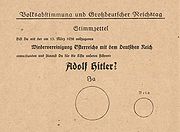 Hitler's forces worked to suppress any opposition. Before the first German soldier crossed the border, Heinrich Himmler
and a few SS officers landed in Vienna to arrest prominent representatives of the First Republic, such as Richard Schmitz
, Leopold Figl
, Friedrich Hillegeist and Franz Olah
. During the few weeks between the Anschluss and the plebiscite, authorities rounded up Social Democrats, Communists and other potential political dissenters, as well as Jews, and imprisoned them or sent them to concentration camps. Within only a few days of 12 March, 70,000 people had been arrested. The plebiscite was subject to large-scale propaganda and to the abrogation of the voting rights of around 400,000 people (nearly 10% of the eligible voting population), mainly former members of left-wing parties and Jews.
While historians concur that the result was not manipulated, the voting process was neither free nor secret. Officials were present directly beside the voting booths and received the voting ballot by hand (in contrast to a secret vote where the voting ballot is inserted into a closed box). In some remote areas of Austria, people voted to preserve the independence of Austria on 13 March despite the Wehrmachts presence. For instance, in the village of Innervillgraten
, a majority of 95% voted for Austria's independence.
A largely unhindered voting process occurred in the Italian harbour city of Gaeta
, where an extraterritorial vote of German and Austrian clerics, studying at the German college of Santa Maria dell'Anima
, took place. The vote was concluded on board the German battleship , which was anchored in the harbour. Contrary to the overall result, these clerical votes rejected the Anschluss by over 90%, an incident which became known at the time as the "Shame of Gaeta" (Vergogna di Gaeta, Schande von Gaeta).
Austria remained part of the Third Reich until the end of World War II, when a preliminary Austrian government declared the Anschluss null und nichtig (null and void) on 27 April 1945. After the war, then Allied-occupied Austria was recognized and treated as a separate country. It was not restored to sovereignty
until the Austrian State Treaty
and Austrian Declaration of Neutrality
, both of 1955, largely due to the rapid development of the Cold War
and disputes between the Soviet Union and its former allies over foreign policy.
Cardinal Theodor Innitzer (a political figure of the CS) declared as early as 12 March: "The Viennese Catholics should thank the Lord for the bloodless way this great political change has occurred, and they should pray for a great future for Austria. Needless to say, everyone should obey the orders of the new institutions." The other Austrian bishops followed suit some days later. Vatican Radio
, however, broadcast a strong denunciation of the German action, and Cardinal Pacelli, the Vatican Secretary of State
, ordered Innitzer to report to Rome. Before meeting the Pope, Innitzer met Pacelli, who had been outraged by Innitzer's statement. He told Innitzer that he needed to retract his statement; he was made to sign a new statement, issued on behalf of all the Austrian bishops, which provided: "The solemn declaration of the Austrian bishops ... was clearly not intended to be an approval of something that was not and is not compatible with God's law". The Vatican newspaper reported that the German bishops' earlier statement had been issued without approval from Rome.
Robert Kauer, president of the minority Lutheran Church in Austria, greeted Hitler on 13 March as "saviour of the 350,000 German Protestants in Austria and liberator from a five-year hardship". Karl Renner
, the most famous Social Democrat of the First Republic, announced his support for the Anschluss and appealed to all Austrians to vote in favour of it on 10 April.
The international response to the Anschluss was publicly moderate. The Times
commented that 300 years before, Scotland had joined England as well, and that this event would not really differ much. On 14 March, the British Prime Minister, Neville Chamberlain
, noted in the House of Commons:
However, the speech concluded:
Within this speech Chamberlain also said, "The hard fact is that nothing could have arrested what has actually happened [in Austria] unless this country and other countries had been prepared to use force."
The moderate reaction to the Anschluss (the U.S. issued a similar statement) was a result of the British appeasement
foreign policy strategy. Hitler appeared to conclude that he could use more aggressive tactics in his "roadmap" to expand the Third Reich, as he would later in annexing the Sudetenland
.
unambiguously was and is not commonly used in this context. The usage of the term Anschluss has been widespread before and in 1938 describing an incorporation of Austria into Germany. Calling the incorporation of Austria into Nazi Germany an "Anschluss", that is a unification or joinder, was also part of the propaganda used in 1938 by Hitler and the Nazis to create the impression the events of March 1938 were not backed and enforced by military pressure. Hitler described the incorporation of Austria as its return to its original home (Heimkehr). The word Anschluss has endured during and following World War II, despite its being a euphemism for what took place.
Some historical sources, like the Encyclopædia Britannica
, describe the Anschluss as an "annexation" rather than a union. Given that events were driven mainly by the German military power and political pressure within Austria and from the outside, the term annexation is a closer description than the term "Anschluss". No one word captures the differences between the Anschluss and other Nazi annexations backed by force, namely, that much of the Austrian population either supported or were indifferent to the incorporation of Austria into the Third Reich.
of 1943, signed by the U.S., the Soviet Union and the UK, included a "Declaration on Austria", which stated the following:
The declaration was mostly intended to serve as propaganda
aimed at stirring Austrian resistance. Although some Austrians aided Jews and are counted as Righteous among the Nations
, there never was an effective Austrian armed resistance of the sort found in other countries under German occupation. The declaration is said to have a somewhat complex drafting history. At Nuremberg, Arthur Seyss-Inquart
and Franz von Papen
, in particular, were both indicted under count one (conspiracy to commit crimes against peace) specifically for their activities in support of the Austrian Nazi Party and the Anschluss, but neither was convicted of this count. In acquitting von Papen, the court noted that his actions were in its view political immoralities but not crimes under its charter. Seyss-Inquart was convicted of other serious war crimes, most of which took place in Poland and the Netherlands, was sentenced to death and executed.
This view of the events of 1938 has deep roots in the 10 years of Allied occupation and the struggle to regain Austrian sovereignty: the "victim theory" played an essential role in the negotiations on the Austrian State Treaty
with the Soviets, and by pointing to the Moscow Declaration, Austrian politicians heavily relied on it to achieve a solution for Austria different from the division of Germany into separate Eastern and Western states. The state treaty, alongside the subsequent Austrian declaration of permanent neutrality
, marked important milestones for the solidification of Austria's independent national identity during the course of the following decades.
As Austrian politicians of the left and right attempted to reconcile their differences in order to avoid the violent conflict that had dominated the First Republic, discussions of both Austrian Nazism
and Austria's role during the Nazi-era were largely avoided. Still, the Austrian People's Party
(ÖVP) had advanced, and still advances, the argument that the establishment of the Dollfuss dictatorship was necessary in order to maintain Austrian independence. On the other hand, the Austrian Social Democratic Party (SPÖ) argues that the Dollfuss dictatorship stripped the country of the democratic resources necessary to repel Hitler; yet it ignores that Hitler himself was a native to Austria.
, a professor of economic history, made anti-Semitic remarks following the death of Ernst Kirchweger
, a concentration camp survivor killed by a right-wing protester during riots. It was not until the 1980s that Austrians confronted their mixed past. The catalyst for the Vergangenheitsbewältigung
was the Waldheim affair. When Kurt Waldheim
, the successful candidate of a presidential election and former UN Secretary-General
, was accused of having been a member of the Nazi party and of the infamous SA
(he was later absolved of direct involvement in war crimes), Austrians said that scrutiny was an unwelcome intervention in the country's internal affairs. Despite the politicians' reactions to international criticism, the Waldheim affair started the first serious discussions about Austria's past and the Anschluss.
Another factor was the rise of Jörg Haider
and the Freedom Party of Austria
(FPÖ) in the 1980s. The party had combined elements of the pan-German right with free-market liberalism since its foundation in 1955, but after Haider ascended to the party chairmanship in 1986, the liberal elements became increasingly marginalized. Haider began to openly use nationalist and anti-immigrant rhetoric. He was criticised for using the völkisch (ethnic) definition of national interest ("Austria for Austrians") and his apologetics for Austria's past, notably calling members of the Waffen-SS
"men of honour". Following a dramatic rise in electoral support in the 1990s that peaked in the 1999 elections, the FPÖ entered a coalition with the Austrian People's Party
(ÖVP), led by Wolfgang Schüssel
. This was condemned in 2000. The coalition prompted the regular Donnerstagsdemonstrationen (Thursday demonstrations) in protest against the government, which took place on the Heldenplatz
where Hitler had greeted the masses during the Anschluss. Haider's tactics and rhetoric, often criticised as sympathetic to Nazism, forced Austrians to reconsider their relationship to the past. Haider's coalition partner, former Chancellor Wolfgang Schüssel, in a 2000 interview with the Jerusalem Post, stated that Austria was the first victim of Hitler-Germany, repeating the victim story.
's last play, Heldenplatz (1988), generated controversy even before it was produced, fifty years after Hitler's entrance to the city. Bernhard made the historic elimination of references to Hitler's reception in Vienna emblematic of Austrian attempts to claim its history and culture under questionable criteria. Many politicians called Bernhard a Nestbeschmutzer (damaging the reputation of his country) and openly demanded that the play should not be staged in Vienna's Burgtheater
. Waldheim, still president, called the play "a crude insult to the Austrian people".
("struggle to come to terms with the past") that has been partially institutionalised, variably in literary, cultural, political, and educational contexts (its development and difficulties have not been trivial; see, for example, the Historikerstreit
). Austria formed a Historikerkommission ("Historian's Commission" or "Historical Commission") in 1998 with a mandate to review Austria's role in the Nazi expropriation of Jewish property from a scholarly rather than legal perspective, partly in response to continuing criticism of its handling of property claims. Its membership was based on recommendations from various quarters, including Simon Wiesenthal
and Yad Vashem
. The Commission delivered its report in 2003. Noted Holocaust historian Raul Hilberg
refused to participate in the Commission and in an interview stated his strenuous objections in terms both personal and in reference to larger questions about Austrian culpability and liability, comparing what he thought to be relative inattention to the settlement governing the Swiss bank holdings of those who died or were displaced by the Holocaust:
The Simon Wiesenthal Center
continues to criticise Austria (as recently as June 2005) for its alleged historical and ongoing unwillingness aggressively to pursue investigations and trials against Nazis for war crimes and crimes against humanity from the 1970s onwards. Its 2001 report offered the following characterization:
In 2003, the Center launched a worldwide effort named "Operation: Last Chance" in order to collect further information about those Nazis still alive that are potentially subject to prosecution. Although reports issued shortly thereafter credited Austria for initiating large-scale investigations, there has been one case where criticism of Austrian authorities arose recently: The Center has put 92-year-old Croatian Milivoj Asner on its 2005 top ten list. Asner fled to Austria in 2004 after Croatia announced it would start investigations in the case of war crimes he may have been involved in. In response to objections about Asner's continued freedom, Austria's federal government has deferred to either extradition requests from Croatia or prosecutorial actions from Klagenfurt
, neither of which appears forthcoming (as of June 2005). Extradition is not an option since Asner also holds Austrian citizenship, having lived in the country from 1946-1991.
Annexation
Annexation is the de jure incorporation of some territory into another geo-political entity . Usually, it is implied that the territory and population being annexed is the smaller, more peripheral, and weaker of the two merging entities, barring physical size...
of Austria
Austria
Austria , officially the Republic of Austria , is a landlocked country of roughly 8.4 million people in Central Europe. It is bordered by the Czech Republic and Germany to the north, Slovakia and Hungary to the east, Slovenia and Italy to the south, and Switzerland and Liechtenstein to the...
into Nazi Germany
Nazi Germany
Nazi Germany , also known as the Third Reich , but officially called German Reich from 1933 to 1943 and Greater German Reich from 26 June 1943 onward, is the name commonly used to refer to the state of Germany from 1933 to 1945, when it was a totalitarian dictatorship ruled by...
in 1938.
Austria was annexed into the German Third Reich on 12 March 1938. There had been several years of pressure by supporters from both Austria and Germany (and both Nazis and non-Nazis) for the "Heim ins Reich
Heim ins Reich
The Heim ins Reich initiative was a policy pursued by Adolf Hitler starting in 1938 and was one of the factors leading to World War II. The initiative attempted to convince people of German descent living outside of the German Reich that they should strive to bring these regions "home" into a...
" movement. Earlier, Nazi Germany had provided support for the Austrian National Socialist Party (Austrian Nazi Party) in its bid to seize power from Austria's Austrofascist leadership.
Devoted to remaining independent but under considerable pressure from both German and Austrian Nazis, Austria's Chancellor Kurt Schuschnigg
Kurt Schuschnigg
Kurt Alois Josef Johann Schuschnigg was Chancellor of the First Austrian Republic, following the assassination of his predecessor, Dr. Engelbert Dollfuss, in July 1934, until Germany’s invasion of Austria, , in March 1938...
tried to hold a referendum
Referendum
A referendum is a direct vote in which an entire electorate is asked to either accept or reject a particular proposal. This may result in the adoption of a new constitution, a constitutional amendment, a law, the recall of an elected official or simply a specific government policy. It is a form of...
for a vote on the issue. Although Schuschnigg expected Austria to vote in favour of maintaining autonomy, a well-planned coup d'état
Coup d'état
A coup d'état state, literally: strike/blow of state)—also known as a coup, putsch, and overthrow—is the sudden, extrajudicial deposition of a government, usually by a small group of the existing state establishment—typically the military—to replace the deposed government with another body; either...
by the Austrian Nazi Party
Austrian National Socialism
Austrian National Socialism was a Pan-German movement that was formed at the beginning of the 20th century. The movement took a concrete form on November 15, 1903 when the German Worker's Party was established in Austria with its secretariat stationed in the town of Aussig...
of Austria's state institutions in Vienna
Vienna
Vienna is the capital and largest city of the Republic of Austria and one of the nine states of Austria. Vienna is Austria's primary city, with a population of about 1.723 million , and is by far the largest city in Austria, as well as its cultural, economic, and political centre...
took place on 11 March, prior to the referendum, which they canceled.
They transferred power to Germany, and Wehrmacht
Wehrmacht
The Wehrmacht – from , to defend and , the might/power) were the unified armed forces of Nazi Germany from 1935 to 1945. It consisted of the Heer , the Kriegsmarine and the Luftwaffe .-Origin and use of the term:...
troops entered Austria to enforce the Anschluss. The Nazis held a plebiscite within the following month, asking the people to ratify the fait accompli. They claimed to have received 99.73% of the vote in favor.
Although the Allies
Allies of World War I
The Entente Powers were the countries at war with the Central Powers during World War I. The members of the Triple Entente were the United Kingdom, France, and the Russian Empire; Italy entered the war on their side in 1915...
were committed to upholding the terms of the Treaty of Versailles
Treaty of Versailles
The Treaty of Versailles was one of the peace treaties at the end of World War I. It ended the state of war between Germany and the Allied Powers. It was signed on 28 June 1919, exactly five years after the assassination of Archduke Franz Ferdinand. The other Central Powers on the German side of...
and St. Germain, which specifically prohibited the union of Austria and Germany, their reaction was only verbal and moderate. No military confrontation took place and even the strongest voices against the annexation, particularly Fascist Italy, France and the United Kingdom (the "Stresa Front
Stresa Front
The Stresa Front was an agreement made in Stresa, a town on the banks of Lake Maggiore in Italy, between French foreign minister Pierre Laval, British prime minister Ramsay MacDonald, and Italian prime minister Benito Mussolini on April 14, 1935...
") remained at peace.
The Anschluss was among the first major steps of Adolf Hitler
Adolf Hitler
Adolf Hitler was an Austrian-born German politician and the leader of the National Socialist German Workers Party , commonly referred to as the Nazi Party). He was Chancellor of Germany from 1933 to 1945, and head of state from 1934 to 1945...
's creation of a Greater German Reich which was to include all of the
German-speaking
German language
German is a West Germanic language, related to and classified alongside English and Dutch. With an estimated 90 – 98 million native speakers, German is one of the world's major languages and is the most widely-spoken first language in the European Union....
lands and territories which Germany had lost after World War I
World War I
World War I , which was predominantly called the World War or the Great War from its occurrence until 1939, and the First World War or World War I thereafter, was a major war centred in Europe that began on 28 July 1914 and lasted until 11 November 1918...
, although Austria had never been a part of (in 20th-century terms) Germany
German Empire
The German Empire refers to Germany during the "Second Reich" period from the unification of Germany and proclamation of Wilhelm I as German Emperor on 18 January 1871, to 1918, when it became a federal republic after defeat in World War I and the abdication of the Emperor, Wilhelm II.The German...
. Prior to the 1938 annexation, Germany had remilitarized the Rhineland
Rhineland
Historically, the Rhinelands refers to a loosely-defined region embracing the land on either bank of the River Rhine in central Europe....
, and the Saar region was returned to Germany after 15 years of occupation through a plebiscite. After the Anschluss, Germany targeted Czechoslovakia, provoking an international crisis which led to the Munich Agreement
Munich Agreement
The Munich Pact was an agreement permitting the Nazi German annexation of Czechoslovakia's Sudetenland. The Sudetenland were areas along Czech borders, mainly inhabited by ethnic Germans. The agreement was negotiated at a conference held in Munich, Germany, among the major powers of Europe without...
in September 1938, giving the Third Reich control of the industrial Sudetenland
Sudetenland
Sudetenland is the German name used in English in the first half of the 20th century for the northern, southwest and western regions of Czechoslovakia inhabited mostly by ethnic Germans, specifically the border areas of Bohemia, Moravia, and those parts of Silesia being within Czechoslovakia.The...
, which had a predominantly ethnic German population. In March 1939, Hitler then annexed truncated Czechoslovakia and made the rest of the nation a protectorate
Protectorate
In history, the term protectorate has two different meanings. In its earliest inception, which has been adopted by modern international law, it is an autonomous territory that is protected diplomatically or militarily against third parties by a stronger state or entity...
. That same year, Memelland was returned from Lithuania.
Austria ceased to exist as a fully independent nation until late 1945. A Provisional Austrian Government was set up on 27 April 1945, and was legally recognized by the Allies
Allies of World War II
The Allies of World War II were the countries that opposed the Axis powers during the Second World War . Former Axis states contributing to the Allied victory are not considered Allied states...
in the following months. It was not until 1955 that Austria regained full sovereignty.
Situation after World War I
The idea of grouping all ethnic Germans into one state had been the subject of inconclusive debate since the end of the Holy Roman EmpireHoly Roman Empire
The Holy Roman Empire was a realm that existed from 962 to 1806 in Central Europe.It was ruled by the Holy Roman Emperor. Its character changed during the Middle Ages and the Early Modern period, when the power of the emperor gradually weakened in favour of the princes...
in 1806. At the same time, the 18th century was a period when thousands of Germans emigrated to other areas, sometimes at the invitation of governments who wanted to resettle areas depopulated by war and the plague, or to improve farming. Often promised special rights and the ability to keep their language and religion, the Germans settled in communities along the Danube (territory that is mostly now present-day Serbia), in Poland, Russia, and across the Atlantic to North America before the American Revolutionary War
American Revolutionary War
The American Revolutionary War , the American War of Independence, or simply the Revolutionary War, began as a war between the Kingdom of Great Britain and thirteen British colonies in North America, and ended in a global war between several European great powers.The war was the result of the...
.
The system of spheres of influence in Europe, developed at Vienna in 1815, depended upon the fragmentation of the German and Italian states, not their consolidation. Consequently, a German nation united under one banner presented significant questions: Who were the Germans? Where was Germany?, but also, Who was in charge?, and, importantly, Who could best defend "Germany", whoever, whatever, and wherever it was? Different groups offered different solutions to this problem. In the Kleindeutschland (little, or "lesser," Germany) solution, the German states would be united under the leadership of Prussia; in the Großdeutsche Lösung (Greater Germany) solution, the German states would be united under the leadership of the Austrian state. This controversy, called dualism
German dualism
Austria and Prussia had a long running conflict and rivalry for supremacy in Central Europe during the 18th and 19th centuries, called in Germany. While wars were a part of the rivalry, it was also a race for prestige to be seen as the legitimate political force of the German-speaking peoples...
, dominated Prusso-Austrian diplomacy and the politics of the German states, for the next 20 years.
In a series of diplomatic and military moves during the late 19th century, the Chancellor of Prussia Otto von Bismarck
Otto von Bismarck
Otto Eduard Leopold, Prince of Bismarck, Duke of Lauenburg , simply known as Otto von Bismarck, was a Prussian-German statesman whose actions unified Germany, made it a major player in world affairs, and created a balance of power that kept Europe at peace after 1871.As Minister President of...
increasingly isolated Austria from its traditional position of influence in broader German affairs. Prussia's defeat of Austria in the Austro-Prussian War
Austro-Prussian War
The Austro-Prussian War was a war fought in 1866 between the German Confederation under the leadership of the Austrian Empire and its German allies on one side and the Kingdom of Prussia with its German allies and Italy on the...
eliminated Austrian influence north of its border, allowed for the creation of the North German Confederation
North German Confederation
The North German Confederation 1866–71, was a federation of 22 independent states of northern Germany. It was formed by a constitution accepted by the member states in 1867 and controlled military and foreign policy. It included the new Reichstag, a parliament elected by universal manhood...
and consolidated the German states through Prussia, enabling the creation of a German Empire
German Empire
The German Empire refers to Germany during the "Second Reich" period from the unification of Germany and proclamation of Wilhelm I as German Emperor on 18 January 1871, to 1918, when it became a federal republic after defeat in World War I and the abdication of the Emperor, Wilhelm II.The German...
in 1871.
When the Austro-Hungarian Empire broke up in 1918, many German-speaking Austrians hoped to join with Germany in the realignment of Europe. On 12 November 1918, German Austria
German Austria
Republic of German Austria was created following World War I as the initial rump state for areas with a predominantly German-speaking population within what had been the Austro-Hungarian Empire, without the Kingdom of Hungary, which in 1918 had become the Hungarian Democratic Republic.German...
was officially declared a republic. The provisional national assembly drafted a provisional constitution that stated that "German Austria is a democratic republic" (Article 1) and "German Austria is a component of the German Republic" (Article 2). Later plebiscites in the German border provinces of Tyrol
Tyrol (state)
Tyrol is a state or Bundesland, located in the west of Austria. It comprises the Austrian part of the historical region of Tyrol.The state is split into two parts–called North Tyrol and East Tyrol–by a -wide strip of land where the state of Salzburg borders directly on the Italian province of...
and Salzburg
Salzburg
-Population development:In 1935, the population significantly increased when Salzburg absorbed adjacent municipalities. After World War II, numerous refugees found a new home in the city. New residential space was created for American soldiers of the postwar Occupation, and could be used for...
yielded majorities of 98 and 99% in favor for a unification with Germany.
The Treaty of Versailles
Treaty of Versailles
The Treaty of Versailles was one of the peace treaties at the end of World War I. It ended the state of war between Germany and the Allied Powers. It was signed on 28 June 1919, exactly five years after the assassination of Archduke Franz Ferdinand. The other Central Powers on the German side of...
and the Treaty of Saint-Germain
Treaty of Saint-Germain
The Treaty of Saint-Germain-en-Laye, was signed on 10 September 1919 by the victorious Allies of World War I on the one hand and by the new Republic of Austria on the other...
(both signed in 1919) explicitly prohibited the inclusion of Austria to politically join the German state. This measure was criticized by Hugo Preuss
Hugo Preuss
Hugo Preuß was a German lawyer and liberal politician.Preuß is often regarded as the father of the German constitution of the Weimar Republic . However, his idea was more of a skeletal structure and not a word for word democratic plan...
, the drafter of the German Weimar Constitution
Weimar constitution
The Constitution of the German Reich , usually known as the Weimar Constitution was the constitution that governed Germany during the Weimar Republic...
, who saw the prohibition as a contradiction of the Wilsonian
Wilsonian
Wilsonianism or Wilsonian are words used to describe a certain type of ideological perspectives on foreign policy. The term comes from the ideology of United States President Woodrow Wilson and his famous Fourteen Points that he believed would help create world peace if implemented.Common...
principle of self-determination
Self-determination
Self-determination is the principle in international law that nations have the right to freely choose their sovereignty and international political status with no external compulsion or external interference...
of peoples, intended to help bring peace to Europe. Following the destruction of World War I
World War I
World War I , which was predominantly called the World War or the Great War from its occurrence until 1939, and the First World War or World War I thereafter, was a major war centred in Europe that began on 28 July 1914 and lasted until 11 November 1918...
, however, both France and Britain feared the power of a larger Germany, and had begun to dis-empower the current one. Austrian particularism, especially among the nobility, also played a role in the decisions; Austria was Roman Catholic, while Germany was dominated by Protestants, especially in government (the Prussian nobility, for example, was Lutheran). The constitutions of the Weimar Republic
Weimar Republic
The Weimar Republic is the name given by historians to the parliamentary republic established in 1919 in Germany to replace the imperial form of government...
and the First Austrian Republic
First Austrian Republic
The Republic of Austria encompasses the period of Austrian history following the signing of the Treaty of Saint-Germain-en-Laye of September 1919, the settlement after the end of World War I which put an end to the Republic of German Austria, continuing up to World War II...
included the political goal of unification, which was widely supported by democratic parties. In the early 1930s, popular support in Austria for union with Germany remained overwhelming, and the Austrian government looked to a possible customs union
Customs union
A customs union is a type of trade bloc which is composed of a free trade area with a common external tariff. The participant countries set up common external trade policy, but in some cases they use different import quotas...
with Germany in 1931.
The rise of Hitler and the Nazis to power in Germany initially caused the Austrian government to withdraw from such economic ties. By contrast Austrian
Austria-Hungary
Austria-Hungary , more formally known as the Kingdoms and Lands Represented in the Imperial Council and the Lands of the Holy Hungarian Crown of Saint Stephen, was a constitutional monarchic union between the crowns of the Austrian Empire and the Kingdom of Hungary in...
-born Hitler
Adolf Hitler
Adolf Hitler was an Austrian-born German politician and the leader of the National Socialist German Workers Party , commonly referred to as the Nazi Party). He was Chancellor of Germany from 1933 to 1945, and head of state from 1934 to 1945...
had promoted an "all German Reich
Heim ins Reich
The Heim ins Reich initiative was a policy pursued by Adolf Hitler starting in 1938 and was one of the factors leading to World War II. The initiative attempted to convince people of German descent living outside of the German Reich that they should strive to bring these regions "home" into a...
" from the early beginning of his leadership in the Nazi Party; he had publicly stated in his 1924 auto-biography (Mein Kampf
Mein Kampf
Mein Kampf is a book written by Nazi leader Adolf Hitler. It combines elements of autobiography with an exposition of Hitler's political ideology. Volume 1 of Mein Kampf was published in 1925 and Volume 2 in 1926...
) that he would create such a union by any means possible.
Austria shared the economic turbulence of the Depression
Great Depression
The Great Depression was a severe worldwide economic depression in the decade preceding World War II. The timing of the Great Depression varied across nations, but in most countries it started in about 1929 and lasted until the late 1930s or early 1940s...
, with a high unemployment rate and unstable commerce and industry. These economic problems made the young democracy vulnerable to social unrest. The First Republic, dominated from the late 1920s by the Catholic nationalist Christian Social Party (CS), gradually disintegrated from 1933 (dissolution of parliament and ban of the Austrian National Socialists) to 1934 (Austrian Civil War
Austrian Civil War
The Austrian Civil War , also known as the February Uprising , is a term sometimes used for a few days of skirmishes between socialist and conservative-fascist forces between 12 February and 16 February 1934, in Austria...
in February and ban of all remaining parties except the CS). The government evolved into a pseudo-fascist, corporatist model of one-party government, which combined the CS and the paramilitary Heimwehr
Heimwehr
The Heimwehr or sometimes Heimatschutz were a Nationalist, initially paramilitary group operating within Austria during the 1920s and 1930s; they were similar in methods, organisation, and ideology to Germany's Freikorps...
with absolute state domination of labour relations and no freedom of the press
Freedom of the press
Freedom of the press or freedom of the media is the freedom of communication and expression through vehicles including various electronic media and published materials...
(see Austrofascism
Austrofascism
Austrofascism is a term which is frequently used by historians to describe the authoritarian rule installed in Austria with the May Constitution of 1934, which ceased with the forcible incorporation of the newly-founded Federal State of Austria into Nazi Germany in 1938...
and Patriotic Front).
Power was centralized in the office of the chancellor
Chancellor of Austria
The Federal Chancellor is the head of government in Austria. Its deputy is the Vice-Chancellor. Before 1918, the equivalent office was the Minister-President of Austria. The Federal Chancellor is considered to be the most powerful political position in Austrian politics.-Appointment:The...
, who was empowered to rule by decree
Rule by decree
Rule by decree is a style of governance allowing quick, unchallenged creation of law by a single person or group, and is used primarily by dictators and absolute monarchs, although philosophers such as Giorgio Agamben have argued that it has been generalized since World War I in all modern states,...
. The predominance of the Christian Social Party (whose economic policies were based on the papal encyclical Rerum Novarum
Rerum Novarum
Rerum Novarum is an encyclical issued by Pope Leo XIII on May 15, 1891. It was an open letter, passed to all Catholic bishops, that addressed the condition of the working classes. The encyclical is entitled: “Rights and Duties of Capital and Labour”...
) was an Austrian phenomenon. Austria's national identity had strong Catholic elements that were incorporated into the movement, by way of clerical authoritarian tendencies not found in Nazism. Both Engelbert Dollfuss
Engelbert Dollfuss
Engelbert Dollfuss was an Austrian Christian Social and Patriotic Front statesman. Serving previously as Minister for Forest and Agriculture, he ascended to Federal Chancellor in 1932 in the midst of a crisis for the conservative government...
and his successor, Kurt Schuschnigg
Kurt Schuschnigg
Kurt Alois Josef Johann Schuschnigg was Chancellor of the First Austrian Republic, following the assassination of his predecessor, Dr. Engelbert Dollfuss, in July 1934, until Germany’s invasion of Austria, , in March 1938...
, turned to Austria's other fascist neighbour, Italy, for inspiration and support. The statist corporatism often referred to as Austrofascism bore much more resemblance to Italian Fascism
Italian Fascism
Italian Fascism also known as Fascism with a capital "F" refers to the original fascist ideology in Italy. This ideology is associated with the National Fascist Party which under Benito Mussolini ruled the Kingdom of Italy from 1922 until 1943, the Republican Fascist Party which ruled the Italian...
than German National Socialism. Benito Mussolini
Benito Mussolini
Benito Amilcare Andrea Mussolini was an Italian politician who led the National Fascist Party and is credited with being one of the key figures in the creation of Fascism....
supported the independence of Austria until his need for German support in Ethiopia (see Second Italo-Abyssinian War
Second Italo-Abyssinian War
The Second Italo–Abyssinian War was a colonial war that started in October 1935 and ended in May 1936. The war was fought between the armed forces of the Kingdom of Italy and the armed forces of the Ethiopian Empire...
) led him into a client relationship with Berlin that began with the 1937 Berlin–Rome Axis
Axis Powers
The Axis powers , also known as the Axis alliance, Axis nations, Axis countries, or just the Axis, was an alignment of great powers during the mid-20th century that fought World War II against the Allies. It began in 1936 with treaties of friendship between Germany and Italy and between Germany and...
.
On 25 July 1934, Chancellor Dollfuss was assassinated by Austrian Nazis
Austrian National Socialism
Austrian National Socialism was a Pan-German movement that was formed at the beginning of the 20th century. The movement took a concrete form on November 15, 1903 when the German Worker's Party was established in Austria with its secretariat stationed in the town of Aussig...
in a failed coup. The second civil war
Austrian Civil War
The Austrian Civil War , also known as the February Uprising , is a term sometimes used for a few days of skirmishes between socialist and conservative-fascist forces between 12 February and 16 February 1934, in Austria...
followed, lasting until August 1934. Afterward leading Austrian Nazis fled to Germany but they continued to push for unification from there. The remaining Austrian Nazis started to make use of terrorist attacks against Austrian governmental institutions, causing a death toll of more than 800 between 1934 and 1938.
Following Dollfuss' assassination, his successor was Schuschnigg, who followed a similar political course. In 1935 Schuschnigg used the police to suppress the Nazi supporters in Austria. Police actions under Schuschnigg included gathering Nazis (and Social Democrats) and holding them in internment camps. However, the support from the powerful and increasingly popular Nazi German state to the north was impossible to prevent. Eventually Schuschnigg gave up his anti-Nazi program and in July 1936 he signed the Austro-German Agreement, which, among other concessions, allowed the release of Nazis imprisoned in Austria and the inclusion of National Socialists in his Cabinet. This did not satisfy Hitler and the pro-German Austrian Nazi's grew in strength.
February 1938
Following increasing violence and demands from Hitler that Austria agree to a union, Schuschnigg met with Hitler on 12 February at BerchtesgadenBerchtesgaden
Berchtesgaden is a municipality in the German Bavarian Alps. It is located in the south district of Berchtesgadener Land in Bavaria, near the border with Austria, some 30 km south of Salzburg and 180 km southeast of Munich...
in an attempt to avoid the take-over of Austria. Hitler presented Schuschnigg with a set of demands which included appointing known Austria Nazi sympathizers to positions of great power in the Austrian government. The key appointment was: Seyss-Inquart would take over as Minister of Public Security, with full and unlimited control of the police forces in Austria. In return Hitler would publicly reaffirm the treaty of 11 July 1936 and reaffirm his support for Austria’s national sovereignty. Schuschnigg accepted Hitler's "deal", returned to Vienna and made the changes to his government.
One week later, Hitler made a speech saying "The German Reich is no longer willing to tolerate the suppression of ten million Germans across its borders." This was clearly directed at Austria and Czechoslovakia
Czechoslovakia
Czechoslovakia or Czecho-Slovakia was a sovereign state in Central Europe which existed from October 1918, when it declared its independence from the Austro-Hungarian Empire, until 1992...
. As would be proved throughout Hitler's career, he could not be trusted to keep his side of any bargain.
Schuschnigg announces a referendum
On 9 March 1938, in an effort to preserve Austria's independence, Schuschnigg scheduled a plebiscite on the issue of unification for 13 March. To secure a large majority in the referendum, Schuschnigg set the minimum voting age at 24, as he believed younger voters were now supporters of the German Nazi ideology. This was a risk, and the next day it became apparent that Hitler would not simply stand by while Austria declared its independence by public vote. Hitler declared that the referendum would be subject to major fraud and that Germany would not accept it. In addition, the German ministry of propaganda issued press reports that riots had broken out in Austria and that large parts of the Austrian population were calling for German troops to restore order. Schuschnigg immediately responded publicly that reports of riots were false.Hitler sent an ultimatum
Ultimatum
An ultimatum is a demand whose fulfillment is requested in a specified period of time and which is backed up by a threat to be followed through in case of noncompliance. An ultimatum is generally the final demand in a series of requests...
to Schuschnigg on 11 March, demanding that he hand over all power to the Austrian National Socialists
Austrian National Socialism
Austrian National Socialism was a Pan-German movement that was formed at the beginning of the 20th century. The movement took a concrete form on November 15, 1903 when the German Worker's Party was established in Austria with its secretariat stationed in the town of Aussig...
or face an invasion. The ultimatum was set to expire at noon, but was extended by two hours. Without waiting for an answer, Hitler had already signed the order to send troops into Austria at one o'clock
Schuschnigg desperately sought support for Austrian independence in the hours following the ultimatum. Realizing that neither France nor Britain was willing to take steps, he resigned as chancellor that evening. In the radio broadcast in which he announced his resignation, he argued that he accepted the changes and allowed the Nazis to take over the government 'to avoid the shedding of fraternal blood [Bruderblut]'.
German troops march into Austria
On the morning of 12 March, the 8th Army of the German WehrmachtWehrmacht
The Wehrmacht – from , to defend and , the might/power) were the unified armed forces of Nazi Germany from 1935 to 1945. It consisted of the Heer , the Kriegsmarine and the Luftwaffe .-Origin and use of the term:...
crossed the German–Austrian border. The German troops were greeted by cheering Austrians with Hitler salutes, Nazi flags and flowers. Because of this, the Nazi invasion is also called the Blumenkrieg (war of flowers), but its official name was Unternehmen Otto. For the Wehrmacht, the invasion was the first big test of its machinery. Although the invading forces were badly organized and coordination among the units was poor, it mattered little because no fighting took place.
Hitler's car crossed the border in the afternoon at Braunau
Braunau am Inn
Braunau am Inn is a town in the Innviertel region of Upper Austria , the north-western state of Austria. It lies about 90 km west of Linz and about 60 km north of Salzburg, on the border with the German state of Bavaria. The population in 2001 was 16,372...
, his birthplace. In the evening, he arrived at Linz
Linz
Linz is the third-largest city of Austria and capital of the state of Upper Austria . It is located in the north centre of Austria, approximately south of the Czech border, on both sides of the river Danube. The population of the city is , and that of the Greater Linz conurbation is about...
and was given an enthusiastic welcome in the city hall.
Hitler's travel through Austria became a triumphal tour that climaxed in Vienna
Vienna
Vienna is the capital and largest city of the Republic of Austria and one of the nine states of Austria. Vienna is Austria's primary city, with a population of about 1.723 million , and is by far the largest city in Austria, as well as its cultural, economic, and political centre...
, on 2 April 1938, when around 200,000 Austrians gathered on the Heldenplatz
Heldenplatz
The Heldenplatz is a historical plaza in Vienna. Many important actions took place here, most notably Adolf Hitler's announcement of the Anschluss of Austria to the German Reich in 1938.-The Plaza:...
(Square of Heroes) to hear Hitler proclaim the Austrian Anschluss. Hitler later commented: "Certain foreign newspapers have said that we fell on Austria with brutal methods. I can only say: even in death they cannot stop lying. I have in the course of my political struggle won much love from my people, but when I crossed the former frontier (into Austria) there met me such a stream of love as I have never experienced. Not as tyrants have we come, but as liberators."
The Anschluss was given immediate effect by legislative act on 13 March, subject to ratification by a plebiscite. Austria became the province of Ostmark
Ostmark (Austria)
Ostmark was the name used by Nazi propaganda to replace that of the formerly independent Austria after the Anschluss annexation of that country by Nazi Germany in 1938....
, and Seyss-Inquart was appointed governor. The plebiscite was held on 10 April and officially recorded a support of 99.73% of the voters.
Heinrich Himmler
Heinrich Luitpold Himmler was Reichsführer of the SS, a military commander, and a leading member of the Nazi Party. As Chief of the German Police and the Minister of the Interior from 1943, Himmler oversaw all internal and external police and security forces, including the Gestapo...
and a few SS officers landed in Vienna to arrest prominent representatives of the First Republic, such as Richard Schmitz
Richard Schmitz
Richard Schmitz was the last Social-Christian mayor of Vienna, Austria.Richard Schmitz served as Vice Chancellor of Austria, as well as its Minister of Social Welfare and of Education, and as Commissioner of Vienna...
, Leopold Figl
Leopold Figl
Leopold Figl was an Austrian politician of the Austrian People's Party and the first Federal Chancellor after World War II...
, Friedrich Hillegeist and Franz Olah
Franz Olah
Franz Olah was an Austrian politician who served as the country's Interior Minister from 1963 until 1964 as a member of the Social Democratic Party ....
. During the few weeks between the Anschluss and the plebiscite, authorities rounded up Social Democrats, Communists and other potential political dissenters, as well as Jews, and imprisoned them or sent them to concentration camps. Within only a few days of 12 March, 70,000 people had been arrested. The plebiscite was subject to large-scale propaganda and to the abrogation of the voting rights of around 400,000 people (nearly 10% of the eligible voting population), mainly former members of left-wing parties and Jews.
While historians concur that the result was not manipulated, the voting process was neither free nor secret. Officials were present directly beside the voting booths and received the voting ballot by hand (in contrast to a secret vote where the voting ballot is inserted into a closed box). In some remote areas of Austria, people voted to preserve the independence of Austria on 13 March despite the Wehrmachts presence. For instance, in the village of Innervillgraten
Innervillgraten
Innervillgraten is a municipality in the district of Lienz in Tyrol in Austria....
, a majority of 95% voted for Austria's independence.
A largely unhindered voting process occurred in the Italian harbour city of Gaeta
Gaeta
Gaeta is a city and comune in the province of Latina, in Lazio, central Italy. Set on a promontory stretching towards the Gulf of Gaeta, it is 120 km from Rome and 80 km from Naples....
, where an extraterritorial vote of German and Austrian clerics, studying at the German college of Santa Maria dell'Anima
Santa Maria dell'Anima
Santa Maria dell'Anima is a Roman Catholic church in central Rome, Italy, just west of the Piazza Navona and near the Santa Maria della Pace church. It was the national church of the Holy Roman Empire in Rome...
, took place. The vote was concluded on board the German battleship , which was anchored in the harbour. Contrary to the overall result, these clerical votes rejected the Anschluss by over 90%, an incident which became known at the time as the "Shame of Gaeta" (Vergogna di Gaeta, Schande von Gaeta).
Austria remained part of the Third Reich until the end of World War II, when a preliminary Austrian government declared the Anschluss null und nichtig (null and void) on 27 April 1945. After the war, then Allied-occupied Austria was recognized and treated as a separate country. It was not restored to sovereignty
Sovereignty
Sovereignty is the quality of having supreme, independent authority over a geographic area, such as a territory. It can be found in a power to rule and make law that rests on a political fact for which no purely legal explanation can be provided...
until the Austrian State Treaty
Austrian State Treaty
The Austrian State Treaty or Austrian Independence Treaty re-established Austria as a sovereign state. It was signed on May 15, 1955, in Vienna at the Schloss Belvedere among the Allied occupying powers and the Austrian government...
and Austrian Declaration of Neutrality
Declaration of Neutrality
The Declaration of Neutrality was a declaration by the Austrian Parliament declaring the country permanently neutral. It was enacted on 26 October 1955 as a constitutional act of parliament, i.e., as part of the Constitution of Austria....
, both of 1955, largely due to the rapid development of the Cold War
Cold War
The Cold War was the continuing state from roughly 1946 to 1991 of political conflict, military tension, proxy wars, and economic competition between the Communist World—primarily the Soviet Union and its satellite states and allies—and the powers of the Western world, primarily the United States...
and disputes between the Soviet Union and its former allies over foreign policy.
Reactions and consequences of the Anschluss
Austria in the first days of the Third Reich had many contradictions: at one and the same time, Hitler's terror regime began to tighten its grip in every area of society, beginning with mass arrests as thousands of Austrians tried to escape; yet other Austrians cheered and welcomed the German troops entering their territory. Many Austrian political figures announced their support of the Anschluss and relief that it happened without violence.Cardinal Theodor Innitzer (a political figure of the CS) declared as early as 12 March: "The Viennese Catholics should thank the Lord for the bloodless way this great political change has occurred, and they should pray for a great future for Austria. Needless to say, everyone should obey the orders of the new institutions." The other Austrian bishops followed suit some days later. Vatican Radio
Vatican Radio
Vatican Radio is the official broadcasting service of the Vatican.Set up in 1931 by Guglielmo Marconi, today its programs are offered in 47 languages, and are sent out on short wave , medium wave, FM, satellite and the Internet. The Jesuit Order has been charged with the management of Vatican...
, however, broadcast a strong denunciation of the German action, and Cardinal Pacelli, the Vatican Secretary of State
Cardinal Secretary of State
The Cardinal Secretary of State—officially Secretary of State of His Holiness The Pope—presides over the Holy See, usually known as the "Vatican", Secretariat of State, which is the oldest and most important dicastery of the Roman Curia...
, ordered Innitzer to report to Rome. Before meeting the Pope, Innitzer met Pacelli, who had been outraged by Innitzer's statement. He told Innitzer that he needed to retract his statement; he was made to sign a new statement, issued on behalf of all the Austrian bishops, which provided: "The solemn declaration of the Austrian bishops ... was clearly not intended to be an approval of something that was not and is not compatible with God's law". The Vatican newspaper reported that the German bishops' earlier statement had been issued without approval from Rome.
Robert Kauer, president of the minority Lutheran Church in Austria, greeted Hitler on 13 March as "saviour of the 350,000 German Protestants in Austria and liberator from a five-year hardship". Karl Renner
Karl Renner
Karl Renner was an Austrian politician. He was born in Untertannowitz in the Austro-Hungarian Empire and died in Vienna...
, the most famous Social Democrat of the First Republic, announced his support for the Anschluss and appealed to all Austrians to vote in favour of it on 10 April.
The international response to the Anschluss was publicly moderate. The Times
The Times
The Times is a British daily national newspaper, first published in London in 1785 under the title The Daily Universal Register . The Times and its sister paper The Sunday Times are published by Times Newspapers Limited, a subsidiary since 1981 of News International...
commented that 300 years before, Scotland had joined England as well, and that this event would not really differ much. On 14 March, the British Prime Minister, Neville Chamberlain
Neville Chamberlain
Arthur Neville Chamberlain FRS was a British Conservative politician who served as Prime Minister of the United Kingdom from May 1937 to May 1940. Chamberlain is best known for his appeasement foreign policy, and in particular for his signing of the Munich Agreement in 1938, conceding the...
, noted in the House of Commons:
His Majesty's Government have throughout been in the closest touch with the situation. The Foreign Secretary saw the German Foreign Minister on the 10th of March and addressed to him a grave warning on the Austrian situation and upon what appeared to be the policy of the German Government in regard to it.... Late on the 11th of March our Ambassador in Berlin registered a protest in strong terms with the German Government against such use of coercion, backed by force, against an independent State in order to create a situation incompatible with its national independence.
However, the speech concluded:
I imagine that according to the temperament of the individual the events which are in our minds to-day will be the cause of regret, of sorrow, perhaps of indignation. They cannot be regarded by His Majesty's Government with indifference or equanimity. They are bound to have effects which cannot yet be measured. The immediate result must be to intensify the sense of uncertainty and insecurity in Europe. Unfortunately, while the policy of appeasement would lead to a relaxation of the economic pressure under which many countries are suffering to-day, what has just occurred must inevitably retard economic recovery and, indeed, increased care will be required to ensure that marked deterioration does not set in. This is not a moment for hasty decisions or for careless words. We must consider the new situation quickly, but with cool judgement... As regards our defence programmes, we have always made it clear that they were flexible and that they would have to be reviewed from time to time in the light of any development in the international situation. It would be idle to pretend that recent events do not constitute a change of the kind that we had in mind. Accordingly we have decided to make a fresh review, and in due course we shall announce what further steps we may think it necessary to take.
Within this speech Chamberlain also said, "The hard fact is that nothing could have arrested what has actually happened [in Austria] unless this country and other countries had been prepared to use force."
The moderate reaction to the Anschluss (the U.S. issued a similar statement) was a result of the British appeasement
Appeasement
The term appeasement is commonly understood to refer to a diplomatic policy aimed at avoiding war by making concessions to another power. Historian Paul Kennedy defines it as "the policy of settling international quarrels by admitting and satisfying grievances through rational negotiation and...
foreign policy strategy. Hitler appeared to conclude that he could use more aggressive tactics in his "roadmap" to expand the Third Reich, as he would later in annexing the Sudetenland
Sudetenland
Sudetenland is the German name used in English in the first half of the 20th century for the northern, southwest and western regions of Czechoslovakia inhabited mostly by ethnic Germans, specifically the border areas of Bohemia, Moravia, and those parts of Silesia being within Czechoslovakia.The...
.
Anschluss: annexation or union?
The word Anschluss outside the context of March 1938 is properly translated as "joinder", "connection", "unification" or "political union". In contrast, the German word Annektierung that would mean military annexationAnnexation
Annexation is the de jure incorporation of some territory into another geo-political entity . Usually, it is implied that the territory and population being annexed is the smaller, more peripheral, and weaker of the two merging entities, barring physical size...
unambiguously was and is not commonly used in this context. The usage of the term Anschluss has been widespread before and in 1938 describing an incorporation of Austria into Germany. Calling the incorporation of Austria into Nazi Germany an "Anschluss", that is a unification or joinder, was also part of the propaganda used in 1938 by Hitler and the Nazis to create the impression the events of March 1938 were not backed and enforced by military pressure. Hitler described the incorporation of Austria as its return to its original home (Heimkehr). The word Anschluss has endured during and following World War II, despite its being a euphemism for what took place.
Some historical sources, like the Encyclopædia Britannica
Encyclopædia Britannica
The Encyclopædia Britannica , published by Encyclopædia Britannica, Inc., is a general knowledge English-language encyclopaedia that is available in print, as a DVD, and on the Internet. It is written and continuously updated by about 100 full-time editors and more than 4,000 expert...
, describe the Anschluss as an "annexation" rather than a union. Given that events were driven mainly by the German military power and political pressure within Austria and from the outside, the term annexation is a closer description than the term "Anschluss". No one word captures the differences between the Anschluss and other Nazi annexations backed by force, namely, that much of the Austrian population either supported or were indifferent to the incorporation of Austria into the Third Reich.
Moscow Declaration
The Moscow DeclarationMoscow Declaration
The Moscow Declaration was signed during the Moscow Conference on October 30, 1943. The formal name of the declaration was "Declaration of the Four Nations on General Security". It was signed by the foreign secretaries of the Governments of the United States, the United Kingdom and the Soviet Union...
of 1943, signed by the U.S., the Soviet Union and the UK, included a "Declaration on Austria", which stated the following:
The governments of the United Kingdom, the Soviet Union and the United States of America are agreed that Austria, the first free country to fall a victim to Hitlerite aggression, shall be liberated from German domination.
They regard the annexation imposed on Austria by Germany on 15 March 1938, as null and void. They consider themselves as in no way bound by any charges effected in Austria since that date. They declare that they wish to see re-established a free and independent Austria and thereby to open the way for the Austrian people themselves, as well as those neighbouring States which will be faced with similar problems, to find that political and economic security which is the only basis for lasting peace.
Austria is reminded, however, that she has a responsibility, which she cannot evade, for participation in the war at the side of Hitlerite Germany, and that in the final settlement account will inevitably be taken of her own contribution to her liberation.
The declaration was mostly intended to serve as propaganda
Propaganda
Propaganda is a form of communication that is aimed at influencing the attitude of a community toward some cause or position so as to benefit oneself or one's group....
aimed at stirring Austrian resistance. Although some Austrians aided Jews and are counted as Righteous among the Nations
Righteous Among the Nations
Righteous among the Nations of the world's nations"), also translated as Righteous Gentiles is an honorific used by the State of Israel to describe non-Jews who risked their lives during the Holocaust to save Jews from extermination by the Nazis....
, there never was an effective Austrian armed resistance of the sort found in other countries under German occupation. The declaration is said to have a somewhat complex drafting history. At Nuremberg, Arthur Seyss-Inquart
Arthur Seyss-Inquart
Arthur Seyss-Inquart was a Chancellor of Austria, lawyer and later Nazi official in pre-Anschluss Austria, the Third Reich and for wartime Germany in Poland and the Netherlands...
and Franz von Papen
Franz von Papen
Lieutenant-Colonel Franz Joseph Hermann Michael Maria von Papen zu Köningen was a German nobleman, Roman Catholic monarchist politician, General Staff officer, and diplomat, who served as Chancellor of Germany in 1932 and as Vice-Chancellor under Adolf Hitler in 1933–1934...
, in particular, were both indicted under count one (conspiracy to commit crimes against peace) specifically for their activities in support of the Austrian Nazi Party and the Anschluss, but neither was convicted of this count. In acquitting von Papen, the court noted that his actions were in its view political immoralities but not crimes under its charter. Seyss-Inquart was convicted of other serious war crimes, most of which took place in Poland and the Netherlands, was sentenced to death and executed.
Austrian identity and the "victim theory"
After World War II, many Austrians sought comfort in the idea of Austria as "the Nazis' first victim". Although the Nazi party was promptly banned, Austria did not have the same thorough process of de-Nazification at the top of government which was imposed on Germany for a time. Lacking outside pressure for political reform, factions of Austrian society tried for a long time to advance the view that the Anschluss was only an annexation at the point of a bayonet.This view of the events of 1938 has deep roots in the 10 years of Allied occupation and the struggle to regain Austrian sovereignty: the "victim theory" played an essential role in the negotiations on the Austrian State Treaty
Austrian State Treaty
The Austrian State Treaty or Austrian Independence Treaty re-established Austria as a sovereign state. It was signed on May 15, 1955, in Vienna at the Schloss Belvedere among the Allied occupying powers and the Austrian government...
with the Soviets, and by pointing to the Moscow Declaration, Austrian politicians heavily relied on it to achieve a solution for Austria different from the division of Germany into separate Eastern and Western states. The state treaty, alongside the subsequent Austrian declaration of permanent neutrality
Neutral country
A neutral power in a particular war is a sovereign state which declares itself to be neutral towards the belligerents. A non-belligerent state does not need to be neutral. The rights and duties of a neutral power are defined in Sections 5 and 13 of the Hague Convention of 1907...
, marked important milestones for the solidification of Austria's independent national identity during the course of the following decades.
As Austrian politicians of the left and right attempted to reconcile their differences in order to avoid the violent conflict that had dominated the First Republic, discussions of both Austrian Nazism
Nazism
Nazism, the common short form name of National Socialism was the ideology and practice of the Nazi Party and of Nazi Germany...
and Austria's role during the Nazi-era were largely avoided. Still, the Austrian People's Party
Austrian People's Party
The Austrian People's Party is a Christian democratic and conservative political party in Austria. A successor to the Christian Social Party of the late 19th and early 20th centuries, it is similar to the Christian Democratic Union of Germany in terms of ideology...
(ÖVP) had advanced, and still advances, the argument that the establishment of the Dollfuss dictatorship was necessary in order to maintain Austrian independence. On the other hand, the Austrian Social Democratic Party (SPÖ) argues that the Dollfuss dictatorship stripped the country of the democratic resources necessary to repel Hitler; yet it ignores that Hitler himself was a native to Austria.
Political events
For decades, the victim theory remained largely undisputed. The Austrian public was rarely forced to confront the legacy of the Third Reich; most notably it had to face issues during the events of 1965, when Taras BorodajkewyczTaras Borodajkewycz
Taras Borodajkewycz , was a former member of the NSDAP and after World War II professor of economic history at the College of World Trade in Vienna .-Life:During the interwar years, he was an adherent of Catholic-national ideas which...
, a professor of economic history, made anti-Semitic remarks following the death of Ernst Kirchweger
Ernst Kirchweger
Ernst Kirchweger was the first person to die as a result of political conflict in Austria's Second Republic....
, a concentration camp survivor killed by a right-wing protester during riots. It was not until the 1980s that Austrians confronted their mixed past. The catalyst for the Vergangenheitsbewältigung
Vergangenheitsbewältigung
Vergangenheitsbewältigung is a composite German word that describes processes of dealing with the past , which is perhaps best rendered in English as "struggle to come to terms with the past"...
was the Waldheim affair. When Kurt Waldheim
Kurt Waldheim
Kurt Josef Waldheim was an Austrian diplomat and politician. Waldheim was the fourth Secretary-General of the United Nations from 1972 to 1981, and the ninth President of Austria, from 1986 to 1992...
, the successful candidate of a presidential election and former UN Secretary-General
United Nations Secretary-General
The Secretary-General of the United Nations is the head of the Secretariat of the United Nations, one of the principal organs of the United Nations. The Secretary-General also acts as the de facto spokesperson and leader of the United Nations....
, was accused of having been a member of the Nazi party and of the infamous SA
Sturmabteilung
The Sturmabteilung functioned as a paramilitary organization of the National Socialist German Workers' Party . It played a key role in Adolf Hitler's rise to power in the 1920s and 1930s...
(he was later absolved of direct involvement in war crimes), Austrians said that scrutiny was an unwelcome intervention in the country's internal affairs. Despite the politicians' reactions to international criticism, the Waldheim affair started the first serious discussions about Austria's past and the Anschluss.
Another factor was the rise of Jörg Haider
Jörg Haider
Jörg Haider was an Austrian politician. He was Governor of Carinthia on two occasions, the long-time leader of the Austrian Freedom Party and later Chairman of the Alliance for the Future of Austria , a breakaway party from the FPÖ.Haider was controversial within Austria and abroad for comments...
and the Freedom Party of Austria
Freedom Party of Austria
The Freedom Party of Austria is a political party in Austria. Ideologically, the party is a direct descendant of the German national liberal camp, which dates back to the 1848 revolutions. The FPÖ itself was founded in 1956 as the successor to the short-lived Federation of Independents , which had...
(FPÖ) in the 1980s. The party had combined elements of the pan-German right with free-market liberalism since its foundation in 1955, but after Haider ascended to the party chairmanship in 1986, the liberal elements became increasingly marginalized. Haider began to openly use nationalist and anti-immigrant rhetoric. He was criticised for using the völkisch (ethnic) definition of national interest ("Austria for Austrians") and his apologetics for Austria's past, notably calling members of the Waffen-SS
Waffen-SS
The Waffen-SS was a multi-ethnic and multi-national military force of the Third Reich. It constituted the armed wing of the Schutzstaffel or SS, an organ of the Nazi Party. The Waffen-SS saw action throughout World War II and grew from three regiments to over 38 divisions, and served alongside...
"men of honour". Following a dramatic rise in electoral support in the 1990s that peaked in the 1999 elections, the FPÖ entered a coalition with the Austrian People's Party
Austrian People's Party
The Austrian People's Party is a Christian democratic and conservative political party in Austria. A successor to the Christian Social Party of the late 19th and early 20th centuries, it is similar to the Christian Democratic Union of Germany in terms of ideology...
(ÖVP), led by Wolfgang Schüssel
Wolfgang Schüssel
Wolfgang Schüssel is an Austrian People's Party politician. He was Chancellor of Austria for two consecutive terms from February 2000 to January 2007...
. This was condemned in 2000. The coalition prompted the regular Donnerstagsdemonstrationen (Thursday demonstrations) in protest against the government, which took place on the Heldenplatz
Heldenplatz
The Heldenplatz is a historical plaza in Vienna. Many important actions took place here, most notably Adolf Hitler's announcement of the Anschluss of Austria to the German Reich in 1938.-The Plaza:...
where Hitler had greeted the masses during the Anschluss. Haider's tactics and rhetoric, often criticised as sympathetic to Nazism, forced Austrians to reconsider their relationship to the past. Haider's coalition partner, former Chancellor Wolfgang Schüssel, in a 2000 interview with the Jerusalem Post, stated that Austria was the first victim of Hitler-Germany, repeating the victim story.
Literature
The political discussions and soul-searching were reflected in other aspects of culture. Thomas BernhardThomas Bernhard
Thomas Bernhard was an Austrian novelist, playwright and poet. Bernhard, whose body of work has been called "the most significant literary achievement since World War II," is widely considered to be one of the most important German-speaking authors of the postwar era.- Life :Thomas Bernhard was...
's last play, Heldenplatz (1988), generated controversy even before it was produced, fifty years after Hitler's entrance to the city. Bernhard made the historic elimination of references to Hitler's reception in Vienna emblematic of Austrian attempts to claim its history and culture under questionable criteria. Many politicians called Bernhard a Nestbeschmutzer (damaging the reputation of his country) and openly demanded that the play should not be staged in Vienna's Burgtheater
Burgtheater
The Burgtheater , originally known as K.K. Theater an der Burg, then until 1918 as the K.K. Hofburgtheater, is the Austrian National Theatre in Vienna and one of the most important German language theatres in the world.The Burgtheater was created in 1741 and has become known as "die Burg" by the...
. Waldheim, still president, called the play "a crude insult to the Austrian people".
Historical Commission and outstanding legal issues
In the context of the postwar Federal Republic of Germany, one encounters a VergangenheitsbewältigungVergangenheitsbewältigung
Vergangenheitsbewältigung is a composite German word that describes processes of dealing with the past , which is perhaps best rendered in English as "struggle to come to terms with the past"...
("struggle to come to terms with the past") that has been partially institutionalised, variably in literary, cultural, political, and educational contexts (its development and difficulties have not been trivial; see, for example, the Historikerstreit
Historikerstreit
The Historikerstreit was an intellectual and political controversy in late 20th-century West Germany about the historical interpretation of the Holocaust. The German word Streit translates variously as "quarrel", "dispute", or "conflict"...
). Austria formed a Historikerkommission ("Historian's Commission" or "Historical Commission") in 1998 with a mandate to review Austria's role in the Nazi expropriation of Jewish property from a scholarly rather than legal perspective, partly in response to continuing criticism of its handling of property claims. Its membership was based on recommendations from various quarters, including Simon Wiesenthal
Simon Wiesenthal
Simon Wiesenthal KBE was an Austrian Holocaust survivor who became famous after World War II for his work as a Nazi hunter....
and Yad Vashem
Yad Vashem
Yad Vashem is Israel's official memorial to the Jewish victims of the Holocaust, established in 1953 through the Yad Vashem Law passed by the Knesset, Israel's parliament....
. The Commission delivered its report in 2003. Noted Holocaust historian Raul Hilberg
Raul Hilberg
Raul Hilberg was an Austrian-born American political scientist and historian. He was widely considered to be the world's preeminent scholar of the Holocaust, and his three-volume, 1,273-page magnum opus, The Destruction of the European Jews, is regarded as a seminal study of the Nazi Final...
refused to participate in the Commission and in an interview stated his strenuous objections in terms both personal and in reference to larger questions about Austrian culpability and liability, comparing what he thought to be relative inattention to the settlement governing the Swiss bank holdings of those who died or were displaced by the Holocaust:
I personally would like to know why the WJCWorld Jewish CongressThe World Jewish Congress was founded in Geneva, Switzerland, in August 1936 as an international federation of Jewish communities and organizations...
has hardly put any pressure on Austria, even as leading Nazis and SS leaders were Austrians, Hitler included... Immediately after the war, the US wanted to make the Russians withdraw from Austria, and the Russians wanted to keep Austria neutral, therefore there was a common interest to grant Austria victim status. And later Austria could cry poor – though its per capita income is as high as Germany's. And, most importantly, the Austrian PR machinery works better. Austria has the opera ball, the imperial castle, Mozartkugeln [a chocolate]. Americans like that. And Austrians invest and export relatively little to the US, therefore they are less vulnerable to blackmail. In the meantime, they set up a commission in Austria to clarify what happened to Jewish property. Victor Klima, the former chancellor, has asked me to join. My father fought for Austria in the First World War and in 1939 he was kicked out of Austria. After the war they offered him ten dollars per month as compensation. For this reason I told Klima, no thank you, this makes me sick.
The Simon Wiesenthal Center
Simon Wiesenthal Center
The Simon Wiesenthal Center , with headquarters in Los Angeles, California, was established in 1977 and named for Simon Wiesenthal, the Nazi hunter. According to its mission statement, it is "an international Jewish human rights organization dedicated to repairing the world one step at a time...
continues to criticise Austria (as recently as June 2005) for its alleged historical and ongoing unwillingness aggressively to pursue investigations and trials against Nazis for war crimes and crimes against humanity from the 1970s onwards. Its 2001 report offered the following characterization:
Given the extensive participation of numerous Austrians, including at the highest levels, in the implementation of the Final Solution and other Nazi crimes, Austria should have been a leader in the prosecution of Holocaust perpetrators over the course of the past four decades, as has been the case in Germany. Unfortunately relatively little has been achieved by the Austrian authorities in this regard and in fact, with the exception of the case of Dr. Heinrich GrossHeinrich GrossHeinrich Gross was an Austrian psychiatrist, medical doctor and neurologist, best known for his proven involvement in the killing of at least nine children with physical, mental and/or emotional/behavioral characteristics considered "unclean" by the Nazi regime, under its Euthanasia Program...
which was suspended this year under highly suspicious circumstances (he claimed to be medically unfit, but outside the court proved to be healthy) not a single Nazi war crimes prosecution has been conducted in Austria since the mid-1970s.
In 2003, the Center launched a worldwide effort named "Operation: Last Chance" in order to collect further information about those Nazis still alive that are potentially subject to prosecution. Although reports issued shortly thereafter credited Austria for initiating large-scale investigations, there has been one case where criticism of Austrian authorities arose recently: The Center has put 92-year-old Croatian Milivoj Asner on its 2005 top ten list. Asner fled to Austria in 2004 after Croatia announced it would start investigations in the case of war crimes he may have been involved in. In response to objections about Asner's continued freedom, Austria's federal government has deferred to either extradition requests from Croatia or prosecutorial actions from Klagenfurt
Klagenfurt
-Name:Carinthia's eminent linguists Primus Lessiak and Eberhard Kranzmayer assumed that the city's name, which literally translates as "ford of lament" or "ford of complaints", had something to do with the superstitious thought that fateful fairies or demons tend to live around treacherous waters...
, neither of which appears forthcoming (as of June 2005). Extradition is not an option since Asner also holds Austrian citizenship, having lived in the country from 1946-1991.
Austrian political and military leaders in Nazi Germany
- Adolf HitlerAdolf HitlerAdolf Hitler was an Austrian-born German politician and the leader of the National Socialist German Workers Party , commonly referred to as the Nazi Party). He was Chancellor of Germany from 1933 to 1945, and head of state from 1934 to 1945...
- Ernst KaltenbrunnerErnst KaltenbrunnerErnst Kaltenbrunner was an Austrian-born senior official of Nazi Germany during World War II. Between January 1943 and May 1945, he held the offices of Chief of the Reichssicherheitshauptamt , President of Interpol and, as a Obergruppenführer und General der Polizei und Waffen-SS, he was the...
- Arthur Seyss-InquartArthur Seyss-InquartArthur Seyss-Inquart was a Chancellor of Austria, lawyer and later Nazi official in pre-Anschluss Austria, the Third Reich and for wartime Germany in Poland and the Netherlands...
- Odilo GlobocnikOdilo GlobocnikOdilo Lotario Globocnik was a prominent Austrian Nazi and later an SS leader. He was an acquaintance of Adolf Eichmann, who played a major role in the extermination of Jews and others during the Holocaust...
- Amon GöthAmon GöthAmon Leopold Göth was an Austrian Nazi and the commandant of the Nazi concentration camp at Płaszów, General Government...
- Lothar RendulicLothar RendulicGeneraloberst Lothar Rendulic was an Austro-Hungarian and Austrian Army officer of Croatian origin who served as a German general during World War II. He commanded the 14. Infanterie-Division, 52. Infanterie-Division, XXXV Armeekorps, 2. Panzer-Armee, 20...
- Alfred Ritter von HubickiAlfred Ritter von HubickiAlfred Eduard Franz Ritter von Hubicki was a Hungarian born Austrian army officer who was a Panzer General in the German army during World War II.-World War I:...
- Alexander LöhrAlexander LöhrAlexander Löhr was an Austrian Air Force commander during the 1930s and, after the "Political Union of Germany and Austria" , he was a German Air Force commander...
- Franz BöhmeFranz BöhmeFranz Friedrich Böhme was an Austrian who later went on to become a military officer...
- Otto SkorzenyOtto SkorzenyOtto Skorzeny was an SS-Obersturmbannführer in the German Waffen-SS during World War II. After fighting on the Eastern Front, he was chosen as the field commander to carry out the rescue mission that freed the deposed Italian dictator Benito Mussolini from captivity...
- Julius RingelJulius RingelJulius Alfred "Papa" Ringel was an Austrian-born German General of Mountain Troops . He commanded the 3. Gebirgs-Division, 5. Gebirgs-Division, LXIX Armeekorps, Wehrkreis XI and the Korps Ringel...
- Adolf EichmannAdolf EichmannAdolf Otto Eichmann was a German Nazi and SS-Obersturmbannführer and one of the major organizers of the Holocaust...
- Erhard RausErhard RausErhard Raus was a Austrian Colonel General during World War II. He commanded the 6th Panzer Division during the early years of the war on the Eastern Front before taking Army and Army Group commands....
- Hans FischböckHans FischböckHans Fischböck was an Austrian banker who was the economics minister and minister of finance of Austria and the finance minister of Nazi occupied Holland....
See also
- The Sound of MusicThe Sound of MusicThe Sound of Music is a musical by Richard Rodgers, lyrics by Oscar Hammerstein II and a book by Howard Lindsay and Russel Crouse. It is based on the memoir of Maria von Trapp, The Story of the Trapp Family Singers...
(a dramatization based on the memoir of Maria von TrappMaria von TrappMaria Augusta von Trapp , also known as Baroness Maria von Trapp, was the stepmother and matriarch of the Trapp Family Singers...
) - The Great DictatorThe Great DictatorThe Great Dictator is a comedy film by Charlie Chaplin released in October 1940. Like most Chaplin films, he wrote, produced, and directed, in addition to starring as the lead. Having been the only Hollywood film maker to continue to make silent films well into the period of sound films, this was...
(a fictitious account of the invasion of "Osterlich" by "Tomania", modeled on the Anschluss) - King Ottokar's SceptreKing Ottokar's SceptreKing Ottokar's Sceptre is the eighth of The Adventures of Tintin, a series of classic comic-strip albums, written and illustrated by Belgian writer and illustrator Hergé, featuring the young reporter Tintin. It was first serialized as a black-and-white comic strip in Le Petit Vingtième on 4 August...
(a fictitious account of the failed Bordurian coup d'état and invasion of their democratic neighbour Syldavia, modeled on the Anschluss)
Books
- Bukey, Evan Burr (1986). Hitler's Hometown: Linz, Austria, 1908–1945. Indiana University PressIndiana University PressIndiana University Press, also known as IU Press, is an academic publisher at Indiana University that specializes in the humanities and social sciences. It was founded in 1950. Its headquarters are located in Bloomington, Indiana....
. ISBN 0-253-32833-0. - Parkinson, F. (ed.) (1989). Conquering the Past: Austrian Nazism Yesterday and Today. Wayne State University PressWayne State University PressWayne State University Press , founded in 1941, is a university press that is part of Wayne State University. It publishes under its own name and also the imprints Painted Turtle and Great Lakes Books....
. ISBN 0-8143-2054-6. - Pauley, Bruce F. (1981). Hitler and the Forgotten Nazis: A History of Austrian National Socialism University of North Carolina PressUniversity of North Carolina PressThe University of North Carolina Press , founded in 1922, is a university press that is part of the University of North Carolina....
. ISBN 0-8078-1456-3. Scheuch, Manfred (2005). Der Weg zum Heldenplatz: eine Geschichte der österreichischen Diktatur. 1933–1938. ISBN 3-8258-7712-4. - Schuschnigg, Kurt (1971). The brutal takeover: The Austrian ex-Chancellor's account of the Anschluss of Austria by Hitler. Weidenfeld and Nicolson. ISBN 0-297-00321-6. Stuckel, Eva-Maria (2001). Österreich, Monarchie, Operette, und Anschluss: Antisemtismus, Faschismus, und Nationalsozialismus im Fadenkreuz von Ingeborg Bachman und Elias Canetti. Kulturfoerderverein Ruhrg. ISBN 3-9313-0009-9.
Electronic articles and journals
- Österreichs Weg zum Anschluss im März 1938," Wiener Zeitung, 25 May 1998 (detailed article the on the events of the Anschluss, in German).
- Die propagandistische Vorbereitung der Volksabstimmung," Austrian Resistance Archive, Vienna, 1988 (accessed 10 June 2005).
- 1938: Austria (Archived 2009-10-31), MSN Encarta. (accessed 10 June 2005).
- The Crisis Year of 1934 Buchner, A. From the Destruction of the Socialist Lager to National Socialist Coup Attempt (accessed 10 June 2005).
External links
- United States Holocaust Memorial Museum - Library Bibliography: Anschluss
- Austrian Historical Commission
- Encyclopaedia Britannica, Anschluss artilcle
- BBC article by Robert Knight, who served on the Historikercommission
- Full text of the Moscow Declaration
- Simon Wiesenthal Center
- Time magazine coverage of the events of the Anschluss
- Pictures of Adolf Hitler in Vienna
- Anschluss - a soundbite history of the German invasion into Austria
- Map of Europe at time of Anschluss at omniatlas.com