

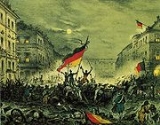
Revolutions of 1848 in the German states

Encyclopedia
.jpg)
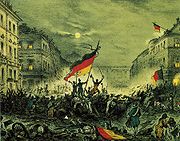
Revolutions of 1848
The European Revolutions of 1848, known in some countries as the Spring of Nations, Springtime of the Peoples or the Year of Revolution, were a series of political upheavals throughout Europe in 1848. It was the first Europe-wide collapse of traditional authority, but within a year reactionary...
that broke out in many countries of Europe – were a series of loosely coordinated protests and rebellions in the states of the German Confederation
German Confederation
The German Confederation was the loose association of Central European states created by the Congress of Vienna in 1815 to coordinate the economies of separate German-speaking countries. It acted as a buffer between the powerful states of Austria and Prussia...
, including the Austrian Empire
Austrian Empire
The Austrian Empire was a modern era successor empire, which was centered on what is today's Austria and which officially lasted from 1804 to 1867. It was followed by the Empire of Austria-Hungary, whose proclamation was a diplomatic move that elevated Hungary's status within the Austrian Empire...
. The revolutions, which stressed pan-Germanism
Pan-Germanism
Pan-Germanism is a pan-nationalist political idea. Pan-Germanists originally sought to unify the German-speaking populations of Europe in a single nation-state known as Großdeutschland , where "German-speaking" was taken to include the Low German, Frisian and Dutch-speaking populations of the Low...
, emphasised popular discontent with the traditional, largely autocratic political structure of the thirty-nine independent states
Sovereign state
A sovereign state, or simply, state, is a state with a defined territory on which it exercises internal and external sovereignty, a permanent population, a government, and the capacity to enter into relations with other sovereign states. It is also normally understood to be a state which is neither...
of the Confederation that inherited the German territory of the former Holy Roman Empire
Holy Roman Empire
The Holy Roman Empire was a realm that existed from 962 to 1806 in Central Europe.It was ruled by the Holy Roman Emperor. Its character changed during the Middle Ages and the Early Modern period, when the power of the emperor gradually weakened in favour of the princes...
. Furthermore, they demonstrated the popular desire for increased political freedom, liberal state policies, freedom from censorship, democracy, and nationalism
Nationalism
Nationalism is a political ideology that involves a strong identification of a group of individuals with a political entity defined in national terms, i.e. a nation. In the 'modernist' image of the nation, it is nationalism that creates national identity. There are various definitions for what...
. The middle class elements were committed to liberal
Liberalism
Liberalism is the belief in the importance of liberty and equal rights. Liberals espouse a wide array of views depending on their understanding of these principles, but generally, liberals support ideas such as constitutionalism, liberal democracy, free and fair elections, human rights,...
principles while the working class sought radical improvements to their working and living conditions. However, the middle class and working class components of the Revolution split, and in the end the conservative aristocracy defeated it, forcing many liberals into exile.
Main causes
The campaigners in the German revolution of 1848 had two main goals, a unified German nation state and the introduction of civil liberties.The demands for political reform included freedom of the press, self-organization of the universities and a parliament representing all German citizens, instead of the federal council representing only the monarchs of a multitude of sovereign German states.
Nationalist sentiment which was widely spread among students and the educated middle class was stimulated by the Rhine crisis of 1840, when it seemed France would invade the Rhineland. The historian Fichte, the writer Arndt and Jahn ("Turnvater Jahn") had contributed in their different ways to the growth of a diffuse German national sentiment. Fichte had raised the national temper with his lectures on the German state, Arndt had declared his undying hatred of the French and Jahn had called for the creation of a strong national body of men ready to die for the fatherland. All three had lived through the occupation of the German states by the Napoleonic armies, and France was seen as the great rival to the German states, which in their scattered composition had been unable to form a coordinated defence against Napoleon. The Rhine crisis caused a new wave of anti-French sentiment and the composition of patriotic Rheinlied songs. In addition, Denmark's declaration that it would occupy part of Schleswig-Holstein provoked widespread opposition. Nationalistic poems and songs were written, such as the Deutschlandlied ("Deutschland über alles", 1841) which eventually became the national anthem. New journals, magazines, and papers arose, such as Die Deutsche Zeitung (The German Newspaper)", widening awareness of events in France and Denmark. From 1840 on there was a consensus among German liberals that only the dual aim of unity and freedom was worth fighting for.
Disastrous economic conditions also played a part. A cholera
Cholera
Cholera is an infection of the small intestine that is caused by the bacterium Vibrio cholerae. The main symptoms are profuse watery diarrhea and vomiting. Transmission occurs primarily by drinking or eating water or food that has been contaminated by the diarrhea of an infected person or the feces...
epidemic led to widespread death and suffering in Silesia. Population growth and the failures of harvests in 1846 and 1847 caused famine and misery. Many people moved to the cities in order to survive, but wages were very low and living conditions were appalling.
In 1828 the Prussian-Hessian Customs Union was formed, which was designed to make trade in Prussian goods more efficient. Austria was the only state that did not join and it was a powerful motor for the unification of the states within the federation. The Zollverein set standards for taxes for goods and made travel between states much easier. Initially, the union area outside of Prussia was rather small, yet by 1834 it had grown into the Zollverein
Zollverein
thumb|upright=1.2|The German Zollverein 1834–1919blue = Prussia in 1834 grey= Included region until 1866yellow= Excluded after 1866red = Borders of the German Union of 1828 pink= Relevant others until 1834...
which encompassed most of what was to become Germany. Amongst other achievements it established standards for weights and currency in Germany.
Events across Europe in 1848 had an impact also on the Germans. In February 1848, King Louis-Phillipe of France abdicated the throne, triggering revolutions across the entire European continent, especially in the German provinces.
Events leading up to the revolutions
The ground work of the 1848 uprising in Germany was laid long beforehand. Hambacher FestHambacher Fest
The Hambacher Fest was a German national democratic festival—disguised as a non-political county fair—that was celebrated from 27 May to 30 May 1832 at Hambach Castle near Neustadt an der Weinstraße ....
of 1832, for instance, reflected growing unrest in the face of heavy taxation and political censorship. The Hambacher Fest is particularly noteworthy for the fact that it resulted in the origination of the black-red-gold colours (which form today's flag of Germany
Flag of Germany
The flag of Germany is a tricolour consisting of three equal horizontal bands displaying the national colours of Germany: black, red, and gold....
) as a symbol of the republican movement and of a unity among the German-speaking people.
Liberal pressure spread through many of the German states
States of the German Confederation
The States of the German Confederation were those member states that from June 20, 1815 were part of the German Confederation, which lasted, with some changes in the member states, until August 24, 1866, under the presidency of the Austrian imperial House of Habsburg, which was represented by an...
, each of which experienced the revolutions in its own way. The street demonstrations of workers and artisans in Paris, France, from February 22 through 24, 1848 resulted in the abdication of King Louis Philippe
Louis Philippe
Louis Philippe may refer to:*Louis-Philippe I, King of the French, last King of France*Prince Philippe, Count of Paris, called King Louis Philippe II by some factions*Louis Philippe I, Duke of Orléans*Louis Philippe II, Duke of Orléans...
of France and his departure from France to live in Britain
United Kingdom
The United Kingdom of Great Britain and Northern IrelandIn the United Kingdom and Dependencies, other languages have been officially recognised as legitimate autochthonous languages under the European Charter for Regional or Minority Languages...
, was the immediate spur to revolt in Germany. In France the revolution of 1848 became known as the February Revolution
French Revolution of 1848
The 1848 Revolution in France was one of a wave of revolutions in 1848 in Europe. In France, the February revolution ended the Orleans monarchy and led to the creation of the French Second Republic. The February Revolution was really the belated second phase of the Revolution of 1830...
.
The revolution spread across Europe and started in Germany with the large demonstrations on March 13, 1848, in Vienna
Vienna
Vienna is the capital and largest city of the Republic of Austria and one of the nine states of Austria. Vienna is Austria's primary city, with a population of about 1.723 million , and is by far the largest city in Austria, as well as its cultural, economic, and political centre...
, Austria
Austria
Austria , officially the Republic of Austria , is a landlocked country of roughly 8.4 million people in Central Europe. It is bordered by the Czech Republic and Germany to the north, Slovakia and Hungary to the east, Slovenia and Italy to the south, and Switzerland and Liechtenstein to the...
, which resulted in the resignation of Prince von Metternich as chief minister to Emperor Ferdinand I of Austria and his departure from
Austria to live in Britain. Because of the date of these demonstrations, the revolutions in Germany are usually called the March Revolution (German: Märzrevolution).
Fearing the fate of Louis-Philippe of France
Louis-Philippe of France
Louis Philippe I was King of the French from 1830 to 1848 in what was known as the July Monarchy. His father was a duke who supported the French Revolution but was nevertheless guillotined. Louis Philippe fled France as a young man and spent 21 years in exile, including considerable time in the...
, some monarchs in Germany accepted some of the demands of the revolutionaries, at least temporarily. In the south and west, large popular assemblies
Popular assembly
A popular or people's assembly is a gathering called to address issues of importance to participants. Assemblies tend to be freely open to participation and operate by direct democracy...
and mass demonstrations took place. They demanded freedom of the press
Freedom of the press
Freedom of the press or freedom of the media is the freedom of communication and expression through vehicles including various electronic media and published materials...
, freedom of assembly
Freedom of assembly
Freedom of assembly, sometimes used interchangeably with the freedom of association, is the individual right to come together and collectively express, promote, pursue and defend common interests...
, written constitutions, arming of the people and a national German parliament
Parliament
A parliament is a legislature, especially in those countries whose system of government is based on the Westminster system modeled after that of the United Kingdom. The name is derived from the French , the action of parler : a parlement is a discussion. The term came to mean a meeting at which...
.
Baden
Baden had had a liberal constitution from 1811 until reaction revoked the constitution in 1825. In 1830, Leopold of Baden became Grand Duke of the duchy. His reign brought liberal reforms in constitutional, civil and criminal law and in education. In 1832 Baden joined the (Prussian) Customs Union. After news broke of revolutionary victories in February 1848 in Paris, uprisings occurred throughout Europe, including the German states. However, the first state in Germany to be affected by the French Revolution in February 1848 was Baden. Baden happened to be one of the most liberal states in Germany. The liberal reforms that Baden had instituted did not allow Baden to escape the uprisings of 1848. After the news of the February Days in Paris reached Baden, there were several unorganized instances of peasants burning the mansions of local aristocrats and threatening them.Events began rolling on February 27, 1848, in Mannheim, where an assembly of the people from Baden adopted a resolution demanding a bill of rights. Similar resolutions were adopted in Württemberg
Kingdom of Württemberg
The Kingdom of Württemberg was a state that existed from 1806 to 1918, located in present-day Baden-Württemberg, Germany. It was a continuation of the Duchy of Württemberg, which came into existence in 1495...
, Hesse-Darmstadt
Grand Duchy of Hesse
The Grand Duchy of Hesse and by Rhine , or, between 1806 and 1816, Grand Duchy of Hesse —as it was also known after 1816—was a member state of the German Confederation from 1806, when the Landgraviate of Hesse-Darmstadt was elevated to a Grand Duchy, until 1918, when all the German...
, Nassau, and other German states. The surprisingly strong popular support for these movements forced rulers to give in to many of the Märzforderungen (demands of March) almost without resistance.
The March Revolution in Vienna further fueled the flames of revolution all across Germany. Popular demands were made for an elected representative government and for the unification of all Germany. Fear on the part of the princes and rulers of the various German states caused them to concede in the demand for reform. Consequently, a preparliament was convened from March 31, 1848 until April 4, 1848 in St. Paul's Church in Frankfurt am Main, charged with the task of drafting a new constitution called the "Fundamental Rights and Demands of the German People." The majority of the delegates to the preparliament were constitutional monarchists.
Baden, however, sent two democrats, Friedrich Karl Franz Hecker and Gustav von Struve, to the preparliament. In the minority and frustrated with the lack of progress at the preparliament, Hecker and Struve walked out of the preparliament in protest on April 2, 1848. The walkout and the continuing revolutionary upsurge in Germany spurred the preparliament to action and they passed a resolution calling for an All-German National Assembly to be formed. On April 8, 1848, a law allowing universal suffrage and an indirect (two stage) voting system was agreed by the assembly. Pursuant to this law, a new National Assembly was selected and on May 18, 1848, 809 delegates (585 of which were elected) were seated at St. Paul's Church in Frankfurt to convene the Frankfurt National Assembly. Karl Mathy
Karl Mathy
Karl Mathy , was a Badensian statesman.He was born at Mannheim. He studied law and politics at Heidelberg, and entered the Baden government department of finance in 1829...
, a right-center journalist was one of the persons elected as deputy to the Frankfurt National Assembly.
Disorder fomented by republican agitators, nonetheless, continued in Baden. The continuing revolutionary upsurge in Baden cause fear within Baden government, which then began to increase the size of its own army and to seek assistance from neighboring states. The Baden government sought to suppress the revolts by arresting Joseph Fickler
Joseph Fickler
Joseph Fickler was a German journalist. A democrat by philosophy, Fickler became a leader of the Baden democratic movement. In 1849, he became a member of the Baden revolutionary provisional government. He died in 1865.-References:...
, a journalist, and the leader of the Baden democrats. The arrests brought the democratic protests in favor of reform to a peak. A full-scale uprising broke out on April 12, 1848. The Bavarian government suppressed the revolutionary forces led by Friedrich Hecker with the aid of Prussian troops at Kandern
Kandern
Kandern is a town in southwestern Germany in the state of Baden-Württemberg, in the Kreis of Lörrach. During the Battle of Schliengen, in which the French Revolutionary army fought the forces of Austria, the battle lines of both armies terminated in Kandern...
on April 20, 1848, ending what became known as the Hecker Uprising
Hecker Uprising
The Hecker Uprising was an attempt by Baden revolutionary leaders Friedrich Hecker, Gustav von Struve, and several other radical democrats in April 1848 to overthrow the monarchy and establish a republic in the Grand Duchy of Baden...
.
In May 1849, a resurgence of revolutionary activity occurred in Baden. However, this resurgent uprising was closely linked with the uprising in the Palatinate. Thus, this resurgent uprising in Baden in 1849 is described, below, in the section of this article called "The Palatinate."
The Palatinate
Like the Rhineland (see below), the Palatinate, today, is a heavily industrial area. Naturally, in 1848, the Palatinate tended to be more agricultural than industrial. Indeed, the Palatinate in 1848 was one of the premier wine growing areas of Germany. Unike the other areas of southern Germany, more wine was consumed in the Palatinate than beer.When the revolutionary upsurge renewed itself in the spring of 1849, the uprisings started in Elberfeld in the Rhineland on May 6, 1848. However, the uprisings soon spread to the state of Baden
Baden
Baden is a historical state on the east bank of the Rhine in the southwest of Germany, now the western part of the Baden-Württemberg of Germany....
, when a riot broke out in Karlsruhe
Karlsruhe
The City of Karlsruhe is a city in the southwest of Germany, in the state of Baden-Württemberg, located near the French-German border.Karlsruhe was founded in 1715 as Karlsruhe Palace, when Germany was a series of principalities and city states...
. The states of Baden and the Palatinate border each other, separated only by the Rhine River. The uprising in Baden and the Palatinate took place, largely, in the Rhine Valley along the border between Baden and the Palatinate. Thus, the uprisings in Baden and the Palatinate were basically the same uprising. In May 1849, the Grand Duke was forced to leave Karlsruhle, Baden and seek help from Prussia. Provisional governments were declared in both the Paltinate and in Baden. While in Baden conditions for the provisional government were ideal—the public, including the army, strongly in support of constitutional change and democratic reform in the government, there was a ready army, which also strongly supported the demands for a constitution, amply supplied arsenals and a full exchequer—conditions in the Palatinate were somewhat less ideal.
While Baden had the near unanimous support of its population, the Palatinate traditionally contained more upper class citizens that other areas of Germany. Accordingly the populace of the Palatinate was more divided with regard to support for the provisional government and the demands for constitutional change in the government. In Baden the army supported the provisional government. However, in the Palatinate, this was not the case. When the insurrectionary government took over in the Palatinate, they did not find the same abundantly supplied arsenals a full organized state machinery a full exchequer that were to be found in Baden. Instead there were limited number of privately held muskets, rifes and sporting guns available in the Palatinate. To solve this problem of the shortage of arms the provisional government of the Palatinate sent agents to France and Belgium to purchase arms. However, nothing resulted from these forays. France banned sales and export of arms to either Baden or the Palatinate.
The provisional government first appointed Joseph Martin Reichardt
Joseph Martin Reichardt
Joseph Martin Reichard was a German politician and revolutionary. He was a lawyer by profession and democrat by philosophy. He was elected as a deputy to the Frankfurt National Assembly in 1848 and served as a member of the Palatinate revolutionary Provisional Government in 1849. He died in 1872....
, a lawyer, democrat and deputy in the Frankfurt Assembly, as the head of the military department in the Palatinate. First Commander in Chief of the military forces of the Palatinate was Daniel Fenner von Fenneberg
Daniel Fenner von Fenneberg
Daniel Fenner von Fenneberg was born in 1820. He served as an officer in the Austrian Army and commanded the Vienna National Guard in 1848. Later he was the Commander in Chief of the National Guard in Vienna in 1848. During the uprising of the citizens of Vienna in 1848, the National Guard...
, a former Austrian officer who commanded the national guard in Vienna during the 1848 uprising. He was soon replaced by Felix Raquilliet
Felix Raquilliet
Felix Raquilliet became a staff general in the Polish insurgent Army during the uprising of 1830-1831. He immigrated to France and in 1849 took part in the Baden-Palatinate uprising. For a while, he was acting as the commander-in-chief of the Palatinate forces.-References:...
, a former Polish staff general in the Polish insurgent army of 1830-1831. In the end, Ludwik Mieroslawski
Ludwik Mieroslawski
Ludwik Adam Mierosławski was a Polish general, writer, poet, historian and political activist. Took part in the November Uprising of 1830s, after its fall he emigrated to France, where he taught Slavic history and military theory. Chosen as a commander for the Greater Poland Uprising of 1846, he...
was given supreme command of the armed forces in the Palatinate and field command of the troops was given to Franz Sznayde
Franz Sznayde
Franz Sznayde was born in 1790 in Poland. He was a participant in the Polish uprising of 1830 through 1831. In 1849, he became a general in the Baden-Palatinate insurgent army. Sznayde died in 1850....
. Other noteworthy military officers providing assistance to the provisional government in the city of Kaiserlautern in the Palatinate, were Friedrich Strasser
Friedrich Strasser
Friedrich Strasser was born in Austria. He became a painter. He then participated in the 1848 revolution in Austria. In 1849 he became a lieutenant-colonel in the Baden-Palatinate insurgent army.-References:...
, Alexander Schimmelpfennig, Captain Rudolph von Manteuffel
Rudolph von Manteuffel
Rudolf von Manteuffel was born in Prussia and was a relative of the Prussian conservative statesman, Otto Theodor von Manteuffel. In 1849, Rudolph von Manteuffel was serving as a captain in the Baden-Palatinate insurgent army.-References:...
, Albert Clement
Albert Clement
Arie Albertus Clement is professor of musicology at the Roosevelt Academy, a small liberal arts college in Middelburg, the Netherlands.Albert Clement studied Musicology at Utrecht University Arie Albertus (Albert) Clement (born 9 August 1962, Middelburg) is professor of musicology at the...
, Herr Zychlinski, Friedrich von Beust, Eugen Oswald
Eugen Oswald
Eugen Oswald was born in 1826. He was a journalist in Germany with democratic beliefs. He participated in the revolutionary movement in Baden in 1848-1849. After the defeat of the Baden uprising, Eugen Oswald emigrated to England. He died in 1912....
, Amand Goegg
Amand Goegg
Amand Geogg was born in Germany in 1820. He was a journalist and a democrat. In 1849, he became a member of the provisional revolutionary government in Baden. He was a member of the First International and in the 1870s he joined the German Social Democratic Party. Amand Geogg died in...
, Gustav von Struve, Otto Julius Bernhard von Corvin-Wiersbitzki
Otto von Corvin
Otto Julius Bernhard von Corvin-Wiersbitzki was a German author.-Biography:Corvin was born in Gumbinnen to the Rittmeister, and later director of the postal administration, of Gumbinnen Friedrich August Heinrich von Corvin-Wiersbitzki...
, Joseph Moll
Joseph Moll
Joseph Moll was a German labour leader and revolutionary. He was a pioneer of the German labour movement and a figure in early German socialism. Moll was an early associate of Karl Marx.-Early life:...
, Johann Gottfried Kinkel, Herr Mersy, Karl Emmermann
Karl Emmermann
Karl Emmermann became a commander of riflemen for the insurgent army during the Baden-Palatinate uprising of 1849.-References:...
, Franz Sigel
Franz Sigel
Franz Sigel was a German military officer, revolutionist and immigrant to the United States who was a teacher, newspaperman, politician, and served as a Union major general in the American Civil War.-Early life:...
, Major Nerlinger, Colonel Kurz
Kurz
Kurz may refer to:* 9mm Kurz, the German name for the .380 ACP cartridge* 7.92mm Kurz, a German assault rifle cartridgeKurz is the surname of:* Hermann Kurz, German poet and novelist...
, Friedrich Karl Franz Hecker and Hermann von Natzmer
Herman von Natzmer
Herman von Natzmer became an officer in the Prussian Army and was assigned as commandant of the arsenal of in Berlin. On June 14, 1848, the arsenal was stormed by the citizens of Berlin protesting the dissolution of the National Assembly and the revocation of the German Constitution by King...
. Hermann von Natzmer was the former Prussian officer who had been in charge of the arsenal of Berlin. Natzmer had become a hero to the insurgents all across Germany, when he refused to shoot the insurgent forces that had stormed the Berlin arsenal on June 14, 1848. Natzmer had been sentenced to 15 years in prison for refusing orders to shoot the crowd, but in 1849, he escaped prison and fled to the Palatinate to join the insurgent forces there. Also in Kaiserlautern aiding the provisional government of the Palatinate was Gustav Adolph Techow
Gustav Adolph Techow
Gustav Adolf Techow was an officer in the Prussian Army and a democrat. He was serving with Herman von Natzmer at the Berlin arsenal when the arsenal was stormed by the citizens of Berlin who were upset over revocation of the German constitution and the dissolution National Assembly...
another former Prussian officer and democrat who had served with Natzmer at the Berlin arsenal. Organizing the artillery and providing services in the ordinance shops for the Palatinate forces was Lieutenant Colonel Freidrich Anneke, who was also a member of the Communist League, one of the founders of the Cologne Workers Association in 1848, editor of the Neue Kölnische Zeitung and a Rhenish District Committee of Democrats.
Democrats of the Palatinate and across Germany saw the Baden-Palatinate insurrection as more than a local uprising. To them it was part of the wider all-German struggle for constitutional rights. Because of this, Franz Sigel
Franz Sigel
Franz Sigel was a German military officer, revolutionist and immigrant to the United States who was a teacher, newspaperman, politician, and served as a Union major general in the American Civil War.-Early life:...
a second lieutenant in the Baden army, a democrat and a supporter of the provisional government, developed a plan for the protection of the reform movement in Karlsruhe and the Palatinate. Lieutenant Sigel's plan recommended using a corps of the Baden army to advance on the town of Hohenzollern and declare the Hohenzollern Republic, then to march on Stuttgart
Stuttgart
Stuttgart is the capital of the state of Baden-Württemberg in southern Germany. The sixth-largest city in Germany, Stuttgart has a population of 600,038 while the metropolitan area has a population of 5.3 million ....
. After having incited Stuttgart and the surrounding state of Württemberg
Württemberg
Württemberg , formerly known as Wirtemberg or Wurtemberg, is an area and a former state in southwestern Germany, including parts of the regions Swabia and Franconia....
, the plan recommended that the military corp march on to Nuremburg and set up a camp in the state of Franconia
Franconia
Franconia is a region of Germany comprising the northern parts of the modern state of Bavaria, a small part of southern Thuringia, and a region in northeastern Baden-Württemberg called Tauberfranken...
. The plan did not take into account the necessity dealing with the Town of Frankfurt, the home of the Frankfurt Assembly, in order to establish an All-German character to the military campaign for the German constitution.
Despite the plan presented to the provisional government by Lieutenant Segal, the new insurgent government did not go on the offensive. Sitting on the defensive, the uprising in Karlsruhl and the state of Baden was eventually suppressed by the Bavarian Army. At the head of the Baden provisional insurgent government was Lorenz Peter Brentano, a lawyer and democrat from Baden. Brentano wielded absolute power in the provisional government. He appointed Karl Eichfeld
Karl Eichfeld
Karl Eichfeld served as the War Minister of the Baden revolutionary provisional government in 1849.-References:...
as War Minister of the new insurgent provisional government. Later, Eichfeld was replaces as War Minister for the provisional government by Rudolph Mayerhofer. Florian Mördes was appointed as Minister of the Interior. Other members of the provisional government included Joseph Fickler
Joseph Fickler
Joseph Fickler was a German journalist. A democrat by philosophy, Fickler became a leader of the Baden democratic movement. In 1849, he became a member of the Baden revolutionary provisional government. He died in 1865.-References:...
a journalist and a democrat from Baden. Other leaders of the constitutional forces in Baden were Karl Blind
Karl Blind
Karl Blind was a German revolutionist and journalist. He was born in Mannheim on 4 September 1826 and died in London on 31 May 1907.Blind took part in the risings of 1848. He was sentenced to prison in consequence of a pamphlet he wrote entitled "German Hunger and German Princes," but he was...
, a journalist and a democrat in Baden; and Gustav von Struve, another journalist and democrat from Baden. John Phillip Becker was placed in charge of the peoples militia. Ludwik Mieroslawski
Ludwik Mieroslawski
Ludwik Adam Mierosławski was a Polish general, writer, poet, historian and political activist. Took part in the November Uprising of 1830s, after its fall he emigrated to France, where he taught Slavic history and military theory. Chosen as a commander for the Greater Poland Uprising of 1846, he...
, a Polish born national who had taken part in the military operations during the Polish uprising of 1830-1831, was placed in charge of the military operation on the Palatinate side of the Rhine River. Whereas, the provisional government, under the virtual dictatorship of Brentano tended to administer the day-to-day affairs of the uprising on the Baden side of the Rhine River, Mieroslawski ran things under military jurisdiction on the Palatinate sid of the Rhine River. There was, however, an unfortunate lack of coordination between the two sides of the River. Take for instance, Mieroslawski's decision to abolish the long standing toll on the Mannheim-Ludwigshaven bridge over the Rhine River. The toll was not collected on the Palatinate side of the River, yet Brentano continued to collect the toll on the Baden side of the river. Due to the continued lack of coordination between the two sides of the River, Mieroslawski lost battles in Waghausle and Ubstadt on the Baden side of the River and he and his troops were forced to retreat across the mountains of southern Baden where they fought one last battle against the Prussians in the town of Murg on the frontier between Baden Switzerland. Murg was the last battle of the uprising in Baden and the Palatinte. Mieroslawski and the other survivors of the battle escaped across the frontier to Switzerland. Mieroslawski fled to Paris.
Frederick Engels actually took an active role in this renewed uprising in Baden and the Palatinate. On May 10, 1848, Engels left Cologne
Cologne
Cologne is Germany's fourth-largest city , and is the largest city both in the Germany Federal State of North Rhine-Westphalia and within the Rhine-Ruhr Metropolitan Area, one of the major European metropolitan areas with more than ten million inhabitants.Cologne is located on both sides of the...
, Germany, with Karl Marx to observe, for themselves, the events that were taking place in Baden and the Palatinate. Since June 1, 1848, Engels and Marx had been editing the Neue Rhenische Zeitung. However, on May 19, 1849 the Prussian authorities had closed down the newspaper because of its support for constitutional and democratic reforms. Marx and Engels also wanted to find Karl Ludwig Johann D'Ester
Karl Ludwig Johann D'Ester
Karl Ludwig Johann d'Ester was born in 1813. He was a physician by vocation and a democrat and socialist by philosophy. Because of his beliefs, d'Ester joined the Cologne chapter of the Communist League. In 1848, he was elected as a deputy to the Prussian National Assembly where he caucused with...
who was now serving as a member of the provisional government in Baden and the Palatinate. D'Ester was a physician, a democrat and a socialist who had been a member of the Cologne community chapter of the Communist League. D'Ester had been elected as a deputy to Prussian National Assembly in 1848. The reason Marx and Engels wanted to find D'Ester was that he had been elected to the Central committee of the German Democrats together with Reichenbach
Reichenbach
- In Germany :* Reichenbach , in the Niederschlesischer Oberlausitzkreis district, Saxony* Reichenbach im Vogtland, in the Vogtlandkreis district, Saxony* Reichenbach am Heuberg, in the Tuttlingen district, Baden-Württemberg...
and Hexamer
Hexamer
A hexamer is a thing composed out of six sub-units.In microbiology, a hexamer is one of the proteins composing the polyhedral protein shell that encloses the bacterial micro-compartments known as carboxysomes....
at the Second Democratic Congress held in Berlin from October 26 through October 30, 1848. Because of his commitments to the provisional government D'Ester was not going to be able to attend an important meeting in Paris on behalf of the German Central Committee. Accordingly he was wanting to provide Marx with the mandate to attend the meeting in his place. Marx and Engels finally caught up with D'Ester in the town of Kaiserlautern in the Palatinate. Marx obtained the mandate from D'Ester and headed off to Paris.
Engels remained in the Palatinate to join the citizens gathering on the barricades of the city of Elberfeld in the Rhineland, to fight the anticipated Prussian troops that were expected to arrive and suppress the uprising. On his way to Elberfeld, Engels took two cases of rifle cartridges which had been gathered by the workers of Solingen
Solingen
Solingen is a city in North Rhine-Westphalia, Germany. It is located on the northern edge of the region called Bergisches Land, south of the Ruhr area, and with a 2009 population of 161,366 is the second largest city in the Bergisches Land...
, Germany, when those workers had stormed the arsenal at Gräfrath
Grafrath
Grafrath is a municipality in the district of Fürstenfeldbruck in Bavaria in Germany. It takes its name from Saint Rasso , who was a count who founded a Benedictine abbey here in the 10th century.- References :...
, Germany. The anticipated Prussian troops arrived and, despite the resistance from the citizens on the barricades, crushed the uprising in August 1849. Engels and some other participants in the uprising escaped to Kaiserlautern, Germany. While in Kaiserlautern on June 13, 1849, Engels joined an 800 member group of workers that was being formed into a military corps by August Willich
August Willich
August Willich , born Johann August Ernst von Willich, was a military officer in the Prussian Army and a leading early proponent of Communism in Germany. In 1847 he discarded his title of nobility...
a former Prussian military officer, who was also a member of the Communist League and was fighting for revolutionary change in Germany. The newly formed Willich Corps combined with other revolutionary groups to form an army of about 30,000 strong which fought to support the uprising in the Palatinate from being crushed by the Prussian troops. Engels fought with the Willich Corps for the whole of the campaign in the Palatinate. However, the Prussians defeated the revolutionary army and the survivors of Willichs Corps crossed over the frontier from Baden into the safety of Switzerland. Engels was one of the last survivors to reach Switzerland on July 25, 1849. Only then was he able to send word to Marx and his friends and comrades in London, England that he was alive and well. Once he was safe in Switzerland, Engels began writing down his memories of the experiences he had been through in Baden and the Palatinate. These writings eventually became the article "The Campaign for the German Imperial Constitution." The quick and effortless way in which the Prussian troops succeeded in crushing this uprising convinced many South German states that Prussia, not Austria, was the nation to watch. The suppression of the uprising in Baden and the Palatinate spelled the final end of the revolutionary uprisings in Germany that had begun in the spring of 1848.
Austria
In 1848, Austria was the predominate German state. Austria was seen as the successor to the Holy Roman Empire
Holy Roman Empire
The Holy Roman Empire was a realm that existed from 962 to 1806 in Central Europe.It was ruled by the Holy Roman Emperor. Its character changed during the Middle Ages and the Early Modern period, when the power of the emperor gradually weakened in favour of the princes...
which had been dissolved by Napoleon in 1806 and was not resurrected by the Congress of Vienna in 1815. German Austrian chancellor Metternich had dominated the German Confederation from 1815 until 1848. On March 13, 1848 a large street demonstration of university broke out in Vienna
Vienna
Vienna is the capital and largest city of the Republic of Austria and one of the nine states of Austria. Vienna is Austria's primary city, with a population of about 1.723 million , and is by far the largest city in Austria, as well as its cultural, economic, and political centre...
. Following the important, but relatively minor, demonstrations against Lola Montez
Lola Montez
Eliza Rosanna Gilbert, Countess of Landsfeld , better known by the stage name Lola Montez, was an Irish dancer and actress who became famous as a "Spanish dancer", courtesan and mistress of King Ludwig I of Bavaria, who made her Countess of Landsfeld. She used her influence to institute liberal...
in Bavaria on February 9, 1848 (see below), the first major revolt of 1848 in German lands occurred in Vienna on March 13, 1848. The demonstrating students in Vienna had been restive since hearing an encouraging sermon during Mass from a liberal priest--Anton Füster
Anton Füster
Anton Füster, also spelled as Fister was an Austrian Roman Catholic priest, theologian, pedagogue, radical political activist and author of Slovene origin. He was one of the leaders of the Viennese March Revolution of 1848....
--on Sunday, March 12, 1848 in their university chapel. The student demonstrators demanded a constitution and a constituent assembly elected by universal male suffrage. Emperor Ferdinand
Ferdinand I of Austria
Ferdinand I was Emperor of Austria, President of the German Confederation, King of Hungary and Bohemia , as well as associated dominions from the death of his father, Francis II, Holy Roman Emperor, until his abdication after the Revolutions of 1848.He married Maria Anna of Savoy, the sixth child...
and his chief advisor called out the troops to crush the demonstration. When the demonstration moved to the streets near the emperor's palace, the troops fired on the students and killed several students. At this time the new proletariat of Vienna joined the student demonstrations and the street demonstrations turned into a full blown armed insurrection. The Diet of Lower Austria
Lower Austria
Lower Austria is the northeasternmost state of the nine states in Austria. The capital of Lower Austria since 1986 is Sankt Pölten, the most recently designated capital town in Austria. The capital of Lower Austria had formerly been Vienna, even though Vienna is not officially part of Lower Austria...
demanded Metternich's resignation. With no forces rallying to Metternich's defense, Ferdinand reluctantly complied and dismissed him. Metternich fled to London and Ferdinand appointed new, nominally liberal, ministers. A constitution was drafted by the Austrian government in late April 1848. However, this constitution proved to be unacceptable to the people because the majority of the people were denied the right to vote under that constitution. As a result, the citizens of Vienna once again came out on the streets on May 26 through 27, 1848 and threw up barricades preparing for another fight with the army. Ferdinand and his family fled to Innsbruck where they spent the next few months surrounded by the loyal peasantry of the Tyrol. Ferdinand issued two manifestos on May 16, 1848 and June 3, 1848 which gave concessions to the people. Among these concessions was the conversion of the Imperial Diet into a Constituent Assembly elected by the people. Other concessions were less substantial and merely contained some generalizations regarding the reorganizing and unification of Germany. Ferdinand returned to Vienna from Innsbruck on August 12, 1848. However shortly after his arrival in Vienna, the working class populace again poured into the streets of Vienna on August 21, 1848 to protest the unemployment situation and the government's decree on the reduction of wages. On August 23, 1848, Austrian troops opened fire on the unarmed demonstrators shot several of them.
In late September 1848, Emperor Ferdinand, who was also King Ferdinand V of Hungary, decided to send Austrian and Croatian troops to Hungary to crush a democratic rebellion there. On September 29, 1848 the Austrian troops sustained a defeat at the hands of the Hungarian revolutionary forces. On October 6 through 7, 1848, the citizens of Vienna poured into the streets to protest this decision on the part of Ferdinand I. As a result of this popular uprising, Emperor Ferdinand I fled Vienna on October 7, 1848 and took up residence in fortress town of Olomouc
Olomouc
Olomouc is a city in Moravia, in the east of the Czech Republic. The city is located on the Morava river and is the ecclesiastical metropolis and historical capital city of Moravia. Nowadays, it is an administrative centre of the Olomouc Region and sixth largest city in the Czech Republic...
in Moravia
Moravia
Moravia is a historical region in Central Europe in the east of the Czech Republic, and one of the former Czech lands, together with Bohemia and Silesia. It takes its name from the Morava River which rises in the northwest of the region...
. On December 2, 1848, Ferdinand was forced to abdicate in favour of his nephew Franz Joseph.
Prussia
In March 1848, crowds of people gathered in Berlin to present their demands in an "address to the king". King Frederick William IVFrederick William IV of Prussia
|align=right|Upon his accession, he toned down the reactionary policies enacted by his father, easing press censorship and promising to enact a constitution at some point, but he refused to enact a popular legislative assembly, preferring to work with the aristocracy through "united committees" of...
, taken by surprise, yielded verbally to all the demonstrators' demands, including parliamentary elections, a constitution, and freedom of the press. He promised that "Prussia was to be merged forthwith into Germany."
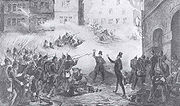
However, on March 18, a large demonstration occurred and two shots fired led a quickly spreading fear that force was to be used to end the demonstrations. Barricades were erected, fighting started, and blood flowed until troops were ordered to retreat a day later, leaving hundreds dead. Afterwards, Frederick William attempted to reassure the public that the reorganization of his government would proceed. The king also approved arming the citizens. On March 21, he paraded through the streets of Berlin to the cemetery where the civil victims were buried, accompanied by some ministers and generals, all wearing the revolutionary tricolor of black, red, and gold.
A Constituent National Assembly was elected and gathered in the St. Paul's Church in Frankfurt am Main on May 18, 1848. Officially called the all-German National Assembly the assembly was composed of deputies democratically elected from various German states in late April and early May 1848. The assembly was composed of 122 deputies who were government officials, 95 were judges, 81 were lawyers, 103 were teachers, 17 were manufacturers and wholesale dealers, 15 were physicians and 40 were landowners. A majority of the Assembly were liberals It became known as the 'professors' parliament' and indeed most of its members were academics. There was one working class member who had the added disadvantage of being Polish and like his colleagues from the Tyrol was never taken seriously by the other members. "Learn to speak German!" was the call of Turnvater Jahn.
Starting on May 18, 1848, the Frankfurt Assembly set about trying to find ways to unite the various German states into a single nation and to write a constitution. However, the Assembly proved to be unable to make any resolute decisions and degenerated into a mere debating club.
On May 22, 1848, another elected assembly sat for the first time in Berlin. Elected under the law of electoral law of April 8, 1848, which allowed for universal suffrage and a two-stage voting system. Most of the deputies elected to the Berlin Assembly, called the Prussian National Assembly, were members of the bourgeoisie or liberal bureaucracy. They set about the task of writing a constitution "by agreement with the Crown." King Frederick William IV of Prussia
Frederick William IV of Prussia
|align=right|Upon his accession, he toned down the reactionary policies enacted by his father, easing press censorship and promising to enact a constitution at some point, but he refused to enact a popular legislative assembly, preferring to work with the aristocracy through "united committees" of...
unilaterally imposed a monarchist Constitution on Prussia as a way to undercut the democratic forces. This Constitution took effect on December 5, 1848. Also on December 5, 1848, the Berlin Assembly was dissolved and replaced with the bi-cameral legislature allowed under the monarchist Constitution. This legislature was composed of a Herrenhaus and a Landtag which are described above. Otto von Bismark was elected to the very first Landtag elected under the new monarchical constitution.
Saxony
Dresden
Dresden is the capital city of the Free State of Saxony in Germany. It is situated in a valley on the River Elbe, near the Czech border. The Dresden conurbation is part of the Saxon Triangle metropolitan area....
, the capital of the Kingdom of Saxony
Kingdom of Saxony
The Kingdom of Saxony , lasting between 1806 and 1918, was an independent member of a number of historical confederacies in Napoleonic through post-Napoleonic Germany. From 1871 it was part of the German Empire. It became a Free state in the era of Weimar Republic in 1918 after the end of World War...
, the people took to the streets asking King Frederick Augustus II of Saxony
Frederick Augustus II of Saxony
Frederick Augustus II |Tyrol]], 9 August 1854) was King of Saxony and a member of the House of Wettin.He was the eldest son of Maximilian, Prince of Saxony --younger son of the Elector Frederick Christian of Saxony—by his...
to engage in electoral reform, social justice and for a constitution.
The famous German composer, Richard Wagner
Richard Wagner
Wilhelm Richard Wagner was a German composer, conductor, theatre director, philosopher, music theorist, poet, essayist and writer primarily known for his operas...
passionately engaged himself in the revolution in Dresden, supporting the democratic-republican movement. Later during the May Uprising in Dresden
May Uprising in Dresden
The May Uprising took place in Dresden, Germany in 1849; it was one of the last of the series of events known as the Revolutions of 1848.-Events leading to the May Uprising:...
from May 3–9, 1849, he supported the provisional government. Others participating in the Uprising were the Russian revolutionary Michael Bakunin and the German working class leader Stephen Born
Stephen Born
Stephen Born's real name was Simon Buttermilch. Born in 1824, he was a German typesetter. He was a member of the Communist League, but his philosophy was more inclined toward reformism during the 1848-1849 revolution. Born was the supreme commander of the insurgncy in the town of Dresden in 1849....
. In all, about 2,500 combatants manned the barricades during the May Uprising. On May 9, 1849, together with the leaders of the uprising, Wagner left Dresden for Switzerland to avoid arrest. He spent a number of years abroad, in Switzerland, Italy, and Paris, before the ban was lifted, and he returned to Germany.
Ever since the revolutionary events of 1830, Saxony had been ruled as a constitutional monarchy with a two-chamber legislature and a responsible ministry. This constitution continued to serve as the basis of the Saxon government until 1918. However the Revolution of 1848 brought more popular reforms in the government of Saxony.
In 1849, other residents left for destinations across the Atlantic. Many natives of Saxony
Saxony
The Free State of Saxony is a landlocked state of Germany, contingent with Brandenburg, Saxony Anhalt, Thuringia, Bavaria, the Czech Republic and Poland. It is the tenth-largest German state in area, with of Germany's sixteen states....
, such as Michael Machemehl, left for Texas
Texas
Texas is the second largest U.S. state by both area and population, and the largest state by area in the contiguous United States.The name, based on the Caddo word "Tejas" meaning "friends" or "allies", was applied by the Spanish to the Caddo themselves and to the region of their settlement in...
where they joined other Germans in creating a German Texan
German Texan
German Texan is an ethnic category that includes residents of the state of Texas with German ancestry who identify with the term. This identification may include cultural agreements—German language, German cuisine, feasts, music, hard work, frugality, and close family ties. From their first...
community.
The Rhineland or Rhenish Prussia
The Rhineland shares a common history with the Rhenish Hesse, Luxembourg and the Palatinate in that in 1795 these areas came under the control of Napoleonic France. Napoleon's armies smashed armies of the Holy Roman Empire and then the social, administrative and legislative measures taken by Napoleon in the area smashed the feudal rule that the priests and the nobility had exercised over the area previously. The soil of the Rhineland is not the best for agriculture. Forestry has traditionally been a strong industry in the Rhineland. Thus, the combination of the lack of good agriculture and the early elimination of the feudal structure and the fact that a logging industry was traditionally strong in the Rhineland meant that industrialization was destined to come to the Rhineland. Additionally, the close proximity of coal in the Mark and fact that the Rhine River was excellent for transportation to the North Sea meant that the west bank of the Rhine River in the Rhineland became the premier industrial area in Germany in the nineteenth century. Thus by 1848, the towns of Aachen, Cologne and Düsseldorf were heavily industrialized with a number of different industries represented. The impact of industrialization on the Rhineland was quick and quite thorough. At the beginning of the nineteenth century, over the 90% of the population of the Rhineland was engaged in agriculture however by 1933 only 12% was still involve in agricultural occupations. Accordingly in 1848, there was a large proletarian class in the Rhineland and because of the influence of Napoleonic France they were educated and politically active. While in other German states the liberal petty bourgeoisie led the uprisings of 1848, in the Rhineland the proletariat was already aserting its interests openly against the bourgeoisie as early as 1840.In 1848, Prussia controlled the Rhineland as part of "West Prussia." Prussian holdings in the Rhineland had first been acquired in 1614. During the Napoleonic Era, as noted above, the Rhineland west of the Rhine River was incorporated into France and feudal structures were crushed. However, following the defeat of Napoleon in 1814, the west bank of the Rhineland was given over to Prussia. Prussia treated the Rhinelanders as subjugated and alien peoples and began to reinstate the hated feudal structures again. Accordingly, much of the revolutionary impulse in the Rhineland in 1848 was colored by a strong anti-Prussian feeling. However, as Prussians the Rhinelanders took careful note of the announcement by King Frederick William IV on March 18, 1848 in Berlin that a United Diet would be formed and that other democratic reforms would be instituted. Elections for the United Diet were indirect. Electors were elected by universal male suffrage and it was these electors that would chose the members of the United Diet. The Rhinelanders remained hopeful regarding this progress and did not participate in the early round of uprisings that were occurring in other parts of Germany.
The Prussian government mistaked this quietude in the Rhineland for loyalty to the autocratic Prussian government. The Prussian government began offering military assistance to other states in suppressing the revolts in their territories and cities, i.e. Dresden, the Palatinate, Baden, Wűrttemberg, Franconia, etc. Soon however, the Prussians discovered that they needed additional troops in this effort. Presuming on the loyalty of the Rhineland, in the spring of 1849, the Prussian government called up a large portion of the army reserve—the Landwehr
Landwehr
Landwehr, or Landeswehr, is a German language term used in referring to certain national armies, or militias found in nineteenth- and early twentieth-century Europe. In different context it refers to large scale, low strength fortifications...
in Westphalia and the Rhineland. This cause a reaction in the Rhineland, because the order to call up the Landwehr affected all males under the age of 40 year and because the call up was to be done only in time of war and to order the call up in peacetime was illegal. The Prussian King also dissolved the Second Chamber of the United Diet because on March 27, 1849 that chamber passed a version of the Constitution which the King disliked. The entire citizenry of the Rhineland, including the petty bourgeoisie, the bigger bourgeoisie and the proletariat, rose up to protect the political reforms that they felt were slipping away.
On May 9, 1849, uprisings occurred in the Rhenish towns of Elberfeld
Elberfeld
Elberfeld is a municipal subdivision of the German city of Wuppertal; it was an independent town until 1929.-History:The first official mentioning of the geographic area on the banks of today's Wupper River as "elverfelde" was in a document of 1161...
, Düsseldorf
Düsseldorf
Düsseldorf is the capital city of the German state of North Rhine-Westphalia and centre of the Rhine-Ruhr metropolitan region.Düsseldorf is an important international business and financial centre and renowned for its fashion and trade fairs. Located centrally within the European Megalopolis, the...
, Iserlohn
Iserlohn
Iserlohn is a city in the Märkischer Kreis district, in North Rhine-Westphalia, Germany. It is the largest city by population and area within the district and the Sauerland region.-Geography:...
and Solingen
Solingen
Solingen is a city in North Rhine-Westphalia, Germany. It is located on the northern edge of the region called Bergisches Land, south of the Ruhr area, and with a 2009 population of 161,366 is the second largest city in the Bergisches Land...
. However, the uprising that broke out in Düsseldorf was suppressed the following day on May 10, 1849. In the town of Elberfeld, the uprising showed strength and endurance as 15,000 workers took to the streets and erected barricades and confronted the Prussian troops that were sent to suppress the unrest and to collect quota of Landwehr conscripts from the town. In the end only about 40 conscripts for the Landwehr were collected in the town of Elberfeld. A Committee of Public Safety was formed in Elberfeld to organize the citizens who were now in revolt. Members of the Committee of Public Safety included Karl Nickolaus Riotte, a democrat and a lawyer in Elberfeld; Ernst Hermann Höchster another lawyer and democrat, who became chairman of the Committee, and even Alexis Heintzmann, a lawyer and a liberal who was also the public prosecutor in Elberfeld. Members of the Palatinate provisional government included Nikolaus Schmitt, serving as Minister of the Interior, and Theodor Ludwig Greiner
Theodor Ludwig Greiner
Theodor Ludwig Greiner was a German by birth and a lawyer by profession. Greiner held democratic beliefs. Thus, he became a member of the Palatinate Provisional government in 1849. After the Provisional Governmen was crushed by the Prussian counter-revolutionary authorities, Greiner fled to...
. Karl Hecker, Franz Heinrch Zitz and Ludwig Blenker were among the other of the leaders of the Elberfeld uprising. The members of the Committee for Public Safety could not agree on a common plan, let alone control the various groups that were participating in the uprising. The now awakened working classes were pursuing their goals with single minded determination. However, citizen-military forces sprung up to support the uprising. Military leaders of these military forces included August Willich
August Willich
August Willich , born Johann August Ernst von Willich, was a military officer in the Prussian Army and a leading early proponent of Communism in Germany. In 1847 he discarded his title of nobility...
and Feliks Trociński and Captain Christian Zinn On May 17 through 18, 1849, a group of workers and democrats from Trier and neighboring townships stormed the arsenal at Prüm
Prüm
Prüm is a town in the Westeifel , Germany. Formerly a district capital, today it is the administrative seat of the Verbandsgemeinde Prüm.-Geography:...
to obtain arms for the insurgents of the uprising. Workers from Solingen stormed the arsenal at Gräfrath and obtained arms and cartidges for the insurgents. (As noted above under the heading on "The Palatinate" Frederick Engels played a role in the uprising in Elberfeld from May 11, 1849 until the end of the revolt. On May 10, 1849, he was in Solingen and making his way toward Elberfeld. Along the way. Engels carried two cases of cartridges that had been obtained from the arsenal at Gräfrath.)
The sight of working classes carrying out these military actions scared the big bourgeoisie. They began to separate themselves from the whole movement for constitutional reform and the Elberfeld Committee of Public Safety. They began to label Karl Hecker, Ernst Höchster, Karl Riotte and even public prosecutor, Alexis Heintzmann as bloodthirsty terrorists. In actuality, these members of the Committed of Public Safety, as members of the petty bourgeoisie were starting vacillate. Rather than seeking to organize and direct the various factions of the protest activity, the Committee of Public Safety began to disassociate itself from the revolutionary movement and especially those actions that were destructive of property. The whole goal of the Committee of Public Safety became one of trying to calm the reformist movement and quell the demonstrations.
Bavaria
In BavariaBavaria
Bavaria, formally the Free State of Bavaria is a state of Germany, located in the southeast of Germany. With an area of , it is the largest state by area, forming almost 20% of the total land area of Germany...
, King Ludwig I
Ludwig I of Bavaria
Ludwig I was a German king of Bavaria from 1825 until the 1848 revolutions in the German states.-Crown prince:...
lost prestige because of his support for his favourite mistress Lola Montez
Lola Montez
Eliza Rosanna Gilbert, Countess of Landsfeld , better known by the stage name Lola Montez, was an Irish dancer and actress who became famous as a "Spanish dancer", courtesan and mistress of King Ludwig I of Bavaria, who made her Countess of Landsfeld. She used her influence to institute liberal...
, a dancer and actor unacceptable to the aristocracy or the Church. She tried to launch liberal reforms using a Protestant prime minister, which outraged the Catholic conservatives of Bavaria. On February 9, the conservative public of Bavaria came out onto the streets in protest. This conservative protest on February 9, 1848 was the first demonstration in that revolutionary year of 1848. However this was an exception among the wave of liberal protests in 1848. The conservatives merely wanted rid of Lola Montez. They had no political agenda or demands for change. Nonetheless, liberal students took advantage of the Lola Montez affair to stress their demands for political change. All over Bavaria, students started demonstrating for constitutional reform, just as students were doing in as in cities all over Germany. Ludwig tried to institute a few minor reforms but they proved insufficient to quell the storm of protests and on March 16, 1848, Ludwig I abdicated in favor of his eldest son Maximilian II
Maximilian II of Bavaria
Maximilian II of Bavaria was king of Bavaria from 1848 until 1864. He was son of Ludwig I of Bavaria and Therese of Saxe-Hildburghausen.-Crown Prince:...
. Ludwig complained that "Govern I could no longer, and to give up an underwriter I did not wish. In order not to become a slave, I became a lord." Ludwig was the only German prince forced to abdicate in the 1848 revolutions. Although some popular reforms were introduced, the government regained full control.
Greater Poland
While technically Greater PolandGreater Poland
Greater Poland or Great Poland, often known by its Polish name Wielkopolska is a historical region of west-central Poland. Its chief city is Poznań.The boundaries of Greater Poland have varied somewhat throughout history...
was not a German state, the roughly corresponding territory of the Grand Duchy of Posen was under Prussian control since the First
First Partition of Poland
The First Partition of Poland or First Partition of the Polish-Lithuanian Commonwealth took place in 1772 as the first of three partitions that ended the existence of the Polish-Lithuanian Commonwealth by 1795. Growth in the Russian Empire's power, threatening the Kingdom of Prussia and the...
and Second Partition of Poland
Second Partition of Poland
The 1793 Second Partition of the Polish-Lithuanian Commonwealth was the second of three partitions that ended the existence of the Polish-Lithuanian Commonwealth by 1795. The second partition occurred in the aftermath of the War in Defense of the Constitution and the Targowica Confederation of 1792...
in the late 18th century. The Greater Poland Uprising of 1848, also known as the Poznań
Poznan
Poznań is a city on the Warta river in west-central Poland, with a population of 556,022 in June 2009. It is among the oldest cities in Poland, and was one of the most important centres in the early Polish state, whose first rulers were buried at Poznań's cathedral. It is sometimes claimed to be...
Uprising was an unsuccessful military insurrection of Polish
Poles
thumb|right|180px|The state flag of [[Poland]] as used by Polish government and diplomatic authoritiesThe Polish people, or Poles , are a nation indigenous to Poland. They are united by the Polish language, which belongs to the historical Lechitic subgroup of West Slavic languages of Central Europe...
troops under Ludwik Mierosławski against the Prussian forces that begun on 20 March 1848. As a result the Greater Polish region was incorporated as the Prussian Province of Posen
Province of Posen
The Province of Posen was a province of Prussia from 1848–1918 and as such part of the German Empire from 1871 to 1918. The area was about 29,000 km2....
.
National Assembly in Frankfurt
Heidelberg
-Early history:Between 600,000 and 200,000 years ago, "Heidelberg Man" died at nearby Mauer. His jaw bone was discovered in 1907; with scientific dating, his remains were determined to be the earliest evidence of human life in Europe. In the 5th century BC, a Celtic fortress of refuge and place of...
, in the state of Baden (southwest Germany), on March 6, 1848, a group of German liberals began to make plans for an election to a German national assembly. This prototype Parliament met on March 31, in Frankfurt
Frankfurt
Frankfurt am Main , commonly known simply as Frankfurt, is the largest city in the German state of Hesse and the fifth-largest city in Germany, with a 2010 population of 688,249. The urban area had an estimated population of 2,300,000 in 2010...
's St. Paul's Church. Its members called for free elections to an assembly for all of Germany
Pan-Germanism
Pan-Germanism is a pan-nationalist political idea. Pan-Germanists originally sought to unify the German-speaking populations of Europe in a single nation-state known as Großdeutschland , where "German-speaking" was taken to include the Low German, Frisian and Dutch-speaking populations of the Low...
- and the German states agreed.
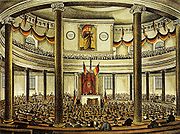
Finally, on May 18, 1848 the National Assembly opened its session in St. Paul's Church. Of the 586 delegates of the first freely elected German parliament
Frankfurt Parliament
The Frankfurt Assembly was the first freely elected parliament for all of Germany. Session was held from May 18, 1848 to May 31, 1849 in the Paulskirche at Frankfurt am Main...
, so many were professors (94), teachers (30) or had a university education (233) that it was called a "professors' parliament" ("Professorenparlament").
There were few practical politicians. Some 400 delegates can be identified in terms of political factions
Factions in the Frankfurt Assembly
The factions in the Frankfurt Assembly were the groups or political factions that developed among delegates to the Frankfurt Parliament that met from May 18, 1848 to May 31, 1849 in the Paulskirche in Frankfurt am Main. They coalesced as groups of like-minded representatives started meeting, and...
- usually named after their meeting places:
- Café Milani - Right/Conservative (40)
- Casino - Right centre/Liberal-conservative (120)
- Landsberg - Centre/Liberal (40)
- Württemberger Hof - Left centre (100)
- Deutscher Hof - Left/Liberal democrats (60)
- Donnersberg - Far leftFar leftFar left, also known as the revolutionary left, radical left and extreme left are terms which refer to the highest degree of leftist positions among left-wing politics...
/Democrats (40)
Heinrich von Gagern
Heinrich Wilhelm August Freiherr von Gagern was a statesman who argued for the unification of Germany.The third son of Hans Christoph Ernst, Baron von Gagern, a liberal statesman from Hesse, Heinrich von Gagern was born at Bayreuth, educated at the military academy at Munich, and, as an officer in...
, the assembly started on its ambitious plan to create a modern constitution as the foundation for a unified Germany.
From the beginning the main problems were regionalism
Regionalism (politics)
Regionalism is a term used in international relations. Regionalism also constitutes one of the three constituents of the international commercial system...
, support of local issues over pan-German issues, and Austro-Prussian conflicts. Archduke Johann of Austria
Archduke Johann of Austria
Archduke John of Austria was a member of the Habsburg dynasty, an Austrian field marshal and German Imperial regent .-Biography:...
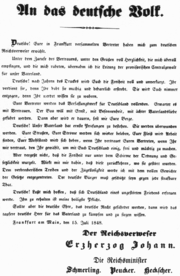
was chosen as a temporary head of state ("Reichsverweser" i.e. imperial vicar). This was an attempt to create a provisional executive power, but it did not get very far since most states failed to fully recognize the new government. The National Assembly lost reputation in the eyes of the German public when Prussia carried through its own political intentions in the Schleswig-Holstein
Schleswig-Holstein
Schleswig-Holstein is the northernmost of the sixteen states of Germany, comprising most of the historical duchy of Holstein and the southern part of the former Duchy of Schleswig...
question without the prior consent of Parliament. A similar discrediting occurred when Austria suppressed a popular uprising in Vienna by military force.
Nonetheless, discussions on the future constitution had started. The main questions to be decided were:
- Should the new united Germany include the German-speaking areas of Austria and thus separate these territories constitutionally from the remaining areas of the Habsburg Empire ("greater German solution", Großdeutschland), or should it exclude Austria, with leadership falling to Prussia ("smaller German solution", Kleindeutschland)? Finally, this question was settled when the Austrian Prime Minister introduced a centralised constitution for the entire Austrian EmpireAustrian EmpireThe Austrian Empire was a modern era successor empire, which was centered on what is today's Austria and which officially lasted from 1804 to 1867. It was followed by the Empire of Austria-Hungary, whose proclamation was a diplomatic move that elevated Hungary's status within the Austrian Empire...
, thus delegates had to give up their hopes for a "Greater Germany". - Should Germany become a hereditary monarchyHereditary monarchyA hereditary monarchy is the most common type of monarchy and is the form that is used by almost all of the world's existing monarchies.Under a hereditary monarchy, all the monarchs come from the same family, and the crown is passed down from one member to another member of the family...
, have an elected monarch, or even become a republic? - Should it be a federation of relatively independent states or have a strong central government?
Soon events began to overtake discussions. Delegate Robert Blum
Robert Blum
thumb|Painting by August Hunger of Robert Blum between 1845 and 1848Robert Blum was a German democratic politician, publicist, poet, publisher, revolutionist and member of the National Assembly of 1848. In his fight for a strong, unified Germany he opposed ethnocentrism and it was his strong...
had been sent to Vienna by his left-wing political colleagues on a fact-finding mission to see how Austria's government was rolling back liberal achievements by military force. Blum participated in the street fighting, was arrested and executed on November 9, despite his claim to immunity from prosecution as a member of the National Assembly.
Although the achievements of the March Revolution were rolled back in many German states, the discussions in Frankfurt continued, increasingly losing touch with society.
In December 1848 the "Basic Rights for the German People" proclaimed equal rights for all citizens before the law. On March 28, 1849, the draft of the Paulskirchenverfassung
Paulskirchenverfassung
The Constitution of the German Empire of 1849, more commonly known as the Frankfurt Constitution or Paulskirchenverfassung , was an ultimately unsuccessful attempt to created a unified German state under an Emperor...
constitution was finally passed. The new Germany was to be a constitutional monarchy
Constitutional monarchy
Constitutional monarchy is a form of government in which a monarch acts as head of state within the parameters of a constitution, whether it be a written, uncodified or blended constitution...
, and the office of head of state ("Emperor of the Germans") was to be hereditary and held by the respective King of Prussia. The latter proposal was carried by a mere 290 votes in favour, with 248 abstentions. The constitution was recognized by 29 smaller states but not by Austria, Prussia, Bavaria, Hanover and Saxony.
Backlash in Prussia
By late 1848, the Prussian aristocrats including Otto von BismarckOtto von Bismarck
Otto Eduard Leopold, Prince of Bismarck, Duke of Lauenburg , simply known as Otto von Bismarck, was a Prussian-German statesman whose actions unified Germany, made it a major player in world affairs, and created a balance of power that kept Europe at peace after 1871.As Minister President of...
and generals had regained power in Berlin. They had not been defeated permanently during the incidents of March, but had only retreated temporarily. General von Wrangel led the troops who recaptured Berlin for the old powers, and King Frederick William IV of Prussia
Frederick William IV of Prussia
|align=right|Upon his accession, he toned down the reactionary policies enacted by his father, easing press censorship and promising to enact a constitution at some point, but he refused to enact a popular legislative assembly, preferring to work with the aristocracy through "united committees" of...
immediately rejoined the old forces. In November, the king dissolved the new Prussian parliament and put forth a constitution
Constitution
A constitution is a set of fundamental principles or established precedents according to which a state or other organization is governed. These rules together make up, i.e. constitute, what the entity is...
of his own which was based upon the work of the assembly, yet maintaining the ultimate authority of the king.
Elaborated in the following years, the constitution came to provide for an upper house (Herrenhaus), and a lower house (Landtag), chosen by universal suffrage but under a three-class system of voting
Prussian three-class franchise
After the 1848 revolutions in the German states, the Prussian three-class franchise system was introduced in 1849 by the Prussian king Friedrich Wilhelm IV for the election of the Lower House of the Prussian state parliament. It was completely abolished only in 1918...
("Dreiklassenwahlrecht"): representation was proportional to tax
Tax
To tax is to impose a financial charge or other levy upon a taxpayer by a state or the functional equivalent of a state such that failure to pay is punishable by law. Taxes are also imposed by many subnational entities...
es paid, so that more than 80% of the electorate controlled only one-third of the seats.
On April 2, 1849, a delegation of the National Assembly met with King Frederick William IV in Berlin and offered him the crown
The Crown
The Crown is a corporation sole that in the Commonwealth realms and any provincial or state sub-divisions thereof represents the legal embodiment of governance, whether executive, legislative, or judicial...
of the Emperor under this new constitution.
Frederick William told the delegation that he felt honoured but could only accept the crown with the consent of his peers, the other sovereign monarchs and free cities. But later, in a letter to a relative in England, he wrote that he felt deeply insulted by being offered "from the gutter" a crown, "disgraced by the stink of revolution, defiled with dirt and mud."
Austria and Prussia withdrew their delegates from the Assembly, which was little more than a debating club. The radical members were forced to go to Stuttgart, where they sat from June 6–18 as a rump parliament until it too was dispersed by Württemberg
Württemberg
Württemberg , formerly known as Wirtemberg or Wurtemberg, is an area and a former state in southwestern Germany, including parts of the regions Swabia and Franconia....
troops. Armed uprisings in support of the constitution, especially in Saxony, the Palatinate and Baden were short-lived, as the local military, aided by Prussian troops, crushed them quickly. Leaders and participants, if caught, were executed or sentenced to long prison terms.
The achievements of the revolutionaries of March 1848 were reversed in all of the German states and by 1851, the Basic Rights had also been abolished nearly everywhere. In the end, the revolution fizzled because of the divisions between the various factions in Frankfurt, the calculating caution of the liberals, the failure of the left to martial popular support and the overwhelming superiority of the monarchist forces.
Many disappointed German patriots went to the United States, among them most notably Carl Schurz
Carl Schurz
Carl Christian Schurz was a German revolutionary, American statesman and reformer, and Union Army General in the American Civil War. He was also an accomplished journalist, newspaper editor and orator, who in 1869 became the first German-born American elected to the United States Senate.His wife,...
, Franz Sigel
Franz Sigel
Franz Sigel was a German military officer, revolutionist and immigrant to the United States who was a teacher, newspaperman, politician, and served as a Union major general in the American Civil War.-Early life:...
and Friedrich Hecker. Such emigrants became known as the Forty-Eighters
Forty-Eighters
The Forty-Eighters were Europeans who participated in or supported the revolutions of 1848 that swept Europe. In Germany, the Forty-Eighters favored unification of the German people, a more democratic government, and guarantees of human rights...
.
Failure of the revolution
The Revolution of 1848 failed in its attempt to unify the German speaking states into a single nation because the Frankfurt Assembly (officially the All-German National Assembly) as an elected body, reflected the many different interests of the German ruling classes and it was difficult, if not impossible to form coalitions in order to push for specific goals. The first conflict arose over the aim of the assembly. The moderate liberals wanted to draw up a document that would be presented to the monarchs as a constitution, whereas the small radical group of members wanted the assembly to declare itself a law-giving parliament. With such a fundamental division within the assembly it was not possible to take any definitive action toward unification or the introduction of democratic rules, and so the assembly became little more than a debating society. While the French revolution could draw on a nation state, the democratic and liberal forces in Germany of 1848 were confronted with the need to build a nation state and a constitutional state at once, which overstrained them. When the Frankfurt Assembly first opened on May 18, 1848, the deputies elected Heinrich von GagernHeinrich von Gagern
Heinrich Wilhelm August Freiherr von Gagern was a statesman who argued for the unification of Germany.The third son of Hans Christoph Ernst, Baron von Gagern, a liberal statesman from Hesse, Heinrich von Gagern was born at Bayreuth, educated at the military academy at Munich, and, as an officer in...
as the first President of the Assembly. Gagern had strong support from the Center-Right Unionist party and had some influence with some of the moderates of the left, such that he could control perhaps 250 of the deputies of the Frankfurt Assembly. Gagern was a strong supporter of unification of all the German states into a single nation. He insisted however that progress towards unity could only be achieved with the agreement of the monarchs, all of whom were died in the wool reactionaries. Only the Kingdom of Prussia had the military force necessary to effect this unification. Many in the Frankfurt National Assembly, including Gagern, were distrustful of the motives of the Prussian state and their absolutist government. The moderate liberals, fearful of losing their positions as servants of the monarchs whom they wished to convince of the need for reforms, quickly came to the conclusion that only negotiations would lead to some form of political progress. Their caution later turned into a self-fulfilling prophecy when the Prussian army ignored the demands for reforms of any kind and chased the rump assembly out of Frankfurt in 1849.
The Frankfurt Assembly had no powers to raise taxes and relied completely on the goodwill of the monarchs. As many of the members held influential positions in provincial governments, their reluctance to call for radical reforms or annoy their employers in any way meant that it was never possible for the assembly to raise the funds necessary for raising an army or even to enforce any laws that were passed. Dominated by the moderate liberals, there was no chance that a more militant mood would take over and the hundred or so radicals, who believed that an armed uprising was necessary if the old powers were to be defeated, lost interest and left the assembly to try and raise forces at a local level to bring about a 'real' revolution. Without a bureaucracy they could not raise any money and without any money they could not raise a bureaucracy. The assembly started strongly with a great deal of motivation to get things done. This impetus was soon dissipated, however, as the various major divides between the various factions of the Frankfurt Assembly came to the fore—advocates of Grossdeutschland versus advocates of Kleindeutschland, Catholics versus Protestants, supporters of Austria versus supporters of Prussia. As various issues arose before the Frankfurt Assembly, the splits between the various factions became evident. The major conflict that later caused the collapse of the whole assembly was the demands from the left that the assembly declare its sovereign rights and write a democratic constitution, while the cautious liberals believed until the end that negotiations with the reactionary monarchs could lead to some small reforms. The various interest groups began to gather in local meeting places in order to decide on tactics in the assembly, ranging from royalist conservatives to radicals, these were not in a position to formulate coherent policies and membership was at best tenuous.
Meanwhile, outside the Frankfurt Assembly, the rulers of the German states gradually realised that their positions were no longer under threat. The King of Bavaria had stepped down, it was true, but that was only partly the result of pressure from below. As the threat of an armed uprising receded it was clear that German unification was a dead letter. The princes were unwilling to give up any power in the pursuit of unification of the whole country. Some princes were so firmly opposed to the Frankfurt Assembly that they had only tolerated its existence while they quelled rebellions in their respective territories. As soon as they had crushed the rebels, they followed the example of Prussia, recalling their deputies from the Assembly. Only Prussia, with its overwhelming military might, was able to overcome the objections of local princes to the unification of Germany and protect the Frankfurt Assembly from military attack by the princes. But Prussia's motives with regard to the very existence of the Frankfurt National Assembly were always questionable at best.
There were few things on which the deputies of the Frankfurt National Assembly could agree to act. One measure of the Assembly that was significant for the future of Germany was the founding of the Reichsflotte
Reichsflotte
The Reichsflotte was the first all-German Navy. It was founded on 14 June 1848 during the Revolutions of 1848 in the German states by the Frankfurt Parliament to provide a naval force in the First Schleswig War against Denmark.-History:...
, the German Navy, on June 14, 1848.
The powerlessness of the Frankfurt Assembly, however, was reflected in the debate over the Danish Conflict of 1848. Like many other events of 1848, the Danish conflict was sparked by a street demonstration. On March 21, 1848, the people of Copenhagen poured out into the streets to demand a liberal Constitution. The majority in the Danish province of Holstein and in the southern part of the province of Schleswig was German-speaking. The citizens of the city of Kiel located in the Danish province of Holstein, where a majority of the population spoke German, were unsure of what was occurring in Copenhagen and revolted themselves to establish a separate and autonomous province with closer relations with the German states. On March 24, 1848, they set up a new provisional, autonomous government in Holstein and raised a Schleswig-Holstein army of 7,000 soldiers. The broad range of national/unification opinion in the German states supported joining both provinces of Schleswig and Holstein to a new unified state of Germany. Prussia sent an army in support of the independence movement in Schleswig and Holstein. Prussia ignored the Frankfurt National assembly altogether when Great Britain and Russia applied international pressure to end the war. The Prussians signed a peace reached at Malmo
Malmö
Malmö , in the southernmost province of Scania, is the third most populous city in Sweden, after Stockholm and Gothenburg.Malmö is the seat of Malmö Municipality and the capital of Skåne County...
which required the removal of all Prussian troops from the two duchies and agreed to all other Danish demands. The Treaty of Malmo was greeted with extreme public consternation in Germany, as reflected in the debate over the treaty in Frankfurt National Assembly. Because the Frankfurt National Assembly had no army of its own, it could do nothing about the unilateral actions on the part of Prussia. On September 16, 1848, the Frankfurt National Assembly approved of the Malmo Treaty by a majority vote. Public support for the National Assembly declined sharply following the vote on the Malmo Treaty. Indeed, the Radical Republicans came out in opposition to the Assembly itself as a result of the vote on the Malmo Treaty.
After many diversions, the Frankfurt National Assembly was finally able to take up the issue of a German constitution. In October 1848, King Frederick William
Frederick William
The name Frederick William usually refers to several monarchs and princes of the Hohenzollern dynasty:*Frederick William, Elector of Brandenburg *Frederick William I , King of Prussia*Frederick William II , King of Prussia...
IV of Prussia unilaterally issued a monarchist constitution. Under this new monarchist Constitution a Prussian Assembly was established. The Assembly was a bicameral legislature, consisting of a Herrenhaus (House of Lords) or upper house, whose members were selected by the provincial governments, and a Landtag (Country Diet) whose members were elected by male suffrage but were seated only through a complicated system of electoral committees. Otto von Bismarck
Otto von Bismarck
Otto Eduard Leopold, Prince of Bismarck, Duke of Lauenburg , simply known as Otto von Bismarck, was a Prussian-German statesman whose actions unified Germany, made it a major player in world affairs, and created a balance of power that kept Europe at peace after 1871.As Minister President of...
was elected to this first Landtag. The Landtag was an attempt to directly undercut the authority of the Frankfurt National Assembly. In an attempt to regain some authority, the Frankfurt Assembly dispatched a delegation to offer King Frederick William IV
Frederick William IV of Prussia
|align=right|Upon his accession, he toned down the reactionary policies enacted by his father, easing press censorship and promising to enact a constitution at some point, but he refused to enact a popular legislative assembly, preferring to work with the aristocracy through "united committees" of...
the crown of German emperor in April 1849. King Frederick William, however, turned down the offer, because he would accept a crown only by the grace of God, not "from the gutter".
The Frankfurt National Assembly came into existence partly because of events that had begun in Vienna, Austria, which resulted in the fall of Prince Metternich from power. The support for the Assembly came mainly from the southern provinces, where there was a tradition of opposition to the local tyrants. After Austria had crushed the Italian revolts of 1848/1849, the Habsburgs were ready to turn their attention back to Germany. Unable to muster an army and lacking support from the German states, the Assembly could not resist Austrian power. The Frankfurt National Assembly was dissolved on May 31, 1849.