

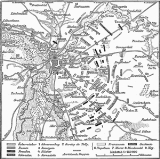
Battle of Leipzig

Encyclopedia

Russia
Russia or , officially known as both Russia and the Russian Federation , is a country in northern Eurasia. It is a federal semi-presidential republic, comprising 83 federal subjects...
, Prussia
Prussia
Prussia was a German kingdom and historic state originating out of the Duchy of Prussia and the Margraviate of Brandenburg. For centuries, the House of Hohenzollern ruled Prussia, successfully expanding its size by way of an unusually well-organized and effective army. Prussia shaped the history...
, Austria
Austria
Austria , officially the Republic of Austria , is a landlocked country of roughly 8.4 million people in Central Europe. It is bordered by the Czech Republic and Germany to the north, Slovakia and Hungary to the east, Slovenia and Italy to the south, and Switzerland and Liechtenstein to the...
and Sweden
Sweden
Sweden , officially the Kingdom of Sweden , is a Nordic country on the Scandinavian Peninsula in Northern Europe. Sweden borders with Norway and Finland and is connected to Denmark by a bridge-tunnel across the Öresund....
against the French army of Napoleon. Napoleon's army also contained Polish
Duchy of Warsaw
The Duchy of Warsaw was a Polish state established by Napoleon I in 1807 from the Polish lands ceded by the Kingdom of Prussia under the terms of the Treaties of Tilsit. The duchy was held in personal union by one of Napoleon's allies, King Frederick Augustus I of Saxony...
and Italian
Kingdom of Italy (Napoleonic)
The Kingdom of Italy was a state founded in Northern Italy by Napoleon, fully influenced by revolutionary France, that ended with his defeat and fall.-Constitutional statutes:...
troops as well as Germans from the Confederation of the Rhine
Confederation of the Rhine
The Confederation of the Rhine was a confederation of client states of the First French Empire. It was formed initially from 16 German states by Napoleon after he defeated Austria's Francis II and Russia's Alexander I in the Battle of Austerlitz. The Treaty of Pressburg, in effect, led to the...
. The battle involved over 600,000 soldiers, making it the largest battle in Europe prior to World War I
World War I
World War I , which was predominantly called the World War or the Great War from its occurrence until 1939, and the First World War or World War I thereafter, was a major war centred in Europe that began on 28 July 1914 and lasted until 11 November 1918...
.
Defeated, Napoleon was compelled to return to France while the Allies hurried to keep their momentum, invading France early the next year. Napoleon was forced to abdicate, and was exiled to Elba
Elba
Elba is a Mediterranean island in Tuscany, Italy, from the coastal town of Piombino. The largest island of the Tuscan Archipelago, Elba is also part of the National Park of the Tuscan Archipelago and the third largest island in Italy after Sicily and Sardinia...
that spring.
Prelude
Following Napoleon's failed invasion of Russia and his defeats in the Peninsular WarPeninsular War
The Peninsular War was a war between France and the allied powers of Spain, the United Kingdom, and Portugal for control of the Iberian Peninsula during the Napoleonic Wars. The war began when French and Spanish armies crossed Spain and invaded Portugal in 1807. Then, in 1808, France turned on its...
, the anti-French forces had cautiously regrouped as the Sixth Coalition, comprising Russia, Austria
Austrian Empire
The Austrian Empire was a modern era successor empire, which was centered on what is today's Austria and which officially lasted from 1804 to 1867. It was followed by the Empire of Austria-Hungary, whose proclamation was a diplomatic move that elevated Hungary's status within the Austrian Empire...
, Prussia
Prussia
Prussia was a German kingdom and historic state originating out of the Duchy of Prussia and the Margraviate of Brandenburg. For centuries, the House of Hohenzollern ruled Prussia, successfully expanding its size by way of an unusually well-organized and effective army. Prussia shaped the history...
, Sweden
Sweden
Sweden , officially the Kingdom of Sweden , is a Nordic country on the Scandinavian Peninsula in Northern Europe. Sweden borders with Norway and Finland and is connected to Denmark by a bridge-tunnel across the Öresund....
, Britain
United Kingdom
The United Kingdom of Great Britain and Northern IrelandIn the United Kingdom and Dependencies, other languages have been officially recognised as legitimate autochthonous languages under the European Charter for Regional or Minority Languages...
, Spain
Spain
Spain , officially the Kingdom of Spain languages]] under the European Charter for Regional or Minority Languages. In each of these, Spain's official name is as follows:;;;;;;), is a country and member state of the European Union located in southwestern Europe on the Iberian Peninsula...
, Portugal
Kingdom of Portugal
The Kingdom of Portugal was Portugal's general designation under the monarchy. The kingdom was located in the west of the Iberian Peninsula, Europe and existed from 1139 to 1910...
and certain smaller German
Confederation of the Rhine
The Confederation of the Rhine was a confederation of client states of the First French Empire. It was formed initially from 16 German states by Napoleon after he defeated Austria's Francis II and Russia's Alexander I in the Battle of Austerlitz. The Treaty of Pressburg, in effect, led to the...
states. In total, the Coalition could put into the field well over a million troops—indeed by the time of Leipzig
Leipzig
Leipzig Leipzig has always been a trade city, situated during the time of the Holy Roman Empire at the intersection of the Via Regia and Via Imperii, two important trade routes. At one time, Leipzig was one of the major European centres of learning and culture in fields such as music and publishing...
, total Allied armies east of the Rhine probably exceeded a million. By contrast Napoleon's forces had shrunk to just a few hundred thousand.
Napoleon sought to re-establish his hold in Germany, winning two hard-fought victories, at Lützen
Battle of Lützen (1813)
In the Battle of Lützen , Napoleon I of France lured a combined Prussian and Russian force into a trap, halting the advances of the Sixth Coalition after his devastating losses in Russia. The Russian commander, Prince Peter Wittgenstein, attempting to undo Napoleon's capture of Leipzig, attacked...
on 2 May and Bautzen
Battle of Bautzen
In the Battle of Bautzen a combined Russian/Prussian army was pushed back by Napoleon, but escaped destruction, some sources claim, because Michel Ney failed to block their retreat...
on 20–21 May, over Russo-Prussian forces. The victories led to a brief armistice
Armistice
An armistice is a situation in a war where the warring parties agree to stop fighting. It is not necessarily the end of a war, but may be just a cessation of hostilities while an attempt is made to negotiate a lasting peace...
. He then won a major victory at Dresden
Battle of Dresden
The Battle of Dresden was fought on 26–27 August 1813 around Dresden, Germany, resulting in a French victory under Napoleon I against forces of the Sixth Coalition of Austrians, Russians and Prussians under Field Marshal Schwartzenberg. However, Napoleon's victory was not as complete as it could...
on August 27. Following this, the Coalition forces, under the chief command of Russian General Barclay De Tolly
Michael Andreas Barclay de Tolly
Prince Michael Andreas Barclay de Tolly , was a Russian Field Marshal and Minister of War during Napoleon's invasion in 1812 and War of the Sixth Coalition.-Early life:...
and individual command of Gebhard von Blücher
Gebhard Leberecht von Blücher
Gebhard Leberecht von Blücher, Fürst von Wahlstatt , Graf , later elevated to Fürst von Wahlstatt, was a Prussian Generalfeldmarschall who led his army against Napoleon I at the Battle of the Nations at Leipzig in 1813 and at the Battle of Waterloo in 1815 with the Duke of Wellington.He is...
, Crown Prince Carl Johan of Sweden and Karl von Schwarzenberg, and Count Benningsen of Russia followed the strategy outlined in the Trachenberg Plan to avoid clashes with Napoleon but to seek confrontations with his marshals, which led to victories at Großbeeren, Kulm
Battle of Kulm
The Battle of Kulm was a battle near the town Kulm and the village Přestanov in northern Bohemia. It was fought on 29–30 August 1813, during the War of the Sixth Coalition...
, Katzbach
Battle of Katzbach
The Battle of Katzbach on 26 August 1813, was an accidental engagement of the Napoleonic Wars between the forces of the First French Empire under Marshal MacDonald and a Russo-Prussian army of the Sixth Coalition under Prussian Marshal Graf von Blücher...
and at Dennewitz
Battle of Dennewitz
The Battle of Dennewitz took place on 6 September 1813 between the forces of the First French Empire and an army of Prussians and Russians of the Sixth Coalition. It occurred in Dennewitz, a village of Germany, in the Prussian province of Brandenburg, near Jüterbog, 40 km. S.W...
.
Marshal Nicolas Oudinot
Nicolas Oudinot
Nicolas Charles Oudinot, 1st Comte Oudinot, 1st Duc de Reggio , was a Marshal of France.-Early life:...
was defeated at the Battle of Großbeeren and thus failed to capture Berlin with his army of 60,000. This forced Napoleon to withdraw westwards because of the threat to the north, crossing the Elbe
Elbe
The Elbe is one of the major rivers of Central Europe. It rises in the Krkonoše Mountains of the northwestern Czech Republic before traversing much of Bohemia , then Germany and flowing into the North Sea at Cuxhaven, 110 km northwest of Hamburg...
in late September and organizing his forces around Leipzig
Leipzig
Leipzig Leipzig has always been a trade city, situated during the time of the Holy Roman Empire at the intersection of the Via Regia and Via Imperii, two important trade routes. At one time, Leipzig was one of the major European centres of learning and culture in fields such as music and publishing...
to protect his supply lines and meet the Allies. Napoleon deployed his army around the city, but concentrated his force from Taucha through Stötteritz, where he placed his command. The Prussians advanced from Wartenburg, the Austrians and Russians from Dresden
Dresden
Dresden is the capital city of the Free State of Saxony in Germany. It is situated in a valley on the River Elbe, near the Czech border. The Dresden conurbation is part of the Saxon Triangle metropolitan area....
and the Swedish force from the north.
16 October
In total, the French had around 190,000 soldiers and the Allies almost 330,000 with both sides having significant artillery—in total there were over 2,500 pieces of ordnance on the field.The battle began on 16 October with an attack by 78,000 Allied troops from the south and 54,000 from the north, with Napoleon using the bulk of his army in the south. The allied offensives achieved little and were soon forced back, but Napoleon's outnumbered forces were unable to break the allied lines, resulting in a hard fought stalemate.
Austrian II Corps captures Dölitz
The Austrian II Corps (Gen. von Merveldt) advanced towards Connewitz via Gautzsch and attempted to attack the position, only to find that the avenue of advance was well covered and did not permit the Austrians to deploy their artillery in support of the attack. Repulsed, the Austrians then moved to attack nearby Dölitz, down a road crossed by two bridges and leading to a manor house and a mill. Two companies of the 24th regiment threw out the small Polish garrison and took the position. A prompt counterattack ejected the Austrians and the battle seesawed, until the Austrians brought up a strong artillery battery and blew the Poles out of the position. The Poles left bodies everywhere in their furious defense and set fire to both the manor and the mill on the way out.Battle of Markkleeberg
General KleistFriedrich Graf Kleist von Nollendorf
Friedrich Emil Ferdinand Heinrich Graf Kleist von Nollendorf , born and died in Berlin, was a Prussian field marshal and a member of the old junker family von Kleist....
, moving along the Pleisse River, attacked Marshals Poniatowski
Józef Antoni Poniatowski
Prince Józef Antoni Poniatowski was a Polish leader, general, minister of war and army chief, who became a Marshal of France.-Early Austrian years and war with Turkey:...
and Augereau in the village of Markkleeberg
Markkleeberg
Markkleeberg is a town in the Leipzig district, in the Free State of Saxony, Germany. It is situated on the river Pleiße, approx. 7 km south of Leipzig.In 1813 much of the Battle of Leipzig took place where today's Markkleeberg is situated....
. The Austrians repaired a bridge and took a school building and manor. The French counterattacked, throwing the Austrians out of the school and back over the river. French attacks on the manor only resulted in mounting casualties for the French and Poles. The Russian 14th Division began a series of flanking attacks that forced the Poles out of Markkleeberg. Marshal Poniatowski stopped the retreat and the advancing Russians. Catching four battalions of the Prussian 12th Brigade in the open, Poniatowski directed attacks by artillery and cavalry until they were relieved by Russian hussars. Marshal Poniatowski retook Markkleeberg, but was thrown out by two Prussian battalions. Austrian grenadiers then formed in front of Markkleeberg and drove the Poles and French out of the area with a flank attack.
Attack on Wachau
The Russian II Infantry Corps attacked WachauWachau, Saxony
Wachau is a municipality in the district of Bautzen, in Saxony, Germany....
with support from the Prussian 9th Brigade. The Russians advanced, unaware that French forces were waiting. The French took them by surprise in the flank, mauling them. The Prussians entered Wachau, engaging in street to street fighting. French artillery blasted the Prussians out of Wachau and the French recovered the village.
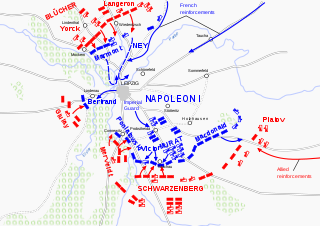
Battle of Liebertwolkwitz
Liebertwolkwitz was a large village in a commanding position, defended by Marshal MacDonaldÉtienne-Jacques-Joseph-Alexandre MacDonald
Étienne Jacques Joseph Alexandre MacDonald, 1st duke of Taranto was a Marshal of France and military leader during the French Revolutionary and Napoleonic Wars.-Family background:...
and General Lauriston
Jacques Lauriston
Jacques Alexandre Bernard Law, marquis de Lauriston was a French soldier and diplomat of Scottish descent, the son of Jacques François Law de Lauriston , and a general officer in the French army during the Napoleonic Wars. He was born in Pondicherry in India...
with about 18,000 men. Johann von Klenau
Johann von Klenau
Johann von Klenau , also called Johann Josef Cajetan von Klenau und Janowitz, the son of a Bohemian noble, was a field marshal in the Habsburg army...
's Austrian IV Corps attacked with 24,500 backed up by Pirth's 10th Brigade (4,550) and Ziethen's 11th Brigade (5,365). The Austrians attacked first, driving the French out of Liebertwolkwitz after hard fighting, only to be driven out in turn by a French counterattack. At this point, Napoleon directed General Drouot
Antoine Drouot
Comte Antoine Drouot was one of Napoleon's generals.Born in Nancy, France, the son of a baker, he trained as an artilleryman and took part in the battles of the French Revolution where he rose through the ranks....
to form a grand battery on Gallows hill. This was done with 100 guns that blasted the exposed Russian II corps, forcing the Prussian battalions supporting it to take cover. Russian General Württemberg
Eugen Duke of Württemberg (1788–1857)
Duke Eugen of Württemberg was a German nobleman and a General of Infantry in the Imperial Russian Army during the Napoleonic Wars.-Early life and family:...
was notable for his extreme bravery, directing his troops under fire. The hole had been now opened as Napoleon wished and at this point, Marshal Murat
Joachim Murat
Joachim-Napoléon Murat , Marshal of France and Grand Admiral or Admiral of France, 1st Prince Murat, was Grand Duke of Berg from 1806 to 1808 and then King of Naples from 1808 to 1815...
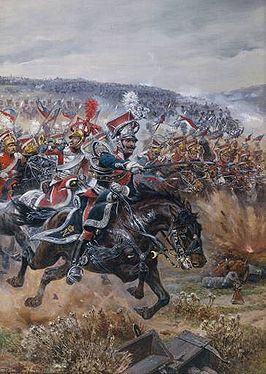
was unleashed with 10,000 French, Italian, and Saxon cavalry. However, Murat's choice of massive columns for the attack formation was unfortunate for the French force, as smaller mobile formations of Russian, Prussian, and Austrian cavalry were able to successfully harass Murat's Division, driving them back to their own artillery, where they were saved by the French Guard Dragoons. The young Guard Division was sent in to drive out the allies and give Napoleon his breakthrough. They recaptured both Liebertwolkwitz and Wachau, but the Allies countered with Russian Guard and Austrian grenadiers backed by Russian cuirassiers. The units lived up to their elite reputation, forming squares that blasted French cavalrymen from their horses and overran the French artillery batteries. On the southern front, although Napoleon gained ground, he could not break the Allied lines.
Northern attack
The northern front opened with the attack by General Langeron's Russian Corps on the villages of Groß-Wiederitzsch and Klein-Wiederitzsch in the center of the French northern lines. This position was defended by General Dabrowski'sJan Henryk Dabrowski
-Biography:Dąbrowski was born to Jan Michal Dąbrowski and Sophie née von Lettow in Pierzchów, Polish–Lithuanian Commonwealth He grew up in Hoyerswerda, Electorate of Saxony, where his father served as a Colonel in the Saxon army...
Polish division of four infantry battalions and two cavalry battalions. At first sign of the attack, the Polish division attacked. The battle wavered back and forth with attacks and counterattacks. General Langeron rallied his forces and finally took both villages with heavy casualties.
Battle of Möckern
The Northern front was dominated by the battle of Möckern. This was a 4 phase battle and saw hard fighting from both sides. A manor, palace, walled gardens, and low walls dominated the village. Each position was turned into a fortress with the walls being loopholed for covered fire by the French. The ground to the west of the position was too wooded and swampy for emplacement of artillery. A dike ran east along the river ElsterWeiße Elster
The White Elster or Weisse Elster is a long river in central Europe, right tributary of the Saale. Its source is in the westernmost part of the Czech Republic, near Aš. After a few kilometres, it flows into eastern Germany...
being 4 meters high. Marshal Auguste Marmont
Auguste Marmont
Auguste Frédéric Louis Viesse de Marmont, 1st Duke of Ragusa was a French General, nobleman and Marshal of France.-Biography:...
brought up infantry columns behind the positions in reserve and for quick counter-attack against any fallen position. Blücher
Gebhard Leberecht von Blücher
Gebhard Leberecht von Blücher, Fürst von Wahlstatt , Graf , later elevated to Fürst von Wahlstatt, was a Prussian Generalfeldmarschall who led his army against Napoleon I at the Battle of the Nations at Leipzig in 1813 and at the Battle of Waterloo in 1815 with the Duke of Wellington.He is...
commanded Langeron's (Russian) and Yorck's (Prussian) corps against Marmont's VI Corps. When the battle hung in the balance, Marmont ordered a cavalry charge, but his commander refused to attack. Later, an attack by Prussian hussars caused serious loss to the French defenders. The battle lasted well into the night. Artillery caused the majority of the 9,000 Allied and 7,000 French casualties, and the French lost another 2,000 prisoners.
17 October
There were only two actions on 17 October: an attack by the Russian General SackenFabian Wilhelm von Osten-Sacken
Prince Fabian Gottlieb von der Osten-Sacken was a Baltic-German Field Marshal who led the Russian army against the Duchy of Warsaw and later governed Paris during the city's brief occupation by the anti-French coalition.-Early career:Osten-Sacken was born in Reval, in present day Estonia, into...
on General Dabrowski's Polish Division at the village of Gohlis. In the end, the numbers and determination of the Russians prevailed and the Poles retired to Pfaffendorf. Blücher, who was made a field marshal
Field Marshal
Field Marshal is a military rank. Traditionally, it is the highest military rank in an army.-Etymology:The origin of the rank of field marshal dates to the early Middle Ages, originally meaning the keeper of the king's horses , from the time of the early Frankish kings.-Usage and hierarchical...
the day before, ordered General Lanskoi's 2nd Hussar Division (Russian) to attack General Arrighi's
Jean-Toussaint Arrighi de Casanova
Jean-Toussaint Arrighi de Casanova , duc de Padoue, was a French diplomat and soldier of the French Revolutionary and Napoleonic Wars. In the late 1840s, Arrighi was also involved in politics and was elected Deputy and then Senator in the French Parliament...
III Cavalry corps. As they had the day before the Sixth Coalition's cavalry proved to be superior, driving the French away with great loss.
The French received only 14,000 troops as reinforcements. On the other hand, the coalition was strengthened by the arrival of 145,000, including those commanded by Russian General von Bennigsen
Levin August, Count von Bennigsen
Levin August Gottlieb Theophil , Count von Bennigsen was a German general in the service of the Russian Empire....
and Prince Charles John of Sweden
Charles XIV John of Sweden
Charles XIV & III John, also Carl John, Swedish and Norwegian: Karl Johan was King of Sweden and King of Norway from 1818 until his death...
(formerly French Marshal Bernadotte).
18 October

Michael Andreas Barclay de Tolly
Prince Michael Andreas Barclay de Tolly , was a Russian Field Marshal and Minister of War during Napoleon's invasion in 1812 and War of the Sixth Coalition.-Early life:...
, Bennigsen (both Russian) and Prince von Hessen-Homburg (Austrian) to the south, and Ignaz Gyulai
Ignaz Gyulai
Ignaz Gyulai von Máros-Nemeth und Nádaska, Ignácz Gyulay, Ignác Gyulay, or Ignjat Đulaj born 11 September 1763 – died 11 November 1831, joined the army of Habsburg Austria, fought against Ottoman Turkey, and became a general officer during the French Revolutionary Wars. From 1806 he held the...
(Austrian) to the west.
The Prussian 9th brigade occupied the abandoned village of Wachau while the Austrians, with General Bianchi's Hungarians, threw the French out of Lößnig. The Austrians proceeded to give a demonstration of combined arms cooperation as Austrian cavalry attacked French infantry to give Austrian infantry time to arrive and deploy in the attack on Dölitz. The Young Guard Division threw them out. At this point, three Austrian grenadier battalions began to contest for the village with artillery support.
In the meantime, at the behest of his Swedish officers, who felt embarrassed that they had not participated in the battle, the Prince gave the order for his light infantry to participate in the final assault on Leipzig itself. The Swedish jägers performed very well, losing only about 121 men in the attack.
During the fighting, 5,400 Saxons of Jean Reynier
Jean Reynier
Jean Louis Ebénézer Reynier rose in rank to become a French army general officer during the French Revolutionary Wars. He led a division under Napoleon Bonaparte in the French Campaign in Egypt and Syria...
's VII Corps defected to the Allies. Napoleon saw that the battle was a lost cause and on the night of 18–19 October, he began to withdraw the majority of his army across the river Elster. The allies did not learn of the evacuation until 7 a.m, and were then held up by Oudinot's ferocious street-to-street rearguard action in Leipzig. The retreat went smoothly until early afternoon when the general tasked with destroying the only bridge over the Elster delegated the task to a Colonel Montfort. The colonel in turn passed this responsibility on to a corporal, who, unaware of the carefully planned time schedule, ignited the fuses at 1 p.m, when the bridge was still crowded with French troops, and Oudinot's rearguard was still in Leipzig. The explosion and subsequent panic and rout resulted in the deaths of thousands of French troops, and the capture of many thousands more. During that unfortunate event, Poniatowski, the Polish leader, drowned while crossing the river.
Results
Józef Antoni Poniatowski
Prince Józef Antoni Poniatowski was a Polish leader, general, minister of war and army chief, who became a Marshal of France.-Early Austrian years and war with Turkey:...
, a nephew to the last king of Poland
Poland
Poland , officially the Republic of Poland , is a country in Central Europe bordered by Germany to the west; the Czech Republic and Slovakia to the south; Ukraine, Belarus and Lithuania to the east; and the Baltic Sea and Kaliningrad Oblast, a Russian exclave, to the north...
, Stanisław August Poniatowski. The Pole, who had received his marshal's baton just the previous day, was commanding the rear guard during the French retreat and drowned as he attempted to cross the river. Corps commanders Lauriston and Reynier were captured. Fifteen French generals were killed and 51 wounded.
Out of a total force of 362,000, the Allies suffered approximately 54,000 casualties. Schwarzenberg's Bohemian Army lost 34,000, Blücher's Silesian Army lost 12,000, while Bernadotte's Army of North and Bennigsen's Army of Poland lost about 4,000 each.
The battle ended the First French Empire
First French Empire
The First French Empire , also known as the Greater French Empire or Napoleonic Empire, was the empire of Napoleon I of France...
's presence east of the Rhine and brought the German states over to the Coalition. The Coalition pressed its advantage and invaded France in early 1814. Napoleon was forced from the throne of France and exiled to the island of Elba
Elba
Elba is a Mediterranean island in Tuscany, Italy, from the coastal town of Piombino. The largest island of the Tuscan Archipelago, Elba is also part of the National Park of the Tuscan Archipelago and the third largest island in Italy after Sicily and Sardinia...
.
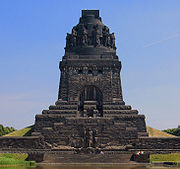
In addition to the 91 m high Völkerschlachtdenkmal
Völkerschlachtdenkmal
The Monument to the Battle of the Nations is a monument in Leipzig, Germany to the 1813 Battle of Leipzig, also known as the Battle of the Nations...
, the course of the battle in the city of Leipzig is marked by numerous monuments and the 50 Apel Stones
Apel-stones
The Apel-stones, named after the writer Theodor Apel from Leipzig who commissioned them, mark important events during the Battle of Leipzig. There are 50 all in all. They were sculpted by A. F. Aster and put up between 1861 and 1865.-External links: *...
that mark important lines of the French and allied troops.
External links
- “Easily ranking as one of the largest battles in History”
- Allied Order-of-Battle at Leipzig: 16-18 October 1813
- French order of battle: II–XI Army Corps
- French order of battle: Cavalry Reserve and the Imperial Guard http://www.voelkerschlacht1813.de/ http://www.voelkerschlacht-bei-leipzig.de/ http://www.leipzig1813.com