
In Depth
See Also

Great Depression

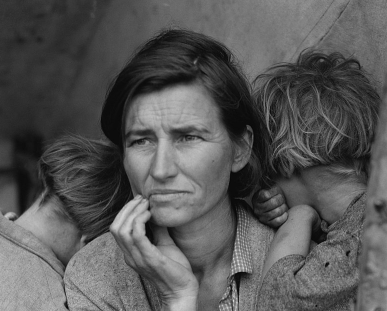
The Great Depression was a worldwide economic downturn which started in 1929 and lasting through most of the 1930s. It centered in North America North America

North America is a continent [i] in the Earth [i]'s northern hemisphere [i] and almost fully in the western hemisphere [i] ... 

 and Europe Europe

Europe is one of the seven traditional continent [i]s of the Earth [i]. ... 

, but had damaging effects around the world. The most industrialized countries were affected the worst, including the United States Great Depression in the United States

The Great Depression [i] was a period where economic activity was stagnant and at an all time low in many coun ... 

, Germany Weimar Republic

The Weimar Republic is the common name for the republic that governed Germany from 1919 [i] to 1933 [i] ... 

, Britain, France, Canada, and Australia Great Depression in Australia

The Great Depression [i] of the 1930s [i] was an economic catastrophe that severely affected most nation ... 

. Cities around the world were hit hard, especially those based on heavy industry.

Discussions

  Discussion Features

   Ask a question about 'Great Depression'

   Start a new discussion about 'Great Depression'

   Answer questions about 'Great Depression'

   'Great Depression' discussion forum

Timeline

1926   Freeman Gosden and Charles Correll premiere their radio Radio

Radio is the wireless transmission of signals [i], by modulation [i] of electromagnetic waves [i] ... 

 program ''Sam 'n' Henry Sam 'n' Henry

Sam 'n' Henry was a radio [i] series by Freeman Gosden [i] and Charles Correll [i] which aired in 1926 [i] ... 

'', in which the two white performers portrayed two black characters from Harlem Harlem

Harlem is a neighborhood [i] of Manhattan [i] in New York City [i], long known as a major black [i] ... 

 looking for extra money during the Depression Great Depression

The Great Depression was a worldwide economic downturn [i] which started in 1929 and lasting ... 

. It was a precursor to Gosden and Correll's more popular later program, ''Amos 'n' Andy Amos 'n' Andy

Amos 'n' Andy was a situation comedy [i] popular in the United States [i] from the 1920s [i] through the ... 

''.

1929   Great Depression: US President Herbert Hoover Herbert Hoover

[i] , was a successful [[mining engineer]... 

 announces to U.S. Congress United States Congress

The United States Congress is the legislature [i] of the United States federal government [i]. ... 

 that the worst effects of the recent stock market Stock market

A stock market is a market [i] for the trading [i] of company [i] stock [i] ... 

 crash are behind the nation and the American people have regained faith in the economy Economics

In the social science [i]s, economics is the study of the production [i], ... 

.

1930   Great Depression: US President Herbert Hoover Herbert Hoover

[i] , was a successful [[mining engineer]... 

 goes before Congress and asks for a US$150 million public works program to help generate jobs and stimulate the economy Economics

In the social science [i]s, economics is the study of the production [i], ... 

.

1933   American President Herbert Clark Hoover Herbert Hoover

[i] , was a successful [[mining engineer]... 

 is succeeded by Franklin D. Roosevelt Franklin D. Roosevelt

Franklin Delano Roosevelt served as the 32nd President of the United States [i] and was elected to four ... 

, who in reference to the Great Depression, gives his "We have nothing to fear, but fear itself" inauguration speech.

1933   Great Depression: President President of the United States

The President of the United States of America is the head of state [i] of the United States [i]. ... 

 Franklin D. Roosevelt Franklin D. Roosevelt

Franklin Delano Roosevelt served as the 32nd President of the United States [i] and was elected to four ... 

 declares a "bank holiday", closing all United States United States

The United States of America, also known as the United States, the U.S., the U.S.A., a... 

 banks and freezing all financial transactions (the 'holiday' ended on March 13).

1933   Great Depression: Franklin Delano Roosevelt Franklin D. Roosevelt

Franklin Delano Roosevelt served as the 32nd President of the United States [i] and was elected to four ... 

 addresses the nation for the first time as President of the United States President of the United States

The President of the United States of America is the head of state [i] of the United States [i]. ... 

. This was also the first of his "Fireside Chats Fireside chats

The fireside chats were a series of 30 evening radio talks given by United States [i] President Franklin Delano Roosevelt [i] ... 

".

1933   Great Depression: New Deal New Deal

The New Deal is the name given to the series of programs implemented between 1933-37 under President Franklin D. Roosevelt [i] ... 

 - US President Franklin D. Roosevelt Franklin D. Roosevelt

Franklin Delano Roosevelt served as the 32nd President of the United States [i] and was elected to four ... 

 unveils the Civil Works Administration, an organization designed to create jobs for more than 4 million of the unemployed.

1938   Great Depression: In an effort to try restore investor confidence, the New York Stock Exchange New York Stock Exchange

The New York Stock Exchange , nicknamed the "Big Board," is a New York City [i]-based stock exchange [i] ... 

 unveils a fifteen-point program aimed to upgrade protection for the investing publi

1943   Great Depression ends in the United States United States

The United States of America, also known as the United States, the U.S., the U.S.A., a... 

: With unemployment figures falling fast due to World War II World War II

World War II, or the Second World War, was a worldwide [i] conflict [i] fought betwe ... 

-related employment, US President Franklin D. Roosevelt Franklin D. Roosevelt

Franklin Delano Roosevelt served as the 32nd President of the United States [i] and was elected to four ... 

 closes the Works Progress Administration Works Progress Administration

The Works Progress Administration , was created in May 1935 by Presidential order .... 

.

1978   Cleveland, Ohio Cleveland, Ohio

For the Cleveland area, see Greater Cleveland [i]. ... 

 becomes the first major American city to go into default since the Great Depression, under Mayor Dennis Kucinich Dennis Kucinich

Dennis John Kucinich is an American [i] politician of the Democratic [i] ... 

.

   More Events >>


Encyclopedia

The Great Depression was a worldwide economic downturn which started in 1929 and lasting through most of the 1930s. It centered in North America North America

North America is a continent [i] in the Earth [i]'s northern hemisphere [i] and almost fully in the western hemisphere [i]... 

 and Europe Europe

Europe is one of the seven traditional continent [i]s of the Earth [i]. ... 

, but had damaging effects around the world. The most industrialized countries were affected the worst, including the United States Great Depression in the United States

The Great Depression [i] was a period where economic activity was stagnant and at an all time low in many coun... 

, Germany Weimar Republic

The Weimar Republic is the common name for the republic that governed Germany from 1919 [i] to 1933 [i] ... 

, Britain, France, Canada, and Australia Great Depression in Australia

The Great Depression [i] of the 1930s [i] was an economic catastrophe that severely affected most nation ... 

. Cities around the world were hit hard, especially those based on heavy industry. Unemployment and homelessness soared. Construction virtually halted in many countries. Farmers and rural areas suffered as prices for crops fell by 40-60% Mining and logging Logging

Logging is the process in which tree [i]s are felled and transported to a mill.... 

 areas were perhaps the hardest hit because demand fell sharply and there was little alternative economic activity. The Great Depression ended at different times in different countries; for subsequent history see Home front during World War II Home front during World War II

The home front [i] is the name given to the activities of the civilians during a state of total war [i] ... 

.


Causes of Depression


Scholars have not agreed on the exact causes and their relative importance. The search for causes is closely connected to the question of how to avoid a future depression, so the political and policy viewpoints of scholars are mixed into the analysis of historic events eight decades ago. Current theories may be broadly classified into two main points of view. First, there is orthodox classical economics, monetarist, Keynesian Keynesian economics

In Keynes's theory, general trends can overwhelm the micro-level [i] behavior of individuals. ... 

, Austrian Economics  and neoclassical economic theory, which focuses on the macroeconomic effects of money supply, including production and consumption. Second, there are structural theories, including those of institutional economics, that point to underconsumption and overinvestment , or to malfeasance by bankers and industrialists.

There are multiple issues—what set off the first downturn in 1929, what were the structural weaknesses and specific events that turned it into a major depression, and how did the downturn spread from country to country.
In terms of the 1929 small downturn, historians emphasize structural factors and the stock market crash, while economists point to Britain's decision to return to the Gold Standard at pre-World War I parities .
Although some believe the Wall Street Crash of 1929 Wall Street Crash of 1929

The Wall Street Crash of 1929, also called the Great Crash or the Crash of '29, was the stock-market crash [i] ... 

 was the immediate cause triggering the Great Depression, there are other, deeper causes that explain the crisis. The vast economic cost of World War I World War I

World War I, also known as the First World War, the Great War and "The War to End All War... 

 weakened the ability of the world to respond to a major crisis.

The New York Stock Market crash

Economists dispute how much weight to give the stock market crash of October 1929. According to Milton Friedman Milton Friedman

[i], known for his work on [[macroeconomics]... 

, "the stock market in 1929 played a role in the initial depression." It clearly changed sentiment about and expectations of the future, shifting the outlook from very positive to negative, with a dampening effect on investment and entrepreneurship. In the long run, the market did not recover; it began almost continuously to head downwards until 1933, producing the greatest long-term market declines by any measure and erasing billions in assets.

Debt

Macroeconomists, including the current chairman of the U.S. Federal Reserve Bank Ben Bernanke Ben Bernanke

The Honorable [i] Benjamin Shalom Bernanke, an American macroeconomist [i], is the Chairman of the Board of Governors of the United States Federal Reserve [i] ... 

, have revived the debt-deflation view of the Great Depression originated by Arthur Cecil Pigou and Irving Fisher. In the 1920s, in the U.S. the widespread use of the home mortgage and credit purchases of automobiles and furniture boosted spending but created consumer debt. People who were deeply in debt when a price deflation occurred were in serious trouble—even if they kept their jobs—and risked default. They drastically cut current spending to keep up time payments, thus lowering demand for new products. Furthermore the debts grew, because prices and incomes fell 20-50%, but the debts remained at the same dollar amount. With future profits looking poor, capital investment slowed or completely ceased. In the face of bad loans and worsening future prospects, banks became more conservative in lending. They built up their capital reserves, which intensified the deflationary pressures. The vicious cycle developed and the downward spiral accelerated. This kind of self-aggravating process may have turned a 1930 recession into a 1933 depression.

Trade Decline and the U.S. Smoot-Hawley Tariff Act

Many economists at the time argued that the sharp decline in international trade after 1930 helped to worsen the depression, especially for countries dependent on foreign trade. Most historians and economists assign the American Smoot-Hawley Tariff Act Smoot-Hawley Tariff Act

The Hawley-Smoot or Smoot-Hawley Tariff Act raised U.S. [i] tariff [i]s on over 20,0 ... 

 of 1930 part of the blame for worsening the depression by reducing international trade and causing retaliation. Foreign trade was a small part of overall economic activity in the United States; it was a much larger factor in most other countries. The average ad valorem rate of duties on dutiable imports for 1921-1925 was 25.9% but under the new tariff it jumped to 50% in 1931-1935.

In dollar terms, American exports declined from about US$5.2 billion in 1929 to US$1.7 billion in 1933; but prices also fell, so the physical volume of exports only fell in half. Hardest hit were farm commodities such as wheat, cotton, tobacco, and lumber. According to this theory, the collapse of farm exports caused many American farmers to default on their loans leading to the bank runs on small rural banks that characterized the early years of the Great Depression

U.S. Federal Reserve and money supply

Monetarists, including Milton Friedman Milton Friedman

[i], known for his work on [[macroeconomics]... 

 and Ben Bernanke Ben Bernanke

The Honorable [i] Benjamin Shalom Bernanke, an American macroeconomist [i], is the Chairman of the Board of Governors of the United States Federal Reserve [i] ... 

, stress the negative role of the American Federal Reserve System Federal Reserve System

The Federal Reserve System is the central banking system [i] of the United States [i].
... 

 in turning a small depression into a large one by cutting the money supply by one-third from 1930 to 1931. With significantly less money to go around, businessmen could not get new loans and could not even get their old loans renewed, forcing many to stop investing. This interpretation blames the Federal Reserve, especially the New York branch, which was owned and controlled by Wall Street bankers. The Fed was not controlled by President Hoover or the U.S. Treasury; it was primarily controlled by member banks and businessmen and it was to these groups that the Fed listened most attentively regarding policies to follow.

In Milton Friedman Milton Friedman

[i], known for his work on [[macroeconomics]... 

's work, A Monetary History of the United States, he writes that the downward turn in the economy starting with the stock market crash would have been just another recession. In general, he states the problem was that some very large, very public bank failures, particularly the Bank of the United States, produced widespread runs on banks, and that the Federal Reserve sat idly by while bank after bank fell. He claims that if the Federal Reserve had acted by providing emergency lending to these key banks or simply bought government bonds on the open market to provide liquidity and increase the quantity of money after the key banks fell, all the rest of the banks that fell after the very large and public ones did would not have, the money supply would not have fallen to the extent it did, and would not have fallen at the speed it did.

Capitalism to blame

The revolutionary left saw the Great Depression as the beginning of capitalism's final collapse. The idea mobilized the far left for action, but they failed to take power in any major country in the 1929-32 period.

Business

Roosevelt primarily blamed the excesses of big business for causing an unstable bubble-like economy. The problem was that business had too much power, and the New Deal New Deal

The New Deal is the name given to the series of programs implemented between 1933-37 under President Franklin D. Roosevelt [i] ... 

 was intended to remedy that by empowering labor unions and farmers and by raising taxes on corporate profits . Regulation of the economy was a favorite remedy. Most of the New Deal regulations were abolished or scaled back in 1975-1985 in a bipartisan wave of deregulation. However the Securities and Exchange Commission which regulates Wall Street, won widespread support and continues to this day.

Deficit Spending needed

The British economist John Maynard Keynes argued that the lower aggregate expenditures in the economy contributed to a multiple decline in income, well below full employment. In this situation, the economy may reach perfect balance, but at a cost of high unemployment. Keynesian economists were increasingly calling for government to take up the slack by increasing government spending.

Effects


Canada

Canada is sometimes considered to be the country hardest hit by the Great Depression. The economy fell further than that of any nation other than the United States, and it took far longer to recover. However, unlike in the U.S., there were no bank failures in Canada.

Britain


The World Depression broke at a time when Britain was still far from having recovered from the effects of the First World War World War I

World War I, also known as the First World War, the Great War and "The War to End All War... 

 more than a decade earlier.

A major cause of the international financial instability, which preceded and accompanied the Great Depression, was the debt which many European countries had accumulated to pay for their involvement in the war. This debt destabilised many European economies as they tried to rebuild during the 1920s.

Great Britain was driven off the gold standard Gold standard

The 'gold standard' is a monetary system [i] in which the standard economic [i] unit of account [i] ... 

 in 1931.

France


The crisis affected France a bit later than other countries, around 1931. As in Britain, France was recovering from World War I, trying without much success to recover the reparations from Germany. This led to the occupation of the Ruhr at the beginning of the 1920s, which failure in turn led to the implementation of the Dawes Plan of August 1924 and the Young Plan of 1929. However, the depression had drastic effects on the local economy, and partly explains the February 6, 1934 riots and even more the formation of the Popular Front, led by SFIO socialist leader Léon Blum Léon Blum

Lon Blum, French [i] politician, was the Prime Minister of France [i] three times: from 1936 [i] ... 

, which won the elections in 1936.

Germany

The Great Depression hit Germany Germany

Germany , officially the Federal Republic of Germany , is a country [i] in central Europe [i]. ... 

 hard. The impact of the Wall Street Crash Wall Street Crash of 1929

The Wall Street Crash of 1929, also called the Great Crash or the Crash of '29, was the stock-market crash [i] ... 

 forced American banks to end the new loans that had been funding the repayments under the Dawes Plan and the Young Plan. In 1932, 90% of German reparation payments were cancelled. Widespread unemployment reached 25% in Germany, as every sector was hurt. The Weimar Weimar

Weimar is a city [i] in Germany [i].... 

 government did not increase government spending to deal with Germany's growing crisis, as they were afraid that a high-spending policy could lead to a return of the hyperinflation Hyperinflation

In economics [i], hyperinflation is inflation [i] that is "out of control", a condition in wh ... 

 that had affected Germany in the years after World War I. Their failure to deal with the crisis caused the public to lose confidence in them, which played a significant role in the election of Adolf Hitler Adolf Hitler

Adolf Hitler was Chancellor of Germany [i] from 1933, and Fhrer [i] of Germany [i] from 1934 until h ... 

 and the Nazi Party National Socialist German Workers Party

The National Socialist German Workers Party , generally known in English [i] as the ... 

.
Hitler followed an autarky economic policy, creating a network of client states and economic allies in central Europe and Latin America. By cutting wages and taking control of labor unions, plus public works spending, unemployment fell significantly by 1935. Large scale military spending did not begin until 1936--it was financed by the recovery but did not cause it.

Italy

The Great Depression hit Italy very hard. As industries came close to failure they were bought out by the banks in a largely illusionary bail-out - the assets used to fund the purchases were largely worthless. This lead to a financial crisis peaking in 1932 and major government intervention. The Industrial Reconstruction Institute  was formed in January 1933 and took control of the bank-owned companies, suddenly giving Italy the largest state-owned industrial sector in Europe . IRI did rather well with its new responsibilities - restructuring, modernising and rationalising as much as it could. It was a significant factor in post-1945 development. But it took the Italian economy until 1935 to recover the manufacturing levels of 1930 - a position that was only 60% better than that of 1913.

Spain


Spain Spain

Spain, officially the Kingdom of Spain , is a Europe [i]an parliamentary monarchy [i].... 

 had a relatively isolated economy, with high protective tariffs and was experiencing other economic problems with the need for land reform, overall development, and better education levels. It was not one of the main countries affected by the Depression. However, because the country was destroyed by civil war Spanish Civil War

The Spanish Civil War, which lasted from July 17 [i], 1936 [i] to April 1 [i], 1939 [i], was a conflict ... 

 and suffered from isolation because of Francisco Franco Francisco Franco

Francisco Paulino Hermenegildo Tedulo Franco y Bahamonde Salgado Pardo , abbreviated Francisco Franc... 

's fascist regime, GDP levels of 1939 were not recovered until 1953.

Australia


Australia Australia

Australia, officially the Commonwealth of Australia, is a country in the Southern Hemisphere [i] c ... 

, with its extreme dependence on exports, particularly primary products such as wool Wool

Wool is the fibre derived from the fur [i] of animals of the Caprinae [i] family, principally sheep [i] ... 

 and wheat Wheat

Wheat is a grass [i] that is cultivated worldwide. ... 

, is thought to have been one of the hardest-hit countries in the Western world Western world

The term Western World or "the West" can have multiple meanings depending on its context.... 

 along with Canada Canada

Canada is the world's second-largest [i] country by total area, occupying most ... 

 and Germany Germany

Germany , officially the Federal Republic of Germany , is a country [i] in central Europe [i]. ... 

. Unemployment Unemployment

In economics [i], a person willing to work at a prevailing wage rate yet is unable to find a paying job [i]... 

 reached a record high of 29% in 1932, one of the highest rates in the world. There were also incidents of civil unrest, particularly in Australia's largest city, Sydney Sydney

Sydney is the most populous city in Australia [i] with a metropolitan area [i] population of over 4.2 m ... 

.

East Asia


Japan, with a growing industrial base, was hurt slightly, with GDP falling 8% 1929-30. The economy recovered by 1932.

Latin America


Before the 1929 crisis, links between the world economy and Latin America Latin America

Latin America is the region [i] of the Americas [i] where Romance language [i]s those derived from Latin [i] ... 

n economies had been established through American and British investment in Latin American exports to the world. As a result, Latin Americans export industries felt the depression quickly. World prices for commodities such as wheat, coffee and copper plunged. Exports from all of Latin America to the US fell in value from $1.2 billion in 1929 to $335 million in 1933, rising to $660 million in 1940.

But on the other hand, the depression led the area governments to develop new local industries and expand consumption and production. Following the example of the New Deal, governments in the area approved regulations and created or improved welfare institutions that helped millions of new industrial workers to achieve a better standard of living.

South Africa


The Great Depression had a pronounced economic and political effect on South Africa South Africa

The Republic of South Africa is a country located at the southern tip of the Africa [i]n continent [i]. ... 

, as it did to most nations at the time. As world trade slumped, demand for South African agricultural and mineral exports fell drastically. Many historians think that the social discomfort caused by the depression was a contributing factor in the defeat of Barry Hertzog and his National Party in the 1933 general election.

United States


The Great Depression had a significant impact on the economy and people of the United States United States

The United States of America, also known as the United States, the U.S., the U.S.A., a... 

 and began to fully affect the country late in 1930 and early in 1931. The official beginning and ending dates for the economic decline according to the National Beureau of Economic Research were from September of 1929 to March of 1933. At the depth of the downturn, the unemployment rate exceeded 20% and the index of industrial production dropped about 50%. Real or inflation/deflation adjusted gross domestic product grew rapidly after 1933 and surpassed the 1929 high by 1936. There was also a decline or recession from June of 1937 through June of 1938, but real GDP remained above the 1929 high. Employment was much slower to recover. The number of non farm jobs did not surpass the 1929 high until 1939 and the number of total jobs did not surpass the 1929 high until 1941. President Herbert Hoover Herbert Hoover

[i] , was a successful [[mining engineer]... 

 was widely blamed, and he was defeated in 1932 by Franklin D. Roosevelt Franklin D. Roosevelt

Franklin Delano Roosevelt served as the 32nd President of the United States [i] and was elected to four... 

. Roosevelt launched a New Deal New Deal

The New Deal is the name given to the series of programs implemented between 1933-37 under President Franklin D. Roosevelt [i] ... 

 designed to provide emergency relief to upwards of a third of the population, to recover the economy to normal levels, and to reform failed parts of the economic system. Relatively high unemployment lingered until the early 1940s.

Responses in the United States


Initial reaction in the United States


Treasury Secretary Andrew Mellon Andrew W. Mellon

Andrew William Mellon was an American [i] banker, industrialist, philanthropist, art colle ... 

 advised President Hoover that a shock treatment would be the best response: "Liquidate labor, liquidate stocks, liquidate the farmers, liquidate real estate. . . . [That] will purge the rottenness out of the system. High costs of living and high living will come down. People will work harder, live a more moral life. Values will be adjusted, and enterprising people will pick up the wrecks from less competent people" . Hoover rejected the advice, and made Mellon an ambassador.

Hoover did not believe that the government should directly aid the people, but insisted instead on "voluntary cooperation" between business and government. Hoover believed that the stock market crash was a regular hiccup in the capitalistic cycle, and that it need not affect the greater economy. Hoover asked large business leaders to voluntarily "take a hit" for the greater good of the nation. Business leaders agreed initially, but in practice no business wanted to put their neck out and risk complete failure for the good of the economy. Hoover also promoted a centralized bank - led by business, not the government like the eventual FDIC Federal Deposit Insurance Corporation

The Federal Deposit Insurance Corporation is a [i] ... 

 - that would hold money in reserve to secure against bank runs. Once again, business agreed that it was a good idea, but they were incapable of coordinating such an organization on their own. Hoover's "voluntary cooperation" failed, but his policies during his tenure proved that the government needed to take an active role in the economy if it was to recover from this depression.

New Deal in the United States


From 1932 onward Roosevelt argued that a restructuring of the economy—a "reform" would be needed to prevent another depression. New Deal programs sought to stimulate demand Supply and demand

In microeconomic [i] theory [i], the partial equilibrium [i] supply and ... 

 and provide work and relief for the impoverished through increased government spending, by:
  • reforming the financial system, especially the banks and Wall Street. The Securities Act of 1933 comprehensively regulated the securities industry. This was followed by the Securities Exchange Act of 1934 which created the Securities and Exchange Commission. . Federal insurance of bank deposits was provided by the FDIC Federal Deposit Insurance Corporation

    The Federal Deposit Insurance Corporation is a [i] ... 

     , and the Glass-Steagal Act .
  • instituting regulations which ended what was called "cut-throat competition" which kept forcing down prices and profits for everyone. .
  • setting minimum prices and wages and competitive conditions in all industries
  • encouraging unions that would raise wages, to increase the purchasing power of the working class
  • cutting farm production so as to raise prices and make it possible to earn a living in farming


The most controversial of the New Deal agencies was the National Recovery Administration National Recovery Administration

As part of the New Deal [i] in the United States [i], the National Recovery Administration was developed ... 

  which ordered:
  • businesses to work with government to set price codes;
  • the NRA board to set labor codes and standards.


These reforms are called by historians the First New Deal New Deal

The New Deal is the name given to the series of programs implemented between 1933-37 under President Franklin D. Roosevelt [i] ... 

. It was centered around the use of an alphabet soup of agencies set up in 1933 and 1934, along with the use of previous agencies such as the Reconstruction Finance Corporation, to regulate and stimulate the economy. By 1935, the "Second New Deal" added Social Security, a national relief agency the Works Progress Administration Works Progress Administration

The Works Progress Administration , was created in May 1935 by Presidential order .... 

 , and, through the National Labor Relations Board National Labor Relations Board

The National Labor Relations Board is an independent agency of the United States Government [i] charged ... 

 a strong stimulus to the growth of labor unions. Unemployment fell by two-thirds in Roosevelt's first term , but then remained stubbornly high until 1942.

In 1929, federal expenditures constituted only 3% of the GDP Gross domestic product

A region's gross domestic product, or GDP, is one of the several measures [i] ... 

. Between 1933 and 1939, federal expenditure tripled, funded primarily by a growth in the national debt. The debt as proportion of GNP rose under Hoover from 20% to 40%. FDR kept it at 40% until the war began, when it soared to 128%. After the Recession of 1937, conservatives were able to form a bipartisan Conservative coalition that stopped further expansion of the New Deal, and, by 1943, had abolished all of the relief programs.

Recession of 1937 in the United States


In 1937, the American economy took an unexpected nosedive that continued through most of 1938. Production declined sharply, as did profits and employment. Unemployment Unemployment

In economics [i], a person willing to work at a prevailing wage rate yet is unable to find a paying job [i]... 

 jumped from 14.3% in 1937 to 19.0% in 1938. The administration reacted by launching a rhetorical campaign against monopoly Monopoly

In economics [i], a monopoly is defined as a persistent market [i] situation where there is only one pr ... 

 power, which was cast as the cause of the new dip. The president appointed an aggressive new direction of the antitrust division of the Justice Department, but this effort lost its effectiveness once World War II, a far more pressing concern, began.

But the administration's other response to the 1937 deepening of the Great Depression had more tangible results. Ignoring the pleas of the Treasury Department, Roosevelt embarked on an antidote to the depression, reluctantly abandoning his efforts to balance the budget and launching a $5 billion spending program in the spring of 1938, an effort to increase mass purchasing power. Business-oriented observers explained the recession and recovery in very different terms from the Keynesians. They argued that the New Deal had been very hostile to business expansion in 1935-37, had encouraged massive strikes which had a negative impact on major industries such as automobiles, and had threatened massive anti-trust legal attacks on big corporations. All those threats diminished sharply after 1938. For example, the antitrust efforts fizzled out without major cases. The CIO and AFL unions started battling each other more than corporations, and tax policy became more favorable to long-term growth.

On the other hand, according to economist Robert Higgs Robert Higgs

Robert Higgs is an American [i] economist [i] of the Austrian School [i]. ... 

, when looking only at the supply of consumer goods, significant GDP growth only resumed in 1946 . To Keynesians, the war economy showed just how large the fiscal stimulus required to end the downturn of the Depression was, and it led, at the time, to fears that as soon as America demobilized, it would return to Depression conditions and industrial output would fall to its pre-war levels. That is, Keynesians predicted a new depression would start after the war—a false prediction.

Keynesian models

In the early 1930s, before John Maynard Keynes wrote The General Theory, he was advocating public works programs and deficits as a way to get the British economy out of the Depression. Although Keynes never mentions fiscal policy in The General Theory, and instead advocates the need to socialise investments, Keynes ushered in more of a theoretical revolution than a policy one. Keynes's basic idea was simple: in order to keep people fully employed, governments have to run deficits when the economy is slowing because the private sector won't invest enough to increase production and reverse the recession.

As the Depression wore on, Franklin D. Roosevelt tried public works, farm subsidies and other devices to restart the economy, but he never completely gave up trying to balance the budget. According to the Keynesians he had to spend much more money; they were unable to say how much more. With fiscal policy, however, government could provide the needed Keynesian spending by decreasing taxes, increasing government spending, increasing individuals' incomes. As incomes increased, they would spend more. As they spent more, the multiplier effect Multiplier (economics)

In economics, a multiplier effect – or, more completely, the spending/income multiplier effect &nd... 

 would take over and expand the effect on the initial spending. The Keynesians did not estimate what the size of the multiplier was. Keynesian economists assumed that poor people would spend new incomes; in reality they saved much of the new money, that is they paid back debts owed to landlords, grocers and family. Keynesian ideas of the consumption function were eventually overturned in the 1950s

Gold Standard

Britain departed from the gold standard Gold standard

The 'gold standard' is a monetary system [i] in which the standard economic [i] unit of account [i] ... 

 in September 1931, allowing the pound sterling Pound sterling

The pound, divided into 100 pence, is the official currency [i] of the United Kingdom [i] and the ... 

 to float. As a result, the value of the pound dropped significantly and British exports became cheaper. In 1933, the United States followed suit and dropped the gold standard.

Rearmament and recovery

The massive rearmament policies to counter the threat from Nazi Germany Nazi Germany

Nazi Germany, or the Third Reich, refers to Germany in the years 1933 to 1945, when it was governe... 

 helped stimulate the economies of many countries around the world. By 1937 unemployment in Britain had fallen to 1.5 million. The mobilization of manpower following the outbreak of war in 1939 finally ended unemployment.

In the United States, the massive war spending doubled the GNP, helping end the depression. Businessmen ignored the mounting national debt and heavy new taxes, redoubling their efforts for greater output as an expression of patriotism Patriotism

Patriotism denotes positive and supportive attitudes to a 'fatherland' , by individuals and groups.... 

. Patriotism drove most people to voluntarily work overtime and give up leisure activities to make money after so many hard years. People accepted rationing and price controls for the first time as a way of expressing their support for the war effort. Cost-plus pricing in munitions contracts guaranteed that businesses would make a profit no matter how many mediocre workers they employed, no matter how inefficient the techniques they used. The demand was for a vast quantity of war supplies as soon as possible, regardless of cost. Businesses hired every person in sight, even driving sound trucks up and down city streets begging people to apply for jobs. New workers were needed to replace the 12 million working-age men serving in the military. These events magnified the role of the federal government in the national economy. In 1929, federal expenditures accounted for only 3% of GNP. Between 1933 and 1939, federal expenditure tripled, and Roosevelt's critics charged that he was turning America into a socialist state. However, spending on the New Deal was far smaller than on the war effort.

Political consequences

The crisis had many political consequences, among which the abandonment of classic economic liberal approaches, which Roosevelt Franklin D. Roosevelt

Franklin Delano Roosevelt served as the 32nd President of the United States [i] and was elected to four... 

 replaced in the US with keynesian Keynesian economics

In Keynes's theory, general trends can overwhelm the micro-level [i] behavior of individuals. ... 

 policies. It was a main factor in the implementation of social-democracy Social democracy

|
|-
|
|}

Social democracy is a political ideology [i] that emerged in the late 19th [i] a... 

 and planned economies in European countries after the war. It would not be until the 1970s and the beginning of monetarism that this keynesian approach was challenged, leading the way to neoliberalism.

See also

  • Aftermath of World War I Aftermath of World War I

    The fighting in World War I [i] ended when an armistice [i] took effect at 11:00 hours on November 11 [i], 1918 [i]... 

  • Business cycle Business cycle

    The business cycle or economic cycle refers to the ups and downs seen somewhat simultaneously in m... 

  • Cities in the great depression
  • Economic collapse
  • Gold as an investment Gold as an investment

    This article discusses buying gold as an investment.... 

  • New Deal New Deal

    The New Deal is the name given to the series of programs implemented between 1933-37 under President Franklin D. Roosevelt [i] ... 

  • Smoot-Hawley Tariff Act Smoot-Hawley Tariff Act

    The Hawley-Smoot or Smoot-Hawley Tariff Act raised U.S. [i] tariff [i]s on over 20,0 ... 


Notes


References

  • Ambrosius, G. and W. Hibbard, A Social and Economic History of Twentieth-Century Europe
  • Bernanke, Ben S. "The Macroeconomics of the Great Depression: A Comparative Approach" Journal of Money, Credit & Banking, Vol. 27, 1995
  • Brown, Ian. The Economies of Africa and Asia in the inter-war depression
  • Davis, Joseph S., The World Between the Wars, 1919-39: An Economist's View
  • Feinstein. Charles H. The European economy between the wars
  • Friedman, Milton and Anna Jacobson Schwartz. A Monetary History of the United States, 1867-1960 , monetarist interpretation
  • Garraty, John A., The Great Depression: An Inquiry into the causes, course, and Consequences of the Worldwide Depression of the Nineteen-Thirties, as Seen by Contemporaries and in Light of History
  • Garraty John A. Unemployment in History.
  • Garside, William R. Capitalism in crisis: international responses to the Great Depression
  • Haberler, Gottfried. The world economy, money, and the great depression 1919-1939
  • Hall Thomas E. and J. David Ferguson. The Great Depression: An International Disaster of Perverse Economic Policies
  • Kaiser, David E. Economic diplomacy and the origins of the Second World War: Germany, Britain, France and Eastern Europe, 1930-1939
  • Kindleberger, Charles P. The World in Depression, 1929-1939
  • League of Nations, World Economic Survey 1932-33
  • Madsen, Jakob B. "Trade Barriers and the Collapse of World Trade during the Great Depression"' Southern Economic Journal, Vol. 67, 200
  • Mundell, R. A. "A Reconsideration of the Twentieth Century' "The American Economic Review" Vol. 90, No. 3 , pp. 327-340 in JSTOR
  • Powell, Jim. FDR's Folly: How Roosevelt And His New Deal Prolonged The Great Depression , libertarian
  • Rothbard, Murray. America's Great Depression , libertarian
  • Rothermund, Dietmar. The Global Impact of the Great Depression
  • Tipton, F. and R. Aldrich, An Economic and Social History of Europe, 1890–1939
  • Stein, Samantha. "Great Depression Women"
  • For US specific references, please see complete listing in the Great Depression in the United States Great Depression in the United States

    The Great Depression [i] was a period where economic activity was stagnant and at an all time low in many coun... 

     article.

External links


  • from EH.NET by Randall Parker.
  • by Lawrence Reed
  • for copyright-free photos of the period