
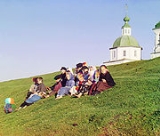
The
Russian people are an
East SlavicThe East Slavs are Slavic peoples speaking East Slavic languages. Formerly the main population of the medieval state of Kievan Rus, by the seventeenth century they evolved into the Russian, Ukrainian, and Belarusian peoples.-Sources:...
ethnic groupAn ethnic group is a group of people whose members identify with each other, through a common heritage, often consisting of a common language, a common culture and/or an ideology that stresses common ancestry or endogamy...
native to
RussiaRussia or , officially known as both Russia and the Russian Federation , is a country in northern Eurasia. It is a federal semi-presidential republic, comprising 83 federal subjects...
, speaking the
Russian languageRussian is a Slavic language used primarily in Russia, Belarus, Uzbekistan, Kazakhstan, Tajikistan and Kyrgyzstan. It is an unofficial but widely spoken language in Ukraine, Moldova, Latvia, Turkmenistan and Estonia and, to a lesser extent, the other countries that were once constituent republics...
and primarily living in
RussiaRussia or , officially known as both Russia and the Russian Federation , is a country in northern Eurasia. It is a federal semi-presidential republic, comprising 83 federal subjects...
and neighboring countries.
The
EnglishEnglish is a West Germanic language that arose in the Anglo-Saxon kingdoms of England and spread into what was to become south-east Scotland under the influence of the Anglian medieval kingdom of Northumbria...
term
Russians is also used to refer to the citizens of Russia, regardless of their ethnicity; the
demonymA demonym , also referred to as a gentilic, is a name for a resident of a locality. A demonym is usually – though not always – derived from the name of the locality; thus, the demonym for the people of England is English, and the demonym for the people of Italy is Italian, yet, in english, the one...
Russian is translated into
RussianRussian is a Slavic language used primarily in Russia, Belarus, Uzbekistan, Kazakhstan, Tajikistan and Kyrgyzstan. It is an unofficial but widely spoken language in Ukraine, Moldova, Latvia, Turkmenistan and Estonia and, to a lesser extent, the other countries that were once constituent republics...
as
rossiyanin (россиянин, plural
rossiyane), while the ethnic Russians are referred to as
russkiye (sg. русский,
russkiy).
According to the 2002 census, ethnic Russians make up about 80% of the population of Russia.
Origins
- See the article about the old legend Lech, Czech and Rus
Lech, Čech, and Rus is a legend of three brothers – Lech, Čech, and Rus – who founded three Slavic nations: Poland , Bohemia, and Ruthenia...
.
- See the article about the Primary Chronicle
The Primary Chronicle , Ruthenian Primary Chronicle or Russian Primary Chronicle, is a history of Kievan Rus' from about 850 to 1110, originally compiled in Kiev about 1113.- Three editions :...
.
- See the article about the Rus' (people)
The Rus' were a group of Varangians . According to the Primary Chronicle of Rus, compiled in about 1113 AD, the Rus had relocated from the Baltic region , first to Northeastern Europe, creating an early polity which finally came under the leadership of Rurik...
.
The modern Russian is formed from two groups, Northern and Southern, which were made up of
KrivichThe Krivichi was one of the tribal unions of Early East Slavs between the 6th and the 12th centuries. They migrated to the mostly Finnic areas in the upper reaches of the Volga, Dnieper, Western Dvina, areas south of the lower reaches of river Velikaya and parts of the Neman basin.-Etymology:Many...
es,
Ilmen SlavsThe Ilmen Slavs was the northernmost tribe of the Early East Slavs, which inhabited the shores of the Lake Ilmen and the basin of the rivers of Volkhov, Lovat, Msta, and the upper stream of the Mologa River in the 8th to 10th centuries....
,
RadimichsThe Radimichs , were a tribe of West Slavs of the last few centuries of the 1st millennium, which inhabited upper east parts of the Dnieper down the Sozh River and its tributaries...
, Vyatiches and
SeveriansThe Severians or Severyans or Siverians were a tribe or tribal union of early East Slavs occupying areas to the east of the middle Dnieper river around the rivers Desna, Sejm and Sula on the territory of the archaeological Romny culture....
East SlavicThe East Slavs are Slavic peoples speaking East Slavic languages. Formerly the main population of the medieval state of Kievan Rus, by the seventeenth century they evolved into the Russian, Ukrainian, and Belarusian peoples.-Sources:...
tribes. Genetic studies show that modern Russians do not differ significantly from
Polesthumb|right|180px|The state flag of [[Poland]] as used by Polish government and diplomatic authoritiesThe Polish people, or Poles , are a nation indigenous to Poland. They are united by the Polish language, which belongs to the historical Lechitic subgroup of West Slavic languages of Central Europe...
or
SloveniansThe Slovenes, Slovene people, Slovenians, or Slovenian people are a South Slavic people primarily associated with Slovenia and the Slovene language.-Population:Most Slovenes today live within the borders of the independent Slovenia...
or
UkrainiansUkrainians are an East Slavic ethnic group native to Ukraine, which is the sixth-largest nation in Europe. The Constitution of Ukraine applies the term 'Ukrainians' to all its citizens...
. Some ethnographers, like Zelenin, affirm that Russians are more similar to Belarusians and Ukrainians than southern Russians to northern Russians. Russians in northern European Russia share moderate genetic similarities with Uralic peoples, who lived in modern north central European Russia and were partly assimilated by the Slavs as the Slavs migrated northeastwards. Among those peoples were Merya and Muromian.
Outside archaeological remains, little is known about the predecessors to Russians in general prior to 859 AD when the
Primary ChronicleThe Primary Chronicle , Ruthenian Primary Chronicle or Russian Primary Chronicle, is a history of Kievan Rus' from about 850 to 1110, originally compiled in Kiev about 1113.- Three editions :...
starts. It is thought that by 600 AD, the Slavs had split linguistically into southern, western, and eastern branches. The eastern branch was settled between the
Southern BugThe Southern Bug, also called Southern Buh), is a river located in Ukraine. The source of the river is in the west of Ukraine, in the Volyn-Podillia Upland, about 145 km from the Polish border, and flows southeasterly into the Bug Estuary through the southern steppes...
and the Dnieper Rivers in what is now
UkraineUkraine is a country in Eastern Europe. It has an area of 603,628 km², making it the second largest contiguous country on the European continent, after Russia...
; from the 1st century AD through almost the millennium, they spread peacefully northward to the
BalticThe terms Baltic region, Baltic Rim countries, and Baltic Rim refer to slightly different combinations of countries in the general area surrounding the Baltic Sea.- Etymology :...
region, assimilating indigents and forming the
DregovichThe Dregoviches were one of the tribal unions of Early East Slavs, and inhabited the territories down the stream of the Pripyat River and northern parts of the right bank of the Dnieper river...
,
RadimichThe Radimichs , were a tribe of West Slavs of the last few centuries of the 1st millennium, which inhabited upper east parts of the Dnieper down the Sozh River and its tributaries...
and
VyatichThe Vyatichi or Viatichi were a tribe of East Slavs who inhabited a part of the Oka basin.The Primary Chronicle names a certain tribal leader Vyatko as the forefather of the tribe, but the modern etymology places the word as a cognate to Veneti and Vandals. The Vyatichi were mainly engaged in...
Slavic tribes on the Baltic substratum, therefore having language features such as
vowel reductionVowel reduction in Russian differs in the standard language and in dialects. Several ways of reduction are distinguished.There are five vowel phonemes in Standard Russian. Vowels tend to merge together when they are unstressed. The vowels and have the same unstressed allophones for a number of...
. Later, both
BelarusiansBelarusians ; are an East Slavic ethnic group who populate the majority of the Republic of Belarus. Introduced to the world as a new state in the early 1990s, the Republic of Belarus brought with it the notion of a re-emerging Belarusian ethnicity, drawn upon the lines of the Old Belarusian...
and South Russians formed themselves on this ethnic linguistic ground.
Since the 6th century, another group of Slavs moved from
PomeraniaPomerania is a historical region on the south shore of the Baltic Sea. Divided between Germany and Poland, it stretches roughly from the Recknitz River near Stralsund in the West, via the Oder River delta near Szczecin, to the mouth of the Vistula River near Gdańsk in the East...
to northeast of the
Baltic SeaThe Baltic Sea is a brackish mediterranean sea located in Northern Europe, from 53°N to 66°N latitude and from 20°E to 26°E longitude. It is bounded by the Scandinavian Peninsula, the mainland of Europe, and the Danish islands. It drains into the Kattegat by way of the Øresund, the Great Belt and...
, where they encountered the
VarangiansThe Varangians or Varyags , sometimes referred to as Variagians, were people from the Baltic region, most often associated with Vikings, who from the 9th to 11th centuries ventured eastwards and southwards along the rivers of Eastern Europe, through what is now Russia, Belarus and Ukraine.According...
of the
Rus' KhaganateRus' khaganate is a historiographical term for the formative phase of the Rus state in the 9th century AD....
and established the important regional center of Novgorod. This is possibly why Russians are known in
Finnic languagesThe term Finnic languages often means the Baltic-Finnic languages, an undisputed branch of the Uralic languages. However, it is also commonly used to mean the Finno-Permic languages, a hypothetical intermediate branch that includes Baltic Finnic, or the more disputed Finno-Volgaic languages....
as
VenedesThe Vistula Veneti were an ancient Indo-European people along the river Vistula and the Bay of Gdańsk.- Etymology of the ethnonym Veneti :...
, a name derived for
West SlavsThe West Slavs are Slavic peoples speaking West Slavic languages. They include Poles , Czechs, Slovaks, Lusatian Sorbs and the historical Polabians. The northern or Lechitic group includes, along with Polish, the extinct Polabian and Pomeranian languages...
. The same Slavic ethnic population also settled the present-day
Tver OblastTver Oblast is a federal subject of Russia . Its administrative center is the city of Tver. From 1935 to 1990, it was named Kalinin Oblast after Mikhail Kalinin. Population: Tver Oblast is an area of lakes, such as Seliger and Brosno...
and the region of Beloozero. With the Uralic substratum, they formed
KrivichThe Krivichi was one of the tribal unions of Early East Slavs between the 6th and the 12th centuries. They migrated to the mostly Finnic areas in the upper reaches of the Volga, Dnieper, Western Dvina, areas south of the lower reaches of river Velikaya and parts of the Neman basin.-Etymology:Many...
es and
Ilmen SlavsThe Ilmen Slavs was the northernmost tribe of the Early East Slavs, which inhabited the shores of the Lake Ilmen and the basin of the rivers of Volkhov, Lovat, Msta, and the upper stream of the Mologa River in the 8th to 10th centuries....
.
Genetics
Russians show the characteristic R1a genes of paternal descent from a single male at 33.4% in North Russia to 49% in rest of Russia. Such large frequencies of R1a have been found only in Eastern Europe and South and Central Asia.
In Europe, R1a (
Haplogroup R1a (Y-DNA)Haplogroup R1a is the phylogenetic name of a major clade of Human Y-chromosome DNA haplogroups. In other words, it is a way of grouping a significant part of all modern men according to a shared male-line ancestor. It is common in many parts of Eurasia and is frequently discussed in human...
) is found at its highest levels among peoples of Eastern European descent (Sorbs, Poles, Russians and Ukrainians; at about 50 to 65%).
The percentages of Y-chromosome markers vary in ethnic Russian populations, and in different studies.
The top four Y-DNA haplogroups are:
Haplogroup R1a (Y-DNA)Haplogroup R1a is the phylogenetic name of a major clade of Human Y-chromosome DNA haplogroups. In other words, it is a way of grouping a significant part of all modern men according to a shared male-line ancestor. It is common in many parts of Eurasia and is frequently discussed in human...
- 19.8% to 62.7%, with an average of
46.7%
Haplogroup I (Y-DNA)In human genetics, Haplogroup I is a Y-chromosome DNA haplogroup, a subgroup of haplogroup IJ, itself a derivative of Haplogroup IJK....
- 0% to 26.8%, with an average of
17.6% (All regions), and
23.5% (Central and South Russia)
Haplogroup N (Y-DNA)In human genetics, Haplogroup N is a Y-chromosome DNA haplogroup, defined by the presence of the marker M231. The b2/b3 deletion in the AZFc region of the human Y-chromosome is a characteristic of Haplogroup N haplotypes. This deletion, however, appears to have occurred independently on four...
- 5.4% to 53.7%, with averages of
21.6% (All regions), and
10% (Central and South Russia)
Haplogroup R1b (Y-DNA)The point of origin of R1b is thought to lie in Eurasia, most likely in Western Asia. T. Karafet et al. estimated the age of R1, the parent of R1b, as 18,500 years before present....
- 0% to 14%, with an average of
5.8%
Emergence of Russian ethnicity
According to some modern ethnologists, ethnic Russians originated from the earlier
Rus' peopleThe Rus' were a group of Varangians . According to the Primary Chronicle of Rus, compiled in about 1113 AD, the Rus had relocated from the Baltic region , first to Northeastern Europe, creating an early polity which finally came under the leadership of Rurik...
and gradually evolved into a separate ethnicity from the western Rus peoples, who became known as the modern-day
BelarusiansBelarusians ; are an East Slavic ethnic group who populate the majority of the Republic of Belarus. Introduced to the world as a new state in the early 1990s, the Republic of Belarus brought with it the notion of a re-emerging Belarusian ethnicity, drawn upon the lines of the Old Belarusian...
and
UkrainiansUkrainians are an East Slavic ethnic group native to Ukraine, which is the sixth-largest nation in Europe. The Constitution of Ukraine applies the term 'Ukrainians' to all its citizens...
. Early ancestors of the Russians were East Slavic tribes migrating to the
East European PlainThe East European Plain is a plain comprising a series of river basins in Eastern Europe. Together with the Northern European Plain it constitutes the European Plain. It is the largest mountain-free part of the European landscape.The plain spans approximately and averages about in elevation...
in the early Middle Ages. Most prominent Slavic tribes in the area of what is now European Russia included
VyatichsThe Vyatichi or Viatichi were a tribe of East Slavs who inhabited a part of the Oka basin.The Primary Chronicle names a certain tribal leader Vyatko as the forefather of the tribe, but the modern etymology places the word as a cognate to Veneti and Vandals. The Vyatichi were mainly engaged in...
,
KrivichThe Krivichi was one of the tribal unions of Early East Slavs between the 6th and the 12th centuries. They migrated to the mostly Finnic areas in the upper reaches of the Volga, Dnieper, Western Dvina, areas south of the lower reaches of river Velikaya and parts of the Neman basin.-Etymology:Many...
s,
RadimichsThe Radimichs , were a tribe of West Slavs of the last few centuries of the 1st millennium, which inhabited upper east parts of the Dnieper down the Sozh River and its tributaries...
,
SeveriansThe Severians or Severyans or Siverians were a tribe or tribal union of early East Slavs occupying areas to the east of the middle Dnieper river around the rivers Desna, Sejm and Sula on the territory of the archaeological Romny culture....
and
Ilmen SlavsThe Ilmen Slavs was the northernmost tribe of the Early East Slavs, which inhabited the shores of the Lake Ilmen and the basin of the rivers of Volkhov, Lovat, Msta, and the upper stream of the Mologa River in the 8th to 10th centuries....
. By the 11th century, East Slavs assimilated the Uralic tribes Merya and Muroma, and the
BalticThe Balts or Baltic peoples , defined as speakers of one of the Baltic languages, a branch of the Indo-European language family, are descended from a group of Indo-European tribes who settled the area between the Jutland peninsula in the west and Moscow, Oka and Volga rivers basins in the east...
tribe Eastern Galindae that inhabited the same area (now Central Russia).
Ethnic Russians were referred to as
Great RussiaGreat Russia is an obsolete name formerly applied to the territories of "Russia proper", the land that formed the core of Muscovy and, later, Russia...
ns (as opposed to the
ethnonymAn ethnonym is the name applied to a given ethnic group. Ethnonyms can be divided into two categories: exonyms and autonyms or endonyms .As an example, the ethnonym for...
s
White RussiaWhite Russia or White Ruthenia is a name that has historically been applied to a part of the wider region of Ruthenia or Rus', most often to that which roughly corresponds to the eastern part of present-day Belarus including the cities of Polatsk, Vitsyebsk and Mahiliou. In English, the use of the...
n and
Little RussiaLittle Russia , sometimes Little or Lesser Rus’ , is a historical political and geographical term in the Russian language referring to most of the territory of modern-day Ukraine before the 20th century. It is similar to the Polish term Małopolska of the Polish-Lithuanian Commonwealth...
n) and began to be recognized as a distinct ethnic group in the 15th century. At that time, during the consolidation of the Russian Tsardom as a regional power, they were referred to as
MoscovitesThe Grand Duchy of Moscow or Grand Principality of Moscow, also known in English simply as Muscovy , was a late medieval Rus' principality centered on Moscow, and the predecessor state of the early modern Tsardom of Russia....
in the West. Between the 12th and 16th century, Russians known as
PomorsPomors or Pomory are Russian settlers and their descendants on the White Sea coast. It is also term of self-identification for the descendants of Russian, primarily Novgorod, settlers of Pomorye , living on the White Sea coasts and the territory whose southern border lies on a watershed which...
migrated to northern Russia and settled the
White SeaThe White Sea is a southern inlet of the Barents Sea located on the northwest coast of Russia. It is surrounded by Karelia to the west, the Kola Peninsula to the north, and the Kanin Peninsula to the northeast. The whole of the White Sea is under Russian sovereignty and considered to be part of...
coasts. As a result of these migrations and Russian conquests, after the liberation from the Mongol
Golden HordeThe Golden Horde was a Mongol and later Turkicized khanate that formed the north-western sector of the Mongol Empire...
domination during the 15th and 16th century, Russians settled the Volga,
UralsUral Federal District is one of the eight federal districts of Russia. The district was established on 13 May 2000 by a decree of the President of Russia. The district is mostly located in the geographical region of Ural, but also includes some parts of the Volga Region; its extent is different...
and
Northern CaucasusSouthern Federal District is one of the eight federal districts of Russia. Its territory lies mostly on the Pontic-Caspian steppe. Its population was 13,856,700 according to the 2010 Census, living on an area of...
regions. Between the 17th and 19th century, migrants settled eastwards in the vast, sparsely inhabited areas of
SiberiaSiberia is an extensive region constituting almost all of Northern Asia. Comprising the central and eastern portion of the Russian Federation, it was part of the Soviet Union from its beginning, as its predecessor states, the Tsardom of Russia and the Russian Empire, conquered it during the 16th...
and the
Russian Far EastRussian Far East is a term that refers to the Russian part of the Far East, i.e., extreme east parts of Russia, between Lake Baikal in Eastern Siberia and the Pacific Ocean...
. The Cossack movement played a significant role in these territorial expansions and migrations.
Population
Russians are the most numerous ethnic group in Europe and one of the largest in the world with a population of about 140 million people worldwide. Roughly 116 million ethnic Russians live in
RussiaRussia or , officially known as both Russia and the Russian Federation , is a country in northern Eurasia. It is a federal semi-presidential republic, comprising 83 federal subjects...
and about 16 million more live in the neighboring countries. A significant number of Russians, around 4,6 million, live elsewhere in the world, mostly in the
AmericasThe Americas, or America , are lands in the Western hemisphere, also known as the New World. In English, the plural form the Americas is often used to refer to the landmasses of North America and South America with their associated islands and regions, while the singular form America is primarily...
and
Western EuropeWestern Europe is a loose term for the collection of countries in the western most region of the European continents, though this definition is context-dependent and carries cultural and political connotations. One definition describes Western Europe as a geographic entity—the region lying in the...
, but also in other places of
Eastern EuropeEastern Europe is the eastern part of Europe. The term has widely disparate geopolitical, geographical, cultural and socioeconomic readings, which makes it highly context-dependent and even volatile, and there are "almost as many definitions of Eastern Europe as there are scholars of the region"...
,
AsiaAsia is the world's largest and most populous continent, located primarily in the eastern and northern hemispheres. It covers 8.7% of the Earth's total surface area and with approximately 3.879 billion people, it hosts 60% of the world's current human population...
and elsewhere.
Culture
Russian culture started from that of
East SlavsThe East Slavs are Slavic peoples speaking East Slavic languages. Formerly the main population of the medieval state of Kievan Rus, by the seventeenth century they evolved into the Russian, Ukrainian, and Belarusian peoples.-Sources:...
, who were largely politeists, and had a specific way of life in the wooden areas of
Eastern EuropeEastern Europe is the eastern part of Europe. The term has widely disparate geopolitical, geographical, cultural and socioeconomic readings, which makes it highly context-dependent and even volatile, and there are "almost as many definitions of Eastern Europe as there are scholars of the region"...
. The
ScandinaviaScandinavia is a cultural, historical and ethno-linguistic region in northern Europe that includes the three kingdoms of Denmark, Norway and Sweden, characterized by their common ethno-cultural heritage and language. Modern Norway and Sweden proper are situated on the Scandinavian Peninsula,...
n Vikings, or
VarangiansThe Varangians or Varyags , sometimes referred to as Variagians, were people from the Baltic region, most often associated with Vikings, who from the 9th to 11th centuries ventured eastwards and southwards along the rivers of Eastern Europe, through what is now Russia, Belarus and Ukraine.According...
, also took part in the forming of Russian identity and state in the early
Kievan Rus'Kievan Rus was a medieval polity in Eastern Europe, from the late 9th to the mid 13th century, when it disintegrated under the pressure of the Mongol invasion of 1237–1240....
period of the late 1st millennium AD. Rus' had accepted the Orthodox Christianity from the East Roman Empire in 988, and this largely defined the Russian culture of
next millenniumThe Millennium of Russia is a famous bronze monument in the Novgorod Kremlin. It was erected in 1862 to celebrate the millennium of Rurik's arrival to Novgorod, an event traditionally taken as a starting point of Russian history.A competition to design the monument was held in 1859...
as the synthesis of
SlavicThe Slavic people are an Indo-European panethnicity living in Eastern Europe, Southeast Europe, North Asia and Central Asia. The term Slavic represents a broad ethno-linguistic group of people, who speak languages belonging to the Slavic language family and share, to varying degrees, certain...
and
ByzantineByzantine usually refers to the Roman Empire during the Middle Ages.Byzantine may also refer to:* A citizen of the Byzantine Empire, or native Greek during the Middle Ages...
cultures. After the
fall of ConstantinopleThe Fall of Constantinople was the capture of the capital of the Byzantine Empire, which occurred after a siege by the Ottoman Empire, under the command of Ottoman Sultan Mehmed II, against the defending army commanded by Byzantine Emperor Constantine XI...
in 1453, Russia remained the largest Orthodox nation in the world and claimed succession to the Byzantine legacy in the form of the
Third RomeThe term Third Rome describes the idea that some European city, state, or country is the successor to the legacy of the Roman Empire and its successor state, the Byzantine Empire ....
idea. At different points of its history, the country also was strongly influenced by the European Culture, and since Peter the Great reforms Russian culture largely developed in the context of the
Western cultureWestern culture, sometimes equated with Western civilization or European civilization, refers to cultures of European origin and is used very broadly to refer to a heritage of social norms, ethical values, traditional customs, religious beliefs, political systems, and specific artifacts and...
. For most of the 20th century, the
Marxist ideologyMarxism is an economic and sociopolitical worldview and method of socioeconomic inquiry that centers upon a materialist interpretation of history, a dialectical view of social change, and an analysis and critique of the development of capitalism. Marxism was pioneered in the early to mid 19th...
shaped the culture of the Soviet Union, where Russia, or Russian SFSR, was the largest and leading part.
Russian cultureRussian culture is associated with the country of Russia and, sometimes, specifically with ethnic Russians. It has a rich history and can boast a long tradition of excellence in every aspect of the arts, especially when it comes to literature and philosophy, classical music and ballet, architecture...
is extremely various and unique in many aspects. It has a rich history and can boast a long tradition of excellence in every aspect of arts, especially when it comes to
literatureRussian literature refers to the literature of Russia or its émigrés, and to the Russian-language literature of several independent nations once a part of what was historically Russia or the Soviet Union...
and
philosophyRussian philosophy includes a variety of philosophical movements. Authors who developed them are listed below sorted by movement.While most authors listed below are primarily philosophers, also included here are some Russian fiction writers, like Tolstoy and Dostoyevsky, who are also known as...
,
classical music and
balletRussian ballet is a form of ballet characteristic of or originating from Russia. In the early 19th century, the theaters were opened up to anyone who could afford a ticket. There was a seating section called a rayok, or 'paradise gallery', that consisted of simple wooden benches...
,
architectureRussian architecture follows a tradition whose roots were established in the Eastern Slavic state of Kievan Rus'. After the fall of Kiev, Russian architectural history continued in the principalities of Vladimir-Suzdal, Novgorod, the succeeding states of the Tsardom of Russia, the Russian Empire,...
and painting, cinema and animation, which all had considerable influence on the world culture.
Russian literatureRussian literature refers to the literature of Russia or its émigrés, and to the Russian-language literature of several independent nations once a part of what was historically Russia or the Soviet Union...
is known for such notable writers as
Aleksandr PushkinAlexander Sergeyevich Pushkin was a Russian author of the Romantic era who is considered by many to be the greatest Russian poet and the founder of modern Russian literature....
,
Leo TolstoyLev Nikolayevich Tolstoy was a Russian writer who primarily wrote novels and short stories. Later in life, he also wrote plays and essays. His two most famous works, the novels War and Peace and Anna Karenina, are acknowledged as two of the greatest novels of all time and a pinnacle of realist...
, Fyodor Dostoyevsky,
Anton ChekhovAnton Pavlovich Chekhov was a Russian physician, dramatist and author who is considered to be among the greatest writers of short stories in history. His career as a dramatist produced four classics and his best short stories are held in high esteem by writers and critics...
,
Vladimir MayakovskyVladimir Vladimirovich Mayakovsky was a Russian and Soviet poet and playwright, among the foremost representatives of early-20th century Russian Futurism.- Early life :...
,
Boris PasternakBoris Leonidovich Pasternak was a Russian language poet, novelist, and literary translator. In his native Russia, Pasternak's anthology My Sister Life, is one of the most influential collections ever published in the Russian language...
,
Anna AkhmatovaAnna Andreyevna Gorenko , better known by the pen name Anna Akhmatova , was a Russian and Soviet modernist poet, one of the most acclaimed writers in the Russian canon.Harrington p11...
,
Joseph BrodskyIosif Aleksandrovich Brodsky , was a Russian poet and essayist.In 1964, 23-year-old Brodsky was arrested and charged with the crime of "social parasitism" He was expelled from the Soviet Union in 1972 and settled in America with the help of W. H. Auden and other supporters...
,
Maxim GorkyAlexei Maximovich Peshkov , primarily known as Maxim Gorky , was a Russian and Soviet author, a founder of the Socialist Realism literary method and a political activist.-Early years:...
,
Vladimir NabokovVladimir Vladimirovich Nabokov was a multilingual Russian novelist and short story writer. Nabokov wrote his first nine novels in Russian, then rose to international prominence as a master English prose stylist...
, Mikhail Sholokhov,
Mikhail BulgakovMikhaíl Afanásyevich Bulgákov was a Soviet Russian writer and playwright active in the first half of the 20th century. He is best known for his novel The Master and Margarita, which The Times of London has called one of the masterpieces of the 20th century.-Biography:Mikhail Bulgakov was born on...
,
Andrei PlatonovAndrei Platonov was the pen name of Andrei Platonovich Klimentov , a Soviet author whose works anticipate existentialism. Although Platonov was a Communist, his works were banned in his own lifetime for their skeptical attitude toward collectivization and other Stalinist policies...
,
Aleksandr SolzhenitsynAleksandr Isayevich Solzhenitsyn was aRussian and Soviet novelist, dramatist, and historian. Through his often-suppressed writings, he helped to raise global awareness of the Gulag, the Soviet Union's forced labor camp system – particularly in The Gulag Archipelago and One Day in the Life of...
, and
Varlam ShalamovVarlam Tikhonovich Shalamov , baptized as Varlaam, was a Russian writer, journalist, poet and Gulag survivor.-Early life:Varlam Shalamov was born in Vologda, Vologda Governorate, a Russian city with a rich culture famous for its wooden architecture, to a family of a hereditary Russian Orthodox...
. Russians also gave the
classical musicClassical music is the art music produced in, or rooted in, the traditions of Western liturgical and secular music, encompassing a broad period from roughly the 11th century to present times...
world some very famous composers, including Piotr Ilyich Tchaikovsky and his contemporaries, the Mighty Handful, including
Modest MussorgskyModest Petrovich Mussorgsky was a Russian composer, one of the group known as 'The Five'. He was an innovator of Russian music in the romantic period...
and
Nikolai Rimsky-KorsakovNikolai Andreyevich Rimsky-Korsakov was a Russian composer, and a member of the group of composers known as The Five.The Five, also known as The Mighty Handful or The Mighty Coterie, refers to a circle of composers who met in Saint Petersburg, Russia, in the years 1856–1870: Mily Balakirev , César...
. In the 20th century Russian music was credited with such influential composers as
Dmitri ShostakovichDmitri Dmitriyevich Shostakovich was a Soviet Russian composer and one of the most celebrated composers of the 20th century....
,
Sergei ProkofievSergei Sergeyevich Prokofiev was a Russian composer, pianist and conductor who mastered numerous musical genres and is regarded as one of the major composers of the 20th century...
,
Sergei RachmaninoffSergei Vasilievich Rachmaninoff was a Russian composer, pianist, and conductor. Rachmaninoff is widely considered one of the finest pianists of his day and, as a composer, one of the last great representatives of Romanticism in Russian classical music...
, Igor Stravinski,
Georgy SviridovGeorgy Vasilyevich Sviridov was a Soviet Russian neoromantic composer....
, and
Alfred SchnittkeAlfred Schnittke ; November 24, 1934 – August 3, 1998) was a Russian and Soviet composer. Schnittke's early music shows the strong influence of Dmitri Shostakovich. He developed a polystylistic technique in works such as the epic First Symphony and First Concerto Grosso...
. Many more famous Russian people are associated with different aspects of culture.
Language
Russian (
(help·info),
transliterationRomanization of the Russian alphabet is the process of transliterating the Russian language from the Cyrillic alphabet into the Latin alphabet...
:
, ˈruskʲɪj jɪˈzɨk) is the most geographically widespread language of
EurasiaEurasia is a continent or supercontinent comprising the traditional continents of Europe and Asia ; covering about 52,990,000 km2 or about 10.6% of the Earth's surface located primarily in the eastern and northern hemispheres...
and the most widely spoken of the
SlavicThe Slavic languages , a group of closely related languages of the Slavic peoples and a subgroup of Indo-European languages, have speakers in most of Eastern Europe, in much of the Balkans, in parts of Central Europe, and in the northern part of Asia.-Branches:Scholars traditionally divide Slavic...
languages. Russian belongs to the family of
Indo-European languagesThe Indo-European languages are a family of several hundred related languages and dialects, including most major current languages of Europe, the Iranian plateau, and South Asia and also historically predominant in Anatolia...
and is one of three (or, according to some authorities, four) living members of the
East Slavic languagesThe East Slavic languages constitute one of three regional subgroups of Slavic languages, currently spoken in Eastern Europe. It is the group with the largest numbers of speakers, far out-numbering the Western and Southern Slavic groups. Current East Slavic languages are Belarusian, Russian,...
, the others being
BelarusianThe Belarusian language , sometimes referred to as White Russian or White Ruthenian, is the language of the Belarusian people...
and
UkrainianUkrainian is a language of the East Slavic subgroup of the Slavic languages. It is the official state language of Ukraine. Written Ukrainian uses a variant of the Cyrillic alphabet....
.
Examples of Old East Slavonic are attested from the 10th century onwards, and while Russian preserves much of East Slavonic grammar and a
Common SlavonicProto-Slavic is the proto-language from which Slavic languages later emerged. It was spoken before the seventh century AD. As with most other proto-languages, no attested writings have been found; the language has been reconstructed by applying the comparative method to all the attested Slavic...
word base, modern Russian exhibits a large stock of borrowed international vocabulary for politics, science, and technology. Due to the status of the
Soviet UnionThe Soviet Union , officially the Union of Soviet Socialist Republics , was a constitutionally socialist state that existed in Eurasia between 1922 and 1991....
as a super power, Russian had great political importance in the 20th century, and is one of the official languages of the
United NationsThe United Nations is an international organization whose stated aims are facilitating cooperation in international law, international security, economic development, social progress, human rights, and achievement of world peace...
.
Russian has
palatalIn linguistics, palatalization , also palatization, may refer to two different processes by which a sound, usually a consonant, comes to be produced with the tongue in a position in the mouth near the palate....
secondary articulationSecondary articulation refers to co-articulated consonants where the two articulations are not of the same manner. The approximant-like secondary articulation is weaker than the primary, and colors it rather than obscuring it...
of
consonantIn articulatory phonetics, a consonant is a speech sound that is articulated with complete or partial closure of the vocal tract. Examples are , pronounced with the lips; , pronounced with the front of the tongue; , pronounced with the back of the tongue; , pronounced in the throat; and ,...
s, the so-called
soft and
hard sounds. This distinction is found in almost all consonant
phonemeIn a language or dialect, a phoneme is the smallest segmental unit of sound employed to form meaningful contrasts between utterances....
s and is one of the most distinguishing features of the language. Another important aspect is the
reductionIn phonetics, vowel reduction is any of various changes in the acoustic quality of vowels, which are related to changes in stress, sonority, duration, loudness, articulation, or position in the word , and which are perceived as "weakening"...
of
unstressedIn linguistics, stress is the relative emphasis that may be given to certain syllables in a word, or to certain words in a phrase or sentence. The term is also used for similar patterns of phonetic prominence inside syllables. The word accent is sometimes also used with this sense.The stress placed...
vowelIn phonetics, a vowel is a sound in spoken language, such as English ah! or oh! , pronounced with an open vocal tract so that there is no build-up of air pressure at any point above the glottis. This contrasts with consonants, such as English sh! , where there is a constriction or closure at some...
s, not entirely unlike a similar process present in most forms of
EnglishEnglish is a West Germanic language that arose in the Anglo-Saxon kingdoms of England and spread into what was to become south-east Scotland under the influence of the Anglian medieval kingdom of Northumbria...
. Stress in Russian is generally quite unpredictable and can be placed on almost any syllable, one of the most difficult aspects for foreign language learners.
Religion
Around 63% of the Russia's population identify themselves with
Orthodox ChristianityThe Russian Orthodox Church or, alternatively, the Moscow Patriarchate The ROC is often said to be the largest of the Eastern Orthodox churches in the world; including all the autocephalous churches under its umbrella, its adherents number over 150 million worldwide—about half of the 300 million...
, most of whom belong to the
Russian Orthodox ChurchThe Russian Orthodox Church or, alternatively, the Moscow Patriarchate The ROC is often said to be the largest of the Eastern Orthodox churches in the world; including all the autocephalous churches under its umbrella, its adherents number over 150 million worldwide—about half of the 300 million...
, which played a vital role in the development of Russian national identity. In other countries Russian faithful usually belong to the local Orthodox congregations which either have a direct connection (like the Ukrainian Orthodox Church, autonomous from the Moscow Patriarchate) or historical origin (like the Orthodox Church in America or a Russian Orthodox Church Outside of Russia) with the Russian Orthodox Church.
Non-religious Russians may associate themselves with the Orthodox faith for cultural reasons. Some Russian people are
Old BelieversIn the context of Russian Orthodox church history, the Old Believers separated after 1666 from the official Russian Orthodox Church as a protest against church reforms introduced by Patriarch Nikon between 1652–66...
: a relatively small
schismaticA schism , from Greek σχίσμα, skhísma , is a division between people, usually belonging to an organization or movement religious denomination. The word is most frequently applied to a break of communion between two sections of Christianity that were previously a single body, or to a division within...
group of the Russian Orthodoxy that rejected the liturgical reforms introduced in the 17th century. Other schisms from Orthodoxy include
DoukhoborThe Doukhobors or Dukhobors , earlierDukhobortsy are a group of Russian origin.The Doukhobors were one of the sects - later defined as a religious philosophy, ethnic group, social movement, or simply a "way of life" - known generically as Spiritual Christianity. The origin of the Doukhobors is...
s which in the 18th century rejected secular government, the Russian Orthodox priests, icons, all church ritual, the Bible as the supreme source of divine revelation and the divinity of Jesus, and later emigrated into Canada. An even earlier sect were
MolokanMolokans are sectarian Christians who evolved from "Spiritual Christian" Russian peasants that refused to obey the Russian Orthodox Church, beginning in the 17th century...
s which formed in 1550 and rejected Czar's
divine right to ruleThe divine right of kings or divine-right theory of kingship is a political and religious doctrine of royal and political legitimacy. It asserts that a monarch is subject to no earthly authority, deriving his right to rule directly from the will of God...
, icons, the
TrinityThe Christian doctrine of the Trinity defines God as three divine persons : the Father, the Son , and the Holy Spirit. The three persons are distinct yet coexist in unity, and are co-equal, co-eternal and consubstantial . Put another way, the three persons of the Trinity are of one being...
as outlined by the
Nicene CreedThe Nicene Creed is the creed or profession of faith that is most widely used in Christian liturgy. It is called Nicene because, in its original form, it was adopted in the city of Nicaea by the first ecumenical council, which met there in the year 325.The Nicene Creed has been normative to the...
, Orthodox fasts, military service, and practices including
water baptismIn Christianity, baptism is for the majority the rite of admission , almost invariably with the use of water, into the Christian Church generally and also membership of a particular church tradition...
.
Other world religions have negligible representation among ethnic Russians. The most prominent are Baptists with over 85,000 Russian adherents. Others are mostly Pentecostals, Evangelicals, Seventh-day Adventists, Lutherans and
Jehovah's WitnessesJehovah's Witnesses is a millenarian restorationist Christian denomination with nontrinitarian beliefs distinct from mainstream Christianity. The religion reports worldwide membership of over 7 million adherents involved in evangelism, convention attendance of over 12 million, and annual...
.
For the last decades
SlavianismSlavic Neopaganism is a modern fakeloric, polytheistic, reconstructionistic, and Neopagan religion; its adherents call themselves Rodnovers , and consider themselves to be the legitimate continuation of pre-Christian Slavic religion.- Rebirth of Slavic spirituality :The pre-Christian religions...
(a Slavic
NeopaganNeopaganism is an umbrella term used to identify a wide variety of modern religious movements, particularly those influenced by or claiming to be derived from the various pagan beliefs of pre-modern Europe...
movement) seems to gain certain popularity and there are many web-sites dedicated to the study of the ancient Slavic religious traditions and thoughts.
Russians outside of Russia
Ethnic Russians historically migrated throughout the area of former
Russian EmpireThe Russian Empire was a state that existed from 1721 until the Russian Revolution of 1917. It was the successor to the Tsardom of Russia and the predecessor of the Soviet Union...
and
Soviet UnionThe Soviet Union , officially the Union of Soviet Socialist Republics , was a constitutionally socialist state that existed in Eurasia between 1922 and 1991....
, sometimes encouraged to re-settle in borderlands by Tsarist and later Soviet government. On some occasions ethnic Russian communities, such as
LipovansLipovans or Lippovans are the Old Believers, mostly of Russian ethnic origin, who settled in the Moldavian Principality, in Dobruja and Eastern Muntenia...
who settled in the
Danube deltaThe Danube Delta is the second largest river delta in Europe, after the Volga Delta, and is the best preserved on the continent. The greater part of the Danube Delta lies in Romania , while its northern part, on the left bank of the Chilia arm, is situated in Ukraine . The approximate surface is...
or
DoukhoborThe Doukhobors or Dukhobors , earlierDukhobortsy are a group of Russian origin.The Doukhobors were one of the sects - later defined as a religious philosophy, ethnic group, social movement, or simply a "way of life" - known generically as Spiritual Christianity. The origin of the Doukhobors is...
s in
CanadaCanada is a North American country consisting of ten provinces and three territories. Located in the northern part of the continent, it extends from the Atlantic Ocean in the east to the Pacific Ocean in the west, and northward into the Arctic Ocean...
, emigrated as religious dissidents fleeing the central authority.
After the
Russian RevolutionThe Russian Revolution is the collective term for a series of revolutions in Russia in 1917, which destroyed the Tsarist autocracy and led to the creation of the Soviet Union. The Tsar was deposed and replaced by a provisional government in the first revolution of February 1917...
and
Russian Civil WarThe Russian Civil War was a multi-party war that occurred within the former Russian Empire after the Russian provisional government collapsed to the Soviets, under the domination of the Bolshevik party. Soviet forces first assumed power in Petrograd The Russian Civil War (1917–1923) was a...
starting in 1917, many Russians were forced to leave their homeland fleeing the
BolshevikThe Bolsheviks, originally also Bolshevists , derived from bol'shinstvo, "majority") were a faction of the Marxist Russian Social Democratic Labour Party which split apart from the Menshevik faction at the Second Party Congress in 1903....
regime, and millions became refugees. Many
white émigrésA white émigré was a Russian who emigrated from Russia in the wake of the Russian Revolution and Russian Civil War, and who was in opposition to the contemporary Russian political climate....
were participants in the
White movementThe White movement and its military arm the White Army - known as the White Guard or the Whites - was a loose confederation of Anti-Communist forces.The movement comprised one of the politico-military Russian forces who fought...
, although the term is broadly applied to anyone who may have left the country due to the change in regime.
Today the largest ethnic Russian diasporas outside of Russia live in former Soviet states such as
UkraineUkraine is a country in Eastern Europe. It has an area of 603,628 km², making it the second largest contiguous country on the European continent, after Russia...
(about 8 million),
KazakhstanKazakhstan , officially the Republic of Kazakhstan, is a transcontinental country in Central Asia and Eastern Europe. Ranked as the ninth largest country in the world, it is also the world's largest landlocked country; its territory of is greater than Western Europe...
(about 3.8 million),
BelarusBelarus , officially the Republic of Belarus, is a landlocked country in Eastern Europe, bordered clockwise by Russia to the northeast, Ukraine to the south, Poland to the west, and Lithuania and Latvia to the northwest. Its capital is Minsk; other major cities include Brest, Grodno , Gomel ,...
(about 785,000),
LatviaLatvia , officially the Republic of Latvia , is a country in the Baltic region of Northern Europe. It is bordered to the north by Estonia , to the south by Lithuania , to the east by the Russian Federation , to the southeast by Belarus and shares maritime borders to the west with Sweden...
(about 612,000) with the most Russian settlement out of the
Baltic StatesThe term Baltic states refers to the Baltic territories which gained independence from the Russian Empire in the wake of World War I: primarily the contiguous trio of Estonia, Latvia, Lithuania ; Finland also fell within the scope of the term after initially gaining independence in the 1920s.The...
which includes
LithuaniaLithuania , officially the Republic of Lithuania is a country in Northern Europe, the biggest of the three Baltic states. It is situated along the southeastern shore of the Baltic Sea, whereby to the west lie Sweden and Denmark...
and
EstoniaEstonia , officially the Republic of Estonia , is a state in the Baltic region of Northern Europe. It is bordered to the north by the Gulf of Finland, to the west by the Baltic Sea, to the south by Latvia , and to the east by Lake Peipsi and the Russian Federation . Across the Baltic Sea lies...
,
UzbekistanUzbekistan , officially the Republic of Uzbekistan is a doubly landlocked country in Central Asia and one of the six independent Turkic states. It shares borders with Kazakhstan to the west and to the north, Kyrgyzstan and Tajikistan to the east, and Afghanistan and Turkmenistan to the south....
(about 650,000) and
KyrgyzstanKyrgyzstan , officially the Kyrgyz Republic is one of the world's six independent Turkic states . Located in Central Asia, landlocked and mountainous, Kyrgyzstan is bordered by Kazakhstan to the north, Uzbekistan to the west, Tajikistan to the southwest and China to the east...
(about 419,000).
Over a million Russian Jews emigrated to
IsraelThe State of Israel is a parliamentary republic located in the Middle East, along the eastern shore of the Mediterranean Sea...
during and after the
RefusenikRefusenik was an unofficial term for individuals, typically but not exclusively, Soviet Jews, who were denied permission to emigrate abroad by the authorities of the former Soviet Union and other countries of the Eastern bloc...
movements; some brought ethnic Russian relatives along with them. Out of more than one million Russian-speaking immigrants in Israel, about 300,000 are considered not Jewish according to the rabbinical commandments (but not all of them are ethnic Russians). There are also small Russian communities in the
BalkansThe Balkans is a geopolitical and cultural region of southeastern Europe...
, Eastern and Central European nations such as
GermanyGermany , officially the Federal Republic of Germany , is a federal parliamentary republic in Europe. The country consists of 16 states while the capital and largest city is Berlin. Germany covers an area of 357,021 km2 and has a largely temperate seasonal climate...
and
PolandPoland , officially the Republic of Poland , is a country in Central Europe bordered by Germany to the west; the Czech Republic and Slovakia to the south; Ukraine, Belarus and Lithuania to the east; and the Baltic Sea and Kaliningrad Oblast, a Russian exclave, to the north...
, as well Russians settled in
ChinaChinese civilization may refer to:* China for more general discussion of the country.* Chinese culture* Greater China, the transnational community of ethnic Chinese.* History of China* Sinosphere, the area historically affected by Chinese culture...
,
JapanJapan is an island nation in East Asia. Located in the Pacific Ocean, it lies to the east of the Sea of Japan, China, North Korea, South Korea and Russia, stretching from the Sea of Okhotsk in the north to the East China Sea and Taiwan in the south...
,
South KoreaThe Republic of Korea , , is a sovereign state in East Asia, located on the southern portion of the Korean Peninsula. It is neighbored by the People's Republic of China to the west, Japan to the east, North Korea to the north, and the East China Sea and Republic of China to the south...
,
Latin AmericaLatin America is a region of the Americas where Romance languages – particularly Spanish and Portuguese, and variably French – are primarily spoken. Latin America has an area of approximately 21,069,500 km² , almost 3.9% of the Earth's surface or 14.1% of its land surface area...
(i.e.
MexicoThe United Mexican States , commonly known as Mexico , is a federal constitutional republic in North America. It is bordered on the north by the United States; on the south and west by the Pacific Ocean; on the southeast by Guatemala, Belize, and the Caribbean Sea; and on the east by the Gulf of...
,
BrazilBrazil , officially the Federative Republic of Brazil , is the largest country in South America. It is the world's fifth largest country, both by geographical area and by population with over 192 million people...
and
ArgentinaArgentina , officially the Argentine Republic , is the second largest country in South America by land area, after Brazil. It is constituted as a federation of 23 provinces and an autonomous city, Buenos Aires...
) and
AustraliaAustralia , officially the Commonwealth of Australia, is a country in the Southern Hemisphere comprising the mainland of the Australian continent, the island of Tasmania, and numerous smaller islands in the Indian and Pacific Oceans. It is the world's sixth-largest country by total area...
. These communities may identify themselves either as Russians or citizens of these countries, or both, to varying degrees.
People who had arrived in
LatviaLatvia , officially the Republic of Latvia , is a country in the Baltic region of Northern Europe. It is bordered to the north by Estonia , to the south by Lithuania , to the east by the Russian Federation , to the southeast by Belarus and shares maritime borders to the west with Sweden...
and
EstoniaEstonia , officially the Republic of Estonia , is a state in the Baltic region of Northern Europe. It is bordered to the north by the Gulf of Finland, to the west by the Baltic Sea, to the south by Latvia , and to the east by Lake Peipsi and the Russian Federation . Across the Baltic Sea lies...
during the Soviet era, including their descendants born in these countries, mostly Russians, became
statelessStatelessness is a legal concept describing the lack of any nationality. It is the absence of a recognized link between an individual and any state....
after the
dissolution of the Soviet UnionThe dissolution of the Soviet Union was the disintegration of the federal political structures and central government of the Union of Soviet Socialist Republics , resulting in the independence of all fifteen republics of the Soviet Union between March 11, 1990 and December 25, 1991...
and were provided only with an option to acquire naturalised citizenship. The language issue is still contentious, particularly in Latvia, where ethnic Russians have protested against plans to liquidate education in minority languages, including Russian. Since 1992, Estonia has naturalized some 137,000 residents of undefined citizenship, mainly ethnic Russians. 136,000, or 10 percent of the total population, remain without citizenship.
Both the
European UnionThe European Union is an economic and political union of 27 independent member states which are located primarily in Europe. The EU traces its origins from the European Coal and Steel Community and the European Economic Community , formed by six countries in 1958...
and the
Council of EuropeThe Council of Europe is an international organisation promoting co-operation between all countries of Europe in the areas of legal standards, human rights, democratic development, the rule of law and cultural co-operation...
, as well as the Russian government, expressed their concern during the 1990s about minority rights in several countries, most notably
LatviaLatvia , officially the Republic of Latvia , is a country in the Baltic region of Northern Europe. It is bordered to the north by Estonia , to the south by Lithuania , to the east by the Russian Federation , to the southeast by Belarus and shares maritime borders to the west with Sweden...
and
EstoniaEstonia , officially the Republic of Estonia , is a state in the Baltic region of Northern Europe. It is bordered to the north by the Gulf of Finland, to the west by the Baltic Sea, to the south by Latvia , and to the east by Lake Peipsi and the Russian Federation . Across the Baltic Sea lies...
. In
MoldovaMoldova , officially the Republic of Moldova is a landlocked state in Eastern Europe, located between Romania to the West and Ukraine to the North, East and South. It declared itself an independent state with the same boundaries as the preceding Moldavian Soviet Socialist Republic in 1991, as part...
, the
TransnistriaTransnistria is a breakaway territory located mostly on a strip of land between the Dniester River and the eastern Moldovan border to Ukraine...
region (where 30.4% of population is Russian) broke away from government control amid fears the country would soon reunite with
RomaniaRomania is a country located at the crossroads of Central and Southeastern Europe, on the Lower Danube, within and outside the Carpathian arch, bordering on the Black Sea...
. In June 2006, Russian President
Vladimir PutinVladimir Vladimirovich Putin served as the second President of the Russian Federation and is the current Prime Minister of Russia, as well as chairman of United Russia and Chairman of the Council of Ministers of the Union of Russia and Belarus. He became acting President on 31 December 1999, when...
announced the plan to introduce a national policy aiming at encouraging ethnic Russians to immigrate to Russia.
Significant numbers of Russians emigrated to
CanadaCanada is a North American country consisting of ten provinces and three territories. Located in the northern part of the continent, it extends from the Atlantic Ocean in the east to the Pacific Ocean in the west, and northward into the Arctic Ocean...
,
AustraliaAustralia , officially the Commonwealth of Australia, is a country in the Southern Hemisphere comprising the mainland of the Australian continent, the island of Tasmania, and numerous smaller islands in the Indian and Pacific Oceans. It is the world's sixth-largest country by total area...
and the
United StatesThe United States of America is a federal constitutional republic comprising fifty states and a federal district...
.
Brighton BeachBrighton Beach is an oceanside neighborhood in the New York City borough of Brooklyn. As of 2000, it has a population of 75,692 with a total of 31,228 households.-Location:...
, in the
New York CityNew York is the most populous city in the United States and the center of the New York Metropolitan Area, one of the most populous metropolitan areas in the world. New York exerts a significant impact upon global commerce, finance, media, art, fashion, research, technology, education, and...
borough of
BrooklynBrooklyn is the most populous of New York City's five boroughs, with nearly 2.6 million residents, and the second-largest in area. Since 1896, Brooklyn has had the same boundaries as Kings County, which is now the most populous county in New York State and the second-most densely populated...
, is an example of a large community of recent Russian and Jewish Russian immigrants. Other examples are Sunny Isles Beach, a northern suburb of Miami, and "Little Moscow" in Hollywood of the
Los AngelesLos Ángeles is the capital of the province of Biobío, in the commune of the same name, in Region VIII , in the center-south of Chile. It is located between the Laja and Biobío rivers. The population is 123,445 inhabitants...
area.
At the same time, many ethnic Russians from former Soviet territories have emigrated to Russia itself since the 1990s. Many of them became refugees from a number of states of
Central AsiaCentral Asia is a core region of the Asian continent from the Caspian Sea in the west, China in the east, Afghanistan in the south, and Russia in the north...
and
CaucasusThe Caucasus, also Caucas or Caucasia , is a geopolitical region at the border of Europe and Asia, and situated between the Black and the Caspian sea...
(as well as from the separatist Chechen Republic), forced to flee during political unrest and hostilities towards Russians.
After the
Russian RevolutionThe Russian Revolution is the collective term for a series of revolutions in Russia in 1917, which destroyed the Tsarist autocracy and led to the creation of the Soviet Union. The Tsar was deposed and replaced by a provisional government in the first revolution of February 1917...
in 1917, many Russians who were identified with the White army moved to
ChinaChinese civilization may refer to:* China for more general discussion of the country.* Chinese culture* Greater China, the transnational community of ethnic Chinese.* History of China* Sinosphere, the area historically affected by Chinese culture...
— most of them settling in
HarbinHarbin ; Manchu language: , Harbin; Russian: Харби́н Kharbin ), is the capital and largest city of Heilongjiang Province in Northeast China, lying on the southern bank of the Songhua River...
and
ShanghaiShanghai is the largest city by population in China and the largest city proper in the world. It is one of the four province-level municipalities in the People's Republic of China, with a total population of over 23 million as of 2010...
. By the 1930s Harbin had 100,000 Russians. Many of these Russians had to move back to the Soviet Union after
World War IIWorld War II, or the Second World War , was a global conflict lasting from 1939 to 1945, involving most of the world's nations—including all of the great powers—eventually forming two opposing military alliances: the Allies and the Axis...
. Today, a large group of people in northern China can still speak Russian as a second language.
Russians (eluosizu)Ethnic Russians form one of the 56 ethnic groups officially recognized by the People's Republic of China, according to the ethnicity classification as applied in mainland China...
are one of the 56 ethnic groups officially recognized by the
People's Republic of ChinaChina , officially the People's Republic of China , is the most populous country in the world, with over 1.3 billion citizens. Located in East Asia, the country covers approximately 9.6 million square kilometres...
(as
the Russ); there are approximately 15,600 Russian Chinese living mostly in northern
XinjiangXinjiang is an autonomous region of the People's Republic of China. It is the largest Chinese administrative division and spans over 1.6 million km2...
, and also in
Inner MongoliaInner Mongolia is an autonomous region of the People's Republic of China, located in the northern region of the country. Inner Mongolia shares an international border with the countries of Mongolia and the Russian Federation...
and
HeilongjiangFor the river known in Mandarin as Heilong Jiang, see Amur River' is a province of the People's Republic of China located in the northeastern part of the country. "Heilongjiang" literally means Black Dragon River, which is the Chinese name for the Amur. The one-character abbreviation is 黑...
.
Notable achievements
Various Russians have greatly contributed to the world of
musicMusic is an art form whose medium is sound and silence. Its common elements are pitch , rhythm , dynamics, and the sonic qualities of timbre and texture...
, sports,
scienceScience is a systematic enterprise that builds and organizes knowledge in the form of testable explanations and predictions about the universe...
, technology and
artsaRts, which stands for analog Real time synthesizer, is an audio framework that is no longer under development. It is best known for previously being used in KDE to simulate an analog synthesizer....
. Notable Russian scientists include
Dmitri MendeleevDmitri Ivanovich Mendeleev , was a Russian chemist and inventor. He is credited as being the creator of the first version of the periodic table of elements...
,
Nikolay BogolyubovNikolay Nikolaevich Bogolyubov was a Russian and Ukrainian Soviet mathematician and theoretical physicist known for a significant contribution to quantum field theory, classical and quantum statistical mechanics, and to the theory of dynamical systems; a recipient of the Dirac Prize...
, Andrei Kolmogorov,
Ivan PavlovIvan Petrovich Pavlov was a famous Russian physiologist. Although he made significant contributions to psychology, he was not in fact a psychologist himself but was a mathematician and actually had strong distaste for the field....
, Nikolai Semyonov,
Dmitri IvanenkoDmitri Ivanenko , Professor of Moscow State University , made a great contribution to the physical science of the twentieth century, especially to nuclear physics, field theory , and gravitation theory.His outstanding achievements include:* the Fock-Ivanenko coefficients of parallel...
, Nikolai Lobachevsky,
Alexander LodyginAlexander Nikolayevich Lodygin was a Russian electrical engineer and inventor, one of inventors of the Incandescent light bulb....
,
Alexander PopovAlexander Stepanovich Popov was a Russian physicist who was the first person to demonstrate the practical application of electromagnetic waves....
(one of inventors of
radioRadio is the transmission of signals through free space by modulation of electromagnetic waves with frequencies below those of visible light. Electromagnetic radiation travels by means of oscillating electromagnetic fields that pass through the air and the vacuum of space...
), Nikolai Zhukovsky, Alexander Prokhorov and
Nikolay BasovNikolay Gennadiyevich Basov was a Soviet physicist and educator. For his fundamental work in the field of quantum electronics that led to the development of laser and maser, Basov shared the 1964 Nobel Prize in Physics with Alexander Prokhorov and Charles Hard Townes.-Early life:Basov was born in...
(co-inventors of
laserA laser is a device that emits light through a process of optical amplification based on the stimulated emission of photons. The term "laser" originated as an acronym for Light Amplification by Stimulated Emission of Radiation...
), Georgiy Gamov,
Vladimir ZworykinVladimir Kozmich Zworykin was a Russian-American inventor, engineer, and pioneer of television technology. Zworykin invented a television transmitting and receiving system employing cathode ray tubes...
, Lev Pontryagin, Sergei Sobolev,
Pavel YablochkovPavel Nikolayevich Yablochkov was a Russian electrical engineer, the inventor of the Yablochkov candle and businessman.-Biography:...
,
Aleksandr ButlerovAleksandr Mikhailovich Butlerov was a Russian chemist, one of the principal creators of the theory of chemical structure , the first to incorporate double bonds into structural formulas, the discoverer of hexamine , and the discoverer of the formose reaction.The...
,
Andrei SakharovAndrei Dmitrievich Sakharov was a Soviet nuclear physicist, dissident and human rights activist. He earned renown as the designer of the Soviet Union's Third Idea, a codename for Soviet development of thermonuclear weapons. Sakharov was an advocate of civil liberties and civil reforms in the...
, Dmitry Ivanovsky,
Sergey KorolyovSergei Pavlovich Korolev ; died 14 January 1966 in Moscow, Russia) was the lead Soviet rocket engineer and spacecraft designer in the Space Race between the United States and the Soviet Union during the 1950s and 1960s...
and
Mstislav KeldyshMstislav Vsevolodovich Keldysh was a Soviet scientist in the field of mathematics and mechanics, academician of the USSR Academy of Sciences , President of the USSR Academy of Sciences , three times Hero of Socialist Labor , fellow of the Royal Society of Edinburgh . He was one of the key figures...
(creators of the
Soviet space programThe Soviet space program is the rocketry and space exploration programs conducted by the former Union of Soviet Socialist Republics from the 1930s until its dissolution in 1991...
),
Aleksandr LyapunovAleksandr Mikhailovich Lyapunov was a Russian mathematician, mechanician and physicist. His surname is sometimes romanized as Ljapunov, Liapunov or Ljapunow....
, Mikhail Dolivo-Dobrovolsky,
Andrei TupolevAndrei Nikolayevich Tupolev was a pioneering Soviet aircraft designer.During his career, he designed and oversaw the design of more than 100 types of aircraft, some of which set 78 world records...
, Yuri Denisyuk (the first practicable method of
holographyHolography is a technique that allows the light scattered from an object to be recorded and later reconstructed so that when an imaging system is placed in the reconstructed beam, an image of the object will be seen even when the object is no longer present...
),
Mikhail LomonosovMikhail Vasilyevich Lomonosov was a Russian polymath, scientist and writer, who made important contributions to literature, education, and science. Among his discoveries was the atmosphere of Venus. His spheres of science were natural science, chemistry, physics, mineralogy, history, art,...
,
Vladimir VernadskyVladimir Ivanovich Vernadsky was a Russian/Ukrainian and Soviet mineralogist and geochemist who is considered one of the founders of geochemistry, biogeochemistry, and of radiogeology. His ideas of noosphere were an important contribution to Russian cosmism. He also worked in Ukraine where he...
,
Pyotr KapitsaPyotr Leonidovich Kapitsa was a prominent Soviet/Russian physicist and Nobel laureate.-Biography:Kapitsa was born in the city of Kronstadt and graduated from the Petrograd Polytechnical Institute in 1918. He worked for over ten years with Ernest Rutherford in the Cavendish Laboratory in Cambridge...
,
Igor SikorskyIgor Sikorsky , born Igor Ivanovich Sikorsky was a Russian American pioneer of aviation in both helicopters and fixed-wing aircraft...
,
Ludvig Faddeev-References:...
, Zhores Alferov,
Fyodor ShcherbatskoyFyodor Ippolitovich Shcherbatskoy or Stcherbatsky , often referred to in the literature as F. Th. Stcherbatsky, was a Russian Indologist who, in large part, was responsible for laying the foundations in the Western world for the scholarly study of Buddhist philosophy...
,
Nikolai TrubetzkoyPrince Nikolai Sergeyevich Trubetzkoy was a Russian linguist and historian whose teachings formed a nucleus of the Prague School of structural linguistics. He is widely considered to be the founder of morphophonology...
etc.
The first man in space,
Yuri GagarinYuri Alekseyevich Gagarin was a Soviet pilot and cosmonaut. He was the first human to journey into outer space, when his Vostok spacecraft completed an orbit of the Earth on April 12, 1961....
, was Russian, and the first artificial satellite to be put into
outer spaceOuter space is the void that exists between celestial bodies, including the Earth. It is not completely empty, but consists of a hard vacuum containing a low density of particles: predominantly a plasma of hydrogen and helium, as well as electromagnetic radiation, magnetic fields, and neutrinos....
,
Sputnik 1Sputnik 1 ) was the first artificial satellite to be put into Earth's orbit. It was launched into an elliptical low Earth orbit by the Soviet Union on 4 October 1957. The unanticipated announcement of Sputnik 1s success precipitated the Sputnik crisis in the United States and ignited the Space...
, was launched by the
Soviet UnionThe Soviet Union , officially the Union of Soviet Socialist Republics , was a constitutionally socialist state that existed in Eurasia between 1922 and 1991....
and was developed mainly by
Sergey KorolyovSergei Pavlovich Korolev ; died 14 January 1966 in Moscow, Russia) was the lead Soviet rocket engineer and spacecraft designer in the Space Race between the United States and the Soviet Union during the 1950s and 1960s...
who had a Russian father (his mother was
UkrainianUkrainians are an East Slavic ethnic group native to Ukraine, which is the sixth-largest nation in Europe. The Constitution of Ukraine applies the term 'Ukrainians' to all its citizens...
).
Russian LiteratureRussian literature refers to the literature of Russia or its émigrés, and to the Russian-language literature of several independent nations once a part of what was historically Russia or the Soviet Union...
representatives like Fyodor Dostoyevsky,
Leo TolstoyLev Nikolayevich Tolstoy was a Russian writer who primarily wrote novels and short stories. Later in life, he also wrote plays and essays. His two most famous works, the novels War and Peace and Anna Karenina, are acknowledged as two of the greatest novels of all time and a pinnacle of realist...
,
Ivan TurgenevIvan Sergeyevich Turgenev was a Russian novelist, short story writer, and playwright. His first major publication, a short story collection entitled A Sportsman's Sketches, is a milestone of Russian Realism, and his novel Fathers and Sons is regarded as one of the major works of 19th-century...
,
Anton ChekhovAnton Pavlovich Chekhov was a Russian physician, dramatist and author who is considered to be among the greatest writers of short stories in history. His career as a dramatist produced four classics and his best short stories are held in high esteem by writers and critics...
, Alexander Pushkin, and many more, reached a high status in world
literatureLiterature is the art of written works, and is not bound to published sources...
. In the field of the novel, Tolstoy and Dostoyevsky, in particular, were important figures and have remained internationally renowned. Some scholars have described one or the other as the greatest novelist ever.
Russian composers who reached a high status in the world of
musicMusic is an art form whose medium is sound and silence. Its common elements are pitch , rhythm , dynamics, and the sonic qualities of timbre and texture...
include
Igor StravinskyIgor Fyodorovich Stravinsky ; 6 April 1971) was a Russian, later naturalized French, and then naturalized American composer, pianist, and conductor....
,
Pyotr Ilyich TchaikovskyPyotr Ilyich Tchaikovsky Pyotr Ilyich Tchaikovsky Pyotr Ilyich Tchaikovsky (Russian: Пётр Ильи́ч Чайко́вский ; often "Peter Ilich Tchaikovsky" in English. His names are also transliterated "Piotr" or "Petr"; "Ilitsch", "Il'ich" or "Illyich"; and "Tschaikowski", "Tschaikowsky", "Chajkovskij"...
,
Dmitri ShostakovichDmitri Dmitriyevich Shostakovich was a Soviet Russian composer and one of the most celebrated composers of the 20th century....
,
Nikolai Rimsky-KorsakovNikolai Andreyevich Rimsky-Korsakov was a Russian composer, and a member of the group of composers known as The Five.The Five, also known as The Mighty Handful or The Mighty Coterie, refers to a circle of composers who met in Saint Petersburg, Russia, in the years 1856–1870: Mily Balakirev , César...
,
Sergei ProkofievSergei Sergeyevich Prokofiev was a Russian composer, pianist and conductor who mastered numerous musical genres and is regarded as one of the major composers of the 20th century...
, and
Sergei RachmaninoffSergei Vasilievich Rachmaninoff was a Russian composer, pianist, and conductor. Rachmaninoff is widely considered one of the finest pianists of his day and, as a composer, one of the last great representatives of Romanticism in Russian classical music...
.
Russian people played a crucial role in the victory over
Nazi GermanyNazi Germany , also known as the Third Reich , but officially called German Reich from 1933 to 1943 and Greater German Reich from 26 June 1943 onward, is the name commonly used to refer to the state of Germany from 1933 to 1945, when it was a totalitarian dictatorship ruled by...
in
World War IIWorld War II, or the Second World War , was a global conflict lasting from 1939 to 1945, involving most of the world's nations—including all of the great powers—eventually forming two opposing military alliances: the Allies and the Axis...
. Russia's casualties in this war were the highest of all nations, and numbered more than 20 million dead (Russians composed 80 % of the 26.6 million people lost by the USSR), which is about half of all World War II casualties and the vast majority of Allied casualties. According to the
BritishThe United Kingdom of Great Britain and Northern IrelandIn the United Kingdom and Dependencies, other languages have been officially recognised as legitimate autochthonous languages under the European Charter for Regional or Minority Languages...
historian
Richard OveryRichard Overy is a British historian who has published extensively on the history of World War II and the Third Reich. In 2007 as The Times editor of Complete History of the World he chose the 50 key dates of world history....
, the Eastern Front included more combat than all the other European fronts combined. The
WehrmachtThe Wehrmacht – from , to defend and , the might/power) were the unified armed forces of Nazi Germany from 1935 to 1945. It consisted of the Heer , the Kriegsmarine and the Luftwaffe .-Origin and use of the term:...
suffered 80% to 93% of all of its total World War II combat casualties on the Eastern Front.
See also
- List of Russians
- List of Russian artists
- List of Russian inventors
- Timeline of Russian inventions and technology records
Timeline of Russian inventions and technology records encompasses the key events in the history of technology in Russia, starting from the Early East Slavs and up to the modern Russian Federation....
- Russian culture
Russian culture is associated with the country of Russia and, sometimes, specifically with ethnic Russians. It has a rich history and can boast a long tradition of excellence in every aspect of the arts, especially when it comes to literature and philosophy, classical music and ballet, architecture...
- Russian diaspora
The term Russian diaspora refers to the global community of ethnic Russians, usually more specifically those who maintain some kind of connection, even if ephemeral, to the land of their ancestors and maintain their feeling of Russian national identity within a local community.The term "Russian...
- European ethnic groups
The ethnic groups in Europe are the various ethnic groups that reside in the nations of Europe. European ethnology is the field of anthropology focusing on Europe....
External links
Prominent Russians: faces of Russia - Russia Today
4.1. Population by nationality "People and Cultures: Russians" book published by
Russian Academy of SciencesThe Russian Academy of Sciences consists of the national academy of Russia and a network of scientific research institutes from across the Russian Federation as well as auxiliary scientific and social units like libraries, publishers and hospitals....
China Internet Information Center – The Russian Ethnic Group