


Protectorate of Bohemia and Moravia

Encyclopedia
The Protectorate of Bohemia and Moravia was the majority ethnic-Czech
protectorate
which Nazi Germany
established in the central parts of Bohemia
, Moravia
and Czech Silesia
in what is today the Czech Republic. It was established on 15 March 1939 by proclamation of Adolf Hitler
from Prague Castle
following the declaration of establishment of the independent Slovak Republic on 14 March 1939. Bohemia and Moravia were autonomous Nazi-administered territories which the German government considered part of the Greater German Reich. The state's existence came to an end with the surrender of Germany to the Allies of World War II
in 1945.
 The Sudetenland
, located on the Czechoslovak
border with Germany and Austria proper, with its majority of ethnic German inhabitants, had been incorporated directly into the Reich on 10 October 1938, when Czechoslovakia was forced to accept the terms of the Munich Agreement
. Five months later, when the Slovak Diet declared the independence of Slovakia
, Hitler summoned Czechoslovak President Emil Hácha
to Berlin and intimidated him into accepting the German occupation of the Czech rump state
.
Bohemia and Moravia were declared a protectorate of Germany and were placed under the supervision of the Reichsprotektor, Konstantin von Neurath
. Hácha remained as technical head of state with the title of State President; German officials manned departments analogous to cabinet ministries, while small German control offices were established locally. The Gestapo
assumed police authority. Jews were dismissed from the civil service and placed in an extralegal position. Political parties were banned, and many Communist Party
leaders fled to the Soviet Union
.
The population of the protectorate was mobilized for labor that would aid the German war effort, and special offices were organized to supervise the management of industries important to that effort. Czechs were drafted to work in coal mines, the iron and steel industry, and armaments production; some young people were sent to Germany. Consumer goods production, much diminished, was largely directed toward supplying the German armed forces. The protectorate's population was subjected to strict rationing
.
German rule was moderate during the first months of the occupation. The Czech government and political system, reorganized by Hácha, continued in formal existence. Gestapo activities were directed mainly against Czech politicians and the intelligentsia
. The eventual goal of German state under Nazi leadership was to eradicate Czech nationality through assimilation, deportation, and extermination of the Czech intelligentsia; the intellectual elites and middle class made up a considerable number of the 200,000 people who passed through concentration camps and the 250,000 who died during German occupation. Under Generalplan Ost
, it was assumed that around 50% Czechs would be fit for Germanization. The Czech intellectual elites were to be removed not only from Czech territories but from Europe
completely. The authors of Generalplan Ost believed it would be best if they emigrated overseas, as even in Siberia
they were considered a threat to German rule. Just like Jews, Poles, Serbs, and several other nations, Czechs were considered to be untermenschen by the Nazi state
The Czechs demonstrated against the occupation on 28 October 1939 the anniversary of Czechoslovak independence. The death on 15 November 1939 of a medical student, Jan Opletal
, who had been wounded in the October violence, precipitated widespread student demonstrations, and the Reich retaliated. Politicians were arrested en masse, as were an estimated 1,800 students and teachers. On 17 November, all universities and colleges in the protectorate were closed, nine student leaders were executed, and hundreds were sent to concentration camps in Germany. (See also Czech resistance to Nazi occupation
)
During World War II
, on 27 September 1941, the Reich adopted a more radical policy in the protectorate. SS hardliner Reinhard Heydrich
was appointed Deputy Reichsprotektor of Bohemia and Moravia. Under his authority Prime Minister Alois Eliáš
was arrested (and later executed), the Czech government was reorganized, and all Czech cultural organizations were closed. The Gestapo indulged in arrests and executions. The deportation of Jews to concentration camps was organized, and the fortress town of Terezín
was made into a ghetto way station for Jewish families. On 4 June 1942, Heydrich died after being wounded by an assassin in Operation Anthropoid
. Following directives issued by Reichsführer-SS
Heinrich Himmler
, Heydrich's successor, SS-Oberstgruppenführer
Kurt Daluege
, ordered mass arrests, executions and the destruction of the villages of Lidice
and Ležáky
. In 1943 the German war effort was accelerated. Under the authority of Karl Hermann Frank
, German minister of state for Bohemia and Moravia, some 350,000 Czech laborers were dispatched to the Reich. Within the protectorate, all non-war-related industry was prohibited. Most of the Czech population obeyed quiescently up until the final months preceding the end of the war, while thousands were involved in the resistance movement
.
For the Czechs of the Protectorate Bohemia and Moravia, German occupation was a period of brutal oppression, made even more painful by the memory of independence and democracy.
Czech losses resulting from political persecution and deaths in concentration camps totalled between 36,000 and 55,000.
The Jewish population of Bohemia and Moravia (118,000 according to the 1930 census) was virtually annihilated. Many Jews emigrated after 1939; more than 70,000 were killed; 8,000 survived at Terezín. Several thousand Jews managed to live in freedom or in hiding throughout the occupation.
The extermination of the Romani population was so thorough that the Bohemian Romani
language became totally extinct. Romani internees were sent to the Lety and Hodonín concentration camps
before being transferred to Auschwitz-Birkenau for gassing. The vast majority of Romani in the Czech Republic today are actually descended from migrants from Slovakia
who moved there during the post-war years in Czechoslovakia
.
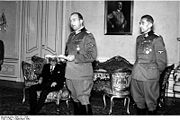
After the establishment of the Protectorate all political parties were outlawed, with the exception of the National Union
(Národní shromáždění). This local Czech Fascist
party was led by a ruling Presidium
until 1942, after which a Führer
(Vůdce) for the party was appointed.
Protector
(Reichsprotektor), the area's senior Nazi administrator whose task it was to represent the "interests" of the German state. The Office and title were held by a variety of persons during the Protectorate's existence. In succession these were:
Konstantin von Neurath
, former Foreign Minister of Nazi Germany, Minister without Portfolio until 1943. He was removed from office after Hitler's dissatisfaction with his "soft policies" in 1941, although he still held the title until his official resignation in 1943.
Reinhard Heydrich
, chief of the SS-Reichssicherheitshauptamt (Reich Main Security Office) or RSHA. He was officially only a deputy to Von Neurath, but in reality was granted supreme authority over the entire state apparatus of the Protectorate.
Kurt Daluege
, Chief of the Ordnungspolizei
(Order Police) or Orpo, in the Interior Ministry, who was also officially a deputy Reich Protector.
Wilhelm Frick
, former Minister of the Interior.
Next to the Reich Protector there was also a political office of State Secretary (from 1943 known as the State Minister to the Reich Protector) who handled most of the internal security. From 1939 to 1945 this person was Karl Hermann Frank
the senior SS and Police Leader
in the Protectorate. A "paper command" of the Allgemeine-SS, with no operational authority, was also established known as the SS-Oberabschnitt Böhmen-Mähren
.
(1872–1945), who had been the President of the Second Czechoslovak Republic
since November 1938. Rudolf Beran
(1887–1954) initially still held the office of Minister President (Předseda vlády) after the German take-over. He was soon replaced by Alois Eliáš
on 27 April 1939, who was himself also sacked on 2 October 1941 not long after the appointment of Reinhard Heydrich
as the new Reich Protector. Because of his contacts with the Czechoslovak Government-in-Exile
Eliás was sentenced to death, with the execution carried out on 19 June 1942 shortly after Heydrich's own death
. From 19 January 1942 the government was led by Jaroslav Krejčí
, and from January to May 1945 by Richard Bienert
, the former police chief of Prague
. When the official dissolution of the Protectorate was proclaimed after the Liberation of Prague
a radio call was issued for Bienert's arrest. This resulted in his conviction to a three-year prison term in 1947, during which he died in 1949.
Aside from the Office of the Minister President, the local Czech government in the Protectorate consisted of the Ministries of Education, Finance, Justice, Trade, the Interior, Agriculture, and Public Labour. The area's foreign policy and military defence were under the exclusive control of the German government. The former foreign minister of Czechoslovakia František Chvalkovský
became a Minister without Portfolio
and permanent representative of the Czech administration in Berlin.
The most prominent Czech politicians in the Protectorate included:
, particularly near the border with Slovakia.
The protectorate was projected to become ethnically totally German. Hitler had approved a plan designed by Konstantin von Neurath
and Karl Hermann Frank
, which projected the Germanization of the "racially valuable" half of the Czech population after the end of the war. This consisted mainly of industrial workers and farmers. The undesirable half contained also the intelligentsia, whom the Nazis viewed as ungermanizable and potential dangerous instigators of Czech nationalism. Some 9,000 Volksdeutsche
from Bukovina
, Dobruja
, South Tyrol
, Bessarabia, Sudetenland and the Altreich
were settled in the protectorate during the war. The goal was to create a German settlement belt from Prague to Sudetenland, and to turn the surroundings of Olomouc
(Olmetz), České Budějovice
(Budweis), Brno
(Brünn) and the area near the Slovak border into German enclaves.
Further integration of the protectorate into the Reich was carried through by the employment of German apprentices, by transferring German evacuee children into schools located in the protectorate, and by authorizing marriages between Germans and "assimilable" Czechs. Germanizable Czechs were allowed to join the Reich Labour Service and be admitted to German universities.
The resulting government overlap led to the usual authority conflicts typical of the Third Reich era. Seeking to extend their own powerbase and to facilitate the area's "Aryanization" the Gauleiter
s of the surrounding districts continually agitated for the liquidation of the Protectorate and its direct incorporation into the German Reich. Hitler
stated as late as 1943 that the issue was still to be decisively settled.
Czech people
Czechs, or Czech people are a western Slavic people of Central Europe, living predominantly in the Czech Republic. Small populations of Czechs also live in Slovakia, Austria, the United States, the United Kingdom, Chile, Argentina, Canada, Germany, Russia and other countries...
protectorate
Protectorate
In history, the term protectorate has two different meanings. In its earliest inception, which has been adopted by modern international law, it is an autonomous territory that is protected diplomatically or militarily against third parties by a stronger state or entity...
which Nazi Germany
Nazi Germany
Nazi Germany , also known as the Third Reich , but officially called German Reich from 1933 to 1943 and Greater German Reich from 26 June 1943 onward, is the name commonly used to refer to the state of Germany from 1933 to 1945, when it was a totalitarian dictatorship ruled by...
established in the central parts of Bohemia
Bohemia
Bohemia is a historical region in central Europe, occupying the western two-thirds of the traditional Czech Lands. It is located in the contemporary Czech Republic with its capital in Prague...
, Moravia
Moravia
Moravia is a historical region in Central Europe in the east of the Czech Republic, and one of the former Czech lands, together with Bohemia and Silesia. It takes its name from the Morava River which rises in the northwest of the region...
and Czech Silesia
Czech Silesia
Czech Silesia is an unofficial name of one of the three Czech lands and a section of the Silesian historical region. It is located in the north-east of the Czech Republic, predominantly in the Moravian-Silesian Region, with a section in the northern Olomouc Region...
in what is today the Czech Republic. It was established on 15 March 1939 by proclamation of Adolf Hitler
Adolf Hitler
Adolf Hitler was an Austrian-born German politician and the leader of the National Socialist German Workers Party , commonly referred to as the Nazi Party). He was Chancellor of Germany from 1933 to 1945, and head of state from 1934 to 1945...
from Prague Castle
Prague Castle
Prague Castle is a castle in Prague where the Kings of Bohemia, Holy Roman Emperors and presidents of Czechoslovakia and the Czech Republic have had their offices. The Czech Crown Jewels are kept here...
following the declaration of establishment of the independent Slovak Republic on 14 March 1939. Bohemia and Moravia were autonomous Nazi-administered territories which the German government considered part of the Greater German Reich. The state's existence came to an end with the surrender of Germany to the Allies of World War II
Allies of World War II
The Allies of World War II were the countries that opposed the Axis powers during the Second World War . Former Axis states contributing to the Allied victory are not considered Allied states...
in 1945.
History
Sudetenland
Sudetenland is the German name used in English in the first half of the 20th century for the northern, southwest and western regions of Czechoslovakia inhabited mostly by ethnic Germans, specifically the border areas of Bohemia, Moravia, and those parts of Silesia being within Czechoslovakia.The...
, located on the Czechoslovak
Czechoslovakia
Czechoslovakia or Czecho-Slovakia was a sovereign state in Central Europe which existed from October 1918, when it declared its independence from the Austro-Hungarian Empire, until 1992...
border with Germany and Austria proper, with its majority of ethnic German inhabitants, had been incorporated directly into the Reich on 10 October 1938, when Czechoslovakia was forced to accept the terms of the Munich Agreement
Munich Agreement
The Munich Pact was an agreement permitting the Nazi German annexation of Czechoslovakia's Sudetenland. The Sudetenland were areas along Czech borders, mainly inhabited by ethnic Germans. The agreement was negotiated at a conference held in Munich, Germany, among the major powers of Europe without...
. Five months later, when the Slovak Diet declared the independence of Slovakia
Slovakia
The Slovak Republic is a landlocked state in Central Europe. It has a population of over five million and an area of about . Slovakia is bordered by the Czech Republic and Austria to the west, Poland to the north, Ukraine to the east and Hungary to the south...
, Hitler summoned Czechoslovak President Emil Hácha
Emil Hácha
Emil Hácha was a Czech lawyer, the third President of Czecho-Slovakia from 1938 to 1939. From March 1939, he presided under the German Protectorate of Bohemia and Moravia.-Judicial career:...
to Berlin and intimidated him into accepting the German occupation of the Czech rump state
Rump state
A rump state is the remnant of a once-larger government, left with limited powers or authority after a disaster, invasion, military occupation, secession or partial overthrowing of a government. In the last case, a government stops short of going in exile because it still controls part of its...
.
Bohemia and Moravia were declared a protectorate of Germany and were placed under the supervision of the Reichsprotektor, Konstantin von Neurath
Konstantin von Neurath
Konstantin Freiherr von Neurath was a German diplomat remembered mostly for having served as Foreign minister of Germany between 1932 and 1938...
. Hácha remained as technical head of state with the title of State President; German officials manned departments analogous to cabinet ministries, while small German control offices were established locally. The Gestapo
Gestapo
The Gestapo was the official secret police of Nazi Germany. Beginning on 20 April 1934, it was under the administration of the SS leader Heinrich Himmler in his position as Chief of German Police...
assumed police authority. Jews were dismissed from the civil service and placed in an extralegal position. Political parties were banned, and many Communist Party
Communist Party of Czechoslovakia
The Communist Party of Czechoslovakia, in Czech and in Slovak: Komunistická strana Československa was a Communist and Marxist-Leninist political party in Czechoslovakia that existed between 1921 and 1992....
leaders fled to the Soviet Union
Soviet Union
The Soviet Union , officially the Union of Soviet Socialist Republics , was a constitutionally socialist state that existed in Eurasia between 1922 and 1991....
.
The population of the protectorate was mobilized for labor that would aid the German war effort, and special offices were organized to supervise the management of industries important to that effort. Czechs were drafted to work in coal mines, the iron and steel industry, and armaments production; some young people were sent to Germany. Consumer goods production, much diminished, was largely directed toward supplying the German armed forces. The protectorate's population was subjected to strict rationing
Rationing
Rationing is the controlled distribution of scarce resources, goods, or services. Rationing controls the size of the ration, one's allotted portion of the resources being distributed on a particular day or at a particular time.- In economics :...
.
German rule was moderate during the first months of the occupation. The Czech government and political system, reorganized by Hácha, continued in formal existence. Gestapo activities were directed mainly against Czech politicians and the intelligentsia
Intelligentsia
The intelligentsia is a social class of people engaged in complex, mental and creative labor directed to the development and dissemination of culture, encompassing intellectuals and social groups close to them...
. The eventual goal of German state under Nazi leadership was to eradicate Czech nationality through assimilation, deportation, and extermination of the Czech intelligentsia; the intellectual elites and middle class made up a considerable number of the 200,000 people who passed through concentration camps and the 250,000 who died during German occupation. Under Generalplan Ost
Generalplan Ost
Generalplan Ost was a secret Nazi German plan for the colonization of Eastern Europe. Implementing it would have necessitated genocide and ethnic cleansing to be undertaken in the Eastern European territories occupied by Germany during World War II...
, it was assumed that around 50% Czechs would be fit for Germanization. The Czech intellectual elites were to be removed not only from Czech territories but from Europe
Europe
Europe is, by convention, one of the world's seven continents. Comprising the westernmost peninsula of Eurasia, Europe is generally 'divided' from Asia to its east by the watershed divides of the Ural and Caucasus Mountains, the Ural River, the Caspian and Black Seas, and the waterways connecting...
completely. The authors of Generalplan Ost believed it would be best if they emigrated overseas, as even in Siberia
Siberia
Siberia is an extensive region constituting almost all of Northern Asia. Comprising the central and eastern portion of the Russian Federation, it was part of the Soviet Union from its beginning, as its predecessor states, the Tsardom of Russia and the Russian Empire, conquered it during the 16th...
they were considered a threat to German rule. Just like Jews, Poles, Serbs, and several other nations, Czechs were considered to be untermenschen by the Nazi state
The Czechs demonstrated against the occupation on 28 October 1939 the anniversary of Czechoslovak independence. The death on 15 November 1939 of a medical student, Jan Opletal
Jan Opletal
Jan Opletal was a student of the Medical Faculty of the Charles University in Prague, who was killed in an anti-Nazi demonstration during the German occupation of Czechoslovakia....
, who had been wounded in the October violence, precipitated widespread student demonstrations, and the Reich retaliated. Politicians were arrested en masse, as were an estimated 1,800 students and teachers. On 17 November, all universities and colleges in the protectorate were closed, nine student leaders were executed, and hundreds were sent to concentration camps in Germany. (See also Czech resistance to Nazi occupation
Czech resistance to Nazi occupation
Czech resistance to German Nazi occupation during World War II is a scarcely documented subject, by and large a result of little formal resistance and an effective German policy that deterred acts of resistance or annihilated organizations of resistance...
)
During World War II
World War II
World War II, or the Second World War , was a global conflict lasting from 1939 to 1945, involving most of the world's nations—including all of the great powers—eventually forming two opposing military alliances: the Allies and the Axis...
, on 27 September 1941, the Reich adopted a more radical policy in the protectorate. SS hardliner Reinhard Heydrich
Reinhard Heydrich
Reinhard Tristan Eugen Heydrich , also known as The Hangman, was a high-ranking German Nazi official.He was SS-Obergruppenführer and General der Polizei, chief of the Reich Main Security Office and Stellvertretender Reichsprotektor of Bohemia and Moravia...
was appointed Deputy Reichsprotektor of Bohemia and Moravia. Under his authority Prime Minister Alois Eliáš
Alois Eliáš
Alois Eliáš was a Czechoslovak general and politician. He served as Prime Minister of the Protectorate of Bohemia and Moravia from April 27, 1939 to September 28, 1941.- Career in 1939-1942 :...
was arrested (and later executed), the Czech government was reorganized, and all Czech cultural organizations were closed. The Gestapo indulged in arrests and executions. The deportation of Jews to concentration camps was organized, and the fortress town of Terezín
Theresienstadt concentration camp
Theresienstadt concentration camp was a Nazi German ghetto during World War II. It was established by the Gestapo in the fortress and garrison city of Terezín , located in what is now the Czech Republic.-History:The fortress of Terezín was constructed between the years 1780 and 1790 by the orders...
was made into a ghetto way station for Jewish families. On 4 June 1942, Heydrich died after being wounded by an assassin in Operation Anthropoid
Operation Anthropoid
Operation Anthropoid was the code name for the targeted killing of top German SS leader Reinhard Heydrich. He was the chief of the Reich Main Security Office , the acting Protector of Bohemia and Moravia, and a chief planner of the Final Solution, the Nazi German programme for the genocide of the...
. Following directives issued by Reichsführer-SS
Reichsführer-SS
was a special SS rank that existed between the years of 1925 and 1945. Reichsführer-SS was a title from 1925 to 1933 and, after 1934, the highest rank of the German Schutzstaffel .-Definition:...
Heinrich Himmler
Heinrich Himmler
Heinrich Luitpold Himmler was Reichsführer of the SS, a military commander, and a leading member of the Nazi Party. As Chief of the German Police and the Minister of the Interior from 1943, Himmler oversaw all internal and external police and security forces, including the Gestapo...
, Heydrich's successor, SS-Oberstgruppenführer
Oberstgruppenführer
Oberst-Gruppenführer was the highest commissioned SS rank with the exception of Reichsführer-SS, which was a special rank held by Heinrich Himmler...
Kurt Daluege
Kurt Daluege
Kurt Daluege was a German Nazi SS-Oberstgruppenführer and Generaloberst der Polizei as chief of the Ordnungspolizei and ruled the Protectorate Bohemia and Moravia as Deputy Protector after Reinhard Heydrich's assassination.-Early life and career:Kurt Daluege, a son of a Prussian state official,...
, ordered mass arrests, executions and the destruction of the villages of Lidice
Lidice
Lidice is a village in the Czech Republic just northwest of Prague. It is built on the site of a previous village of the same name which, as part of the Nazi Protectorate of Bohemia and Moravia, was on orders from Reichsführer-SS Heinrich Himmler, completely destroyed by German forces in reprisal...
and Ležáky
Ležáky
Ležáky was a village in Czechoslovakia. In 1942 it was razed to the ground by Nazis during the German occupation of Czechoslovakia.Ležáky was a settlement inhabited by poor stone-cutters and little cottagers...
. In 1943 the German war effort was accelerated. Under the authority of Karl Hermann Frank
Karl Hermann Frank
Karl Hermann Frank was a prominent Sudeten German Nazi official in Czechoslovakia prior to and during World War II and an SS-Obergruppenführer...
, German minister of state for Bohemia and Moravia, some 350,000 Czech laborers were dispatched to the Reich. Within the protectorate, all non-war-related industry was prohibited. Most of the Czech population obeyed quiescently up until the final months preceding the end of the war, while thousands were involved in the resistance movement
Resistance movement
A resistance movement is a group or collection of individual groups, dedicated to opposing an invader in an occupied country or the government of a sovereign state. It may seek to achieve its objects through either the use of nonviolent resistance or the use of armed force...
.
For the Czechs of the Protectorate Bohemia and Moravia, German occupation was a period of brutal oppression, made even more painful by the memory of independence and democracy.
Czech losses resulting from political persecution and deaths in concentration camps totalled between 36,000 and 55,000.
The Jewish population of Bohemia and Moravia (118,000 according to the 1930 census) was virtually annihilated. Many Jews emigrated after 1939; more than 70,000 were killed; 8,000 survived at Terezín. Several thousand Jews managed to live in freedom or in hiding throughout the occupation.
The extermination of the Romani population was so thorough that the Bohemian Romani
Bohemian Romani
Bohemian Romani or Bohemian Romany is a dialect of Romani formerly spoken by the Romanies of Bohemia, the western part of today's Czech Republic...
language became totally extinct. Romani internees were sent to the Lety and Hodonín concentration camps
Concentration camps Lety and Hodonín
The concentration camp in Lety was a World War II internment camp for Romani people from the so-called Protectorate of Bohemia and Moravia during the German occupation of Czechoslovakia on July 10, 1942.- Background :...
before being transferred to Auschwitz-Birkenau for gassing. The vast majority of Romani in the Czech Republic today are actually descended from migrants from Slovakia
Slovakia
The Slovak Republic is a landlocked state in Central Europe. It has a population of over five million and an area of about . Slovakia is bordered by the Czech Republic and Austria to the west, Poland to the north, Ukraine to the east and Hungary to the south...
who moved there during the post-war years in Czechoslovakia
Czechoslovakia
Czechoslovakia or Czecho-Slovakia was a sovereign state in Central Europe which existed from October 1918, when it declared its independence from the Austro-Hungarian Empire, until 1992...
.
Politics
After the establishment of the Protectorate all political parties were outlawed, with the exception of the National Union
National Union
National Union may refer to one of many political parties:* Liberia National Union* National Union * National Union * National Union Party * National Union , Nasser's party in the United Arab Republic, 1957 - 1962...
(Národní shromáždění). This local Czech Fascist
Fascism
Fascism is a radical authoritarian nationalist political ideology. Fascists seek to rejuvenate their nation based on commitment to the national community as an organic entity, in which individuals are bound together in national identity by suprapersonal connections of ancestry, culture, and blood...
party was led by a ruling Presidium
Presidium
The presidium or praesidium is the name for the heading organ of various legislative and organizational bodies.-Historical usage:...
until 1942, after which a Führer
Führer
Führer , alternatively spelled Fuehrer in both English and German when the umlaut is not available, is a German title meaning leader or guide now most associated with Adolf Hitler, who modelled it on Benito Mussolini's title il Duce, as well as with Georg von Schönerer, whose followers also...
(Vůdce) for the party was appointed.
German government
Ultimate authority within the Protectorate was held by the ReichReich
Reich is a German word cognate with the English rich, but also used to designate an empire, realm, or nation. The qualitative connotation from the German is " sovereign state." It is the word traditionally used for a variety of sovereign entities, including Germany in many periods of its history...
Protector
Protector (title)
Protector, sometimes spelled protecter, is used as a title or part of various historical titles of heads of state and others in authority...
(Reichsprotektor), the area's senior Nazi administrator whose task it was to represent the "interests" of the German state. The Office and title were held by a variety of persons during the Protectorate's existence. In succession these were:
- 16 March 1939 - 20 August 1943:
Konstantin von Neurath
Konstantin von Neurath
Konstantin Freiherr von Neurath was a German diplomat remembered mostly for having served as Foreign minister of Germany between 1932 and 1938...
, former Foreign Minister of Nazi Germany, Minister without Portfolio until 1943. He was removed from office after Hitler's dissatisfaction with his "soft policies" in 1941, although he still held the title until his official resignation in 1943.
- 27 September 1941 - 30 May 1942:
Reinhard Heydrich
Reinhard Heydrich
Reinhard Tristan Eugen Heydrich , also known as The Hangman, was a high-ranking German Nazi official.He was SS-Obergruppenführer and General der Polizei, chief of the Reich Main Security Office and Stellvertretender Reichsprotektor of Bohemia and Moravia...
, chief of the SS-Reichssicherheitshauptamt (Reich Main Security Office) or RSHA. He was officially only a deputy to Von Neurath, but in reality was granted supreme authority over the entire state apparatus of the Protectorate.
- 31 May 1942 - 20 August 1943:
Kurt Daluege
Kurt Daluege
Kurt Daluege was a German Nazi SS-Oberstgruppenführer and Generaloberst der Polizei as chief of the Ordnungspolizei and ruled the Protectorate Bohemia and Moravia as Deputy Protector after Reinhard Heydrich's assassination.-Early life and career:Kurt Daluege, a son of a Prussian state official,...
, Chief of the Ordnungspolizei
Ordnungspolizei
The Ordnungspolizei or Orpo were the uniformed regular police force in Nazi Germany between 1936 and 1945. It was increasingly absorbed into the Nazi police system. Owing to their green uniforms, they were also referred to as Grüne Polizei...
(Order Police) or Orpo, in the Interior Ministry, who was also officially a deputy Reich Protector.
- 20 August 1943 - 5 May 1945:
Wilhelm Frick
Wilhelm Frick
Wilhelm Frick was a prominent German Nazi official serving as Minister of the Interior of the Third Reich. After the end of World War II, he was tried for war crimes at the Nuremberg Trials and executed...
, former Minister of the Interior.
Next to the Reich Protector there was also a political office of State Secretary (from 1943 known as the State Minister to the Reich Protector) who handled most of the internal security. From 1939 to 1945 this person was Karl Hermann Frank
Karl Hermann Frank
Karl Hermann Frank was a prominent Sudeten German Nazi official in Czechoslovakia prior to and during World War II and an SS-Obergruppenführer...
the senior SS and Police Leader
SS and Police Leader
SS and Police Leader was a title for senior Nazi officials that commanded large units of the SS, of Gestapo and of the regular German police during and prior to World War II.Three levels of subordination were established for bearers of this title:...
in the Protectorate. A "paper command" of the Allgemeine-SS, with no operational authority, was also established known as the SS-Oberabschnitt Böhmen-Mähren
SS-Oberabschnitt Böhmen-Mähren
SS-Oberabschnitt Böhmen-Mähren was the Allgemeine-SS division command which encompassed the territory of the Protectorate of Bohemia and Moravia . Oberabschnitt Böhmen-Mähren was strictly a "paper command" and never exercised any active operational authority...
.
Czech government
The Czech State President (Státní Prezident) under the period of German rule from 1939 to 1945 was Emil HáchaEmil Hácha
Emil Hácha was a Czech lawyer, the third President of Czecho-Slovakia from 1938 to 1939. From March 1939, he presided under the German Protectorate of Bohemia and Moravia.-Judicial career:...
(1872–1945), who had been the President of the Second Czechoslovak Republic
Second Czechoslovak Republic
The Second Czechoslovak Republic refers to the second Czechoslovak state that existed from October 1, 1938 to March 14, 1939, thus existing for only 167 days...
since November 1938. Rudolf Beran
Rudolf Beran
Rudolf Beran was a Czechoslovakian politician who served as prime minister of the country before its occupation by Nazi Germany and shortly thereafter, before it was declared a protectorate...
(1887–1954) initially still held the office of Minister President (Předseda vlády) after the German take-over. He was soon replaced by Alois Eliáš
Alois Eliáš
Alois Eliáš was a Czechoslovak general and politician. He served as Prime Minister of the Protectorate of Bohemia and Moravia from April 27, 1939 to September 28, 1941.- Career in 1939-1942 :...
on 27 April 1939, who was himself also sacked on 2 October 1941 not long after the appointment of Reinhard Heydrich
Reinhard Heydrich
Reinhard Tristan Eugen Heydrich , also known as The Hangman, was a high-ranking German Nazi official.He was SS-Obergruppenführer and General der Polizei, chief of the Reich Main Security Office and Stellvertretender Reichsprotektor of Bohemia and Moravia...
as the new Reich Protector. Because of his contacts with the Czechoslovak Government-in-Exile
Czechoslovak government-in-exile
The Czechoslovak government-in-exile was an informal title conferred upon the Czechoslovak National Liberation Committee, initially by British diplomatic recognition. The name came to be used by other World War II Allies as they subsequently recognized it...
Eliás was sentenced to death, with the execution carried out on 19 June 1942 shortly after Heydrich's own death
Operation Anthropoid
Operation Anthropoid was the code name for the targeted killing of top German SS leader Reinhard Heydrich. He was the chief of the Reich Main Security Office , the acting Protector of Bohemia and Moravia, and a chief planner of the Final Solution, the Nazi German programme for the genocide of the...
. From 19 January 1942 the government was led by Jaroslav Krejčí
Jaroslav Krejcí
Jaroslav Krejčí was a Czechoslovakian lawyer and politician. He served as Prime Minister of Protectorate of Bohemia and Moravia from January 19, 1942 to January 19, 1945....
, and from January to May 1945 by Richard Bienert
Richard Bienert
Richard Bienert was a Czechoslovakian politician. He served as Prime Minister of Czechoslovakia from January 19, 1945 to May 5, 1945, under the Protectorate of Bohemia and Moravia...
, the former police chief of Prague
Prague
Prague is the capital and largest city of the Czech Republic. Situated in the north-west of the country on the Vltava river, the city is home to about 1.3 million people, while its metropolitan area is estimated to have a population of over 2.3 million...
. When the official dissolution of the Protectorate was proclaimed after the Liberation of Prague
Prague Offensive
The Prague Offensive was the last major Soviet operation of World War II in Europe. The offensive, and the battle for Prague, was fought on the Eastern Front from 6 May to 11 May 1945. This battle for the city is particularly noteworthy in that it ended after the Third Reich capitulated on 8 May...
a radio call was issued for Bienert's arrest. This resulted in his conviction to a three-year prison term in 1947, during which he died in 1949.
Aside from the Office of the Minister President, the local Czech government in the Protectorate consisted of the Ministries of Education, Finance, Justice, Trade, the Interior, Agriculture, and Public Labour. The area's foreign policy and military defence were under the exclusive control of the German government. The former foreign minister of Czechoslovakia František Chvalkovský
Frantisek Chvalkovsky
František Chvalkovský was a Czech diplomat and the fourth foreign minister of Czechoslovakia.-Activities during the First Republic:...
became a Minister without Portfolio
Minister without Portfolio
A minister without portfolio is either a government minister with no specific responsibilities or a minister that does not head a particular ministry...
and permanent representative of the Czech administration in Berlin.
The most prominent Czech politicians in the Protectorate included:
- Alois EliášAlois EliášAlois Eliáš was a Czechoslovak general and politician. He served as Prime Minister of the Protectorate of Bohemia and Moravia from April 27, 1939 to September 28, 1941.- Career in 1939-1942 :...
(1890–1942), a former Czechoslovak General who was executed for his secret contacts with the Czechoslovak Government-in-ExileCzechoslovak government-in-exileThe Czechoslovak government-in-exile was an informal title conferred upon the Czechoslovak National Liberation Committee, initially by British diplomatic recognition. The name came to be used by other World War II Allies as they subsequently recognized it...
in 1942; Minister President from 1939 to 1945. - Ladislav Karel Feierabend, Minister of Agriculture from 1939 to 1940. Joined the London-based Czechoslovak government in 1940.
- Jiří Havelka, Minister of Traffic from 1939 to 1941.
- Josef Ježek, Interior Minister from 1939 to 1942.
- Jan Kapras, Minister of Education from 1939 to 1942.
- Josef Kalfus (1880–1956), Minister of Finance from 1939 to 1945.
- Josef Nebeský, party leader of the National UnionNational UnionNational Union may refer to one of many political parties:* Liberia National Union* National Union * National Union * National Union Party * National Union , Nasser's party in the United Arab Republic, 1957 - 1962...
from 1939 to 1941. - Josef Fousek (1875–1942), party leader of the National UnionNational UnionNational Union may refer to one of many political parties:* Liberia National Union* National Union * National Union * National Union Party * National Union , Nasser's party in the United Arab Republic, 1957 - 1962...
from 1941 to 1942. - Jaroslav KrejčíJaroslav KrejcíJaroslav Krejčí was a Czechoslovakian lawyer and politician. He served as Prime Minister of Protectorate of Bohemia and Moravia from January 19, 1942 to January 19, 1945....
(1892–1956), Minister of Justice from 1939 to 1945, as well as Minister President from 1942 to 1945. - Jindřich Kamenický, Minister of Traffic from 1941 to 1945.
- Walter Bertsch, Minister of Economics from 1942 to 1945.
- Richard BienertRichard BienertRichard Bienert was a Czechoslovakian politician. He served as Prime Minister of Czechoslovakia from January 19, 1945 to May 5, 1945, under the Protectorate of Bohemia and Moravia...
(1881–1949), Interior Minister from 1942 to 1945, as well as the last Minister President in 1945. - Adolf Hrubý (1893–1951), Minister of Agriculture from 1942 to 1945.
- Tomáš Krejčí, FührerFührerFührer , alternatively spelled Fuehrer in both English and German when the umlaut is not available, is a German title meaning leader or guide now most associated with Adolf Hitler, who modelled it on Benito Mussolini's title il Duce, as well as with Georg von Schönerer, whose followers also...
(Vůdce) of the National UnionNational UnionNational Union may refer to one of many political parties:* Liberia National Union* National Union * National Union * National Union Party * National Union , Nasser's party in the United Arab Republic, 1957 - 1962...
from 1942 to 1945. - Emanuel MoravecEmanuel MoravecEmanuel Moravec was a pre-war Czechoslovakian army colonel who became aNazi collaborator during World War II....
, Minister of Education from 1942 to 1945.
Population
The area of the Protectorate of Bohemia and Moravia contained about 7.380.000 inhabitants in 1940. 225.000 (3.3 %) of these were of German origin, while the rest were mainly ethnic Czechs as well as some SlovaksSlovaks
The Slovaks, Slovak people, or Slovakians are a West Slavic people that primarily inhabit Slovakia and speak the Slovak language, which is closely related to the Czech language.Most Slovaks today live within the borders of the independent Slovakia...
, particularly near the border with Slovakia.
The protectorate was projected to become ethnically totally German. Hitler had approved a plan designed by Konstantin von Neurath
Konstantin von Neurath
Konstantin Freiherr von Neurath was a German diplomat remembered mostly for having served as Foreign minister of Germany between 1932 and 1938...
and Karl Hermann Frank
Karl Hermann Frank
Karl Hermann Frank was a prominent Sudeten German Nazi official in Czechoslovakia prior to and during World War II and an SS-Obergruppenführer...
, which projected the Germanization of the "racially valuable" half of the Czech population after the end of the war. This consisted mainly of industrial workers and farmers. The undesirable half contained also the intelligentsia, whom the Nazis viewed as ungermanizable and potential dangerous instigators of Czech nationalism. Some 9,000 Volksdeutsche
Volksdeutsche
Volksdeutsche - "German in terms of people/folk" -, defined ethnically, is a historical term from the 20th century. The words volk and volkische conveyed in Nazi thinking the meanings of "folk" and "race" while adding the sense of superior civilization and blood...
from Bukovina
Bukovina
Bukovina is a historical region on the northern slopes of the northeastern Carpathian Mountains and the adjoining plains.-Name:The name Bukovina came into official use in 1775 with the region's annexation from the Principality of Moldavia to the possessions of the Habsburg Monarchy, which became...
, Dobruja
Dobruja
Dobruja is a historical region shared by Bulgaria and Romania, located between the lower Danube river and the Black Sea, including the Danube Delta, Romanian coast and the northernmost part of the Bulgarian coast...
, South Tyrol
South Tyrol
South Tyrol , also known by its Italian name Alto Adige, is an autonomous province in northern Italy. It is one of the two autonomous provinces that make up the autonomous region of Trentino-Alto Adige/Südtirol. The province has an area of and a total population of more than 500,000 inhabitants...
, Bessarabia, Sudetenland and the Altreich
Altreich
Altreich or Altes Reich is a German term that may refer to:* A synonym for the medieval Kingdom of Germany in prior German historiography, i.e. the territory of the German stem duchies excluding the Saxon and Bavarian eastern marches....
were settled in the protectorate during the war. The goal was to create a German settlement belt from Prague to Sudetenland, and to turn the surroundings of Olomouc
Olomouc
Olomouc is a city in Moravia, in the east of the Czech Republic. The city is located on the Morava river and is the ecclesiastical metropolis and historical capital city of Moravia. Nowadays, it is an administrative centre of the Olomouc Region and sixth largest city in the Czech Republic...
(Olmetz), České Budějovice
Ceské Budejovice
České Budějovice is a city in the Czech Republic. It is the largest city in the South Bohemian Region and is the political and commercial capital of the region and centre of the Roman Catholic Diocese of České Budějovice and of the University of South Bohemia and the Academy of Sciences...
(Budweis), Brno
Brno
Brno by population and area is the second largest city in the Czech Republic, the largest Moravian city, and the historical capital city of the Margraviate of Moravia. Brno is the administrative centre of the South Moravian Region where it forms a separate district Brno-City District...
(Brünn) and the area near the Slovak border into German enclaves.
Further integration of the protectorate into the Reich was carried through by the employment of German apprentices, by transferring German evacuee children into schools located in the protectorate, and by authorizing marriages between Germans and "assimilable" Czechs. Germanizable Czechs were allowed to join the Reich Labour Service and be admitted to German universities.
Administrative subdivisions
Protectorate Districts
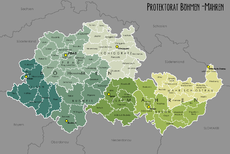
For administrative purposes the Protectorate of Bohemia and Moravia was divided into two Lands; Böhmen (Bohemia) and Mähren (Moravia). Each of these was further subdivided into Oberlandratsbezirke, each comprising a number of Bezirke.| Böhmen | |
| Budweis | Budweis, Gumpolds, Ledetsch Ledec nad Sázavou Ledeč nad Sázavou is a town in the Vysočina Region, Czech Republic. It is located at around . The Sázava River flows through the town.- External links :* *... , Pilgrams Pelhrimov - Basic facts :Pelhřimov is located approximately half-way between Prague and Brno. It is known as “the Gateway to the Highlands“ because of its location in the westernmost tip of the Czech-Moravian Highlands. The altitude above sea level at the foot of the tower of the Church of St... , Tabor Tábor Tábor is a city of the Czech Republic, in the South Bohemian Region. It is named after Mount Tabor, which is believed by many to be the place of the Transfiguration of Christ; however, the name became popular and nowadays translates to "camp" or "encampment" in the Czech language.The town was... , Wittingau |
| Königgrätz | Chrudim Chrudim Chrudim is a city in eastern Bohemia, in the Pardubice region of the Czech Republic.The oldest archaeological findings which provide first signs of the settlement in this area date back to the 5th millennium BC. Various cultures succeeded one on another in the territory of today’s town of Chrudim... , Hohenmauth, Jitschin, Königgrätz, Königinhof, Leitomischl, Nachod Náchod Náchod -History:Náchod was founded in 14th century by knight Hron of Načeradice, who founded a castle on a strategical place, where local trade road reaches the defile called Branka. The first written note dates back to 1254.-Castle:... , Neu-Bidschow Nový Bydžov Nový Bydžov is a town in the Hradec Králové Region of the Czech Republic. It is situated near Hradec Králové and Chlumec nad Cidlinou on the river Cidlina.-History:... , Neuenburg Nymburk Nymburk is a city in the Central Bohemian Region of the Czech Republic, located 45 km east of Prague on the Elbe River. It is also home to the Czech men's basketball team ČEZ Basketball Nymburk... , Pardubitz, Reichenau Rychnov nad Knežnou Rychnov nad Kněžnou is a town in the Hradec Králové Region of the Czech Republic. It has around 12,000 inhabitants.This is a small town, with a sprinkling of other small towns in the vicinity. The nearest big city is Hradec Králové which is about 32 km to the west... , Semil |
| Pilsen | Klattau, Kralowitz Kralovice Kralovice is a town in the Pilsen Region of the Czech Republic. The town is situated about in the North-East from Pilsen.Kralovice is also a Municipality with Extended Competence.... Pilsen-Land Plzen Region Plzeň Region is an administrative unit in the western part of Bohemia in the Czech Republic. It is named after its capital Plzeň .- Communes :... , Pilsen-Stadt, Pisek Písek Písek is a town in the South Bohemian Region of the Czech Republic. It has a population of 29 909 .-About:Písek is usually called "The Athens of the South", although Athens is much more southerly, because it has many high schools and schools of higher education, e.g. the Film School in Písek... , Schüttenhofen, Strakonitz Strakonice Strakonice is a town in the South Bohemian Region of the Czech Republic. Estimated population: 24,000.-History:The settlement of this region took place in the second half of 12th century when a castle was built... , Taus |
| Prag | Beneschau, Beraun, Böhmisch-Brod Ceský Brod Český Brod is a town in the Central Bohemian Region of the Czech Republic. It is located 35 km east of Prague and had a population of 6,637 in 2005.Rock for People, an annual summer music festival was held in Český Brod from 1995 to 2006... , Brandeis Brandeis Brandeis may refer to:* Louis Brandeis, U.S. Supreme Court Justice* Things named for Louis Brandeis:** Brandeis Brief, a 1908 document written by Brandeis as a litigator** Brandeis University, in Massachusetts, USA... , Jungbunzlau, Kladno Kladno Kladno is a city in the Central Bohemian Region of the Czech Republic. It is located 25 km northwest of Prague. Kladno is the largest city of the region and holds a population together with its adjacent suburban areas of more than 110,000 people... , Kolin Kolín Kolín is a town in the Central Bohemian Region of the Czech Republic some east from Prague, lying on the Elbe river.-History:Kolín was founded by king Přemysl Otakar II in the 13th century, first mentioned in 1261. Later on, 1437, a castle was founded here... , Laun, Melnik Melnik -Places:Bulgaria* Melnik, Bulgaria, a town in Bulgaria* Shiroka Melnishka Losa, a Bulgarian wine grape also known as MelnikCzech Republic* Mělník, a townUnited States* Melnik, Wisconsin, an unincorporated community... , Pibrans, Prag-Land-Nord, Prag-Land-Süd, Prag-Stadt, Rakonitz, Raudnitz, Schlan, Seltschan, Tschaslau Cáslav Čáslav is a town in eastern part of Central Bohemian Region of the Czech Republic.- History :History of Čáslav begins after year 800 with founding of citadel and settlement called Hrádek. Near Hrádek, new town with huge square was founded by king Přemysl Otakar II in 1250... |
| Mähren | |
| Brünn Brunn Brunn or Brünn may refer to:Places* Brünn, the German form of the Czech city Brno* Brunn, Upper Palatinate, a town in Bavaria, Germany* Brunn, Mecklenburg-Vorpommern, a municipality in Mecklenburg-Vorpommern, Germany... |
Boskowitz, Brünn-Land Brno Brno by population and area is the second largest city in the Czech Republic, the largest Moravian city, and the historical capital city of the Margraviate of Moravia. Brno is the administrative centre of the South Moravian Region where it forms a separate district Brno-City District... , Brünn-Stadt Brno Brno by population and area is the second largest city in the Czech Republic, the largest Moravian city, and the historical capital city of the Margraviate of Moravia. Brno is the administrative centre of the South Moravian Region where it forms a separate district Brno-City District... , Gaya Kyjov (Hodonín District) Kyjov is a town in the South Moravian Region of the Czech Republic. It has around 12,000 inhabitants. Kyjov is famous for its folk festival which takes place every four years.The villages Bohuslavice, Boršov and Nětčice are administrative parts of Kyjov.... , Göding Hodonín Hodonín is a town on the River Morava in the southeast of Moravia, in the Czech Republic. It lies in the South Moravian Region. The population is 26,226 . Hodonín was first mentioned in 1046. In 1228 it became a town... , Ungarisch-Brod Uherský Brod Uherský Brod is a town in the Zlín Region of the Czech Republic. It is situated in the south-east of Moravia . It lies in the Vizovice Highlands and near the White Carpathian Mountains .... , Ungarisch-Hradisch Uherské Hradište Uherské Hradiště is a town in the Zlín Region of the Czech Republic. It lies on the Morava river and is the seat of the Uherské Hradiště District.- History :... , Wischau, Zline Zlín Zlín , from 1949 to 1989 Gottwaldov , is a city in the Zlín Region, southeastern Moravia, Czech Republic, on the Dřevnice River. The development of the modern city is closely connected to the Bata Shoes company... |
| Iglau | Groß-Meseritsch Velké Mezirící Velké Meziříčí is a town in the Vysočina Region, Czech Republic. It is situated under the original Gothic castle in a valley framed by the hills of the Bohemian-Moravian Highlands.... , Iglau, Mährisch-Budwitz, Neustadtl Nové Mesto na Morave Nové Město na Moravě is a town in the Vysočina Region of the Czech Republic. It has 10,464 inhabitants.-Business in town:Despite its location surrounded by great outdoors, the town has a long tradition of manufacturing... , Trebitsch Trebíc Třebíč is a city in the Moravian part of the Vysočina Region of the Czech Republic.Třebíč is situated 35 km southeast of Jihlava and 65 km west of Brno on the Jihlava River. Třebíč is from 392 to 503 metres above sea-level.... |
| Mährisch-Ostrau | Friedberg Frýdek-Místek Frýdek-Místek is a city in Moravian-Silesian Region of the Czech Republic. It is the administrative center of Frýdek-Místek District. It comprises two formerly independent towns, Frýdek and Místek, divided by the Ostravice River... , Kremsier, Littau Litovel Litovel is a town in the Olomouc Region of the Czech Republic. It has around 10,000 inhabitants. Litovel lies in Upper-Moravian Vale , 233 metres above the sea level. Thanks to its rich history Litovel has many historical monuments.-Demographics:Source: -Town Hall:The Town Hall lies on Přemysl... , Mährisch-Ostrau Ostrava Ostrava is the third largest city in the Czech Republic and the second largest urban agglomeration after Prague. Located close to the Polish border, it is also the administrative center of the Moravian-Silesian Region and of the Municipality with Extended Competence. Ostrava was candidate for the... , Mährisch-Weißkirchen Hranice na Morave Hranice , sometimes called Hranice na Moravě , is a town in Moravia, the eastern Czech Republic.In the Austrian-Hungarian era, this city was famous for its military academy and yeshivah .- External links :... , Olmütz-Land, Olmütz-Stadt, Prerau, Proßnitz, Wallachisch-Meseritsch Valašské Mezirící Valašské Meziříčí is a town in the Zlín Region, the Czech Republic. The town has 27,960 inhabitants.Vsetínská Bečva and Rožnovská Bečva rivers join in the town to form the Bečva River.-Main sights:* The Kinský Chateau... , Wesetin Vsetín Vsetín is a town in Zlín Region of the Czech Republic. It has around 28,500 inhabitants and lies on the Vsetínská Bečva river.The area around Vsetín, called Vsetínsko, is spread out on the foothills of the Vsetín, Hostýn and Vizovice Highlands around the Bečva River... |
NSDAP Districts
For party administrative purposes the Nazi Party extended its Gau-system to Bohemia and Moravia when the Protectorate was established. This step divided the remaining parts of Bohemia and Moravia up between its four surrounding Gaue:- SudetenlandSudetenlandSudetenland is the German name used in English in the first half of the 20th century for the northern, southwest and western regions of Czechoslovakia inhabited mostly by ethnic Germans, specifically the border areas of Bohemia, Moravia, and those parts of Silesia being within Czechoslovakia.The...
; - BayreuthGau BayreuthThe Gau Bayreuth, until 1942 named Gau Bayerische Ostmark , was an administrative division of Nazi Germany in Lower Bavaria, Upper Palatinate and Upper Franconia, Bavaria from 1933 to 1945...
(Bavarian Eastern March); - Lower DanubeLower AustriaLower Austria is the northeasternmost state of the nine states in Austria. The capital of Lower Austria since 1986 is Sankt Pölten, the most recently designated capital town in Austria. The capital of Lower Austria had formerly been Vienna, even though Vienna is not officially part of Lower Austria...
; - Upper DanubeUpper AustriaUpper Austria is one of the nine states or Bundesländer of Austria. Its capital is Linz. Upper Austria borders on Germany and the Czech Republic, as well as on the other Austrian states of Lower Austria, Styria, and Salzburg...
.
The resulting government overlap led to the usual authority conflicts typical of the Third Reich era. Seeking to extend their own powerbase and to facilitate the area's "Aryanization" the Gauleiter
Gauleiter
A Gauleiter was the party leader of a regional branch of the NSDAP or the head of a Gau or of a Reichsgau.-Creation and Early Usage:...
s of the surrounding districts continually agitated for the liquidation of the Protectorate and its direct incorporation into the German Reich. Hitler
Adolf Hitler
Adolf Hitler was an Austrian-born German politician and the leader of the National Socialist German Workers Party , commonly referred to as the Nazi Party). He was Chancellor of Germany from 1933 to 1945, and head of state from 1934 to 1945...
stated as late as 1943 that the issue was still to be decisively settled.
See also
- German occupation of CzechoslovakiaGerman occupation of CzechoslovakiaGerman occupation of Czechoslovakia began with the Nazi annexation of Czechoslovakia's northern and western border regions, known collectively as the Sudetenland, under terms outlined by the Munich Agreement. Nazi leader Adolf Hitler's pretext for this effort was the alleged privations suffered by...
- History of SlovakiaHistory of SlovakiaThis article discusses the history of the territory of Slovakia.- Palaeolithic :Radiocarbon dating puts the oldest surviving archaeological artifacts from Slovakia - found near Nové Mesto nad Váhom - at 270,000 BCE, in the Early Paleolithic era...
- Concentration camps Lety and HodonínConcentration camps Lety and HodonínThe concentration camp in Lety was a World War II internment camp for Romani people from the so-called Protectorate of Bohemia and Moravia during the German occupation of Czechoslovakia on July 10, 1942.- Background :...
- Out DistanceOut DistanceOut Distance was a Czech resistance group during World War II, operating in the Protectorate of Bohemia and Moravia .-Operations:At 2AM on 28 March 1942, the group parachuted from a British Halifax plane...
Sources
- WorldStatesmen – Czech Republic
- Westermann, Großer Atlas zur Weltgeschichte
External links
- Maps of the Protectorate Bohemia and Moravia
- Amtliches Deutsches Ortsbuch für das Protektorat Böhmen und Mähren
- Map
- Hungarian language map, with land transfers by Germany, Hungary, and Poland in the late 1930s.

