
Encyclopedia
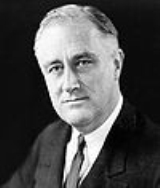
Franklin Delano Roosevelt served as the 32nd
President of the United States and was elected to four terms in office. He served from 1933 to 1945, and is the only President to serve more than two terms. A central figure of the 20th century, he is ranked by
scholarly surveys among the three greatest U.S. Presidents.
During the
Great Depression of the 1930s, Roosevelt created the
New Deal to provide relief for the unemployed, recovery of the economy, and reform of the economic system. His most famous legacies include the Social Security system and the regulation of Wall Street. His aggressive use of an active federal government reenergized the Democratic party. Roosevelt built the New Deal coalition that dominated politics into the 1960s. He and his wife
Eleanor Roosevelt remain touchstones for American
liberalism. The
conservatives fought back, but Roosevelt consistently prevailed until he tried to pack the Supreme Court in 1937, and the new Conservative coalition successfully ended New Deal expansion, and ended many programs like the WPA when the war started.
After 1938, Roosevelt championed re-armament and led the nation away from isolationism as the world headed into
World War II. He provided extensive support to
Winston Churchill and the British war effort before the attack on Pearl Harbor pulled the U.S. into the fighting. During the war, Roosevelt, working closely with his aide
Harry Hopkins, provided decisive leadership against
Nazi Germany and made the United States the principal arms supplier and financier of the
Allies who defeated Germany, Italy and Japan. Roosevelt led the United States as it became the
Arsenal of Democracy, putting 16 million American men into uniform.
On the homefront his term saw the end of unemployment, restoration of prosperity, significant new taxes and controls, 120,000 Japanese and Japanese Americans sent to relocation camps, and new opportunities opened for African Americans and women. As the Allies neared victory, Roosevelt played a critical role in shaping the post-war world, particularly through the
Yalta Conference and the creation of the
United Nations. Roosevelt died on the eve of victory in World War II and was succeeded by Vice President
Harry S. Truman.
Roosevelt's administration redefined
liberalism for subsequent generations and realigned the
Democratic Party based his the
New Deal coalition on labor, ethnic and racial minorities, the South, big city machines, and the poor.
Personal life
Early life
Franklin Delano Roosevelt was born on January 30, 1882, in Hyde Park, in the
Hudson River valley in
upstate New York. His father, James Roosevelt, Sr., and his mother,
Sara Ann Delano, were each from wealthy old New York families, of Dutch and French ancestry respectively.
Franklin was their only child.
Roosevelt grew up in an atmosphere of privilege. Sara was a possessive mother, while James was an elderly and remote father . Sara was the dominant influence in Franklin's early years. Frequent trips to Europe made Roosevelt conversant in
German and
French. He learned to ride, shoot, row, and play polo and lawn tennis.
Roosevelt went to
Groton School, an
Episcopal boarding school in
Massachusetts. He was heavily influenced by the headmaster, Endicott Peabody, who preached the duty of Christians to help the less fortunate and urged his students to enter public service. While Roosevelt was at
Harvard, his cousin
Theodore Roosevelt became President, and his vigorous leadership style and reforming zeal made him Franklin's role model. In 1903, he met his future wife
Anna Eleanor Roosevelt, Theodore's niece, at a
White House reception. Eleanor and Franklin were fifth cousins, once removed. They were both descended from Claes Martenszen van Rosenvelt who arrived in
New Amsterdam from
Holland in the 1640s. Rosenvelt's two grandsons, Johannes and Jacobus, began the Oyster Bay and Hyde Park branches of the Roosevelt family. Eleanor was descended from the Johannes branch while FDR was descended from the Jacobus branch.
They married two years later in 1905.
Roosevelt next graduated
Columbia Law School in 1907. In 1908 he took a job with the prestigious
Wall Street firm of Carter, Ledyard and Milburn, dealing mainly with corporate law.
Marriage and family life
Roosevelt married Eleanor over the fierce resistance of his mother. They were married March 17, 1905, with
Theodore Roosevelt standing in for Eleanor's deceased father
Elliott. The young couple moved into a house bought for them by Roosevelt's mother, who became a frequent house guest, much to Eleanor's chagrin. Roosevelt was a charismatic, handsome, and socially active man. In contrast, Eleanor was shy and disliked social life, and at first stayed at home to raise their children. They had six children in rapid succession:
- Anna Eleanor ,
- James ,
- Franklin Delano, Jr. ,
- Elliott ,
- a second Franklin Delano, Jr. , and
- John Aspinwall .
The five surviving Roosevelt children all led tumultuous lives overshadowed by their famous parents. They had among them nineteen marriages, fifteen divorces and twenty-nine children. All four sons were officers in World War II and were decorated, on merit, for bravery. Their postwar careers, whether in business or politics, were disappointing. Two of them were elected to the
U.S. House of Representatives but none were elected to higher office despite several attempts.
Roosevelt soon found romantic outlets outside his marriage. One of these was Eleanor's social secretary
Lucy Mercer, with whom Roosevelt began an affair soon after she was hired in early 1914. In September 1918, Eleanor found letters in Franklin's luggage which revealed the affair. Eleanor confronted him with the letters and demanded a divorce. While the marriage survived, Eleanor established a separate house in Hyde Park at
Valkill.
Paralytic illness
In August 1921, while the Roosevelts were vacationing at
Campobello Island, New Brunswick, Roosevelt contracted an illness, at the time believed to be
polio, which resulted in Roosevelt's total and permanent paralysis from the waist down. For the rest of his life, Roosevelt refused to accept that he was permanently paralyzed. He tried a wide range of therapies, including hydrotherapy, and in 1926, he purchased a resort at
Warm Springs, Georgia, where he founded a hydrotherapy center for the treatment of polio patients which still operates as the Roosevelt Warm Springs Institute for Rehabilitation. After he became President, he helped to found the
National Foundation for Infantile Paralysis . His leadership in this organization is one reason he is commemorated on the dime.
At a time when media intrusion in the private lives of public figures was much less intense than it is today, Roosevelt was able to convince many people that he was in fact getting better, which he believed was essential if he was to run for public office again. Fitting his hips and legs with iron braces, he laboriously taught himself to walk a short distance by swiveling his torso while supporting himself with a cane. In private he used a wheelchair, but he was careful never to be seen in it in public. He usually appeared in public standing upright, supported on one side by an aide or one of his sons.
In 2003, a peer-reviewed study found that it was more likely that Roosevelt's paralytic illness was actually Guillain-Barré syndrome, not poliomyelitis.
Early political career
State Senator
In 1910, Roosevelt ran for the New York State Senate from the district around Hyde Park, which had not elected a Democrat since 1884. The Roosevelt name, with its associated wealth, prestige and influence in the Hudson Valley, and the Democratic landslide that year carried him to the state capital of
Albany, New York, where he became a leader of a group of reformers who opposed Manhattan's
Tammany Hall machine which dominated the state Democratic Party. Roosevelt soon became a popular figure among New York Democrats.
Assistant Secretary of the Navy
Roosevelt took the position as Assistant Secretary of the United States Navy under
Woodrow Wilson in 1912. In 1914, he was defeated in the Democratic primary for the
United States Senate by Tammany Hall-backed
James W. Gerard. From 1913 to 1917, Roosevelt worked to expand the Navy and founded the
United States Navy Reserve. Wilson sent the Navy and
Marines to intervene in
Central American and
Caribbean countries. In a series of speeches in his 1920 campaign for Vice-President, Roosevelt claimed that he, as Assistant Secretary of the Navy, had played a significant role in Latin American politics and had even written the constitution which the U.S. imposed on
Haiti in 1915.
Roosevelt developed a life-long affection for the Navy. He showed great administrative talent and quickly learned to negotiate with Congressional leaders and other government departments to get budgets approved. He became an enthusiastic advocate of the submarine and also of means to combat the German submarine menace to Allied shipping: he proposed building a mine barrage across the
North Sea from
Norway to
Scotland. In 1918, he visited Britain and France to inspect American naval facilities. During this visit he met Winston Churchill for the first time. With the end of the war in November 1918, he was in charge of demobilization, although he opposed plans to completely dismantle the Navy.
Campaign for Vice-President
The 1920
Democratic National Convention chose Roosevelt as the candidate for
Vice-President of the United States on the ticket headed by Governor
James M. Cox of Ohio, helping build a national base. The Cox-Roosevelt ticket was heavily defeated by Republican
Warren Harding in the
United States presidential election, 1920. Roosevelt then retired to a New York legal practice, but few doubted that he would soon run for public office again.
Governor of New York, 1928-1932
By 1928, Roosevelt believed he had recovered sufficiently to resume his political career. He had been careful to maintain his contacts in the Democratic Party and had allied himself with
Alfred E. Smith, the current governor and the Democratic Party presidential nominee in 1928.
To gain the Democratic nomination for the election, Roosevelt had to make his peace with
Tammany Hall, which he did with some reluctance. Roosevelt was elected Governor by a narrow margin, and came to office in 1929 as a reform Democrat. As Governor, he established a number of new social programs, and began gathering the team of advisors he would bring with him to Washington four years later, including
Frances Perkins and
Harry Hopkins.
The main weakness of Roosevelt's gubernatorial administration was the corruption of the
Tammany Hall machine in
New York City. Roosevelt had made his name as an opponent of Tammany, but needed the machine's goodwill to be re-elected in 1930. As the 1930 election approached, Roosevelt set up a judicial investigation into the corrupt sale of offices. In 1930, Roosevelt was elected to a second term by a margin of more than 700,000 votes, defeating Republican Charles H. Tuttle.
1932 presidential election
Roosevelt's strong base in the most populous state made him an obvious candidate for the Democratic nomination, which was hotly contested since it seemed clear that
Herbert Hoover would be defeated at the
1932 presidential election.
Al Smith was supported by some city bosses, but had lost control of the New York Democratic party to Roosevelt. Roosevelt built his own national coalition with personal allies such as newspaper magnate
William Randolph Hearst, Irish leader
Joseph P. Kennedy, and California leader
William G. McAdoo. When
Texas leader John Nance Garner switched to FDR, he was given the vice presidential nomination.
The election campaign was conducted under the shadow of the Great Depression, and the new alliances created by the Depression. Roosevelt and the Democratic Party mobilized the expanded ranks of the poor as well as organized labor, ethnic minorities, urbanites, and Southern whites, crafting the New Deal coalition. During the campaign, Roosevelt said: "I pledge you, I pledge myself, to a new deal for the American people", coining a slogan that was later adopted for his legislative program as well as his new coalition.
Economist Marriner Eccles observed that "given later developments, the campaign speeches often read like a giant misprint, in which Roosevelt and Hoover speak each other's lines." Roosevelt campaigned on the Democratic platform advocating "immediate and drastic reductions of all public expenditures," "abolishing useless commissions and offices, consolidating bureaus and eliminating extravagances reductions in bureaucracy," and for a "sound currency to be maintained at all hazards." In a criticism of Hoover, Roosevelt said, "I accuse the President of being the greatest spending administration in peace time in all American history—one which piled bureau on bureau, commission on commission… We are spending altogether too much money for government services which are neither practical or necessary." Hoover damned that pessimism as a denial of "the promise of American life . . . the counsel of despair." On October 19, Roosevelt attacked Hoover's deficits and called for sharp reductions in government spending. The prohibition issue solidified the wet vote for Roosevelt, who noted that repeal would bring in new tax revenues.
Roosevelt won 57% of the vote and carried all but six states. After the election, Roosevelt refused Hoover's requests for a meeting to come up with a joint program to stop the downward spiral. In February 1933, an assassin,
Giuseppe Zangara, fired five shots at Roosevelt, missing him but killing the
Chicago Mayor
Anton Cermak.
First term, 1933-1937
When Roosevelt was inaugurated in March 1933, the U.S. was at the nadir of the worst depression in its history. A quarter of the workforce was unemployed. Farmers were in deep trouble as prices fell by 60%. Industrial production had fallen by more than half since 1929. In a country with limited government social services outside the cities, two million were homeless. The banking system had collapsed completely. Historians later categorized Roosevelt's program as "relief, recovery and reform." Beginning with his inauguration address, he began blaming the economic downturn on businessmen, the quest for profit, and the self-interest basis of capitalism:
- "Primarily this is because rulers of the exchange of mankind's goods have failed through their own stubbornness and their own incompetence, have admitted their failure, and have abdicated. Practices of the unscrupulous money changers stand indicted in the court of public opinion, rejected by the hearts and minds of men. True they have tried, but their efforts have been cast in the pattern of an outworn tradition. Faced by failure of credit they have proposed only the lending of more money. Stripped of the lure of profit by which to induce our people to follow their false leadership, they have resorted to exhortations, pleading tearfully for restored confidence. They know only the rules of a generation of self-seekers. They have no vision, and when there is no vision the people perish. The money changers have fled from their high seats in the temple of our civilization. We may now restore that temple to the ancient truths. The measure of the restoration lies in the extent to which we apply social values more noble than mere monetary profit."
Relief was urgently needed by tens of millions of unemployed. Recovery meant boosting the economy back to normal. Reform meant long-term fixes of what was wrong, especially with the financial and banking systems. Roosevelt's series of
radio speeches, known as
Fireside Chats, presented his proposals directly to the American public.
First New Deal, 1933-1934
Roosevelt's "
First 100 Days" concentrated on the first part of his strategy: immediate relief. From March 9 to June 16, 1933, Franklin D. Roosevelt sent Congress a record number of bills, all of which passed easily. To propose programs, Roosevelt relied on leading Senators such as
George Norris,
Robert F. Wagner and
Hugo Black, as well as his own Brain Trust of academic advisers. Like Hoover, he saw the Depression as partly a matter of confidence, caused in part by people no longer spending or investing because they were afraid to do so. He therefore set out to restore confidence through a series of dramatic gestures.
FDR's natural air of confidence and optimism did much to reassure the nation. His inauguration on March 4, 1933, occurred in the middle of a bank panic, hence the backdrop for his famous words: "The only thing we have to fear is fear itself." The very next day he announced a plan to allow banks to reopen, which they largely did by the end of the month. This was his first proposed step to recovery.

- Relief measures included the continuation of Hoover's major relief program for the unemployed under the new name, Federal Emergency Relief Administration. The most popular of all New Deal agencies, and Roosevelt's favorite, was the Civilian Conservation Corps , which hired 250,000 unemployed young men to work on rural local projects. Congress also gave the Federal Trade Commission broad new regulatory powers and provided mortgage relief to millions of farmers and homeowners. Roosevelt expanded a Hoover agency, the Reconstruction Finance Corporation, making it a major source of financing to railroads and industry. Roosevelt made agriculture relief a high priority and set up the first Agricultural Adjustment Administration . The AAA tried to force higher prices for commodities by paying farmers to take land out of crops and to cut herds.
- Reform of the economy was the goal of the National Industrial Recovery Act of 1933. It tried to end cutthroat competition by forcing industries to come up with codes that established the rules of operation for all firms within specific industries, such as minimum prices, agreements not to compete, and production restrictions. Industry leaders negotiated the codes which were then approved by NIRA officials. Industry needed to raise wages as a condition for approval. Provisions encouraged unions and suspended anti-trust laws. The NIRA was found to be unconstitutional by unanimous decision of the U.S. Supreme Court on May 27, 1935. Roosevelt opposed the decision, saying "The fundamental purposes and principles of the NIRA are sound. To abandon them is unthinkable. It would spell the return to industrial and labor chaos." In 1933, major new banking regulations were passed. In 1934, the Securities and Exchange Commission was created to regulate Wall Street, with 1932 campaign fund raiser Joseph P. Kennedy in charge.
- Recovery was pursued through "pump-priming" . The NIRA included $3.3 billion of spending through the Public Works Administration to stimulate the economy, which was to be handled by Interior Secretary Harold Ickes. Roosevelt worked with Republican Senator George Norris to create the largest government-owned industrial enterprise in American history, the Tennessee Valley Authority , which built dams and power stations, controlled floods, and modernized agriculture and home conditions in the poverty-stricken Tennessee Valley. The repeal of prohibition also brought in new tax revenues and helped him keep a major campaign promise.
Roosevelt tried to keep his campaign promise by cutting the regular federal budget, including 40% cuts to veterans' benefits and cuts in overall military spending. He removed 500,000 veterans and widows from the pension rolls and slashed benefits for the remainder. Protests erupted, led by the
Veterans of Foreign Wars. Roosevelt held his ground, but when the angry veterans formed a coalition with Senator
Huey Long and passed a huge bonus bill over his veto, he was defeated. He succeeded in cutting federal salaries and the military and naval budgets. He reduced spending on research and education—there was no New Deal for science until World War II began.
Second New Deal, 1935-1936
After the 1934 Congressional elections, which gave Roosevelt large majorities in both houses, there was a fresh surge of New Deal legislation. These measures included the
Works Progress Administration which set up a national relief agency that employed two million family heads. However, even at the height of WPA employment in 1938, unemployment was still 12.5% according to figures from Micheal Darby.The
Social Security Act, established Social Security and promised economic security for the elderly, the poor and the sick. Senator
Robert Wagner wrote the
Wagner Act, which officially became the
National Labor Relations Act. The act established the federal rights of workers to organize unions, to engage in collective bargaining, and to take part in strikes.
While the First New Deal of 1933 had broad support from most sectors, the Second New Deal challenged the business community. Conservative Democrats, led by Al Smith, fought back with the American Liberty League, but it failed to mobilize much grass roots support. By contrast, the labor unions, energized by the Wagner Act, signed up millions of new members and became a major backer of Roosevelt's reelections in 1936, 1940 and 1944.
Economic environment
See also: Unemployment and the New Deal and Effects of the Great DepressionGovernment spending increased from 8.0% of gross national product under
Hoover in 1932 to 10.2% of the GNP in 1936. Because of the depression, the national debt as a percentage of the GNP had doubled under Hoover from 16% to 33.6% of the GNP in 1932. While Roosevelt balanced the "regular" budget, the emergency budget was funded by debt, which increased to 40.9% in 1936, and then remained level until World War II, at which time it escalated rapidly.
Deficit spending had been recommended by some economists, most notably by John Maynard Keynes of Britain. Some economists in retrospect have argued that the
National Labor Relations Act and Agricultural Adjustment Administration were ineffective policies because they relied on price fixing. The GNP was 34% higher in 1936 than in 1932 and 58% higher in 1940 on the eve of war. That is, the economy grew 58% from 1932 to 1940 in 8 years of peacetime, and then grew 56% from 1940 to 1945 in 5 years of wartime. However, the economic recovery did not absorb all the unemployment Roosevelt inherited. In his first term, unemployment fell by two-thirds from 25% when he took office to 9.1% in 1937 but then stayed high until it vanished during the war.
During the war, the economy operated under such different conditions that comparison is impossible with peacetime. However, Roosevelt saw the New Deal policies as central to his legacy, and in his 1944 State of the Union speech, he advocated that Americans should think of basic economic rights as a Second Bill of Rights.
The
U.S. economy grew rapidly during Roosevelt's term. However, coming out of the depression, this growth was accompanied by continuing high levels of
unemployment; as the median joblessness rate during the New Deal was 17.2 percent. Throughout his entire term, including the war years, average unemployment was 13%. Total employment during Roosevelt's term expanded by 18.31 million jobs, with an average annual increase in jobs during his administration of 5.3%.
Roosevelt's administration also saw significant changes to the
income tax in the American tax system. Just
prior to Roosevelt's election in 1932, Congress passed the Revenue Act of 1932, increasing the top marginal tax rate on individual income from 25% to 63% and enacting a wide range of additional excise taxes. In 1936, the Roosevelt administration added a higher top rate of 79% on individual income greater than $5 million, and that rate was increased again in 1939. During World War II, the top marginal tax rate was moved up to 91%. More significantly for most Americans, the overall rate structure was heavily compressed in 1943, with the highest rate made applicable to individuals with income of $200,000 or more, and withholding taxes were introduced.
Unemployment |
% labor force | Lebergott | Darby |
1933 | 24.9 | 20.6 |
1934 | 21.7 | 16.0 |
1935 | 20.1 | 14.2 |
1936 | 16.9 | 9.9 |
1937 | 14.3 | 9.1 |
1938 | 19.0 | 12.5 |
1939 | 17.2 | 11.3 |
1940 | 14.6 | 9.5 |
1941 | 9.9 | 8.0 |
1942 | 4.7 | 4.7 |
1943 | 1.9 | 1.9 |
1944 | 1.2 | 1.2 |
1945 | 1.9 | 1.9 |
Foreign policy
The rejection of the
League of Nations treaty in 1919 marked the dominance of isolationism from world organizations in American foreign policy. Despite Roosevelt's Wilsonian background, he and Secretary of State
Cordell Hull acted with great care not to provoke isolationist sentiment. The main foreign policy initiative of Roosevelt's first term was the Good Neighbor Policy, which was a re-evaluation of American policy towards
Latin America. Since the
Monroe Doctrine of 1823, this area had been seen as an American sphere of influence. American forces were withdrawn from
Haiti, and new treaties with
Cuba and
Panama ended their status as American protectorates. In December 1933, Roosevelt signed the Montevideo Convention on the Rights and Duties of States, renouncing the right to intervene unilaterally in the affairs of Latin American countries.
Second term, 1937-1941
In the
1936 presidential election, Roosevelt campaigned on his New Deal programs against
Kansas Governor
Alfred Landon, who accepted much of the New Deal but objected that it was hostile to business and involved too much waste. Roosevelt and Garner won 61% of the vote and carried every state except
Maine and
Vermont. The New Deal Democrats won even larger majorities in Congress. Roosevelt was backed by a coalition of voters which included traditional Democrats across the country, small farmers, the "Solid South", Catholics,
big city machines,
labor unions, northern
African-Americans,
Jews, intellectuals and political liberals. This coalition, frequently referred to as the New Deal coalition, remained largely intact for the Democratic Party until the 1960s.
In dramatic contrast to the first term, very little major legislation was passed in the second term. There was a United States Housing Authority , a second Agricultural Adjustment Act and the Fair Labor Standards Act of 1938, which created the
minimum wage. When the economy began to deteriorate again in late 1937, Roosevelt responded with an aggressive program of stimulation, asking Congress for $5 billion for WPA relief and public works. This managed to eventually create a peak of 3.3 million WPA jobs by 1938.
The Supreme Court was the main obstacle to Roosevelt's programs during his first term. In 1935, the Court ruled that the
National Recovery Act was an unconstitutional delegation of legislative power to the President. It also ruled that some other pieces of New Deal legislation were unconstitutional. In addition, the Court reversed the President’s dismissal of William E. Humphrey from the Federal Trade Commission. The decision on Humphrey "is said to have nettled the President more than any other, but when he held a lengthy press conference and denounced the Supreme Court for taking the country back to a "horse-and-buggy" concept of interstate commerce it was the NRA decision that he had in mind." Roosevelt proposed a "persistent infusion of new blood" by enlarging the Court so that he could appoint more sympathetic judges. This "court packing" plan ran into intense political opposition from his own party, since it seemed to upset the separation of powers which is one of the cornerstones of the American constitutional structure. Roosevelt was forced to abandon the plan, but the Court also drew back from confrontation with the administration by finding the Labor Relations Act and the Social Security Act to be constitutional. Deaths and retirements on the Supreme Court soon allowed Roosevelt to make his own appointments to the bench. Between 1937 and 1941, he appointed eight justices to the court.
Determined to overcome the opposition of conservative Democrats in Congress , Roosevelt involved himself in the 1938 Democratic primaries, actively campaigning for challengers who were more supportive of New Deal reform. His targets denounced Roosevelt for trying to take over the Democratic party and used the argument that they were independent to win reelection. Roosevelt only defeated one target: a conservative Democrat from New York City. The Southern Congressmen forged a Conservative coalition with congressional Republicans, virtually ending Roosevelt's ability to get his domestic proposals enacted into law. The minimum wage law of 1938 was the last substantial New Deal reform act passed by Congress.
The rise to power of
Adolf Hitler in Germany aroused fears of a new world war. In 1935, at the time of Italy's invasion of
Abyssinia, Congress passed the Neutrality Act, applying a mandatory ban on the shipment of arms from the U.S. to any combatant nation. Roosevelt opposed the act on the grounds that it penalized the victims of aggression such as Abyssinia, and that it restricted his right as President to assist friendly countries, but public support was overwhelming so he signed it. In 1937, Congress passed an even more stringent act, but when the Sino-Japanese War broke out in 1937, public opinion favored China, and Roosevelt found various ways to assist
China.
In October 1937, he gave the
Quarantine Speech