


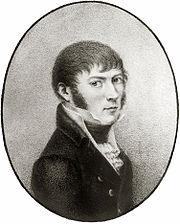
Joseph von Fraunhofer

Encyclopedia
Germany
Germany , officially the Federal Republic of Germany , is a federal parliamentary republic in Europe. The country consists of 16 states while the capital and largest city is Berlin. Germany covers an area of 357,021 km2 and has a largely temperate seasonal climate...
optician
Optician
An optician is a person who is trained to fill prescriptions for eye correction in the field of medicine, also known as a dispensing optician or optician, dispensing...
. He is known for the discovery of the dark absorption lines known as Fraunhofer lines
Fraunhofer lines
In physics and optics, the Fraunhofer lines are a set of spectral lines named for the German physicist Joseph von Fraunhofer . The lines were originally observed as dark features in the optical spectrum of the Sun....
in the Sun's spectrum, and for making excellent optical glass and achromatic telescope
Achromatic telescope
The achromatic telescope is a refracting telescope that uses an achromatic lens to correct for chromatic aberration.-How it works:When an image passes through a lens, the light is refracted at different angles for different wavelengths. This produces focal lengths that are dependent on the color of...
objectives.
Biography
Fraunhofer was born in StraubingStraubing
Straubing is an independent city in Lower Bavaria, southern Germany. It is seat of the district of Straubing-Bogen. Annually in August the Gäubodenvolksfest, the second largest fair in Bavaria, is held....
, Bavaria
Bavaria
Bavaria, formally the Free State of Bavaria is a state of Germany, located in the southeast of Germany. With an area of , it is the largest state by area, forming almost 20% of the total land area of Germany...
. He became an orphan
Orphan
An orphan is a child permanently bereaved of or abandoned by his or her parents. In common usage, only a child who has lost both parents is called an orphan...
at the age of 11, and he started working as an apprentice to a harsh glassmaker named Philipp Anton Weichelsberger. In 1801, the workshop in which he was working collapsed and he was buried in the rubble. The rescue operation was led by Maximilian IV Joseph, Prince Elector
Prince-elector
The Prince-electors of the Holy Roman Empire were the members of the electoral college of the Holy Roman Empire, having the function of electing the Roman king or, from the middle of the 16th century onwards, directly the Holy Roman Emperor.The heir-apparent to a prince-elector was known as an...
of Bavaria (the future Maximilian I Joseph). The prince entered Fraunhofer's life, providing him with books and forcing his employer to allow the young Fraunhofer time to study.
Joseph Utzschneider was also at the site of the disaster, a fact which turned out to be important. With the money given to him by the Prince upon his rescue and the support he received from Utzschneider, Fraunhofer was able to continue his education alongside his practical training. In 1806 Utzscheider and Georg von Reichenbach then brought Fraunhofer into their Institute at Benediktbeuern
Benediktbeuern Abbey
Benediktbeuern Abbey is a monastery of the Salesians of Don Bosco, originally a monastery of the Benedictine Order, in Benediktbeuern in Bavaria, near the Kochelsee, 64 km south-south-west of Munich...
, a secularised Benedictine
Benedictine
Benedictine refers to the spirituality and consecrated life in accordance with the Rule of St Benedict, written by Benedict of Nursia in the sixth century for the cenobitic communities he founded in central Italy. The most notable of these is Monte Cassino, the first monastery founded by Benedict...
monastery devoted to glass making. There he discovered how to make the world's finest optical glass and invented incredibly precise methods for measuring dispersion
Dispersion (optics)
In optics, dispersion is the phenomenon in which the phase velocity of a wave depends on its frequency, or alternatively when the group velocity depends on the frequency.Media having such a property are termed dispersive media...
.
It was at the Institute that Fraunhofer met Pierre Louis Guinand, a Swiss glass technician, who Utzschneider had introduce Fraunhofer to the secrets of glass making. In 1809 the mechanical part of the Optical Institute was chiefly under Fraunhofer's direction, and that same year he became one of the members of the firm. In 1814, Guinand left the firm, as did Reichenbach, and Fraunhofer became a partner in the firm, the name being changed to Utzschneider und Fraunhofer. In 1818, he became the director of the Optical Institute. Due to the fine optical instruments he had developed, Bavaria
Bavaria
Bavaria, formally the Free State of Bavaria is a state of Germany, located in the southeast of Germany. With an area of , it is the largest state by area, forming almost 20% of the total land area of Germany...
overtook England
England
England is a country that is part of the United Kingdom. It shares land borders with Scotland to the north and Wales to the west; the Irish Sea is to the north west, the Celtic Sea to the south west, with the North Sea to the east and the English Channel to the south separating it from continental...
as the centre of the optics industry. Even the likes of Michael Faraday
Michael Faraday
Michael Faraday, FRS was an English chemist and physicist who contributed to the fields of electromagnetism and electrochemistry....
were unable to produce glass that could rival Fraunhofer's.
His illustrious career eventually earned him an honorary doctorate from the University of Erlangen in 1822. In 1824, he was awarded the order of merit, became a noble, and made an honorary citizen of Munich
Munich
Munich The city's motto is "" . Before 2006, it was "Weltstadt mit Herz" . Its native name, , is derived from the Old High German Munichen, meaning "by the monks' place". The city's name derives from the monks of the Benedictine order who founded the city; hence the monk depicted on the city's coat...
. Like many glassmakers of his era who were poisoned by heavy metal
Heavy metals
A heavy metal is a member of a loosely-defined subset of elements that exhibit metallic properties. It mainly includes the transition metals, some metalloids, lanthanides, and actinides. Many different definitions have been proposed—some based on density, some on atomic number or atomic weight,...
vapours, Fraunhofer died young, in 1826 at the age of 39. His most valuable glassmaking recipes are thought to have gone to the grave with him.
Invention and scientific research
One of the most difficult operations of practical optics was to polishPolishing
Polishing is the process of creating a smooth and shiny surface by rubbing it or using a chemical action, leaving a surface with a significant specular reflection In some materials polishing is also able to reduce diffuse reflection to...
the spherical surfaces of large object glasses
Objective (optics)
In an optical instrument, the objective is the optical element that gathers light from the object being observed and focuses the light rays to produce a real image. Objectives can be single lenses or mirrors, or combinations of several optical elements. They are used in microscopes, telescopes,...
accurately. Fraunhofer invented a machine which obviated this difficulty, and rendered the surface more accurate than it was left by the grinding
Grinding (abrasive cutting)
Grinding is an abrasive machining process that uses a grinding wheel as the cutting tool.A wide variety of machines are used for grinding:* Hand-cranked knife-sharpening stones * Handheld power tools such as angle grinders and die grinders...
. He invented also other grinding and polishing machines, and introduced many improvements into the manufacture of the different kinds of glass used for optical instruments, and which he found to be always injured by flaws and irregularities of various sorts.
In 1811 he constructed a new kind of furnace
Glass production
Glass production involves two main methods - the float glass process, which produces sheet glass, and glassblowing which produces bottles and other containers.-Glass container factories:...
, and on the second occasion when he melted a large quantity found that he could produce flint glass
Flint glass
Flint glass is optical glass that has relatively high refractive index and low Abbe number. Flint glasses are arbitrarily defined as having an Abbe number of 50 to 55 or less. The currently known flint glasses have refractive indices ranging between 1.45 and 2.00...
, which, taken from the bottom of a vessel containing two hundredweight
Hundredweight
The hundredweight or centum weight is a unit of mass defined in terms of the pound . The definition used in Britain differs from that used in North America. The two are distinguished by the terms long hundredweight and short hundredweight:* The long hundredweight is defined as 112 lb, which...
of glass, had the same refractive
Refraction
Refraction is the change in direction of a wave due to a change in its speed. It is essentially a surface phenomenon . The phenomenon is mainly in governance to the law of conservation of energy. The proper explanation would be that due to change of medium, the phase velocity of the wave is changed...
power as glass taken from the surface. He found that the English crown glass
Crown glass
Crown glass is either of two kinds of glass:*Crown glass was a type of hand-blown window glass.*Crown glass is a type of optical glass used in lenses....
and the German table glass both contained defects occasioning irregular refraction. In the thicker and larger glasses, there would be more of such defects, so that in larger telescopes this kind of glass would not be fit for object glasses. Fraunhofer therefore made his own crown glass.
The cause which had hitherto prevented the accurate determination of the power of a given medium to refract the rays of light and separate the different colors which they contain was chiefly the circumstance that the color
Color
Color or colour is the visual perceptual property corresponding in humans to the categories called red, green, blue and others. Color derives from the spectrum of light interacting in the eye with the spectral sensitivities of the light receptors...
s of the spectrum
Spectrum
A spectrum is a condition that is not limited to a specific set of values but can vary infinitely within a continuum. The word saw its first scientific use within the field of optics to describe the rainbow of colors in visible light when separated using a prism; it has since been applied by...
have no precise limits, and that the transition from one to another is gradual and not immediate; hence, the angle of refraction could not be accurately measured. To obviate this, Fraunhofer made a series of experiments for the purpose of producing homogeneous light artificially, and unable to effect his object in a direct way, he did so by means of lamps and prism
Prism (optics)
In optics, a prism is a transparent optical element with flat, polished surfaces that refract light. The exact angles between the surfaces depend on the application. The traditional geometrical shape is that of a triangular prism with a triangular base and rectangular sides, and in colloquial use...
s.
Fire
Fire is the rapid oxidation of a material in the chemical process of combustion, releasing heat, light, and various reaction products. Slower oxidative processes like rusting or digestion are not included by this definition....
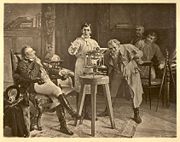
. This line enabled him afterward to determine the absolute power of refraction in different substances. Experiments to ascertain whether the solar spectrum contained the same bright line in the orange as that produced by the light of fire led him to the discovery of the 574 dark fixed lines in the solar spectrum.
These dark fixed lines were later shown to be atomic absorption lines, as explained by Kirchhoff
Gustav Kirchhoff
Gustav Robert Kirchhoff was a German physicist who contributed to the fundamental understanding of electrical circuits, spectroscopy, and the emission of black-body radiation by heated objects...
and Bunsen
Robert Bunsen
Robert Wilhelm Eberhard Bunsen was a German chemist. He investigated emission spectra of heated elements, and discovered caesium and rubidium with Gustav Kirchhoff. Bunsen developed several gas-analytical methods, was a pioneer in photochemistry, and did early work in the field of organoarsenic...
in 1859. These lines are still called Fraunhofer lines
Fraunhofer lines
In physics and optics, the Fraunhofer lines are a set of spectral lines named for the German physicist Joseph von Fraunhofer . The lines were originally observed as dark features in the optical spectrum of the Sun....
in his honour.
Fraunhofer also developed a diffraction grating
Diffraction grating
In optics, a diffraction grating is an optical component with a periodic structure, which splits and diffracts light into several beams travelling in different directions. The directions of these beams depend on the spacing of the grating and the wavelength of the light so that the grating acts as...
in 1821, which occurred after James Gregory
James Gregory (astronomer and mathematician)
James Gregory FRS was a Scottish mathematician and astronomer. He described an early practical design for the reflecting telescope – the Gregorian telescope – and made advances in trigonometry, discovering infinite series representations for several trigonometric functions.- Biography :The...
discovered the principles of diffraction grating and after American astronomer David Rittenhouse
David Rittenhouse
David Rittenhouse was a renowned American astronomer, inventor, clockmaker, mathematician, surveyor, scientific instrument craftsman and public official...
invented the first man-made diffraction grating in 1785. Fraunhofer found out that the spectra of Sirius
Sirius
Sirius is the brightest star in the night sky. With a visual apparent magnitude of −1.46, it is almost twice as bright as Canopus, the next brightest star. The name "Sirius" is derived from the Ancient Greek: Seirios . The star has the Bayer designation Alpha Canis Majoris...
and other first-magnitude stars differed from each other and from the sun, thus founding stellar spectroscopy.
Ultimately, however, his primary passion was still practical optics, once noting that "In all my experiments I could, owing to lack of time, pay attention to only those matter which appeared to have a bearing upon practical optics". In the early 1990s, a firm that designed and built refracting telescopes was named in his honor, Fraunhofer Systems Company, since the telescopes were based on his design but now the company is part of Burbank Optical Company.
Telescopes & optical instruments
Fraunhofer produced various optical instruments including microscopes for his firm. This included the Fraunhofer Dorpat Refractor used by Struve (delivered 1824), and the Bessel HeliometerHeliometer
Heliometer is an instrument originally designed for measuring the variation of the sun's diameter at different seasons of the year, but applied now to the modern form of the instrument which is capable of much wider use....
(delivered posthumously), which were both used to collect data for stellar parallax
Stellar parallax
Stellar parallax is the effect of parallax on distant stars in astronomy. It is parallax on an interstellar scale, and it can be used to determine the distance of Earth to another star directly with accurate astrometry...
. The firm's successor, Merz und Mahler, made a telescope for the New Berlin Observatory, which confirmed the existence of the major planet Neptune
Neptune
Neptune is the eighth and farthest planet from the Sun in the Solar System. Named for the Roman god of the sea, it is the fourth-largest planet by diameter and the third largest by mass. Neptune is 17 times the mass of Earth and is slightly more massive than its near-twin Uranus, which is 15 times...
.
See also
- Fraunhofer societyFraunhofer SocietyThe Fraunhofer Society is a German research organization with 60 institutes spread throughout Germany, each focusing on different fields of applied science . It employs around 18,000, mainly scientists and engineers, with an annual research budget of about €1.65 billion...
- Fraunhofer diffractionFraunhofer diffractionIn optics, the Fraunhofer diffraction equation is used to model the diffraction of waves when the diffraction pattern is viewed at a long distance from the diffracting object, and also when it is viewed at the focal plane of an imaging lens....
- German inventors and discoverersGerman inventors and discoverersThis is a list of German inventors and discoverers. The following list comprises people from Germany or German-speaking Europe, also of people of predominantly German heritage, in alphabetical order of the surname. The main section includes existing articles, indicated by blue links, and possibly...