
All Topics  
Cologne

 
Cologne

   Email Print
   Bookmark   Link


Cologne


Cologne (; local dialect
Kölsch language

K?lsch is a very closely related small set of dialects, or variants, of the Ripuarian Central German group of languages. K?lsch is spoken in, and partially around Cologne, in the West of Germany....
: Kölle ) is Germany
Germany

Germany , officially the Federal Republic of Germany , is a country in Central Europe. It is bordered to the north by the North Sea, Denmark, and the Baltic Sea; to the east by Poland and the Czech Republic; to the south by Austria and Switzerland; and to the west by France, Luxembourg, Belgium, and the Netherlands....
's fourth-largest city
City

A city is an urban area with a high population density and a particular administrative, legal, or historical status.Large industrialized cities generally have advanced systems for sanitation, utilities, land usage, house, and transportation and more....
 (after Berlin
Berlin

Berlin is the Capital of Germany city and one of sixteen States of Germany of Germany. With a population of 3.4 million within its city limits, Berlin is the country's largest city....
, Hamburg
Hamburg

Hamburg is the second-largest city in Germany , and is the Largest cities of the European Union by population within city limits. The city is home to approximately 1.8 million people, while the Hamburg metropolitan area has more than 4.3 million inhabitants....
 and Munich
Munich

Munich is the capital city of Bavaria, Germany. Munich is located on the River Isar north of the Northern Limestone Alps. Munich is the third largest city in Germany, after Berlin and Hamburg....
), and is the largest city both in the German Federal State of North Rhine-Westphalia
North Rhine-Westphalia

North Rhine - Westphalia is the westernmost and - in terms of population and economic output - the largest States of Germany of Germany. North Rhine - Westphalia has over 18 million inhabitants, contributes about 22% of Germany's gross domestic product and comprises a land area of 34,083 km? ....
 and within the Rhine-Ruhr Metropolitan Area
Rhine-Ruhr

The Rhine-Ruhr Area in Germany is one of the largest metropolitan areas in Europe, with about 11,800,000 inhabitants. It lies completely within the federal state North Rhine-Westphalia and spreads from the Dortmund-Essen-Duisburg Megalopolis in the north, to the urban areas of the cities of M?nchengladbach, D?sseldorf , Wuppertal, Cologn...
, one of the major European metropolitan areas with more than ten million inhabitants. It is one of the oldest cities in Germany, having been founded by the Romans
Roman Empire

The Roman Empire was the Roman Republic phase of the Ancient Rome, characterised by an autocracy form of government and large territorial holdings in Europe and around the Mediterranean....
 in the year 38 BC. Cologne was granted the status of a Roman "city" in the year 50 AD.

Cologne lies on the River Rhine
Rhine

File:Swiss Grand Canyon.jpgThe Rhine is one of the longest and most important rivers in Europe, at , with an average discharge of more than ....
.


Discussion
Ask a question about 'Cologne'
Start a new discussion about 'Cologne'
Answer questions from other users
Full Discussion Forum


Timeline

80   The Eifel Aqueduct is constructed to bring water 95 km (60 miles) from the Eifel region to Colonia Claudia Ara Agrippinensum (modern Cologne).

90   Cologne becomes the capital of Germania Inferior.

259   The Franks who invaded the Roman Empire near Cologne in 257, reach Tarraco in Hispania

309   Construction of a stone bridge across the Rhine near Cologne is completed.

355   The Franks besiege Cologne for ten months.

785   Cologne becomes an archbishopry.

850   Guntherus becomes Bishop of Cologne.

1164   Archbishop Rainald of Dassel brings relics of the Magi from Milan to Cologne.

1288   John I of Brabant defeats the duchy of Guelders in the Battle of Worringen — one of the largest battles in Europe of the Middle Ages — thus winning possession of the duchy of Limburg. The battle also liberates the city of Cologne from rule by the Archbishopric of Cologne; it had previously been one of the major ecclesiastical principalities of the Holy Roman Empire.

1647   Thirty Years' War: Bavaria, Cologne, France and Sweden sign the Truce of Ulm.


Encyclopedia


Cologne (; local dialect
Kölsch language

K?lsch is a very closely related small set of dialects, or variants, of the Ripuarian Central German group of languages. K?lsch is spoken in, and partially around Cologne, in the West of Germany....
: Kölle ) is Germany
Germany

Germany , officially the Federal Republic of Germany , is a country in Central Europe. It is bordered to the north by the North Sea, Denmark, and the Baltic Sea; to the east by Poland and the Czech Republic; to the south by Austria and Switzerland; and to the west by France, Luxembourg, Belgium, and the Netherlands....
's fourth-largest city
City

A city is an urban area with a high population density and a particular administrative, legal, or historical status.Large industrialized cities generally have advanced systems for sanitation, utilities, land usage, house, and transportation and more....
 (after Berlin
Berlin

Berlin is the Capital of Germany city and one of sixteen States of Germany of Germany. With a population of 3.4 million within its city limits, Berlin is the country's largest city....
, Hamburg
Hamburg

Hamburg is the second-largest city in Germany , and is the Largest cities of the European Union by population within city limits. The city is home to approximately 1.8 million people, while the Hamburg metropolitan area has more than 4.3 million inhabitants....
 and Munich
Munich

Munich is the capital city of Bavaria, Germany. Munich is located on the River Isar north of the Northern Limestone Alps. Munich is the third largest city in Germany, after Berlin and Hamburg....
), and is the largest city both in the German Federal State of North Rhine-Westphalia
North Rhine-Westphalia

North Rhine - Westphalia is the westernmost and - in terms of population and economic output - the largest States of Germany of Germany. North Rhine - Westphalia has over 18 million inhabitants, contributes about 22% of Germany's gross domestic product and comprises a land area of 34,083 km? ....
 and within the Rhine-Ruhr Metropolitan Area
Rhine-Ruhr

The Rhine-Ruhr Area in Germany is one of the largest metropolitan areas in Europe, with about 11,800,000 inhabitants. It lies completely within the federal state North Rhine-Westphalia and spreads from the Dortmund-Essen-Duisburg Megalopolis in the north, to the urban areas of the cities of M?nchengladbach, D?sseldorf , Wuppertal, Cologn...
, one of the major European metropolitan areas with more than ten million inhabitants. It is one of the oldest cities in Germany, having been founded by the Romans
Roman Empire

The Roman Empire was the Roman Republic phase of the Ancient Rome, characterised by an autocracy form of government and large territorial holdings in Europe and around the Mediterranean....
 in the year 38 BC. Cologne was granted the status of a Roman "city" in the year 50 AD.

Cologne lies on the River Rhine
Rhine

File:Swiss Grand Canyon.jpgThe Rhine is one of the longest and most important rivers in Europe, at , with an average discharge of more than ....
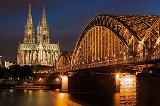
. The city's famous Cologne Cathedral
Cologne Cathedral

Cologne Cathedral is the seat of the Archbishop of Cologne, under the administration of the Roman Catholic Church and is renowned as a monument of Christianity, of Gothic architecture and of the faith and perseverance of the people of the city in which it stands....
 (Kölner Dom) is the seat of the Roman Catholic
Roman Catholic Church

The Roman Catholic Church, officially known as the Catholic Church is the world's largest Christianity Ecclesia , representing over half of all Christians and one-sixth of the world population....
 Archbishop of Cologne. The University of Cologne
University of Cologne

The University of Cologne is one of the oldest University in Europe and, with over 44,000 students, one of the largest universities in Germany....
 (Universität zu Köln) is one of Europe
Europe

Europe is, conventionally, one of the world's seven continents. Comprising the westernmost peninsula of Eurasia, Europe is generally divided from Asia to its east by the water divide of the Ural Mountains, the Ural , the Caspian Sea, and by the Caucasus Mountains to the southeast....
's oldest universities.

Cologne is a major cultural center of the Rhineland
Rhineland

The Rhineland is the general name for the land on both sides of the river Rhine in the west of Germany. After the collapse of the First French Empire in the early 19th century, the German-speaking regions at the middle and lower course of the Rhine were annexed to the kingdom of Prussia....
 and has a vibrant arts scene. Cologne is home to more than 30 museums and hundreds of galleries. Exhibitions range from local ancient Roman
Ancient Rome

Ancient Rome was a civilization that grew out of a small agricultural community founded on the Italian Peninsula as early as the 10th century BC....
 archeological sites to contemporary graphics and sculpture. The city's Trade Fair Grounds
Cologne Trade Fair

Cologne Trade Fair are an International Exhibition Center located in Cologne, Germany. Among others the following trade fairs are held in Cologne:...
 are host to a number of trade shows such as the Art Cologne Fair
Art Cologne

Art Cologne is an art fair held annually in Cologne, Germany. Art Cologne is Germany's leading art fair and was established in 1967 as the world's first Art Fair....
, the International Furniture Fair (IMM) and the Photokina
Photokina

The photokina is the world's biggest trade fair for the photographic and imaging industries. It is held in September every 2 years at the Cologne Trade Fair, Germany....
. Cologne is also well-known for its celebration of Cologne Carnival
Cologne carnival

The Cologne carnival is a carnival that takes place every year in Cologne, Germany. Traditionally, the "fifth season" is declared open at 11 minutes past 11 on the 11th of November....
, the annual reggae summerjam, and the gay/lesbian pride festival Christopher Street Day
Christopher Street Day

Christopher Street Day is an annual European LGBT celebration held in various cities across Europe. Only Germany and Switzerland use the term CSD, in other countries, the same kind of event is called Gay Pride or Pride Parade....
 (CSD).

Within Germany, Cologne is known as an important media center. Several radio and television stations, including Westdeutscher Rundfunk
Westdeutscher Rundfunk

The Westdeutscher Rundfunk is a Germany public broadcasting institution based in the States of Germany of North Rhine-Westphalia with its main office in K?ln....
 (WDR), RTL
RTL Television

RTL Television is a German television commercial television station distributed via cable television and satellite television along with DVB-T ....
 and VOX, are based in the city. The city also hosts the Cologne Comedy Festival
Cologne Comedy Festival

The Cologne Comedy Festival is an international festival of comedy held in Cologne, Germany every year since 1991. The festival initially started by importing comedians from around the world....
, which is considered to be the largest comedy festival in mainland Europe.

In 2005 Cologne hosted the 20th Roman Catholic World Youth Day
World Youth Day 2005

The 20th World Youth Day 2005 was a Catholic youth festival that started on August 16 and continued until August 21, 2005 in Cologne, Germany. It was the first World Youth Day and foreign trip of Pope Benedict XVI, who joined the festival on August 18....
 with Pope Benedict XVI
Pope Benedict XVI

Pope Benedict XVI is the List of popes and reigning Pope, by virtue of his office of Bishop of Rome, the head of the Roman Catholic Church and, as such, monarch of the Vatican City....
.

Demographics

Cologne is the fourth-largest city in Germany in terms of inhabitants after Berlin
Berlin

Berlin is the Capital of Germany city and one of sixteen States of Germany of Germany. With a population of 3.4 million within its city limits, Berlin is the country's largest city....
, Hamburg
Hamburg

Hamburg is the second-largest city in Germany , and is the Largest cities of the European Union by population within city limits. The city is home to approximately 1.8 million people, while the Hamburg metropolitan area has more than 4.3 million inhabitants....
 and Munich
Munich

Munich is the capital city of Bavaria, Germany. Munich is located on the River Isar north of the Northern Limestone Alps. Munich is the third largest city in Germany, after Berlin and Hamburg....
. Officially, the city still has somewhat fewer than a million inhabitants (as of 31 December 2006: 989,766). However, this might change rapidly as the city's registration rules will change in the course of 2007. Cologne is the center of an urban area of around 2 million inhabitants (including the neighboring cities of Bonn
Bonn

Bonn is the 19th largest city in Germany. Located about 20 kilometres south of Cologne on the river Rhine in the Federal State of North Rhine-Westphalia, it was the Capital of Germany West Germany from 1949 to 1990 and the official seat of government of united Germany from 1990 to 1999....
, Hürth
Hürth

H?rth is a city near Cologne in the Rhein-Erft-Kreis, North Rhine-Westphalia, Germany....
, Leverkusen
Leverkusen

Leverkusen is a city in North Rhine-Westphalia, Germany. It is located on the eastern bank of the Rhine, half way between Cologne and D?sseldorf....
, and Bergisch-Gladbach).

According to local statistics, in 2006 the population density
Population density

Population density is a measurement of population per unit area or unit volume. It is frequently applied to living organisms, and particularly to humans....
 in the city was 2,528 inhabitants per square kilometer. 31.4 percent of the population has migrated there, and 17.2 percent of Cologne's population is non-German. The largest group, comprising 6.3 percent of the total population, is Turkish. As of September 2007, there are about 120,000 Muslims living in Cologne, mostly of Turkish origin.

In the city the population was spread out with 15.5% under the age of 18, 67.0% from 18 to 64 and 17.4% who were 65 years of age or older. For every 100 females there were 95 males.

Administration

Cologne is incorporated as an independent city (Kreisfreie Stadt) under the Gemeindeordnung Nordrhein-Westfalen (GO NRW) (Municipality Code of North Rhine-Westphalia
North Rhine-Westphalia

North Rhine - Westphalia is the westernmost and - in terms of population and economic output - the largest States of Germany of Germany. North Rhine - Westphalia has over 18 million inhabitants, contributes about 22% of Germany's gross domestic product and comprises a land area of 34,083 km? ....
). The city's administration is headed by a mayor (Oberbürgermeister) and three deputy mayors.

Subdivision

Cologne is subdivided into 9 boroughs (Stadtbezirke) and 86 quarters (Stadtteile): Innenstadt (Stadtbezirk 1)
Altstadt-Nord, Altstadt-Süd, Neustadt-Nord, Neustadt-Süd, Deutz
Rodenkirchen
Rodenkirchen

Rodenkirchen is a southern borough of Cologne in Germany. It has about 100,000 inhabitants and covers an area of 54.56 square kilometres . The borough includes the districts Bayenthal, Godorf, Hahnwald, Immendorf, Marienburg, Meschenich, Raderberg, Raderthal, Rodenkirchen, S?rth, Rondorf, Wei? and Zollstock....
 (Stadtbezirk 2)
Bayenthal, Godorf, Hahnwald, Immendorf, Marienburg, Meschenich, Raderberg, Raderthal, Rodenkirchen, Rondorf, Sürth, Weiß, Zollstock
Lindenthal (Stadtbezirk 3)
Braunsfeld, Junkersdorf, Klettenberg, Lindenthal, Lövenich, Müngersdorf, Sülz, Weiden, Widdersdorf
Ehrenfeld (Stadtbezirk 4)
Bickendorf, Bocklemünd/Mengenich, Ehrenfeld, Neuehrenfeld, Ossendorf, Vogelsang
Nippes (Stadtbezirk 5)
Bilderstöckchen, Longerich, Mauenheim, Niehl, Nippes, Riehl, Weidenpesch
Chorweiler (Stadtbezirk 6)
Blumenberg, Chorweiler, Esch/Auweiler, Fühlingen, Heimersdorf, Lindweiler, Merkenich, Pesch, Roggendorf/Thenhoven, Seeberg, Volkhoven/Weiler, Worringen
Porz
Porz

Porz is a borough or Stadtbezirk of Cologne, It is situated on the right side of the Rhine in the south-east of the city. Porz is the largest borough of Cologne by area at 78,87 km ? and has 107,500 inhabitants....
 (Stadtbezirk 7)
Eil
Eil (Cologne)

Eil is a suburb of Cologne, Germany, located to the south-east of the city centre. With an area totalling 16,23 km?, it is the largest district in the entire city in terms of area, although not all of the land is built up....
, Elsdorf, Ensen, Finkenberg, Gremberghoven, Grengel, Langel, Libur, Lind, Poll, Porz, Urbach, Wahn, Wahnheide, Westhoven, Zündorf
Kalk
Kalk (Cologne)

Kalk is a Stadtbezirk of the city of Cologne in Germany.External links ...
 (Stadtbezirk 8)
Brück, Höhenberg, Humboldt/Gremberg, Kalk, Merheim, Neubrück, Ostheim, Rath/Heumar, Vingst
Mülheim (Stadtbezirk 9)
Buchforst, Buchheim, Dellbrück, Dünnwald, Flittard, Höhenhaus, Holweide, Mülheim, Stammheim


Coat of arms

The three crowns symbolize the Magi
Magi

File:Adoracao_dos_magos_de_Vicente_Gil.jpgMagi is a term, used since at least the 4th century BCE, to denote a follower of Zoroaster, or rather, a follower of what the Hellenistic civilization associated Zoroaster with, which was – in the main – the ability to read the stars, and manipulate the fate that the stars foretold....
 (Three Wise Men) whose bones are said to be kept in a golden sarcophagus
Sarcophagus

A sarcophagus is a funeral receptacle for a corpse, most commonly carved or cut from stone. The word "sarcophagus" comes from the Greek language sa?? sarx meaning "flesh", and fa?e?? phagein meaning "to eat", hence sarkophagus means "flesh-eating"; from the phrase lithos sarkophagos the word came to refer to the limestone t...
 in Cologne Cathedral (see Shrine of the Three Kings at Cologne Cathedral
Shrine of the Three Kings at Cologne Cathedral

The Shrine of the Three Kings is a reliquary said to contain the bones of the Biblical Magi, also known as the Three Kings or the Three Wise Men....
). In 1164, Rainald of Dassel
Rainald of Dassel

Rainald of Dassel was archbishop of Cologne from 1159 to 1167 and archchancellor of Italy. He was preceded as archbishop by Friedrich II of Berg and succeeded by Philip I von Heinsberg....
, the archbishop of Cologne, brought the relic
Relic

A relic is an object or a personal item of Religion significance, carefully preserved with an air of veneration as a tangible memorial. Relics are an important aspect of some forms of Buddhism, Christianity, Hinduism, shamanism, and many other religions....
s to the city, making it a major pilgrimage
Pilgrimage

File:Supplicating Pilgrim at Masjid Al Haram. Mecca, Saudi Arabia.jpgIn religion and spirituality, a pilgrimage is a long quest or search of great moral significance....
 destination. This led to the design of the current cathedral as the predecessor was considered too small to accommodate the pilgrims.

The eleven tears are a reminder of Cologne's patron, Saint Ursula
Saint Ursula

Saint Ursula is a Great Britain Christian saint. Her feast day in the Roman Catholic Church is October 21. Because of the lack of sure information about the anonymous group of holy virgins who on some uncertain date were killed at Cologne, their commemoration was omitted from the Roman Catholic calendar of saints for universal liturgical ce...
, a Britannic princess, and her legendary 11,000 virgin companions who were supposedly martyred by Attila the Hun
Attila the Hun

Attila , also known as Attila the Hun, was leader of the Huns from 434 until his death in 453. He was leader of the Hunnic Empire which stretched from Germany to the Ural River and from the Danube to the Baltic Sea ....
 at Cologne for their Christian faith
Christianity

Christianity is a Monotheistic religion #Christian view religion centered on the life and teachings of Jesus as New Testament view on Jesus' life....
 in 383. The entourage of Ursula and the number of victims was significantly smaller; according to one source, the original legend referred to only eleven companions and the number was later inflated by relic traders.

Culture

Cologne is well-known for its beer, called Kölsch
Kölsch (beer)

K?lsch is a local beer speciality, brewed in Cologne, Germany. It is a clear beer with a bright straw yellow hue, and it has a prominent, but not extreme, hops....
. Kölsch
Kölsch language

K?lsch is a very closely related small set of dialects, or variants, of the Ripuarian Central German group of languages. K?lsch is spoken in, and partially around Cologne, in the West of Germany....
 is also the name of the local dialect. This has led to the common joke that Kölsch is the only language you can drink.

Cologne is also famous for Eau de Cologne
Eau de Cologne

Cologne or Eau de Cologne is a toiletry, a perfume in a style of that originated from Cologne, Germany. It is nowadays a generic term for scented formulations in typical concentration of 2-5% essential oils....
 (Kölnisch Wasser). At the beginning of the 18th century, Italian expatriate Johann Maria Farina
Johann Maria Farina

Johann Maria Farina , born in december 8 1685 in Santa Maria Maggiore, Verbania Italy also known as Giovanni Maria Farina, was a Italy Cologne perfume maker primarily responsible for establishing Eau de Cologne in Germany....
 (1685–1766) created a new fragrance and named it after his hometown Cologne, Eau de Cologne (Water of Cologne). In the course of the 18th century the fragrance became increasingly popular. Eventually, Cologne merchant Wilhelm Mülhens secured the name Farina, which at that time had become a household name for Eau de Cologne, under contract and opened a small factory at Cologne's Glockengasse. In later years, and under pressure from court battles, his grandson Ferdinand Mülhens
Ferdinand Mülhens

Ferdinand M?lhens was a land owner and entrepreneur in K?nigswinter, Germany. M?lhens was born in Cologne.In the 19th century he managed the perfume factory founded by his grandfather Wilhelm M?lhens at Cologne's Glockengasse 4711 , producing the original Eau de Cologne....
 chose a new name for the firm and their product. It was the house number that was given to the factory at Glockengasse during French occupation of the Rhineland
Rhineland

The Rhineland is the general name for the land on both sides of the river Rhine in the west of Germany. After the collapse of the First French Empire in the early 19th century, the German-speaking regions at the middle and lower course of the Rhine were annexed to the kingdom of Prussia....
 in the early 19th century, number 4711. In 1994, the Mülhens family sold their company to German Wella
Wella

Wella is a Germany company, and one of the world?s leading cosmetics suppliers. Founded in 1880 by Franz Stroher, with its headquarters in Darmstadt, Germany, the company is represented in over 150 countries....
 corporation. In 2003 Procter & Gamble
Procter & Gamble

Procter & Gamble Co. is a Fortune 500, United States multinational corporation headquartered in Cincinnati, Ohio, that manufactures a wide range of Fast moving consumer goods....
 took over Wella. Today, original Eau de Cologne still is produced in Cologne by both the Farina family (Farina gegenüber since 1709), currently in the eighth generation, and by Mäurer and Wirtz who bought the 4711 brand in December 2006.

Carnival

Cologne carnival
Cologne carnival

The Cologne carnival is a carnival that takes place every year in Cologne, Germany. Traditionally, the "fifth season" is declared open at 11 minutes past 11 on the 11th of November....
 is one of the biggest street festivals in Europe. In Cologne, the carnival season officially starts on 11 November at 11 minutes past 11 a.m. with the proclamation of the new Carnival Season, and continues until Ash Wednesday
Ash Wednesday

In the Western Christianity calendar, Ash Wednesday is the first day of Lent and occurs forty-six days before Easter. It falls on a different date each year, because it is dependent on the Computus; it can occur as early as February 4 or as late as March 10....
. But the so-called "Tolle Tage" (mad days) don't start until Weiberfastnacht (Women's Carnival) or, in dialect, Wieverfastelovend (Thursday before Ash Wednesday), which is the beginning of the street carnival. Hundreds of thousands of visitors flock to Cologne during this time. Generally, around a million people are celebrating in the streets on the Thursday before Ash Wednesday.

History


Roman Cologne

The first urban settlement on the grounds of what today is the center of Cologne was Oppidum Ubiorum, which was founded in 38 BC by the Ubii
Ubii

The Ubii were a Germanic tribes first encountered dwelling on the right bank of the Rhine in the time of Julius Caesar, who formed an alliance with them in 55 BC in order to launch attacks across the river....
, a Germanic tribe
Germanic peoples

File:Germanische-ratsversammlung 1-1250x715.jpgThe Germanic peoples are a historical Ethnolinguistics group, originating in Northern Europe and identified by their use of the Indo-European languages Germanic languages which diversified out of Common Germanic in the course of the Pre-Roman Iron Age....
. Cologne became acknowledged as a city by the Romans in 50 AD by the name of Colonia Claudia Ara Agrippinensium. Considerable Roman remains can be found in contemporary Cologne, especially near the wharf area, where a notable discovery of a 1900 year old Roman boat was made in late 2007. From 260 to 271 Cologne was the capital of the Gallic Empire
Gallic Empire

The Gallic Empire is the modern name for the independent realm that existed from 260 to 273, during the Roman Empire's Crisis of the Third Century....
 under Postumus
Postumus

Marcus Cassianius Latinius Postumus was a Roman emperor of Batavi origin. He usurped power from Gallienus in 260 and formed the so called Gallic Empire....
, Marius
Marcus Aurelius Marius

Marcus Aurelius Marius was emperor of the Gallic Empire in 268.According to later tradition, he was a blacksmith by trade who rose through the ranks of the Roman army to become an officer....
 and Victorinus
Victorinus

Marcus Piavonius Victorinus was emperor of the secessionist Gallic Empire from 268 to 270 or 271, following the brief reign of Marcus Aurelius Marius....
. In 310 under Constantine a bridge
Bridge

A bridge is a structure built to span a gorge, valley, road, Rail tracks, river, body of water, or any other physical obstacle, for the purpose of providing passage over the obstacle....
 was built over the Rhine at Cologne.

Maternus, who was elected as bishop
Bishop

A bishop is an ordination or consecration member of the Clergy#Christian clergy who is generally entrusted with a position of authority and oversight....
 in 313, was the first known bishop of Cologne. The city was the capital of a Roman province until occupied by the Franks in 459. In 785, Cologne became the seat of an archbishop
Archbishop

In Christianity, an archbishop is an elevated bishop. In the Roman Catholic Church, the Anglican Communion and others, this means that they lead a diocese of particular importance called an archdiocese, or in the Anglican Communion an Ecclesiastical Province, but this is not always the case....
ric.

Middle Ages


During the time of the Holy Roman Empire
Holy Roman Empire

The Holy Roman Empire was a union of territories in Central Europe during the Middle Ages and the Early modern Europe under a Holy Roman Emperor....
 in the Middle Ages
Middle Ages

File:Karl 1 mit papst gelasius gregor1 sacramentar v karl d kahlen.jpgThe Middle Ages of European history are a period in history which lasted for roughly a millennium, commonly dated from the fall of the Roman Empire in the 5th century to the beginning of the Early Modern Period in the 16th century, marked by the division of Western Christi...
, the Archbishop of Cologne was one of the seven prince-elector
Prince-elector

The Prince-Electors of the Holy Roman Empire were the members of the electoral college of the Holy Roman Empire, having the function of Imperial election the Holy Roman Emperors....
s and one of the three ecclesiastical electors. The archbishops had ruled large temporal domains but in 1288 Sigfried II von Westerburg was defeated in the Battle of Worringen
Battle of Worringen

File:Johann von Brabant Heidelberger Liederhandschrift.jpgThe Battle of Worringen was fought on June 5, 1288 near the town of Worringen , which is now the northern-most borough of Cologne....
 and forced into exile at Bonn
Bonn

Bonn is the 19th largest city in Germany. Located about 20 kilometres south of Cologne on the river Rhine in the Federal State of North Rhine-Westphalia, it was the Capital of Germany West Germany from 1949 to 1990 and the official seat of government of united Germany from 1990 to 1999....
.

Cologne's location on the river Rhine placed it at the intersection of the major trade route
Trade route

A trade route is a Logistics identified as a series of pathways and stoppages used for the commercial transport of cargo. Allowing Good s to reach distant markets, a single trade route contains long distance Arterial road which may further be connected to several smaller networks of commercial and non commercial transportation....
s between east and west and was the basis of Cologne's growth. Cologne was a member of the Hanseatic League
Hanseatic League

The Hanseatic League was an Military alliance of Trade cities and their guilds that established and maintained trade monopoly along the coast of Northern Europe, from the Baltic Sea to the North Sea and inland, during the Late Middle Ages and Early modern period ....
 and became a Free Imperial City
Free Imperial City

In the Holy Roman Empire, a free imperial city was a city formally ruled by the emperor only — as opposed to the majority of cities in the Empire, which belonged to a List of states in the Holy Roman Empire and so were governed by one of the many princes of the Empire, such as dukes or prince-bishops....
 in 1475. Interestingly the archbishop nevertheless preserved the right of capital punishment
Capital punishment

Capital punishment, the death penalty or execution, is the killing of a person by procedural law for Punishment#Retribution and Punishment#Incapacitation....
. Thus, the municipal council (though in strict political opposition towards the archbishop) depended upon him in all matters concerning criminal jurisdiction. This included torture, which sentence was only allowed to be handed down by the episcopal judge, the so-called "Greve". This legal situation lasted until the French conquest of Cologne.

Besides its economic and political significance Cologne also became an outstanding centre of medieval pilgrimage, when Cologne's Archbishop Rainald of Dassel
Rainald of Dassel

Rainald of Dassel was archbishop of Cologne from 1159 to 1167 and archchancellor of Italy. He was preceded as archbishop by Friedrich II of Berg and succeeded by Philip I von Heinsberg....
 gave the relics of the Three Wise Men to Cologne's cathedral in 1164 (after they in fact had been captured from Milan
Milan

Milan is the second largest city of Italy, located in the plains of Lombardy. It is the capital in the Province of Milan, as well as the Regions of Italy capital of Lombardy....
). Besides the three magi Cologne preserves the relics of Saint Ursula
Saint Ursula

Saint Ursula is a Great Britain Christian saint. Her feast day in the Roman Catholic Church is October 21. Because of the lack of sure information about the anonymous group of holy virgins who on some uncertain date were killed at Cologne, their commemoration was omitted from the Roman Catholic calendar of saints for universal liturgical ce...
 and Albertus Magnus
Albertus Magnus

Saint Albertus Magnus, Ordo Praedicatorum , also known as Saint Albert the Great and Albert of Cologne, was a Dominican Order Dominican friar and bishop who achieved fame for his comprehensive knowledge of and advocacy for the peaceful Relationship between religion and science....
.

The economic structures of medieval and early modern Cologne were characterized by the city's status as a major harbor and transport hub upon the Rhine. Craftsmanship was organized by self-administrating guilds, some of which were exclusive to women.

As a free city Cologne was a sovereign state within the Holy Roman Empire and as such had the right (and obligation) of maintaining its own military force. Wearing a red uniform these troops were known as the Rote Funken (red sparks). These soldiers were part of the Army of the Holy Roman Empire
Holy Roman Empire

The Holy Roman Empire was a union of territories in Central Europe during the Middle Ages and the Early modern Europe under a Holy Roman Emperor....
 ("Reichskontingent") and fought in the wars of the 17th and 18th century, including the wars against revolutionary France, when the small force almost completely perished in combat. The tradition of these troops is preserved as a military persiflage by Cologne's most outstanding carnival society, the Rote Funken.

The free city of Cologne must not be confused with the Archbishopric of Cologne which was a state of its own within the Holy Roman Empire
Holy Roman Empire

The Holy Roman Empire was a union of territories in Central Europe during the Middle Ages and the Early modern Europe under a Holy Roman Emperor....
. Since the second half of the 16th century the archbishops were taken from the Bavaria
Bavaria

Bavaria , with an area of and almost 12.5 million inhabitants, is a region located in the southeast of Germany and is the largest States of Germany of Germany by area....
n dynasty Wittelsbach
Wittelsbach

The Wittelsbach family is a European royal family and a Germany dynasty from Bavaria. Their major principal roles were as List of rulers of Bavaria , Electoral Palatinate , List of rulers of Brandenburg , Counts of Holland, County of Hainaut and Zeeland , List of bishops and archbishops of Cologne , Duchy of J?lich and Berg , Kings of Sweden...
. Due to the free status of Cologne, the archbishops usually were not allowed to enter the city. Thus they took residence in Bonn
Bonn

Bonn is the 19th largest city in Germany. Located about 20 kilometres south of Cologne on the river Rhine in the Federal State of North Rhine-Westphalia, it was the Capital of Germany West Germany from 1949 to 1990 and the official seat of government of united Germany from 1990 to 1999....
 and later in Brühl
Brühl, North Rhine-Westphalia

Br?hl is a city in Germany, located 20 km south of Cologne, in the Rhein-Erft-Kreis. It is located at the edge of the nature reserve Naturpark Kottenforst-Ville....
 on Rhine. As members of an influential and powerful family and supported by their outstanding status as electors
Prince-elector

The Prince-Electors of the Holy Roman Empire were the members of the electoral college of the Holy Roman Empire, having the function of Imperial election the Holy Roman Emperors....
, the archbishops of Cologne repeatedly challenged and threatened the free status of Cologne during the 17th and 18th century, resulting in complicated affairs, which were handled by diplomatic means and propaganda as well as by the supreme courts of the Holy Roman Empire.

19th and 20th century

Cologne lost its status as a free city
Free city

Free city may refer to:* City-state, a region controlled exclusively by a sovereign city.* Free Imperial City, a city in the Holy Roman Empire under the emperor's direct control....
 during the French period. According to the Peace Treaty of Lunéville
Treaty of Lunéville

The Treaty of Lun?ville was signed on February 9, 1801 between the French First Republic and the Holy Roman Empire by Joseph Bonaparte and Count Ludwig von Cobenzl, respectively....
 (1801) all the territories of the Holy Roman Empire
Holy Roman Empire

The Holy Roman Empire was a union of territories in Central Europe during the Middle Ages and the Early modern Europe under a Holy Roman Emperor....
 on the left bank of the Rhine were officially incorporated into the French Republic (which already had occupied Cologne in 1798). Thus, this region later became part of Napoleon's
Napoleon I of France

Napoleon Bonaparte later known as Emperor Napoleon I, was a military and political leader of France whose actions shaped European politics in the early 19th century....
 Empire. Cologne was part of the French Département Roer (named after the River Roer, German: Rur
RUR

RUR can refer to:* Rur river in eastern Belgium, western Germany and southern Netherlands * R.U.R. , a science fiction play by Karel Capek* Russian ruble before 1997 ...
) with Aachen
Aachen

is a historic spa town in North Rhine-Westphalia, Germany. It is the westernmost city of Germany, located along its borders with Belgium and the Netherlands, 65 km west of Cologne....
 (Aix-la-Chapelle) as its capital. The French modernized public life, for example by introducing the Napoleonic code
Napoleonic code

The Napoleonic Code, or Code Napol?on is the France civil code, established under Napoleon I of France in 1804. It was drafted rapidly by a commission of four eminent jurists and entered into force on March 21, 1804....
 and removing the old elites from power. The Napoleonic code
Napoleonic code

The Napoleonic Code, or Code Napol?on is the France civil code, established under Napoleon I of France in 1804. It was drafted rapidly by a commission of four eminent jurists and entered into force on March 21, 1804....
 remained in use on the left bank of the Rhine until 1900, when a unified civil code (the Bürgerliches Gesetzbuch
Bürgerliches Gesetzbuch

The B?rgerliches Gesetzbuch is the civil code of Germany. In development since 1881, it became effective on January 1 1900, and was considered a massive and groundbreaking project....
) was introduced in the German Empire
German Empire

The German Empire is the name commonly used in English to describe Germany from the unification of Germany and proclamation of William I, German Emperor as German Emperor on 18 January 1871, to 1918, when it became Weimar republic after defeat in World War I and the abdication of William II, German Emperor ....
. In 1815, at the Congress of Vienna
Congress of Vienna

The Congress of Vienna was a conference of ambassadors of European states chaired by the Austrian statesman Klemens Wenzel von Metternich, and held in Vienna from September, 1814 to June, 1815....
, Cologne was made part of the Kingdom of Prussia
Kingdom of Prussia

The Kingdom of Prussia was a Germany monarchy from 1701 to 1918 and, from 1871, was the leading state of the German Empire, comprising almost two-thirds of the area of the empire....
, first in the Jülich-Cleves-Berg province
Province of Jülich-Cleves-Berg

The Province of J?lich-Cleves-Berg was a Provinces of Prussia of the Kingdom of Prussia from 1815-1822. The land held by the defunct united duchies of J?lich-Cleves-Berg formed the majority of the land in this new province....
 and then the Rhine province
Rhine Province

The Rhine Province , also known as Rhenish Prussia and the Rhineland , was a Provinces of Prussia of the Kingdom of Prussia and the Free State of Prussia from 1822-1946....
.

The permanent tensions between the Roman Catholic Rhineland
Rhineland

The Rhineland is the general name for the land on both sides of the river Rhine in the west of Germany. After the collapse of the First French Empire in the early 19th century, the German-speaking regions at the middle and lower course of the Rhine were annexed to the kingdom of Prussia....
 and the overwhelmingly Protestant Prussian state repeatedly escalated with Cologne being in the focus of the conflict. In 1837 the archbishop of Cologne, Clemens August von Droste-Vischering, was arrested and imprisoned for two years after a dispute over the legal status of marriages between Protestants and Roman Catholics Mischehenstreit). In 1874 during the Kulturkampf
Kulturkampf

The German language term refers to German policies in relation to secularity and the influence of the Roman Catholic Church, enacted from 1871 to 1878 by the Chancellor of the German Empire, Otto von Bismarck....
, ArchbishopPaul Melchers
Paul Melchers

Paul Melchers was a Cardinal and Archbishop of Cologne. At the height of the Kulturkampf he took refuge in the Netherlands....
 was imprisoned before taking refuge in the Netherlands. These conflicts alienated the Catholic population from Berlin and contributed to a deeply felt anti-Prussian resentment, which was still significant after World War II, when the former mayor of Cologne, Konrad Adenauer
Konrad Adenauer

Konrad Hermann Josef Adenauer , 5 January 1876 ? 19 April 1967) was a Germany statesman.Although his political career spanned sixty years, beginning as early as 1906, he is most noted for his role as the Chancellor of Germany of West Germany from 1949?1963 and chairman of the Christian Democratic Union from 1950 to 1966....
, became the first West German chancellor.

During the nineteenth and twentieth centuries, Cologne absorbed numerous surrounding towns, and by World War I
World War I

World War I, or the First World War , was a global military conflict which involved the Great powers, organized into two opposing military alliances: the Allies of World War I and the Central Powers....
 had already grown to 700,000 inhabitants. Industrialization changed the city and spurred its growth. Vehicle and engine manufacturing were especially successful, though heavy industry was less ubiquitous than in the Ruhr area
Ruhr Area

The Ruhr Area, is an urban area in North Rhine-Westphalia, Germany. With 4435 km? and a population of some 5.3 million, it is the largest urban agglomeration in Germany....
. The cathedral
Cologne Cathedral

Cologne Cathedral is the seat of the Archbishop of Cologne, under the administration of the Roman Catholic Church and is renowned as a monument of Christianity, of Gothic architecture and of the faith and perseverance of the people of the city in which it stands....
, started in 1248 but abandoned around 1560, was eventually finished in 1880 not just as a place of worship but also as a German national monument celebrating the newly founded German empire
German Empire

The German Empire is the name commonly used in English to describe Germany from the unification of Germany and proclamation of William I, German Emperor as German Emperor on 18 January 1871, to 1918, when it became Weimar republic after defeat in World War I and the abdication of William II, German Emperor ....
 and the continuity of the German nation since the Middle Ages. Some of this urban growth happened at the expense of the city's historic heritage with much being demolished (e.g. the city walls or in the area around the cathedral) and sometimes replaced by contemporary constructions. On the other hand, Cologne was turned into a heavily armed fortress (opposing the French and Belgian fortresses of Verdun
Verdun

Verdun is a city in the Meuse Departments of France in Lorraine in northeastern France. It is a sub-prefecture of the department.Verdun is the biggest city in Meuse, although it is not the capital, but the slightly smaller Bar-le-Duc....
 and Liège
Liège (city)

Li?ge is a major Walloon Region city and Municipalities in Belgium in Belgium located in the Provinces of Belgium of Li?ge , of which it is the administrative capital....
) with two fortified belts surrounding the city, the can be seen to this day. The military demands on what became Germany's largest fortress presented a significant obstacle to urban development, with forts, bunkers and wide defensive dugouts completely encircling the city and preventing expansion; this resulted in a very dense built-up area within the city itself.

After WWI, during which several minor air raids had targeted the city, Cologne was occupied by British Forces until 1926 under the terms of the armistice and the subsequent Versailles Peace Treaty. In contrast to the harsh measures of French occupation troops in the Rhineland, the British acted with more tact towards the local population. The mayor of Cologne (the future West German chancellor) Konrad Adenauer
Konrad Adenauer

Konrad Hermann Josef Adenauer , 5 January 1876 ? 19 April 1967) was a Germany statesman.Although his political career spanned sixty years, beginning as early as 1906, he is most noted for his role as the Chancellor of Germany of West Germany from 1949?1963 and chairman of the Christian Democratic Union from 1950 to 1966....
 acknowledged the political significance of this approach, as the British opposed French plans for a permanent Allied occupation of the Rhineland. In 1919 the University of Cologne
University of Cologne

The University of Cologne is one of the oldest University in Europe and, with over 44,000 students, one of the largest universities in Germany....
 (closed by the French in 1798) was refounded. It was meant as a substitute for the German University of Strasbourg
University of Strasbourg

The University of Strasbourg in Strasbourg, Alsace, France, is the largest university in France, with 43,000 students and over 4,000 researchers....
 that had become French in 1918-19. During the Weimar Republic
Weimar Republic

The Weimar Republic was the democracy and republican period of Germany from 1919 to 1933. Following World War I, the republic emerged from the German Revolution in November 1918....
 (1919–1933) Cologne prospered under the guidance of Mayor Adenauer, with improvements especially in public governance, housing, planning and social affairs. Large public parks were created, in particular the two Grüngürtel (green belts), which were planned on the areas of the former fortifications, which had to be dismantled as part of the de-militarization of the Rhineland
Rhineland

The Rhineland is the general name for the land on both sides of the river Rhine in the west of Germany. After the collapse of the First French Empire in the early 19th century, the German-speaking regions at the middle and lower course of the Rhine were annexed to the kingdom of Prussia....
 imposed by the peace treaty (this project was not completed until 1933). New social housing was held up as an example for other German cities. As Cologne competed for hosting the Olympics a modern stadium was erected in Müngersdorf. By the end of the British occupation, German civil aviation was readmitted over Cologne and the airport of Butzweilerhof soon became a hub for national and international air traffic, second in Germany only to Berlin-Tempelhof
Tempelhof International Airport

File:FlughafenBerlinTempelhof1984.jpgThe now-defunct Berlin Tempelhof Airport was Airports in Berlin in Berlin, Germany, situated in the south-central Boroughs of Berlin of Tempelhof-Sch?neberg....
. By 1939 the population had risen to 772,221. Compared to other major cities the Nazis did not gain decisive support in Cologne and the number of votes cast for the NSDAP in Reichstag
Reichstag (institution)

The Reichstag was the parliament of the Holy Roman Empire, the North German Confederation, and of Germany until 1945. The main chamber of the German parliament is now called Bundestag , but the building in which it meets is still called "Reichstag" ....
 elections was always below the national average.

World War II


During World War II, Köln was a Military Area Command Headquarters (Militärische Bereich Befehl Hauptsitze) for Military District (Wehrkreis) VI in Münster
Münster

M?nster is a city in North Rhine-Westphalia, Germany. It is located in the northern part of the state and is considered to be the cultural centre of the Westphalia region and it is also capital of the government region M?nster ....
. Cologne was under the command of Lieutenant-General Freiherr Roeder von Diersburg, who was responsible for military operations at Bonn
Bonn

Bonn is the 19th largest city in Germany. Located about 20 kilometres south of Cologne on the river Rhine in the Federal State of North Rhine-Westphalia, it was the Capital of Germany West Germany from 1949 to 1990 and the official seat of government of united Germany from 1990 to 1999....
, Siegburg
Siegburg

Siegburg is a city in the district of Rhein-Sieg-Kreis, in North Rhine-Westphalia, Germany. It is located on the banks of the rivers Sieg and Agger River, 10 kilometres away from the former capital Bonn and 26 kilometres away from Cologne....
, Aachen
Aachen

is a historic spa town in North Rhine-Westphalia, Germany. It is the westernmost city of Germany, located along its borders with Belgium and the Netherlands, 65 km west of Cologne....
, Jülich
Jülich

J?lich is a town in the district of D?ren , in the federal state of North Rhine-Westphalia, Germany. J?lich is well known as location of a world-famous research centre, the Forschungszentrum J?lich and as shortwave transmitter J?lich of Deutsche Welle....
, Düren
Düren

D?ren is a town in North Rhine-Westphalia, capital of D?ren . It is located between Aachen and Cologne on the river Rur....
, and Monschau
Monschau

Monschau is a town in the west of Germany, located in the Aachen , North Rhine-Westphalia....
. Cologne was the Home Station for the 211th Infantry Regiment and the 26th Artillery Regiment.

Koeln 1945


In World War II
World War II

World War II, or the Second World War , was a global military conflict which involved a Participants in World War II, including all of the great powers, organised into two opposing military alliances: the Allies of World War II and the Axis powers....
, Cologne endured exactly 262 air raids by the Western Allies
Allies of World War II

The Allies of World War II were the countries officially opposed to the Axis powers of World War II during the World War II. Within the ranks of the Allies powers, the British Empire, the Soviet Union, and the United States of America were known as "The Big Three"....
, which caused approximately 20,000 civilian casualties and almost completely wiped out the center of the city. During the night of 31 May 1942, Cologne was the site of "Operation Millennium", the first 1,000 bomber raid by the Royal Air Force
Royal Air Force

The Royal Air Force is the United Kingdom's air force, the oldest independent air force in the world. Formed on 1 April 1918, the RAF has taken a significant role in British military history ever since, playing a large part in World War II and in more recent conflicts....
 in World War II. 1,046 heavy bombers attacked their target with 1,455 tons of explosives. This raid lasted about 75 minutes, destroyed of built-up area, killed 486 civilians and made 59,000 people homeless. By the end of the war, the population of Cologne was reduced by 95%. This loss was mainly caused by a massive evacuation of the people to more rural areas. The same happened in many other German cities in the last two years of war. At the end of 1945, the population had already risen to about 500,000 again.

By that time, essentially all of Cologne's pre-war Jewish population of 20,000 had been deported or killed. The six synagogues of the city were destroyed . The only rebuilt synagogue on Roonstraße was the site of a historic visit in 2005 by the German-born Pope Benedict XVI, only the second Pope to ever visit a synagogue.

Post-war Cologne

||- |
Koln Chorweiler
|}

Despite Cologne's status of being the largest city in the region, nearby Düsseldorf
Düsseldorf

D?sseldorf is the capital city of the Germany state of North Rhine-Westphalia. It is an economic centre of Germany. The city is situated on the River Rhine and has a high population density - the Rhine-Ruhr metropolitan area has over 10 million inhabitants alone....
 was chosen as the political capital of the Federal State
States of Germany

Germany is a federation consisting of sixteen states, known in German language as L?nder . Since Land is the literal German word for "country", the term Bundesl?nder is commonly used colloquially, as it is more specific, though technically incorrect within the corpus of German law....
 North Rhine-Westphalia
North Rhine-Westphalia

North Rhine - Westphalia is the westernmost and - in terms of population and economic output - the largest States of Germany of Germany. North Rhine - Westphalia has over 18 million inhabitants, contributes about 22% of Germany's gross domestic product and comprises a land area of 34,083 km? ....
. With Bonn
Bonn

Bonn is the 19th largest city in Germany. Located about 20 kilometres south of Cologne on the river Rhine in the Federal State of North Rhine-Westphalia, it was the Capital of Germany West Germany from 1949 to 1990 and the official seat of government of united Germany from 1990 to 1999....
 being chosen as the provisional capital (provisorische Bundeshauptstadt) and seat of the government of the Federal Republic of Germany, Cologne benefited by being sandwiched between the two important political centers of the former West Germany
West Germany

West Germany was the common English name for the Germany , from its formation in May 1949 to German reunification in October 1990, when East Germany was dissolved and its States of Germany became part of the Federal Republic, ending the more than 40-year division of Germany....
. The city became home to a large number of Federal agencies and organizations. After re-unification in 1990 Berlin
Berlin

Berlin is the Capital of Germany city and one of sixteen States of Germany of Germany. With a population of 3.4 million within its city limits, Berlin is the country's largest city....
 was made the Federal capital of Germany.

For Cologne mayors refer to the list of mayors of Cologne.

In 1945 architect and urban planner Rudolf Schwarz
Rudolf Schwarz

Rudolf Schwarz may refer to:* Rudolf Schwarz , German architect* Rudolf Schwarz , Austrian-born British conductor...
 called Cologne the "world's greatest heap of debris". Schwarz designed the master plan of reconstruction in 1947, which called for the construction of several new thoroughfares through the downtown area, especially the Nord-Süd-Fahrt ("North-South-Drive"). The masterplan took into consideration the fact that even shortly after the war a large increase in automobile traffic could be anticipated. Plans for new roads had already to a certain degree evolved under the Nazi administration, but the actual construction became easier in times when the majority of downtown lots were undeveloped. The destruction of famous like St. Gereon, Great St. Martin
Great St. Martin Church

Great Saint Martin Church is a Romanesque architecture Catholic church in Cologne, Germany. It was founded circa 960 AD on what was then an island in the Rhine, and was later transformed into a Benedictine monastery....
, St. Maria im Capitol and about a dozen others in World War II
World War II

World War II, or the Second World War , was a global military conflict which involved a Participants in World War II, including all of the great powers, organised into two opposing military alliances: the Allies of World War II and the Axis powers....
 meant a tremendous loss of cultural substance to the city. The rebuilding of those churches and other landmarks like the Gürzenich event hall was not undisputed among leading architects and art historians at that time, but in most cases, civil intention prevailed. The reconstruction lasted until the 1990s, when Romanesque church of St. Kunibert was finished.

It took some time to rebuild the city. In 1959 the city's population reached pre-war numbers again. It then grew steadily, exceeding 1 million for about one year from 1975. It has remained just below that since.

In the 1980s and 1990s Cologne's economy prospered for two main reasons. Firstly, a growth in the number of media companies, both in the private and public sectors; they are especially catered for in the newly-developed Media Park, which creates a strongly visual focal point in down-town Cologne and includes the KölnTurm, one of Cologne's most prominent high-rises. Secondly, a permanent improvement of the diverse traffic infrastructure made Cologne one of the most easily accessible metropolitan areas in Central Europe.

Due to the economic success of the Cologne Trade Fair
Cologne Trade Fair

Cologne Trade Fair are an International Exhibition Center located in Cologne, Germany. Among others the following trade fairs are held in Cologne:...
, the city arranged a large extension to the fair site in 2005. At the same time the original buildings, which date back to the 1920s are rented out to RTL
RTL Group

RTL Group is Europe's largest TV, radio and production company, and is majority-owned by German media conglomerate Bertelsmann. It has 43 television and 32 radio stations in 10 countries....
, Germany's largest private broadcaster, as their new corporate headquarters.

Landmarks

|
Cologne Cathedral Wiki
|- |
Cologne Old Church
|- ||- ||} The center of Cologne was completely destroyed during World War II. The reconstruction of the city followed the style of the 1950s, while respecting the old layout and naming of the streets. Thus, the city today is characterized by simple and modest post-war buildings, with few interspersed pre-war buildings which were reconstructed due to their historical importance. Some buildings of the "Wiederaufbauzeit" (era of reconstruction), for example the opera house by Wilhelm Riphahn
Wilhelm Riphahn

Wilhelm Riphahn was a Germany architect.Riphahn studied at the technical universities in Charlottenburg, Munich, and Karlsruhe. He worked for a Siemens AG construction office in Berlin and in 1912 for "Gebr?der Taut & Hoffmann"....
, are nowadays regarded as classics in modern architecture. Nevertheless, the uncompromising style of the opera house and other modern buildings has remained controversial.

  • Cologne Cathedral
    Cologne Cathedral

    Cologne Cathedral is the seat of the Archbishop of Cologne, under the administration of the Roman Catholic Church and is renowned as a monument of Christianity, of Gothic architecture and of the faith and perseverance of the people of the city in which it stands....
     (German: Kölner Dom) is the city's famous landmark and unofficial symbol. It is a Gothic
    Gothic architecture

    Gothic architecture is a style of architecture which flourished during the high and late Middle Ages. It evolved from Romanesque architecture and was succeeded by Renaissance architecture....
     church, started in 1248, and completed in 1880. In 1996, it was designated a World Heritage site
    World Heritage Site

    A UNESCO World Heritage Site is a site that is on the list maintained by the international World Heritage Programme administered by the UNESCO World Heritage Committee, composed of 21 Sovereign state which are elected by their General Assembly for a four-year term....
    ; it houses the Shrine of the Three Holy Kings that supposedly contains the relic
    Relic

    A relic is an object or a personal item of Religion significance, carefully preserved with an air of veneration as a tangible memorial. Relics are an important aspect of some forms of Buddhism, Christianity, Hinduism, shamanism, and many other religions....
    s of the Three Magi
    Biblical Magi

    In Christianity tradition the Magi , Three Wise Men, Three Kings or Kings from the East are said to have visited Jesus after his birth, bearing gifts....
     (see also ). It is interesting to note that the residents of Cologne call the cathedral "the eternal construction site" (Dauerbaustelle). They predict that, by the time the renovation of the building has finished, the end of the world will be upon us!
  • Twelve : These buildings are outstanding examples of medieval sacral architecture. The roots of some of the churches date back as far as Roman times, like St. Gereon, which originally was a chapel on a Roman graveyard. With the exception of St. Maria Lyskirchen all of these churches were very badly damaged during World War II. Reconstruction was only finished in the 1990s.
  • Cologne University
    University of Cologne

    The University of Cologne is one of the oldest University in Europe and, with over 44,000 students, one of the largest universities in Germany....
    , with approx. 44,000 students as of 2005, is the largest university in Germany.
  • Fragrance Museum Farina House, the birthplace of Eau de Cologne
    Eau de Cologne

    Cologne or Eau de Cologne is a toiletry, a perfume in a style of that originated from Cologne, Germany. It is nowadays a generic term for scented formulations in typical concentration of 2-5% essential oils....
    .
  • Römisch-Germanisches Museum
    Römisch-Germanisches Museum

    The Roman-Germanic Museum is an important Archaeology museum in Cologne, Germany. It has a large collection of Ancient Rome artifacts from the Roman settlement Colonia Claudia Ara Agrippinensium, on which modern Cologne is built....
     (English: Roman-Germanic Museum) for ancient Roman and Germanic culture.
  • Wallraf-Richartz Museum
    Wallraf-Richartz Museum

    The Wallraf-Richartz Museum is one of the three major museums in Cologne, Germany. It houses an art gallery with a collection of fine art from the medieval period to the early twentieth century....
     for medieval art.
  • Museum Ludwig
    Museum Ludwig

    Museum Ludwig, located in Cologne, Germany, houses a collection of modern art. It includes works from PopArt, Abstract art and Surrealism, and has one of the largest Pablo Picasso collections in Europe....
     for modern art.
  • EL-DE Haus
    EL-DE Haus

    EL-DE Haus, officially the National Socialist Documentation Center, located in Cologne, is the former headquarters of the Gestapo and now a museum documenting the Third Reich ....
    , the former local headquarters of the Gestapo
    Gestapo

    The was the official secret police of Nazi Germany. Under the overall administration of the Schutzstaffel , it was administered by the Reichssicherheitshauptamt and was considered a dual organization of the Sicherheitsdienst and also a suboffice of the Sicherheitspolizei ....
     houses a museum documenting the Nazi rule in Cologne with a special focus on the persecution of political dissenters and minorities.
  • - the Cologne Philharmonic Orchestra Building housing both the Gürzenich Orchestra
    Gürzenich Orchestra

    The G?rzenich-Orchester K?ln is a symphony orchestra based in Cologne, Germany. On some recordings it is styled "G?rzenich-Orchester K?lner Philharmoniker"....
     and the WDR Symphony Orchestra Cologne
    WDR Symphony Orchestra Cologne

    File:Bundesarchiv B 145 Bild-F001346-0001, K?ln, WDR Rundfunkstudio.jpgThe WDR Symphony Orchestra Cologne is a German orchestra based in Cologne....
    .
  • RheinEnergieStadion
    RheinEnergieStadion

    The RheinEnergieStadion is a Association football stadium in Cologne, North Rhine-Westphalia, Germany. It was built on the site of the two previous M?ngersdorfer stadiums....
    , the major Cologne stadium, primarily used for soccer games, seating 50,997 visitors in national games and 46,134 in international games, home to the local first division (Bundesliga
    Fußball-Bundesliga

    The Bundesliga is the highest level of Germany's German football league system. The term Bundesliga also applies to Austrian Football Bundesliga and is used to refer to the highest level league competitions in several other sports in those two countries....
    ) team, 1.FC Köln.
  • Lanxess Arena (formerly known as Kölnarena), a multifunctional event hall, home to the local hockey
    Hockey

    Hockey is any of a family of sports in which two teams compete by trying to maneuver a ball, or a hard, round, rubber or heavy plastic disc called a Hockey puck, into the opponent's net or goal, using a hockey stick....
     team, the Kölner Haie
    Kölner Haie

    The K?lner Haie are an ice ice hockey club based in Cologne, Germany that plays in the Deutsche Eishockey-Liga. The team was one of the founding members of the DEL....
     (English: Cologne Sharks).
  • Kölnturm (English: Cologne Tower), Cologne's second tallest building at in height, second only to the Colonius .
  • Colonius
    Colonius

    Colonius is the Cologne telecommunications tower, which was finished in 1981. The Colonius possesses a cafeteria, viewing platform, and a restaurant, apart from antennas for radio relay and radio services within the Very high frequency range....
     - a telecommunication tower with an observation deck (closed since 1992).
  • Colonia Hochhaus - Germany's tallest residential building.
  • Köln Triangle Tower - opposite the cathedral with a high viewing platform - in contrast to the cathedral with an elevator and a view with the cathedral over the Rhine.
  • Hansa Hochhaus - designed by architect Jakob Koerfer and completed in 1925, it was at one time Europe's tallest office building.
  • Rheinseilbahn
    Rheinseilbahn

    The Rheinseilbahn in Cologne is the only river crossing aerial ropeway in Germany. It connects the two banks of the Rhine at the height of the Cologne Zoobr?cke ....
     - an aerial tramway
    Aerial tramway

    An aerial tramway is a type of aerial lift in which a cabin is suspended from a Wire rope and is pulled by another cable.An aerial tramway is often called a cable car or ropeway, and sometimes incorrectly referred to as a gondola lift ....
     crossing the Rhine
    Rhine

    File:Swiss Grand Canyon.jpgThe Rhine is one of the longest and most important rivers in Europe, at , with an average discharge of more than ....
    .
  • (English: Cologne Fair). Exhibition area of .
  • Messeturm Köln (English: Exhibition Tower Cologne).
  • Hohe Strasse (English: High Street) is one of the main shopping areas and extends past the cathedral in an approximately southerly direction. This street is particularly popular with tourists and contains many gift shops, clothing stores, fast food restaurants and electronic goods dealers.
  • Ford Motor Company
    Ford Motor Company

    The Ford Motor Company is an United States multinational corporation and the world's List of automobile manufacturers#World Motor Vehicle Production by Manufacturer based on worldwide vehicle sales, following Toyota, General Motors, and Volkswagen Group....
     plants, assembling the Ford Fiesta
    Ford Fiesta

    The Ford Fiesta is a small front wheel drive supermini car designed by the Ford Motor Company and built in Europe, Brazil, Argentina, Mexico, Venezuela, China, India and South Africa....
     and Ford Fusion
    Ford Fusion (European)

    The European Ford Fusion is a stretched version of the Ford Fiesta supermini car produced by Ford Europe since 2002 and sold in Europe and India....
     as well as manufacturing engines and parts; headquarters for Ford of Europe.
  • The Panasonic
    Panasonic

    Panasonic is an international brand name for Japanese electric products manufacturer Panasonic Corporation Under this brand the company sells Plasma display and LCD display panels, DVD recorders and players, Blu-ray Disc players, camcorders, telephones, vacuum cleaners, microwave ovens, shavers, projectors, digital cameras, batteries, lapto...
     Toyota Racing
    Toyota F1

    Toyota Racing is a Formula One team owned by Japanese car manufacturer Toyota and based in Cologne, Germany. Toyota announced their plans to participate in F1 in 1999, and after extensive testing with their TF101 initial car, the team made their debut in 2002....
     Formula One
    Formula One

    Formula One, abbreviated to F1, and currently officially referred as the FIA Formula One World Championship is the highest class of auto racing sanctioned by the F?d?ration Internationale de l'Automobile ....
     team has its factory in the city.
  • Schildergasse - extends the shopping area of Hohe Strasse to the west ending at Neumarkt.
  • Ehrenstrasse - the shopping area around Apostelnstrasse, Ehrenstrasse, and Rudolfplatz is a little more on the eccentric and stylish side.
  • Historic Ringe boulevards (such as Hohenzollernring, Kaiser-Wilhelm-Ring, Hansaring) with their medieval city gates (such as Hahnentorburg on Rudolfplatz) are also known for their night life.
  • , with exhibitions about sports from antiquity until the present.
  • (Chocolatemuseum) officially called Imhoff-Schokoladen-Museum.
  • - collections of Internet based art, corporate part of (NewMediaArtProjectNetwork):cologne - the experimental platform for art and New Media.


Transport


Roads

Koelner Ring
Road building had been a major issue in the 1920s under the leadership of mayor Konrad Adenauer
Konrad Adenauer

Konrad Hermann Josef Adenauer , 5 January 1876 ? 19 April 1967) was a Germany statesman.Although his political career spanned sixty years, beginning as early as 1906, he is most noted for his role as the Chancellor of Germany of West Germany from 1949?1963 and chairman of the Christian Democratic Union from 1950 to 1966....
. The first German limited access road was constructed after 1929 between Cologne and Bonn
Bonn

Bonn is the 19th largest city in Germany. Located about 20 kilometres south of Cologne on the river Rhine in the Federal State of North Rhine-Westphalia, it was the Capital of Germany West Germany from 1949 to 1990 and the official seat of government of united Germany from 1990 to 1999....
. Today, this is A 555
Bundesautobahn 555

Bundesautobahn 555 , connecting the cities of Cologne and Bonn, was constructed between 1929 and 1932, and opened to traffic on August 6, 1932....
. In 1965 Cologne became the first German city to be fully encircled by a freeway belt. Roughly at the same time a downtown bypass freeway (Stadtautobahn) was planned, but only partially executed, due to opposition by environmental groups. The completed section became Bundesstraße ("Federal Road") B 55a which begins at the Zoobrücke ("Zoo Bridge") and meets with A 4
Bundesautobahn 4

is an Autobahn that crosses Germany in a west-east direction. The western segment has a length of 134 km , the part in the east is 381 km long....
 and A 3
Bundesautobahn 3

File:Bundesarchiv B 145 Bild-F088783-0003, Bei Bad Honnef, Ferienverkehr auf der A 3.jpg is an autobahn in Germany that links the border to the Netherlands near Wesel in the northwest to the Austrian border near Passau in the southeast....
 at the interchange Cologne East. Nevertheless, it is referred to as Stadtautobahn by most locals. Fully accomplished in contrast was the Nord-Süd-Fahrt ("North-South-Drive"), a new four/six lane downtown thoroughfare, which had already been anticipated by planners like Fritz Schumacher in the 1920s. The last section south of Ebertplatz was completed in 1972.

In 2005 the first stretch of an eight-lane freeway in North Rhine-Westphalia
North Rhine-Westphalia

North Rhine - Westphalia is the westernmost and - in terms of population and economic output - the largest States of Germany of Germany. North Rhine - Westphalia has over 18 million inhabitants, contributes about 22% of Germany's gross domestic product and comprises a land area of 34,083 km? ....
 was opened to traffic on Bundesautobahn 3, part of the eastern section of the freeway belt between the interchanges Cologne East and Heumar.

Public transport

|
Tram Cologne
|- ||- ||- |
Ice3 Station
|} Cologne has a railway service with Deutsche Bahn
Deutsche Bahn

Deutsche Bahn AG is the Germany national railway company, a private joint stock company . It came into existence in 1994 as the successor of the former state railways of Germany, the Deutsche Bundesbahn of West Germany and the Deutsche Reichsbahn of the GDR of East Germany....
 Intercity
Intercity

Intercity or Inter-city means "between cities". It can refer to inter-city transportation by Rail transport, bus, truck or airline. There are many transport companies with Intercity or Inter-city as their brand....
 and ICE
InterCityExpress

File:ICE 3 Fahlenbach.jpgThe Intercity-Express ? in Austria and Switzerland: InterCityExpress ; abbreviation: ICE ? is a system of high-speed rail predominantly running in Germany and neighbouring countries....
-trains stopping at Köln Hauptbahnhof
Köln Hauptbahnhof

K?ln Hauptbahnhof is the Hauptbahnhof in Cologne, Germany.The station is an important local, national and international hub, with many InterCityExpress, Thalys and InterCity trains calling there, as well as regional RegionalExpress, RegionalBahn and local S-Bahn trains....
 (Cologne Central Station), Köln-Deutz
Cologne-Deutz

Cologne-Deutz, often just Deutz, is a former town, presently a borough of Cologne, Germany.The painter August Lemmer was born in Deutz....
 station and at Cologne Bonn Airport
Cologne Bonn Airport

Cologne/Bonn Airport is an international airport located in the Wahner Heide nature reserve, 15 km southeast of Cologne Central business district and 16 km northeast of Bonn....
 (Konrad-Adenauer-Flughafen). ICE and Thalys
Thalys

Thalys is an international high-speed rail operator built around the high-speed lines between Paris, Brussels, Cologne and Amsterdam. This track is shared with Eurostar trains that go from Paris or Brussels to London via Lille and the Channel Tunnel and with French domestic TGV trains....
 high-speed trains link Cologne with Amsterdam
Amsterdam

Amsterdam is the Capital of the Netherlands and List of cities in the Netherlands with over 100,000 people of the Netherlands, located in the Provinces of the Netherlands of North Holland in the west of the country....
, Brussels
Brussels

Brussels , officially the Brussels Capital-Region, is the de facto capital city of the European Union and the largest urban area in Belgium....
 and Paris
Paris

Paris is the Capital of France and the country's largest city. It is situated on the river Seine, in northern France, at the heart of the ?le-de-France Regions of France ....
. There are frequent ICE trains to other German cities, including Frankfurt am Main and Berlin
Berlin

Berlin is the Capital of Germany city and one of sixteen States of Germany of Germany. With a population of 3.4 million within its city limits, Berlin is the country's largest city....
.

The Cologne city railway
Cologne Stadtbahn

The Cologne Stadtbahn is a light rail system in the Germany city of Cologne as well as several surrounding cities and towns . The term Stadtbahn denotes a system that encompasses elements of streetcars as well as Rapid transit and interurban rail, even including three lines that are licensed as heavy rail and used by freight trains as w...
 operated by Kölner Verkehrsbetriebe (KVB) is an extensive light rail
Light rail

Light rail or light rail transit is a form of urban rail transit public transportation that generally has a lower capacity and lower speed than Passenger_rail_terminology#Heavy_rail and rapid transit systems, but higher capacity and higher speed than street-running tram systems....
 system that is partially underground (referred to as U-Bahn
Rapid transit in Germany

Rapid transit in Germany consists of five U-Bahn systems and thirteen S-Bahn systems. The U-Bahn or Untergrundbahn are conventional rapid transit systems that run mostly underground, while the S-Bahn or Stadtschnellbahn are hybrids of rapid transit and commuter rail that run underground in the city centers and abo...
) and serves Cologne and a number of neighboring cities. Nearby Bonn
Bonn

Bonn is the 19th largest city in Germany. Located about 20 kilometres south of Cologne on the river Rhine in the Federal State of North Rhine-Westphalia, it was the Capital of Germany West Germany from 1949 to 1990 and the official seat of government of united Germany from 1990 to 1999....
 is linked by both the city railway and Deutsche Bahn trains, and occasional recreational boats on the Rhine
Rhine

File:Swiss Grand Canyon.jpgThe Rhine is one of the longest and most important rivers in Europe, at , with an average discharge of more than ....
. Düsseldorf
Düsseldorf

D?sseldorf is the capital city of the Germany state of North Rhine-Westphalia. It is an economic centre of Germany. The city is situated on the River Rhine and has a high population density - the Rhine-Ruhr metropolitan area has over 10 million inhabitants alone....
 is also linked by S-Bahn
S-Bahn

S-Bahn refers to suburban rapid transit railways in Austria, Germany and Switzerland. The name is an abbreviation for the German "Stadtschnellbahn" and was introduced in December 1930 in Berlin, after "SS-Bahn" had been unofficially in use already....
 trains which are operated by Deutsche Bahn.

There are also frequent buses covering most of the city and surrounding suburbs, and Eurolines
Eurolines

Eurolines is a Coach organisation, operating international bus routes within Europe to over 500 destinations in over 25 countries. Rather than being a single company, Eurolines is a network of co-operating bus companies from all over Europe, offering integrated ticketing and extensive connections....
 coaches to London
London

London is the capital of both England and the United Kingdom, and the most populous municipality in the European Union. An important settlement for two millennia, History of London goes back to its founding by the Roman Empire....
 via Brussels
Brussels

Brussels , officially the Brussels Capital-Region, is the de facto capital city of the European Union and the largest urban area in Belgium....
.

Cycling

Like most German cities, Cologne has a traffic layout designed to be bicycle-friendly
Bicycle-friendly

"Bicycle-friendly" describes policies and practices which may help some people feel more comfortable about traveling by bicycle with other traffic....
. There is an extensive cycle network, featuring pavement-edge cycle lanes linked by cycle priority crossings. In many of the narrow one-way central streets, cyclists are explicitly allowed to cycle both ways.

Air transport

Cologne's international airport is Cologne Bonn Airport
Cologne Bonn Airport

Cologne/Bonn Airport is an international airport located in the Wahner Heide nature reserve, 15 km southeast of Cologne Central business district and 16 km northeast of Bonn....
 (CGN). It is also called Konrad Adenauer Airport after Germany's post-war Chancellor, Konrad Adenauer
Konrad Adenauer

Konrad Hermann Josef Adenauer , 5 January 1876 ? 19 April 1967) was a Germany statesman.Although his political career spanned sixty years, beginning as early as 1906, he is most noted for his role as the Chancellor of Germany of West Germany from 1949?1963 and chairman of the Christian Democratic Union from 1950 to 1966....
, who was born in Cologne and was mayor of the city from 1917 until 1933. The airport is shared with the neighbouring city of Bonn
Bonn

Bonn is the 19th largest city in Germany. Located about 20 kilometres south of Cologne on the river Rhine in the Federal State of North Rhine-Westphalia, it was the Capital of Germany West Germany from 1949 to 1990 and the official seat of government of united Germany from 1990 to 1999....
.

Sport

A 2006 FIFA World Cup
2006 FIFA World Cup

The 2006 FIFA World Cup was the 18th instance of the FIFA World Cup, the Anniversary#Latin-derived numerical names international football world championship tournament....
 venue, The RheinEnergieStadion
RheinEnergieStadion

The RheinEnergieStadion is a Association football stadium in Cologne, North Rhine-Westphalia, Germany. It was built on the site of the two previous M?ngersdorfer stadiums....
, hosts both the city's football
Football

File:Football4.pngFootball is the word given to a number of similar team sports, all of which involve kicking a ball with the foot in an attempt to score a Goal ....
 team "1. FC Köln
1. FC Köln

1. FC K?ln is a Germany football List of football clubs in Germany based in Cologne, North Rhine-Westphalia. It was formed in 1948 as a merger of the clubs K?lner Ballspiel-Club 1901 and SpVgg S?lz 07....
" which competes in the Bundesliga
Fußball-Bundesliga

The Bundesliga is the highest level of Germany's German football league system. The term Bundesliga also applies to Austrian Football Bundesliga and is used to refer to the highest level league competitions in several other sports in those two countries....
, and the American football
American football

American football, known in the United States and Canada simply as football, is a competitive team sport known for mixing strategy with physical play....
 Cologne Centurions
Cologne Centurions

The Cologne Centurions were an American football team that played in NFL Europa. The Centurions began competing in the league in the 2004 season, having replaced the defunct Barcelona Dragons....
 who played in the now defunct NFL Europa.

The city is also home of the hockey team Kölner Haie
Kölner Haie

The K?lner Haie are an ice ice hockey club based in Cologne, Germany that plays in the Deutsche Eishockey-Liga. The team was one of the founding members of the DEL....
 (Cologne Sharks), in the highest hockey league in Germany, the DEL. They are based at the Lanxess Arena. Cologne's basketball team "Köln 99ers" competes in the Basketball Bundesliga
Basketball Bundesliga

In German basketball, the Basketball Bundesliga is the highest level club competition where play determines the national champion.A national basketball league was first organized for play in 1939....
.

An annual Cologne Marathon
Cologne Marathon

The Cologne Marathon is an annual marathon held in Cologne, Germany. Since October 1997 the marathon was held annual in early October. ...
 was started in 1997.

Twinned cities

Cologne is "twinned
Town twinning

Town twinning, also known as sister cities, is a concept whereby towns or city in geographically and politically distinct areas are paired, with the goal of fostering human contact and cultural links between their inhabitants....
" with the following cities:
- Liverpool
Liverpool

Liverpool [] is a city and metropolitan borough of Merseyside, England, along the eastern side of the Mersey Estuary. It was founded as a History of borough status in England and Wales in 1207 and was granted City status in the United Kingdom in 1880....
, United Kingdom
United Kingdom

The United Kingdom of Great Britain and Northern Ireland, commonly known as the United Kingdom , the UK or Britain,is a sovereign state located off the northwestern coast of continental Europe....
, since 1952 - Lille
Lille

Lille is a city in northern France. It is the principal city of the Urban Community of Lille M?tropole, the fourth-largest metropolitan area in the country behind those of Paris, Lyon and Marseille....
, France
France

France , officially the French Republic , is a country whose Metropolitan France is located in Western Europe and that also comprises various Overseas departments and territories of France....
, since 1958 - Liège
Liège (city)

Li?ge is a major Walloon Region city and Municipalities in Belgium in Belgium located in the Provinces of Belgium of Li?ge , of which it is the administrative capital....
, Belgium
Belgium

* A small German-speaking Community of Belgium exists in eastern Wallonia. Belgium's linguistic diversity and related political and cultural conflicts are reflected in the history of Belgium and a complex Communities and regions of Belgium....
, since 1958 - Rotterdam
Rotterdam

Rotterdam ; city and municipality in the Netherlands province of South Holland, situated in the west of the Netherlands. The municipality is the List of cities in the Netherlands with over 100,000 people in the country, with a population of 584,046 on 1 January 2007 and comprises the southern part of the Randstad, the List of metropolitan are...
, Netherlands
Netherlands

The Netherlands is a country that is part of the Kingdom of the Netherlands. It is a parliamentary democratic constitutional monarchy. The Netherlands is located in North-West Europe, and bordered by the North Sea to the north and west, Belgium to the south, and Germany to the east....
, since 1958 - Turin
Turín

Tur?n is a municipality in the Ahuachap?n Department Departments of El Salvador of El Salvador....
, Italy
Italy

Italy , officially the Italian Republic , is a country located on the Italian Peninsula in Southern Europe and on the two largest islands in the Mediterranean Sea, Sicily and Sardinia....
, since 1958 - Esch-sur-Alzette
Esch-sur-Alzette

Esch-sur-Alzette is a Communes of Luxembourg with List of cities in Luxembourg, in south-western Luxembourg. It is the country's second city, and its List of communes of Luxembourg by population, with a population of 28,000 people....
, Luxembourg
Luxembourg

Luxembourg , officially the Grand Duchy of Luxembourg , is a small landlocked country in western Europe, bordered by Belgium, France, and Germany....
, since 1958 - Kyoto
Kyoto

Sorry, no overview for this topic
, Japan
Japan

Japan is an island country in East Asia. Located in the Pacific Ocean, it lies to the east of the Sea of Japan, People's Republic of China, North Korea, South Korea and Russia, stretching from the Sea of Okhotsk in the north to the East China Sea and Taiwan in the south....
, since 1963 - Tunis
Tunis

Tunis is the Capital of the Tunisian Republic and also the Tunis Governorate, with a population of 1 200,000 in 2008 and over 3,980,500 in the municipal area....
, Tunisia
Tunisia

Tunisia , officially the Tunisian Republic , is a country located in North Africa. It is bordered by Algeria to the west and Libya to the southeast....
, since 1964 - Turku
Turku

Turku is a List of towns in Finland situated on the southwest coast of Finland at the mouth of Aura river. It is located in the region of Finland Proper in the Province of Western Finland....
, Finland
Finland

Finland , officially the Republic of Finland , is a Nordic countries situated in the Fennoscandian region of northern Europe. It borders Sweden on the west, Russia on the east, and Norway on the north, while Estonia lies to its south across the Gulf of Finland....
, since 1967 - Neukölln
Neukölln

Neuk?lln is the eighth Boroughs of Berlin of Berlin, located in the southeastern part of the city. It features many Gr?nderzeit buildings and has one of the highest percentage of Immigration to Germany in Berlin....
, Berlin
Berlin

Berlin is the Capital of Germany city and one of sixteen States of Germany of Germany. With a population of 3.4 million within its city limits, Berlin is the country's largest city....
, since 1967 - Tel Aviv-Jaffa, Israel
Israel

Israel officially the State of Israel , is a country in the Middle East located on the eastern shore of the Mediterranean Sea. It borders Lebanon in the north, Syria in the northeast, Jordan in the east, and Egypt on the southwest, and contains geographically diverse features within its relatively small area....
, since 1979 - Barcelona
Barcelona

Barcelona is the capital and most populous city of the Autonomous communities of Spain of Catalonia and the second largest city in Spain, with a population of 1,615,908 in 2008, while the population of the Metropolitan Area was 3,161,081....
, Spain
Spain

Spain or the Kingdom of Spain , is a country located in Southern Europe on the Iberian Peninsula.The Spanish constitution does not establish any official denomination of the country, even though Espa?a , Estado espa?ol and Naci?n espa?ola are used interchangeably....
, since 1984 - Beijing
Beijing

is a metropolis in northern China and the Capital of the People's Republic of China. It is one of the four municipality of China, which are equivalent to province in China's Political divisions of China....
, China, since 1987 - Cork
Cork (city)

Cork is the second largest city in the Republic of Ireland and the Ireland third most populous city after Dublin and Belfast. It is the principal city and administrative centre of County Cork and the largest city in the Provinces of Ireland of Munster....
, Ireland
Republic of Ireland

Ireland is an Island country in north-western Europe. The modern Sovereignty state occupies about five-sixths of the island of Ireland, which was partitioned by the British on 3 May 1921....
, since 1988 - Thessaloniki
Thessaloniki

Thessaloniki , Thessalonica, or Salonica is the List of largest cities and second largest cities by country in Greece and the capital of Macedonia , the nation's largest Regions of Greece....
, Greece
Greece

Greece , officially the Hellenic Republic , is a country in southeastern Europe, situated on the southern end of the Balkans. It has borders with Albania, Bulgaria and the former Yugoslav Republic of Macedonia to the north, and Turkey to the east....
, since 1988
- Corinto
Corinto, Nicaragua

Corinto is a town of 17,000 on the northwest Pacific coast of Nicaragua in the province of Chinandega Department. The municipality was founded in 1863 and was named in honour of the Greek city of Corinth....
 / El Realejo
El Realejo

El Realejo is a municipality in the Chinandega Departments of Nicaragua of Nicaragua. The town of El Realejo was constructed in 1532, during the first years of Spanish colonization of the Americas....
, Nicaragua
Nicaragua

Nicaragua officially the Republic of Nicaragua , is a representative democracy republic. It is the largest state in Central America with an area of 130,000 km2, about the size of the state of New York....
, since 1988 - Indianapolis
Indianapolis, Indiana

Indianapolis is the Capital of the U.S. state of Indiana, and the county seat of Marion County, Indiana. The United States Census estimated the city's population, Indianapolis , Indiana the Unigov, at 795,458 in 2006....
, Indiana
Indiana

The State of Indiana was the 19th U.S. state admitted into the union. It is located in the Midwestern United States of the United States of America....
, United States
United States

The United States of America is a Federal government constitutional republic comprising U.S. state and a federal district. The country is situated mostly in central North America, where its Contiguous United States and Washington, D.C., the Capital districts and territories, lie between the Pacific Ocean and Atlantic Oceans, Borders of the U...
, since 1988 - Volgograd
Volgograd

Volgograd , geographical renaming Tsaritsyn and Stalingrad is a types of inhabited localities in Russia and the administrative center of Volgograd Oblast, Russia....
, Russia
Russia

Russia , or the Russian Federation , is a list of countries spanning more than one continent country extending over much of northern Eurasia....
, since 1988 - Treptow-Köpenick
Treptow-Köpenick

Treptow-K?penick is the ninth Boroughs of Berlin of Berlin, formed in Berlin's 2001 administrative reform by merging the former boroughs of Treptow and K?penick....
, Berlin
Berlin

Berlin is the Capital of Germany city and one of sixteen States of Germany of Germany. With a population of 3.4 million within its city limits, Berlin is the country's largest city....
, since 1990 - Katowice
Katowice

Katowice is a city in Silesia in southern Poland, on the Klodnica and Rawa river rivers . Katowice is located in the Silesian Highlands, about 50 km from the Silesian Beskids and about 100 km from Sudetes....
, Poland
Poland

Poland , officially the Republic of Poland , is a country in Central Europe. Poland is bordered by Germany to the west; the Czech Republic and Slovakia to the south; Ukraine, Belarus and Lithuania to the east; and the Baltic Sea and Kaliningrad Oblast, a Russian Enclave and exclave, to the north....
, since 1991 - Bethlehem
Bethlehem

Bethlehem is a Palestine city in the central West Bank, approximately south of Jerusalem, with a population of about 30,000 people. It is the capital of the Bethlehem Governorate of the Palestinian National Authority and a hub of Palestinian culture and tourism....
, Palestinian Territories
Palestinian territories

The Palestinian territories are composed of two discontiguous regions, the West Bank and the Gaza Strip, whose final status has yet to be determined....
, since 1996 - Istanbul
Istanbul

Istanbul is the largest city in Turkey, List of metropolitan areas in Europe by population, and List of cities proper by population in the world with a population of 12.6 million....
, Turkey
Turkey

Turkey , known officially as the Republic of Turkey , is a Eurasian country that stretches across the Anatolian peninsula in southwest Asia and Thrace in the Balkans region of Southern Europe....
, since 1997 - Cluj-Napoca
Cluj-Napoca

, until 1974 Cluj, is the second largest city in Romania and the seat of Cluj County in north-western Transylvania. Geographically, it is roughly equally distant from Bucharest , Budapest and Belgrade ....
, Romania
Romania

Romania is a country located in Southeastern Europe Central Europe, North of the Balkan Peninsula, on the Lower Danube, within and outside the Carpathian Mountains, bordering on the Black Sea....
, since 1999 - Dunstable
Dunstable

Dunstable is a market town in Bedfordshire, England. It lies on the eastward tail spurs of the Chiltern Hills, 30 miles north of London. These geographical features form several steep chalk escarpments most noticeable when approaching Dunstable from the north....
, United Kingdom
United Kingdom

The United Kingdom of Great Britain and Northern Ireland, commonly known as the United Kingdom , the UK or Britain,is a sovereign state located off the northwestern coast of continental Europe....
 (only borough of Porz
Porz

Porz is a borough or Stadtbezirk of Cologne, It is situated on the right side of the Rhine in the south-east of the city. Porz is the largest borough of Cologne by area at 78,87 km ? and has 107,500 inhabitants....
) - Benfleet
Benfleet

South Benfleet is a town in the Castle Point district of Essex, 30 miles east of London. The Benfleet post town includes South Benfleet, Thundersley and Hadleigh, Essex....
, United Kingdom
United Kingdom

The United Kingdom of Great Britain and Northern Ireland, commonly known as the United Kingdom , the UK or Britain,is a sovereign state located off the northwestern coast of continental Europe....
 (only borough of Rodenkirchen
Rodenkirchen

Rodenkirchen is a southern borough of Cologne in Germany. It has about 100,000 inhabitants and covers an area of 54.56 square kilometres . The borough includes the districts Bayenthal, Godorf, Hahnwald, Immendorf, Marienburg, Meschenich, Raderberg, Raderthal, Rodenkirchen, S?rth, Rondorf, Wei? and Zollstock....
) - Igny
Igny

Igny is the name of part of the name of the following communes in France:* Igny, Essonne, in the Essonne department* Igny, Haute-Sa?ne, in the Haute-Sa?ne department...
, France
France

France , officially the French Republic , is a country whose Metropolitan France is located in Western Europe and that also comprises various Overseas departments and territories of France....
- Brive-la-Gaillarde
Brive-la-Gaillarde

Brive-la-Gaillarde is a Communes of France of France. It is a sub-prefecture of the Corr?ze Departments of France. The population of the urban area was 89,260 as of 1999....
, France
France

France , officially the French Republic , is a country whose Metropolitan France is located in Western Europe and that also comprises various Overseas departments and territories of France....
- Hazebrouck
Hazebrouck

Hazebrouck is a Communes of France in the Nord Departments of France in northern France. Hazebrouck in Flanders was a small market town before it became an important railway junction in the 1860s....
, France
France

France , officially the French Republic , is a country whose Metropolitan France is located in Western Europe and that also comprises various Overseas departments and territories of France....
- Islamabad
Islamabad

Islamabad is the Capital of Pakistan, and is the tenth largest city in Pakistan. The Rawalpindi/Islamabad List of most populous metropolitan areas in Pakistan is the third largest in Pakistan with a population of over 4.5 million inhabitants, 1.5 million in Islamabad and three million in Rawalpindi....
, Pakistan
Pakistan

Pakistan , officially the Islamic Republic of Pakistan, is a country located in South Asia and borders Central Asia and the Middle East. It has a 1,046 kilometre coastline along the Arabian Sea and Gulf of Oman in the south, and is bordered by Afghanistan and Iran in the west, India in the east and People's Republic of China in th...
- Eygelshoven
Eygelshoven

Eygelshoven is a small village near the town of Kerkrade in the southeast of the Netherlands, close to the German and Belgian borders.It has two former coalmines, Laura and Julia, which were named after the wives of the two owners....
, Netherlands
Netherlands

The Netherlands is a country that is part of the Kingdom of the Netherlands. It is a parliamentary democratic constitutional monarchy. The Netherlands is located in North-West Europe, and bordered by the North Sea to the north and west, Belgium to the south, and Germany to the east....


Born in Cologne

Notable people, whose roots can be found in Cologne:
  • Adenauer, Konrad
    Konrad Adenauer

    Konrad Hermann Josef Adenauer , 5 January 1876 ? 19 April 1967) was a Germany statesman.Although his political career spanned sixty years, beginning as early as 1906, he is most noted for his role as the Chancellor of Germany of West Germany from 1949?1963 and chairman of the Christian Democratic Union from 1950 to 1966....
     (5 January 1876 - 19 April 1967), politician, mayor of Cologne (1917 - 1933, 1945) and first West German Federal Chancellor
  • Agrippa, Heinrich Cornelius
    Heinrich Cornelius Agrippa

    Heinrich Cornelius Agrippa von Nettesheim was a German magic , occult writer, theology, astrology, and alchemy....
     (1486 - 1535), alchemist, occultist, and author of Three Books of Occult Philosophy
    Libri tres de occulta philosophia

    De occulta philosophia libri tres is Heinrich Cornelius Agrippa's study of occult philosophy, acknowledged as a significant contribution to the Renaissance philosophy discussion concerning the powers of ritual magic and its relationship with religion....
  • Agrippina the Younger
    Agrippina the Younger

    Julia Agrippina; known as Agrippina Minor , was a great granddaughter of Emperor Augustus, great niece and adoptive granddaughter of Emperor Tiberius, sister to Emperor Caligula, wife of Emperor Claudius and mother of Emperor Nero....
     (6 November 15 - between 19 March and 23 March 59), Roman Empress (wife of Emperor Claudius
    Claudius

    Tiberius Claudius Caesar Augustus Germanicus or Claudius I was the fourth Roman Emperor, a member of the Julio-Claudian dynasty, ruling from January 24, AD 41 to his death in AD 54....
    ) and mother of Emperor Nero
    Nero

    Nero Claudius Caesar Augustus Germanicus , born Lucius Domitius Ahenobarbus, also called Nero Claudius Caesar Drusus Germanicus, was the fifth and final Roman emperor of the Julio-Claudian dynasty....
  • Bach, Dirk
    Dirk Bach

    Dirk Bach is a Germany television comedy actor, best known as Pepe in the German version of Sesamstra?e and as an actor in television series Lukas....
     (born 23 April 1961), actor and comedian
  • Birnbaum, Heinrich
    Heinrich Birnbaum

    Heinrich Birnbaum, also known as De Piro was a pious and learned Carthusian Germany monk.Little is known of him before his entrance into the Carthusian monastery at Cologne on 14 March, 1435, at the age of 32 years....
     (1403 - 1473), a Catholic monk
  • Blum, Robert
    Robert Blum

    Robert Blum was a German history politician and member of the The Revolutions of 1848 in the German states of 1848....
     (10 November 1807 - 9 November 1848), politician and martyr of the 19th century democratic movement in Germany
  • Böll, Heinrich
    Heinrich Böll

    Heinrich Theodor B?ll was one of Germany's foremost post-World War II writers. B?ll was awarded the Georg B?chner Prize in 1967 and the Nobel Prize for Literature in 1972....
     (21 December 1917 - 16 July 1985), writer and winner of the Nobel prize for literature in 1972
  • Bruch, Max
    Max Bruch

    Max Christian Friedrich Bruch also known as Max Karl August Bruch, was a German Romantic music composer and Conducting who wrote over 200 works, including three violin concertos, one of which is a staple of the violin repertoire....
     (6 January 1838 - 2 October 1920) composer
  • Calatrava, Alex
    Alex Calatrava

    Alex Patricio Calatrava Weber is a tennis player from Spain, who turned professional in 1993. The right-hander has won one singles title so far....
     (born 14 June 1973), Spanish professional tennis player
  • Donnersmarck, Florian Henckel von
    Florian Henckel von Donnersmarck

    Florian Maria Georg Christian Graf Henckel von Donnersmarck is an Academy Award-winning Germany Film director and screenwriter....
     (born 2 May 1973), Academy Award-winning director and screenwriter
  • Ernst, Max
    Max Ernst

    Max Ernst was a German Painting, sculptor, graphic artist, and poet. A prolific artist, Ernst is considered to be one of the primary pioneers of Dada movement and Surrealism....
     (2 April 1891 - 1 April 1976), artist
  • Fresh, Eko
    Eko Fresh

    Ekrem Bora better known as Eko Fresh and also known as Elektro Eko is a Germany rapper of Turks in Germany. His hometown is M?nchengladbach....
     (born 3 September 1983), rap artist
  • Gossow, Angela
    Angela Gossow

    Angela Nathalie Gossow is the lead vocalist for the Sweden melodic death metal band Arch Enemy. Her previous bands include Asmodina and Mistress ....
     (born 5 November 1974), vocalist for Melodic death metal
    Melodic death metal

    Melodic death metal is a subgenre of death metal which combines the melody of the New Wave of British Heavy Metal with the intensity of death metal....
     band Arch enemy
  • Heidemann, Britta
    Britta Heidemann

    Britta Heidemann is a German ?p?e fencing. Heidemann had her biggest success on 13 August during the 2008 Summer Olympics, when she defeated Ana Maria Br?nza to win the Gold Medal, just minutes after fellow countryman Benjamin Kleibrink won the men's individual foil competition....
     (born 22 December 1982), épée fencer and Olympic medalist
    Olympic medalist

    An Olympic medalist is the winner of a medal in one of the Olympic Games. There are three classes of medal: gold medal, silver medal and bronze medal....
  • Herr, Trude (4 May 1927 - 16 March 1991), actress and singer
  • Kier, Udo
    Udo Kier

    Udo Kier is a German people–England actor....
     (born 14 October 1944), actor
  • Klemperer, Werner
    Werner Klemperer

    Werner Klemperer was an Emmy Award-winning comedic actor, best known for his role as Colonel Klink on the television sitcom, Hogan's Heroes....
     (22 March 1920 - 6 December 2000), Emmy Award
    Emmy Award

    The Emmy Award, also known as the 'Emmy', is a television production award, similar in nature to the Peabody Awards but more focused on entertainment, and is considered the television equivalent to the Academy Awards....
    -winning comedy actor
  • Krekel, Hildegard (born 2 June 1952), actress
  • Krekel, Lotti (born 23 August 1941), actress and singer
  • Krupp, Uwe
    Uwe Krupp

    Uwe Krupp [pronounced OO-vah KROOP] is a retired Germany ice hockey Defenceman and Coach of the German Ice Hockey National Team....
     (born 24 June 1965), professional (ice) hockey
    Ice hockey

    Ice hockey, often referred to simply as hockey, is a team sport played on ice. It is a fast paced and physical sport. Ice hockey is most popular in areas that are sufficiently cold for natural reliable seasonal ice cover such as Canada, the northern United States, Scandinavia and Russia, though with the advent of indoor artificial ice r...
     player
  • Kühn, Heinz
    Heinz Kühn

    Heinz K?hn was a Germany politician and Minister-President of North Rhine-Westphalia . He was born in K?ln.External links ...
     (18 February 1912 - 12 March 1992), Minister-President
    Minister-President

    A minister-president is the head of government in a number of European countries or subnational governments, who presides over the council of ministers....
     of North Rhine-Westphalia
    North Rhine-Westphalia

    North Rhine - Westphalia is the westernmost and - in terms of population and economic output - the largest States of Germany of Germany. North Rhine - Westphalia has over 18 million inhabitants, contributes about 22% of Germany's gross domestic product and comprises a land area of 34,083 km? ....
     (1966 - 1978)
  • Lauterbach, Heiner
    Heiner Lauterbach

    Heiner Lauterbach is a Germany actor....
     (born 10 April 1953), actor
  • Liebert, Ottmar
    Ottmar Liebert

    Ottmar Liebert is a German-born composer and guitarist, born to a Chinese-German father and a Hungarian mother. As a child, he spent most of his time traveling Europe and Asia with his family....
     (born 1 February 1961), musician
  • Millowitsch, Marie-Luise
    Mariele Millowitsch

    Mariele Millowitsch is a Germany actor. She is the fourth child of actor Willy Millowitsch. She is a veterinary doctor and one of the board members of the Zentral-Dombauverein zu K?ln von 1842....
     (born 23 November 1955), actress
  • Millowitsch, Peter (born 1 February 1949), actor, playwright
    Playwright

    A playwright, also known as a dramatist, is a person who writes dramatic literature or drama. These works may be written specifically to be performed by actors or they may be closet dramas or literary works written using dramatic forms but not meant for performance....
     and theatre director
  • Millowitsch, Willy
    Willy Millowitsch

    Willy Millowitsch was a Germany stage and TV actor and the director of the Volkstheater Millowitsch in Cologne.Millowitsch was born in Cologne....
     (8 January 1909 - 20 September 1999), actor, playwright and theatre director
  • Niedecken, Wolfgang
    Wolfgang Niedecken

    Wolfgang Niedecken is a German Singer, Musician and visual artist. He founded the K?lsch speaking rock group BAP at the end of the 70s. He soon became famous with BAP all over Germany....
     (born 30 March 1951), singer, musician, artist and bandleader of BAP
    BAP (German band)

    BAP is a German rock group....
  • Neuhoff, Theodor von (25 August 1694 - 11 December 1756), briefly King Theodore of Corsica
  • Offenbach, Jacques
    Jacques Offenbach

    File:Offencolor.jpgJacques Offenbach was a Germany-born France composer and cello of the Romantic music era and one of the originators of the operetta form....
     (20 June 1819 - 5 October 1880), composer
  • Ostermann, Wilhelm (1 October 1876 - 6 August 1936) composer
  • Prausnitz, Frederik William
    Frederik Prausnitz

    Frederik William Prausnitz was a German-born American conductor and teacher. His grandfather, Wilhelm Prausnitz, was the dean of the medical school at Graz, as well as a Privy Counsellor....
     (26 August 1920 - 12 November 2004), American conductor and teacher
  • Päffgen, Christa aka Nico
    Nico

    Christa P?ffgen was a German musician, Model , actress, and Warhol Superstar who is best known by her stage name Nico. She is renowned for both her tenure in The Velvet Underground and for her work as a solo artist....
     (16 October 1938 - 18 July 1988), model, actress, singer and songwriter (see Velvet Underground) and Warhol Superstar
    Warhol superstar

    The Warhol Superstars were a clique of New York City personalities promoted by Andy Warhol during the 1960s and early 1970s. The Superstars appeared in Warhol's artworks and accompanied him in his social life....
  • Raab, Stefan Konrad
    Stefan Raab

    Stefan Konrad Raab is a German entertainer, music producer, singer and comedian. He attended Jesuit boarding school Aloisiuskolleg in Bonn. Before entering the media world, he worked as a butcher and studied law school before dropping out of college after five semesters....
     (born 20 October 1966), entertainer and comedian
  • Ruland, Tina (born 9 October 1966), actress
  • Rüttgers, Jürgen
    Jürgen Rüttgers

    J?rgen R?ttgers is a Germany politician and Minister-President of North Rhine-Westphalia, widely known for his views on immigration and the famous phrase "Kinder statt Inder" which was a media interpretation of "Statt Inder an die Computer m?ssen unsere Kinder an die Computer" , at a time when immigrants from India were feared to come by...
     (born 26 June 1951), Minister-President of North Rhine-Westphalia since 2005
  • Stockhausen, Markus
    Markus Stockhausen

    Markus Pirol Stockhausen is a Germany trumpeter and composer.He is the son of composer Karlheinz Stockhausen. He was born in Cologne. At age four he appeared as "child at play" in his father's theatre piece Originals ....
     (born 2 May 1957), musician and composer
  • Trips, Wolfgang Graf Berghe von
    Wolfgang Graf Berghe von Trips

    Wolfgang Alexander Albert Eduard Maximilian Reichsgraf Berghe von Trips was a Germany racing driver. He was the son of a noble Rhineland family....
    , Formula One racing driver
  • Vondel, Joost van den
    Joost van den Vondel

    Joost van den Vondel was a Dutch Republic writer and playwright....
     (17 November 1587 - 5 February 1679), Dutch poet and playwright
  • Weimar, Robert
    Robert Weimar

    Robert Weimar is a Germany professor of law and psychologist.Weimar is particularly concerned with German and European commercial law, and deals with the psychological and neuro-scientific fundamentals of thinking and decision-making ....
     (born 13 May 1932), legal scientist and psychologist


External links


Official information

  • , official City of Cologne page
  • , Cologne information portal
  • , Cologne Cathedral's official website


Tourism and travel

  • - Cologne Public Transport


Culture and history