

History of Poland

Encyclopedia
The History of Poland
is rooted in the arrival of the Slavs
, who gave rise to permanent settlement and historic development on Polish lands. During the Piast dynasty
Christianity
was adopted
in 966 and medieval monarchy
established. The Jagiellon dynasty
period brought close ties with the Grand Duchy of Lithuania
, cultural development
and territorial expansion, culminating in the establishment of the Polish–Lithuanian Commonwealth in 1569.
The Commonwealth in its early phase constituted a continuation of the Jagiellon prosperity. From the mid-17th century, the huge state entered a period of decline caused by devastating wars and deterioration of the country's system of government
. Significant internal reforms
were introduced during the later part of the 18th century, but the reform process was not allowed to run its course, as the Russian Empire
, the Kingdom of Prussia
and the Austrian Habsburg Monarchy
through a series of invasions and partitions
terminated the Commonwealth's independent existence in 1795.
From then until 1918 there was no independent Polish state. The Poles had engaged intermittently in armed resistance until 1864. After the failure of the last uprising
, the nation preserved its identity through educational uplift and the program called "organic work
" to modernize the economy and society. The opportunity for freedom appeared only after World War I
, when the partitioning imperial powers were defeated by war and revolution.
The Second Polish Republic
was established and existed from 1918 to 1939. It was destroyed by Nazi Germany
and the Soviet Union
by their Invasion of Poland at the beginning of World War II
. Millions of Polish citizens perished in the course of the Nazi occupation. The Polish government in exile
kept functioning and through the many Polish military formations on the western
and eastern
fronts the Poles contributed
to the Allied
victory. Nazi Germany's forces were compelled to retreat from Poland as the Soviet Red Army
advanced, which led to the creation of the People's Republic of Poland
.
The country's geographic location was shifted to the west
and Poland existed as a Soviet satellite state
. Poland largely lost its traditional multi-ethnic
character and the communist
system was imposed. By the late 1980s Solidarity, a Polish reform movement, became crucial in causing a peaceful transition from a communist state
to the capitalist
system and parliamentary democracy
. This process resulted in the creation of the modern Polish state
.
have lived in the glaciation
disrupted environment of north Central Europe
for a long time. In prehistoric
and protohistoric
times, over the period of at least 800,000 years, the area of present-day Poland went through the Stone Age
, Bronze Age
and Iron Age
stages of development, along with the nearby regions. Settled agricultural people have lived there for the past 7500 years, since their first arrival at the outset of the Neolithic
period. Following the earlier La Tène
and Roman influence
cultures
, the Slavic
people have been in this territory for over 1500 years. They organized first into tribal units
, and then combined into larger political structure
s.
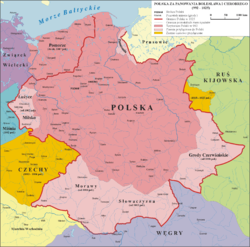 Poland during the Piast dynasty is the period of the formation and establishment of Poland as a state and a nation. The historically recorded Polish state begins with the rule of Mieszko I
of the Piast dynasty
in the second half of the 10th century. Mieszko chose to be baptized
in the Western Latin Rite in 966. Mieszko completed the unification of the West Slavic
tribal lands fundamental to the new country's existence. Following its emergence, the Polish nation
was led by a series of rulers who converted the population to Christianity
, created a strong kingdom and integrated Poland into the European culture
.
Mieszko's son Bolesław I Chrobry established a Polish Church province, pursued territorial conquests and was officially crowned in 1025, becoming the first King of Poland. This was followed by a collapse of the monarchy and restoration under Casimir I. Casimir's son Bolesław II the Bold became fatally involved in a conflict with the ecclesiastical authority
, and was expelled from the country. After Bolesław III divided the country among his sons, internal fragmentation eroded the initial Piast monarchy structure in the 12th and 13th centuries. One of the regional Piast dukes
invited the Teutonic Knights
to help him fight the Baltic
Prussian
pagans, which caused centuries of Poland's warfare with the Knights and then with the German Prussian state. The Kingdom was restored under Władysław I the Elbow-high, strengthened and expanded by his son Casimir III the Great. The western provinces of Silesia
and Pomerania
were lost after the fragmentation, and Poland began expanding to the east. The consolidation in the 14th century laid the base for, after the reigns of two members of the Angevin dynasty
, the new powerful Kingdom of Poland
that was to follow.
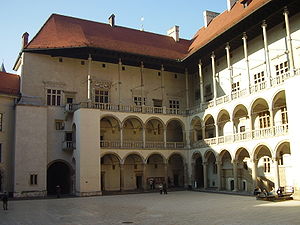 Beginning with the Lithuanian Grand Duke
Jogaila
(Władysław II Jagiełło), the Jagiellon dynasty
(1386–1572) formed the Polish–Lithuanian union. The partnership brought vast Lithuania
-controlled Rus' areas
into Poland's sphere of influence and proved beneficial for the Poles and Lithuanians
, who coexisted and cooperated in one of the largest political entities
in Europe for the next four centuries. In the Baltic Sea
region, Poland's struggle with the Teutonic Knights continued and included the Battle of Grunwald
(German: Battle of Tannenberg; Lithuanian: Battle of Žalgiris) (1410) and in 1466 the milestone Peace of Thorn under King Casimir IV Jagiellon
; the treaty created the future Duchy of Prussia. In the south, Poland confronted the Ottoman Empire
and the Crimean Tatars
, and in the east helped Lithuania fight the Grand Duchy of Moscow
. Poland was developing as a feudal
state, with predominantly agricultural economy and an increasingly dominant landed nobility
component. The Nihil novi
act adopted by the Polish Sejm
(parliament
) in 1505, transferred most of the legislative power
from the monarch
to the Sejm. This event marked the beginning of the period known as "Golden Liberty
", when the state was ruled by the "free and equal" Polish nobility
. Protestant Reformation
movements made deep inroads into the Polish Christianity, which resulted in unique at that time in Europe policies of religious tolerance
. The European Renaissance
currents evoked in late Jagiellon Poland (kings Sigismund I the Old
and Sigismund II Augustus
) an immense cultural flowering
. Poland's and Lithuania's territorial expansion included the far north region of Livonia
.
 The Union of Lublin
of 1569 established the Polish–Lithuanian Commonwealth, a more closely unified federal state. The Union was largely run by the nobility, through the system of the central parliament
and local assemblies
, but led by elected kings
. The beginning of the Commonwealth coincided with the period of Poland's great power, civilizational advancement and prosperity. The Polish–Lithuanian Union had become an influential player in Europe and a vital cultural entity, spreading
the Western culture
eastward. In the second half of the 16th and the first half of the 17th century, the Polish–Lithuanian Commonwealth was a huge state in central-eastern Europe, with an area approaching one million square kilometers. The Catholic Church embarked on an ideological counteroffensive and Counter-Reformation
claimed many converts from Protestant circles. The Union of Brest
split the Eastern Christians
of the Commonwealth. The Commonwealth, assertive militarily under King Stephen Báthory, suffered from dynastic distractions during the reigns of the Vasa
kings Sigismund III
and Władysław IV
. The Commonwealth fought wars with Russia
, Sweden
and the Ottoman Empire
and dealt with a series of Cossack uprisings. Allied with the Habsburg Monarchy
, it did not directly participate in the Thirty Years' War
.
 Beginning in the middle of the 17th century, the nobles' democracy
, subjected to devastating wars, falling into internal disorder and then anarchy
, gradually declined, making the once powerful Commonwealth vulnerable to foreign intervention. From 1648, the Cossack Khmelnytsky Uprising
engulfed the south and east, and was soon followed by a Swedish invasion, which raged through core Polish lands. Warfare with the Cossacks and Russia left Ukraine
divided, with the eastern part, lost by the Commonwealth, becoming the Tsardom
's dependency. John III Sobieski
, fighting protracted wars with the Ottoman Empire, revived the Commonwealth's military might once more, in process helping decisively in 1683 to deliver Vienna
from a Turkish
onslaught. From there, it all went downhill. The Commonwealth, subjected to almost constant warfare until 1720, suffered enormous population losses as well as massive damage to its economy and social structure. The government became ineffective because of large scale internal conflicts (e.g. Lubomirski's Rokosz
against John II Casimir and rebellious confederation
s), corrupted legislative processes and manipulation by foreign interests. The nobility class fell under control of a handful of powerful families with established territorial domains, the urban population and infrastructure fell into ruin, together with most peasant farms. The reigns of two kings of the Saxon
Wettin dynasty, Augustus II
and Augustus III
, brought the Commonwealth further disintegration. The Great Northern War
, a period seen by the contemporaries as a passing eclipse, may have been the fatal blow destined to bring down the Noble Republic. The Kingdom of Prussia
became a strong regional power and took Silesia
from the Habsburg Monarchy
. The Commonwealth-Saxony personal union
however gave rise to the emergence of the reform movement in the Commonwealth, and the beginnings of the Polish Enlightenment
culture.
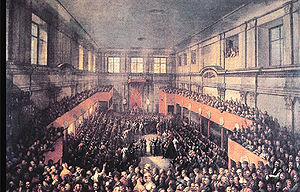 During the later part of the 18th century, the Commonwealth attempted fundamental internal reforms. The reform activity provoked hostile reaction and eventually military response on the part of the neighboring powers. The second half of the century brought improved economy and significant growth of the population. The most populous capital city of Warsaw
replaced Danzig
(Gdańsk) as the leading trade center, and the role of the more prosperous urban strata was increasing. The last decades of the independent Commonwealth existence were characterized by intense reform movements and far-reaching progress in the areas of education, intellectual life, art, and especially toward the end of the period, evolution of the social and political system. The royal election of 1764 resulted in the elevation of Stanisław August Poniatowski, a refined and worldly aristocrat connected to a major magnate
faction, but hand-picked and imposed by Empress Catherine II of Russia
, who expected Poniatowski to be her obedient follower. The King accordingly spent his reign torn between his desire to implement reforms necessary to save the state, and his perceived necessity of remaining in subordinate relationship with his Russian
sponsors. The Bar Confederation
of 1768 was a szlachta
rebellion directed against Russia and the Polish king, fought to preserve Poland's independence and in support of szlachtas traditional causes. It was brought under control and followed in 1772 by the First Partition of the Commonwealth
, a permanent encroachment on the outer Commonwealth provinces by the Russian Empire
, the Kingdom of Prussia
and Habsburg Austria
. The "Partition Sejm
" under duress "ratified" the partition fait accompli, but in 1773 also established the Commission of National Education, a pioneering in Europe government education authority.
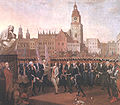 The long-lasting sejm
convened by Stanisław August in 1788 is known as the Great, or Four-Year Sejm
. The sejms landmark achievement was the passing of the May 3 Constitution
, the first in modern Europe singular pronouncement of a supreme law of the state. The reformist but moderate document, accused by detractors of French Revolution
sympathies, soon generated strong opposition coming from the Commonwealth's upper nobility conservative circles and Catherine II, determined to prevent a rebirth of the strong Commonwealth. The nobility's Targowica Confederation
appealed to the Empress
for help and in May 1792 the Russian army entered the territory of the Commonwealth. The defensive war fought by the forces of the Commonwealth ended when the King, convinced of the futility of resistance, capitulated by joining the Targowica Confederation. The Confederation took over the government, but Russia and Prussia in 1793 arranged for and executed the Second Partition of the Commonwealth
, which left the country with critically reduced territory, practically incapable of independent existence. The radicalized by the recent events reformers, in the still nominally Commonwealth area and in exile, were soon working on national insurrection preparations. Tadeusz Kościuszko
was chosen as its leader; the popular general came from abroad and on March 24, 1794 in Cracow (Kraków)
declared
a national uprising
under his supreme command
. Kościuszko emancipated and enrolled in his army many peasants, but the hard-fought insurrection, strongly supported also by urban plebeian masses, proved incapable of generating the necessary foreign collaboration and aid. It ended suppressed by the forces of Russia and Prussia, with Warsaw captured in November. The third and final partition of the Commonwealth
was undertaken again by all three partitioning powers
, and in 1795 the Polish–Lithuanian Commonwealth effectively ceased to exist.
. Henryk Dąbrowski's
Polish Legions fought in French campaigns outside of Poland, hoping that their involvement and contribution result in liberation of their Polish homeland. The Polish national anthem - Dąbrowski's Mazurka - was written in praise of his actions by Józef Wybicki
in 1797. The Duchy of Warsaw
, a small, semi-independent Polish state, was created in 1807 by Napoleon Bonaparte
, following his defeat of Prussia. The Duchy's military forces, led by Józef Poniatowski
, participated in numerous campaigns, including the Polish–Austrian War of 1809, the French invasion of Russia
in 1812, and the German campaign
of 1813.
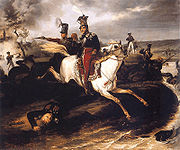 After the defeat of Napoleon, a new European order was established at the Congress of Vienna
. Adam Czartoryski
became the leading advocate for the Polish national cause. The Congress implemented a new partition scheme, which took into account some of the gains realized by the Poles during the Napoleonic period. The Duchy of Warsaw was replaced with the Kingdom of Poland
, a residual Polish state in personal union
with the Russian Empire
, ruled by the Russian tsar. East of the Kingdom, large areas of the former Commonwealth remained directly incorporated
into the Empire; together with the Kingdom they were part of the Russian partition
. There was a Prussian partition
, with a portion of it separated as the Grand Duchy of Posen, and an Austrian partition
. The newly created Republic of Kraków
was a tiny state under a joint supervision of the three partitioning powers. "Partitions" were the lands of the former Commonwealth, not actual administrative units.
The increasingly repressive policies of the partitioning powers led to Polish conspiracies, and in 1830 to the November Uprising
in the Kingdom. The uprising developed into a full-scale war with Russia, but the leadership was taken over by the Polish conservative circles reluctant to challenge the Empire, and hostile to broadening the independence movement's social base through measures such as land reform
. Despite the significant resources mobilized and self-sacrifice of the participants, a series of missteps by several successive unwilling or incompetent chief commanders appointed by the Polish government ultimately led to the defeat of the insurgents by the Russian army. After the fall of the Uprising, thousands of former Polish combatants and other activists emigrated to Western Europe, where they were initially enthusiastically received. This element, known as the Great Emigration
, soon dominated the Polish political and intellectual life. Together with the leaders of the independence movement, the exile community included the greatest Polish literary and artistic minds, including the Romantic
poets Adam Mickiewicz
, Juliusz Słowacki, Cyprian Norwid
, and composer Frédéric Chopin
. Within the occupied and repressed Poland, some sought progress through self-improvement oriented activities known as organic work
, others, in cooperation with the emigrant circles, organized conspiracies and prepared for the next armed insurrection.
The planned national uprising, after authorities in the partitions had found out about secret preparations, ended in a fiasco in early 1846. In its most significant manifestation, the Kraków Uprising
of February 1846, patriotic action was combined with revolutionary demands, but the result was the incorporation of the Republic of Kraków into the Austrian partition. Peasant discontent was taken advantage of by the Austrian authorities, who incited the villagers against noble-dominated insurgent units; it led to the Galician slaughter
, a violent anti-feudal rebellion, beyond the intended scope of the provocation. A new wave of Polish military and other involvement, in the partitions and in other parts of Europe, soon took place in the context of the 1848 Spring of Nations
revolutions. In particular, the Berlin events
precipitated the Greater Poland Uprising, where prominent role was played by the by then largely enfranchised in Prussia peasants.
 A renewal of popular liberation activities took place in 1860-1861; during the large scale demonstrations in Warsaw the Russian forces inflicted numerous casualties on the civilian participants. The "Red", or left-wing conspiracy faction, which promoted peasant enfranchisement and cooperated with Russian revolutionaries, became involved in immediate preparations for a national uprising. The "White", or right-wing faction, inclined to cooperate with the Russian authorities, countered with partial reform proposals. The conservative leader of the Kingdom's government Aleksander Wielopolski
, in order to cripple the manpower potential of the Reds, arranged for a partial selective conscription of young Poles for the Russian army, which hastened the outbreak of the hostilities. The January Uprising
, joined and led after the initial period by the Whites, was fought by partisan units against an overwhelming enemy advantage. The warfare was limited to the Kingdom and lasted from January 1863 to the spring of 1864, when Romuald Traugutt
, the dedicated last supreme commander of the insurgence, was captured by the tsarist
police.
On March 2, 1864, the Russian authority — compelled by the uprising to compete for the loyalty of Polish peasants — officially published an enfranchisement decree in the Kingdom, along the lines of an earlier insurgent land reform proclamation. The act created the conditions necessary for the development of the capitalist system on central Polish lands. At the time when the futility of armed resistance without external support was realized by most Poles, the various segments of the Polish society were undergoing deep and far-reaching social, economic and cultural transformations.
, downgraded in official usage from the Kingdom of Poland to the Vistula Land
, was more fully integrated into Russia proper, but not entirely obliterated. The Russian and German languages were respectively imposed in all public communication and the Catholic Church was not spared from severe repression. On the other hand the Galicia region in western Ukraine and southern Poland, economically and socially backward, but under the Austro-Hungarian Monarchy
rule increasingly allowed limited autonomy, experienced gradual relaxation of authoritarian policies and even a Polish cultural revival. Positivism
replaced Romanticism as the leading intellectual, social and literary trend.
"Organic work
" social activities consisted of self-help organizations that promoted economic advancement and worked on improving competitiveness of Polish-held business entities, industrial, agricultural, or other. New commercial methods and ways of generating higher productivity were discussed and implemented through trade associations and special interest groups, while Polish banking and cooperative financial institutions made necessary business loans available. The other major area of organic work concern was education and intellectual development of the common people. Many libraries and reading rooms were established in small towns and villages, and numerous printed periodicals reflected the growing interest in popular education. Scientific and educational societies were active in a number of cities.
Economic and social changes, such as land reform and industrialization, combined with the effects of foreign domination, altered the centuries old social structure of the Polish society. Among the newly emergent strata were wealthy industrialists and financiers, distinct from the traditional, but still critically important landed aristocracy. The intelligentsia
, an educated, professional or business middle class, often originated from gentry alienated from their rural possessions (many smaller serfdom
-based agricultural enterprises
had not survived the land reforms) and from urban people. Industrial proletariat
, the new underprivileged class, were usually poor peasants or townspeople forced by deteriorating conditions to migrate and search for work in urban centers in countries of their origin or abroad. Millions of residents of the former Commonwealth of various ethnic backgrounds
worked or settled in Europe and in North and South America.
The changes were partial and gradual, and the degree of the fast-paced in some areas industrialization and capitalist development on Polish lands lagged behind the advanced regions of western Europe. The three partitions developed different economies, and were economically integrated with their mother states more than with each other. In the 1870s-1890s, large scale socialist
, nationalist
and agrarian
movements of great ideological fervor and corresponding political parties became established in partitioned Poland and Lithuania. The main minority ethnic groups of the former Commonwealth, including Ukrainians
, Lithuanians, Belarusians
and Jews
, were getting involved in their own national movements and plans, which met with disapproval on the part of those ethnically Polish independence activists, who counted on an eventual rebirth of the Commonwealth. Around the turn of the century the Young Poland
cultural movement
, centered on Galicia and taking advantage of the conducive to liberal expression milieu there, was the source of Poland's finest artistic and literary productions.
The 1905 Russian Revolution arose new waves of Polish unrest, political maneuvering, strikes and rebellion, with Roman Dmowski
and Józef Piłsudski active as leaders of the nationalist and socialist
factions respectively. As the authorities reestablished control within the Empire
, the revolt in the Kingdom
, placed under martial law, had withered as well, leaving tsarist concessions in the areas of national and workers' rights, including Polish representation in the newly created Russian Duma
. Some of the acquired gains were however rolled back, which coupled with intensified Germanization
in the Prussian partition, left the Austrian Galicia
as the most amenable to patriotic action territory.
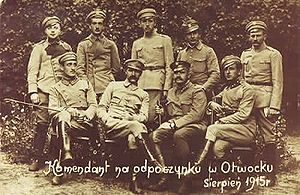 After the outbreak of World War I
, which confronted the partitioning powers against each other, Piłsudski's paramilitary units stationed in Galicia were turned into the Polish Legions
, and as a part of the Austro-Hungarian Army
fought on the Russian front.
World War I and the political turbulence that was sweeping Europe in 1914 offered the Polish nation hopes for regaining independence. On the outbreak of war the Poles found themselves conscripted
into the armies of Germany, Austria and Russia, and forced to fight each other in a war that was not theirs. Although many Poles sympathized with France and Britain, they found it hard to fight for their ally, Russia. They also had little sympathy for the Germans. Total deaths
from 1914 to 1918, military and civilian, within the 1919–1939 borders, were estimated at 1,128,000. By the end of World War I Poland had seen the defeat or retreat of all three partitioning powers.
As the area of Congress Poland became occupied by the Central Powers
, with the act of November 5, 1916 the Kingdom of Poland
(Królestwo Regencyjne) was recreated by Imperial Germany
and Austria-Hungary
on formerly Russian-controlled territory. This new puppet state
existed until November 1918, when it was replaced by the newly established Republic of Poland
. The independence of Poland had been campaigned for in the West by Dmowski and Ignacy Paderewski
. With Woodrow Wilson's support
, Polish independence was officially endorsed in June 1918 by the Entente Powers
, on whose fronts sizable armies of Polish volunteers had been mobilized and fought. On the ground in Poland in October–November the final upsurge of the push for independence was taking place, with Ignacy Daszyński
heading a short-lived Polish government in Lublin
from November 6. Germany
decided to withdraw its forces from Warsaw and released imprisoned Piłsudski, who arrived in Warsaw on November 10.
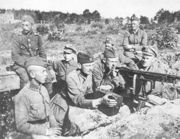 After more than a century of rule by its neighbors, Poland regained its independence
in 1918, internationally recognized in 1919 with the Treaty of Versailles
. The Paris Peace Conference
and the Versailles treaty that followed resolved the issue of Poland's western border with Germany, including the Polish Corridor
, which gave Poland access to the Baltic Sea
, and the separate status of the Free City of Danzig
. Plebiscites in southern East Prussia
and Upper Silesia
were provided for, while the issues of other northern, eastern and southern borders remained undetermined, inviting military action.
Of the several border-settling conflicts that ensued, the Polish–Soviet War of 1919-1921 was the confrontation fought on a very large scale. Piłsudski had entertained far-reaching anti-Russian cooperative designs for Eastern Europe, and in 1919 the Polish forces pushed eastward into Lithuania, Belarus and Ukraine (previously a theater of the Polish–Ukrainian War), taking advantage of the Russian preoccupation with the civil war
. By June 1920, the Polish armies were past Vilnius
, Minsk
and (allied with the Directorate of Ukraine
) reached Kiev, but then the massive Bolshevik
counteroffensive moved the Poles out of most of Ukraine and on the northern front arrived at the outskirts of Warsaw. The seemingly certain disaster was averted
in August by the combination of Piłsudski's military skills and a dedicated national defense effort.
 The Russian armies were separated, defeated and pushed back, which forced Lenin
and the Soviet
leadership to abandon for the time being their strategic objective of linking up with the German and other European revolution-minded comrades (Lenin's hope of generating support for the Red Army
in Poland had already failed to materialize). Piłsudski's seizure of Vilnius in October 1920 poisoned Polish–Lithuanian relations for the remainder of the interwar period
. Piłsudski's planned East European federation of states (inspired by the tradition of the binational and multiethnic Commonwealth) was incompatible, at the time of rising national movements, with his assumption of Polish domination and with the encroachment on the neighboring peoples' lands and aspirations; as such it was doomed to failure. A larger federated structure was also opposed by Dmowski's National Democrats. Their representative at the Peace of Riga
talks opted for leaving Minsk
area on the Soviet side of the border, not wanting the ethnically Polish element overly diluted. The successful outcome of the war gave Poland a false sense of being a major and self-sufficient military power, and the government a justification for trying to resolve international problems through imposed unilateral solutions. The interwar period's Polish territorial and ethnic policies contributed to bad relations with most of Poland's neighbors and to uneasy cooperation with the more distant centers of power, including France, Britain and the League of Nations
. The Treaty of Riga
of 1921 settled the eastern border, preserving for Poland, at the cost of partitioning the ethnic Lithuania, Belarus and Ukraine, a good portion
of the old Commonwealth's eastern lands.
The rapidly growing population of Poland within the new boundaries was ¾ agricultural and ¼ urban, with Polish being the primary language of ⅔ of the inhabitants. A constitution
was adopted in 1921. Due to the insistence of the National Democrats, worried about the potential power of Piłsudski if elected, it introduced limited prerogatives for the presidency.
What followed was the Second Republic's short (1921–1926) and turbulent period of constitutional order and parliamentary democracy
. The legislature remained fragmented and lacking stable majorities, governments changed frequently, corruption was commonplace. The open-minded Gabriel Narutowicz
was constitutionally elected president by the National Assembly in 1922, but deemed not pure enough by the nationalist right wing, was assassinated. Poland had suffered under a plethora of economic calamities, but there were also signs of progress and stabilization (Władysław Grabski's economically competent government lasted for almost two years). The achievements of the democratic period, such as the establishment, strengthening or expansion of the various governmental and civil society
structures and integrative processes necessary for normal functioning of the reunited state and nation, were too easily overlooked. Lurking on the sidelines was the disgusted army upper corps, not willing to subject itself to civilian control, but ready to follow its equally dissatisfied, at that time retired, legendary chief.
On May 12, 1926, Piłsudski, prompted by mutinous units seeking his leadership and intent on preventing the three-time prime minister Wincenty Witos
of the peasant Polish People's Party from forming another coalition, staged a military overthrow of the Polish government, confronting President Stanisław Wojciechowski and overpowering the troops loyal to him. Piłsudski was supported by several leftist factions, who ensured the success of his coup by blocking during the fighting the railway transportation of government forces, but the authoritarian
"Sanation" regime that he was to lead for the rest of his life and that stayed in power until World War II
, was neither leftist, nor overtly fascist
. Political institutions and parties were allowed to function, which was combined with electoral manipulation and strong-arming of those not willing to cooperate into submission. Eventually persistent opponents of the regime, many of the leftist persuasion, were subjected to long staged trials
and harsh sentences, or detained in camps for political prisoners
. Rebellious peasants
, striking industrial workers and nationalist Ukrainians became targets of ruthless military pacification, other minorities were harassed. Piłsudski, conscious of Poland's precarious international situation, signed non-aggression pacts with the Soviet Union in 1932 and with Nazi Germany in 1934.
The mainstream of the Polish society was not affected by the repressions of the Sanation authorities, many enjoyed the relative prosperity (the economy improved between 1926 and 1929) and supported the government. Polish independence had boosted the development of thriving culture
and intellectual achievement was high, but the Great Depression
brought huge unemployment and increased social tensions, including rising antisemitism. The reconstituted Polish state had had only 20 years of relative stability and uneasy peace between the two wars
. A major economic transformation and national industrial development plan led by Minister Eugeniusz Kwiatkowski
, the main architect of the Gdynia seaport
project, was in progress at the time of the outbreak of the war
. The interwar period's overall economic situation in Poland was however stagnant. The total industrial production (within the pre-1939 borders) had barely increased between 1913 and 1939, but because of the population growth, the per capita output actually decreased by 17.8%.
 The lack of sufficient domestic or foreign investment funding precluded by 1939 the level of industrial development necessary for creating modern armed forces for successful self-defense; because of its strategic and tactical priorities, the ruling establishment had not primarily prepared the country for a major war on the western front. The regime of Piłsudski's "colonels", left in power after the marshal's death, had neither the vision nor resources to cope with the deteriorating situation in Europe. The government (foreign policy conduct was the responsibility of Józef Beck
) undertook opportunistic hostile actions against Lithuania
and Czechoslovakia, while it failed to control the increasingly fractured situation at home, where fringe groups and extreme nationalist circles were getting more outspoken (one Camp of National Unity was connected to the new strongman, Marshal Edward Rydz-Śmigły).
In 1939 the Polish government rejected the German offer of forming an alliance on terms which would amount to an end or severe curtailment of Poland's sovereignty; Hitler
abrogated the Polish-German pact. Before the war broke out, Poland entered into a full military alliance with Britain and France; the western powers lacked the will to confront Nazi Germany
and their (false) assurances of imminent military action were only intended as pressure applied to deter Hitler. The mid-August British-French talks with the Soviets on forming an anti-Nazi defensive military alliance had failed, in part over the Polish government's refusal to allow the Red Army to operate on Polish territory. On August 23, 1939 Germany and the Soviet Union signed the Molotov–Ribbentrop non-aggression pact, which secretly provided for the dismemberment of Poland into Nazi
and Soviet-controlled zones.
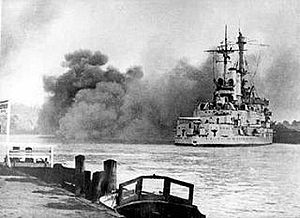 On September 1, 1939 Hitler ordered his troops into Poland. Poland had signed a pact with Britain (as recently as August 25) and France and the two western powers soon declared a war
on Germany, but remained rather inactive and extended no aid to the attacked country. On September 17, the Soviet troops moved in
and took control of most of the areas of eastern Poland having significant Ukrainian
and Belarusian
populations under the terms of the German-Soviet agreement. While Poland's military forces were fighting the invading armies, Poland's top government officials and military high command left the country (September 17/18). Among the military operations that held out the longest (until late September or early October) were the Defense of Warsaw
, the Defense of Hel
and the resistance of the Polesie Group
.
Fighting the initial "September Campaign" of World War II was the most significant Polish contribution to the allied war effort
. The nearly one million Polish soldiers mobilized significantly delayed Hitler's attack on Western Europe
, planned for 1939. When the Nazi offensive did happen, the delay caused it to be less effective, a possibly crucial factor in the case of the defense of Britain
.
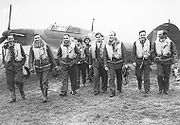 After Germany invaded the Soviet Union in June 1941, Poland was completely occupied by German troops.
The Poles formed an underground resistance movement and a Polish government in exile, first in Paris
and later in London
, which was recognized by the Soviet Union (diplomatic relations, broken since September 1939, were resumed in July 1941). During World War II, about 300,000 Poles fought under the Soviet command
, and about 200,000 went into combat on western fronts
in units loyal to the Polish government in exile.
In April 1943, the Soviet Union broke the deteriorating relations with the Polish government in exile after the German military announced that they had discovered mass graves of murdered Polish army officers
at Katyn, in the USSR
. The Soviets claimed that the Poles had committed a hostile act by requesting that the Red Cross
investigate these reports.
As the Jewish
ghetto in occupied Warsaw
was being liquidated by the Nazi SS
units, in 1943 the city was the scene of the Warsaw Ghetto Uprising
. The eliminations of the ghettos took place in Polish cities and uprisings were fought there against impossible odds by desperate Jewish insurgents, whose people were being removed and exterminated.
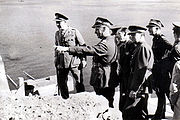 At the time of the western Allies' increasing cooperation with the Soviet Union, the standing and influence of the Polish government in exile were seriously diminished by the death of its most prominent leader — Prime Minister Władysław Sikorski — on July 4, 1943.
In July 1944, the Soviet Red Army
and the People's Army of Poland controlled by the Soviets entered Poland, and through protracted fighting in 1944 and 1945 defeated the Germans, losing 600,000 of their soldiers. Initially, a communist
-controlled "Polish Committee of National Liberation
" was established in Lublin
.
The greatest single instance of armed struggle in the occupied Poland
and a major political event of World War II was the Warsaw Uprising
of 1944. The uprising, in which most of the Warsaw population participated, was instigated by the underground Armia Krajowa
(Home Army) and approved by the Polish government in exile, in an attempt to establish a non-communist Polish administration ahead of the approaching Red Army. The uprising was planned with the expectation that the Soviet forces, who had arrived in the course of their offensive and were present on the other side of the Vistula River
, would help in battle over Warsaw. However, the Soviets stopped their advance at the Vistula and were mostly passive as the Germans brutally suppressed the forces of the pro-Western Polish underground.
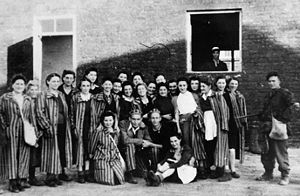 The bitterly fought uprising lasted for two months and resulted in hundreds of thousands of civilians killed and expelled. After a hopeless surrender on the part of the Poles (October 2), the Germans carried out Hitler's order to destroy the remaining infrastructure of the city. The Polish First Army
, fighting along the Soviet Red Army, entered Warsaw on 17 January 1945.
As a consequence of the war and by the decision of the Soviet leadership, agreed to by the United States and Britain beginning with the Tehran Conference
(late 1943), Poland's geographic location was fundamentally altered. Stalin
's proposal that Poland should be moved very far to the west was readily accepted by Polish communists
, who were at that time at the early stages of forming the post-war government
.
By the time of the Yalta Conference
(February 1945), seen by many Poles as the pivotal point when the nation's fate was sealed
by the Great Powers, the communists had established a provisional government in Poland. The Soviet position at the Conference was strong, corresponding to their advance on the German battlefield. The three Great Powers gave assurances for the conversion of the communist provisional government, by including in it democratic forces from within the country and currently active abroad (the Provisional Government of National Unity
and subsequent democratic elections were the agreed stated goals), but the London-based government in exile was not mentioned.
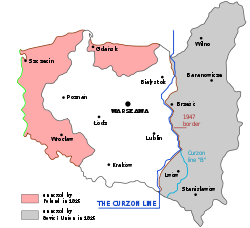
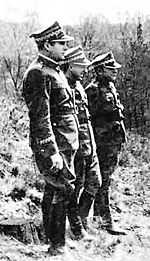 After the final (for all practical purposes) settlement at Potsdam
, the Soviet Union retained most of the territories captured as a result of the 1939 German-Soviet pact (now western Ukraine
, western Belarus
and part of Lithuania
around Vilnius
). Poland was compensated with parts of Silesia
including Breslau (Wrocław) and Grünberg (Zielona Góra)
, of Pomerania
including Stettin (Szczecin)
, and of East Prussia
, along with Danzig (Gdańsk)
, collectively referred to as the "Recovered Territories
", which were incorporated into the reconstituted Polish state. Most of the German population there was expelled to Germany
.
Scientific and numerically correct estimation of the human losses suffered by Polish citizens during World War II does not seem possible because of the paucity of available data. Some conjectures can be arrived at and they suggest that assertions made in the past have been incorrect and motivated by political needs. To begin with, the total population of 1939 Poland and of the several nationalities/ethnicities
present there are not accurately known, since the last population census took place in 1931
.
Modern research indicates that during the war about 5 million Polish citizens were killed, including 3 million Polish Jews
. According to the Holocaust Memorial Museum
, at least 1.9 to two million ethnic Poles and 3 million Polish Jews were killed, and 2.5 million were deported to Germany for forced labor or to German extermination camps such as Treblinka
and Auschwitz
. According to a recent estimate, between 2.35 and 2.9 million Polish Jews and about 2 million ethnic Poles were killed (almost all of the Jewish losses and 90% of the Polish losses were caused by Nazi Germany). This Jewish loss of life, together with the numerically much less significant waves of displacement during the war and emigration after the war, after the Polish October
1956 thaw and following the 1968 Polish political crisis, put an end to several centuries of large scale, well-established Jewish settlement and presence in Poland
. The magnitudes of the (also substantial) losses of Polish citizens of German, Ukrainian, Belarusian and other nationalities are not known.
In 1940-1941, some 325,000 Polish citizens were deported by the Soviet regime. The number of Polish citizen deaths at the hands of the Soviets is estimated at less than 100,000. In 1943–1944, Ukrainian nationalists (OUN
and Ukrainian Insurgent Army) massacred tens of thousands of Poles in Volhynia and Galicia
.
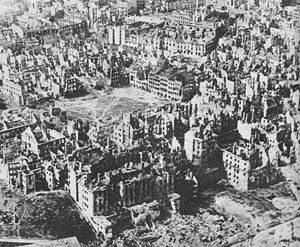 Approximately 90% of Polish war losses (Jews and Gentiles) were the victims of prisons, death camps, raids, executions, annihilation of ghettos, epidemics, starvation, excessive work and ill treatment. There were one million war orphans and 590,000 war disabled. The country lost 38% of its national assets (Britain lost 0.8%, France 1.5%). Nearly half the prewar Poland was expropriated by the Soviet Union, including the two great cultural centers of Lwów
and Wilno
. Many Poles could not return to the country for which they had fought because they belonged to the "wrong" political group, or came from prewar eastern Poland incorporated into the Soviet Union (see Polish population transfers (1944–1946)), or having fought in the West were warned not to return because of the high risk of persecution. Others were arrested, tortured and imprisoned by the Soviet authorities for belonging to the Home Army (see Cursed soldiers
), or persecuted because of having fought on the western front.
With Germany's defeat, as the reestablished Polish state was shifted west to the area between the Oder-Neisse
and Curzon
lines, the Germans who had not fled were expelled
. Of those who remained, many chose to emigrate to post-war Germany
. According to a recently quoted estimate, of the 200-250 thousand Jews who escaped the Nazis, 40-60 thousand had survived in Poland. More had been repatriated from the Soviet Union and elsewhere, and the February 1946 population census showed ca. 300,000 Jews within the new borders. Of the surviving Jews, many chose or felt compelled to emigrate. Many Ukrainians remaining in Poland were forcibly moved to Soviet Ukraine (see Repatriation of Ukrainians from Poland to the Soviet Union), and to the new territories in northern and western Poland under Operation Vistula. Because of the changing borders and of mass movements of people of various nationalities, sponsored by governments and spontaneous, the emerging communist Poland ended up with a mainly homogeneous, ethnically Polish population (97.6% according to the December 1950 census). The remaining members of the minorities were not encouraged, by the authorities or by their neighbors, to emphasize their ethnic identity.
 In June 1945, as an implementation of the February Yalta Conference
directives, according to the Soviet interpretation, a Polish Provisional Government of National Unity
was formed; it was soon recognized by the United States and many other countries. A national referendum
arranged for by the communist
Polish Workers' Party
was used to legitimize its dominance in Polish politics and claim widespread support for the party's policies. Although the Yalta agreement called for free elections, those held in January 1947
were controlled by the communists. Some democratic and pro-Western elements, led by Stanisław Mikołajczyk, the former Prime Minister in Exile, participated in the Provisional National Unity Government and the 1947 elections, but were ultimately eliminated through electoral fraud
, intimidation and violence. In times of radical change, they attempted to preserve some degree of mixed economy
.
A Polish People's Republic
(Polska Rzeczpospolita Ludowa) was created under the communist Polish United Workers' Party
rule after the brief period of coalition "National Unity" government. The ruling party
itself was a result of the forced amalgamation (December 1948) of the communist Polish Workers' Party and the historically non-communist, more popular Polish Socialist Party
(the party, reestablished in 1944, had been from that time allied with the communists). The ruling communists, who in post-war Poland preferred to use the term "socialism", needed to include the socialist junior partner to broaden their appeal, claim greater legitimacy and eliminate competition on the left
. The socialists, who were losing their organization, had to be subjected to political pressure, ideological cleansing and purges in order to become suitable for the unification on the "Workers' Party"'s terms.
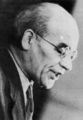 During the most oppressive Stalinist
period, terror, justified by the necessity to eliminate the reactionary subversion, was widespread; many thousands of perceived opponents of the regime were arbitrarily tried and large numbers executed. The People's Republic was led by discredited Moscow
's operatives such as Bolesław Bierut and Konstantin Rokossovsky
.
Larger rural estates and agricultural holdings as well as post-German property were redistributed through land reform
and industry was nationalized
beginning in 1944. The Three-Year Plan
(1947–1949) continued with the rebuilding, socialization
and restructuring of the economy. The rejection of the Marshall Plan
however made the aspirations to catch-up with the West European
standard of living unrealistic. The government's economic high priority was the development of militarily useful heavy industry. State-run institutions, collectivization and cooperative entities were imposed (the last category dismantled in the 1940s as not socialist enough, later reestablished), while even small-scale private enterprises were being eradicated. Great strides however were made in the areas of universal public education (including elimination of adult illiteracy), health care and recreational amenities for working people. Many historic sites, including central districts of war-destroyed Warsaw and Gdańsk (Danzig), were rebuilt at a great cost. The Polish government in exile
existed until 1990, although its influence was degraded.
In October 1956, after the 20th Soviet Party Congress in Moscow ushered in de-Stalinization
and riots by workers in Poznań
ensued, there was a shakeup in the communist regime. While retaining most traditional communist economic and social aims, the regime led by the Polish Communist Party
's First Secretary Władysław Gomułka began to liberalize internal life in Poland
. Several years of relative stabilization followed the legislative election of 1957
.
In 1965, the Conference of Polish Bishops
issued the Letter of Reconciliation of the Polish Bishops to the German Bishops
. In 1966, the celebrations of the 1,000th anniversary of the Baptism of Poland
led by Cardinal Stefan Wyszyński and other bishops turned into a huge demonstration of the power and popularity of the Polish Catholic Church
.
Sophisticated cultural life developed under Gomułka and his successors, even if the creative process had often been compromised by state censorship. Significant productions were accomplished in fields such as literature, theater, cinema and music, among others. Journalism of veiled understanding and native varieties of popular trends and styles of western mass culture
were well represented. Uncensored information and works generated by émigré
circles were conveyed by a variety of channels, the Radio Free Europe being of foremost importance.
In 1968, the liberalizing trend was reversed when student demonstrations were suppressed and an anti-Zionist
campaign initially directed against Gomułka supporters within the party eventually led to the emigration of much of Poland's remaining Jewish population. In August 1968, the Polish People's Army took part in the infamous Warsaw Pact invasion of Czechoslovakia
.
In 1970, the governments of Poland and West Germany
signed a treaty
which normalized their relations and in which the Federal Republic
recognized the post-war de facto borders between Poland and East Germany.
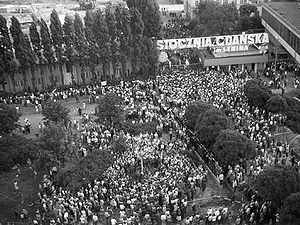 In December 1970, disturbances and strikes in the port cities
of Gdańsk
(Danzig), Gdynia
, and Szczecin
(Stettin), triggered by a price increase for essential consumer goods, reflected deep dissatisfaction with living and working conditions in the country. Edward Gierek
replaced Gomułka as First Secretary.
Fueled by large infusions of Western credit, Poland's economic growth rate was one of the world's highest during the first half of the 1970s. But much of the borrowed capital was misspent, and the centrally planned economy
was unable to use the new resources effectively. The growing debt burden became insupportable in the late 1970s, and economic growth had become negative by 1979. The Workers' Defense Committee
(KOR) established in 1976 consisted of dissident intellectuals willing to openly support industrial workers struggling with the authorities.
In October 1978, the Archbishop of Kraków, Cardinal Karol Józef Wojtyła
, became Pope John Paul II
, head of the Roman Catholic Church. Polish Catholics rejoiced at the elevation of a Pole to the papacy
and greeted his June 1979 visit to Poland with an outpouring of emotion.
On July 1, 1980, with the Polish foreign debt at more than $20 billion, the government made another attempt to increase meat prices. A chain reaction of strikes
virtually paralyzed the Baltic coast by the end of August and, for the first time, closed most coal mines in Silesia
. Poland was entering into an extended crisis that would change the course of its future development.
On August 31, workers at the Lenin Shipyard in Gdańsk
, led by an electrician named Lech Wałęsa
, signed a 21-point agreement with the government
that ended their strike. Similar agreements were signed at Szczecin and in Silesia. The key provision of these agreements was the guarantee of the workers' right to form independent trade union
s and the right to strike. After the Gdańsk Agreement
was signed, a new national union movement "Solidarity" swept Poland.
The discontent underlying the strikes was intensified by revelations of widespread corruption and mismanagement within the Polish state and party leadership. In September 1980, Gierek was replaced by Stanisław Kania as First Secretary.
Alarmed by the rapid deterioration of the PZPR's
authority following the Gdańsk agreement, the Soviet Union proceeded with a massive military buildup along Poland's border in December 1980. In February 1981, Defense Minister Gen. Wojciech Jaruzelski
assumed the position of Prime Minister, and in October 1981, was named First Secretary of the Communist Party. At the first Solidarity national congress
in September–October 1981, Lech Wałęsa was elected national chairman of the union.
On December 12–13, the regime declared martial law
, under which the army and ZOMO
riot police were used to crush the union. Virtually all Solidarity leaders and many affiliated intellectuals were arrested or detained. The United States and other Western countries responded to martial law by imposing economic sanctions against the Polish regime and against the Soviet Union. Unrest in Poland continued for several years thereafter.
Having achieved some semblance of stability, the Polish regime in several stages relaxed and then rescinded martial law. By December 1982, martial law was suspended, and a small number of political prisoners (including Wałęsa) were released. Although martial law formally ended in July 1983 and a general amnesty was enacted, several hundred political prisoners remained in jail.
In July 1984, another general amnesty was declared, and two years later, the government had released nearly all political prisoners. The authorities continued, however, to harass dissidents and Solidarity activists. Solidarity remained proscribed and its publications banned. Independent publications were censored.
The government's inability to forestall Poland's economic decline led to waves of strikes across the country in April, May and August 1988. With the Soviet Union increasingly destabilized, in the late 1980s the government was forced to negotiate with Solidarity in the Polish Round Table Negotiations
. The resulting Polish legislative election in 1989
became one of the important events marking the fall of communism
in Poland.
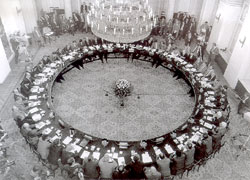 The "round-table" talks
with the opposition began in February 1989. These talks produced the Round Table Agreement
in April for partly open National Assembly elections
. The failure of the communists at the polls produced a political crisis. The agreement called for a communist president
, and on July 19, the National Assembly
, with the support of a number of Solidarity deputies, elected General Wojciech Jaruzelski
to that office. However, two attempts by the communists to form governments failed.
On August 19, President Jaruzelski asked journalist/Solidarity activist Tadeusz Mazowiecki
to form a government; on September 12, the Sejm (national legislature) voted approval of Prime Minister Mazowiecki and his cabinet. For the first time in more than 40 years, Poland had a government led by noncommunists.
In December 1989, the Sejm approved the government's reform program to transform the Polish economy rapidly from centrally planned to free-market, amended the constitution
to eliminate references to the "leading role" of the Communist Party, and renamed the country the "Republic of Poland." The Polish United Workers' (Communist) Party
dissolved itself in January 1990, creating in its place a new party, Social Democracy of the Republic of Poland
.
In October 1990, the constitution was amended to curtail the term of President Jaruzelski.
In the early 1990s, Poland made great progress towards achieving a fully democratic government and a market economy. In November 1990, Lech Wałęsa was elected president
for a five-year term. In December Wałęsa became the first popularly elected President of Poland.
Poland's first free parliamentary election
was held in 1991. More than 100 parties participated, and no single party received more than 13% of the total vote. In 1993 parliamentary election
the "post-communist" Democratic Left Alliance
(SLD) received the largest share of votes. In 1993 the Soviet Northern Group of Forces
finally left Poland.
In November 1995, Poland held its second post-war free presidential election
. SLD leader Aleksander Kwaśniewski
defeated Wałęsa by a narrow margin—51.7% to 48.3%.
In 1997 parliamentary election
two parties with roots in the Solidarity movement — Solidarity Electoral Action
(AWS) and the Freedom Union
(UW) — won 261 of the 460 seats in the Sejm and formed a coalition government. In April 1997, the new Constitution of Poland
was finalized, and in July put into effect, replacing the previously used amended
communist statute
.
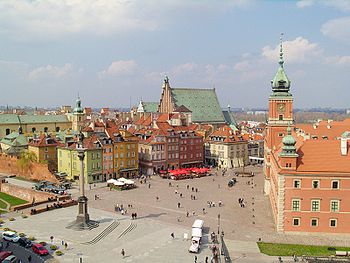 Poland joined NATO in 1999. Elements of the Polish Armed Forces
have since participated in the Iraq War and the Afghanistan War
.
In the presidential election of 2000
, Aleksander Kwaśniewski, the incumbent former leader of the SLD
, was re-elected in the first round of voting. After September 2001 parliamentary election
SLD (a successor of the communist party) formed a coalition with the agrarian Polish People's Party (PSL) and the leftist Labor Union
(UP).
Poland joined the European Union
in May 2004. Both President Kwaśniewski and the government were vocal in their support for this cause. The only party decidedly opposed to EU entry was the populist right-wing League of Polish Families
(LPR).
After the fall of communism the government policy of guaranteed full employment had ended and many large unprofitable state enterprises were closed or restructured. This and other economic woes of the transition period caused the unemployment to be at times as high as 20%. With the EU
access, the gradual opening of West European labor markets to Polish workers, combined with the domestic economic growth, led to marked improvement in the employment situation (currently at above 10%) in Poland.
September's 2005 parliamentary election
was expected to produce a coalition of two center-right parties, PiS (Law and Justice
) and PO (Civic Platform
). During the bitter campaign PiS overtook PO, gaining 27% of votes cast and becoming the largest party in the Sejm, ahead of PO with 24%. In the presidential election in October
the early favorite, Donald Tusk
, leader of the PO, was beaten 54% to 46% in the second round by the PiS candidate Lech Kaczyński
.
Coalition talks ensued simultaneously with the presidential elections, but negotiations ended up in a stalemate and the PO decided to go into opposition. PiS formed a minority government which relied on the support of smaller populist and agrarian parties (Samoobrona
, LPR
) to govern. This became a formal coalition, but its deteriorating state made early parliamentary election necessary.
In the 2007 parliamentary election
, the Civic Platform was most successful (41.5%), ahead of Law and Justice (32%), and the government of Donald Tusk, the chairman of PO, was formed. PO governs in a parliamentary majority coalition with the smaller Polish People's Party (PSL).
In the current great worldwide economic downturn, triggered and exemplified in particular by the 2008 USA collapse and bailout of the banking system
, the Polish economy has weathered the crisis, in comparison with many European and other countries, relatively unscathed. Worrisome signs, signalling upcoming difficulties are however present, and the European sovereign debt crisis, unraveling some of Europe's economies, is expected to negatively affect also the economy of Poland, currently not a member of the eurozone
.
The social price paid by the Poles for the implementation of liberal free market economic policies
has been the sharply more inequitable distribution of wealth and the associated impoverishment of large segments of the society.
Poland's president Lech Kaczyński and all aboard died in a plane crash on April 10, 2010 in western Russia, near Smolensk
. President Kaczyński and other prominent Poles were on the way to the Katyn massacre
anniversary commemoration.
In the second final round of the Polish presidential election on July 4, 2010, Bronisław Komorowski, Acting President, Marshal of the Sejm and a Civic Platform politician, defeated Jarosław Kaczyński by 53% to 47%.
The Smolensk tragedy brought into the open deep divisions within the Polish society and became a destabilizing factor in Poland's politics.
Poland's relations with its European neighbors have been good or improving, with Belarus
being a sore point
. The Eastern Partnership
summit, hosted in September 2011 by Poland, the holder of the rotating Presidency of the Council of the European Union
, resulted in no agreement on near future expansion of the Union to include the several considered Eastern Europe
an and Caucasus
states, formerly Soviet republics
. The European Union membership for at least some of those states, including Ukraine
, has long been a goal of Polish diplomacy. Poland has also been promoting NATO membership for Ukraine and Georgia
, a plan seen by Russia as threatening to its security.
The 2011 parliamentary election
results were generally an affirmation of the current distribution of political forces. The Civic Platform
won over 39% of the votes, Law and Justice
almost 30%, Palikot's Movement 10%, the Polish People's Party and the Democratic Left Alliance
over 8% each. The new element was the successful debut of the left-of-center movement of Janusz Palikot
, a maverick politician, which resulted in decreased electoral appeal of the Democratic Left Alliance.
Poland's foreign minister, Radosław Sikorski, delivered a speech on 28 November 2011 in Berlin, in which he emphatically appealed to Germany and other European Union countries for closer economic and political integration and coordination, to be achieved through a more powerful central government of the Union. Sikorski feels that decisive action and substantial reform, led by Germany, are necessary to prevent a collapse of the euro and subsequent destabilization and possible demise of the European Union. His remarks, directed primarily at the German audience, encountered hostile reception in Poland from Jarosław Kaczyński and his conservative parliamentary opposition
, who accused the minister of betraying Poland's sovereignty and demanded his ouster and trial. Sikorski specified in his speech several areas important to Polish traditionalists, which, he said, should permanently remain within the competence of individual national governments.
Other:
Poland
Poland , officially the Republic of Poland , is a country in Central Europe bordered by Germany to the west; the Czech Republic and Slovakia to the south; Ukraine, Belarus and Lithuania to the east; and the Baltic Sea and Kaliningrad Oblast, a Russian exclave, to the north...
is rooted in the arrival of the Slavs
Poland in the Early Middle Ages
The ancient Roman scholars new nothing about the impenetrable forest north of Dacia and the Carpathian Mountains, between the migrating Celts and Germanic tribes to the west, and the Sarmatians to the east. Augustian historian Strabo only assumed the presence of a different tribe reaching north to...
, who gave rise to permanent settlement and historic development on Polish lands. During the Piast dynasty
Piast dynasty
The Piast dynasty was the first historical ruling dynasty of Poland. It began with the semi-legendary Piast Kołodziej . The first historical ruler was Duke Mieszko I . The Piasts' royal rule in Poland ended in 1370 with the death of king Casimir the Great...
Christianity
Western Christianity
Western Christianity is a term used to include the Latin Rite of the Catholic Church and groups historically derivative thereof, including the churches of the Anglican and Protestant traditions, which share common attributes that can be traced back to their medieval heritage...
was adopted
Baptism of Poland
The Baptism of Poland was the event in 966 that signified the beginning of the Christianization of Poland, commencing with the baptism of Mieszko I, who was the first ruler of the Polish state. The next significant step in Poland's adoption of Christianity was the establishment of various...
in 966 and medieval monarchy
High Middle Ages
The High Middle Ages was the period of European history around the 11th, 12th, and 13th centuries . The High Middle Ages were preceded by the Early Middle Ages and followed by the Late Middle Ages, which by convention end around 1500....
established. The Jagiellon dynasty
Jagiellon dynasty
The Jagiellonian dynasty was a royal dynasty originating from the Lithuanian House of Gediminas dynasty that reigned in Central European countries between the 14th and 16th century...
period brought close ties with the Grand Duchy of Lithuania
Grand Duchy of Lithuania
The Grand Duchy of Lithuania was a European state from the 12th /13th century until 1569 and then as a constituent part of Polish-Lithuanian Commonwealth until 1791 when Constitution of May 3, 1791 abolished it in favor of unitary state. It was founded by the Lithuanians, one of the polytheistic...
, cultural development
Renaissance in Poland
The Renaissance in Poland lasted from the late 15th to the late 16th century and is widely considered to have been the Golden Age of Polish culture. Ruled by the Jagiellon dynasty, the Kingdom of Poland actively participated in the broad European Renaissance...
and territorial expansion, culminating in the establishment of the Polish–Lithuanian Commonwealth in 1569.
The Commonwealth in its early phase constituted a continuation of the Jagiellon prosperity. From the mid-17th century, the huge state entered a period of decline caused by devastating wars and deterioration of the country's system of government
Golden Liberty
Golden Liberty , sometimes referred to as Golden Freedoms, Nobles' Democracy or Nobles' Commonwealth refers to a unique aristocratic political system in the Kingdom of Poland and later, after the Union of Lublin , in the Polish-Lithuanian Commonwealth...
. Significant internal reforms
Constitution of May 3, 1791
The Constitution of May 3, 1791 was adopted as a "Government Act" on that date by the Sejm of the Polish–Lithuanian Commonwealth. Historian Norman Davies calls it "the first constitution of its type in Europe"; other scholars also refer to it as the world's second oldest constitution...
were introduced during the later part of the 18th century, but the reform process was not allowed to run its course, as the Russian Empire
Russian Empire
The Russian Empire was a state that existed from 1721 until the Russian Revolution of 1917. It was the successor to the Tsardom of Russia and the predecessor of the Soviet Union...
, the Kingdom of Prussia
Kingdom of Prussia
The Kingdom of Prussia was a German kingdom from 1701 to 1918. Until the defeat of Germany in World War I, it comprised almost two-thirds of the area of the German Empire...
and the Austrian Habsburg Monarchy
Habsburg Monarchy
The Habsburg Monarchy covered the territories ruled by the junior Austrian branch of the House of Habsburg , and then by the successor House of Habsburg-Lorraine , between 1526 and 1867/1918. The Imperial capital was Vienna, except from 1583 to 1611, when it was moved to Prague...
through a series of invasions and partitions
Partitions of Poland
The Partitions of Poland or Partitions of the Polish–Lithuanian Commonwealth took place in the second half of the 18th century and ended the existence of the Polish–Lithuanian Commonwealth, resulting in the elimination of sovereign Poland for 123 years...
terminated the Commonwealth's independent existence in 1795.
From then until 1918 there was no independent Polish state. The Poles had engaged intermittently in armed resistance until 1864. After the failure of the last uprising
January Uprising
The January Uprising was an uprising in the former Polish-Lithuanian Commonwealth against the Russian Empire...
, the nation preserved its identity through educational uplift and the program called "organic work
Organic work
Organic work is a term coined by 19th century Polish positivists, denoting an ideology demanding that the vital powers of the nation be spent on labour rather than fruitless national uprisings. The basic principles of the organic work included education of the masses and increase of the economical...
" to modernize the economy and society. The opportunity for freedom appeared only after World War I
World War I
World War I , which was predominantly called the World War or the Great War from its occurrence until 1939, and the First World War or World War I thereafter, was a major war centred in Europe that began on 28 July 1914 and lasted until 11 November 1918...
, when the partitioning imperial powers were defeated by war and revolution.
The Second Polish Republic
Second Polish Republic
The Second Polish Republic, Second Commonwealth of Poland or interwar Poland refers to Poland between the two world wars; a period in Polish history in which Poland was restored as an independent state. Officially known as the Republic of Poland or the Commonwealth of Poland , the Polish state was...
was established and existed from 1918 to 1939. It was destroyed by Nazi Germany
Nazi Germany
Nazi Germany , also known as the Third Reich , but officially called German Reich from 1933 to 1943 and Greater German Reich from 26 June 1943 onward, is the name commonly used to refer to the state of Germany from 1933 to 1945, when it was a totalitarian dictatorship ruled by...
and the Soviet Union
Soviet Union
The Soviet Union , officially the Union of Soviet Socialist Republics , was a constitutionally socialist state that existed in Eurasia between 1922 and 1991....
by their Invasion of Poland at the beginning of World War II
World War II
World War II, or the Second World War , was a global conflict lasting from 1939 to 1945, involving most of the world's nations—including all of the great powers—eventually forming two opposing military alliances: the Allies and the Axis...
. Millions of Polish citizens perished in the course of the Nazi occupation. The Polish government in exile
Polish government in Exile
The Polish government-in-exile, formally known as the Government of the Republic of Poland in Exile , was the government in exile of Poland formed in the aftermath of the Invasion of Poland of September 1939, and the subsequent occupation of Poland by Nazi Germany and the Soviet Union, which...
kept functioning and through the many Polish military formations on the western
Western Front (World War II)
The Western Front of the European Theatre of World War II encompassed, Denmark, Norway, Luxembourg, Belgium, the Netherlands, France, and West Germany. The Western Front was marked by two phases of large-scale ground combat operations...
and eastern
Eastern Front (World War II)
The Eastern Front of World War II was a theatre of World War II between the European Axis powers and co-belligerent Finland against the Soviet Union, Poland, and some other Allies which encompassed Northern, Southern and Eastern Europe from 22 June 1941 to 9 May 1945...
fronts the Poles contributed
Polish contribution to World War II
The European theater of World War II opened with the German invasion of Poland on September 1, 1939. The Polish Army was defeated after over a month of fighting. After Poland had been overrun, a government-in-exile , armed forces, and an intelligence service were established outside of Poland....
to the Allied
Allies of World War II
The Allies of World War II were the countries that opposed the Axis powers during the Second World War . Former Axis states contributing to the Allied victory are not considered Allied states...
victory. Nazi Germany's forces were compelled to retreat from Poland as the Soviet Red Army
Red Army
The Workers' and Peasants' Red Army started out as the Soviet Union's revolutionary communist combat groups during the Russian Civil War of 1918-1922. It grew into the national army of the Soviet Union. By the 1930s the Red Army was among the largest armies in history.The "Red Army" name refers to...
advanced, which led to the creation of the People's Republic of Poland
People's Republic of Poland
The People's Republic of Poland was the official name of Poland from 1952 to 1990. Although the Soviet Union took control of the country immediately after the liberation from Nazi Germany in 1944, the name of the state was not changed until eight years later...
.
The country's geographic location was shifted to the west
Territorial changes of Poland
Poland is a country in Central Europe bordered by Germany to the west; the Czech Republic and Slovakia to the south; Ukraine, Belarus and Lithuania to the east; and the Baltic Sea and Kaliningrad Oblast, a Russian exclave, to the north...
and Poland existed as a Soviet satellite state
Satellite state
A satellite state is a political term that refers to a country that is formally independent, but under heavy political and economic influence or control by another country...
. Poland largely lost its traditional multi-ethnic
Ethnic group
An ethnic group is a group of people whose members identify with each other, through a common heritage, often consisting of a common language, a common culture and/or an ideology that stresses common ancestry or endogamy...
character and the communist
Communism
Communism is a social, political and economic ideology that aims at the establishment of a classless, moneyless, revolutionary and stateless socialist society structured upon common ownership of the means of production...
system was imposed. By the late 1980s Solidarity, a Polish reform movement, became crucial in causing a peaceful transition from a communist state
Communist state
A communist state is a state with a form of government characterized by single-party rule or dominant-party rule of a communist party and a professed allegiance to a Leninist or Marxist-Leninist communist ideology as the guiding principle of the state...
to the capitalist
Capitalism
Capitalism is an economic system that became dominant in the Western world following the demise of feudalism. There is no consensus on the precise definition nor on how the term should be used as a historical category...
system and parliamentary democracy
Parliamentary system
A parliamentary system is a system of government in which the ministers of the executive branch get their democratic legitimacy from the legislature and are accountable to that body, such that the executive and legislative branches are intertwined....
. This process resulted in the creation of the modern Polish state
History of Poland (1989–present)
In 1989-1991, Poland engaged in a democratic transition which put an end to the Polish People's Republic and led to a democratic regime, called Polish Third Republic...
.
Prehistory and protohistory
HumansHomo
Homo may refer to:*the Greek prefix ὅμο-, meaning "the same"*the Latin for man, human being*Homo, the taxonomical genus including modern humans...
have lived in the glaciation
Glacial period
A glacial period is an interval of time within an ice age that is marked by colder temperatures and glacier advances. Interglacials, on the other hand, are periods of warmer climate within an ice age...
disrupted environment of north Central Europe
Central Europe
Central Europe or alternatively Middle Europe is a region of the European continent lying between the variously defined areas of Eastern and Western Europe...
for a long time. In prehistoric
Prehistory
Prehistory is the span of time before recorded history. Prehistory can refer to the period of human existence before the availability of those written records with which recorded history begins. More broadly, it refers to all the time preceding human existence and the invention of writing...
and protohistoric
Protohistory
Protohistory refers to a period between prehistory and history, during which a culture or civilization has not yet developed writing, but other cultures have already noted its existence in their own writings...
times, over the period of at least 800,000 years, the area of present-day Poland went through the Stone Age
Stone Age
The Stone Age is a broad prehistoric period, lasting about 2.5 million years , during which humans and their predecessor species in the genus Homo, as well as the earlier partly contemporary genera Australopithecus and Paranthropus, widely used exclusively stone as their hard material in the...
, Bronze Age
Bronze Age
The Bronze Age is a period characterized by the use of copper and its alloy bronze as the chief hard materials in the manufacture of some implements and weapons. Chronologically, it stands between the Stone Age and Iron Age...
and Iron Age
Iron Age
The Iron Age is the archaeological period generally occurring after the Bronze Age, marked by the prevalent use of iron. The early period of the age is characterized by the widespread use of iron or steel. The adoption of such material coincided with other changes in society, including differing...
stages of development, along with the nearby regions. Settled agricultural people have lived there for the past 7500 years, since their first arrival at the outset of the Neolithic
Neolithic
The Neolithic Age, Era, or Period, or New Stone Age, was a period in the development of human technology, beginning about 9500 BC in some parts of the Middle East, and later in other parts of the world. It is traditionally considered as the last part of the Stone Age...
period. Following the earlier La Tène
La Tène culture
The La Tène culture was a European Iron Age culture named after the archaeological site of La Tène on the north side of Lake Neuchâtel in Switzerland, where a rich cache of artifacts was discovered by Hansli Kopp in 1857....
and Roman influence
Roman Empire
The Roman Empire was the post-Republican period of the ancient Roman civilization, characterised by an autocratic form of government and large territorial holdings in Europe and around the Mediterranean....
cultures
Archaeological culture
An archaeological culture is a recurring assemblage of artifacts from a specific time and place, which are thought to constitute the material culture remains of a particular past human society. The connection between the artifacts is based on archaeologists' understanding and interpretation and...
, the Slavic
Slavic peoples
The Slavic people are an Indo-European panethnicity living in Eastern Europe, Southeast Europe, North Asia and Central Asia. The term Slavic represents a broad ethno-linguistic group of people, who speak languages belonging to the Slavic language family and share, to varying degrees, certain...
people have been in this territory for over 1500 years. They organized first into tribal units
Polish tribes
Polish tribes - a term used sometimes to describe the tribes of West Slavs that lived in the territories that became Polish from around the mid-7th century to the creation of Polish state by the Piast dynasty...
, and then combined into larger political structure
Political system
A political system is a system of politics and government. It is usually compared to the legal system, economic system, cultural system, and other social systems...
s.
Piast dynasty
Mieszko I of Poland
Mieszko I , was a Duke of the Polans from about 960 until his death. A member of the Piast dynasty, he was son of Siemomysł; grandchild of Lestek; father of Bolesław I the Brave, the first crowned King of Poland; likely father of Świętosława , a Nordic Queen; and grandfather of her son, Cnut the...
of the Piast dynasty
Piast dynasty
The Piast dynasty was the first historical ruling dynasty of Poland. It began with the semi-legendary Piast Kołodziej . The first historical ruler was Duke Mieszko I . The Piasts' royal rule in Poland ended in 1370 with the death of king Casimir the Great...
in the second half of the 10th century. Mieszko chose to be baptized
Baptism of Poland
The Baptism of Poland was the event in 966 that signified the beginning of the Christianization of Poland, commencing with the baptism of Mieszko I, who was the first ruler of the Polish state. The next significant step in Poland's adoption of Christianity was the establishment of various...
in the Western Latin Rite in 966. Mieszko completed the unification of the West Slavic
West Slavs
The West Slavs are Slavic peoples speaking West Slavic languages. They include Poles , Czechs, Slovaks, Lusatian Sorbs and the historical Polabians. The northern or Lechitic group includes, along with Polish, the extinct Polabian and Pomeranian languages...
tribal lands fundamental to the new country's existence. Following its emergence, the Polish nation
Poles
thumb|right|180px|The state flag of [[Poland]] as used by Polish government and diplomatic authoritiesThe Polish people, or Poles , are a nation indigenous to Poland. They are united by the Polish language, which belongs to the historical Lechitic subgroup of West Slavic languages of Central Europe...
was led by a series of rulers who converted the population to Christianity
Christianity
Christianity is a monotheistic religion based on the life and teachings of Jesus as presented in canonical gospels and other New Testament writings...
, created a strong kingdom and integrated Poland into the European culture
Culture of medieval Poland
The culture of medieval Poland was closely linked to the Catholic Church in Poland and its involvement in the country's affairs, especially during the first centuries of the Polish state's history...
.
Mieszko's son Bolesław I Chrobry established a Polish Church province, pursued territorial conquests and was officially crowned in 1025, becoming the first King of Poland. This was followed by a collapse of the monarchy and restoration under Casimir I. Casimir's son Bolesław II the Bold became fatally involved in a conflict with the ecclesiastical authority
Stanislaus of Szczepanów
Stanislaus of Szczepanów, or Stanisław Szczepanowski, was a Bishop of Kraków known chiefly for having been martyred by the Polish king Bolesław II the Bold...
, and was expelled from the country. After Bolesław III divided the country among his sons, internal fragmentation eroded the initial Piast monarchy structure in the 12th and 13th centuries. One of the regional Piast dukes
Konrad I of Masovia
Konrad I of Masovia , from the Polish Piast dynasty, was the sixth Duke of Masovia from 1194 until his death and High Duke of Poland from 1229 to 1232.-Life:...
invited the Teutonic Knights
Teutonic Knights
The Order of Brothers of the German House of Saint Mary in Jerusalem , commonly the Teutonic Order , is a German medieval military order, in modern times a purely religious Catholic order...
to help him fight the Baltic
Balts
The Balts or Baltic peoples , defined as speakers of one of the Baltic languages, a branch of the Indo-European language family, are descended from a group of Indo-European tribes who settled the area between the Jutland peninsula in the west and Moscow, Oka and Volga rivers basins in the east...
Prussian
Old Prussians
The Old Prussians or Baltic Prussians were an ethnic group, autochthonous Baltic tribes that inhabited Prussia, the lands of the southeastern Baltic Sea in the area around the Vistula and Curonian Lagoons...
pagans, which caused centuries of Poland's warfare with the Knights and then with the German Prussian state. The Kingdom was restored under Władysław I the Elbow-high, strengthened and expanded by his son Casimir III the Great. The western provinces of Silesia
Silesia
Silesia is a historical region of Central Europe located mostly in Poland, with smaller parts also in the Czech Republic, and Germany.Silesia is rich in mineral and natural resources, and includes several important industrial areas. Silesia's largest city and historical capital is Wrocław...
and Pomerania
Pomerania
Pomerania is a historical region on the south shore of the Baltic Sea. Divided between Germany and Poland, it stretches roughly from the Recknitz River near Stralsund in the West, via the Oder River delta near Szczecin, to the mouth of the Vistula River near Gdańsk in the East...
were lost after the fragmentation, and Poland began expanding to the east. The consolidation in the 14th century laid the base for, after the reigns of two members of the Angevin dynasty
Capetian House of Anjou
The Capetian House of Anjou, also known as the House of Anjou-Sicily and House of Anjou-Naples, was a royal house and cadet branch of the direct House of Capet. Founded by Charles I of Sicily, a son of Louis VIII of France, the Capetian king first ruled the Kingdom of Sicily during the 13th century...
, the new powerful Kingdom of Poland
Poland during the Jagiellon dynasty
History of Poland during the Jagiellon dynasty is the period in the history of Poland that spans the late Middle Ages and early Modern Era. Beginning with the Lithuanian Grand Duke Jogaila , the Jagiellon dynasty formed the Polish–Lithuanian union...
that was to follow.
Jagiellon dynasty
Grand Duchy of Lithuania
The Grand Duchy of Lithuania was a European state from the 12th /13th century until 1569 and then as a constituent part of Polish-Lithuanian Commonwealth until 1791 when Constitution of May 3, 1791 abolished it in favor of unitary state. It was founded by the Lithuanians, one of the polytheistic...
Jogaila
Jogaila
Jogaila, later 'He is known under a number of names: ; ; . See also: Jogaila : names and titles. was Grand Duke of Lithuania , king consort of Kingdom of Poland , and sole King of Poland . He ruled in Lithuania from 1377, at first with his uncle Kęstutis...
(Władysław II Jagiełło), the Jagiellon dynasty
Jagiellon dynasty
The Jagiellonian dynasty was a royal dynasty originating from the Lithuanian House of Gediminas dynasty that reigned in Central European countries between the 14th and 16th century...
(1386–1572) formed the Polish–Lithuanian union. The partnership brought vast Lithuania
Grand Duchy of Lithuania
The Grand Duchy of Lithuania was a European state from the 12th /13th century until 1569 and then as a constituent part of Polish-Lithuanian Commonwealth until 1791 when Constitution of May 3, 1791 abolished it in favor of unitary state. It was founded by the Lithuanians, one of the polytheistic...
-controlled Rus' areas
Ruthenia
Ruthenia is the Latin word used onwards from the 13th century, describing lands of the Ancient Rus in European manuscripts. Its geographic and culturo-ethnic name at that time was applied to the parts of Eastern Europe. Essentially, the word is a false Latin rendering of the ancient place name Rus...
into Poland's sphere of influence and proved beneficial for the Poles and Lithuanians
Lithuanians
Lithuanians are the Baltic ethnic group native to Lithuania, where they number around 2,765,600 people. Another million or more make up the Lithuanian diaspora, largely found in countries such as the United States, Brazil, Canada, Colombia, Russia, United Kingdom and Ireland. Their native language...
, who coexisted and cooperated in one of the largest political entities
Personal union
A personal union is the combination by which two or more different states have the same monarch while their boundaries, their laws and their interests remain distinct. It should not be confused with a federation which is internationally considered a single state...
in Europe for the next four centuries. In the Baltic Sea
Baltic Sea
The Baltic Sea is a brackish mediterranean sea located in Northern Europe, from 53°N to 66°N latitude and from 20°E to 26°E longitude. It is bounded by the Scandinavian Peninsula, the mainland of Europe, and the Danish islands. It drains into the Kattegat by way of the Øresund, the Great Belt and...
region, Poland's struggle with the Teutonic Knights continued and included the Battle of Grunwald
Battle of Grunwald
The Battle of Grunwald or 1st Battle of Tannenberg was fought on 15 July 1410, during the Polish–Lithuanian–Teutonic War. The alliance of the Kingdom of Poland and the Grand Duchy of Lithuania, led respectively by King Jogaila and Grand Duke Vytautas , decisively defeated the Teutonic Knights, led...
(German: Battle of Tannenberg; Lithuanian: Battle of Žalgiris) (1410) and in 1466 the milestone Peace of Thorn under King Casimir IV Jagiellon
Casimir IV Jagiellon
Casimir IV KG of the House of Jagiellon was Grand Duke of Lithuania from 1440, and King of Poland from 1447, until his death.Casimir was the second son of King Władysław II Jagiełło , and the younger brother of Władysław III of Varna....
; the treaty created the future Duchy of Prussia. In the south, Poland confronted the Ottoman Empire
Ottoman Empire
The Ottoman EmpireIt was usually referred to as the "Ottoman Empire", the "Turkish Empire", the "Ottoman Caliphate" or more commonly "Turkey" by its contemporaries...
and the Crimean Tatars
Crimean Khanate
Crimean Khanate, or Khanate of Crimea , was a state ruled by Crimean Tatars from 1441 to 1783. Its native name was . Its khans were the patrilineal descendants of Toqa Temür, the thirteenth son of Jochi and grandson of Genghis Khan...
, and in the east helped Lithuania fight the Grand Duchy of Moscow
Grand Duchy of Moscow
The Grand Duchy of Moscow or Grand Principality of Moscow, also known in English simply as Muscovy , was a late medieval Rus' principality centered on Moscow, and the predecessor state of the early modern Tsardom of Russia....
. Poland was developing as a feudal
Feudalism
Feudalism was a set of legal and military customs in medieval Europe that flourished between the 9th and 15th centuries, which, broadly defined, was a system for ordering society around relationships derived from the holding of land in exchange for service or labour.Although derived from the...
state, with predominantly agricultural economy and an increasingly dominant landed nobility
Landed nobility
Landed nobility is a category of nobility in various countries over the history, for which landownership was part of their noble privileges. Their character depends on the country.*Landed gentry is the landed nobility in the United Kingdom and Ireland....
component. The Nihil novi
Nihil novi
Nihil novi nisi commune consensu is the original Latin title of a 1505 act adopted by the Polish Sejm , meeting in the royal castle at Radom.-History:...
act adopted by the Polish Sejm
General sejm
The general sejm was the parliament of Poland for four centuries from the late 15th until the late 18th century.-Genesis:The power of early sejms grew during the period of Poland's fragmentation , when the power of individual rulers waned and that of various councils and wiece grew...
(parliament
Parliament
A parliament is a legislature, especially in those countries whose system of government is based on the Westminster system modeled after that of the United Kingdom. The name is derived from the French , the action of parler : a parlement is a discussion. The term came to mean a meeting at which...
) in 1505, transferred most of the legislative power
Legislature
A legislature is a kind of deliberative assembly with the power to pass, amend, and repeal laws. The law created by a legislature is called legislation or statutory law. In addition to enacting laws, legislatures usually have exclusive authority to raise or lower taxes and adopt the budget and...
from the monarch
Monarch
A monarch is the person who heads a monarchy. This is a form of government in which a state or polity is ruled or controlled by an individual who typically inherits the throne by birth and occasionally rules for life or until abdication...
to the Sejm. This event marked the beginning of the period known as "Golden Liberty
Golden Liberty
Golden Liberty , sometimes referred to as Golden Freedoms, Nobles' Democracy or Nobles' Commonwealth refers to a unique aristocratic political system in the Kingdom of Poland and later, after the Union of Lublin , in the Polish-Lithuanian Commonwealth...
", when the state was ruled by the "free and equal" Polish nobility
Szlachta
The szlachta was a legally privileged noble class with origins in the Kingdom of Poland. It gained considerable institutional privileges during the 1333-1370 reign of Casimir the Great. In 1413, following a series of tentative personal unions between the Grand Duchy of Lithuania and the Kingdom of...
. Protestant Reformation
Protestant Reformation
The Protestant Reformation was a 16th-century split within Western Christianity initiated by Martin Luther, John Calvin and other early Protestants. The efforts of the self-described "reformers", who objected to the doctrines, rituals and ecclesiastical structure of the Roman Catholic Church, led...
movements made deep inroads into the Polish Christianity, which resulted in unique at that time in Europe policies of religious tolerance
Religious toleration
Toleration is "the practice of deliberately allowing or permitting a thing of which one disapproves. One can meaningfully speak of tolerating, ie of allowing or permitting, only if one is in a position to disallow”. It has also been defined as "to bear or endure" or "to nourish, sustain or preserve"...
. The European Renaissance
Renaissance
The Renaissance was a cultural movement that spanned roughly the 14th to the 17th century, beginning in Italy in the Late Middle Ages and later spreading to the rest of Europe. The term is also used more loosely to refer to the historical era, but since the changes of the Renaissance were not...
currents evoked in late Jagiellon Poland (kings Sigismund I the Old
Sigismund I the Old
Sigismund I of Poland , of the Jagiellon dynasty, reigned as King of Poland and also as the Grand Duke of Lithuania from 1506 until 1548...
and Sigismund II Augustus
Sigismund II Augustus
Sigismund II Augustus I was King of Poland and Grand Duke of Lithuania, the only son of Sigismund I the Old, whom Sigismund II succeeded in 1548...
) an immense cultural flowering
Renaissance in Poland
The Renaissance in Poland lasted from the late 15th to the late 16th century and is widely considered to have been the Golden Age of Polish culture. Ruled by the Jagiellon dynasty, the Kingdom of Poland actively participated in the broad European Renaissance...
. Poland's and Lithuania's territorial expansion included the far north region of Livonia
Livonia
Livonia is a historic region along the eastern shores of the Baltic Sea. It was once the land of the Finnic Livonians inhabiting the principal ancient Livonian County Metsepole with its center at Turaida...
.
Polish–Lithuanian Commonwealth
Establishment (1569–1648)
Union of Lublin
The Union of Lublin replaced the personal union of the Kingdom of Poland and the Grand Duchy of Lithuania with a real union and an elective monarchy, since Sigismund II Augustus, the last of the Jagiellons, remained childless after three marriages. In addition, the autonomy of Royal Prussia was...
of 1569 established the Polish–Lithuanian Commonwealth, a more closely unified federal state. The Union was largely run by the nobility, through the system of the central parliament
General sejm
The general sejm was the parliament of Poland for four centuries from the late 15th until the late 18th century.-Genesis:The power of early sejms grew during the period of Poland's fragmentation , when the power of individual rulers waned and that of various councils and wiece grew...
and local assemblies
Sejmik
A sejmik was a regional assembly in the Polish–Lithuanian Commonwealth, and earlier in the Kingdom of Poland. Sejmiks existed until the end of the Commonwealth in 1795 following the partitions of the Commonwealth...
, but led by elected kings
Elective monarchy
An elective monarchy is a monarchy ruled by an elected rather than hereditary monarch. The manner of election, the nature of the candidacy and the electors vary from case to case...
. The beginning of the Commonwealth coincided with the period of Poland's great power, civilizational advancement and prosperity. The Polish–Lithuanian Union had become an influential player in Europe and a vital cultural entity, spreading
Polonization
Polonization was the acquisition or imposition of elements of Polish culture, in particular, Polish language, as experienced in some historic periods by non-Polish populations of territories controlled or substantially influenced by Poland...
the Western culture
Western culture
Western culture, sometimes equated with Western civilization or European civilization, refers to cultures of European origin and is used very broadly to refer to a heritage of social norms, ethical values, traditional customs, religious beliefs, political systems, and specific artifacts and...
eastward. In the second half of the 16th and the first half of the 17th century, the Polish–Lithuanian Commonwealth was a huge state in central-eastern Europe, with an area approaching one million square kilometers. The Catholic Church embarked on an ideological counteroffensive and Counter-Reformation
Counter-Reformation
The Counter-Reformation was the period of Catholic revival beginning with the Council of Trent and ending at the close of the Thirty Years' War, 1648 as a response to the Protestant Reformation.The Counter-Reformation was a comprehensive effort, composed of four major elements:#Ecclesiastical or...
claimed many converts from Protestant circles. The Union of Brest
Union of Brest
Union of Brest or Union of Brześć refers to the 1595-1596 decision of the Church of Rus', the "Metropolia of Kiev-Halych and all Rus'", to break relations with the Patriarch of Constantinople and place themselves under the Pope of Rome. At the time, this church included most Ukrainians and...
split the Eastern Christians
Eastern Christianity
Eastern Christianity comprises the Christian traditions and churches that developed in the Balkans, Eastern Europe, Asia Minor, the Middle East, Northeastern Africa, India and parts of the Far East over several centuries of religious antiquity. The term is generally used in Western Christianity to...
of the Commonwealth. The Commonwealth, assertive militarily under King Stephen Báthory, suffered from dynastic distractions during the reigns of the Vasa
House of Vasa
The House of Vasa was the Royal House of Sweden 1523-1654 and of Poland 1587-1668. It originated from a noble family in Uppland of which several members had high offices during the 15th century....
kings Sigismund III
Sigismund III Vasa
Sigismund III Vasa was King of Poland and Grand Duke of Lithuania, a monarch of the united Polish–Lithuanian Commonwealth from 1587 to 1632, and King of Sweden from 1592 until he was deposed in 1599...
and Władysław IV
Władysław IV Vasa
Władysław IV Vasa was a Polish and Swedish prince from the House of Vasa. He reigned as King of the Polish–Lithuanian Commonwealth from 8 November 1632 to his death in 1648....
. The Commonwealth fought wars with Russia
Tsardom of Russia
The Tsardom of Russia was the name of the centralized Russian state from Ivan IV's assumption of the title of Tsar in 1547 till Peter the Great's foundation of the Russian Empire in 1721.From 1550 to 1700, Russia grew 35,000 km2 a year...
, Sweden
Sweden
Sweden , officially the Kingdom of Sweden , is a Nordic country on the Scandinavian Peninsula in Northern Europe. Sweden borders with Norway and Finland and is connected to Denmark by a bridge-tunnel across the Öresund....
and the Ottoman Empire
Ottoman Empire
The Ottoman EmpireIt was usually referred to as the "Ottoman Empire", the "Turkish Empire", the "Ottoman Caliphate" or more commonly "Turkey" by its contemporaries...
and dealt with a series of Cossack uprisings. Allied with the Habsburg Monarchy
Habsburg Monarchy
The Habsburg Monarchy covered the territories ruled by the junior Austrian branch of the House of Habsburg , and then by the successor House of Habsburg-Lorraine , between 1526 and 1867/1918. The Imperial capital was Vienna, except from 1583 to 1611, when it was moved to Prague...
, it did not directly participate in the Thirty Years' War
Thirty Years' War
The Thirty Years' War was fought primarily in what is now Germany, and at various points involved most countries in Europe. It was one of the most destructive conflicts in European history....
.
Decline (1648–1764)
Democracy
Democracy is generally defined as a form of government in which all adult citizens have an equal say in the decisions that affect their lives. Ideally, this includes equal participation in the proposal, development and passage of legislation into law...
, subjected to devastating wars, falling into internal disorder and then anarchy
Anarchy
Anarchy , has more than one colloquial definition. In the United States, the term "anarchy" typically is meant to refer to a society which lacks publicly recognized government or violently enforced political authority...
, gradually declined, making the once powerful Commonwealth vulnerable to foreign intervention. From 1648, the Cossack Khmelnytsky Uprising
Khmelnytsky Uprising
The Khmelnytsky Uprising, was a Cossack rebellion in the Ukraine between the years 1648–1657 which turned into a Ukrainian war of liberation from Poland...
engulfed the south and east, and was soon followed by a Swedish invasion, which raged through core Polish lands. Warfare with the Cossacks and Russia left Ukraine
Ukraine
Ukraine is a country in Eastern Europe. It has an area of 603,628 km², making it the second largest contiguous country on the European continent, after Russia...
divided, with the eastern part, lost by the Commonwealth, becoming the Tsardom
Tsardom of Russia
The Tsardom of Russia was the name of the centralized Russian state from Ivan IV's assumption of the title of Tsar in 1547 till Peter the Great's foundation of the Russian Empire in 1721.From 1550 to 1700, Russia grew 35,000 km2 a year...
's dependency. John III Sobieski
John III Sobieski
John III Sobieski was one of the most notable monarchs of the Polish–Lithuanian Commonwealth, from 1674 until his death King of Poland and Grand Duke of Lithuania. Sobieski's 22-year-reign was marked by a period of the Commonwealth's stabilization, much needed after the turmoil of the Deluge and...
, fighting protracted wars with the Ottoman Empire, revived the Commonwealth's military might once more, in process helping decisively in 1683 to deliver Vienna
Battle of Vienna
The Battle of Vienna took place on 11 and 12 September 1683 after Vienna had been besieged by the Ottoman Empire for two months...
from a Turkish
Ottoman Empire
The Ottoman EmpireIt was usually referred to as the "Ottoman Empire", the "Turkish Empire", the "Ottoman Caliphate" or more commonly "Turkey" by its contemporaries...
onslaught. From there, it all went downhill. The Commonwealth, subjected to almost constant warfare until 1720, suffered enormous population losses as well as massive damage to its economy and social structure. The government became ineffective because of large scale internal conflicts (e.g. Lubomirski's Rokosz
Lubomirski's Rokosz
Lubomirski's Rokosz, or Lubomirski's Rebellion , was a rebellion against Polish King Jan II Kazimierz Vasa, initiated by the Polish nobleman, Jerzy Sebastian Lubomirski.In 1665-66, Lubomirski's supporters paralyzed the proceedings of the Sejm...
against John II Casimir and rebellious confederation
Confederation (Poland)
A konfederacja was an ad hoc association formed by Polish-Lithuanian szlachta A konfederacja (Polish for "confederation") was an ad hoc association formed by Polish-Lithuanian szlachta A konfederacja (Polish for "confederation") was an ad hoc association formed by Polish-Lithuanian szlachta...
s), corrupted legislative processes and manipulation by foreign interests. The nobility class fell under control of a handful of powerful families with established territorial domains, the urban population and infrastructure fell into ruin, together with most peasant farms. The reigns of two kings of the Saxon
Electorate of Saxony
The Electorate of Saxony , sometimes referred to as Upper Saxony, was a State of the Holy Roman Empire. It was established when Emperor Charles IV raised the Ascanian duchy of Saxe-Wittenberg to the status of an Electorate by the Golden Bull of 1356...
Wettin dynasty, Augustus II
Augustus II the Strong
Frederick Augustus I or Augustus II the Strong was Elector of Saxony and King of Poland and Grand Duke of Lithuania ....
and Augustus III
Augustus III of Poland
Augustus III, known as the Saxon ; ; also Prince-elector Friedrich August II was the Elector of Saxony in 1733-1763, as Frederick Augustus II , King of Poland and Grand Duke of Lithuania in 1734-1763.-Biography:Augustus was the only legitimate son of Augustus II the Strong, Imperial Prince-Elector...
, brought the Commonwealth further disintegration. The Great Northern War
Great Northern War
The Great Northern War was a conflict in which a coalition led by the Tsardom of Russia successfully contested the supremacy of the Swedish Empire in northern Central Europe and Eastern Europe. The initial leaders of the anti-Swedish alliance were Peter I the Great of Russia, Frederick IV of...
, a period seen by the contemporaries as a passing eclipse, may have been the fatal blow destined to bring down the Noble Republic. The Kingdom of Prussia
Kingdom of Prussia
The Kingdom of Prussia was a German kingdom from 1701 to 1918. Until the defeat of Germany in World War I, it comprised almost two-thirds of the area of the German Empire...
became a strong regional power and took Silesia
Silesian Wars
The Silesian Wars were a series of wars between Prussia and Austria for control of Silesia. They formed parts of the larger War of the Austrian Succession and Seven Years' War. They eventually ended with Silesia being incorporated into Prussia, and Austrian recognition of this...
from the Habsburg Monarchy
Habsburg Monarchy
The Habsburg Monarchy covered the territories ruled by the junior Austrian branch of the House of Habsburg , and then by the successor House of Habsburg-Lorraine , between 1526 and 1867/1918. The Imperial capital was Vienna, except from 1583 to 1611, when it was moved to Prague...
. The Commonwealth-Saxony personal union
Personal union
A personal union is the combination by which two or more different states have the same monarch while their boundaries, their laws and their interests remain distinct. It should not be confused with a federation which is internationally considered a single state...
however gave rise to the emergence of the reform movement in the Commonwealth, and the beginnings of the Polish Enlightenment
Enlightenment in Poland
The ideas of the Age of Enlightenment in Poland were developed later than in the Western Europe, as Polish bourgeoisie was weaker, and szlachta culture together with the Polish-Lithuanian Commonwealth political system were in deep crisis...
culture.
Reforms and loss of statehood (1764–1795)
Warsaw
Warsaw is the capital and largest city of Poland. It is located on the Vistula River, roughly from the Baltic Sea and from the Carpathian Mountains. Its population in 2010 was estimated at 1,716,855 residents with a greater metropolitan area of 2,631,902 residents, making Warsaw the 10th most...
replaced Danzig
Gdansk
Gdańsk is a Polish city on the Baltic coast, at the centre of the country's fourth-largest metropolitan area.The city lies on the southern edge of Gdańsk Bay , in a conurbation with the city of Gdynia, spa town of Sopot, and suburban communities, which together form a metropolitan area called the...
(Gdańsk) as the leading trade center, and the role of the more prosperous urban strata was increasing. The last decades of the independent Commonwealth existence were characterized by intense reform movements and far-reaching progress in the areas of education, intellectual life, art, and especially toward the end of the period, evolution of the social and political system. The royal election of 1764 resulted in the elevation of Stanisław August Poniatowski, a refined and worldly aristocrat connected to a major magnate
Magnate
Magnate, from the Late Latin magnas, a great man, itself from Latin magnus 'great', designates a noble or other man in a high social position, by birth, wealth or other qualities...
faction, but hand-picked and imposed by Empress Catherine II of Russia
Catherine II of Russia
Catherine II, also known as Catherine the Great , Empress of Russia, was born in Stettin, Pomerania, Prussia on as Sophie Friederike Auguste von Anhalt-Zerbst-Dornburg...
, who expected Poniatowski to be her obedient follower. The King accordingly spent his reign torn between his desire to implement reforms necessary to save the state, and his perceived necessity of remaining in subordinate relationship with his Russian
Russian Empire
The Russian Empire was a state that existed from 1721 until the Russian Revolution of 1917. It was the successor to the Tsardom of Russia and the predecessor of the Soviet Union...
sponsors. The Bar Confederation
Bar Confederation
The Bar Confederation was an association of Polish nobles formed at the fortress of Bar in Podolia in 1768 to defend the internal and external independence of the Polish–Lithuanian Commonwealth against Russian influence and against King Stanisław August Poniatowski and Polish reformers who were...
of 1768 was a szlachta
Szlachta
The szlachta was a legally privileged noble class with origins in the Kingdom of Poland. It gained considerable institutional privileges during the 1333-1370 reign of Casimir the Great. In 1413, following a series of tentative personal unions between the Grand Duchy of Lithuania and the Kingdom of...
rebellion directed against Russia and the Polish king, fought to preserve Poland's independence and in support of szlachtas traditional causes. It was brought under control and followed in 1772 by the First Partition of the Commonwealth
First Partition of Poland
The First Partition of Poland or First Partition of the Polish-Lithuanian Commonwealth took place in 1772 as the first of three partitions that ended the existence of the Polish-Lithuanian Commonwealth by 1795. Growth in the Russian Empire's power, threatening the Kingdom of Prussia and the...
, a permanent encroachment on the outer Commonwealth provinces by the Russian Empire
Russian Empire
The Russian Empire was a state that existed from 1721 until the Russian Revolution of 1917. It was the successor to the Tsardom of Russia and the predecessor of the Soviet Union...
, the Kingdom of Prussia
Kingdom of Prussia
The Kingdom of Prussia was a German kingdom from 1701 to 1918. Until the defeat of Germany in World War I, it comprised almost two-thirds of the area of the German Empire...
and Habsburg Austria
Habsburg Monarchy
The Habsburg Monarchy covered the territories ruled by the junior Austrian branch of the House of Habsburg , and then by the successor House of Habsburg-Lorraine , between 1526 and 1867/1918. The Imperial capital was Vienna, except from 1583 to 1611, when it was moved to Prague...
. The "Partition Sejm
Partition Sejm
The Partition Sejm was a Sejm lasting from 1773 to 1776 in the Polish-Lithuanian Commonwealth, convened by its three neighbours in order to legalize their First Partition of Poland. During its first days in session, that Sejm was the site of Tadeusz Rejtan famous gesture of protest...
" under duress "ratified" the partition fait accompli, but in 1773 also established the Commission of National Education, a pioneering in Europe government education authority.
General sejm
The general sejm was the parliament of Poland for four centuries from the late 15th until the late 18th century.-Genesis:The power of early sejms grew during the period of Poland's fragmentation , when the power of individual rulers waned and that of various councils and wiece grew...
convened by Stanisław August in 1788 is known as the Great, or Four-Year Sejm
Great Sejm
The Great Sejm, also known as the Four-Year Sejm was a Sejm of the Polish-Lithuanian Commonwealth that was held in Warsaw, beginning in 1788...
. The sejms landmark achievement was the passing of the May 3 Constitution
Constitution of May 3, 1791
The Constitution of May 3, 1791 was adopted as a "Government Act" on that date by the Sejm of the Polish–Lithuanian Commonwealth. Historian Norman Davies calls it "the first constitution of its type in Europe"; other scholars also refer to it as the world's second oldest constitution...
, the first in modern Europe singular pronouncement of a supreme law of the state. The reformist but moderate document, accused by detractors of French Revolution
French Revolution
The French Revolution , sometimes distinguished as the 'Great French Revolution' , was a period of radical social and political upheaval in France and Europe. The absolute monarchy that had ruled France for centuries collapsed in three years...
sympathies, soon generated strong opposition coming from the Commonwealth's upper nobility conservative circles and Catherine II, determined to prevent a rebirth of the strong Commonwealth. The nobility's Targowica Confederation
Targowica Confederation
The Targowica Confederation was a confederation established by Polish and Lithuanian magnates on 27 April 1792, in Saint Petersburg, with the backing of the Russian Empress Catherine II. The confederation opposed the Polish Constitution of May 3, 1791, which had been adopted by the Great Sejm,...
appealed to the Empress
Catherine II of Russia
Catherine II, also known as Catherine the Great , Empress of Russia, was born in Stettin, Pomerania, Prussia on as Sophie Friederike Auguste von Anhalt-Zerbst-Dornburg...
for help and in May 1792 the Russian army entered the territory of the Commonwealth. The defensive war fought by the forces of the Commonwealth ended when the King, convinced of the futility of resistance, capitulated by joining the Targowica Confederation. The Confederation took over the government, but Russia and Prussia in 1793 arranged for and executed the Second Partition of the Commonwealth
Second Partition of Poland
The 1793 Second Partition of the Polish-Lithuanian Commonwealth was the second of three partitions that ended the existence of the Polish-Lithuanian Commonwealth by 1795. The second partition occurred in the aftermath of the War in Defense of the Constitution and the Targowica Confederation of 1792...
, which left the country with critically reduced territory, practically incapable of independent existence. The radicalized by the recent events reformers, in the still nominally Commonwealth area and in exile, were soon working on national insurrection preparations. Tadeusz Kościuszko
Tadeusz Kosciuszko
Andrzej Tadeusz Bonawentura Kościuszko was a Polish–Lithuanian and American general and military leader during the Kościuszko Uprising. He is a national hero of Poland, Lithuania, the United States and Belarus...
was chosen as its leader; the popular general came from abroad and on March 24, 1794 in Cracow (Kraków)
Kraków
Kraków also Krakow, or Cracow , is the second largest and one of the oldest cities in Poland. Situated on the Vistula River in the Lesser Poland region, the city dates back to the 7th century. Kraków has traditionally been one of the leading centres of Polish academic, cultural, and artistic life...
declared
Kosciuszko's proclamation
Kościuszko's proclamation refers to a speech given by Tadeusz Kościuszko in Kraków on March 24, 1794. The speech is considered the starting point of the Kościuszko's Uprising against the forces of Imperial Russia occupying Poland....
a national uprising
Kosciuszko Uprising
The Kościuszko Uprising was an uprising against Imperial Russia and the Kingdom of Prussia led by Tadeusz Kościuszko in Poland, Belarus and Lithuania in 1794...
under his supreme command
Naczelnik
Naczelnik is the Polish word for Leader. It was first used as an official title by Tadeusz Kościuszko during the Polish revolutions of the 18th Century...
. Kościuszko emancipated and enrolled in his army many peasants, but the hard-fought insurrection, strongly supported also by urban plebeian masses, proved incapable of generating the necessary foreign collaboration and aid. It ended suppressed by the forces of Russia and Prussia, with Warsaw captured in November. The third and final partition of the Commonwealth
Third Partition of Poland
The Third Partition of Poland or Third Partition of the Polish-Lithuanian Commonwealth took place in 1795 as the third and last of three partitions that ended the existence of the Polish-Lithuanian Commonwealth.-Background:...
was undertaken again by all three partitioning powers
Partitions of Poland
The Partitions of Poland or Partitions of the Polish–Lithuanian Commonwealth took place in the second half of the 18th century and ended the existence of the Polish–Lithuanian Commonwealth, resulting in the elimination of sovereign Poland for 123 years...
, and in 1795 the Polish–Lithuanian Commonwealth effectively ceased to exist.
Armed resistance (1795–1864)
While there was no separate Polish state at all, the idea of Polish independence was kept alive throughout the 19th century and led to more Polish uprisings and other warfare against the partitioning powers. Military efforts after the Partitions were first based on Polish alliances with post-revolutionary FranceFrench Revolution
The French Revolution , sometimes distinguished as the 'Great French Revolution' , was a period of radical social and political upheaval in France and Europe. The absolute monarchy that had ruled France for centuries collapsed in three years...
. Henryk Dąbrowski's
Jan Henryk Dabrowski
-Biography:Dąbrowski was born to Jan Michal Dąbrowski and Sophie née von Lettow in Pierzchów, Polish–Lithuanian Commonwealth He grew up in Hoyerswerda, Electorate of Saxony, where his father served as a Colonel in the Saxon army...
Polish Legions fought in French campaigns outside of Poland, hoping that their involvement and contribution result in liberation of their Polish homeland. The Polish national anthem - Dąbrowski's Mazurka - was written in praise of his actions by Józef Wybicki
Józef Wybicki
Józef Rufin Wybicki was a Polish general, poet and political figure.-Life:He was a close friend of General Jan Henryk Dąbrowski, and in 1797 he wrote Mazurek Dąbrowskiego , which in 1927 was adopted as the Polish national anthem.During the Kościuszko Uprising, he was counselor of the Military...
in 1797. The Duchy of Warsaw
Duchy of Warsaw
The Duchy of Warsaw was a Polish state established by Napoleon I in 1807 from the Polish lands ceded by the Kingdom of Prussia under the terms of the Treaties of Tilsit. The duchy was held in personal union by one of Napoleon's allies, King Frederick Augustus I of Saxony...
, a small, semi-independent Polish state, was created in 1807 by Napoleon Bonaparte
Napoleon I
Napoleon Bonaparte was a French military and political leader during the latter stages of the French Revolution.As Napoleon I, he was Emperor of the French from 1804 to 1815...
, following his defeat of Prussia. The Duchy's military forces, led by Józef Poniatowski
Józef Antoni Poniatowski
Prince Józef Antoni Poniatowski was a Polish leader, general, minister of war and army chief, who became a Marshal of France.-Early Austrian years and war with Turkey:...
, participated in numerous campaigns, including the Polish–Austrian War of 1809, the French invasion of Russia
French invasion of Russia
The French invasion of Russia of 1812 was a turning point in the Napoleonic Wars. It reduced the French and allied invasion forces to a tiny fraction of their initial strength and triggered a major shift in European politics as it dramatically weakened French hegemony in Europe...
in 1812, and the German campaign
Battle of Leipzig
The Battle of Leipzig or Battle of the Nations, on 16–19 October 1813, was fought by the coalition armies of Russia, Prussia, Austria and Sweden against the French army of Napoleon. Napoleon's army also contained Polish and Italian troops as well as Germans from the Confederation of the Rhine...
of 1813.
Congress of Vienna
The Congress of Vienna was a conference of ambassadors of European states chaired by Klemens Wenzel von Metternich, and held in Vienna from September, 1814 to June, 1815. The objective of the Congress was to settle the many issues arising from the French Revolutionary Wars, the Napoleonic Wars,...
. Adam Czartoryski
Adam Jerzy Czartoryski
Prince Adam Jerzy Czartoryski was a Polish-Lithuanian noble, statesman and author. He was the son of Prince Adam Kazimierz Czartoryski and Izabela Fleming....
became the leading advocate for the Polish national cause. The Congress implemented a new partition scheme, which took into account some of the gains realized by the Poles during the Napoleonic period. The Duchy of Warsaw was replaced with the Kingdom of Poland
Congress Poland
The Kingdom of Poland , informally known as Congress Poland , created in 1815 by the Congress of Vienna, was a personal union of the Russian parcel of Poland with the Russian Empire...
, a residual Polish state in personal union
Personal union
A personal union is the combination by which two or more different states have the same monarch while their boundaries, their laws and their interests remain distinct. It should not be confused with a federation which is internationally considered a single state...
with the Russian Empire
Russian Empire
The Russian Empire was a state that existed from 1721 until the Russian Revolution of 1917. It was the successor to the Tsardom of Russia and the predecessor of the Soviet Union...
, ruled by the Russian tsar. East of the Kingdom, large areas of the former Commonwealth remained directly incorporated
Western Krai
Western Krai or Stolen Lands is an unofficial name, introduced in 1834 by a Polish historian Maurycy Mochnacki, of the westernmost parts of the Imperial Russia, but excluding the Kingdom of Poland...
into the Empire; together with the Kingdom they were part of the Russian partition
Russian partition
The Russian partition was the former territories of the Polish-Lithuanian Commonwealth that were acquired by the Russian Empire in the late-18th-century Partitions of Poland.-Terminology:...
. There was a Prussian partition
Prussian partition
The Prussian partition refers to the former territories of the Polish-Lithuanian Commonwealth acquired during the partitions of Poland in the late 18th century by the Kingdom of Prussia.-History:...
, with a portion of it separated as the Grand Duchy of Posen, and an Austrian partition
Austrian partition
The Austrian partition refers to the former territories of the Polish-Lithuanian Commonwealth acquired by the Austrian Empire during the partitions of Poland in late 18th century.-History:...
. The newly created Republic of Kraków
Free City of Kraków
The Free, Independent, and Strictly Neutral City of Kraków with its Territory , more commonly known as either the Free City of Kraków or Republic of Kraków , was a city-state created by the Congress of Vienna in 1815, and controlled by its three neighbours until 1846, when in the aftermath of the...
was a tiny state under a joint supervision of the three partitioning powers. "Partitions" were the lands of the former Commonwealth, not actual administrative units.
The increasingly repressive policies of the partitioning powers led to Polish conspiracies, and in 1830 to the November Uprising
November Uprising
The November Uprising , Polish–Russian War 1830–31 also known as the Cadet Revolution, was an armed rebellion in the heartland of partitioned Poland against the Russian Empire. The uprising began on 29 November 1830 in Warsaw when the young Polish officers from the local Army of the Congress...
in the Kingdom. The uprising developed into a full-scale war with Russia, but the leadership was taken over by the Polish conservative circles reluctant to challenge the Empire, and hostile to broadening the independence movement's social base through measures such as land reform
Land reform
[Image:Jakarta farmers protest23.jpg|300px|thumb|right|Farmers protesting for Land Reform in Indonesia]Land reform involves the changing of laws, regulations or customs regarding land ownership. Land reform may consist of a government-initiated or government-backed property redistribution,...
. Despite the significant resources mobilized and self-sacrifice of the participants, a series of missteps by several successive unwilling or incompetent chief commanders appointed by the Polish government ultimately led to the defeat of the insurgents by the Russian army. After the fall of the Uprising, thousands of former Polish combatants and other activists emigrated to Western Europe, where they were initially enthusiastically received. This element, known as the Great Emigration
Great Emigration
The Great Emigration was an emigration of political elites from Poland from 1831–1870. Since the end of the 18th century, a major role in Polish political life was played by people who carried out their activities outside the country as émigrés...
, soon dominated the Polish political and intellectual life. Together with the leaders of the independence movement, the exile community included the greatest Polish literary and artistic minds, including the Romantic
Romanticism in Poland
Romanticism in Poland was a literary, artistic and intellectual period in the evolution of Polish culture that began around 1820, coinciding with the publication of Adam Mickiewicz's first poems in 1822. It ended with the suppression of the January 1863 Uprising against the Russian Empire in 1864. ...
poets Adam Mickiewicz
Adam Mickiewicz
Adam Bernard Mickiewicz ) was a Polish poet, publisher and political writer of the Romantic period. One of the primary representatives of the Polish Romanticism era, a national poet of Poland, he is seen as one of Poland's Three Bards and the greatest poet in all of Polish literature...
, Juliusz Słowacki, Cyprian Norwid
Cyprian Norwid
Cyprian Kamil Norwid, a.k.a. Cyprian Konstanty Norwid is a nationally esteemed Polish poet, dramatist, painter, and sculptor. He was born in the Masovian village of Laskowo-Głuchy near Warsaw. One of his maternal ancestors was Polish King John III Sobieski.Norwid is regarded as one of the second...
, and composer Frédéric Chopin
Frédéric Chopin
Frédéric François Chopin was a Polish composer and virtuoso pianist. He is considered one of the great masters of Romantic music and has been called "the poet of the piano"....
. Within the occupied and repressed Poland, some sought progress through self-improvement oriented activities known as organic work
Organic work
Organic work is a term coined by 19th century Polish positivists, denoting an ideology demanding that the vital powers of the nation be spent on labour rather than fruitless national uprisings. The basic principles of the organic work included education of the masses and increase of the economical...
, others, in cooperation with the emigrant circles, organized conspiracies and prepared for the next armed insurrection.
The planned national uprising, after authorities in the partitions had found out about secret preparations, ended in a fiasco in early 1846. In its most significant manifestation, the Kraków Uprising
Kraków Uprising
The Kraków Uprising of February 1846 was an attempt, led by Edward Dembowski, to incite a Polish fight for national independence. Even though most of Poland was part of the Russian Empire, the Polish risings were conducted mainly in Prussia and in the Austrian Empire.-History:Most of the...
of February 1846, patriotic action was combined with revolutionary demands, but the result was the incorporation of the Republic of Kraków into the Austrian partition. Peasant discontent was taken advantage of by the Austrian authorities, who incited the villagers against noble-dominated insurgent units; it led to the Galician slaughter
Galician slaughter
"The Galician Slaughter" also "The Peasant Uprising of 1846" or Szela uprising was a two month uprising of Polish peasants resulting inter alia in suppression of other - szlachta uprising and massacre of szlachta in Galicia in the Austrian partition in early 1846. The peasant uprising lasted from...
, a violent anti-feudal rebellion, beyond the intended scope of the provocation. A new wave of Polish military and other involvement, in the partitions and in other parts of Europe, soon took place in the context of the 1848 Spring of Nations
Revolutions of 1848
The European Revolutions of 1848, known in some countries as the Spring of Nations, Springtime of the Peoples or the Year of Revolution, were a series of political upheavals throughout Europe in 1848. It was the first Europe-wide collapse of traditional authority, but within a year reactionary...
revolutions. In particular, the Berlin events
Revolutions of 1848 in the German states
The Revolutions of 1848 in the German states, also called the March Revolution – part of the Revolutions of 1848 that broke out in many countries of Europe – were a series of loosely coordinated protests and rebellions in the states of the German Confederation, including the Austrian Empire...
precipitated the Greater Poland Uprising, where prominent role was played by the by then largely enfranchised in Prussia peasants.
Aleksander Wielopolski
Margrave Aleksander Wielopolski was a Polish aristocrat, owner of large estates, and the 13th lord of the manor of Pinczów...
, in order to cripple the manpower potential of the Reds, arranged for a partial selective conscription of young Poles for the Russian army, which hastened the outbreak of the hostilities. The January Uprising
January Uprising
The January Uprising was an uprising in the former Polish-Lithuanian Commonwealth against the Russian Empire...
, joined and led after the initial period by the Whites, was fought by partisan units against an overwhelming enemy advantage. The warfare was limited to the Kingdom and lasted from January 1863 to the spring of 1864, when Romuald Traugutt
Romuald Traugutt
Romuald Traugutt was a Polish general and war hero, best known for commanding the January Uprising. From October 1863 to August 1864 he was Dictator of Insurrection. He headed the Polish national government from October 17, 1863 to April 20, 1864, and was president of its Foreign Affairs...
, the dedicated last supreme commander of the insurgence, was captured by the tsarist
Russian Empire
The Russian Empire was a state that existed from 1721 until the Russian Revolution of 1917. It was the successor to the Tsardom of Russia and the predecessor of the Soviet Union...
police.
On March 2, 1864, the Russian authority — compelled by the uprising to compete for the loyalty of Polish peasants — officially published an enfranchisement decree in the Kingdom, along the lines of an earlier insurgent land reform proclamation. The act created the conditions necessary for the development of the capitalist system on central Polish lands. At the time when the futility of armed resistance without external support was realized by most Poles, the various segments of the Polish society were undergoing deep and far-reaching social, economic and cultural transformations.
Formation of modern Polish society under foreign rule (1864–1918)
Following the failure of the last of the national uprisings, the January Uprising of 1863, the Polish nation, subjected within the territories under the Russian and Prussian administrations to still stricter controls and increased persecution, preserved its identity in nonviolent ways. After the Uprising Congress PolandCongress Poland
The Kingdom of Poland , informally known as Congress Poland , created in 1815 by the Congress of Vienna, was a personal union of the Russian parcel of Poland with the Russian Empire...
, downgraded in official usage from the Kingdom of Poland to the Vistula Land
Vistula land
Vistula Land or Vistula Country was the name applied to the lands of the Kingdom of Poland following the defeats of the November Uprising and January Uprising as it was increasingly stripped of autonomy and incorporated into Imperial Russia...
, was more fully integrated into Russia proper, but not entirely obliterated. The Russian and German languages were respectively imposed in all public communication and the Catholic Church was not spared from severe repression. On the other hand the Galicia region in western Ukraine and southern Poland, economically and socially backward, but under the Austro-Hungarian Monarchy
Austria-Hungary
Austria-Hungary , more formally known as the Kingdoms and Lands Represented in the Imperial Council and the Lands of the Holy Hungarian Crown of Saint Stephen, was a constitutional monarchic union between the crowns of the Austrian Empire and the Kingdom of Hungary in...
rule increasingly allowed limited autonomy, experienced gradual relaxation of authoritarian policies and even a Polish cultural revival. Positivism
Positivism in Poland
Positivism in Poland was a socio-cultural movement that defined progressive thought in literature and social sciences of Partitioned Poland following the suppression of the 1863 January Uprising against the occupying army of Imperial Russia...
replaced Romanticism as the leading intellectual, social and literary trend.
"Organic work
Organic work
Organic work is a term coined by 19th century Polish positivists, denoting an ideology demanding that the vital powers of the nation be spent on labour rather than fruitless national uprisings. The basic principles of the organic work included education of the masses and increase of the economical...
" social activities consisted of self-help organizations that promoted economic advancement and worked on improving competitiveness of Polish-held business entities, industrial, agricultural, or other. New commercial methods and ways of generating higher productivity were discussed and implemented through trade associations and special interest groups, while Polish banking and cooperative financial institutions made necessary business loans available. The other major area of organic work concern was education and intellectual development of the common people. Many libraries and reading rooms were established in small towns and villages, and numerous printed periodicals reflected the growing interest in popular education. Scientific and educational societies were active in a number of cities.
Economic and social changes, such as land reform and industrialization, combined with the effects of foreign domination, altered the centuries old social structure of the Polish society. Among the newly emergent strata were wealthy industrialists and financiers, distinct from the traditional, but still critically important landed aristocracy. The intelligentsia
Intelligentsia
The intelligentsia is a social class of people engaged in complex, mental and creative labor directed to the development and dissemination of culture, encompassing intellectuals and social groups close to them...
, an educated, professional or business middle class, often originated from gentry alienated from their rural possessions (many smaller serfdom
Serfdom
Serfdom is the status of peasants under feudalism, specifically relating to Manorialism. It was a condition of bondage or modified slavery which developed primarily during the High Middle Ages in Europe and lasted to the mid-19th century...
-based agricultural enterprises
Folwark
Folwark is a Polish word for a primarily serfdom-based farm and agricultural enterprise , often very large. Folwarks were operated in the Crown of Poland from the 14th century and in the Grand Duchy of Lithuania since the 15th century, from the second half of the 16th century in the joint...
had not survived the land reforms) and from urban people. Industrial proletariat
Proletariat
The proletariat is a term used to identify a lower social class, usually the working class; a member of such a class is proletarian...
, the new underprivileged class, were usually poor peasants or townspeople forced by deteriorating conditions to migrate and search for work in urban centers in countries of their origin or abroad. Millions of residents of the former Commonwealth of various ethnic backgrounds
Ethnic group
An ethnic group is a group of people whose members identify with each other, through a common heritage, often consisting of a common language, a common culture and/or an ideology that stresses common ancestry or endogamy...
worked or settled in Europe and in North and South America.
The changes were partial and gradual, and the degree of the fast-paced in some areas industrialization and capitalist development on Polish lands lagged behind the advanced regions of western Europe. The three partitions developed different economies, and were economically integrated with their mother states more than with each other. In the 1870s-1890s, large scale socialist
Socialism
Socialism is an economic system characterized by social ownership of the means of production and cooperative management of the economy; or a political philosophy advocating such a system. "Social ownership" may refer to any one of, or a combination of, the following: cooperative enterprises,...
, nationalist
Nationalism
Nationalism is a political ideology that involves a strong identification of a group of individuals with a political entity defined in national terms, i.e. a nation. In the 'modernist' image of the nation, it is nationalism that creates national identity. There are various definitions for what...
and agrarian
Agrarianism
Agrarianism has two common meanings. The first meaning refers to a social philosophy or political philosophy which values rural society as superior to urban society, the independent farmer as superior to the paid worker, and sees farming as a way of life that can shape the ideal social values...
movements of great ideological fervor and corresponding political parties became established in partitioned Poland and Lithuania. The main minority ethnic groups of the former Commonwealth, including Ukrainians
Ukrainians
Ukrainians are an East Slavic ethnic group native to Ukraine, which is the sixth-largest nation in Europe. The Constitution of Ukraine applies the term 'Ukrainians' to all its citizens...
, Lithuanians, Belarusians
Belarusians
Belarusians ; are an East Slavic ethnic group who populate the majority of the Republic of Belarus. Introduced to the world as a new state in the early 1990s, the Republic of Belarus brought with it the notion of a re-emerging Belarusian ethnicity, drawn upon the lines of the Old Belarusian...
and Jews
Jews
The Jews , also known as the Jewish people, are a nation and ethnoreligious group originating in the Israelites or Hebrews of the Ancient Near East. The Jewish ethnicity, nationality, and religion are strongly interrelated, as Judaism is the traditional faith of the Jewish nation...
, were getting involved in their own national movements and plans, which met with disapproval on the part of those ethnically Polish independence activists, who counted on an eventual rebirth of the Commonwealth. Around the turn of the century the Young Poland
Young Poland
Young Poland is a modernist period in Polish visual arts, literature and music, covering roughly the years between 1890 and 1918. It was a result of strong aesthetic opposition to the ideas of Positivism...
cultural movement
Cultural movement
A cultural movement is a change in the way a number of different disciplines approach their work. This embodies all art forms, the sciences, and philosophies. Historically, different nations or regions of the world have gone through their own independent sequence of movements in culture, but as...
, centered on Galicia and taking advantage of the conducive to liberal expression milieu there, was the source of Poland's finest artistic and literary productions.
The 1905 Russian Revolution arose new waves of Polish unrest, political maneuvering, strikes and rebellion, with Roman Dmowski
Roman Dmowski
Roman Stanisław Dmowski was a Polish politician, statesman, and chief ideologue and co-founder of the National Democracy political movement, which was one of the strongest political camps of interwar Poland.Though a controversial personality throughout his life, Dmowski was instrumental in...
and Józef Piłsudski active as leaders of the nationalist and socialist
Polish Socialist Party
The Polish Socialist Party was one of the most important Polish left-wing political parties from its inception in 1892 until 1948...
factions respectively. As the authorities reestablished control within the Empire
Russian Empire
The Russian Empire was a state that existed from 1721 until the Russian Revolution of 1917. It was the successor to the Tsardom of Russia and the predecessor of the Soviet Union...
, the revolt in the Kingdom
Congress Poland
The Kingdom of Poland , informally known as Congress Poland , created in 1815 by the Congress of Vienna, was a personal union of the Russian parcel of Poland with the Russian Empire...
, placed under martial law, had withered as well, leaving tsarist concessions in the areas of national and workers' rights, including Polish representation in the newly created Russian Duma
State Duma of the Russian Empire
The State Duma of the Russian Empire was a legislative assembly in the late Russian Empire, which met in the Taurida Palace in St. Petersburg. It was convened four times between 1906 and the collapse of the Empire in 1917.-History:...
. Some of the acquired gains were however rolled back, which coupled with intensified Germanization
Germanisation
Germanisation is both the spread of the German language, people and culture either by force or assimilation, and the adaptation of a foreign word to the German language in linguistics, much like the Romanisation of many languages which do not use the Latin alphabet...
in the Prussian partition, left the Austrian Galicia
Kingdom of Galicia and Lodomeria
The Kingdom of Galicia and Lodomeria was a crownland of the Habsburg Monarchy, the Austrian Empire, and Austria–Hungary from 1772 to 1918 .This historical region in eastern Central Europe is currently divided between Poland and Ukraine...
as the most amenable to patriotic action territory.
World War I
World War I , which was predominantly called the World War or the Great War from its occurrence until 1939, and the First World War or World War I thereafter, was a major war centred in Europe that began on 28 July 1914 and lasted until 11 November 1918...
, which confronted the partitioning powers against each other, Piłsudski's paramilitary units stationed in Galicia were turned into the Polish Legions
Polish Legions in World War I
Polish Legions was the name of Polish armed forces created in August 1914 in Galicia. Thanks to the efforts of KSSN and the Polish members of the Austrian parliament, the unit became an independent formation of the Austro-Hungarian Army...
, and as a part of the Austro-Hungarian Army
Austro-Hungarian Army
The Austro-Hungarian Army was the ground force of the Austro-Hungarian Dual Monarchy from 1867 to 1918. It was composed of three parts: the joint army , the Austrian Landwehr , and the Hungarian Honvédség .In the wake of fighting between the...
fought on the Russian front.
World War I and the political turbulence that was sweeping Europe in 1914 offered the Polish nation hopes for regaining independence. On the outbreak of war the Poles found themselves conscripted
Poland during World War I
While Poland did not exist as an independent state during World War I, its geographical position between the fighting powers had meant that much fighting and terrific human and material losses occurred on the Polish lands between 1914 and 1918....
into the armies of Germany, Austria and Russia, and forced to fight each other in a war that was not theirs. Although many Poles sympathized with France and Britain, they found it hard to fight for their ally, Russia. They also had little sympathy for the Germans. Total deaths
World War I casualties
The total number of military and civilian casualties in World War I were over 35 million. There were over 15 million deaths and 20 million wounded ranking it among the deadliest conflicts in human history....
from 1914 to 1918, military and civilian, within the 1919–1939 borders, were estimated at 1,128,000. By the end of World War I Poland had seen the defeat or retreat of all three partitioning powers.
As the area of Congress Poland became occupied by the Central Powers
Central Powers
The Central Powers were one of the two warring factions in World War I , composed of the German Empire, the Austro-Hungarian Empire, the Ottoman Empire, and the Kingdom of Bulgaria...
, with the act of November 5, 1916 the Kingdom of Poland
Kingdom of Poland (1916–1918)
The Kingdom of Poland, also informally called the Regency Kingdom of Poland , was a proposed puppet state during World War I by Germany and Austria-Hungary in 1916 after their conquest of the former Congress Poland from Russia...
(Królestwo Regencyjne) was recreated by Imperial Germany
German Empire
The German Empire refers to Germany during the "Second Reich" period from the unification of Germany and proclamation of Wilhelm I as German Emperor on 18 January 1871, to 1918, when it became a federal republic after defeat in World War I and the abdication of the Emperor, Wilhelm II.The German...
and Austria-Hungary
Austria-Hungary
Austria-Hungary , more formally known as the Kingdoms and Lands Represented in the Imperial Council and the Lands of the Holy Hungarian Crown of Saint Stephen, was a constitutional monarchic union between the crowns of the Austrian Empire and the Kingdom of Hungary in...
on formerly Russian-controlled territory. This new puppet state
Puppet state
A puppet state is a nominal sovereign of a state who is de facto controlled by a foreign power. The term refers to a government controlled by the government of another country like a puppeteer controls the strings of a marionette...
existed until November 1918, when it was replaced by the newly established Republic of Poland
Second Polish Republic
The Second Polish Republic, Second Commonwealth of Poland or interwar Poland refers to Poland between the two world wars; a period in Polish history in which Poland was restored as an independent state. Officially known as the Republic of Poland or the Commonwealth of Poland , the Polish state was...
. The independence of Poland had been campaigned for in the West by Dmowski and Ignacy Paderewski
Ignacy Jan Paderewski
Ignacy Jan Paderewski GBE was a Polish pianist, composer, diplomat, politician, and the second Prime Minister of the Republic of Poland.-Biography:...
. With Woodrow Wilson's support
Fourteen Points
The Fourteen Points was a speech given by United States President Woodrow Wilson to a joint session of Congress on January 8, 1918. The address was intended to assure the country that the Great War was being fought for a moral cause and for postwar peace in Europe...
, Polish independence was officially endorsed in June 1918 by the Entente Powers
Triple Entente
The Triple Entente was the name given to the alliance among Britain, France and Russia after the signing of the Anglo-Russian Entente in 1907....
, on whose fronts sizable armies of Polish volunteers had been mobilized and fought. On the ground in Poland in October–November the final upsurge of the push for independence was taking place, with Ignacy Daszyński
Ignacy Daszynski
Ignacy Ewaryst Daszyński was a Polish politician, journalist and Prime Minister of the Polish government created in Lublin in 1918....
heading a short-lived Polish government in Lublin
Lublin
Lublin is the ninth largest city in Poland. It is the capital of Lublin Voivodeship with a population of 350,392 . Lublin is also the largest Polish city east of the Vistula river...
from November 6. Germany
Weimar Republic
The Weimar Republic is the name given by historians to the parliamentary republic established in 1919 in Germany to replace the imperial form of government...
decided to withdraw its forces from Warsaw and released imprisoned Piłsudski, who arrived in Warsaw on November 10.
Second Polish Republic (1918–1939)
Polish Independence Day
National Independence Day is a public holiday in Poland celebrated every year on 11 November to commemorate the anniversary of Poland's assumption of independent statehood in 1918 after 123 years of partition by Russia, Prussia and Austria....
in 1918, internationally recognized in 1919 with the Treaty of Versailles
Treaty of Versailles
The Treaty of Versailles was one of the peace treaties at the end of World War I. It ended the state of war between Germany and the Allied Powers. It was signed on 28 June 1919, exactly five years after the assassination of Archduke Franz Ferdinand. The other Central Powers on the German side of...
. The Paris Peace Conference
Paris Peace Conference, 1919
The Paris Peace Conference was the meeting of the Allied victors following the end of World War I to set the peace terms for the defeated Central Powers following the armistices of 1918. It took place in Paris in 1919 and involved diplomats from more than 32 countries and nationalities...
and the Versailles treaty that followed resolved the issue of Poland's western border with Germany, including the Polish Corridor
Polish Corridor
The Polish Corridor , also known as Danzig Corridor, Corridor to the Sea or Gdańsk Corridor, was a territory located in the region of Pomerelia , which provided the Second Republic of Poland with access to the Baltic Sea, thus dividing the bulk of Germany from the province of East...
, which gave Poland access to the Baltic Sea
Baltic Sea
The Baltic Sea is a brackish mediterranean sea located in Northern Europe, from 53°N to 66°N latitude and from 20°E to 26°E longitude. It is bounded by the Scandinavian Peninsula, the mainland of Europe, and the Danish islands. It drains into the Kattegat by way of the Øresund, the Great Belt and...
, and the separate status of the Free City of Danzig
Free City of Danzig
The Free City of Danzig was a semi-autonomous city-state that existed between 1920 and 1939, consisting of the Baltic Sea port of Danzig and surrounding areas....
. Plebiscites in southern East Prussia
East Prussian plebiscite
The East Prussia plebiscite , also known as the Allenstein and Marienwerder plebiscite or Warmia, Masuria and Powiśle plebiscite , was a plebiscite for self-determination of the regions Warmia , Masuria and Powiśle, which had been in parts of East Prussia and West Prussia, in accordance with...
and Upper Silesia
Upper Silesia plebiscite
The Upper Silesia plebiscite was a border referendum mandated by the Versailles Treaty and carried out in March 1921 to determine a section of the border between Weimar Germany and Poland. The region was ethnically mixed, chiefly among Germans, Poles and Silesians. According to prewar statistics,...
were provided for, while the issues of other northern, eastern and southern borders remained undetermined, inviting military action.
Of the several border-settling conflicts that ensued, the Polish–Soviet War of 1919-1921 was the confrontation fought on a very large scale. Piłsudski had entertained far-reaching anti-Russian cooperative designs for Eastern Europe, and in 1919 the Polish forces pushed eastward into Lithuania, Belarus and Ukraine (previously a theater of the Polish–Ukrainian War), taking advantage of the Russian preoccupation with the civil war
Russian Civil War
The Russian Civil War was a multi-party war that occurred within the former Russian Empire after the Russian provisional government collapsed to the Soviets, under the domination of the Bolshevik party. Soviet forces first assumed power in Petrograd The Russian Civil War (1917–1923) was a...
. By June 1920, the Polish armies were past Vilnius
Vilnius
Vilnius is the capital of Lithuania, and its largest city, with a population of 560,190 as of 2010. It is the seat of the Vilnius city municipality and of the Vilnius district municipality. It is also the capital of Vilnius County...
, Minsk
Minsk
- Ecological situation :The ecological situation is monitored by Republican Center of Radioactive and Environmental Control .During 2003–2008 the overall weight of contaminants increased from 186,000 to 247,400 tons. The change of gas as industrial fuel to mazut for financial reasons has worsened...
and (allied with the Directorate of Ukraine
Directorate of Ukraine
The Directorate, or Directory was a provisional revolutionary state committee of the Ukrainian National Republic, formed in 1918 by the Ukrainian National Union in rebellion against Skoropadsky's regime....
) reached Kiev, but then the massive Bolshevik
Bolshevik
The Bolsheviks, originally also Bolshevists , derived from bol'shinstvo, "majority") were a faction of the Marxist Russian Social Democratic Labour Party which split apart from the Menshevik faction at the Second Party Congress in 1903....
counteroffensive moved the Poles out of most of Ukraine and on the northern front arrived at the outskirts of Warsaw. The seemingly certain disaster was averted
Battle of Warsaw (1920)
The Battle of Warsaw sometimes referred to as the Miracle at the Vistula, was the decisive battle of the Polish–Soviet War. That war began soon after the end of World War I in 1918 and lasted until the Treaty of Riga resulted in the end of the hostilities between Poland and Russia in 1921.The...
in August by the combination of Piłsudski's military skills and a dedicated national defense effort.
Vladimir Lenin
Vladimir Ilyich Lenin was a Russian Marxist revolutionary and communist politician who led the October Revolution of 1917. As leader of the Bolsheviks, he headed the Soviet state during its initial years , as it fought to establish control of Russia in the Russian Civil War and worked to create a...
and the Soviet
Russian Soviet Federative Socialist Republic
The Russian Soviet Federative Socialist Republic , commonly referred to as Soviet Russia, Bolshevik Russia, or simply Russia, was the largest, most populous and economically developed republic in the former Soviet Union....
leadership to abandon for the time being their strategic objective of linking up with the German and other European revolution-minded comrades (Lenin's hope of generating support for the Red Army
Red Army
The Workers' and Peasants' Red Army started out as the Soviet Union's revolutionary communist combat groups during the Russian Civil War of 1918-1922. It grew into the national army of the Soviet Union. By the 1930s the Red Army was among the largest armies in history.The "Red Army" name refers to...
in Poland had already failed to materialize). Piłsudski's seizure of Vilnius in October 1920 poisoned Polish–Lithuanian relations for the remainder of the interwar period
Interwar period
Interwar period can refer to any period between two wars. The Interbellum is understood to be the period between the end of the Great War or First World War and the beginning of the Second World War in Europe....
. Piłsudski's planned East European federation of states (inspired by the tradition of the binational and multiethnic Commonwealth) was incompatible, at the time of rising national movements, with his assumption of Polish domination and with the encroachment on the neighboring peoples' lands and aspirations; as such it was doomed to failure. A larger federated structure was also opposed by Dmowski's National Democrats. Their representative at the Peace of Riga
Peace of Riga
The Peace of Riga, also known as the Treaty of Riga; was signed in Riga on 18 March 1921, between Poland, Soviet Russia and Soviet Ukraine. The treaty ended the Polish-Soviet War....
talks opted for leaving Minsk
Minsk
- Ecological situation :The ecological situation is monitored by Republican Center of Radioactive and Environmental Control .During 2003–2008 the overall weight of contaminants increased from 186,000 to 247,400 tons. The change of gas as industrial fuel to mazut for financial reasons has worsened...
area on the Soviet side of the border, not wanting the ethnically Polish element overly diluted. The successful outcome of the war gave Poland a false sense of being a major and self-sufficient military power, and the government a justification for trying to resolve international problems through imposed unilateral solutions. The interwar period's Polish territorial and ethnic policies contributed to bad relations with most of Poland's neighbors and to uneasy cooperation with the more distant centers of power, including France, Britain and the League of Nations
League of Nations
The League of Nations was an intergovernmental organization founded as a result of the Paris Peace Conference that ended the First World War. It was the first permanent international organization whose principal mission was to maintain world peace...
. The Treaty of Riga
Peace of Riga
The Peace of Riga, also known as the Treaty of Riga; was signed in Riga on 18 March 1921, between Poland, Soviet Russia and Soviet Ukraine. The treaty ended the Polish-Soviet War....
of 1921 settled the eastern border, preserving for Poland, at the cost of partitioning the ethnic Lithuania, Belarus and Ukraine, a good portion
Kresy
The Polish term Kresy refers to a land considered by Poles as historical eastern provinces of their country. Today, it makes western Ukraine, western Belarus, as well as eastern Lithuania, with such major cities, as Lviv, Vilnius, and Hrodna. This territory belonged to the Polish-Lithuanian...
of the old Commonwealth's eastern lands.
The rapidly growing population of Poland within the new boundaries was ¾ agricultural and ¼ urban, with Polish being the primary language of ⅔ of the inhabitants. A constitution
March Constitution of Poland
The Second Polish Republic adopted the March Constitution on 17 March 1921, after ousting the occupation of the German/Prussian forces in the 1918 Greater Poland Uprising, and avoiding conquest by the Soviets in the 1920 Polish-Soviet War. The Constitution, based on the French one, was regarded as...
was adopted in 1921. Due to the insistence of the National Democrats, worried about the potential power of Piłsudski if elected, it introduced limited prerogatives for the presidency.
What followed was the Second Republic's short (1921–1926) and turbulent period of constitutional order and parliamentary democracy
Parliamentary system
A parliamentary system is a system of government in which the ministers of the executive branch get their democratic legitimacy from the legislature and are accountable to that body, such that the executive and legislative branches are intertwined....
. The legislature remained fragmented and lacking stable majorities, governments changed frequently, corruption was commonplace. The open-minded Gabriel Narutowicz
Gabriel Narutowicz
Gabriel Narutowicz was a Lithuanian-born professor of hydroelectric engineering at Switzerland's Zurich Polytechnic, and Poland's Minister of Public Works , Minister of Foreign Affairs , and the first president of the Second Polish Republic....
was constitutionally elected president by the National Assembly in 1922, but deemed not pure enough by the nationalist right wing, was assassinated. Poland had suffered under a plethora of economic calamities, but there were also signs of progress and stabilization (Władysław Grabski's economically competent government lasted for almost two years). The achievements of the democratic period, such as the establishment, strengthening or expansion of the various governmental and civil society
Civil society
Civil society is composed of the totality of many voluntary social relationships, civic and social organizations, and institutions that form the basis of a functioning society, as distinct from the force-backed structures of a state , the commercial institutions of the market, and private criminal...
structures and integrative processes necessary for normal functioning of the reunited state and nation, were too easily overlooked. Lurking on the sidelines was the disgusted army upper corps, not willing to subject itself to civilian control, but ready to follow its equally dissatisfied, at that time retired, legendary chief.
On May 12, 1926, Piłsudski, prompted by mutinous units seeking his leadership and intent on preventing the three-time prime minister Wincenty Witos
Wincenty Witos
Wincenty Witos was a prominent member of the Polish People's Party from 1895, and leader of its "Piast" faction from 1913. He was a member of parliament in the Galician Sejm from 1908–1914, and an envoy to Reichsrat in Vienna from 1911 to 1918...
of the peasant Polish People's Party from forming another coalition, staged a military overthrow of the Polish government, confronting President Stanisław Wojciechowski and overpowering the troops loyal to him. Piłsudski was supported by several leftist factions, who ensured the success of his coup by blocking during the fighting the railway transportation of government forces, but the authoritarian
Authoritarianism
Authoritarianism is a form of social organization characterized by submission to authority. It is usually opposed to individualism and democracy...
"Sanation" regime that he was to lead for the rest of his life and that stayed in power until World War II
World War II
World War II, or the Second World War , was a global conflict lasting from 1939 to 1945, involving most of the world's nations—including all of the great powers—eventually forming two opposing military alliances: the Allies and the Axis...
, was neither leftist, nor overtly fascist
Fascism
Fascism is a radical authoritarian nationalist political ideology. Fascists seek to rejuvenate their nation based on commitment to the national community as an organic entity, in which individuals are bound together in national identity by suprapersonal connections of ancestry, culture, and blood...
. Political institutions and parties were allowed to function, which was combined with electoral manipulation and strong-arming of those not willing to cooperate into submission. Eventually persistent opponents of the regime, many of the leftist persuasion, were subjected to long staged trials
Brest trials
The Brest trials were among the most famous trials conducted under the Second Polish Republic. Lasting from October 26, 1931 to January 13, 1932, they were held at the Warsaw Regional Court where leaders of the Centrolew, a "Center-Left" anti-Sanation-government political-opposition movement,...
and harsh sentences, or detained in camps for political prisoners
Bereza Kartuska prison
The Bereza Kartuska detention camp was a Polish prison, principally for political prisoners of the sanacja regime, that was operated in 1934–39 at Bereza Kartuska in the former Polesie Province ....
. Rebellious peasants
1937 peasant strike in Poland
1937 peasant strike in Poland, also known in some Polish sources as the Great Peasant Uprising was a mass strike and demonstration of peasants organized by the People's Party and aimed at the ruling sanacja government. It was the largest political protest in the Second Polish Republic, taking...
, striking industrial workers and nationalist Ukrainians became targets of ruthless military pacification, other minorities were harassed. Piłsudski, conscious of Poland's precarious international situation, signed non-aggression pacts with the Soviet Union in 1932 and with Nazi Germany in 1934.
The mainstream of the Polish society was not affected by the repressions of the Sanation authorities, many enjoyed the relative prosperity (the economy improved between 1926 and 1929) and supported the government. Polish independence had boosted the development of thriving culture
Polish culture in the Interbellum
Polish culture in the Interbellum period witnessed a time of rebirth, as Polish culture was no longer suppressed by partitioners. It saw the retreat of the 19th century elite cultures of nobility as well as the traditional folk culture, and rise of a new mass culture, close to inteligentsia,...
and intellectual achievement was high, but the Great Depression
Great Depression
The Great Depression was a severe worldwide economic depression in the decade preceding World War II. The timing of the Great Depression varied across nations, but in most countries it started in about 1929 and lasted until the late 1930s or early 1940s...
brought huge unemployment and increased social tensions, including rising antisemitism. The reconstituted Polish state had had only 20 years of relative stability and uneasy peace between the two wars
Interwar period
Interwar period can refer to any period between two wars. The Interbellum is understood to be the period between the end of the Great War or First World War and the beginning of the Second World War in Europe....
. A major economic transformation and national industrial development plan led by Minister Eugeniusz Kwiatkowski
Eugeniusz Kwiatkowski
Eugeniusz Kwiatkowski was a Polish politician and economist, Deputy Prime Minister of Poland, government minister and manager of the Second Polish Republic....
, the main architect of the Gdynia seaport
Gdynia
Gdynia is a city in the Pomeranian Voivodeship of Poland and an important seaport of Gdańsk Bay on the south coast of the Baltic Sea.Located in Kashubia in Eastern Pomerania, Gdynia is part of a conurbation with the spa town of Sopot, the city of Gdańsk and suburban communities, which together...
project, was in progress at the time of the outbreak of the war
World War II
World War II, or the Second World War , was a global conflict lasting from 1939 to 1945, involving most of the world's nations—including all of the great powers—eventually forming two opposing military alliances: the Allies and the Axis...
. The interwar period's overall economic situation in Poland was however stagnant. The total industrial production (within the pre-1939 borders) had barely increased between 1913 and 1939, but because of the population growth, the per capita output actually decreased by 17.8%.
Józef Beck
' was a Polish statesman, diplomat, military officer, and close associate of Józef Piłsudski...
) undertook opportunistic hostile actions against Lithuania
1938 Polish ultimatum to Lithuania
The 1938 Polish ultimatum to Lithuania was an ultimatum delivered to Lithuania by Poland on March 17, 1938. The Lithuanian government had steadfastly refused to have any diplomatic relations with Poland after 1920, protesting the annexation by Poland of the Vilnius Region. As pre-World War II...
and Czechoslovakia, while it failed to control the increasingly fractured situation at home, where fringe groups and extreme nationalist circles were getting more outspoken (one Camp of National Unity was connected to the new strongman, Marshal Edward Rydz-Śmigły).
In 1939 the Polish government rejected the German offer of forming an alliance on terms which would amount to an end or severe curtailment of Poland's sovereignty; Hitler
Adolf Hitler
Adolf Hitler was an Austrian-born German politician and the leader of the National Socialist German Workers Party , commonly referred to as the Nazi Party). He was Chancellor of Germany from 1933 to 1945, and head of state from 1934 to 1945...
abrogated the Polish-German pact. Before the war broke out, Poland entered into a full military alliance with Britain and France; the western powers lacked the will to confront Nazi Germany
Nazi Germany
Nazi Germany , also known as the Third Reich , but officially called German Reich from 1933 to 1943 and Greater German Reich from 26 June 1943 onward, is the name commonly used to refer to the state of Germany from 1933 to 1945, when it was a totalitarian dictatorship ruled by...
and their (false) assurances of imminent military action were only intended as pressure applied to deter Hitler. The mid-August British-French talks with the Soviets on forming an anti-Nazi defensive military alliance had failed, in part over the Polish government's refusal to allow the Red Army to operate on Polish territory. On August 23, 1939 Germany and the Soviet Union signed the Molotov–Ribbentrop non-aggression pact, which secretly provided for the dismemberment of Poland into Nazi
Nazism
Nazism, the common short form name of National Socialism was the ideology and practice of the Nazi Party and of Nazi Germany...
and Soviet-controlled zones.
World War II: invasion and partition
Declaration of war
A declaration of war is a formal act by which one nation goes to war against another. The declaration is a performative speech act by an authorized party of a national government in order to create a state of war between two or more states.The legality of who is competent to declare war varies...
on Germany, but remained rather inactive and extended no aid to the attacked country. On September 17, the Soviet troops moved in
Soviet invasion of Poland
Soviet invasion of Poland can refer to:* the second phase of the Polish-Soviet War of 1920 when Soviet armies marched on Warsaw, Poland* Soviet invasion of Poland of 1939 when Soviet Union allied with Nazi Germany attacked Second Polish Republic...
and took control of most of the areas of eastern Poland having significant Ukrainian
Ukrainians
Ukrainians are an East Slavic ethnic group native to Ukraine, which is the sixth-largest nation in Europe. The Constitution of Ukraine applies the term 'Ukrainians' to all its citizens...
and Belarusian
Belarusians
Belarusians ; are an East Slavic ethnic group who populate the majority of the Republic of Belarus. Introduced to the world as a new state in the early 1990s, the Republic of Belarus brought with it the notion of a re-emerging Belarusian ethnicity, drawn upon the lines of the Old Belarusian...
populations under the terms of the German-Soviet agreement. While Poland's military forces were fighting the invading armies, Poland's top government officials and military high command left the country (September 17/18). Among the military operations that held out the longest (until late September or early October) were the Defense of Warsaw
Siege of Warsaw (1939)
The 1939 Battle of Warsaw was fought between the Polish Warsaw Army garrisoned and entrenched in the capital of Poland and the German Army...
, the Defense of Hel
Battle of Hel
The Battle of Hel was one of the longest battles of the Invasion of Poland during World War II.The Hel Peninsula, together with the town of Hel, was the pocket of Polish Army resistance that held out the longest against the German invasion...
and the resistance of the Polesie Group
Independent Operational Group Polesie
Independent Operational Group Polesie was one of the Polish Army Corps that defended Poland during the Invasion of Poland in 1939. It was created on 11 September 1939 and was commanded by general Franciszek Kleeberg...
.
Fighting the initial "September Campaign" of World War II was the most significant Polish contribution to the allied war effort
Polish contribution to World War II
The European theater of World War II opened with the German invasion of Poland on September 1, 1939. The Polish Army was defeated after over a month of fighting. After Poland had been overrun, a government-in-exile , armed forces, and an intelligence service were established outside of Poland....
. The nearly one million Polish soldiers mobilized significantly delayed Hitler's attack on Western Europe
Battle of France
In the Second World War, the Battle of France was the German invasion of France and the Low Countries, beginning on 10 May 1940, which ended the Phoney War. The battle consisted of two main operations. In the first, Fall Gelb , German armoured units pushed through the Ardennes, to cut off and...
, planned for 1939. When the Nazi offensive did happen, the delay caused it to be less effective, a possibly crucial factor in the case of the defense of Britain
Battle of Britain
The Battle of Britain is the name given to the World War II air campaign waged by the German Air Force against the United Kingdom during the summer and autumn of 1940...
.
The Poles formed an underground resistance movement and a Polish government in exile, first in Paris
Paris
Paris is the capital and largest city in France, situated on the river Seine, in northern France, at the heart of the Île-de-France region...
and later in London
London
London is the capital city of :England and the :United Kingdom, the largest metropolitan area in the United Kingdom, and the largest urban zone in the European Union by most measures. Located on the River Thames, London has been a major settlement for two millennia, its history going back to its...
, which was recognized by the Soviet Union (diplomatic relations, broken since September 1939, were resumed in July 1941). During World War II, about 300,000 Poles fought under the Soviet command
Polish Armed Forces in the East
Polish Armed Forces in the East refers to military units composed of Poles created in the Soviet Union at the time when the territory of Poland was occupied by both Nazi Germany and the Soviet Union in the Second World War....
, and about 200,000 went into combat on western fronts
Polish Armed Forces in the West
Polish Armed Forces in the West refers to the Polish military formations formed to fight alongside the Western Allies against Nazi Germany and its allies...
in units loyal to the Polish government in exile.
In April 1943, the Soviet Union broke the deteriorating relations with the Polish government in exile after the German military announced that they had discovered mass graves of murdered Polish army officers
Katyn massacre
The Katyn massacre, also known as the Katyn Forest massacre , was a mass execution of Polish nationals carried out by the People's Commissariat for Internal Affairs , the Soviet secret police, in April and May 1940. The massacre was prompted by Lavrentiy Beria's proposal to execute all members of...
at Katyn, in the USSR
Soviet Union
The Soviet Union , officially the Union of Soviet Socialist Republics , was a constitutionally socialist state that existed in Eurasia between 1922 and 1991....
. The Soviets claimed that the Poles had committed a hostile act by requesting that the Red Cross
International Red Cross and Red Crescent Movement
The International Red Cross and Red Crescent Movement is an international humanitarian movement with approximately 97 million volunteers, members and staff worldwide which was founded to protect human life and health, to ensure respect for all human beings, and to prevent and alleviate human...
investigate these reports.
As the Jewish
History of the Jews in Poland
The history of the Jews in Poland dates back over a millennium. For centuries, Poland was home to the largest and most significant Jewish community in the world. Poland was the centre of Jewish culture thanks to a long period of statutory religious tolerance and social autonomy. This ended with the...
ghetto in occupied Warsaw
Warsaw Ghetto
The Warsaw Ghetto was the largest of all Jewish Ghettos in Nazi-occupied Europe during World War II. It was established in the Polish capital between October and November 15, 1940, in the territory of General Government of the German-occupied Poland, with over 400,000 Jews from the vicinity...
was being liquidated by the Nazi SS
Schutzstaffel
The Schutzstaffel |Sig runes]]) was a major paramilitary organization under Adolf Hitler and the Nazi Party. Built upon the Nazi ideology, the SS under Heinrich Himmler's command was responsible for many of the crimes against humanity during World War II...
units, in 1943 the city was the scene of the Warsaw Ghetto Uprising
Warsaw Ghetto Uprising
The Warsaw Ghetto Uprising was the Jewish resistance that arose within the Warsaw Ghetto in German occupied Poland during World War II, and which opposed Nazi Germany's effort to transport the remaining ghetto population to Treblinka extermination camp....
. The eliminations of the ghettos took place in Polish cities and uprisings were fought there against impossible odds by desperate Jewish insurgents, whose people were being removed and exterminated.
In July 1944, the Soviet Red Army
Red Army
The Workers' and Peasants' Red Army started out as the Soviet Union's revolutionary communist combat groups during the Russian Civil War of 1918-1922. It grew into the national army of the Soviet Union. By the 1930s the Red Army was among the largest armies in history.The "Red Army" name refers to...
and the People's Army of Poland controlled by the Soviets entered Poland, and through protracted fighting in 1944 and 1945 defeated the Germans, losing 600,000 of their soldiers. Initially, a communist
Communism
Communism is a social, political and economic ideology that aims at the establishment of a classless, moneyless, revolutionary and stateless socialist society structured upon common ownership of the means of production...
-controlled "Polish Committee of National Liberation
Polish Committee of National Liberation
The Polish Committee of National Liberation , also known as the Lublin Committee, was a provisional government of Poland, officially proclaimed 21 July 1944 in Chełm under the direction of State National Council in opposition to the Polish government in exile...
" was established in Lublin
Lublin
Lublin is the ninth largest city in Poland. It is the capital of Lublin Voivodeship with a population of 350,392 . Lublin is also the largest Polish city east of the Vistula river...
.
The greatest single instance of armed struggle in the occupied Poland
Polish resistance movement in World War II
The Polish resistance movement in World War II, with the Home Army at its forefront, was the largest underground resistance in all of Nazi-occupied Europe, covering both German and Soviet zones of occupation. The Polish defence against the Nazi occupation was an important part of the European...
and a major political event of World War II was the Warsaw Uprising
Warsaw Uprising
The Warsaw Uprising was a major World War II operation by the Polish resistance Home Army , to liberate Warsaw from Nazi Germany. The rebellion was timed to coincide with the Soviet Union's Red Army approaching the eastern suburbs of the city and the retreat of German forces...
of 1944. The uprising, in which most of the Warsaw population participated, was instigated by the underground Armia Krajowa
Armia Krajowa
The Armia Krajowa , or Home Army, was the dominant Polish resistance movement in World War II German-occupied Poland. It was formed in February 1942 from the Związek Walki Zbrojnej . Over the next two years, it absorbed most other Polish underground forces...
(Home Army) and approved by the Polish government in exile, in an attempt to establish a non-communist Polish administration ahead of the approaching Red Army. The uprising was planned with the expectation that the Soviet forces, who had arrived in the course of their offensive and were present on the other side of the Vistula River
Vistula
The Vistula is the longest and the most important river in Poland, at 1,047 km in length. The watershed area of the Vistula is , of which lies within Poland ....
, would help in battle over Warsaw. However, the Soviets stopped their advance at the Vistula and were mostly passive as the Germans brutally suppressed the forces of the pro-Western Polish underground.
First Polish Army (1944-1945)
The Polish First Army was a Polish Army unit formed in the Soviet Union in 1944, from the previously existing Polish I Corps as part of the People's Army of Poland . The First Army fought westward, subordinated to the Soviet 1st Belorussian Front, during the offensive against Germany that led to...
, fighting along the Soviet Red Army, entered Warsaw on 17 January 1945.
As a consequence of the war and by the decision of the Soviet leadership, agreed to by the United States and Britain beginning with the Tehran Conference
Tehran Conference
The Tehran Conference was the meeting of Joseph Stalin, Franklin D. Roosevelt and Winston Churchill between November 28 and December 1, 1943, most of which was held at the Soviet Embassy in Tehran, Iran. It was the first World War II conference amongst the Big Three in which Stalin was present...
(late 1943), Poland's geographic location was fundamentally altered. Stalin
Joseph Stalin
Joseph Vissarionovich Stalin was the Premier of the Soviet Union from 6 May 1941 to 5 March 1953. He was among the Bolshevik revolutionaries who brought about the October Revolution and had held the position of first General Secretary of the Communist Party of the Soviet Union's Central Committee...
's proposal that Poland should be moved very far to the west was readily accepted by Polish communists
Polish Workers' Party
The Polish Workers' Party was a communist party in Poland from 1942 to 1948. It was founded as a reconstitution of the Communist Party of Poland, and merged with the Polish Socialist Party in 1948 to form the Polish United Workers' Party.-History:...
, who were at that time at the early stages of forming the post-war government
State National Council
Krajowa Rada Narodowa in Polish was a parliament-like political body formed in the late stages of the Second World War in the Soviet Union, as part of the formation of a new Communist Polish government...
.
By the time of the Yalta Conference
Yalta Conference
The Yalta Conference, sometimes called the Crimea Conference and codenamed the Argonaut Conference, held February 4–11, 1945, was the wartime meeting of the heads of government of the United States, the United Kingdom, and the Soviet Union, represented by President Franklin D...
(February 1945), seen by many Poles as the pivotal point when the nation's fate was sealed
Western betrayal
Western betrayal, also called Yalta betrayal, refers to a range of critical views concerning the foreign policies of several Western countries between approximately 1919 and 1968 regarding Eastern Europe and Central Europe...
by the Great Powers, the communists had established a provisional government in Poland. The Soviet position at the Conference was strong, corresponding to their advance on the German battlefield. The three Great Powers gave assurances for the conversion of the communist provisional government, by including in it democratic forces from within the country and currently active abroad (the Provisional Government of National Unity
Provisional Government of National Unity
The Provisional Government of National Unity was a government formed by a decree of the State National Council on 28 June 1945. It was created as a coalition government between Polish Communists and the Polish government-in-exile...
and subsequent democratic elections were the agreed stated goals), but the London-based government in exile was not mentioned.
Potsdam Conference
The Potsdam Conference was held at Cecilienhof, the home of Crown Prince Wilhelm Hohenzollern, in Potsdam, occupied Germany, from 16 July to 2 August 1945. Participants were the Soviet Union, the United Kingdom, and the United States...
, the Soviet Union retained most of the territories captured as a result of the 1939 German-Soviet pact (now western Ukraine
Ukraine
Ukraine is a country in Eastern Europe. It has an area of 603,628 km², making it the second largest contiguous country on the European continent, after Russia...
, western Belarus
Belarus
Belarus , officially the Republic of Belarus, is a landlocked country in Eastern Europe, bordered clockwise by Russia to the northeast, Ukraine to the south, Poland to the west, and Lithuania and Latvia to the northwest. Its capital is Minsk; other major cities include Brest, Grodno , Gomel ,...
and part of Lithuania
Lithuania
Lithuania , officially the Republic of Lithuania is a country in Northern Europe, the biggest of the three Baltic states. It is situated along the southeastern shore of the Baltic Sea, whereby to the west lie Sweden and Denmark...
around Vilnius
Vilnius
Vilnius is the capital of Lithuania, and its largest city, with a population of 560,190 as of 2010. It is the seat of the Vilnius city municipality and of the Vilnius district municipality. It is also the capital of Vilnius County...
). Poland was compensated with parts of Silesia
Silesia
Silesia is a historical region of Central Europe located mostly in Poland, with smaller parts also in the Czech Republic, and Germany.Silesia is rich in mineral and natural resources, and includes several important industrial areas. Silesia's largest city and historical capital is Wrocław...
including Breslau (Wrocław) and Grünberg (Zielona Góra)
Zielona Góra
Zielona Góra is a city in Lubusz Voivodeship, in western Poland, with 117,557 inhabitants within the city limits and 294,000 inhabitants within the metropolitan area, including three neighbouring counties ....
, of Pomerania
Pomerania
Pomerania is a historical region on the south shore of the Baltic Sea. Divided between Germany and Poland, it stretches roughly from the Recknitz River near Stralsund in the West, via the Oder River delta near Szczecin, to the mouth of the Vistula River near Gdańsk in the East...
including Stettin (Szczecin)
Szczecin
Szczecin , is the capital city of the West Pomeranian Voivodeship in Poland. It is the country's seventh-largest city and the largest seaport in Poland on the Baltic Sea. As of June 2009 the population was 406,427....
, and of East Prussia
East Prussia
East Prussia is the main part of the region of Prussia along the southeastern Baltic Coast from the 13th century to the end of World War II in May 1945. From 1772–1829 and 1878–1945, the Province of East Prussia was part of the German state of Prussia. The capital city was Königsberg.East Prussia...
, along with Danzig (Gdańsk)
Gdansk
Gdańsk is a Polish city on the Baltic coast, at the centre of the country's fourth-largest metropolitan area.The city lies on the southern edge of Gdańsk Bay , in a conurbation with the city of Gdynia, spa town of Sopot, and suburban communities, which together form a metropolitan area called the...
, collectively referred to as the "Recovered Territories
Recovered Territories
Recovered or Regained Territories was an official term used by the People's Republic of Poland to describe those parts of pre-war Germany that became part of Poland after World War II...
", which were incorporated into the reconstituted Polish state. Most of the German population there was expelled to Germany
Expulsion of Germans after World War II
The later stages of World War II, and the period after the end of that war, saw the forced migration of millions of German nationals and ethnic Germans from various European states and territories, mostly into the areas which would become post-war Germany and post-war Austria...
.
Scientific and numerically correct estimation of the human losses suffered by Polish citizens during World War II does not seem possible because of the paucity of available data. Some conjectures can be arrived at and they suggest that assertions made in the past have been incorrect and motivated by political needs. To begin with, the total population of 1939 Poland and of the several nationalities/ethnicities
Ethnic group
An ethnic group is a group of people whose members identify with each other, through a common heritage, often consisting of a common language, a common culture and/or an ideology that stresses common ancestry or endogamy...
present there are not accurately known, since the last population census took place in 1931
Polish census of 1931
The Polish census of 1931 or Second General Census in Poland was the second census taken in Poland, performed on December 9, 1931 by the Main Bureau of Statistics...
.
Modern research indicates that during the war about 5 million Polish citizens were killed, including 3 million Polish Jews
History of the Jews in Poland
The history of the Jews in Poland dates back over a millennium. For centuries, Poland was home to the largest and most significant Jewish community in the world. Poland was the centre of Jewish culture thanks to a long period of statutory religious tolerance and social autonomy. This ended with the...
. According to the Holocaust Memorial Museum
United States Holocaust Memorial Museum
The United States Holocaust Memorial Museum is the United States' official memorial to the Holocaust. Adjacent to the National Mall in Washington, D.C., the USHMM provides for the documentation, study, and interpretation of Holocaust history...
, at least 1.9 to two million ethnic Poles and 3 million Polish Jews were killed, and 2.5 million were deported to Germany for forced labor or to German extermination camps such as Treblinka
Treblinka extermination camp
Treblinka was a Nazi extermination camp in occupied Poland during World War II near the village of Treblinka in the modern-day Masovian Voivodeship of Poland. The camp, which was constructed as part of Operation Reinhard, operated between and ,. During this time, approximately 850,000 men, women...
and Auschwitz
Auschwitz concentration camp
Concentration camp Auschwitz was a network of Nazi concentration and extermination camps built and operated by the Third Reich in Polish areas annexed by Nazi Germany during World War II...
. According to a recent estimate, between 2.35 and 2.9 million Polish Jews and about 2 million ethnic Poles were killed (almost all of the Jewish losses and 90% of the Polish losses were caused by Nazi Germany). This Jewish loss of life, together with the numerically much less significant waves of displacement during the war and emigration after the war, after the Polish October
Polish October
Polish October, also known as October 1956, Polish thaw, or Gomułka's thaw, marked a change in the Polish internal political scene in the second half of 1956...
1956 thaw and following the 1968 Polish political crisis, put an end to several centuries of large scale, well-established Jewish settlement and presence in Poland
History of the Jews in Poland
The history of the Jews in Poland dates back over a millennium. For centuries, Poland was home to the largest and most significant Jewish community in the world. Poland was the centre of Jewish culture thanks to a long period of statutory religious tolerance and social autonomy. This ended with the...
. The magnitudes of the (also substantial) losses of Polish citizens of German, Ukrainian, Belarusian and other nationalities are not known.
In 1940-1941, some 325,000 Polish citizens were deported by the Soviet regime. The number of Polish citizen deaths at the hands of the Soviets is estimated at less than 100,000. In 1943–1944, Ukrainian nationalists (OUN
Organization of Ukrainian Nationalists
The Organization of Ukrainian Nationalists is a Ukrainian political organization which as a movement originally was created in 1929 in Western Ukraine . The OUN accepted violence as an acceptable tool in the fight against foreign and domestic enemies particularly Poland and Russia...
and Ukrainian Insurgent Army) massacred tens of thousands of Poles in Volhynia and Galicia
Massacres of Poles in Volhynia
The Massacres of Poles in Volhynia and Eastern Galicia were part of an ethnic cleansing operation carried out by the Ukrainian Insurgent Army West in the Nazi occupied regions of the Eastern Galicia , and UPA North in Volhynia , beginning in March 1943 and lasting until the end of...
.
Lviv
Lviv is a city in western Ukraine. The city is regarded as one of the main cultural centres of today's Ukraine and historically has also been a major Polish and Jewish cultural center, as Poles and Jews were the two main ethnicities of the city until the outbreak of World War II and the following...
and Wilno
Vilnius
Vilnius is the capital of Lithuania, and its largest city, with a population of 560,190 as of 2010. It is the seat of the Vilnius city municipality and of the Vilnius district municipality. It is also the capital of Vilnius County...
. Many Poles could not return to the country for which they had fought because they belonged to the "wrong" political group, or came from prewar eastern Poland incorporated into the Soviet Union (see Polish population transfers (1944–1946)), or having fought in the West were warned not to return because of the high risk of persecution. Others were arrested, tortured and imprisoned by the Soviet authorities for belonging to the Home Army (see Cursed soldiers
Cursed soldiers
The cursed soldiers is a name applied to a variety of Polish resistance movements formed in the later stages of World War II and afterwards. Created by some members of the Polish Secret State, these clandestine organizations continued their armed struggle against the Stalinist government of Poland...
), or persecuted because of having fought on the western front.
With Germany's defeat, as the reestablished Polish state was shifted west to the area between the Oder-Neisse
Oder-Neisse line
The Oder–Neisse line is the border between Germany and Poland which was drawn in the aftermath of World War II. The line is formed primarily by the Oder and Lusatian Neisse rivers, and meets the Baltic Sea west of the seaport cities of Szczecin and Świnoujście...
and Curzon
Curzon Line
The Curzon Line was put forward by the Allied Supreme Council after World War I as a demarcation line between the Second Polish Republic and Bolshevik Russia and was supposed to serve as the basis for a future border. In the wake of World War I, which catalysed the Russian Revolution of 1917, the...
lines, the Germans who had not fled were expelled
Flight and expulsion of Germans from Poland during and after World War II
The flight and expulsion of Germans from Poland was the largest of a series of flights and expulsions of Germans in Europe during and after World War II...
. Of those who remained, many chose to emigrate to post-war Germany
German exodus from Eastern Europe
The German exodus from Eastern Europe describes the dramatic reduction of ethnic German populations in lands to the east of present-day Germany and Austria. The exodus began in the aftermath of World War I and was implicated in the rise of Nazism. It culminated in expulsions of Germans from...
. According to a recently quoted estimate, of the 200-250 thousand Jews who escaped the Nazis, 40-60 thousand had survived in Poland. More had been repatriated from the Soviet Union and elsewhere, and the February 1946 population census showed ca. 300,000 Jews within the new borders. Of the surviving Jews, many chose or felt compelled to emigrate. Many Ukrainians remaining in Poland were forcibly moved to Soviet Ukraine (see Repatriation of Ukrainians from Poland to the Soviet Union), and to the new territories in northern and western Poland under Operation Vistula. Because of the changing borders and of mass movements of people of various nationalities, sponsored by governments and spontaneous, the emerging communist Poland ended up with a mainly homogeneous, ethnically Polish population (97.6% according to the December 1950 census). The remaining members of the minorities were not encouraged, by the authorities or by their neighbors, to emphasize their ethnic identity.
People's Republic of Poland (1945–1989)
Yalta Conference
The Yalta Conference, sometimes called the Crimea Conference and codenamed the Argonaut Conference, held February 4–11, 1945, was the wartime meeting of the heads of government of the United States, the United Kingdom, and the Soviet Union, represented by President Franklin D...
directives, according to the Soviet interpretation, a Polish Provisional Government of National Unity
Provisional Government of National Unity
The Provisional Government of National Unity was a government formed by a decree of the State National Council on 28 June 1945. It was created as a coalition government between Polish Communists and the Polish government-in-exile...
was formed; it was soon recognized by the United States and many other countries. A national referendum
Polish people's referendum, 1946
The People's Referendum of 1946, also known as the "Three Times Yes" referendum, was a referendum held in Poland on 30 June 1946 on the authority of the State National Council...
arranged for by the communist
Communism
Communism is a social, political and economic ideology that aims at the establishment of a classless, moneyless, revolutionary and stateless socialist society structured upon common ownership of the means of production...
Polish Workers' Party
Polish Workers' Party
The Polish Workers' Party was a communist party in Poland from 1942 to 1948. It was founded as a reconstitution of the Communist Party of Poland, and merged with the Polish Socialist Party in 1948 to form the Polish United Workers' Party.-History:...
was used to legitimize its dominance in Polish politics and claim widespread support for the party's policies. Although the Yalta agreement called for free elections, those held in January 1947
Polish legislative election, 1947
The Polish legislative election of 1947 was held on January 19, 1947 in the People's Republic of Poland. The anti-communist opposition candidates and activists were persecuted and the eventual results were falsified...
were controlled by the communists. Some democratic and pro-Western elements, led by Stanisław Mikołajczyk, the former Prime Minister in Exile, participated in the Provisional National Unity Government and the 1947 elections, but were ultimately eliminated through electoral fraud
Electoral fraud
Electoral fraud is illegal interference with the process of an election. Acts of fraud affect vote counts to bring about an election result, whether by increasing the vote share of the favored candidate, depressing the vote share of the rival candidates or both...
, intimidation and violence. In times of radical change, they attempted to preserve some degree of mixed economy
Mixed economy
Mixed economy is an economic system in which both the state and private sector direct the economy, reflecting characteristics of both market economies and planned economies. Most mixed economies can be described as market economies with strong regulatory oversight, in addition to having a variety...
.
A Polish People's Republic
People's Republic of Poland
The People's Republic of Poland was the official name of Poland from 1952 to 1990. Although the Soviet Union took control of the country immediately after the liberation from Nazi Germany in 1944, the name of the state was not changed until eight years later...
(Polska Rzeczpospolita Ludowa) was created under the communist Polish United Workers' Party
Polish United Workers' Party
The Polish United Workers' Party was the Communist party which governed the People's Republic of Poland from 1948 to 1989. Ideologically it was based on the theories of Marxism-Leninism.- The Party's Program and Goals :...
rule after the brief period of coalition "National Unity" government. The ruling party
Polish United Workers' Party
The Polish United Workers' Party was the Communist party which governed the People's Republic of Poland from 1948 to 1989. Ideologically it was based on the theories of Marxism-Leninism.- The Party's Program and Goals :...
itself was a result of the forced amalgamation (December 1948) of the communist Polish Workers' Party and the historically non-communist, more popular Polish Socialist Party
Polish Socialist Party
The Polish Socialist Party was one of the most important Polish left-wing political parties from its inception in 1892 until 1948...
(the party, reestablished in 1944, had been from that time allied with the communists). The ruling communists, who in post-war Poland preferred to use the term "socialism", needed to include the socialist junior partner to broaden their appeal, claim greater legitimacy and eliminate competition on the left
Left-wing politics
In politics, Left, left-wing and leftist generally refer to support for social change to create a more egalitarian society...
. The socialists, who were losing their organization, had to be subjected to political pressure, ideological cleansing and purges in order to become suitable for the unification on the "Workers' Party"'s terms.
Stalinism
Stalinism refers to the ideology that Joseph Stalin conceived and implemented in the Soviet Union, and is generally considered a branch of Marxist–Leninist ideology but considered by some historians to be a significant deviation from this philosophy...
period, terror, justified by the necessity to eliminate the reactionary subversion, was widespread; many thousands of perceived opponents of the regime were arbitrarily tried and large numbers executed. The People's Republic was led by discredited Moscow
Soviet Union
The Soviet Union , officially the Union of Soviet Socialist Republics , was a constitutionally socialist state that existed in Eurasia between 1922 and 1991....
's operatives such as Bolesław Bierut and Konstantin Rokossovsky
Konstantin Rokossovsky
Konstantin Rokossovskiy was a Polish-origin Soviet career officer who was a Marshal of the Soviet Union, as well as Marshal of Poland and Polish Defence Minister, who was famously known for his service in the Eastern Front, where he received high esteem for his outstanding military skill...
.
Larger rural estates and agricultural holdings as well as post-German property were redistributed through land reform
Land reform
[Image:Jakarta farmers protest23.jpg|300px|thumb|right|Farmers protesting for Land Reform in Indonesia]Land reform involves the changing of laws, regulations or customs regarding land ownership. Land reform may consist of a government-initiated or government-backed property redistribution,...
and industry was nationalized
Nationalization
Nationalisation, also spelled nationalization, is the process of taking an industry or assets into government ownership by a national government or state. Nationalization usually refers to private assets, but may also mean assets owned by lower levels of government, such as municipalities, being...
beginning in 1944. The Three-Year Plan
Three-Year Plan
The Three-Year Plan of Reconstructing the Economy was a centralized plan created by the Polish communist government to rebuild Poland after the devastation of the Second World War. Carried out in the years 1947-1949, it is widely considered a success and the only efficient economic plan in the...
(1947–1949) continued with the rebuilding, socialization
Socialization (economics)
In economic discourse, socialization has several different but related connotations. In socialist economics, the term usually refers to the process whereby production is reorganized away from producing for private profit to producing goods and services directly for use, along with the end of the...
and restructuring of the economy. The rejection of the Marshall Plan
Marshall Plan
The Marshall Plan was the large-scale American program to aid Europe where the United States gave monetary support to help rebuild European economies after the end of World War II in order to combat the spread of Soviet communism. The plan was in operation for four years beginning in April 1948...
however made the aspirations to catch-up with the West European
Western Europe
Western Europe is a loose term for the collection of countries in the western most region of the European continents, though this definition is context-dependent and carries cultural and political connotations. One definition describes Western Europe as a geographic entity—the region lying in the...
standard of living unrealistic. The government's economic high priority was the development of militarily useful heavy industry. State-run institutions, collectivization and cooperative entities were imposed (the last category dismantled in the 1940s as not socialist enough, later reestablished), while even small-scale private enterprises were being eradicated. Great strides however were made in the areas of universal public education (including elimination of adult illiteracy), health care and recreational amenities for working people. Many historic sites, including central districts of war-destroyed Warsaw and Gdańsk (Danzig), were rebuilt at a great cost. The Polish government in exile
Polish government in Exile
The Polish government-in-exile, formally known as the Government of the Republic of Poland in Exile , was the government in exile of Poland formed in the aftermath of the Invasion of Poland of September 1939, and the subsequent occupation of Poland by Nazi Germany and the Soviet Union, which...
existed until 1990, although its influence was degraded.
In October 1956, after the 20th Soviet Party Congress in Moscow ushered in de-Stalinization
De-Stalinization
De-Stalinization refers to the process of eliminating the cult of personality, Stalinist political system and the Gulag labour-camp system created by Soviet leader Joseph Stalin. Stalin was succeeded by a collective leadership after his death in March 1953...
and riots by workers in Poznań
Poznan 1956 protests
The Poznań 1956 protests, also known as Poznań 1956 uprising or Poznań June , were the first of several massive protests of the Polish people against the communist government of the People's Republic of Poland...
ensued, there was a shakeup in the communist regime. While retaining most traditional communist economic and social aims, the regime led by the Polish Communist Party
Polish United Workers' Party
The Polish United Workers' Party was the Communist party which governed the People's Republic of Poland from 1948 to 1989. Ideologically it was based on the theories of Marxism-Leninism.- The Party's Program and Goals :...
's First Secretary Władysław Gomułka began to liberalize internal life in Poland
Polish October
Polish October, also known as October 1956, Polish thaw, or Gomułka's thaw, marked a change in the Polish internal political scene in the second half of 1956...
. Several years of relative stabilization followed the legislative election of 1957
Polish legislative election, 1957
The Polish legislative election of 1957 was the second election to the Sejm, the parliament of the People's Republic of Poland, and the third in Communist Poland). It took place on 20 January, during the liberalization period following Władysław Gomułka's ascension to power. Although freer than...
.
In 1965, the Conference of Polish Bishops
Polish Episcopal Conference
Polish Episcopal Conference is the central organ of Catholic Church in Poland. It is composed of 6 cardinals, 25 archbishops and 104 bishops.** President - abp Józef Michalik...
issued the Letter of Reconciliation of the Polish Bishops to the German Bishops
Letter of Reconciliation of the Polish Bishops to the German Bishops
The Pastoral Letter of the Polish Bishops to their German Brothers was a pastoral letter sent on 18 November 1965 by Polish bishops of the Roman Catholic Church to their German counterparts. It was foremost an invitation to the 1000 Year Anniversary Celebrations of Poland's Christianization in 1966...
. In 1966, the celebrations of the 1,000th anniversary of the Baptism of Poland
Baptism of Poland
The Baptism of Poland was the event in 966 that signified the beginning of the Christianization of Poland, commencing with the baptism of Mieszko I, who was the first ruler of the Polish state. The next significant step in Poland's adoption of Christianity was the establishment of various...
led by Cardinal Stefan Wyszyński and other bishops turned into a huge demonstration of the power and popularity of the Polish Catholic Church
Roman Catholicism in Poland
Ever since Poland officially adopted Latin Christianity in 966, the Catholic Church has played an important religious, cultural and political role in the country....
.
Sophisticated cultural life developed under Gomułka and his successors, even if the creative process had often been compromised by state censorship. Significant productions were accomplished in fields such as literature, theater, cinema and music, among others. Journalism of veiled understanding and native varieties of popular trends and styles of western mass culture
Popular culture
Popular culture is the totality of ideas, perspectives, attitudes, memes, images and other phenomena that are deemed preferred per an informal consensus within the mainstream of a given culture, especially Western culture of the early to mid 20th century and the emerging global mainstream of the...
were well represented. Uncensored information and works generated by émigré
Émigré
Émigré is a French term that literally refers to a person who has "migrated out", but often carries a connotation of politico-social self-exile....
circles were conveyed by a variety of channels, the Radio Free Europe being of foremost importance.
In 1968, the liberalizing trend was reversed when student demonstrations were suppressed and an anti-Zionist
Anti-Zionism
Anti-Zionism is opposition to Zionistic views or opposition to the state of Israel. The term is used to describe various religious, moral and political points of view in opposition to these, but their diversity of motivation and expression is sufficiently different that "anti-Zionism" cannot be...
campaign initially directed against Gomułka supporters within the party eventually led to the emigration of much of Poland's remaining Jewish population. In August 1968, the Polish People's Army took part in the infamous Warsaw Pact invasion of Czechoslovakia
Warsaw Pact invasion of Czechoslovakia
On the night of 20–21 August 1968, the Soviet Union and her main satellite states in the Warsaw Pact – Bulgaria, the German Democratic Republic , Hungary and Poland – invaded the Czechoslovak Socialist Republic in order to halt Alexander Dubček's Prague Spring political liberalization...
.
In 1970, the governments of Poland and West Germany
West Germany
West Germany is the common English, but not official, name for the Federal Republic of Germany or FRG in the period between its creation in May 1949 to German reunification on 3 October 1990....
signed a treaty
Treaty of Warsaw (1970)
The Treaty of Warsaw was a treaty between West Germany and the People's Republic of Poland. It was signed by Chancellor Willy Brandt and Prime Minister Józef Cyrankiewicz at the Presidential Palace on 7 December 1970, and it was ratified by the German Bundestag on 17 May 1972.In the treaty, both...
which normalized their relations and in which the Federal Republic
West Germany
West Germany is the common English, but not official, name for the Federal Republic of Germany or FRG in the period between its creation in May 1949 to German reunification on 3 October 1990....
recognized the post-war de facto borders between Poland and East Germany.
Polish 1970 protests
The Polish 1970 protests were protests that occurred in northern Poland in December 1970. The protests were sparked by a sudden increase of prices of food and other everyday items...
of Gdańsk
Gdansk
Gdańsk is a Polish city on the Baltic coast, at the centre of the country's fourth-largest metropolitan area.The city lies on the southern edge of Gdańsk Bay , in a conurbation with the city of Gdynia, spa town of Sopot, and suburban communities, which together form a metropolitan area called the...
(Danzig), Gdynia
Gdynia
Gdynia is a city in the Pomeranian Voivodeship of Poland and an important seaport of Gdańsk Bay on the south coast of the Baltic Sea.Located in Kashubia in Eastern Pomerania, Gdynia is part of a conurbation with the spa town of Sopot, the city of Gdańsk and suburban communities, which together...
, and Szczecin
Szczecin
Szczecin , is the capital city of the West Pomeranian Voivodeship in Poland. It is the country's seventh-largest city and the largest seaport in Poland on the Baltic Sea. As of June 2009 the population was 406,427....
(Stettin), triggered by a price increase for essential consumer goods, reflected deep dissatisfaction with living and working conditions in the country. Edward Gierek
Edward Gierek
Edward Gierek was a Polish communist politician.He was born in Porąbka, outside of Sosnowiec. He lost his father to a mining accident in a pit at the age of four. His mother married again and emigrated to northern France, where he was raised. He joined the French Communist Party in 1931 and was...
replaced Gomułka as First Secretary.
Fueled by large infusions of Western credit, Poland's economic growth rate was one of the world's highest during the first half of the 1970s. But much of the borrowed capital was misspent, and the centrally planned economy
Planned economy
A planned economy is an economic system in which decisions regarding production and investment are embodied in a plan formulated by a central authority, usually by a government agency...
was unable to use the new resources effectively. The growing debt burden became insupportable in the late 1970s, and economic growth had become negative by 1979. The Workers' Defense Committee
Workers' Defence Committee
The Workers’ Defense Committee was a Polish civil society group that emerged under communist rule to give aid to prisoners & their families after the June 1976 protests & government crackdown...
(KOR) established in 1976 consisted of dissident intellectuals willing to openly support industrial workers struggling with the authorities.
In October 1978, the Archbishop of Kraków, Cardinal Karol Józef Wojtyła
Pope John Paul II
Blessed Pope John Paul II , born Karol Józef Wojtyła , reigned as Pope of the Catholic Church and Sovereign of Vatican City from 16 October 1978 until his death on 2 April 2005, at of age. His was the second-longest documented pontificate, which lasted ; only Pope Pius IX ...
, became Pope John Paul II
Pope John Paul II
Blessed Pope John Paul II , born Karol Józef Wojtyła , reigned as Pope of the Catholic Church and Sovereign of Vatican City from 16 October 1978 until his death on 2 April 2005, at of age. His was the second-longest documented pontificate, which lasted ; only Pope Pius IX ...
, head of the Roman Catholic Church. Polish Catholics rejoiced at the elevation of a Pole to the papacy
Pope
The Pope is the Bishop of Rome, a position that makes him the leader of the worldwide Catholic Church . In the Catholic Church, the Pope is regarded as the successor of Saint Peter, the Apostle...
and greeted his June 1979 visit to Poland with an outpouring of emotion.
On July 1, 1980, with the Polish foreign debt at more than $20 billion, the government made another attempt to increase meat prices. A chain reaction of strikes
History of Solidarity
The history of Solidarity , a Polish non-governmental trade union, begins in August 1980, at the Lenin Shipyards at its founding by Lech Wałęsa and others. In the early 1980s, it became the first independent labor union in a Soviet-bloc country...
virtually paralyzed the Baltic coast by the end of August and, for the first time, closed most coal mines in Silesia
Silesia
Silesia is a historical region of Central Europe located mostly in Poland, with smaller parts also in the Czech Republic, and Germany.Silesia is rich in mineral and natural resources, and includes several important industrial areas. Silesia's largest city and historical capital is Wrocław...
. Poland was entering into an extended crisis that would change the course of its future development.
On August 31, workers at the Lenin Shipyard in Gdańsk
Gdansk Shipyard
Gdańsk Shipyard is a large Polish shipyard, located in the city of Gdańsk. The yard gained international fame when Solidarity was founded there in September 1980...
, led by an electrician named Lech Wałęsa
Lech Wałęsa
Lech Wałęsa is a Polish politician, trade-union organizer, and human-rights activist. A charismatic leader, he co-founded Solidarity , the Soviet bloc's first independent trade union, won the Nobel Peace Prize in 1983, and served as President of Poland between 1990 and 95.Wałęsa was an electrician...
, signed a 21-point agreement with the government
Gdansk Agreement
The Gdańsk Agreement was an accord reached as a direct result of the strikes that took place in Gdańsk, Poland...
that ended their strike. Similar agreements were signed at Szczecin and in Silesia. The key provision of these agreements was the guarantee of the workers' right to form independent trade union
Trade union
A trade union, trades union or labor union is an organization of workers that have banded together to achieve common goals such as better working conditions. The trade union, through its leadership, bargains with the employer on behalf of union members and negotiates labour contracts with...
s and the right to strike. After the Gdańsk Agreement
Gdansk Agreement
The Gdańsk Agreement was an accord reached as a direct result of the strikes that took place in Gdańsk, Poland...
was signed, a new national union movement "Solidarity" swept Poland.
The discontent underlying the strikes was intensified by revelations of widespread corruption and mismanagement within the Polish state and party leadership. In September 1980, Gierek was replaced by Stanisław Kania as First Secretary.
Alarmed by the rapid deterioration of the PZPR's
Polish United Workers' Party
The Polish United Workers' Party was the Communist party which governed the People's Republic of Poland from 1948 to 1989. Ideologically it was based on the theories of Marxism-Leninism.- The Party's Program and Goals :...
authority following the Gdańsk agreement, the Soviet Union proceeded with a massive military buildup along Poland's border in December 1980. In February 1981, Defense Minister Gen. Wojciech Jaruzelski
Wojciech Jaruzelski
Wojciech Witold Jaruzelski is a retired Polish military officer and Communist politician. He was the last Communist leader of Poland from 1981 to 1989, Prime Minister from 1981 to 1985 and the country's head of state from 1985 to 1990. He was also the last commander-in-chief of the Polish People's...
assumed the position of Prime Minister, and in October 1981, was named First Secretary of the Communist Party. At the first Solidarity national congress
History of Solidarity
The history of Solidarity , a Polish non-governmental trade union, begins in August 1980, at the Lenin Shipyards at its founding by Lech Wałęsa and others. In the early 1980s, it became the first independent labor union in a Soviet-bloc country...
in September–October 1981, Lech Wałęsa was elected national chairman of the union.
On December 12–13, the regime declared martial law
Martial law in Poland
Martial law in Poland refers to the period of time from December 13, 1981 to July 22, 1983, when the authoritarian government of the People's Republic of Poland drastically restricted normal life by introducing martial law in an attempt to crush political opposition to it. Thousands of opposition...
, under which the army and ZOMO
ZOMO
Zmotoryzowane Odwody Milicji Obywatelskiej , were paramilitary-police formations during the Communist Era, in the People's Republic of Poland...
riot police were used to crush the union. Virtually all Solidarity leaders and many affiliated intellectuals were arrested or detained. The United States and other Western countries responded to martial law by imposing economic sanctions against the Polish regime and against the Soviet Union. Unrest in Poland continued for several years thereafter.
Having achieved some semblance of stability, the Polish regime in several stages relaxed and then rescinded martial law. By December 1982, martial law was suspended, and a small number of political prisoners (including Wałęsa) were released. Although martial law formally ended in July 1983 and a general amnesty was enacted, several hundred political prisoners remained in jail.
In July 1984, another general amnesty was declared, and two years later, the government had released nearly all political prisoners. The authorities continued, however, to harass dissidents and Solidarity activists. Solidarity remained proscribed and its publications banned. Independent publications were censored.
The government's inability to forestall Poland's economic decline led to waves of strikes across the country in April, May and August 1988. With the Soviet Union increasingly destabilized, in the late 1980s the government was forced to negotiate with Solidarity in the Polish Round Table Negotiations
Polish Round Table Agreement
The Polish Round Table Talks took place in Warsaw, Poland from February 6 to April 4, 1989. The government initiated the discussion with the banned trade union Solidarność and other opposition groups in an attempt to defuse growing social unrest.-History:...
. The resulting Polish legislative election in 1989
Polish legislative election, 1989
The Polish legislative election of 1989 was the tenth election to the Sejm, the parliament of the People's Republic of Poland, and eleventh in Communist Poland...
became one of the important events marking the fall of communism
Revolutions of 1989
The Revolutions of 1989 were the revolutions which overthrew the communist regimes in various Central and Eastern European countries.The events began in Poland in 1989, and continued in Hungary, East Germany, Bulgaria, Czechoslovakia and...
in Poland.
Third Polish Republic (1989–today)
Polish Round Table Agreement
The Polish Round Table Talks took place in Warsaw, Poland from February 6 to April 4, 1989. The government initiated the discussion with the banned trade union Solidarność and other opposition groups in an attempt to defuse growing social unrest.-History:...
with the opposition began in February 1989. These talks produced the Round Table Agreement
Polish Round Table Agreement
The Polish Round Table Talks took place in Warsaw, Poland from February 6 to April 4, 1989. The government initiated the discussion with the banned trade union Solidarność and other opposition groups in an attempt to defuse growing social unrest.-History:...
in April for partly open National Assembly elections
Polish legislative election, 1989
The Polish legislative election of 1989 was the tenth election to the Sejm, the parliament of the People's Republic of Poland, and eleventh in Communist Poland...
. The failure of the communists at the polls produced a political crisis. The agreement called for a communist president
April Novelization
April Novelization refers to the changes to the 1952 Constitution of the People's Republic of Poland, agreed in April 1989, in the aftermath of the Polish Round Table Agreement.Among key changes were:...
, and on July 19, the National Assembly
Contract Sejm
Contract Sejm is a term commonly applied to the Polish Parliament elected in the Polish parliamentary elections of 1989. The contract refers to an agreement reached by the Communist Party and the Solidarity movement during the Polish Round Table Agreement. The final agreement was signed on April...
, with the support of a number of Solidarity deputies, elected General Wojciech Jaruzelski
Wojciech Jaruzelski
Wojciech Witold Jaruzelski is a retired Polish military officer and Communist politician. He was the last Communist leader of Poland from 1981 to 1989, Prime Minister from 1981 to 1985 and the country's head of state from 1985 to 1990. He was also the last commander-in-chief of the Polish People's...
to that office. However, two attempts by the communists to form governments failed.
On August 19, President Jaruzelski asked journalist/Solidarity activist Tadeusz Mazowiecki
Tadeusz Mazowiecki
Tadeusz Mazowiecki is a Polish author, journalist, philanthropist and Christian-democratic politician, formerly one of the leaders of the Solidarity movement, and the first non-communist prime minister in Central and Eastern Europe after World War II.-Biography:Mazowiecki comes from a Polish...
to form a government; on September 12, the Sejm (national legislature) voted approval of Prime Minister Mazowiecki and his cabinet. For the first time in more than 40 years, Poland had a government led by noncommunists.
In December 1989, the Sejm approved the government's reform program to transform the Polish economy rapidly from centrally planned to free-market, amended the constitution
Constitution of the People's Republic of Poland
The Constitution of the People's Republic of Poland was passed on 22 July 1952. Created by the Polish communists in the People's Republic of Poland, it was based on the 1936 Soviet Constitution , and it superseded the post-war provisional Small Constitution of 1947 which, at its turn, had declared...
to eliminate references to the "leading role" of the Communist Party, and renamed the country the "Republic of Poland." The Polish United Workers' (Communist) Party
Polish United Workers' Party
The Polish United Workers' Party was the Communist party which governed the People's Republic of Poland from 1948 to 1989. Ideologically it was based on the theories of Marxism-Leninism.- The Party's Program and Goals :...
dissolved itself in January 1990, creating in its place a new party, Social Democracy of the Republic of Poland
Social Democracy of the Republic of Poland
Social Democracy of the Republic of Poland was a social-democratic political party in Poland created in 1990, shortly after the Revolutions of 1989. The party was one of two successor parties to the Polish United Workers Party, the other being the Social Democratic Union. SdRP was the leading...
.
In October 1990, the constitution was amended to curtail the term of President Jaruzelski.
In the early 1990s, Poland made great progress towards achieving a fully democratic government and a market economy. In November 1990, Lech Wałęsa was elected president
Polish presidential election, 1990
The 1990 Presidential elections were held in Poland on Sunday, November 25 , and Sunday, December 9 . These were the first direct presidential elections in the history of Poland. Before World War II, presidents were elected by the Sejm, but the Sejm was abolished in 1952. The leader of the...
for a five-year term. In December Wałęsa became the first popularly elected President of Poland.
Poland's first free parliamentary election
Polish parliamentary election, 1991
The Polish parliamentary election in 1991 to the Sejm and the Senate of Poland was held on October 27. In the Sejm elections, 27,517,280 citizens were eligible to vote, 11,887,949 of them cast their votes, 11,218,602 of those were counted as valid. In the Senate elections, 43.2% of citizens cast...
was held in 1991. More than 100 parties participated, and no single party received more than 13% of the total vote. In 1993 parliamentary election
Polish parliamentary election, 1993
Polish parliamentary election in 1993 to Sejm and Senate of Poland was held on the 19 September. In Sejm elections, 52.13% of citizens cast their votes, and 95.7% of those were counted as valid. In Senate elections, 52.1% of citizens cast their votes, and 97.07% were valid...
the "post-communist" Democratic Left Alliance
Democratic Left Alliance
Democratic Left Alliance is a social-democratic political party in Poland. Formed in 1991 as a coalition of centre-left parties, it was formally established as a single party on 15 April 1999. It is currently the third largest opposition party in Poland....
(SLD) received the largest share of votes. In 1993 the Soviet Northern Group of Forces
Northern Group of Forces
The Northern Group of Forces was the military formation of the Soviet Army stationed in Poland from the end of Second World War in 1945 until 1993 when they were withdrawn in the aftermath of the fall of Soviet Union...
finally left Poland.
In November 1995, Poland held its second post-war free presidential election
Polish presidential election, 1995
1995 Presidential elections were held in Poland on Sunday November 5 , and Sunday November 19 . Aleksander Kwaśniewski and Lech Wałęsa passed to the second round...
. SLD leader Aleksander Kwaśniewski
Aleksander Kwasniewski
Aleksander Kwaśniewski is a Polish politician who served as the President of Poland from 1995 to 2005. He was born in Białogard, and during communist rule he was active in the Socialist Union of Polish Students and was the Minister for Sport in the communist government in the 1980s...
defeated Wałęsa by a narrow margin—51.7% to 48.3%.
In 1997 parliamentary election
Polish parliamentary election, 1997
The Polish parliamentary election in 1997 to the Sejm and Senate of Poland was held on the 21 September. In the Sejm elections, 47.93% of citizens cast their votes, 96.12% of which were counted as valid...
two parties with roots in the Solidarity movement — Solidarity Electoral Action
Solidarity Electoral Action
Solidarity Electoral Action was a political party coalition in Poland. Since 1997 its official name has been Akcja Wyborcza Solidarność Prawicy or Solidarity Electoral Action of the Right...
(AWS) and the Freedom Union
Freedom Union (Poland)
The Freedom Union was a liberal democratic party in Poland. It was founded on March 20, 1994 out of the merger of the Democratic Union and the Liberal Democratic Congress . Both of these parties had roots in the Solidarity trade union movement. It represented European democratic and liberal...
(UW) — won 261 of the 460 seats in the Sejm and formed a coalition government. In April 1997, the new Constitution of Poland
Constitution of Poland
The current Constitution of Poland was adopted on 2 April 1997. Formally known as the Constitution of the Republic of Poland , it replaced the temporary amendments put into place in 1992 designed to reverse the effects of Communism, establishing the nation as "a democratic state ruled by law and...
was finalized, and in July put into effect, replacing the previously used amended
Small Constitution of 1992
Small Constitution of 1992 in Poland was a constitution regulating relations between legislative and executive branches of Poland, and the local self-government. It was voted by the Poland's first democratic Sejm elected in the free elections...
communist statute
Constitution of the People's Republic of Poland
The Constitution of the People's Republic of Poland was passed on 22 July 1952. Created by the Polish communists in the People's Republic of Poland, it was based on the 1936 Soviet Constitution , and it superseded the post-war provisional Small Constitution of 1947 which, at its turn, had declared...
.
Polish Armed Forces
Siły Zbrojne Rzeczypospolitej Polskiej are the national defense forces of Poland...
have since participated in the Iraq War and the Afghanistan War
War in Afghanistan (2001–present)
The War in Afghanistan began on October 7, 2001, as the armed forces of the United States of America, the United Kingdom, Australia, and the Afghan United Front launched Operation Enduring Freedom...
.
In the presidential election of 2000
Polish presidential election, 2000
The 2000 Polish presidential election took place in Poland on 8 October 2000. Incumbent President Aleksander Kwaśniewski was easily re-elected in the first round after winning more than 50% of the votes.-Background:...
, Aleksander Kwaśniewski, the incumbent former leader of the SLD
Democratic Left Alliance
Democratic Left Alliance is a social-democratic political party in Poland. Formed in 1991 as a coalition of centre-left parties, it was formally established as a single party on 15 April 1999. It is currently the third largest opposition party in Poland....
, was re-elected in the first round of voting. After September 2001 parliamentary election
Polish parliamentary election, 2001
Polish parliamentary election in 2001 to Sejm and Senate of Poland were held on the 23rd September. In Sejm elections, 46.29% of citizens cast their votes, 96.01% of those were counted as valid...
SLD (a successor of the communist party) formed a coalition with the agrarian Polish People's Party (PSL) and the leftist Labor Union
Labour Union (Poland)
The Labour Union is a social-democratic political party in Poland. It is a member of the Party of European Socialists and Socialist International....
(UP).
Poland joined the European Union
European Union
The European Union is an economic and political union of 27 independent member states which are located primarily in Europe. The EU traces its origins from the European Coal and Steel Community and the European Economic Community , formed by six countries in 1958...
in May 2004. Both President Kwaśniewski and the government were vocal in their support for this cause. The only party decidedly opposed to EU entry was the populist right-wing League of Polish Families
League of Polish Families
The League of Polish Families is a right-wing political party in Poland. It was represented in the Polish parliament, forming part of the cabinet of Jarosław Kaczyński, until the latter dissolved in September 2007....
(LPR).
After the fall of communism the government policy of guaranteed full employment had ended and many large unprofitable state enterprises were closed or restructured. This and other economic woes of the transition period caused the unemployment to be at times as high as 20%. With the EU
European Union
The European Union is an economic and political union of 27 independent member states which are located primarily in Europe. The EU traces its origins from the European Coal and Steel Community and the European Economic Community , formed by six countries in 1958...
access, the gradual opening of West European labor markets to Polish workers, combined with the domestic economic growth, led to marked improvement in the employment situation (currently at above 10%) in Poland.
September's 2005 parliamentary election
Polish parliamentary election, 2005
Parliamentary elections for both houses of the Parliament of Poland were held on September 25, 2005. Thirty million voters were eligible to vote for all 460 members of the lower house, the Assembly of the Republic of Poland , and all 100 members of the upper house, the Senate of the Republic of...
was expected to produce a coalition of two center-right parties, PiS (Law and Justice
Law and Justice
Law and Justice , abbreviated to PiS, is a right-wing, conservative political party in Poland. With 147 seats in the Sejm and 38 in the Senate, it is the second-largest party in the Polish parliament....
) and PO (Civic Platform
Civic Platform
Civic Platform , abbreviated to PO, is a centre-right, liberal conservative political party in Poland. It has been the major coalition partner in Poland's government since the 2007 general election, with party leader Donald Tusk as Prime Minister of Poland and Bronisław Komorowski as President...
). During the bitter campaign PiS overtook PO, gaining 27% of votes cast and becoming the largest party in the Sejm, ahead of PO with 24%. In the presidential election in October
Polish presidential election, 2005
-External links:**] ]**...
the early favorite, Donald Tusk
Donald Tusk
Donald Franciszek Tusk is a Polish politician who has been Prime Minister of Poland since 2007. He was a co-founder and is chairman of the Civic Platform party....
, leader of the PO, was beaten 54% to 46% in the second round by the PiS candidate Lech Kaczyński
Lech Kaczynski
Lech Aleksander Kaczyński was Polish lawyer and politician who served as the President of Poland from 2005 until 2010 and as Mayor of Warsaw from 2002 until 22 December 2005. Before he became a president, he was also a member of the party Prawo i Sprawiedliwość...
.
Coalition talks ensued simultaneously with the presidential elections, but negotiations ended up in a stalemate and the PO decided to go into opposition. PiS formed a minority government which relied on the support of smaller populist and agrarian parties (Samoobrona
Self-Defense of the Republic of Poland
Self-Defence of the Republic of Poland , abbreviated to SRP, is an agrarian political party and trade union in Poland led by Andrzej Lepper. Its platform combines left-wing populist economic policies with religious conservative social policies....
, LPR
League of Polish Families
The League of Polish Families is a right-wing political party in Poland. It was represented in the Polish parliament, forming part of the cabinet of Jarosław Kaczyński, until the latter dissolved in September 2007....
) to govern. This became a formal coalition, but its deteriorating state made early parliamentary election necessary.
In the 2007 parliamentary election
Polish parliamentary election, 2007
Early parliamentary elections for both houses of parliament were held in Poland on 21 October 2007 after the Sejm voted for its own dissolution on 7 September 2007. The election took place two years before the maximum tenure of four years, with the previous elections having been in September 2005...
, the Civic Platform was most successful (41.5%), ahead of Law and Justice (32%), and the government of Donald Tusk, the chairman of PO, was formed. PO governs in a parliamentary majority coalition with the smaller Polish People's Party (PSL).
In the current great worldwide economic downturn, triggered and exemplified in particular by the 2008 USA collapse and bailout of the banking system
Emergency Economic Stabilization Act of 2008
The Emergency Economic Stabilization Act of 2008 The Emergency Economic Stabilization Act of 2008 The Emergency Economic Stabilization Act of 2008 (Division A of , commonly referred to as a bailout of the U.S. financial system, is a law enacted in response to the subprime mortgage crisis...
, the Polish economy has weathered the crisis, in comparison with many European and other countries, relatively unscathed. Worrisome signs, signalling upcoming difficulties are however present, and the European sovereign debt crisis, unraveling some of Europe's economies, is expected to negatively affect also the economy of Poland, currently not a member of the eurozone
Eurozone
The eurozone , officially called the euro area, is an economic and monetary union of seventeen European Union member states that have adopted the euro as their common currency and sole legal tender...
.
The social price paid by the Poles for the implementation of liberal free market economic policies
Economic liberalism
Economic liberalism is the ideological belief in giving all people economic freedom, and as such granting people with more basis to control their own lives and make their own mistakes. It is an economic philosophy that supports and promotes individual liberty and choice in economic matters and...
has been the sharply more inequitable distribution of wealth and the associated impoverishment of large segments of the society.
Poland's president Lech Kaczyński and all aboard died in a plane crash on April 10, 2010 in western Russia, near Smolensk
Smolensk
Smolensk is a city and the administrative center of Smolensk Oblast, Russia, located on the Dnieper River. Situated west-southwest of Moscow, this walled city was destroyed several times throughout its long history since it was on the invasion routes of both Napoleon and Hitler. Today, Smolensk...
. President Kaczyński and other prominent Poles were on the way to the Katyn massacre
Katyn massacre
The Katyn massacre, also known as the Katyn Forest massacre , was a mass execution of Polish nationals carried out by the People's Commissariat for Internal Affairs , the Soviet secret police, in April and May 1940. The massacre was prompted by Lavrentiy Beria's proposal to execute all members of...
anniversary commemoration.
In the second final round of the Polish presidential election on July 4, 2010, Bronisław Komorowski, Acting President, Marshal of the Sejm and a Civic Platform politician, defeated Jarosław Kaczyński by 53% to 47%.
The Smolensk tragedy brought into the open deep divisions within the Polish society and became a destabilizing factor in Poland's politics.
Poland's relations with its European neighbors have been good or improving, with Belarus
Belarus
Belarus , officially the Republic of Belarus, is a landlocked country in Eastern Europe, bordered clockwise by Russia to the northeast, Ukraine to the south, Poland to the west, and Lithuania and Latvia to the northwest. Its capital is Minsk; other major cities include Brest, Grodno , Gomel ,...
being a sore point
Human rights in Belarus
Since the election of the country's first president, Aleksandr Lukashenko in July 1994, Lukashenko has steadily consolidated his power through authoritarian means. Government restrictions on freedom of speech and the press, peaceful assembly, and religion remain in place...
. The Eastern Partnership
Eastern Partnership
The Eastern Partnership is a project which was initiated by the European Union . It was presented by the foreign minister of Poland with assistance from Sweden at a the EU's General Affairs and External Relations Council in Brussels on 26 May 2008...
summit, hosted in September 2011 by Poland, the holder of the rotating Presidency of the Council of the European Union
Presidency of the Council of the European Union
The Presidency of the Council of the European Union is the responsibility for the functioning of the Council of the European Union that rotates between the member states of the European Union every six months. The presidency is not a single president but rather the task is undertaken by a national...
, resulted in no agreement on near future expansion of the Union to include the several considered Eastern Europe
Eastern Europe
Eastern Europe is the eastern part of Europe. The term has widely disparate geopolitical, geographical, cultural and socioeconomic readings, which makes it highly context-dependent and even volatile, and there are "almost as many definitions of Eastern Europe as there are scholars of the region"...
an and Caucasus
Caucasus
The Caucasus, also Caucas or Caucasia , is a geopolitical region at the border of Europe and Asia, and situated between the Black and the Caspian sea...
states, formerly Soviet republics
Republics of the Soviet Union
The Republics of the Soviet Union or the Union Republics of the Soviet Union were ethnically-based administrative units that were subordinated directly to the Government of the Soviet Union...
. The European Union membership for at least some of those states, including Ukraine
Ukraine
Ukraine is a country in Eastern Europe. It has an area of 603,628 km², making it the second largest contiguous country on the European continent, after Russia...
, has long been a goal of Polish diplomacy. Poland has also been promoting NATO membership for Ukraine and Georgia
Georgia (country)
Georgia is a sovereign state in the Caucasus region of Eurasia. Located at the crossroads of Western Asia and Eastern Europe, it is bounded to the west by the Black Sea, to the north by Russia, to the southwest by Turkey, to the south by Armenia, and to the southeast by Azerbaijan. The capital of...
, a plan seen by Russia as threatening to its security.
The 2011 parliamentary election
Polish parliamentary election, 2011
A parliamentary election to both the Senate and the Sejm was held in Poland on 9 October 2011. The previous election, in 2007, resulted in a Civic Platform–Polish People's Party government...
results were generally an affirmation of the current distribution of political forces. The Civic Platform
Civic Platform
Civic Platform , abbreviated to PO, is a centre-right, liberal conservative political party in Poland. It has been the major coalition partner in Poland's government since the 2007 general election, with party leader Donald Tusk as Prime Minister of Poland and Bronisław Komorowski as President...
won over 39% of the votes, Law and Justice
Law and Justice
Law and Justice , abbreviated to PiS, is a right-wing, conservative political party in Poland. With 147 seats in the Sejm and 38 in the Senate, it is the second-largest party in the Polish parliament....
almost 30%, Palikot's Movement 10%, the Polish People's Party and the Democratic Left Alliance
Democratic Left Alliance
Democratic Left Alliance is a social-democratic political party in Poland. Formed in 1991 as a coalition of centre-left parties, it was formally established as a single party on 15 April 1999. It is currently the third largest opposition party in Poland....
over 8% each. The new element was the successful debut of the left-of-center movement of Janusz Palikot
Janusz Palikot
Janusz Marian Palikot is a Polish politician, activist and businessman best known for waving around a pistol and a dildo at a press conference. Palikot studied philosophy and became wealthy as a businessman who dealt with crates and distilled beverages...
, a maverick politician, which resulted in decreased electoral appeal of the Democratic Left Alliance.
Poland's foreign minister, Radosław Sikorski, delivered a speech on 28 November 2011 in Berlin, in which he emphatically appealed to Germany and other European Union countries for closer economic and political integration and coordination, to be achieved through a more powerful central government of the Union. Sikorski feels that decisive action and substantial reform, led by Germany, are necessary to prevent a collapse of the euro and subsequent destabilization and possible demise of the European Union. His remarks, directed primarily at the German audience, encountered hostile reception in Poland from Jarosław Kaczyński and his conservative parliamentary opposition
Law and Justice
Law and Justice , abbreviated to PiS, is a right-wing, conservative political party in Poland. With 147 seats in the Sejm and 38 in the Senate, it is the second-largest party in the Polish parliament....
, who accused the minister of betraying Poland's sovereignty and demanded his ouster and trial. Sikorski specified in his speech several areas important to Polish traditionalists, which, he said, should permanently remain within the competence of individual national governments.
See also
- History of AustriaHistory of AustriaThe history of Austria covers the history of the current country of Austria and predecessor states, from the Iron Age, through to a sovereign state, annexation by the German Third Reich, partition after the Second World War and later developments until the present day...
- History of BelarusHistory of BelarusThis article describes the history of Belarus. The Belarusian ethnos is traced at least as far in time as other East Slavs.After an initial period of independent feudal consolidation, Belarusian lands were incorporated into the Kingdom of Lithuania, Grand Duchy of Lithuania, and later in the...
- History of the Czech Republic
- History of EuropeHistory of EuropeHistory of Europe describes the history of humans inhabiting the European continent since it was first populated in prehistoric times to present, with the first human settlement between 45,000 and 25,000 BC.-Overview:...
- History of the European UnionHistory of the European UnionThe European Union is a geo-political entity covering a large portion of the European continent. It is founded upon numerous treaties and has undergone expansions that have taken it from 7 member states to 27, a majority of states in Europe....
- History of GermanyHistory of GermanyThe concept of Germany as a distinct region in central Europe can be traced to Roman commander Julius Caesar, who referred to the unconquered area east of the Rhine as Germania, thus distinguishing it from Gaul , which he had conquered. The victory of the Germanic tribes in the Battle of the...
- History of LithuaniaHistory of LithuaniaThe history of Lithuania dates back to at least 1009, the first recorded written use of the term. Lithuanians, a branch of the Baltic peoples, later conquered neighboring lands, establishing the Grand Duchy of Lithuania and in the 13th century the short-lived Kingdom of Lithuania. The Grand Duchy...
- History of RussiaHistory of RussiaThe history of Russia begins with that of the Eastern Slavs and the Finno-Ugric peoples. The state of Garðaríki , which was centered in Novgorod and included the entire areas inhabited by Ilmen Slavs, Veps and Votes, was established by the Varangian chieftain Rurik in 862...
- History of SlovakiaHistory of SlovakiaThis article discusses the history of the territory of Slovakia.- Palaeolithic :Radiocarbon dating puts the oldest surviving archaeological artifacts from Slovakia - found near Nové Mesto nad Váhom - at 270,000 BCE, in the Early Paleolithic era...
- History of SwedenHistory of SwedenModern Sweden started out of the Kalmar Union formed in 1397 and by the unification of the country by King Gustav Vasa in the 16th century. In the 17th century Sweden expanded its territories to form the Swedish empire. Most of these conquered territories had to be given up during the 18th century...
- History of UkraineHistory of UkraineThe territory of Ukraine was a key center of East Slavic culture in the Middle Ages, before being divided between a variety of powers. However, the history of Ukraine dates back many thousands of years. The territory has been settled continuously since at least 5000 BC, and is also a candidate site...
- List of Kings of Poland
- List of Presidents of Poland
- List of Prime Ministers of Poland
- Military history of Poland
- Old Polish units of measurement
- Polish AmericanPolish AmericanA Polish American , is a citizen of the United States of Polish descent. There are an estimated 10 million Polish Americans, representing about 3.2% of the population of the United States...
- Polish BritishPolish BritishPolish migration to the United Kingdom describes the temporary or permanent migration of Poles to the United Kingdom . Most Polish migrants to the UK emigrated after two major events, the Polish Resettlement Act 1947 and the 2004 enlargement of the European Union...
- Polish United Workers' PartyPolish United Workers' PartyThe Polish United Workers' Party was the Communist party which governed the People's Republic of Poland from 1948 to 1989. Ideologically it was based on the theories of Marxism-Leninism.- The Party's Program and Goals :...
- Politics of PolandPolitics of PolandThe politics of Poland take place in the framework of a parliamentary representative democratic republic, whereby the Prime Minister is the head of government of a multi-party system and the President is the head of state....
Maps
- Poland and West-Slavs 800–950
- Poland 990–1040
- Poland 1040–1090
- Poland 1090–1140
- Poland 1140–1250
- Poland 1250–1290
- Poland 1290–1333
- Poland 1333–1350
- Poland 1350–1370
- Poland 1550
- Poland 1773
- Poland 2004
- Poland (flash version)


Further reading
More recent general history of Poland books in English- Biskupski, M. B. The History of Poland. Greenwood, 2000. 264 pp. online edition
- The Cambridge History of Poland, 2 vols., Cambridge: Cambridge University Press, 1941 (1697–1935), 1950 (to 1696). New York: Octagon Books, 1971 online edition vol 1 to 1696, old fashioned but highly detailed
- Davies, NormanNorman DaviesProfessor Ivor Norman Richard Davies FBA, FRHistS is a leading English historian of Welsh descent, noted for his publications on the history of Europe, Poland, and the United Kingdom.- Academic career :...
. God's PlaygroundGod's PlaygroundGod's Playground is a book written in 1979 by Norman Davies, covering the history of Poland.Davies was inspired to the title by Jan Kochanowski's 1580s Boże igrzysko ....
. A History of Poland. Vol. 1: The Origins to 1795, Vol. 2: 1795 to the Present. Oxford: Oxford University Press, 1981. ISBN 0-19-925339-0 / ISBN 0-19-925340-4. - Davies, Norman. Heart of Europe: A Short History of Poland. Oxford University Press, 1984. 511 pp. excerpt and text search
- Frucht, Richard. Encyclopedia of Eastern Europe: From the Congress of Vienna to the Fall of Communism Garland Pub., 2000 online edition
- Oskar HaleckiOskar HaleckiOskar Halecki was a Polish historian, social and Catholic activist.As a historian, Halecki was an expert on medieval history of Poland and Lithuania, and history of Byzantine Empire....
. History of Poland, New York: Roy Publishers, 1942. New York: Barnes and Noble, 1993, ISBN 0-679-51087-7 - Kenney, Padraic. “After the Blank Spots Are Filled: Recent Perspectives on Modern Poland,” Journal of Modern History Volume 79, Number 1, March 2007 pp 134–61, historiography
- Stefan Kieniewicz, History of Poland, Hippocrene BooksHippocrene BooksHippocrene Books is a US publishing press located at 171 Madison Avenue, New York City, NY 10016.Hippocrene specializes in books on folklore, ethnic cookbooks , translations of classic literature, and foreign-language reference works...
, 1982, ISBN 0882546953 - Kloczowski, Jerzy. A History of Polish Christianity. Cambridge U. Pr., 2000. 385 pp.
- Lerski, George J. Historical Dictionary of Poland, 966-1945. Greenwood, 1996. 750 pp. online edition
- Leslie, R. F. et al. The History of Poland since 1863. Cambridge U. Press, 1980. 494 pp.
- Lewinski-Corwin, Edward Henry. The Political History of Poland (1917), well-illustrated; 650pp online at books.google.com
- Lukowski, Jerzy and Zawadzki, Hubert. A Concise History of Poland. Cambridge U. Press, 2nd ed 2006. 408pp. excerpts and search
- Iwo Cyprian PogonowskiIwo Cyprian PogonowskiIwo Cyprian Pogonowski is a Polish–, Belgian– and American–educated inventor and civil and industrial engineer with 50 patents to his credit...
. Poland: An Illustrated History, New York: Hippocrene Books, 2000, ISBN 0-7818-0757-3 - Pogonowski, Iwo Cyprian. Poland: A Historical Atlas. Hippocrene, 1987. 321 pp.
- Anita J. PrazmowskaAnita J. PrazmowskaAnita J. Prazmowska is a Professor in International History at the London School of Economics. Her main fields of research interests lie in the Cold War, communism, contemporary history, Eastern Europe, fascism and Poland. She has published several books, and journals...
. A History of Poland, Basingstoke: Palgrave Macmillan 2004, ISBN 0333972546 - Radzilowski, John. A Traveller's History of Poland, Northampton, Massachusetts: Interlink Books, 2007, ISBN 1-56656-655-X
- Roos, Hans. A History of Modern Poland (1966)
- Sanford, George. Historical Dictionary of Poland. Scarecrow Press, 2003. 291 pp.
- Wróbel, Piotr. Historical Dictionary of Poland, 1945-1996. Greenwood, 1998. 397 pp.
- Zamoyski, Adam. The Polish Way. A Thousand-Year History of the Poles and their Culture. J. Murray, 1987. 422 pp.; heavily illustrated excerpt and text search
Published in Poland
- History of Poland, Aleksander Gieysztor et al. Warsaw: PWN, 1968
- History of Poland, Stefan KieniewiczStefan KieniewiczStefan Kieniewicz was a Polish historian and university professor, notable for his works on 19th century history of Poland...
et al. Warsaw: PWN, 1979 - An Outline History of Poland, by Jerzy TopolskiJerzy TopolskiJerzy Topolski was a Polish historian. Professor of Adam Mickiewicz University in Poznań, he wrote over 30 books and hundreds of articles. He specialized in modern history of Poland and Europe, history of historiography and theory and methodology of history....
. Warsaw: Interpress Publishers, 1986, ISBN 832232118X - An Illustrated History of Poland, by Dariusz Banaszak, Tomasz Biber, Maciej Leszczyński. Poznań: Publicat, 2008, ISBN 978-83-2451-587-5
- Poland: History of Poland, by Stanisław Kołodziejski, Roman Marcinek, Jakub Polit. Kraków: Wydawnictwo Ryszard Kluszczyński, 2005, 2009, ISBN 83-7447-018-6
External links
Movie (on-line):Other: