

Schleswig

Encyclopedia
Schleswig or South Jutland ( or Slesvig
; ; Low German
: Sleswig; North Frisian
: Slaswik or Sleesweg) is a region covering the area about 60 km north and 70 km south of the border between Germany
and Denmark
; the territory has been divided between the two countries since 1920, with Northern Schleswig in Denmark and Southern Schleswig
in Germany. The region is also known archaically in English
as Sleswick.
The area's traditional significance lies in the transfer of goods between the North Sea
and the Baltic Sea
, connecting the trade route through Russia
with the trade routes along the Rhine and the Atlantic
coast (see also Kiel Canal
).
north of the river Eider
and that of the Angles
to its south who in turn abutted the neighbouring Saxons
. Towards the end of the Early Middle Ages
, Schleswig formed part of the historical Lands of Denmark
as Denmark unified out of a number of petty chiefdoms in the 8th to 10th centuries (The heyday of the Viking incursions).
During the early Viking Age
, Haithabu - Scandinavia's biggest trading centre - was located in this region, which is also the location of the Danewerk. This construction, and in particular its great expansion around 737, has been interpreted as an indication of the emergence of a unified Danish state.
In May 1931 scientists of the National Museum of Denmark
announced the finding of eighteen Viking graves with the remains of eighteen men in them. The discovery came during excavations in Schleswig. The skeletons indicated that the men were bigger proportioned than twentieth-century Danish
men. Each of the graves was laid out from east to west. Researchers surmised that the bodies were entombed in wooden coffins originally, but only the iron nails remained.
During the 10th century, ownership over the region between the Eider River
and the Danevirke became a source of dispute between the Holy Roman Empire
and Denmark, resulting in several wars. In 974, Otto II, Holy Roman Emperor
concluded a successful campaign by erecting a fortress, which was razed to the ground by Sweyn Forkbeard
in 983.
Schleswig or South Jutland ( or Slesvig
; ; Low German
: Sleswig; North Frisian
: Slaswik or Sleesweg) is a region covering the area about 60 km north and 70 km south of the border between Germany
and Denmark
; the territory has been divided between the two countries since 1920, with Northern Schleswig in Denmark and Southern Schleswig
in Germany. The region is also known archaically in English
as Sleswick.
The area's traditional significance lies in the transfer of goods between the North Sea
and the Baltic Sea
, connecting the trade route through Russia
with the trade routes along the Rhine and the Atlantic
coast (see also Kiel Canal
).
north of the river Eider
and that of the Angles
to its south who in turn abutted the neighbouring Saxons
. Towards the end of the Early Middle Ages
, Schleswig formed part of the historical Lands of Denmark
as Denmark unified out of a number of petty chiefdoms in the 8th to 10th centuries (The heyday of the Viking incursions).
During the early Viking Age
, Haithabu - Scandinavia's biggest trading centre - was located in this region, which is also the location of the Danewerk. This construction, and in particular its great expansion around 737, has been interpreted as an indication of the emergence of a unified Danish state.
In May 1931 scientists of the National Museum of Denmark
announced the finding of eighteen Viking graves with the remains of eighteen men in them. The discovery came during excavations in Schleswig. The skeletons indicated that the men were bigger proportioned than twentieth-century Danish
men. Each of the graves was laid out from east to west. Researchers surmised that the bodies were entombed in wooden coffins originally, but only the iron nails remained.
During the 10th century, ownership over the region between the Eider River
and the Danevirke became a source of dispute between the Holy Roman Empire
and Denmark, resulting in several wars. In 974, Otto II, Holy Roman Emperor
concluded a successful campaign by erecting a fortress, which was razed to the ground by Sweyn Forkbeard
in 983.
Schleswig or South Jutland ( or Slesvig
; ; Low German
: Sleswig; North Frisian
: Slaswik or Sleesweg) is a region covering the area about 60 km north and 70 km south of the border between Germany
and Denmark
; the territory has been divided between the two countries since 1920, with Northern Schleswig in Denmark and Southern Schleswig
in Germany. The region is also known archaically in English
as Sleswick.
The area's traditional significance lies in the transfer of goods between the North Sea
and the Baltic Sea
, connecting the trade route through Russia
with the trade routes along the Rhine and the Atlantic
coast (see also Kiel Canal
).
north of the river Eider
and that of the Angles
to its south who in turn abutted the neighbouring Saxons
. Towards the end of the Early Middle Ages
, Schleswig formed part of the historical Lands of Denmark
as Denmark unified out of a number of petty chiefdoms in the 8th to 10th centuries (The heyday of the Viking incursions).
During the early Viking Age
, Haithabu - Scandinavia's biggest trading centre - was located in this region, which is also the location of the Danewerk. This construction, and in particular its great expansion around 737, has been interpreted as an indication of the emergence of a unified Danish state.
In May 1931 scientists of the National Museum of Denmark
announced the finding of eighteen Viking graves with the remains of eighteen men in them. The discovery came during excavations in Schleswig. The skeletons indicated that the men were bigger proportioned than twentieth-century Danish
men. Each of the graves was laid out from east to west. Researchers surmised that the bodies were entombed in wooden coffins originally, but only the iron nails remained.
During the 10th century, ownership over the region between the Eider River
and the Danevirke became a source of dispute between the Holy Roman Empire
and Denmark, resulting in several wars. In 974, Otto II, Holy Roman Emperor
concluded a successful campaign by erecting a fortress, which was razed to the ground by Sweyn Forkbeard
in 983.
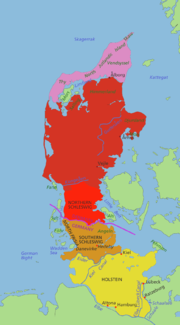
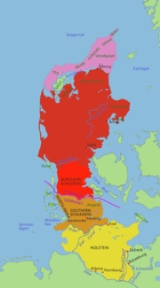
 By the early middle ages the population of Schleswig consisted of Danes to the north of Danevirke
and Schlei and on the peninsula Schwansen
, North Frisians on the west coast below a line slighly south of the present border and on the islands, and Saxon (or Low German) in the far South.
During the 14th century the population on Schwansen began to speak German, but otherwise the ethnic borders remained remarkably stable until around 1800 with the exception of the population in the towns that became increasingly German from the 14th century onwards.
and Canute the Great
settled their mutual border at the Eider. In 1115, king Niels
created his nephew Canute Lavard
- a son of his predecessor Eric I
- Earl
of Schleswig, a title used for only a short time before the recipient began to style himself Duke
. In 1230s, Southern Jutland (Duchy of Slesvig) was allotted as an appanage to Abel Valdemarsen
, Canute's great-grandson, a younger son of Valdemar II of Denmark
. Abel, having wrested the Danish throne to himself for a brief period, left his duchy to his sons and their successors, who pressed claims to the throne of Denmark for much of the next century, so that the Danish kings were at odds with their cousins, the dukes of Slesvig.
Feuds and marital alliances brought the Abel dynasty into a close connection with the German Duchy of Holstein
by the 15th century. The latter was a fief subordinate to the Holy Roman Empire
, while Schleswig remained a Danish fief. These dual loyalties were to become a main root of the dispute between the German states and Denmark in the 19th century, when the ideas of romantic nationalism
and the nation-state
won popular support. The title Duke
of Schleswig was inherited in 1460 by the hereditary kings of Norway who were also regularly elected kings of Denmark simultaneously, and their sons (unlike Denmark which was not hereditary). This was an anomaly – a king holding a ducal title, which he as king was the fount of and its liege lord
. The title and anomaly survived presumably because it was already co-regally held by the king's sons. Between 1544 and 1713/20 the ducal reign had become a condominium, with the royal House of Oldenburg
and its cadet branch House of Holstein-Gottorp
jointly holding the stake. A third branch in the condominium, the short-lived House of Haderslev
, was already extinct in 1580 by the time of John the Elder
.
Following the reformation when latin was replaced as the medium of church service by the vernacular languages, the diocese of Schleswig was divided and an autonomous archdeaconry of Haderslev created. On the west coast the Danish diocese of Ribe stopped about 5 km north of the present border. This created a new cultural dividing line in the duchy because German was used for church services and teaching in the diocese of Schleswig and Danish was used in the diocese of Ribe and the archdeaconry of Haderslev. This line corresponds remarkably well with the present border.
peninsula between Schleswig and Flensburg began to swith to Low German and in the same period many North Frisians also swithed to Low German. This linguistc change created a new de facto dividing line between German and Danish speakers north of Tønder
and south of Flensburg.
From around 1830 large segments of the population began to identify with either German or Danish nationality and mobilized politically. In Denmark the National Liberal Party used the Schleswig Question as part of their agitation and demanded the Duchy incorporated in the Danish kingdom under the slogan "Denmark to the Eider". This caused a conflict between Denmark and the German states over Schleswig and Holstein
which led to the Schleswig-Holstein Question
of the 19th century. When the National Liberals came to power in Denmark in 1848, it provoked an uprising of ethnic Germans who supported Schleswig's ties with Holstein. This led to the First War of Schleswig
. Denmark was victorious and the Prussian troops were ordered to pull out of Schleswig and Holstein following the London Protocol
of 1852.
Denmark again attempted to integrate Schleswig by creating a new common constitution (the so called November Constitution) for Denmark and Schleswig in 1863, but the German Confederation
led by Prussia and Austria defeated the Danes in the Second War of Schleswig
the following year. Prussia and Austria then assumed administration of Schleswig and Holstein respectively under the Gastein Convention
of 14 August 1865. However, tensions between the two powers culminated in the Austro-Prussian War
of 1866. In the Peace of Prague
, the victorious Prussians annexed Schleswig and Holstein, creating the province of Schleswig-Holstein
. Provision for the cession of northern Schleswig to Denmark was made pending a popular vote in favour of this. In 1878, however, Austria went back on this provision, and Denmark in a Treaty of 1907 with Germany recognized that by the agreement between Austria and Prussia the frontier between Prussia and Denmark had finally been settled.
provided for a plebiscite to determine the ownership of the region. Thus two referendum
s were held in 1920 resulting in the partition of the region. Northern Schleswig
joined Denmark, whereas Central Schleswig voted to with a 80% majority to remain part of Germany. In Southern Schleswig no referendum was held as the likely outcome was apparent. The name Southern Schleswig
is now used for all of German Schleswig. This decision left substantial minorities on both sides of the new border.
Following the Second World War a substantial part of the German population in Southern Schleswig changed their nationality and declared themselves as Danish. This change was caused by a number of factors, most importantly the German defeat and the incoming of a large number of refugees from eastern Germany whose culture and appearance differed from the local Germans who were mostly descendents of Danish families that had changed their nationality in the 19th century. The change created a temporary Danish majority in the region and a demand for a new referendum from the Danish population in South Schleswig and some Danish politicians including prime minister Knud Kristensen
. But the majority in the Danish parliament refused to support a referendum in South Schleswig fearing that the "new Danes" were not genuine in their change of nationality. This proved to be the case and from 1948 the Danish population began to shrink again. By the early 1950s it stabilised at a level four times higher than the pre-war number.
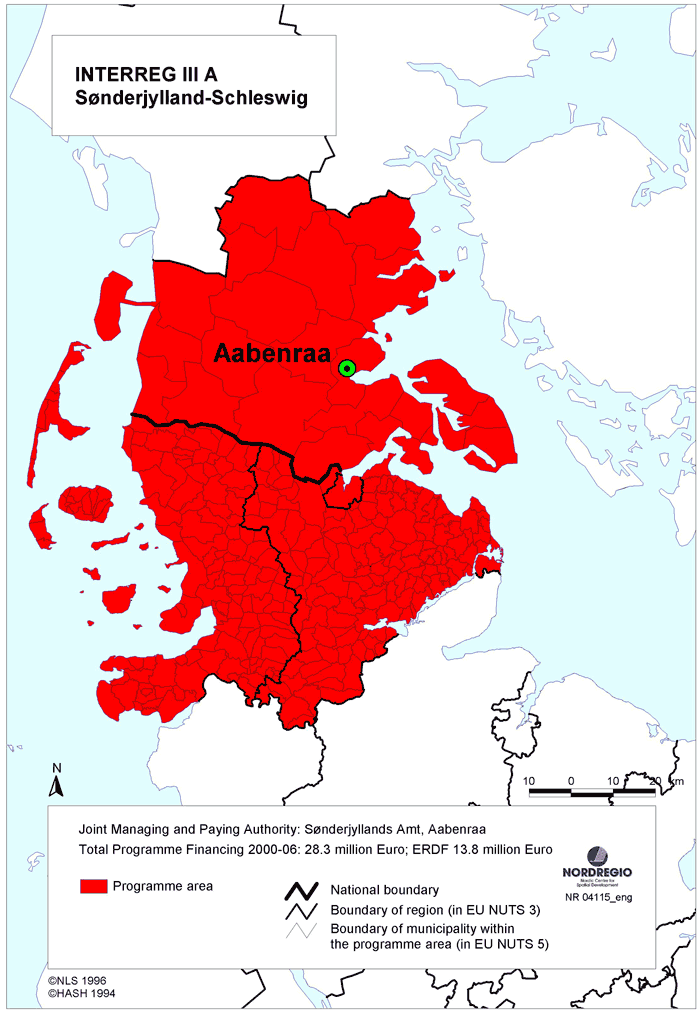
In the Copenhagen-Bonn declaration of 1955 Germany and Denmark promised to uphold the rights of each other's minority population. Today, both parts cooperate as a Euroregion
, despite a national border dividing the former duchy. As Denmark and Germany are both part of the Schengen Area
, there are no controls at the border.
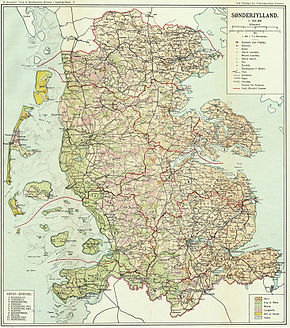
. Its revival and widespread use in the 19th Century therefore had a clear Danish nationalist connotation of laying a claim to the territory and objecting to the German claims. "Olsen's Map", published by the Danish cartographer Olsen in the 1830s that used this term, aroused a storm of protests by the duchys German inhabitants. Even though many Danish nationalists such as the National Liberal ideolouge and agitator
Orla Lehmann
used the name "Schleswig", it began to assume a clear German nationalist character in the mid 19th century – especially when included in the combined term "Schleswig-Holstein". A central element of the German nationalistic claim was the insistence on Schleswig and Holstein being a single, indivisible entity. Since Holstein was legally part of the German Confederation and ethnically entirely German with no Danish population, use of that name implied that both provinces should belong to Germany and their connection with Denmark weakened or altogether severed.
After the German conquest in 1864 the term Sønderjylland became increasingly dominant among the Danish population even though most Danes still had no objection to the use of "Schleswig" as such (it is etymologically of Danish origin) and many of them still used it themselves in its Danish version "Slesvig". An example is the founding of De Nordslesvigske Landboforeninger (The North Schleswig Farmers Association).
The naming dispute was resolved with the 1920 plebiscites and partition, each side applying its preferred name to the part of the territory remaining in its possession – though both terms can in principle still refer to the entire region. Northern Schleswig was after the 1920 plebiscites officially named The South Jutlandic districts (de sønderjyske landsdele), while Southern Schleswig became a part of the German province Schleswig-Holstein
.
Slesvig
Slesvig is the Danish name for:* Schleswig, Schleswig-Holstein, a German city* The former Duchy of Schleswig * A former name for Hedeby, a Viking Age trading center, originally the largest town in the Nordic Countries...
; ; Low German
Low German
Low German or Low Saxon is an Ingvaeonic West Germanic language spoken mainly in northern Germany and the eastern part of the Netherlands...
: Sleswig; North Frisian
North Frisian language
North Frisian is a minority language of Germany, spoken by about 10,000 people in North Frisia. The language is part of the larger group of the West Germanic Frisian languages.-Classification:...
: Slaswik or Sleesweg) is a region covering the area about 60 km north and 70 km south of the border between Germany
Germany
Germany , officially the Federal Republic of Germany , is a federal parliamentary republic in Europe. The country consists of 16 states while the capital and largest city is Berlin. Germany covers an area of 357,021 km2 and has a largely temperate seasonal climate...
and Denmark
Denmark
Denmark is a Scandinavian country in Northern Europe. The countries of Denmark and Greenland, as well as the Faroe Islands, constitute the Kingdom of Denmark . It is the southernmost of the Nordic countries, southwest of Sweden and south of Norway, and bordered to the south by Germany. Denmark...
; the territory has been divided between the two countries since 1920, with Northern Schleswig in Denmark and Southern Schleswig
Southern Schleswig
Southern Schleswig denotes the southern half of the former Duchy of Schleswig on the Jutland Peninsula. The geographical area today covers the thirty or forty northernmost kilometers of Germany up to the Flensburg Fjord, where it borders on Denmark...
in Germany. The region is also known archaically in English
English language
English is a West Germanic language that arose in the Anglo-Saxon kingdoms of England and spread into what was to become south-east Scotland under the influence of the Anglian medieval kingdom of Northumbria...
as Sleswick.
The area's traditional significance lies in the transfer of goods between the North Sea
North Sea
In the southwest, beyond the Straits of Dover, the North Sea becomes the English Channel connecting to the Atlantic Ocean. In the east, it connects to the Baltic Sea via the Skagerrak and Kattegat, narrow straits that separate Denmark from Norway and Sweden respectively...
and the Baltic Sea
Baltic Sea
The Baltic Sea is a brackish mediterranean sea located in Northern Europe, from 53°N to 66°N latitude and from 20°E to 26°E longitude. It is bounded by the Scandinavian Peninsula, the mainland of Europe, and the Danish islands. It drains into the Kattegat by way of the Øresund, the Great Belt and...
, connecting the trade route through Russia
Russia
Russia or , officially known as both Russia and the Russian Federation , is a country in northern Eurasia. It is a federal semi-presidential republic, comprising 83 federal subjects...
with the trade routes along the Rhine and the Atlantic
Atlantic Ocean
The Atlantic Ocean is the second-largest of the world's oceanic divisions. With a total area of about , it covers approximately 20% of the Earth's surface and about 26% of its water surface area...
coast (see also Kiel Canal
Kiel Canal
The Kiel Canal , known as the Kaiser-Wilhelm-Kanal until 1948, is a long canal in the German state of Schleswig-Holstein.The canal links the North Sea at Brunsbüttel to the Baltic Sea at Kiel-Holtenau. An average of is saved by using the Kiel Canal instead of going around the Jutland Peninsula....
).
History
Roman sources place the homeland of the Jute tribeJutes
The Jutes, Iuti, or Iutæ were a Germanic people who, according to Bede, were one of the three most powerful Germanic peoples of their time, the other two being the Saxons and the Angles...
north of the river Eider
Eider River
The Eider is the longest river of the German state of Schleswig-Holstein. The river starts near Bordesholm and reaches the southwestern outskirts of Kiel on the shores of the Baltic Sea, but flows to the west, ending in the North Sea...
and that of the Angles
Angles
The Angles is a modern English term for a Germanic people who took their name from the ancestral cultural region of Angeln, a district located in Schleswig-Holstein, Germany...
to its south who in turn abutted the neighbouring Saxons
Saxons
The Saxons were a confederation of Germanic tribes originating on the North German plain. The Saxons earliest known area of settlement is Northern Albingia, an area approximately that of modern Holstein...
. Towards the end of the Early Middle Ages
Early Middle Ages
The Early Middle Ages was the period of European history lasting from the 5th century to approximately 1000. The Early Middle Ages followed the decline of the Western Roman Empire and preceded the High Middle Ages...
, Schleswig formed part of the historical Lands of Denmark
Lands of Denmark
The three lands of Denmark historically formed the Danish kingdom from its unification and consolidation in the 9th century:*Zealand and the islands south of it, with Roskilde as a centre...
as Denmark unified out of a number of petty chiefdoms in the 8th to 10th centuries (The heyday of the Viking incursions).
During the early Viking Age
Viking Age
Viking Age is the term for the period in European history, especially Northern European and Scandinavian history, spanning the late 8th to 11th centuries. Scandinavian Vikings explored Europe by its oceans and rivers through trade and warfare. The Vikings also reached Iceland, Greenland,...
, Haithabu - Scandinavia's biggest trading centre - was located in this region, which is also the location of the Danewerk. This construction, and in particular its great expansion around 737, has been interpreted as an indication of the emergence of a unified Danish state.
In May 1931 scientists of the National Museum of Denmark
National Museum of Denmark
The National Museum of Denmark in Copenhagen is Denmark’s largest museum of cultural history, comprising the histories of Danish and foreign cultures, alike. The museum's main domicile is located a short distance from Strøget at the center of Copenhagen. It contains exhibits from around the world,...
announced the finding of eighteen Viking graves with the remains of eighteen men in them. The discovery came during excavations in Schleswig. The skeletons indicated that the men were bigger proportioned than twentieth-century Danish
Denmark
Denmark is a Scandinavian country in Northern Europe. The countries of Denmark and Greenland, as well as the Faroe Islands, constitute the Kingdom of Denmark . It is the southernmost of the Nordic countries, southwest of Sweden and south of Norway, and bordered to the south by Germany. Denmark...
men. Each of the graves was laid out from east to west. Researchers surmised that the bodies were entombed in wooden coffins originally, but only the iron nails remained.
During the 10th century, ownership over the region between the Eider River
Eider River
The Eider is the longest river of the German state of Schleswig-Holstein. The river starts near Bordesholm and reaches the southwestern outskirts of Kiel on the shores of the Baltic Sea, but flows to the west, ending in the North Sea...
and the Danevirke became a source of dispute between the Holy Roman Empire
Holy Roman Empire
The Holy Roman Empire was a realm that existed from 962 to 1806 in Central Europe.It was ruled by the Holy Roman Emperor. Its character changed during the Middle Ages and the Early Modern period, when the power of the emperor gradually weakened in favour of the princes...
and Denmark, resulting in several wars. In 974, Otto II, Holy Roman Emperor
Otto II, Holy Roman Emperor
Otto II , called the Red, was the third ruler of the Saxon or Ottonian dynasty, the son of Otto the Great and Adelaide of Italy.-Early years and co-ruler with Otto I:...
concluded a successful campaign by erecting a fortress, which was razed to the ground by Sweyn Forkbeard
Sweyn I of Denmark
Sweyn I Forkbeard was king of Denmark and England, as well as parts of Norway. His name appears as Swegen in the Anglo-Saxon Chronicle and he is also known in English as Svein, Swein, Sven the Dane, and Tuck.He was a Viking leader and the father of Cnut the Great...
in 983.
Schleswig or South Jutland ( or Slesvig
Slesvig
Slesvig is the Danish name for:* Schleswig, Schleswig-Holstein, a German city* The former Duchy of Schleswig * A former name for Hedeby, a Viking Age trading center, originally the largest town in the Nordic Countries...
; ; Low German
Low German
Low German or Low Saxon is an Ingvaeonic West Germanic language spoken mainly in northern Germany and the eastern part of the Netherlands...
: Sleswig; North Frisian
North Frisian language
North Frisian is a minority language of Germany, spoken by about 10,000 people in North Frisia. The language is part of the larger group of the West Germanic Frisian languages.-Classification:...
: Slaswik or Sleesweg) is a region covering the area about 60 km north and 70 km south of the border between Germany
Germany
Germany , officially the Federal Republic of Germany , is a federal parliamentary republic in Europe. The country consists of 16 states while the capital and largest city is Berlin. Germany covers an area of 357,021 km2 and has a largely temperate seasonal climate...
and Denmark
Denmark
Denmark is a Scandinavian country in Northern Europe. The countries of Denmark and Greenland, as well as the Faroe Islands, constitute the Kingdom of Denmark . It is the southernmost of the Nordic countries, southwest of Sweden and south of Norway, and bordered to the south by Germany. Denmark...
; the territory has been divided between the two countries since 1920, with Northern Schleswig in Denmark and Southern Schleswig
Southern Schleswig
Southern Schleswig denotes the southern half of the former Duchy of Schleswig on the Jutland Peninsula. The geographical area today covers the thirty or forty northernmost kilometers of Germany up to the Flensburg Fjord, where it borders on Denmark...
in Germany. The region is also known archaically in English
English language
English is a West Germanic language that arose in the Anglo-Saxon kingdoms of England and spread into what was to become south-east Scotland under the influence of the Anglian medieval kingdom of Northumbria...
as Sleswick.
The area's traditional significance lies in the transfer of goods between the North Sea
North Sea
In the southwest, beyond the Straits of Dover, the North Sea becomes the English Channel connecting to the Atlantic Ocean. In the east, it connects to the Baltic Sea via the Skagerrak and Kattegat, narrow straits that separate Denmark from Norway and Sweden respectively...
and the Baltic Sea
Baltic Sea
The Baltic Sea is a brackish mediterranean sea located in Northern Europe, from 53°N to 66°N latitude and from 20°E to 26°E longitude. It is bounded by the Scandinavian Peninsula, the mainland of Europe, and the Danish islands. It drains into the Kattegat by way of the Øresund, the Great Belt and...
, connecting the trade route through Russia
Russia
Russia or , officially known as both Russia and the Russian Federation , is a country in northern Eurasia. It is a federal semi-presidential republic, comprising 83 federal subjects...
with the trade routes along the Rhine and the Atlantic
Atlantic Ocean
The Atlantic Ocean is the second-largest of the world's oceanic divisions. With a total area of about , it covers approximately 20% of the Earth's surface and about 26% of its water surface area...
coast (see also Kiel Canal
Kiel Canal
The Kiel Canal , known as the Kaiser-Wilhelm-Kanal until 1948, is a long canal in the German state of Schleswig-Holstein.The canal links the North Sea at Brunsbüttel to the Baltic Sea at Kiel-Holtenau. An average of is saved by using the Kiel Canal instead of going around the Jutland Peninsula....
).
History
Roman sources place the homeland of the Jute tribeJutes
The Jutes, Iuti, or Iutæ were a Germanic people who, according to Bede, were one of the three most powerful Germanic peoples of their time, the other two being the Saxons and the Angles...
north of the river Eider
Eider River
The Eider is the longest river of the German state of Schleswig-Holstein. The river starts near Bordesholm and reaches the southwestern outskirts of Kiel on the shores of the Baltic Sea, but flows to the west, ending in the North Sea...
and that of the Angles
Angles
The Angles is a modern English term for a Germanic people who took their name from the ancestral cultural region of Angeln, a district located in Schleswig-Holstein, Germany...
to its south who in turn abutted the neighbouring Saxons
Saxons
The Saxons were a confederation of Germanic tribes originating on the North German plain. The Saxons earliest known area of settlement is Northern Albingia, an area approximately that of modern Holstein...
. Towards the end of the Early Middle Ages
Early Middle Ages
The Early Middle Ages was the period of European history lasting from the 5th century to approximately 1000. The Early Middle Ages followed the decline of the Western Roman Empire and preceded the High Middle Ages...
, Schleswig formed part of the historical Lands of Denmark
Lands of Denmark
The three lands of Denmark historically formed the Danish kingdom from its unification and consolidation in the 9th century:*Zealand and the islands south of it, with Roskilde as a centre...
as Denmark unified out of a number of petty chiefdoms in the 8th to 10th centuries (The heyday of the Viking incursions).
During the early Viking Age
Viking Age
Viking Age is the term for the period in European history, especially Northern European and Scandinavian history, spanning the late 8th to 11th centuries. Scandinavian Vikings explored Europe by its oceans and rivers through trade and warfare. The Vikings also reached Iceland, Greenland,...
, Haithabu - Scandinavia's biggest trading centre - was located in this region, which is also the location of the Danewerk. This construction, and in particular its great expansion around 737, has been interpreted as an indication of the emergence of a unified Danish state.
In May 1931 scientists of the National Museum of Denmark
National Museum of Denmark
The National Museum of Denmark in Copenhagen is Denmark’s largest museum of cultural history, comprising the histories of Danish and foreign cultures, alike. The museum's main domicile is located a short distance from Strøget at the center of Copenhagen. It contains exhibits from around the world,...
announced the finding of eighteen Viking graves with the remains of eighteen men in them. The discovery came during excavations in Schleswig. The skeletons indicated that the men were bigger proportioned than twentieth-century Danish
Denmark
Denmark is a Scandinavian country in Northern Europe. The countries of Denmark and Greenland, as well as the Faroe Islands, constitute the Kingdom of Denmark . It is the southernmost of the Nordic countries, southwest of Sweden and south of Norway, and bordered to the south by Germany. Denmark...
men. Each of the graves was laid out from east to west. Researchers surmised that the bodies were entombed in wooden coffins originally, but only the iron nails remained.
During the 10th century, ownership over the region between the Eider River
Eider River
The Eider is the longest river of the German state of Schleswig-Holstein. The river starts near Bordesholm and reaches the southwestern outskirts of Kiel on the shores of the Baltic Sea, but flows to the west, ending in the North Sea...
and the Danevirke became a source of dispute between the Holy Roman Empire
Holy Roman Empire
The Holy Roman Empire was a realm that existed from 962 to 1806 in Central Europe.It was ruled by the Holy Roman Emperor. Its character changed during the Middle Ages and the Early Modern period, when the power of the emperor gradually weakened in favour of the princes...
and Denmark, resulting in several wars. In 974, Otto II, Holy Roman Emperor
Otto II, Holy Roman Emperor
Otto II , called the Red, was the third ruler of the Saxon or Ottonian dynasty, the son of Otto the Great and Adelaide of Italy.-Early years and co-ruler with Otto I:...
concluded a successful campaign by erecting a fortress, which was razed to the ground by Sweyn Forkbeard
Sweyn I of Denmark
Sweyn I Forkbeard was king of Denmark and England, as well as parts of Norway. His name appears as Swegen in the Anglo-Saxon Chronicle and he is also known in English as Svein, Swein, Sven the Dane, and Tuck.He was a Viking leader and the father of Cnut the Great...
in 983.
Schleswig or South Jutland ( or Slesvig
Slesvig
Slesvig is the Danish name for:* Schleswig, Schleswig-Holstein, a German city* The former Duchy of Schleswig * A former name for Hedeby, a Viking Age trading center, originally the largest town in the Nordic Countries...
; ; Low German
Low German
Low German or Low Saxon is an Ingvaeonic West Germanic language spoken mainly in northern Germany and the eastern part of the Netherlands...
: Sleswig; North Frisian
North Frisian language
North Frisian is a minority language of Germany, spoken by about 10,000 people in North Frisia. The language is part of the larger group of the West Germanic Frisian languages.-Classification:...
: Slaswik or Sleesweg) is a region covering the area about 60 km north and 70 km south of the border between Germany
Germany
Germany , officially the Federal Republic of Germany , is a federal parliamentary republic in Europe. The country consists of 16 states while the capital and largest city is Berlin. Germany covers an area of 357,021 km2 and has a largely temperate seasonal climate...
and Denmark
Denmark
Denmark is a Scandinavian country in Northern Europe. The countries of Denmark and Greenland, as well as the Faroe Islands, constitute the Kingdom of Denmark . It is the southernmost of the Nordic countries, southwest of Sweden and south of Norway, and bordered to the south by Germany. Denmark...
; the territory has been divided between the two countries since 1920, with Northern Schleswig in Denmark and Southern Schleswig
Southern Schleswig
Southern Schleswig denotes the southern half of the former Duchy of Schleswig on the Jutland Peninsula. The geographical area today covers the thirty or forty northernmost kilometers of Germany up to the Flensburg Fjord, where it borders on Denmark...
in Germany. The region is also known archaically in English
English language
English is a West Germanic language that arose in the Anglo-Saxon kingdoms of England and spread into what was to become south-east Scotland under the influence of the Anglian medieval kingdom of Northumbria...
as Sleswick.
The area's traditional significance lies in the transfer of goods between the North Sea
North Sea
In the southwest, beyond the Straits of Dover, the North Sea becomes the English Channel connecting to the Atlantic Ocean. In the east, it connects to the Baltic Sea via the Skagerrak and Kattegat, narrow straits that separate Denmark from Norway and Sweden respectively...
and the Baltic Sea
Baltic Sea
The Baltic Sea is a brackish mediterranean sea located in Northern Europe, from 53°N to 66°N latitude and from 20°E to 26°E longitude. It is bounded by the Scandinavian Peninsula, the mainland of Europe, and the Danish islands. It drains into the Kattegat by way of the Øresund, the Great Belt and...
, connecting the trade route through Russia
Russia
Russia or , officially known as both Russia and the Russian Federation , is a country in northern Eurasia. It is a federal semi-presidential republic, comprising 83 federal subjects...
with the trade routes along the Rhine and the Atlantic
Atlantic Ocean
The Atlantic Ocean is the second-largest of the world's oceanic divisions. With a total area of about , it covers approximately 20% of the Earth's surface and about 26% of its water surface area...
coast (see also Kiel Canal
Kiel Canal
The Kiel Canal , known as the Kaiser-Wilhelm-Kanal until 1948, is a long canal in the German state of Schleswig-Holstein.The canal links the North Sea at Brunsbüttel to the Baltic Sea at Kiel-Holtenau. An average of is saved by using the Kiel Canal instead of going around the Jutland Peninsula....
).
History
Roman sources place the homeland of the Jute tribeJutes
The Jutes, Iuti, or Iutæ were a Germanic people who, according to Bede, were one of the three most powerful Germanic peoples of their time, the other two being the Saxons and the Angles...
north of the river Eider
Eider River
The Eider is the longest river of the German state of Schleswig-Holstein. The river starts near Bordesholm and reaches the southwestern outskirts of Kiel on the shores of the Baltic Sea, but flows to the west, ending in the North Sea...
and that of the Angles
Angles
The Angles is a modern English term for a Germanic people who took their name from the ancestral cultural region of Angeln, a district located in Schleswig-Holstein, Germany...
to its south who in turn abutted the neighbouring Saxons
Saxons
The Saxons were a confederation of Germanic tribes originating on the North German plain. The Saxons earliest known area of settlement is Northern Albingia, an area approximately that of modern Holstein...
. Towards the end of the Early Middle Ages
Early Middle Ages
The Early Middle Ages was the period of European history lasting from the 5th century to approximately 1000. The Early Middle Ages followed the decline of the Western Roman Empire and preceded the High Middle Ages...
, Schleswig formed part of the historical Lands of Denmark
Lands of Denmark
The three lands of Denmark historically formed the Danish kingdom from its unification and consolidation in the 9th century:*Zealand and the islands south of it, with Roskilde as a centre...
as Denmark unified out of a number of petty chiefdoms in the 8th to 10th centuries (The heyday of the Viking incursions).
During the early Viking Age
Viking Age
Viking Age is the term for the period in European history, especially Northern European and Scandinavian history, spanning the late 8th to 11th centuries. Scandinavian Vikings explored Europe by its oceans and rivers through trade and warfare. The Vikings also reached Iceland, Greenland,...
, Haithabu - Scandinavia's biggest trading centre - was located in this region, which is also the location of the Danewerk. This construction, and in particular its great expansion around 737, has been interpreted as an indication of the emergence of a unified Danish state.
In May 1931 scientists of the National Museum of Denmark
National Museum of Denmark
The National Museum of Denmark in Copenhagen is Denmark’s largest museum of cultural history, comprising the histories of Danish and foreign cultures, alike. The museum's main domicile is located a short distance from Strøget at the center of Copenhagen. It contains exhibits from around the world,...
announced the finding of eighteen Viking graves with the remains of eighteen men in them. The discovery came during excavations in Schleswig. The skeletons indicated that the men were bigger proportioned than twentieth-century Danish
Denmark
Denmark is a Scandinavian country in Northern Europe. The countries of Denmark and Greenland, as well as the Faroe Islands, constitute the Kingdom of Denmark . It is the southernmost of the Nordic countries, southwest of Sweden and south of Norway, and bordered to the south by Germany. Denmark...
men. Each of the graves was laid out from east to west. Researchers surmised that the bodies were entombed in wooden coffins originally, but only the iron nails remained.
During the 10th century, ownership over the region between the Eider River
Eider River
The Eider is the longest river of the German state of Schleswig-Holstein. The river starts near Bordesholm and reaches the southwestern outskirts of Kiel on the shores of the Baltic Sea, but flows to the west, ending in the North Sea...
and the Danevirke became a source of dispute between the Holy Roman Empire
Holy Roman Empire
The Holy Roman Empire was a realm that existed from 962 to 1806 in Central Europe.It was ruled by the Holy Roman Emperor. Its character changed during the Middle Ages and the Early Modern period, when the power of the emperor gradually weakened in favour of the princes...
and Denmark, resulting in several wars. In 974, Otto II, Holy Roman Emperor
Otto II, Holy Roman Emperor
Otto II , called the Red, was the third ruler of the Saxon or Ottonian dynasty, the son of Otto the Great and Adelaide of Italy.-Early years and co-ruler with Otto I:...
concluded a successful campaign by erecting a fortress, which was razed to the ground by Sweyn Forkbeard
Sweyn I of Denmark
Sweyn I Forkbeard was king of Denmark and England, as well as parts of Norway. His name appears as Swegen in the Anglo-Saxon Chronicle and he is also known in English as Svein, Swein, Sven the Dane, and Tuck.He was a Viking leader and the father of Cnut the Great...
in 983.
Danevirke
The Danevirke The Danevirke The Danevirke (modern Danish spelling: Dannevirke; in Old Norse Danavirki ; in German Danewerk ; is a system of Danish fortifications in Schleswig-Holstein (Northern Germany). This important linear defensive earthwork was constructed across the neck of the Cimbrian...
and Schlei and on the peninsula Schwansen
Schwansen
Schwansen is a peninsula in Schleswig-Holstein, Germany, protruding into the Baltic Sea. It is located between the Eckernförde Bay in the south and the Schlei inlet in the north....
, North Frisians on the west coast below a line slighly south of the present border and on the islands, and Saxon (or Low German) in the far South.
During the 14th century the population on Schwansen began to speak German, but otherwise the ethnic borders remained remarkably stable until around 1800 with the exception of the population in the towns that became increasingly German from the 14th century onwards.
High Middle Ages
In 1027, Conrad IIConrad II, Holy Roman Emperor
Conrad II was Holy Roman Emperor from 1027 until his death.The son of a mid-level nobleman in Franconia, Count Henry of Speyer and Adelaide of Alsace, he inherited the titles of count of Speyer and of Worms as an infant when Henry died at age twenty...
and Canute the Great
Canute the Great
Cnut the Great , also known as Canute, was a king of Denmark, England, Norway and parts of Sweden. Though after the death of his heirs within a decade of his own and the Norman conquest of England in 1066, his legacy was largely lost to history, historian Norman F...
settled their mutual border at the Eider. In 1115, king Niels
Niels of Denmark
Niels of Denmark was King of Denmark from 1104 to 1134, following his brother Eric Evergood, and is presumed to have been the youngest son of king Sweyn II Estridson. Niels actively supported the canonization of Canute IV the Holy, and his secular rule was supported by the clergy...
created his nephew Canute Lavard
Canute Lavard
Canute Lavard was a Danish prince. Later he was the first Duke of Schleswig and the first border prince who was both a Danish and a German vassal, a position leafing towards the historical double position of Southern Jutland...
- a son of his predecessor Eric I
Eric I of Denmark
Eric I Evergood , also known as Eric the Good, , was King of Denmark following his brother Olaf I Hunger in 1095. He was a son of king Sweyn II Estridsson, by his wife Gunhild Sveinsdotter, and married Boedil Thurgotsdatter.-Biography:...
- Earl
Earl
An earl is a member of the nobility. The title is Anglo-Saxon, akin to the Scandinavian form jarl, and meant "chieftain", particularly a chieftain set to rule a territory in a king's stead. In Scandinavia, it became obsolete in the Middle Ages and was replaced with duke...
of Schleswig, a title used for only a short time before the recipient began to style himself Duke
Duke
A duke or duchess is a member of the nobility, historically of highest rank below the monarch, and historically controlling a duchy...
. In 1230s, Southern Jutland (Duchy of Slesvig) was allotted as an appanage to Abel Valdemarsen
Abel of Denmark
Abel of Denmark was Duke of Schleswig from 1232 to 1252 and King of Denmark from 1250 until his death in 1252. He was the son of Valdemar II by his second wife, Infanta Berengária of Portugal, and brother to Eric IV and Christopher I....
, Canute's great-grandson, a younger son of Valdemar II of Denmark
Valdemar II of Denmark
Valdemar II , called Valdemar the Victorious or Valdemar the Conqueror , was the King of Denmark from 1202 until his death in 1241. The nickname Sejr is a later invention and was not used during the King's own lifetime...
. Abel, having wrested the Danish throne to himself for a brief period, left his duchy to his sons and their successors, who pressed claims to the throne of Denmark for much of the next century, so that the Danish kings were at odds with their cousins, the dukes of Slesvig.
Early modern times
Feuds and marital alliances brought the Abel dynasty into a close connection with the German Duchy of Holstein
Holstein-Glückstadt
The Duchy of Holstein in Glückstadt was the northernmost state of the Holy Roman Empire. It consisted of the part of Holstein that was ruled by the king of Denmark; its capital was Glückstadt on the River Elbe.-History:...
by the 15th century. The latter was a fief subordinate to the Holy Roman Empire
Holy Roman Empire
The Holy Roman Empire was a realm that existed from 962 to 1806 in Central Europe.It was ruled by the Holy Roman Emperor. Its character changed during the Middle Ages and the Early Modern period, when the power of the emperor gradually weakened in favour of the princes...
, while Schleswig remained a Danish fief. These dual loyalties were to become a main root of the dispute between the German states and Denmark in the 19th century, when the ideas of romantic nationalism
Romantic nationalism
Romantic nationalism is the form of nationalism in which the state derives its political legitimacy as an organic consequence of the unity of those it governs...
and the nation-state
Nation-state
The nation state is a state that self-identifies as deriving its political legitimacy from serving as a sovereign entity for a nation as a sovereign territorial unit. The state is a political and geopolitical entity; the nation is a cultural and/or ethnic entity...
won popular support. The title Duke
Duke
A duke or duchess is a member of the nobility, historically of highest rank below the monarch, and historically controlling a duchy...
of Schleswig was inherited in 1460 by the hereditary kings of Norway who were also regularly elected kings of Denmark simultaneously, and their sons (unlike Denmark which was not hereditary). This was an anomaly – a king holding a ducal title, which he as king was the fount of and its liege lord
Liege Lord
Liege Lord was an American speed/power metal band, active in the 1980s and considered to be a pioneer of the genre. It was formed by Matt Vinci, Anthony Truglio and Frank Cortese....
. The title and anomaly survived presumably because it was already co-regally held by the king's sons. Between 1544 and 1713/20 the ducal reign had become a condominium, with the royal House of Oldenburg
House of Oldenburg
The House of Oldenburg is a North German dynasty and one of Europe's most influential Royal Houses with branches that rule or have ruled in Denmark, Russia, Greece, Norway, Schleswig, Holstein, Oldenburg and Sweden...
and its cadet branch House of Holstein-Gottorp
House of Holstein-Gottorp
The House of Holstein-Gottorp, a cadet branch of the Oldenburg dynasty, ruled Sweden from 1751 until 1818, and Norway from 1814 to 1818.In 1743 Adolf Frederick of Holstein-Gottorp was elected crown prince of Sweden as a Swedish concession to Russia, a strategy for achieving an acceptable peace...
jointly holding the stake. A third branch in the condominium, the short-lived House of Haderslev
Schleswig-Holstein-Haderslev
Schleswig-Holstein-Hadersleben was a branch line of the House of Oldenburg, and of the territory held by the Duke of this branch.It was founded in 1544 by John II, as was compensated for not inheriting the Danish throne, with parts of Schleswig and Holstein...
, was already extinct in 1580 by the time of John the Elder
John II, Duke of Schleswig-Holstein-Haderslev
John the Elder was the only Duke of Schleswig-Holstein-Haderslev. The predicate the Elder is sometimes used to distinguish him from his nephew John the Younger, who held Sønderborg from 1564 as a partitioned-off duke...
.
Following the reformation when latin was replaced as the medium of church service by the vernacular languages, the diocese of Schleswig was divided and an autonomous archdeaconry of Haderslev created. On the west coast the Danish diocese of Ribe stopped about 5 km north of the present border. This created a new cultural dividing line in the duchy because German was used for church services and teaching in the diocese of Schleswig and Danish was used in the diocese of Ribe and the archdeaconry of Haderslev. This line corresponds remarkably well with the present border.
19th century and the rise of nationalism
From around 1800 to 1840 the Danish speaking population on the AngelAngel
Angels are mythical beings often depicted as messengers of God in the Hebrew and Christian Bibles along with the Quran. The English word angel is derived from the Greek ἄγγελος, a translation of in the Hebrew Bible ; a similar term, ملائكة , is used in the Qur'an...
peninsula between Schleswig and Flensburg began to swith to Low German and in the same period many North Frisians also swithed to Low German. This linguistc change created a new de facto dividing line between German and Danish speakers north of Tønder
Tønder
Tønder is a municipality in Region of Southern Denmark on the Jutland peninsula in south Denmark. The municipality covers an area of 1,278 km², and has a total population of 40,367...
and south of Flensburg.
From around 1830 large segments of the population began to identify with either German or Danish nationality and mobilized politically. In Denmark the National Liberal Party used the Schleswig Question as part of their agitation and demanded the Duchy incorporated in the Danish kingdom under the slogan "Denmark to the Eider". This caused a conflict between Denmark and the German states over Schleswig and Holstein
Holstein
Holstein is the region between the rivers Elbe and Eider. It is part of Schleswig-Holstein, the northernmost state of Germany....
which led to the Schleswig-Holstein Question
Schleswig-Holstein Question
The Schleswig-Holstein Question was a complex of diplomatic and other issues arising in the 19th century from the relations of two duchies, Schleswig and Holstein , to the Danish crown and to the German Confederation....
of the 19th century. When the National Liberals came to power in Denmark in 1848, it provoked an uprising of ethnic Germans who supported Schleswig's ties with Holstein. This led to the First War of Schleswig
First War of Schleswig
The First Schleswig War or Three Years' War was the first round of military conflict in southern Denmark and northern Germany rooted in the Schleswig-Holstein Question, contesting the issue of who should control the Duchies of Schleswig and Holstein. The war, which lasted from 1848–1851,...
. Denmark was victorious and the Prussian troops were ordered to pull out of Schleswig and Holstein following the London Protocol
London Protocol
-1814:On June 21, 1814, a secret convention between the Great Powers: United Kingdom of Great Britain and Ireland, Prussia, Austria, and Russia awarded the territory of current Belgium and the Netherlands to William I of the Netherlands, then "Sovereign Prince" of the United Netherlands...
of 1852.
Denmark again attempted to integrate Schleswig by creating a new common constitution (the so called November Constitution) for Denmark and Schleswig in 1863, but the German Confederation
German Confederation
The German Confederation was the loose association of Central European states created by the Congress of Vienna in 1815 to coordinate the economies of separate German-speaking countries. It acted as a buffer between the powerful states of Austria and Prussia...
led by Prussia and Austria defeated the Danes in the Second War of Schleswig
Second War of Schleswig
The Second Schleswig War was the second military conflict as a result of the Schleswig-Holstein Question. It began on 1 February 1864, when Prussian forces crossed the border into Schleswig.Denmark fought Prussia and Austria...
the following year. Prussia and Austria then assumed administration of Schleswig and Holstein respectively under the Gastein Convention
Gastein Convention
In diplomacy, the Gastein Convention, also called the Convention of Badgastein, a treaty signed at Bad Gastein in Austria on August 20, 1865, embodied agreements between the two principal powers of the German Confederation, Prussia and Austria, over the governing of the provinces of Schleswig and...
of 14 August 1865. However, tensions between the two powers culminated in the Austro-Prussian War
Austro-Prussian War
The Austro-Prussian War was a war fought in 1866 between the German Confederation under the leadership of the Austrian Empire and its German allies on one side and the Kingdom of Prussia with its German allies and Italy on the...
of 1866. In the Peace of Prague
Peace of Prague (1866)
The Peace of Prague was a peace treaty signed at Prague on 23 August 1866, which ended the Austro-Prussian War. The treaty was lenient toward the Austrian Empire because Otto von Bismarck had persuaded William I that maintaining Austria's place in Europe would be better in the future for Prussia...
, the victorious Prussians annexed Schleswig and Holstein, creating the province of Schleswig-Holstein
Province of Schleswig-Holstein
The Province of Schleswig-Holstein was a province of the Kingdom of Prussia and the Free State of Prussia from 1868 to 1946. It was created from the Duchies of Schleswig and Holstein, which had been conquered by Prussia and the Austrian Empire from Denmark in the Second War of Schleswig in 1864...
. Provision for the cession of northern Schleswig to Denmark was made pending a popular vote in favour of this. In 1878, however, Austria went back on this provision, and Denmark in a Treaty of 1907 with Germany recognized that by the agreement between Austria and Prussia the frontier between Prussia and Denmark had finally been settled.
Modern times
The Treaty of VersaillesTreaty of Versailles
The Treaty of Versailles was one of the peace treaties at the end of World War I. It ended the state of war between Germany and the Allied Powers. It was signed on 28 June 1919, exactly five years after the assassination of Archduke Franz Ferdinand. The other Central Powers on the German side of...
provided for a plebiscite to determine the ownership of the region. Thus two referendum
Referendum
A referendum is a direct vote in which an entire electorate is asked to either accept or reject a particular proposal. This may result in the adoption of a new constitution, a constitutional amendment, a law, the recall of an elected official or simply a specific government policy. It is a form of...
s were held in 1920 resulting in the partition of the region. Northern Schleswig
South Jutland County
South Jutland County is a former county on the south-central portion of the Jutland Peninsula in southern Denmark....
joined Denmark, whereas Central Schleswig voted to with a 80% majority to remain part of Germany. In Southern Schleswig no referendum was held as the likely outcome was apparent. The name Southern Schleswig
Southern Schleswig
Southern Schleswig denotes the southern half of the former Duchy of Schleswig on the Jutland Peninsula. The geographical area today covers the thirty or forty northernmost kilometers of Germany up to the Flensburg Fjord, where it borders on Denmark...
is now used for all of German Schleswig. This decision left substantial minorities on both sides of the new border.
Following the Second World War a substantial part of the German population in Southern Schleswig changed their nationality and declared themselves as Danish. This change was caused by a number of factors, most importantly the German defeat and the incoming of a large number of refugees from eastern Germany whose culture and appearance differed from the local Germans who were mostly descendents of Danish families that had changed their nationality in the 19th century. The change created a temporary Danish majority in the region and a demand for a new referendum from the Danish population in South Schleswig and some Danish politicians including prime minister Knud Kristensen
Knud Kristensen
Knud Kristensen was Prime Minister of Denmark 7 November 1945 to 13 November 1947 in the first elected government after the German occupation of Denmark during World War II. After the October 1945 election Knud Kristensen formed the Cabinet of Knud Kristensen, a minority government consisting...
. But the majority in the Danish parliament refused to support a referendum in South Schleswig fearing that the "new Danes" were not genuine in their change of nationality. This proved to be the case and from 1948 the Danish population began to shrink again. By the early 1950s it stabilised at a level four times higher than the pre-war number.
In the Copenhagen-Bonn declaration of 1955 Germany and Denmark promised to uphold the rights of each other's minority population. Today, both parts cooperate as a Euroregion
Euroregion
In European politics, the term Euroregion usually refers to a transnational co-operation structure between two contiguous territories located in different European countries. Euroregions represent a specific type of cross-border region.-Scope:...
, despite a national border dividing the former duchy. As Denmark and Germany are both part of the Schengen Area
Schengen Area
The Schengen Area comprises the territories of twenty-five European countries that have implemented the Schengen Agreement signed in the town of Schengen, Luxembourg, in 1985...
, there are no controls at the border.
Dukes and rulers
Name and naming dispute
In the 19th century, there was a naming dispute concerning the use of Schleswig or Slesvig and Sønderjylland (South Jutland). Originally the duchy was called Sønderjylland (South Jutland) but in the late 14th century the name of the city Slesvig (now Schleswig) started to be used for the whole territory. The term "Sønderjylland" was hardly used between the 16th and 19th centuries, and in this period the name "Schleswig" had no special political connotations. But around 1830 some Danes started to reintroduce the archaic term Sønderjylland to emphasize the areas history before its association with Holstein and its connection to the rest of JutlandJutland
Jutland , historically also called Cimbria, is the name of the peninsula that juts out in Northern Europe toward the rest of Scandinavia, forming the mainland part of Denmark. It has the North Sea to its west, Kattegat and Skagerrak to its north, the Baltic Sea to its east, and the Danish–German...
. Its revival and widespread use in the 19th Century therefore had a clear Danish nationalist connotation of laying a claim to the territory and objecting to the German claims. "Olsen's Map", published by the Danish cartographer Olsen in the 1830s that used this term, aroused a storm of protests by the duchys German inhabitants. Even though many Danish nationalists such as the National Liberal ideolouge and agitator
Agitator
An agitator is a person who actively supports some ideology or movement with speeches and especially actions. The Agitators were a political movement as well as elected representatives of soldiers, including the New Model Army of Oliver Cromwell, during the English Civil War. They were also known...
Orla Lehmann
Orla Lehmann
Peter Martin Orla Lehmann was a Danish statesman, a key figure in the development of Denmark's parliamentary government....
used the name "Schleswig", it began to assume a clear German nationalist character in the mid 19th century – especially when included in the combined term "Schleswig-Holstein". A central element of the German nationalistic claim was the insistence on Schleswig and Holstein being a single, indivisible entity. Since Holstein was legally part of the German Confederation and ethnically entirely German with no Danish population, use of that name implied that both provinces should belong to Germany and their connection with Denmark weakened or altogether severed.
After the German conquest in 1864 the term Sønderjylland became increasingly dominant among the Danish population even though most Danes still had no objection to the use of "Schleswig" as such (it is etymologically of Danish origin) and many of them still used it themselves in its Danish version "Slesvig". An example is the founding of De Nordslesvigske Landboforeninger (The North Schleswig Farmers Association).
The naming dispute was resolved with the 1920 plebiscites and partition, each side applying its preferred name to the part of the territory remaining in its possession – though both terms can in principle still refer to the entire region. Northern Schleswig was after the 1920 plebiscites officially named The South Jutlandic districts (de sønderjyske landsdele), while Southern Schleswig became a part of the German province Schleswig-Holstein
Schleswig-Holstein
Schleswig-Holstein is the northernmost of the sixteen states of Germany, comprising most of the historical duchy of Holstein and the southern part of the former Duchy of Schleswig...
.
See also
- Coat of arms of SchleswigCoat of arms of SchleswigThe coat of arms of Schleswig depicts two blue lions in a golden shield. It is the heraldic symbol of the former Duchy of Schleswig, originally a Danish province but later disputed between Danes and Germans. The region has been divided between Germany and Denmark since 1920 and the symbol...
- DanevirkeDanevirkeThe Danevirke The Danevirke The Danevirke (modern Danish spelling: Dannevirke; in Old Norse Danavirki ; in German Danewerk ; is a system of Danish fortifications in Schleswig-Holstein (Northern Germany). This important linear defensive earthwork was constructed across the neck of the Cimbrian...
- German BightGerman BightGerman Bight is the southeastern bight of the North Sea bounded by the Netherlands and Germany to the south, and Denmark and Germany to the east . To the north and west it is limited by the Dogger Bank. The Bight contains the Frisian and Danish Islands. The Wadden Sea is approximately ten to...
- JutlandJutlandJutland , historically also called Cimbria, is the name of the peninsula that juts out in Northern Europe toward the rest of Scandinavia, forming the mainland part of Denmark. It has the North Sea to its west, Kattegat and Skagerrak to its north, the Baltic Sea to its east, and the Danish–German...
- HedebyHedebyHedeby |heath]]land, and býr = yard, thus "heath yard"), mentioned by Alfred the Great as aet Haethe , in German Haddeby and Haithabu, a modern spelling of the runic Heiðabý was an important trading settlement in the Danish-northern German borderland during the Viking Age...
- History of Schleswig-HolsteinHistory of Schleswig-HolsteinThe Jutland Peninsula is a long peninsula in Northern Europe, and the current Schleswig-Holstein is its southern part. Schleswig is also called Southern Jutland...
- North Frisian IslandsNorth Frisian IslandsThe North Frisian Islands are a group of islands in the Wadden Sea, a part of the North Sea, off the western coast of Schleswig-Holstein, Germany. The German islands are in the traditional region of North Frisia and are part of the Schleswig-Holstein Wadden Sea National Park and the Kreis of...
- Schleswig-Holstein QuestionSchleswig-Holstein QuestionThe Schleswig-Holstein Question was a complex of diplomatic and other issues arising in the 19th century from the relations of two duchies, Schleswig and Holstein , to the Danish crown and to the German Confederation....
- Traditional districts of DenmarkTraditional districts of DenmarkThe traditional districts of Denmark differ from the country's administrative country subdivisions, as their existence and extent are usually not defined by law...
- Region Sønderjylland-SchleswigRegion Sønderjylland-SchleswigRegion Sønderjylland-Schleswig is the regional centre for the formalized cross-border cooperation between the municipalities of Tønder, Aabenraa, Haderslev and Sønderborg, and regional council of southern Denmark, the districts Schleswig-Flensburg and Nordfriesland, plus the city of...